

Fresh page layout. |
m expanded information per sources and corrected details based on references |
||
| Line 1: | Line 1: | ||
{{Short description|City in Emilia-Romagna, Italy}} | {{Short description|City in Emilia-Romagna, Italy}} | ||
{{About||the province|Province of Reggio Emilia|the educational method|Reggio Emilia approach|the basketball club|Pallacanestro Reggiana}} | {{About||the province|Province of Reggio Emilia|the educational method|Reggio Emilia approach|the basketball club|Pallacanestro Reggiana}} | ||
{{Infobox Italian comune | {{Infobox Italian comune | ||
| name = Reggio Emilia | | name = Reggio Emilia | ||
| official_name = Comune di Reggio nell'Emilia | | official_name = Comune di Reggio nell'Emilia | ||
| native_name = {{native name|egl|Rèz}} | | native_name = {{native name|egl|Rèz}} | ||
| image_skyline = Reggio emilia | | image_skyline = Reggio emilia panorama e Ghiara.jpg | ||
| image_alt = | | image_alt = | ||
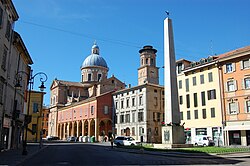
| image_caption = | | image_caption = Panorama of Reggio Emilia | ||
| image_shield = Coat of Arms of Reggio Emilia.svg | | image_shield = Coat of Arms of Reggio Emilia.svg | ||
| shield_size = 90px | | shield_size = 90px | ||
| Line 22: | Line 21: | ||
| frazioni = see [[#Frazioni|list]] | | frazioni = see [[#Frazioni|list]] | ||
| mayor_party = [[Democratic Party (Italy)|PD]] | | mayor_party = [[Democratic Party (Italy)|PD]] | ||
| mayor = | | mayor = Marco Massari | ||
| area_footnotes = | | area_footnotes = | ||
| area_total_km2 = | | area_total_km2 = 230.66 | ||
| population_footnotes = <ref> | | population_footnotes = <ref name="population">{{cite web|title=Resident population|url=https://demo.istat.it/app/?i=POS&l=en|publisher=[[Italian National Institute of Statistics|ISTAT]]}}</ref> | ||
| population_total = | | population_total = 172518 | ||
| population_as_of = | | population_as_of = 2025 | ||
| population_demonym = Reggiano | | population_demonym = Reggiano | ||
| elevation_footnotes = | | elevation_footnotes = | ||
| Line 45: | Line 43: | ||
}} | }} | ||
'''Reggio nell'Emilia'''{{efn|Pronunciation: {{IPAc-en|US|ˈ|r|ɛ|dʒ|(|i|)|oʊ|_|ˌ|n|ɛ|l|ɛ|ˈ|m|iː|l|j|ə}} | '''Reggio nell'Emilia'''{{efn|Pronunciation: {{IPAc-en|US|ˈ|r|ɛ|dʒ|(|i|)|oʊ|_|ˌ|n|ɛ|l|ɛ|ˈ|m|iː|l|j|ə}};<ref>{{Cite American Heritage Dictionary|Reggio nell'Emilia|access-date=February 9, 2019}}</ref><ref>{{Cite Merriam-Webster|Reggio|access-date=February 9, 2019}}</ref> {{IPA|it|ˈreddʒo nelleˈmiːlja; ˈrɛddʒo -|lang|It-Reggio nell'Emilia.ogg}}.}} ({{langx|egl|Rèz}}; {{langx|la|Regium Lepidi}}), usually referred to as '''Reggio Emilia''', or simply '''Reggio''' by its inhabitants, and known until [[Unification of Italy|1861]] as '''Reggio di Lombardia''',{{efn|Literally "Reggio of [[Lombardy (historical region)|Lombardy]]".}} is a city in the region of [[Emilia-Romagna]] in [[Italy]]. With a population of 172,518, it is the [[List of municipalities of Emilia-Romagna|4th-largest city in Emilia-Romagna]] and the [[List of cities in Italy|22nd-largest in Italy]]. | ||
The inhabitants of Reggio nell'Emilia are called ''Reggiani'', while the inhabitants of [[Reggio di Calabria]], in the southwest of the country, are called ''Reggini''. | The inhabitants of Reggio nell'Emilia are called ''Reggiani'', while the inhabitants of [[Reggio di Calabria]], in the southwest of the country, are called ''Reggini''. | ||
| Line 53: | Line 51: | ||
==History== | ==History== | ||
{{see also|Timeline of Reggio Emilia}} | {{see also|Timeline of Reggio Emilia}} | ||
===Ancient and early Middle Ages=== | ===Ancient and early Middle Ages=== | ||
{{ | {{unreferenced section|date=November 2022}} | ||
Reggio began as a historical site with the construction by [[Marcus Aemilius Lepidus (consul 187 BC)|Marcus Aemilius Lepidus]] of the [[Via Aemilia]], leading from [[Piacenza]] to [[Rimini]] (187 BC). Reggio became a judicial administration centre, with a [[Forum (Roman)|forum]] called at first ''Regium Lepidi'', then simply ''Regium'', whence the city's current name. | Reggio began as a historical site with the construction by [[Marcus Aemilius Lepidus (consul 187 BC)|Marcus Aemilius Lepidus]] of the [[Via Aemilia]], leading from [[Piacenza]] to [[Rimini]] (187 BC). Reggio became a judicial administration centre, with a [[Forum (Roman)|forum]] called at first ''Regium Lepidi'', then simply ''Regium'', whence the city's current name. | ||
| Line 60: | Line 59: | ||
[[Apollinaris of Ravenna]] brought [[Christianity]] in the 1st century CE. The sources confirm the presence of a [[bishop]]ric in Reggio after the [[Edict of Milan]] (313). In 440 the Reggio diocese was placed under the jurisdiction of [[Ravenna]] by [[Western Roman Empire|Western Roman Emperor]] [[Valentinianus III]]. At the end of the 4th century, however, Reggio had decayed so much that [[Ambrose|Saint Ambrose]] included it among the dilapidated cities. Further damage occurred with the Barbarian invasions. After the deposition of Romulus Augustulus in 476 Reggio was part of [[Odoacer]]'s realm. In 489 it came under Ostrogothic control; from 539 it was part of the Roman Empire (Italy), but was taken by [[Alboin]]'s [[Lombards]] in 569. Reggio was chosen as [[Duchy of Reggio]] seat. | [[Apollinaris of Ravenna]] brought [[Christianity]] in the 1st century CE. The sources confirm the presence of a [[bishop]]ric in Reggio after the [[Edict of Milan]] (313). In 440 the Reggio diocese was placed under the jurisdiction of [[Ravenna]] by [[Western Roman Empire|Western Roman Emperor]] [[Valentinianus III]]. At the end of the 4th century, however, Reggio had decayed so much that [[Ambrose|Saint Ambrose]] included it among the dilapidated cities. Further damage occurred with the Barbarian invasions. After the deposition of Romulus Augustulus in 476 Reggio was part of [[Odoacer]]'s realm. In 489 it came under Ostrogothic control; from 539 it was part of the Roman Empire (Italy), but was taken by [[Alboin]]'s [[Lombards]] in 569. Reggio was chosen as [[Duchy of Reggio]] seat. | ||
In 773, the [[Franks]] took Reggio. [[Charlemagne]] gave the bishop the authority to exercise royal authority over the city and established the diocese' limits (781). In 888, Reggio was handed over to the [[Kingdom of Italy (medieval)|Kings of Italy]]. In 899, the [[Magyars]] heavily damaged it, killing Bishop Azzo II. As a result of this, new walls were built. On 31 October 900 Emperor [[Louis III the Blind|Louis III]] gave authority for the erection of a ''castrum'' (castle) in the city's centre. | In 773, the [[Franks]] took Reggio. [[Charlemagne]] gave the bishop the authority to exercise royal authority over the city and established the diocese' limits (781). In 888, Reggio was handed over to the [[Kingdom of Italy (medieval)|Kings of Italy]]. In 899, the [[Magyars]] heavily damaged it, killing Bishop Azzo II. As a result of this, new walls were built. On 31 October 900 Emperor [[Louis III the Blind|Louis III]] gave authority for the erection of a ''castrum'' (castle) in the city's centre. | ||
| Line 66: | Line 65: | ||
===Free commune=== | ===Free commune=== | ||
{{ | {{unreferenced section|date=November 2022}} | ||
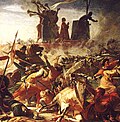
Reggio became a free [[medieval commune|commune]] around the end of the 11th or the beginning of the 12th century. In 1167 it was a member of the [[Lombard League]] and took part in the [[Battle of Legnano]]. In 1183 the city signed the [[Peace of Constance|Treaty of Konstanz]], from which the city's [[consul]], Rolando della Carità, received the imperial investiture. The subsequent peace spurred a period of prosperity: Reggio adopted new statutes, had a mint, schools with celebrated masters, and developed its trades and arts. It also increasingly subjugated the castles of the neighbouring areas. At this time the Crostolo stream was deviated westwards, to gain space for the city. The former course of the stream was turned into an avenue called Corso della Ghiara (gravel), nowadays Corso Garibaldi. | [[File:BattagliaLegnano.jpg|thumb|left|The defence of the [[Carroccio]] during the [[battle of Legnano]] (1176) by [[Amos Cassioli]] (1832–1891)]] | ||
Reggio became a free [[medieval commune|commune]] around the end of the 11th or the beginning of the 12th century. In 1167 it was a member of the [[Lombard League]] and took part in the [[Battle of Legnano]]. In 1183 the city signed the [[Peace of Constance|Treaty of Konstanz]], from which the city's [[consul]], Rolando della Carità, received the imperial investiture. The subsequent peace spurred a period of prosperity: Reggio adopted new statutes, had a [[Mint (facility)|mint]], schools with celebrated masters, and developed its trades and arts. It also increasingly subjugated the castles of the neighbouring areas. At this time the Crostolo stream was deviated westwards, to gain space for the city. The former course of the stream was turned into an avenue called {{Lang|it|Corso della Ghiara}} ('gravel course'), nowadays Corso Garibaldi. | |||
The 12th and 13th | The 12th and 13th centuries, however, were also a period of violent internal struggle between the {{Lang|it|Scopazzati}} (meaning 'swept away from the city with brooms', [[noblemen]]) and {{Lang|it|Mazzaperlini}} (meaning 'lice killers', [[plebeians]]) parties, and later those of {{Lang|it|Ruggeri}} and {{Lang|it|Malaguzzi}}, involved in a bitter domestic rivalry. In 1152 Reggio also warred with Parma and in 1225 with Modena, as part of the general struggle between the [[Guelphs and Ghibellines]]. In 1260, a hermit from Perugia led 25,000 [[penitent]]s into the city, and this event calmed the situation for a while, spurring religious fervour. But disputes soon resurfaced, and as early as 1265 the Ghibellines killed the Guelph's leader, Caco da Reggio, and gained preeminence. Arguments with the bishop continued and two new parties formed, the Inferiori and Superiori. Final victory went to the latter. | ||
To thwart the abuses of powerful families such as the Sessi, Fogliani and Canossa, the Senate of Reggio gave the city's rule for a period of three years to [[Obizzo II d'Este]]. This choice marked the future path of Reggio under the [[seignory]] of [[House of Este|the latter's family]], as Obizzo continued to rule ''de facto'' after his mandate has ceased. His son [[Azzo VIII d'Este|Azzo]] was expelled by the Reggiani in 1306, creating a republic ruled by 800 common people. In 1310 Holy Roman Emperor [[Henry VII, Holy Roman Emperor|Henry VII]] imposed Marquis [[Spinetto Malaspina]] on the city as [[Imperial vicar|vicar]], but he was soon driven out. The republic ended in 1326 when Cardinal [[Bertrando del Poggetto]] annexed Reggio to the [[Papal States]]. | |||
To thwart the abuses of powerful families such as the Sessi, Fogliani and Canossa, the Senate of Reggio gave the city's rule for a period of three years to [[Obizzo II d'Este]]. This choice marked the future path of Reggio under the seignory of [[House of Este|the latter's family]], as Obizzo continued to rule ''de facto'' after his mandate has ceased. His son [[Azzo VIII d'Este|Azzo]] was expelled by the Reggiani in 1306, creating a republic ruled by 800 common people. In 1310 | |||
The city was subsequently under the suzerainty of [[John of Bohemia]], Nicolò Fogliani and [[Mastino II della Scala]], who in 1336 gave it to [[Ludovico I Gonzaga|Luigi Gonzaga]]. Gonzaga built a citadel in the St. Nazario quarter, and destroyed 144 houses. In 1356 the | The city was subsequently under the suzerainty of [[John of Bohemia]], Nicolò Fogliani and [[Mastino II della Scala]], who in 1336 gave it to [[Ludovico I Gonzaga|Luigi Gonzaga]]. Gonzaga built a citadel in the St. Nazario quarter, and destroyed 144 houses. In 1356 the [[Visconti of Milan|Milanese Visconti]], helped by 2,000 exiled Reggiani, captured the city, starting an unsettled period of power sharing with the [[Gonzaga family]]. In the end the latter sold Reggio to the Visconti for 5,000 [[ducat]]s. In 1405 [[Ottobono Terzi]] of [[Parma]] seized Reggio, but was killed by [[Michele Attendolo]], who handed the city over to [[Nicolò III d'Este]], who therefore became seignor of Reggio. The city, however, maintained significant autonomy, with laws and coinage of its own. Nicolò was succeeded by his illegitimate son [[Lionello d'Este|Lionello]], and, from 1450, by [[Borso d'Este]]. | ||
===Duchy of Reggio=== | ===Duchy of Reggio=== | ||
{{Main | {{Main|Duchy of Reggio|Duchy of Modena and Reggio}} | ||
{{ | {{unreferenced section|date=November 2022}} | ||
In 1452, Borso was awarded the title | In 1452, Borso was awarded the title of [[Duke of Modena and Reggio]] by [[Frederick III, Holy Roman Emperor|Frederick III]]. Borso's successor, [[Ercole I d'Este|Ercole I]], imposed heavy levies on the city and appointed the poet [[Matteo Maria Boiardo]], born in the nearby town of [[Scandiano]], as its governor. Later another famous Italian writer, [[Francesco Guicciardini]], held the same position. In 1474, [[Ludovico Ariosto]], author of ''[[Orlando Furioso]]'', was born in the Malaguzzi palace, near the site of the 21st-century town hall. He was the first son of a knight from [[Ferrara]], who was in charge of the citadel, and a noblewoman from Reggio, Daria Maleguzzi Valeri. As a grown man he would be sent to Reggio as governor on behalf of the [[Duchy of Ferrara|dukes of Ferrara]], and would spend time in a villa outside the town ({{Lang|it|Il Mauriziano}}) that still stands. | ||
In 1513, Reggio was handed over to [[Pope Julius II]]. The city was returned to the Este after the death of [[ | In 1513, Reggio was handed over to [[Pope Julius II]]. The city was returned to the [[House of Este]] after the death of [[Hadrian VI]] on 29 September 1523. In 1551 [[Ercole II d'Este]] destroyed the suburbs of the city in his program of reconstruction of the walls. At the end of the century work on the city's famous [[Basilica della Ghiara]] began, on the site where a miracle was believed to have occurred. The Este rule continued until 1796, with short interruptions in 1702 and 1733–1734. | ||
===Napoleonic age and restoration=== | ===Napoleonic age and restoration=== | ||
{{ | {{unreferenced section|date=November 2022}} | ||
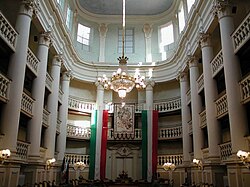
[[File:Sala tricolore reggio.jpg|left|thumb|The | [[File:Sala tricolore reggio.jpg|left|thumb|The ''Tricolore's Room'', in the Town Hall, is where for the first time the Italian flag's three colours were adopted]] | ||
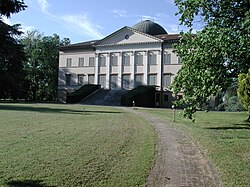
[[File:Reggio emilia coviolo villa levi 2.jpg|thumb|[[Villa Levi, Coviolo|Villa Levi]] | [[File:Reggio emilia coviolo villa levi 2.jpg|thumb|[[Villa Levi, Coviolo|Villa Levi]], now belonging to the Department of Animal Sciences of the [[University of Bologna]]]] | ||
The arrival of the [[French First Republic|republican French]] troops was greeted with enthusiasm in the city. On 21 August 1796, the ducal garrison of 600 men was driven off, and the Senate claimed the rule of Reggio and its duchy. On 26 September, the Provisional Government's volunteers pushed back an [[Austria]]n column, in the Battle of [[Montechiarugolo]]. Though minor, this clash is considered the first one of the Italian [[Risorgimento]]. [[Napoleon]] himself awarded the Reggiani with 500 rifles and 4 guns. Later he occupied [[Emilia (region of Italy)|Emilia]] and formed a new province, the [[Cispadane Republic]], whose existence was proclaimed in Reggio on 7 January 1797. The [[Italian national flag]], named {{Lang|it|Il Tricolore}} ('the tricolour'), was sewn on that occasion by Reggio women. In this period of patriotic fervour, [[Jozef Wybicki]], a lieutenant in the Polish troops of General [[Jan Henryk Dąbrowski]], an ally of Napoleon, composed in Reggio the ''[[Mazurek Dąbrowskiego]]'', which in 1927 became the Polish national anthem. | |||
The arrival of the [[French First Republic|republican]] | |||
The 1815 [[Treaty of Vienna (1815)|Treaty of Vienna]] returned Reggio to [[Francis IV, Duke of Modena|Francis IV]] of Austria-Este, but in 1831 Modena rose up against him, and Reggio followed its example organizing a corps under the command of General [[Carlo Zucchi]]. However, on 9 March, the Duke conquered the city with his escort of Austrian soldiers. | The 1815 [[Treaty of Vienna (1815)|Treaty of Vienna]] returned Reggio to [[Francis IV, Duke of Modena|Francis IV]] of Austria-Este, but in 1831 Modena rose up against him, and Reggio followed its example organizing a corps under the command of General [[Carlo Zucchi (general)|Carlo Zucchi]]. However, on 9 March, the Duke conquered the city with his escort of Austrian soldiers. | ||
In 1848, Duke [[Francis V d'Este|Francis V]] left his | In 1848, Duke [[Francis V d'Este|Francis V]] left his estate fearing a revolution and Reggio proclaimed its union with [[Piedmont]]. The latter's defeat at the [[Battle of Novara (1849)|Battle of Novara]] brought the city back under Este control. In 1859 Reggio, under [[dictator]] [[Luigi Carlo Farini]], became part of united [[Italy]] and, with the plebiscite of 10 March 1860, definitively entered the new unified kingdom. | ||
===Contemporary history=== | ===Contemporary history=== | ||
{{ | {{unreferenced section|date=November 2022}} | ||
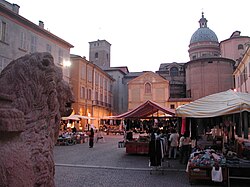
Reggio then went through a period of economic and population growth from 1873 to the destruction of the ancient walls. In 1911, it had 70,000 inhabitants. A strong [[socialist]] tradition grew. On 7 July, the city hosted the 13th National Congress of the [[Italian Socialist Party]]. On 26 July 1943, the fascist | [[File:Reggio emilia piazza san prospero sera.jpg|thumb|Piazza San Prospero seen from the patron saint's basilica]] | ||
Reggio then went through a period of economic and population growth from 1873 to the destruction of the ancient walls. In 1911, it had 70,000 inhabitants. A strong [[socialist]] tradition grew. On 7 July, the city hosted the 13th National Congress of the [[Italian Socialist Party]]. On 26 July 1943, the fascist regime's fall was cheered with enthusiasm by the Reggiani. Numerous [[Italian resistance movement|partisan]] bands were formed in the city and surrounding countryside. | |||
On 27 April 2023 the | On 27 April 2023 the city was declared a European Capital of Inclusion and Diversity by the European Commission.<ref>{{Cite web |date=2023-04-26 |title=EU Diversity Month kicks off with the winners of the 2023 European Capitals of Inclusion and Diversity Awards |url=https://ec.europa.eu/commission/presscorner/detail/en/ip_23_2469 |access-date= |website=[[European Commission]]}}</ref> | ||
===Jewish history=== | ===Jewish history=== | ||
Jews began arriving to Reggio in the early 15th century. Many Jews were [[Sephardim]] from [[Spain]], Portugal and other parts of | Jews began arriving to Reggio in the early 15th century. Many Jews were [[Sephardim]] from [[Spain]], Portugal and other parts of Italy. Nearly all were fleeing religious persecution. The Jewish community was prosperous and enjoyed considerable growth for the next several hundred years. The [[Synagogue of Reggio Emilia]] was relocated in 1672 into the ghetto, and rebuilt in 1858.<ref>{{Cite web|url=https://dbs.bh.org.il/place/reggio-emilia|title=Community of Reggio Emilia|website=Beit Hatfutsot Open Databases Project, The Museum of the Jewish People at Beit Hatfutsot|access-date=2019-07-30|archive-date=2019-07-30|archive-url=https://web.archive.org/web/20190730101844/https://dbs.bh.org.il/place/reggio-emilia|url-status=dead}}</ref> | ||
After the Napoleonic era the Jews of Reggio gained emancipation and began to migrate to other parts of Europe looking for greater economic and social freedom. Thus, the Jewish community in Reggio began to lower. The German occupation during [[World War II]] and the [[Holocaust]] hastened the decline. Today, only one Jew remains in Reggio Emilia. <ref>{{cite web |last1=Nicolò |first1=Vasc |title=Gli ebrei reggiani dal 1945 a oggi |url=https://www.reggioebraica.it/1945-oggi/ |website=reggioebraica.it |publisher=Reggio Ebraica}}</ref> The Jewish Community of Reggio Emilia was merged with Modena's. However, an unused synagogue and burial ground still exist. In 2016 the City Council posed some small street plates in front of the houses of the deported Jews to preserve their remembrance.<ref>{{Cite web|url=https://gazzettadireggio.gelocal.it/reggio/cronaca/2014/12/02/news/dieci-pietre-per-gli-ebrei-reggiani-morti-ad-auschwitz-1.10420946|title=Dieci "pietre" per gli ebrei reggiani morti ad Auschwitz|website=Gazzetta di Reggio}}</ref> | After the Napoleonic era the Jews of Reggio gained [[emancipation]] and began to migrate to other parts of Europe looking for greater economic and social freedom. Thus, the Jewish community in Reggio began to lower. The German occupation during [[World War II]] and the [[Holocaust]] hastened the decline. Today, only one Jew remains in Reggio Emilia.<ref>{{cite web |last1=Nicolò |first1=Vasc |title=Gli ebrei reggiani dal 1945 a oggi |url=https://www.reggioebraica.it/1945-oggi/ |website=reggioebraica.it |publisher=Reggio Ebraica}}</ref> The Jewish Community of Reggio Emilia was merged with Modena's. However, an unused synagogue and burial ground still exist. In 2016 the City Council posed some small street plates in front of the houses of the deported Jews to preserve their remembrance.<ref>{{Cite web|url=https://gazzettadireggio.gelocal.it/reggio/cronaca/2014/12/02/news/dieci-pietre-per-gli-ebrei-reggiani-morti-ad-auschwitz-1.10420946|title=Dieci "pietre" per gli ebrei reggiani morti ad Auschwitz|date=December 2, 2014|website=Gazzetta di Reggio}}</ref> | ||
Many notable rabbinic scholars have resided in Reggio. These include Isaac Foa, Immanuel Sonino, Obadiah ben Israel Sforno, Nathan ben Reuben David Spira, Menahem Azariah Fano, Baruch Abraham ben Elhanan David Foa, Hezekiah ben Isaac Foa, Isaac ben Vardama Foa, Israel Nissim Foa, Israel Solomon Longhi, Isaiah Mordecai ben Israel Hezekiah Bassani, Israel Benjamin ben Isaiah Bassani, Elhanan David Carmi, Benjamin ben Eliezer ha-Kohen, Joshua ben Raphael Fermi, Moses Benjamin Foa, Abram Michael Fontanella, Judah Ḥayyim Fontanella, Israel Berechiah Fontanella, Raphael Jehiel Sanguinetti, Isaac Samson d'Angeli, R. J. Bolognese, Hananiah Elhanan Ḥai ha-Kohen, Jacob Levi, Moses Benjamin Levi, Israel Berechiah Sanguinetti, David Jacob Maroni, Giuseppe Lattes, Alessandro da Fano, Lazzaro Laide Tedesco, and Shimshon Chaim Nachmani.<ref>{{cite web|url=https://www.jewishvirtuallibrary.org/jsource/judaica/ejud_0002_0017_0_16572.html |title=Reggio Emilia |publisher=Jewishvirtuallibrary.org |access-date=2011-04-05}}</ref> | Many notable rabbinic scholars have resided in Reggio. These include Isaac Foa, Immanuel Sonino, Obadiah ben Israel Sforno, Nathan ben Reuben David Spira, Menahem Azariah Fano, Baruch Abraham ben Elhanan David Foa, Hezekiah ben Isaac Foa, Isaac ben Vardama Foa, Israel Nissim Foa, Israel Solomon Longhi, Isaiah Mordecai ben Israel Hezekiah Bassani, Israel Benjamin ben Isaiah Bassani, Elhanan David Carmi, Benjamin ben Eliezer ha-Kohen, Joshua ben Raphael Fermi, Moses Benjamin Foa, Abram Michael Fontanella, Judah Ḥayyim Fontanella, Israel Berechiah Fontanella, Raphael Jehiel Sanguinetti, Isaac Samson d'Angeli, R. J. Bolognese, Hananiah Elhanan Ḥai ha-Kohen, Jacob Levi, Moses Benjamin Levi, Israel Berechiah Sanguinetti, David Jacob Maroni, Giuseppe Lattes, Alessandro da Fano, Lazzaro Laide Tedesco, and Shimshon Chaim Nachmani.<ref>{{cite web|url=https://www.jewishvirtuallibrary.org/jsource/judaica/ejud_0002_0017_0_16572.html |title=Reggio Emilia |publisher=Jewishvirtuallibrary.org |access-date=2011-04-05}}</ref><ref>{{cite web|url=http://www.jewishencyclopedia.com/view.jsp?artid=177&letter=R |title=Reggio |publisher=JewishEncyclopedia.com |access-date=2011-04-05}}</ref><ref>{{cite web|url=https://www.zerashimshon.co.il/en/home/|title=About the Author |date=24 September 2017 }}</ref> | ||
<ref>{{cite web|url=http://www.jewishencyclopedia.com/view.jsp?artid=177&letter=R |title=Reggio |publisher=JewishEncyclopedia.com |access-date=2011-04-05}}</ref><ref>{{cite web|url=https://www.zerashimshon.co.il/en/home/|title=About the Author }}</ref> | |||
==Climate== | ==Climate== | ||
The climate in Reggio Emilia is [[Temperate continental climate|temperate continental]], with hot rather moist summers (the temperatures can sometimes rise above 35 °C) (95 °F) and fairly frigid winters with frequent frosts (the temperatures can go below -10 °C) (14 °F).<ref>{{Cite web|url=https://www.arpae.it/sim/pagine/osservazioni_e_dati/climatologia/tabella.php?periodo=trent&variabile=temperature&stazione=08253|title=Arpa Servizio IdroMeteo|access-date=2017-02-14|archive-date=2017-02-15|archive-url=https://web.archive.org/web/20170215033234/https://www.arpae.it/sim/pagine/osservazioni_e_dati/climatologia/tabella.php?periodo=trent&variabile=temperature&stazione=08253|url-status=dead}}</ref> Precipitations are evenly distributed all year long, but October, November and April are the most rainy months, while July and January are the most arid.<ref>{{Cite web|url=https://www.arpae.it/sim/pagine/osservazioni_e_dati/climatologia/tabella.php?periodo=trent&variabile=piogge&stazione=08253|title=Arpa Servizio IdroMeteo|access-date=2017-02-14|archive-date=2017-02-15|archive-url=https://web.archive.org/web/20170215032932/https://www.arpae.it/sim/pagine/osservazioni_e_dati/climatologia/tabella.php?periodo=trent&variabile=piogge&stazione=08253|url-status=dead}}</ref><ref>{{Cite web|url=https://www.arpae.it/sim/pagine/osservazioni_e_dati/climatologia/tabella.php?periodo=quind&variabile=piogge&stazione=08253|title=Arpa Servizio IdroMeteo|access-date=2017-02-14|archive-date=2017-02-15|archive-url=https://web.archive.org/web/20170215032828/https://www.arpae.it/sim/pagine/osservazioni_e_dati/climatologia/tabella.php?periodo=quind&variabile=piogge&stazione=08253|url-status=dead}}</ref> In the city snow rarely accumulates, even though it snows almost every year, due to the rather high temperatures. | |||
During autumn and winter it is very common, especially in the areas outside the city, to encounter very thick fog, although it is less frequent than in the past. Other meteorological phenomena that can be expected in the area are rain, [[freezing rain]] during winter, and [[hail]] during summer and rarely in the spring. | |||
The area is not particularly windy and there are often days of total calm, especially during the [[anticyclonic]] phases in winter, while spring is more windy.<ref>{{cite web|title=Atlante Eolico|url=http://atlanteeolico.rse-web.it/}}</ref> The most intense winds are the ones blowing from northeast ([[Bora (wind)|Bora]]) or from southwest ([[Libeccio]]). The latter, during its descent from the [[Northern Apennines]], sometimes tends to become a downslope wind and thus is very dry and hot. Rarely, [[Foehn wind]] from the Alps can reach Reggio Emilia from the northwest. In the city, the average annual high temperature is {{convert|18|°C|0}}, the annual low temperature is {{convert|9|°C|0}}, and the annual precipitation is {{convert|700|mm|2|abbr=off|lk=out}}. | |||
{{Weather box|width=auto | |||
|metric first = y | |||
|single line = y | |||
|collapsed = Y | |||
|location = Reggio Emilia (1991–2020) | |||
|Jan high C = 7.6 | |||
|Feb high C = 10.5 | |||
|Mar high C = 16.1 | |||
|Apr high C = 20.1 | |||
|May high C = 25.1 | |||
|Jun high C = 29.7 | |||
|Jul high C = 32.3 | |||
|Aug high C = 32.0 | |||
|Sep high C = 26.2 | |||
|Oct high C = 19.3 | |||
|Nov high C = 12.5 | |||
|Dec high C = 7.9 | |||
| year high C = | |||
|Jan mean C = 4.3 | |||
|Feb mean C = 6.3 | |||
|Mar mean C = 11.0 | |||
|Apr mean C = 14.8 | |||
|May mean C = 19.5 | |||
|Jun mean C = 23.9 | |||
|Jul mean C = 26.1 | |||
|Aug mean C = 26.2 | |||
|Sep mean C = 21.1 | |||
|Oct mean C = 15.3 | |||
|Nov mean C = 9.3 | |||
|Dec mean C = 4.5 | |||
| year mean C = | |||
|Jan low C = 1.1 | |||
|Feb low C = 2.2 | |||
|Mar low C = 5.9 | |||
|Apr low C = 9.5 | |||
|May low C = 13.9 | |||
|Jun low C = 18.1 | |||
|Jul low C = 20.3 | |||
|Aug low C = 20.2 | |||
|Sep low C = 15.9 | |||
|Oct low C = 11.5 | |||
|Nov low C = 6.6 | |||
|Dec low C = 1.9 | |||
| year low C = | |||
|precipitation colour = green | |||
|Jan precipitation mm = 35.9 | |||
|Feb precipitation mm = 49.5 | |||
|Mar precipitation mm = 50.5 | |||
|Apr precipitation mm = 72.8 | |||
|May precipitation mm = 66.7 | |||
|Jun precipitation mm = 65.6 | |||
|Jul precipitation mm = 35.8 | |||
|Aug precipitation mm = 35.9 | |||
|Sep precipitation mm = 62.0 | |||
|Oct precipitation mm = 82.6 | |||
|Nov precipitation mm = 93.5 | |||
|Dec precipitation mm = 55.0 | |||
|year precipitation mm = | |||
|unit precipitation days = 1.0 mm | |||
| Jan precipitation days = 5 | |||
| Feb precipitation days = 6 | |||
| Mar precipitation days = 6 | |||
| Apr precipitation days = 8 | |||
| May precipitation days = 6 | |||
| Jun precipitation days = 6 | |||
| Jul precipitation days = 3 | |||
| Aug precipitation days = 5 | |||
| Sep precipitation days = 6 | |||
| Oct precipitation days = 8 | |||
| Nov precipitation days = 8 | |||
| Dec precipitation days = 6 | |||
| year precipitation days = | |||
| source 1 = Arpae Emilia-Romagna<ref name=Clim>{{cite web | |||
| url = https://www.arpae.it/it/temi-ambientali/clima/dati-e-indicatori/tabelle-climatiche/tabelle-climatologiche-1961-2020 | |||
| title = Tabelle climatologiche | |||
| publisher= Arpae Emilia-Romagna agenzia prevenzione ambiente energia | |||
| access-date = 30 June 2024}}</ref> | |||
| source 2 = Climi e viaggi (precipitation days)<ref name=ISPRAClim>{{cite web | |||
| url = https://www.climieviaggi.it/clima/italia/reggio-emilia | |||
| title = Clima - Reggio Emilia (Emilia Romagna) | |||
| publisher= Climi e viaggi | |||
| access-date = 27 November 2024}}</ref> | |||
}} | |||
{{ | == Demographics == | ||
| | {{Historical populations|1861|46856|1871|50955|1881|50759|1901|58993|1911|70955|1921|82011|1931|89605|1936|93913|1951|106726|1961|116445|1971|128789|1981|130376|1991|132030|2001|141877|2011|162082|2021|169908|cols=1|align=right|source=[[National Institute of Statistics (Italy)|ISTAT]]<ref>{{cite web |title=Popolazione residente dei comuni. Censimenti dal 1861 al 1991|trans-title=Resident population of the municipalities. Censuses from 1861 to 1991|url=https://ebiblio.istat.it/digibib/Censimenti%20popolazione/Censimentipopolazioneresidentedal1861/RML0050288Pop_res_cens_1861_1991.pdf|lang=it|publisher=[[National Institute of Statistics (Italy)|ISTAT]]}}</ref><ref name="timeseries">{{cite web |title=Dashboard Permanent census of population and housing|url=https://esploradati.censimentopopolazione.istat.it/databrowser/#/en/censtest/dashboards|publisher=[[National Institute of Statistics (Italy)|ISTAT]]}}</ref>}} | ||
| | As of 2025, Reggio Emilia has a population of 172,518, of whom 49.7% are male and 50.3% are female. Minors make up 15.7% of the population, and seniors make up 21.7%, compared to the Italian average of 14.9% and 24.7% respectively.<ref name="population" /> | ||
| | |||
| | |||
| | As of 2024, the foreign-born population is 33,301, equal to 19.5% of the population. The 5 largest foreign nationalities are [[Albanians]] (3,706), [[Moroccans]] (2,778), [[Ukrainians]] (2,475), [[Egyptians]] (2,273) and [[Moldovans]] (2,170).<ref name="foreignborn">{{cite web |title=Resident population by sex, municipality and citizenship |url=https://demo.istat.it/app/?i=RCS&a=2024&l=en |publisher=[[Italian National Institute of Statistics|ISTAT]]}}</ref> | ||
| | {| class="wikitable floatright" | ||
| | |+Foreign population by country of birth (2024)<ref name="foreignborn" /> | ||
| | !Country | ||
| | !Population | ||
| | |- | ||
| | |{{flag|Albania}} | ||
| | |3,706 | ||
| | |- | ||
| | |{{flag|Morocco}} | ||
| | |2,778 | ||
| | |- | ||
| | |{{flag|Ukraine}} | ||
|2,475 | |||
|- | |||
|{{flag|Egypt}} | |||
|2,273 | |||
|- | |||
|{{flag|Moldova}} | |||
|2,170 | |||
|- | |||
|{{flag|China}} | |||
|2,111 | |||
|- | |||
|{{flag|Nigeria}} | |||
|1,677 | |||
|- | |||
|{{flag|Romania}} | |||
|1,590 | |||
|- | |||
|{{flag|Ghana}} | |||
|1,488 | |||
|- | |||
|{{flag|Tunisia}} | |||
|1,206 | |||
|- | |||
|{{flag|Georgia}} | |||
|1,089 | |||
|- | |||
|{{flag|Pakistan}} | |||
|738 | |||
|- | |||
|{{flag|Sri Lanka}} | |||
|581 | |||
|- | |||
|{{flag|Senegal}} | |||
|567 | |||
|- | |||
|{{flag|Brazil}} | |||
|545 | |||
|} | |||
==Administration== | |||
{{See also|List of mayors of Reggio Emilia}} | |||
| | |||
===''Frazioni'' (hamlets)=== | |||
* Bagno | |||
* Cadè | |||
* Canali | |||
* Cavazzoli | |||
* Castellazzo | |||
* Cella | |||
* Codemondo | |||
* Corticella | |||
* Coviolo | |||
* Fogliano | |||
* Gaida | |||
* Gavassa | |||
* Gavasseto | |||
* Mancasale | |||
* Marmirolo | |||
* Masone | |||
* Massenzatico | |||
* Ospizio | |||
* Pieve Modolena | |||
* Pratofontana | |||
* Rivalta | |||
* Roncadella | |||
* Roncocesi | |||
* Sabbione | |||
* San Bartolomeo | |||
* San Maurizio | |||
* San Pellegrino | |||
* San Prospero Strinati | |||
* Sesso | |||
===Boroughs=== | |||
* Acque Chiare | |||
* Baragalla | |||
* Buco del Signore | |||
* Canalina | |||
* Centro Storico (Historical Centre) | |||
* Lungocrostolo | |||
* Mirabello | |||
* Ospedale (Hospital) | |||
* Ospizio | |||
* Quartier Giardino | |||
* Rosta Nuova | |||
* Stazione (Railway station) | |||
== | ==Education== | ||
{{main | {{main|Reggio Emilia approach}} | ||
The Reggio Emilia approach to preschool education was started by the schools of Reggio Emilia after World War II and is well known around the world. It is based and inspired on theories of Malaguzzi, Bruner, Vygotsky, Dewey, Piaget and Gardner. Reggio Emilia holds the [[Reggio Children - Loris Malaguzzi Centre Foundation|Loris Malaguzzi International Centre]], a modern structure where the | The Reggio Emilia approach to preschool education was started by the schools of Reggio Emilia after World War II and is well-known around the world. It is based and inspired on theories of Malaguzzi, Bruner, Vygotsky, Dewey, Piaget and Gardner. Reggio Emilia holds the [[Reggio Children - Loris Malaguzzi Centre Foundation|Loris Malaguzzi International Centre]], a modern structure where the Reggio Emilia approach is implemented, exported and spread around the world.<ref>[http://www.reggioemiliaapproach.net/about.php Accessed 10 July 2011.] {{webarchive |url=https://web.archive.org/web/20120225174447/http://www.reggioemiliaapproach.net/about.php |date=February 25, 2012 }}</ref> | ||
==Economy== | ==Economy== | ||
The economy of the province of Reggio Emilia was for a long time based on agriculture. One typical product, known worldwide and imitated, is [[Parmigiano-Reggiano]] cheese. Another is [[Lambrusco]] wine. Reggio Emilia | The economy of the province of Reggio Emilia was for a long time based on agriculture. One typical product, known worldwide and imitated, is [[Parmigiano-Reggiano]] cheese. Another is [[Lambrusco]] wine. Reggio Emilia also produces [[balsamic vinegar]],<ref>{{cite web|url=http://www.italiaregina.it/balsamic-vinegar |title=Balsamic Vinegar |publisher=Italiaregina.it |access-date=2016-02-05}}</ref> a condiment for salad but also cheese, strawberries and many other dishes. In the twentieth century the city and its territory also saw a rapid development of small and medium industries, particularly in the sector of agricultural machinery. For more than 100 years, there has been a strong tradition that supported the development of consumers' cooperatives, as well as building and banking cooperatives. New developments in mechanics and information technology are at the origin of some new companies operating in [[mechatronics]]. Another well-established sector is the ceramic tile industry, mainly concentrated in the districts of [[Scandiano]] and [[Casalgrande]]. | ||
In the twentieth century | |||
Other leading sectors include: electronics ( | Other leading sectors include: electronics (Cellular Line, [[Phonocar]], [[RCF audio]]); finance ([[Credito Emiliano]]); Iris Ceramica; fashion ([[Marina Rinaldi]], [[Max Mara]]); food ([[NewPrinces|NewPrinces S.p.A.]]); machinery ([[ARGO SpA]], [[Emak]], [[Interpump Group]], [[Landi Renzo]], [[Lombardini S.r.l.]]; [[Preston & Barbieri]], [[Smeg (appliances)|Smeg]]); and utilities ({{ill|Iren Group|lt=Iren|it|Iren}}). | ||
Industrial growth has attracted immigration from North and Central Africa, East Europe, and Far East (China, Pakistan, India). The immigration rate in the province is about 25%. Research indicates that Reggio Emilia ranks very high in quality of life among Italian provinces.<ref>{{cite web |title=Qualità della vita 2008 |trans-title=Quality of life 2008 |url=http://www.ilsole24ore.com/speciali/qv_2008/qv_2008_province/qv_2008_province_settori_classifica_finale.shtml |url-status=dead |archive-url=https://web.archive.org/web/20180828035526/http://www.ilsole24ore.com/speciali/qv_2008/qv_2008_province/qv_2008_province_settori_classifica_finale.shtml?refresh_ce=1 |archive-date=2018-08-28 |publisher=[[Il Sole 24 Ore]] |language=it}}</ref> | |||
==Transport== | ==Transport== | ||
[[Reggio Emilia railway station]], opened in 1859, forms part of the [[Milan–Bologna railway]]. It is also a terminus of three secondary railways, linking Reggio Emilia with [[Ciano d'Enza]], [[Guastalla]] and [[Sassuolo]], respectively. The station is situated at Piazza [[Guglielmo Marconi]], at the eastern edge of the city centre. | |||
The other major railway station, [[Reggio Emilia AV Mediopadana railway station|Reggio Emilia AV Mediopadana]], is on the [[Milan–Bologna high-speed railway]] (there is also a connection with Reggio Emilia-Guastalla railway). It is located at the Mancasale locality, approximately {{convert|4|km|abbr=off}} north from the city centre. | |||
[[Reggio Emilia | Along with this, there is a plan to construct a [[tram]] in the city.<ref name=":0">{{Cite web |title=Un tram attraverserà Reggio Emilia: ecco il progetto. VIDEO Reggionline -Telereggio – Ultime notizie Reggio Emilia {{!}} |url=https://www.reggionline.com/un-tram-attraversera-reggio-emilia-progetto/ |access-date=2023-12-31 |website=www.reggionline.com}}</ref> The tram will run from the [[Mancasale Industrial zone]] in the north to Rivalta in the south, stopping at the [[Reggio Emilia AV Mediopadana railway station]], Reggio Emilia railway station and other neighborhoods.<ref name=":0" /> The tram system has undergone a feasibility study,<ref>{{Cite web |title=Tram Reggio Emilia |url=https://www.go-mobility.it/portfolio/tram-reggio-emilia/ |access-date=2023-12-31 |website=GO-Mobility |language=it-IT}}</ref> and is set to open in 2026.<ref>{{Cite web|date=2023-12-20 |title=Reggio Emilia looks forward to getting its first tramway line {{!}} TheMayor.EU |url=https://www.themayor.eu/en/a/view/reggio-emilia-looks-forward-to-getting-its-first-tramway-line-7110 |access-date=2023-12-31 |website=www.themayor.eu |language=en}}</ref> | ||
The | The nearest airport is served by [[Bologna Guglielmo Marconi Airport]] which is located approximately 68 km from Reggio Emilia. | ||
==Sports== | ==Sports== | ||
Reggio Emilia is home to various professional sports clubs and arenas: | Reggio Emilia is home to various professional sports clubs and arenas: | ||
*[[Pallacanestro Reggiana]], which competes in | |||
*[[A.C. Reggiana 1919]], which competes in [[Serie | *[[Pallacanestro Reggiana]], which competes in [[Lega Basket Serie A]] and has won 1 Italian Supercup and 1 Eurochallenge. | ||
*[[ | *[[A.C. Reggiana 1919]], a football team which competes in [[Serie B]]. | ||
*[[Volley Tricolore]], playing in Serie | *[[Valorugby Emilia]], playing in [[Top10 (rugby union)|Serie A Elite]] (top Italian [[Rugby union|rugby]] division). | ||
* [[ | *[[Volley Tricolore]], playing in Serie A3. | ||
* Olimpia Regium, playing in [[futsal]] Serie A2. | |||
The main sports venues in the city are: | The main sports venues in the city are: | ||
*[[Mapei Stadium - Città del Tricolore|Stadio Città del Tricolore]] (23,717 capacity), located near the A1 highway and home to Reggiana and [[U.S. Sassuolo]] home games. | |||
*[[PalaBigi]] (4,500 capacity), located in city centre. | *[[Mapei Stadium - Città del Tricolore|Stadio Città del Tricolore]] (23,717 capacity), located near the A1 highway and home to Reggiana and [[U.S. Sassuolo]] home games. | ||
*[[Stadio Mirabello]] (4,500 capacity), located in the city centre. | *[[PalaBigi]] (4,500 capacity), located in city centre. | ||
*Palasport Fanticini, located in the Tribunal hub. | *[[Stadio Mirabello]] (4,500 capacity), located in the city centre. | ||
*Palasport Fanticini, located in the Tribunal hub. | |||
*Stadio Canalina, located in the Canalina borough. | *Stadio Canalina, located in the Canalina borough. | ||
| Line 229: | Line 341: | ||
===Religious buildings=== | ===Religious buildings=== | ||
[[File:Tempio della Beata Vergine della Ghiara.JPG|thumb | [[File:Tempio della Beata Vergine della Ghiara.JPG|thumb|Tempio della Beata Vergine della Ghiara]] | ||
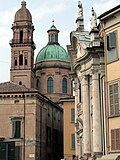
[[File:San giorgio torre cupola reggio emilia.jpg|thumb|The Baroque church of San Giorgio]] | |||
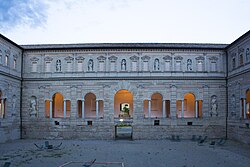
[[File:CHIOSTRI_SAN_PIETRO_RE.JPG|thumb|Greater cloister of San Pietro]] | |||
*''[[Basilica della Ghiara]]'': Main church of the city; begun in 1597, and completed in [[Baroque architecture|Baroque]] style. | *''[[Basilica della Ghiara]]'': Main church of the city; begun in 1597, and completed in [[Baroque architecture|Baroque]] style. | ||
*''[[San Prospero, Reggio Emilia|Basilica di San Prospero]]'': Built in the 10th century and dedicated to [[Prosper of Reggio]], a bishop of the city, it was rebuilt by | *''[[San Prospero, Reggio Emilia|Basilica di San Prospero]]'': Built in the 10th century and dedicated to [[Prosper of Reggio]], a bishop of the city, it was rebuilt by Luca Corti and Matteo Fiorentini between 1514 and 1523. The façade, with eleven statues of saints and patrones, was redesigned by Giovan Battista Cattani in the mid-18th century. It includes a pleasant belfry/tower, begun in 1535 and never quite finished, with an octagonal plant. The interior of the church has a Latin cross plant, with three naves. The apse houses the splendid [[fresco]] ''Last Judgement'', by the [[Bologna|Bolognese]] artist [[Camillo Procaccini]]. Also noteworthy are the wooden choir from 1546 and the ''Assumption'' altarpiece by [[Tommaso Laureti]] and [[Ludovico Carracci]] (1602). | ||
*''[[Cathedral of Reggio Emilia|Cathedral]]'': Built in 9th through 12th centuries. It was rebuilt in the second half of the 16th century. It has three naves with works by [[Guercino]], [[Palma the Younger]], [[Prospero Spani]] and [[Alessandro Tiarini]]. | *''[[Cathedral of Reggio Emilia|Cathedral]]'': Built in 9th through 12th centuries. It was rebuilt in the second half of the 16th century. It has three naves with works by [[Guercino]], [[Palma the Younger]], [[Prospero Spani]] and [[Alessandro Tiarini]]. | ||
*''Baptistery of Saint John the Baptist''. | *''Baptistery of Saint John the Baptist''. | ||
*''[[Sant'Agostino, Reggio Emilia|Sant'Agostino]]'': church once dedicated to [[Apollinaris of Ravenna|Saint Apollinaris]], its dedication was changed to [[St Augustine]] in 1268 when it was rebuilt, along with the annexed convent, by the Augustinian friars. It was restored in 1452, when the tower was also erected. The current interior dates from 1645 to 1666, while the façade (1746) was designed by [[Alfonso Torreggiani]] and built by | *''[[Sant'Agostino, Reggio Emilia|Sant'Agostino]]'': church once dedicated to [[Apollinaris of Ravenna|Saint Apollinaris]], its dedication was changed to [[St Augustine]] in 1268 when it was rebuilt, along with the annexed convent, by the Augustinian friars. It was restored in 1452, when the tower was also erected. The current interior dates from 1645 to 1666, while the façade (1746) was designed by [[Alfonso Torreggiani]] and built by Giovan Battista Cattani. Its restored theatre hosted [[Model European Parliament]] sessions in 2015. | ||
*The small [[Baroque]] Christ's Oratory. | *The small [[Baroque]] Christ's Oratory. | ||
*''[[San Girolamo, Reggio Emilia|San Girolamo e Vitale]]'': church mentioned in document in 857 and rebuilt in 1646 by | *''[[San Girolamo, Reggio Emilia|San Girolamo e Vitale]]'': church mentioned in document in 857 and rebuilt in 1646 by Gaspare Vigarani. It consists of three separate churches in the same building, two above ground and one underground; the crypt church houses a replica of the Holy Sepulcher in Jerusalem. | ||
*''[[San Francesco, Reggio Emilia|San Francesco]]'': church. | *''[[San Francesco, Reggio Emilia|San Francesco]]'': church. | ||
*''[[San Giorgio, Reggio Emilia|San Giorgio]]'': Baroque church with cupola (1746) designed by [[Alfonso Torreggiani]]. | *''[[San Giorgio, Reggio Emilia|San Giorgio]]'': Baroque church with cupola (1746) designed by [[Alfonso Torreggiani]]. | ||
*''[[San Giovannino, Reggio Emilia|San Giovannino]]'': (1545) church houses Baroque frescoes (1613) by [[Sisto Badalocchio]], [[Lorenzo Franchi]], [[Tommaso Sandrini]], [[Paolo Guidotti]] and paintings by Tiarini. | *''[[San Giovannino, Reggio Emilia|San Giovannino]]'': (1545) church houses Baroque frescoes (1613) by [[Sisto Badalocchio]], [[Lorenzo Franchi]], [[Tommaso Sandrini]], [[Paolo Guidotti]] and paintings by Tiarini. | ||
*''[[ | *''[[San Pietro, Reggio Emilia|Chiesa di San Pietro]]'' (1586): church designed by Giulio della Torre; cupola erected in 1625, façade in 1782, while the [[cloisters]] in the 16th century (the small cloister by Bartolomeo Spani in 1520, the works in the main cloister ended in 1580). The interior is in a Latin cross shape with a single nave. It houses notable Baroque paintings by [[Alessandro Tiarini]], [[Pietro Desani]], [[Luca Ferrari|Luca da Reggio]], [[Camillo Gavasetti]] and [[Paolo Emilio Besenzi]]. | ||
*''San Filippo Neri'': [[Baroque]] church dedicated to St Philip Neri. | *''San Filippo Neri'': [[Baroque]] church dedicated to St Philip Neri. | ||
*''[[Oratory of San Spiridione|San Spiridione]] Oratory'' | *''[[Oratory of San Spiridione|San Spiridione]] Oratory'' | ||
*''[[San Stefano, Reggio Emilia|San Stefano]]'': church first mentioned when its site was outside the city walls, as a [[Knights Templar|Templar]]s' church. | *''[[San Stefano, Reggio Emilia|San Stefano]]'': church first mentioned when its site was outside the city walls, as a [[Knights Templar|Templar]]s' church. | ||
* [[Synagogue of Reggio Emilia]] rebuilt in 1845 by Pietro Marchelli. | * ''[[Synagogue of Reggio Emilia]]'': rebuilt in 1845 by Pietro Marchelli. | ||
* Chiesa Battista la Verità: Main Baptist church of Reggio Emilia. | * ''Chiesa Battista la Verità'': Main Baptist church of Reggio Emilia. | ||
<gallery mode="packed" heights="160px"> | |||
File:Palazzo del monte RE.jpg|Palazzo del Monte in Piazza del Duomo, with the Fountain of River Crostolo | |||
File:Piazza Prampolini1.JPG|Piazza Prampolini | |||
File:07 Reggio Emilia, Italy - レッジョ・エミリア.jpg|Old town street in Reggio Emilia | |||
</gallery> | |||
===Secular buildings=== | ===Secular buildings=== | ||
* ''Bishop's Palace'' | |||
*''Bishop's Palace'' | * ''[[Palazzo dei Musei, Reggio Emilia|Palazzo dei Musei]]'' | ||
*''[[Palazzo dei Musei, Reggio Emilia|Palazzo dei Musei]]'' | * ''[[Palazzo Ancini]]'' | ||
*''[[Palazzo Ancini]]'' | * ''[[Palazzo Busetti]]'' | ||
*''[[Palazzo Busetti]]'' | * ''[[Palazzo del Capitano del Popolo, Reggio Emilia|Palazzo del Capitano del Popolo]]'' – Built in 1280, restored in 1432 and again in the 1920s, when its northern and western façades were embellished with [[Ghibelline]] merlons and the crests of ancient Reggio's Captains and Communities. Inside is the ''Sala dei Difensori'' ("Defenders' Room"), a wide hall once used by the citizens' council. | ||
*''[[Palazzo del Capitano del Popolo, Reggio Emilia|Palazzo del Capitano del Popolo]]'' | * ''[[Palazzo del Carbone]]'' | ||
*''[[Palazzo del Carbone]]'' | * ''[[Palazzo Cassoli]]'' | ||
*''[[Palazzo Cassoli]]'' | * ''[[Palazzo Cassoli – Tirelli]]'' | ||
*''[[Palazzo Cassoli | * ''Palazzo Comunale'' – Begun in 1414, it houses the [[Sala del Tricolore (Reggio Emilia)|Tricolore Hall]] and the [[Tricolour Flag Museum|Museum of the Italian Flag]]. The ''Torre del Bordello'' ("Brothel Tower"), built in 1489, contains a museum on the Reggiani uprisings of 1796–1831. | ||
*''Palazzo Comunale'' | * ''Palazzo Corbelli'' – 19th-century palace with a façade designed by [[Pietro Marchelli]]. | ||
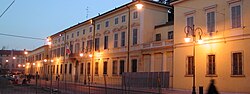
*''Palazzo Corbelli'' | [[File:Palazzo ducale reggio emilia.jpg|thumb|350px|Palazzo Ducale in Reggio Emilia]] | ||
[[File:Palazzo ducale reggio emilia.jpg|thumb| | * ''[[Palazzo Ducale di Reggio Emilia|Palazzo Ducale]]'' – 18th-century palace. See [[:it:Palazzo Ducale (Reggio Emilia)|Italian article]]. | ||
*''[[Palazzo Ducale di Reggio Emilia|Palazzo Ducale]]'' | * ''[[Palazzo Fontanelli Sacrati, Reggio Emilia|Palazzo Fontanelli Sacrati]]'' | ||
*''[[Palazzo Fontanelli Sacrati, Reggio Emilia|Palazzo Fontanelli Sacrati]]'' | * ''[[Palazzo Magnani, Reggio Emilia|Palazzo Magnani]]'' | ||
*''[[Palazzo Magnani, Reggio Emilia|Palazzo Magnani]]'' | * ''[[Palazzo Masdoni, Reggio Emilia|Palazzo Masdoni]]'' | ||
*''[[Palazzo Masdoni, Reggio Emilia|Palazzo Masdoni]]'' | * ''[[Palazzo da Mosto, Reggio Emilia|Palazzo da Mosto]]'' | ||
*''[[Palazzo da Mosto, Reggio Emilia|Palazzo da Mosto]]'' | * ''[[Palazzo Pratonieri, Reggio Emilia|Palazzo Pratonieri]]'' | ||
*''[[Palazzo Pratonieri, Reggio Emilia|Palazzo Pratonieri]]'' | * ''[[Palazzo San Giorgio, Reggio Emilia|Palazzo San Giorgio]]'' | ||
*''[[Palazzo San Giorgio, Reggio Emilia|Palazzo San Giorgio]]'' | * ''Palazzo Scaruffi'' | ||
*'' | * ''[[Palazzo Spalletti-Trivelli]]'' | ||
*''[[Palazzo | * ''[[Palazzo Tirelli, Reggio Emilia|Palazzo Tirelli]]'' | ||
*''[[Palazzo Tirelli]]'' | * ''Palazzo Torello Malaspina'' | ||
*'' | * ''[[Teatro Municipale di Reggio|Teatro Municipale]]'' – Neoclassical building. | ||
*''[[Teatro Municipale di Reggio|Teatro Municipale]]'' | * ''[[Teatro Ariosto]]'' – See [[:it:Teatro Ariosto (Reggio Emilia)|Italian article]]. | ||
*''[[Teatro Ariosto]]'' | * ''[[Monumento ai Caduti, Parco del Popolo, Reggio nell'Emilia|Monumento ai Caduti, Parco del Popolo]]'' – Erected in 1927. | ||
*''[[Monumento ai Caduti, Parco del Popolo, Reggio nell'Emilia|Monumento ai Caduti, Parco del Popolo]]'' | * ''[[Monument to the Concordi, Reggio|Monument to the Concordi]]'' – Ancient Roman monument located in Parco del Popolo. | ||
*''[[Monument to the Concordi, Reggio|Monument to the Concordi]]'' | |||
===Bridges=== | ===Bridges=== | ||
* [[Autostrada A1 (Italy)|Autostrada A1]] bridges, three bridges designed by [[Santiago Calatrava]] and opened in 2005–2006.<ref name=bridge1>{{cite web|url=http://www.redaelli.com/en/projects/tensostructures/stay-road-bridge-reggio-emilia/|title=Twin Stayed Road Bridges Reggio Emilia|publisher= Redailli Tecna S.P.A.|location=[[Milan]], [[Italy]]|access-date=January 2, 2017}}</ref> The three bridges connect the Austostrada del Sole A1 (the main Italian north to south [[Controlled-access highway|motorway]]) to the city of Reggio Emilia.<ref name=bridge1/> A central [[arch bridge]] spans the Milan-Bologna high-speed railway line and the motorway, while twin [[cable-stayed bridge]]s are at either end.<ref name=bridge1/><ref name=bridge2/> The twin bridges pass over service roundabouts and access roads to allow connections with the adjacent Reggio Emilia AV Mediopadana high-speed railway station.<ref name=bridge1/> | |||
In 2009, the European Convention for Constructional Steelwork gave the three bridges a European Steel Design Award, stating that the twin bridges' original visual effects at different angles give the two bridges "the aspect of huge musical instruments."<ref name=bridge2>{{cite web|archive-url=https://web.archive.org/web/20170105195243/https://www.steelconstruct.com/old/sda2009/SDA2009BD.pdf|archive-date=January 5, 2017|url=https://www.steelconstruct.com/old/sda2009/SDA2009BD.pdf|title=Three bridges in Reggio Emilia (Italy)|work=European Steel Design Awards 2009|year=2009|pages=16–17|publisher=General Secretariat, European Convention for Constructional Steelwork|location=[[Brussels]], [[Belgium]]|access-date=January 5, 2017}}</ref> | |||
* [[ | ==Notable people==<!-- PLEASE RESPECT ALPHABETICAL ORDER --> | ||
{{div col|colwidth=30em}} | |||
*[[Elvis Abbruscato]], footballer | |||
*[[Daniele Adani]], former footballer and television pundit | |||
*[[Carlo Ancelotti]], football manager and former footballer | |||
*[[Luca Ariatti]], former footballer | |||
*[[Ludovico Ariosto]], poet | |||
*[[Stefano Baldini]], marathon champion | |||
*[[Benny Benassi]], musician | |||
*[[Orietta Berti]], singer | |||
*[[Matteo Maria Boiardo]], poet | |||
*[[Kobe Bryant]], American basketball player. He lived in Reggio Emilia in his youth. | |||
* [[Cervi Brothers|Fratelli Cervi]] | |||
*[[Riccardo Cervi]], basketball player | |||
*[[Philip Corner]], composer, Fluxus artist | |||
*[[Black Box (band)]], band | |||
*[[Graziano Delrio]], politician | |||
*[[Giuseppe Dossetti]], politician | |||
*[[Zucchero Fornaciari]], singer | |||
*[[Sonia Ganassi]], opera singer | |||
*[[Gino Giaroli]], former footballer | |||
*[[Luigi Ghirri]], photographer | |||
*[[Giovanni Guicciardi]], opera singer<ref>Ascarelli, Alessanda (2004). [http://www.treccani.it/enciclopedia/giovanni-guicciardi_%28Dizionario_Biografico%29/ "Gucciardi, Giovanni"], ''[[Dizionario Biografico degli Italiani]]'', Vol. 61. Treccani. Online version retrieved 1 October 2013 {{in lang|it}}.</ref> | |||
*[[Nilde Iotti]], politician | |||
*[[Maurizio Landini]], general secretary of [[CGIL]] | |||
*[[Luciano Ligabue]], singer | |||
*[[Hachim Mastour]], footballer | |||
*[[Nicolo Melli]], basketball player | |||
*[[Federico Mussini]], basketball player | |||
*[[Antonio Pacchioni]], scientist | |||
*[[Romano Prodi]], economist and politician | |||
*[[Serge Reggiani]], actor and singer | |||
*[[Meuccio Ruini]], politician | |||
*[[Angelo Secchi]], scientist | |||
*[[Marco Silvestri]], footballer | |||
*[[Lazzaro Spallanzani]], scientist | |||
*[[Ferruccio Tagliavini]], opera singer | |||
*[[Pier Vittorio Tondelli]], writer | |||
*[[Romolo Valli]], actor | |||
*[[Giovanni Battista Venturi]], scientist | |||
*[[Ermete Zacconi]], actor | |||
*[[Iva Zanicchi]], singer and politician | |||
*[[Cesare Zavattini]], writer and painter | |||
*[[CCCP - Fedeli alla linea]], band | |||
*[[Offlaga Disco Pax]], band | |||
*[[Raw Power (band)]], band | |||
{{div col end}} | |||
==Painters and sculptors== | === Painters and sculptors === | ||
{{div col|colwidth=30em}} | {{div col|colwidth=30em}} | ||
*[[Giacomo Benevelli]] | *[[Giacomo Benevelli]] | ||
| Line 298: | Line 464: | ||
*[[Lelio Orsi]] | *[[Lelio Orsi]] | ||
*[[Prospero Spani ("Il Clemente")]] | *[[Prospero Spani ("Il Clemente")]] | ||
*[[Antonio Ligabue]] | *[[Antonio Ligabue]] | ||
{{div col end}} | {{div col end}} | ||
==International relations== | ==International relations== | ||
| Line 420: | Line 494: | ||
*{{flagicon|BRA}} [[Rio Branco, Acre|Rio Branco]], Brazil | *{{flagicon|BRA}} [[Rio Branco, Acre|Rio Branco]], Brazil | ||
*{{flagicon|CHN}} [[Rizhao]], China | *{{flagicon|CHN}} [[Rizhao]], China | ||
{{div col end}} | {{div col end}}{{Portal|Italy|European Union|Cities}} | ||
==Notes== | ==Notes== | ||
| Line 432: | Line 506: | ||
==External links== | ==External links== | ||
{{ | {{sister project links|Reggio Emilia}} | ||
*{{Wikivoyage | *{{Wikivoyage inline}} | ||
*[https://web.archive.org/web/20070224041519/http://www.municipio.re.it/IAT/iatre.nsf/schede/8012466CCB7B51E3C1256AD40055A27E?OpenDocument&lng=eng Official tourist information in English] | *[https://web.archive.org/web/20070224041519/http://www.municipio.re.it/IAT/iatre.nsf/schede/8012466CCB7B51E3C1256AD40055A27E?OpenDocument&lng=eng Official tourist information in English] | ||
{{Province of Reggio Emilia}} | {{Province of Reggio Emilia}} | ||
{{Cities in Italy}} | {{Cities in Italy}} | ||
{{Authority control}} | |||
[[Category:Reggio Emilia| ]] | [[Category:Reggio Emilia| ]] | ||
[[Category:Cities and towns in Emilia-Romagna]] | [[Category:Cities and towns in Emilia-Romagna]] | ||
[[Category:Jewish Italian history]] | [[Category:Jewish Italian history]] | ||
[[Category: | [[Category:Jewish communities in Italy]] | ||
[[Category:Cities founded by Rome]] | [[Category:Cities founded by Rome]] | ||
Latest revision as of 03:01, 20 March 2026
Template:Infobox Italian comune
Reggio nell'Emilia[lower-alpha 1] (Emilian: Rèz; Latin: Regium Lepidi), usually referred to as Reggio Emilia, or simply Reggio by its inhabitants, and known until 1861 as Reggio di Lombardia,[lower-alpha 2] is a city in the region of Emilia-Romagna in Italy. With a population of 172,518, it is the 4th-largest city in Emilia-Romagna and the 22nd-largest in Italy.
The inhabitants of Reggio nell'Emilia are called Reggiani, while the inhabitants of Reggio di Calabria, in the southwest of the country, are called Reggini.
The old town has a hexagonal form, which derives from the ancient walls, and the main buildings are from the 16th–17th centuries. The commune's territory lies entirely on a plain, crossed by the Crostolo stream.
History[edit | edit source]
Ancient and early Middle Ages[edit | edit source]
 |
Reggio began as a historical site with the construction by Marcus Aemilius Lepidus of the Via Aemilia, leading from Piacenza to Rimini (187 BC). Reggio became a judicial administration centre, with a forum called at first Regium Lepidi, then simply Regium, whence the city's current name.
During the Roman age Regium is cited only by Festus and Cicero, as one of the military stations on the Via Aemilia. However, it was a flourishing city, a Municipium with its own statutes, magistrates and art colleges.
Apollinaris of Ravenna brought Christianity in the 1st century CE. The sources confirm the presence of a bishopric in Reggio after the Edict of Milan (313). In 440 the Reggio diocese was placed under the jurisdiction of Ravenna by Western Roman Emperor Valentinianus III. At the end of the 4th century, however, Reggio had decayed so much that Saint Ambrose included it among the dilapidated cities. Further damage occurred with the Barbarian invasions. After the deposition of Romulus Augustulus in 476 Reggio was part of Odoacer's realm. In 489 it came under Ostrogothic control; from 539 it was part of the Roman Empire (Italy), but was taken by Alboin's Lombards in 569. Reggio was chosen as Duchy of Reggio seat.
In 773, the Franks took Reggio. Charlemagne gave the bishop the authority to exercise royal authority over the city and established the diocese' limits (781). In 888, Reggio was handed over to the Kings of Italy. In 899, the Magyars heavily damaged it, killing Bishop Azzo II. As a result of this, new walls were built. On 31 October 900 Emperor Louis III gave authority for the erection of a castrum (castle) in the city's centre.
In 1002, Reggio's territory, together with that of Parma, Brescia, Modena, Mantua and Ferrara, were merged into the March of Tuscany, later held by Matilde of Canossa.
Free commune[edit | edit source]
|

Reggio became a free commune around the end of the 11th or the beginning of the 12th century. In 1167 it was a member of the Lombard League and took part in the Battle of Legnano. In 1183 the city signed the Treaty of Konstanz, from which the city's consul, Rolando della Carità, received the imperial investiture. The subsequent peace spurred a period of prosperity: Reggio adopted new statutes, had a mint, schools with celebrated masters, and developed its trades and arts. It also increasingly subjugated the castles of the neighbouring areas. At this time the Crostolo stream was deviated westwards, to gain space for the city. The former course of the stream was turned into an avenue called Corso della Ghiara ('gravel course'), nowadays Corso Garibaldi.
The 12th and 13th centuries, however, were also a period of violent internal struggle between the Scopazzati (meaning 'swept away from the city with brooms', noblemen) and Mazzaperlini (meaning 'lice killers', plebeians) parties, and later those of Ruggeri and Malaguzzi, involved in a bitter domestic rivalry. In 1152 Reggio also warred with Parma and in 1225 with Modena, as part of the general struggle between the Guelphs and Ghibellines. In 1260, a hermit from Perugia led 25,000 penitents into the city, and this event calmed the situation for a while, spurring religious fervour. But disputes soon resurfaced, and as early as 1265 the Ghibellines killed the Guelph's leader, Caco da Reggio, and gained preeminence. Arguments with the bishop continued and two new parties formed, the Inferiori and Superiori. Final victory went to the latter.
To thwart the abuses of powerful families such as the Sessi, Fogliani and Canossa, the Senate of Reggio gave the city's rule for a period of three years to Obizzo II d'Este. This choice marked the future path of Reggio under the seignory of the latter's family, as Obizzo continued to rule de facto after his mandate has ceased. His son Azzo was expelled by the Reggiani in 1306, creating a republic ruled by 800 common people. In 1310 Holy Roman Emperor Henry VII imposed Marquis Spinetto Malaspina on the city as vicar, but he was soon driven out. The republic ended in 1326 when Cardinal Bertrando del Poggetto annexed Reggio to the Papal States.
The city was subsequently under the suzerainty of John of Bohemia, Nicolò Fogliani and Mastino II della Scala, who in 1336 gave it to Luigi Gonzaga. Gonzaga built a citadel in the St. Nazario quarter, and destroyed 144 houses. In 1356 the Milanese Visconti, helped by 2,000 exiled Reggiani, captured the city, starting an unsettled period of power sharing with the Gonzaga family. In the end the latter sold Reggio to the Visconti for 5,000 ducats. In 1405 Ottobono Terzi of Parma seized Reggio, but was killed by Michele Attendolo, who handed the city over to Nicolò III d'Este, who therefore became seignor of Reggio. The city, however, maintained significant autonomy, with laws and coinage of its own. Nicolò was succeeded by his illegitimate son Lionello, and, from 1450, by Borso d'Este.
Duchy of Reggio[edit | edit source]
|
In 1452, Borso was awarded the title of Duke of Modena and Reggio by Frederick III. Borso's successor, Ercole I, imposed heavy levies on the city and appointed the poet Matteo Maria Boiardo, born in the nearby town of Scandiano, as its governor. Later another famous Italian writer, Francesco Guicciardini, held the same position. In 1474, Ludovico Ariosto, author of Orlando Furioso, was born in the Malaguzzi palace, near the site of the 21st-century town hall. He was the first son of a knight from Ferrara, who was in charge of the citadel, and a noblewoman from Reggio, Daria Maleguzzi Valeri. As a grown man he would be sent to Reggio as governor on behalf of the dukes of Ferrara, and would spend time in a villa outside the town (Il Mauriziano) that still stands.
In 1513, Reggio was handed over to Pope Julius II. The city was returned to the House of Este after the death of Hadrian VI on 29 September 1523. In 1551 Ercole II d'Este destroyed the suburbs of the city in his program of reconstruction of the walls. At the end of the century work on the city's famous Basilica della Ghiara began, on the site where a miracle was believed to have occurred. The Este rule continued until 1796, with short interruptions in 1702 and 1733–1734.
Napoleonic age and restoration[edit | edit source]
|


The arrival of the republican French troops was greeted with enthusiasm in the city. On 21 August 1796, the ducal garrison of 600 men was driven off, and the Senate claimed the rule of Reggio and its duchy. On 26 September, the Provisional Government's volunteers pushed back an Austrian column, in the Battle of Montechiarugolo. Though minor, this clash is considered the first one of the Italian Risorgimento. Napoleon himself awarded the Reggiani with 500 rifles and 4 guns. Later he occupied Emilia and formed a new province, the Cispadane Republic, whose existence was proclaimed in Reggio on 7 January 1797. The Italian national flag, named Il Tricolore ('the tricolour'), was sewn on that occasion by Reggio women. In this period of patriotic fervour, Jozef Wybicki, a lieutenant in the Polish troops of General Jan Henryk Dąbrowski, an ally of Napoleon, composed in Reggio the Mazurek Dąbrowskiego, which in 1927 became the Polish national anthem.
The 1815 Treaty of Vienna returned Reggio to Francis IV of Austria-Este, but in 1831 Modena rose up against him, and Reggio followed its example organizing a corps under the command of General Carlo Zucchi. However, on 9 March, the Duke conquered the city with his escort of Austrian soldiers.
In 1848, Duke Francis V left his estate fearing a revolution and Reggio proclaimed its union with Piedmont. The latter's defeat at the Battle of Novara brought the city back under Este control. In 1859 Reggio, under dictator Luigi Carlo Farini, became part of united Italy and, with the plebiscite of 10 March 1860, definitively entered the new unified kingdom.
Contemporary history[edit | edit source]
|

Reggio then went through a period of economic and population growth from 1873 to the destruction of the ancient walls. In 1911, it had 70,000 inhabitants. A strong socialist tradition grew. On 7 July, the city hosted the 13th National Congress of the Italian Socialist Party. On 26 July 1943, the fascist regime's fall was cheered with enthusiasm by the Reggiani. Numerous partisan bands were formed in the city and surrounding countryside.
On 27 April 2023 the city was declared a European Capital of Inclusion and Diversity by the European Commission.[3]
Jewish history[edit | edit source]
Jews began arriving to Reggio in the early 15th century. Many Jews were Sephardim from Spain, Portugal and other parts of Italy. Nearly all were fleeing religious persecution. The Jewish community was prosperous and enjoyed considerable growth for the next several hundred years. The Synagogue of Reggio Emilia was relocated in 1672 into the ghetto, and rebuilt in 1858.[4]
After the Napoleonic era the Jews of Reggio gained emancipation and began to migrate to other parts of Europe looking for greater economic and social freedom. Thus, the Jewish community in Reggio began to lower. The German occupation during World War II and the Holocaust hastened the decline. Today, only one Jew remains in Reggio Emilia.[5] The Jewish Community of Reggio Emilia was merged with Modena's. However, an unused synagogue and burial ground still exist. In 2016 the City Council posed some small street plates in front of the houses of the deported Jews to preserve their remembrance.[6]
Many notable rabbinic scholars have resided in Reggio. These include Isaac Foa, Immanuel Sonino, Obadiah ben Israel Sforno, Nathan ben Reuben David Spira, Menahem Azariah Fano, Baruch Abraham ben Elhanan David Foa, Hezekiah ben Isaac Foa, Isaac ben Vardama Foa, Israel Nissim Foa, Israel Solomon Longhi, Isaiah Mordecai ben Israel Hezekiah Bassani, Israel Benjamin ben Isaiah Bassani, Elhanan David Carmi, Benjamin ben Eliezer ha-Kohen, Joshua ben Raphael Fermi, Moses Benjamin Foa, Abram Michael Fontanella, Judah Ḥayyim Fontanella, Israel Berechiah Fontanella, Raphael Jehiel Sanguinetti, Isaac Samson d'Angeli, R. J. Bolognese, Hananiah Elhanan Ḥai ha-Kohen, Jacob Levi, Moses Benjamin Levi, Israel Berechiah Sanguinetti, David Jacob Maroni, Giuseppe Lattes, Alessandro da Fano, Lazzaro Laide Tedesco, and Shimshon Chaim Nachmani.[7][8][9]
Climate[edit | edit source]
The climate in Reggio Emilia is temperate continental, with hot rather moist summers (the temperatures can sometimes rise above 35 °C) (95 °F) and fairly frigid winters with frequent frosts (the temperatures can go below -10 °C) (14 °F).[10] Precipitations are evenly distributed all year long, but October, November and April are the most rainy months, while July and January are the most arid.[11][12] In the city snow rarely accumulates, even though it snows almost every year, due to the rather high temperatures.
During autumn and winter it is very common, especially in the areas outside the city, to encounter very thick fog, although it is less frequent than in the past. Other meteorological phenomena that can be expected in the area are rain, freezing rain during winter, and hail during summer and rarely in the spring.
The area is not particularly windy and there are often days of total calm, especially during the anticyclonic phases in winter, while spring is more windy.[13] The most intense winds are the ones blowing from northeast (Bora) or from southwest (Libeccio). The latter, during its descent from the Northern Apennines, sometimes tends to become a downslope wind and thus is very dry and hot. Rarely, Foehn wind from the Alps can reach Reggio Emilia from the northwest. In the city, the average annual high temperature is 18 °C (64 °F), the annual low temperature is 9 °C (48 °F), and the annual precipitation is 700 millimetres (27.56 inches).
| Climate data for Reggio Emilia (1991–2020) | |||||||||||||
|---|---|---|---|---|---|---|---|---|---|---|---|---|---|
| Month | Jan | Feb | Mar | Apr | May | Jun | Jul | Aug | Sep | Oct | Nov | Dec | Year |
| Average high °C (°F) | 7.6 (45.7) |
10.5 (50.9) |
16.1 (61.0) |
20.1 (68.2) |
25.1 (77.2) |
29.7 (85.5) |
32.3 (90.1) |
32.0 (89.6) |
26.2 (79.2) |
19.3 (66.7) |
12.5 (54.5) |
7.9 (46.2) |
19.9 (67.9) |
| Daily mean °C (°F) | 4.3 (39.7) |
6.3 (43.3) |
11.0 (51.8) |
14.8 (58.6) |
19.5 (67.1) |
23.9 (75.0) |
26.1 (79.0) |
26.2 (79.2) |
21.1 (70.0) |
15.3 (59.5) |
9.3 (48.7) |
4.5 (40.1) |
15.2 (59.3) |
| Average low °C (°F) | 1.1 (34.0) |
2.2 (36.0) |
5.9 (42.6) |
9.5 (49.1) |
13.9 (57.0) |
18.1 (64.6) |
20.3 (68.5) |
20.2 (68.4) |
15.9 (60.6) |
11.5 (52.7) |
6.6 (43.9) |
1.9 (35.4) |
10.6 (51.1) |
| Average precipitation mm (inches) | 35.9 (1.41) |
49.5 (1.95) |
50.5 (1.99) |
72.8 (2.87) |
66.7 (2.63) |
65.6 (2.58) |
35.8 (1.41) |
35.9 (1.41) |
62.0 (2.44) |
82.6 (3.25) |
93.5 (3.68) |
55.0 (2.17) |
705.8 (27.79) |
| Average precipitation days (≥ 1.0 mm) | 5 | 6 | 6 | 8 | 6 | 6 | 3 | 5 | 6 | 8 | 8 | 6 | 73 |
| Source 1: Arpae Emilia-Romagna[14] | |||||||||||||
| Source 2: Climi e viaggi (precipitation days)[15] | |||||||||||||
Demographics[edit | edit source]
| Year | Pop. | ±% |
|---|---|---|
| 1861 | 46,856 | — |
| 1871 | 50,955 | +8.7% |
| 1881 | 50,759 | −0.4% |
| 1901 | 58,993 | +16.2% |
| 1911 | 70,955 | +20.3% |
| 1921 | 82,011 | +15.6% |
| 1931 | 89,605 | +9.3% |
| 1936 | 93,913 | +4.8% |
| 1951 | 106,726 | +13.6% |
| 1961 | 116,445 | +9.1% |
| 1971 | 128,789 | +10.6% |
| 1981 | 130,376 | +1.2% |
| 1991 | 132,030 | +1.3% |
| 2001 | 141,877 | +7.5% |
| 2011 | 162,082 | +14.2% |
| 2021 | 169,908 | +4.8% |
| Source: ISTAT[16][17] | ||
As of 2025, Reggio Emilia has a population of 172,518, of whom 49.7% are male and 50.3% are female. Minors make up 15.7% of the population, and seniors make up 21.7%, compared to the Italian average of 14.9% and 24.7% respectively.[18]
As of 2024, the foreign-born population is 33,301, equal to 19.5% of the population. The 5 largest foreign nationalities are Albanians (3,706), Moroccans (2,778), Ukrainians (2,475), Egyptians (2,273) and Moldovans (2,170).[19]
| Country | Population |
|---|---|
 Albania Albania
|
3,706 |
 Morocco Morocco
|
2,778 |
 Ukraine Ukraine
|
2,475 |
 Egypt Egypt
|
2,273 |
 Moldova Moldova
|
2,170 |
 China China
|
2,111 |
 Nigeria Nigeria
|
1,677 |
 Romania Romania
|
1,590 |
 Ghana Ghana
|
1,488 |
 Tunisia Tunisia
|
1,206 |
 Georgia Georgia
|
1,089 |
 Pakistan Pakistan
|
738 |
 Sri Lanka Sri Lanka
|
581 |
 Senegal Senegal
|
567 |
 Brazil Brazil
|
545 |
Administration[edit | edit source]
Frazioni (hamlets)[edit | edit source]
- Bagno
- Cadè
- Canali
- Cavazzoli
- Castellazzo
- Cella
- Codemondo
- Corticella
- Coviolo
- Fogliano
- Gaida
- Gavassa
- Gavasseto
- Mancasale
- Marmirolo
- Masone
- Massenzatico
- Ospizio
- Pieve Modolena
- Pratofontana
- Rivalta
- Roncadella
- Roncocesi
- Sabbione
- San Bartolomeo
- San Maurizio
- San Pellegrino
- San Prospero Strinati
- Sesso
Boroughs[edit | edit source]
- Acque Chiare
- Baragalla
- Buco del Signore
- Canalina
- Centro Storico (Historical Centre)
- Lungocrostolo
- Mirabello
- Ospedale (Hospital)
- Ospizio
- Quartier Giardino
- Rosta Nuova
- Stazione (Railway station)
Education[edit | edit source]
The Reggio Emilia approach to preschool education was started by the schools of Reggio Emilia after World War II and is well-known around the world. It is based and inspired on theories of Malaguzzi, Bruner, Vygotsky, Dewey, Piaget and Gardner. Reggio Emilia holds the Loris Malaguzzi International Centre, a modern structure where the Reggio Emilia approach is implemented, exported and spread around the world.[20]
Economy[edit | edit source]
The economy of the province of Reggio Emilia was for a long time based on agriculture. One typical product, known worldwide and imitated, is Parmigiano-Reggiano cheese. Another is Lambrusco wine. Reggio Emilia also produces balsamic vinegar,[21] a condiment for salad but also cheese, strawberries and many other dishes. In the twentieth century the city and its territory also saw a rapid development of small and medium industries, particularly in the sector of agricultural machinery. For more than 100 years, there has been a strong tradition that supported the development of consumers' cooperatives, as well as building and banking cooperatives. New developments in mechanics and information technology are at the origin of some new companies operating in mechatronics. Another well-established sector is the ceramic tile industry, mainly concentrated in the districts of Scandiano and Casalgrande.
Other leading sectors include: electronics (Cellular Line, Phonocar, RCF audio); finance (Credito Emiliano); Iris Ceramica; fashion (Marina Rinaldi, Max Mara); food (NewPrinces S.p.A.); machinery (ARGO SpA, Emak, Interpump Group, Landi Renzo, Lombardini S.r.l.; Preston & Barbieri, Smeg); and utilities (Iren).
Industrial growth has attracted immigration from North and Central Africa, East Europe, and Far East (China, Pakistan, India). The immigration rate in the province is about 25%. Research indicates that Reggio Emilia ranks very high in quality of life among Italian provinces.[22]
Transport[edit | edit source]
Reggio Emilia railway station, opened in 1859, forms part of the Milan–Bologna railway. It is also a terminus of three secondary railways, linking Reggio Emilia with Ciano d'Enza, Guastalla and Sassuolo, respectively. The station is situated at Piazza Guglielmo Marconi, at the eastern edge of the city centre.
The other major railway station, Reggio Emilia AV Mediopadana, is on the Milan–Bologna high-speed railway (there is also a connection with Reggio Emilia-Guastalla railway). It is located at the Mancasale locality, approximately 4 kilometres (2.5 miles) north from the city centre.
Along with this, there is a plan to construct a tram in the city.[23] The tram will run from the Mancasale Industrial zone in the north to Rivalta in the south, stopping at the Reggio Emilia AV Mediopadana railway station, Reggio Emilia railway station and other neighborhoods.[23] The tram system has undergone a feasibility study,[24] and is set to open in 2026.[25]
The nearest airport is served by Bologna Guglielmo Marconi Airport which is located approximately 68 km from Reggio Emilia.
Sports[edit | edit source]
Reggio Emilia is home to various professional sports clubs and arenas:
- Pallacanestro Reggiana, which competes in Lega Basket Serie A and has won 1 Italian Supercup and 1 Eurochallenge.
- A.C. Reggiana 1919, a football team which competes in Serie B.
- Valorugby Emilia, playing in Serie A Elite (top Italian rugby division).
- Volley Tricolore, playing in Serie A3.
- Olimpia Regium, playing in futsal Serie A2.
The main sports venues in the city are:
- Stadio Città del Tricolore (23,717 capacity), located near the A1 highway and home to Reggiana and U.S. Sassuolo home games.
- PalaBigi (4,500 capacity), located in city centre.
- Stadio Mirabello (4,500 capacity), located in the city centre.
- Palasport Fanticini, located in the Tribunal hub.
- Stadio Canalina, located in the Canalina borough.
Main sights[edit | edit source]
Religious buildings[edit | edit source]


- Basilica della Ghiara: Main church of the city; begun in 1597, and completed in Baroque style.
- Basilica di San Prospero: Built in the 10th century and dedicated to Prosper of Reggio, a bishop of the city, it was rebuilt by Luca Corti and Matteo Fiorentini between 1514 and 1523. The façade, with eleven statues of saints and patrones, was redesigned by Giovan Battista Cattani in the mid-18th century. It includes a pleasant belfry/tower, begun in 1535 and never quite finished, with an octagonal plant. The interior of the church has a Latin cross plant, with three naves. The apse houses the splendid fresco Last Judgement, by the Bolognese artist Camillo Procaccini. Also noteworthy are the wooden choir from 1546 and the Assumption altarpiece by Tommaso Laureti and Ludovico Carracci (1602).
- Cathedral: Built in 9th through 12th centuries. It was rebuilt in the second half of the 16th century. It has three naves with works by Guercino, Palma the Younger, Prospero Spani and Alessandro Tiarini.
- Baptistery of Saint John the Baptist.
- Sant'Agostino: church once dedicated to Saint Apollinaris, its dedication was changed to St Augustine in 1268 when it was rebuilt, along with the annexed convent, by the Augustinian friars. It was restored in 1452, when the tower was also erected. The current interior dates from 1645 to 1666, while the façade (1746) was designed by Alfonso Torreggiani and built by Giovan Battista Cattani. Its restored theatre hosted Model European Parliament sessions in 2015.
- The small Baroque Christ's Oratory.
- San Girolamo e Vitale: church mentioned in document in 857 and rebuilt in 1646 by Gaspare Vigarani. It consists of three separate churches in the same building, two above ground and one underground; the crypt church houses a replica of the Holy Sepulcher in Jerusalem.
- San Francesco: church.
- San Giorgio: Baroque church with cupola (1746) designed by Alfonso Torreggiani.
- San Giovannino: (1545) church houses Baroque frescoes (1613) by Sisto Badalocchio, Lorenzo Franchi, Tommaso Sandrini, Paolo Guidotti and paintings by Tiarini.
- Chiesa di San Pietro (1586): church designed by Giulio della Torre; cupola erected in 1625, façade in 1782, while the cloisters in the 16th century (the small cloister by Bartolomeo Spani in 1520, the works in the main cloister ended in 1580). The interior is in a Latin cross shape with a single nave. It houses notable Baroque paintings by Alessandro Tiarini, Pietro Desani, Luca da Reggio, Camillo Gavasetti and Paolo Emilio Besenzi.
- San Filippo Neri: Baroque church dedicated to St Philip Neri.
- San Spiridione Oratory
- San Stefano: church first mentioned when its site was outside the city walls, as a Templars' church.
- Synagogue of Reggio Emilia: rebuilt in 1845 by Pietro Marchelli.
- Chiesa Battista la Verità: Main Baptist church of Reggio Emilia.
-
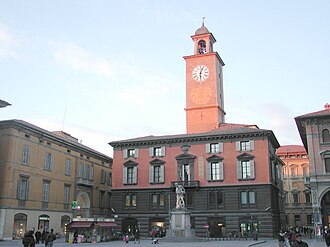 Palazzo del Monte in Piazza del Duomo, with the Fountain of River Crostolo
 -
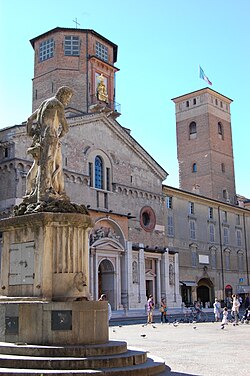 Piazza Prampolini
 -
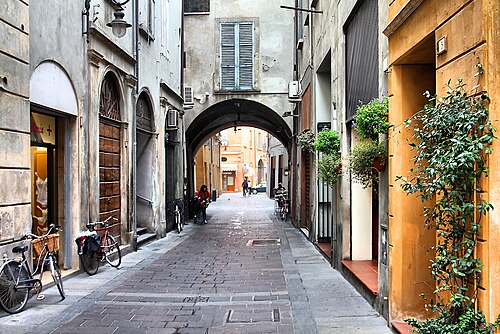 Old town street in Reggio Emilia


Secular buildings[edit | edit source]
- Bishop's Palace
- Palazzo dei Musei
- Palazzo Ancini
- Palazzo Busetti
- Palazzo del Capitano del Popolo – Built in 1280, restored in 1432 and again in the 1920s, when its northern and western façades were embellished with Ghibelline merlons and the crests of ancient Reggio's Captains and Communities. Inside is the Sala dei Difensori ("Defenders' Room"), a wide hall once used by the citizens' council.
- Palazzo del Carbone
- Palazzo Cassoli
- Palazzo Cassoli – Tirelli
- Palazzo Comunale – Begun in 1414, it houses the Tricolore Hall and the Museum of the Italian Flag. The Torre del Bordello ("Brothel Tower"), built in 1489, contains a museum on the Reggiani uprisings of 1796–1831.
- Palazzo Corbelli – 19th-century palace with a façade designed by Pietro Marchelli.

- Palazzo Ducale – 18th-century palace. See Italian article.
- Palazzo Fontanelli Sacrati
- Palazzo Magnani
- Palazzo Masdoni
- Palazzo da Mosto
- Palazzo Pratonieri
- Palazzo San Giorgio
- Palazzo Scaruffi
- Palazzo Spalletti-Trivelli
- Palazzo Tirelli
- Palazzo Torello Malaspina
- Teatro Municipale – Neoclassical building.
- Teatro Ariosto – See Italian article.
- Monumento ai Caduti, Parco del Popolo – Erected in 1927.
- Monument to the Concordi – Ancient Roman monument located in Parco del Popolo.
Bridges[edit | edit source]
- Autostrada A1 bridges, three bridges designed by Santiago Calatrava and opened in 2005–2006.[26] The three bridges connect the Austostrada del Sole A1 (the main Italian north to south motorway) to the city of Reggio Emilia.[26] A central arch bridge spans the Milan-Bologna high-speed railway line and the motorway, while twin cable-stayed bridges are at either end.[26][27] The twin bridges pass over service roundabouts and access roads to allow connections with the adjacent Reggio Emilia AV Mediopadana high-speed railway station.[26]
In 2009, the European Convention for Constructional Steelwork gave the three bridges a European Steel Design Award, stating that the twin bridges' original visual effects at different angles give the two bridges "the aspect of huge musical instruments."[27]
Notable people[edit | edit source]
- Elvis Abbruscato, footballer
- Daniele Adani, former footballer and television pundit
- Carlo Ancelotti, football manager and former footballer
- Luca Ariatti, former footballer
- Ludovico Ariosto, poet
- Stefano Baldini, marathon champion
- Benny Benassi, musician
- Orietta Berti, singer
- Matteo Maria Boiardo, poet
- Kobe Bryant, American basketball player. He lived in Reggio Emilia in his youth.
- Fratelli Cervi
- Riccardo Cervi, basketball player
- Philip Corner, composer, Fluxus artist
- Black Box (band), band
- Graziano Delrio, politician
- Giuseppe Dossetti, politician
- Zucchero Fornaciari, singer
- Sonia Ganassi, opera singer
- Gino Giaroli, former footballer
- Luigi Ghirri, photographer
- Giovanni Guicciardi, opera singer[28]
- Nilde Iotti, politician
- Maurizio Landini, general secretary of CGIL
- Luciano Ligabue, singer
- Hachim Mastour, footballer
- Nicolo Melli, basketball player
- Federico Mussini, basketball player
- Antonio Pacchioni, scientist
- Romano Prodi, economist and politician
- Serge Reggiani, actor and singer
- Meuccio Ruini, politician
- Angelo Secchi, scientist
- Marco Silvestri, footballer
- Lazzaro Spallanzani, scientist
- Ferruccio Tagliavini, opera singer
- Pier Vittorio Tondelli, writer
- Romolo Valli, actor
- Giovanni Battista Venturi, scientist
- Ermete Zacconi, actor
- Iva Zanicchi, singer and politician
- Cesare Zavattini, writer and painter
- CCCP - Fedeli alla linea, band
- Offlaga Disco Pax, band
- Raw Power (band), band
Painters and sculptors[edit | edit source]
International relations[edit | edit source]
- Reggio Emilia is a pilot city of the Council of Europe and the European Commission Intercultural cities programme.[29]
- Reggio Emilia is a member city of Eurotowns network.[30]
Twin towns – sister cities[edit | edit source]
Reggio Emilia is twinned with:[31]
- Template:Country data PSEScript error: The function "pwarning" does not exist. Beit Jala, Palestine
 Bydgoszcz, Poland
- Chișinău, Moldova
 Dijon, France
 Fort Worth, United States
 Girona, Spain
 Kragujevac, Serbia
- Template:Country data MOZScript error: The function "pwarning" does not exist. Pemba, Mozambique
 Polokwane, South Africa
 Schwerin, Germany
 Zadar, Croatia
Friendship[edit | edit source]
- Ekurhuleni, South Africa
- Template:Country data PSEScript error: The function "pwarning" does not exist. Nablus, Palestine
- Rio Branco, Brazil
- Rizhao, China
Notes[edit | edit source]
- ↑ Pronunciation: US: /ˈrɛdʒ(i)oʊ ˌnɛlɛˈmiːljə/;[1][2] Italian: [ˈreddʒo nelleˈmiːlja; ˈrɛddʒo -]
 [[:Media:It-Reggio nell'Emilia.ogg|]] (help·info).
- ↑ Literally "Reggio of Lombardy".
References[edit | edit source]
- ↑ Template:Cite American Heritage Dictionary
- ↑ "Reggio". Merriam-Webster.com Dictionary. Merriam-Webster. OCLC 1032680871. Retrieved February 9, 2019.
- ↑ "EU Diversity Month kicks off with the winners of the 2023 European Capitals of Inclusion and Diversity Awards". European Commission. 2023-04-26.
- ↑ "Community of Reggio Emilia". Beit Hatfutsot Open Databases Project, The Museum of the Jewish People at Beit Hatfutsot. Archived from the original on 2019-07-30. Retrieved 2019-07-30.
- ↑ Nicolò, Vasc. "Gli ebrei reggiani dal 1945 a oggi". reggioebraica.it. Reggio Ebraica.
- ↑ "Dieci "pietre" per gli ebrei reggiani morti ad Auschwitz". Gazzetta di Reggio. December 2, 2014.
- ↑ "Reggio Emilia". Jewishvirtuallibrary.org. Retrieved 2011-04-05.
- ↑ "Reggio". JewishEncyclopedia.com. Retrieved 2011-04-05.
- ↑ "About the Author". 24 September 2017.
- ↑ "Arpa Servizio IdroMeteo". Archived from the original on 2017-02-15. Retrieved 2017-02-14.
- ↑ "Arpa Servizio IdroMeteo". Archived from the original on 2017-02-15. Retrieved 2017-02-14.
- ↑ "Arpa Servizio IdroMeteo". Archived from the original on 2017-02-15. Retrieved 2017-02-14.
- ↑ "Atlante Eolico".
- ↑ "Tabelle climatologiche". Arpae Emilia-Romagna agenzia prevenzione ambiente energia. Retrieved 30 June 2024.
- ↑ "Clima - Reggio Emilia (Emilia Romagna)". Climi e viaggi. Retrieved 27 November 2024.
- ↑ "Popolazione residente dei comuni. Censimenti dal 1861 al 1991" [Resident population of the municipalities. Censuses from 1861 to 1991] (PDF) (in italiano). ISTAT.
- ↑ "Dashboard Permanent census of population and housing". ISTAT.
- ↑ Cite error: Invalid
<ref>tag; no text was provided for refs namedpopulation - ↑ 19.0 19.1 "Resident population by sex, municipality and citizenship". ISTAT.
- ↑ Accessed 10 July 2011. Archived February 25, 2012, at the Wayback Machine
- ↑ "Balsamic Vinegar". Italiaregina.it. Retrieved 2016-02-05.
- ↑ "Qualità della vita 2008" [Quality of life 2008] (in italiano). Il Sole 24 Ore. Archived from the original on 2018-08-28.
- ↑ 23.0 23.1 "Un tram attraverserà Reggio Emilia: ecco il progetto. VIDEO Reggionline -Telereggio – Ultime notizie Reggio Emilia |". www.reggionline.com. Retrieved 2023-12-31.
- ↑ "Tram Reggio Emilia". GO-Mobility (in italiano). Retrieved 2023-12-31.
- ↑ "Reggio Emilia looks forward to getting its first tramway line | TheMayor.EU". www.themayor.eu. 2023-12-20. Retrieved 2023-12-31.
- ↑ 26.0 26.1 26.2 26.3 "Twin Stayed Road Bridges Reggio Emilia". Milan, Italy: Redailli Tecna S.P.A. Retrieved January 2, 2017.
- ↑ 27.0 27.1 "Three bridges in Reggio Emilia (Italy)" (PDF). European Steel Design Awards 2009. Brussels, Belgium: General Secretariat, European Convention for Constructional Steelwork. 2009. pp. 16–17. Archived from the original (PDF) on January 5, 2017. Retrieved January 5, 2017.
- ↑ Ascarelli, Alessanda (2004). "Gucciardi, Giovanni", Dizionario Biografico degli Italiani, Vol. 61. Treccani. Online version retrieved 1 October 2013 (in Italian).
- ↑ Council of Europe (2011). "Intercultural city: Reggio Emilia, Italy". coe.int. Retrieved 22 May 2011.
- ↑ "Eurotowns – The future's city network in Europe (2019)". Eurotowns.
- ↑ "Gemellaggi e dichiarazioni di amicizia". comune.re.it (in italiano). Reggio nell'Emilia. Retrieved 2019-12-16.
Bibliography[edit | edit source]
External links[edit | edit source]
- Pages with Italian IPA
- Pages using the JsonConfig extension
- Articles containing Emilian-language text
- Articles needing additional references from November 2022
- Flag icons missing country data templates
- Reggio Emilia
- Cities and towns in Emilia-Romagna
- Jewish Italian history
- Jewish communities in Italy
- Cities founded by Rome