





Add |
added references |
||
| Line 1: | Line 1: | ||
{{Short description|Fixed structure to allow people to board or alight trains}} | {{Short description|Fixed structure to allow people to board or alight trains}} | ||
{{For|the 1955 Indian film|Railway Platform (film)}} | {{For|the 1955 Indian film|Railway Platform (film)}} | ||
[[File:Warszawa 1963.jpg|thumb|Platforms at [[Warszawa Śródmieście railway station]] dated 1963, Poland]] | |||
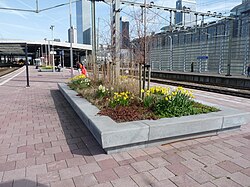
[[File:Bloemperk Rotterdam CS.jpg|thumb|Platform at [[Rotterdam Centraal station]], Netherlands]] | [[File:Bloemperk Rotterdam CS.jpg|thumb|Platform at [[Rotterdam Centraal station]], Netherlands]] | ||
[[File: | [[File:Paris, Arts et Métiers station, line 11.jpg|thumb|Station platforms at [[Arts et Métiers station]] on [[Paris Métro Line 11|Line 11]] of the [[Paris Métro]]]] | ||
A '''railway platform''' is an area alongside a railway [[Track (rail transport)|track]] providing convenient access to trains. | A '''railway platform''' is an area in a [[train station]] alongside a railway [[Track (rail transport)|track]] providing convenient access to trains. Almost all stations have some form of platform, with larger stations having multiple platforms. | ||
The world's longest station platform is at [[ | [[Grand Central Terminal]] in [[Midtown Manhattan|Midtown]] [[Manhattan]] hosts 44 platforms, more than any other [[rail station]] in the world.<ref name=GrandCentralLargestTrainStationWorld>{{cite web|title=10 things we bet you didn't know about Grand Central|publisher=Signum International AG|url=https://www.ef.com/wwen/blog/language/10-things-we-bet-you-didnt-know-about-grand-central/|quote=Grand Central Terminal is spread over 49 acres, has 44 platforms and 67 tracks on two levels. It is the world’s largest train station by number of platforms and area occupied.}}</ref> The world's longest station platform is at [[Hubballi Junction railway station|Hubballi Junction]] in India at {{convert|1507|m}}.<ref name=":0">[http://timesofindia.indiatimes.com/city/lucknow/Gorakhpur-gets-worlds-largest-railway-platform/articleshow/23616764.cms Gorakhpur gets world's largest railway platform] ''The Times of India''</ref> The [[Appalachian Trail station]] or [[Benson station]] in the United States, at the other extreme, has a platform which is only long enough for a single bench.<ref>{{Cite web|url=http://as0.mta.info/mnr/stations/station_detail.cfm?key=167|title=MNR Stations APPALACHIAN TRAIL|website=as0.mta.info|access-date=2018-10-14}}</ref> | ||
Among some | Among some American [[train conductor]]s, the word "platform" has entered [[Conversion (word formation)#Verbification|usage as a verb]] meaning "to berth at a station", as in the announcement: "The last two cars of this train will not platform at East Rockaway".<ref>[https://www.nytimes.com/1986/05/18/nyregion/about-long-island-what-car-of-the-train-is-this.html ''NY Times'' 18 May 1986]</ref> | ||
==Height relative to trains== | ==Height relative to trains== | ||
| Line 30: | Line 31: | ||
| collapsible = no | | collapsible = no | ||
| map = | | map = | ||
vCONTgfaq!~MASKa\-STRq!~ | vCONTgfaq!~MASKa\-STRq!~PLT-\-STRq!~PLT-\-STRq!~PLT-\vCONTgfeq!~MASKa\num1r | ||
vCONTgfaq!~MASKa\-STRq\-STRq\-STRq\vCONTgfeq!~MASKa\num2r | vCONTgfaq!~MASKa\-STRq\-STRq\-STRq\vCONTgfeq!~MASKa\num2r | ||
vCONTfgaq!~MASKa\-STRq!~ | vCONTfgaq!~MASKa\-STRq!~PLT-\-STRq!~PLT-\-STRq!~PLT-\vCONTfgeq!~MASKa\num3r | ||
vCONTfgaq!~MASKa\-STRq\-STRq\-STRq\vCONTfgeq!~MASKa\num4r | vCONTfgaq!~MASKa\-STRq\-STRq\-STRq\vCONTfgeq!~MASKa\num4r | ||
PLT-\PLT-\PLT-\ | |||
| bottom = <div style="width:18em;text-align:center">In US usage, this station would be described as having three platforms and four tracks (Tracks 1—4). In other English-speaking countries, it would be described as having four platforms (Platforms 1—4).</div> | | bottom = <div style="width:18em;text-align:center">In US usage, this station would be described as having three platforms and four tracks (Tracks 1—4). In other English-speaking countries, it would be described as having four platforms (Platforms 1—4).</div> | ||
}} | }} | ||
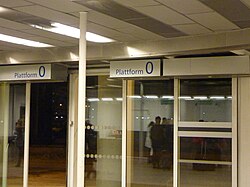
Most stations have their platforms numbered consecutively from 1; a few stations, including {{stnlnk|Cardiff Central}}, {{stnlnk|Haymarket}}, [[London King's Cross railway station|King's Cross]], {{stnlnk|Stockport}}, and {{stnlnk|Gravesend}} (in the UK); and [[Lidcombe railway station|Lidcombe, Sydney]] (Australia), start from 0. At {{stnlnk|Bristol Temple Meads}} platforms 3 through to 12 are split along their length with odd numbered platforms facing north and east and even facing south and west, with a small signal halfway along the platform. Some, such as {{stnlnk|London Waterloo East}}, use letters instead of numbers (this is to distinguish the platforms from numbered ones in the adjoining [[London Waterloo station|Waterloo main-line station]] | Most stations have their platforms numbered consecutively from 1; a few stations, including {{stnlnk|Cardiff Central}}, {{stnlnk|Haymarket}}, [[London King's Cross railway station|King's Cross]], {{stnlnk|Stockport}}, and {{stnlnk|Gravesend}} (in the UK); and [[Lidcombe railway station|Lidcombe, Sydney]] (Australia), start from 0, generally because a new platform has been added next to Platform 1. At {{stnlnk|Bristol Temple Meads}} platforms 3 through to 12 are split along their length, with odd numbered platforms facing north and east and even numbers facing south and west, with a small signal halfway along the platform. Some, such as {{stnlnk|London Waterloo East}}, use letters instead of numbers (this is to distinguish the platforms from numbered ones in the adjoining [[London Waterloo station|Waterloo main-line station]]; some, such as [[Paris-Gare de Lyon]], use letters for one group of platforms but numbers for the other. | ||
The actual meaning of the word platform depends on country and language. In some countries such as the United States, the word platform refers to the physical structure, while the place where a train can arrive is referred to as a "track" (e.g. "The train is arriving on Track 5"). In other countries, such as the UK, Ireland and most Commonwealth countries, platform refers specifically to the place where the train stops, which means that in such a case [[island platform]]s are allocated two separate numbers, one for each side. Some countries are in the process of switching from platform to track numbers, i.e. the Czech Republic and Poland. In locations where track numbers are used, an island platform would be described as one platform with two tracks. Many stations also have numbered tracks which are used only for through traffic and do not have physical platform access. | |||
==Facilities== | ==Facilities== | ||
[[File:Lights of Stasiun Gedebage at Night.jpg|thumb|Station in [[Indonesia]], where the station provides a crossing staircase between platforms for passengers. ]] | |||
Some of the station facilities are often located on the platforms. Where the platforms are not adjacent to a station building, often some form of shelter or [[waiting room]] is provided, and employee cabins may also be present. The weather protection offered varies greatly, from little more than a roof with open sides, to a closed room with heating or air-conditioning. There may be [[Bench (furniture)|bench]]es, [[lighting]], ticket counters, [[drinking fountain]]s, shops, [[waste|trash]] boxes, and static [[Public transport timetable|timetable]]s or [[platform display|dynamic displays]] with information about the next train. | Some of the station facilities are often located on the platforms. Where the platforms are not adjacent to a station building, often some form of shelter or [[waiting room]] is provided, and employee cabins may also be present. The weather protection offered varies greatly, from little more than a roof with open sides, to a closed room with heating or air-conditioning. There may be [[Bench (furniture)|bench]]es, [[lighting]], ticket counters, [[drinking fountain]]s, shops, [[waste|trash]] boxes, and static [[Public transport timetable|timetable]]s or [[platform display|dynamic displays]] with information about the next train. | ||
| Line 49: | Line 51: | ||
Some metro stations have [[platform screen doors]] between the platforms and the tracks. They provide more safety, and they allow the heating or air conditioning in the station to be separated from the ventilation in the tunnel, thus being more efficient and effective. They have been installed in most stations of the [[Singapore]] [[Mass Rapid Transit (Singapore)|MRT]] and the Hong Kong [[MTR]], and stations on the [[Jubilee Line Extension]] in London. | Some metro stations have [[platform screen doors]] between the platforms and the tracks. They provide more safety, and they allow the heating or air conditioning in the station to be separated from the ventilation in the tunnel, thus being more efficient and effective. They have been installed in most stations of the [[Singapore]] [[Mass Rapid Transit (Singapore)|MRT]] and the Hong Kong [[MTR]], and stations on the [[Jubilee Line Extension]] in London. | ||
Platforms should be sloped upwards slightly towards the platform edge to prevent wheeled objects such as trolleys, prams and wheelchairs from rolling away and into the path of the train.{{citation needed|date=June 2012}} Many platforms have a cavity underneath an [[cantilever|overhanging edge]] so that people who may fall off the platform can seek shelter from incoming trains. | Platforms should be sloped upwards slightly towards the platform edge to prevent wheeled objects such as trolleys, prams and wheelchairs from rolling away and into the path of the train.{{citation needed|date=June 2012}} Many platforms have a cavity underneath an [[cantilever|overhanging edge]] so that people who may fall off the platform can seek shelter from incoming trains. | ||
[[File:Pasca S.40 PPKA PWT.jpg|thumb|[[Kereta Api Indonesia|Indonesian railway guard]] ( The one who wears a beret) on guard at the station platform ]] | |||
For security against theft or to secure stowaways, some countries have special security officers stationed at stations, just like the police, but specifically for railways, For example, in [[Indonesia]] and [[Poland]], there are special [[Railway Security Guard|railway security]] officers. | |||
===High-speed rail=== | ===High-speed rail=== | ||
| Line 56: | Line 60: | ||
[[File:Hamburg berlin track platform barriers.jpg|thumb|Platform barriers on the [[Berlin–Hamburg Railway|Berlin-Hamburg high speed line]]]] | [[File:Hamburg berlin track platform barriers.jpg|thumb|Platform barriers on the [[Berlin–Hamburg Railway|Berlin-Hamburg high speed line]]]] | ||
In United Kingdom, a guideline for platform safety specifies that for the platforms with train passing speeds between {{convert|160|kph|mph}} and {{convert|200|kph|mph}}, there should be a yellow-line buffer zone of {{convert|1.5|m|ft}} and other warning signs. If trains can pass at speeds higher than {{convert|200|kph|mph}}, the platforms should be inaccessible to passengers unless there are waiting rooms or screened areas to provide protection.<ref>{{cite book|title=Guidance on Interface between Station Platforms, Track and Trains|date=March 2014|publisher=Rail Safety and Standards Board Limited|edition=2|url=https://www.rssb.co.uk/rgs/standards/GIGN7616%20Iss%202.pdf|access-date=25 April 2017}}</ref> The [[European Union]] has a regulation for platforms that are close to tracks with train passing speeds of {{convert|250|kph|mph}} or more should not be accessible to passengers unless there is a lower speed limit for trains that intend to stop at the station or there are barriers to limit access.<ref>{{cite book|title=2002/732/EC: Commission Decision of 30 May 2002 concerning the technical specification for interoperability relating to the infrastructure subsystem of the trans-European high-speed rail system referred to in Article 6(1) of Council Directive 96/48/EC|date=9 December 2002|publisher=The European Union|pages=143–279|edition=Official Journal L 245|url=http://eur-lex.europa.eu/legal-content/EN/TXT/?uri=celex%3A32002D0732|access-date=26 April 2017}}</ref> | In United Kingdom, a guideline for platform safety specifies that for the platforms with train passing speeds between {{convert|160|kph|mph}} and {{convert|200|kph|mph}}, there should be a yellow-line buffer zone of {{convert|1.5|m|ft}} and other warning signs. If trains can pass at speeds higher than {{convert|200|kph|mph}}, the platforms should be inaccessible to passengers unless there are waiting rooms or screened areas to provide protection.<ref>{{cite book|title=Guidance on Interface between Station Platforms, Track and Trains|date=March 2014|publisher=Rail Safety and Standards Board Limited|edition=2|url=https://www.rssb.co.uk/rgs/standards/GIGN7616%20Iss%202.pdf|access-date=25 April 2017|archive-date=9 September 2016|archive-url=https://web.archive.org/web/20160909194558/http://www.rssb.co.uk/rgs/standards/GIGN7616%20Iss%202.pdf|url-status=dead}}</ref> The [[European Union]] has a regulation for platforms that are close to tracks with train passing speeds of {{convert|250|kph|mph}} or more should not be accessible to passengers unless there is a lower speed limit for trains that intend to stop at the station or there are barriers to limit access.<ref>{{cite book|title=2002/732/EC: Commission Decision of 30 May 2002 concerning the technical specification for interoperability relating to the infrastructure subsystem of the trans-European high-speed rail system referred to in Article 6(1) of Council Directive 96/48/EC|date=9 December 2002|publisher=The European Union|pages=143–279|edition=Official Journal L 245|url=http://eur-lex.europa.eu/legal-content/EN/TXT/?uri=celex%3A32002D0732|access-date=26 April 2017}}</ref><ref>{{cite web|url=https://theindiantrain.blogspot.com/2021/11/platform-locator.html|title=Train Platform Locator|publisher=Indian Train|access-date=26 April 2021}}</ref> | ||
===Markings=== | ===Markings=== | ||
| Line 76: | Line 80: | ||
# [[Hubballi Junction railway station|Hubballi Junction]], [[Karnataka]], India: {{convert|1505|m}}<ref>{{Cite web |title=World's longest railway platform in Hubballi in its final stage of construction |url=https://www.newindianexpress.com/states/karnataka/2021/mar/21/worlds-longest-railway-platform-in-hubballiin-its-final-stage-of-construction-2279648.html |access-date=2022-09-13 |website=The New Indian Express}}</ref> | # [[Hubballi Junction railway station|Hubballi Junction]], [[Karnataka]], India: {{convert|1505|m}}<ref>{{Cite web |title=World's longest railway platform in Hubballi in its final stage of construction |url=https://www.newindianexpress.com/states/karnataka/2021/mar/21/worlds-longest-railway-platform-in-hubballiin-its-final-stage-of-construction-2279648.html |access-date=2022-09-13 |website=The New Indian Express}}</ref> | ||
# {{stnlnk|Gorakhpur Junction}}, [[Uttar Pradesh]], India: {{convert|1,366.33|m|0|abbr=on}}<ref>{{cite news|last=Dinda|first=Archisman|title=Uttar Pradesh gets world's longest railway platform|url=http://gulfnews.com/news/world/india/uttar-pradesh-gets-world-s-longest-railway-platform-1.1241468|access-date=9 October 2013|newspaper=GulfNews.com|date=<!-- 18:53 --> October 9, 2013}}</ref> | # {{stnlnk|Gorakhpur Junction}}, [[Uttar Pradesh]], India: {{convert|1,366.33|m|0|abbr=on}}<ref>{{cite news|last=Dinda|first=Archisman|title=Uttar Pradesh gets world's longest railway platform|url=http://gulfnews.com/news/world/india/uttar-pradesh-gets-world-s-longest-railway-platform-1.1241468|access-date=9 October 2013|newspaper=GulfNews.com|date=<!-- 18:53 --> October 9, 2013}}</ref> | ||
# {{stnlnk|Kollam Junction}}, [[Kerala]], India: {{convert|1,180.5|m|0|abbr=on}}<ref>{{cite web |url= http://www.railnewscenter.com/2015/01/at-glance-longest-railway-platforms-in.html |title=At a glance: Longest railway platforms in India |publisher=Railnewscenter |access-date=25 February 2015 |url-status=dead |archive-url=https://web.archive.org/web/20150225073235/http://www.railnewscenter.com/2015/01/at-glance-longest-railway-platforms-in.html |archive-date=25 February 2015 }}</ref><ref>{{cite web|url=http://www.walkthroughindia.com/walkthroughs/trains/top-6-longest-railway-platforms-india/ |title=The Top 6 Longest Railway Platforms of India |publisher=Walk through India |access-date=25 February 2015}}</ref><ref>{{cite news |url=https://www.independent.co.uk/travel/asia/west-bengal-tea-plantations-and-other-rajera-relics-9835426.html |title=West Bengal: tea plantations and other Raj-era relics |work = The Independent|first = Ben|last = Walsh|date = 2 November 2014}}</ref><ref>{{cite news |url=http://i.imgur.com/v1AEV5k.jpg |title=Malayala Manorama Daily(Kollam Edition 22/02/2015) |access-date= 2015-02-22}}</ref> | # {{stnlnk|Kollam Junction}}, [[Kerala]], India: {{convert|1,180.5|m|0|abbr=on}}<ref>{{cite web |url= http://www.railnewscenter.com/2015/01/at-glance-longest-railway-platforms-in.html |title=At a glance: Longest railway platforms in India |publisher=Railnewscenter |access-date=25 February 2015 |url-status=dead |archive-url=https://web.archive.org/web/20150225073235/http://www.railnewscenter.com/2015/01/at-glance-longest-railway-platforms-in.html |archive-date=25 February 2015 }}</ref><ref>{{cite web |url=http://www.walkthroughindia.com/walkthroughs/trains/top-6-longest-railway-platforms-india/ |title=The Top 6 Longest Railway Platforms of India |publisher=Walk through India |access-date=25 February 2015 }}{{Dead link|date=July 2025 |bot=InternetArchiveBot |fix-attempted=yes }}</ref><ref>{{cite news |url=https://www.independent.co.uk/travel/asia/west-bengal-tea-plantations-and-other-rajera-relics-9835426.html |title=West Bengal: tea plantations and other Raj-era relics |work = The Independent|first = Ben|last = Walsh|date = 2 November 2014}}</ref><ref>{{cite news |url=http://i.imgur.com/v1AEV5k.jpg |title=Malayala Manorama Daily(Kollam Edition 22/02/2015) |access-date= 2015-02-22}}</ref> | ||
# {{rws|Kharagpur Junction}}, [[West Bengal]], India: {{convert|1072.5|m|0|abbr=on}}<ref>{{cite web| url = http://www.irfca.org/faq/faq-trivia.html |title = Trivia|publisher=IRFCA| access-date = 2012-01-21 }}</ref><ref>{{cite web| url = http://www.iloveindia.com/indian-railways/facts.html |title = Indian Railway Facts|publisher=iloveindia| access-date = 2012-01-21 }}</ref> | # {{rws|Kharagpur Junction}}, [[West Bengal]], India: {{convert|1072.5|m|0|abbr=on}}<ref>{{cite web| url = http://www.irfca.org/faq/faq-trivia.html |title = Trivia|publisher=IRFCA| access-date = 2012-01-21 }}</ref><ref>{{cite web | url = http://www.iloveindia.com/indian-railways/facts.html | title = Indian Railway Facts | publisher = iloveindia | access-date = 2012-01-21 | archive-date = 2019-12-30 | archive-url = https://web.archive.org/web/20191230130232/http://www.iloveindia.com/indian-railways/facts.html | url-status = dead }}</ref> | ||
# [[State Street subway|State Street Subway]], [[Chicago]], [[Illinois]], US, {{convert|1067.1|m|0|abbr=on}} | # [[State Street subway|State Street Subway]], [[Chicago]], [[Illinois]], US, {{convert|1067.1|m|0|abbr=on}} | ||
# [[ | # [[Rayagada railway station|Rayagada]], [[Odisha]], India 910 m (2986 ft) | ||
# {{rws|Pilibhit Junction}}, [[Uttar Pradesh]] [[India]] {{convert| | # {{rws|Pilibhit Junction}}, [[Uttar Pradesh]] [[India]] {{convert|855|m|0|abbr=on}} | ||
# [[Auto Club Speedway]] station, [[Fontana, California]], US: {{convert|2675|ft|0|abbr=on}}<ref name="schematics">{{CA rail schematics}}</ref> | # [[Auto Club Speedway]] station, [[Fontana, California]], US: {{convert|2675|ft|0|abbr=on}}<ref name="schematics">{{CA rail schematics}}</ref> | ||
# {{stnlnk|Bilaspur}}, [[Chhattisgarh]], India: {{convert|802|m|0|abbr=on}} | # {{stnlnk|Bilaspur}}, [[Chhattisgarh]], India: {{convert|802|m|0|abbr=on}} | ||
| Line 86: | Line 90: | ||
# {{stnlnk|Bern}}, [[Bern]], Switzerland: {{convert|785|m|0|abbr=on}} | # {{stnlnk|Bern}}, [[Bern]], Switzerland: {{convert|785|m|0|abbr=on}} | ||
# [[Jhansi Junction|Jhansi]], [[Uttar Pradesh]], India: {{convert|770|m|0|abbr=on}} | # [[Jhansi Junction|Jhansi]], [[Uttar Pradesh]], India: {{convert|770|m|0|abbr=on}} | ||
# [[Milwaukee-Dearborn subway|Dearborn Street subway]], [[Chicago]], [[Illinois]], US {{convert|762|m|0|abbr=on}} | # [[Milwaukee-Dearborn subway|Dearborn Street subway]], [[Chicago]], [[Illinois]], US {{convert|762|m|0|abbr=on}} | ||
# {{stnlnk|Sonpur Junction}}, [[Sonepur, Bihar]], India: {{convert|738|m|0|abbr=on}}<ref>{{cite web |url= | # {{stnlnk|Sonpur Junction}}, [[Sonepur, Bihar]], India: {{convert|738|m|0|abbr=on}}<ref>{{cite web |url=https://www.jagran.com/uttar-pradesh/lucknow-city-all-trains-from-gorakhpur-will-be-on-track-from-tomorrow-10779991.html |title=गोरखपुर से ट्रेन का सुचारू संचालन कल से |url-status=live|archive-url=https://web.archive.org/web/20160322230152/http://www.jagran.com/uttar-pradesh/lucknow-city-all-trains-from-gorakhpur-will-be-on-track-from-tomorrow-10779991.html |archive-date=2016-03-22 |language =hi |trans-title=All Trains from Gorakhpur Will Be On Track From Tomorrow|date = 7 October 2013 }}</ref> | ||
# {{stnlnk|Nabadwip Dham}}, [[Nadia district]], West Bengal, India {{convert|720|m|0|abbr=on}} | # {{stnlnk|Nabadwip Dham}}, [[Nadia district]], West Bengal, India {{convert|720|m|0|abbr=on}} | ||
# [[Flinders Street railway station]], [[Melbourne]], Victoria, Australia: {{convert|708|m|0|abbr=on}}<ref>[http://www.gowest.com.au/melbourne-attractions.html Melbourne Crime Tours – Go West Tours Melbourne<!-- Bot generated title -->] {{webarchive |url=https://web.archive.org/web/20120403150453/http://www.gowest.com.au/melbourne-attractions.html |date=April 3, 2012 }}</ref> | # [[Flinders Street railway station]], [[Melbourne]], Victoria, Australia: {{convert|708|m|0|abbr=on}}<ref>[http://www.gowest.com.au/melbourne-attractions.html Melbourne Crime Tours – Go West Tours Melbourne<!-- Bot generated title -->] {{webarchive |url=https://web.archive.org/web/20120403150453/http://www.gowest.com.au/melbourne-attractions.html |date=April 3, 2012 }}</ref> | ||
| Line 98: | Line 101: | ||
===Greatest number of platforms=== | ===Greatest number of platforms=== | ||
#[[Grand Central Terminal]] New York City, US: 44 | #[[Grand Central Terminal]], New York City, US: 44 | ||
#[[Gare du Nord]], France: 35 (31 above ground level + 4 underground) | #[[Ōsaka Station|Ōsaka]] / [[Umeda Station]], Japan: 36 <ref>Including Ōsaka, Umeda, Ōsaka-Umeda, [[Higashi-Umeda Station|Higashi-Umeda]], [[Nishi-Umeda Station|Nishi-Umeda]], and [[Kitashinchi Station|Kitashinchi]] Stations. [[West Japan Railway Company|JR West]]: 17 {{Cite web|title=駅情報(大阪駅) 構内図|url=https://www.jr-odekake.net/eki/premises?id=0610130|access-date=2025-05-21}} {{Cite web|title=駅情報(北新地駅) 構内図|url=https://www.jr-odekake.net/eki/premises?id=0612303|access-date=2025-05-21}}, [[Hankyu]]: 9 {{Cite web|title=大阪梅田駅 構内図|url=https://www.hankyu.co.jp/station/umeda_map.html|access-date=2025-05-21}}, [[Osaka Metro]]: 6 {{Cite web|title=梅田 駅構内図|url=https://subway.osakametro.co.jp/station_guide/m/m16/|access-date=2025-05-21}} {{Cite web|title=東梅田 駅構内図|url=https://subway.osakametro.co.jp/station_guide/T/t20/|access-date=2025-05-21}} {{Cite web|title=西梅田 駅構内図|url=https://subway.osakametro.co.jp/station_guide/Y/y11/|access-date=2025-05-21}}, [[Hanshin Electric Railway|Hanshin]]: 4 {{Cite web|title=大阪梅田駅 構内案内図|url=https://www.hanshin.co.jp/uploads/guidemap/umeda.pdf|access-date=2025-05-21}}</ref> | ||
#[[Gare du Nord]], Paris, France: 35 (31 above ground level + 4 underground) | |||
#[[Shinjuku Station]], Tokyo, Japan: 35 <ref>Including Shinjuku, [[Seibu-Shinjuku Station|Seibu-Shinjuku]], and [[Shinjuku-nishiguchi Station|Shinjuku-nishiguchi]] Stations. The platforms for drop-off only are not counted. [[East Japan Railway Company|JR East]]: 16 {{Cite web|title=新宿駅の構内図・バリアフリー情報|url=https://www.jreast.co.jp/estation/stations/866.html|access-date=2025-05-21}}, [[Odakyu Electric Railway|Odakyu]]: 5 {{Cite web|title=新宿駅 ホーム図・駅構内図|url=https://www.odakyu.jp/station/shinjuku/homeview/|access-date=2025-05-21}}, [[Keio Corporation|Keio]] / [[Toei Subway]] ([[Toei Shinjuku Line|Shinjuku Line]]): 5 {{Cite web|title=新宿駅 駅構内施設|url=https://www.keio.co.jp/train/station/ko01_shinjuku/|access-date=2025-05-21}}, Toei Subway ([[Toei Ōedo Line|Ōedo Line]]): 4 {{Cite web|title=各駅情報 新宿|url=https://www.kotsu.metro.tokyo.jp/subway/stations/shinjuku.html|access-date=2025-05-21}} {{Cite web|title=各駅情報 新宿西口|url=https://www.kotsu.metro.tokyo.jp/subway/stations/shinjuku-nishiguchi.html|access-date=2025-05-21}}, [[Seibu Railway|Seibu]]: 3 {{Cite web|title=駅の情報・路線図 西武新宿駅|url=https://www.seiburailway.jp/railway/station/seibu-shinjuku/|access-date=2025-05-21}}, [[Tokyo Metro]]: 2 {{Cite web|title=路線・駅の情報 新宿駅|url=https://www.tokyometro.jp/station/shinjuku/index.html|access-date=2025-05-21}}</ref> | |||
#[[Munich Central Station]], Germany: 34 (32 above ground level + 2 underground) | #[[Munich Central Station]], Germany: 34 (32 above ground level + 2 underground) | ||
#[[London Waterloo station]], United Kingdom: 32 (24 [[National Rail|mainline]]<ref>{{Cite web |title=London Waterloo - Facilities, Shops and Parking Information |url=https://www.networkrail.co.uk/communities/passengers/our-stations/london-waterloo/ |access-date=2022-10-16 |website=www.networkrail.co.uk}}</ref> and 8 at [[Waterloo tube station]]<ref>{{Cite web |last= |first= |title=Waterloo Underground Station |url=https://tfl.gov.uk/tube/stop/940GZZLUWLO/waterloo-underground-station |access-date=2022-10-16 |website=Transport for London |language=en-GB}}</ref>) | |||
#[[Frankfurt (Main) Hauptbahnhof]], Germany: 31 (24 above ground level + 7 underground) | |||
#[[Chicago Union Station]], US: 30 | #[[Chicago Union Station]], US: 30 | ||
#{{stnlnk|Zhengzhou East}}, China: 30 | #{{stnlnk|Zhengzhou East}}, China: 30 | ||
#[[Central railway station, Sydney|Central railway station]] Sydney, Australia: | #[[Tokyo Station]], Japan: 30 <ref>[[East Japan Railway Company|JR East]]: 22 {{Cite web|title=東京駅の構内図・バリアフリー情報|url=https://www.jreast.co.jp/estation/stations/1039.html|access-date=2025-05-21}}, [[Central Japan Railway Company|JR Central]]: 6 {{Cite web|title=東京駅 駅構内図|url=https://railway.jr-central.co.jp/station-guide/shinkansen/tokyo/map.html|access-date=2025-05-21}}, [[Tokyo Metro]]: 2 {{Cite web|title=路線・駅の情報 東京駅|url=https://www.tokyometro.jp/station/tokyo/index.html|access-date=2025-05-21}}</ref> | ||
#{{stnlnk|Howrah}}, India : 28 (24 for the railway station and 4 for [[Howrah metro station]]) | |||
#[[Nagoya Station]], Japan: 27 <ref>Including Nagoya, [[Meitetsu Nagoya Station|Meitetsu Nagoya]], and [[Kintetsu Nagoya Station|Kintetsu Nagoya]] Stations. The platforms for drop-off only are not counted. [[Central Japan Railway Company|JR Central]]: 15 {{Cite web|title=名古屋駅 駅構内図|url=https://railway.jr-central.co.jp/station-guide/shinkansen/nagoya/map.html|access-date=2025-05-21}}, [[Nagoya Municipal Subway]]: 4, [[Kintetsu Railway|Kintetsu]]: 4 {{Cite web|title=駅構内図 近鉄名古屋駅|url=https://www.kintetsu.co.jp/soukatsu/kounai/nagoya.html|access-date=2025-05-21}}, [[Meitetsu]]: 2 {{Cite web|title=各駅詳細情報 名鉄名古屋|url=https://www.meitetsu.co.jp/train/station_info/line01/station/1201.html|access-date=2025-05-21}}, [[Aonami Line]]: 2 {{Cite web|title=駅・時刻表 AN01-名古屋駅|url=https://www.aonamiline.co.jp/train/an01-nagoya|access-date=2025-05-21}}</ref> | |||
#[[Central railway station, Sydney|Central railway station]], Sydney, Australia: 26 (22 above ground level + 4 underground) | |||
#[[Zürich Hauptbahnhof]], Switzerland: 26 (16 above ground level + 10 underground) | #[[Zürich Hauptbahnhof]], Switzerland: 26 (16 above ground level + 10 underground) | ||
#[[ | #[[Krung Thep Aphiwat Central Terminal]] (Bang Sue Grand Central), Bangkok, Thailand: 26 (24 for the railway station and 2 for [[Blue Line (Bangkok)|MRT Blue Line]], 12 platforms are currently out of use) | ||
#[[Ueno Station]], Tokyo, Japan: 25 <ref>[[East Japan Railway Company|JR East]]: 21 {{Cite web|title=上野駅の構内図・バリアフリー情報|url=https://www.jreast.co.jp/estation/stations/204.html|access-date=2025-05-21}}, [[Tokyo Metro]]: 4 {{Cite web|title=路線・駅の情報 上野駅|url=https://www.tokyometro.jp/station/ueno/index.html|access-date=2025-05-21}}</ref> | |||
#{{stnlnk| | #[[Kyoto Station]], Japan: 25 <ref>[[West Japan Railway Company|JR West]]: 15 {{Cite web|title=駅情報(京都駅) 構内図|url=https://www.jr-odekake.net/eki/premises?id=0610116|access-date=2025-05-21}}, [[Central Japan Railway Company|JR Central]]: 4 {{Cite web|title=京都駅 駅構内図|url=https://railway.jr-central.co.jp/station-guide/shinkansen/kyoto/map.html|access-date=2025-05-21}}, [[Kintetsu Group Holdings|Kintetsu]] 4 {{Cite web|title=駅構内図 京都駅|url=https://www.kintetsu.co.jp/soukatsu/kounai/kyoto.html|access-date=2025-05-21}}, [[Kyoto Municipal Subway]]: 2 {{Cite web|title=地下鉄駅構内図 京都駅|url=https://www2.city.kyoto.lg.jp/kotsu/tikadia/img/map/sta/pdf/k11map.pdf|access-date=2025-05-21}}</ref> | ||
#{{stnlnk|Sealdah}}, India: 25 (21 for the railway station and 4 for [[Sealdah metro station]]) | |||
#[[Leipzig Hauptbahnhof]], Germany: 24 | |||
== See also == | == See also == | ||
| Line 140: | Line 152: | ||
{{Rail tracks}} | {{Rail tracks}} | ||
{{Railway_track_layouts}} | {{Railway_track_layouts}} | ||
{{Authority control}} | |||
[[Category:Railway platforms| ]] | [[Category:Railway platforms| ]] | ||
[[Category:Railway stations| Platform]] | [[Category:Railway stations| Platform]] | ||
Latest revision as of 09:19, 23 February 2026


A railway platform is an area in a train station alongside a railway track providing convenient access to trains. Almost all stations have some form of platform, with larger stations having multiple platforms.
Grand Central Terminal in Midtown Manhattan hosts 44 platforms, more than any other rail station in the world.[1] The world's longest station platform is at Hubballi Junction in India at 1,507 metres (4,944 ft).[2] The Appalachian Trail station or Benson station in the United States, at the other extreme, has a platform which is only long enough for a single bench.[3]
Among some American train conductors, the word "platform" has entered usage as a verb meaning "to berth at a station", as in the announcement: "The last two cars of this train will not platform at East Rockaway".[4]
Height relative to trains[edit | edit source]
The most basic form of platform consists of an area at the same level as the track, usually resulting in a fairly large height difference between the platform and the train floor. This would often not be considered a true platform. The more traditional platform is elevated relative to the track but often lower than the train floor, although ideally they should be at the same level. Occasionally the platform is higher than the train floor, where a train with a low floor serves a station built for trains with a high floor, for example at the Dutch stations of the DB Regionalbahn Westfalen (see Enschede). On the London Underground some stations are served by both District line and Piccadilly line trains, and the Piccadilly trains have lower floors.
A tram stop is often in the middle of the street; usually it has as a platform a refuge area of a similar height to that of the sidewalk, e.g. 100 mm (4 in), and sometimes has no platform. The latter requires extra care by passengers and other traffic to avoid accidents. Both types of tram stops can be seen in the tram networks of Melbourne and Toronto. Sometimes a tram stop is served by ordinary trams with rather low floors and metro-like light rail vehicles with higher floors, and the tram stop has a dual-height platform. A railway station may be served by heavy-rail and light-rail vehicles with lower floors and have a dual- height platform, as on the RijnGouweLijn in the Netherlands.
In all cases the platform must accommodate the loading gauge and conform to the structure gauge of the system.
Types of platform[edit | edit source]


Platform types include the bay platform, side platform (also called through platform), split platform and island platform. A bay platform is one at which the track terminates, i.e. a dead-end or siding. Trains serving a bay platform must reverse in or out. A side platform is the more usual type, alongside tracks where the train arrives from one end and leaves towards the other. An island platform has through platforms on both sides; it may be indented on one or both ends, with bay platforms. To reach an island platform there may be a bridge, a tunnel, or a level crossing. A variant on the side platform is the spanish solution which has platforms on both sides of a single through track.
Modern station platforms can be constructed from a variety of materials such as glass-reinforced polymer, pre-cast concrete or expanded polystrene, depending on the underlying substructure.
Identification[edit | edit source]
Designated platforms or tracks | ||||||||||||||||||||||||||||||||||||||||||
|---|---|---|---|---|---|---|---|---|---|---|---|---|---|---|---|---|---|---|---|---|---|---|---|---|---|---|---|---|---|---|---|---|---|---|---|---|---|---|---|---|---|---|
| ||||||||||||||||||||||||||||||||||||||||||
In US usage, this station would be described as having three platforms and four tracks (Tracks 1—4). In other English-speaking countries, it would be described as having four platforms (Platforms 1—4).
| ||||||||||||||||||||||||||||||||||||||||||


Most stations have their platforms numbered consecutively from 1; a few stations, including Cardiff Central, Haymarket, King's Cross, Stockport, and Gravesend (in the UK); and Lidcombe, Sydney (Australia), start from 0, generally because a new platform has been added next to Platform 1. At Bristol Temple Meads platforms 3 through to 12 are split along their length, with odd numbered platforms facing north and east and even numbers facing south and west, with a small signal halfway along the platform. Some, such as London Waterloo East, use letters instead of numbers (this is to distinguish the platforms from numbered ones in the adjoining Waterloo main-line station; some, such as Paris-Gare de Lyon, use letters for one group of platforms but numbers for the other.
The actual meaning of the word platform depends on country and language. In some countries such as the United States, the word platform refers to the physical structure, while the place where a train can arrive is referred to as a "track" (e.g. "The train is arriving on Track 5"). In other countries, such as the UK, Ireland and most Commonwealth countries, platform refers specifically to the place where the train stops, which means that in such a case island platforms are allocated two separate numbers, one for each side. Some countries are in the process of switching from platform to track numbers, i.e. the Czech Republic and Poland. In locations where track numbers are used, an island platform would be described as one platform with two tracks. Many stations also have numbered tracks which are used only for through traffic and do not have physical platform access.
Facilities[edit | edit source]

Some of the station facilities are often located on the platforms. Where the platforms are not adjacent to a station building, often some form of shelter or waiting room is provided, and employee cabins may also be present. The weather protection offered varies greatly, from little more than a roof with open sides, to a closed room with heating or air-conditioning. There may be benches, lighting, ticket counters, drinking fountains, shops, trash boxes, and static timetables or dynamic displays with information about the next train.
There are often loudspeakers as part of a public address (PA) system. The PA system is often used where dynamic timetables or electronic displays are not present. A variety of information is presented, including destinations and times (for all trains, or only the more important long-distance trains), delays, cancellations, platform changes, changes in routes and destinations, the number of carriages in the train and the location of first class or luggage compartments, and supplementary fee or reservation requirements.
Safety[edit | edit source]
Some metro stations have platform screen doors between the platforms and the tracks. They provide more safety, and they allow the heating or air conditioning in the station to be separated from the ventilation in the tunnel, thus being more efficient and effective. They have been installed in most stations of the Singapore MRT and the Hong Kong MTR, and stations on the Jubilee Line Extension in London.
Platforms should be sloped upwards slightly towards the platform edge to prevent wheeled objects such as trolleys, prams and wheelchairs from rolling away and into the path of the train.[citation needed] Many platforms have a cavity underneath an overhanging edge so that people who may fall off the platform can seek shelter from incoming trains.

For security against theft or to secure stowaways, some countries have special security officers stationed at stations, just like the police, but specifically for railways, For example, in Indonesia and Poland, there are special railway security officers.
High-speed rail[edit | edit source]
In high-speed rail, passing trains are a significant safety problem as the safe distance from the platform edge increases with the speed of the passing train. A study done by the United States Department of Transportation in 1999 found that trains passing station platforms at speeds of 240 kilometres per hour (150 mph) can pose safety concerns to passengers on the platforms who are 2 metres (6.6 ft) away from the edge due to the aerodynamic effects created by pressure and induced airflow with speeds of 64 kilometres per hour (40 mph) to 95 kilometres per hour (59 mph) depending on the train body aerodynamic designs. Additionally, the airflow can cause debris to be blown out to the waiting passengers. If the passengers stand closer at 1 metre (3.3 ft), the risk increases with airflow that can reach speeds of 79 kilometres per hour (49 mph) to 116 kilometres per hour (72 mph).[5]

In United Kingdom, a guideline for platform safety specifies that for the platforms with train passing speeds between 160 kilometres per hour (99 mph) and 200 kilometres per hour (120 mph), there should be a yellow-line buffer zone of 1.5 metres (4.9 ft) and other warning signs. If trains can pass at speeds higher than 200 kilometres per hour (120 mph), the platforms should be inaccessible to passengers unless there are waiting rooms or screened areas to provide protection.[6] The European Union has a regulation for platforms that are close to tracks with train passing speeds of 250 kilometres per hour (160 mph) or more should not be accessible to passengers unless there is a lower speed limit for trains that intend to stop at the station or there are barriers to limit access.[7][8]
Markings[edit | edit source]

Platforms usually have some form of warnings or measures to keep passengers away from the tracks. The simplest measure is markings near the edge of the platform to demarcate the distance back that passengers should remain. Often a special tiled surface is used as well as a painted line, to help blind people using a walking aid, and help in preventing wheelchairs from rolling too near the platform edge.
In the US, Americans with Disabilities Act of 1990 regulations require a detectable warning strip 24 inches (61 cm) wide, consisting of truncated dome bumps in a visually-contrasting color, for the full length of the platform.[9]
Curvature[edit | edit source]
Ideally platforms should be straight or slightly convex, so that the guard (if any) can see the whole train when preparing to close the doors. Platforms that have great curvature have blind spots that create a safety hazard. Mirrors or closed-circuit cameras may be used in these cases to view the whole platform. Also passenger carriages are straight, so doors will not always open directly onto a curved platform – often a platform gap is present. Usually such platforms will have warning signs, possibly auditory, such as London Underground's famous phrase "Mind the gap".
There may be moveable gap filler sections within the platform, extending once the train has stopped and retracting after the doors have closed. The New York City Subway employs these at 14th Street–Union Square on the IRT Lexington Avenue Line and at Times Square on the 42nd Street Shuttle, and formerly at the South Ferry outer loop station on the IRT Broadway–Seventh Avenue Line.
Notable examples[edit | edit source]
Longest railway platforms[edit | edit source]

- Hubballi Junction, Karnataka, India: 1,505 metres (4,938 ft)[10]
- Gorakhpur Junction, Uttar Pradesh, India: 1,366.33 m (4,483 ft)[11]
- Kollam Junction, Kerala, India: 1,180.5 m (3,873 ft)[12][13][14][15]
- Kharagpur Junction, West Bengal, India: 1,072.5 m (3,519 ft)[16][17]
- State Street Subway, Chicago, Illinois, US, 1,067.1 m (3,501 ft)
- Rayagada, Odisha, India 910 m (2986 ft)
- Pilibhit Junction, Uttar Pradesh India 855 m (2,805 ft)
- Auto Club Speedway station, Fontana, California, US: 2,675 ft (815 m)[18]
- Bilaspur, Chhattisgarh, India: 802 m (2,631 ft)
- Cheriton Shuttle Terminal, Kent, United Kingdom: 791 m (2,595 ft) (longest in Europe)
- Bern, Bern, Switzerland: 785 m (2,575 ft)
- Jhansi, Uttar Pradesh, India: 770 m (2,526 ft)
- Dearborn Street subway, Chicago, Illinois, US 762 m (2,500 ft)
- Sonpur Junction, Sonepur, Bihar, India: 738 m (2,421 ft)[19]
- Nabadwip Dham, Nadia district, West Bengal, India 720 m (2,362 ft)
- Flinders Street railway station, Melbourne, Victoria, Australia: 708 m (2,323 ft)[20]
- Port Pirie (Mary Elie Street) railway station, South Australia: 701 m (2,300 ft)[21]
- Sittard railway station, Netherlands: 700 m (2,297 ft)
- 's-Hertogenbosch railway station, Netherlands: 699 m (2,293 ft)
- Nijmegen, Netherlands: 699 m (2,293 ft)
Greatest number of platforms[edit | edit source]
- Grand Central Terminal, New York City, US: 44
- Ōsaka / Umeda Station, Japan: 36 [22]
- Gare du Nord, Paris, France: 35 (31 above ground level + 4 underground)
- Shinjuku Station, Tokyo, Japan: 35 [23]
- Munich Central Station, Germany: 34 (32 above ground level + 2 underground)
- London Waterloo station, United Kingdom: 32 (24 mainline[24] and 8 at Waterloo tube station[25])
- Frankfurt (Main) Hauptbahnhof, Germany: 31 (24 above ground level + 7 underground)
- Chicago Union Station, US: 30
- Zhengzhou East, China: 30
- Tokyo Station, Japan: 30 [26]
- Howrah, India : 28 (24 for the railway station and 4 for Howrah metro station)
- Nagoya Station, Japan: 27 [27]
- Central railway station, Sydney, Australia: 26 (22 above ground level + 4 underground)
- Zürich Hauptbahnhof, Switzerland: 26 (16 above ground level + 10 underground)
- Krung Thep Aphiwat Central Terminal (Bang Sue Grand Central), Bangkok, Thailand: 26 (24 for the railway station and 2 for MRT Blue Line, 12 platforms are currently out of use)
- Ueno Station, Tokyo, Japan: 25 [28]
- Kyoto Station, Japan: 25 [29]
- Sealdah, India: 25 (21 for the railway station and 4 for Sealdah metro station)
- Leipzig Hauptbahnhof, Germany: 24
See also[edit | edit source]
References[edit | edit source]
- ↑ "10 things we bet you didn't know about Grand Central". Signum International AG.
Grand Central Terminal is spread over 49 acres, has 44 platforms and 67 tracks on two levels. It is the world's largest train station by number of platforms and area occupied.
- ↑ Gorakhpur gets world's largest railway platform The Times of India
- ↑ "MNR Stations APPALACHIAN TRAIL". as0.mta.info. Retrieved 2018-10-14.
- ↑ NY Times 18 May 1986
- ↑ Lee, Harvey Shui-Hong (December 1999). Assessment of Potential Aerodynamic Effects on Personnel and Equipment in Proximity to High-Speed Train Operations (PDF). United States Department of Transportation. Retrieved 25 April 2017.
- ↑ Guidance on Interface between Station Platforms, Track and Trains (PDF) (2 ed.). Rail Safety and Standards Board Limited. March 2014. Archived from the original (PDF) on 9 September 2016. Retrieved 25 April 2017.
- ↑ 2002/732/EC: Commission Decision of 30 May 2002 concerning the technical specification for interoperability relating to the infrastructure subsystem of the trans-European high-speed rail system referred to in Article 6(1) of Council Directive 96/48/EC (Official Journal L 245 ed.). The European Union. 9 December 2002. pp. 143–279. Retrieved 26 April 2017.
- ↑ "Train Platform Locator". Indian Train. Retrieved 26 April 2021.
- ↑ 2010 ADA Standards Archived 2016-11-18 at the Wayback Machine, US Department of Justice, Sections 710.5, 810
- ↑ "World's longest railway platform in Hubballi in its final stage of construction". The New Indian Express. Retrieved 2022-09-13.
- ↑ Dinda, Archisman (October 9, 2013). "Uttar Pradesh gets world's longest railway platform". GulfNews.com. Retrieved 9 October 2013.
- ↑ "At a glance: Longest railway platforms in India". Railnewscenter. Archived from the original on 25 February 2015. Retrieved 25 February 2015.
- ↑ "The Top 6 Longest Railway Platforms of India". Walk through India. Retrieved 25 February 2015.[permanent dead link]
- ↑ Walsh, Ben (2 November 2014). "West Bengal: tea plantations and other Raj-era relics". The Independent.
- ↑ "Malayala Manorama Daily(Kollam Edition 22/02/2015)". Retrieved 2015-02-22.
- ↑ "Trivia". IRFCA. Retrieved 2012-01-21.
- ↑ "Indian Railway Facts". iloveindia. Archived from the original on 2019-12-30. Retrieved 2012-01-21.
- ↑ Template:CA rail schematics
- ↑ "गोरखपुर से ट्रेन का सुचारू संचालन कल से" [All Trains from Gorakhpur Will Be On Track From Tomorrow] (in हिन्दी). 7 October 2013. Archived from the original on 2016-03-22.
- ↑ Melbourne Crime Tours – Go West Tours Melbourne Archived April 3, 2012, at the Wayback Machine
- ↑ "News" Railway Gazette 18 August 1967 page 603
- ↑ Including Ōsaka, Umeda, Ōsaka-Umeda, Higashi-Umeda, Nishi-Umeda, and Kitashinchi Stations. JR West: 17 "駅情報(大阪駅) 構内図". Retrieved 2025-05-21. "駅情報(北新地駅) 構内図". Retrieved 2025-05-21., Hankyu: 9 "大阪梅田駅 構内図". Retrieved 2025-05-21., Osaka Metro: 6 "梅田 駅構内図". Retrieved 2025-05-21. "東梅田 駅構内図". Retrieved 2025-05-21. "西梅田 駅構内図". Retrieved 2025-05-21., Hanshin: 4 "大阪梅田駅 構内案内図" (PDF). Retrieved 2025-05-21.
- ↑ Including Shinjuku, Seibu-Shinjuku, and Shinjuku-nishiguchi Stations. The platforms for drop-off only are not counted. JR East: 16 "新宿駅の構内図・バリアフリー情報". Retrieved 2025-05-21., Odakyu: 5 "新宿駅 ホーム図・駅構内図". Retrieved 2025-05-21., Keio / Toei Subway (Shinjuku Line): 5 "新宿駅 駅構内施設". Retrieved 2025-05-21., Toei Subway (Ōedo Line): 4 "各駅情報 新宿". Retrieved 2025-05-21. "各駅情報 新宿西口". Retrieved 2025-05-21., Seibu: 3 "駅の情報・路線図 西武新宿駅". Retrieved 2025-05-21., Tokyo Metro: 2 "路線・駅の情報 新宿駅". Retrieved 2025-05-21.
- ↑ "London Waterloo - Facilities, Shops and Parking Information". www.networkrail.co.uk. Retrieved 2022-10-16.
- ↑ "Waterloo Underground Station". Transport for London. Retrieved 2022-10-16.
- ↑ JR East: 22 "東京駅の構内図・バリアフリー情報". Retrieved 2025-05-21., JR Central: 6 "東京駅 駅構内図". Retrieved 2025-05-21., Tokyo Metro: 2 "路線・駅の情報 東京駅". Retrieved 2025-05-21.
- ↑ Including Nagoya, Meitetsu Nagoya, and Kintetsu Nagoya Stations. The platforms for drop-off only are not counted. JR Central: 15 "名古屋駅 駅構内図". Retrieved 2025-05-21., Nagoya Municipal Subway: 4, Kintetsu: 4 "駅構内図 近鉄名古屋駅". Retrieved 2025-05-21., Meitetsu: 2 "各駅詳細情報 名鉄名古屋". Retrieved 2025-05-21., Aonami Line: 2 "駅・時刻表 AN01-名古屋駅". Retrieved 2025-05-21.
- ↑ JR East: 21 "上野駅の構内図・バリアフリー情報". Retrieved 2025-05-21., Tokyo Metro: 4 "路線・駅の情報 上野駅". Retrieved 2025-05-21.
- ↑ JR West: 15 "駅情報(京都駅) 構内図". Retrieved 2025-05-21., JR Central: 4 "京都駅 駅構内図". Retrieved 2025-05-21., Kintetsu 4 "駅構内図 京都駅". Retrieved 2025-05-21., Kyoto Municipal Subway: 2 "地下鉄駅構内図 京都駅" (PDF). Retrieved 2025-05-21.

External links[edit | edit source]
- "Emplacementstekeningen NS". www.sporenplan.nl (in Nederlands). Schematic maps of all tracks, junctionsswitches and platforms in the Netherlands (point at an area and open detail map in a new window)
- "Train Station Page". www.railway-technical.com. Railway Technical Web Pages. Platforms. Archived from the original on 2007-06-09. (UK-centric information)