
>CommonsDelinker Removing Idumban.png, it has been deleted from Commons by JuTa because: Source of derivative work not specified since 1 February 2020. |
improved intro after review to improve readability |
||
| Line 1: | Line 1: | ||
{{ | {{Infobox deity | ||
| type = Hindu | |||
| name = Idumban | |||
| image = Lord Idumban lineart.jpg | |||
{{ | | caption = Modern representation of Idumban | ||
| venerated_in = [[Kaumaram]] | |||
| texts = [[Skanda Purana|Kanda Puranam]] | |||
| affiliation = [[Asura]] | |||
}}{{Short description|Hindu mythological character}} | |||
'''Idumban''' | '''Idumban''' ({{Langx|ta|இடும்பன்|translit=Iṭumpaṉ}}) is an [[asura]] in [[Hinduism]], featured in [[Tamil mythology]]. Idumban is described to be a devotee of the deity [[Murugan]] (Kartikeya), regarded by adherents to be a guardian of the deity's temples in [[Tamil Nadu]]. He is also associated with the ritual practice of the [[Kavadi Attam|Kavadi Aattam]], in which his veneration is regarded to be a prerequisite.<ref>{{Cite book |last=Gajrani |first=S. |url=https://books.google.com/books?id=zh6z0nuIjAgC&pg=PA222 |title=History, Religion and Culture of India |date=2004 |publisher=Gyan Publishing House |isbn=978-81-8205-061-7 |pages=222 |language=en}}</ref> | ||
== | ==Legend== | ||
Sage [[Agastya]] wanted | {{Kaumaram}}According to legend, Sage [[Agastya]] wanted two hills, Shivagiri and Shaktigiri, to be transported to his abode in the south, and commissioned his disciple, the asura Idumban, to carry them. Idumban bore the hills slung across his shoulders by inventing a tool called the kavadi. The tool was made of the staff of [[Brahma]], which was employed as a pole, and two divine serpents, which were employed as ropes. When he became fatigued after carrying the hills, he placed the kavadi near [[Palani]] to recuperate. Meanwhile, Murugan, having journeyed to Palani after losing the [[Jnana Palam|jnana palam]] (fruit of wisdom) to [[Ganesha]], claimed the hills as his own. Unable to lift the hills and resume his journey, Idumban confronted the deity. In the combat that ensued, Idumban was slain,<ref>{{Cite book |last=Handelman |first=Don |url=https://books.google.com/books?id=bWJTAQAAQBAJ&dq=Idumban+asura&pg=PA31 |title=One God, Two Goddesses, Three Studies of South Indian Cosmology |date=2013-09-25 |publisher=BRILL |isbn=978-90-04-25739-9 |pages=301 |language=en}}</ref> but was resurrected on the intercession of his wife, Idumbi, as well as Agastya. Restored to life, Idumban wished to serve for perpetuity as the [[dvarapala]] (door-guardian) of Murugan's shrine. The deity declared that Idumban would stand guard at the foot of the hill, and proclaimed that every devotee who worshipped him at the site would first venerate his dvarapala.<ref>{{Cite book |last=Belle |first=Carl Vadivella |url=https://books.google.com/books?id=kB1qDwAAQBAJ&dq=idumban&pg=PT201 |title=Thaipusam in Malaysia |date=2018-02-14 |publisher=Flipside Digital Content Company Inc. |isbn=978-981-4786-66-9 |pages=201 |language=en}}</ref> | ||
==Gallery== | |||
<gallery> | |||
File:Kaduveividuhi idumban3.jpg|Idumban at Kaduveividuhi | |||
File:Idumban 01.jpg|Image of Idumban | |||
File:SRILANGA DEVOTEES CAME KADUVETTIVIDUTHY IDUMBAN TEMPLE.jpg|Devotees from Sri Lanka come to the Kaduvettividuthy Murugan Temple, Kaduvettividuthy, Tamil Nadu. | |||
File:Kaduveividuhi idumban4.jpg|Idumban at Kaduveividuhi | |||
File:Kaduveividuhi idumban2.jpg|Idumban at Kaduveividuhi | |||
</gallery> | |||
==References== | ==References== | ||
<!--- See [[ | <!--- See [[Bharatpedia:Footnotes]] on how to create references using <ref></ref> tags which will then appear here automatically --> | ||
{{Reflist|30em}} | {{Reflist|30em}} | ||
[[Category:Kaumaram]] | [[Category:Kaumaram]] | ||
[[Category: | [[Category:Asura]] | ||
Latest revision as of 21:31, 2 May 2025
| Idumban | |
|---|---|
 Modern representation of Idumban | |
| Venerated in | Kaumaram |
| Affiliation | Asura |
| Texts | Kanda Puranam |
Idumban (Script error: The function "langx" does not exist.) is an asura in Hinduism, featured in Tamil mythology. Idumban is described to be a devotee of the deity Murugan (Kartikeya), regarded by adherents to be a guardian of the deity's temples in Tamil Nadu. He is also associated with the ritual practice of the Kavadi Aattam, in which his veneration is regarded to be a prerequisite.[1]
Legend[edit | edit source]
| Part of the series on |
| Kaumaram |
|---|
 |
According to legend, Sage Agastya wanted two hills, Shivagiri and Shaktigiri, to be transported to his abode in the south, and commissioned his disciple, the asura Idumban, to carry them. Idumban bore the hills slung across his shoulders by inventing a tool called the kavadi. The tool was made of the staff of Brahma, which was employed as a pole, and two divine serpents, which were employed as ropes. When he became fatigued after carrying the hills, he placed the kavadi near Palani to recuperate. Meanwhile, Murugan, having journeyed to Palani after losing the jnana palam (fruit of wisdom) to Ganesha, claimed the hills as his own. Unable to lift the hills and resume his journey, Idumban confronted the deity. In the combat that ensued, Idumban was slain,[2] but was resurrected on the intercession of his wife, Idumbi, as well as Agastya. Restored to life, Idumban wished to serve for perpetuity as the dvarapala (door-guardian) of Murugan's shrine. The deity declared that Idumban would stand guard at the foot of the hill, and proclaimed that every devotee who worshipped him at the site would first venerate his dvarapala.[3]
Gallery[edit | edit source]
-
 Idumban at Kaduveividuhi
 -
 Image of Idumban
 -
 Devotees from Sri Lanka come to the Kaduvettividuthy Murugan Temple, Kaduvettividuthy, Tamil Nadu.
 -
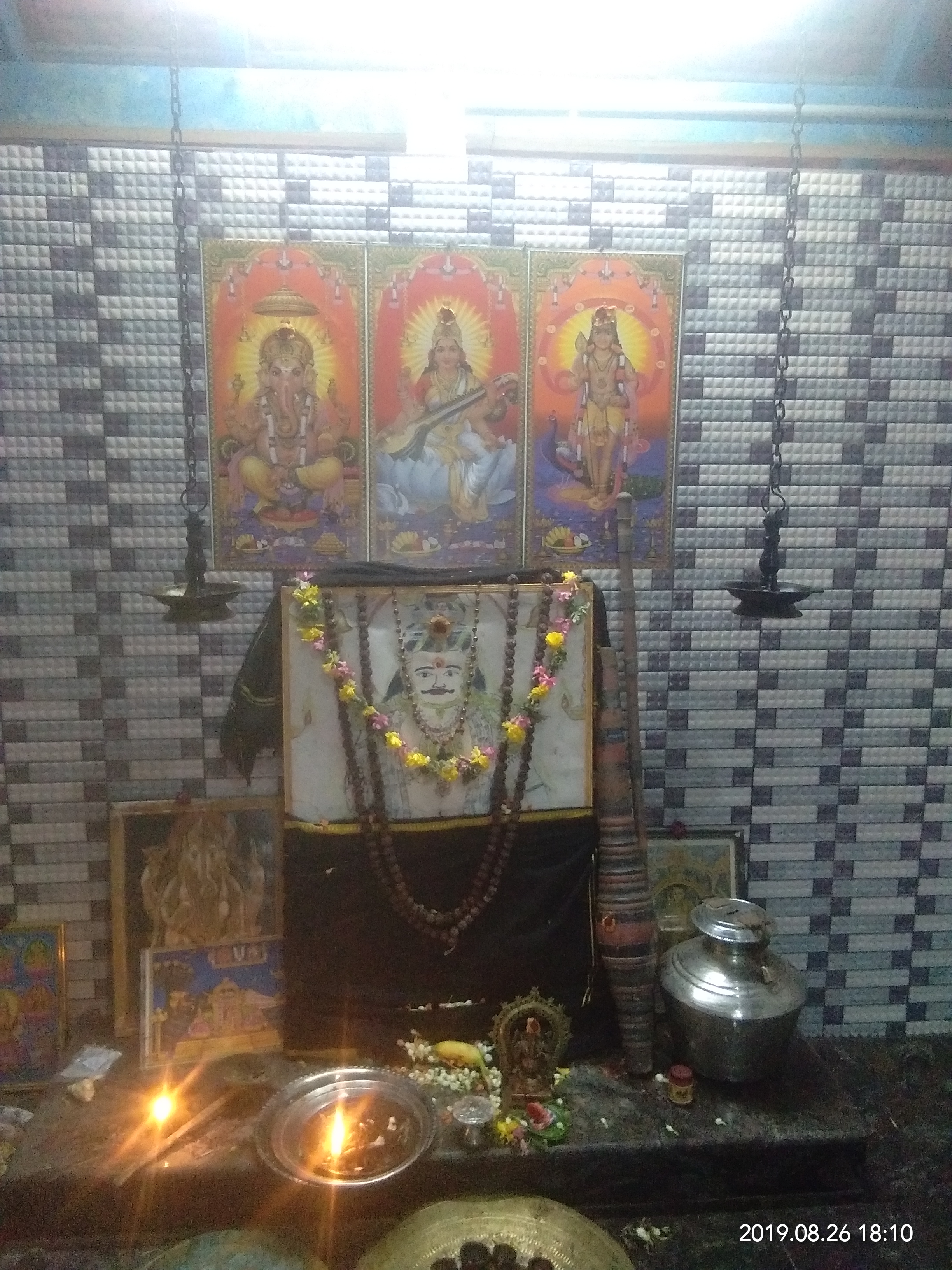 Idumban at Kaduveividuhi
 -
 Idumban at Kaduveividuhi


References[edit | edit source]
- ↑ Gajrani, S. (2004). History, Religion and Culture of India. Gyan Publishing House. p. 222. ISBN 978-81-8205-061-7.
- ↑ Handelman, Don (2013-09-25). One God, Two Goddesses, Three Studies of South Indian Cosmology. BRILL. p. 301. ISBN 978-90-04-25739-9.
- ↑ Belle, Carl Vadivella (2018-02-14). Thaipusam in Malaysia. Flipside Digital Content Company Inc. p. 201. ISBN 978-981-4786-66-9.