





Created guerrilla warfare|guerrilla war Tag: self-published-blog |
m cleanup |
||
| Line 1: | Line 1: | ||
{{ | {{Short description|Warfare by small groups against regular forces}} | ||
{{ | {{other uses|Guerrilla (disambiguation)|Guerrilla Warfare (disambiguation)}} | ||
{{ | {{Being merged|Strategy and tactics of guerrilla warfare|date=December 2025|discuss=Talk:Guerrilla warfare#Proposed merge of Strategy and tactics of guerrilla warfare into Guerrilla warfare|dir=from}} | ||
[[File:As Guerrilhas na Guerra Peninsular (Roque Gameiro, Quadros da História de Portugal, 1917).png|thumb|upright=1.3|''Guerrilla warfare during the Peninsular War'', by [[Alfredo Roque Gameiro|Roque Gameiro]], depicting a Portuguese guerrilla ambush against French forces | {{Multiple issues| | ||
{{Original research|date=October 2024}} | |||
{{More footnotes|date=September 2010}} | |||
}} | |||
[[File:As Guerrilhas na Guerra Peninsular (Roque Gameiro, Quadros da História de Portugal, 1917).png|thumb|upright=1.3|''Guerrilla warfare during the [[Peninsular War]]'', by [[Alfredo Roque Gameiro|Roque Gameiro]], depicting a Portuguese guerrilla ambush against French forces]] | |||
{{History of war}} | {{History of war}} | ||
'''Guerrilla warfare''' is a type of [[unconventional warfare]] in which small groups of [[irregular military]], such as rebels, [[Partisan (military)|partisan]]s, [[paramilitary]] personnel or armed [[civilian]]s, which may include [[children in the military]], use [[ambush]]es, [[sabotage]], [[terrorism]], [[Raid (military)|raids]], [[petty warfare]] or [[hit-and-run tactics]] in a [[rebellion]], in a [[violence|violent conflict]], in a [[war]] or in a [[civil war]] to fight against regular [[military]], [[police]] or rival [[insurgency|insurgent]] forces.{{sfn|Asprey|2023}} | |||
Although the term "guerrilla warfare" was coined in the context of the [[Peninsular War]] in the 19th century,{{sfn|OED|2023}} the tactical methods of guerrilla warfare have long been in use. In the 6th century [[Anno Domini|BC]], [[Sun Tzu]] proposed the use of guerrilla-style tactics in ''[[The Art of War]]''.<ref>[https://www.britannica.com/eb/article-9110197/guerrilla-warfare Encyclopædia Britannica, Guerrilla warfare]</ref> The 3rd century BC Roman general [[Quintus Fabius Maximus Verrucosus]] is also credited with inventing many of the tactics of guerrilla warfare through what is today called the [[Fabian strategy]], and in China [[Peng Yue]] is also often regarded as the inventor of guerrilla warfare. Guerrilla warfare has been used by various factions throughout history and is particularly associated with revolutionary movements and popular resistance against invading or occupying armies. | |||
[[Strategy and tactics of guerrilla warfare|Guerrilla tactics]] focus on avoiding head-on confrontations with enemy armies, typically due to inferior arms or forces, and instead engage in limited skirmishes with the goal of exhausting adversaries and forcing them to withdraw (see also [[attrition warfare]]). Organized guerrilla groups often depend on the support of either the local population or foreign backers who sympathize with the guerrilla group's efforts.<ref>''Guerrilla Warfare'' (1987), John Pimlott (Author), {{ISBN|0861242254}}</ref> | |||
[[Strategy and tactics of guerrilla warfare|Guerrilla tactics]] focus on avoiding head-on confrontations with enemy armies, typically due to inferior arms or forces, and instead engage in limited skirmishes with the goal of exhausting adversaries and forcing them to withdraw | |||
== Etymology == | == Etymology == | ||
[[File:6-de-junio-1808.jpg|thumb|upright=1.3|Spanish guerrilla resistance to the Napoleonic French invasion of Spain at the [[Battle of Valdepeñas]]]] | [[File:6-de-junio-1808.jpg|thumb|upright=1.3|Spanish guerrilla resistance to the Napoleonic French invasion of Spain at the [[Battle of Valdepeñas]]]] | ||
The Spanish word {{lang|es|guerrilla}} is the diminutive form of {{lang|es|guerra}} ( | The Spanish word {{lang|es|guerrilla}} is the diminutive form of {{lang|es|guerra}} ("war"); hence, "little war". The term became popular during the early-19th century [[Peninsular War]], when, after the defeat of their regular armies, [[Guerrilla warfare in the Peninsular War|the Spanish and Portuguese people successfully rose]] against the [[Napoleon Bonaparte|Napoleonic]] [[Grande Armée|troops]] and defeated a highly superior army using the guerrilla strategy in combination with a [[scorched earth policy]] and [[people's war]] (see also [[attrition warfare against Napoleon]]). In correct [[Spanish language|Spanish]] usage, a person who is a member of a {{lang|es|guerrilla}} unit is a {{lang|es|guerrillero}} ({{IPA|es|geriˈʎeɾo|}}) if male, or a {{lang|es|guerrillera}} ([[Help:IPA/Spanish|[geriˈʎeɾa]]]) if female. [[Arthur Wellesley, 1st Duke of Wellington|Arthur Wellesley]] adopted the term "guerrilla" into [[English language|English]] from Spanish usage in 1809,{{sfn|OED|2023}} to refer to the individual ''fighters'' (e.g., "I have recommended to set the Guerrillas to work"), and also (as in Spanish) to denote ''a group or band'' of such fighters. However, in most languages ''guerrilla'' still denotes a specific style of warfare. The use of the [[diminutive]] evokes the differences in number, scale, and scope between the guerrilla army and the formal, professional army of the state.{{sfn|etymonline|2023}} | ||
==History== | ==History== | ||
{{ | {{Main|History of guerrilla warfare}} | ||
[[File:Sov partizans.jpg|thumb|upright=1.3|[[Soviet partisans]] on the road in Belarus | [[File:Elas vo Ksanti.jpg|thumb|upright=1.3|Guerrillas of the [[Greek People's Liberation Army]] in Xanthi during [[World War II]]]] | ||
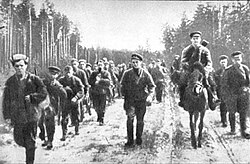
[[File:Sov partizans.jpg|thumb|upright=1.3|[[Soviet partisans]] on the road in [[Nazi-occupied Belarus]] during the 1944 counter-offensive]] | |||
Prehistoric tribal warriors presumably employed guerrilla-style tactics against enemy tribes: | Prehistoric tribal warriors presumably employed guerrilla-style tactics against enemy tribes: | ||
{{blockquote|Primitive (and guerrilla) warfare consists of war stripped to its essentials: the murder of enemies; the theft or destruction of their sustenance, wealth, and essential resources; and the inducement in them of insecurity and terror. It conducts the basic business of war without recourse to ponderous formations or equipment, complicated maneuvers, strict chains of command, calculated strategies, timetables, or other civilized embellishments.{{sfn|Keeley|1997|p=75}}}} | {{blockquote|Primitive (and guerrilla) warfare consists of war stripped to its essentials: the murder of enemies; the theft or destruction of their sustenance, wealth, and essential resources; and the inducement in them of insecurity and terror. It conducts the basic business of war without recourse to ponderous formations or equipment, complicated maneuvers, strict chains of command, calculated strategies, timetables, or other civilized embellishments.{{sfn|Keeley|1997|p=75}}}} | ||
| Line 23: | Line 28: | ||
Evidence of [[conventional warfare]], on the other hand, did not emerge until 3100 BC in Egypt and Mesopotamia. The Chinese general and strategist [[Sun Tzu]], in his ''[[The Art of War]]'' (6th century BC), became one of the earliest to propose the use of guerrilla warfare.{{sfn|Leonard|1989|p=728}} This inspired developments in modern guerrilla warfare.{{sfn|Snyder|1999|p=46}} | Evidence of [[conventional warfare]], on the other hand, did not emerge until 3100 BC in Egypt and Mesopotamia. The Chinese general and strategist [[Sun Tzu]], in his ''[[The Art of War]]'' (6th century BC), became one of the earliest to propose the use of guerrilla warfare.{{sfn|Leonard|1989|p=728}} This inspired developments in modern guerrilla warfare.{{sfn|Snyder|1999|p=46}} | ||
In the 3rd century BC, [[Quintus Fabius Maximus Verrucosus]], used elements of guerrilla warfare, such as the evasion of battle, the attempt to wear down the enemy, to attack small detachments in an ambush{{sfn|Laqueur|1977|p=7}} and devised the [[Fabian strategy]], which the [[Roman Republic]] used to great effect against [[Hannibal]]'s army, see also ''His Excellency : George Washington'': the Fabian choice.{{sfn|Ellis|2005|pp=99–102}} | In the 3rd century BC, [[Quintus Fabius Maximus Verrucosus]], called ''Cunctator'' ("delayer"), used elements of guerrilla warfare, such as the evasion of battle, the attempt to wear down the enemy, to attack small detachments in an ambush{{sfn|Laqueur|1977|p=7}} and devised the [[Fabian strategy]], which the [[Roman Republic]] used to great effect against [[Hannibal]]'s army, see also ''His Excellency : George Washington'': the Fabian choice.{{sfn|Ellis|2005|pp=99–102}} The Roman general [[Quintus Sertorius]] is also noted for his skillful use of guerrilla warfare during [[Sertorian War|his revolt]] against the [[Roman Senate]]. In China, Han dynasty general [[Peng Yue]] is often regarded as the inventor of guerrilla warfare due to his use of irregular warfare in the [[Chu–Han Contention|Chu-Han contention]] to attack Chu convoys and supplies.<ref>{{Cite web |title=彭越,一个历史量身打造的游击战术的鼻祖 |url=https://www.sohu.com/a/367455192_120507727 |access-date=2024-10-29 |website=www.sohu.com}}</ref><ref>{{Cite web |title=彭越游击战:刘邦反楚的重要推手 |url=https://m.szonline.net/think/contents/20240218/202402735054.html |access-date=29 October 2024}}</ref> | ||
In the [[Byzantine Empire]], guerrilla warfare was frequently practiced between the eighth through tenth centuries along the eastern frontier with the Umayyad and then Abbasid caliphates. Tactics involved a heavy emphasis on reconnaissance and intelligence, shadowing the enemy, evacuating threatened population centres, and attacking when the enemy dispersed to raid.{{sfn|McMahon|2016|pages=22–33}} In the later tenth century this form of warfare was codified in a military manual known by its later Latin name as ''[[De velitatione bellica]]'' ('On Skirmishing') so it would not be forgotten in the future.{{sfn|Dennis|1985|p=147}} | |||
The Normans often made many forays into Wales, where the Welsh used the mountainous region, which the Normans were unfamiliar with, to spring surprise attacks upon them.{{sfn|Hooper|Bennett|1996|pp=68–}} | |||
[[Gonzalo Fernández de Córdoba]] successfully employed guerrilla warfare during the [[Italian Wars]], where his Italian lieutenant and successor [[Prospero Colonna]] was called ''Cuntatore'' after Quintus Fabius Maximus due to their similar tactics. Guerrilla warfare eventually became one of the specialties of the Spanish ''[[tercio]]s'', including techniques like the [[camisado]].<ref>Baquer, M. A. (2006). ''La escuela Hispano-Italiana de Estrategia. Guerra y sociedad en la monarquía hispánica''. Vol. 1, 2006, ISBN 84-8483-235-X, págs. 367-380</ref> | |||
Since [[the Enlightenment]], ideologies such as [[nationalism]], [[liberalism]], [[socialism]], and [[religious fundamentalism]] have played an important role in shaping insurgencies and guerrilla warfare.{{sfn|Hanhimäki|Blumenau|Rapaport|2013|pp=46–73}} | Since [[the Enlightenment]], ideologies such as [[nationalism]], [[liberalism]], [[socialism]], and [[religious fundamentalism]] have played an important role in shaping insurgencies and guerrilla warfare.{{sfn|Hanhimäki|Blumenau|Rapaport|2013|pp=46–73}} | ||
In the 17th century, [[ | In the 17th century, [[Chatrapati Shivaji Maharaj]], founder of the [[Maratha Kingdom]], pioneered the ''Shiva sutra'' or ''[[Ganimi Kava]]'' (Guerrilla Tactics) to defeat the many times larger and more powerful armies of the [[Mughal Empire]].{{sfn|Duff|2014}} | ||
[[File:Fortaleza San Luis - Monumento a los Héroes de la Restauración.jpg|thumb|upright=.8|Siege of the [[Fortaleza San Luis]] by the Dominican rebels by Melanio Guzmán]] | [[File:Fortaleza San Luis - Monumento a los Héroes de la Restauración.jpg|thumb|upright=.8|Siege of the [[Fortaleza San Luis]] by the Dominican rebels by Melanio Guzmán]] | ||
The [[Dominican Restoration War]] was a guerrilla war between 1863 and 1865 in the [[Dominican Republic]] between nationalists and [[Spain]], the latter of which [[Spanish occupation of the Dominican Republic|had recolonized the country]] 17 years after its independence. The war resulted in the withdrawal of Spanish forces and the establishment of a second republic in the Dominican Republic.{{sfn|Pons|1998}} | The [[Dominican Restoration War]] was a guerrilla war between 1863 and 1865 in the [[Dominican Republic]] between nationalists and [[Spain]], the latter of which [[Spanish occupation of the Dominican Republic|had recolonized the country]] 17 years after its independence. The war resulted in the withdrawal of Spanish forces and the establishment of a second republic in the Dominican Republic.{{sfn|Pons|1998}} | ||
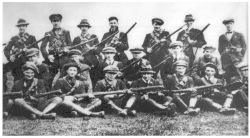
[[File:Hogan's Flying Column.gif|thumb|upright=1.3|[[Seán Hogan]]'s [[flying column]] of the IRA's [[3rd Tipperary Brigade]], during the [[Irish War of Independence]]]] | [[File:Hogan's Flying Column.gif|thumb|upright=1.3|[[Seán Hogan]]'s [[flying column]] of the IRA's [[3rd Tipperary Brigade]], during the [[Irish War of Independence]]]] | ||
The | The Riffian [[Berbers|Berber]] military leader [[Abd el-Krim]] ({{circa | 1883}} – 1963) and his father{{sfn|islamicus|2023}} unified the Berber tribes under their control and took up arms against the Spanish and French occupiers during the [[Rif War]] in 1920. For the first time in history, [[tunnel warfare]] was used alongside modern guerrilla tactics, which caused considerable damage to both the colonial armies in Morocco.{{sfn|Boot|2013|pp=10–11, 55}} | ||
In the early 20th century [[Michael Collins (Irish leader) |Michael Collins]] and [[Tom Barry (Irish republican) |Tom Barry]] both developed many tactical features of guerrilla warfare during [[Irish War of Independence |the guerrilla phase of the 1919–1921 Irish War of Independence]]. Collins developed mainly | In the early 20th century [[Michael Collins (Irish leader)|Michael Collins]] and [[Tom Barry (Irish republican)|Tom Barry]] both developed many tactical features of guerrilla warfare during [[Irish War of Independence|the guerrilla phase of the 1919–1921 Irish War of Independence]]. Collins developed mainly urban guerrilla warfare tactics in [[Dublin| Dublin City]] (the Irish capital). Operations in which small [[Irish Republican Army (1919–1922)|Irish Republican Army]] (IRA) units (3 to 6 guerrillas) quickly attacked a target and then disappeared into civilian crowds.{{sfn|Ferriter|2020}}{{sfn|historyireland|2003}} In [[County Cork]], Tom Barry was the commander of the IRA [[3rd Cork Brigade|West Cork brigade]]. Fighting in west Cork was rural, and the IRA fought in much larger units than their comrades in urban areas. These units, called "[[flying column]]s",{{sfn|Chisholm|1911|p=585}} engaged British forces in large battles, usually for between 10–30 minutes. | ||
[[File:Women guerrilla.jpg|thumb|upright=1.3|Lakhdari, [[Zohra Drif|Drif]], [[Djamila Bouhired|Bouhired]] and [[Hassiba Ben Bouali|Bouali]]. Female Algerian guerrillas of the [[Algerian War|Algerian War of Independence]], {{circa|1956}}.]] | |||
[[File:Women guerrilla.jpg|thumb|upright=1.3|Lakhdari, Drif, Bouhired and Bouali. Female Algerian | |||
The | The [[Algerian revolution|Algerian Revolution]] of 1954 started with a handful of Algerian guerrillas. Primitively armed, the guerrillas fought the French for over eight years. This remains a prototype for modern insurgency and counterinsurgency, terrorism, torture, and asymmetric warfare prevalent throughout the world today.{{sfn|Horne|2022}} In [[South Africa]], [[African National Congress]] (ANC) members studied the Algerian War, prior to the release and apotheosis of [[Nelson Mandela]];{{sfn|Drew|2015|pp=22–43}} in their [[intifada]] against Israel, [[Palestinian fedayeen|Palestinian fighters]] have sought to emulate it.{{sfn|Chamberlin|2015}} Additionally, the tactics of [[Al-Qaeda]] closely resemble those of the Algerians.{{sfn|Boeke|2019}} | ||
==Theoretical works== | ==Theoretical works== | ||
The growth of guerrilla warfare was inspired in part by theoretical works on guerrilla warfare, starting with the ''Manual de Guerra de Guerrillas'' by [[Matías Ramón Mella]] written in the 19th century:{{blockquote|...our troops should...fight while protected by the terrain...using small, mobile guerrilla units to exhaust the enemy...denying them rest so that they only control the terrain under their feet.{{sfn|Kruijt|Tristán|Álvarez|2019}}}} | The growth of guerrilla warfare was inspired in part by theoretical works on guerrilla warfare, starting with the ''Manual de Guerra de Guerrillas'' by [[Matías Ramón Mella]] written in the 19th century:{{blockquote|...our troops should...fight while protected by the terrain...using small, mobile guerrilla units to exhaust the enemy...denying them rest so that they only control the terrain under their feet.{{sfn|Kruijt|Tristán|Álvarez|2019}}}} | ||
More recently, Mao Zedong's ''[[On Guerrilla Warfare]]'',{{sfn|Mao|1989}} [[Che Guevara]]'s [[Guerrilla Warfare (book)|''Guerrilla Warfare'']],{{sfn|Guevara|2006}} and Lenin's ''Guerrilla warfare'',{{sfn|Lenin|1906}} were all written after the successful revolutions carried by them in China, Cuba and Russia, respectively. Those texts characterized the tactic of guerrilla warfare as, according to [[Che Guevara]]'s text, being "used by the side which is supported by a majority but which possesses a much smaller number of arms for use in defense against oppression".{{sfn|Guevara|2006|p=16}} | More recently, Mao Zedong's ''[[On Guerrilla Warfare]]'',{{sfn|Mao|1989}} [[Che Guevara]]'s [[Guerrilla Warfare (book)|''Guerrilla Warfare'']],{{sfn|Guevara|2006}} and Lenin's ''Guerrilla warfare'',{{sfn|Lenin|1906}} were all written after the successful revolutions carried out by them in China, Cuba and Russia, respectively. Those texts characterized the tactic of guerrilla warfare as, according to [[Che Guevara]]'s text, being "used by the side which is supported by a majority but which possesses a much smaller number of arms for use in defense against oppression".{{sfn|Guevara|2006|p=16}} | ||
=== Foco theory === | === Foco theory === | ||
| Line 59: | Line 61: | ||
{{Blockquote|Why does the guerrilla fighter fight? We must come to the inevitable conclusion that the guerrilla fighter is a social reformer, that he takes up arms responding to the angry protest of the people against their oppressors, and that he fights in order to change the social system that keeps all his unarmed brothers in ignominy and misery.| [[Che Guevara]]{{sfn|Guevara|2006|p=17}}}} | {{Blockquote|Why does the guerrilla fighter fight? We must come to the inevitable conclusion that the guerrilla fighter is a social reformer, that he takes up arms responding to the angry protest of the people against their oppressors, and that he fights in order to change the social system that keeps all his unarmed brothers in ignominy and misery.| [[Che Guevara]]{{sfn|Guevara|2006|p=17}}}} | ||
In the 1960s, the [[Marxist]] revolutionary [[Che Guevara]] developed the ''foco'' ({{ | In the 1960s, the [[Marxist]] revolutionary [[Che Guevara]] developed the ''foco'' ({{langx|es|foquismo|link=no}}) theory of [[revolution]] in his book ''[[Guerrilla Warfare (book)|Guerrilla Warfare]]'',{{sfn|Guevara|2006|p=13}} based on his experiences during the 1959 [[Cuban Revolution]]. This theory was later formalized as "focal-ism" by [[Régis Debray]]. Its central principle is that [[vanguardism]] by [[Cadre (politics)|cadres]] of small, fast-moving [[paramilitary]] groups can provide a focus for popular discontent against a sitting regime, and thereby lead a general [[insurrection]]. Although the original approach was to mobilize and launch attacks from rural areas, many ''foco'' ideas were adapted into urban guerrilla warfare movements. | ||
== Strategy, tactics and methods == | == Strategy, tactics and methods == | ||
| Line 65: | Line 67: | ||
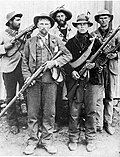
[[File:Afrikaner Commandos2.JPG|thumb|upright=1.0|Boer guerrillas during the [[Second Boer War]] in South Africa]] | [[File:Afrikaner Commandos2.JPG|thumb|upright=1.0|Boer guerrillas during the [[Second Boer War]] in South Africa]] | ||
[[File:Estonian forest brothers relaxing and cleaning their guns after a shooting exercise in Veskiaru, Järva County, Estonia, 1953. (47953893422).jpg|thumb|upright=1.0|The Estonian [[Forest Brothers]] relaxing and cleaning their guns after a shooting exercise in [[Veskiaru]], [[Järva County]], [[Estonian SSR]], in 1953]] | [[File:Estonian forest brothers relaxing and cleaning their guns after a shooting exercise in Veskiaru, Järva County, Estonia, 1953. (47953893422).jpg|thumb|upright=1.0|The Estonian [[Forest Brothers]] relaxing and cleaning their guns after a shooting exercise in [[Veskiaru]], [[Järva County]], [[Estonian SSR]], in 1953]] | ||
=== Strategy === | === Strategy === | ||
Guerrilla warfare is a type of [[asymmetric warfare]]: competition between opponents of unequal strength.{{sfn|Tomes|2004}} It is also a type of irregular warfare: that is, it aims not simply to defeat an invading enemy, but to win popular support and political influence, to the enemy's cost. Accordingly, guerrilla [[strategy]] aims to magnify the impact of a small, mobile force on a larger, more cumbersome one.{{sfn|Creveld|2000|pp=356–358}} If successful, guerrillas weaken their enemy by [[Attrition warfare|attrition]], eventually forcing them to withdraw. | Guerrilla warfare is a type of [[asymmetric warfare]]: competition between opponents of unequal strength.{{sfn|Tomes|2004}} It is also a type of [[irregular warfare]]: that is, it aims not simply to defeat an invading enemy, but to win popular support and political influence, to the enemy's cost. Accordingly, guerrilla [[strategy]] aims to magnify the impact of a small, mobile force on a larger, more cumbersome one.{{sfn|Creveld|2000|pp=356–358}} If successful, guerrillas weaken their enemy by [[Attrition warfare|attrition]], eventually forcing them to withdraw. | ||
=== Tactics === | === Tactics === | ||
{{See also|Asymmetric warfare}} | {{See also|Asymmetric warfare}} | ||
Tactically, guerrillas usually avoid confrontation with large units and formations of enemy troops but seek and attack small groups of enemy personnel and resources to gradually deplete the opposing force while minimizing their own losses. The guerrilla prizes mobility, secrecy, and surprise, organizing in small units and taking [[advantage of terrain]] that is difficult for larger units to use. For example, [[Mao Zedong]] summarized basic guerrilla tactics at the beginning of the [[Chinese Civil War]] as:<blockquote>"The enemy advances, we retreat; the enemy camps, we harass; the enemy tires, we attack; the enemy retreats, we pursue."{{sfn|Mao|1965|p=124}} </blockquote>At least one author credits the ancient Chinese work ''[[The Art of War]]'' with inspiring Mao's tactics.{{sfn|McNeilly|2003|pp= | Tactically, guerrillas usually avoid confrontation with large units and formations of enemy troops but seek and attack small groups of enemy personnel and resources to gradually deplete the opposing force while minimizing their own losses. The guerrilla prizes mobility, secrecy, and surprise, organizing in small units and taking [[advantage of terrain]] that is difficult for larger units to use. For example, [[Mao Zedong]] summarized basic guerrilla tactics at the beginning of the [[Chinese Civil War]] as:<blockquote>"The enemy advances, we retreat; the enemy camps, we harass; the enemy tires, we attack; the enemy retreats, we pursue."{{sfn|Mao|1965|p=124}} </blockquote>At least one author credits the ancient Chinese work ''[[The Art of War]]'' with inspiring Mao's tactics.{{sfn|McNeilly|2003|pp=6–7}} In the 20th century, other communist leaders, including North Vietnamese [[Ho Chi Minh]], often used and developed guerrilla warfare tactics, which provided a model for their use elsewhere, leading to the Cuban "[[foco]]" theory and the anti-[[Soviet Union|Soviet]] [[Mujahadeen]] in [[Afghanistan]].{{sfn|McNeilly|2003|p=204}} | ||
=== Unconventional methods === | === Unconventional methods === | ||
Guerrilla groups may use [[improvised explosive device]]s and [[Logistics|logistical]] support by the local population | Guerrilla groups may use [[improvised explosive device]]s and [[Logistics|logistical]] support by the local population. The opposing army may come at last to suspect all civilians as potential guerrilla backers. The guerrillas might get political support from foreign backers and many guerrilla groups are adept at public persuasion through [[propaganda]] and use of force.{{sfn|Detsch|2017}} Some guerrilla movements today also rely heavily on children as combatants, scouts, porters, spies, informants, and in other roles.{{sfn|Child Soldiers International|2016}}<ref>{{Cite web |date=2024-01-03 |title=IDF proof: Hamas, Palestinian Islamic Jihad use young children for Gaza terror activities {{!}} The Jerusalem Post |url=https://www.jpost.com/israel-hamas-war/article-780613 |access-date=2026-03-22 |website=The Jerusalem Post {{!}} JPost.com |language=en}}</ref> Many governments and states also [[child soldier|recruit children]] within their armed forces.{{sfn|United Nations Secretary-General|2017}}{{sfn|Child Soldiers International|2012}} | ||
=== Comparison of guerrilla warfare and terrorism === | === Comparison of guerrilla warfare and terrorism === | ||
| Line 82: | Line 85: | ||
==See also== | ==See also== | ||
{{div col}} | {{div col}} | ||
* [[Armed Insurrection]] | |||
* [[Counter-insurgency]] | * [[Counter-insurgency]] | ||
* [[Free | * [[Free war]] | ||
* [[Freedom Fighters (disambiguation)]] | * [[Freedom Fighters (disambiguation)]] | ||
* [["Yank" Levy]] | * [["Yank" Levy]] | ||
* [[Insurgency weapons and tactics]] | |||
* [[List of guerrilla movements]] | * [[List of guerrilla movements]] | ||
* [[List of guerrillas]] | * [[List of guerrillas]] | ||
| Line 91: | Line 96: | ||
* [[Militia]] | * [[Militia]] | ||
* [[New generation warfare]] | * [[New generation warfare]] | ||
* [[Partisan (military)]] | |||
* [[Resistance during World War II]] | * [[Resistance during World War II]] | ||
* [[Special forces]] | * [[Special forces]] | ||
* [[Civilian Irregular Defense Group program]] | |||
* [[United Nations Partisan Infantry Korea]] | |||
* [[Violent non-state actor]] | * [[Violent non-state actor]] | ||
* [[ | * [[National Liberation Front of South Vietnam]] | ||
* [[TM 31-210 Improvised Munitions Handbook]]{{div col end}} | * [[TM 31-210 Improvised Munitions Handbook]]{{div col end}} | ||
| Line 104: | Line 112: | ||
* {{cite book |last=Boeke |first=Sergei |chapter=Al-Qaeda in the Islamic Maghreb |year=2019 |chapter-url=https://dx.doi.org/10.1093/obo/9780199743292-0267 |title=International Relations |publisher=Oxford University Press |doi=10.1093/obo/9780199743292-0267 |isbn=978-0-19-974329-2 |access-date=17 July 2021}} | * {{cite book |last=Boeke |first=Sergei |chapter=Al-Qaeda in the Islamic Maghreb |year=2019 |chapter-url=https://dx.doi.org/10.1093/obo/9780199743292-0267 |title=International Relations |publisher=Oxford University Press |doi=10.1093/obo/9780199743292-0267 |isbn=978-0-19-974329-2 |access-date=17 July 2021}} | ||
* {{cite book |last=Boot |first=Max |year=2013 |title=Invisible Armies: An Epic History of Guerrilla Warfare from Ancient Times to the Present| pages=10–11, 55 |publisher=Liveright |isbn=978-0-87140-424-4}} | * {{cite book |last=Boot |first=Max |year=2013 |title=Invisible Armies: An Epic History of Guerrilla Warfare from Ancient Times to the Present| pages=10–11, 55 |publisher=Liveright |isbn=978-0-87140-424-4}} | ||
* {{cite book |last=Chamberlin |first=Paul Thomas | * {{cite book |last=Chamberlin |first=Paul Thomas |title=The global offensive : the United States, the Palestine Liberation Organization, and the making of the post-cold war order |year=2015 |publisher=Oxford University Press |isbn=978-0-19-021782-2 |oclc=907783262}} | ||
* {{cite web |last=Child Soldiers International |year=2012 |url=https://www.child-soldiers.org/Handlers/Download.ashx?IDMF=da92581e-7130-40e6-bf3a-a86b944f17dd |archive-url=https://web.archive.org/web/20190308184421/https://www.child-soldiers.org/Handlers/Download.ashx?IDMF=da92581e-7130-40e6-bf3a-a86b944f17dd |url-status= | * {{cite web |last=Child Soldiers International |year=2012 |url=https://www.child-soldiers.org/Handlers/Download.ashx?IDMF=da92581e-7130-40e6-bf3a-a86b944f17dd |archive-url=https://web.archive.org/web/20190308184421/https://www.child-soldiers.org/Handlers/Download.ashx?IDMF=da92581e-7130-40e6-bf3a-a86b944f17dd |url-status=usurped |archive-date=2019-03-08 |title=Louder than words: An agenda for action to end state use of child soldiers |access-date=19 January 2018}} | ||
* {{cite web |last=Child Soldiers International |year=2016 |url=https://www.child-soldiers.org/Handlers/Download.ashx?IDMF=38e90749-3a76-4441-82dc-bd49f1217599 |archive-url=https://web.archive.org/web/20190308184421/https://www.child-soldiers.org/Handlers/Download.ashx?IDMF=38e90749-3a76-4441-82dc-bd49f1217599 |url-status= | * {{cite web |last=Child Soldiers International |year=2016 |url=https://www.child-soldiers.org/Handlers/Download.ashx?IDMF=38e90749-3a76-4441-82dc-bd49f1217599 |archive-url=https://web.archive.org/web/20190308184421/https://www.child-soldiers.org/Handlers/Download.ashx?IDMF=38e90749-3a76-4441-82dc-bd49f1217599 |url-status=usurped |archive-date=2019-03-08 |title=A law unto themselves? Confronting the recruitment of children by armed groups |access-date=19 January 2018}} | ||
* {{cite book |last=Creveld |first=Martin van |title=The Oxford History of Modern War |chapter=Technology and War II:Postmodern War? |editor=Charles Townshend |publisher=Oxford University Press |year=2000 | location=New York, | * {{cite book |last=Creveld |first=Martin van |title=The Oxford History of Modern War |chapter=Technology and War II:Postmodern War? |editor=Charles Townshend |publisher=Oxford University Press |year=2000 | location=New York, US | pages=[https://archive.org/details/oxfordhistoryofm00town/page/356 356–358] |isbn=978-0-19-285373-8 | chapter-url-access=registration | chapter-url=https://archive.org/details/oxfordhistoryofm00town | url=https://archive.org/details/oxfordhistoryofm00town/page/356}} | ||
* {{cite book |last=Dennis |first=George |year=1985 |title=Three Byzantine Military Treatises |publisher=Dumbarton Oaks |location=Washington, D.C. |page=147}} | * {{cite book |last=Dennis |first=George |year=1985 |title=Three Byzantine Military Treatises |publisher=Dumbarton Oaks |location=Washington, D.C. |page=147}} | ||
* {{cite news |last=Detsch |first=J |year=2017 |url=https://www.al-monitor.com/pulse/originals/2017/07/pentagon-islamic-state-insurgency-mosul-iraq.html |title=Pentagon braces for Islamic State insurgency after Mosul |work=Al-Monitor |access-date=2018-01-24| archive-url=https://web.archive.org/web/20170712041829/http://www.al-monitor.com/pulse/originals/2017/07/pentagon-islamic-state-insurgency-mosul-iraq.html |archive-date=2017-07-12 |url-status=dead |language=en-us}} | * {{cite news |last=Detsch |first=J |year=2017 |url=https://www.al-monitor.com/pulse/originals/2017/07/pentagon-islamic-state-insurgency-mosul-iraq.html |title=Pentagon braces for Islamic State insurgency after Mosul |work=Al-Monitor |access-date=2018-01-24| archive-url=https://web.archive.org/web/20170712041829/http://www.al-monitor.com/pulse/originals/2017/07/pentagon-islamic-state-insurgency-mosul-iraq.html |archive-date=2017-07-12 |url-status=dead |language=en-us}} | ||
* {{cite journal |last=Drew |first=Allison |year=2015 |title=Visions of liberation: the Algerian war of independence and its South African reverberations |url=http://dx.doi.org/10.1080/03056244.2014.1000288|journal=Review of African Political Economy |volume=42 |issue=143 |pages=22–43 |doi=10.1080/03056244.2014.1000288|s2cid=144545186|issn=0305-6244}} | * {{cite journal |last=Drew |first=Allison |year=2015 |title=Visions of liberation: the Algerian war of independence and its South African reverberations |url=http://dx.doi.org/10.1080/03056244.2014.1000288|journal=Review of African Political Economy |volume=42 |issue=143 |pages=22–43 |doi=10.1080/03056244.2014.1000288|s2cid=144545186|issn=0305-6244|hdl=10.1080/03056244.2014.1000288 |hdl-access=free }} | ||
* {{cite book |last=Duff |first=James Grant |year=2014 |url= https://play.google.com/store/books/details/James_Grant_Duff_The_History_Of_The_Mahrattas?id=qQZvCwAAQBAJ|publisher= Pickle Partners Publishing |title=The History Of The Mahrattas |isbn=9781782892335 |pages=376}} | * {{cite book |last=Duff |first=James Grant |year=2014 |url= https://play.google.com/store/books/details/James_Grant_Duff_The_History_Of_The_Mahrattas?id=qQZvCwAAQBAJ|publisher= Pickle Partners Publishing |title=The History Of The Mahrattas |isbn=9781782892335 |pages=376}} | ||
* {{cite book |last=Ellis |first=Joseph J. |year=2005 |title= His Excellency : George Washington |publisher=Vintage Books | location=New York |pages=92–109 |author-link=Joseph J. Ellis |url=https://archive.org/details/hisexcellencygeo0000elli_k8r3 |via=Internet Archive}} | * {{cite book |last=Ellis |first=Joseph J. |year=2005 |title= His Excellency : George Washington |publisher=Vintage Books | location=New York |pages=92–109 |isbn=9781400032532 |author-link=Joseph J. Ellis |url=https://archive.org/details/hisexcellencygeo0000elli_k8r3 |via=Internet Archive}} | ||
* {{cite web |last=Emmerson |first=B |year=2016 |url=https://documents-dds-ny.un.org/doc/UNDOC/GEN/N16/285/61/PDF/N1628561.pdf?OpenElement |title=Report of the Special Rapporteur on the promotion and protection of human rights and fundamental freedoms while countering terrorism |website=www.un.org |access-date=2018-01-24}} | * {{cite web |last=Emmerson |first=B |year=2016 |url=https://documents-dds-ny.un.org/doc/UNDOC/GEN/N16/285/61/PDF/N1628561.pdf?OpenElement |title=Report of the Special Rapporteur on the promotion and protection of human rights and fundamental freedoms while countering terrorism |website=www.un.org |access-date=2018-01-24}} | ||
* {{cite web |last=etymonline |year=2023 |title=guerrilla | website=Origin and meaning of guerrilla by Online Etymology Dictionary | url=https://www.etymonline.com/word/guerrilla#etymonline_v_14346 | access-date=14 July 2023}} | * {{cite web |last=etymonline |year=2023 |title=guerrilla | website=Origin and meaning of guerrilla by Online Etymology Dictionary | url=https://www.etymonline.com/word/guerrilla#etymonline_v_14346 | access-date=14 July 2023}} | ||
| Line 118: | Line 126: | ||
* {{cite book |last=Guevara |first=Ernesto Che |year=2006 |url=https://archive.org/details/guerrilla-warfare-che-guevara |title=Guerrilla Warfare |via=[[Internet Archive]] }} | * {{cite book |last=Guevara |first=Ernesto Che |year=2006 |url=https://archive.org/details/guerrilla-warfare-che-guevara |title=Guerrilla Warfare |via=[[Internet Archive]] }} | ||
* {{cite book |last1=Halibozek |first1=Edward P. |last2=Jones |first2=Andy |last3=Kovacich |first3=Gerald L. |year=2008 |url=https://books.google.com/books?id=qpwcHUNXw-kC&pg=PA4 |title=The corporate security professional's handbook on terrorism |publisher=Elsevier (Butterworth-Heinemann) | isbn=978-0-7506-8257-2 |edition=illustrated |pages=4–5| access-date=17 December 2016}} | * {{cite book |last1=Halibozek |first1=Edward P. |last2=Jones |first2=Andy |last3=Kovacich |first3=Gerald L. |year=2008 |url=https://books.google.com/books?id=qpwcHUNXw-kC&pg=PA4 |title=The corporate security professional's handbook on terrorism |publisher=Elsevier (Butterworth-Heinemann) | isbn=978-0-7506-8257-2 |edition=illustrated |pages=4–5| access-date=17 December 2016}} | ||
* {{cite book |last1=Hanhimäki |first1=Jussi M. |year=2013 |title=An International History of Terrorism: Western and Non-Western Experiences |last2=Blumenau |first2=Bernhard |last3=Rapaport |first3=David |chapter=The Four Waves of Modern Terrorism |pages=46–73 |publisher= | * {{cite book |last1=Hanhimäki |first1=Jussi M. |year=2013 |title=An International History of Terrorism: Western and Non-Western Experiences |last2=Blumenau |first2=Bernhard |last3=Rapaport |first3=David |chapter=The Four Waves of Modern Terrorism |pages=46–73 |publisher=Routledge |chapter-url=https://international.ucla.edu/media/files/Rapoport-Four-Waves-of-Modern-Terrorism.pdf |isbn=9780415635417 |archiveurl=https://web.archive.org/web/20140221213228/https://international.ucla.edu/media/files/Rapoport-Four-Waves-of-Modern-Terrorism.pdf |archive-date=February 21, 2014}} | ||
* {{cite web |last=historyireland |year=2003 | * {{cite web |last=historyireland |year=2003 | ||
|url= https://www.historyireland.com/20th-century-contemporary-history/bloody-sunday-1920-new-evidence/ | |url= https://www.historyireland.com/20th-century-contemporary-history/bloody-sunday-1920-new-evidence/ | ||
|title= Bloody Sunday 1920: new evidence}} | |title= Bloody Sunday 1920: new evidence}} | ||
* {{cite book |last1=Hooper |first1=Nicholas |last2=Bennett |first2=Matthew |year=1996 |title=Cambridge illustrated atlas, warfare : the Middle Ages, | * {{cite book |last1=Hooper |first1=Nicholas |last2=Bennett |first2=Matthew |year=1996 |title=Cambridge illustrated atlas, warfare : the Middle Ages, 768–1487 |publisher=Cambridge University Press |isbn=978-0-521-44049-3 |url=https://archive.org/details/cambridgeillustr00nich/page |via=Internet Archive}} | ||
* {{cite journal |last=Horne |first=Alistair |year=2022 |title=A Savage War of Peace: Algeria 1954–1962. Rev. ed |url=https://dx.doi.org/10.1163/2468-1733_shafr_sim220070002 |access-date=17 July 2023 |website=The SHAFR Guide Online |doi=10.1163/2468-1733_shafr_sim220070002}} | * {{cite journal |last=Horne |first=Alistair |year=2022 |title=A Savage War of Peace: Algeria 1954–1962. Rev. ed |url=https://dx.doi.org/10.1163/2468-1733_shafr_sim220070002 |access-date=17 July 2023 |website=The SHAFR Guide Online |doi=10.1163/2468-1733_shafr_sim220070002|url-access=subscription }} | ||
* {{cite web |last=islamicus |year=2023 |url=http://islamicus.org/abd-el-krim/ |title=ABD EL-KRIM |website=Islamicus |archiveurl=https://web.archive.org/web/20230614171503/http://islamicus.org/abd-el-krim/ |archive-date=14 June 2023}} | * {{cite web |last=islamicus |year=2023 |url=http://islamicus.org/abd-el-krim/ |title=ABD EL-KRIM |website=Islamicus |archiveurl=https://web.archive.org/web/20230614171503/http://islamicus.org/abd-el-krim/ |archive-date=14 June 2023}} | ||
* {{cite book |last=Keeley |first=Lawrence H. |year=1997 |title=[[War Before Civilization]] |publisher=Oxford University Press}} | * {{cite book |last=Keeley |first=Lawrence H. |year=1997 |title=[[War Before Civilization]] |publisher=Oxford University Press}} | ||
* {{cite book |last1=Kruijt |first1=Dirk |last2=Tristán |first2=Eduardo Rey |last3=Álvarez |first3=Alberto Martín |year=2019 |title=Latin American Guerrilla Movements: Origins, Evolution, Outcomes |publisher=Routledge |isbn=9780429534270 |url=https://books.google.com/books?id=wtvBDwAAQBAJ&dq=Latin+American+Guerrilla+Movements:+Origins,+Evolution,+Outcomes+mella&pg=PT62}} | * {{cite book |last1=Kruijt |first1=Dirk |last2=Tristán |first2=Eduardo Rey |last3=Álvarez |first3=Alberto Martín |year=2019 |title=Latin American Guerrilla Movements: Origins, Evolution, Outcomes |publisher=Routledge |isbn=9780429534270 |url=https://books.google.com/books?id=wtvBDwAAQBAJ&dq=Latin+American+Guerrilla+Movements:+Origins,+Evolution,+Outcomes+mella&pg=PT62}} | ||
* {{cite book |last=Laqueur |first=Walter |year=1977 |title=Guerrilla : a historical and critical study |url=https://archive.org/details/guerrillahistori0000laqu_j9w4/page/7 |via=Internet archive}} | * {{cite book |last=Laqueur |first=Walter |year=1977 |title=Guerrilla : a historical and critical study |publisher=Weidenfeld and Nicolson |isbn=9780297771845 |url=https://archive.org/details/guerrillahistori0000laqu_j9w4/page/7 |via=Internet archive}} | ||
* {{cite web |last=Lenin |first=V. I. |year=1906 |title=Guerrilla Warfare | * {{cite web |last=Lenin |first=V. I. |year=1906 |title=Guerrilla Warfare | ||
|url=https://www.marxists.org/archive/lenin/works/1906/gw/index.htm |archive-url=https://web.archive.org/web/20230511043828/https://www.marxists.org/archive/lenin/works/1906/gw/index.htm |archive-date=11 May 2023 |via=Internet archive}} | |url=https://www.marxists.org/archive/lenin/works/1906/gw/index.htm |archive-url=https://web.archive.org/web/20230511043828/https://www.marxists.org/archive/lenin/works/1906/gw/index.htm |archive-date=11 May 2023 |via=Internet archive}} | ||
| Line 139: | Line 147: | ||
* {{cite journal |last=Rowe |first=P |year=2002 |title=Freedom fighters and rebels: the rules of civil war |pmc=1279138 |pmid=11773342 |volume=95 | issue=1 |journal=J R Soc Med |pages=3–4|doi=10.1177/014107680209500102}} | * {{cite journal |last=Rowe |first=P |year=2002 |title=Freedom fighters and rebels: the rules of civil war |pmc=1279138 |pmid=11773342 |volume=95 | issue=1 |journal=J R Soc Med |pages=3–4|doi=10.1177/014107680209500102}} | ||
* {{cite book |last=Snyder |first=Craig |year=1999 |title=Contemporary security and strategy}} | * {{cite book |last=Snyder |first=Craig |year=1999 |title=Contemporary security and strategy}} | ||
* {{cite book |last1=Sinclair |first1=Samuel Justin |last2=Antonius |first2=Daniel |year=2012 |url=https://books.google.com/books?id=_2oCOWmQfysC&pg=PT30 |title=The Psychology of Terrorism Fears |publisher=Oxford University Press, | * {{cite book |last1=Sinclair |first1=Samuel Justin |last2=Antonius |first2=Daniel |year=2012 |url=https://books.google.com/books?id=_2oCOWmQfysC&pg=PT30 |title=The Psychology of Terrorism Fears |publisher=Oxford University Press, US |isbn=978-0-19-538811-4}} | ||
* {{cite web |last=Tamer |first= | * {{cite web |last=Tamer |first=Cenk | date=25 September 2017 |url=https://ankasam.org/en/the-differences-between-the-guerrilla-warfare-and-terrorism/ | title=The Differences Between the Guerrilla Warfare and Terrorism}} | ||
* {{cite journal |last=Tomes |first=Robert |year=2004 |title=Relearning Counterinsurgency Warfare |url=http://www.carlisle.army.mil/USAWC/Parameters/Articles/04spring/tomes.pdf |journal=Parameters |archive-url=https://web.archive.org/web/20100607224951/http://www.carlisle.army.mil/USAWC/Parameters/Articles/04spring/tomes.pdf |archive-date=7 June 2010}} | * {{cite journal |last=Tomes |first=Robert |year=2004 |title=Relearning Counterinsurgency Warfare |url=http://www.carlisle.army.mil/USAWC/Parameters/Articles/04spring/tomes.pdf |journal=Parameters |archive-url=https://web.archive.org/web/20100607224951/http://www.carlisle.army.mil/USAWC/Parameters/Articles/04spring/tomes.pdf |archive-date=7 June 2010}} | ||
* {{cite web |last=United Nations Secretary-General |year=2017 |url=http://www.un.org/ga/search/view_doc.asp?symbol=S/2017/821&Lang=E&Area=UNDOC |title=Report of the Secretary-General: Children and armed conflict, 2017 |website=www.un.org |access-date=2018-01-24}} | * {{cite web |last=United Nations Secretary-General |year=2017 |url=http://www.un.org/ga/search/view_doc.asp?symbol=S/2017/821&Lang=E&Area=UNDOC |title=Report of the Secretary-General: Children and armed conflict, 2017 |website=www.un.org |access-date=2018-01-24}} | ||
| Line 151: | Line 159: | ||
==Further reading== | ==Further reading== | ||
* Asprey, Robert. ''War in the Shadows: The Guerrilla in History'' | * Asprey, Robert. ''War in the Shadows: The Guerrilla in History'' | ||
* {{cite book |ref=none |title=Encyclopedia of Guerrilla Warfare |type=Hardcover |first1=I. F. W. |last1=Beckett |location=Santa Barbara, California |publisher=Abc-Clio Inc | | * {{cite book |ref=none |title=Encyclopedia of Guerrilla Warfare |type=Hardcover |first1=I. F. W. |last1=Beckett |location=Santa Barbara, California |publisher=Abc-Clio Inc |year= 2009 |isbn=978-0874369298}} | ||
* Derradji Abder-Rahmane, The Algerian Guerrilla Campaign Strategy & Tactics, [[Lewiston, New York]]: [[Edwin Mellen Press]], 1997. | * Derradji Abder-Rahmane, The Algerian Guerrilla Campaign Strategy & Tactics, [[Lewiston, New York]]: [[Edwin Mellen Press]], 1997. | ||
* [[Warren Hinckle|Hinckle, Warren]] (with Steven Chain and David Goldstein): ''Guerrilla-Krieg in USA'' (''Guerrilla war in the USA''), [[Stuttgart]] (Deutsche Verlagsanstalt) 1971. {{ISBN|3-421-01592-9}} | * [[Warren Hinckle|Hinckle, Warren]] (with Steven Chain and David Goldstein): ''Guerrilla-Krieg in USA'' (''Guerrilla war in the USA''), [[Stuttgart]] (Deutsche Verlagsanstalt) 1971. {{ISBN|3-421-01592-9}} | ||
* Keats, John (1990). ''They Fought Alone''. Time Life. {{ISBN|0-8094-8555-9}} | * Keats, John (1990). ''They Fought Alone''. Time Life. {{ISBN|0-8094-8555-9}} | ||
* Kreiman, Guillermo (2024). "[[doi:10.1177/00223433231215751|Revolutionary days: Introducing the Latin American Guerrillas Dataset]]". ''Journal of Peace Research''. | |||
* MacDonald, Peter. ''Giap: The Victor in Vietnam'' | * MacDonald, Peter. ''Giap: The Victor in Vietnam'' | ||
* {{cite book |ref=none |title=The Heretic: the life and times of Josip Broz-Tito|year=1957|url=https://archive.org/details/FitzroyMacleanTheHereticTheLifeAndTimesbOk.xyz/page/n2}} | * {{cite book |ref=none |title=The Heretic: the life and times of Josip Broz-Tito|year=1957|url=https://archive.org/details/FitzroyMacleanTheHereticTheLifeAndTimesbOk.xyz/page/n2}} | ||
| Line 163: | Line 172: | ||
* Schmidt, LS. 1982. [http://www.dtic.mil/cgi-bin/GetTRDoc?AD=ADB068659&Location=U2&doc=GetTRDoc.pdf "American Involvement in the Filipino Resistance on Mindanao During the Japanese Occupation, 1942–1945"] {{Webarchive|url=https://web.archive.org/web/20151005012402/http://www.dtic.mil/cgi-bin/GetTRDoc?AD=ADB068659&Location=U2&doc=GetTRDoc.pdf |date=5 October 2015 }}. M.S. Thesis. U.S. Army Command and General Staff College. 274 pp. | * Schmidt, LS. 1982. [http://www.dtic.mil/cgi-bin/GetTRDoc?AD=ADB068659&Location=U2&doc=GetTRDoc.pdf "American Involvement in the Filipino Resistance on Mindanao During the Japanese Occupation, 1942–1945"] {{Webarchive|url=https://web.archive.org/web/20151005012402/http://www.dtic.mil/cgi-bin/GetTRDoc?AD=ADB068659&Location=U2&doc=GetTRDoc.pdf |date=5 October 2015 }}. M.S. Thesis. U.S. Army Command and General Staff College. 274 pp. | ||
* Sutherland, Daniel E. "Sideshow No Longer: A Historiographical Review of the Guerrilla War." ''Civil War History'' 46.1 (2000): 5–23; American Civil War, 1861–65 | * Sutherland, Daniel E. "Sideshow No Longer: A Historiographical Review of the Guerrilla War." ''Civil War History'' 46.1 (2000): 5–23; American Civil War, 1861–65 | ||
* Sutherland, Daniel E. ''A Savage Conflict: The Decisive Role of Guerrillas in the American Civil War'' (U of North Carolina Press, 2009). [https://www.questia.com/library/120077254/a-savage-conflict-the-decisive-role-of-guerrillas online] | * Sutherland, Daniel E. ''A Savage Conflict: The Decisive Role of Guerrillas in the American Civil War'' (U of North Carolina Press, 2009). [https://www.questia.com/library/120077254/a-savage-conflict-the-decisive-role-of-guerrillas online] {{Webarchive|url=https://web.archive.org/web/20180624040035/https://www.questia.com/library/120077254/a-savage-conflict-the-decisive-role-of-guerrillas |date=24 June 2018 }} | ||
* [[Olivier Weber|Weber, Olivier]], ''Afghan Eternity'', 2002 | * [[Olivier Weber|Weber, Olivier]], ''Afghan Eternity'', 2002 | ||
==External links== | ==External links== | ||
{{commons | {{commons}} | ||
{{Wiktionary|guerrilla}} | {{Wiktionary|guerrilla}} | ||
* {{YouTube|Xudmib4Posg|abcNEWS: The Secret War}} – Pakistani militants conduct raids in Iran | * {{YouTube|Xudmib4Posg|abcNEWS: The Secret War}} – Pakistani militants conduct raids in Iran {{Webarchive|url=https://web.archive.org/web/20240529100910/https://www.youtube.com/watch?v=Xudmib4Posg|date=May 29, 2024}} | ||
* [https://web.archive.org/web/20120429235556/http://abcnews.go.com/blogs/headlines/2007/04/abc_news_exclus/ abcNEWS Exclusive: The Secret War] – Deadly guerrilla raids in Iran | * [https://web.archive.org/web/20120429235556/http://abcnews.go.com/blogs/headlines/2007/04/abc_news_exclus/ abcNEWS Exclusive: The Secret War] – Deadly guerrilla raids in Iran | ||
* [http://insurgencyresearchgroup.wordpress.com/ Insurgency Research Group] – Multi-expert blog dedicated to the study of insurgency and the development of counter-insurgency policy. | * [http://insurgencyresearchgroup.wordpress.com/ Insurgency Research Group] – Multi-expert blog dedicated to the study of insurgency and the development of counter-insurgency policy. {{Webarchive|url=https://web.archive.org/web/20250305033837/https://insurgencyresearchgroup.wordpress.com/|date=March 5, 2025}} | ||
* [http://www.spartacus-educational.com/VNguerrilla.htm Guerrilla warfare on Spartacus Educational] | * [http://www.spartacus-educational.com/VNguerrilla.htm Guerrilla warfare on Spartacus Educational] {{Webarchive|url=https://web.archive.org/web/20241203012344/https://www.spartacus-educational.com/VNguerrilla.htm#source|date=December 3, 2024}} | ||
* [https://web.archive.org/web/20080514095825/http://www.army.mil/prof_writing/volumes/volume2/march_2004/3_04_1.html Relearning Counterinsurgency Warfare] | |||
* [https://web.archive.org/web/20080514095825/http://www.army.mil/prof_writing/volumes/volume2/march_2004/3_04_1.html Relearning Counterinsurgency Warfare] | * [https://purl.fdlp.gov/GPO/gpo46546 Casebook on Insurgency and Revolutionary Warfare] [[United States Army Special Operations Command]] {{Webarchive|url=https://web.archive.org/web/20250305034115/https://permanent.fdlp.gov/gpo46546/index.htm|date=March 5, 2025}} | ||
* [https://purl.fdlp.gov/GPO/gpo46546 Casebook on Insurgency and Revolutionary Warfare] [[United States Army Special Operations Command]] | * [http://www.sepiamutiny.com/sepia/archives/002207.html Counter Insurgency Jungle Warfare School (CIJWS)India] {{Webarchive|url=https://web.archive.org/web/20200428141542/http://sepiamutiny.com/blog/2005/09/14/guerrillas_in_t/|date=April 28, 2020}} | ||
* [http://www.sepiamutiny.com/sepia/archives/002207.html Counter Insurgency Jungle Warfare School (CIJWS)India] | |||
{{Weapons}} | |||
{{Authority control}} | {{Authority control}} | ||
Latest revision as of 16:53, 22 March 2026
 | This article has multiple issues. Please help improve it or discuss these issues on the talk page. (Learn how and when to remove these template messages)
|

.png)
| Part of a series on |
| War |
|---|
Guerrilla warfare is a type of unconventional warfare in which small groups of irregular military, such as rebels, partisans, paramilitary personnel or armed civilians, which may include children in the military, use ambushes, sabotage, terrorism, raids, petty warfare or hit-and-run tactics in a rebellion, in a violent conflict, in a war or in a civil war to fight against regular military, police or rival insurgent forces.[1]
Although the term "guerrilla warfare" was coined in the context of the Peninsular War in the 19th century,[2] the tactical methods of guerrilla warfare have long been in use. In the 6th century BC, Sun Tzu proposed the use of guerrilla-style tactics in The Art of War.[3] The 3rd century BC Roman general Quintus Fabius Maximus Verrucosus is also credited with inventing many of the tactics of guerrilla warfare through what is today called the Fabian strategy, and in China Peng Yue is also often regarded as the inventor of guerrilla warfare. Guerrilla warfare has been used by various factions throughout history and is particularly associated with revolutionary movements and popular resistance against invading or occupying armies.
Guerrilla tactics focus on avoiding head-on confrontations with enemy armies, typically due to inferior arms or forces, and instead engage in limited skirmishes with the goal of exhausting adversaries and forcing them to withdraw (see also attrition warfare). Organized guerrilla groups often depend on the support of either the local population or foreign backers who sympathize with the guerrilla group's efforts.[4]
Etymology[edit | edit source]

The Spanish word guerrilla is the diminutive form of guerra ("war"); hence, "little war". The term became popular during the early-19th century Peninsular War, when, after the defeat of their regular armies, the Spanish and Portuguese people successfully rose against the Napoleonic troops and defeated a highly superior army using the guerrilla strategy in combination with a scorched earth policy and people's war (see also attrition warfare against Napoleon). In correct Spanish usage, a person who is a member of a guerrilla unit is a guerrillero ([geriˈʎeɾo]) if male, or a guerrillera ([geriˈʎeɾa]) if female. Arthur Wellesley adopted the term "guerrilla" into English from Spanish usage in 1809,[2] to refer to the individual fighters (e.g., "I have recommended to set the Guerrillas to work"), and also (as in Spanish) to denote a group or band of such fighters. However, in most languages guerrilla still denotes a specific style of warfare. The use of the diminutive evokes the differences in number, scale, and scope between the guerrilla army and the formal, professional army of the state.[5]
History[edit | edit source]


Prehistoric tribal warriors presumably employed guerrilla-style tactics against enemy tribes:
Primitive (and guerrilla) warfare consists of war stripped to its essentials: the murder of enemies; the theft or destruction of their sustenance, wealth, and essential resources; and the inducement in them of insecurity and terror. It conducts the basic business of war without recourse to ponderous formations or equipment, complicated maneuvers, strict chains of command, calculated strategies, timetables, or other civilized embellishments.[6]
Evidence of conventional warfare, on the other hand, did not emerge until 3100 BC in Egypt and Mesopotamia. The Chinese general and strategist Sun Tzu, in his The Art of War (6th century BC), became one of the earliest to propose the use of guerrilla warfare.[7] This inspired developments in modern guerrilla warfare.[8]
In the 3rd century BC, Quintus Fabius Maximus Verrucosus, called Cunctator ("delayer"), used elements of guerrilla warfare, such as the evasion of battle, the attempt to wear down the enemy, to attack small detachments in an ambush[9] and devised the Fabian strategy, which the Roman Republic used to great effect against Hannibal's army, see also His Excellency : George Washington: the Fabian choice.[10] The Roman general Quintus Sertorius is also noted for his skillful use of guerrilla warfare during his revolt against the Roman Senate. In China, Han dynasty general Peng Yue is often regarded as the inventor of guerrilla warfare due to his use of irregular warfare in the Chu-Han contention to attack Chu convoys and supplies.[11][12]
In the Byzantine Empire, guerrilla warfare was frequently practiced between the eighth through tenth centuries along the eastern frontier with the Umayyad and then Abbasid caliphates. Tactics involved a heavy emphasis on reconnaissance and intelligence, shadowing the enemy, evacuating threatened population centres, and attacking when the enemy dispersed to raid.[13] In the later tenth century this form of warfare was codified in a military manual known by its later Latin name as De velitatione bellica ('On Skirmishing') so it would not be forgotten in the future.[14]
The Normans often made many forays into Wales, where the Welsh used the mountainous region, which the Normans were unfamiliar with, to spring surprise attacks upon them.[15]
Gonzalo Fernández de Córdoba successfully employed guerrilla warfare during the Italian Wars, where his Italian lieutenant and successor Prospero Colonna was called Cuntatore after Quintus Fabius Maximus due to their similar tactics. Guerrilla warfare eventually became one of the specialties of the Spanish tercios, including techniques like the camisado.[16]
Since the Enlightenment, ideologies such as nationalism, liberalism, socialism, and religious fundamentalism have played an important role in shaping insurgencies and guerrilla warfare.[17]
In the 17th century, Chatrapati Shivaji Maharaj, founder of the Maratha Kingdom, pioneered the Shiva sutra or Ganimi Kava (Guerrilla Tactics) to defeat the many times larger and more powerful armies of the Mughal Empire.[18]

The Dominican Restoration War was a guerrilla war between 1863 and 1865 in the Dominican Republic between nationalists and Spain, the latter of which had recolonized the country 17 years after its independence. The war resulted in the withdrawal of Spanish forces and the establishment of a second republic in the Dominican Republic.[19]

The Riffian Berber military leader Abd el-Krim (c. 1883 – 1963) and his father[20] unified the Berber tribes under their control and took up arms against the Spanish and French occupiers during the Rif War in 1920. For the first time in history, tunnel warfare was used alongside modern guerrilla tactics, which caused considerable damage to both the colonial armies in Morocco.[21]
In the early 20th century Michael Collins and Tom Barry both developed many tactical features of guerrilla warfare during the guerrilla phase of the 1919–1921 Irish War of Independence. Collins developed mainly urban guerrilla warfare tactics in Dublin City (the Irish capital). Operations in which small Irish Republican Army (IRA) units (3 to 6 guerrillas) quickly attacked a target and then disappeared into civilian crowds.[22][23] In County Cork, Tom Barry was the commander of the IRA West Cork brigade. Fighting in west Cork was rural, and the IRA fought in much larger units than their comrades in urban areas. These units, called "flying columns",[24] engaged British forces in large battles, usually for between 10–30 minutes.

The Algerian Revolution of 1954 started with a handful of Algerian guerrillas. Primitively armed, the guerrillas fought the French for over eight years. This remains a prototype for modern insurgency and counterinsurgency, terrorism, torture, and asymmetric warfare prevalent throughout the world today.[25] In South Africa, African National Congress (ANC) members studied the Algerian War, prior to the release and apotheosis of Nelson Mandela;[26] in their intifada against Israel, Palestinian fighters have sought to emulate it.[27] Additionally, the tactics of Al-Qaeda closely resemble those of the Algerians.[28]
Theoretical works[edit | edit source]
The growth of guerrilla warfare was inspired in part by theoretical works on guerrilla warfare, starting with the Manual de Guerra de Guerrillas by Matías Ramón Mella written in the 19th century:
...our troops should...fight while protected by the terrain...using small, mobile guerrilla units to exhaust the enemy...denying them rest so that they only control the terrain under their feet.[29]
More recently, Mao Zedong's On Guerrilla Warfare,[30] Che Guevara's Guerrilla Warfare,[31] and Lenin's Guerrilla warfare,[32] were all written after the successful revolutions carried out by them in China, Cuba and Russia, respectively. Those texts characterized the tactic of guerrilla warfare as, according to Che Guevara's text, being "used by the side which is supported by a majority but which possesses a much smaller number of arms for use in defense against oppression".[33]
Foco theory[edit | edit source]

Why does the guerrilla fighter fight? We must come to the inevitable conclusion that the guerrilla fighter is a social reformer, that he takes up arms responding to the angry protest of the people against their oppressors, and that he fights in order to change the social system that keeps all his unarmed brothers in ignominy and misery.
In the 1960s, the Marxist revolutionary Che Guevara developed the foco (Spanish: foquismo) theory of revolution in his book Guerrilla Warfare,[35] based on his experiences during the 1959 Cuban Revolution. This theory was later formalized as "focal-ism" by Régis Debray. Its central principle is that vanguardism by cadres of small, fast-moving paramilitary groups can provide a focus for popular discontent against a sitting regime, and thereby lead a general insurrection. Although the original approach was to mobilize and launch attacks from rural areas, many foco ideas were adapted into urban guerrilla warfare movements.
Strategy, tactics and methods[edit | edit source]

.jpg)
Strategy[edit | edit source]
Guerrilla warfare is a type of asymmetric warfare: competition between opponents of unequal strength.[36] It is also a type of irregular warfare: that is, it aims not simply to defeat an invading enemy, but to win popular support and political influence, to the enemy's cost. Accordingly, guerrilla strategy aims to magnify the impact of a small, mobile force on a larger, more cumbersome one.[37] If successful, guerrillas weaken their enemy by attrition, eventually forcing them to withdraw.
Tactics[edit | edit source]
Tactically, guerrillas usually avoid confrontation with large units and formations of enemy troops but seek and attack small groups of enemy personnel and resources to gradually deplete the opposing force while minimizing their own losses. The guerrilla prizes mobility, secrecy, and surprise, organizing in small units and taking advantage of terrain that is difficult for larger units to use. For example, Mao Zedong summarized basic guerrilla tactics at the beginning of the Chinese Civil War as:
"The enemy advances, we retreat; the enemy camps, we harass; the enemy tires, we attack; the enemy retreats, we pursue."[38]
At least one author credits the ancient Chinese work The Art of War with inspiring Mao's tactics.[39] In the 20th century, other communist leaders, including North Vietnamese Ho Chi Minh, often used and developed guerrilla warfare tactics, which provided a model for their use elsewhere, leading to the Cuban "foco" theory and the anti-Soviet Mujahadeen in Afghanistan.[40]
Unconventional methods[edit | edit source]
Guerrilla groups may use improvised explosive devices and logistical support by the local population. The opposing army may come at last to suspect all civilians as potential guerrilla backers. The guerrillas might get political support from foreign backers and many guerrilla groups are adept at public persuasion through propaganda and use of force.[41] Some guerrilla movements today also rely heavily on children as combatants, scouts, porters, spies, informants, and in other roles.[42][43] Many governments and states also recruit children within their armed forces.[44][45]
Comparison of guerrilla warfare and terrorism[edit | edit source]
No commonly accepted definition of "terrorism" has attained clear consensus.[46][47][48] The term "terrorism" is often used as political propaganda by belligerents (most often by governments in power) to denounce opponents whose status as terrorists is disputed.[49][50]
While the primary concern of guerrillas is the enemy's active military units, actual terrorists largely are concerned with non-military agents and target mostly civilians.[51]
See also[edit | edit source]
- Armed Insurrection
- Counter-insurgency
- Free war
- Freedom Fighters (disambiguation)
- "Yank" Levy
- Insurgency weapons and tactics
- List of guerrilla movements
- List of guerrillas
- List of revolutions and rebellions
- Militia
- New generation warfare
- Partisan (military)
- Resistance during World War II
- Special forces
- Civilian Irregular Defense Group program
- United Nations Partisan Infantry Korea
- Violent non-state actor
- National Liberation Front of South Vietnam
- TM 31-210 Improvised Munitions Handbook
Notes[edit | edit source]
- ↑ Asprey 2023.
- ↑ 2.0 2.1 OED 2023.
- ↑ Encyclopædia Britannica, Guerrilla warfare
- ↑ Guerrilla Warfare (1987), John Pimlott (Author), ISBN 0861242254
- ↑ etymonline 2023.
- ↑ Keeley 1997, p. 75.
- ↑ Leonard 1989, p. 728.
- ↑ Snyder 1999, p. 46.
- ↑ Laqueur 1977, p. 7.
- ↑ Ellis 2005, pp. 99–102.
- ↑ "彭越,一个历史量身打造的游击战术的鼻祖". www.sohu.com. Retrieved 29 October 2024.
- ↑ "彭越游击战:刘邦反楚的重要推手". Retrieved 29 October 2024.
- ↑ McMahon 2016, pp. 22–33.
- ↑ Dennis 1985, p. 147.
- ↑ Hooper & Bennett 1996, pp. 68–.
- ↑ Baquer, M. A. (2006). La escuela Hispano-Italiana de Estrategia. Guerra y sociedad en la monarquía hispánica. Vol. 1, 2006, ISBN 84-8483-235-X, págs. 367-380
- ↑ Hanhimäki, Blumenau & Rapaport 2013, pp. 46–73.
- ↑ Duff 2014.
- ↑ Pons 1998.
- ↑ islamicus 2023.
- ↑ Boot 2013, pp. 10–11, 55.
- ↑ Ferriter 2020.
- ↑ historyireland 2003.
- ↑ Chisholm 1911, p. 585.
- ↑ Horne 2022.
- ↑ Drew 2015, pp. 22–43.
- ↑ Chamberlin 2015.
- ↑ Boeke 2019.
- ↑ Kruijt, Tristán & Álvarez 2019.
- ↑ Mao 1989.
- ↑ Guevara 2006.
- ↑ Lenin 1906.
- ↑ Guevara 2006, p. 16.
- ↑ Guevara 2006, p. 17.
- ↑ Guevara 2006, p. 13.
- ↑ Tomes 2004.
- ↑ Creveld 2000, pp. 356–358.
- ↑ Mao 1965, p. 124.
- ↑ McNeilly 2003, pp. 6–7.
- ↑ McNeilly 2003, p. 204.
- ↑ Detsch 2017.
- ↑ Child Soldiers International 2016.
- ↑ "IDF proof: Hamas, Palestinian Islamic Jihad use young children for Gaza terror activities | The Jerusalem Post". The Jerusalem Post | JPost.com. 3 January 2024. Retrieved 22 March 2026.
- ↑ United Nations Secretary-General 2017.
- ↑ Child Soldiers International 2012.
- ↑ Emmerson 2016.
- ↑ Halibozek, Jones & Kovacich 2008, pp. 4–5.
- ↑ Williamson 2009, p. 38.
- ↑ Sinclair & Antonius 2012, p. 30.
- ↑ Rowe 2002, pp. 3–4.
- ↑ Tamer 2017.
References[edit | edit source]
- Asprey, Robert Brown (2023). "guerrilla warfare". Entry within britannica.
- Boeke, Sergei (2019). "Al-Qaeda in the Islamic Maghreb". International Relations. Oxford University Press. doi:10.1093/obo/9780199743292-0267. ISBN 978-0-19-974329-2. Retrieved 17 July 2021.
- Boot, Max (2013). Invisible Armies: An Epic History of Guerrilla Warfare from Ancient Times to the Present. Liveright. pp. 10–11, 55. ISBN 978-0-87140-424-4.
- Chamberlin, Paul Thomas (2015). The global offensive : the United States, the Palestine Liberation Organization, and the making of the post-cold war order. Oxford University Press. ISBN 978-0-19-021782-2. OCLC 907783262.
- Child Soldiers International (2012). "Louder than words: An agenda for action to end state use of child soldiers". Archived from the original on 8 March 2019. Retrieved 19 January 2018.
- Child Soldiers International (2016). "A law unto themselves? Confronting the recruitment of children by armed groups". Archived from the original on 8 March 2019. Retrieved 19 January 2018.
- Creveld, Martin van (2000). "Technology and War II:Postmodern War?". In Charles Townshend (ed.). The Oxford History of Modern War. New York, US: Oxford University Press. pp. 356–358. ISBN 978-0-19-285373-8.
- Dennis, George (1985). Three Byzantine Military Treatises. Washington, D.C.: Dumbarton Oaks. p. 147.
- Detsch, J (2017). "Pentagon braces for Islamic State insurgency after Mosul". Al-Monitor. Archived from the original on 12 July 2017. Retrieved 24 January 2018.
- Drew, Allison (2015). "Visions of liberation: the Algerian war of independence and its South African reverberations". Review of African Political Economy. 42 (143): 22–43. doi:10.1080/03056244.2014.1000288. hdl:10.1080/03056244.2014.1000288. ISSN 0305-6244. S2CID 144545186.
- Duff, James Grant (2014). The History Of The Mahrattas. Pickle Partners Publishing. p. 376. ISBN 9781782892335.
- Ellis, Joseph J. (2005). His Excellency : George Washington. New York: Vintage Books. pp. 92–109. ISBN 9781400032532 – via Internet Archive.
- Emmerson, B (2016). "Report of the Special Rapporteur on the promotion and protection of human rights and fundamental freedoms while countering terrorism" (PDF). www.un.org. Retrieved 24 January 2018.
- etymonline (2023). "guerrilla". Origin and meaning of guerrilla by Online Etymology Dictionary. Retrieved 14 July 2023.
- Ferriter, Diarmaid (2020). "Diarmaid Ferriter: Bloody Sunday 1920 changed British attitudes to Ireland". The Irish Times.
- Guevara, Ernesto Che (2006). Guerrilla Warfare – via Internet Archive.
- Halibozek, Edward P.; Jones, Andy; Kovacich, Gerald L. (2008). The corporate security professional's handbook on terrorism (illustrated ed.). Elsevier (Butterworth-Heinemann). pp. 4–5. ISBN 978-0-7506-8257-2. Retrieved 17 December 2016.
- Hanhimäki, Jussi M.; Blumenau, Bernhard; Rapaport, David (2013). "The Four Waves of Modern Terrorism" (PDF). An International History of Terrorism: Western and Non-Western Experiences. Routledge. pp. 46–73. ISBN 9780415635417. Archived from the original (PDF) on 21 February 2014.
- historyireland (2003). "Bloody Sunday 1920: new evidence".
- Hooper, Nicholas; Bennett, Matthew (1996). Cambridge illustrated atlas, warfare : the Middle Ages, 768–1487. Cambridge University Press. ISBN 978-0-521-44049-3 – via Internet Archive.
- Horne, Alistair (2022). "A Savage War of Peace: Algeria 1954–1962. Rev. ed". The SHAFR Guide Online. doi:10.1163/2468-1733_shafr_sim220070002. Retrieved 17 July 2023.
- islamicus (2023). "ABD EL-KRIM". Islamicus. Archived from the original on 14 June 2023.
- Keeley, Lawrence H. (1997). War Before Civilization. Oxford University Press.
- Kruijt, Dirk; Tristán, Eduardo Rey; Álvarez, Alberto Martín (2019). Latin American Guerrilla Movements: Origins, Evolution, Outcomes. Routledge. ISBN 9780429534270.
- Laqueur, Walter (1977). Guerrilla : a historical and critical study. Weidenfeld and Nicolson. ISBN 9780297771845 – via Internet archive.
- Lenin, V. I. (1906). "Guerrilla Warfare". Archived from the original on 11 May 2023 – via Internet archive.
- Leonard, Thomas M. (1989). Encyclopedia of the developing world.
- Mao, Zedong (1965). Selected Works: A Single Spark Can Start a Prairie Fire. Vol. I. Foreign Languages Press – via Internet Archive.
- Mao, Zedong (1989). On Guerrilla Warfare. Washington: U.S. Marine Corps – via Internet Archive.
- McMahon, Lucas (2016). "De Velitatione Bellica and Byzantine Guerrilla Warfare" (PDF). The Annual of Medieval Studies at CEU. 22: 22–33. Archived (PDF) from the original on 7 August 2021.
- McNeilly, Mark (2003). Sun Tzu and the Art of Modern Warfare. p. 204.
- OED (2023). "guerrilla". Oxford English Dictionary.
- Pons, Frank Moya (1998). The Dominican Republic: a national history. Markus Wiener Publishers. ISBN 978-1-55876-192-6. Retrieved 15 August 2011.
- Rowe, P (2002). "Freedom fighters and rebels: the rules of civil war". J R Soc Med. 95 (1): 3–4. doi:10.1177/014107680209500102. PMC 1279138. PMID 11773342.
- Snyder, Craig (1999). Contemporary security and strategy.
- Sinclair, Samuel Justin; Antonius, Daniel (2012). The Psychology of Terrorism Fears. Oxford University Press, US. ISBN 978-0-19-538811-4.
- Tamer, Cenk (25 September 2017). "The Differences Between the Guerrilla Warfare and Terrorism".
- Tomes, Robert (2004). "Relearning Counterinsurgency Warfare" (PDF). Parameters. Archived from the original (PDF) on 7 June 2010.
- United Nations Secretary-General (2017). "Report of the Secretary-General: Children and armed conflict, 2017". www.un.org. Retrieved 24 January 2018.
- Williamson, Myra (2009). Terrorism, war and international law: the legality of the use of force against Afghanistan in 2001. Ashgate Publishing. ISBN 978-0-7546-7403-0.
- Wilson, William John (1883). History of Madras Army. Printed by E. Keys at the Govt. Press – via Internet Archive.
Attribution:
 This article incorporates text from a publication now in the public domain: Chisholm, Hugh, ed. (1911). "Flying column". Encyclopædia Britannica. Vol. 10 (11th ed.). Cambridge University Press. p. 585.
Further reading[edit | edit source]
- Asprey, Robert. War in the Shadows: The Guerrilla in History
- Beckett, I. F. W. (2009). Encyclopedia of Guerrilla Warfare (Hardcover). Santa Barbara, California: Abc-Clio Inc. ISBN 978-0874369298.
- Derradji Abder-Rahmane, The Algerian Guerrilla Campaign Strategy & Tactics, Lewiston, New York: Edwin Mellen Press, 1997.
- Hinckle, Warren (with Steven Chain and David Goldstein): Guerrilla-Krieg in USA (Guerrilla war in the USA), Stuttgart (Deutsche Verlagsanstalt) 1971. ISBN 3-421-01592-9
- Keats, John (1990). They Fought Alone. Time Life. ISBN 0-8094-8555-9
- Kreiman, Guillermo (2024). "Revolutionary days: Introducing the Latin American Guerrillas Dataset". Journal of Peace Research.
- MacDonald, Peter. Giap: The Victor in Vietnam
- The Heretic: the life and times of Josip Broz-Tito. 1957.
- Oller, John. The Swamp Fox: How Francis Marion Saved the American Revolution. Boston: Da Capo Press, 2016. ISBN 978-0-306-82457-9.
- Peers, William R.; Brelis, Dean. Behind the Burma Road: The Story of America's Most Successful Guerrilla Force. Boston: Little, Brown & Co., 1963.
- Polack, Peter. Guerrilla Warfare; Kings of Revolution Casemate,ISBN 9781612006758.
- Thomas Powers, "The War without End" (review of Steve Coll, Directorate S: The CIA and America's Secret Wars in Afghanistan and Pakistan, Penguin, 2018, 757 pp.), The New York Review of Books, vol. LXV, no. 7 (19 April 2018), pp. 42–43. "Forty-plus years after our failure in Vietnam, the United States is again fighting an endless war in a faraway place against a culture and a people we don't understand for political reasons that make sense in Washington, but nowhere else." (p. 43.)
- Schmidt, LS. 1982. "American Involvement in the Filipino Resistance on Mindanao During the Japanese Occupation, 1942–1945" Archived 5 October 2015 at the Wayback Machine. M.S. Thesis. U.S. Army Command and General Staff College. 274 pp.
- Sutherland, Daniel E. "Sideshow No Longer: A Historiographical Review of the Guerrilla War." Civil War History 46.1 (2000): 5–23; American Civil War, 1861–65
- Sutherland, Daniel E. A Savage Conflict: The Decisive Role of Guerrillas in the American Civil War (U of North Carolina Press, 2009). online Archived 24 June 2018 at the Wayback Machine
- Weber, Olivier, Afghan Eternity, 2002
External links[edit | edit source]
- abcNEWS: The Secret War at YouTube – Pakistani militants conduct raids in Iran Archived May 29, 2024, at the Wayback Machine
- abcNEWS Exclusive: The Secret War – Deadly guerrilla raids in Iran
- Insurgency Research Group – Multi-expert blog dedicated to the study of insurgency and the development of counter-insurgency policy. Archived March 5, 2025, at the Wayback Machine
- Guerrilla warfare on Spartacus Educational Archived December 3, 2024, at the Wayback Machine
- Relearning Counterinsurgency Warfare
- Casebook on Insurgency and Revolutionary Warfare United States Army Special Operations Command Archived March 5, 2025, at the Wayback Machine
- Counter Insurgency Jungle Warfare School (CIJWS)India Archived April 28, 2020, at the Wayback Machine