

imported>ShortDescBot ShortDescBot adding short description "Species of carnivore" |
m Page updated with relevant improvements |
||
| (One intermediate revision by one other user not shown) | |||
| Line 1: | Line 1: | ||
{{Short description|Species of carnivore}} | {{Short description|Species of carnivore}} | ||
{{ | {{Speciesbox | ||
| name = Spotted linsang | | name = Spotted linsang | ||
| fossil_range = Middle [[Miocene]]-Present | |||
Middle [[Miocene]]-Present | |||
| image = Prionodon pardicolor - Kunming Natural History Museum of Zoology - DSC02486.JPG | | image = Prionodon pardicolor - Kunming Natural History Museum of Zoology - DSC02486.JPG | ||
| status = LC | | status = LC | ||
| status_system = IUCN3.1 | | status_system = IUCN3.1 | ||
| status_ref = <ref name=iucn>{{ | | status_ref = <ref name=iucn>{{cite iucn |author=Duckworth, J.W. |author2=Lau, M. |author3=Choudhury, A.U. |author4=Chutipong, W. |author5=Timmins, R.J. |author6=Willcox, D.H.A. |author7=Chan, B.P.L. |author8=Long, B. |author9=Roberton, S. |year=2024 |amends=2016 |title=''Prionodon pardicolor'' |volume=2024 |article-number=e.T41706A259356428 |doi=10.2305/IUCN.UK.2024-2.RLTS.T41706A259356428.en |access-date=19 August 2025}}</ref> | ||
| status2 = CITES_A1 | |||
| status2_system = CITES | |||
| status2_ref = <ref name=iucn/> | |||
| genus = Prionodon | | genus = Prionodon | ||
| species = pardicolor<ref name=msw3>{{MSW3 Wozencraft | id=14000373 |heading=Species ''Prionodon pardicolor''}}</ref> | | species = pardicolor<ref name=msw3>{{MSW3 Wozencraft | id=14000373 |heading=Species ''Prionodon pardicolor''}}</ref> | ||
| Line 16: | Line 17: | ||
}} | }} | ||
The '''spotted linsang''' (''Prionodon pardicolor'') is a [[Asiatic linsang|linsang]], a tree-dwelling [[carnivorous]] mammal, native to much of [[Southeast Asia]]. It is widely, though usually sparsely, recorded, and listed as [[Least Concern]] on the [[IUCN Red List]].<ref name=iucn/> | The '''spotted linsang''' ('''''Prionodon pardicolor''''') is a [[Asiatic linsang|linsang]], a tree-dwelling [[carnivorous]] mammal, native to much of [[Southeast Asia]]. It is widely, though usually sparsely, recorded, and listed as [[Least Concern]] on the [[IUCN Red List]].<ref name=iucn /> | ||
== Characteristics == | == Characteristics == | ||
The spotted linsang resembles the [[banded linsang]] in its long, slender body, short limbs, elongated neck and head, and long tail. The ground colour ranges from dusky brown to light buff. Two long stripes extend from behind the ears to the shoulders or beyond, and two shorter stripes run along the neck. Three to four longitudinal rows of spots adorn the back, their size decreasing towards the belly. The fore legs are spotted to the paw, the hind legs to the hock. The cylindrical tail has eight or nine broad dark rings, separated by narrow white rings. The feet have five digits, and the area between the pads is covered with hair. The claws are retractile, claw sheaths are present on the fore paws, but the hind-paws have protective lobes of skin.<ref name=VanRompaey95>Van Rompaey, H. (1995). The Spotted Linsang, ''Prionodon pardicolor''. Small Carnivore Conservation 13: 10–13.</ref> | The spotted linsang resembles the [[banded linsang]] in its long, slender body, short limbs, elongated neck and head, and long tail. The ground colour ranges from dusky brown to light buff. Two long stripes extend from behind the ears to the shoulders or beyond, and two shorter stripes run along the neck. Three to four longitudinal rows of spots adorn the back, their size decreasing towards the belly. The fore legs are spotted to the paw, the hind legs to the hock. The cylindrical tail has eight or nine broad dark rings, separated by narrow white rings. The feet have five digits, and the area between the pads is covered with hair. The claws are retractile, claw sheaths are present on the fore paws, but the hind-paws have protective lobes of skin.<ref name=VanRompaey95>Van Rompaey, H. (1995). The Spotted Linsang, ''Prionodon pardicolor''. Small Carnivore Conservation 13: 10–13.</ref> | ||
It weighs about {{ | It weighs about {{cvt|1|lb|kg|order=flip}} and measures in length about {{cvt|14|-|15|in|order=flip}} with a {{cvt|12|-|13|in|cm|order=flip}} long tail. Its height is about {{cvt|5|-|5.5|in|cm|order=flip}}, the girth of its chest {{cvt|5.75|in|cm|order=flip}}, and length of head to the [[occiput]] about {{cvt|3|in|cm|order=flip}}.<ref name=Hodgson1847>{{cite journal |last1=Hodgson |first1=B. H. |year=1847 |title=Observations on the manners and structure of ''Prionodon pardicolor'' |journal=Calcutta Journal of Natural History |volume=8 |pages=40–45 |url=https://archive.org/stream/calcuttajournalo08#page/40/mode/2up}}</ref> | ||
== Distribution and habitat == | == Distribution and habitat == | ||
The range of the spotted linsang includes eastern [[Nepal]], [[Sikkim]], [[Assam]] and [[Bengal]] in [[India]], [[Bhutan]], northeastern [[Myanmar]], northern [[Thailand]], [[Laos]], northern [[Vietnam]], and western [[Sichuan]], [[Yunnan]] [[Guizhou]] and southwestern [[Guangxi]] in southern China. It is uncommon to rare throughout this range.<ref name=VanRompaey95 /> | The range of the spotted linsang includes eastern [[Nepal]], [[Sikkim]], [[Assam]] and [[Bengal]] in [[India]], [[Bhutan]], northeastern [[Myanmar]], northern [[Thailand]], [[Laos]], northern [[Vietnam]], and western [[Sichuan]], [[Yunnan]] [[Guizhou]] and southwestern [[Guangxi]] in southern China. It is uncommon to rare throughout this range.<ref name=VanRompaey95 /> | ||
It is rarely observed in northern Bengal.<ref>{{cite journal |author1=Choudhury, A. U. |year=1999 |title=Conservation of small carnivores (mustelids, viverrids, herpestids and one ailurid) in north Bengal, India |journal=Small Carnivore Conservation |issue=20 |pages=15–17 }}</ref> It primarily inhabits [[evergreen forest]]s and shrubland. A large portion of this habitat is not protected, and this may cause the spotted linsang to be threatened with extinction due to [[habitat loss]].<ref name=Jennings2015>{{cite journal |author1=Jennings, A.P. |name-list-style=amp |author2=Veron, G. |year=2015 |title=Predicted distributions, niche comparisons, and conservation status of the spotted linsang (''Prionodon pardicolor'') and banded linsang (''Prionodon linsang'') |journal=Mammal Research |volume=60 |issue=2 |pages=107−116}}</ref> | It is rarely observed in northern Bengal.<ref>{{cite journal |author1=Choudhury, A. U. |year=1999 |title=Conservation of small carnivores (mustelids, viverrids, herpestids and one ailurid) in north Bengal, India |journal=Small Carnivore Conservation |issue=20 |pages=15–17}}</ref> It primarily inhabits [[evergreen forest]]s and shrubland. A large portion of this habitat is not protected, and this may cause the spotted linsang to be threatened with extinction due to [[habitat loss]].<ref name=Jennings2015>{{cite journal |author1=Jennings, A.P. |name-list-style=amp |author2=Veron, G. |year=2015 |title=Predicted distributions, niche comparisons, and conservation status of the spotted linsang (''Prionodon pardicolor'') and banded linsang (''Prionodon linsang'') |journal=Mammal Research |volume=60 |issue=2 |pages=107−116|doi=10.1007/s13364-014-0204-y |s2cid=17396993}}</ref> | ||
In [[Nam Et-Phou Louey]] National Biodiversity Conservation Area, it was observed in secondary vegetation dominated by banana stands in 2017.<ref>{{cite journal |last1=Chua |first1=M. A. H. |last2=Lim |first2=K. K. P. |name-list-style=amp |year=2017 |title=Spotted Linsang ''Prionodon pardicolor'' at Nam Et - Phou Louey National Biodiversity Conservation Area, Lao |journal=Southeast Asia Vertebrate Records |issue=2017 |pages=5–6 |url=https://www.ecologyasia.com/pdf/2017/seavr2017-003(p005-006).pdf}}</ref> | In [[Nam Et-Phou Louey]] National Biodiversity Conservation Area, it was observed in secondary vegetation dominated by banana stands in 2017.<ref name=Chua2017>{{cite journal |last1=Chua |first1=M. A. H. |last2=Lim |first2=K. K. P. |name-list-style=amp |year=2017 |title=Spotted Linsang ''Prionodon pardicolor'' at Nam Et - Phou Louey National Biodiversity Conservation Area, Lao |journal=Southeast Asia Vertebrate Records |issue=2017 |pages=5–6 |url=https://www.ecologyasia.com/pdf/2017/seavr2017-003(p005-006).pdf}}</ref> | ||
== Ecology and behaviour == | == Ecology and behaviour == | ||
The spotted linsang is [[nocturnal]], solitary, and at least partly [[arboreal]].<ref | The spotted linsang is [[nocturnal]], solitary, and at least partly [[arboreal]].<ref name=Chua2017/> It uses hollows in trees as resting and denning sites.<ref name=Hodgson1847/> It hunts on the ground and in trees and feeds on rodents, frogs and snakes. It has also been observed feeding on carcass.<ref name=VanRompaey95 /> | ||
==Taxonomy== | ==Taxonomy== | ||
The Asiatic linsangs (''Prionodon'') are not, as was traditionally thought, members of the [[Viverridae]] (which does include the African linsangs), and may instead be the closest living relatives of the family [[Felidae]]. They have been placed in their own family, the [[Prionodontidae]].<ref> | The Asiatic linsangs (''Prionodon'') are not, as was traditionally thought, members of the [[Viverridae]] (which does include the African linsangs), and may instead be the closest living relatives of the family [[Felidae]]. They have been placed in their own family, the [[Prionodontidae]].<ref>{{cite journal |author1=Gaubert, P. |author2=Veron, G. |date=2003 |title=Exhaustive sample set among Viverridae reveals the sister-group of felids: the linsangs as a case of extreme morphological convergence within Feliformia |journal=Proceedings of the Royal Society of London B |volume=270 |issue=1532 |pages=2523–2530 |doi=10.1098/rspb.2003.2521 |pmid=14667345 |pmc=1691530 |url=http://iucn.org/themes/ssc/sgs/mvpsg/pdf/Biblio/Gaubert_Veron_2003.pdf |access-date=2019-01-31 |archive-date=2005-03-02 |archive-url=https://web.archive.org/web/20050302185702/http://iucn.org/themes/ssc/sgs/mvpsg/pdf/Biblio/Gaubert_Veron_2003.pdf }}</ref> | ||
In 2004, [[Cytochrome b]] gene sequencing data changed the opinion of having Prionodon within the Viverrinae subfamily. Genetic data indicate that the similarities between Asiatic and African linsangs are due to convergence.<ref>{{cite journal |last1=Gaubert |first1=P. |last2=Tranier |first2=M. |last3=Delmas |first3=A.-S. |last4=Colyn |first4=M. |last5=Veron |first5=G. |title=First molecular evidence for reassessing phylogenetic affinities between genets (''Genetta'') and the enigmatic genet-like taxa ''Osbornictis'', ''Poiana'' and ''Prionodon'' (Carnivora, Viverridae) |journal=Zoologica Scripta |date=2004 |volume=33 |issue=2 |pages=117–129 |doi=10.1111/j.1463-6409.2004.00140.x}}</ref> | |||
==References== | ==References== | ||
{{Reflist}} | {{Reflist}} | ||
{{Carnivora|P.}} | |||
{{Carnivora| | |||
{{Taxonbar|from=Q1344102}} | {{Taxonbar|from=Q1344102}} | ||
[[Category:Viverridae]] | |||
[[Category: | |||
[[Category:Carnivorans of Asia]] | [[Category:Carnivorans of Asia]] | ||
[[Category:Mammals of Southeast Asia]] | [[Category:Mammals of Southeast Asia]] | ||
| Line 55: | Line 53: | ||
[[Category:Mammals of Thailand]] | [[Category:Mammals of Thailand]] | ||
[[Category:Mammals of Vietnam]] | [[Category:Mammals of Vietnam]] | ||
[[Category:Least concern biota of Asia | [[Category:Least concern biota of Asia]] | ||
[[Category:Mammals described in 1842]] | [[Category:Mammals described in 1842]] | ||
[[Category:Taxa named by Brian Houghton Hodgson]] | |||
Latest revision as of 03:32, 24 March 2026
| Spotted linsang Temporal range:
| |
|---|---|

| |
Scientific classification 
| |
| : | [[Template:Taxonomy/Prionodon]] |
| Species: | Template:Taxonomy/PrionodonP. pardicolor[2]
|
| Binomial name | |
| Template:Taxonomy/PrionodonPrionodon pardicolor[2] Hodgson, 1842
| |

| |
| Spotted linsang range | |
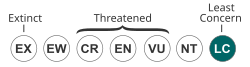
The spotted linsang (Prionodon pardicolor) is a linsang, a tree-dwelling carnivorous mammal, native to much of Southeast Asia. It is widely, though usually sparsely, recorded, and listed as Least Concern on the IUCN Red List.[1]
Characteristics[edit | edit source]
The spotted linsang resembles the banded linsang in its long, slender body, short limbs, elongated neck and head, and long tail. The ground colour ranges from dusky brown to light buff. Two long stripes extend from behind the ears to the shoulders or beyond, and two shorter stripes run along the neck. Three to four longitudinal rows of spots adorn the back, their size decreasing towards the belly. The fore legs are spotted to the paw, the hind legs to the hock. The cylindrical tail has eight or nine broad dark rings, separated by narrow white rings. The feet have five digits, and the area between the pads is covered with hair. The claws are retractile, claw sheaths are present on the fore paws, but the hind-paws have protective lobes of skin.[3] It weighs about 0.45 kg (1 lb) and measures in length about 360–380 mm (14–15 in) with a 30–33 cm (12–13 in) long tail. Its height is about 13–14 cm (5–5.5 in), the girth of its chest 14.6 cm (5.75 in), and length of head to the occiput about 7.6 cm (3 in).[4]
Distribution and habitat[edit | edit source]
The range of the spotted linsang includes eastern Nepal, Sikkim, Assam and Bengal in India, Bhutan, northeastern Myanmar, northern Thailand, Laos, northern Vietnam, and western Sichuan, Yunnan Guizhou and southwestern Guangxi in southern China. It is uncommon to rare throughout this range.[3] It is rarely observed in northern Bengal.[5] It primarily inhabits evergreen forests and shrubland. A large portion of this habitat is not protected, and this may cause the spotted linsang to be threatened with extinction due to habitat loss.[6] In Nam Et-Phou Louey National Biodiversity Conservation Area, it was observed in secondary vegetation dominated by banana stands in 2017.[7]
Ecology and behaviour[edit | edit source]
The spotted linsang is nocturnal, solitary, and at least partly arboreal.[7] It uses hollows in trees as resting and denning sites.[4] It hunts on the ground and in trees and feeds on rodents, frogs and snakes. It has also been observed feeding on carcass.[3]
Taxonomy[edit | edit source]
The Asiatic linsangs (Prionodon) are not, as was traditionally thought, members of the Viverridae (which does include the African linsangs), and may instead be the closest living relatives of the family Felidae. They have been placed in their own family, the Prionodontidae.[8] In 2004, Cytochrome b gene sequencing data changed the opinion of having Prionodon within the Viverrinae subfamily. Genetic data indicate that the similarities between Asiatic and African linsangs are due to convergence.[9]
References[edit | edit source]
- ↑ 1.0 1.1 1.2 Duckworth, J.W.; Lau, M.; Choudhury, A.U.; Chutipong, W.; Timmins, R.J.; Willcox, D.H.A.; Chan, B.P.L.; Long, B.; Roberton, S. (2024). "Prionodon pardicolor". IUCN Red List of Threatened Species. 2024 e.T41706A259356428. doi:10.2305/IUCN.UK.2024-2.RLTS.T41706A259356428.en. Retrieved 19 August 2025.
{{cite journal}}: Unknown parameter|amends=ignored (help) - ↑ Wozencraft, W.C. (2005). "Species Prionodon pardicolor". In Wilson, D.E.; Reeder, D.M (eds.). Mammal Species of the World: A Taxonomic and Geographic Reference (3rd ed.). Johns Hopkins University Press. pp. 532–628. ISBN 978-0-8018-8221-0. OCLC 62265494.
- ↑ 3.0 3.1 3.2 Van Rompaey, H. (1995). The Spotted Linsang, Prionodon pardicolor. Small Carnivore Conservation 13: 10–13.
- ↑ 4.0 4.1 Hodgson, B. H. (1847). "Observations on the manners and structure of Prionodon pardicolor". Calcutta Journal of Natural History. 8: 40–45.
- ↑ Choudhury, A. U. (1999). "Conservation of small carnivores (mustelids, viverrids, herpestids and one ailurid) in north Bengal, India". Small Carnivore Conservation (20): 15–17.
- ↑ Jennings, A.P. & Veron, G. (2015). "Predicted distributions, niche comparisons, and conservation status of the spotted linsang (Prionodon pardicolor) and banded linsang (Prionodon linsang)". Mammal Research. 60 (2): 107−116. doi:10.1007/s13364-014-0204-y. S2CID 17396993.
- ↑ 7.0 7.1 Chua, M. A. H. & Lim, K. K. P. (2017). "Spotted Linsang Prionodon pardicolor at Nam Et - Phou Louey National Biodiversity Conservation Area, Lao" (PDF). Southeast Asia Vertebrate Records (2017): 5–6.
- ↑ Gaubert, P.; Veron, G. (2003). "Exhaustive sample set among Viverridae reveals the sister-group of felids: the linsangs as a case of extreme morphological convergence within Feliformia" (PDF). Proceedings of the Royal Society of London B. 270 (1532): 2523–2530. doi:10.1098/rspb.2003.2521. PMC 1691530. PMID 14667345. Archived from the original (PDF) on 2005-03-02. Retrieved 2019-01-31.
- ↑ Gaubert, P.; Tranier, M.; Delmas, A.-S.; Colyn, M.; Veron, G. (2004). "First molecular evidence for reassessing phylogenetic affinities between genets (Genetta) and the enigmatic genet-like taxa Osbornictis, Poiana and Prionodon (Carnivora, Viverridae)". Zoologica Scripta. 33 (2): 117–129. doi:10.1111/j.1463-6409.2004.00140.x.
- Pages using the JsonConfig extension
- IUCN Red List least concern species
- Viverridae
- Carnivorans of Asia
- Mammals of Southeast Asia
- Mammals of Bhutan
- Mammals of Myanmar
- Mammals of Cambodia
- Mammals of China
- Mammals of India
- Mammals of Laos
- Mammals of Nepal
- Mammals of Thailand
- Mammals of Vietnam
- Least concern biota of Asia
- Mammals described in 1842
- Taxa named by Brian Houghton Hodgson