

imported>EditWiki45 No need to add redirect links and do not mention yutusyu or dushala seperately |
Improved article clarity and structure |
||
| (One intermediate revision by one other user not shown) | |||
| Line 1: | Line 1: | ||
{{about|the character|other uses|Shantanu (disambiguation) }} | |||
{{redirect|Santanu|other uses|Santanu (disambiguation) }} | |||
{{short description|Kuru King and father of Bhishma in epic Mahabharata}} | |||
{{Use dmy dates|date=January 2016}} | {{Use dmy dates|date=January 2016}} | ||
{{Use Indian English|date=January 2016}} | {{Use Indian English|date=January 2016}} | ||
{{Infobox character | |||
{{Infobox character | | title = [[Maharaja]] of [[Kuru Kingdom|Kuru]] | ||
| | | image = File:Santanu and Ganga.JPG | ||
| image | | alt = Shantanu | ||
| alt | | caption = ''Shantanu and Ganga'', chromolithograph by Bama Pada Banerjee | ||
| caption | | relatives = {{bulleted list|[[Pratipa]] (father)|Sunanda (mother)|[[Devapi]] (brother)|[[Bahlika (Mahabharata)|Bahlika]] (brother)}} | ||
| | | spouses = [[Ganga (goddess)|Ganga]]<br>[[Satyavati]] | ||
| | | children = | ||
{{bulleted list|[[Bhishma]] (from Ganga)|[[Chitrāngada|Chitrangada]] and [[Vichitravirya]] (from Satyavati)}} | |||
| children | | home = [[Hastinapur]]a | ||
| | | religion= [[Hinduism]] | ||
}} | }} | ||
Shantanu is | '''Shantanu''' ({{langx|sa|शांतनु, शान्तनु}}, {{IAST3|Śāṃtanu, Śāntanu}})<ref>van Buitenen (1973), p. 231; Shastri Chitrao (1964), p. 962</ref> is a character in the ancient Hindu epic ''[[Mahabharata]]''. He was the King of [[Kuru kingdom]] with his capital at [[Hastinapura]].<ref>{{cite book |last1=Chandrakant |first1=Kamala |last2=Pai |first2=Anant |title=Bheesma- Heroes from the Mahabharat |date=1997 |publisher=Amar Chitra Katha Pvt Ltd |location=Mumbai |isbn=81-8482-035-6 |page=1 |edition=August 2010 Reprint}}</ref> He was a descendant of the [[Bhāratas|Bharata]] race, a forebear of the lineage of the [[Lunar dynasty|Chandravamsha]], the father of [[Bhishma]] and the great-grandfather of the [[Pandava]]s and the [[Kaurava]]s. | ||
Shantanu was the youngest son of King [[Pratipa]] of Hastinapura and had been born during the king's later years. His eldest brother, [[Devapi]], had [[leprosy]], and had given up his rightful claim before becoming a hermit. The middle son, [[Bahlika (Mahabharata)|Bahlika]] (or Vahlika), abandoned his birth kingdom, and had started living with his maternal uncle in [[Balkh]], subsequently inheriting his kingdom. Shantanu, thus, ascended the throne of Hastinapura. | |||
==Etymology== | ==Etymology== | ||
The meaning of the name can be explained by [[Nirukta|nirukti]] available in [[Adi Parva]], through which Sri Nityananda Mishra elaborates its meaning as "the one who amplifies [[sukha]] (happiness) for others".<ref>{{Citation|last=Nityananda Mishra|title=Shantanu/śāntanu meaning explained|date=2020-03-29|url=http://archive.org/details/shantanumeaning|access-date=2020-04-02}}</ref>{{Unreliable source|date=November 2025}}{{Better source needed|date=November 2025}} Monier-Williams translates ''śaṁ-tanu'' as "wholesome for the body".<ref>Monier-Williams Online Sanskrit-English Dictionary (1899), p. 1054</ref> | |||
The meaning of the name can be explained by [[Nirukta|nirukti]] available in [[Adi Parva]], through which Sri | |||
The Sambhava Parva of Mahabharata says that the old men of his kingdom who were touched by this monarch not only felt an indescribable sensation of pleasure but also became restored to youth. Therefore, this monarch was called Santanu. | The Sambhava Parva of Mahabharata says that the old men of his kingdom who were touched by this monarch not only felt an indescribable sensation of pleasure but also became restored to youth. Therefore, this monarch was called Santanu. | ||
==Brahma's curse and the birth of Shantanu== | ==Brahma's curse and the birth of Shantanu== | ||
In his previous birth, there was a powerful king of the [[Ikshvaku dynasty]] named Mahabhisha. He possessed many virtuous qualities, and after performing a thousand [[Ashvamedha]] Yagnas and a hundred [[Rajasuya]] [[Yagna]]s (to qualify as emperor), he had attained heaven after his death. Once, he got an opportunity to visit the court of [[Brahma]] where all the [[Deva (Hinduism)|Devas]] and [[Ganges in Hinduism|Ganga]] were also present.<ref>{{cite book |last1=Roy |first1=Pratap Chandra |last2=Ganguli |first2=Kisari Mohan |title=The Mahabharat of Krishna-Dwaipayana Vyasa - Translated from Original Sanskrit |date=1896 |publisher=Oriental Publishing Co. |location=Calcutta-12 |page=230 |url=https://holybooks-lichtenbergpress.netdna-ssl.com/wp-content/uploads/Mahabharata-VOL-1.pdf |access-date=4 August 2018}}</ref> While the celestials were worshipping Brahma, a wind blew and displaced Ganga's clothes revealing her body. Everybody present there lowered their gaze except Mahabhisha who kept gazing at her. Upon seeing this, Brahma lost his temper and cursed him to be born a mortal. Ganga who also relished the impious act was cursed to be born as human and come back only after breaking Mahabhisha's heart. Mahabhisha then requested Brahma that he, Mahabhisha, be born as the son of Kuru king [[Pratipa]] and his wish was granted by Brahma. | |||
When the Pratipa was once meditating, Ganga took the form of a beautiful woman, approached the king and sat on his right thigh. When he asked her what she desired, Ganga requested him to become her husband. Pratipa however refused since he had taken a vow not to lust for anybody, and also that she had sat on his right thigh and according to traditions a man's right thigh was for his daughter or daughter-in-law while the left thigh was for his wife. He then proposed that she marry his son, to which she agreed. | |||
A child was born to Pratipa and his wife Sunanda in their old age. He was named Shantanu because when he was born his father had controlled his passions by ascetic penances. Pratipa then installed Shantanu as king of Hastinapura and retired into the woods to perform penances. Bahlika who was elder than Shantanu also gave | A child was born to Pratipa and his wife Sunanda in their old age. He was named Shantanu because when he was born his father had controlled his passions by ascetic penances. Pratipa then installed Shantanu as king of Hastinapura and retired into the woods to perform penances. Bahlika, who was elder than Shantanu, also gave his assent to Shantanu for becoming the king of Hastinapura. | ||
==Marriage with Ganga== | ==Marriage with Ganga== | ||
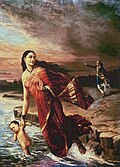
[[File: Raja Ravi Varma, Ganga and Shantanu (1890).jpg|thumb|170px|Shantanu stops Ganga from drowning their eighth child, who later was known as Bhishma.]] | [[File: Raja Ravi Varma, Ganga and Shantanu (1890).jpg|thumb|170px|Shantanu stops Ganga from drowning their eighth child, who later was known as Bhishma.]] | ||
Shantanu saw a beautiful woman on the banks of the river [[ | Shantanu saw a beautiful woman on the banks of the river [[Ganga]] and asked her to marry him. She agreed but with one condition: that Shantanu would never question any of her actions. They married and later she gave birth to a son. But she drowned the child. Shantanu could not ask her the reason, because of his promise, lest she would leave him. Six sons were born to the couple over the years and drowned by Ganga. | ||
When Ganga was about to drown | When Ganga was about to drown their eighth son, the devastated Shantanu could not restrain himself and confronted her. Ganga explained to King Shantanu about Brahma's curse given to Mahabhisha and to her. She revealed to him that their eight children were the eight reincarnated [[Vasu]]s who were cursed by sage [[Vasishtha]] to be born on earth as mortal humans. However, when they pacified him, he limited his curse and told them that they would be freed from this curse upon their birth as humans. So, she liberated the seven of them from human life by drowning them all. However, the Vasu [[Dyaus Pita|Dyaus]] was cursed to live a long life and not to have a wife or children. But Vasishtha also gave him a boon that he would be virtuous, conversant with all the holy scriptures and would be an obedient son to his father. Ganga said she would take him to train him properly for the king's throne and status. With these words, she disappeared along with the child, while Shantanu was struck with grief, pondering over spending the rest of his life without her.<ref>van Buitenen (1973), pp. 218-222</ref> | ||
==Reunion with his son== | ==Reunion with his son== | ||
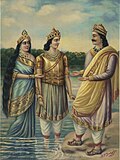
[[File: The scene from the Mahabharata of the presentation by Ganga of her son Devavrata (the future Bhisma) to his father, Santanu..jpg|thumb|left|Ganga presents her son Devavrata (the future Bhishma) to his father, Shantanu]] | [[File: The scene from the Mahabharata of the presentation by Ganga of her son Devavrata (the future Bhisma) to his father, Santanu..jpg|thumb|left|Ganga presents her son Devavrata (the future Bhishma) to his father, Shantanu.]] | ||
Shantanu, filled with grief from the loss of his wife and son, began to practise Brahmacharya and ruled his kingdom extremely well. By merely adopting virtuous behaviour, Shantanu was easily able to conquer the entire world without lifting weapons. All the kings declared Shantanu as Emperor and his reign was a peaceful one. Shantanu gave up hunting and gained popularity from his subjects. | Shantanu, filled with grief from the loss of his wife and son, began to practise Brahmacharya and ruled his kingdom extremely well. By merely adopting virtuous behaviour, Shantanu was easily able to conquer the entire world without lifting weapons. All the kings declared Shantanu as Emperor and his reign was a peaceful one. Shantanu gave up hunting and gained popularity from his subjects. | ||
One day, while walking along the banks of the Ganga, Shantanu saw that the river had become shallow. While searching for the cause of this phenomenon, he came across a handsome young boy who had checked the river's flow with his celestial weapon. The young boy was his son | One day, while walking along the banks of the Ganga, Shantanu saw that the river had become shallow. While searching for the cause of this phenomenon, he came across a handsome young boy who had checked the river's flow with his celestial weapon. The young boy was his son whom he did not recognize him because he could see him only for a few moments after he was born. The boy recognized that he was his father; however, he did not reveal it to him. Instead he disappeared from his sight using his power of illusion. Shantanu upon seeing this wondered whether the boy was actually his son and called upon Ganga to show the boy to him. Ganga appeared and revealed to him that the boy was actually their son Devavrata and that he was taught the knowledge of the holy scriptures by sage Vasishtha and the art of warfare by [[Parshurama]]. After revealing the truth about Devavrata she told Shantanu to take him to Hastinapura. Upon reaching the capital Shantanu crowned Devavrata as his heir-apparent.<ref>{{Cite book|last=Narasimhan|first=Chakravarthi V.|url=https://books.google.com/books?id=-P56leXRgAYC&q=santanu+sees+a+beautiful+woman&pg=PA8|title=The Mahābhārata: An English Version Based on Selected Verses|date=1999|publisher=Motilal Banarsidass Publ.|isbn=978-81-208-1673-2|language=en}}</ref> | ||
Although Shantanu was pained from his separation from Ganga, he was overjoyed upon receiving such an accomplished son. He performed seven | Although Shantanu was pained from his separation from Ganga, he was overjoyed upon receiving such an accomplished son. He performed seven Ashvamedha Yagnas on the banks of Yamuna with the help of Devavrata.<ref>van Buitenen (1973), pp.223-224</ref> | ||
==Marriage with Satyavati== | ==Marriage with Satyavati== | ||
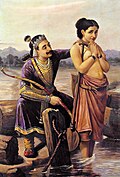
[[File: Ravi Varma-Shantanu and Satyavati.jpg|thumb|Shantanu and Satyavati, painting by [[Raja Ravi Varma]] | [[File: Ravi Varma-Shantanu and Satyavati.jpg|thumb|Shantanu and Satyavati, painting by [[Raja Ravi Varma]]]] | ||
Four years later, Shantanu while travelling near the banks of Yamuna smelled a sweet scent coming from an unknown direction. While searching for the | Four years later, Shantanu while travelling near the banks of Yamuna smelled a sweet scent coming from an unknown direction. While searching for the source of the fragrance, he came across [[Satyavati]] from whom the smell of scent was coming. Satyavati was an adopted daughter of the chief of the fishermen of her village. Upon seeing her, Shantanu fell in love with her and desired to marry her. Upon asking for his consent, her father agreed to the marriage on the condition that Satyavati's son would inherit the throne of Hastinapura. | ||
King Shantanu was unable to | King Shantanu was unable to meet this condition as his son Devavrata was the heir to the throne and was forlorn. Devavrata, however, realised the cause of his sorrow and for the sake of his father, gave his word to the chief that he would renounce all his claims to the throne, in favour of Satyavati's children. To reassure the skeptical chief further, Devavrata also vowed lifelong celibacy to ensure that future generations descended from Satyavati would also not be challenged by his offspring. Upon hearing this vow he immediately agreed to the marriage of Satyavati and Shantanu. Devavrata was then named as [[Bhishma]] (one who has taken a terrible vow) by the celestials. Devavrata returned to Hastinapura with Satyavati. Shantanu, unaware of his son's vow, married Satyavati. Eventually Shantanu learnt of his son's vow and was heartbroken. Later he became highly impressed with his son's love and affection and gave him a boon that he will only die if and when he decides to. Shantanu and Satyavati went on to have two sons, [[Chitrāngada]] and [[Vichitravirya]]. After Shantanu's death, Chitrangada became king of Hastinapura. | ||
==Literature== | ==Literature== | ||
| Line 57: | Line 59: | ||
==References== | ==References== | ||
{{Commons category}} | |||
{{reflist}} | |||
{{Mahābhārata}} | {{Mahābhārata}} | ||
{{HinduMythology}} | {{HinduMythology}} | ||
[[Category: Characters in the Mahabharata]] | [[Category:Characters in the Mahabharata]] | ||
[[Category: | [[Category:Mythological kings of Kuru]] | ||
Latest revision as of 02:59, 23 March 2026
| Shantanu | |
|---|---|
 Shantanu and Ganga, chromolithograph by Bama Pada Banerjee | |
| In-universe information | |
| Title | Maharaja of Kuru |
| Spouses | Ganga Satyavati |
| Children |
|
| Relatives | |
| Religion | Hinduism |
| Home | Hastinapura |
Shantanu (Sanskrit: शांतनु, शान्तनु, IAST: Śāṃtanu, Śāntanu)[1] is a character in the ancient Hindu epic Mahabharata. He was the King of Kuru kingdom with his capital at Hastinapura.[2] He was a descendant of the Bharata race, a forebear of the lineage of the Chandravamsha, the father of Bhishma and the great-grandfather of the Pandavas and the Kauravas.
Shantanu was the youngest son of King Pratipa of Hastinapura and had been born during the king's later years. His eldest brother, Devapi, had leprosy, and had given up his rightful claim before becoming a hermit. The middle son, Bahlika (or Vahlika), abandoned his birth kingdom, and had started living with his maternal uncle in Balkh, subsequently inheriting his kingdom. Shantanu, thus, ascended the throne of Hastinapura.
Etymology[edit | edit source]
The meaning of the name can be explained by nirukti available in Adi Parva, through which Sri Nityananda Mishra elaborates its meaning as "the one who amplifies sukha (happiness) for others".[3][unreliable source?][better source needed] Monier-Williams translates śaṁ-tanu as "wholesome for the body".[4]
The Sambhava Parva of Mahabharata says that the old men of his kingdom who were touched by this monarch not only felt an indescribable sensation of pleasure but also became restored to youth. Therefore, this monarch was called Santanu.
Brahma's curse and the birth of Shantanu[edit | edit source]
In his previous birth, there was a powerful king of the Ikshvaku dynasty named Mahabhisha. He possessed many virtuous qualities, and after performing a thousand Ashvamedha Yagnas and a hundred Rajasuya Yagnas (to qualify as emperor), he had attained heaven after his death. Once, he got an opportunity to visit the court of Brahma where all the Devas and Ganga were also present.[5] While the celestials were worshipping Brahma, a wind blew and displaced Ganga's clothes revealing her body. Everybody present there lowered their gaze except Mahabhisha who kept gazing at her. Upon seeing this, Brahma lost his temper and cursed him to be born a mortal. Ganga who also relished the impious act was cursed to be born as human and come back only after breaking Mahabhisha's heart. Mahabhisha then requested Brahma that he, Mahabhisha, be born as the son of Kuru king Pratipa and his wish was granted by Brahma.
When the Pratipa was once meditating, Ganga took the form of a beautiful woman, approached the king and sat on his right thigh. When he asked her what she desired, Ganga requested him to become her husband. Pratipa however refused since he had taken a vow not to lust for anybody, and also that she had sat on his right thigh and according to traditions a man's right thigh was for his daughter or daughter-in-law while the left thigh was for his wife. He then proposed that she marry his son, to which she agreed.
A child was born to Pratipa and his wife Sunanda in their old age. He was named Shantanu because when he was born his father had controlled his passions by ascetic penances. Pratipa then installed Shantanu as king of Hastinapura and retired into the woods to perform penances. Bahlika, who was elder than Shantanu, also gave his assent to Shantanu for becoming the king of Hastinapura.
Marriage with Ganga[edit | edit source]
.jpg)
Shantanu saw a beautiful woman on the banks of the river Ganga and asked her to marry him. She agreed but with one condition: that Shantanu would never question any of her actions. They married and later she gave birth to a son. But she drowned the child. Shantanu could not ask her the reason, because of his promise, lest she would leave him. Six sons were born to the couple over the years and drowned by Ganga.
When Ganga was about to drown their eighth son, the devastated Shantanu could not restrain himself and confronted her. Ganga explained to King Shantanu about Brahma's curse given to Mahabhisha and to her. She revealed to him that their eight children were the eight reincarnated Vasus who were cursed by sage Vasishtha to be born on earth as mortal humans. However, when they pacified him, he limited his curse and told them that they would be freed from this curse upon their birth as humans. So, she liberated the seven of them from human life by drowning them all. However, the Vasu Dyaus was cursed to live a long life and not to have a wife or children. But Vasishtha also gave him a boon that he would be virtuous, conversant with all the holy scriptures and would be an obedient son to his father. Ganga said she would take him to train him properly for the king's throne and status. With these words, she disappeared along with the child, while Shantanu was struck with grief, pondering over spending the rest of his life without her.[6]
Reunion with his son[edit | edit source]
_to_his_father,_Santanu..jpg)
Shantanu, filled with grief from the loss of his wife and son, began to practise Brahmacharya and ruled his kingdom extremely well. By merely adopting virtuous behaviour, Shantanu was easily able to conquer the entire world without lifting weapons. All the kings declared Shantanu as Emperor and his reign was a peaceful one. Shantanu gave up hunting and gained popularity from his subjects.
One day, while walking along the banks of the Ganga, Shantanu saw that the river had become shallow. While searching for the cause of this phenomenon, he came across a handsome young boy who had checked the river's flow with his celestial weapon. The young boy was his son whom he did not recognize him because he could see him only for a few moments after he was born. The boy recognized that he was his father; however, he did not reveal it to him. Instead he disappeared from his sight using his power of illusion. Shantanu upon seeing this wondered whether the boy was actually his son and called upon Ganga to show the boy to him. Ganga appeared and revealed to him that the boy was actually their son Devavrata and that he was taught the knowledge of the holy scriptures by sage Vasishtha and the art of warfare by Parshurama. After revealing the truth about Devavrata she told Shantanu to take him to Hastinapura. Upon reaching the capital Shantanu crowned Devavrata as his heir-apparent.[7]
Although Shantanu was pained from his separation from Ganga, he was overjoyed upon receiving such an accomplished son. He performed seven Ashvamedha Yagnas on the banks of Yamuna with the help of Devavrata.[8]
Marriage with Satyavati[edit | edit source]

Four years later, Shantanu while travelling near the banks of Yamuna smelled a sweet scent coming from an unknown direction. While searching for the source of the fragrance, he came across Satyavati from whom the smell of scent was coming. Satyavati was an adopted daughter of the chief of the fishermen of her village. Upon seeing her, Shantanu fell in love with her and desired to marry her. Upon asking for his consent, her father agreed to the marriage on the condition that Satyavati's son would inherit the throne of Hastinapura.
King Shantanu was unable to meet this condition as his son Devavrata was the heir to the throne and was forlorn. Devavrata, however, realised the cause of his sorrow and for the sake of his father, gave his word to the chief that he would renounce all his claims to the throne, in favour of Satyavati's children. To reassure the skeptical chief further, Devavrata also vowed lifelong celibacy to ensure that future generations descended from Satyavati would also not be challenged by his offspring. Upon hearing this vow he immediately agreed to the marriage of Satyavati and Shantanu. Devavrata was then named as Bhishma (one who has taken a terrible vow) by the celestials. Devavrata returned to Hastinapura with Satyavati. Shantanu, unaware of his son's vow, married Satyavati. Eventually Shantanu learnt of his son's vow and was heartbroken. Later he became highly impressed with his son's love and affection and gave him a boon that he will only die if and when he decides to. Shantanu and Satyavati went on to have two sons, Chitrāngada and Vichitravirya. After Shantanu's death, Chitrangada became king of Hastinapura.
Literature[edit | edit source]
- van Buitenen, J.A.B. (1973), Mahabharata, vol. 1, Chicago, The University of Chicago Press, pp. 216–230
- Shastri Chitrao, M.M.S. (1964), Bharatavarshiya Prachin Charitrakosha (Dictionary of Ancient Indian Biography, in Hindi), pp. 962–63
References[edit | edit source]
- ↑ van Buitenen (1973), p. 231; Shastri Chitrao (1964), p. 962
- ↑ Chandrakant, Kamala; Pai, Anant (1997). Bheesma- Heroes from the Mahabharat (August 2010 Reprint ed.). Mumbai: Amar Chitra Katha Pvt Ltd. p. 1. ISBN 81-8482-035-6.
- ↑ Nityananda Mishra (29 March 2020), Shantanu/śāntanu meaning explained, retrieved 2 April 2020
- ↑ Monier-Williams Online Sanskrit-English Dictionary (1899), p. 1054
- ↑ Roy, Pratap Chandra; Ganguli, Kisari Mohan (1896). The Mahabharat of Krishna-Dwaipayana Vyasa - Translated from Original Sanskrit (PDF). Calcutta-12: Oriental Publishing Co. p. 230. Retrieved 4 August 2018.
{{cite book}}: CS1 maint: location (link) - ↑ van Buitenen (1973), pp. 218-222
- ↑ Narasimhan, Chakravarthi V. (1999). The Mahābhārata: An English Version Based on Selected Verses. Motilal Banarsidass Publ. ISBN 978-81-208-1673-2.
- ↑ van Buitenen (1973), pp.223-224
Hindu deities and texts | ||
|---|---|---|
| Gods |  | |
| Goddesses | ||
| Other deities | ||
| Texts | ||