
imported>Dl2000 m ordinals not normally used in dates (WP:DATESNO) |
CleanupBot (talk | contribs) m Robot: Replacing encoded entity with character |
||
| (One intermediate revision by one other user not shown) | |||
| Line 1: | Line 1: | ||
{{Short description|Wildlife sanctuary in Chandigarh, India}} | |||
{{Use dmy dates|date=February 2017}} | {{Use dmy dates|date=February 2017}} | ||
{{Use Indian English|date=February 2017}} | {{Use Indian English|date=February 2017}} | ||
{{Multiple issues| | {{Multiple issues| | ||
{{More citations needed|date=May 2016}} | {{More citations needed|date=May 2016}} | ||
{{More footnotes|date=October 2017}}}} | {{More footnotes needed|date=October 2017}}}} | ||
{{Infobox protected area | {{Infobox protected area | ||
| name = Sukhna Wildlife Sanctuary | | name = Sukhna Wildlife Sanctuary | ||
| alt_name = Nature Trail Lake Reserve Forest | | alt_name = Nature Trail Lake Reserve Forest | ||
| iucn_category = | | iucn_category = IV | ||
| | | image = File:Entrance of Sukhna Wildlife Sanctuary,Chandigarh, India.JPG | ||
| | |||
| | | | ||
| | | image_alt = | ||
| location = Near[[Sukhna Lake]], [[Chandigarh]] | | image_caption = Main entrance | ||
| map = India Chandigarh#India | |||
| relief = 1 | |||
| mapframe = Yes | |||
| image_size = | |||
| location = Near [[Sukhna Lake]], [[Chandigarh]] | |||
| coordinates = {{coord|30|44|42|N|76|49|22|E|format=dms|display=inline,title}} | | coordinates = {{coord|30|44|42|N|76|49|22|E|format=dms|display=inline,title}} | ||
| coords_ref = | | coords_ref = | ||
| area = 2600 Hects. | | area = 2600 Hects. | ||
| established = 1998 | | established = 1998 | ||
| visitation_num = | | visitation_num = | ||
| visitation_year = | | visitation_year = | ||
| governing_body = | | governing_body = Forest and Wildlife department [[Chandigarh Administration]] [https://www.chandigarhforest.gov.in/ https://www.chandigarhforest.gov.in/] | ||
| url = https://chandigarh.gov.in/green-chandigarh/sukhna-wildlife-sanctuary | |||
| url = | |||
}} | }} | ||
'''Sukhna Wildlife Sanctuary''' is located in [[Shivalik | The '''Sukhna Wildlife Sanctuary''' is a 2600 hectare (6400+ acres) nature preserve located in the [[Shivalik Hills]] of [[Chandigarh]], [[India]], near [[Sukhna Lake]].<ref>{{cite web |url=http://chandigarh.gov.in/green_suk_wild.htm |title=Official Website of Chandigarh Administration |website=Chandigarh.gov.in |access-date=11 October 2017}}</ref> The area was officially declared a wildlife sanctuary in 1998. The sanctuary is open to a limited number of visitors, and an entry pass is required, which is issued by the Forest Department Office (sector 19, Chandigarh). The reserve is typically not open to the public during the rainy season. | ||
==Area and location== | ==Area and location== | ||
The Sukhna Wildlife Sanctuary is a protected wildlife | [[Image:Sukhna Wildlife Sanctuary, Kansal gate, Chandigarh.jpg|thumb|Entry near Kansal]] | ||
The Sukhna Wildlife Sanctuary is a protected wildlife reserve situated about two kilometres from Sukhna Lake, in the centre-northwest of India. It spans an area of 26 square kilometres (2600 hectares; 6424.74 acres) of lightly wooded and shrub lands; the main areas include much of the Nepli Forest,<ref>{{cite web|url=https://m.youtube.com/watch?v=RwuLqxkJ9xA&pp=ygUkc3VraG5hIHdpbGRsaWZlIHNhbmN0dWFyeSBjaGFuZGlnYXJo |title= Nepli Forest I Sukhna Wildlife Sanctuary I Chandigarh I |date=10 April 2022 |accessdate=26 May 2023 |website=YouTube |publisher=RambleGirl}}</ref> as well as encompassing the plains at the foot of the Shivalik Hills. The rain-catchment region of Sukhna Lake partially falls in the area designated for the wildlife sanctuary. | |||
==History== | ==History== | ||
The history of | The history of Sukhna Lake and the Sukhna Wildlife Sanctuary is intertwined; the Lake was part of the original development plans for the city of [[Chandigarh]], and was planned and erected over a period of years, beginning in 1958 and lasting through the 1970s. It was an [[artificial lake]] that was fed with rainwater from the [[catchment]] areas in the Shivalik Hills. [[Siltation]] was a big problem for Sukhna Lake, and had to be tackled effectively; the issue was minimized by many [[engineering]] and [[soil conservation]] methods. A large-scale [[afforestation]] program was implemented in the catchment area.<ref>{{cite journal |author=Singh, Yadvinder |journal=ENVIS Bulletin |volume=10 |issue=2 |date=2002 |publisher=Department of Geography, [[Punjabi University]], Patiala |title=Siltation Problems in Sukhna Lake in Chandigarh, NW India and Comments on Geohydrological Changes in the Yamuna-Satluj Region |url=http://gbpihed.nic.in/envis/HTML/vol10_2/ysingh.htm |access-date=2008-03-06 |url-status=dead |archive-url=https://web.archive.org/web/20080119031818/http://gbpihed.nic.in/envis/HTML/vol10_2/ysingh.htm |archive-date=19 January 2008}}</ref> | ||
==Flora and fauna== | ==Flora and fauna== | ||
The Sukhna Wildlife Sanctuary was declared a protected wildlife sanctuary in March 1998, as this hilly area was recognized for its fauna and substantial tree and forest growth. After becoming a reserve, more systematic and large-scale afforestation programs were undertaken, particularly in the water catchment areas, which ultimately resulted in an improved biodiversity and healthier flora. The Nepli Forest area grew in lushness over several decades, mainly through the managed plantings of nursery-grown native plants and trees. Numerous endemic trees, herbs, and other plants thrive in Sukhna, including ''[[Acacia leucophloea]]'' (raeru), ''[[Acacia modesta]]'' (phulai), ''[[Acacia nilotica]]'' (kikar), ''[[Justicia (plant)|Justicia]]'' sp., ''[[Anogeissus latifolia]]'' (chhal), ''[[Azadirachta indica]]'' (neem), ''[[Bambusa vulgaris]]'' (golden bamboo), ''[[Bauhinia racemosa]]'' (kachnar/bidi leaf), ''[[Bombax ceiba]]'' (semal/cotton tree), ''[[Butea frondosa]]'' (dhakk), ''[[Cassia fistula]]'' (amaltas), ''[[Dalbergia]]'' sp. (shisham/rosewood), ''[[Diospyros montana]]'' (kendu/Indian ebony), ''[[Emblica officinalis]]'' (amla/gooseberry), ''[[Morus alba]]'' (tut/white mulberry), ''[[Murraya koenigii]]'' (kari patta/curry-leaf tree), ''[[Prosopis juliflora]]'' (mesquite), ''[[Senegalia catechu]]'' (khair), and ''[[Senna siamea]]'' (kassod).<ref>{{cite web|url=https://www.inaturalist.org/observations?place_id=10788 |title=Observations; Chandigarh, IN |website=iNaturalist |author=Research-grade observations |accessdate=26 May 2023 |publisher=iNaturalist Network}}</ref> | |||
Sukhna Wildlife Sanctuary has a rich variety of animal life,<ref>{{cite web|url=https://www.inaturalist.org/observations?place_id=10788 |title=Observations; Chandigarh, IN |website=iNaturalist |author=Research-grade observations |accessdate=26 May 2023 |publisher=iNaturalist Network}}</ref> known to have one of the highest concentrations of [[sambar deer]] (''Cervus unicolor'') in the country. It is also home to other mammals including [[axis deer]] (chital), [[Nilgai|blue bull]] (nilgai), [[Hanuman langur]], [[Indian flying fox]], [[Indian muntjac|muntjac]], [[Five-lined palm squirrel|palm squirrel]], [[Indian pangolin|pangolin]], [[Rhesus macaque]] and [[Eurasian wild boar|wild boar]] (jangali suar). | |||
Numerous resident, migratory and breeding birds can be observed in the sanctuary;<ref>{{cite web|url=https://www.inaturalist.org/observations?place_id=10788 |title=Observations; Chandigarh, IN |website=iNaturalist |author=Research-grade observations |accessdate=26 May 2023 |publisher=iNaturalist Network}}</ref> species include the [[Asian koel]], [[Barn-owl|barn owl]], [[black bittern]], [[black francolin]], [[black redstart]], [[black-rumped flameback]], [[black kite|black]] and [[black-winged kite]], [[Indian blue peafowl|blue peafowl]], [[blue-tailed bee-eater]], [[booted eagle]], [[brown-headed barbet]], [[common hawk-cuckoo]], [[common myna]], [[Eurasian coot|coot]], [[cormorant]]s, [[crimson sunbird|crimson]] and [[purple sunbird]], [[greater coucal]], [[greenish warbler]], [[grey-winged blackbird]], [[Indian grey hornbill]], [[Indian paradise flycatcher]], [[Indian pond-heron]], [[Indian roller]], [[Indian scops-owl]], [[Indian spot-billed duck]], [[Indian white-eye]], [[jungle babbler]], [[lesser whitethroat]], [[lineated barbet]], [[Common moorhen|moorhen]], [[mottled wood-owl]], [[Indian pitta]], [[Oriental honey-buzzard]], [[Oriental pied hornbill]], [[red junglefowl]], [[red-vented bulbul]], [[red-wattled lapwing]], [[ring-necked parakeet]], [[ruddy shelduck]], [[scarlet minivet|scarlet]] and [[long-tailed minivet]], [[shikra]], [[Sind sparrow]], [[spotted owlet]], [[tufted duck]], [[white wagtail]], [[white-breasted waterhen]] and [[white-throated kingfisher]]. | |||
==Gallery== | ==Gallery== | ||
<gallery> | <gallery> | ||
File:Sukhna Wildlife Sanctuary , view from middle way of Sukhna | File:Sukhna Wildlife Sanctuary, view from middle way of Sukhna Lake, Chandigarh, India.jpg|Sanctuary's view from Midway of [[Sukhna lake]], [[Chandigarh]] | ||
File:Sukhna Wildlife Sanctury Chandigarh,India.jpg | File:Sukhna Wildlife Sanctury Chandigarh, India.jpg | ||
File:Sukhna Wildlife Sactury, Chandigarh.JPG | File:Sukhna Wildlife Sactury, Chandigarh.JPG | ||
File:Birds in Sukhna Wildlife Sanctuary , Chandigarh , India. | File:Birds in Sukhna Wildlife Sanctuary, Chandigarh, India.jpg | ||
File:Jungle fowls in Sukhna Wildlife sanctury, Chandigarh, India.JPG | File:Jungle fowls in Sukhna Wildlife sanctury, Chandigarh, India.JPG | ||
File:Sukhna Wildlife Sanctuary , Chandigarh, India. | File:Sukhna Wildlife Sanctuary, Chandigarh, India.jpg | ||
File:Stages at Sukhna Wildlife Sanctuary , view from middle way of Sukhna | File:Stages at Sukhna Wildlife Sanctuary, view from middle way of Sukhna Lake, Chandigarh, India.jpg | ||
File:Sukhna Wildlife Sanctuary , view from bird watch point of Sukhna | File:Sukhna Wildlife Sanctuary, view from bird watch point of Sukhna Lake, Chandigarh, India.jpg | ||
File:Jungle fowl, Sukhna Wldlife Sanctuary, Chandigarh, India.JPG | File:Jungle fowl, Sukhna Wldlife Sanctuary, Chandigarh, India.JPG | ||
File:Inner view of Sukhna Wildlife Sanctuary,Chandigarh, India.JPG | File:Inner view of Sukhna Wildlife Sanctuary,Chandigarh, India.JPG | ||
File:Nature Trail, lake reserve forest, Sukhna Lake, Chandigarh 01.jpg|Entrance Nature Trail, Lake forest | |||
File:Nature Trail, lake reserve forest, Sukhna Lake, Chandigarh 02.jpg|Inner view of Nature Trail, Lake forest | |||
File:Nature Trail, lake reserve forest, Sukhna Lake, Chandigarh 03.jpg|Pro nature slogan/ motos written in Nature Trail, Lake forest | |||
File:Nature Trail , lake reserve forest , Sukhna | File:Pro-nature mottos in Nature Trail, lake reserve forest, Sukhna Lake, Chandigarh 04.jpg|Pro Nature motos, Nature Trail | ||
File:Nature Trail , lake reserve forest , Sukhna | File:Pro-nature mottos in Nature Trail, lake reserve forest, Sukhna Lake, Chandigarh 05.jpg|Pro Nature motos in Nature Trail | ||
File:Nature Trail , lake reserve forest , Sukhna | File:Nature Trail, lake reserve forest, Sukhna Lake, Chandigarh 06.jpg|Nature Trail Reserve Forest, Sukhna Lake | ||
File:Pro | File:Landscape in Nature Trail, lake reserve forest, Sukhna Lake, Chandigarh 07.jpg|Landscape in Nature Trail reserve forest | ||
File:Pro | File:Landscape in Nature Trail, lake reserve forest, Sukhna Lake, Chandigarh 08.jpg|Landscape in and around Nature Trail reserve forest | ||
File:Nature Trail , lake reserve forest , Sukhna | |||
File:Landscape in Nature Trail , lake reserve forest , Sukhna | |||
File:Landscape in Nature Trail , lake reserve forest , Sukhna | |||
</gallery> | </gallery> | ||
Latest revision as of 12:26, 22 March 2026
 | This article has multiple issues. Please help improve it or discuss these issues on the talk page. (Learn how and when to remove these template messages)
|


| Sukhna Wildlife Sanctuary | |
|---|---|
| Nature Trail Lake Reserve Forest | |
IUCN category IV (habitat/species management area) | |
| Location | Near Sukhna Lake, Chandigarh |
| Coordinates | 30°44′42″N 76°49′22″E / 30.74500°N 76.82278°E |
| Area | 2600 Hects. |
| Established | 1998 |
| Governing body | Forest and Wildlife department Chandigarh Administration https://www.chandigarhforest.gov.in/ |
| chandigarh | |


The Sukhna Wildlife Sanctuary is a 2600 hectare (6400+ acres) nature preserve located in the Shivalik Hills of Chandigarh, India, near Sukhna Lake.[1] The area was officially declared a wildlife sanctuary in 1998. The sanctuary is open to a limited number of visitors, and an entry pass is required, which is issued by the Forest Department Office (sector 19, Chandigarh). The reserve is typically not open to the public during the rainy season.
Area and location[edit | edit source]
The Sukhna Wildlife Sanctuary is a protected wildlife reserve situated about two kilometres from Sukhna Lake, in the centre-northwest of India. It spans an area of 26 square kilometres (2600 hectares; 6424.74 acres) of lightly wooded and shrub lands; the main areas include much of the Nepli Forest,[2] as well as encompassing the plains at the foot of the Shivalik Hills. The rain-catchment region of Sukhna Lake partially falls in the area designated for the wildlife sanctuary.
History[edit | edit source]
The history of Sukhna Lake and the Sukhna Wildlife Sanctuary is intertwined; the Lake was part of the original development plans for the city of Chandigarh, and was planned and erected over a period of years, beginning in 1958 and lasting through the 1970s. It was an artificial lake that was fed with rainwater from the catchment areas in the Shivalik Hills. Siltation was a big problem for Sukhna Lake, and had to be tackled effectively; the issue was minimized by many engineering and soil conservation methods. A large-scale afforestation program was implemented in the catchment area.[3]
Flora and fauna[edit | edit source]
The Sukhna Wildlife Sanctuary was declared a protected wildlife sanctuary in March 1998, as this hilly area was recognized for its fauna and substantial tree and forest growth. After becoming a reserve, more systematic and large-scale afforestation programs were undertaken, particularly in the water catchment areas, which ultimately resulted in an improved biodiversity and healthier flora. The Nepli Forest area grew in lushness over several decades, mainly through the managed plantings of nursery-grown native plants and trees. Numerous endemic trees, herbs, and other plants thrive in Sukhna, including Acacia leucophloea (raeru), Acacia modesta (phulai), Acacia nilotica (kikar), Justicia sp., Anogeissus latifolia (chhal), Azadirachta indica (neem), Bambusa vulgaris (golden bamboo), Bauhinia racemosa (kachnar/bidi leaf), Bombax ceiba (semal/cotton tree), Butea frondosa (dhakk), Cassia fistula (amaltas), Dalbergia sp. (shisham/rosewood), Diospyros montana (kendu/Indian ebony), Emblica officinalis (amla/gooseberry), Morus alba (tut/white mulberry), Murraya koenigii (kari patta/curry-leaf tree), Prosopis juliflora (mesquite), Senegalia catechu (khair), and Senna siamea (kassod).[4]
Sukhna Wildlife Sanctuary has a rich variety of animal life,[5] known to have one of the highest concentrations of sambar deer (Cervus unicolor) in the country. It is also home to other mammals including axis deer (chital), blue bull (nilgai), Hanuman langur, Indian flying fox, muntjac, palm squirrel, pangolin, Rhesus macaque and wild boar (jangali suar).
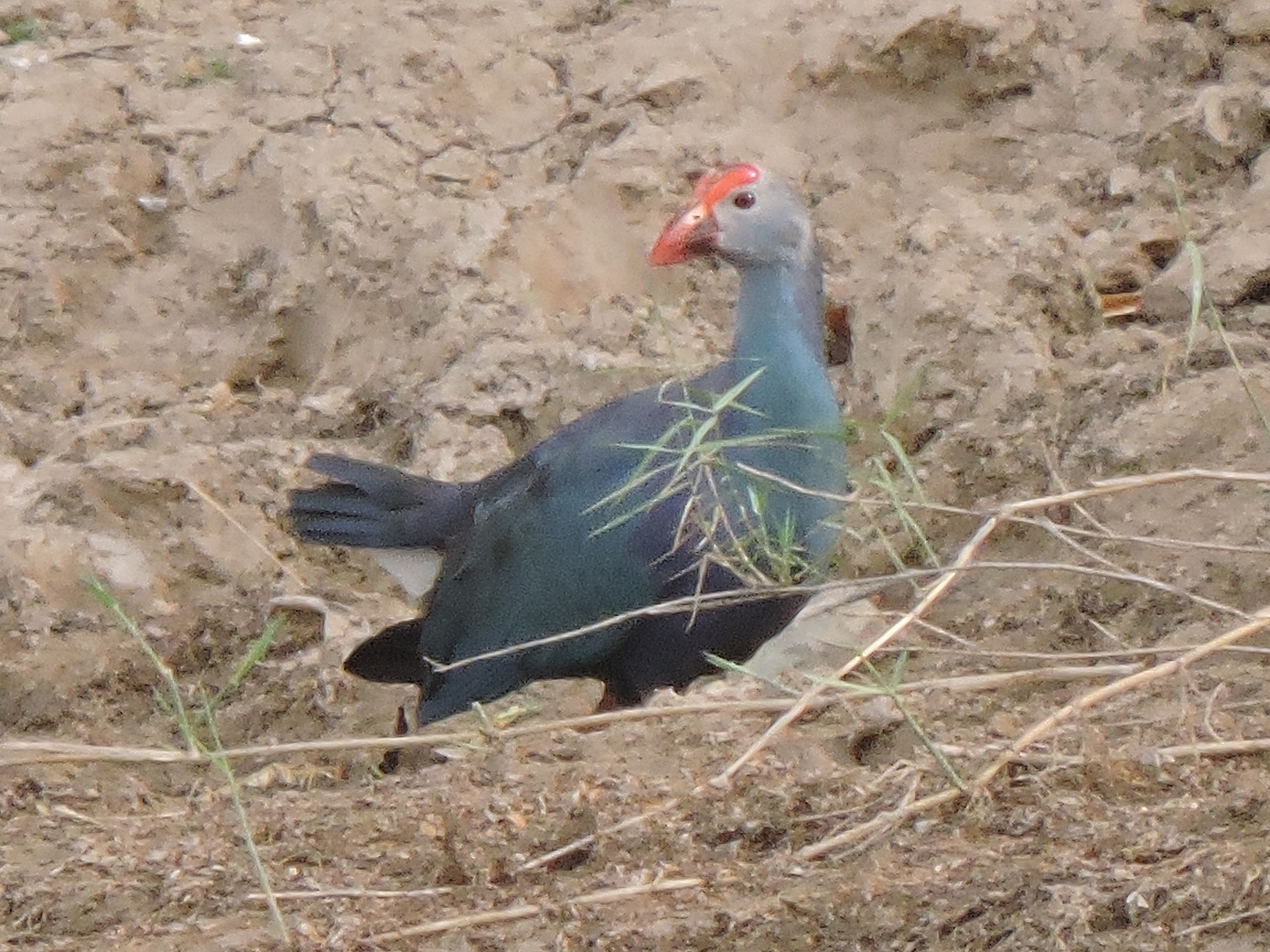
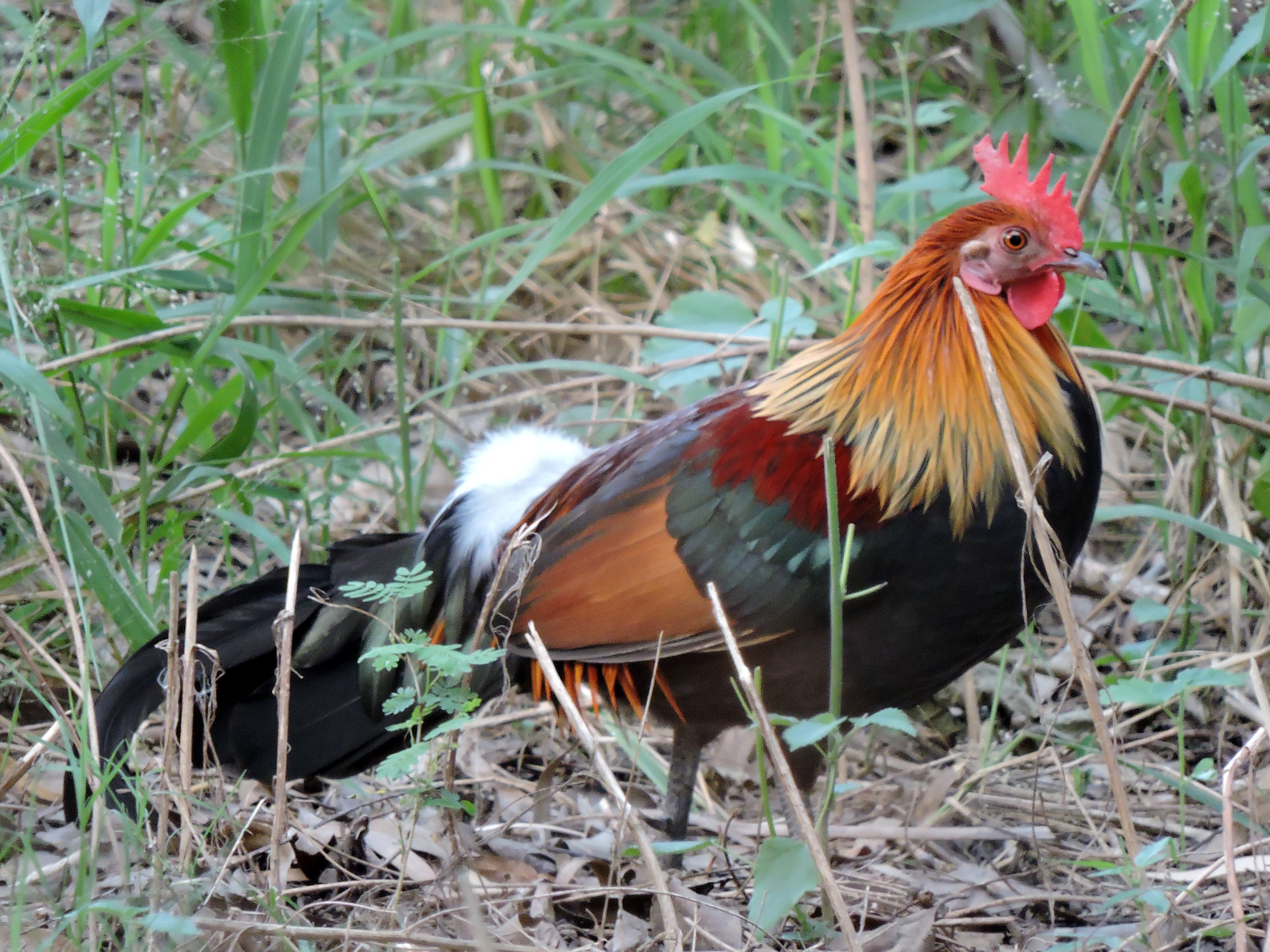
Numerous resident, migratory and breeding birds can be observed in the sanctuary;[6] species include the Asian koel, barn owl, black bittern, black francolin, black redstart, black-rumped flameback, black and black-winged kite, blue peafowl, blue-tailed bee-eater, booted eagle, brown-headed barbet, common hawk-cuckoo, common myna, coot, cormorants, crimson and purple sunbird, greater coucal, greenish warbler, grey-winged blackbird, Indian grey hornbill, Indian paradise flycatcher, Indian pond-heron, Indian roller, Indian scops-owl, Indian spot-billed duck, Indian white-eye, jungle babbler, lesser whitethroat, lineated barbet, moorhen, mottled wood-owl, Indian pitta, Oriental honey-buzzard, Oriental pied hornbill, red junglefowl, red-vented bulbul, red-wattled lapwing, ring-necked parakeet, ruddy shelduck, scarlet and long-tailed minivet, shikra, Sind sparrow, spotted owlet, tufted duck, white wagtail, white-breasted waterhen and white-throated kingfisher.
Gallery[edit | edit source]
-
 Sanctuary's view from Midway of Sukhna lake, Chandigarh
 -
-
-
Entrance Nature Trail, Lake forest
-
Inner view of Nature Trail, Lake forest
-
Pro nature slogan/ motos written in Nature Trail, Lake forest
-
Pro Nature motos, Nature Trail
-
Pro Nature motos in Nature Trail
-
Nature Trail Reserve Forest, Sukhna Lake
-
Landscape in Nature Trail reserve forest
-
 Landscape in and around Nature Trail reserve forest


References[edit | edit source]
- ↑ "Official Website of Chandigarh Administration". Chandigarh.gov.in. Retrieved 11 October 2017.
- ↑ "Nepli Forest I Sukhna Wildlife Sanctuary I Chandigarh I". YouTube. RambleGirl. 10 April 2022. Retrieved 26 May 2023.
- ↑ Singh, Yadvinder (2002). "Siltation Problems in Sukhna Lake in Chandigarh, NW India and Comments on Geohydrological Changes in the Yamuna-Satluj Region". ENVIS Bulletin. 10 (2). Department of Geography, Punjabi University, Patiala. Archived from the original on 19 January 2008. Retrieved 6 March 2008.
- ↑ Research-grade observations. "Observations; Chandigarh, IN". iNaturalist. iNaturalist Network. Retrieved 26 May 2023.
- ↑ Research-grade observations. "Observations; Chandigarh, IN". iNaturalist. iNaturalist Network. Retrieved 26 May 2023.
- ↑ Research-grade observations. "Observations; Chandigarh, IN". iNaturalist. iNaturalist Network. Retrieved 26 May 2023.
External links[edit | edit source]
- "Official Website of Chandigarh Administration". Chandigarh.gov.in. Retrieved 11 October 2017.
- "ਸੁਖਨਾ ਜੰਗਲੀ ਜੀਵ ਰੱਖ ਦੀ ਜ਼ਮੀਨ ਬਾਰੇ ਉੱਠਿਆ ਵਿਵਾਦ". Punjabitribuneonline.com. 7 April 2012. Retrieved 11 October 2017.