

robot: Update article (please report if you notice any mistake or error in this edit) |
No edit summary |
||
| Line 1: | Line 1: | ||
{{Short description|Ruler of Kashmir from 980 to 1003}} | |||
{{Use dmy dates|date=June 2024}} | |||
{{Use Indian English|date=June 2024}} | |||
{{Infobox royalty | {{Infobox royalty | ||
| title | | title = | ||
| name | | name = Didda | ||
| image | | image = Queen Didda coin.jpg | ||
| caption | | caption = Copper coin featuring Queen Didda | ||
| succession | | succession = [[List of monarchs of Kashmir#Utpala dynasty (c. 855–1012 CE)|Queen of Kashmir]] | ||
| reign | | reign = 980 – 8 August 1003 | ||
| predecessor | | predecessor = Bhimagupta ({{abbr|r.|reigned}} 975 – 980) | ||
| successor | | successor = [[Samgrāmarāja]] ({{abbr|r.|reigned}} 1003–1028) | ||
|reign-type2 = [[Regency]] | | reign-type2 = [[Regency]] | ||
|reign2 = 958 – 980 | | reign2 = 958 – 980 | ||
|succession2 = | | succession2 = [[Regent]] of [[Utpala dynasty|Kashmir]] | ||
|pre-type2 = Monarch | | pre-type2 = Monarch | ||
|predecessor2 = {{Plainlist| | | predecessor2 = {{Plainlist| | ||
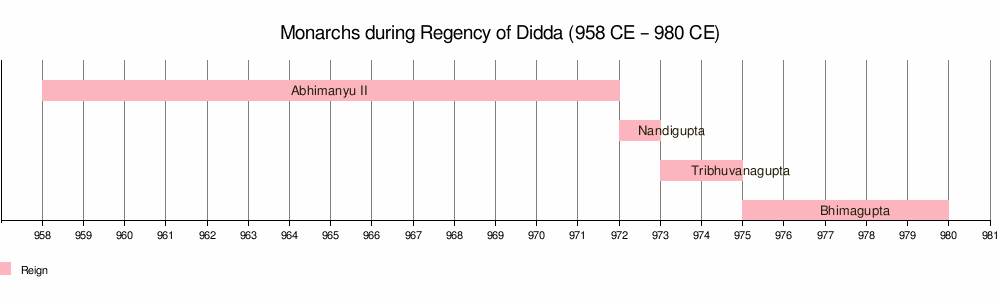
* Abhimanyu II ({{abbr|r.|reigned}} 958 – 972) | * Abhimanyu II ({{abbr|r.|reigned}} 958 – 972) | ||
* Nandigupta ({{abbr|r.|reigned}} 972 – 973) | * Nandigupta ({{abbr|r.|reigned}} 972 – 973) | ||
| Line 18: | Line 21: | ||
* Bhimagupta ({{abbr|r.|reigned}} 975 – 980) | * Bhimagupta ({{abbr|r.|reigned}} 975 – 980) | ||
}} | }} | ||
|successor2 = <!--Herself as Queen--> | | successor2 = <!--Herself as Queen--> | ||
| house | | house = {{plainlist| | ||
* [[Lohara dynasty]] (by birth) | * [[Lohara dynasty]] (by birth) | ||
* [[Utpala dynasty]] (by marriage) | * [[Utpala dynasty]] (by marriage) | ||
}} | }} | ||
| birth_date | | birth_date = {{circa|924}} | ||
| father | | father = Simharaja, King of Lohara | ||
| mother | | mother = | ||
| module | | module = {{Infobox person | ||
| child=yes | |||
| relatives = [[Hindu Shahi#Bhimadeva: confrontations with Alp-Tegin and loss of Kabul|Bhimadeva Shahi]] <br /><small>(maternal grandfather)</small><br />Udayaraja <br /><small>(brother)</small><br />[[Samgrāmarāja]] <br /><small>(nephew)</small> | |||
}} | }} | ||
'''Didda''' ({{circa|924 | | spouse = Kshemagupta | ||
| issue = Abhimanyu II | |||
| death_date = {{Death date and age|1003|8|8|924|||df=yes}}<ref name="n439">{{cite web | title=The Hindu Sahis of Afghanistan and the Punjab | last = Mishra | first = Yogendra | url=https://ia800604.us.archive.org/14/items/in.ernet.dli.2015.99741/2015.99741.The-Hindu-Sahis-Of-Afghanistan-And-The-Punjab_text.pdf | access-date=22 October 2025 | page = 61}}</ref> | |||
| death_place = | |||
| burial_place = | |||
| religion = [[Hinduism]] | |||
| regnal name = | |||
}} | |||
'''Didda''' ({{circa|924}} – 8 August 1003), also known as '''The Catherine of Kashmir''',<ref name=Cathy /> was the last ruler of the [[Utpala Dynasty]] of Kashmir from 980 to 1003.<ref>Upinder Singh book</ref> She first acted as [[regent]] for her son and various grandsons from 958 to 980, and from 980 as sole ruler and [[monarch]]. Most knowledge relating to her is obtained from the ''[[Rajatarangini]]'', a work written by [[Kalhana]] in the twelfth century. | |||
== | == Early life == | ||
Didda was a daughter of Simharāja, the King of Lohara, and a granddaughter on her maternal side of [[Hindu Shahi#Bhimadeva: confrontations with Alp-Tegin and loss of Kabul|Bhimadeva Shahi]], one of the [[Hindu Shahi]] of Kabul. Lohara lay in the [[Pir Panjal]] range of mountains, on a trade route between western [[Punjab, India|Punjab]] and Kashmir.{{sfnp|Stein|1989b|pp=293-294|ps=}}{{sfnp|Stein|1989a|p=104|ps=}} | Didda was a daughter of Simharāja, the King of Lohara, and a granddaughter on her maternal side of [[Hindu Shahi#Bhimadeva: confrontations with Alp-Tegin and loss of Kabul|Bhimadeva Shahi]], one of the [[Hindu Shahi]] of Kabul. Lohara lay in the [[Pir Panjal]] range of mountains, on a trade route between western [[Punjab, India|Punjab]] and Kashmir.{{sfnp|Stein|1989b|pp=293-294|ps=}}{{sfnp|Stein|1989a|p=104|ps=}} | ||
At the age of 26,<ref name=live> | At the age of 26,<ref name=live>{{Cite web |url=https://www.livehistoryindia.com/story/herstory/kashmirs-ruthless-queen-didda/ |title=Kashmir's 'Ruthless' Queen Didda |access-date=25 July 2021 |archive-date=8 December 2021 |archive-url=https://web.archive.org/web/20211208122945/https://www.livehistoryindia.com/story/herstory/kashmirs-ruthless-queen-didda/ |url-status=live }}</ref> she married the King of Kashmir, Ksemagupta, thus uniting the Kingdom of Lohara with that of her husband. Even prior to becoming regent, Didda had considerable influence in state affairs, and coins have been found which appear to show both her name and that of Ksemagupta.{{sfnp|Ganguly|1979|pp=68-69|ps=}} | ||
=== | === As regent === | ||
When Ksemagupta died following a fever contracted after a hunt in 958, he was succeeded by his son, Abhimanyu II. As Abhimanyu was still a child, Didda acted as regent and effectively exercised sole power.{{sfnp|Stein|1989a|p=105|ps=}} Compared to other societies of the period, women in Kashmir were held in high regard.{{sfnp|Kaw|2004|p=91|ps=}} | When Ksemagupta died following a fever contracted after a hunt in 958, he was succeeded by his son, Abhimanyu II. As Abhimanyu was still a child, Didda acted as regent and effectively exercised sole power.{{sfnp|Stein|1989a|p=105|ps=}} Compared to other societies of the period, women in Kashmir were held in high regard.{{sfnp|Kaw|2004|p=91|ps=}} | ||
| Line 104: | Line 109: | ||
</timeline> | </timeline> | ||
=== | === As monarch === | ||
Didda ruled as [[Queen regnant]] from 980 | Didda ruled as [[Queen regnant]] from 980 until her death in 1003, at the age of 79.<ref name=live /> She is one of the very few female monarchs in Indian history.{{sfnp|Kalia|1994|p=21|ps=}} She is sometimes called the ''Catherine of Kashmir'', referring to the ruthless [[Catherine the Great]] of Russia, who ruled long and well with the help of her favourites, whom she periodically purged.<ref name=Cathy>{{cite web|url=https://www.greaterkashmir.com/todays-paper/kashmirs-women-rulers|title=Kashmir's Women Rulers |work=Greater Kashmir |date=4 August 2016 |access-date=26 June 2021 }}</ref><ref>{{cite web |date=18 January 2021 |title=Queen Didda: Between facts and fantasy |url=https://freepresskashmir.news/2021/01/18/queen-didda-between-facts-and-fantasy/ |work=Free Press Kashmir |access-date=25 January 2021}}</ref> | ||
Although there remained some discontent among the Dāmaras, Didda and Tunga were able to resolve the issues by force and by diplomacy, causing Stein to comment that {{blockquote|The statesmanlike instinct and political ability which we must ascribe to Didda in spite of all the defects of her character, are attested by the fact that she remains the last in peaceful possession of the Kashmir throne, and was able to bequeath it to her family in undisputed succession.{{sfnp|Stein|1989a|p=106|ps=}}}} | Although there remained some discontent among the Dāmaras, Didda and Tunga were able to resolve the issues by force and by diplomacy, causing Stein to comment that {{blockquote|The statesmanlike instinct and political ability which we must ascribe to Didda in spite of all the defects of her character, are attested by the fact that she remains the last in peaceful possession of the Kashmir throne, and was able to bequeath it to her family in undisputed succession.{{sfnp|Stein|1989a|p=106|ps=}}}} | ||
| Line 111: | Line 116: | ||
Vigraharaja had assumed control after he had murdered her parents. Udayaraja had to flee. She adopted a nephew, [[Lohara dynasty#Samgrāmarāja|Samgrāmarāja]], Udayaraja's eldest son to be her heir in Kashmir. From this decision arose the Lohara dynasty of Kashmir, although Vigraharāja even during her lifetime made attempts to assert his right to that area as well as Lohara. Her reign ended in 1003.{{sfnp|Stein|1989a|p=106|ps=}}{{sfnp|Stein|1989b|p=294|ps=}} | Vigraharaja had assumed control after he had murdered her parents. Udayaraja had to flee. She adopted a nephew, [[Lohara dynasty#Samgrāmarāja|Samgrāmarāja]], Udayaraja's eldest son to be her heir in Kashmir. From this decision arose the Lohara dynasty of Kashmir, although Vigraharāja even during her lifetime made attempts to assert his right to that area as well as Lohara. Her reign ended in 1003.{{sfnp|Stein|1989a|p=106|ps=}}{{sfnp|Stein|1989b|p=294|ps=}} | ||
[[Mahmud of Ghazni]] did not raid Kashmir as far as 1013, while Didda died in 1003, ten years before [[Mahmud of Ghazni]] invaded.<ref>{{cite web|url=https://thekashmirwalla.com/2021/01/did-didda-fight-ghaznavi-kangana-ranaut-is-wrong/|title=Did Didda fight Ghaznavi? Kangana Ranaut is wrong.}}</ref><ref name=fch>{{cite web|url=https://freepresskashmir.news/2021/01/15/fact-check-queen-didda-did-not-defeat-mehmood-ghaznavi-twice-as-claimed-by-film-makers/|title=FACT CHECK: Queen Didda did not face Ghaznavi in battle}}</ref> Didda did not embark on any adventure involving a conflict with any neighboring ruler during her rule.<ref name=fch /> It was during her successor [[Samgrāmarāja]] | [[Mahmud of Ghazni]] did not raid Kashmir as far as 1013, while Didda died in 1003, ten years before [[Mahmud of Ghazni]] invaded.<ref>{{cite web|url=https://thekashmirwalla.com/2021/01/did-didda-fight-ghaznavi-kangana-ranaut-is-wrong/|archive-url=https://web.archive.org/web/20210115143015/https://thekashmirwalla.com/2021/01/did-didda-fight-ghaznavi-kangana-ranaut-is-wrong/|url-status=usurped|archive-date=15 January 2021|title=Did Didda fight Ghaznavi? Kangana Ranaut is wrong.}}</ref><ref name=fch>{{cite web|url=https://freepresskashmir.news/2021/01/15/fact-check-queen-didda-did-not-defeat-mehmood-ghaznavi-twice-as-claimed-by-film-makers/|title=FACT CHECK: Queen Didda did not face Ghaznavi in battle}}</ref> Didda did not embark on any adventure involving a conflict with any neighboring ruler during her rule.<ref name=fch /> It was during her successor [[Samgrāmarāja]]'s rule that [[Mahmud of Ghazni]] invaded Northern India. In 1015, Ghazni's expedition to Kashmir failed, due to the inability to capture the fort of Loharkot, inclement weather and mountainous geography of the region.{{sfn|Chandra|2006|p=18}}<ref name="Mohibbul Hasan">{{cite book|author=Mohibbul Hasan|url=https://books.google.com/books?id=EUlwmXjE9DQC|title=Kashmīr Under the Sultāns pp31|publisher=Aakar Books|year= 2005|isbn=9788187879497|pages=31}}</ref> | ||
== In popular culture == | == In popular culture == | ||
* Ashish Kaul's historical fiction ''Didda: The Warrior Queen of Kashmir'' is based on Didda's life and legends.<ref name=ak>{{cite web|url=https://www.outlookindia.com/newsscroll/amitabh-bachchan-unveils-didda--the-warrior-queen-of-kashmir-by-ashish-kaul/1706473|title=Amitabh Bachchan unveils ''Didda – The Warrior Queen of Kashmir'' by Ashish Kaul}}</ref><ref>{{cite web|url=https://ianslife.in/entertainment/amitabh-bachchan-unveils-didda-warrior-queen-kashmir-ashish-kaul|title=Amitabh Bachchan unveils 'Didda – The Warrior Queen of Kashmir' by Ashish Kaul}}</ref> | * Ashish Kaul's historical fiction ''Didda: The Warrior Queen of Kashmir'' is based on Didda's life and legends.<ref name=ak>{{cite web|url=https://www.outlookindia.com/newsscroll/amitabh-bachchan-unveils-didda--the-warrior-queen-of-kashmir-by-ashish-kaul/1706473|title=Amitabh Bachchan unveils ''Didda – The Warrior Queen of Kashmir'' by Ashish Kaul}}</ref><ref>{{cite web|url=https://ianslife.in/entertainment/amitabh-bachchan-unveils-didda-warrior-queen-kashmir-ashish-kaul|title=Amitabh Bachchan unveils 'Didda – The Warrior Queen of Kashmir' by Ashish Kaul|access-date=17 January 2021|archive-date=22 January 2021|archive-url=https://web.archive.org/web/20210122213504/https://ianslife.in/entertainment/amitabh-bachchan-unveils-didda-warrior-queen-kashmir-ashish-kaul|url-status=dead}}</ref> | ||
* In January 2021, [[Kangana Ranaut]] announced that she would be making a movie ''Manikarnika Returns: The Legend of Didda'' on Queen Didda.<ref>{{cite web|url=https://www.hindustantimes.com/entertainment/kangana-ranaut-announces-manikarnika-returns-the-legend-of-didda-to-play-kashmiri-warrior-queen-101610616611739.html|title=Kangana Ranaut announces Manikarnika Returns: The Legend of Didda, to play Kashmiri warrior queen}}</ref> | * In January 2021, [[Kangana Ranaut]] announced that she would be making a movie ''[[Manikarnika: The Queen of Jhansi|Manikarnika Returns: The Legend of Didda]]'' on Queen Didda.<ref>{{cite web|url=https://www.hindustantimes.com/entertainment/kangana-ranaut-announces-manikarnika-returns-the-legend-of-didda-to-play-kashmiri-warrior-queen-101610616611739.html|title=Kangana Ranaut announces Manikarnika Returns: The Legend of Didda, to play Kashmiri warrior queen|access-date=17 January 2021|archive-date=17 January 2021|archive-url=https://web.archive.org/web/20210117225118/https://www.hindustantimes.com/entertainment/kangana-ranaut-announces-manikarnika-returns-the-legend-of-didda-to-play-kashmiri-warrior-queen-101610616611739.html|url-status=live}}</ref> | ||
== References == | == References == | ||
| Line 122: | Line 127: | ||
'''Bibliography''' | '''Bibliography''' | ||
{{refbegin}} | {{refbegin}} | ||
* {{cite book |first=Satish |last=Chandra |author-link=Satish Chandra (historian) |title=Medieval India: From Sultanat to the Mughals-Delhi Sultanat (1206–1526) Part 1 |publisher=Har-Anand Publication Pvt Ltd |year=2006}} | |||
*{{citation |title=Aspects of ancient Indian administration |first=Dilip Kumar |last=Ganguly |url=https://books.google.com/books?id=mWgbE3r0aYcC |publisher=Abhinav Publications |year=1979 |isbn=978-81-7017-098-3}} | *{{citation |title=Aspects of ancient Indian administration |first=Dilip Kumar |last=Ganguly |url=https://books.google.com/books?id=mWgbE3r0aYcC |publisher=Abhinav Publications |year=1979 |isbn=978-81-7017-098-3}} | ||
*{{citation |first=Ravi |last=Kalia |title=Bhubaneswar: From a Temple Town to a Capital City |publisher=Southern Illinois University Press |year=1994 |url=https:// | *{{citation |first=Ravi |last=Kalia |title=Bhubaneswar: From a Temple Town to a Capital City |publisher=Southern Illinois University Press |year=1994 |url=https://books.google.com/books?id=F2YSPiKbmHkC |isbn=978-0-8093-1876-6 }} | ||
*{{citation |title=Kashmir and its people: studies in the evolution of Kashmiri society |first=M. K. |last=Kaw |publisher=APH Publishing |year=2004 |isbn=978-81-7648-537-1 |url=https://books.google.com/books?id=QpjKpK7ywPIC}} | *{{citation |title=Kashmir and its people: studies in the evolution of Kashmiri society |first=M. K. |last=Kaw |publisher=APH Publishing |year=2004 |isbn=978-81-7648-537-1 |url=https://books.google.com/books?id=QpjKpK7ywPIC}} | ||
*{{citation |first=Mark Aurel |last=Stein |author-link=Mark Aurel Stein |title=Kalhana's Rajatarangini: a chronicle of the kings of Kasmir, Volume 1 |edition=Reprinted |publisher=Motilal Banarsidass |year=1989a |orig-year=1900 |isbn=978-81-208-0369-5 |url=https://books.google.com/books?id=-dfT2D8mnukC}} | *{{citation |first=Mark Aurel |last=Stein |author-link=Mark Aurel Stein |title=Kalhana's Rajatarangini: a chronicle of the kings of Kasmir, Volume 1 |edition=Reprinted |publisher=Motilal Banarsidass |year=1989a |orig-year=1900 |isbn=978-81-208-0369-5 |url=https://books.google.com/books?id=-dfT2D8mnukC}} | ||
| Line 131: | Line 137: | ||
{{DEFAULTSORT:Didda, Queen}} | {{DEFAULTSORT:Didda, Queen}} | ||
[[Category:Indian female royalty]] | [[Category:Indian female royalty]] | ||
[[Category:Regents | [[Category:Regents in India]] | ||
[[Category:10th-century | [[Category:10th-century queens regnant]] | ||
[[Category: | [[Category:Queens regnant of Kashmir]] | ||
[[Category:11th-century | [[Category:11th-century queens regnant]] | ||
[[Category:10th-century Indian women]] | [[Category:10th-century Indian women]] | ||
[[Category:10th-century Indian monarchs]] | [[Category:10th-century Indian monarchs]] | ||
[[Category:11th-century Indian women]] | [[Category:11th-century Indian women]] | ||
[[Category:11th-century Indian people]] | [[Category:11th-century Indian people]] | ||
[[Category:1003 deaths]] | [[Category:1003 deaths]] | ||
[[Category:10th-century women regents]] | |||
[[Category:10th-century regents]] | |||
[[Category:Utpala dynasty]] | |||
Latest revision as of 05:36, 9 March 2026
| Didda | |
|---|---|
 Copper coin featuring Queen Didda | |
| Queen of Kashmir | |
| Reign | 980 – 8 August 1003 |
| Predecessor | Bhimagupta (r. 975 – 980) |
| Successor | Samgrāmarāja (r. 1003–1028) |
| Regent of Kashmir | |
| Regency | 958 – 980 |
| Monarch |
|
| Born | c. 924 |
| Died | 8 August 1003 (aged 78–79)[1] |
| Spouse | Kshemagupta |
| Issue | Abhimanyu II |
| House |
|
| Father | Simharaja, King of Lohara |
| Religion | Hinduism |
| Relatives | Bhimadeva Shahi (maternal grandfather) Udayaraja (brother) Samgrāmarāja (nephew) |
| 2= | |
Didda (c. 924 – 8 August 1003), also known as The Catherine of Kashmir,[2] was the last ruler of the Utpala Dynasty of Kashmir from 980 to 1003.[3] She first acted as regent for her son and various grandsons from 958 to 980, and from 980 as sole ruler and monarch. Most knowledge relating to her is obtained from the Rajatarangini, a work written by Kalhana in the twelfth century.
Early life[edit | edit source]
Didda was a daughter of Simharāja, the King of Lohara, and a granddaughter on her maternal side of Bhimadeva Shahi, one of the Hindu Shahi of Kabul. Lohara lay in the Pir Panjal range of mountains, on a trade route between western Punjab and Kashmir.[4][5]
At the age of 26,[6] she married the King of Kashmir, Ksemagupta, thus uniting the Kingdom of Lohara with that of her husband. Even prior to becoming regent, Didda had considerable influence in state affairs, and coins have been found which appear to show both her name and that of Ksemagupta.[7]
As regent[edit | edit source]
When Ksemagupta died following a fever contracted after a hunt in 958, he was succeeded by his son, Abhimanyu II. As Abhimanyu was still a child, Didda acted as regent and effectively exercised sole power.[8] Compared to other societies of the period, women in Kashmir were held in high regard.[9]
Her first task was to rid herself of troublesome ministers and nobles, whom she drove from office only to have them rebel against her. The situation was tense and she came close to losing control, but having asserted her position with support from others, including some whom she bribed, Didda displayed a ruthlessness in executing not only the rebels who had been captured but also their families. Further trouble erupted in 972, when Abhimanyu died. He was succeeded by his son, Nandigupta, still a young child himself, and this caused restlessness among the Dāmaras, who were feudatory landlords and later to cause huge problems for the Lohara dynasty which Didda founded.[8]
In 973, she 'disposed of' Nandigupta, in Stein's phrase, and then did the same to Tribhuvanagupta, his younger brother, in 975. This left her youngest grandson, Bhimagupta, on the throne, again with Didda as regent. Her desire for absolute power became untrammeled, especially after the death of Phalunga, a counsellor who had been prime minister of her husband before being exiled by Didda after Ksemagupta's death and then brought back into her fold when his skills were required. She also took a lover called Tunga at this time, and although he was a mere herdsman, this provided her with a sense of security sufficient that in 980 she arranged for Bhimagupta to be tortured to death and assumed unfettered control for herself, with Tunga as her prime minister.[8]
As monarch[edit | edit source]
Didda ruled as Queen regnant from 980 until her death in 1003, at the age of 79.[6] She is one of the very few female monarchs in Indian history.[10] She is sometimes called the Catherine of Kashmir, referring to the ruthless Catherine the Great of Russia, who ruled long and well with the help of her favourites, whom she periodically purged.[2][11]
Although there remained some discontent among the Dāmaras, Didda and Tunga were able to resolve the issues by force and by diplomacy, causing Stein to comment that
The statesmanlike instinct and political ability which we must ascribe to Didda in spite of all the defects of her character, are attested by the fact that she remains the last in peaceful possession of the Kashmir throne, and was able to bequeath it to her family in undisputed succession.[12]
Vigraharaja had assumed control after he had murdered her parents. Udayaraja had to flee. She adopted a nephew, Samgrāmarāja, Udayaraja's eldest son to be her heir in Kashmir. From this decision arose the Lohara dynasty of Kashmir, although Vigraharāja even during her lifetime made attempts to assert his right to that area as well as Lohara. Her reign ended in 1003.[12][13]
Mahmud of Ghazni did not raid Kashmir as far as 1013, while Didda died in 1003, ten years before Mahmud of Ghazni invaded.[14][15] Didda did not embark on any adventure involving a conflict with any neighboring ruler during her rule.[15] It was during her successor Samgrāmarāja's rule that Mahmud of Ghazni invaded Northern India. In 1015, Ghazni's expedition to Kashmir failed, due to the inability to capture the fort of Loharkot, inclement weather and mountainous geography of the region.[16][17]
In popular culture[edit | edit source]
- Ashish Kaul's historical fiction Didda: The Warrior Queen of Kashmir is based on Didda's life and legends.[18][19]
- In January 2021, Kangana Ranaut announced that she would be making a movie Manikarnika Returns: The Legend of Didda on Queen Didda.[20]
References[edit | edit source]
Citations
- ↑ Mishra, Yogendra. "The Hindu Sahis of Afghanistan and the Punjab" (PDF). p. 61. Retrieved 22 October 2025.
- ↑ 2.0 2.1 "Kashmir's Women Rulers". Greater Kashmir. 4 August 2016. Retrieved 26 June 2021.
- ↑ Upinder Singh book
- ↑ Stein (1989b), pp. 293-294
- ↑ Stein (1989a), p. 104
- ↑ 6.0 6.1 "Kashmir's 'Ruthless' Queen Didda". Archived from the original on 8 December 2021. Retrieved 25 July 2021.
- ↑ Ganguly (1979), pp. 68-69
- ↑ 8.0 8.1 8.2 Stein (1989a), p. 105
- ↑ Kaw (2004), p. 91
- ↑ Kalia (1994), p. 21
- ↑ "Queen Didda: Between facts and fantasy". Free Press Kashmir. 18 January 2021. Retrieved 25 January 2021.
- ↑ 12.0 12.1 Stein (1989a), p. 106
- ↑ Stein (1989b), p. 294
- ↑ "Did Didda fight Ghaznavi? Kangana Ranaut is wrong". Archived from the original on 15 January 2021.
- ↑ 15.0 15.1 "FACT CHECK: Queen Didda did not face Ghaznavi in battle".
- ↑ Chandra 2006, p. 18.
- ↑ Mohibbul Hasan (2005). Kashmīr Under the Sultāns pp31. Aakar Books. p. 31. ISBN 9788187879497.
- ↑ "Amitabh Bachchan unveils Didda – The Warrior Queen of Kashmir by Ashish Kaul".
- ↑ "Amitabh Bachchan unveils 'Didda – The Warrior Queen of Kashmir' by Ashish Kaul". Archived from the original on 22 January 2021. Retrieved 17 January 2021.
- ↑ "Kangana Ranaut announces Manikarnika Returns: The Legend of Didda, to play Kashmiri warrior queen". Archived from the original on 17 January 2021. Retrieved 17 January 2021.
Bibliography
- Chandra, Satish (2006). Medieval India: From Sultanat to the Mughals-Delhi Sultanat (1206–1526) Part 1. Har-Anand Publication Pvt Ltd.
- Ganguly, Dilip Kumar (1979), Aspects of ancient Indian administration, Abhinav Publications, ISBN 978-81-7017-098-3
- Kalia, Ravi (1994), Bhubaneswar: From a Temple Town to a Capital City, Southern Illinois University Press, ISBN 978-0-8093-1876-6
- Kaw, M. K. (2004), Kashmir and its people: studies in the evolution of Kashmiri society, APH Publishing, ISBN 978-81-7648-537-1
- Stein, Mark Aurel (1989a) [1900], Kalhana's Rajatarangini: a chronicle of the kings of Kasmir, Volume 1 (Reprinted ed.), Motilal Banarsidass, ISBN 978-81-208-0369-5
- Stein, Mark Aurel (1989b) [1900], Kalhana's Rajatarangini: a chronicle of the kings of Kasmir, Volume 2 (Reprinted ed.), Motilal Banarsidass, ISBN 978-81-208-0370-1
- Pages using the EasyTimeline extension
- Indian female royalty
- Regents in India
- 10th-century queens regnant
- Queens regnant of Kashmir
- 11th-century queens regnant
- 10th-century Indian women
- 10th-century Indian monarchs
- 11th-century Indian women
- 11th-century Indian people
- 1003 deaths
- 10th-century women regents
- 10th-century regents
- Utpala dynasty