

HamzhaSaleem (talk | contribs) Created page with "{{short description|Line of smartphones designed and marketed by Apple Inc.}} {{short description|Line of smartphones designed and marketed by Apple Inc.}} {{en-Wikipedia}} {{..." |
WEMBruce20 (talk | contribs) minor changes |
||
| (7 intermediate revisions by 2 users not shown) | |||
| Line 1: | Line 1: | ||
{{ | {{Short description|Line of smartphones by Apple}} | ||
{{ | {{Lowercase title}} | ||
{{ | {{About|||IPhone (disambiguation){{!}}iPhone (disambiguation)}} | ||
{{Infobox | {{Pp-semi-indef}} | ||
{{Use American English|date=September 2024}} | |||
{{Use mdy dates|date=September 2024}} | |||
{{Infobox computing device | |||
| name = iPhone | | name = iPhone | ||
| logo = | | logo = IPhone new logo.svg | ||
| image = | | logo_class = skin-invert | ||
| caption = | | image = IPhone 17 Pro Vector.svg | ||
| developer = [[Apple Inc.]] | | image_upright = | ||
| manufacturer = [[Foxconn]] | | caption = Front face of the latest [[flagship model]], the [[iPhone 17 Pro]], in Cosmic Orange | ||
| developer = [[Apple Inc.|Apple]] | |||
| manufacturer = [[Contract manufacturer]]s: {{hlist|[[Foxconn]] |[[Pegatron]] |[[Wistron]] | [[Tata Group]]}} | |||
| type = [[Smartphone]] | | type = [[Smartphone]] | ||
| os = [[iOS]] | | os = [[iOS]] | ||
| power | | power = Built-in rechargeable [[lithium-ion battery]] | ||
| storage = 128, 256, 512 GB, 1 or 2 TB<ref group=note name=storageunits>1 GB = 1 billion bytes; 1 TB = 1 trillion bytes</ref> [[flash memory]] (current models) | |||
| storage = | |||
| sound = {{flatlist| | | sound = {{flatlist| | ||
* [[Bluetooth]] | * [[Bluetooth]] | ||
* | * Stereo speaker ([[iPhone 7]] and up) | ||
* | * Microphone | ||
* 3.5 mm [[ | * 3.5 mm [[phone connector (audio)|headphone jack]] (until iPhone 7) | ||
* [[ | * [[30-pin dock connector]] (until [[iPhone 5]]) | ||
* [[Lightning (connector)|Lightning]] port (iPhone 5 – [[iPhone 14]]) | |||
* [[USB-C]] port ([[iPhone 15]] and up) | |||
[[ | |||
* | |||
}} | }} | ||
| related = {{flatlist| | | related = {{flatlist| | ||
* [[iPad]] | * [[iPad]] | ||
* [[List of iPhone models|Comparison of iPhone models]] | |||
* [[List of | |||
}} | }} | ||
| website = {{URL|apple.com/iphone/ | | website = {{URL|https://www.apple.com/iphone/|apple.com/iphone}} | ||
| | | units_sold = >3 billion ({{as of|2025|7|lc=y|df=US}}) | ||
| online_services = {{flatlist| | |||
* [[App Store (iOS/iPadOS)|App Store]] | |||
* [[Apple One]] | |||
| | |||
* [[App Store (iOS)|App Store]] | |||
* [[iCloud]] | * [[iCloud]] | ||
* [[Apple | * [[Apple Pay]] | ||
}} | }} | ||
| release_date = {{start date and age|2007|06|29}} | |||
}} | }} | ||
{{iPhone models}} | {{iPhone models}} | ||
The iPhone | The '''iPhone''' is a line of [[smartphone|smartphones]] developed and marketed by [[Apple Inc.|Apple]] that run [[iOS]], the company's own [[mobile operating system]]. The [[iPhone (1st generation)|first-generation iPhone]] was announced by then–Apple CEO and co-founder [[Steve Jobs]] on January 9, 2007, at [[Macworld 2007]], and launched later that year. Since then, Apple has annually released new [[List of iPhone models|iPhone models]] and [[IOS version history|iOS versions]]; the latest models being the [[iPhone 17]], the higher-end [[iPhone 17 Pro]] and 17 Pro Max, the thinner [[iPhone Air]], and the entry-level [[iPhone 17e]]. As of July 2025, more than 3 billion iPhones have been sold, and Apple has been the [[List of best-selling mobile phones#Annual sales by manufacturer|largest vendor of mobile phones since 2023]]. | ||
The iPhone | The original iPhone was the first mobile phone to use [[multi-touch]] technology. Throughout [[History of the iPhone|its history]], the iPhone has gained larger, [[Retina display|higher-resolution]] displays, [[video camera|video-recording]] functionality, [[waterproofing]], and many [[Computer accessibility|accessibility]] features. Up to the [[iPhone 8]] and 8 Plus, iPhones had a single button on the front panel, with the [[iPhone 5s]] and later integrating a [[Touch ID]] fingerprint sensor. Since the [[iPhone X]],{{NoteTag|The [[iPhone naming|naming]] of the iPhone X ([[Roman numeral]] "X" pronounced "ten") marked the 10th anniversary of the iPhone, thus skipping the iPhone 9.}} models have switched to a nearly [[Screen bezel|bezel]]-less front screen design with [[Face ID]] facial recognition in place of Touch ID for authentication, and increased use of gestures in place of the home button for navigation. | ||
The iPhone, which operates using Apple's [[Proprietary software|proprietary]] iOS software, is one of the two major smartphone [[Computing platform|platforms]] in the world, alongside [[Android (operating system)|Android]]. The first-generation iPhone was described by Steve Jobs as a "revolution" for the mobile phone industry. The iPhone has been credited with popularizing the [[slate phone|slate]] smartphone form factor, and with creating a large market for smartphone apps, or "[[Mobile app development|app economy]]"; laying the foundation for the [[Post-PC era|boom of the market for mobile devices]]. In addition to the [[List of built-in iOS apps|apps that come pre-installed on iOS]], there are nearly 2 million apps available for download from Apple's mobile [[App store|distribution marketplace]], the [[App Store (Apple)|App Store]], as of {{As of|2024|August|bare=yes}}. | |||
== History == | |||
{{Main|History of the iPhone}} | {{Main|History of the iPhone}} | ||
Development of | ===2000s=== | ||
Development of an [[Apple Inc.|Apple]] smartphone began in 2004, when the company started to gather a team of 1,000 employees led by hardware engineer [[Tony Fadell]], software engineer [[Scott Forstall]], and design officer [[Jony Ive]],<ref name=":0">Gladwell, Malcolm (November 14, 2011). [http://www.newyorker.com/reporting/2011/11/14/111114fa_fact_gladwell?currentPage=2 "The Tweaker: The real genius of Steve Jobs."] {{Webarchive|url=https://web.archive.org/web/20130308210758/http://www.newyorker.com/reporting/2011/11/14/111114fa_fact_gladwell?currentPage=2 |date=March 8, 2013 }} ''[[The New Yorker]]''. p. 2</ref> to work on the highly confidential "Project Purple".<ref>{{Cite web|last=|first=|date=June 13, 2017|title=The Secret Origin Story of the IPHONE. An exclusive excerpt from the book "The One Device: The secret history of the iPhone"|url=https://www.theverge.com/2017/6/13/15782200/one-device-secret-history-iphone-brian-merchant-book-excerpt|access-date=|website=The Verge|page=|publication-date=2017|archive-date=August 27, 2022|archive-url=https://web.archive.org/web/20220827040315/http://www.theverge.com/2017/6/13/15782200/one-device-secret-history-iphone-brian-merchant-book-excerpt|url-status=live}}</ref><ref name="RWW12">{{cite web|last=Rowinski|first=Dan|date=August 7, 2012|title=4 Real Secrets We've Learned So Far About Apple|url=http://www.readwriteweb.com/mobile/2012/08/4-real-secrets-weve-learned-so-far-about-apple.php|url-status=dead|archive-url=https://web.archive.org/web/20120808131222/http://www.readwriteweb.com/mobile/2012/08/4-real-secrets-weve-learned-so-far-about-apple.php|archive-date=August 8, 2012|access-date=October 25, 2012|work=Readwriteweb.com}}</ref> | |||
Apple CEO [[Steve Jobs]] steered the original focus away from a tablet (which | Then Apple CEO [[Steve Jobs]] steered the original focus away from a tablet (which was later revisited in the form of the [[iPad]]) towards a phone.<ref>{{cite news|last=Murtazin|first=Eldar|date=June 20, 2010|title=Apple's Phone: From 1980s' Sketches to iPhone. Part 3|work=Mobile-review|url=http://mobile-review.com/articles/2010/iphone-history3-en.shtml|access-date=March 27, 2011|archive-date=May 11, 2011|archive-url=https://web.archive.org/web/20110511134715/http://mobile-review.com/articles/2010/iphone-history3-en.shtml|url-status=live}}</ref> Apple created the device during a secretive collaboration with [[Cingular Wireless]] (later renamed [[AT&T Mobility]]) at an estimated development cost of US$150 million<!-- Wired, page 3 --> over thirty months.<ref name="Wired_Untold">{{cite news|date=January 9, 2008|title=The Untold Story: How the iPhone Blew Up the Wireless Industry|magazine=[[Wired (magazine)|Wired]]|url=http://archive.wired.com/gadgets/wireless/magazine/16-02/ff_iphone?currentPage=all|url-status=dead|archive-url=https://web.archive.org/web/20150213101032/http://archive.wired.com/gadgets/wireless/magazine/16-02/ff_iphone?currentPage=all|archive-date=February 13, 2015}}</ref> According to Jobs in 1998, the "i" in "iMac" (and thereafter "iPod", "iPhone" and "iPad") stands for internet, individual, instruct, inform, and inspire.<ref>{{cite web|date=February 18, 2016|title=iPhone: What the "i" in Apple's handset names for|url=https://www.independent.co.uk/life-style/gadgets-and-tech/news/iphone-apple-name-imac-i-internet-phone-handset-a6881701.html|access-date=November 12, 2017|work=Andrew Griffin|publisher=The Independent|archive-date=July 6, 2022|archive-url=https://web.archive.org/web/20220706183659/http://www.independent.co.uk/tech/iphone-apple-name-imac-i-internet-phone-handset-a6881701.html|url-status=live}}</ref><ref>{{cite web|last=Wei|first=Will|date=September 7, 2016|title=The meaning of the 'i' in 'iPhone' – as explained by Steve Jobs|url=http://www.businessinsider.com/what-i-means-iphone-2016-9|access-date=November 12, 2017|work=[[Business Insider]]|archive-date=June 27, 2022|archive-url=https://web.archive.org/web/20220627235254/https://www.businessinsider.com/what-i-means-iphone-2016-9|url-status=live}}</ref> | ||
Apple rejected the "[[design by committee]]" approach that had yielded the [[Motorola ROKR E1]], a largely unsuccessful "iTunes phone" made in collaboration with [[Motorola]]. Among other deficiencies, the ROKR E1's firmware limited storage to only 100 [[iTunes]] songs to avoid competing with Apple's [[iPod nano]].<ref>{{cite news|last=Andreescu|first=Alex|date=September 27, 2005|title=iPod nano: The End of the Motorola-Apple Story – Ed Zander, Motorola CEO: "Screw the nano"|work=[[Softpedia]]|url=http://news.softpedia.com/news/iPod-nano-The-End-of-the-Motorola-Apple-Story-9409.shtml|access-date=June 5, 2010|archive-date=July 1, 2022|archive-url=https://web.archive.org/web/20220701181902/https://news.softpedia.com/news/iPod-nano-The-End-of-the-Motorola-Apple-Story-9409.shtml|url-status=live}}</ref><ref>{{cite web|last=Rojas|first=Peter|date=September 8, 2005|title=It's official: ROKR E1 iTunes phone can only store max. 100 tracks|url=https://www.engadget.com/2005/09/08/its-official-rokr-e1-itunes-phone-can-only-store-max-100/|access-date=March 23, 2017|work=[[Engadget]]|archive-date=May 25, 2022|archive-url=https://web.archive.org/web/20220525225131/https://www.engadget.com/2005-09-08-its-official-rokr-e1-itunes-phone-can-only-store-max-100.html|url-status=live}}</ref> Cingular gave Apple the liberty to develop the iPhone's hardware and software in-house, a rare practice at the time,<ref name="CNN secrets">{{cite news|last=Lewis|first=Peter|date=January 12, 2007|title=How Apple kept its iPhone secrets|publisher=CNN|url=https://money.cnn.com/2007/01/10/commentary/lewis_fortune_iphone.fortune/index.htm|access-date=January 11, 2009|archive-date=December 10, 2008|archive-url=https://web.archive.org/web/20081210110636/http://money.cnn.com/2007/01/10/commentary/lewis_fortune_iphone.fortune/index.htm|url-status=live}}</ref><ref>{{cite news|last=Vogelstein|first=Fred|date=January 9, 2008|title=The Untold Story: How the iPhone Blew Up the Wireless Industry|magazine=[[Wired (magazine)|Wired]]|url=https://www.wired.com/gadgets/wireless/magazine/16-02/ff_iphone|access-date=January 10, 2008|archive-date=May 9, 2008|archive-url=https://web.archive.org/web/20080509154531/http://www.wired.com/gadgets/wireless/magazine/16-02/ff_iphone|url-status=live}}</ref> and paid Apple a fraction of its monthly service revenue (until the iPhone 3G),<ref>{{cite web|last=Cheng|first=Jacqui|date=June 9, 2008|title=AT&T remains sole iPhone carrier in US, revenue sharing axed (Updated)|url=https://arstechnica.com/apple/2008/06/att-remains-sole-iphone-carrier-in-us-revenue-sharing-axed/|access-date=March 23, 2017|work=[[Ars Technica]]|archive-date=March 24, 2017|archive-url=https://web.archive.org/web/20170324090421/https://arstechnica.com/apple/2008/06/att-remains-sole-iphone-carrier-in-us-revenue-sharing-axed/|url-status=live}}</ref> in exchange for four years of exclusive U.S. sales, until 2011.<ref name="arstechnica.com">{{cite web|last=Brodkin|first=Jon|date=June 29, 2017|title=With iPhone, Apple showed AT&T and Verizon who's boss|url=https://arstechnica.com/apple/2017/06/with-iphone-apple-showed-att-and-verizon-whos-boss/|work=[[Ars Technica]]|access-date=July 4, 2017|archive-date=July 3, 2017|archive-url=https://web.archive.org/web/20170703090321/https://arstechnica.com/apple/2017/06/with-iphone-apple-showed-att-and-verizon-whos-boss/|url-status=live}}</ref> | |||
Jobs unveiled the [[IPhone (1st generation)|first-generation iPhone]] to the public on January 9, 2007, at the [[Macworld Conference & Expo|Macworld]] 2007 convention at the [[Moscone Center]] in [[San Francisco]].<ref>{{cite web|last=Farber|first=Dan|date=January 9, 2014|title=When iPhone met world, 7 years ago today|url=https://www.cnet.com/news/when-iphone-met-world-7-years-ago-today/|access-date=March 23, 2017|publisher=[[CNET]]|archive-date=July 5, 2022|archive-url=https://web.archive.org/web/20220705220307/https://www.cnet.com/tech/tech-industry/when-iphone-met-world-7-years-ago-today/|url-status=live}}</ref> The iPhone incorporated a 3.5-inch [[multi-touch]] display with few hardware buttons, and ran the [[IOS|iPhone OS]] operating system with a touch-friendly interface, then marketed as a version of [[MacOS|Mac OS X]].<ref>{{Cite web |title=iPhone (2007) review: A game-changer years in the making |url=https://www.macworld.com/article/186335/original-iphone-review-2.html |access-date=October 5, 2022 |website=Macworld |language=en |archive-date=October 5, 2022 |archive-url=https://web.archive.org/web/20221005204304/https://www.macworld.com/article/186335/original-iphone-review-2.html |url-status=live }}</ref> It was the first mobile phone to use multi-touch technology.<ref name=":13">{{Cite book |last=Merchant |first=Brian |author-link=Brian Merchant |url=https://books.google.com/books?id=WVk_DQAAQBAJ |title=The One Device: The Secret History of the iPhone |date=June 22, 2017 |publisher=Transworld |isbn=978-1-4735-4254-9}}</ref> The device launched on June 29, 2007, at a starting price of US$499 in the United States, and required a two-year contract with [[AT&T]].<ref name="AppleQ32007">{{cite press release|url=https://images.apple.com/pr/pdf/q307data_sum.pdf|title=Apple Inc. Q3 2007 Unaudited Summary Data|access-date=June 6, 2008|date=July 25, 2007|publisher=Apple Inc.|quote=Consists of iPhones and Apple-branded and third-party iPhone accessories.|url-status=dead|archive-url=https://web.archive.org/web/20080529133618/http://images.apple.com/pr/pdf/q307data_sum.pdf|archive-date=May 29, 2008}}</ref> The price was reduced by a third after two months. The resulting complaints forced Jobs to issue an apology and offer a partial rebate to [[early adopter|early purchasers]] of the Phone.<ref>{{cite web |website=[[Wharton Business School]] |url=https://knowledge.wharton.upenn.edu/podcast/knowledge-at-wharton-podcast/the-price-is-right-but-maybe-its-not-and-how-do-you-know/ |title=The Price Is Right, but Maybe It's Not, and How Do You Know? |date=October 3, 2007 |access-date=April 26, 2024 |archive-date=April 26, 2024 |archive-url=https://web.archive.org/web/20240426145152/https://knowledge.wharton.upenn.edu/podcast/knowledge-at-wharton-podcast/the-price-is-right-but-maybe-its-not-and-how-do-you-know/ |url-status=live }}</ref> | |||
[[File:iPhone 3G Availability.svg|upright=1.13|thumb|Worldwide iPhone availability:{{legend|#305ba3|iPhone available since its original release}}{{legend|#7e98ce|iPhone available since the release of the [[iPhone 3G]]}}]] | |||
On July 11, 2008, at Apple's [[Worldwide Developers Conference]] (WWDC) 2008, Apple announced the [[iPhone 3G]], and expanded its launch-day availability to twenty-two countries; it was eventually released in 70 countries and territories.<ref name=3G_countries>{{cite web|url=https://www.apple.com/iphone/countries/|archive-url=https://web.archive.org/web/20080721021512/http://www.apple.com/iphone/countries/|url-status=dead|archive-date=July 21, 2008|title=iPhone 3G Coming to countries everywhere|publisher=Apple Inc.|access-date=April 12, 2009}}</ref><ref>{{Cite web |title=iPhone 3G now available in 22 other countries |url=https://www.macworld.com/article/192113/iphone3g_countries.html |access-date=October 5, 2022 |website=Macworld |language=en |archive-date=October 5, 2022 |archive-url=https://web.archive.org/web/20221005191602/https://www.macworld.com/article/192113/iphone3g_countries.html |url-status=live }}</ref> The iPhone 3G introduced faster [[3G]] connectivity, and a lower starting price of US$199 (with a two-year AT&T contract).<ref>{{Cite magazine |last=Tweney |first=Dylan |title=WWDC Keynote: Steve Jobs Announces a $200, 3G iPhone |language=en-US |magazine=Wired |url=https://www.wired.com/2008/06/liveblog-steve/ |access-date=October 5, 2022 |issn=1059-1028 |archive-date=October 5, 2022 |archive-url=https://web.archive.org/web/20221005191602/https://www.wired.com/2008/06/liveblog-steve/ |url-status=live }}</ref> It proved commercially popular, overtaking [[Motorola Razr V3|Motorola RAZR V3]] as the best selling cell phone in the U.S. by the end of 2008.<ref>{{Cite web |title=iPhone 3G crowned most popular phone in U.S. |url=https://www.cnet.com/tech/mobile/iphone-3g-crowned-most-popular-phone-in-u-s/ |access-date=October 25, 2023 |website=CNET |language=en |archive-date=November 15, 2023 |archive-url=https://web.archive.org/web/20231115133851/https://www.cnet.com/tech/mobile/iphone-3g-crowned-most-popular-phone-in-u-s/ |url-status=live }}</ref> Its successor, the [[iPhone 3GS]], was announced on June 8, 2009, at WWDC 2009, and introduced video recording functionality.<ref>{{Cite web |title=Apple iPhone 3GS review: Same clothes, new feel |url=https://www.gsmarena.com/apple_iphone_3gs-review-369.php |access-date=October 5, 2022 |website=GSMArena.com |language=en-US |archive-date=October 5, 2022 |archive-url=https://web.archive.org/web/20221005191555/https://www.gsmarena.com/apple_iphone_3gs-review-369.php |url-status=live }}</ref> | |||
===2010s=== | |||
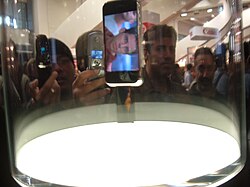
[[File:First iPhone Macworld 2007 DSCF1286.agr.jpg|thumb|228x228px|The [[IPhone (1st generation)|original iPhone]] on display under glass at the January 2007 [[Macworld]] show|left]]The [[iPhone 4]] was announced on June 7, 2010, at WWDC 2010, and introduced a redesigned body incorporating a [[stainless steel]] frame and a rear glass panel.<ref name=":1">{{Cite web |date=June 7, 2010 |title=iPhone 4: The Definitive Guide |url=https://gizmodo.com/iphone-4-the-definitive-guide-5557101 |access-date=October 5, 2022 |website=Gizmodo |language=en |archive-date=July 24, 2017 |archive-url=https://web.archive.org/web/20170724221043/http://gizmodo.com/5557101/iphone-4-the-definitive-guide |url-status=live }}</ref> At release, the iPhone 4 was marketed as the "world's thinnest smartphone";<ref name=":1" /> it uses the [[Apple A4]] processor, being the first iPhone to use an Apple custom-designed chip. It introduced the [[Retina display]], having four times the [[display resolution]] of preceding iPhones, and was the highest-resolution smartphone screen at release;<ref name=":1" /> a front-facing camera was also introduced, enabling video calling functionality via [[FaceTime]]. | |||
[[ | Users of the iPhone 4 reported dropped/disconnected telephone calls when holding their phones in a certain way, and this issue was nicknamed "[[antennagate]]".<ref>Ionescu, Daniel. (July 17, 2010) [http://www.pcworld.com/article/201297/apples_iphone_4_antennagate_timeline.html Apple's iPhone 4 Antennagate Timeline] {{Webarchive|url=https://web.archive.org/web/20111103182357/http://www.pcworld.com/article/201297/apples_iphone_4_antennagate_timeline.html |date=November 3, 2011 }}. PCWorld. Retrieved November 6, 2011.</ref> In January 2011, as Apple's exclusivity agreement with AT&T was expiring, [[Verizon Wireless|Verizon]] announced that they would be carrying the iPhone 4, with a model compatible with Verizon's [[CDMA2000|CDMA]] network releasing on February 10.<ref>{{cite news|url=http://voices.washingtonpost.com/fasterforward/2011/01/liveblog_the_verizon_iphone.html|newspaper=The Washington Post|title=Liveblog: The Verizon iPhone|access-date=January 11, 2011|archive-date=July 18, 2022|archive-url=https://web.archive.org/web/20220718011021/http://voices.washingtonpost.com/fasterforward/2011/01/liveblog_the_verizon_iphone.html|url-status=dead}}</ref><ref>{{cite news|url=https://www.wsj.com/articles/SB10001424052748703791904576075681886276172|work=[[The Wall Street Journal]]|first=Shayndi|last=Raice|title=Verizon Unwraps iPhone|date=January 12, 2011|access-date=August 12, 2017|archive-date=July 18, 2022|archive-url=https://web.archive.org/web/20220718001323/https://www.wsj.com/articles/SB10001424052748703791904576075681886276172|url-status=live}}</ref> | ||
[[ | The [[iPhone 4s]] was announced on October 4, 2011, and introduced the [[Siri]] [[virtual assistant]], a dual-core [[Apple A5|A5]] processor, and an 8 megapixel camera with [[1080p]] video recording functionality. The [[iPhone 5]] was announced on September 12, 2012, and introduced a larger 4-inch screen, up from the 3.5-inch screen of all previous iPhone models, as well as faster [[LTE (telecommunication)|4G LTE]] connectivity.<ref name=":3">{{Cite web |last=Ziegler |first=Chris |date=September 12, 2012 |title=Apple's iPhone 5 announcement: everything you need to know |url=https://www.theverge.com/2012/9/12/3321568/apples-iphone-5-event-heres-everything-that-happened |access-date=October 5, 2022 |website=The Verge |language=en-US |archive-date=October 5, 2022 |archive-url=https://web.archive.org/web/20221005191558/https://www.theverge.com/2012/9/12/3321568/apples-iphone-5-event-heres-everything-that-happened |url-status=live }}</ref> It also introduced a thinner and lighter body made of [[aluminum alloy]], and the [[30-pin dock connector]] of previous iPhones was replaced with the new, reversible [[Lightning (connector)|Lightning]] connector.<ref name=":3" /> | ||
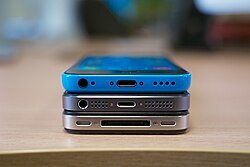
[[File:Size comparison of iPhone 5C 5S 4S.jpg|thumb|Bottom angle comparison between [[iPhone 5c]] (top), [[iPhone 5s]] (middle), and [[iPhone 4s]] (bottom)]] | |||
The [[iPhone 5s]] and [[iPhone 5c]] were announced on September 10, 2013. The iPhone 5s included a [[64-bit computing|64-bit]] [[Apple A7|A7]] processor, becoming the first ever 64-bit smartphone;<ref>{{Cite web |last=Koetsier |first=John |date=September 10, 2013 |title=Apple's new iPhone 5s: The world's first 64-bit mobile phone … with fingerprint login |url=https://venturebeat.com/business/apples-new-iphone-5s-the-worlds-first-64-bit-mobile-phone/ |access-date=October 6, 2022 |website=VentureBeat |language=en-US |archive-date=October 6, 2022 |archive-url=https://web.archive.org/web/20221006074328/https://venturebeat.com/business/apples-new-iphone-5s-the-worlds-first-64-bit-mobile-phone/ |url-status=live }}</ref> it also introduced the [[Touch ID]] fingerprint authentication sensor.<ref name=":14">{{Cite web |title=A New Touch for iPhone |url=https://allthingsd.com/20130917/a-new-touch-for-iphone/ |url-status=live |archive-url=https://web.archive.org/web/20220423202230/https://allthingsd.com/20130917/a-new-touch-for-iphone/ |archive-date=April 23, 2022 |access-date=January 5, 2024 |website=AllThingsD |language=en-US}}</ref> The iPhone 5c was a lower-cost device that incorporated hardware from the iPhone 5, into a series of colorful plastic frames.<ref name=":2">{{Cite web |last=Tibken |first=Shara |title=Apple launches iPhone 5s and $99 iPhone 5c with five colors |url=https://www.cnet.com/tech/tech-industry/apple-launches-iphone-5s-and-99-iphone-5c-with-five-colors/ |access-date=October 5, 2022 |website=CNET |language=en |archive-date=October 5, 2022 |archive-url=https://web.archive.org/web/20221005191558/https://www.cnet.com/tech/tech-industry/apple-launches-iphone-5s-and-99-iphone-5c-with-five-colors/ |url-status=live }}</ref> | |||
The iPhone | On September 9, 2014, Apple introduced the [[iPhone 6]] and iPhone 6 Plus, and included significantly larger screens than the iPhone 5s, at 4.7-inch and 5.5-inch respectively; both models also introduced mobile payment technology via [[Apple Pay]].<ref>{{cite news |first1=Dominic |last1=Rushe |first2=Alex |last2=Hern |first3=Samuel |last3=Gibbs |first4=Stuart |last4=Dredge |title=The Apple Watch, iPhone 6 and iPhone 6 Plus – as it happened |url=https://www.theguardian.com/technology/live/2014/sep/09/apple-announcement-iphone-6-iwatch-ios8-event-live |work=[[The Guardian]] |date=September 9, 2014 |access-date=March 23, 2017 |archive-date=August 14, 2022 |archive-url=https://web.archive.org/web/20220814080353/https://www.theguardian.com/technology/live/2014/sep/09/apple-announcement-iphone-6-iwatch-ios8-event-live |url-status=live }}</ref> [[Optical image stabilization]] was introduced to the 6 Plus' camera. The [[Apple Watch]] was also introduced on the same day, and is a [[smartwatch]] that operates in conjunction with a connected iPhone. Some users experienced bending issues from normal use with the iPhone 6 and 6 Plus, particularly on the latter model, and this issue was nicknamed "[[bendgate]]".<ref>{{Cite web|last=Sacco|first=Al|date=September 29, 2014|title=Apple (Mostly) Not to Blame in iPhone 6 Plus 'Bendgate' Fiasco|url=https://www.cio.com/article/2688437/apple-mostly-not-to-blame-in-iphone-6-plus-bendgate-fiasco.html|access-date=May 28, 2021|website=CIO|language=en|archive-date=June 27, 2022|archive-url=https://web.archive.org/web/20220627185729/https://www.cio.com/article/250571/apple-mostly-not-to-blame-in-iphone-6-plus-bendgate-fiasco.html|url-status=live}}</ref> | ||
The [[iPhone 6s]] and 6s Plus were introduced on September 9, 2015, and included a more bend-resistant frame made of a stronger aluminum alloy, as well as a higher resolution 12 megapixel main camera capable of [[4K resolution|4K]] video recording.<ref>{{Cite web |last=Miller |first=Chance |date=September 25, 2015 |title=Here's how iPhone 6s Plus handles bendgate brutality |url=https://9to5mac.com/2015/09/24/does-the-iphone-6s-plus-bend/ |access-date=October 5, 2022 |website=9to5Mac |language=en-US |archive-date=October 5, 2022 |archive-url=https://web.archive.org/web/20221005191602/https://9to5mac.com/2015/09/24/does-the-iphone-6s-plus-bend/ |url-status=live }}</ref> The [[IPhone SE (1st generation)|first-generation iPhone SE]] was introduced on March 21, 2016, and was a low-cost device that incorporated newer hardware from the iPhone 6s, in the frame of the older iPhone 5s.<ref>{{Cite web |title=Apple Introduces iPhone SE – The Most Powerful Phone with a Four-inch Display |url=https://www.apple.com/sg/newsroom/2016/03/21Apple-Introduces-iPhone-SE-The-Most-Powerful-Phone-with-a-Four-inch-Display/ |access-date=October 5, 2022 |website=Apple Newsroom (Singapore) |language=en-SG |archive-date=October 5, 2022 |archive-url=https://web.archive.org/web/20221005204303/https://www.apple.com/sg/newsroom/2016/03/21Apple-Introduces-iPhone-SE-The-Most-Powerful-Phone-with-a-Four-inch-Display/ |url-status=live }}</ref> | |||
The [[iPhone 7]] and 7 Plus were announced on September 7, 2016, which introduced larger camera sensors, [[IP code|IP67]]-certified water and dust resistance, and a quad-core [[Apple A10|A10 Fusion]] processor utilizing [[ARM big.LITTLE|big.LITTLE]] technology;<ref>{{cite web |first=Dan |last=Seifert |title=iPhone 7 and 7 Plus announced with water resistance, dual cameras, and no headphone jack |url=https://www.theverge.com/2016/9/7/12758236/apple-iphone-7-announced-features-price-release-date |website=[[The Verge]] |date=September 7, 2016 |access-date=March 23, 2017 |archive-date=April 27, 2019 |archive-url=https://web.archive.org/web/20190427014804/https://www.theverge.com/2016/9/7/12758236/apple-iphone |url-status=live }}</ref> the 3.5 mm [[phone connector (audio)|headphone jack]] was removed, and was followed by the introduction of the [[AirPods]] wireless earbuds.<ref>{{Cite web |last=Novet |first=Jordan |date=January 19, 2017 |title=Apple's AirPods are a no-brainer – if you have the latest iPhone |url=https://venturebeat.com/business/airpods-review/ |access-date=October 5, 2022 |website=VentureBeat |language=en-US |archive-date=October 5, 2022 |archive-url=https://web.archive.org/web/20221005204305/https://venturebeat.com/business/airpods-review/ |url-status=live }}</ref> Optical image stabilization was added to the 7's camera. A second telephoto camera lens was added on the 7 Plus, enabling two-times optical zoom, and "Portrait" photography mode which simulates [[bokeh]] in photos.<ref>{{Cite web |title=Camera |url=https://www.trustedreviews.com/reviews/iphone-7-plus-camera-page-3 |access-date=October 5, 2022 |website=Trusted Reviews |date=March 11, 2020 |language=en |archive-date=October 5, 2022 |archive-url=https://web.archive.org/web/20221005204305/https://www.trustedreviews.com/reviews/iphone-7-plus-camera-page-3 |url-status=live }}</ref> | |||
The [[iPhone 8]], 8 Plus, and [[iPhone X]] were announced on September 12, 2017, in Apple's first event held at the [[Steve Jobs Theater]] in [[Apple Park]]. All models featured rear glass panel designs akin to the iPhone 4, [[Inductive charging|wireless charging]], and a hexa-core [[Apple A11|A11 Bionic]] chip with "Neural Engine" [[AI accelerator]] hardware. The iPhone X additionally introduced a 5.8-inch [[OLED]] "Super Retina" display with a "[[Bezel (screen)|bezel]]-less" design, with a higher [[pixel density]] and [[contrast ratio]] than previous iPhones with LCD displays, and introduced a stronger frame made of stainless steel. It also introduced [[Face ID]] facial recognition authentication hardware, in a "notch" screen cutout, in place of Touch ID;<ref>{{Cite news|url=https://www.apple.com/newsroom/2017/09/the-future-is-here-iphone-x/|title=The future is here: iPhone X|work=Apple Inc.|access-date=September 14, 2017|archive-date=September 24, 2017|archive-url=https://web.archive.org/web/20170924073859/https://www.apple.com/newsroom/2017/09/the-future-is-here-iphone-x/|url-status=live}}</ref><ref>{{Cite web |last=Warren |first=Tom |date=September 14, 2017 |title=Apple's iPhone X notch is an odd design choice |url=https://www.theverge.com/2017/9/14/16306298/apple-iphone-x-screen-notch |access-date=October 5, 2022 |website=The Verge |language=en-US |archive-date=December 4, 2017 |archive-url=https://web.archive.org/web/20171204223008/https://www.theverge.com/2017/9/14/16306298/apple-iphone-x-screen-notch |url-status=live }}</ref> the home button was removed to achieve the “bezel-less” design, replacing it with a gesture-based navigation system.<ref>{{Cite web |last=Stein |first=Scott |title=No home button? No problem: How to do everything on the iPhone X |url=https://www.cnet.com/tech/mobile/iphone-x-how-to-survive-with-no-home-button/ |access-date=October 5, 2022 |website=CNET |language=en |archive-date=October 13, 2022 |archive-url=https://web.archive.org/web/20221013201552/https://www.cnet.com/tech/mobile/iphone-x-how-to-survive-with-no-home-button/ |url-status=live }}</ref> At its US$999 starting price, the iPhone X was the most expensive iPhone at launch.<ref>{{Cite web |last=Clifford |first=Catherine |title=Apple CEO Tim Cook on the $999 new iPhone X: 'We're not trying to charge the highest price we could get or anything like that' |url=https://www.cnbc.com/2017/11/03/tim-cook-buying-a-999-iphone-x-is-like-buying-high-quality-coffee.html |access-date=October 5, 2022 |website=CNBC |date=November 3, 2017 |language=en |archive-date=October 5, 2022 |archive-url=https://web.archive.org/web/20221005204303/https://www.cnbc.com/2017/11/03/tim-cook-buying-a-999-iphone-x-is-like-buying-high-quality-coffee.html |url-status=live }}</ref> | |||
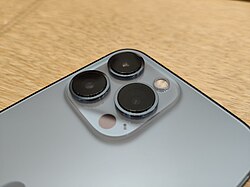
[[File:IPhone 13 Pro camera lens group.jpg|thumb|Picture of the cameras on the [[iPhone 13 Pro]]]] | |||
The [[iPhone XR]], [[iPhone XS]], and XS Max were announced on September 12, 2018. All models featured the "Smart HDR" computational photography system, and a significantly more powerful "Neural Engine".<ref>{{Cite news|url=https://www.apple.com/newsroom/2018/09/iphone-xs-and-iphone-xs-max-bring-the-best-and-biggest-displays-to-iphone/|title=iPhone Xs and iPhone Xs Max bring the best and biggest displays to iPhone|work=Apple Inc.|access-date=September 12, 2018|archive-date=April 27, 2019|archive-url=https://web.archive.org/web/20190427014807/https://www.apple.com/newsroom/2018/09/iphone-xs-and-iphone-xs-max-bring-the-best-and-biggest-displays-to-iphone/|url-status=live}}</ref> The XS Max introduced a larger 6.5-inch screen. The iPhone XR included a 6.1-inch LCD "Liquid Retina" display, with a "bezel-less" design similar to the iPhone X, but does not include a second telephoto lens; it was made available in a series of vibrant colors, akin to the iPhone 5c, and was a lower-cost device compared to the iPhone X and XS.<ref>{{Cite news|url=https://www.apple.com/newsroom/2018/09/apple-introduces-iphone-xr/|title=Apple introduces iPhone XR|work=Apple Inc.|access-date=September 12, 2018|archive-date=March 27, 2019|archive-url=https://web.archive.org/web/20190327101626/https://www.apple.com/newsroom/2018/09/apple-introduces-iphone-xr/|url-status=live}}</ref> | |||
The [[iPhone 11]], [[IPhone 11 Pro|11 Pro]], and 11 Pro Max were announced on September 10, 2019. The iPhone 11 was the successor to the iPhone XR, while the iPhone 11 Pro and 11 Pro Max succeeded the iPhone XS and XS Max. All models gained an Ultra-Wide lens, enabling two-times optical zoom out, as well as larger batteries for longer battery life.<ref>{{Cite web|url=https://www.businessinsider.com/apple-iphone-11-cheaper-xr-despite-trump-china-tariffs-2019-9|title=Apple's new iPhone 11 is $50 cheaper than last year's model, despite Trump's planned tariffs on Chinese imports|date=September 11, 2019|website=Business Insider|access-date=September 10, 2019|archive-date=June 20, 2022|archive-url=https://web.archive.org/web/20220620214642/https://www.businessinsider.com/apple-iphone-11-cheaper-xr-despite-trump-china-tariffs-2019-9|url-status=live}}</ref><ref>{{cite press release | title=iPhone 11 Pro and iPhone 11 Pro Max: the most powerful and advanced smartphones | website=Apple Inc. | date=September 10, 2019 | url=https://www.apple.com/newsroom/2019/09/iphone-11-pro-and-iphone-11-pro-max-the-most-powerful-and-advanced-smartphones/ | access-date=September 4, 2019 | archive-date=September 10, 2019 | archive-url=https://web.archive.org/web/20190910185030/https://www.apple.com/newsroom/2019/09/iphone-11-pro-and-iphone-11-pro-max-the-most-powerful-and-advanced-smartphones/ | url-status=live }}</ref> The [[IPhone SE (2nd generation)|second-generation iPhone SE]] was introduced on April 17, 2020, and was a low-cost device that incorporated newer hardware from the iPhone 11, in the frame of the older iPhone 8, while retaining the home button and the Touch ID sensor.<ref>{{Cite web |title=iPhone SE: A powerful new smartphone in a popular design |url=https://www.apple.com/newsroom/2020/04/iphone-se-a-powerful-new-smartphone-in-a-popular-design/ |access-date=October 5, 2022 |website=Apple Newsroom |language=en-US |archive-date=April 28, 2020 |archive-url=https://web.archive.org/web/20200428153235/https://www.apple.com/newsroom/2020/04/iphone-se-a-powerful-new-smartphone-in-a-popular-design/ |url-status=live }}</ref> | |||
===2020s=== | |||
The [[iPhone 12]], 12 Mini, [[IPhone 12 Pro|12 Pro]], and 12 Pro Max were announced via a [[Livestreaming|livestream]] event on October 13, 2020. All models featured OLED "Super Retina XDR" displays, introduced faster [[5G]] connectivity, and the [[MagSafe (iPhone)|MagSafe]] magnetic charging and accessory system; a slimmer flat-edged design was also introduced, which combined with stronger [[glass-ceramic]] front glass, added better drop protection compared to previous iPhones.<ref>{{Cite web|title=Apple announces iPhone 12 and iPhone 12 mini: A new era for iPhone with 5G|url=https://www.apple.com/newsroom/2020/10/apple-announces-iphone-12-and-iphone-12-mini-a-new-era-for-iphone-with-5g/|access-date=January 9, 2021|website=Apple Newsroom|language=en-US|archive-date=August 14, 2022|archive-url=https://web.archive.org/web/20220814131441/https://www.apple.com/newsroom/2020/10/apple-announces-iphone-12-and-iphone-12-mini-a-new-era-for-iphone-with-5g/|url-status=live}}</ref><ref>{{Cite web|title=Apple introduces iPhone 12 Pro and iPhone 12 Pro Max with 5G|url=https://www.apple.com/newsroom/2020/10/apple-introduces-iphone-12-pro-and-iphone-12-pro-max-with-5g/|access-date=January 9, 2021|website=Apple Newsroom|language=en-US|archive-date=October 13, 2020|archive-url=https://web.archive.org/web/20201013181423/https://www.apple.com/newsroom/2020/10/apple-introduces-iphone-12-pro-and-iphone-12-pro-max-with-5g/|url-status=live}}</ref> The iPhone 12 Mini introduced a smaller 5.4-inch screen, while the 12 Pro and 12 Pro Max had larger screens of 6.1-inch and 6.7-inch respectively. The iPhone 12 Pro and 12 Pro Max additionally added a [[Lidar]] sensor for better accuracy in [[Augmented reality|augumented reality]] (AR) applications. | |||
The [[iPhone 13]], 13 Mini, [[IPhone 13 Pro|13 Pro]], and 13 Pro Max were announced via a livestream event on September 14, 2021. All models featured larger camera sensors, larger batteries for longer battery life, and a narrower "notch" screen cutout.<ref>{{Cite web|title=Apple introduces iPhone 13 and iPhone 13 mini, delivering breakthrough camera innovations and a powerhouse chip with an impressive leap in battery life|url=https://www.apple.com/newsroom/2021/09/apple-introduces-iphone-13-and-iphone-13-mini/|access-date=October 9, 2021|website=Apple Newsroom|language=en-US|archive-date=June 22, 2022|archive-url=https://web.archive.org/web/20220622015723/https://www.apple.com/newsroom/2021/09/apple-introduces-iphone-13-and-iphone-13-mini/|url-status=live}}</ref> The iPhone 13 Pro and 13 Pro Max additionally introduced smoother adaptive 120 Hz [[refresh rate]] "ProMotion" technology in its OLED display, and three-times optical zoom in the telephoto lens.<ref>{{Cite web|title=Apple unveils iPhone 13 Pro and iPhone 13 Pro Max – more pro than ever before|url=https://www.apple.com/newsroom/2021/09/apple-unveils-iphone-13-pro-and-iphone-13-pro-max-more-pro-than-ever-before/|access-date=October 9, 2021|website=Apple Newsroom|language=en-US|archive-date=September 15, 2021|archive-url=https://web.archive.org/web/20210915145506/https://www.apple.com/newsroom/2021/09/apple-unveils-iphone-13-pro-and-iphone-13-pro-max-more-pro-than-ever-before/|url-status=live}}</ref> The low-cost [[IPhone SE (3rd generation)|third-generation iPhone SE]] was introduced on March 8, 2022, and incorporated the [[Apple A15|A15 Bionic]] chip from the iPhone 13, but otherwise retained similar hardware to the second-generation iPhone SE. | |||
The [[iPhone 14]], 14 Plus, [[IPhone 14 Pro|14 Pro]], and 14 Pro Max were announced on September 7, 2022. All models introduced [[satellite phone]] emergency calling functionality. A new 14 Plus model introduced the large 6.7-inch screen size, first seen on the iPhone 12 Pro Max, into a lower-cost device.<ref>{{Cite web |title=Apple introduces iPhone 14 and iPhone 14 Plus |url=https://www.apple.com/newsroom/2022/09/apple-introduces-iphone-14-and-iphone-14-plus/ |access-date=September 24, 2022 |website=Apple Newsroom |language=en-US |archive-date=September 24, 2022 |archive-url=https://web.archive.org/web/20220924172020/https://www.apple.com/newsroom/2022/09/apple-introduces-iphone-14-and-iphone-14-plus/ |url-status=live }}</ref> The iPhone 14 Pro and 14 Pro Max additionally introduced a higher-resolution 48-megapixel main camera, the first increase in megapixel count since the iPhone 6s; it also introduced [[Always on display|always-on display]] technology to the [[lock screen]], and an interactive status bar interface integrated in a redesigned screen cutout, entitled "Dynamic Island".<ref>{{Cite web |title=Apple debuts iPhone 14 Pro and iPhone 14 Pro Max |url=https://www.apple.com/newsroom/2022/09/apple-debuts-iphone-14-pro-and-iphone-14-pro-max/ |access-date=September 24, 2022 |website=Apple Newsroom |language=en-US |archive-date=September 24, 2022 |archive-url=https://web.archive.org/web/20220924172007/https://www.apple.com/newsroom/2022/09/apple-debuts-iphone-14-pro-and-iphone-14-pro-max/ |url-status=live }}</ref> | |||
The [[iPhone 15]], 15 Plus, [[iPhone 15 Pro|15 Pro]], and 15 Pro Max were announced on September 12, 2023. Starting with this group of devices, all models switch to using [[USB-C]] as their power connector to comply with [[European Commission]] regulations, replacing Apple's proprietary [[Lightning (connector)|Lightning]] connector after eleven years of use in previous models.<ref>{{cite web |last1=Morrow |first1=Allison |title=Apple just killed the iPhone Lightning connector. What to do with your old chargers |url=https://www.cnn.com/2023/09/12/tech/old-iphone-chargers-dispose-reuse/index.html |website=CNN |date=September 12, 2023 |publisher=Cable News Network |access-date=September 12, 2023 |archive-date=September 13, 2023 |archive-url=https://web.archive.org/web/20230913021727/https://www.cnn.com/2023/09/12/tech/old-iphone-chargers-dispose-reuse/index.html |url-status=live }}</ref> The 15 and 15 plus now feature the Dynamic Island, which debuted with the iPhone 14 Pro (effectively retiring the "notch" display cutout), a 48-megapixel main camera, slightly curved edges, and a color-infused frosted glass back.<ref>{{cite web |last1=Kelly |first1=Samantha Murphy |date=September 12, 2023 |title=The iPhone 15 and five other takeaways from Apple's 'wonderlust' event |url=https://www.cnn.com/2023/09/12/tech/apple-iphone-15-event-wonderlust/index.html |archive-url=https://web.archive.org/web/20230930012341/https://www.cnn.com/2023/09/12/tech/apple-iphone-15-event-wonderlust/index.html |archive-date=September 30, 2023 |access-date=September 12, 2023 |website=CNN}}</ref><ref>{{Cite web |date=September 12, 2023 |title=Apple debuts iPhone 15 and iPhone 15 Plus |url=https://www.apple.com/newsroom/2023/09/apple-debuts-iphone-15-and-iphone-15-plus/ |archive-url=https://web.archive.org/web/20230920002853/https://www.apple.com/newsroom/2023/09/apple-debuts-iphone-15-and-iphone-15-plus/ |archive-date=September 20, 2023 |access-date=December 20, 2023 |website=Apple Newsroom |language=en-US}}</ref><ref name=":11">{{Cite web |date=September 12, 2023 |title=Apple unveils iPhone 15 Pro and iPhone 15 Pro Max |url=https://www.apple.com/newsroom/2023/09/apple-unveils-iphone-15-pro-and-iphone-15-pro-max/ |archive-url=https://web.archive.org/web/20230920005125/https://www.apple.com/newsroom/2023/09/apple-unveils-iphone-15-pro-and-iphone-15-pro-max/ |archive-date=September 20, 2023 |access-date=December 20, 2023 |website=Apple Newsroom |language=en-US}}</ref> The 15 Pro and Pro Max also replace the mute switch with the "Action" button, and stainless-steel material to titanium.<ref name=":11" /> | |||
The [[iPhone 16]], 16 Plus, [[IPhone 16 Pro|16 Pro]], and 16 Pro Max were announced on September 9, 2024. The former two introduced a vertical camera layout with refined "Fusion" and Ultra-Wide cameras.<ref>{{Cite web |title=Apple introduces iPhone 16 and iPhone 16 Plus |url=https://www.apple.com/newsroom/2024/09/apple-introduces-iphone-16-and-iphone-16-plus/ |access-date=2024-10-30 |website=Apple Newsroom |language=en-US}}</ref> The 16 Pro and Pro Max have larger 6.3-inch and 6.9-inch displays, a 48-megapixel Ultra-Wide camera, and the largest batteries in an iPhone up to that point.<ref>{{Cite web |title=Apple debuts iPhone 16 Pro and iPhone 16 Pro Max |url=https://www.apple.com/newsroom/2024/09/apple-debuts-iphone-16-pro-and-iphone-16-pro-max/ |access-date=2024-10-30 |website=Apple Newsroom |language=en-US}}</ref> All models now include access to new [[Apple Intelligence]] AI features,<ref>{{Cite web |title=Apple Intelligence |url=https://www.apple.com/apple-intelligence/ |access-date=2024-10-30 |website=Apple |language=en-US |archive-date=June 13, 2024 |archive-url=https://web.archive.org/web/20240613233953/https://www.apple.com/apple-intelligence/ |url-status=live }}</ref> a refined thermal system, support for [[Wi-Fi 7]], and a new button dubbed the "Camera Control", allowing easier access to camera features. On February 19, 2025, the 16e was announced as the newest member of the 16 family. This model has a longer battery life thanks to the A18 chip and the new Apple C1, which is the first cellular modem designed by Apple.<ref>{{Cite web |title=Apple debuts iPhone 16e: A powerful new member of the iPhone 16 family |url=https://www.apple.com/newsroom/2025/02/apple-debuts-iphone-16e-a-powerful-new-member-of-the-iphone-16-family/ |access-date=2025-02-19 |website=Apple Newsroom |language=en-US |archive-date=February 20, 2025 |archive-url=https://web.archive.org/web/20250220001135/https://www.apple.com/newsroom/2025/02/apple-debuts-iphone-16e-a-powerful-new-member-of-the-iphone-16-family/ |url-status=live }}</ref> It has a 6.1-inch screen, and the same 48-megapixel camera as previous models, but lacks the wider shot option due to its cheaper purchasing price.<ref>{{Cite web |last=Eadicicco |first=Lisa |date=2025-02-19 |title=Apple launches the iPhone 16e, a cheaper new version of the iPhone 16 {{!}} CNN Business |url=https://www.cnn.com/2025/02/19/tech/apple-iphone-16e-launch/index.html |access-date=2025-02-19 |website=CNN |language=en |archive-date=February 19, 2025 |archive-url=https://web.archive.org/web/20250219232144/https://www.cnn.com/2025/02/19/tech/apple-iphone-16e-launch/index.html |url-status=live }}</ref> | |||
The [[iPhone 17]], [[IPhone 17 Pro|17 Pro]], 17 Pro Max, and [[iPhone Air]] were announced on September 9, 2025. These devices feature the new faster A19 and A19 Pro chip with improved CPU and GPU performance including faster AI tasks. The always on display and ProMotion 120 Hz are standard now in all the new iPhones in the September 2025 lineup.<ref>{{Cite web |title=CNET |url=https://www.cnet.com/tech/mobile/which-2025-iphone-has-the-best-battery-ive-crowned-a-new-power-winner/ |access-date=December 25, 2025 |archive-date=December 27, 2025 |archive-url=https://web.archive.org/web/20251227230309/https://www.cnet.com/tech/mobile/which-2025-iphone-has-the-best-battery-ive-crowned-a-new-power-winner/ |url-status=live }}</ref> The iPhone Air is the thinnest iPhone ever made yet and is the first iPhone to only have a speaker from the earpiece only. The iPhone Air also features the new C1X cellular modem which uses 30% less energy than the previous C1 chips. The iPhone 17 Pro models do not have this and instead uses the Qualcomm's Snapdragon X80 modem.<ref>{{Cite news |last=Christoffel |first=Ryan |date=2025-09-24 |title=Why iPhone 17 Pro doesn’t have Apple’s new C1X modem - 9to5Mac |url=https://9to5mac.com/2025/09/24/why-iphone-17-pro-doesnt-have-apples-new-c1x-modem/ |archive-url=https://web.archive.org/web/20250926001954/https://9to5mac.com/2025/09/24/why-iphone-17-pro-doesnt-have-apples-new-c1x-modem/ |archive-date=September 26, 2025 |access-date=2025-12-25 |work=9to5Mac |language=en-US |url-status=live }}</ref> The new Pro lineup has the distinctive camera plateau bump. The iPhone 17 Pro models also switch back to a aluminum body for better heat dissipation and feature the first for a iPhone, a vapor chamber cooling system which helps regulate the heat in heavy workloads.<ref>{{Cite web |title=iPhone 17 Pro Vapor Chamber: Complete 2025 Guide |url=https://smartish.com/blogs/news/iphone-17-pro-vapor-chamber?srsltid=AfmBOopWr5MUKmRJ6pWb8o1e10GpAbxJF6M643P0MUjBEh_BJbXbcBbM|date=September 12, 2025|website=Smartish|archive-url=https://web.archive.org/web/20260113062655/https://smartish.com/blogs/news/iphone-17-pro-vapor-chamber?srsltid=AfmBOopWr5MUKmRJ6pWb8o1e10GpAbxJF6M643P0MUjBEh_BJbXbcBbM|archive-date=January 13, 2026}}</ref> They also have the biggest and best battery life yet in any iPhone model.<ref>{{Cite web |title=CNET |url=https://www.cnet.com/tech/mobile/which-2025-iphone-has-the-best-battery-ive-crowned-a-new-power-winner/ |access-date=December 25, 2025 |archive-date=December 27, 2025 |archive-url=https://web.archive.org/web/20251227230309/https://www.cnet.com/tech/mobile/which-2025-iphone-has-the-best-battery-ive-crowned-a-new-power-winner/ |url-status=live }}</ref> On March 2, 2026, the 17e was announced as the newest member of the 17 family. | |||
== Models == | |||
{{Main|List of iPhone models}} | |||
52 iPhone models have been produced. The models in '''bold''' are devices of the latest generation: | |||
{| class="wikitable sortable" style="width: 75%; text-align: center;" | |||
|+ iPhone models currently in production<ref>{{cite web |title=Apple - Support - Technical Specifications |url=https://support.apple.com/specs/iphone |website=support.apple.com |access-date=December 7, 2022 |archive-date=December 7, 2022 |archive-url=https://web.archive.org/web/20221207095745/https://support.apple.com/specs/iphone |url-status=live }}</ref> | |||
! Release date | |||
! Model | |||
! [[System on a chip|System-on-a-chip]] | |||
|- | |||
|rowspan="2"| September 20, 2024 | |||
|[[iPhone 16]] | |||
|rowspan="2"| [[Apple A18]] | |||
|- | |||
|[[iPhone 16|iPhone 16 Plus]] | |||
|- | |- | ||
| | |rowspan="4"| September 19, 2025 | ||
| '''[[iPhone 17]]''' | |||
| [[Apple A19]] | |||
| | |||
| | |||
| | |||
|- | |- | ||
|- | |- | ||
| | | '''[[iPhone 17 Pro]]''' | ||
|rowspan="3"| [[Apple A19|Apple A19 Pro]] | |||
| | |||
| | |||
|- | |- | ||
| | | '''[[iPhone 17 Pro|iPhone 17 Pro Max]]''' | ||
|- | |- | ||
| | | '''[[iPhone Air]]''' | ||
|- | |- | ||
| | | March 11, 2026 | ||
| | | '''[[iPhone 17e]]''' | ||
| | | [[Apple A19]] | ||
|} | |} | ||
{{Anchor|All models}} | |||
{{mw-datatable}} | |||
{|class="wikitable mw-datatable" style="text-align: center; font-size: 90%;" | |||
|+ Availability and support lifespan of all iPhone models | |||
!rowspan="3" | Model | |||
!colspan="2" | Release(d) | |||
!rowspan="3" | Discontinued | |||
!colspan="4" | Support | |||
!rowspan="3" | Status | |||
= | |||
| | |||
|- | |- | ||
!rowspan=" | !rowspan="2" | With OS | ||
! | !rowspan="2" | Date | ||
!rowspan=" | !rowspan="2" | Ended | ||
! | !rowspan="2" | Final OS{{efn|group=remarks|Last regular iOS version (probably with feature updates), in parentheses: last iOS supported}} | ||
! | !colspan="2" | Lifespan{{efn|group=remarks|Min / max amount of time Apple support is/was available}} | ||
|- | |- | ||
! | !Max{{efn|group=remarks|Maximal support lifespan {{=}} current or support end date - release date}} | ||
!Min{{efn|group=remarks|Minimal support lifespan {{=}} current or support end date - discontinue date}} | |||
! | |||
|- | |- | ||
![[iPhone (1st generation)|iPhone]] | ![[iPhone (1st generation)|iPhone]] | ||
|[[iPhone OS 1 | |[[iPhone OS 1]].0 | ||
|{{Start date|2007|06|29}} | |{{Start date|2007|06|29}} | ||
|{{End date|2008|06|09}} | |{{End date|2008|06|09}} | ||
|{{End date|2010|6| | |{{End date|2010|6|21}} | ||
|[[iPhone OS 3 | |[[iPhone OS 3]].1.3 | ||
|{{age in years and months|2007|06|29|2010|6| | |{{age in years and months|2007|06|29|2010|6|21}} | ||
|'''{{age in years and months|2008|06|09|2010|6| | |'''{{age in years and months|2008|06|09|2010|6|21}}''' | ||
| | | rowspan="9" style="background-color: #ececec;" | Discontinued and unsupported | ||
|- | |||
![[iPhone 3G]] | ![[iPhone 3G]] | ||
|[[iPhone OS 2 | |[[iPhone OS 2]].0 | ||
|{{Start date|2008|07|11}} | |{{Start date|2008|07|11}} | ||
|{{End date|2010|08|09}} | |{{End date|2010|08|09}} | ||
|{{End date|2011|03|03}} | |{{End date|2011|03|03}} | ||
|[[iOS 4 | |[[iOS 4]].2.1 | ||
|{{age in years and months|2008|07|11|2011|03|03}} | |{{age in years and months|2008|07|11|2011|03|03}} | ||
|'''{{age in years and months|2010|08|09|2011|03|03}}''' | |'''{{age in years and months|2010|08|09|2011|03|03}}''' | ||
|- | |||
|- | |||
![[iPhone 3GS]] | ![[iPhone 3GS]] | ||
|[[iPhone OS 3 | |[[iPhone OS 3]].0 | ||
|{{Start date|2009|06|19}} | |{{Start date|2009|06|19}} | ||
|{{End date|2012|09|12}} | |{{End date|2012|09|12}} | ||
|{{End date|2013|09|18}} | |{{End date|2013|09|18}}<br />(late, single update: {{End date|2014|02|21}}) | ||
|[[iOS 6 | |[[iOS 6]].1.3<br />(6.1.6) | ||
|{{age in years and months|2009|06|19|2013|09|18}} | |||
|'''{{age in years and months|2012|09|12|2013|09|18}}''' | |||
|- | |- | ||
![[iPhone 4]] | ![[iPhone 4]] | ||
|[[iOS 4 | |[[iOS 4]].0 | ||
|{{Start date|2010|06|24}} | |{{Start date|2010|06|24}} | ||
|{{End date|2013|09|10}} | |{{End date|2013|09|10}} | ||
|{{End date|2014|09|17}} | |{{End date|2014|09|17}} | ||
|[[iOS 7 | |[[iOS 7]].1.2 | ||
|- | |{{age in years and months|2010|06|24|2014|09|17}} | ||
![[iPhone | |'''{{age in years and months|2013|09|10|2014|09|17}}''' | ||
|[[iOS 5 | |- | ||
![[iPhone 4s]] | |||
|[[iOS 5]].0 | |||
|{{Start date|2011|10|14}} | |{{Start date|2011|10|14}} | ||
|{{End date|2014|09|09}} | |{{End date|2014|09|09}} | ||
|{{End date|2016|09| | |{{End date|2016|09|13}}<br />(late, single update: {{End date|2019|07|22}}) | ||
|[[iOS 9 | |[[iOS 9]].3.5<br />(9.3.6) | ||
|{{age in years and months|2011|10|14|2016|09| | |{{age in years and months|2011|10|14|2016|09|13}} | ||
|'''{{age in years and months|2014|09|09|2016|09| | |'''{{age in years and months|2014|09|09|2016|09|13}}''' | ||
|- | |||
|- | |||
![[iPhone 5]] | ![[iPhone 5]] | ||
|[[iOS 6 | |[[iOS 6]].0 | ||
|{{Start date|2012|09|21}} | |{{Start date|2012|09|21}} | ||
|{{End date|2013|09|10}} | |{{End date|2013|09|10}} | ||
|{{End date|2017|09| | |{{End date|2017|09|19}}<br />(late, single update: {{End date|2019|07|22}}) | ||
|[[iOS 10 | |[[iOS 10]].3.3<br />(10.3.4) | ||
|{{age in years and months|2012|09|21|2017|09| | |{{age in years and months|2012|09|21|2017|09|19}} | ||
|'''{{age in years and months|2013|09|10|2017|09| | |'''{{age in years and months|2013|09|10|2017|09|19}}''' | ||
|- | |- | ||
![[iPhone | ![[iPhone 5c]] | ||
|[[iOS 7 | |[[iOS 7]].0 | ||
|{{Start date|2013|09|20}} | |{{Start date|2013|09|20}} | ||
|{{End date|2015|09|09}} | |{{End date|2015|09|09}} | ||
|{{End date|2017|09| | |{{End date|2017|09|19}} | ||
|[[iOS 10 | |[[iOS 10]].3.3 | ||
|{{age in years and months|2013|09|20|2017|09| | |{{age in years and months|2013|09|20|2017|09|19}} | ||
|'''{{age in years and months|2015|09|09|2017|09| | |'''{{age in years and months|2015|09|09|2017|09|19}}''' | ||
|- | |||
|- | ![[iPhone 5s]] | ||
![[iPhone | |[[iOS 7]].0 | ||
|[[iOS 7 | |||
|{{Start date|2013|09|20}} | |{{Start date|2013|09|20}} | ||
|{{End date|2016|03|21}} | |{{End date|2016|03|21}} | ||
| rowspan="2" |{{End date|2019|09|18}}<br />( | | rowspan="2" |{{End date|2019|09|18}}<br />(last security update: {{Current iOS|12|date}}) | ||
| rowspan="2" |[[iOS 12 | | rowspan="2" |[[iOS 12]].4.1<br />(12.5.7) | ||
|{{age in years and months|2013|09|20|2019|09|18}} | |{{age in years and months|2013|09|20|2019|09|18}} | ||
|'''{{age in years and months|2016|03|21|2019|09|18}}''' | |'''{{age in years and months|2016|03|21|2019|09|18}}''' | ||
|- | |||
|- | ![[iPhone 6]] / 6 Plus | ||
![[iPhone 6 | |[[iOS 8]].0 | ||
|[[iOS 8 | |||
|{{Start date|2014|09|19}} | |{{Start date|2014|09|19}} | ||
|{{End date|2016|09|07}} | |{{End date|2016|09|07}} | ||
|{{age in years and months|2014|09|19|2019|09|18}} | |{{age in years and months|2014|09|19|2019|09|18}} | ||
|'''{{age in years and months|2016|09|07|2019|09|18}}''' | |'''{{age in years and months|2016|09|07|2019|09|18}}''' | ||
|- | |||
|- | ![[iPhone 6s]] / 6s Plus | ||
![[iPhone | |[[iOS 9]].0 | ||
|[[iOS 9 | |||
|{{Start date|2015|09|25}} | |{{Start date|2015|09|25}} | ||
|{{End date|2018|09|12}} | |{{End date|2018|09|12}} | ||
| rowspan=" | | rowspan="3" |{{End date|2022|09|12}}<br />(last security update: {{Current iOS|15|date}}) | ||
| rowspan=" | | rowspan="3" |[[iOS 15]].6.1 (15.8.4) | ||
| | |{{age in years and months|2015|09|25|2022|09|12}} | ||
|''' | |'''{{age in years and months|2018|09|12|2022|09|12}}''' | ||
| | | rowspan="7" style="background-color: #F5F3E4 |Discontinued and unsupported, critical security bug fixes only | ||
|- | |||
![[iPhone SE (1st generation)|iPhone SE (1st)]] | ![[iPhone SE (1st generation)|iPhone SE (1st)]] | ||
|[[iOS 9 | |[[iOS 9]].3 | ||
|{{Start date|2016|03|31}} | |{{Start date|2016|03|31}} | ||
|{{End date|2018|09|12}} | |{{End date|2018|09|12}} | ||
| | |{{age in years and months|2016|03|31|2022|09|12}} | ||
|''' | |'''{{age in years and months|2018|09|12|2022|09|12}}''' | ||
|- | |||
|- | ![[iPhone 7]] / 7 Plus | ||
![[iPhone 7 | |[[iOS 10]].0 | ||
|[[iOS 10 | |||
|{{Start date|2016|09|16}} | |{{Start date|2016|09|16}} | ||
|{{End date|2019|09|10}} | |{{End date|2019|09|10}} | ||
| | |{{age in years and months|2016|09|16|2022|09|12}} | ||
|''' | |'''{{age in years and months|2019|09|10|2022|09|12}}''' | ||
|- | |||
|- | ![[iPhone 8]] / 8 Plus | ||
![[iPhone 8 | |[[iOS 11]].0 | ||
|[[iOS 11 | |||
|{{Start date|2017|09|22}} | |{{Start date|2017|09|22}} | ||
|{{End date|2020|04|15}} | |{{End date|2020|04|15}} | ||
|> {{age in years and months|2017|09|22}} | | rowspan="2" |{{End date|2023|09|18}}<br />(last security update: {{Current iOS|16|date}}) | ||
|''' | | rowspan="2" |[[iOS 16]].6.1<br />(16.7.11) | ||
|{{age in years and months|2017|09|22|2023|09|18}} | |||
|- | |'''{{age in years and months|2020|07|29|2023|09|18}}''' | ||
|- | |||
![[iPhone X]] | ![[iPhone X]] | ||
|[[iOS 11 | |[[iOS 11]].0.1 | ||
|{{Start date|2017|11|03}} | |{{Start date|2017|11|03}} | ||
|{{End date|2018|09|12}} | |{{End date|2018|09|12}} | ||
| | |{{age in years and months|2017|11|03|2023|09|18}} | ||
|''' | |'''{{age in years and months|2018|07|29|2023|09|18}}''' | ||
|- | |||
|- | ![[iPhone XS]] / XS Max | ||
![[iPhone XS | |[[iOS 12]].0 | ||
|[[iOS 12 | |||
|{{Start date|2018|09|21}} | |{{Start date|2018|09|21}} | ||
|{{End date|2019|09|10}} | |{{End date|2019|09|10}} | ||
|> {{age in years and months|2018|09|12}} | | rowspan="2" |{{End date|2025|09|15}}<br />(last security update: {{Current iOS|18|date}}) | ||
|''' | | rowspan="2" |[[iOS 18]].7<br />({{Current iOS|18|shortlink}}) | ||
|{{age in years and months|2018|09|12|2025|09|15}} | |||
|- | |'''{{age in years and months|2019|09|10|2025|09|15}}''' | ||
|- | |||
![[iPhone XR]] | ![[iPhone XR]] | ||
|[[iOS 12 | |[[iOS 12]].0 | ||
|{{Start date|2018|10|26}} | |{{Start date|2018|10|26}} | ||
|{{End date|||}} | |{{End date|2021|09|14}} | ||
| | |{{age in years and months|2018|10|26| 2025|09|15}} | ||
|'''{{age in years and months|2021|09|14| 2025|09|15}}''' | |||
|- | |||
|- | |||
![[iPhone 11]] | ![[iPhone 11]] | ||
|[[iOS 13 | |[[iOS 13]].0 | ||
|{{Start date|2019|09|20}} | |{{Start date|2019|09|20}} | ||
|{{End date|||}} | |{{End date|2022|9|7}} | ||
| | | rowspan="19" |current: {{Current iOS|shortlink}} | ||
| | | rowspan="19" |– | ||
| | |{{age in years and months|2019|09|20}} | ||
| | | '''{{age in years and months|2022|09|08}}''' | ||
![[iPhone 11 Pro | | rowspan="12" style="background-color: #c1e6f5;" | Discontinued, still supported | ||
|[[iOS 13 | |- | ||
![[iPhone 11 Pro]] / 11 Pro Max | |||
|[[iOS 13]].0 | |||
|{{Start date|2019|09|20}} | |{{Start date|2019|09|20}} | ||
|{{End date|2020|10|13}} | |{{End date|2020|10|13}} | ||
| | |{{age in years and months|2019|09|20}} | ||
|'''{{age in years and months|2020|10|13}}''' | |||
|- | |||
|''' | |||
|- | |||
![[iPhone SE (2nd generation)|iPhone SE (2nd)]] | ![[iPhone SE (2nd generation)|iPhone SE (2nd)]] | ||
|[[iOS 13 | |[[iOS 13]].4 | ||
|{{Start date|2020|04|24}} | |{{Start date|2020|04|24}} | ||
|{{End date|||}} | |{{End date|2022|03|08}} | ||
| rowspan=" | |{{age in years and months|2020|04|24}} | ||
| | |'''{{age in years and months|2022|03|08}}''' | ||
| | |- | ||
![[iPhone 12]] / 12 Mini | |||
|[[iOS 14]].1 | |||
|{{Start date|2020|10|23}} <small>(12)</small><br />{{Start date|2020|11|13}} <small>(12 Mini)</small> | |||
|{{End date|2023|09|12}} <small>(12)</small><br />{{End date|2022|09|07}} <small>(12 Mini)</small> | |||
|{{age in years and months|2020|10|23}} | |||
|'''{{age in years and months|2022|09|12}}''' | |||
|- | |||
![[iPhone 12 Pro]] / 12 Pro Max | |||
|[[iOS 14]].1 <small>(12 Pro)</small><br />[[iOS 14]].2 <small>(12 Pro Max)</small> | |||
|{{Start date|2020|10|23}} <small>(12 Pro)</small><br />{{Start date|2020|11|13}} <small>(12 Pro Max)</small> | |||
|{{End date|2021|09|14}} | |||
|{{age in years and months|2020|10|23}} <small>(12 Pro)</small><br />{{age in years and months|2020|11|13}} <small>(12 Pro Max)</small> | |||
| '''{{age in years and months|2021|09|14}}''' | |||
|- | |||
![[iPhone 13]] / 13 Mini | |||
|[[iOS 15]].0 | |||
|{{Start date|2021|09|24}} | |||
|{{End date|2024|09|09}} <small>(13)</small><br />{{End date|2023|09|12}} <small>(13 Mini)</small> | |||
|{{age in years and months|2021|09|24}} | |||
|'''{{age in years and months|2023|09|12}}''' | |||
|- | |||
![[iPhone 13 Pro]] / 13 Pro Max | |||
|[[iOS 15]].0 | |||
|{{Start date|2021|09|24}} | |||
|{{End date|2022|09|07}} | |||
|{{age in years and months|2021|09|24}} | |||
| '''{{age in years and months|2022|09|08}}''' | |||
|- | |||
![[iPhone SE (3rd generation)|iPhone SE (3rd)]] | |||
|[[iOS 15]].4 | |||
|{{Start date|2022|03|18}} | |||
| rowspan="2" |{{End date|2025|02|19}} | |||
| {{age in years and months|2022|03|18}} | |||
|'''{{age in years and months|2025|02|19}}''' | |||
|- | |||
![[iPhone 14]] / 14 Plus | |||
|[[iOS 16]].0 | |||
|{{Start date|2022|09|16}} <small>(14)</small><br />{{Start date|2022|10|07}} <small>(14 Plus)</small> | |||
|{{age in years and months|2022|09|16}} | |||
|'''{{age in years and months|2025|02|19}}''' | |||
|- | |||
![[iPhone 14 Pro]] / 14 Pro Max | |||
|[[iOS 16]].0 | |||
|{{Start date|2022|09|16}} | |||
|{{End date|2023|09|12}} | |||
| {{age in years and months|2022|09|16}} | |||
|'''{{age in years and months|2023|09|12}}''' | |||
|- | |||
![[iPhone 15]] / 15 Plus | |||
|[[iOS 17]].0 | |||
|{{Start date|2023|09|22}} | |||
|{{End date|2025|09|09}} | |||
| {{age in years and months|2023|09|22}} | |||
| '''{{age in years and months|2025|09|09}}''' | |||
|- | |||
![[iPhone 15 Pro]] / 15 Pro Max | |||
|[[iOS 17]].0 | |||
|{{Start date|2023|09|22}} | |||
|{{End date|2024|09|09}} | |||
| {{age in years and months|2023|09|22}} | |||
| '''{{age in years and months|2024|09|09}}''' | |||
|- | |||
![[iPhone 16]] / 16 Plus | |||
|[[iOS 18]].0 | |||
|{{Start date|2024|09|20}} | |||
| | | | ||
| | |{{age in years and months|2024|09|20}} | ||
| | |||
| | |||
| | | | ||
| | | style="background-color: #d4f4b4;" | Current or still sold | ||
|- | |||
![[iPhone 16 Pro]] / 16 Pro Max | |||
|[[iOS 18]].0 | |||
|{{Start date|2024|09|20}} | |||
|{{End date|2025|09|09}} | |||
|{{age in years and months|2024|09|20}} | |||
| '''{{age in years and months|2025|09|09}}''' | |||
| rowspan="2" style="background-color: #c1e6f5;" | Discontinued, still supported | |||
|- | |||
![[iPhone 16e]] | |||
|[[iOS 18]].3 | |||
|{{Start date|2025|02|28}} | |||
|{{End date|2026|03|02}} | |||
|{{age in years and months|2025|02|28}} | |||
| '''{{age in years and months|2026|03|02}}''' | |||
|- | |||
![[iPhone 17]] | |||
|[[iOS 26]].0 | |||
|{{Start date|2025|09|19}} | |||
| rowspan="4" | | |||
|{{age in years and months|2025|09|19}} | |||
| | | | ||
| | | rowspan="4" style="background-color: #d4f4b4;" | Current or still sold | ||
|- | |||
![[iPhone Air]] | |||
![[iPhone | |[[iOS 26]].0 | ||
|[[iOS | |{{Start date|2025|09|19}} | ||
| | |{{age in years and months|2025|09|19}} | ||
| | | | ||
| | |- | ||
![[iPhone 17 Pro]] / 17 Pro Max | |||
|[[iOS 26]].0 | |||
|{{Start date|2025|09|19}} | |||
|{{age in years and months|2025|09|19}} | |||
| | | | ||
|- | |- | ||
![[iPhone 17e]] | |||
|[[iOS 26]].3 | |||
|{{Start date|2026|03|11}} | |||
|{{age in years and months|2026|03|11}} | |||
| | |||
|- | |||
| colspan="9" | | | colspan="9" | | ||
{| | {| | ||
!Legend: | !Legend: | ||
|{{legend2|#ececec|{{abbr|Discontinued and unsupported| | |{{legend2|#ececec|{{abbr|Discontinued and unsupported|The device is discontinued, and does not receive iOS updates.}}|border=1px solid #AAAAAA}} | ||
|{{legend2|#c1e6f5|{{abbr|Discontinued, | |{{legend2|#F5F3E4|{{abbr|Discontinued, bug fixes only|The device is discontinued, but still receives security bug fixes.}}|border=1px solid #AAAAAA}} | ||
|{{legend2|#d4f4b4|{{abbr| | |{{legend2|#c1e6f5|{{abbr|Discontinued, still supported|The device is no longer sold, but is still supported and receives iOS updates.}}|border=1px solid #AAAAAA}} | ||
| | |{{legend2|#d4f4b4|{{abbr|Current or still sold|The device is currently sold, and receives iOS updates.}}|border=1px solid #AAAAAA}} | ||
| | |} | ||
|- | |||
| colspan="9" | | |||
{| | |||
!Remarks: | |||
|{{notelist|group=remarks}} | |||
|} | |} | ||
|} | |} | ||
== | == Production == | ||
Up to the [[iPhone 4]], all iPhones and other devices, such as [[iPod Touch]] models and [[iPad]]s, were manufactured by [[Foxconn]], based in [[Taiwan]]. In 2011, new CEO [[Tim Cook]] changed Apple's [[manufacturing strategy]] to diversify its supply base. The [[iPhone 4s]] in 2012 was the first model to be manufactured simultaneously by two stand-alone companies: Foxconn and [[Pegatron]], the latter also based in Taiwan. Although Foxconn still produces more iPhones, Pegatron's orders have been slowly increased: the company made part of the [[iPhone 5c]] line in 2013, and 30% of [[iPhone 6]] devices in 2014. The 6 Plus model was produced solely by Foxconn.<ref>{{cite web|title=Taiwan's Pegatron to get most iPhone 6s orders in 2015: brokerage|date=December 2, 2014 |url=http://focustaiwan.tw/news/aeco/201412020006.aspx|publisher=Focus Taiwan|access-date=December 9, 2014|archive-date=June 29, 2017|archive-url=https://web.archive.org/web/20170629211227/http://focustaiwan.tw/news/aeco/201412020006.aspx|url-status=live}}</ref> In 2019, Apple investigated reports that some Foxconn managers had used rejected parts to build iPhones.<ref>{{Cite web|url=https://9to5mac.com/2019/12/18/iphones-made-from-rejected-parts/|title=$43M fraud by Foxconn managers selling iPhones made from rejected parts|first=Ben|last=Lovejoy|date=December 18, 2019|website=9to5Mac|access-date=December 20, 2019|archive-date=June 22, 2022|archive-url=https://web.archive.org/web/20220622150743/https://9to5mac.com/2019/12/18/iphones-made-from-rejected-parts/|url-status=live}}</ref> In [[India]], Apple pays [[Wistron]], a Taiwan-based manufacturer with a plant near [[Bangalore]], to assemble iPhones to sell in the region.<ref>{{cite news |title=Arrests as Indian workers ransack iPhone plant over wages |url=https://www.bbc.com/news/world-asia-india-55296433 |work=BBC News |date=December 14, 2020 |access-date=December 15, 2020 |archive-date=July 10, 2022 |archive-url=https://web.archive.org/web/20220710043842/https://www.bbc.com/news/world-asia-india-55296433 |url-status=live }}</ref> | |||
In 2022, Apple announced that a portion of the [[iPhone 14]] would be manufactured in [[Tamil Nadu]], [[India]], as a response to China's "[[zero-COVID]]" policy that has negatively affected global supply chains for many industries.<ref>{{cite news | url=https://www.bbc.com/news/world-asia-india-63140815 | title=Apple iPhone: Can India be China's 'plus one' to the world? | date=October 5, 2022 | publisher=BBC News | access-date=October 6, 2022 | archive-date=October 6, 2022 | archive-url=https://web.archive.org/web/20221006000139/https://www.bbc.com/news/world-asia-india-63140815 | url-status=live }}</ref> Apple also stated that they planned to shift 25% of iPhone production to India by 2025.<ref>{{Cite web |last=Singh |first=Manish |date=September 21, 2022 |title=Apple to move 25% iPhone production to India by 2025, 20% iPad and Apple Watch to Vietnam, analysts say |url=https://techcrunch.com/2022/09/21/apple-to-move-25-iphone-production-to-india-by-2025-20-ipad-and-apple-watch-to-vietnam/ |access-date=October 12, 2022 |website=TechCrunch |language=en-US |archive-date=October 12, 2022 |archive-url=https://web.archive.org/web/20221012051633/https://techcrunch.com/2022/09/21/apple-to-move-25-iphone-production-to-india-by-2025-20-ipad-and-apple-watch-to-vietnam/ |url-status=live }}</ref>{{Update-inline|date=January 2026}} | |||
== Hardware == | |||
{{Main|iPhone hardware}} | |||
Apple directly sub-contracts [[Computer hardware|hardware]] production to external [[Original equipment manufacturer|OEM]] companies, maintaining a high degree of control over the end product. The iPhone contains most of the hardware parts of a typical modern smartphone. Some hardware elements, such as [[Force Touch|3D Touch]] and the [[Taptic Engine]], are unique to the iPhone. The main hardware of the iPhone is the [[touchscreen]], with current models offering screens of 4.7 inches and larger. All iPhones include a rear-facing camera; the front-facing camera dates back to the [[iPhone 4]]. The [[iPhone 7 Plus]] introduced multiple lenses to the rear-facing camera. A range of sensors are also included on the device, such as a [[proximity sensor]], [[Photodetector|ambient light sensor]], [[accelerometer]], [[Gyroscope|gyroscopic sensor]], [[magnetometer]], [[Face ID|facial recognition sensor]] or [[Touch ID|fingerprint sensor]] (depending on the model) and [[barometer]]. In 2022, Apple added satellite communications to the iPhone, with the release of the iPhone 14 and iPhone 14 Pro.<ref>{{cite web |last1=Nellis |first1=Stephen |date=September 7, 2022 |title=Apple offers adventure watch, satellite SOS iPhone – and steady prices |url=https://www.reuters.com/technology/apples-new-iphones-watches-are-coming-tough-time-consumers-2022-09-07/ |url-status=live |archive-url=https://web.archive.org/web/20220908082118/https://www.reuters.com/technology/apples-new-iphones-watches-are-coming-tough-time-consumers-2022-09-07/ |archive-date=September 8, 2022 |access-date=September 8, 2022 |website=Reuters |language=en}}</ref> | |||
== Software == | |||
=== Operating system === | |||
{{Main|iOS|iOS version history}} | |||
=== | |||
The iPhone runs iOS.<ref>{{cite web |first=Nilay |last=Patel |author-link=Nilay Patel |title=iPhone OS 4 renamed iOS 4, launching June 21 with 1500 new features |url=https://www.engadget.com/2010/06/07/iphone-os-4-renamed-ios-gets-1500-new-features/ |work=[[Engadget]] |date=June 7, 2010 |access-date=March 23, 2017 |archive-date=May 23, 2022 |archive-url=https://web.archive.org/web/20220523171310/https://www.engadget.com/2010-06-07-iphone-os-4-renamed-ios-gets-1500-new-features.html |url-status=live }}</ref> It is based on macOS's [[Darwin (operating system)|Darwin]] and many of its userland [[API]]s, with [[Cocoa (API)|Cocoa]] replaced by [[Cocoa Touch]], and [[AppKit]] replaced by [[Cocoa Touch|UIKit]]. The graphics stack runs on [[Metal (API)|Metal]], Apple's low-level graphics API. The iPhone comes with a set of bundled applications developed by Apple,<ref>{{cite web |first=Dan |last=Frommer |title=Here's how to remove Apple's built-in system apps in iOS 10 |url=https://www.recode.net/2016/6/14/11929496/apple-ios-10-system-apps-trash |website=[[Recode]] |date=June 14, 2016 |access-date=May 28, 2017 |archive-date=April 29, 2019 |archive-url=https://web.archive.org/web/20190429122038/https://www.recode.net/2016/6/14/11929496/apple-ios-10-system-apps-trash |url-status=live }}</ref> and supports downloading third-party applications through the [[App Store (iOS/iPadOS)|App Store]].<ref>{{cite web |first=Paul |last=Miller |title=Apple announces App Store for iPhone, iPod touch |url=https://www.engadget.com/2008/03/06/apple-announces-app-store-for-iphone-ipod-touch/ |work=[[Engadget]] |date=March 6, 2008 |access-date=May 28, 2017 |archive-date=December 31, 2017 |archive-url=https://web.archive.org/web/20171231103226/https://www.engadget.com/2008/03/06/apple-announces-app-store-for-iphone-ipod-touch/ |url-status=live }}</ref> | |||
Apple provides free updates to iOS over-the-air, or through [[Finder (software)|Finder]] and [[iTunes]] on a computer.<ref>{{Cite news|url=https://support.apple.com/en-us/HT204204|title=Update your iPhone, iPad, or iPod touch|work=Apple Support|access-date=May 30, 2018|archive-date=August 28, 2022|archive-url=https://web.archive.org/web/20220828222102/https://support.apple.com/en-us/HT204204|url-status=live}}</ref> Major iOS releases have historically accompanied new iPhone models.<ref>{{Cite news|url=https://www.macworld.co.uk/feature/iosapps/which-iphones-ipads-are-compatible-with-ios-11-3521184/|title=Which iPhones & iPads are compatible with iOS 11?|last=Painter|first=Lewis|work=[[Macworld]]|access-date=May 30, 2018|archive-date=March 28, 2018|archive-url=https://web.archive.org/web/20180328211646/https://www.macworld.co.uk/feature/iosapps/which-iphones-ipads-are-compatible-with-ios-11-3521184/|url-status=live}}</ref><ref>{{Cite news|url=https://9to5mac.com/2017/09/19/apple-releases-ios11-iphone-ipad-ipod-touch-new-features/|title=Apple releases iOS 11 for iPhone and iPad, here's everything new|date=September 19, 2017|work=[[9to5Mac]]|access-date=May 30, 2018|archive-date=June 22, 2022|archive-url=https://web.archive.org/web/20220622144017/http://9to5mac.com/2017/09/19/apple-releases-ios11-iphone-ipad-ipod-touch-new-features/|url-status=live}}</ref> The most recent version is [[iOS 26]].<ref>{{Cite web |title=iOS 18 |url=https://www.apple.com/ios/ios-18/ |access-date=2024-10-30 |website=Apple |language=en-US |archive-date=September 15, 2024 |archive-url=https://web.archive.org/web/20240915201203/https://www.apple.com/ios/ios-18/ |url-status=live }}</ref> | |||
=== | === App Store and third-party apps === | ||
{{See also|iOS SDK|App Store (iOS/iPadOS)|l2=App Store}} | |||
At [[Worldwide Developers Conference#2007|WWDC 2007]] on June 11, 2007, Apple announced that the iPhone would support [[third-party developer|third-party]] [[Ajax (programming)|Ajax]] web applications that share the look and feel of the iPhone interface.<ref name="Web apps">{{cite press release|url=https://www.apple.com/pr/library/2007/06/11iphone.html|title=iPhone to Support Third-Party Web 2.0 Applications|date=June 11, 2007|publisher=Apple Inc.|access-date=December 15, 2008|url-status=dead|archive-url=https://web.archive.org/web/20081215230338/http://www.apple.com/pr/library/2007/06/11iphone.html|archive-date=December 15, 2008}}</ref> On October 17, 2007, Steve Jobs, in an open letter posted to Apple's "Hot News" [[weblog]], announced that a [[software development kit]] (SDK) would be made available to third-party developers in February 2008.<ref>{{cite web |title=Hot News |url=https://www.apple.com/hotnews |website=Apple |archive-url=https://web.archive.org/web/20071018221832/http://www.apple.com/hotnews/ |archive-date=October 18, 2007 |url-status=dead |access-date=September 9, 2017 }}</ref> The iPhone SDK was officially announced and released on March 6, 2008.<ref>{{cite web |first=Ryan |last=Block |author-link=Ryan Block |title=Live from Apple's iPhone SDK press conference |url=https://www.engadget.com/2008/03/06/live-from-apples-iphone-press-conference/ |work=[[Engadget]] |date=March 6, 2008 |access-date=March 23, 2017 |archive-date=March 23, 2020 |archive-url=https://web.archive.org/web/20200323092549/https://www.engadget.com/2008/03/06/live-from-apples-iphone-press-conference/ |url-status=live }}</ref> The App Store was launched with the release of iPhone OS 2.0, on July 11, 2008.<ref name="releasedate">{{cite press release |url=https://www.apple.com/pr/library/2008/06/09iphone.html |title=Apple Introduces the New iPhone 3G |quote=iPhone 2.0 software will be available on July 11 as a free software update via iTunes 7.7 or later for all iPhone customers |publisher=Apple Inc. |date=June 9, 2008 |url-status=dead |archive-url=https://web.archive.org/web/20110501035135/http://www.apple.com/pr/library/2008/06/09iphone.html |archive-date=May 1, 2011}}</ref> | |||
Apple requires all third-party apps to be downloaded from the App Store, with exceptions for ad-hoc apps used within enterprises. Developers must pay a yearly $99 fee as part of Apple's Developer Program;<ref>{{Cite web |title=Should Apple raise its $99 developer program fee, or scrap it entirely? |url=https://www.zdnet.com/article/should-apple-raise-its-99-developer-program-fee-or-scrap-it-entirely/ |date=June 19, 2020 |first1= Adrian |last1=Kingsley-Hughes |access-date=October 3, 2022 |website=ZDNET |language=en |archive-date=October 3, 2022 |archive-url=https://web.archive.org/web/20221003211008/https://www.zdnet.com/article/should-apple-raise-its-99-developer-program-fee-or-scrap-it-entirely/ |url-status=live }}</ref> if their membership expires, their apps are removed from the App Store, though existing users retain the ability to redownload the app.<ref>{{Cite web |title=Program Renewal |url=https://developer.apple.com/support/renewal |access-date=October 3, 2022 |website=Support – Apple Developer |quote=If your Apple Developer Program membership expires, your apps will no longer be available for download and you won't be able to submit new apps or updates. [...] However, your apps will still function for users who have already installed or downloaded them, and you will still have access to App Store Connect and free development resources. |archive-date=October 3, 2022 |archive-url=https://web.archive.org/web/20221003211013/https://developer.apple.com/support/renewal |url-status=live }}</ref> Developers can release free apps, or paid apps for which Apple takes a 30% cut of proceeds.<ref>{{cite news |last=Quinn |first=Michelle |date=July 10, 2008 |title=Store aims to plug people into iPhones |work=Los Angeles Times |url=http://www.latimes.com/business/la-fi-iphone10-2008jul10,0,3798678.story |access-date=July 10, 2008 |archive-date=October 16, 2008 |archive-url=https://web.archive.org/web/20081016001509/http://www.latimes.com/business/la-fi-iphone10-2008jul10,0,3798678.story |url-status=live }}</ref> Developers earning less than $1 million in annual sales qualify for the App Store Small Business Program, with Apple only taking a 15% fee.<ref>{{Cite web |last=Statt |first=Nick |date=November 18, 2020 |title=Apple will reduce App Store cut to 15 percent for most developers starting January 1st |url=https://www.theverge.com/2020/11/18/21572302/apple-app-store-small-business-program-commission-cut-15-percent-reduction |access-date=October 3, 2022 |website=The Verge |language=en-US |archive-date=October 3, 2022 |archive-url=https://web.archive.org/web/20221003211007/https://www.theverge.com/2020/11/18/21572302/apple-app-store-small-business-program-commission-cut-15-percent-reduction |url-status=live }}</ref> | |||
Though iOS has far lower market share than Android, its app ecosystem has been described as superior, with higher-quality apps, and more iOS-exclusive releases.<ref>{{Cite web |last1=Hill |first1=Simon |last2=Jansen |first2=Mark |date=April 14, 2021 |title=Android vs. iOS: Which Smartphone Platform Is the Best? |url=https://www.digitaltrends.com/mobile/android-vs-ios/ |access-date=October 12, 2022 |website=Digital Trends |language=en |archive-date=October 11, 2022 |archive-url=https://web.archive.org/web/20221011221349/https://www.digitaltrends.com/mobile/android-vs-ios/ |url-status=live }}</ref> Android's [[Android (operating system)#Reception|version fragmentation]],<ref>{{Cite web |last=Brodkin |first=Jon |date=June 29, 2017 |title=With iPhone, Apple showed AT&T and Verizon who's boss |url=https://arstechnica.com/gadgets/2017/06/with-iphone-apple-showed-att-and-verizon-whos-boss/ |access-date=October 11, 2022 |website=Ars Technica |language=en-us |archive-date=September 12, 2022 |archive-url=https://web.archive.org/web/20220912164328/https://arstechnica.com/gadgets/2017/06/with-iphone-apple-showed-att-and-verizon-whos-boss/ |url-status=live }}</ref> less uniform hardware, and lower app revenues have been cited as key factors. | |||
All apps must pass Apple's app review process before being distributed in the App Store.<ref>{{Cite web |last=Leswing |first=Kif |title=Inside Apple's team that greenlights iPhone apps for the App Store |url=https://www.cnbc.com/2019/06/21/how-apples-app-review-process-for-the-app-store-works.html |access-date=October 3, 2022 |website=CNBC |date=June 21, 2019 |language=en |archive-date=October 3, 2022 |archive-url=https://web.archive.org/web/20221003211006/https://www.cnbc.com/2019/06/21/how-apples-app-review-process-for-the-app-store-works.html |url-status=live }}</ref> Apple may also stop distributing apps it deems inappropriate. For example, in 2009, Apple rejected the [[Censorship by Apple#Newspaper and magazine content|Newspapers app]] due to [[The Sun (United Kingdom)|The Sun]]'s "obscene" topless Page 3 girls.<ref>{{Cite web |last=Andrews |first=Robert |date=May 6, 2009 |title=The Sun's 'obscene' Page 3 girls get iPhone newspaper app banned by Apple |url=http://www.theguardian.com/media/pda/2009/may/06/sun-newsinternational |access-date=October 3, 2022 |website=the Guardian |language=en |archive-date=October 7, 2022 |archive-url=https://web.archive.org/web/20221007234549/https://www.theguardian.com/media/pda/2009/may/06/sun-newsinternational |url-status=live }}</ref> In 2018, Apple removed [[Tumblr]] from the App Store, citing illegal content, causing Tumblr to ban all adult content from their platform.<ref>{{Cite web |title=Tumblr Explains Why It Still Bans Porn: Blame Credit Card Companies, Apple |url=https://www.pcmag.com/news/tumblr-explains-why-it-still-bans-porn-blame-credit-card-companies-apple |access-date=October 3, 2022 |website=PCMAG |date=September 29, 2022 |language=en |archive-date=October 13, 2022 |archive-url=https://web.archive.org/web/20221013201551/https://www.pcmag.com/news/tumblr-explains-why-it-still-bans-porn-blame-credit-card-companies-apple |url-status=live }}</ref> The App Store's review process has been criticized by developers as "frustrating", "[[Anti-competitive practices of Apple Inc.|anti-competitive]]", and "asinine".<ref>{{Cite web |last=Lovejoy |first=Ben |date=December 28, 2021 |title=App Store review process perplexing, random, discordant, asinine – ex-Tumblr developer |url=https://9to5mac.com/2021/12/28/app-store-review-process-problems/ |access-date=October 3, 2022 |website=9to5Mac |language=en-US |archive-date=October 13, 2022 |archive-url=https://web.archive.org/web/20221013201551/https://9to5mac.com/2021/12/28/app-store-review-process-problems/ |url-status=live }}</ref><ref>{{Cite web |last=Centers |first=Josh |date=August 13, 2020 |title=Developers v. Apple: Outlining Complaints about the App Store |url=https://tidbits.com/2020/08/13/developers-v-apple-outlining-complaints-about-the-app-store/ |access-date=October 3, 2022 |website=TidBITS |language=en |archive-date=October 3, 2022 |archive-url=https://web.archive.org/web/20221003211008/https://tidbits.com/2020/08/13/developers-v-apple-outlining-complaints-about-the-app-store/ |url-status=live }}</ref><ref>{{Cite web |last=Statt |first=Nick |date=November 18, 2020 |title=Apple's biggest App Store critics are not impressed with its new fee cut for small developers |url=https://www.theverge.com/2020/11/18/21573109/epic-tim-sweeney-apple-app-store-fee-cut-reduction-criticize |access-date=October 3, 2022 |website=The Verge |language=en-US |archive-date=October 3, 2022 |archive-url=https://web.archive.org/web/20221003211013/https://www.theverge.com/2020/11/18/21573109/epic-tim-sweeney-apple-app-store-fee-cut-reduction-criticize |url-status=live }}</ref><ref>{{Cite web |title=Apple 'Surprised' By Developer Frustration With Its App Review Process |url=https://www.macrumors.com/2021/03/22/apple-surprised-developer-concerns-app-review/ |access-date=October 3, 2022 |website=MacRumors |date=March 22, 2021 |language=en |archive-date=October 3, 2022 |archive-url=https://web.archive.org/web/20221003211006/https://www.macrumors.com/2021/03/22/apple-surprised-developer-concerns-app-review/ |url-status=live }}</ref> | |||
Users can also install native apps outside of the App Store through [[IOS jailbreaking|jailbreaking]],<ref>{{cite news|last=Healey|first=Jon|title=Hacking the iPhone|work=Los Angeles Times|date=August 6, 2007|url=http://www.latimes.com/news/opinion/la-oew-healey6aug06,0,3456267.story|access-date=June 6, 2008|archive-date=November 12, 2013|archive-url=https://web.archive.org/web/20131112130736/http://www.latimes.com/news/opinion/la-oew-healey6aug06,0,3456267.story|url-status=live}}</ref> or through [[Exploit (computer security)|exploits]], such as TrollStore. Jailbreaking may cause security issues, and is not supported by Apple.<ref>{{Cite news |last=Fitzgerald |first=Thomas J. |date=November 24, 2010 |title=Breaking into the Smartphone (Risks Included) |language=en-US |work=The New York Times |url=https://www.nytimes.com/2010/11/25/technology/personaltech/25basics.html |access-date=October 3, 2022 |issn=0362-4331 |archive-date=October 3, 2022 |archive-url=https://web.archive.org/web/20221003211014/https://www.nytimes.com/2010/11/25/technology/personaltech/25basics.html |url-status=live }}</ref> | |||
=== | {{As of|2013|10}}, Apple has passed 60 billion app downloads.<ref>{{cite web |first=Marc |last=Perton |title=Apple App Store hits 60 billion cumulative downloads |url=https://www.engadget.com/2013/10/22/apple-ios-7-downloaded-over-200-million-times-in-5-days/ |work=[[Engadget]] |date=October 22, 2013 |access-date=March 23, 2017 |archive-date=March 30, 2019 |archive-url=https://web.archive.org/web/20190330044546/https://www.engadget.com/2013/10/22/apple-ios-7-downloaded-over-200-million-times-in-5-days/ |url-status=live }}</ref> {{As of|2016|9}}, there have been over 140 billion app downloads from the App Store.<ref>{{cite web |first=Sarah |last=Perez |title=App Store sees 140 billion downloads, 106% year-over-year growth |url=https://techcrunch.com/2016/09/07/app-store-sees-140-billion-downloads-106-year-over-year-growth/ |work=[[TechCrunch]] |date=September 7, 2016 |access-date=March 23, 2017 |archive-date=March 19, 2022 |archive-url=https://web.archive.org/web/20220319075709/https://techcrunch.com/2016/09/07/app-store-sees-140-billion-downloads-106-year-over-year-growth/ |url-status=live }}</ref> In January 2017, the App Store had over 2.2{{nbsp}}million apps for the iPhone.<ref>{{cite web |first=Lauren |last=Goode |title=Apple's App Store just had the most successful month of sales ever |url=https://www.theverge.com/2017/1/5/14173328/apple-december-2016-app-store-record-phil-schiller |website=[[The Verge]] |date=January 5, 2017 |access-date=May 28, 2017 |archive-date=August 21, 2022 |archive-url=https://web.archive.org/web/20220821185418/https://www.theverge.com/2017/1/5/14173328/apple-december-2016-app-store-record-phil-schiller |url-status=live }}</ref><ref>{{cite press release | title=App Store shatters records on New Year's Day | publisher=Apple Inc. | date=January 5, 2017 | url=https://www.apple.com/newsroom/2017/01/app-store-shatters-records-on-new-years-day/ | access-date=December 31, 2017 | archive-date=July 9, 2022 | archive-url=https://web.archive.org/web/20220709042435/https://www.apple.com/newsroom/2017/01/app-store-shatters-records-on-new-years-day/ | url-status=live }}</ref> As of August 2024, Apple's [[App Store (iOS/iPadOS)|App Store]] contains nearly 2 million applications.<ref name=":12">{{Cite news |title=The apps you love. From a place you can trust. |url=https://www.apple.com/in/app-store/ |access-date=September 7, 2024 |work=Apple.com |language=en-US |archive-date=September 7, 2024 |archive-url=https://web.archive.org/web/20240907154338/https://www.apple.com/in/app-store/ |url-status=live }}</ref> | ||
[[ | |||
=== Jailbreaking === | |||
{{Main|iOS jailbreaking}} | |||
Apple restricts the installation of unapproved third-party apps and does not allow full access to the iPhone's filesystem. According to [[Jonathan Zittrain]], the emergence of closed devices like the iPhone has made computing more [[proprietary software|proprietary]] than it was in the PC era.<ref>{{cite web |last=Braiker |first=Brian |date=May 2, 2008 |title=A Killer Product: Will closed devices like Apple's iPhone murder the Web? |url=http://www.newsweek.com/id/135150 |url-status=live |archive-url=https://web.archive.org/web/20100413072716/http://www.newsweek.com/id/135150 |archive-date=April 13, 2010 |access-date=June 16, 2009 |website=[[Newsweek]]}}</ref> Jailbreaking allows users to install apps not available on the App Store, customize their device in ways not allowed by Apple, and bypass SIM locks without carrier approval.<ref>{{cite web |last=Krazit |first=Tom |date=October 29, 2007 |title=iPhone jailbreak for the masses released |url=https://www.cnet.com/news/iphone-jailbreak-for-the-masses-released/ |url-status=live |archive-url=https://web.archive.org/web/20220319195927/https://www.cnet.com/tech/tech-industry/iphone-jailbreak-for-the-masses-released/ |archive-date=March 19, 2022 |access-date=March 23, 2017 |publisher=[[CNET]]}}</ref> Some jailbreak tweaks were later copied by Apple and implemented into iOS, like multitasking, widgets, and copy and paste.<ref>{{Cite web |last=Love |first=Dylan |title=13 iPhone Features Apple Stole From Jailbreak Developers |url=https://www.businessinsider.com/apple-steal-jailbreak-2011-6 |access-date=October 20, 2022 |website=Business Insider |language=en-US |archive-date=October 20, 2022 |archive-url=https://web.archive.org/web/20221020092655/https://www.businessinsider.com/apple-steal-jailbreak-2011-6 |url-status=live }}</ref> | |||
Apple attempted to use the [[Digital Millennium Copyright Act|DMCA]] to fight jailbreaking; however in 2010, the U.S. found jailbreaking to be legal.<ref>{{Cite web |last=Milian |first=Mark |date=July 27, 2010 |title='Jailbreaking' Apple iPhones is legal, government says |url=https://www.latimes.com/archives/la-xpm-2010-jul-27-la-fi-iphone-apps-20100727-story.html |access-date=October 20, 2022 |website=Los Angeles Times |language=en-US |archive-date=October 20, 2022 |archive-url=https://web.archive.org/web/20221020092655/https://www.latimes.com/archives/la-xpm-2010-jul-27-la-fi-iphone-apps-20100727-story.html |url-status=live }}</ref> Jailbroken iPhones are at higher risk of malware due to Apple's lesser control of the app ecosystem.<ref>{{Cite web |title=The pros and cons of iPhone jailbreaking |url=https://www.macworld.com/article/670893/is-jailbreaking-an-iphone-or-ipad-safe.html |access-date=October 20, 2022 |website=Macworld |language=en |archive-date=October 20, 2022 |archive-url=https://web.archive.org/web/20221020092655/https://www.macworld.com/article/670893/is-jailbreaking-an-iphone-or-ipad-safe.html |url-status=live }}</ref> In the United States, Apple cannot void an iPhone's warranty solely due to jailbreaking.<ref>[http://eshop.macsales.com/Search/displayFAQDetails.cfm?ID=656 FAQ Details] {{Webarchive|url=https://web.archive.org/web/20140804114415/http://eshop.macsales.com/Search/displayFAQDetails.cfm?ID=656|date=August 4, 2014}}. Eshop.macsales.com (March 27, 2013). Retrieved on July 30, 2013.</ref> Jailbreaks rely on [[Exploit (computer security)|exploits]]. Apple has improved the iPhone's hardware and software security, making these exploits harder to find; as a result, recent iPhones cannot currently be jailbroken.<ref>{{Cite web |last=Brandom |first=Russell |date=September 30, 2016 |title=The rising cost of cracking the iPhone |url=https://www.theverge.com/2016/9/30/13123790/iphone-crack-remote-jailbreak-price-bug-bounty |access-date=October 20, 2022 |website=The Verge |language=en-US |archive-date=January 11, 2023 |archive-url=https://web.archive.org/web/20230111154746/https://www.theverge.com/2016/9/30/13123790/iphone-crack-remote-jailbreak-price-bug-bounty |url-status=live }}</ref> | |||
=== Accessibility === | |||
The iPhone contains a range of accessibility features to support users' visual, auditory, and motor needs. iPhones can notify users through onscreen banners, audio alerts, vibrations, or the LED flash; vibration patterns can be customized by users. Since [[iOS 15]], [[Siri]] can read notifications out loud through earphones, and, since [[iOS 16]], through the device's speakers.<ref>{{Cite web |last=Hardwick |first=Tim |date=August 19, 2022 |title=iOS 16: How to Make Siri Announce Notifications Through Your iPhone's Speaker |url=https://www.macrumors.com/how-to/make-siri-announce-notifications-iphone-speaker/ |access-date=October 20, 2022 |website=MacRumors |language=en |archive-date=January 11, 2023 |archive-url=https://web.archive.org/web/20230111154753/https://www.macrumors.com/how-to/make-siri-announce-notifications-iphone-speaker/ |url-status=live }}</ref> | |||
Users with motor needs can use [[AssistiveTouch]] to customize the way they navigate through menus; it can assist users who have difficulties with some gestures, like pinching, and makes these gestures available by tapping on a menu. The user can create their own gestures and customize the layout of the AssistiveTouch menu. If the user has trouble pressing the Home button, it can be set so that it can be activated with an onscreen tap. Gestures, like rotate and shake, are available even when if the iOS device is mounted on a [[wheelchair]]. Head Tracking can be used to control an iPhone using facial movements recognized by the front camera.<ref name=":9">{{Cite news |last=Biersdorfer |first=J. D. |date=September 21, 2022 |title=The Settings That Make Smartphones Easier for Everyone to Use |language=en-US |work=The New York Times |url=https://www.nytimes.com/2022/09/21/technology/personaltech/smartphone-accessibility-features.html |access-date=October 20, 2022 |issn=0362-4331 |archive-date=October 19, 2022 |archive-url=https://web.archive.org/web/20221019233827/https://www.nytimes.com/2022/09/21/technology/personaltech/smartphone-accessibility-features.html |url-status=live }}</ref> | |||
Low-vision users can enable VoiceOver, a [[screen reader]] which describes what is on the screen, while [[Siri]] allows for hands-free interaction. The iPhone also supports wireless [[Refreshable braille display|braille displays]] to help users read its interface. Text can be enlarged system-wide. The Magnifier app uses the iPhone's [[Lidar]] scanner to identify objects, for example doors, people, and objects, and can describe them to the user, as well as their distance. Door Detection can alert the user through sound, speech, and haptics.<ref name=":9" /> | |||
Hearing aids that are part of the Made for iPhone program can be controlled from an iPhone. These hearing aids also feature Live Listen, which enables the iPhone to act as a directional microphone, beaming its audio to compatible hearing aids.<ref>{{Cite web |title=Use Live Listen with Made for iPhone hearing aids |url=https://support.apple.com/en-us/HT203990 |access-date=October 12, 2022 |website=Apple Support |language=en |archive-date=April 27, 2019 |archive-url=https://web.archive.org/web/20190427034926/https://support.apple.com/en-us/HT203990 |url-status=live }}</ref> Live Listen can help the user hear a conversation in a noisy room or hear someone speaking across the room.<ref>{{cite web|url=https://support.apple.com/en-us/HT203990|title=Use Live Listen with Made for iPhone hearing aids|publisher=Apple Inc.|access-date=April 3, 2016|archive-date=April 27, 2019|archive-url=https://web.archive.org/web/20190427034926/https://support.apple.com/en-us/HT203990|url-status=live}}</ref> Apple built Live Listen support into all AirPods, which can also relay audio from a connected iPhone's microphone. [[Closed captioning]] and external [[Telecommunications device for the deaf|TTY]] devices are supported, while Live Caption can transcribe audio across all apps and display it onscreen. Sound Recognition can recognize surrounding noises, including door bells, kettles, water running, and babies crying, and notify the user with an onscreen alert.<ref name=":9" /> | |||
Guided Access helps people with [[autism]], [[Attention deficit hyperactivity disorder|ADHD]], or [[Sensory processing disorder|sensory challenges]] stay focused on a single app. With Guided Access, a parent, teacher, or therapist can limit an iOS device to stay on one app by disabling the Home button and limit the amount of time spent in an app. The user can restrict access to the keyboard or touch input on certain areas of the screen. | |||
iPhone | == Marketing == | ||
The original iPhone was heavily promoted before its official announcement, creating buzz and anticipation.<ref>{{Cite web |last=Heisler |first=Yoni |date=June 8, 2016 |title=This was the first iPhone rumor. Ever. |url=https://nypost.com/2016/06/08/this-was-the-first-iphone-rumor-ever/ |access-date=October 11, 2022 |website=New York Post |language=en-US |archive-date=October 11, 2022 |archive-url=https://web.archive.org/web/20221011185759/https://nypost.com/2016/06/08/this-was-the-first-iphone-rumor-ever/ |url-status=live }}</ref> Upon its release, it was marketed heavily in television, web and print ads created in partnership with [[TBWA/Chiat/Day|TBWA\Chiat\Day]].<ref>{{Cite web |last=Graham |first=Jefferson |date=March 9, 2010 |title=Apple buffs marketing savvy to a high shine |url=http://news.yahoo.com/s/usatoday/20070309/tc_usatoday/applebuffsmarketingsavvytoahighshine |url-status=dead |archive-url=https://web.archive.org/web/20070324010755/http://news.yahoo.com/s/usatoday/20070309/tc_usatoday/applebuffsmarketingsavvytoahighshine |archive-date=March 24, 2007 |access-date=October 11, 2022 |website=[[USA Today]] }}</ref> | |||
Apple's [[Premium pricing|premium market positioning]] has led the iPhone to be seen as a status symbol.<ref>{{Cite web |last=Stieg |first=Cory |title=The psychology behind a new iPhone release—and why it's so hard to resist |url=https://www.cnbc.com/2020/12/08/the-psychology-of-new-iphone-releases-apple-marketing.html |access-date=October 20, 2022 |website=CNBC |date=December 8, 2020 |language=en |archive-date=January 11, 2023 |archive-url=https://web.archive.org/web/20230111154746/https://www.cnbc.com/2020/12/08/the-psychology-of-new-iphone-releases-apple-marketing.html |url-status=live }}</ref><ref>{{Cite web |last=DeNinno |first=Nadine |date=May 22, 2014 |title=Forget Fashion: Teens Spend Their Money On Food And Phones |url=https://www.ibtimes.com/teen-clothing-retail-trumped-gadgets-food-status-symbol-1588959 |access-date=October 20, 2022 |website=International Business Times |language=en-US |archive-date=February 8, 2023 |archive-url=https://web.archive.org/web/20230208045702/https://www.ibtimes.com/teen-clothing-retail-trumped-gadgets-food-status-symbol-1588959 |url-status=live }}</ref><ref>{{Cite journal |last1=Bertrand |first1=Marianne |last2=Kamenica |first2=Emir |date=July 5, 2018 |title=Coming Apart? Cultural Distances in the United States Over Time |url=https://papers.ssrn.com/abstract=3208730 |journal=NBER Working Paper |language=en |location=Rochester, NY |ssrn=3208730 |access-date=October 20, 2022 |archive-date=January 11, 2023 |archive-url=https://web.archive.org/web/20230111154748/https://papers.ssrn.com/sol3/papers.cfm?abstract_id=3208730 |url-status=live }}</ref> | |||
The [[Apple ecosystem]] has been described as a key [[Moat (economics)|moat]] that increases iPhone [[brand loyalty]]. [[iMessage]] has especially been singled out with its "green bubbles" phenomena. In iMessage, SMS messages from Android users appear as green bubble, rather than the blue bubbles used for texts from other iPhone users. Until the introduction of [[Rich Communication Services]] (RCS) support in [[iOS 18]] in 2024, group chats between iOS and Android were poorly supported, with reactions displayed as text rather than bubbles, and images being sent through [[Multimedia Messaging Service|MMS]], which degraded image quality. Some teens described being "ostracized" after switching to Android,<ref>{{Cite news |last=Higgins |first=Tim |title=Why Apple's iMessage Is Winning: Teens Dread the Green Text Bubble |url=https://www.wsj.com/articles/why-apples-imessage-is-winning-teens-dread-the-green-text-bubble-11641618009 |access-date=October 20, 2022 |newspaper=Wall Street Journal |date=January 8, 2022 |language=en-US |archive-date=October 20, 2022 |archive-url=https://web.archive.org/web/20221020010550/https://www.wsj.com/articles/why-apples-imessage-is-winning-teens-dread-the-green-text-bubble-11641618009 |url-status=live }}</ref> which Google labeled "bullying".<ref>{{Cite web |last=Nieva |first=Richard |title=Google Calls On Apple To Fix Hated Green Bubbles On iMessage |url=https://www.forbes.com/sites/richardnieva/2022/08/09/google-calls-on-apple-to-fix-hated-green-bubbles-on-imessage/ |access-date=October 20, 2022 |website=Forbes |language=en |archive-date=January 11, 2023 |archive-url=https://web.archive.org/web/20230111154747/https://www.forbes.com/sites/richardnieva/2022/08/09/google-calls-on-apple-to-fix-hated-green-bubbles-on-imessage/ |url-status=live }}</ref> This has been described by critics as a key factor leading 88% of U.S. teenagers to use iPhones.<ref name=":10" /> | |||
[[ | |||
== Retail == | |||
=== SIM unlocking === | |||
Many iPhones bought through a monthly [[Mobile network operator|carrier]] contract are [[SIM lock]]ed, restricting their use to one particular carrier.<ref name=":7">{{Cite web |last=Hattersley |first=Lucy |date=July 22, 2022 |title=How to check an iPhone is unlocked before buying it |url=https://www.macworld.com/article/671715/how-to-check-if-an-iphone-is-locked-or-unlocked.html |access-date=October 14, 2022 |website=Macworld |language=en |archive-date=October 14, 2022 |archive-url=https://web.archive.org/web/20221014223645/https://www.macworld.com/article/671715/how-to-check-if-an-iphone-is-locked-or-unlocked.html |url-status=live }}</ref> While the iPhone was initially [[AT&T, the iPhone, and Tying of Smartphones and Service Providers|sold in the U.S. only on the AT&T network]] with a SIM lock in place, various hackers found methods to bypass that SIM lock.<ref>{{cite web |last=Farivar |first=Cyrus |date=November 14, 2007 |title=Unlocking an iPhone |url=http://www.macworld.com/article/1060045/iphone_sim_unlocking.html |url-status=live |archive-url=https://web.archive.org/web/20220319195927/https://www.macworld.com/article/1060045/iphone_sim_unlocking.html |archive-date=March 19, 2022 |access-date=May 25, 2009 |work=Macworld}}</ref> More than a quarter of first-generation iPhones sold in the U.S. were not registered with AT&T. Apple speculated that they were likely shipped overseas and unlocked, a lucrative market before the iPhone 3G's worldwide release.<ref name="NPD demographics">{{cite web |date=June 22, 2009 |title=iPhone 3G Price Decrease Addresses Key Reason Consumers Exhibit Purchase Resistance |url=http://www.npd.com/press/releases/press_090622.html |url-status=dead |archive-url=https://web.archive.org/web/20090626074446/http://www.npd.com/press/releases/press_090622.html |archive-date=June 26, 2009 |access-date=June 27, 2009 |publisher=[[NPD Group]]}}</ref><ref>{{cite news |date=January 28, 2008 |title=Quarter of US iPhones 'unlocked' |publisher=[[BBC News]] |url=http://news.bbc.co.uk/1/hi/business/7214873.stm |url-status=live |access-date=January 29, 2008 |archive-url=https://web.archive.org/web/20090212222147/http://news.bbc.co.uk/1/hi/business/7214873.stm |archive-date=February 12, 2009}}</ref> Today,{{When|date=July 2025}} many carriers either remove the SIM lock automatically after a certain period, or do it upon request, either for free or for a small fee.<ref>{{Cite web |title=Sim lock laws by country – ChimeraTool help |url=https://chimeratool.com/en/docs/sim-lock-laws-by-country |access-date=October 14, 2022 |website=ChimeraTool |language=en |archive-date=January 11, 2023 |archive-url=https://web.archive.org/web/20230111154750/https://chimeratool.com/en/docs/sim-lock-laws-by-country |url-status=live }}</ref> iPhones bought from Apple are not SIM locked.<ref name=":7" /> Many carriers also sell the iPhone unlocked when purchased outright rather than on a long-term contract. | |||
=== Retail strategy === | |||
Since 2013, iPhone buyers can obtain a trade in discount when buying a new iPhone directly from Apple. The program aims to increase the number of customers who purchase iPhones at Apple Stores rather than carrier stores.<ref>{{cite web |last=Fiegerman |first=Seth |date=September 1, 2013 |title=Apple Rolls Out iPhone Trade-In Program Nationwide |url=http://mashable.com/2013/08/30/apple-iphone-trade-ins/ |url-status=live |archive-url=https://web.archive.org/web/20220901190052/https://mashable.com/archive/apple-iphone-trade-ins |archive-date=September 1, 2022 |access-date=September 1, 2013 |work=Mashable }}</ref> In 2015, Apple unveiled the iPhone Upgrade Program, a 24-month leasing agreement, which [[Fortune (magazine)|Fortune]] described as a "change [in] iPhone owners' relationships with mobile carriers".<ref>{{Cite web |title=Here's Why Apple Is Offering An iPhone Upgrade Plan |url=https://fortune.com/2015/09/15/apple-upgrade-iphone/ |access-date=October 18, 2022 |website=Fortune |language=en |archive-date=February 8, 2023 |archive-url=https://web.archive.org/web/20230208045625/https://fortune.com/2015/09/15/apple-upgrade-iphone/ |url-status=live |date=September 15, 2015|last=Kokalitcheva|first=Kia}}</ref> | |||
=== Repairability === | |||
[[File:IPhone 6s - opened-92987.jpg|thumb|[[iPhone 6s]]'s interior; the side on the left contains the display and the side on the right contains hardware and battery]] | |||
Only [[Apple Store]]s and [[Apple Authorized Service Provider]]s are allowed by Apple to perform genuine replacements.<ref>{{Cite web |title=About genuine iPhone displays |url=https://support.apple.com/en-us/HT210321 |url-status=live |archive-url=https://web.archive.org/web/20220805174620/https://support.apple.com/en-us/HT210321 |archive-date=August 5, 2022 |access-date=June 1, 2021 |website=Apple Support |language=en}}</ref> Apple has taken steps to make third-party repairs more difficult. iPhone components are soldered, and many are glued together.<ref>{{Cite web |last=Chugh |first=Ritesh |title=Screwed over: how Apple and others are making it impossible to get a cheap and easy phone repair |url=http://theconversation.com/screwed-over-how-apple-and-others-are-making-it-impossible-to-get-a-cheap-and-easy-phone-repair-156871 |access-date=October 20, 2022 |website=The Conversation |date=March 11, 2021 |language=en |archive-date=October 22, 2022 |archive-url=https://web.archive.org/web/20221022115748/https://theconversation.com/screwed-over-how-apple-and-others-are-making-it-impossible-to-get-a-cheap-and-easy-phone-repair-156871 |url-status=live }}</ref> iPhones receive low repairability scores, in part due to the difficulty of obtaining genuine parts, and the difficulty undertaking each repair.<ref>{{Cite web |last=Buskirk |first=Chris Van |title=Apple products get low marks in new repairability index |url=https://www.metrowestdailynews.com/story/business/2022/03/13/apple-laptops-cellphones-score-low-new-repairability-index/9451411002/ |access-date=October 20, 2022 |website=MetroWest Daily News |language=en-US |archive-date=October 20, 2022 |archive-url=https://web.archive.org/web/20221020104231/https://www.metrowestdailynews.com/story/business/2022/03/13/apple-laptops-cellphones-score-low-new-repairability-index/9451411002/ |url-status=live }}</ref> This has given rise to the [[right to repair]] movement, aimed at giving users cheaper options for repairing their phones. Apple has lobbied against right to repair legislation.<ref>{{Cite web |title=Apple Is Lobbying Against Your Right to Repair iPhones, New York State Records Confirm |url=https://www.vice.com/en/article/apple-is-lobbying-against-your-right-to-repair-iphones-new-york-state-records-confirm/ |access-date=October 20, 2022 |website=Vice.com |date=May 18, 2017 |language=en |archive-date=October 20, 2022 |archive-url=https://web.archive.org/web/20221020104232/https://www.vice.com/en/article/nz85y7/apple-is-lobbying-against-your-right-to-repair-iphones-new-york-state-records-confirm |url-status=live |last=Koebler|first=Jason}}</ref> Multiple jurisdictions aim to introduce right to repair laws, including the [[European Union|EU]],<ref>{{Cite news |last=Abnett |first=Kate |date=March 30, 2022 |title=Reduce, repair, recycle as EU plans 'circular' rules for everyday items |language=en |work=Reuters |url=https://www.reuters.com/business/environment/reduce-repair-recycle-eu-plans-circular-rules-everyday-items-2022-03-30/ |access-date=October 20, 2022 |archive-date=October 20, 2022 |archive-url=https://web.archive.org/web/20221020104230/https://www.reuters.com/business/environment/reduce-repair-recycle-eu-plans-circular-rules-everyday-items-2022-03-30/ |url-status=live }}</ref> [[United Kingdom|UK]],<ref>{{Cite news |last=Swinford |first=Steven |date=March 10, 2021 |title='Right to repair' means spare parts for household appliances |language=en |work=[[The Times]] |url=https://www.thetimes.com/article/right-to-repair-means-spare-parts-for-household-appliances-mr5gmkjxr |access-date=October 20, 2022 |archive-date=October 20, 2022 |archive-url=https://web.archive.org/web/20221020104232/https://www.thetimes.co.uk/article/right-to-repair-means-spare-parts-for-household-appliances-mr5gmkjxr |url-status=live }}</ref> and U.S.<ref>{{Cite news |last=Shepardson |first=David |date=February 3, 2022 |title=U.S. lawmakers introduce 'Right to Repair' bills to spur competition |language=en |work=Reuters |url=https://www.reuters.com/world/us/us-lawmakers-introduce-right-repair-bills-spur-competition-2022-02-03/ |access-date=October 20, 2022 |archive-date=October 20, 2022 |archive-url=https://web.archive.org/web/20221020104232/https://www.reuters.com/world/us/us-lawmakers-introduce-right-repair-bills-spur-competition-2022-02-03/ |url-status=live }}</ref> | |||
In the past, Apple bricked [[iPhone 6]] models after their home buttons were replaced, displaying an ''Error 53'' message; Apple called this a bug, and released an update to address the issue.<ref>{{cite web |last1=Macro |first1=Ashleigh |date=July 26, 2018 |title=Apple apologises, releases fix for iPhones bricked by Error 53 |url=https://www.macworld.co.uk/feature/what-is-iphone-error-53-3634865/ |url-status=live |archive-url=https://web.archive.org/web/20220319075709/https://www.macworld.co.uk/feature/what-is-iphone-error-53-3634865/ |archive-date=March 19, 2022 |access-date=April 20, 2021 |website=Macworld UK}}</ref> On iPhones with a Touch ID sensor, the home button cannot be replaced by users or independent repair shops without losing Touch ID functionality, since Apple has not made their calibration tool public.<ref>{{Cite web |date=December 13, 2017 |title=iPhone 8 Plus Home/Touch ID Sensor Replacement |url=https://www.ifixit.com/Guide/iPhone+8+Plus+Home-Touch+ID+Sensor+Replacement/100950 |access-date=October 20, 2022 |website=iFixit |language=en |archive-date=October 20, 2022 |archive-url=https://web.archive.org/web/20221020104232/https://www.ifixit.com/Guide/iPhone+8+Plus+Home-Touch+ID+Sensor+Replacement/100950 |url-status=live }}</ref> | |||
Starting with the [[iPhone XR]], Apple displays warnings in the Settings app if the battery, display, or camera are replaced by a third party.<ref>{{Cite web |title=iOS 14.4 Will Introduce Warning on iPhones With Non-Genuine Cameras |url=https://www.macrumors.com/2021/01/14/ios-14-4-non-genuine-camera-warning/ |url-status=live |archive-url=https://web.archive.org/web/20220524173102/https://www.macrumors.com/2021/01/14/ios-14-4-non-genuine-camera-warning/ |archive-date=May 24, 2022 |access-date=June 1, 2021 |website=MacRumors |date=January 14, 2021 |language=en|last=Rossingnol|first=Joe|last2=Moser|first2=Steve}}</ref> Additionally, some features are disabled when a part labeled "non-genuine" is detected, like True Tone, or the battery health measurement. [[iFixit]] notes that a proprietary, cloud-linked System Configuration tool is required to "complete" a part repair, meaning that even replacing a genuine part with another genuine part will fail Apple's "genuine parts" check unless said tool is used.<ref>{{Cite web |date=June 1, 2021 |title=Is This the End of the Repairable iPhone? |url=https://www.ifixit.com/News/45921/is-this-the-end-of-the-repairable-iphone |url-status=live |archive-url=https://web.archive.org/web/20220826224329/https://www.ifixit.com/News/45921/is-this-the-end-of-the-repairable-iphone |archive-date=August 26, 2022 |access-date=June 1, 2021 |website=iFixit |language=en|last=Purdy|first=Kevin}}</ref> | |||
In 2022, Apple rolled out a self-service repair program, allowing any user to buy parts, rent repair tools from Apple, and obtain repair manuals. The program received a degree of praise by iFixit and repair advocates, who also critically noted that Apple maintains control over the parts supply.<ref>{{Cite web |last=Adorno |first=José |date=April 27, 2022 |title=iFixit praises Apple Self Service Repair program, but says it falls short of Right to Repair goals |url=https://9to5mac.com/2022/04/27/ifixit-praises-apple-self-service-repair-program-but-says-it-falls-short-of-right-to-repair-goals/ |access-date=October 20, 2022 |website=9to5Mac |language=en-US |archive-date=October 21, 2022 |archive-url=https://web.archive.org/web/20221021012506/https://9to5mac.com/2022/04/27/ifixit-praises-apple-self-service-repair-program-but-says-it-falls-short-of-right-to-repair-goals/ |url-status=live }}</ref><ref>{{Cite web |date=December 7, 2021 |title=Apple Fixes Its DIY Repair Stance |url=https://spectrum.ieee.org/right-to-repair-apple |access-date=October 20, 2022 |website=IEEE Spectrum |language=en |archive-date=October 20, 2022 |archive-url=https://web.archive.org/web/20221020104237/https://spectrum.ieee.org/right-to-repair-apple |url-status=live }}</ref> | |||
=== | == Privacy == | ||
{{ | === Tracking prevention === | ||
Apple introduced App Tracking Transparency (ATT) with iOS 14.5 in April 2021. ATT requires apps to ask for explicit permission before being allowed to track the user across other apps and websites. If the user refuses, the app cannot access Apple's [[Identifier for Advertisers]] (IDFA), an identifier used to serve personalized ads.<ref>{{Cite web |last=Cross |first=Jason |date=April 29, 2021 |title=What is App Tracking Transparency and how do you block app tracking? |url=https://www.macworld.com/article/344420/app-tracking-transparency-privacy-ad-tracking-iphone-ipad-how-to-change-settings.html |access-date=October 19, 2022 |website=Macworld |language=en |archive-date=October 19, 2022 |archive-url=https://web.archive.org/web/20221019201249/https://www.macworld.com/article/344420/app-tracking-transparency-privacy-ad-tracking-iphone-ipad-how-to-change-settings.html |url-status=live }}</ref> ATT does not prevent personalized ads that are based on the user's behavior within the app itself.<ref>{{Cite web |last=Bechade |first=Corentin |date=April 30, 2021 |title=App Tracking Transparency : tout savoir sur le contrôle du suivi publicitaire d'Apple |url=https://www.numerama.com/tech/707374-tout-comprendre-a-lapp-tracking-transparency-loutil-dapple-pour-brouiller-le-pistage-publicitaire.html |access-date=October 19, 2022 |website=Numerama |language=fr-FR |archive-date=October 19, 2022 |archive-url=https://web.archive.org/web/20221019201245/https://www.numerama.com/tech/707374-tout-comprendre-a-lapp-tracking-transparency-loutil-dapple-pour-brouiller-le-pistage-publicitaire.html |url-status=live }}</ref> The feature has been criticized by some as anti-competitive, including Facebook, whose shares fell by 26% after its rollout.<ref>{{Cite web |last=Howley |first=Daniel |date=February 3, 2022 |title=What to know about the Apple privacy changes that crushed Facebook parent Meta |url=https://finance.yahoo.com/news/how-apple-app-tracking-transparency-works-162225922-220141435.html |access-date=October 19, 2022 |website=Yahoo Finance |language=en-US |archive-date=October 19, 2022 |archive-url=https://web.archive.org/web/20221019201249/https://finance.yahoo.com/news/how-apple-app-tracking-transparency-works-162225922-220141435.html |url-status=live }}</ref> Apple exempts their own apps from their anti-tracking measures, which has led to anti-trust investigations by the French and German governments.<ref>{{Cite news |date=March 17, 2021 |title=Apple gets boost in French privacy fight, but still faces probe |language=en |work=Reuters |url=https://www.reuters.com/article/us-france-apple-antitrust-idUSKBN2B914D |access-date=October 19, 2022 |archive-date=October 19, 2022 |archive-url=https://web.archive.org/web/20221019201250/https://www.reuters.com/article/us-france-apple-antitrust-idUSKBN2B914D |url-status=live }}</ref><ref>{{Cite news |date=June 14, 2022 |title=German cartel office examining Apple's tracking rules |language=en |work=Reuters |url=https://www.reuters.com/article/germany-cartel-idCAKBN2NV0JM |access-date=October 19, 2022 |archive-date=October 19, 2022 |archive-url=https://web.archive.org/web/20221019201249/https://www.reuters.com/article/germany-cartel-idCAKBN2NV0JM |url-status=live }}</ref> | |||
=== Location tracking controversy === | |||
In July 2010, Apple claimed that it collected iPhone users' GPS coordinates and nearby Wi-Fi networks twice a day; a [[The Wall Street Journal|''Wall Street Journal'']] investigation found that Google's Android sent this data "several times an hour".<ref>{{Cite news |last=Valentino-DeVries |first=Julia Angwin And Jennifer |title=Apple's iPhones and Google's Androids Send Cellphone Location |url=http://online.wsj.com/article/SB10001424052748703983704576277101723453610.html |access-date=October 19, 2022 |newspaper=Wall Street Journal |date=April 21, 2011 |language=en-US |archive-date=September 28, 2013 |archive-url=https://web.archive.org/web/20130928012407/http://online.wsj.com/article/SB10001424052748703983704576277101723453610.html |url-status=live }}</ref><ref>{{Cite web |last=Sewell |first=Bruce |date=July 12, 2010 |title=Apple Inc.'s Response to Request for Information Regarding Its Privacy Policy and Location-Based Services |url=http://markey.house.gov/docs/applemarkeybarton7-12-10.pdf |url-status=dead |archive-url=https://web.archive.org/web/20101208141602/http://markey.house.gov/docs/applemarkeybarton7-12-10.pdf |archive-date=December 8, 2010 |access-date=October 19, 2022 |website=}}</ref> | |||
In September 2010, forensic expert Christopher Vance discovered a [[hidden file and hidden directory|hidden]] unencrypted file named "consolidated.db" that contained a record of iPhone users' locations.<ref>{{Cite web |last=Vance |first=Christopher |date=October 9, 2010 |title=iPhone iOS4 GPS Data |url=http://blog.csvance.com/?p=39 |url-status=dead |archive-url=https://web.archive.org/web/20101009004414/http://blog.csvance.com/?p=39 |archive-date=October 9, 2010 |access-date=October 19, 2022 |website=Cellular.Sherlock}}</ref><ref name="Keizer">{{Cite web |last=Keizer |first=Gregg |date=April 21, 2011 |title=Apple faces questions from Congress about iPhone tracking |url=https://www.computerworld.com/article/2507868/apple-faces-questions-from-congress-about-iphone-tracking.html |access-date=October 19, 2022 |website=Computerworld |language=en |archive-date=October 19, 2022 |archive-url=https://web.archive.org/web/20221019214406/https://www.computerworld.com/article/2507868/apple-faces-questions-from-congress-about-iphone-tracking.html |url-status=live }}</ref> The file was added with the June 2010 [[iOS4|iOS 4]] update, though previous versions of iOS stored similar information in a file called "h-cells.plist".<ref>{{Cite news |last=Rooney |first=Ben |date=April 21, 2011 |title=Apple New Secret Tracking File Neither New Nor Secret |language=en-US |work=[[The Wall Street Journal]] |url=https://www.wsj.com/articles/BL-TEB-2446 |access-date=October 20, 2022 |issn=0099-9660 |archive-date=October 20, 2022 |archive-url=https://web.archive.org/web/20221020031710/https://www.wsj.com/articles/BL-TEB-2446 |url-status=live }}</ref> On April 20, 2011, ''[[The Guardian]]'' publicized research by Alasdair Allan and Pete Warden, who found that anyone with physical access to an iPhone could obtain a detailed record of its owner's location and movements over the past year.<ref>{{Cite web |last=Arthur |first=Charles |date=April 20, 2011 |title=iPhone keeps record of everywhere you go |url=http://www.theguardian.com/technology/2011/apr/20/iphone-tracking-prompts-privacy-fears |access-date=October 19, 2022 |website=[[The Guardian]] |language=en |archive-date=October 19, 2022 |archive-url=https://web.archive.org/web/20221019214520/https://www.theguardian.com/technology/2011/apr/20/iphone-tracking-prompts-privacy-fears |url-status=live }}</ref> Moreover, the file was automatically backed up by iTunes onto any computer the iPhone was synchronized with.<ref>{{Cite web |last=Allan |first=Alasdair |title=Got an iPhone or 3G iPad? Apple is recording your moves |url=http://radar.oreilly.com/2011/04/apple-location-tracking.html |access-date=October 19, 2022 |website=O'Reilly Radar |language=en-US |archive-date=October 19, 2022 |archive-url=https://web.archive.org/web/20221019214411/http://radar.oreilly.com/2011/04/apple-location-tracking.html |url-status=live }}</ref> A ''Wall Street Journal'' investigation found that users' locations were still stored when location services are disabled.<ref>{{Cite web |last=Valentino-DeVries |first=Jennifer |date=April 25, 2011 |title=IPhone Stored Location Even if Disabled |url=http://online.wsj.com/article/SB10001424052748704123204576283580249161342.html |access-date=October 19, 2022 |website=WSJ |language=en-US |archive-date=September 27, 2013 |archive-url=https://web.archive.org/web/20130927220036/http://online.wsj.com/article/SB10001424052748704123204576283580249161342.html |url-status=live }}</ref> The controversy led to U.S. congressional scrutiny and an FCC investigation,<ref name="Keizer"/> and was dubbed "Locationgate" by the media.<ref name=":8">{{Cite web |last=Elmer-Dewitt |first=Philip |date=April 27, 2011 |title=LocationGate was a "bug," says Apple |url=https://fortune.com/2011/04/27/locationgate-was-a-bug-says-apple/ |access-date=October 19, 2022 |website=Fortune |language=en |archive-date=October 19, 2022 |archive-url=https://web.archive.org/web/20221019214408/https://fortune.com/2011/04/27/locationgate-was-a-bug-says-apple/ |url-status=live }}</ref> | |||
Apple responded on April 27, 2011, claiming that the data was used to cache nearby Wi-Fi hotspots and cell towers in order to improve location speed and accuracy. The company also claimed that locations being collected when location services were off, and being stored for more than a year, were both bugs.<ref name=":8" /> Apple issued an update for iOS (version [[iOS 4|4.3.3]], or 4.2.8 for the CDMA iPhone 4) which reduced the size of the cache, encrypted it, stopped it being backed up to iTunes, and erased it entirely whenever location services were turned off.<ref name="Apple-location-FAQ">{{cite press release |url=https://www.apple.com/pr/library/2011/04/27location_qa.html |date=April 27, 2011 |access-date=June 7, 2011 |publisher=Apple Inc. |title=Apple Q&A on Location Data |url-status=dead |archive-url=https://web.archive.org/web/20110607035322/http://www.apple.com/pr/library/2011/04/27location_qa.html |archive-date=June 7, 2011}}</ref> Nevertheless, in July 2014, a report on state-owned China Central Television called iPhone tracking a "national security concern".<ref name="iPhoneChina">{{cite news|title=Influential China TV alleges iPhone exposing 'state secrets'|url=http://www.beijingnews.net/index.php/sid/223727225/scat/3a8a80d6f705f8cc/ht/Influential-China-TV-alleges-iPhone-exposing-state-secrets|access-date=July 10, 2014|work=Beijing News.Net|archive-date=July 14, 2014|archive-url=https://web.archive.org/web/20140714141821/http://www.beijingnews.net/index.php/sid/223727225/scat/3a8a80d6f705f8cc/ht/Influential-China-TV-alleges-iPhone-exposing-state-secrets|url-status=dead}}</ref> | |||
Currently, iPhones contain a "Frequent Locations" database which records where users have been, along with exact times they arrived and left, raising concerns that the data could be used in court.<ref>{{Cite web |date=May 2, 2014 |title=iPhone Feature Tracks Your Movement, Learns Your 'Home' |url=https://www.newsweek.com/your-iphone-knows-exactly-where-youve-been-and-how-long-you-spent-there-249475 |access-date=October 19, 2022 |website=Newsweek |language=en |archive-date=October 19, 2022 |archive-url=https://web.archive.org/web/20221019215429/https://www.newsweek.com/your-iphone-knows-exactly-where-youve-been-and-how-long-you-spent-there-249475 |url-status=live }}</ref> This feature can be turned off.<ref>{{Cite web |last=Waterson |first=Jim |title=Your iPhone Knows Exactly Where You've Been And This Is How To See It |url=https://www.buzzfeed.com/jimwaterson/your-iphone-knows-exactly-where-youve-been-and-this-is-how-t |access-date=October 19, 2022 |website=BuzzFeed News |date=April 29, 2014 |language=en-gb |archive-date=March 23, 2022 |archive-url=https://web.archive.org/web/20220323201034/https://www.buzzfeed.com/jimwaterson/your-iphone-knows-exactly-where-youve-been-and-this-is-how-t |url-status=live }}</ref> | |||
=== Child safety controversy === | |||
In August 2021, Apple announced plans to scan iCloud Photos for [[child pornography|child abuse imagery]] (through an algorithm called "NeuralHash"), and filter explicit images sent and received by children using iPhones (dubbed "Conversation Safety"), to be rolled out later that year.<ref>{{Cite news |last1=Marcos |first1=Coral Murphy |last2=Browning |first2=Kellen |date=September 3, 2021 |title=Apple delays the rollout of child-safety features over privacy concerns. |language=en-US |work=The New York Times |url=https://www.nytimes.com/2021/09/03/business/apple-child-safety.html |access-date=October 20, 2022 |issn=0362-4331 |archive-date=October 20, 2022 |archive-url=https://web.archive.org/web/20221020085913/https://www.nytimes.com/2021/09/03/business/apple-child-safety.html |url-status=live }}</ref> More than 90 policy and human rights groups wrote an open letter to condemn both features.<ref>{{Cite news |last=Menn |first=Joseph |date=August 19, 2021 |title=Policy groups ask Apple to drop plans to inspect iMessages, scan for abuse images |language=en |work=Reuters |url=https://www.reuters.com/technology/exclusive-policy-groups-ask-apple-drop-plans-inspect-imessages-scan-abuse-images-2021-08-19/ |access-date=October 20, 2022 |archive-date=January 11, 2023 |archive-url=https://web.archive.org/web/20230111154749/https://www.reuters.com/technology/exclusive-policy-groups-ask-apple-drop-plans-inspect-imessages-scan-abuse-images-2021-08-19/ |url-status=live }}</ref> Apple's plan to implement NeuralHash on-device rather than in the cloud led the EFF and security experts to call it a "backdoor" that could later be expanded to detect other types of contents, and would decrease users' privacy.<ref>{{Cite web |last=Portnoy |first=India McKinney and Erica |date=August 5, 2021 |title=Apple's Plan to "Think Different" About Encryption Opens a Backdoor to Your Private Life |url=https://www.eff.org/deeplinks/2021/08/apples-plan-think-different-about-encryption-opens-backdoor-your-private-life |access-date=October 20, 2022 |website=Electronic Frontier Foundation |language=en |archive-date=October 18, 2022 |archive-url=https://web.archive.org/web/20221018221139/https://www.eff.org/deeplinks/2021/08/apples-plan-think-different-about-encryption-opens-backdoor-your-private-life |url-status=live }}</ref> Apple claimed the system was "misunderstood",<ref>{{Cite web |last=Simon |first=Michael |date=April 21, 2022 |title=Apple CSAM detection: Conversation Safety for Messages is coming to the UK |url=https://www.macworld.com/article/352875/ios-15-csam-scanning-icloud-photos-messages-siri-search-faq.html |access-date=October 20, 2022 |website=Macworld |language=en |archive-date=October 20, 2022 |archive-url=https://web.archive.org/web/20221020085924/https://www.macworld.com/article/352875/ios-15-csam-scanning-icloud-photos-messages-siri-search-faq.html |url-status=live }}</ref> but announced in December 2022 that the photo-scanning feature would never be implemented.<ref>{{Cite magazine |last=Newman |first=Lily Hay |title=Apple Kills Its Plan to Scan Your Photos for CSAM. Here's What's Next |language=en-US |magazine=Wired |url=https://www.wired.com/story/apple-photo-scanning-csam-communication-safety-messages/ |access-date=January 24, 2023 |issn=1059-1028 |archive-date=January 17, 2023 |archive-url=https://web.archive.org/web/20230117204253/https://www.wired.com/story/apple-photo-scanning-csam-communication-safety-messages/ |url-status=live }}</ref> The other feature, Conversation Safety, was added in [[iOS 15|iOS 15.2]].<ref>{{Cite web |last=Malik |first=Aisha |date=November 9, 2021 |title=iOS 15.2 includes Apple's new safety feature for kids in Messages |url=https://techcrunch.com/2021/11/09/apple-safety-feature-messages/ |access-date=October 20, 2022 |website=TechCrunch |language=en-US |archive-date=October 20, 2022 |archive-url=https://web.archive.org/web/20221020085913/https://techcrunch.com/2021/11/09/apple-safety-feature-messages/ |url-status=live }}</ref> | |||
== Security == | |||
Apple's iOS operating system is regarded by some security experts as more secure against common malware than Android.<ref>{{Cite web |last=Bary |first=Emily |title=Android vs. iOS: Are iPhones Really Safer? |url=https://www.barrons.com/articles/android-vs-ios-are-iphones-really-safer-1496254475 |access-date=October 20, 2022 |website=[[Barron's (newspaper)|Barron's]] |language=en-US |archive-date=January 11, 2023 |archive-url=https://web.archive.org/web/20230111154806/https://gum.criteo.com/syncframe?origin=publishertag&topUrl=www.barrons.com&gdpr=0&gdpr_consent= |url-status=live |date=31 May 2017}}</ref> Less than 1% of mobile malware targets iOS.<ref>{{Cite web |title=Do iPhones get viruses? We bust the myths |url=https://www.macworld.com/article/672485/do-iphones-get-viruses.html |access-date=October 20, 2022 |website=Macworld |language=en |archive-date=January 11, 2023 |archive-url=https://web.archive.org/web/20230111154749/https://www.macworld.com/article/672485/do-iphones-get-viruses.html |url-status=live |last=Casserly|first=Martyn|date=15 March 2024}}</ref> | |||
{{ | Prior to 2014, the iPhone stored all "messages, pictures and videos, contacts, audio recordings [...] and call history" in unencrypted form, enabling easy access by law enforcement.<ref>{{Cite web |last=Cunningham |first=Andrew |date=May 8, 2014 |title=New guidelines outline what iPhone data Apple can give to police |url=https://arstechnica.com/gadgets/2014/05/new-guidelines-outline-what-iphone-data-apple-can-give-to-police/ |access-date=October 20, 2022 |website=Ars Technica |language=en-us |archive-date=October 20, 2022 |archive-url=https://web.archive.org/web/20221020055142/https://arstechnica.com/gadgets/2014/05/new-guidelines-outline-what-iphone-data-apple-can-give-to-police/ |url-status=live }}</ref> This changed with iOS 8, which adopted [[Filesystem-level encryption|file-based encryption]]. Apple does not hold the decryption key, and cannot be compelled to turn over user data, even when presented with a government warrant.<ref>{{Cite web |last=Farivar |first=Cyrus |date=September 18, 2014 |title=Apple expands data encryption under iOS 8, making handover to cops moot |url=https://arstechnica.com/gadgets/2014/09/apple-expands-data-encryption-under-ios-8-making-handover-to-cops-moot/ |access-date=October 20, 2022 |website=Ars Technica |language=en-us |archive-date=January 11, 2023 |archive-url=https://web.archive.org/web/20230111154748/https://arstechnica.com/gadgets/2014/09/apple-expands-data-encryption-under-ios-8-making-handover-to-cops-moot/ |url-status=live }}</ref> Companies like [[Grayshift]] and [[Cellebrite]] developed [[Exploit (computer security)|exploits]] that enable law enforcement to extract user data from iPhones without needing the user's passcode.<ref>{{cite news |last=Cox |first=Joseph |date=July 5, 2018 |title=Leaked Emails Show Cops Trying to Hide Emails About Phone Hacking Tools |publisher=[[Vice Media]] |url=https://www.vice.com/en/article/leaked-emails-cops-hiding-graykey-grayshift-phone-hacking-emails/ |url-status=live |access-date=July 6, 2018 |archive-url=https://web.archive.org/web/20220320044712/https://www.vice.com/en/article/wjken4/leaked-emails-cops-hiding-graykey-grayshift-phone-hacking-emails |archive-date=March 20, 2022 |quote=Leaked emails from one of these communities showed how some members were confident that Grayshift, the company behind the GrayKey product, had already found a workaround to a new security feature from Apple called USB Restricted Mode.}}</ref><ref name="Nicas">{{Cite news |last=Nicas |first=Jack |date=October 21, 2020 |title=The Police Can Probably Break Into Your Phone |language=en-US |work=The New York Times |url=https://www.nytimes.com/2020/10/21/technology/iphone-encryption-police.html |access-date=October 20, 2022 |issn=0362-4331 |archive-date=October 20, 2022 |archive-url=https://web.archive.org/web/20221020055141/https://www.nytimes.com/2020/10/21/technology/iphone-encryption-police.html |url-status=live }}</ref> | ||
In 2015 and 2016, [[Apple–FBI encryption dispute|a dispute]] unfolded between Apple and the [[Federal Bureau of Investigation|FBI]]. The FBI had recovered the iPhone 5c of one of the [[2015 San Bernardino attack|San Bernardino attackers]], and [[iCloud]] backups of that phone from a month and a half before the shooting. The U.S. government attempted to obtain a court order under the [[All Writs Act]] compelling Apple to produce a modified version of iOS that would allow investigators to [[brute force attack|brute force]] the device passcode.<ref>{{cite web|url=https://www.bloomberg.com/news/articles/2016-02-19/secret-memo-details-u-s-s-broader-strategy-to-crack-phones|title=Secret Memo Details U.S.'s Broader Strategy to Crack Phones|author1=Michael Riley|author2=Jordan Robertson|date=February 19, 2016|work=[[Bloomberg News]]|access-date=March 7, 2017|archive-date=August 26, 2022|archive-url=https://web.archive.org/web/20220826235933/https://www.bloomberg.com/news/articles/2016-02-19/secret-memo-details-u-s-s-broader-strategy-to-crack-phones|url-status=live}}</ref><ref>{{cite web |first=Cyrus |last=Farivar |title=Judge: Apple must help FBI unlock San Bernardino shooter's iPhone |url=https://arstechnica.com/tech-policy/2016/02/judge-apple-must-help-fbi-unlock-san-bernardino-shooters-iphone/ |work=[[Ars Technica]] |date=February 17, 2016 |access-date=March 23, 2017 |archive-date=June 23, 2022 |archive-url=https://web.archive.org/web/20220623200114/https://arstechnica.com/tech-policy/2016/02/judge-apple-must-help-fbi-unlock-san-bernardino-shooters-iphone/ |url-status=live }}</ref> Tim Cook responded on the company's website, outlining a need for encryption, arguing that a [[backdoor (computing)|backdoor]] would compromise the privacy of all iPhone users.<ref>{{cite web|url=https://www.apple.com/customer-letter/|archive-url=https://web.archive.org/web/20160217084120/http://www.apple.com/customer-letter/|archive-date=February 17, 2016|title=A Message to Our Customers|quote=The United States government has demanded that Apple take an unprecedented step which threatens the security of our customers. We oppose this order, which has implications far beyond the legal case at hand.|author=Tim Cook}}</ref> The [[United States Department of Justice|DOJ]] withdrew its request after the FBI bought an exploit to bypass the iPhone's passcode.<ref>{{Cite news |last1=Nakashima |first1=Ellen |last2=Albergotti |first2=Reed |date=April 14, 2021 |title=The FBI wanted to unlock the San Bernardino shooter's iPhone. It turned to a little-known Australian firm. |language=en-US |newspaper=[[Washington Post]] |url=https://www.washingtonpost.com/technology/2021/04/14/azimuth-san-bernardino-apple-iphone-fbi/ |access-date=October 20, 2022 |archive-date=November 24, 2022 |archive-url=https://web.archive.org/web/20221124085649/https://www.washingtonpost.com/technology/2021/04/14/azimuth-san-bernardino-apple-iphone-fbi/ |url-status=live }}</ref> As a countermeasure, Apple implemented USB Restricted Mode,<ref>{{Cite news |last=Nicas |first=Jack |date=June 13, 2018 |title=Apple to Close iPhone Security Hole That Law Enforcement Uses to Crack Devices |language=en-US |work=The New York Times |url=https://www.nytimes.com/2018/06/13/technology/apple-iphone-police.html |access-date=October 20, 2022 |issn=0362-4331 |archive-date=October 20, 2022 |archive-url=https://web.archive.org/web/20221020055142/https://www.nytimes.com/2018/06/13/technology/apple-iphone-police.html |url-status=live }}</ref> which was subsequently exploited too.<ref name="Nicas"/> | |||
=== | In 2016, researchers discovered the [[Pegasus (spyware)|Pegasus]] suite of [[Exploit (computer security)|exploits]] targeting iOS and Android, which led to significant international media coverage.<ref name="WP-20210719">{{cite news |last1=Timberg |first1=Craig |last2=Albergotti |first2=Reed |last3=Guéguen |first3=Elodie |date=July 19, 2021 |title=Despite the hype, iPhone security no match for NSO spyware – International investigation finds 23 Apple devices that were successfully hacked |newspaper=[[The Washington Post]] |url=https://www.washingtonpost.com/technology/2021/07/19/apple-iphone-nso/ |url-status=live |accessdate=July 19, 2021 |archive-url=https://web.archive.org/web/20210719121837/https://www.washingtonpost.com/technology/2021/07/19/apple-iphone-nso/ |archive-date=July 19, 2021}}</ref> Some Pegasus exploits are [[Exploit (computer security)#Zero-click|zero-click]], meaning that they can fully compromise the device with no user interaction, for example by sending a malformed [[iMessage]] to the user that would not even trigger a notification.<ref>{{Cite news |last1=Priest |first1=Dana |last2=Timberg |first2=Craig |last3=Mekhennet |first3=Souad |title=Private Israeli spyware used to hack cellphones of journalists, activists worldwide |language=en |newspaper=Washington Post |url=https://www.washingtonpost.com/investigations/interactive/2021/nso-spyware-pegasus-cellphones/ |access-date=October 20, 2022 |archive-date=January 2, 2020 |archive-url=https://web.archive.org/web/20200102225119/https://www.washingtonpost.com/investigations/interactive/2021/nso-spyware-pegasus-cellphones/ |url-status=live }}</ref> Pegasus can collect most data, including chats, passwords, and photos, and can turn on the phone's microphone and camera remotely.<ref>{{Cite news |last=Cox |first=Joseph |date=May 12, 2020 |title=NSO Group Pitched Phone Hacking Tech to American Police |work=Vice |url=https://www.vice.com/en/article/nso-group-pitched-phone-hacking-tech-american-police/ |url-status=live |access-date=January 30, 2022 |archive-url=https://web.archive.org/web/20220130025302/https://www.vice.com/en/article/8899nz/nso-group-pitched-phone-hacking-tech-american-police |archive-date=January 30, 2022}}</ref><ref name=":17">{{Cite news |last1=Bergman |first1=Ronen |last2=Mazzetti |first2=Mark |date=January 28, 2022 |title=The Battle for the World's Most Powerful Cyberweapon |language=en-US |work=The New York Times |url=https://www.nytimes.com/2022/01/28/magazine/nso-group-israel-spyware.html |url-status=live |access-date=January 30, 2022 |archive-url=https://web.archive.org/web/20220130025302/https://www.nytimes.com/2022/01/28/magazine/nso-group-israel-spyware.html |archive-date=January 30, 2022}}</ref> Apple quickly issued an update fixing [[FORCEDENTRY]] and other known Pegasus exploits,<ref>{{Cite web |date=September 14, 2021 |title=Israeli spyware firm targeted Apple devices via iMessage, researchers say |url=https://www.theguardian.com/technology/2021/sep/13/nso-group-iphones-apple-devices-hack-patch |access-date=November 1, 2022 |website=the Guardian |language=en |archive-date=November 1, 2022 |archive-url=https://web.archive.org/web/20221101130803/https://www.theguardian.com/technology/2021/sep/13/nso-group-iphones-apple-devices-hack-patch |url-status=live }}</ref> though Pegasus continued to be used, relying on new exploits.<ref>{{Cite web |last=Kirchgaessner |first=Stephanie |date=April 5, 2022 |title=Victim's iPhone hacked by Pegasus spyware weeks after Apple sued NSO |url=https://www.theguardian.com/world/2022/apr/05/apple-iphone-pegasus-spyware-nso-group-israel-jordan |access-date=November 1, 2022 |website=[[The Guardian]] |language=en |archive-date=February 8, 2023 |archive-url=https://web.archive.org/web/20230208045711/https://www.theguardian.com/world/2022/apr/05/apple-iphone-pegasus-spyware-nso-group-israel-jordan |url-status=live }}</ref> Apple announced a new [[Bug bounty program|bug bounty]] for vulnerabilities, and added an optional Lockdown Mode to [[iOS 16]] that reduces the iPhone's [[attack surface]].<ref>{{Cite news |last=Nellis |first=Stephen |date=July 6, 2022 |title=Apple to release new 'Lockdown Mode' as it battles spyware firms |language=en |work=[[Reuters]] |url=https://www.reuters.com/article/apple-cyber-idTRNIKBN2OH1J7 |access-date=November 1, 2022 |archive-date=November 1, 2022 |archive-url=https://web.archive.org/web/20221101130804/https://www.reuters.com/article/apple-cyber-idTRNIKBN2OH1J7 |url-status=live }}</ref><ref>{{Cite magazine |last=Newman |first=Lily Hay |title=iOS 16 Has 2 New Security Features for Worst-Case Scenarios |language=en-US |magazine=Wired |url=https://www.wired.com/story/apple-ios-16-safety-check-lockdown-mode/ |access-date=November 1, 2022 |issn=1059-1028 |archive-date=February 8, 2023 |archive-url=https://web.archive.org/web/20230208045710/https://www.wired.com/story/apple-ios-16-safety-check-lockdown-mode/ |url-status=live }}</ref> Many security researchers have criticized Apple's bug bounty for underpaying researchers, being uncommunicative, and being slow to fix vulnerabilities, and two Apple employees told ''The Washington Post'' that the company "has a massive backlog of bugs that it hasn't fixed".<ref>{{Cite news |last=Albergotti |first=Reed |date=2021-09-13 |title=Apple pays hackers six figures to find bugs in its software. Then it sits on their findings. |url=https://www.washingtonpost.com/technology/2021/09/09/apple-bug-bounty/ |access-date=2024-09-27 |newspaper=Washington Post |language=en-US |issn=0190-8286 |archive-date=July 19, 2024 |archive-url=https://web.archive.org/web/20240719073000/https://www.washingtonpost.com/technology/2021/09/09/apple-bug-bounty/ |url-status=live }}</ref> | ||
Prominent victims of Pegasus include [[Jamal Khashoggi]], and numerous activists, businessmen and politicians.<ref>{{Cite news |last=Benjakob |first=Omer |date=April 5, 2022 |title=The NSO File: A Complete (Updating) List of Individuals Targeted With Pegasus Spyware |language=en |work=Haaretz |url=https://www.haaretz.com/israel-news/tech-news/2022-04-05/ty-article-magazine/nso-pegasus-spyware-file-complete-list-of-individuals-targeted/0000017f-ed7a-d3be-ad7f-ff7b5a600000 |access-date=October 20, 2022 |archive-date=October 20, 2022 |archive-url=https://web.archive.org/web/20221020055142/https://www.haaretz.com/israel-news/tech-news/2022-04-05/ty-article-magazine/nso-pegasus-spyware-file-complete-list-of-individuals-targeted/0000017f-ed7a-d3be-ad7f-ff7b5a600000 |url-status=live }}</ref> Pegasus has been widely used since 2011,<ref>{{Cite news |last1=Bergman |first1=Ronen |last2=Mazzetti |first2=Mark |date=January 28, 2022 |title=The Battle for the World's Most Powerful Cyberweapon |language=en-US |work=The New York Times |url=https://www.nytimes.com/2022/01/28/magazine/nso-group-israel-spyware.html |access-date=October 20, 2022 |issn=0362-4331 |archive-date=January 30, 2022 |archive-url=https://web.archive.org/web/20220130025302/https://www.nytimes.com/2022/01/28/magazine/nso-group-israel-spyware.html |url-status=live }}</ref> and is still used by law enforcement and governments as of July 2022.<ref>{{Cite web |last=Ingleton |first=Danna |date=July 18, 2022 |title=A year on from the Pegasus project, governments still have access to surveillance technology {{!}} Danna Ingleton |url=https://www.theguardian.com/commentisfree/2022/jul/18/pegasus-project-surveillance-tech-spying-nso-group |access-date=October 20, 2022 |website=[[The Guardian]] |language=en |archive-date=October 20, 2022 |archive-url=https://web.archive.org/web/20221020055141/https://www.theguardian.com/commentisfree/2022/jul/18/pegasus-project-surveillance-tech-spying-nso-group |url-status=live }}</ref> | |||
iPhone | == Reception and legacy == | ||
The [[IPhone (1st generation)|original iPhone]] has been described as "revolutionary",<ref>{{cite news |first=David |last=Pogue |title=The iPhone Matches Most of Its Hype |url=https://www.nytimes.com/2007/06/27/technology/circuits/27pogue.html |website=[[The New York Times]] |date=June 27, 2007 |access-date=March 23, 2017 |archive-date=September 1, 2022 |archive-url=https://web.archive.org/web/20220901085353/http://www.nytimes.com/2007/06/27/technology/circuits/27pogue.html |url-status=live }}</ref> a "breakthrough handheld computer",<ref>{{Cite news |last=Boehret |first=Walter S. Mossberg and Katherine |date=June 28, 2007 |title=Testing Out the iPhone |language=en-US |work=[[The Wall Street Journal]] |url=https://www.wsj.com/articles/SB118289311361649057 |access-date=October 11, 2022 |issn=0099-9660 |archive-date=October 13, 2022 |archive-url=https://web.archive.org/web/20221013201552/https://www.wsj.com/articles/SB118289311361649057 |url-status=live }}</ref> and "the best phone that anybody has ever made".<ref>{{Cite magazine |last=Grossman |first=Lev |date=June 30, 2007 |title="I Take the iPhone Home" |language=en-US |magazine=Time |url=http://content.time.com/time/business/article/0,8599,1639068,00.html |access-date=October 11, 2022 |issn=0040-781X |archive-date=October 13, 2022 |archive-url=https://web.archive.org/web/20221013201559/http://content.time.com/time/business/article/0,8599,1639068,00.html |url-status=live }}</ref> It is now Apple's bestselling product, and has been credited with helping to make Apple one of the world's [[List of public corporations by market capitalization|most valuable publicly traded companies]] by 2011.<ref>{{cite web |first=Adam |last=Satariano |title=Apple Surpasses Exxon as World's Most Valuable Company Before Retreating |url=https://www.bloomberg.com/news/2011-08-09/apple-rises-from-near-bankruptcy-to-become-most-valuable-company.html |archive-url=https://web.archive.org/web/20110810082324/http://www.bloomberg.com/news/2011-08-09/apple-rises-from-near-bankruptcy-to-become-most-valuable-company.html |work=[[Bloomberg News]] |date=August 10, 2011 |archive-date=August 10, 2011 |access-date=May 28, 2017}}</ref> Newer iterations have also received praise and awards.<ref>{{Cite web |last=Clover |first=Juli |date=September 27, 2022 |title=iPhone 14 Pro Max Earns Best Smartphone Display Award, Replacing iPhone 13 Pro Max |url=https://www.macrumors.com/2022/09/27/iphone-14-pro-max-best-smartphone-display/ |access-date=October 11, 2022 |website=MacRumors |language=en |archive-date=October 11, 2022 |archive-url=https://web.archive.org/web/20221011165229/https://www.macrumors.com/2022/09/27/iphone-14-pro-max-best-smartphone-display/ |url-status=live }}</ref><ref>{{Cite web |last=Stevenson |first=Alastair |date=October 11, 2021 |title=Trusted Reviews Awards: The iPhone 12 Pro Max is 2021's Best Camera Phone |url=https://www.trustedreviews.com/news/trusted-reviews-awards-the-iphone-12-pro-max-is-2021s-best-camera-phone-4171979 |access-date=October 11, 2022 |website=Trusted Reviews |language=en |archive-date=October 13, 2022 |archive-url=https://web.archive.org/web/20221013201553/https://www.trustedreviews.com/news/trusted-reviews-awards-the-iphone-12-pro-max-is-2021s-best-camera-phone-4171979 |url-status=live }}</ref> | |||
Before the iPhone, smartphones were mostly used for texting, calls, and email; more advanced functions were harder to use and inconvenient on a small screen.<ref name="Time">{{Cite magazine |title=Why The iPhone Upended The Tech Industry |url=https://time.com/4837176/iphone-10th-anniversary/ |access-date=October 11, 2022 |magazine=Time |language=en |archive-date=July 20, 2022 |archive-url=https://web.archive.org/web/20220720210128/https://time.com/4837176/iphone-10th-anniversary/ |url-status=live }}</ref> They were also hard to develop for,<!-- citation needed for this, but it was a widespread view after Apple unveiled the iPhone OS SDK in 2008 --> and lacked a thriving app ecosystem like the [[App Store (iOS/iPadOS)|App Store]] (released in 2008).<ref name="Symbian_collapse">{{cite web |title=Why does Symbian collapse? |url=http://pixelstech.net/article/1359363948_Why_does_Symbian_collapse_ |url-status=live |archive-url=https://web.archive.org/web/20220320044718/https://www.pixelstech.net/article/1359363948-Why-does-Symbian-collapse |archive-date=March 20, 2022 |access-date=June 13, 2013 |publisher=Pixelstech.net}}</ref><ref>{{cite news|last=Streitfeld|first=David|title=As Boom Lures App Creators, Tough Part Is Making a Living|url=https://www.nytimes.com/2012/11/18/business/as-boom-lures-app-creators-tough-part-is-making-a-living.html|access-date=April 2, 2013|newspaper=The New York Times|date=November 17, 2012|archive-date=September 1, 2022|archive-url=https://web.archive.org/web/20220901190132/https://www.nytimes.com/2012/11/18/business/as-boom-lures-app-creators-tough-part-is-making-a-living.html|url-status=live}}</ref> Many phones were heavily customized by mobile carriers, which led to feature fragmentation and prevented these phones from turning into thriving [[Computing platform|software platforms]].<ref>{{cite web |first=John |last=Siracusa |title=Let a million iPhones bloom |url=https://arstechnica.com/staff/2007/07/let-a-million-iphones-bloom/ |website=[[Ars Technica]] |date=July 2, 2007 |access-date=March 23, 2017 |archive-date=March 19, 2022 |archive-url=https://web.archive.org/web/20220319075713/https://arstechnica.com/staff/2007/07/let-a-million-iphones-bloom/ |url-status=live }}</ref> In contrast, Apple's [[IOS SDK|iPhone SDK]] provided a wide range of APIs, made mobile development far more accessible,<ref>{{Cite web |last=Hackett |first=Stephen |date=March 15, 2018 |title=The Initial iPhone SDK |url=https://www.macstories.net/stories/the-initial-iphone-sdk/ |access-date=October 11, 2022 |website=MacStories |language=en-US |archive-date=October 11, 2022 |archive-url=https://web.archive.org/web/20221011185806/https://www.macstories.net/stories/the-initial-iphone-sdk/ |url-status=live }}</ref><ref>{{Cite web |last=Timmer |first=John |date=June 28, 2017 |title=A touch of Cocoa: Inside the original iPhone SDK |url=https://arstechnica.com/gadgets/2017/06/iphone-sdk/ |access-date=October 11, 2022 |website=Ars Technica |language=en-us |archive-date=October 13, 2022 |archive-url=https://web.archive.org/web/20221013201802/https://arstechnica.com/gadgets/2017/06/iphone-sdk/ |url-status=live }}</ref> and was instrumental in turning the iPhone into a "Swiss army knife" with a wide range of features and apps.<ref name="Time"/> | |||
Successive [[List of iPhone models|iPhone models]] have generated significant fan enthusiasm, with many customers queuing up in front of Apple Stores on launch day.<ref>{{cite web |last=Etherington |first=Darrell |date=September 20, 2013 |title=Apple's iPhone 5s And 5c Launch Draws Big Crowds, Including Biggest Ever Line at NYC Flagship Store |url=https://techcrunch.com/2013/09/20/apples-iphone-5s-and-5c-launch-draws-big-crowds-including-biggest-ever-line-at-nyc-flagship-store/ |url-status=live |archive-url=https://web.archive.org/web/20220901190044/https://techcrunch.com/2013/09/20/apples-iphone-5s-and-5c-launch-draws-big-crowds-including-biggest-ever-line-at-nyc-flagship-store/ |archive-date=September 1, 2022 |access-date=March 23, 2017 |publisher=[[TechCrunch]]}}</ref> As of 2021, the iPhone has higher brand loyalty than any other smartphone.<ref>{{Cite web |date=October 29, 2021 |title=Apple has most loyal smartphone customers in US, study finds |url=https://appleinsider.com/articles/21/10/29/apple-has-most-loyal-smartphone-customers-in-us-study-finds |access-date=October 12, 2022 |website=AppleInsider |language=en |archive-date=October 12, 2022 |archive-url=https://web.archive.org/web/20221012082620/https://appleinsider.com/articles/21/10/29/apple-has-most-loyal-smartphone-customers-in-us-study-finds |url-status=live }}</ref> | |||
The iPhone's success has led to the decline of incumbents [[Nokia]], [[BlackBerry Limited|BlackBerry]], and [[Motorola]].<ref>{{Cite report |url=https://canalys-prod-public.s3.eu-west-1.amazonaws.com/static/press_release/2007/r2007024.pdf |title=64 million smart phones shipped worldwide in 2006 |date=February 12, 2007 |publisher=Canalys |access-date=October 11, 2022 |archive-date=October 13, 2022 |archive-url=https://web.archive.org/web/20221013201557/https://canalys-prod-public.s3.eu-west-1.amazonaws.com/static/press_release/2007/r2007024.pdf |url-status=live }}</ref> RIM, [[Symbian]] and [[Microsoft]] all attempted to develop more modern operating systems to compete with the iPhone, like [[Maemo]], [[Windows Phone]], and [[BlackBerry 10]]; all were unsuccessful. Google successfully started over on their Android project,<ref name="Time"/> and designed it for mass adoption by carriers and phone hardware manufacturers.<ref>{{Cite web |last=Amadeo |first=Ron |date=August 6, 2015 |title=Waiting for Android's inevitable security Armageddon |url=https://arstechnica.com/gadgets/2015/08/waiting-for-androids-inevitable-security-armageddon/ |access-date=October 11, 2022 |website=Ars Technica |language=en-us |archive-date=March 12, 2017 |archive-url=https://web.archive.org/web/20170312065601/https://arstechnica.com/gadgets/2015/08/waiting-for-androids-inevitable-security-armageddon/ |url-status=live }}</ref> Today,{{When|date=July 2025}} iOS and Android account for 99% of smartphones used worldwide.<ref>{{Cite web |title=Global mobile OS market share 2012–2022 |url=https://www.statista.com/statistics/272698/global-market-share-held-by-mobile-operating-systems-since-2009/ |access-date=October 11, 2022 |website=Statista |language=en |archive-date=October 11, 2022 |archive-url=https://web.archive.org/web/20221011192809/https://www.statista.com/statistics/272698/global-market-share-held-by-mobile-operating-systems-since-2009/ |url-status=live }}</ref><!-- add a paragraph or two on its legacy --> | |||
=== Sales === | === Sales === | ||
<div class=floatright> | <div class="floatright"> | ||
<timeline> | <timeline> | ||
ImageSize=width:270 height: | ImageSize=width:270 height:400 | ||
PlotArea=left:60 bottom:51 top:10 right:16 | PlotArea=left:60 bottom:51 top:10 right:16 | ||
AlignBars=justify | AlignBars=justify | ||
Period=from:0 till: | Period=from:0 till:250 | ||
TimeAxis=orientation:horizontal | TimeAxis=orientation:horizontal | ||
| Line 1,166: | Line 565: | ||
id:line2 value:gray(0.7) | id:line2 value:gray(0.7) | ||
ScaleMajor=unit:year increment: | ScaleMajor=unit:year increment:50 start:0 gridcolor:line2 | ||
ScaleMinor=unit:year increment: | ScaleMinor=unit:year increment:50 start:0 gridcolor:line1 | ||
BarData= | BarData= | ||
bar: | bar:2007 text:2007 | ||
bar: | bar:2008 text:2008 | ||
bar: | bar:2009 text:2009 | ||
bar: | bar:2010 text:2010 | ||
bar: | bar:2011 text:2011 | ||
bar: | bar:2012 text:2012 | ||
bar: | bar:2013 text:2013 | ||
bar: | bar:2014 text:2014 | ||
bar: | bar:2015 text:2015 | ||
bar: | bar:2016 text:2016 | ||
bar: | bar:2017 text:2017 | ||
bar: | bar:2018 text:2018 | ||
bar: | bar:2019 text:2019 | ||
bar: | bar:2020 text:2020 | ||
bar: | bar:2021 text:2021 | ||
bar: | bar:2022 text:2022 | ||
bar: | bar:2023 text:2023 | ||
PlotData= | PlotData= | ||
color:tan1 width:10 | color:tan1 width:10 | ||
bar: | bar:2007 from:start till:1.3 text:1.3 | ||
bar:2008 from:start till:11.6 text:11.6 | |||
bar: | bar:2009 from:start till:20.7 text:20.7 | ||
bar:2010 from:start till:39.9 text:39.9 | |||
bar:2011 from:start till:72.2 text:72.2 | |||
bar:2012 from:start till:125 text:125 | |||
bar: | bar:2013 from:start till:150 text:150 | ||
bar:2014 from:start till:169 text:169 | |||
bar:2015 from:start till:231 text:231 | |||
bar:2016 from:start till:211 text:211 | |||
bar:2017 from:start till:216 text:216 | |||
bar:2018 from:start till:217 text:217 | |||
bar:2019 from:start till:185 text:185 | |||
bar:2020 from:start till:189 text:189 | |||
bar:2021 from:start till:238 text:238 | |||
bar:2022 from:start till:239 text:239 | |||
bar:2023 from:start till:223 text:223 | |||
bar: | |||
bar: | |||
bar: | |||
bar: | |||
bar: | |||
bar: | |||
bar: | |||
bar: | |||
bar: | |||
bar: | |||
bar: | |||
bar: | |||
bar: | |||
bar: | |||
TextData= | TextData= | ||
pos:( | pos:(50,16) textcolor:gray fontsize:M text:iPhone sales worldwide (million) | ||
TextData= | TextData= | ||
pos:( | pos:(50,1) textcolor:gray fontsize:M text:Source: Apple/IDC | ||
</timeline></div> | </timeline></div> | ||
Steve Jobs's initial target was to reach 1% of phone market share in 2008.<ref>{{Cite web |last=Guglielmo |first=Connie |title=Steve Jobs Knew iPhone Would Be Iconic. More Than 2 Billion Phones Later, He Was Right |url=https://www.cnet.com/tech/mobile/steve-jobs-knew-iphone-would-be-iconic-more-than-2-billion-phones-later-he-was-right/ |access-date=October 19, 2022 |website=CNET |language=en |archive-date=October 18, 2022 |archive-url=https://web.archive.org/web/20221018155551/https://www.cnet.com/tech/mobile/steve-jobs-knew-iphone-would-be-iconic-more-than-2-billion-phones-later-he-was-right/ |url-status=live }}</ref> Apple sold 6.1 million units of the original iPhone between [[Financial quarter|Q3]] [[Fiscal year|FY]]2007{{NoteTag|Each company may choose different quarters for their [[fiscal year]]. Apple's fiscal quarters correspond to the following months: Q1 ends in late December, Q2 ends in late March, Q3 ends in late June, and Q4 ends in late September. | |||
Apple | All references to quarters in this section reference Apple's fiscal year quarters. The holiday quarter, the fourth quarter of the calendar year, is referred to as Apple's Q1. | ||
Since 2011, iPhone releases have consistently occurred in September at the end of Q4, meaning that sales of a new model are mostly reflected in Q1 of the following fiscal year, covering October to December.|name=AppleFY}} and Q4 FY2008, and 11.3 million units of the iPhone 3G in Q4 FY2008 and Q1 FY2009.<ref name="2009_Q1_PR">{{cite press release|url=https://www.apple.com/pr/library/2009/01/21results.html|title=Apple Reports First Quarter Results|publisher=Apple Inc.|date=January 21, 2009|url-status=dead|archive-url=https://web.archive.org/web/20090623022830/http://www.apple.com/pr/library/2009/01/21results.html|archive-date=June 23, 2009}}</ref> In 2008, the iPhone reached 1.1% of worldwide mobile phone market share,<ref>{{Cite web|url=https://arstechnica.com/gadgets/2009/01/iphone-passes-1-percent-goal-for-2008-looking-good-for-2009/|title=iPhone passes 1 percent goal for 2008, looking good for 2009|first=Chris|last=Foresman|date=January 30, 2009|website=Ars Technica|access-date=September 24, 2020|archive-date=August 14, 2022|archive-url=https://web.archive.org/web/20220814203007/https://arstechnica.com/gadgets/2009/01/iphone-passes-1-percent-goal-for-2008-looking-good-for-2009/|url-status=live}}</ref> and 8.2% of the smartphone market.<ref>{{Cite web|url=https://www.macrumors.com/2010/02/23/gartner-iphone-sales-double-in-2009-as-apple-claims-third-place-in-smartphone-sales/|title=Gartner: iPhone Sales Double in 2009 as Apple Claims Third Place in Smartphone Sales|website=MacRumors|date=February 23, 2010 |first=Eric |last=Slivka |access-date=September 24, 2020|archive-date=August 14, 2022|archive-url=https://web.archive.org/web/20220814203007/https://www.macrumors.com/2010/02/23/gartner-iphone-sales-double-in-2009-as-apple-claims-third-place-in-smartphone-sales/|url-status=live}}</ref> During this time it was quickly becoming relevant in North America, and in market share was ranked second in the U.S. in 2009, behind the [[BlackBerry]];<ref>{{Cite web |title=Research in Motion battles BlackBerry's competitors |date=August 17, 2009 |first=Jessi |last=Hempel |url=https://money.cnn.com/2009/08/12/technology/blackberry_research_in_motion.fortune/index.htm |access-date=January 4, 2023 |website=CNN Money |archive-date=December 8, 2022 |archive-url=https://web.archive.org/web/20221208084753/https://money.cnn.com/2009/08/12/technology/blackberry_research_in_motion.fortune/index.htm |url-status=live }}</ref> in 2010 the [[iPhone 3GS]] was the best-selling smartphone in the U.S., the first time that an iPhone device reached top spot in that market.<ref>{{Cite web |date=December 24, 2010 |title=Top 10 Mobile phones in the US in 2010 |url=https://www.independent.co.uk/tech/top-10-mobile-phones-in-the-us-in-2010-2168707.html |access-date=January 4, 2023 |website=The Independent |language=en |archive-date=January 4, 2023 |archive-url=https://web.archive.org/web/20230104171909/https://www.independent.co.uk/tech/top-10-mobile-phones-in-the-us-in-2010-2168707.html |url-status=live }}</ref> | |||
<!-- iPhone (hardware) sales and market share, historically. Keep paragraphs organized by topic so it's readable! -->iPhone sales grew continuously [[wiktionary:year-over-year|year-over-year]] since its introduction until Q2 FY2016.<ref>{{Cite web |last=Howse |first=Brett |title=Apple Announces Q2 Fiscal Year 2016 Results: iPhone Sales Slowed But Services Gain |url=https://www.anandtech.com/show/10283/apple-announces-q2-fiscal-year-2016-results-iphone-sales-slowed-but-services-gain |access-date=October 12, 2022 |website=www.anandtech.com |archive-date=November 18, 2021 |archive-url=https://web.archive.org/web/20211118121418/https://www.anandtech.com/show/10283/apple-announces-q2-fiscal-year-2016-results-iphone-sales-slowed-but-services-gain |url-status=dead }}</ref><ref>{{Cite web |last=Snell |first=Jason |date=April 26, 2016 |title=Apple Q2 2016 results: Going down! |url=https://sixcolors.com/post/2016/04/apple-q2-2016-results-going-down/ |access-date=October 12, 2022 |website=Six Colors |language=en-us |archive-date=October 12, 2022 |archive-url=https://web.archive.org/web/20221012082613/https://sixcolors.com/post/2016/04/apple-q2-2016-results-going-down/ |url-status=live }}</ref> The iPhone briefly surpassed [[BlackBerry]] in Q4 FY2008,<ref>{{cite web |date=October 21, 2008 |title=Apple iPhone 3G sales surpass RIM's Blackberry |url=http://www.appleinsider.com/articles/08/10/21/apple_iphone_3g_sales_surpass_rims_blackberry.html |url-status=live |archive-url=https://web.archive.org/web/20081022214401/http://www.appleinsider.com/articles/08/10/21/apple_iphone_3g_sales_surpass_rims_blackberry.html |archive-date=October 22, 2008 |access-date=October 22, 2008 |publisher=[[AppleInsider]]}}</ref> and permanently overtook it starting in Q3 FY2010.<ref name=":5">{{Cite web |date=August 24, 2022 |title=Global smartphone shipments by vendor 2009–2022 |url=https://www.statista.com/statistics/271490/quarterly-global-smartphone-shipments-by-vendor/ |access-date=October 12, 2022 |website=Statista |language=en |archive-date=October 12, 2022 |archive-url=https://web.archive.org/web/20221012082612/https://www.statista.com/statistics/271490/quarterly-global-smartphone-shipments-by-vendor/ |url-status=live }}</ref> By 2011, Apple sold 100 million iPhones worldwide,<ref name="post">{{cite news |date=March 2, 2011 |title=Apple: 100 Million iPhones Sold |publisher=Mashable |url=http://mashable.com/2011/03/02/100-million-iphones |url-status=live |access-date=March 2, 2011 |archive-url=https://web.archive.org/web/20220901190051/https://mashable.com/archive/100-million-iphones |archive-date=September 1, 2022}}</ref> and became the largest mobile phone vendor in the world by revenue, surpassing long-time leader [[Nokia]].<ref name="eon.businesswire.com">{{cite press release |url=http://eon.businesswire.com/news/eon/20110421005965/en/Apple/Nokia/revenues |title=Strategy Analytics: Apple Becomes World's Largest Handset Vendor by Revenue in the first quarter of 2011 |date=April 21, 2011 |url-status=dead |archive-url=https://web.archive.org/web/20120111133615/http://eon.businesswire.com/news/eon/20110421005965/en/Apple/Nokia/revenues |archive-date=January 11, 2012}}</ref> Q1 FY2012 marked Apple's best quarterly earnings in its history, with 53% of the company's revenues coming from iPhone sales.<ref name="Jordan">{{cite web |last=Jordan |first=Golson |date=January 26, 2012 |title=iPhone Average Selling Price Remains Steady Even With Free 3GS Offer |url=http://www.macrumors.com/2012/01/26/iphone-average-selling-price-remains-steady-even-with-free-3gs-offer/ |url-status=live |archive-url=https://web.archive.org/web/20220319195915/https://www.macrumors.com/2012/01/26/iphone-average-selling-price-remains-steady-even-with-free-3gs-offer/ |archive-date=March 19, 2022 |access-date=September 6, 2012 |publisher=MacRumors}}</ref> Phone sales are strongly seasonal, peaking in the holiday season (Apple's Q1). With the release of the iPhone 13 in Q1 FY2022, Apple temporarily topped Samsung, with 84.9 million units shipped compared to Samsung's 68.9 million. In most quarters, Apple is the second-largest smartphone vendor by units.<ref name=":5" />{{NoteTag|Note that Statista presents data in calendar year quarters; Q4 in Statista data corresponds to Apple's [[fiscal year|FY]] Q1.|name=StatistaQ}} Apple sold 223 million iPhones in its financial year 2023 ending September 24.<ref>{{Cite web |title=Apple Reports Fourth Quarter Results |url=https://www.apple.com/newsroom/2022/10/apple-reports-fourth-quarter-results/ |access-date=November 14, 2023 |website=Apple Newsroom |language=en-US |archive-date=October 27, 2022 |archive-url=https://web.archive.org/web/20221027203215/https://www.apple.com/newsroom/2022/10/apple-reports-fourth-quarter-results/ |url-status=live }}</ref><ref>{{Cite web |title=iPhone-Verkaufszahlen weltweit bis 2023 |url=https://de.statista.com/statistik/daten/studie/203584/umfrage/absatz-von-apple-iphones-seit-dem-geschaeftsjahr-2007/ |access-date=November 14, 2023 |website=Statista |language=de |archive-date=November 14, 2023 |archive-url=https://web.archive.org/web/20231114154109/https://de.statista.com/statistik/daten/studie/203584/umfrage/absatz-von-apple-iphones-seit-dem-geschaeftsjahr-2007/ |url-status=live }}</ref> | |||
<!-- Today's smartphone market --> | |||
Today,{{When|date=July 2025}} Samsung and Apple dominate the smartphone market, with 21.8% and 15.6% worldwide market share respectively.<ref>{{Cite web |date=August 24, 2022 |title=Apple iPhone market share 2007–2022 |url=https://www.statista.com/statistics/216459/global-market-share-of-apple-iphone/ |access-date=October 12, 2022 |website=Statista |language=en |archive-date=October 7, 2022 |archive-url=https://web.archive.org/web/20221007045228/https://www.statista.com/statistics/216459/global-market-share-of-apple-iphone/ |url-status=live }}</ref> Due to Apple's small lineup, Apple often dominates the list of bestselling smartphone models.<ref>{{Cite web |last=Chauhan |first=Karn |date=March 8, 2022 |title=Apple Captures 7 Spots in 2021 List for Global Top 10 Smartphones |url=https://www.counterpointresearch.com/global-top-10-smartphones-2021/ |access-date=October 12, 2022 |website=Counterpoint Research |language=en-US |archive-date=March 8, 2022 |archive-url=https://web.archive.org/web/20220308162002/https://www.counterpointresearch.com/global-top-10-smartphones-2021/ |url-status=live }}</ref><ref>{{Cite web |last=Swingle |first=Joshua |date=May 19, 2022 |title=The iPhone 13 and 13 Pro Max were the world's best-selling phones in Q1 |url=https://www.phonearena.com/news/iphone-13-world-best-selling-phone-q1-2022_id140285 |access-date=October 12, 2022 |website=Phone Arena |language=en-US |archive-date=September 27, 2022 |archive-url=https://web.archive.org/web/20220927002902/https://www.phonearena.com/news/iphone-13-world-best-selling-phone-q1-2022_id140285 |url-status=live }}</ref> Despite its lower market share, the iPhone's premium positioning has led it to capture nearly half of global smartphone revenue,<ref>{{Cite web |date=February 25, 2022 |title=Global Smartphone Revenue Hits Record ~$450 Billion in 2021; Apple Captures Highest Ever Share in Q4 2021 |url=https://www.counterpointresearch.com/global-smartphone-revenue-hits-record-450-billion-2021-apple-captures-highest-ever-share-q4-2021/ |access-date=October 12, 2022 |website=Counterpoint Research |language=en-US |archive-date=October 12, 2022 |archive-url=https://web.archive.org/web/20221012082620/https://www.counterpointresearch.com/global-smartphone-revenue-hits-record-450-billion-2021-apple-captures-highest-ever-share-q4-2021/ |url-status=live }}</ref> and 80% of global smartphone profits, with Samsung taking the other 20%.<ref>{{Cite web |last=Orr |first=Andrew |date=September 29, 2022 |title=Apple continuing command of global smartphone profits, and the lead is growing |url=https://appleinsider.com/articles/22/09/29/apple-continuing-command-of-global-smartphone-profits-and-the-lead-is-growing |access-date=October 12, 2022 |website=AppleInsider |language=en |archive-date=October 12, 2022 |archive-url=https://web.archive.org/web/20221012082621/https://appleinsider.com/articles/22/09/29/apple-continuing-command-of-global-smartphone-profits-and-the-lead-is-growing |url-status=live }}</ref> Carriers compete with each other to subsidize iPhone upgrades, which is seen as a significant factor in iPhone sales, though this has reduced carrier profits.<ref>{{Cite web |last=Bary |first=Emily |date=October 17, 2020 |title=The 5G iPhone is reigniting the subsidy wars, which is good for Apple and consumers but not mobile carriers |url=https://www.marketwatch.com/story/the-5g-iphone-is-reigniting-the-subsidy-wars-which-is-good-for-apple-and-consumers-but-not-mobile-carriers-11602760302 |access-date=October 12, 2022 |website=MarketWatch |language=EN-US |archive-date=July 22, 2022 |archive-url=https://web.archive.org/web/20220722074024/https://www.marketwatch.com/story/the-5g-iphone-is-reigniting-the-subsidy-wars-which-is-good-for-apple-and-consumers-but-not-mobile-carriers-11602760302 |url-status=live }}</ref> On July 27, 2016, Apple announced that it had sold their billionth iPhone.<ref>{{Cite web |title=Apple celebrates one billion iPhones |url=https://www.apple.com/newsroom/2016/07/apple-celebrates-one-billion-iphones/ |url-status=live |archive-url=https://web.archive.org/web/20220901190054/https://www.apple.com/newsroom/2016/07/apple-celebrates-one-billion-iphones/ |archive-date=September 1, 2022 |access-date=March 18, 2021 |website=Apple Newsroom |language=en-US}}</ref> As of January 1, 2024, more than 2.3 billion iPhones have been sold.<ref>{{cite news |date=January 11, 2024 |title=32 iPhone User Statistics: Sales, Usage & Revenue (2024) |url=https://www.demandsage.com/iphone-user-statistics/ |url-status=live |archive-url=https://web.archive.org/web/20240218052637/https://www.demandsage.com/iphone-user-statistics/ |archive-date=February 18, 2024 |access-date=February 17, 2024 |website=Demandsage}}</ref> In July 2025, Apple CEO Tim Cook said that 3 billion iPhones have been sold.<ref>{{Cite web |last=Silberling |first=Amanda |date=2025-07-31 |title=Apple has now sold 3 billion iPhones |url=https://techcrunch.com/2025/07/31/apple-has-now-sold-three-billion-iphones/ |access-date=2025-08-03 |website=TechCrunch |language=en-US |archive-date=August 3, 2025 |archive-url=https://web.archive.org/web/20250803163946/https://techcrunch.com/2025/07/31/apple-has-now-sold-three-billion-iphones/ |url-status=live }}</ref> | |||
<!-- iPhone market positioning -->Compared to other high-tech products, a greater proportion of iPhone users are female.<ref name="Women more likely to own an iPhone than men">{{cite news |last1=Williams |first1=Rhiannon |date=January 9, 2015 |title=Women more likely to own an iPhone than men |website=Daily Telegraph |location=London |url=https://www.telegraph.co.uk/technology/apple/iphone/11335574/Women-more-likely-to-own-an-iPhone-than-men.html |url-status=live |access-date=August 15, 2015 |archive-url=https://web.archive.org/web/20220701035144/https://www.telegraph.co.uk/technology/apple/iphone/11335574/Women-more-likely-to-own-an-iPhone-than-men.html |archive-date=July 1, 2022}}</ref> The iPhone has been adopted by both consumers and business users.<ref>{{Cite news |title=Early Signs Of iPhone Adoption in Business – InformationWeek |work=InformationWeek |url=https://www.informationweek.com/early-signs-of-iphone-adoption-in-business/d/d-id/1057082 |url-status=live |access-date=May 30, 2018 |archive-url=https://web.archive.org/web/20220901190133/https://www.informationweek.com/it-life/early-signs-of-iphone-adoption-in-business |archive-date=September 1, 2022}}</ref> iPhone users are wealthier and spend more time on their phones than Android users on average.<ref>{{Cite web |title=iPhone Users Earn Higher Income, Engage More on Apps than Android Users |url=https://www.comscore.com/ita/Public-Relations/Infographics/iPhone-Users-Earn-Higher-Income-Engage-More-on-Apps-than-Android-Users |url-status=live |archive-url=https://web.archive.org/web/20220809143557/https://www.comscore.com/ita/Public-Relations/Infographics/iPhone-Users-Earn-Higher-Income-Engage-More-on-Apps-than-Android-Users |archive-date=August 9, 2022 |access-date=June 7, 2020 |website=Comscore, Inc.}}</ref><ref>{{Cite web |date=July 8, 2018 |title=Want to Appear Rich? Buy an iPhone |url=https://gizmodo.com/want-to-appear-rich-buy-an-iphone-1827431776 |url-status=live |archive-url=https://web.archive.org/web/20220528065156/https://gizmodo.com/want-to-appear-rich-buy-an-iphone-1827431776 |archive-date=May 28, 2022 |access-date=June 7, 2020 |website=Gizmodo}}</ref> The iPhone is especially popular in the U.S., where it has a 50% market share<ref name=":4">{{Cite web |last=Lovejoy |first=Ben |date=September 2, 2022 |title=iPhone US market share hits all-time high, overtaking Android; dominates global premium sales |url=https://9to5mac.com/2022/09/02/iphone-us-market-share/ |access-date=October 12, 2022 |website=9to5Mac |language=en-US |archive-date=October 12, 2022 |archive-url=https://web.archive.org/web/20221012054230/https://9to5mac.com/2022/09/02/iphone-us-market-share/ |url-status=live }}</ref> and is used by 88% of teenagers.<ref name=":10">{{Cite web |title=Taking Stock With Teens {{!}} Piper Sandler |url=https://www.pipersandler.com/teens |access-date=2025-06-22 |website=www.pipersandler.com |archive-date=July 16, 2024 |archive-url=https://web.archive.org/web/20240716162504/https://www.pipersandler.com/teens |url-status=live }}</ref> Worldwide, the iPhone accounts for 78% of the high-end ($1,000+) smartphone market.<ref name=":4" /> | |||
<!-- iOS (software) market share -->Android overtook the iPhone's installed base in 2010, according to [[The NPD Group|NPD Group]].<ref>{{Cite web |last=Hardwick |first=Tim |date=September 2, 2022 |title=Apple's U.S. iPhone User Base Overtook Android in June Quarter, Now Accounts for More Than Half of All Smartphones |url=https://www.macrumors.com/2022/09/02/us-iphone-user-base-overtakes-android/ |access-date=October 12, 2022 |website=MacRumors |language=en |archive-date=October 13, 2022 |archive-url=https://web.archive.org/web/20221013032010/https://www.macrumors.com/2022/09/02/us-iphone-user-base-overtakes-android/ |url-status=live }}</ref> During Apple's [[earnings call]] on January 27, 2021, Tim Cook said that 1 billion iPhones were being actively used worldwide.<ref>{{Cite web |last=Kastrenakes |first=Jacob |date=January 27, 2021 |title=Apple says there are now over 1 billion active iPhones |url=https://www.theverge.com/2021/1/27/22253162/iphone-users-total-number-billion-apple-tim-cook-q1-2021 |url-status=live |archive-url=https://web.archive.org/web/20220903092127/https://www.theverge.com/2021/1/27/22253162/iphone-users-total-number-billion-apple-tim-cook-q1-2021 |archive-date=September 3, 2022 |access-date=March 18, 2021 |website=The Verge |language=en}}</ref> | |||
=== Emerging markets === | |||
While other manufacturers make separate entry-level phones, Apple's entry-level phones are the previous years' models, part of an effort to increase its market share in emerging markets without diluting its premium brand.<ref>{{Cite web |title=How the old products Apple keeps around are crucial to its success |url=https://www.macworld.com/article/358034/apple-old-products-iphone-ipad-apple-watch.html |access-date=October 12, 2022 |website=Macworld |language=en |archive-date=October 12, 2022 |archive-url=https://web.archive.org/web/20221012082620/https://www.macworld.com/article/358034/apple-old-products-iphone-ipad-apple-watch.html |url-status=live }}</ref><ref>{{Cite web |last=Duprey |first=Rich |date=August 20, 2020 |title=Analyst: Used iPhones Will Significantly Expand Apple's Share in Emerging Markets |url=https://www.nasdaq.com/articles/analyst%3A-used-iphones-will-significantly-expand-apples-share-in-emerging-markets-2020-08 |website=[[NASDAQ]] |access-date=October 12, 2022 |archive-date=October 12, 2022 |archive-url=https://web.archive.org/web/20221012082619/https://www.nasdaq.com/articles/analyst:-used-iphones-will-significantly-expand-apples-share-in-emerging-markets-2020-08 |url-status=live }}</ref> It also considers emerging market tastes in its product designs; for example, it introduced a gold iPhone after finding that gold was seen as a popular sign of a [[luxury product]] among Chinese customers.<ref name="Cook Says Chinese Tastes Considered in Apple Product Designs">{{cite news |last1=Chan & Chen |date=June 22, 2015 |title=Cook Says Chinese Tastes Considered in Apple Product Designs |work=[[Bloomberg News]] |url=https://www.bloomberg.com/news/articles/2015-06-22/cook-says-chinese-tastes-considered-in-apple-product-designs |access-date=August 15, 2015 |archive-date=August 11, 2022 |archive-url=https://web.archive.org/web/20220811091312/https://www.bloomberg.com/tosv2.html?vid=&uuid=d163da7f-1955-11ed-bde9-5450626e6b67&url=L25ld3MvYXJ0aWNsZXMvMjAxNS0wNi0yMi9jb29rLXNheXMtY2hpbmVzZS10YXN0ZXMtY29uc2lkZXJlZC1pbi1hcHBsZS1wcm9kdWN0LWRlc2lnbnM= |url-status=live }}</ref> In 2017, Apple started manufacturing previous years' iPhone models in India; in 2022, it began manufacturing the current iPhone 14 there too.<ref name=":6">{{Cite web |last=Kharpal |first=Arjun |date=September 26, 2022 |title=Apple begins making the iPhone 14 in India, marking a big shift in its manufacturing strategy |url=https://www.cnbc.com/2022/09/26/apple-starts-manufacturing-the-iphone-14-in-india.html |access-date=October 12, 2022 |website=CNBC |language=en |archive-date=October 11, 2022 |archive-url=https://web.archive.org/web/20221011200449/https://www.cnbc.com/2022/09/26/apple-starts-manufacturing-the-iphone-14-in-india.html |url-status=live }}</ref> Analysts have speculated that this was partly caused by Apple's desire to reduce its dependence on China, and to overcome Indian import duties.<ref name=":6" /><ref>{{Cite web |last=John |first=Cyrus |date=October 19, 2020 |title=Explained: Why iPhones Cost Lot More in India |url=https://www.thequint.com/tech-and-auto/tech-news/here-is-why-apple-iphone-costs-more-in-india-compared-to-us |access-date=October 12, 2022 |website=TheQuint |language=en |archive-date=October 21, 2021 |archive-url=https://web.archive.org/web/20211021113558/https://www.thequint.com/tech-and-auto/tech-news/here-is-why-apple-iphone-costs-more-in-india-compared-to-us |url-status=live }}</ref> In 2023, the Chinese government banned the use of iPhones by government civil servants in what was seen as an effort to reduce dependence on foreign technology and strengthen cybersecurity.<ref>{{Cite news |last=Kubota |first=Yoko |title=China Bans iPhone Use for Government Officials at Work |url=https://www.wsj.com/world/china/china-bans-iphone-use-for-government-officials-at-work-635fe2f8 |access-date=September 6, 2023 |website=[[The Wall Street Journal]] |language=en-US |archive-date=September 6, 2023 |archive-url=https://web.archive.org/web/20230906152539/https://www.wsj.com/world/china/china-bans-iphone-use-for-government-officials-at-work-635fe2f8 |url-status=live }}</ref> | |||
In May 2024, Iranian president Mokhber banned imported iPhone 14 and newer models. In November, the ban was lifted and replaced with a 30% customs tariff to the phones.<ref>{{Cite web |title=گمرک: مصوبه آزاد سازی واردات آیفون به گمرکات کشور ابلاغ شد |url=https://www.etemadonline.com/tiny/news-683646 |access-date=December 3, 2024 |language=fa|archive-url=https://web.archive.org/web/20251114044121/https://www.etemadonline.com/%D8%A8%D8%AE%D8%B4-%D8%A7%D9%82%D8%AA%D8%B5%D8%A7%D8%AF%DB%8C-22/683646-%D8%A2%D8%B2%D8%A7%D8%AF-%D8%B3%D8%A7%D8%B2%DB%8C-%D9%88%D8%A7%D8%B1%D8%AF%D8%A7%D8%AA-%D8%A2%DB%8C%D9%81%D9%88%D9%86|archive-date=November 14, 2025|website=etemadonline.com}}</ref><ref>{{Cite web |title=واردات گوشی آیفون ۱۴ به بعد ممنوع شد |url=https://www.etemadonline.com/tiny/news-597020 |access-date=December 3, 2024 |language=fa|website=etemadonline.com|archive-url=https://web.archive.org/web/20251113123751/https://www.etemadonline.com/%D8%A8%D8%AE%D8%B4-%D8%A7%D9%82%D8%AA%D8%B5%D8%A7%D8%AF%DB%8C-22/597020-%D9%85%D9%85%D9%86%D9%88%D8%B9%DB%8C%D8%AA-%D8%A2%DB%8C%D9%81%D9%88%D9%86|archive-date=November 13, 2025}}</ref> | |||
==See also== | == See also == | ||
{{Portal|Telephones}} | |||
* [[Newton | * [[Apple Newton]], an early [[personal digital assistant]] and the first tablet platform developed by Apple | ||
==Notes== | == Notes == | ||
{{ | {{reflist|group=note}} | ||
==References== | == References == | ||
{{Reflist|30em}} | {{Reflist|30em}} | ||
==External links== | == External links == | ||
{{Sister project links|iPhone}} | {{Sister project links|iPhone}} | ||
* {{official | * {{official|https://apple.com/iphone}} | ||
* {{YouTube|6uW-E496FXg|Video of Steve Jobs announcing the first-generation iPhone at Macworld 2007}} | |||
* {{YouTube|6uW-E496FXg|Video of Jobs | * [https://techengage.com/evolution-of-iphone/ Evolution of the iPhone] at TechEngage, February 3, 2021 | ||
* [https://techengage.com/evolution-of-iphone/ Evolution of iPhone] at TechEngage, February 3, 2021 | |||
{{iOS}} | {{iOS}} | ||
| Line 1,331: | Line 658: | ||
[[Category:Computer-related introductions in 2007]] | [[Category:Computer-related introductions in 2007]] | ||
[[Category:Digital audio players]] | [[Category:Digital audio players]] | ||
[[Category: | [[Category:Personal digital assistants]] | ||
[[Category:ITunes]] | [[Category:ITunes]] | ||
[[Category:Smartphones]] | [[Category:Smartphones]] | ||
Latest revision as of 16:47, 17 March 2026
 | |
 Front face of the latest flagship model, the iPhone 17 Pro, in Cosmic Orange | |
| Developer | Apple |
|---|---|
| Manufacturer | Contract manufacturers: |
| Type | Smartphone |
| Released | June 29, 2007 |
| Units sold | >3 billion (as of July 2025[update]) |
| iOS | |
| Storage | 128, 256, 512 GB, 1 or 2 TB[note 1] flash memory (current models) |
| Sound |
|
| Power | Built-in rechargeable lithium-ion battery |
Online services | |
| Related | |
| Website | apple.com/iphone |
| This article is part of a series on the |
| iPhone |
|---|
| List of iPhone models |
The iPhone is a line of smartphones developed and marketed by Apple that run iOS, the company's own mobile operating system. The first-generation iPhone was announced by then–Apple CEO and co-founder Steve Jobs on January 9, 2007, at Macworld 2007, and launched later that year. Since then, Apple has annually released new iPhone models and iOS versions; the latest models being the iPhone 17, the higher-end iPhone 17 Pro and 17 Pro Max, the thinner iPhone Air, and the entry-level iPhone 17e. As of July 2025, more than 3 billion iPhones have been sold, and Apple has been the largest vendor of mobile phones since 2023.
The original iPhone was the first mobile phone to use multi-touch technology. Throughout its history, the iPhone has gained larger, higher-resolution displays, video-recording functionality, waterproofing, and many accessibility features. Up to the iPhone 8 and 8 Plus, iPhones had a single button on the front panel, with the iPhone 5s and later integrating a Touch ID fingerprint sensor. Since the iPhone X,[note 2] models have switched to a nearly bezel-less front screen design with Face ID facial recognition in place of Touch ID for authentication, and increased use of gestures in place of the home button for navigation.
The iPhone, which operates using Apple's proprietary iOS software, is one of the two major smartphone platforms in the world, alongside Android. The first-generation iPhone was described by Steve Jobs as a "revolution" for the mobile phone industry. The iPhone has been credited with popularizing the slate smartphone form factor, and with creating a large market for smartphone apps, or "app economy"; laying the foundation for the boom of the market for mobile devices. In addition to the apps that come pre-installed on iOS, there are nearly 2 million apps available for download from Apple's mobile distribution marketplace, the App Store, as of As of August 2024[update].
History[edit | edit source]
2000s[edit | edit source]
Development of an Apple smartphone began in 2004, when the company started to gather a team of 1,000 employees led by hardware engineer Tony Fadell, software engineer Scott Forstall, and design officer Jony Ive,[1] to work on the highly confidential "Project Purple".[2][3]
Then Apple CEO Steve Jobs steered the original focus away from a tablet (which was later revisited in the form of the iPad) towards a phone.[4] Apple created the device during a secretive collaboration with Cingular Wireless (later renamed AT&T Mobility) at an estimated development cost of US$150 million over thirty months.[5] According to Jobs in 1998, the "i" in "iMac" (and thereafter "iPod", "iPhone" and "iPad") stands for internet, individual, instruct, inform, and inspire.[6][7]
Apple rejected the "design by committee" approach that had yielded the Motorola ROKR E1, a largely unsuccessful "iTunes phone" made in collaboration with Motorola. Among other deficiencies, the ROKR E1's firmware limited storage to only 100 iTunes songs to avoid competing with Apple's iPod nano.[8][9] Cingular gave Apple the liberty to develop the iPhone's hardware and software in-house, a rare practice at the time,[10][11] and paid Apple a fraction of its monthly service revenue (until the iPhone 3G),[12] in exchange for four years of exclusive U.S. sales, until 2011.[13]
Jobs unveiled the first-generation iPhone to the public on January 9, 2007, at the Macworld 2007 convention at the Moscone Center in San Francisco.[14] The iPhone incorporated a 3.5-inch multi-touch display with few hardware buttons, and ran the iPhone OS operating system with a touch-friendly interface, then marketed as a version of Mac OS X.[15] It was the first mobile phone to use multi-touch technology.[16] The device launched on June 29, 2007, at a starting price of US$499 in the United States, and required a two-year contract with AT&T.[17] The price was reduced by a third after two months. The resulting complaints forced Jobs to issue an apology and offer a partial rebate to early purchasers of the Phone.[18]

On July 11, 2008, at Apple's Worldwide Developers Conference (WWDC) 2008, Apple announced the iPhone 3G, and expanded its launch-day availability to twenty-two countries; it was eventually released in 70 countries and territories.[19][20] The iPhone 3G introduced faster 3G connectivity, and a lower starting price of US$199 (with a two-year AT&T contract).[21] It proved commercially popular, overtaking Motorola RAZR V3 as the best selling cell phone in the U.S. by the end of 2008.[22] Its successor, the iPhone 3GS, was announced on June 8, 2009, at WWDC 2009, and introduced video recording functionality.[23]
2010s[edit | edit source]

The iPhone 4 was announced on June 7, 2010, at WWDC 2010, and introduced a redesigned body incorporating a stainless steel frame and a rear glass panel.[24] At release, the iPhone 4 was marketed as the "world's thinnest smartphone";[24] it uses the Apple A4 processor, being the first iPhone to use an Apple custom-designed chip. It introduced the Retina display, having four times the display resolution of preceding iPhones, and was the highest-resolution smartphone screen at release;[24] a front-facing camera was also introduced, enabling video calling functionality via FaceTime.
Users of the iPhone 4 reported dropped/disconnected telephone calls when holding their phones in a certain way, and this issue was nicknamed "antennagate".[25] In January 2011, as Apple's exclusivity agreement with AT&T was expiring, Verizon announced that they would be carrying the iPhone 4, with a model compatible with Verizon's CDMA network releasing on February 10.[26][27]
The iPhone 4s was announced on October 4, 2011, and introduced the Siri virtual assistant, a dual-core A5 processor, and an 8 megapixel camera with 1080p video recording functionality. The iPhone 5 was announced on September 12, 2012, and introduced a larger 4-inch screen, up from the 3.5-inch screen of all previous iPhone models, as well as faster 4G LTE connectivity.[28] It also introduced a thinner and lighter body made of aluminum alloy, and the 30-pin dock connector of previous iPhones was replaced with the new, reversible Lightning connector.[28]

The iPhone 5s and iPhone 5c were announced on September 10, 2013. The iPhone 5s included a 64-bit A7 processor, becoming the first ever 64-bit smartphone;[29] it also introduced the Touch ID fingerprint authentication sensor.[30] The iPhone 5c was a lower-cost device that incorporated hardware from the iPhone 5, into a series of colorful plastic frames.[31]
On September 9, 2014, Apple introduced the iPhone 6 and iPhone 6 Plus, and included significantly larger screens than the iPhone 5s, at 4.7-inch and 5.5-inch respectively; both models also introduced mobile payment technology via Apple Pay.[32] Optical image stabilization was introduced to the 6 Plus' camera. The Apple Watch was also introduced on the same day, and is a smartwatch that operates in conjunction with a connected iPhone. Some users experienced bending issues from normal use with the iPhone 6 and 6 Plus, particularly on the latter model, and this issue was nicknamed "bendgate".[33]
The iPhone 6s and 6s Plus were introduced on September 9, 2015, and included a more bend-resistant frame made of a stronger aluminum alloy, as well as a higher resolution 12 megapixel main camera capable of 4K video recording.[34] The first-generation iPhone SE was introduced on March 21, 2016, and was a low-cost device that incorporated newer hardware from the iPhone 6s, in the frame of the older iPhone 5s.[35]
The iPhone 7 and 7 Plus were announced on September 7, 2016, which introduced larger camera sensors, IP67-certified water and dust resistance, and a quad-core A10 Fusion processor utilizing big.LITTLE technology;[36] the 3.5 mm headphone jack was removed, and was followed by the introduction of the AirPods wireless earbuds.[37] Optical image stabilization was added to the 7's camera. A second telephoto camera lens was added on the 7 Plus, enabling two-times optical zoom, and "Portrait" photography mode which simulates bokeh in photos.[38]
The iPhone 8, 8 Plus, and iPhone X were announced on September 12, 2017, in Apple's first event held at the Steve Jobs Theater in Apple Park. All models featured rear glass panel designs akin to the iPhone 4, wireless charging, and a hexa-core A11 Bionic chip with "Neural Engine" AI accelerator hardware. The iPhone X additionally introduced a 5.8-inch OLED "Super Retina" display with a "bezel-less" design, with a higher pixel density and contrast ratio than previous iPhones with LCD displays, and introduced a stronger frame made of stainless steel. It also introduced Face ID facial recognition authentication hardware, in a "notch" screen cutout, in place of Touch ID;[39][40] the home button was removed to achieve the “bezel-less” design, replacing it with a gesture-based navigation system.[41] At its US$999 starting price, the iPhone X was the most expensive iPhone at launch.[42]

The iPhone XR, iPhone XS, and XS Max were announced on September 12, 2018. All models featured the "Smart HDR" computational photography system, and a significantly more powerful "Neural Engine".[43] The XS Max introduced a larger 6.5-inch screen. The iPhone XR included a 6.1-inch LCD "Liquid Retina" display, with a "bezel-less" design similar to the iPhone X, but does not include a second telephoto lens; it was made available in a series of vibrant colors, akin to the iPhone 5c, and was a lower-cost device compared to the iPhone X and XS.[44]
The iPhone 11, 11 Pro, and 11 Pro Max were announced on September 10, 2019. The iPhone 11 was the successor to the iPhone XR, while the iPhone 11 Pro and 11 Pro Max succeeded the iPhone XS and XS Max. All models gained an Ultra-Wide lens, enabling two-times optical zoom out, as well as larger batteries for longer battery life.[45][46] The second-generation iPhone SE was introduced on April 17, 2020, and was a low-cost device that incorporated newer hardware from the iPhone 11, in the frame of the older iPhone 8, while retaining the home button and the Touch ID sensor.[47]
2020s[edit | edit source]
The iPhone 12, 12 Mini, 12 Pro, and 12 Pro Max were announced via a livestream event on October 13, 2020. All models featured OLED "Super Retina XDR" displays, introduced faster 5G connectivity, and the MagSafe magnetic charging and accessory system; a slimmer flat-edged design was also introduced, which combined with stronger glass-ceramic front glass, added better drop protection compared to previous iPhones.[48][49] The iPhone 12 Mini introduced a smaller 5.4-inch screen, while the 12 Pro and 12 Pro Max had larger screens of 6.1-inch and 6.7-inch respectively. The iPhone 12 Pro and 12 Pro Max additionally added a Lidar sensor for better accuracy in augumented reality (AR) applications.
The iPhone 13, 13 Mini, 13 Pro, and 13 Pro Max were announced via a livestream event on September 14, 2021. All models featured larger camera sensors, larger batteries for longer battery life, and a narrower "notch" screen cutout.[50] The iPhone 13 Pro and 13 Pro Max additionally introduced smoother adaptive 120 Hz refresh rate "ProMotion" technology in its OLED display, and three-times optical zoom in the telephoto lens.[51] The low-cost third-generation iPhone SE was introduced on March 8, 2022, and incorporated the A15 Bionic chip from the iPhone 13, but otherwise retained similar hardware to the second-generation iPhone SE.
The iPhone 14, 14 Plus, 14 Pro, and 14 Pro Max were announced on September 7, 2022. All models introduced satellite phone emergency calling functionality. A new 14 Plus model introduced the large 6.7-inch screen size, first seen on the iPhone 12 Pro Max, into a lower-cost device.[52] The iPhone 14 Pro and 14 Pro Max additionally introduced a higher-resolution 48-megapixel main camera, the first increase in megapixel count since the iPhone 6s; it also introduced always-on display technology to the lock screen, and an interactive status bar interface integrated in a redesigned screen cutout, entitled "Dynamic Island".[53]
The iPhone 15, 15 Plus, 15 Pro, and 15 Pro Max were announced on September 12, 2023. Starting with this group of devices, all models switch to using USB-C as their power connector to comply with European Commission regulations, replacing Apple's proprietary Lightning connector after eleven years of use in previous models.[54] The 15 and 15 plus now feature the Dynamic Island, which debuted with the iPhone 14 Pro (effectively retiring the "notch" display cutout), a 48-megapixel main camera, slightly curved edges, and a color-infused frosted glass back.[55][56][57] The 15 Pro and Pro Max also replace the mute switch with the "Action" button, and stainless-steel material to titanium.[57]
The iPhone 16, 16 Plus, 16 Pro, and 16 Pro Max were announced on September 9, 2024. The former two introduced a vertical camera layout with refined "Fusion" and Ultra-Wide cameras.[58] The 16 Pro and Pro Max have larger 6.3-inch and 6.9-inch displays, a 48-megapixel Ultra-Wide camera, and the largest batteries in an iPhone up to that point.[59] All models now include access to new Apple Intelligence AI features,[60] a refined thermal system, support for Wi-Fi 7, and a new button dubbed the "Camera Control", allowing easier access to camera features. On February 19, 2025, the 16e was announced as the newest member of the 16 family. This model has a longer battery life thanks to the A18 chip and the new Apple C1, which is the first cellular modem designed by Apple.[61] It has a 6.1-inch screen, and the same 48-megapixel camera as previous models, but lacks the wider shot option due to its cheaper purchasing price.[62]
The iPhone 17, 17 Pro, 17 Pro Max, and iPhone Air were announced on September 9, 2025. These devices feature the new faster A19 and A19 Pro chip with improved CPU and GPU performance including faster AI tasks. The always on display and ProMotion 120 Hz are standard now in all the new iPhones in the September 2025 lineup.[63] The iPhone Air is the thinnest iPhone ever made yet and is the first iPhone to only have a speaker from the earpiece only. The iPhone Air also features the new C1X cellular modem which uses 30% less energy than the previous C1 chips. The iPhone 17 Pro models do not have this and instead uses the Qualcomm's Snapdragon X80 modem.[64] The new Pro lineup has the distinctive camera plateau bump. The iPhone 17 Pro models also switch back to a aluminum body for better heat dissipation and feature the first for a iPhone, a vapor chamber cooling system which helps regulate the heat in heavy workloads.[65] They also have the biggest and best battery life yet in any iPhone model.[66] On March 2, 2026, the 17e was announced as the newest member of the 17 family.
Models[edit | edit source]
52 iPhone models have been produced. The models in bold are devices of the latest generation:
| Release date | Model | System-on-a-chip |
|---|---|---|
| September 20, 2024 | iPhone 16 | Apple A18 |
| iPhone 16 Plus | ||
| September 19, 2025 | iPhone 17 | Apple A19 |
| iPhone 17 Pro | Apple A19 Pro | |
| iPhone 17 Pro Max | ||
| iPhone Air | ||
| March 11, 2026 | iPhone 17e | Apple A19 |
| Model | Release(d) | Discontinued | Support | Status | |||||||||
|---|---|---|---|---|---|---|---|---|---|---|---|---|---|
| With OS | Date | Ended | Final OS[lower-alpha 1] | Lifespan[lower-alpha 2] | |||||||||
| Max[lower-alpha 3] | Min[lower-alpha 4] | ||||||||||||
| iPhone | iPhone OS 1.0 | June 29, 2007 | June 9, 2008 | June 21, 2010 | iPhone OS 3.1.3 | 2 years, 11 months | 2 years | Discontinued and unsupported | |||||
| iPhone 3G | iPhone OS 2.0 | July 11, 2008 | August 9, 2010 | March 3, 2011 | iOS 4.2.1 | 2 years, 7 months | 6 months | ||||||
| iPhone 3GS | iPhone OS 3.0 | June 19, 2009 | September 12, 2012 | September 18, 2013 (late, single update: February 21, 2014) |
iOS 6.1.3 (6.1.6) |
4 years, 2 months | 1 year | ||||||
| iPhone 4 | iOS 4.0 | June 24, 2010 | September 10, 2013 | September 17, 2014 | iOS 7.1.2 | 4 years, 2 months | 1 year | ||||||
| iPhone 4s | iOS 5.0 | October 14, 2011 | September 9, 2014 | September 13, 2016 (late, single update: July 22, 2019) |
iOS 9.3.5 (9.3.6) |
4 years, 10 months | 2 years | ||||||
| iPhone 5 | iOS 6.0 | September 21, 2012 | September 10, 2013 | September 19, 2017 (late, single update: July 22, 2019) |
iOS 10.3.3 (10.3.4) |
4 years, 11 months | 4 years | ||||||
| iPhone 5c | iOS 7.0 | September 20, 2013 | September 9, 2015 | September 19, 2017 | iOS 10.3.3 | 3 years, 11 months | 2 years | ||||||
| iPhone 5s | iOS 7.0 | September 20, 2013 | March 21, 2016 | September 18, 2019 (last security update: Template:Current iOS) |
iOS 12.4.1 (12.5.7) |
5 years, 11 months | 3 years, 5 months | ||||||
| iPhone 6 / 6 Plus | iOS 8.0 | September 19, 2014 | September 7, 2016 | 4 years, 11 months | 3 years | ||||||||
| iPhone 6s / 6s Plus | iOS 9.0 | September 25, 2015 | September 12, 2018 | September 12, 2022 (last security update: Template:Current iOS) |
iOS 15.6.1 (15.8.4) | 6 years, 11 months | 4 years | Discontinued and unsupported, critical security bug fixes only | |||||
| iPhone SE (1st) | iOS 9.3 | March 31, 2016 | September 12, 2018 | 6 years, 5 months | 4 years | ||||||||
| iPhone 7 / 7 Plus | iOS 10.0 | September 16, 2016 | September 10, 2019 | 5 years, 11 months | 3 years | ||||||||
| iPhone 8 / 8 Plus | iOS 11.0 | September 22, 2017 | April 15, 2020 | September 18, 2023 (last security update: Template:Current iOS) |
iOS 16.6.1 (16.7.11) |
5 years, 11 months | 3 years, 1 month | ||||||
| iPhone X | iOS 11.0.1 | November 3, 2017 | September 12, 2018 | 5 years, 10 months | 5 years, 1 month | ||||||||
| iPhone XS / XS Max | iOS 12.0 | September 21, 2018 | September 10, 2019 | September 15, 2025 (last security update: Template:Current iOS) |
iOS 18.7 (Template:Current iOS) |
7 years | 6 years | ||||||
| iPhone XR | iOS 12.0 | October 26, 2018 | September 14, 2021 | 6 years, 10 months | 4 years | ||||||||
| iPhone 11 | iOS 13.0 | September 20, 2019 | September 7, 2022 | current: Template:Current iOS | – | 7 years, 1 month | 4 years, 1 month | Discontinued, still supported | |||||
| iPhone 11 Pro / 11 Pro Max | iOS 13.0 | September 20, 2019 | October 13, 2020 | 7 years, 1 month | 6 years | ||||||||
| iPhone SE (2nd) | iOS 13.4 | April 24, 2020 | March 8, 2022 | 6 years, 5 months | 4 years, 7 months | ||||||||
| iPhone 12 / 12 Mini | iOS 14.1 | October 23, 2020 (12) November 13, 2020 (12 Mini) |
September 12, 2023 (12) September 7, 2022 (12 Mini) |
5 years, 11 months | 4 years, 1 month | ||||||||
| iPhone 12 Pro / 12 Pro Max | iOS 14.1 (12 Pro) iOS 14.2 (12 Pro Max) |
October 23, 2020 (12 Pro) November 13, 2020 (12 Pro Max) |
September 14, 2021 | 5 years, 11 months (12 Pro) 5 years, 11 months (12 Pro Max) |
5 years, 1 month | ||||||||
| iPhone 13 / 13 Mini | iOS 15.0 | September 24, 2021 | September 9, 2024 (13) September 12, 2023 (13 Mini) |
5 years | 3 years, 1 month | ||||||||
| iPhone 13 Pro / 13 Pro Max | iOS 15.0 | September 24, 2021 | September 7, 2022 | 5 years | 4 years, 1 month | ||||||||
| iPhone SE (3rd) | iOS 15.4 | March 18, 2022 | February 19, 2025 | 4 years, 7 months | 1 year, 8 months | ||||||||
| iPhone 14 / 14 Plus | iOS 16.0 | September 16, 2022 (14) October 7, 2022 (14 Plus) |
4 years, 1 month | 1 year, 8 months | |||||||||
| iPhone 14 Pro / 14 Pro Max | iOS 16.0 | September 16, 2022 | September 12, 2023 | 4 years, 1 month | 3 years, 1 month | ||||||||
| iPhone 15 / 15 Plus | iOS 17.0 | September 22, 2023 | September 9, 2025 | 3 years | 1 year, 1 month | ||||||||
| iPhone 15 Pro / 15 Pro Max | iOS 17.0 | September 22, 2023 | September 9, 2024 | 3 years | 2 years, 1 month | ||||||||
| iPhone 16 / 16 Plus | iOS 18.0 | September 20, 2024 | 2 years, 1 month | Current or still sold | |||||||||
| iPhone 16 Pro / 16 Pro Max | iOS 18.0 | September 20, 2024 | September 9, 2025 | 2 years, 1 month | 1 year, 1 month | Discontinued, still supported | |||||||
| iPhone 16e | iOS 18.3 | February 28, 2025 | March 2, 2026 | 1 year, 7 months | 7 months | ||||||||
| iPhone 17 | iOS 26.0 | September 19, 2025 | 1 year, 1 month | Current or still sold | |||||||||
| iPhone Air | iOS 26.0 | September 19, 2025 | 1 year, 1 month | ||||||||||
| iPhone 17 Pro / 17 Pro Max | iOS 26.0 | September 19, 2025 | 1 year, 1 month | ||||||||||
| iPhone 17e | iOS 26.3 | March 11, 2026 | 7 months | ||||||||||
| |||||||||||||
| |||||||||||||
Production[edit | edit source]
Up to the iPhone 4, all iPhones and other devices, such as iPod Touch models and iPads, were manufactured by Foxconn, based in Taiwan. In 2011, new CEO Tim Cook changed Apple's manufacturing strategy to diversify its supply base. The iPhone 4s in 2012 was the first model to be manufactured simultaneously by two stand-alone companies: Foxconn and Pegatron, the latter also based in Taiwan. Although Foxconn still produces more iPhones, Pegatron's orders have been slowly increased: the company made part of the iPhone 5c line in 2013, and 30% of iPhone 6 devices in 2014. The 6 Plus model was produced solely by Foxconn.[68] In 2019, Apple investigated reports that some Foxconn managers had used rejected parts to build iPhones.[69] In India, Apple pays Wistron, a Taiwan-based manufacturer with a plant near Bangalore, to assemble iPhones to sell in the region.[70]
In 2022, Apple announced that a portion of the iPhone 14 would be manufactured in Tamil Nadu, India, as a response to China's "zero-COVID" policy that has negatively affected global supply chains for many industries.[71] Apple also stated that they planned to shift 25% of iPhone production to India by 2025.[72][needs update]
Hardware[edit | edit source]
Apple directly sub-contracts hardware production to external OEM companies, maintaining a high degree of control over the end product. The iPhone contains most of the hardware parts of a typical modern smartphone. Some hardware elements, such as 3D Touch and the Taptic Engine, are unique to the iPhone. The main hardware of the iPhone is the touchscreen, with current models offering screens of 4.7 inches and larger. All iPhones include a rear-facing camera; the front-facing camera dates back to the iPhone 4. The iPhone 7 Plus introduced multiple lenses to the rear-facing camera. A range of sensors are also included on the device, such as a proximity sensor, ambient light sensor, accelerometer, gyroscopic sensor, magnetometer, facial recognition sensor or fingerprint sensor (depending on the model) and barometer. In 2022, Apple added satellite communications to the iPhone, with the release of the iPhone 14 and iPhone 14 Pro.[73]
Software[edit | edit source]
Operating system[edit | edit source]
The iPhone runs iOS.[74] It is based on macOS's Darwin and many of its userland APIs, with Cocoa replaced by Cocoa Touch, and AppKit replaced by UIKit. The graphics stack runs on Metal, Apple's low-level graphics API. The iPhone comes with a set of bundled applications developed by Apple,[75] and supports downloading third-party applications through the App Store.[76]
Apple provides free updates to iOS over-the-air, or through Finder and iTunes on a computer.[77] Major iOS releases have historically accompanied new iPhone models.[78][79] The most recent version is iOS 26.[80]
App Store and third-party apps[edit | edit source]
At WWDC 2007 on June 11, 2007, Apple announced that the iPhone would support third-party Ajax web applications that share the look and feel of the iPhone interface.[81] On October 17, 2007, Steve Jobs, in an open letter posted to Apple's "Hot News" weblog, announced that a software development kit (SDK) would be made available to third-party developers in February 2008.[82] The iPhone SDK was officially announced and released on March 6, 2008.[83] The App Store was launched with the release of iPhone OS 2.0, on July 11, 2008.[84]
Apple requires all third-party apps to be downloaded from the App Store, with exceptions for ad-hoc apps used within enterprises. Developers must pay a yearly $99 fee as part of Apple's Developer Program;[85] if their membership expires, their apps are removed from the App Store, though existing users retain the ability to redownload the app.[86] Developers can release free apps, or paid apps for which Apple takes a 30% cut of proceeds.[87] Developers earning less than $1 million in annual sales qualify for the App Store Small Business Program, with Apple only taking a 15% fee.[88]
Though iOS has far lower market share than Android, its app ecosystem has been described as superior, with higher-quality apps, and more iOS-exclusive releases.[89] Android's version fragmentation,[90] less uniform hardware, and lower app revenues have been cited as key factors.
All apps must pass Apple's app review process before being distributed in the App Store.[91] Apple may also stop distributing apps it deems inappropriate. For example, in 2009, Apple rejected the Newspapers app due to The Sun's "obscene" topless Page 3 girls.[92] In 2018, Apple removed Tumblr from the App Store, citing illegal content, causing Tumblr to ban all adult content from their platform.[93] The App Store's review process has been criticized by developers as "frustrating", "anti-competitive", and "asinine".[94][95][96][97]
Users can also install native apps outside of the App Store through jailbreaking,[98] or through exploits, such as TrollStore. Jailbreaking may cause security issues, and is not supported by Apple.[99]
As of October 2013[update], Apple has passed 60 billion app downloads.[100] As of September 2016[update], there have been over 140 billion app downloads from the App Store.[101] In January 2017, the App Store had over 2.2 million apps for the iPhone.[102][103] As of August 2024, Apple's App Store contains nearly 2 million applications.[104]
Jailbreaking[edit | edit source]
Apple restricts the installation of unapproved third-party apps and does not allow full access to the iPhone's filesystem. According to Jonathan Zittrain, the emergence of closed devices like the iPhone has made computing more proprietary than it was in the PC era.[105] Jailbreaking allows users to install apps not available on the App Store, customize their device in ways not allowed by Apple, and bypass SIM locks without carrier approval.[106] Some jailbreak tweaks were later copied by Apple and implemented into iOS, like multitasking, widgets, and copy and paste.[107]
Apple attempted to use the DMCA to fight jailbreaking; however in 2010, the U.S. found jailbreaking to be legal.[108] Jailbroken iPhones are at higher risk of malware due to Apple's lesser control of the app ecosystem.[109] In the United States, Apple cannot void an iPhone's warranty solely due to jailbreaking.[110] Jailbreaks rely on exploits. Apple has improved the iPhone's hardware and software security, making these exploits harder to find; as a result, recent iPhones cannot currently be jailbroken.[111]
Accessibility[edit | edit source]
The iPhone contains a range of accessibility features to support users' visual, auditory, and motor needs. iPhones can notify users through onscreen banners, audio alerts, vibrations, or the LED flash; vibration patterns can be customized by users. Since iOS 15, Siri can read notifications out loud through earphones, and, since iOS 16, through the device's speakers.[112]
Users with motor needs can use AssistiveTouch to customize the way they navigate through menus; it can assist users who have difficulties with some gestures, like pinching, and makes these gestures available by tapping on a menu. The user can create their own gestures and customize the layout of the AssistiveTouch menu. If the user has trouble pressing the Home button, it can be set so that it can be activated with an onscreen tap. Gestures, like rotate and shake, are available even when if the iOS device is mounted on a wheelchair. Head Tracking can be used to control an iPhone using facial movements recognized by the front camera.[113]
Low-vision users can enable VoiceOver, a screen reader which describes what is on the screen, while Siri allows for hands-free interaction. The iPhone also supports wireless braille displays to help users read its interface. Text can be enlarged system-wide. The Magnifier app uses the iPhone's Lidar scanner to identify objects, for example doors, people, and objects, and can describe them to the user, as well as their distance. Door Detection can alert the user through sound, speech, and haptics.[113]
Hearing aids that are part of the Made for iPhone program can be controlled from an iPhone. These hearing aids also feature Live Listen, which enables the iPhone to act as a directional microphone, beaming its audio to compatible hearing aids.[114] Live Listen can help the user hear a conversation in a noisy room or hear someone speaking across the room.[115] Apple built Live Listen support into all AirPods, which can also relay audio from a connected iPhone's microphone. Closed captioning and external TTY devices are supported, while Live Caption can transcribe audio across all apps and display it onscreen. Sound Recognition can recognize surrounding noises, including door bells, kettles, water running, and babies crying, and notify the user with an onscreen alert.[113]
Guided Access helps people with autism, ADHD, or sensory challenges stay focused on a single app. With Guided Access, a parent, teacher, or therapist can limit an iOS device to stay on one app by disabling the Home button and limit the amount of time spent in an app. The user can restrict access to the keyboard or touch input on certain areas of the screen.
Marketing[edit | edit source]
The original iPhone was heavily promoted before its official announcement, creating buzz and anticipation.[116] Upon its release, it was marketed heavily in television, web and print ads created in partnership with TBWA\Chiat\Day.[117]
Apple's premium market positioning has led the iPhone to be seen as a status symbol.[118][119][120]
The Apple ecosystem has been described as a key moat that increases iPhone brand loyalty. iMessage has especially been singled out with its "green bubbles" phenomena. In iMessage, SMS messages from Android users appear as green bubble, rather than the blue bubbles used for texts from other iPhone users. Until the introduction of Rich Communication Services (RCS) support in iOS 18 in 2024, group chats between iOS and Android were poorly supported, with reactions displayed as text rather than bubbles, and images being sent through MMS, which degraded image quality. Some teens described being "ostracized" after switching to Android,[121] which Google labeled "bullying".[122] This has been described by critics as a key factor leading 88% of U.S. teenagers to use iPhones.[123]
Retail[edit | edit source]
SIM unlocking[edit | edit source]
Many iPhones bought through a monthly carrier contract are SIM locked, restricting their use to one particular carrier.[124] While the iPhone was initially sold in the U.S. only on the AT&T network with a SIM lock in place, various hackers found methods to bypass that SIM lock.[125] More than a quarter of first-generation iPhones sold in the U.S. were not registered with AT&T. Apple speculated that they were likely shipped overseas and unlocked, a lucrative market before the iPhone 3G's worldwide release.[126][127] Today,[when?] many carriers either remove the SIM lock automatically after a certain period, or do it upon request, either for free or for a small fee.[128] iPhones bought from Apple are not SIM locked.[124] Many carriers also sell the iPhone unlocked when purchased outright rather than on a long-term contract.
Retail strategy[edit | edit source]
Since 2013, iPhone buyers can obtain a trade in discount when buying a new iPhone directly from Apple. The program aims to increase the number of customers who purchase iPhones at Apple Stores rather than carrier stores.[129] In 2015, Apple unveiled the iPhone Upgrade Program, a 24-month leasing agreement, which Fortune described as a "change [in] iPhone owners' relationships with mobile carriers".[130]
Repairability[edit | edit source]

Only Apple Stores and Apple Authorized Service Providers are allowed by Apple to perform genuine replacements.[131] Apple has taken steps to make third-party repairs more difficult. iPhone components are soldered, and many are glued together.[132] iPhones receive low repairability scores, in part due to the difficulty of obtaining genuine parts, and the difficulty undertaking each repair.[133] This has given rise to the right to repair movement, aimed at giving users cheaper options for repairing their phones. Apple has lobbied against right to repair legislation.[134] Multiple jurisdictions aim to introduce right to repair laws, including the EU,[135] UK,[136] and U.S.[137]
In the past, Apple bricked iPhone 6 models after their home buttons were replaced, displaying an Error 53 message; Apple called this a bug, and released an update to address the issue.[138] On iPhones with a Touch ID sensor, the home button cannot be replaced by users or independent repair shops without losing Touch ID functionality, since Apple has not made their calibration tool public.[139]
Starting with the iPhone XR, Apple displays warnings in the Settings app if the battery, display, or camera are replaced by a third party.[140] Additionally, some features are disabled when a part labeled "non-genuine" is detected, like True Tone, or the battery health measurement. iFixit notes that a proprietary, cloud-linked System Configuration tool is required to "complete" a part repair, meaning that even replacing a genuine part with another genuine part will fail Apple's "genuine parts" check unless said tool is used.[141]
In 2022, Apple rolled out a self-service repair program, allowing any user to buy parts, rent repair tools from Apple, and obtain repair manuals. The program received a degree of praise by iFixit and repair advocates, who also critically noted that Apple maintains control over the parts supply.[142][143]
Privacy[edit | edit source]
Tracking prevention[edit | edit source]
Apple introduced App Tracking Transparency (ATT) with iOS 14.5 in April 2021. ATT requires apps to ask for explicit permission before being allowed to track the user across other apps and websites. If the user refuses, the app cannot access Apple's Identifier for Advertisers (IDFA), an identifier used to serve personalized ads.[144] ATT does not prevent personalized ads that are based on the user's behavior within the app itself.[145] The feature has been criticized by some as anti-competitive, including Facebook, whose shares fell by 26% after its rollout.[146] Apple exempts their own apps from their anti-tracking measures, which has led to anti-trust investigations by the French and German governments.[147][148]
Location tracking controversy[edit | edit source]
In July 2010, Apple claimed that it collected iPhone users' GPS coordinates and nearby Wi-Fi networks twice a day; a Wall Street Journal investigation found that Google's Android sent this data "several times an hour".[149][150]
In September 2010, forensic expert Christopher Vance discovered a hidden unencrypted file named "consolidated.db" that contained a record of iPhone users' locations.[151][152] The file was added with the June 2010 iOS 4 update, though previous versions of iOS stored similar information in a file called "h-cells.plist".[153] On April 20, 2011, The Guardian publicized research by Alasdair Allan and Pete Warden, who found that anyone with physical access to an iPhone could obtain a detailed record of its owner's location and movements over the past year.[154] Moreover, the file was automatically backed up by iTunes onto any computer the iPhone was synchronized with.[155] A Wall Street Journal investigation found that users' locations were still stored when location services are disabled.[156] The controversy led to U.S. congressional scrutiny and an FCC investigation,[152] and was dubbed "Locationgate" by the media.[157]
Apple responded on April 27, 2011, claiming that the data was used to cache nearby Wi-Fi hotspots and cell towers in order to improve location speed and accuracy. The company also claimed that locations being collected when location services were off, and being stored for more than a year, were both bugs.[157] Apple issued an update for iOS (version 4.3.3, or 4.2.8 for the CDMA iPhone 4) which reduced the size of the cache, encrypted it, stopped it being backed up to iTunes, and erased it entirely whenever location services were turned off.[158] Nevertheless, in July 2014, a report on state-owned China Central Television called iPhone tracking a "national security concern".[159]
Currently, iPhones contain a "Frequent Locations" database which records where users have been, along with exact times they arrived and left, raising concerns that the data could be used in court.[160] This feature can be turned off.[161]
Child safety controversy[edit | edit source]
In August 2021, Apple announced plans to scan iCloud Photos for child abuse imagery (through an algorithm called "NeuralHash"), and filter explicit images sent and received by children using iPhones (dubbed "Conversation Safety"), to be rolled out later that year.[162] More than 90 policy and human rights groups wrote an open letter to condemn both features.[163] Apple's plan to implement NeuralHash on-device rather than in the cloud led the EFF and security experts to call it a "backdoor" that could later be expanded to detect other types of contents, and would decrease users' privacy.[164] Apple claimed the system was "misunderstood",[165] but announced in December 2022 that the photo-scanning feature would never be implemented.[166] The other feature, Conversation Safety, was added in iOS 15.2.[167]
Security[edit | edit source]
Apple's iOS operating system is regarded by some security experts as more secure against common malware than Android.[168] Less than 1% of mobile malware targets iOS.[169]
Prior to 2014, the iPhone stored all "messages, pictures and videos, contacts, audio recordings [...] and call history" in unencrypted form, enabling easy access by law enforcement.[170] This changed with iOS 8, which adopted file-based encryption. Apple does not hold the decryption key, and cannot be compelled to turn over user data, even when presented with a government warrant.[171] Companies like Grayshift and Cellebrite developed exploits that enable law enforcement to extract user data from iPhones without needing the user's passcode.[172][173]
In 2015 and 2016, a dispute unfolded between Apple and the FBI. The FBI had recovered the iPhone 5c of one of the San Bernardino attackers, and iCloud backups of that phone from a month and a half before the shooting. The U.S. government attempted to obtain a court order under the All Writs Act compelling Apple to produce a modified version of iOS that would allow investigators to brute force the device passcode.[174][175] Tim Cook responded on the company's website, outlining a need for encryption, arguing that a backdoor would compromise the privacy of all iPhone users.[176] The DOJ withdrew its request after the FBI bought an exploit to bypass the iPhone's passcode.[177] As a countermeasure, Apple implemented USB Restricted Mode,[178] which was subsequently exploited too.[173]
In 2016, researchers discovered the Pegasus suite of exploits targeting iOS and Android, which led to significant international media coverage.[179] Some Pegasus exploits are zero-click, meaning that they can fully compromise the device with no user interaction, for example by sending a malformed iMessage to the user that would not even trigger a notification.[180] Pegasus can collect most data, including chats, passwords, and photos, and can turn on the phone's microphone and camera remotely.[181][182] Apple quickly issued an update fixing FORCEDENTRY and other known Pegasus exploits,[183] though Pegasus continued to be used, relying on new exploits.[184] Apple announced a new bug bounty for vulnerabilities, and added an optional Lockdown Mode to iOS 16 that reduces the iPhone's attack surface.[185][186] Many security researchers have criticized Apple's bug bounty for underpaying researchers, being uncommunicative, and being slow to fix vulnerabilities, and two Apple employees told The Washington Post that the company "has a massive backlog of bugs that it hasn't fixed".[187]
Prominent victims of Pegasus include Jamal Khashoggi, and numerous activists, businessmen and politicians.[188] Pegasus has been widely used since 2011,[189] and is still used by law enforcement and governments as of July 2022.[190]
Reception and legacy[edit | edit source]
The original iPhone has been described as "revolutionary",[191] a "breakthrough handheld computer",[192] and "the best phone that anybody has ever made".[193] It is now Apple's bestselling product, and has been credited with helping to make Apple one of the world's most valuable publicly traded companies by 2011.[194] Newer iterations have also received praise and awards.[195][196]
Before the iPhone, smartphones were mostly used for texting, calls, and email; more advanced functions were harder to use and inconvenient on a small screen.[197] They were also hard to develop for, and lacked a thriving app ecosystem like the App Store (released in 2008).[198][199] Many phones were heavily customized by mobile carriers, which led to feature fragmentation and prevented these phones from turning into thriving software platforms.[200] In contrast, Apple's iPhone SDK provided a wide range of APIs, made mobile development far more accessible,[201][202] and was instrumental in turning the iPhone into a "Swiss army knife" with a wide range of features and apps.[197]
Successive iPhone models have generated significant fan enthusiasm, with many customers queuing up in front of Apple Stores on launch day.[203] As of 2021, the iPhone has higher brand loyalty than any other smartphone.[204]
The iPhone's success has led to the decline of incumbents Nokia, BlackBerry, and Motorola.[205] RIM, Symbian and Microsoft all attempted to develop more modern operating systems to compete with the iPhone, like Maemo, Windows Phone, and BlackBerry 10; all were unsuccessful. Google successfully started over on their Android project,[197] and designed it for mass adoption by carriers and phone hardware manufacturers.[206] Today,[when?] iOS and Android account for 99% of smartphones used worldwide.[207]
Sales[edit | edit source]
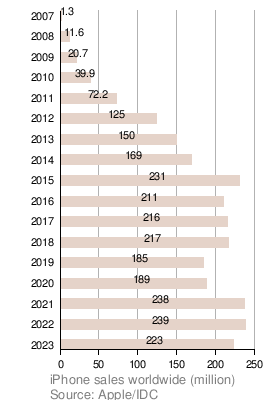
Steve Jobs's initial target was to reach 1% of phone market share in 2008.[208] Apple sold 6.1 million units of the original iPhone between Q3 FY2007[note 3] and Q4 FY2008, and 11.3 million units of the iPhone 3G in Q4 FY2008 and Q1 FY2009.[209] In 2008, the iPhone reached 1.1% of worldwide mobile phone market share,[210] and 8.2% of the smartphone market.[211] During this time it was quickly becoming relevant in North America, and in market share was ranked second in the U.S. in 2009, behind the BlackBerry;[212] in 2010 the iPhone 3GS was the best-selling smartphone in the U.S., the first time that an iPhone device reached top spot in that market.[213]
iPhone sales grew continuously year-over-year since its introduction until Q2 FY2016.[214][215] The iPhone briefly surpassed BlackBerry in Q4 FY2008,[216] and permanently overtook it starting in Q3 FY2010.[217] By 2011, Apple sold 100 million iPhones worldwide,[218] and became the largest mobile phone vendor in the world by revenue, surpassing long-time leader Nokia.[219] Q1 FY2012 marked Apple's best quarterly earnings in its history, with 53% of the company's revenues coming from iPhone sales.[220] Phone sales are strongly seasonal, peaking in the holiday season (Apple's Q1). With the release of the iPhone 13 in Q1 FY2022, Apple temporarily topped Samsung, with 84.9 million units shipped compared to Samsung's 68.9 million. In most quarters, Apple is the second-largest smartphone vendor by units.[217][note 4] Apple sold 223 million iPhones in its financial year 2023 ending September 24.[221][222]
Today,[when?] Samsung and Apple dominate the smartphone market, with 21.8% and 15.6% worldwide market share respectively.[223] Due to Apple's small lineup, Apple often dominates the list of bestselling smartphone models.[224][225] Despite its lower market share, the iPhone's premium positioning has led it to capture nearly half of global smartphone revenue,[226] and 80% of global smartphone profits, with Samsung taking the other 20%.[227] Carriers compete with each other to subsidize iPhone upgrades, which is seen as a significant factor in iPhone sales, though this has reduced carrier profits.[228] On July 27, 2016, Apple announced that it had sold their billionth iPhone.[229] As of January 1, 2024, more than 2.3 billion iPhones have been sold.[230] In July 2025, Apple CEO Tim Cook said that 3 billion iPhones have been sold.[231]
Compared to other high-tech products, a greater proportion of iPhone users are female.[232] The iPhone has been adopted by both consumers and business users.[233] iPhone users are wealthier and spend more time on their phones than Android users on average.[234][235] The iPhone is especially popular in the U.S., where it has a 50% market share[236] and is used by 88% of teenagers.[123] Worldwide, the iPhone accounts for 78% of the high-end ($1,000+) smartphone market.[236]
Android overtook the iPhone's installed base in 2010, according to NPD Group.[237] During Apple's earnings call on January 27, 2021, Tim Cook said that 1 billion iPhones were being actively used worldwide.[238]
Emerging markets[edit | edit source]
While other manufacturers make separate entry-level phones, Apple's entry-level phones are the previous years' models, part of an effort to increase its market share in emerging markets without diluting its premium brand.[239][240] It also considers emerging market tastes in its product designs; for example, it introduced a gold iPhone after finding that gold was seen as a popular sign of a luxury product among Chinese customers.[241] In 2017, Apple started manufacturing previous years' iPhone models in India; in 2022, it began manufacturing the current iPhone 14 there too.[242] Analysts have speculated that this was partly caused by Apple's desire to reduce its dependence on China, and to overcome Indian import duties.[242][243] In 2023, the Chinese government banned the use of iPhones by government civil servants in what was seen as an effort to reduce dependence on foreign technology and strengthen cybersecurity.[244]
In May 2024, Iranian president Mokhber banned imported iPhone 14 and newer models. In November, the ban was lifted and replaced with a 30% customs tariff to the phones.[245][246]
See also[edit | edit source]
- Apple Newton, an early personal digital assistant and the first tablet platform developed by Apple
Notes[edit | edit source]
- ↑ 1 GB = 1 billion bytes; 1 TB = 1 trillion bytes
- ↑ The naming of the iPhone X (Roman numeral "X" pronounced "ten") marked the 10th anniversary of the iPhone, thus skipping the iPhone 9.
- ↑ Each company may choose different quarters for their fiscal year. Apple's fiscal quarters correspond to the following months: Q1 ends in late December, Q2 ends in late March, Q3 ends in late June, and Q4 ends in late September. All references to quarters in this section reference Apple's fiscal year quarters. The holiday quarter, the fourth quarter of the calendar year, is referred to as Apple's Q1. Since 2011, iPhone releases have consistently occurred in September at the end of Q4, meaning that sales of a new model are mostly reflected in Q1 of the following fiscal year, covering October to December.
- ↑ Note that Statista presents data in calendar year quarters; Q4 in Statista data corresponds to Apple's FY Q1.
References[edit | edit source]
- ↑ Gladwell, Malcolm (November 14, 2011). "The Tweaker: The real genius of Steve Jobs." Archived March 8, 2013, at the Wayback Machine The New Yorker. p. 2
- ↑ "The Secret Origin Story of the IPHONE. An exclusive excerpt from the book "The One Device: The secret history of the iPhone"". The Verge (published 2017). June 13, 2017. Archived from the original on August 27, 2022.
- ↑ Rowinski, Dan (August 7, 2012). "4 Real Secrets We've Learned So Far About Apple". Readwriteweb.com. Archived from the original on August 8, 2012. Retrieved October 25, 2012.
- ↑ Murtazin, Eldar (June 20, 2010). "Apple's Phone: From 1980s' Sketches to iPhone. Part 3". Mobile-review. Archived from the original on May 11, 2011. Retrieved March 27, 2011.
- ↑ "The Untold Story: How the iPhone Blew Up the Wireless Industry". Wired. January 9, 2008. Archived from the original on February 13, 2015.
- ↑ "iPhone: What the "i" in Apple's handset names for". Andrew Griffin. The Independent. February 18, 2016. Archived from the original on July 6, 2022. Retrieved November 12, 2017.
- ↑ Wei, Will (September 7, 2016). "The meaning of the 'i' in 'iPhone' – as explained by Steve Jobs". Business Insider. Archived from the original on June 27, 2022. Retrieved November 12, 2017.
- ↑ Andreescu, Alex (September 27, 2005). "iPod nano: The End of the Motorola-Apple Story – Ed Zander, Motorola CEO: "Screw the nano"". Softpedia. Archived from the original on July 1, 2022. Retrieved June 5, 2010.
- ↑ Rojas, Peter (September 8, 2005). "It's official: ROKR E1 iTunes phone can only store max. 100 tracks". Engadget. Archived from the original on May 25, 2022. Retrieved March 23, 2017.
- ↑ Lewis, Peter (January 12, 2007). "How Apple kept its iPhone secrets". CNN. Archived from the original on December 10, 2008. Retrieved January 11, 2009.
- ↑ Vogelstein, Fred (January 9, 2008). "The Untold Story: How the iPhone Blew Up the Wireless Industry". Wired. Archived from the original on May 9, 2008. Retrieved January 10, 2008.
- ↑ Cheng, Jacqui (June 9, 2008). "AT&T remains sole iPhone carrier in US, revenue sharing axed (Updated)". Ars Technica. Archived from the original on March 24, 2017. Retrieved March 23, 2017.
- ↑ Brodkin, Jon (June 29, 2017). "With iPhone, Apple showed AT&T and Verizon who's boss". Ars Technica. Archived from the original on July 3, 2017. Retrieved July 4, 2017.
- ↑ Farber, Dan (January 9, 2014). "When iPhone met world, 7 years ago today". CNET. Archived from the original on July 5, 2022. Retrieved March 23, 2017.
- ↑ "iPhone (2007) review: A game-changer years in the making". Macworld. Archived from the original on October 5, 2022. Retrieved October 5, 2022.
- ↑ Merchant, Brian (June 22, 2017). The One Device: The Secret History of the iPhone. Transworld. ISBN 978-1-4735-4254-9.
- ↑ "Apple Inc. Q3 2007 Unaudited Summary Data" (PDF) (Press release). Apple Inc. July 25, 2007. Archived from the original (PDF) on May 29, 2008. Retrieved June 6, 2008.
Consists of iPhones and Apple-branded and third-party iPhone accessories.
- ↑ "The Price Is Right, but Maybe It's Not, and How Do You Know?". Wharton Business School. October 3, 2007. Archived from the original on April 26, 2024. Retrieved April 26, 2024.
- ↑ "iPhone 3G Coming to countries everywhere". Apple Inc. Archived from the original on July 21, 2008. Retrieved April 12, 2009.
- ↑ "iPhone 3G now available in 22 other countries". Macworld. Archived from the original on October 5, 2022. Retrieved October 5, 2022.
- ↑ Tweney, Dylan. "WWDC Keynote: Steve Jobs Announces a $200, 3G iPhone". Wired. ISSN 1059-1028. Archived from the original on October 5, 2022. Retrieved October 5, 2022.
- ↑ "iPhone 3G crowned most popular phone in U.S." CNET. Archived from the original on November 15, 2023. Retrieved October 25, 2023.
- ↑ "Apple iPhone 3GS review: Same clothes, new feel". GSMArena.com. Archived from the original on October 5, 2022. Retrieved October 5, 2022.
- ↑ 24.0 24.1 24.2 "iPhone 4: The Definitive Guide". Gizmodo. June 7, 2010. Archived from the original on July 24, 2017. Retrieved October 5, 2022.
- ↑ Ionescu, Daniel. (July 17, 2010) Apple's iPhone 4 Antennagate Timeline Archived November 3, 2011, at the Wayback Machine. PCWorld. Retrieved November 6, 2011.
- ↑ "Liveblog: The Verizon iPhone". The Washington Post. Archived from the original on July 18, 2022. Retrieved January 11, 2011.
- ↑ Raice, Shayndi (January 12, 2011). "Verizon Unwraps iPhone". The Wall Street Journal. Archived from the original on July 18, 2022. Retrieved August 12, 2017.
- ↑ 28.0 28.1 Ziegler, Chris (September 12, 2012). "Apple's iPhone 5 announcement: everything you need to know". The Verge. Archived from the original on October 5, 2022. Retrieved October 5, 2022.
- ↑ Koetsier, John (September 10, 2013). "Apple's new iPhone 5s: The world's first 64-bit mobile phone … with fingerprint login". VentureBeat. Archived from the original on October 6, 2022. Retrieved October 6, 2022.
- ↑ "A New Touch for iPhone". AllThingsD. Archived from the original on April 23, 2022. Retrieved January 5, 2024.
- ↑ Tibken, Shara. "Apple launches iPhone 5s and $99 iPhone 5c with five colors". CNET. Archived from the original on October 5, 2022. Retrieved October 5, 2022.
- ↑ Rushe, Dominic; Hern, Alex; Gibbs, Samuel; Dredge, Stuart (September 9, 2014). "The Apple Watch, iPhone 6 and iPhone 6 Plus – as it happened". The Guardian. Archived from the original on August 14, 2022. Retrieved March 23, 2017.
- ↑ Sacco, Al (September 29, 2014). "Apple (Mostly) Not to Blame in iPhone 6 Plus 'Bendgate' Fiasco". CIO. Archived from the original on June 27, 2022. Retrieved May 28, 2021.
- ↑ Miller, Chance (September 25, 2015). "Here's how iPhone 6s Plus handles bendgate brutality". 9to5Mac. Archived from the original on October 5, 2022. Retrieved October 5, 2022.
- ↑ "Apple Introduces iPhone SE – The Most Powerful Phone with a Four-inch Display". Apple Newsroom (Singapore). Archived from the original on October 5, 2022. Retrieved October 5, 2022.
- ↑ Seifert, Dan (September 7, 2016). "iPhone 7 and 7 Plus announced with water resistance, dual cameras, and no headphone jack". The Verge. Archived from the original on April 27, 2019. Retrieved March 23, 2017.
- ↑ Novet, Jordan (January 19, 2017). "Apple's AirPods are a no-brainer – if you have the latest iPhone". VentureBeat. Archived from the original on October 5, 2022. Retrieved October 5, 2022.
- ↑ "Camera". Trusted Reviews. March 11, 2020. Archived from the original on October 5, 2022. Retrieved October 5, 2022.
- ↑ "The future is here: iPhone X". Apple Inc. Archived from the original on September 24, 2017. Retrieved September 14, 2017.
- ↑ Warren, Tom (September 14, 2017). "Apple's iPhone X notch is an odd design choice". The Verge. Archived from the original on December 4, 2017. Retrieved October 5, 2022.
- ↑ Stein, Scott. "No home button? No problem: How to do everything on the iPhone X". CNET. Archived from the original on October 13, 2022. Retrieved October 5, 2022.
- ↑ Clifford, Catherine (November 3, 2017). "Apple CEO Tim Cook on the $999 new iPhone X: 'We're not trying to charge the highest price we could get or anything like that'". CNBC. Archived from the original on October 5, 2022. Retrieved October 5, 2022.
- ↑ "iPhone Xs and iPhone Xs Max bring the best and biggest displays to iPhone". Apple Inc. Archived from the original on April 27, 2019. Retrieved September 12, 2018.
- ↑ "Apple introduces iPhone XR". Apple Inc. Archived from the original on March 27, 2019. Retrieved September 12, 2018.
- ↑ "Apple's new iPhone 11 is $50 cheaper than last year's model, despite Trump's planned tariffs on Chinese imports". Business Insider. September 11, 2019. Archived from the original on June 20, 2022. Retrieved September 10, 2019.
- ↑ "iPhone 11 Pro and iPhone 11 Pro Max: the most powerful and advanced smartphones". Apple Inc. (Press release). September 10, 2019. Archived from the original on September 10, 2019. Retrieved September 4, 2019.
- ↑ "iPhone SE: A powerful new smartphone in a popular design". Apple Newsroom. Archived from the original on April 28, 2020. Retrieved October 5, 2022.
- ↑ "Apple announces iPhone 12 and iPhone 12 mini: A new era for iPhone with 5G". Apple Newsroom. Archived from the original on August 14, 2022. Retrieved January 9, 2021.
- ↑ "Apple introduces iPhone 12 Pro and iPhone 12 Pro Max with 5G". Apple Newsroom. Archived from the original on October 13, 2020. Retrieved January 9, 2021.
- ↑ "Apple introduces iPhone 13 and iPhone 13 mini, delivering breakthrough camera innovations and a powerhouse chip with an impressive leap in battery life". Apple Newsroom. Archived from the original on June 22, 2022. Retrieved October 9, 2021.
- ↑ "Apple unveils iPhone 13 Pro and iPhone 13 Pro Max – more pro than ever before". Apple Newsroom. Archived from the original on September 15, 2021. Retrieved October 9, 2021.
- ↑ "Apple introduces iPhone 14 and iPhone 14 Plus". Apple Newsroom. Archived from the original on September 24, 2022. Retrieved September 24, 2022.
- ↑ "Apple debuts iPhone 14 Pro and iPhone 14 Pro Max". Apple Newsroom. Archived from the original on September 24, 2022. Retrieved September 24, 2022.
- ↑ Morrow, Allison (September 12, 2023). "Apple just killed the iPhone Lightning connector. What to do with your old chargers". CNN. Cable News Network. Archived from the original on September 13, 2023. Retrieved September 12, 2023.
- ↑ Kelly, Samantha Murphy (September 12, 2023). "The iPhone 15 and five other takeaways from Apple's 'wonderlust' event". CNN. Archived from the original on September 30, 2023. Retrieved September 12, 2023.
- ↑ "Apple debuts iPhone 15 and iPhone 15 Plus". Apple Newsroom. September 12, 2023. Archived from the original on September 20, 2023. Retrieved December 20, 2023.
- ↑ 57.0 57.1 "Apple unveils iPhone 15 Pro and iPhone 15 Pro Max". Apple Newsroom. September 12, 2023. Archived from the original on September 20, 2023. Retrieved December 20, 2023.
- ↑ "Apple introduces iPhone 16 and iPhone 16 Plus". Apple Newsroom. Retrieved October 30, 2024.
- ↑ "Apple debuts iPhone 16 Pro and iPhone 16 Pro Max". Apple Newsroom. Retrieved October 30, 2024.
- ↑ "Apple Intelligence". Apple. Archived from the original on June 13, 2024. Retrieved October 30, 2024.
- ↑ "Apple debuts iPhone 16e: A powerful new member of the iPhone 16 family". Apple Newsroom. Archived from the original on February 20, 2025. Retrieved February 19, 2025.
- ↑ Eadicicco, Lisa (February 19, 2025). "Apple launches the iPhone 16e, a cheaper new version of the iPhone 16 | CNN Business". CNN. Archived from the original on February 19, 2025. Retrieved February 19, 2025.
- ↑ "CNET". Archived from the original on December 27, 2025. Retrieved December 25, 2025.
- ↑ Christoffel, Ryan (September 24, 2025). "Why iPhone 17 Pro doesn't have Apple's new C1X modem - 9to5Mac". 9to5Mac. Archived from the original on September 26, 2025. Retrieved December 25, 2025.
- ↑ "iPhone 17 Pro Vapor Chamber: Complete 2025 Guide". Smartish. September 12, 2025. Archived from the original on January 13, 2026.
- ↑ "CNET". Archived from the original on December 27, 2025. Retrieved December 25, 2025.
- ↑ "Apple - Support - Technical Specifications". support.apple.com. Archived from the original on December 7, 2022. Retrieved December 7, 2022.
- ↑ "Taiwan's Pegatron to get most iPhone 6s orders in 2015: brokerage". Focus Taiwan. December 2, 2014. Archived from the original on June 29, 2017. Retrieved December 9, 2014.
- ↑ Lovejoy, Ben (December 18, 2019). "$43M fraud by Foxconn managers selling iPhones made from rejected parts". 9to5Mac. Archived from the original on June 22, 2022. Retrieved December 20, 2019.
- ↑ "Arrests as Indian workers ransack iPhone plant over wages". BBC News. December 14, 2020. Archived from the original on July 10, 2022. Retrieved December 15, 2020.
- ↑ "Apple iPhone: Can India be China's 'plus one' to the world?". BBC News. October 5, 2022. Archived from the original on October 6, 2022. Retrieved October 6, 2022.
- ↑ Singh, Manish (September 21, 2022). "Apple to move 25% iPhone production to India by 2025, 20% iPad and Apple Watch to Vietnam, analysts say". TechCrunch. Archived from the original on October 12, 2022. Retrieved October 12, 2022.
- ↑ Nellis, Stephen (September 7, 2022). "Apple offers adventure watch, satellite SOS iPhone – and steady prices". Reuters. Archived from the original on September 8, 2022. Retrieved September 8, 2022.
- ↑ Patel, Nilay (June 7, 2010). "iPhone OS 4 renamed iOS 4, launching June 21 with 1500 new features". Engadget. Archived from the original on May 23, 2022. Retrieved March 23, 2017.
- ↑ Frommer, Dan (June 14, 2016). "Here's how to remove Apple's built-in system apps in iOS 10". Recode. Archived from the original on April 29, 2019. Retrieved May 28, 2017.
- ↑ Miller, Paul (March 6, 2008). "Apple announces App Store for iPhone, iPod touch". Engadget. Archived from the original on December 31, 2017. Retrieved May 28, 2017.
- ↑ "Update your iPhone, iPad, or iPod touch". Apple Support. Archived from the original on August 28, 2022. Retrieved May 30, 2018.
- ↑ Painter, Lewis. "Which iPhones & iPads are compatible with iOS 11?". Macworld. Archived from the original on March 28, 2018. Retrieved May 30, 2018.
- ↑ "Apple releases iOS 11 for iPhone and iPad, here's everything new". 9to5Mac. September 19, 2017. Archived from the original on June 22, 2022. Retrieved May 30, 2018.
- ↑ "iOS 18". Apple. Archived from the original on September 15, 2024. Retrieved October 30, 2024.
- ↑ "iPhone to Support Third-Party Web 2.0 Applications" (Press release). Apple Inc. June 11, 2007. Archived from the original on December 15, 2008. Retrieved December 15, 2008.
- ↑ "Hot News". Apple. Archived from the original on October 18, 2007. Retrieved September 9, 2017.
- ↑ Block, Ryan (March 6, 2008). "Live from Apple's iPhone SDK press conference". Engadget. Archived from the original on March 23, 2020. Retrieved March 23, 2017.
- ↑ "Apple Introduces the New iPhone 3G" (Press release). Apple Inc. June 9, 2008. Archived from the original on May 1, 2011.
iPhone 2.0 software will be available on July 11 as a free software update via iTunes 7.7 or later for all iPhone customers
- ↑ Kingsley-Hughes, Adrian (June 19, 2020). "Should Apple raise its $99 developer program fee, or scrap it entirely?". ZDNET. Archived from the original on October 3, 2022. Retrieved October 3, 2022.
- ↑ "Program Renewal". Support – Apple Developer. Archived from the original on October 3, 2022. Retrieved October 3, 2022.
If your Apple Developer Program membership expires, your apps will no longer be available for download and you won't be able to submit new apps or updates. [...] However, your apps will still function for users who have already installed or downloaded them, and you will still have access to App Store Connect and free development resources.
- ↑ Quinn, Michelle (July 10, 2008). "Store aims to plug people into iPhones". Los Angeles Times. Archived from the original on October 16, 2008. Retrieved July 10, 2008.
- ↑ Statt, Nick (November 18, 2020). "Apple will reduce App Store cut to 15 percent for most developers starting January 1st". The Verge. Archived from the original on October 3, 2022. Retrieved October 3, 2022.
- ↑ Hill, Simon; Jansen, Mark (April 14, 2021). "Android vs. iOS: Which Smartphone Platform Is the Best?". Digital Trends. Archived from the original on October 11, 2022. Retrieved October 12, 2022.
- ↑ Brodkin, Jon (June 29, 2017). "With iPhone, Apple showed AT&T and Verizon who's boss". Ars Technica. Archived from the original on September 12, 2022. Retrieved October 11, 2022.
- ↑ Leswing, Kif (June 21, 2019). "Inside Apple's team that greenlights iPhone apps for the App Store". CNBC. Archived from the original on October 3, 2022. Retrieved October 3, 2022.
- ↑ Andrews, Robert (May 6, 2009). "The Sun's 'obscene' Page 3 girls get iPhone newspaper app banned by Apple". the Guardian. Archived from the original on October 7, 2022. Retrieved October 3, 2022.
- ↑ "Tumblr Explains Why It Still Bans Porn: Blame Credit Card Companies, Apple". PCMAG. September 29, 2022. Archived from the original on October 13, 2022. Retrieved October 3, 2022.
- ↑ Lovejoy, Ben (December 28, 2021). "App Store review process perplexing, random, discordant, asinine – ex-Tumblr developer". 9to5Mac. Archived from the original on October 13, 2022. Retrieved October 3, 2022.
- ↑ Centers, Josh (August 13, 2020). "Developers v. Apple: Outlining Complaints about the App Store". TidBITS. Archived from the original on October 3, 2022. Retrieved October 3, 2022.
- ↑ Statt, Nick (November 18, 2020). "Apple's biggest App Store critics are not impressed with its new fee cut for small developers". The Verge. Archived from the original on October 3, 2022. Retrieved October 3, 2022.
- ↑ "Apple 'Surprised' By Developer Frustration With Its App Review Process". MacRumors. March 22, 2021. Archived from the original on October 3, 2022. Retrieved October 3, 2022.
- ↑ Healey, Jon (August 6, 2007). "Hacking the iPhone". Los Angeles Times. Archived from the original on November 12, 2013. Retrieved June 6, 2008.
- ↑ Fitzgerald, Thomas J. (November 24, 2010). "Breaking into the Smartphone (Risks Included)". The New York Times. ISSN 0362-4331. Archived from the original on October 3, 2022. Retrieved October 3, 2022.
- ↑ Perton, Marc (October 22, 2013). "Apple App Store hits 60 billion cumulative downloads". Engadget. Archived from the original on March 30, 2019. Retrieved March 23, 2017.
- ↑ Perez, Sarah (September 7, 2016). "App Store sees 140 billion downloads, 106% year-over-year growth". TechCrunch. Archived from the original on March 19, 2022. Retrieved March 23, 2017.
- ↑ Goode, Lauren (January 5, 2017). "Apple's App Store just had the most successful month of sales ever". The Verge. Archived from the original on August 21, 2022. Retrieved May 28, 2017.
- ↑ "App Store shatters records on New Year's Day" (Press release). Apple Inc. January 5, 2017. Archived from the original on July 9, 2022. Retrieved December 31, 2017.
- ↑ "The apps you love. From a place you can trust". Apple.com. Archived from the original on September 7, 2024. Retrieved September 7, 2024.
- ↑ Braiker, Brian (May 2, 2008). "A Killer Product: Will closed devices like Apple's iPhone murder the Web?". Newsweek. Archived from the original on April 13, 2010. Retrieved June 16, 2009.
- ↑ Krazit, Tom (October 29, 2007). "iPhone jailbreak for the masses released". CNET. Archived from the original on March 19, 2022. Retrieved March 23, 2017.
- ↑ Love, Dylan. "13 iPhone Features Apple Stole From Jailbreak Developers". Business Insider. Archived from the original on October 20, 2022. Retrieved October 20, 2022.
- ↑ Milian, Mark (July 27, 2010). "'Jailbreaking' Apple iPhones is legal, government says". Los Angeles Times. Archived from the original on October 20, 2022. Retrieved October 20, 2022.
- ↑ "The pros and cons of iPhone jailbreaking". Macworld. Archived from the original on October 20, 2022. Retrieved October 20, 2022.
- ↑ FAQ Details Archived August 4, 2014, at the Wayback Machine. Eshop.macsales.com (March 27, 2013). Retrieved on July 30, 2013.
- ↑ Brandom, Russell (September 30, 2016). "The rising cost of cracking the iPhone". The Verge. Archived from the original on January 11, 2023. Retrieved October 20, 2022.
- ↑ Hardwick, Tim (August 19, 2022). "iOS 16: How to Make Siri Announce Notifications Through Your iPhone's Speaker". MacRumors. Archived from the original on January 11, 2023. Retrieved October 20, 2022.
- ↑ 113.0 113.1 113.2 Biersdorfer, J. D. (September 21, 2022). "The Settings That Make Smartphones Easier for Everyone to Use". The New York Times. ISSN 0362-4331. Archived from the original on October 19, 2022. Retrieved October 20, 2022.
- ↑ "Use Live Listen with Made for iPhone hearing aids". Apple Support. Archived from the original on April 27, 2019. Retrieved October 12, 2022.
- ↑ "Use Live Listen with Made for iPhone hearing aids". Apple Inc. Archived from the original on April 27, 2019. Retrieved April 3, 2016.
- ↑ Heisler, Yoni (June 8, 2016). "This was the first iPhone rumor. Ever". New York Post. Archived from the original on October 11, 2022. Retrieved October 11, 2022.
- ↑ Graham, Jefferson (March 9, 2010). "Apple buffs marketing savvy to a high shine". USA Today. Archived from the original on March 24, 2007. Retrieved October 11, 2022.
- ↑ Stieg, Cory (December 8, 2020). "The psychology behind a new iPhone release—and why it's so hard to resist". CNBC. Archived from the original on January 11, 2023. Retrieved October 20, 2022.
- ↑ DeNinno, Nadine (May 22, 2014). "Forget Fashion: Teens Spend Their Money On Food And Phones". International Business Times. Archived from the original on February 8, 2023. Retrieved October 20, 2022.
- ↑ Bertrand, Marianne; Kamenica, Emir (July 5, 2018). "Coming Apart? Cultural Distances in the United States Over Time". NBER Working Paper. Rochester, NY. SSRN 3208730. Archived from the original on January 11, 2023. Retrieved October 20, 2022.
- ↑ Higgins, Tim (January 8, 2022). "Why Apple's iMessage Is Winning: Teens Dread the Green Text Bubble". Wall Street Journal. Archived from the original on October 20, 2022. Retrieved October 20, 2022.
- ↑ Nieva, Richard. "Google Calls On Apple To Fix Hated Green Bubbles On iMessage". Forbes. Archived from the original on January 11, 2023. Retrieved October 20, 2022.
- ↑ 123.0 123.1 "Taking Stock With Teens | Piper Sandler". www.pipersandler.com. Archived from the original on July 16, 2024. Retrieved June 22, 2025.
- ↑ 124.0 124.1 Hattersley, Lucy (July 22, 2022). "How to check an iPhone is unlocked before buying it". Macworld. Archived from the original on October 14, 2022. Retrieved October 14, 2022.
- ↑ Farivar, Cyrus (November 14, 2007). "Unlocking an iPhone". Macworld. Archived from the original on March 19, 2022. Retrieved May 25, 2009.
- ↑ "iPhone 3G Price Decrease Addresses Key Reason Consumers Exhibit Purchase Resistance". NPD Group. June 22, 2009. Archived from the original on June 26, 2009. Retrieved June 27, 2009.
- ↑ "Quarter of US iPhones 'unlocked'". BBC News. January 28, 2008. Archived from the original on February 12, 2009. Retrieved January 29, 2008.
- ↑ "Sim lock laws by country – ChimeraTool help". ChimeraTool. Archived from the original on January 11, 2023. Retrieved October 14, 2022.
- ↑ Fiegerman, Seth (September 1, 2013). "Apple Rolls Out iPhone Trade-In Program Nationwide". Mashable. Archived from the original on September 1, 2022. Retrieved September 1, 2013.
- ↑ Kokalitcheva, Kia (September 15, 2015). "Here's Why Apple Is Offering An iPhone Upgrade Plan". Fortune. Archived from the original on February 8, 2023. Retrieved October 18, 2022.
- ↑ "About genuine iPhone displays". Apple Support. Archived from the original on August 5, 2022. Retrieved June 1, 2021.
- ↑ Chugh, Ritesh (March 11, 2021). "Screwed over: how Apple and others are making it impossible to get a cheap and easy phone repair". The Conversation. Archived from the original on October 22, 2022. Retrieved October 20, 2022.
- ↑ Buskirk, Chris Van. "Apple products get low marks in new repairability index". MetroWest Daily News. Archived from the original on October 20, 2022. Retrieved October 20, 2022.
- ↑ Koebler, Jason (May 18, 2017). "Apple Is Lobbying Against Your Right to Repair iPhones, New York State Records Confirm". Vice.com. Archived from the original on October 20, 2022. Retrieved October 20, 2022.
- ↑ Abnett, Kate (March 30, 2022). "Reduce, repair, recycle as EU plans 'circular' rules for everyday items". Reuters. Archived from the original on October 20, 2022. Retrieved October 20, 2022.
- ↑ Swinford, Steven (March 10, 2021). "'Right to repair' means spare parts for household appliances". The Times. Archived from the original on October 20, 2022. Retrieved October 20, 2022.
- ↑ Shepardson, David (February 3, 2022). "U.S. lawmakers introduce 'Right to Repair' bills to spur competition". Reuters. Archived from the original on October 20, 2022. Retrieved October 20, 2022.
- ↑ Macro, Ashleigh (July 26, 2018). "Apple apologises, releases fix for iPhones bricked by Error 53". Macworld UK. Archived from the original on March 19, 2022. Retrieved April 20, 2021.
- ↑ "iPhone 8 Plus Home/Touch ID Sensor Replacement". iFixit. December 13, 2017. Archived from the original on October 20, 2022. Retrieved October 20, 2022.
- ↑ Rossingnol, Joe; Moser, Steve (January 14, 2021). "iOS 14.4 Will Introduce Warning on iPhones With Non-Genuine Cameras". MacRumors. Archived from the original on May 24, 2022. Retrieved June 1, 2021.
- ↑ Purdy, Kevin (June 1, 2021). "Is This the End of the Repairable iPhone?". iFixit. Archived from the original on August 26, 2022. Retrieved June 1, 2021.
- ↑ Adorno, José (April 27, 2022). "iFixit praises Apple Self Service Repair program, but says it falls short of Right to Repair goals". 9to5Mac. Archived from the original on October 21, 2022. Retrieved October 20, 2022.
- ↑ "Apple Fixes Its DIY Repair Stance". IEEE Spectrum. December 7, 2021. Archived from the original on October 20, 2022. Retrieved October 20, 2022.
- ↑ Cross, Jason (April 29, 2021). "What is App Tracking Transparency and how do you block app tracking?". Macworld. Archived from the original on October 19, 2022. Retrieved October 19, 2022.
- ↑ Bechade, Corentin (April 30, 2021). "App Tracking Transparency : tout savoir sur le contrôle du suivi publicitaire d'Apple". Numerama (in français). Archived from the original on October 19, 2022. Retrieved October 19, 2022.
- ↑ Howley, Daniel (February 3, 2022). "What to know about the Apple privacy changes that crushed Facebook parent Meta". Yahoo Finance. Archived from the original on October 19, 2022. Retrieved October 19, 2022.
- ↑ "Apple gets boost in French privacy fight, but still faces probe". Reuters. March 17, 2021. Archived from the original on October 19, 2022. Retrieved October 19, 2022.
- ↑ "German cartel office examining Apple's tracking rules". Reuters. June 14, 2022. Archived from the original on October 19, 2022. Retrieved October 19, 2022.
- ↑ Valentino-DeVries, Julia Angwin And Jennifer (April 21, 2011). "Apple's iPhones and Google's Androids Send Cellphone Location". Wall Street Journal. Archived from the original on September 28, 2013. Retrieved October 19, 2022.
- ↑ Sewell, Bruce (July 12, 2010). "Apple Inc.'s Response to Request for Information Regarding Its Privacy Policy and Location-Based Services" (PDF). Archived from the original (PDF) on December 8, 2010. Retrieved October 19, 2022.
- ↑ Vance, Christopher (October 9, 2010). "iPhone iOS4 GPS Data". Cellular.Sherlock. Archived from the original on October 9, 2010. Retrieved October 19, 2022.
- ↑ 152.0 152.1 Keizer, Gregg (April 21, 2011). "Apple faces questions from Congress about iPhone tracking". Computerworld. Archived from the original on October 19, 2022. Retrieved October 19, 2022.
- ↑ Rooney, Ben (April 21, 2011). "Apple New Secret Tracking File Neither New Nor Secret". The Wall Street Journal. ISSN 0099-9660. Archived from the original on October 20, 2022. Retrieved October 20, 2022.
- ↑ Arthur, Charles (April 20, 2011). "iPhone keeps record of everywhere you go". The Guardian. Archived from the original on October 19, 2022. Retrieved October 19, 2022.
- ↑ Allan, Alasdair. "Got an iPhone or 3G iPad? Apple is recording your moves". O'Reilly Radar. Archived from the original on October 19, 2022. Retrieved October 19, 2022.
- ↑ Valentino-DeVries, Jennifer (April 25, 2011). "IPhone Stored Location Even if Disabled". WSJ. Archived from the original on September 27, 2013. Retrieved October 19, 2022.
- ↑ 157.0 157.1 Elmer-Dewitt, Philip (April 27, 2011). "LocationGate was a "bug," says Apple". Fortune. Archived from the original on October 19, 2022. Retrieved October 19, 2022.
- ↑ "Apple Q&A on Location Data" (Press release). Apple Inc. April 27, 2011. Archived from the original on June 7, 2011. Retrieved June 7, 2011.
- ↑ "Influential China TV alleges iPhone exposing 'state secrets'". Beijing News.Net. Archived from the original on July 14, 2014. Retrieved July 10, 2014.
- ↑ "iPhone Feature Tracks Your Movement, Learns Your 'Home'". Newsweek. May 2, 2014. Archived from the original on October 19, 2022. Retrieved October 19, 2022.
- ↑ Waterson, Jim (April 29, 2014). "Your iPhone Knows Exactly Where You've Been And This Is How To See It". BuzzFeed News. Archived from the original on March 23, 2022. Retrieved October 19, 2022.
- ↑ Marcos, Coral Murphy; Browning, Kellen (September 3, 2021). "Apple delays the rollout of child-safety features over privacy concerns". The New York Times. ISSN 0362-4331. Archived from the original on October 20, 2022. Retrieved October 20, 2022.
- ↑ Menn, Joseph (August 19, 2021). "Policy groups ask Apple to drop plans to inspect iMessages, scan for abuse images". Reuters. Archived from the original on January 11, 2023. Retrieved October 20, 2022.
- ↑ Portnoy, India McKinney and Erica (August 5, 2021). "Apple's Plan to "Think Different" About Encryption Opens a Backdoor to Your Private Life". Electronic Frontier Foundation. Archived from the original on October 18, 2022. Retrieved October 20, 2022.
- ↑ Simon, Michael (April 21, 2022). "Apple CSAM detection: Conversation Safety for Messages is coming to the UK". Macworld. Archived from the original on October 20, 2022. Retrieved October 20, 2022.
- ↑ Newman, Lily Hay. "Apple Kills Its Plan to Scan Your Photos for CSAM. Here's What's Next". Wired. ISSN 1059-1028. Archived from the original on January 17, 2023. Retrieved January 24, 2023.
- ↑ Malik, Aisha (November 9, 2021). "iOS 15.2 includes Apple's new safety feature for kids in Messages". TechCrunch. Archived from the original on October 20, 2022. Retrieved October 20, 2022.
- ↑ Bary, Emily (May 31, 2017). "Android vs. iOS: Are iPhones Really Safer?". Barron's. Archived from the original on January 11, 2023. Retrieved October 20, 2022.
- ↑ Casserly, Martyn (March 15, 2024). "Do iPhones get viruses? We bust the myths". Macworld. Archived from the original on January 11, 2023. Retrieved October 20, 2022.
- ↑ Cunningham, Andrew (May 8, 2014). "New guidelines outline what iPhone data Apple can give to police". Ars Technica. Archived from the original on October 20, 2022. Retrieved October 20, 2022.
- ↑ Farivar, Cyrus (September 18, 2014). "Apple expands data encryption under iOS 8, making handover to cops moot". Ars Technica. Archived from the original on January 11, 2023. Retrieved October 20, 2022.
- ↑ Cox, Joseph (July 5, 2018). "Leaked Emails Show Cops Trying to Hide Emails About Phone Hacking Tools". Vice Media. Archived from the original on March 20, 2022. Retrieved July 6, 2018.
Leaked emails from one of these communities showed how some members were confident that Grayshift, the company behind the GrayKey product, had already found a workaround to a new security feature from Apple called USB Restricted Mode.
- ↑ 173.0 173.1 Nicas, Jack (October 21, 2020). "The Police Can Probably Break Into Your Phone". The New York Times. ISSN 0362-4331. Archived from the original on October 20, 2022. Retrieved October 20, 2022.
- ↑ Michael Riley; Jordan Robertson (February 19, 2016). "Secret Memo Details U.S.'s Broader Strategy to Crack Phones". Bloomberg News. Archived from the original on August 26, 2022. Retrieved March 7, 2017.
- ↑ Farivar, Cyrus (February 17, 2016). "Judge: Apple must help FBI unlock San Bernardino shooter's iPhone". Ars Technica. Archived from the original on June 23, 2022. Retrieved March 23, 2017.
- ↑ Tim Cook. "A Message to Our Customers". Archived from the original on February 17, 2016.
The United States government has demanded that Apple take an unprecedented step which threatens the security of our customers. We oppose this order, which has implications far beyond the legal case at hand.
- ↑ Nakashima, Ellen; Albergotti, Reed (April 14, 2021). "The FBI wanted to unlock the San Bernardino shooter's iPhone. It turned to a little-known Australian firm". Washington Post. Archived from the original on November 24, 2022. Retrieved October 20, 2022.
- ↑ Nicas, Jack (June 13, 2018). "Apple to Close iPhone Security Hole That Law Enforcement Uses to Crack Devices". The New York Times. ISSN 0362-4331. Archived from the original on October 20, 2022. Retrieved October 20, 2022.
- ↑ Timberg, Craig; Albergotti, Reed; Guéguen, Elodie (July 19, 2021). "Despite the hype, iPhone security no match for NSO spyware – International investigation finds 23 Apple devices that were successfully hacked". The Washington Post. Archived from the original on July 19, 2021. Retrieved July 19, 2021.
- ↑ Priest, Dana; Timberg, Craig; Mekhennet, Souad. "Private Israeli spyware used to hack cellphones of journalists, activists worldwide". Washington Post. Archived from the original on January 2, 2020. Retrieved October 20, 2022.
- ↑ Cox, Joseph (May 12, 2020). "NSO Group Pitched Phone Hacking Tech to American Police". Vice. Archived from the original on January 30, 2022. Retrieved January 30, 2022.
- ↑ Bergman, Ronen; Mazzetti, Mark (January 28, 2022). "The Battle for the World's Most Powerful Cyberweapon". The New York Times. Archived from the original on January 30, 2022. Retrieved January 30, 2022.
- ↑ "Israeli spyware firm targeted Apple devices via iMessage, researchers say". the Guardian. September 14, 2021. Archived from the original on November 1, 2022. Retrieved November 1, 2022.
- ↑ Kirchgaessner, Stephanie (April 5, 2022). "Victim's iPhone hacked by Pegasus spyware weeks after Apple sued NSO". The Guardian. Archived from the original on February 8, 2023. Retrieved November 1, 2022.
- ↑ Nellis, Stephen (July 6, 2022). "Apple to release new 'Lockdown Mode' as it battles spyware firms". Reuters. Archived from the original on November 1, 2022. Retrieved November 1, 2022.
- ↑ Newman, Lily Hay. "iOS 16 Has 2 New Security Features for Worst-Case Scenarios". Wired. ISSN 1059-1028. Archived from the original on February 8, 2023. Retrieved November 1, 2022.
- ↑ Albergotti, Reed (September 13, 2021). "Apple pays hackers six figures to find bugs in its software. Then it sits on their findings". Washington Post. ISSN 0190-8286. Archived from the original on July 19, 2024. Retrieved September 27, 2024.
- ↑ Benjakob, Omer (April 5, 2022). "The NSO File: A Complete (Updating) List of Individuals Targeted With Pegasus Spyware". Haaretz. Archived from the original on October 20, 2022. Retrieved October 20, 2022.
- ↑ Bergman, Ronen; Mazzetti, Mark (January 28, 2022). "The Battle for the World's Most Powerful Cyberweapon". The New York Times. ISSN 0362-4331. Archived from the original on January 30, 2022. Retrieved October 20, 2022.
- ↑ Ingleton, Danna (July 18, 2022). "A year on from the Pegasus project, governments still have access to surveillance technology | Danna Ingleton". The Guardian. Archived from the original on October 20, 2022. Retrieved October 20, 2022.
- ↑ Pogue, David (June 27, 2007). "The iPhone Matches Most of Its Hype". The New York Times. Archived from the original on September 1, 2022. Retrieved March 23, 2017.
- ↑ Boehret, Walter S. Mossberg and Katherine (June 28, 2007). "Testing Out the iPhone". The Wall Street Journal. ISSN 0099-9660. Archived from the original on October 13, 2022. Retrieved October 11, 2022.
- ↑ Grossman, Lev (June 30, 2007). ""I Take the iPhone Home"". Time. ISSN 0040-781X. Archived from the original on October 13, 2022. Retrieved October 11, 2022.
- ↑ Satariano, Adam (August 10, 2011). "Apple Surpasses Exxon as World's Most Valuable Company Before Retreating". Bloomberg News. Archived from the original on August 10, 2011. Retrieved May 28, 2017.
- ↑ Clover, Juli (September 27, 2022). "iPhone 14 Pro Max Earns Best Smartphone Display Award, Replacing iPhone 13 Pro Max". MacRumors. Archived from the original on October 11, 2022. Retrieved October 11, 2022.
- ↑ Stevenson, Alastair (October 11, 2021). "Trusted Reviews Awards: The iPhone 12 Pro Max is 2021's Best Camera Phone". Trusted Reviews. Archived from the original on October 13, 2022. Retrieved October 11, 2022.
- ↑ 197.0 197.1 197.2 "Why The iPhone Upended The Tech Industry". Time. Archived from the original on July 20, 2022. Retrieved October 11, 2022.
- ↑ "Why does Symbian collapse?". Pixelstech.net. Archived from the original on March 20, 2022. Retrieved June 13, 2013.
- ↑ Streitfeld, David (November 17, 2012). "As Boom Lures App Creators, Tough Part Is Making a Living". The New York Times. Archived from the original on September 1, 2022. Retrieved April 2, 2013.
- ↑ Siracusa, John (July 2, 2007). "Let a million iPhones bloom". Ars Technica. Archived from the original on March 19, 2022. Retrieved March 23, 2017.
- ↑ Hackett, Stephen (March 15, 2018). "The Initial iPhone SDK". MacStories. Archived from the original on October 11, 2022. Retrieved October 11, 2022.
- ↑ Timmer, John (June 28, 2017). "A touch of Cocoa: Inside the original iPhone SDK". Ars Technica. Archived from the original on October 13, 2022. Retrieved October 11, 2022.
- ↑ Etherington, Darrell (September 20, 2013). "Apple's iPhone 5s And 5c Launch Draws Big Crowds, Including Biggest Ever Line at NYC Flagship Store". TechCrunch. Archived from the original on September 1, 2022. Retrieved March 23, 2017.
- ↑ "Apple has most loyal smartphone customers in US, study finds". AppleInsider. October 29, 2021. Archived from the original on October 12, 2022. Retrieved October 12, 2022.
- ↑ 64 million smart phones shipped worldwide in 2006 (PDF) (Report). Canalys. February 12, 2007. Archived (PDF) from the original on October 13, 2022. Retrieved October 11, 2022.
- ↑ Amadeo, Ron (August 6, 2015). "Waiting for Android's inevitable security Armageddon". Ars Technica. Archived from the original on March 12, 2017. Retrieved October 11, 2022.
- ↑ "Global mobile OS market share 2012–2022". Statista. Archived from the original on October 11, 2022. Retrieved October 11, 2022.
- ↑ Guglielmo, Connie. "Steve Jobs Knew iPhone Would Be Iconic. More Than 2 Billion Phones Later, He Was Right". CNET. Archived from the original on October 18, 2022. Retrieved October 19, 2022.
- ↑ "Apple Reports First Quarter Results" (Press release). Apple Inc. January 21, 2009. Archived from the original on June 23, 2009.
- ↑ Foresman, Chris (January 30, 2009). "iPhone passes 1 percent goal for 2008, looking good for 2009". Ars Technica. Archived from the original on August 14, 2022. Retrieved September 24, 2020.
- ↑ Slivka, Eric (February 23, 2010). "Gartner: iPhone Sales Double in 2009 as Apple Claims Third Place in Smartphone Sales". MacRumors. Archived from the original on August 14, 2022. Retrieved September 24, 2020.
- ↑ Hempel, Jessi (August 17, 2009). "Research in Motion battles BlackBerry's competitors". CNN Money. Archived from the original on December 8, 2022. Retrieved January 4, 2023.
- ↑ "Top 10 Mobile phones in the US in 2010". The Independent. December 24, 2010. Archived from the original on January 4, 2023. Retrieved January 4, 2023.
- ↑ Howse, Brett. "Apple Announces Q2 Fiscal Year 2016 Results: iPhone Sales Slowed But Services Gain". www.anandtech.com. Archived from the original on November 18, 2021. Retrieved October 12, 2022.
- ↑ Snell, Jason (April 26, 2016). "Apple Q2 2016 results: Going down!". Six Colors. Archived from the original on October 12, 2022. Retrieved October 12, 2022.
- ↑ "Apple iPhone 3G sales surpass RIM's Blackberry". AppleInsider. October 21, 2008. Archived from the original on October 22, 2008. Retrieved October 22, 2008.
- ↑ 217.0 217.1 "Global smartphone shipments by vendor 2009–2022". Statista. August 24, 2022. Archived from the original on October 12, 2022. Retrieved October 12, 2022.
- ↑ "Apple: 100 Million iPhones Sold". Mashable. March 2, 2011. Archived from the original on September 1, 2022. Retrieved March 2, 2011.
- ↑ "Strategy Analytics: Apple Becomes World's Largest Handset Vendor by Revenue in the first quarter of 2011" (Press release). April 21, 2011. Archived from the original on January 11, 2012.
- ↑ Jordan, Golson (January 26, 2012). "iPhone Average Selling Price Remains Steady Even With Free 3GS Offer". MacRumors. Archived from the original on March 19, 2022. Retrieved September 6, 2012.
- ↑ "Apple Reports Fourth Quarter Results". Apple Newsroom. Archived from the original on October 27, 2022. Retrieved November 14, 2023.
- ↑ "iPhone-Verkaufszahlen weltweit bis 2023". Statista (in Deutsch). Archived from the original on November 14, 2023. Retrieved November 14, 2023.
- ↑ "Apple iPhone market share 2007–2022". Statista. August 24, 2022. Archived from the original on October 7, 2022. Retrieved October 12, 2022.
- ↑ Chauhan, Karn (March 8, 2022). "Apple Captures 7 Spots in 2021 List for Global Top 10 Smartphones". Counterpoint Research. Archived from the original on March 8, 2022. Retrieved October 12, 2022.
- ↑ Swingle, Joshua (May 19, 2022). "The iPhone 13 and 13 Pro Max were the world's best-selling phones in Q1". Phone Arena. Archived from the original on September 27, 2022. Retrieved October 12, 2022.
- ↑ "Global Smartphone Revenue Hits Record ~$450 Billion in 2021; Apple Captures Highest Ever Share in Q4 2021". Counterpoint Research. February 25, 2022. Archived from the original on October 12, 2022. Retrieved October 12, 2022.
- ↑ Orr, Andrew (September 29, 2022). "Apple continuing command of global smartphone profits, and the lead is growing". AppleInsider. Archived from the original on October 12, 2022. Retrieved October 12, 2022.
- ↑ Bary, Emily (October 17, 2020). "The 5G iPhone is reigniting the subsidy wars, which is good for Apple and consumers but not mobile carriers". MarketWatch. Archived from the original on July 22, 2022. Retrieved October 12, 2022.
- ↑ "Apple celebrates one billion iPhones". Apple Newsroom. Archived from the original on September 1, 2022. Retrieved March 18, 2021.
- ↑ "32 iPhone User Statistics: Sales, Usage & Revenue (2024)". Demandsage. January 11, 2024. Archived from the original on February 18, 2024. Retrieved February 17, 2024.
- ↑ Silberling, Amanda (July 31, 2025). "Apple has now sold 3 billion iPhones". TechCrunch. Archived from the original on August 3, 2025. Retrieved August 3, 2025.
- ↑ Williams, Rhiannon (January 9, 2015). "Women more likely to own an iPhone than men". Daily Telegraph. London. Archived from the original on July 1, 2022. Retrieved August 15, 2015.
- ↑ "Early Signs Of iPhone Adoption in Business – InformationWeek". InformationWeek. Archived from the original on September 1, 2022. Retrieved May 30, 2018.
- ↑ "iPhone Users Earn Higher Income, Engage More on Apps than Android Users". Comscore, Inc. Archived from the original on August 9, 2022. Retrieved June 7, 2020.
- ↑ "Want to Appear Rich? Buy an iPhone". Gizmodo. July 8, 2018. Archived from the original on May 28, 2022. Retrieved June 7, 2020.
- ↑ 236.0 236.1 Lovejoy, Ben (September 2, 2022). "iPhone US market share hits all-time high, overtaking Android; dominates global premium sales". 9to5Mac. Archived from the original on October 12, 2022. Retrieved October 12, 2022.
- ↑ Hardwick, Tim (September 2, 2022). "Apple's U.S. iPhone User Base Overtook Android in June Quarter, Now Accounts for More Than Half of All Smartphones". MacRumors. Archived from the original on October 13, 2022. Retrieved October 12, 2022.
- ↑ Kastrenakes, Jacob (January 27, 2021). "Apple says there are now over 1 billion active iPhones". The Verge. Archived from the original on September 3, 2022. Retrieved March 18, 2021.
- ↑ "How the old products Apple keeps around are crucial to its success". Macworld. Archived from the original on October 12, 2022. Retrieved October 12, 2022.
- ↑ Duprey, Rich (August 20, 2020). "Analyst: Used iPhones Will Significantly Expand Apple's Share in Emerging Markets". NASDAQ. Archived from the original on October 12, 2022. Retrieved October 12, 2022.
- ↑ Chan & Chen (June 22, 2015). "Cook Says Chinese Tastes Considered in Apple Product Designs". Bloomberg News. Archived from the original on August 11, 2022. Retrieved August 15, 2015.
- ↑ 242.0 242.1 Kharpal, Arjun (September 26, 2022). "Apple begins making the iPhone 14 in India, marking a big shift in its manufacturing strategy". CNBC. Archived from the original on October 11, 2022. Retrieved October 12, 2022.
- ↑ John, Cyrus (October 19, 2020). "Explained: Why iPhones Cost Lot More in India". TheQuint. Archived from the original on October 21, 2021. Retrieved October 12, 2022.
- ↑ Kubota, Yoko. "China Bans iPhone Use for Government Officials at Work". The Wall Street Journal. Archived from the original on September 6, 2023. Retrieved September 6, 2023.
- ↑ "گمرک: مصوبه آزاد سازی واردات آیفون به گمرکات کشور ابلاغ شد". etemadonline.com (in فارسی). Archived from the original on November 14, 2025. Retrieved December 3, 2024.
- ↑ "واردات گوشی آیفون ۱۴ به بعد ممنوع شد". etemadonline.com (in فارسی). Archived from the original on November 13, 2025. Retrieved December 3, 2024.
External links[edit | edit source]
- apple
.com /iphone - Video of Steve Jobs announcing the first-generation iPhone at Macworld 2007 at YouTube
- Evolution of the iPhone at TechEngage, February 3, 2021
Template:IOS Template:Apple hardware since 1998 Template:Apple