

>Freshacconci |
Kamal Guha (talk | contribs) Rajasthan Buddhist sites template added |
||
| (3 intermediate revisions by 3 users not shown) | |||
| Line 1: | Line 1: | ||
{{Use dmy dates|date=July 2018}} | {{Use dmy dates|date=July 2018}} | ||
{{Use Indian English|date=July 2018}} | {{Use Indian English|date=July 2018}} | ||
{{ | {{Infobox ancient site | ||
| name = Kolvi Caves | | name = Kolvi Caves | ||
| native_name = Kolvi Caves | | native_name = Kolvi Caves | ||
| Line 57: | Line 57: | ||
==See also== | ==See also== | ||
==References== | ==References== | ||
| Line 66: | Line 66: | ||
{{Colossal Buddha statues}} | {{Colossal Buddha statues}} | ||
{{Buddhist sites in Rajasthan}} | |||
{{Indian Buddhist Caves}} | {{Indian Buddhist Caves}} | ||
| Line 79: | Line 80: | ||
[[Category:Caves of Rajasthan]] | [[Category:Caves of Rajasthan]] | ||
[[Category:Buddhism in Rajasthan]] | [[Category:Buddhism in Rajasthan]] | ||
[[Category:Buddhist sites in Rajasthan]] | |||
Latest revision as of 19:32, 25 November 2023
Kolvi Caves | |
 Kolvi Caves | |
  Shown within India | |
| Coordinates | 24°00′43″N 75°50′53″E / 24.0118137°N 75.8480568°E |
|---|---|
| Type | Buddhist Caves |
| Pilgrimage to |
| Buddha's Holy Sites |
|---|
 |
| The Four Main Sites |
| Four Additional Sites |
| Other Sites |
| Later Sites |
Kolvi Caves or Kholve Caves, are located at Kolvi village in the state of Rajasthan, India. They are carved out in laterite rock hill. This Buddhist site has stupas, chaityas containing figures of Buddha. An architectural style shows dominance of Hinayana sect in this region. The caves has statues of Buddha in the meditation and standing position.[1] The stupas and colossal statues of Buddha are archaeologically significant.[2] Around Kolva village similar caves have been discovered which proves existence of prosperous Buddhist civilization in the region.[3]
The caves[edit | edit source]
The caves are in state of natural weathering resulting complete damage on northern and eastern side, but their remains are important in the architecture.[1] The group has 50 caves in which many caves have lost their figure faces due to decaying. Currently caves are not occupied.[4] Few caves have open or pillared verandah.[5]
-
 Kholvi Caves, plan and elevation
 -
 Kolvi Caves
 -
 Kolvi Caves
 -
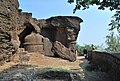 Kolvi Caves
 -
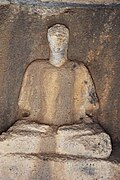 Buddha statue
 -
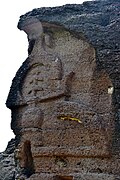 Rock-hewn chaitya arch
 -
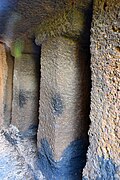 Pillars


Further reading[edit | edit source]
Fergusson, James; Burgess, James (6 May 2013). The cave temples of India. Cambridge: Cambridge University Press. pp. 395–399. ISBN 978-1108055529.
See also[edit | edit source]
References[edit | edit source]
- ↑ 1.0 1.1 Jaipur Circle, ASI. "Buddhist Caves, Pillars, and Idols". Archaeological Survey of India. Retrieved 30 November 2013.
- ↑ "A new dot on the tourism map". The Financial Express. 20 November 2005. Retrieved 30 November 2013.
- ↑ "Buddhist Caves, Kolvi". Jhalawar District, Government of Rajasthan. Archived from the original on 3 December 2013. Retrieved 30 November 2013.
- ↑ Kumar, Arjun (22 April 2012). "Rajasthan's best kept secret: 3 Buddhist cave complexes". The Economic Times. Retrieved 30 November 2013.
- ↑ Hadoti Tourism Development Society. "Jhalawar". Hadoti Tourism Development Society. Retrieved 30 November 2013.
External links[edit | edit source]

- Pages using the JsonConfig extension
- Buddhist monasteries in India
- Buddhist temples in India
- Colossal Buddha statues
- Buddhist caves in India
- Indian rock-cut architecture
- Former populated places in India
- Buddhist pilgrimage sites in India
- Caves containing pictograms in India
- Tourist attractions in Jhalawar district
- Caves of Rajasthan
- Buddhism in Rajasthan
- Buddhist sites in Rajasthan