








Created page with "{{short description|Country in West Africa}} {{about|the modern country of Ghana||Ghana (disambiguation)|and|Gana (disambiguation)}} {{pp-move|small=yes}} {{Coord|7|49|N|1|03|..." |
m Removing protection template from an unprotected page |
||
| (5 intermediate revisions by 3 users not shown) | |||
| Line 1: | Line 1: | ||
{{short description|Country in West Africa}} | {{short description|Country in West Africa}} | ||
{{about|the | {{about|the country|other uses}} | ||
{{ | {{Use Ghanaian English|date=January 2022}} | ||
{{Use dmy dates|date=June 2020}} | {{Use dmy dates|date=June 2020}} | ||
{{Infobox country | {{Infobox country | ||
| conventional_long_name | | conventional_long_name = Republic of Ghana | ||
| common_name | | common_name = Ghana | ||
| image_flag | | native_name = | ||
| image_coat | | image_flag = Flag of Ghana.svg | ||
| national_motto | | image_coat = Coat of arms of Ghana.svg | ||
| national_anthem | | coa_size = 90 | ||
| image_map | | national_motto = "Freedom and Justice" | ||
| capital | | motto = | ||
| largest_city | | national_anthem = "[[God Bless Our Homeland Ghana]]"<div style="display:inline-block;margin-top:0.4em;">{{center|[[File:National Anthem of Ghana.ogg]]}}</div> | ||
| coordinates | | image_map = Ghana (orthographic projection).svg | ||
| official_languages | | capital = [[Accra]] | ||
| national_languages | | largest_city = capital | ||
| coordinates = {{Coord|05|33|18|N|00|11|33|W|type:city}} | |||
| official_languages = [[English language|English]]<ref name="The Ghanaian Government states that English is the official language">{{cite web |quote=English is the official language of Ghana and is universally used in schools in addition to nine other local languages. The most widely spoken local languages are Dagbanli, Ewe, Ga and Twi. |url=http://www.ghanaembassy.org/index.php?page=language-and-religion |title=Language and Religion |publisher=Ghana Embassy |access-date=8 January 2017 |archive-url=https://web.archive.org/web/20170301155437/https://www.ghanaembassy.org/index.php?page=language-and-religion |archive-date=1 March 2017 |url-status=live}}</ref><ref name="Ghana – 2010 Population and Housing Census">{{cite web |url=http://www.statsghana.gov.gh/docfiles/2010phc/Census2010_Summary_report_of_final_results.pdf |title=Ghana – 2010 Population and Housing Census |work=Government of Ghana |year=2010 |access-date=1 June 2013 |archive-url=https://web.archive.org/web/20130925192147/http://www.statsghana.gov.gh/docfiles/2010phc/Census2010_Summary_report_of_final_results.pdf |archive-date=25 September 2013 |url-status=dead}}</ref> | |||
| national_languages = {{plainlist|item_style=padding-left:0.5em| | |||
*[[Dagaare language|Dagaare]] | *[[Dagaare language|Dagaare]] | ||
*[[Dagbani language|Dagbanli]] | *[[Dagbani language|Dagbanli]] | ||
*[[Dangme language|Dangme]] | *[[Dangme language|Dangme]] | ||
*[[Ewe language|Ewe]] | *[[Ewe language|Ewe]] | ||
*[[Frafra language|Frafra]] | *[[Frafra language|Frafra]] | ||
*[[Ga language|Ga]] | *[[Ga language|Ga]] | ||
*[[Gonja language|Gonja]] | *[[Gonja language|Gonja]] | ||
*[[Hausa Language|Hausa]] | |||
*[[Nzema language|Nzema]] | *[[Nzema language|Nzema]] | ||
*[[Twi]] | *[[Twi]] | ||
*[[Fante dialect|Fante]] | |||
*[[Ghanaian Sign Language]]}} | *[[Ghanaian Sign Language]]}} | ||
| religion | | religion = {{ublist |item_style=white-space:nowrap; | ||
|{{Tree list}} | |||
* 71.3% [[Christianity]] | |||
** 49.0% [[Protestantism]] | |||
** 22.3% other [[List of Christian denominations|Christian]] | |||
{{Tree list/end}} | |||
|19.9% [[Islam in Ghana|Islam]] | |||
|3.2% [[African traditional religion|traditional faiths]] | |||
|1.1% [[Irreligion|no religion]] | |||
| ethnic_groups | |4.5% [[Religion in Ghana|other]] / unspecified}} | ||
| | | religion_year = 2021 census<ref name="statsghana1">{{cite web |url=https://census2021.statsghana.gov.gh/gssmain/fileUpload/reportthemelist/2021%20PHC%20General%20Report%20Vol%203C_Background%20Characteristics_181121.pdf |archive-url=https://web.archive.org/web/20211227194122/https://census2021.statsghana.gov.gh/gssmain/fileUpload/reportthemelist/2021%20PHC%20General%20Report%20Vol%203C_Background%20Characteristics_181121.pdf |archive-date=2021-12-27 |url-status=live |title=2021 PHC General Report Vol 3C, Background Characteristics |website=Ghana Statistical Service}}</ref> | ||
| | | ethnic_groups = {{unbulleted list | ||
| | |45.7% [[Akan people|Akans]] | ||
|7. | |18.5% [[Mole-Dagbon people|Mole-Dagbon]] | ||
| | |12.8% [[Ewe people|Ewe]] | ||
|7.1% [[Ga-Adangbe people|Ga-Adangbe]] | |||
|3. | |6.4% [[Gurma people|Gurma]] | ||
|2. | |3.2% [[Guang people|Guan]] | ||
|2. | |2.7% [[Gurunsi peoples|Gurunsi]] | ||
|1. | |2.0% [[Mande people|Mande]] | ||
|1.6% other / unspecified}} | |||
| ethnic_groups_year | | ethnic_groups_year = 2021 census<ref name="statsghana1"/> | ||
| demonym | | demonym = Ghanaian | ||
| government_type | | government_type = [[Unitary state|Unitary]] [[Presidential system|presidential]] [[republic]] | ||
| leader_title1 | | leader_title1 = [[President of Ghana|President]] | ||
| leader_name1 | | leader_name1 = [[Nana Akufo-Addo]] | ||
| leader_title2 | | leader_title2 = [[Vice-President of Ghana|Vice-President]] | ||
| leader_name2 | | leader_name2 = [[Mahamudu Bawumia]] | ||
| leader_title3 | | leader_title3 = [[Speaker of the Parliament of Ghana|Speaker of Parliament]] | ||
[[Speaker of the Parliament of Ghana|Speaker of Parliament]] | | leader_name3 = [[Alban Bagbin]] | ||
| leader_name3 | | leader_title4 = [[Chief Justice of Ghana|Chief Justice]] | ||
[[Alban | | leader_name4 = [[Gertrude Tokornoo]] | ||
| leader_title4 | | legislature = [[Parliament of Ghana|Parliament]] | ||
[[Chief Justice of Ghana|Chief Justice]] | | sovereignty_type = [[History of Ghana|Independence]] {{nobold|from the [[United Kingdom]]}} | ||
| leader_name4 | | established_event1 = [[Commonwealth realm]] | ||
[[ | | established_date1 = 6 March 1957 | ||
| legislature | | established_event2 = Republic | ||
| established_event1 | | established_date2 = 1 July 1960 | ||
| established_date1 | | area_km2 = 239,535<ref name="Ghana">{{cite web | url=https://www.cia.gov/the-world-factbook/countries/ghana/ | title=Ghana | date=August 2023 }}</ref> | ||
| established_event2 | | area_rank = 80th | ||
| established_date2 | | area_sq_mi = 92,099 <!--Do not remove per [[Wikipedia:Manual of Style/Dates and numbers]]--> | ||
| | | percent_water = 4.61 (11,000 km{{smallsup|2}}; 4,247 mi{{smallsup|2}}) | ||
| | | population_estimate = 34,237,620 <ref>{{Cite CIA World Factbook |country=Ghana |access-date=22 June 2023 |year=2023}}</ref> | ||
| | | population_estimate_year = 2023 | ||
| area_rank | | population_estimate_rank = 48th | ||
| area_sq_mi | | population_density_km2 = 101.5 | ||
| percent_water | |||
| population_estimate | |||
| population_estimate_year = | |||
| population_estimate_rank = | |||
| population_density_km2 | |||
| population_density_sq_mi = 258.8 <!--Do not remove per [[Wikipedia:Manual of Style/Dates and numbers]]--> | | population_density_sq_mi = 258.8 <!--Do not remove per [[Wikipedia:Manual of Style/Dates and numbers]]--> | ||
| population_density_rank | | population_density_rank = 66th | ||
| GDP_PPP | | GDP_PPP = {{increase}} $229 billion<ref name="IMF">{{cite web |url=https://www.imf.org/en/Publications/WEO/weo-database/2023/April/weo-report?c=652,&s=NGDP_R,NGDP_RPCH,NGDP,NGDPD,PPPGDP,NGDP_D,NGDPRPC,NGDPRPPPPC,NGDPPC,NGDPDPC,PPPPC,PPPSH,PPPEX,NID_NGDP,NGSD_NGDP,PCPI,PCPIPCH,PCPIE,PCPIEPCH,TM_RPCH,TMG_RPCH,TX_RPCH,TXG_RPCH,LP,GGR,GGR_NGDP,GGX,GGX_NGDP,GGXCNL,GGXCNL_NGDP,GGXONLB,GGXONLB_NGDP,GGXWDN,GGXWDN_NGDP,GGXWDG,GGXWDG_NGDP,NGDP_FY,BCA,BCA_NGDPD,&sy=2021&ey=2023&ssm=0&scsm=1&scc=0&ssd=1&ssc=0&sic=0&sort=country&ds=.&br=1 |title=World Economic Outlook Database, April 2023 |date=April 2023 |website=IMF.org |publisher=[[International Monetary Fund]] |access-date=April 24, 2023 |archive-date=24 April 2023 |archive-url=https://web.archive.org/web/20230424111015/https://www.imf.org/en/Publications/WEO/weo-database/2023/April/weo-report?c=652,&s=NGDP_R,NGDP_RPCH,NGDP,NGDPD,PPPGDP,NGDP_D,NGDPRPC,NGDPRPPPPC,NGDPPC,NGDPDPC,PPPPC,PPPSH,PPPEX,NID_NGDP,NGSD_NGDP,PCPI,PCPIPCH,PCPIE,PCPIEPCH,TM_RPCH,TMG_RPCH,TX_RPCH,TXG_RPCH,LP,GGR,GGR_NGDP,GGX,GGX_NGDP,GGXCNL,GGXCNL_NGDP,GGXONLB,GGXONLB_NGDP,GGXWDN,GGXWDN_NGDP,GGXWDG,GGXWDG_NGDP,NGDP_FY,BCA,BCA_NGDPD,&sy=2021&ey=2023&ssm=0&scsm=1&scc=0&ssd=1&ssc=0&sic=0&sort=country&ds=.&br=1 |url-status=bot: unknown}}</ref> | ||
| GDP_PPP_year | | GDP_PPP_rank = 68th | ||
| GDP_PPP_per_capita | | GDP_PPP_year = 2023 | ||
| GDP_nominal | | GDP_PPP_per_capita = {{increase}} $6,974<ref name=IMF/> | ||
| GDP_nominal_year | | GDP_PPP_per_capita_rank = 136th | ||
| GDP_nominal_per_capita | | GDP_nominal = {{decrease}} $66 billion<ref name=IMF/> | ||
| Gini | | GDP_nominal_rank = 89th | ||
| Gini_year | | GDP_nominal_year = 2023 | ||
| Gini_change | | GDP_nominal_per_capita = {{decrease}} $2,024<ref name=IMF/> | ||
| Gini_ref | | GDP_nominal_per_capita_rank = 149th | ||
| Gini_rank | | Gini = 43.5 | ||
| HDI | | Gini_year = 2016 | ||
| HDI_year | | Gini_change = increase<!--increase/decrease/steady--> | ||
| HDI_change | | Gini_ref = <ref name="worldbank">{{cite web |url=https://data.worldbank.org/indicator/SI.POV.GINI?locations=GH |title=GINI index (World Bank estimate) |publisher=[[World Bank]] |website=data.worldbank.org |access-date=14 July 2021 |archive-url=https://web.archive.org/web/20190125020447/https://data.worldbank.org/indicator/SI.POV.GINI?locations=GH |archive-date=25 January 2019 |url-status=live}}</ref> | ||
| HDI_ref | | Gini_rank = | ||
| HDI_rank | | HDI = 0.632 | ||
| currency | | HDI_year = 2021 | ||
| currency_code | | HDI_change = increase | ||
| utc_offset | | HDI_ref = <ref name="UNHDR">{{cite web |url=http://hdr.undp.org/sites/default/files/hdr2020.pdf |archive-url=https://web.archive.org/web/20201215063955/http://hdr.undp.org/sites/default/files/hdr2020.pdf |archive-date=2020-12-15 |url-status=live |title=Human Development Report 2020 |publisher=[[United Nations Development Programme]] |date=15 December 2020 |access-date=15 December 2020}}</ref> | ||
| time_zone | | HDI_rank = 133rd | ||
| date_format | | currency = [[Ghanaian cedi|Cedi]] | ||
| drives_on | | currency_code = GHS | ||
| calling_code | | utc_offset = {{sp}} | ||
| iso3166code | | time_zone = [[Greenwich Mean Time|GMT]] | ||
| cctld | | date_format = dd/mm/yyyy | ||
| today | | drives_on = right | ||
| calling_code = [[Telephone numbers in Ghana|+233]] | |||
| iso3166code = GH | |||
| cctld = [[.gh]] | |||
| today = | |||
}} | }} | ||
'''Ghana''' ({{IPAc-en|audio=En-us-Ghana.ogg|ˈ|ɡ|ɑː|n|ə}}), officially the '''Republic of Ghana''', is a country in [[West Africa]]. It | '''Ghana''' ({{IPAc-en|audio=En-us-Ghana.ogg|ˈ|ɡ|ɑː|n|ə}} {{respell|GAH|nə}}; {{lang-tw|Gaana}}, {{lang-ee|Gana}}), officially the '''Republic of Ghana''', is a country in [[West Africa]].<ref>{{cite news |date=11 December 2020 |title=Ghana country profile |language=en-GB |publisher=BBC News |url=https://www.bbc.com/news/world-africa-13433790 |access-date=26 January 2022 |archive-date=26 January 2022 |archive-url=https://web.archive.org/web/20220126143422/https://www.bbc.com/news/world-africa-13433790 |url-status=live}}</ref> It abuts the [[Gulf of Guinea]] and the Atlantic Ocean to the south, sharing borders with [[Ivory Coast]] [[Ghana–Ivory Coast border|in the west]], [[Burkina Faso]] [[Burkina Faso–Ghana border|in the north]], and [[Togo]] [[Ghana–Togo border|in the east]].<ref name="warriorking">Jackson, John G. (2001) ''[[iarchive:introductiontoaf00jack|Introduction to African Civilizations]]'', Citadel Press, p. 201, {{ISBN|0-8065-2189-9}}.</ref> Ghana covers an area of {{convert|239535|km2|abbr=on}},<ref name="Ghana"/> spanning diverse biomes that range from coastal savannas to tropical rainforests. With over 32 million inhabitants, Ghana is the [[List of African countries by population|second-most populous country]] in [[West Africa]], after [[Nigeria]].<ref>{{cite book |title=Ghana a country to study |publisher=Library of Congress Cataloging-in-Publication Data |year=1995 |page=63}}</ref> The capital and [[List of cities in Ghana|largest city]] is [[Accra]]; other major cities are [[Kumasi]], [[Tamale, Ghana|Tamale]], and [[Sekondi-Takoradi]]. | ||
The | The earliest known kingdoms to emerge in what today is modern Ghana were the [[Mole-Dagbon people|Mole-Dagbani]] and the [[Bono state]], with the Bono state existing in the area that is modern Ghana during the 11th century.<ref>{{cite book |last=Meyerowitz |first=Eva L. R. |url=https://books.google.com/books?id=F3lyAAAAMAAJ |title=The Early History of the Akan States of Ghana |date=1975 |publisher=Red Candle Press |isbn=9780608390352}}</ref> Kingdoms and empires such as [[Kingdom of Dagbon]] in the north<ref>{{cite book |last1=Danver |first1=Steven L |url=https://books.google.com/books?id=vf4TBwAAQBAJ&pg=PA25 |title=Native Peoples of the World: An Encyclopedia of Groups, Cultures and Contemporary Issues |date=10 March 2015 |publisher=Routledge |isbn=978-1-317-46400-6 |page=25 |access-date=19 March 2023 |archive-date=4 April 2023 |archive-url=https://web.archive.org/web/20230404105202/https://books.google.com/books?id=vf4TBwAAQBAJ&pg=PA25 |url-status=live}}</ref> and the [[Ashanti Empire]] in the south emerged over the centuries.<ref>{{cite web |title=Asante Kingdom |date=15 June 2002 |url=http://www.ascleiden.nl/content/webdossiers/asante-kingdom |publisher=[[Afrika-Studiecentrum, Leiden]] |access-date=8 June 2014 |archive-url=https://web.archive.org/web/20140712214333/http://www.ascleiden.nl/content/webdossiers/asante-kingdom |archive-date=12 July 2014 |url-status=live}}</ref> Beginning in the 15th century, the [[Portuguese Empire]], followed by other [[European Powers|European powers]], contested the area for trading rights, until the [[British Empire|British]] ultimately established control of the coast by the 19th century. Following over a century of colonial resistance, the current borders of the country took shape, encompassing 4 separate British colonial territories: [[Gold Coast (British colony)|Gold Coast]], [[Ashanti (Crown Colony)|Ashanti]], the [[Northern Territories of the Gold Coast|Northern Territories]], and [[British Togoland]]. These were unified as an independent dominion within the [[Commonwealth of Nations]]. On 6 March 1957, Ghana became the first country in [[Sub-Saharan Africa]] to achieve sovereignty.<ref name="Universal Newsreel">{{cite video |year=1957 |title=Video: A New Nation: Gold Coast becomes Ghana In Ceremony, 1957/03/07 (1957) |url=https://archive.org/details/1957-03-07_A_New_Nation |publisher=[[Universal Newsreel]] |access-date=20 February 2012 |archive-url=https://web.archive.org/web/20130128113959/http://archive.org/details/1957-03-07_A_New_Nation |archive-date=28 January 2013 |url-status=live}}</ref><ref name="First For Sub-Saharan Africa">{{cite web |url=http://www.bbc.co.uk/worldservice/africa/features/storyofafrica/14chapter3.shtml |title=First For Sub-Saharan Africa |publisher=BBC |access-date=29 February 2012 |archive-url=https://web.archive.org/web/20111101135716/http://www.bbc.co.uk/worldservice/africa/features/storyofafrica/14chapter3.shtml |archive-date=1 November 2011 |url-status=live}}</ref><ref name="Exploring Africa – Decolinization">{{cite web |title=Exploring Africa – Decolonization |url=http://exploringafrica.matrix.msu.edu/images/decolinization.jpg |url-status=dead |archive-url=https://web.archive.org/web/20130602212136/http://exploringafrica.matrix.msu.edu/images/decolinization.jpg |archive-date=2 June 2013 |access-date=29 February 2012 |publisher=Exploring Africa - Michigan State University}}</ref> Ghana subsequently became influential in [[Decolonisation of Africa|decolonisation efforts]] and the [[Pan-Africanism|Pan-African movement]].<ref name="Ateku">{{cite web |last=Ateku |first=Abdul-Jalilu |date=March 7, 2017 |title=Ghana is 60: An African success story with tough challenges ahead |url=http://theconversation.com/ghana-is-60-an-african-success-story-with-tough-challenges-ahead-74049 |url-status=live |archive-url=https://web.archive.org/web/20210629063944/https://theconversation.com/ghana-is-60-an-african-success-story-with-tough-challenges-ahead-74049 |archive-date=Jun 29, 2021 |access-date=27 June 2021 |website=The Conversation}}</ref> | ||
Ghana is | Ghana is a multi-ethnic country with linguistic and religious groups;<ref name=popest>{{cite web |title=2020 Population Projection by Sex, 2010–2020 |publisher=Ghana Statistical Service |url=http://www.statsghana.gov.gh/pop_stats.html |access-date=2 May 2018 |archive-url=https://web.archive.org/web/20180424110616/http://www.statsghana.gov.gh/pop_stats.html |archive-date=24 April 2018 |url-status=dead}}</ref> while the [[Akan people|Akan]] are the largest ethnic group, they constitute a plurality. Most [[Ghanaian people|Ghanaians]] are [[Christianity in Ghana|Christians]] (71.3%); almost a fifth are [[Islam in Ghana|Muslims]]; a tenth practise traditional faiths or report no religion.<ref name="statsghana1"/> Ghana is a [[Unitary state|unitary]] [[Liberal democracy|constitutional democracy]] led by a [[President of Ghana|president]] who is [[head of state]] and [[head of government]].<ref name="Ghana: CIA World FactBook">{{cite web |last1= |title=Ghana |url=https://www.cia.gov/the-world-factbook/countries/ghana/ |url-status=live |archive-url=https://web.archive.org/web/20210109003331/https://www.cia.gov/the-world-factbook/countries/ghana/ |archive-date=Jan 9, 2021 |access-date=20 May 2016 |website=CIA World FactBook |publisher=}}</ref> For political stability in Africa, Ghana ranked 7th in the 2012 [[Ibrahim Index of African Governance]] and 5th in the 2012 [[Fragile States Index]]. It has maintained since 1993 one of the freest and most stable governments on the continent, and it performs relatively well in [[Healthcare in Ghana|healthcare]], [[Economy of Ghana|economic]] growth, and human development,<ref name="Ateku"/> so that it has a significant influence in West Africa and Africa as a whole.<ref name="South America and West Africa"/> Ghana is highly integrated in international affairs, being a founding member of the [[Non-Aligned Movement]], [[African Union]] and a member of the [[Economic Community of West African States]], [[Group of 24]] and [[Commonwealth of Nations]].<ref>{{cite web |url=http://m.state.gov/md2860.htm |publisher=[[United States Department of State]] |title=Ghana-US relations |date=13 February 2013 |access-date=1 June 2013 |url-status=dead |archive-url=https://web.archive.org/web/20130405184830/http://m.state.gov/md2860.htm |archive-date=5 April 2013}}</ref> | ||
==Etymology== | ==Etymology== | ||
''Ghana'' means "king"<ref name="etymology">{{cite web |title=Etymology of Ghana |url=http://www.etymonline.com/index.php?term=Ghana |publisher=Douglas Harper |access-date=12 May 2012 |archive-url=https://web.archive.org/web/20121104100547/http://www.etymonline.com/index.php?term=Ghana |archive-date=4 November 2012 |url-status=live}}</ref> and was the title accorded to the kings of the medieval [[Ghana Empire]] in [[West Africa]]—not to be confused with today's Ghana, for the empire was further north, in modern-day Mali, Senegal and southern Mauritania, as well as in [[Guinea (region)|the region of Guinea]].{{citation needed|date=March 2023}} | |||
The Republic of Ghana used the word in its name because of "indications that present-day [Akan] inhabitants descended from migrants who moved south from the ancient kingdom of Ghana."<ref>{{Cite web |date=1998 |title=Ghana |url=https://clintonwhitehouse3.archives.gov/Africa/ghana.html |access-date=2023-07-09 |website=[[whitehouse.gov]] |publisher=[[National Archives and Records Administration]]}}</ref> | |||
==History== | ==History== | ||
{{main|History of Ghana}} | |||
===Medieval kingdoms=== | |||
{{main|Ashanti Empire|Kingdom of Dagbon}} | |||
[[File:Guinea from Milner's Atlas.jpg|thumb|An 1850 map showing the [[Akan people|Akan]] [[Kingdom of Ashanti]] within the [[Guinea (region)|Guinea region]] and surrounding regions in West Africa]] | [[File:Guinea from Milner's Atlas.jpg|thumb|An 1850 map showing the [[Akan people|Akan]] [[Kingdom of Ashanti]] within the [[Guinea (region)|Guinea region]] and surrounding regions in West Africa]] | ||
[[File:Lidded Vessel (Kuduo) MET DP108293.jpg|thumb|18th-century Ashanti brass ''kuduo''. Gold dust and nuggets were kept in ''kuduo'', as were other items of personal value and significance. As receptacles for their owners' ''kra'', or life force, ''kuduo'' were prominent features of ceremonies designed to honour and protect that individual.]] | [[File:Lidded Vessel (Kuduo) MET DP108293.jpg|thumb|18th-century Ashanti brass ''kuduo''. Gold dust and nuggets were kept in ''kuduo'', as were other items of personal value and significance. As receptacles for their owners' ''kra'', or life force, ''kuduo'' were prominent features of ceremonies designed to honour and protect that individual.]] | ||
{{ | The earliest known kingdoms to emerge in modern Ghana were the [[Mole-Dagbani]] states.<ref name="col" /> The Mole-Dagomba came on horseback from what later became [[Burkina Faso]] under a single leader, [[Naa Gbewaa]].<ref>{{cite web |url=http://articles.ghananation.com/articles/ghana-history/3017-invasion-of-the-peoples-of-the-north.html |title=Invasion of the Peoples of the North |publisher=GhanaNation |date=15 November 2011 |access-date=22 June 2014 |first=Jessica |last=W |archive-url=https://web.archive.org/web/20140708222407/http://articles.ghananation.com/articles/ghana-history/3017-invasion-of-the-peoples-of-the-north.html |archive-date=8 July 2014 |url-status=live}}</ref> They invaded and occupied the lands of the local people ruled by the ''tendamba'' (land god priests), established themselves as the rulers over the locals, and made [[Gambaga]] their capital.<ref>{{cite web |url=http://articles.ghananation.com/feed/articles/ghana-articles/3093-dagomba.txt |title=Ghana Articles: Dagomba |publisher=GhanaNation.com |date=19 November 2011 |access-date=22 August 2014 |author=Curtis M. |url-status=dead |archive-url=https://web.archive.org/web/20141019101858/http://articles.ghananation.com/feed/articles/ghana-articles/3093-dagomba.txt |archive-date=19 October 2014}}</ref> The death of Naa Gbewaa caused secession among their children, some of whom broke off and founded separate states including [[Mamprusi people|Mamprugu]] and [[Nanumba people|Nanung]].<ref>{{cite web |url=http://www.bristoldrumming.com/ghanagoods/index.php?option=com_content&view=category&layout=blog&id=42&Itemid=67 |title=Dagomba: Background |publisher=BristolDrumming |url-status=dead |archive-url=https://web.archive.org/web/20140714121340/http://www.bristoldrumming.com/ghanagoods/index.php?option=com_content&view=category&layout=blog&id=42&Itemid=67 |archive-date=14 July 2014}}</ref><ref>{{cite web |url=http://www.sim.org/index.php/content/mamprusi |title=Mamprusi |publisher=Sim.org |access-date=22 June 2014 |url-status=dead |archive-url=https://web.archive.org/web/20140714184651/http://www.sim.org/index.php/content/mamprusi |archive-date=14 July 2014}}</ref> | ||
=== | |||
{{ | |||
The [[Akan people|Akan]]-speaking peoples began to move into what later became Ghana toward the 15th century.<ref name="col">{{cite web |url=http://www.ghanaweb.com/GhanaHomePage/history/pre-colonial.php |title=Pre-Colonial Period |publisher=Ghanaweb.com |access-date=13 December 2010 |archive-url=https://web.archive.org/web/20101123235900/http://ghanaweb.com/GhanaHomePage/history/pre-colonial.php |archive-date=23 November 2010 |url-status=live}}</ref><ref>{{cite web |url=http://www.pdmhs.com/PDFs/ScannedBulletinArticles/Bulletin%2013-4%20-%20Pre-European%20Gold%20Mining%20at%20Ashanti,%20Ghana.pdf |title=Pre-European Mining at Ashanti, Ghana |type=PDF |publisher=Pdmhs.com |date=October 1996 |access-date=24 January 2015 |url-status=dead |archive-url=https://web.archive.org/web/20141122214748/http://www.pdmhs.com/PDFs/ScannedBulletinArticles/Bulletin%2013-4%20-%20Pre-European%20Gold%20Mining%20at%20Ashanti,%20Ghana.pdf |archive-date=22 November 2014}}</ref> By the 16th century, the Akans were established in the Akan state called [[Bono state|Bonoman]], for which the [[Brong-Ahafo region]] was named.<ref name="col" /><ref>{{cite book |author1=Tvedten, Ige |author2=Hersoug, Bjørn |title=Fishing for Development: Small Scale Fisheries in Africa |url=https://books.google.com/books?id=Itt1hIbsbQsC&pg=PA60 |year=1992 |publisher=Nordic Africa Institute |isbn=978-91-7106-327-4 |pages=60– |access-date=27 June 2015 |archive-url=https://web.archive.org/web/20150912143828/https://books.google.com/books?id=Itt1hIbsbQsC&pg=PA60 |archive-date=12 September 2015 |url-status=live}}</ref> From the 17th century, Akans emerged from what is believed to have been the Bonoman area, to create Akan states, mainly based on gold trading.<ref>Dennis M. Warren, ''The Techiman-Bono of Ghana: An Ethnography of an Akan Society''. Kendall/Hunt Publishing Company, 1975.</ref> These states included Bonoman (Brong-Ahafo region), Ashanti ([[Ashanti Region]]), [[Denkyira]] ([[Central Region (Ghana)|Western North region]]), [[Mankessim Kingdom]] ([[Western Region (Ghana)|Central region]]), and [[Akwamu]] [[Eastern Region (Ghana)|(Eastern region)]].<ref name="col" /> By the 19th century, the territory of the southern part of Ghana was included in the [[Ashanti Empire|Kingdom of Ashanti]].<ref name="col" /> The government of the Ashanti Empire operated first as a loose network and eventually as a centralised kingdom with a specialised bureaucracy centred in the capital city of [[Kumasi]].<ref name="col" /> Prior to Akan contact with Europeans, the Akan people created an economy based on principally gold and [[gold bar]] [[Commodity|commodities]], which were traded with other states in Africa.<ref name="col" /><ref>{{cite web |url=http://rubens.anu.edu.au/htdocs/surveys/african/ashanti/history.html |title=A Short History of Ashanti Gold Weights |publisher=Rubens.anu.edu.au |access-date=24 January 2015 |archive-url=https://web.archive.org/web/20130902030803/http://rubens.anu.edu.au/htdocs/surveys/african/ashanti/history.html |archive-date=2 September 2013 |url-status=live}}</ref> | |||
The Ga-Dangme and Ewe migrated westward from south-western Nigeria. The Ewe migrated from Oyo area with their Gbe-speaking kinsmen (Adja, Fon, Phera Gun)and in transition, settled in Ketou in Benin Republic, Tado in Togo and with Nortsie ( a walled town on present-day Togo)as their final dispersal point. Their dispersal from Nortsie was necessitated by the high-handed rule of King Agorkorli (Agor Akorlie). The [[Ga-Adangbe people|Ga- Dangme]] occupy the Greater Accra Region and parts of the Eastern Region, while the Ewe are found in the [[Volta Region]] as well as the neighbouring Togo, Benin Republic and Nigeria ( around Badagry area). | |||
The | ===European contact and colonialism=== | ||
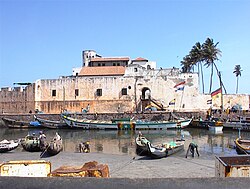
{{See also|Slave Coast of West Africa|Dutch Slave Coast}}[[File:Elmina_slave_castle.jpg|thumb|left|The [[Portuguese Empire|Portuguese]] established the [[Portuguese Gold Coast]] with the construction of [[Elmina Castle]] (''Castelo da Mina'') by [[Diogo de Azambuja]] in 1482, making it the oldest [[Portuguese colonial architecture|European building]] in [[sub-Saharan Africa]].]] | |||
Akan trade with European states began after contact with the [[Portuguese Empire|Portuguese]] in the 15th century.<ref>{{cite web |url=http://www.modernghana.com/GhanaHome/ashanti/ashanti.asp?menu_id=6&sub_menu_id=67&gender=&s=a |title=History of the Ashanti People |publisher=Modern Ghana |access-date=9 May 2013 |archive-url=https://web.archive.org/web/20130731222849/http://www.modernghana.com/GhanaHome/ashanti/ashanti.asp?menu_id=6&sub_menu_id=67&gender=&s=a |archive-date=31 July 2013 |url-status=live}}</ref> European contact was by the [[Portuguese people]], who came to the [[Gold Coast (region)|Gold Coast region]] in the 15th century to trade. The Portuguese then established the [[Portuguese Gold Coast]] (Costa do Ouro), focused on the availability of gold.<ref name="History"/> The Portuguese built a trading lodge at a coastal settlement called Anomansah (the perpetual drink) which they renamed [[Elmina|São Jorge da Mina]].<ref name="History">{{cite web |url=http://www.tonyxworld.com/index.php?option=com_content&task=view&id=2&Itemid=38 |title=History of Ghana |publisher=TonyX |access-date=20 May 2012 |archive-url=https://web.archive.org/web/20130501201014/http://www.tonyxworld.com/index.php?option=com_content&task=view&id=2&Itemid=38 |archive-date=1 May 2013 |url-status=dead}}</ref> In 1481, King [[John II of Portugal]] commissioned [[Diogo de Azambuja]] to build the [[Elmina Castle]], which was completed in 3 years.<ref name="History" /> By 1598, the [[Dutch people|Dutch]] had joined the Portuguese in the gold trade, establishing the [[Dutch Gold Coast]] (''Nederlandse Bezittingen ter Kuste van Guinea'' - 'Dutch properties at the Guinea coast') and building forts at [[Fort Komenda]] and Kormantsi.<ref name="Ghana book">{{cite book |last=Levy |first=Patricia |author2=Wong, Winnie |title=Ghana |url=https://archive.org/details/ghana0000levy |url-access=registration |publisher=[[Marshall Cavendish]] |page=[https://archive.org/details/ghana0000levy/page/24 24] |year=2010 |isbn=978-0-7614-4847-1}}</ref> In 1617, the Dutch captured the Elmina Castle from the Portuguese and [[Axim]] in 1642 ([[Fort Saint Anthony|Fort St Anthony]]).<ref name="Ghana book" /> | |||
European traders had joined in gold trading by the 17th century, including the [[Swedes]], establishing the [[Swedish Gold Coast]] (''Svenska Guldkusten''), and [[Denmark–Norway]], establishing the [[Danish Gold Coast]] (''Danske Guldkyst'' or ''Dansk Guinea'').<ref name="History of Ghana">{{cite web |title=History of Ghana |url=http://www.ghanaweb.com/GhanaHomePage/history/ |url-status=dead |archive-url=https://web.archive.org/web/20101215170543/http://ghanaweb.com/GhanaHomePage/history/ |archive-date=15 December 2010 |access-date=10 January 2011 |publisher=ghanaweb.com}}</ref> European traders participated in the [[Atlantic slave trade]] in this area.<ref name="Emmer">{{cite book |last=Emmer |first=Pieter C. |edition=1st |series=Variorum Collected Studies (Book 614) |title=The Dutch in the Atlantic Economy, 1580–1880: Trade, Slavery, and Emancipation (Variorum Collected Studies) |page=17 |publisher=Routledge |location=Abingdon-on-Thames |year=2018 |isbn=978-0-86078-697-9}}</ref> More than 30 forts and castles were built by the merchants. The Germans established the [[Brandenburger Gold Coast]] or Groß Friedrichsburg).<ref>{{cite web |date=15 September 2008 |title=Bush Praises Strong Leadership of Ghanaian President Kufuor |url=http://iipdigital.usembassy.gov/st/english/article/2008/09/20080915145840dmslahrellek0.5556452.html |url-status=live |archive-url=https://web.archive.org/web/20140512220141/http://iipdigital.usembassy.gov/st/english/article/2008/09/20080915145840dmslahrellek0.5556452.html |archive-date=12 May 2014 |access-date=26 June 2010 |work=iipdigital.usembassy.gov}}</ref> In 1874, Great Britain established control over some parts of the country, assigning these areas the status of the [[Gold Coast (British colony)|British Gold Coast]].<ref name="colestablish">MacLean, Iain (2001), ''Rational Choice and British Politics: An Analysis of Rhetoric and Manipulation from Peel to Blair'', p. 76, {{ISBN|0-19-829529-4}}.</ref> Military engagements occurred between British colonial powers and Akan nation-states. The Kingdom of [[Ashanti Empire|Ashanti]] defeated the British some times in the 100-year-long [[Anglo-Ashanti wars]] and eventually lost with the [[War of the Golden Stool]] in 1900.<ref>{{cite book |author=Puri, Jyoti |url=https://books.google.com/books?id=tEL4ToU8JSQC&pg=PA76 |title=Encountering Nationalism |publisher=Wiley |year=2008 |isbn=978-0-470-77672-8 |pages=76– |access-date=27 June 2015 |archive-url=https://web.archive.org/web/20150915131854/https://books.google.com/books?id=tEL4ToU8JSQC&pg=PA76 |archive-date=15 September 2015 |url-status=live}}</ref><ref name="Chronology of world history">Chronology of world history: a calendar of principal events from 3000 BC to AD 1973, Part 1973, Rowman & Littlefield, 1975, {{ISBN|0-87471-765-5}}.</ref><ref>[https://www.webcitation.org/5kwpwoVQ8?url=http://ca.encarta.msn.com/encyclopedia_761580620_3/Ashanti_Kingdom.html Ashanti Kingdom], Microsoft Encarta Online Encyclopedia 2009, Archived 31 October 2009.</ref> | |||
More than | |||
a calendar of principal events from 3000 BC to AD 1973, Part 1973, Rowman & Littlefield, 1975, {{ISBN|0-87471-765-5}}.</ref><ref>[https://www.webcitation.org/5kwpwoVQ8?url=http://ca.encarta.msn.com/encyclopedia_761580620_3/Ashanti_Kingdom.html Ashanti Kingdom], Microsoft Encarta Online Encyclopedia 2009, Archived 31 October 2009.</ref> | |||
===Transition to independence=== | ===Transition to independence=== | ||
{{see also|Dominion of Ghana|Ghana Independence Act 1957}} | |||
{{ | |||
{{Multiple images | {{Multiple images | ||
|image1=Ghana Independence overprint on Gold Coast 1s stamp 1957.jpg | | image1 = Ghana Independence overprint on Gold Coast 1s stamp 1957.jpg | ||
|caption1=A postage stamp of Gold Coast overprinted for Ghanaian independence in 1957 | | caption1 = A postage stamp of Gold Coast overprinted for Ghanaian independence in 1957 | ||
|image2=Ghana (1957-03-07 A New Nation).ogg|thumbtime=0:55 | | image2 = Ghana (1957-03-07 A New Nation).ogg|thumbtime=0:55 | ||
|caption2=Celebrations marking Ghana's independence on 6 March 1957 | | caption2 = Celebrations marking Ghana's independence on 6 March 1957 | ||
| | | direction = vertical | ||
}} | }} | ||
In 1947, the newly formed [[United Gold Coast Convention]] | In 1947, the newly formed [[United Gold Coast Convention]] led by [[The Big Six (Ghana)|"The Big Six"]] called for "self-government within the shortest possible time" following the [[1946 Gold Coast general election|1946 Gold Coast legislative election]].<ref name="History of Ghana"/><ref>{{cite book |author=Gocking, Roger |title=The History of Ghana |url=https://archive.org/details/historyofghana00gock |url-access=registration |year=2005 |publisher=Greenwood Publishing Group |isbn=978-0-313-31894-8 |pages=[https://archive.org/details/historyofghana00gock/page/92 92]– |access-date=27 June 2015}}</ref> [[Kwame Nkrumah]], a Ghanaian nationalist who led Ghana from 1957 to 1966 as the country's first [[Prime Minister of Ghana|prime minister]] and [[President of Ghana|president]], formed the [[Convention People's Party]] in 1949 with the motto "self-government now".<ref name="History of Ghana"/> The party initiated a "positive action" campaign involving non-violent protests, strikes and non-cooperation with the British authorities. Nkrumah was arrested and sentenced to one year imprisonment during this time. In the Gold Coast's [[1951 Gold Coast general election|1951 general election]], he was elected to Parliament and was released from prison.<ref name="History of Ghana"/> He became prime minister in 1952 and began a policy of Africanization.{{Citation needed|date=March 2023}} | ||
On 1 July 1960, following the [[Ghanaian constitutional referendum | On 6 March 1957 at midnight, the Gold Coast, Ashanti, the Northern Territories, and [[British Togoland]] were unified as one single independent dominion within the [[Commonwealth of Nations|British Commonwealth]] under the name Ghana. This was done under the [[Ghana Independence Act 1957]]. The current [[flag of Ghana]], consisting of the colours red, gold, green, and a black star, dates back to this unification.<ref name="Ghana flag and description">{{cite web |url=http://www.worldatlas.com/webimage/flags/countrys/africa/ghana.htm |title=Ghana flag and description |publisher=worldatlas.com |access-date=24 June 2013 |archive-url=https://web.archive.org/web/20121224131743/http://www.worldatlas.com/webimage/flags/countrys/africa/ghana.htm |archive-date=24 December 2012 |url-status=live}}</ref> On 1 July 1960, following the [[1960 Ghanaian constitutional referendum|Ghanaian constitutional referendum]] and [[1960 Ghanaian presidential election|Ghanaian presidential election]], Nkrumah declared Ghana a republic and assumed the presidency.<ref name="Universal Newsreel"/><ref name="First For Sub-Saharan Africa"/><ref name="Exploring Africa – Decolinization"/><ref name="History of Ghana"/> 6 March is the nation's [[Independence Day (Ghana)|Independence Day]], and 1 July is celebrated as [[Republic Day]].<ref>{{cite web |url=https://www.africa.com/5-things-know-ghana-independence-day/ |title=5 Things To Know About Ghana's Independence Day |website=Africa.com |access-date=10 July 2018 |archive-url=https://web.archive.org/web/20180710225301/https://www.africa.com/5-things-know-ghana-independence-day/ |archive-date=10 July 2018 |url-status=dead}}</ref><ref>{{cite web |url=https://www.ghanaweb.com/GhanaHomePage/features/What-is-Republic-Day-in-Ghana-615882 |title=What is Republic Day in Ghana? |last=Oquaye |first=Mike |date=10 January 2018 |website=GhanaWeb |access-date=29 June 2018 |archive-url=https://web.archive.org/web/20180629211559/https://www.ghanaweb.com/GhanaHomePage/features/What-is-Republic-Day-in-Ghana-615882 |archive-date=29 June 2018 |url-status=live}}</ref> | ||
Nkrumah led an [[Authoritarianism|authoritarian]] regime in Ghana, as he repressed political opposition and conducted elections that were not free and fair.<ref>{{Cite journal |last=Mazrui |first=Ali |date=1966 |title=Nkrumah: The Leninist Czar |journal=Transition |issue=26 |pages=9–17 |doi=10.2307/2934320 |jstor=2934320 |issn=0041-1191}}</ref><ref>{{Cite journal |last=Kilson |first=Martin L. |date=1963 |title=Authoritarian and Single-Party Tendencies in African Politics |url=https://www.cambridge.org/core/journals/world-politics/article/abs/authoritarian-and-singleparty-tendencies-in-african-politics/C06E363B216E1DC2324E77AABDE4FE40 |journal=World Politics |language=en |volume=15 |issue=2 |pages=262–294 |doi=10.2307/2009376 |jstor=2009376 |s2cid=154624186 |issn=1086-3338 |access-date=6 January 2023 |archive-date=1 February 2023 |archive-url=https://web.archive.org/web/20230201210711/https://www.cambridge.org/core/journals/world-politics/article/abs/authoritarian-and-singleparty-tendencies-in-african-politics/C06E363B216E1DC2324E77AABDE4FE40 |url-status=live}}</ref><ref>{{Cite journal |last=Bretton |first=Henry L. |date=1958 |title=Current Political Thought and Practice in Ghana* |url=https://www.cambridge.org/core/journals/american-political-science-review/article/abs/current-political-thought-and-practice-in-ghana/01D51435240B4DD2FFCDF67F554FA682 |journal=American Political Science Review |language=en |volume=52 |issue=1 |pages=46–63 |doi=10.2307/1953012 |jstor=1953012 |s2cid=145766298 |issn=1537-5943 |access-date=6 January 2023 |archive-date=1 February 2023 |archive-url=https://web.archive.org/web/20230201201816/https://www.cambridge.org/core/journals/american-political-science-review/article/abs/current-political-thought-and-practice-in-ghana/01D51435240B4DD2FFCDF67F554FA682 |url-status=live}}</ref><ref>{{Cite web |date=2016 |title=Ghana's Kwame Nkrumah: visionary, authoritarian ruler and national hero |url=https://www.dw.com/en/ghanas-kwame-nkrumah-visionary-authoritarian-ruler-and-national-hero/a-19070359 |website=Deutsche Welle |language=en-GB |access-date=6 January 2023 |archive-date=1 February 2023 |archive-url=https://web.archive.org/web/20230201182454/https://www.dw.com/en/ghanas-kwame-nkrumah-visionary-authoritarian-ruler-and-national-hero/a-19070359 |url-status=live}}</ref><ref>{{Cite news |date=1964-05-03 |title=Portrait of Nkrumah as Dictator |language=en-US |work=The New York Times |url=https://www.nytimes.com/1964/05/03/archives/portrait-of-nkrumah-as-dictator.html |access-date=2022-02-19 |issn=0362-4331 |archive-date=1 February 2023 |archive-url=https://web.archive.org/web/20230201205439/https://www.nytimes.com/1964/05/03/archives/portrait-of-nkrumah-as-dictator.html |url-status=live}}</ref> In 1964, a [[1964 Ghanaian constitutional referendum|constitutional amendment]] made Ghana a [[one-party state]], with Nkrumah as [[president for life]] of both the nation and its party.<ref>{{Citation |title=VII. The Reluctant Nation |date=1964-12-31 |work=One-Party Government in the Ivory Coast |pages=219–249 |place=Princeton |publisher=Princeton University Press |doi=10.1515/9781400876563-012 |isbn=978-1-4008-7656-3}}</ref> Nkrumah was the first African head of state to promote the concept of [[Pan-Africanism]], which he had been introduced to during his studies at [[Lincoln University (Pennsylvania)|Lincoln University]], Pennsylvania in the United States, at the time when [[Marcus Garvey]] was known for his "Back to Africa Movement".<ref name="History of Ghana" /> He merged the teachings of Garvey, [[Martin Luther King Jr.]] and the naturalised Ghanaian scholar [[W. E. B. Du Bois]] into the formation of 1960s Ghana.<ref name="History of Ghana" /> Osagyefo Dr. Kwame Nkrumah, as he became known, played an instrumental part in the founding of the [[Non-Aligned Movement]], and in establishing the [[Kwame Nkrumah Ideological Institute]] to teach his ideologies of [[communism]] and [[socialism]].<ref>{{cite web |title=Of Nkrumah's Political Ideologies: Communism, Socialism, Nkrumaism |url=http://www.ghanaweb.com/GhanaHomePage/NewsArchive/artikel.php?ID=110817 |publisher=Ghana Web |date=20 September 2006 |access-date=9 June 2015 |archive-url=https://web.archive.org/web/20150725015602/http://www.ghanaweb.com/GhanaHomePage/NewsArchive/artikel.php?ID=110817 |archive-date=25 July 2015 |url-status=live}}</ref> His life achievements were recognised by Ghanaians during his centenary birthday celebration, and the day was instituted as a [[Public holidays in Ghana|public holiday in Ghana]] ([[Founders' Day (Ghana)|Founders' Day]]).<ref>{{cite web |title=When it was made a Holiday |url=http://www.modernghana.com/news/419363/1/founders-day-to-be-placed-on-ghanas-holiday-calend.html |publisher=Modern Ghana |date=22 September 2012 |access-date=9 May 2014 |archive-url=https://web.archive.org/web/20130925093111/http://www.modernghana.com/news/419363/1/founders-day-to-be-placed-on-ghanas-holiday-calend.html |archive-date=25 September 2013 |url-status=live}}</ref> | |||
Nkrumah was the first African head of state to promote the concept of [[Pan-Africanism]], which he had been introduced to during his studies at [[Lincoln University (Pennsylvania)|Lincoln University]], Pennsylvania in the United States, at the time when [[Marcus Garvey]] was | |||
Osagyefo Dr. Kwame Nkrumah, as he became known, played an instrumental part in the founding of the [[Non-Aligned Movement]], and in establishing the [[Kwame Nkrumah Ideological Institute]] to teach his ideologies of [[communism]] and [[socialism]].<ref>{{cite web|title=Of Nkrumah's Political Ideologies: Communism, Socialism, Nkrumaism|url=http://www.ghanaweb.com/GhanaHomePage/NewsArchive/artikel.php?ID=110817|publisher=Ghana Web|date=20 September 2006|access-date=9 June 2015|archive-url=https://web.archive.org/web/20150725015602/http://www.ghanaweb.com/GhanaHomePage/NewsArchive/artikel.php?ID=110817|archive-date=25 July 2015|url-status=live}}</ref> His life achievements were recognised by Ghanaians during his centenary birthday celebration, and the day was instituted as a [[Public holidays in Ghana|public holiday in Ghana]] ([[ | |||
===Operation Cold Chop and aftermath=== | ===Operation Cold Chop and aftermath=== | ||
{{ | {{main|History of Ghana (1966–1979)}} | ||
The government of Nkrumah was subsequently overthrown | The government of Nkrumah was subsequently overthrown in a coup by the [[Ghana Armed Forces]], codenamed "Operation Cold Chop". This occurred while Nkrumah was abroad with [[Zhou Enlai]] in the People's Republic of China, on a fruitless mission to [[Hanoi]], Vietnam, to help end the [[Vietnam War]]. The coup took place on 24 February 1966, led by Colonel [[Emmanuel Kwasi Kotoka]] and Brigadier Akwasi Afrifa. The [[National Liberation Council]] was formed, chaired by Lieutenant General [[Joseph Arthur Ankrah|Joseph A. Ankrah]].<ref name="political & social thought of Kwame Nkrumah">{{cite web |url=http://libyadiary.files.wordpress.com/2011/09/pdf-2011-the-political-and-social-thought-of-kwame-nkrumah.pdf |title=The political and social thought of Kwame Nkrumah |year=2011 |access-date=28 April 2014 |work=Libyadiary |archive-url=https://web.archive.org/web/20140429052034/http://libyadiary.files.wordpress.com/2011/09/pdf-2011-the-political-and-social-thought-of-kwame-nkrumah.pdf |archive-date=29 April 2014 |url-status=live}}</ref> | ||
A series of alternating military and civilian governments, often affected by economic instabilities,<ref>{{ | A series of alternating military and civilian governments, often affected by economic instabilities,<ref>{{cite book |title=A Country Study: Ghana |last=David |first=Owusu-Ansah |publisher=La Verle Berry |year=1994}}</ref> ruled Ghana from 1966, ending with the ascent to power of [[Flight lieutenant|Flight Lieutenant]] [[Jerry Rawlings|Jerry John Rawlings]] of the [[Provisional National Defence Council]] in 1981.<ref name="Flight Lieutenant Jerry John Rawlings (J.J Rawlings)">{{cite news |url=http://www.africa-confidential.com/whos-who-profile/id/424/ |title=Ghana: Flight Lieutenant Jerry John Rawlings (J.J Rawlings) |work=[[Africa Confidential]] |access-date=1 June 2013 |archive-url=https://web.archive.org/web/20131029191244/http://www.africa-confidential.com/whos-who-profile/id/424/ |archive-date=29 October 2013 |url-status=live}}</ref> These changes resulted in the suspension of the [[Constitution of Ghana|constitution]] in 1981 and the banning of [[List of political parties in Ghana|political parties]].<ref name="Rawlings: The legacy">{{cite news |url=http://news.bbc.co.uk/1/hi/world/africa/1050310.stm |title=Rawlings: The legacy |publisher=BBC News |date=1 December 2000 |access-date=1 June 2013 |archive-url=https://web.archive.org/web/20170828010357/http://news.bbc.co.uk/1/hi/world/africa/1050310.stm |archive-date=28 August 2017 |url-status=live}}</ref> The economy soon declined, so Rawlings negotiated a structural adjustment plan, changing many old economic policies, and growth recovered during the mid-1980s.<ref name="Rawlings: The legacy"/> A new constitution restoring [[multi-party system]] politics was promulgated in the [[1992 Ghanaian presidential election|presidential election of 1992]], in which Rawlings was elected, and again in the [[1996 Ghanaian general election|general election of 1996]].<ref name="Elections in Ghana">{{cite web |title=Elections in Ghana |url=http://africanelections.tripod.com/gh.html |work=Africanelections.tripod.com |access-date=1 June 2013 |archive-url=https://web.archive.org/web/20120530060759/http://africanelections.tripod.com/gh.html |archive-date=30 May 2012 |url-status=live}}</ref> | ||
{{ | |||
In a [[Konkomba–Nanumba conflict|tribal war]] in [[Northern Region (Ghana)|Northern Ghana]] in 1994, between the [[Konkomba people|Konkomba]] and other ethnic groups, including the [[Nanumba people|Nanumba]], [[Dagomba people|Dagomba]] and [[Gonja people|Gonja]], between 1,000 and 2,000 people were killed and 150,000 people were displaced.<ref>{{cite web |url=https://www.refworld.org/docid/3df4be33c.html |title=Refworld {{!}} Ghana: Conflict between the Konkomba and Nanumba tribes and the government response to the conflict (1994 – September 2000) |last=Refugees |first=United Nations High Commissioner for |website=Refworld |date=26 September 2000 |access-date=8 January 2022 |archive-date=26 April 2019 |archive-url=https://web.archive.org/web/20190426203557/https://www.refworld.org/docid/3df4be33c.html |url-status=live}}</ref> | |||
[[File:Kpetoee.jpg|thumb|Traditional [[Chieftaincy|chiefs]] in 2015]] | |||
After the [[2000 Ghanaian general election|2000 general election]], [[John Kufuor]] of the [[New Patriotic Party]] became president of Ghana on 7 January 2001 and was [[2004 Ghanaian general election|re-elected in 2004]], thus also serving two terms (the term limit) as president of Ghana and marking the first time under the fourth republic that power was transferred from one legitimately elected head of state and head of government to another.<ref name="Elections in Ghana"/> | |||
[[Nana Akufo-Addo]], the ruling party candidate, was defeated in a very close [[2008 Ghanaian general election|2008 general election]] by [[John Atta Mills]] of the [[National Democratic Congress (Ghana)|National Democratic Congress]].<ref>{{cite news |last=Kokutse |first=Francis |title=Opposition leader wins presidency in Ghana |agency=Associated Press |date=3 January 2009 |url=https://www.usatoday.com/news/world/2009-01-03-ghana-election_N.htm |work=USA Today |access-date=9 May 2014 |archive-url=https://archive.today/20121209072058/http://www.usatoday.com/news/world/2009-01-03-ghana-election_N.htm |archive-date=9 December 2012 |url-status=live}}</ref><ref>Emmanuel Gyimah-Boadi, "The 2008 Freedom House Survey: Another Step Forward for Ghana." ''Journal of Democracy'' 20.2 (2009): 138–152 [https://muse.jhu.edu/article/262756/summary excerpt] {{Webarchive |url=https://web.archive.org/web/20220818201829/https://muse.jhu.edu/article/262756/summary |date=18 August 2022 }}.</ref> Mills died of natural causes and was succeeded by Vice President [[John Mahama]] on 24 July 2012.<ref>{{cite news |title=Atta Mills dies |url=https://www.nytimes.com/2012/07/25/world/africa/john-atta-mills-ghanas-president-dies-68.html |work=The New York Times |date=25 July 2012 |access-date=9 May 2014 |archive-url=https://web.archive.org/web/20140709161829/http://www.nytimes.com/2012/07/25/world/africa/john-atta-mills-ghanas-president-dies-68.html |archive-date=9 July 2014 |url-status=live}}</ref> Following the [[2012 Ghanaian general election|2012 general election]], Mahama became president in his own right,<ref name="Ghanaian President John Dramani Mahama sworn in">{{cite news |url=http://english.sina.com/world/p/2013/0107/545991.html |title=Ghanaian President John Dramani Mahama sworn in |publisher=[[Sina Corp]] |date=7 January 2013 |access-date=30 July 2013 |archive-url=https://web.archive.org/web/20131005011622/http://english.sina.com/world/p/2013/0107/545991.html |archive-date=5 October 2013 |url-status=live}}</ref> and Ghana was described as a "stable democracy".<ref name="OBG2012">{{cite web |title=Ghana - Economy: Keep calm and carry on: A strong and stable democracy has been built over the years |url=https://oxfordbusinessgroup.com/reports/ghana/2012-report/economy/keep-calm-and-carry-on-a-strong-and-stable-democracy-has-been-built-over-the-years |publisher=Oxford Business Group |access-date=23 April 2023 |archive-url=https://web.archive.org/web/20230423125221/https://oxfordbusinessgroup.com/reports/ghana/2012-report/economy/keep-calm-and-carry-on-a-strong-and-stable-democracy-has-been-built-over-the-years |archive-date=23 April 2023 |date=2013}}</ref><ref>{{cite web |title=BTI 2016: Ghana Country Report |url=https://bti-project.org/fileadmin/api/content/en/downloads/reports/country_report_2016_GHA.pdf |website=BTI Transformation Index |publisher=[[Bertelsmann Stiftung]] |access-date=23 April 2023 |archive-url=https://web.archive.org/web/20220127192937/https://bti-project.org/fileadmin/api/content/en/downloads/reports/country_report_2016_GHA.pdf |archive-date=27 January 2022 |location=Gütersloh |date=2016}}</ref> As a result of the [[2016 Ghanaian general election|2016 general election]],<ref>{{cite web |url=https://yen.com.gh/85240-what-world-media-ghanas-2016-elections.html#85240 |title=What the world media is saying about Ghana's 2016 elections – YEN.COM.GH |date=7 December 2016 |work=yen.com.gh |access-date=7 December 2016 |archive-url=https://web.archive.org/web/20161208122522/https://yen.com.gh/85240-what-world-media-ghanas-2016-elections.html#85240 |archive-date=8 December 2016 |url-status=dead}}</ref> [[Nana Akufo-Addo]] became president on 7 January 2017.<ref>{{cite web |title=2016 Presidential Results |url=http://www.thumbsapp.com.gh/ |website=Ghana Electoral Commission |access-date=18 March 2017 |archive-url=https://web.archive.org/web/20170519211542/http://www.thumbsapp.com.gh/ |archive-date=19 May 2017 |url-status=dead}}</ref> He was re-elected after a tightly contested [[2020 Ghanaian general election|election in 2020]].<ref>{{cite web |url=https://www.bbc.com/news/world-africa-55236356 |title=Ghana election: Nana Akufo-Addo re-elected as president |work=BBC News |date=9 December 2020 |access-date=21 June 2021 |archive-date=9 December 2020 |archive-url=https://web.archive.org/web/20201209194653/https://www.bbc.com/news/world-africa-55236356 |url-status=live}}</ref> | |||
To combat deforestation, on 11 June 2021 Ghana inaugurated Green Ghana Day, with the aim of planting 5 million trees in a concentrated effort to preserve the country's rainforest cover.<ref>{{cite web |title=Planting of Five Million Tres on 11th June, 2021 the Green Ghana in the Bosomtwe Constituency {{!}} Bosomtwe District Assembly |url=http://www.bosomtwe.gov.gh/article/planting-five-million-trees-11th-june2021-green-ghana-bosomtwe-constituency |website=www.bosomtwe.gov.gh |access-date=16 February 2022 |archive-date=16 February 2022 |archive-url=https://web.archive.org/web/20220216230232/http://www.bosomtwe.gov.gh/article/planting-five-million-trees-11th-june2021-green-ghana-bosomtwe-constituency |url-status=live}}</ref> | |||
==Geography | ==Geography== | ||
{{Main|Geography of Ghana|Geology of Ghana}} | {{Main|Geography of Ghana|Geology of Ghana}} | ||
{{See also|Biodiversity of Ghana}} | |||
{{ multiple images | {{ multiple images | ||
| align=right | | align=right | ||
|image1=Ghana Topography.png | |image1=Ghana Topography.png | ||
|caption1 = | |caption1 =[[Topography]]−[[topographic map]] | ||
|image2=Ghana sat.png | |image2=Ghana sat.png | ||
|caption2= | |caption2=[[Satellite imagery|Satellite image]] | ||
|total_width=330 | |total_width=330 | ||
}} | }} | ||
Ghana is located on the [[Gulf of Guinea]], | Ghana is located on the [[Gulf of Guinea]], a few degrees north of the [[Equator]].<ref name="Geography Physical"/> It spans an area of {{convert|239535|km2|sqmi|0|abbr=on}}<ref name="Ghana"/> and has an Atlantic coastline that stretches {{convert|560|km|mi|abbr=off}} on the Gulf of Guinea in the Atlantic Ocean to its south.<ref name="Geography Physical">{{cite web |url=http://www.photius.com/countries/ghana/geography/ghana_geography_physical_setting.html |title=Ghana: Geography Physical |publisher=photius.com |access-date=24 June 2013 |archive-url=https://web.archive.org/web/20130921060123/http://www.photius.com/countries/ghana/geography/ghana_geography_physical_setting.html |archive-date=21 September 2013 |url-status=live}}, {{cite web |url=http://www.photius.com/countries/ghana/geography/ghana_geography_location_and_size.html |title=Ghana: Location and Size |publisher=photius.com |access-date=24 June 2013 |archive-url=https://web.archive.org/web/20130921060248/http://www.photius.com/countries/ghana/geography/ghana_geography_location_and_size.html |archive-date=21 September 2013 |url-status=live}}</ref> [[Dodi Island]] and [[Bobowasi Island]] are near the south coast.<ref name="Ghana low plains">{{cite web |title=Ghana low plains |url=http://www.photius.com/countries/ghana/geography/ghana_geography_the_low_plains.html |url-status=live |archive-url=https://web.archive.org/web/20130921060245/http://www.photius.com/countries/ghana/geography/ghana_geography_the_low_plains.html |archive-date=21 September 2013 |access-date=24 June 2013 |publisher=photius.com}}</ref> It lies between latitudes 4°45'N and 11°N, and longitudes 1°15'E and 3°15'W. The [[prime meridian]] passes through Ghana, specifically through [[Tema]].<ref name="Geography Physical"/> Ghana is geographically closer to the intersection of the Prime Meridian and the Equator than any other country, since this point, (0°, 0°), is located in the Atlantic Ocean approximately 614 km (382 mi) off the south-east coast of Ghana. | ||
Ghana is geographically closer to the | |||
Grasslands mixed with south coastal shrublands and forests dominate Ghana, with forest extending northward from the coast {{convert|320|km|mi|abbr=off}} and eastward for a maximum of about {{convert|270|km|mi|abbr=off}} with locations for mining of industrial minerals and timber.<ref name="Geography Physical"/> Ghana is home to 5 terrestrial ecoregions: [[Eastern Guinean forests]], [[Guinean forest–savanna mosaic]], [[West Sudanian savanna]], [[Central African mangroves]], and [[Guinean mangroves]].<ref name="DinersteinOlson2017">{{cite journal |last1=Dinerstein |first1=Eric |last2=Olson |first2=David |last3=Joshi |first3=Anup |last4=Vynne |first4=Carly |last5=Burgess |first5=Neil D. |last6=Wikramanayake |first6=Eric |last7=Hahn |first7=Nathan |last8=Palminteri |first8=Suzanne |last9=Hedao |first9=Prashant|last10=Noss|first10=Reed |last11=Hansen |first11=Matt |last12=Locke |first12=Harvey |last13=Ellis |first13=Erle C |last14=Jones |first14=Benjamin |last15=Barber |first15=Charles Victor |last16=Hayes |first16=Randy |last17=Kormos |first17=Cyril |last18=Martin |first18=Vance |last19=Crist |first19=Eileen|last20=Sechrest|first20=Wes |last21=Price |first21=Lori |last22=Baillie |first22=Jonathan E. M. |last23=Weeden |first23=Don |last24=Suckling |first24=Kierán |last25=Davis |first25=Crystal |last26=Sizer |first26=Nigel |last27=Moore |first27=Rebecca |last28=Thau |first28=David |last29=Birch |first29=Tanya|last30=Potapov|first30=Peter |last31=Turubanova |first31=Svetlana |last32=Tyukavina |first32=Alexandra |last33=de Souza |first33=Nadia |last34=Pintea |first34=Lilian |last35=Brito |first35=José C. |last36=Llewellyn |first36=Othman A. |last37=Miller |first37=Anthony G. |last38=Patzelt |first38=Annette |last39=Ghazanfar |first39=Shahina A.|last40=Timberlake|first40=Jonathan |last41=Klöser |first41=Heinz |last42=Shennan-Farpón |first42=Yara |last43=Kindt |first43=Roeland |last44=Lillesø |first44=Jens-Peter Barnekow |last45=van Breugel |first45=Paulo |last46=Graudal |first46=Lars |last47=Voge |first47=Maianna |last48=Al-Shammari |first48=Khalaf F. |last49=Saleem |first49=Muhammad |title=An Ecoregion-Based Approach to Protecting Half the Terrestrial Realm |journal=BioScience |volume=67 |issue=6 |year=2017 |pages=534–545 |issn=0006-3568 |doi=10.1093/biosci/bix014 |pmid=28608869 |pmc=5451287 |doi-access=free}}</ref> It had a 2018 [[Forest Landscape Integrity Index]] mean score of 4.53/10, ranking it 112th globally out of 172 countries.<ref name="FLII-Supplementary">{{cite journal |last1=Grantham |first1=H. S. |last2=Duncan |first2=A. |last3=Evans |first3=T. D. |last4=Jones |first4=K. R. |last5=Beyer |first5=H. L. |last6=Schuster |first6=R. |last7=Walston |first7=J. |last8=Ray |first8=J. C. |last9=Robinson |first9=J. G.|last10=Callow|first10=M. |last11=Clements |first11=T. |last12=Costa |first12=H. M. |last13=DeGemmis |first13=A. |last14=Elsen |first14=P. R. |last15=Ervin |first15=J. |last16=Franco |first16=P. |last17=Goldman |first17=E. |last18=Goetz |first18=S. |last19=Hansen |first19=A.|last20=Hofsvang|first20=E. |last21=Jantz |first21=P. |last22=Jupiter |first22=S. |last23=Kang |first23=A. |last24=Langhammer |first24=P. |last25=Laurance |first25=W. F. |last26=Lieberman |first26=S. |last27=Linkie |first27=M. |last28=Malhi |first28=Y. |last29=Maxwell |first29=S.|last30=Mendez|first30=M. |last31=Mittermeier |first31=R. |last32=Murray |first32=N. J. |last33=Possingham |first33=H. |last34=Radachowsky |first34=J. |last35=Saatchi |first35=S. |last36=Samper |first36=C. |last37=Silverman |first37=J. |last38=Shapiro |first38=A. |last39=Strassburg |first39=B.|last40=Stevens|first40=T. |last41=Stokes |first41=E. |last42=Taylor |first42=R. |last43=Tear |first43=T. |last44=Tizard |first44=R. |last45=Venter |first45=O. |last46=Visconti |first46=P. |last47=Wang |first47=S. |last48=Watson |first48=J. E. M. |title=Anthropogenic modification of forests means only 40% of remaining forests have high ecosystem integrity – Supplementary Material |journal=Nature Communications |volume=11 |issue=1 |year=2020 |page=5978 |issn=2041-1723 |doi=10.1038/s41467-020-19493-3 |pmid=33293507 |pmc=7723057 |bibcode=2020NatCo..11.5978G |doi-access=free}}</ref> | |||
The [[White Volta]] River and its tributary [[Black Volta]], flow south through Ghana to [[Lake Volta]], the world's [[List of reservoirs by volume|third-largest reservoir by volume]] and largest by surface area, formed by the hydroelectric [[Akosombo Dam]],<ref>{{cite web |url=https://www.water-technology.net/features/feature-ten-largest-dams-in-the-world-reservoirs/ |title=Top 10 biggest dams |work=Water Technology |date=29 September 2013 |access-date=5 December 2021 |archive-date=30 November 2022 |archive-url=https://web.archive.org/web/20221130182444/https://www.water-technology.net/features/feature-ten-largest-dams-in-the-world-reservoirs/ |url-status=live}}</ref> completed in 1965. The Volta flows out of Lake Volta into the [[Gulf of Guinea]].<ref>{{cite web |url=https://www.ghanamaritime.org/uploads/39536-profile-of-major-rivers-in-ghana.pdf |archive-url=https://web.archive.org/web/20171215083109/http://www.ghanamaritime.org/uploads/39536-profile-of-major-rivers-in-ghana.pdf |archive-date=2017-12-15 |url-status=live |title=Profile of Major Rivers in Ghana |work=Ghana Maritime Authority |access-date=5 December 2021}}</ref> The northernmost part of Ghana is Pulmakong and the southernmost part of Ghana is [[Cape Three Points]].<ref name="Geography Physical" />{{clear}} | |||
{| class="wikitable" | |||
|- | |||
!colspan="3"| Landmarks, Borders, and Regions | |||
|- | |||
|colspan="2"| | |||
{| class="wikitable" | {| class="wikitable" | ||
|- | |- | ||
| style="background:#71b37b;width:5px" | | |||
|[[Geography of Ghana#Plains|Coastal Plain]] | |||
| [[Accra]], [[Apam]], [[Cape Coast]], [[Elmina]], [[Kakum National Park]], [[Kokrobite]], [[Nzulezo]], [[Sekondi-Takoradi]], [[Ada Foah]] | |||
| The [[Gulf of Guinea]] [[coastal plain]] with the [[seat of government]] and capital city, castles and forts and [[rainforest]] | |||
|- | |- | ||
| style="background:#64a0c7;width:5px" | | |||
|style=" | |[[Geography of Ghana#Ashanti Uplands|Ashanti-Kwahu]] | ||
|[[ | | [[Koforidua]], [[Kumasi]], [[Obuasi]], [[Sunyani]] | ||
| | | Forested hills and the [[Kingdom of Ashanti]] | ||
|- | |- | ||
| style="background:#bf88bf;width:5px" | | |||
|style=" | |[[Volta Basin]] | ||
|[[ | | [[Tamale, Ghana|Tamale]] | ||
| [[Lake Volta]], the river system that feeds it and Ghana eastern [[border crossing]] | |||
|- | |- | ||
|[[ | | style="background:#b2be9b;width:5px" | | ||
|style="text-align: | |[[Geography of Ghana#High plains|Northern Plains]] | ||
| [[Wa, Ghana|Wa]], [[Bolgatanga]], [[Mole National Park]] | |||
| [[Savanna]] plains and north Ghana [[trade route]] and [[border crossing]] | |||
|} | |||
|rowspan="12"|[[File:Ghana Regions map.png|upright=1.35|thumb|center|{{center|Map with [[national border]], [[geographical region]]s and [[Plain|terrestrial plains]] colour-coded}}]] | |||
|- style="background:#eee;" | |||
| style="text-align:center;" colspan="2"|'''Settlements''' | |||
|- | |- | ||
|[[ | |border = "1"|[[Accra]] | ||
|style="text-align: | |style="text-align:center;"| [[Seat of Government]] and Capital city. | ||
|[[ | |||
|- | |- | ||
|[[ | |border = "1"|[[Bolgatanga]] | ||
|style="text-align: | |style="text-align:center;"| [[Paga Crocodile Pond]] location. | ||
|[[Cape Coast]] | |- | ||
|border = "1"|[[Cape Coast]] | |||
|style="text-align:center;"|[[Cape Coast Castle]] is a [[UNESCO World Heritage Site]]. | |||
|- | |||
|border = "1"|[[Elmina]] | |||
|style="text-align:center;"| Coastal town with [[Elmina Castle]]. | |||
|- | |- | ||
|[[ | |border = "1"|[[Koforidua]] | ||
|style="text-align: | |style="text-align:center;"|[[Aburi Botanical Gardens]] location. | ||
|[[ | |||
|- | |- | ||
|[[ | |border = "1"|[[Kumasi]] | ||
|style="text-align: | |style="text-align:center;"|Traditional centre of the [[Kingdom of Ashanti]]. | ||
|- | |- | ||
|[[ | |border = "1"|[[Obuasi]] | ||
|style="text-align: | |style="text-align:center;"|World's 9th largest [[gold mine]] location; and [[Mining town]]. | ||
|- | |- | ||
|[[ | |border = "1"|[[Sekondi-Takoradi]] | ||
|style="text-align: | |style="text-align:center;"|[[Surfing]] beaches such as [[Busua Beach]],<ref name="11 of the world's most unusual surf spots">{{cite web |url=http://edition.cnn.com/2014/07/13/travel/unusual-surf-spots/ |title=11 of the world's most unusual surf spots |work=edition.cnn.com |publisher=CNN |first=Tamara |last=Hinson |date=28 August 2014 |access-date=28 March 2016 |archive-url=https://web.archive.org/web/20160411081223/http://edition.cnn.com/2014/07/13/travel/unusual-surf-spots/ |archive-date=11 April 2016 |url-status=live}}</ref> and [[UNESCO World Heritage Site]]s. | ||
|[[ | |- | ||
|border = "1"|[[Tamale, Ghana|Tamale]] | |||
|style="text-align:center;"|Largest settlement in the [[Kingdom of Dagbon]] and gateway to [[Mole National Park]]. | |||
| | |- | ||
| | |border = "1"|[[Yendi, Ghana|Yendi]] | ||
| | |style="text-align:center;"|Traditional Capital of the [[Kingdom of Dagbon]] and seat of [[Yaa Naa]]. | ||
| | |||
| | |||
| | |||
|- | |||
|[[ | |||
|- | |||
| | |||
|[[ | |||
|style="text-align: | |||
|- | |||
|[[ | |||
|style="text-align: | |||
|} | |} | ||
The [[climate of Ghana]] is [[tropical climate|tropical]], and there is [[wet season]] and [[dry season]].<ref name="UNDP Climate">{{cite web |url=http://ncsp.undp.org/document/undp-climate-change-country-profile-11 |title=UNDP Climate Change Country Profile: Ghana |work=ncsp.undp.org |access-date=24 June 2013 |archive-url=https://web.archive.org/web/20130921055503/http://ncsp.undp.org/document/undp-climate-change-country-profile-11 |archive-date=21 September 2013 |url-status=dead}}</ref> Ghana sits at the intersection of 3 hydro-climatic zones.<ref name=":1">{{Cite web |title=Ghana |url=https://www.climatelinks.org/countries/ghana |access-date=2020-04-22 |website=Climatelinks |language=en |archive-date=7 April 2022 |archive-url=https://web.archive.org/web/20220407044029/https://www.climatelinks.org/countries/ghana |url-status=live}}</ref> Changes in rainfall, weather conditions and sea-level rise affect the salinity of coastal waters. This is expected to negatively affect both farming and fisheries.<ref>{{Cite web |url=https://www.climatelinks.org/resources/climate-change-risk-profile-ghana |title=Climate Risk Profile: Ghana |date=January 2017 |website=Climatelinks |publisher=USAID |language=en |access-date=2020-04-22 |archive-date=25 January 2021 |archive-url=https://web.archive.org/web/20210125200234/https://www.climatelinks.org/resources/climate-change-risk-profile-ghana |url-status=live}}</ref> | |||
[[ | |||
In 2015, the government produced a document titled "Ghana's Intended Nationally Determined Contribution."<ref name=":2">{{Cite web |title=NDC Registry(interim) |url=https://www4.unfccc.int/sites/NDCStaging/Pages/All.aspx |access-date=24 November 2020 |archive-date=28 March 2022 |archive-url=https://web.archive.org/web/20220328173610/https://www4.unfccc.int/sites/NDCStaging/Pages/All.aspx |url-status=live }}</ref> Following that, Ghana signed the Paris Climate Agreement in 2016. | |||
== | ==Politics== | ||
{{ | {{main|Government of Ghana|Politics of Ghana}} | ||
[[File:Ghana Parliament House – Ghana Supreme Court – Osu Castle.JPG|thumb| [[Parliament House of Ghana]], the Supreme Court of Ghana and [[Judiciary of Ghana]] buildings and [[Jubilee House]] is the [[presidential palace]].]] | |||
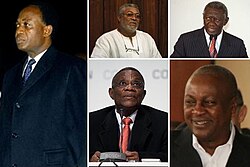
[[File:Presidents of Ghana and of the 4th Republic of Ghana.JPG|thumb| First President of the Republic of Ghana [[Kwame Nkrumah|Nkrumah]] and the 1st, 2nd, 3rd and 4th presidents of the 4th Republic of Ghana [[Jerry Rawlings|Rawlings]]; [[John Kufuor|Kufuor]]; [[John Evans Atta Mills|Mills]] and [[John Dramani Mahama|Mahama]].]] | |||
Ghana is a [[Unitary executive theory|unitary]] [[Presidential system|presidential]] [[Liberal democracy|constitutional democracy]] with a parliamentary [[multi-party system]] that is dominated by two parties—the National Democratic Congress (NDC) and the New Patriotic Party (NPP). Ghana alternated between civilian and military governments until January 1993, when the military government gave way to the Fourth Republic of Ghana after [[1992 Ghanaian presidential election|presidential]] and [[1992 Ghanaian parliamentary election|parliamentary elections]] in late 1992. The 1992 [[constitution of Ghana]] divides powers among a [[commander-in-chief]] of the [[Ghana Armed Forces]] ([[President of Ghana]]), parliament ([[Parliament of Ghana]]), cabinet ([[Cabinet of Ghana]]), council of state ([[Council of State (Ghana)|Ghanaian Council of State]]), and an independent judiciary ([[Judiciary of Ghana]]). The government is elected by [[universal suffrage]] after every four years.<ref name="cs">"Government and Politics". ''[http://lcweb2.loc.gov/frd/cs/ghtoc.html A Country Study: Ghana] {{webarchive |url=https://archive.today/20120713070609/http://lcweb2.loc.gov/frd/cs/ghtoc.html |date=13 July 2012}}'' (La Verle Berry, editor). [[Library of Congress]] [[Federal Research Division]] (November 1994). This article incorporates text from this source, which is in the [[public domain]]. [http://lcweb2.loc.gov/frd/cs/about.html Lcweb2.loc.gov] {{Webarchive |url=https://archive.today/20120710004153/http://lcweb2.loc.gov/frd/cs/about.html |date=10 July 2012}}</ref> | |||
[[Nana Akufo-Addo]] won the presidency in the [[2016 Ghanaian general election|general election in 2016]], defeating incumbent [[John Mahama]]. He also won the [[2020 Ghanaian general election|2020 election]] after the presidential election results were challenged at the Supreme Court by flagbearer of the NDC, John Mahama. Presidents are limited to two four-year terms in office. The president can serve a second term only upon re-election. | |||
The 2012 [[Fragile States Index]] indicated that Ghana is ranked the 67th-least fragile state in the world and the fifth-least fragile state in Africa. Ghana ranked 112th out of 177 countries on the index.<ref>{{cite web |url=https://foreignpolicy.com/failed_states_index_2012_interactive |title=Foreignpolicy.com – Failed States List 2012 |year=2012 |access-date=1 June 2013 |archive-url=https://web.archive.org/web/20130528161748/http://www.foreignpolicy.com/failed_states_index_2012_interactive |archive-date=28 May 2013 |url-status=live}}</ref> Ghana ranked as the 64th-least corrupt and politically corrupt country in the world out of all 174 countries ranked and ranked as the fifth-least corrupt and politically corrupt country in Africa out of 53 countries in the 2012 [[Corruption Perceptions Index|Transparency International Corruption Perception Index]].<ref>{{cite web |url=http://www.transparency.org/cpi2012/results |title=Corruption Perceptions Index 2012 |publisher=[[Corruption Perceptions Index|Transparency International Corruption Perception Index]] |year=2012 |access-date=1 June 2013 |archive-url=https://web.archive.org/web/20130528032608/http://www.transparency.org/cpi2012/results |archive-date=28 May 2013 |url-status=dead}}</ref><ref>{{cite web |url=http://www.cddghana.org/documents/Curbing%20Corruption%20and%20Improving%20Economic%20Governance.pdf |archive-url=https://web.archive.org/web/20080510115831/http://www.cddghana.org/documents/Curbing%20Corruption%20and%20Improving%20Economic%20Governance.pdf |archive-date=10 May 2008 |title=Curbing Corruption and Improving Economic Governance: The Case of Ghana |publisher=Ghana Center for Democratic Development |access-date=1 June 2013 |page=5 |author=Agyeman-Duah, Baffour}}</ref> Ghana was ranked 7th in Africa out of 53 countries in the 2012 [[Ibrahim Index of African Governance]]. The Ibrahim Index is a comprehensive measure of African government, based on variables which reflect the success with which governments deliver essential political goods to its citizens.<ref>{{cite web |url=http://www.moibrahimfoundation.org/interact/ |title=Mo Ibrahim Foundation – 2012 Ibrahim Index of African Governance (IIAG) |publisher=Moibrahimfoundation.org |year=2012 |access-date=1 June 2013 |url-status=dead |archive-url=https://web.archive.org/web/20130530015728/http://www.moibrahimfoundation.org/interact/ |archive-date=30 May 2013}}</ref> | |||
=== | ===Foreign relations=== | ||
[[File: | {{main|Foreign relations of Ghana}} | ||
[[ | [[File:Kofi Annan at OYW.jpg|thumb|left|[[Kofi Annan]], Ghanaian diplomat and United Nations Secretary-General 1997–2006]] | ||
Since independence, Ghana has been devoted to ideals of nonalignment and is a founding member of the [[Non-Aligned Movement]]. Ghana favours international and regional political and economic co-operation, and is an active member of the [[United Nations]] and the [[African Union]].<ref name="H. E. Mr. Ken Kanda">{{cite web |url=http://www.un.int/ghana/ |title=Official page of Nations Permanent Mission of Ghana to the United Nations |access-date=20 May 2012 |date=20 September 2011 |publisher=United Nations |archive-url=https://web.archive.org/web/20120501042954/http://www.un.int/ghana/ |archive-date=1 May 2012 |url-status=live}}</ref> | |||
Ghana | Ghana has a strong relationship with the United States. Three recent U.S. presidents—[[Bill Clinton]], [[George W. Bush]], and [[Barack Obama]] and a Vice President — [[Kamala Harris]] made diplomatic trips to Ghana.<ref>{{Cite web |date=2023-03-26 |title=US Vice President Kamala Harris' full speech upon arrival in Ghana - MyJoyOnline.com |url=https://www.myjoyonline.com/us-vice-president-kamala-harris-full-speech-upon-arrival-in-ghana/ |access-date=2023-03-29 |website=www.myjoyonline.com |language=en-US |archive-date=29 March 2023 |archive-url=https://web.archive.org/web/20230329174643/https://www.myjoyonline.com/us-vice-president-kamala-harris-full-speech-upon-arrival-in-ghana/ |url-status=live}}</ref> Many Ghanaian diplomats and politicians hold positions in international organisations, including Ghanaian diplomat and former [[Secretary-General of the United Nations]] [[Kofi Annan]], [[International Criminal Court]] Judge [[Akua Kuenyehia]], as well as former President [[Jerry Rawlings|Jerry John Rawlings]] and former President [[John Kufuor|John Agyekum Kufuor]], who both served as diplomats of the United Nations.<ref name=cs/> | ||
In September 2010, President [[John Atta Mills]] visited China on an official visit. Mills and China's former President [[Hu Jintao]] marked the 50th anniversary of diplomatic ties between the two nations, at the [[Great Hall of the People]].<ref name="Hu Jintao-John Atta Mills">{{cite web |url=http://www.fmprc.gov.cn/eng/wjb/zzjg/fzs/gjlb/2999/3001/t755583.htm |title=Hu Jintao Holds Talks with President of Ghana Mills |access-date=4 January 2012 |date=20 September 2010 |publisher=[[Ministry of Foreign Affairs of the People's Republic of China]] |archive-url=https://web.archive.org/web/20120627115536/http://www.fmprc.gov.cn/eng/wjb/zzjg/fzs/gjlb/2999/3001/t755583.htm |archive-date=27 June 2012 |url-status=live}}</ref> China reciprocated with an official visit in November 2011, by the vice-chairman of the [[Standing Committee of the National People's Congress|Standing Committee of the National People's Congress of China]], [[Zhou Tienong]] who visited Ghana and met with Ghana's President [[John Mahama]].<ref name="Xinhua2011">{{cite news |url=http://news.xinhuanet.com/english2010/china/2011-11/12/c_122269189.htm |title=Visiting senior Chinese official lauds Ghana for political stability, national unity |agency=Xinhua News Agency |date=12 November 2011 |access-date=13 November 2011 |author=Deng, Shasha |url-status=dead |archive-url=https://web.archive.org/web/20130909155705/http://news.xinhuanet.com/english2010/china/2011-11/12/c_122269189.htm |archive-date=9 September 2013}}</ref> Iranian President [[Mahmoud Ahmadinejad]] met with Mahama in 2013 to hold discussions on strengthening the [[Non-Aligned Movement]] and also co–chair a bilateral meeting between Ghana and Iran at the Ghanaian [[presidential palace]] [[Jubilee House|Flagstaff House]].<ref name="Ahmadinejad">{{cite web |url=https://www.bbc.co.uk/news/world-middle-east-22733605 |title=Ahmadinejad: Iran's populist and pariah leaves the stage |access-date=10 May 2014 |date=4 June 2013 |publisher=BBCNews |archive-url=https://web.archive.org/web/20140414120427/http://www.bbc.co.uk/news/world-middle-east-22733605 |archive-date=14 April 2014 |url-status=live}}</ref><ref name="Ahmadinejad2">{{cite news |url=https://www.bbc.co.uk/news/world-africa-22193136 |title=Iranian leader Ahmadinejad's West Africa tour defended |access-date=10 May 2014 |date=17 April 2013 |work=BBC News |archive-url=https://web.archive.org/web/20140922183829/http://www.bbc.co.uk/news/world-africa-22193136 |archive-date=22 September 2014 |url-status=live}}</ref><ref name="CPP welcomes President Ahmadinejad visit to Ghana">{{cite news |url=http://ghananewsagency.org/politics/cpp-welcomes-president-ahmadinejad-visit-to-ghana--59069 |title=CPP welcomes President Ahmadinejad visit to Ghana |access-date=10 May 2014 |date=18 April 2013 |agency=[[Ghana News Agency]] |archive-url=https://web.archive.org/web/20140512215634/http://ghananewsagency.org/politics/cpp-welcomes-president-ahmadinejad-visit-to-ghana--59069 |archive-date=12 May 2014 |url-status=live}}</ref><ref name="Ghana welcomed Iran's President Mahmoud Ahmadinejad">{{cite web |url=https://www.iafrica.tv/ghana-welcomed-irans-president-mahmoud-ahmadinejad/ |title=Ghana welcomed Iran's President Mahmoud Ahmadinejad |access-date=10 May 2014 |date=17 April 2013 |publisher=iafrica.tv |url-status=dead |archive-url=https://web.archive.org/web/20140512213620/https://www.iafrica.tv/ghana-welcomed-irans-president-mahmoud-ahmadinejad/ |archive-date=12 May 2014}}</ref><ref name="President Mahmoud Ahmadinejad">{{cite web |url=http://www.ghana.gov.gh/index.php/information/press-release/637-president-mahmoud-ahmadinejad-to-visit-ghana |title=President Mahmoud Ahmadinejad To Visit Ghana |access-date=10 May 2014 |year=2013 |publisher=Government of Ghana |archive-url=https://web.archive.org/web/20130929200634/http://ghana.gov.gh/index.php/information/press-release/637-president-mahmoud-ahmadinejad-to-visit-ghana |archive-date=29 September 2013 |url-status=live}}</ref> | |||
The [[ | The [[Sustainable Development Goals and Ghana|Sustainable Development Goals (SDG)]] were integrated into Ghana's development agenda and the budget. According to reports, the SDGs were implemented through a decentralized planning approach. This allows for stakeholders' participation, such as in UN agencies, traditional leaders, civil society organizations, academia, and others.<ref>{{cite web |title=Ghana .:. Sustainable Development Knowledge Platform |url=https://sustainabledevelopment.un.org/memberstates/ghana |access-date=2020-09-21 |website=sustainabledevelopment.un.org |archive-date=17 May 2022 |archive-url=https://web.archive.org/web/20220517021851/https://sustainabledevelopment.un.org/memberstates/ghana |url-status=live}}</ref> The 17 SDGs are a global call to action to end poverty among others, and the UN and its partners in the country are working towards achieving them.<ref>{{cite web |title=Sustainable Development Goals {{!}} United Nations in Ghana |url=https://ghana.un.org/en/sdgs |access-date=2020-09-21 |website=ghana.un.org |archive-date=18 September 2020 |archive-url=https://web.archive.org/web/20200918144931/https://ghana.un.org/en/sdgs |url-status=live}}</ref> According to the President [[Nana Akufo-Addo]], Ghana was "the first sub-Saharan African country to achieve the goal of halving poverty, as contained in Goal 1 of the [[Millennium Development Goals]]"<ref>{{Cite news |title=SDGs implementation: Ghana will be a shinning example' – Akufo-Addo |language=en-GB |work=Graphic Online |url=https://www.graphic.com.gh/news/politics/sdgs-implementation-ghana-will-be-a-shinning-example-akufo-addo.html |access-date=2020-09-22 |archive-date=30 April 2022 |archive-url=https://web.archive.org/web/20220430020854/https://www.graphic.com.gh/news/politics/sdgs-implementation-ghana-will-be-a-shinning-example-akufo-addo.html |url-status=live}}</ref> | ||
Ghana | ===Military=== | ||
[[File:Ghana Airforce Reccep Tayyip Erdogan Honor Guard at Flagstaff House.jpg|thumb|[[Turkish President]] [[Recep Tayyip Erdoğan]] inspects [[Guard of honour|Honour Guards]] mounted by the [[Ghana Air Force]] at the [[Jubilee House]], the Presidential Palace of Ghana in [[Greater Accra Region|Greater Accra]] on 1 March 2016.]] | |||
In 1957, the [[Ghana Armed Forces]] (GAF) consisted of its headquarters, support services, three battalions of infantry and a reconnaissance squadron with armoured vehicles.<ref name="Canada's Military Assistance">Kilford, Christopher R. (2010), [http://qspace.library.queensu.ca/bitstream/1974/1876/1/Kilford_Chris_R_200905_PhD.pdf ''The Other Cold War: Canada's Military Assistance to the Developing World 1945–75''] {{webarchive |url=https://web.archive.org/web/20131020150101/http://qspace.library.queensu.ca/bitstream/1974/1876/1/Kilford_Chris_R_200905_PhD.pdf |date=20 October 2013}}, [[Kingston, Ontario|Kingston]], Ontario: Canadian Defence Academy Press, p. 138, {{ISBN|1-100-14338-6}}.</ref> President Nkrumah aimed at rapidly expanding the GAF to support the [[United States of Africa]] ambitions. Thus, in 1961, 4th and 5th Battalions were established, and in 1964 6th Battalion was established, from a [[Paratrooper|parachute]] [[Airborne forces|airborne unit]] originally raised in 1963.<ref>Baynham, Simon (1988), ''The Military and Politics in Nkumrah's Ghana'', Westview, Chapter 4, {{ISBN|0-8133-7063-9}}.</ref> Today, Ghana is a [[regional power]] and [[Regional hegemony|regional hegemon]].<ref name="South America and West Africa">{{cite book |last=Kacowicz |first=Arie M. |url=https://books.google.com/books?id=itXKj0EY9zwC&pg=PA144 |title=Zones of Peace in the Third World: South America and West Africa |publisher=SUNY Press |year=1998 |isbn=978-0-7914-3957-9 |page=144 |access-date=19 March 2023 |archive-date=4 April 2023 |archive-url=https://web.archive.org/web/20230404105201/https://books.google.com/books?id=itXKj0EY9zwC&pg=PA144 |url-status=live}}</ref> In his book ''[[Shake Hands with the Devil (book)|Shake Hands with the Devil]]'', [[Canadian Armed Forces|Canadian Forces]] commander [[Roméo Dallaire]] highly rated the GAF soldiers and military personnel.<ref name="Canada's Military Assistance" /> | |||
Ghana is | The [[military operation]]s and [[military doctrine]] of the GAF are conceptualised in the constitution, Ghana's Law on Armed Force Military Strategy, and [[Kofi Annan International Peacekeeping Training Centre]] agreements to which GAF is attestator.<ref name="Defence">{{cite news |url=http://www.mofep.gov.gh/?q=divisions/pbb/defence |title=Defence |work=[[Ministry of Finance and Economic Planning (Ghana)|Ministry of Finance and Economic Planning]] |access-date=10 May 2014 |archive-url=https://web.archive.org/web/20140426201752/http://www.mofep.gov.gh/?q=divisions%2Fpbb%2Fdefence |archive-date=26 April 2014 |url-status=live}}</ref><ref name="Ghana's Regional Security Policy">{{cite web |url=http://www.kaiptc.org/Publications/Occasional-Papers/Documents/no_20.aspx |title=Ghana's Regional Security Policy: Costs, Benefits and Consistency |page=33 |format=PDF |access-date=10 May 2014 |publisher=[[Kofi Annan International Peacekeeping Training Centre]] |url-status=dead |archive-url=https://web.archive.org/web/20140508150900/http://www.kaiptc.org/Publications/Occasional-Papers/Documents/no_20.aspx |archive-date=8 May 2014}}</ref><ref name="KAIPTC">{{cite news |url=http://www.kaiptc.org/about-us/History.aspx |title=KAIPTC |work=[[Kofi Annan International Peacekeeping Training Centre]] |access-date=10 May 2014 |url-status=dead |archive-url=https://web.archive.org/web/20140512214613/http://www.kaiptc.org/about-us/History.aspx |archive-date=12 May 2014}}</ref> GAF military operations are executed under the auspices and imperium of the [[Ministry of Defence (Ghana)|Ministry of Defence]].<ref name="Defence" /><ref name="Vision & Mission">{{cite web |url=http://www.gaf.mil.gh/index.php?option=com_content&view=category&layout=blog&id=67&Itemid=101 |title=Vision and Mission of the Ministry of Defence (MoD) |access-date=10 May 2014 |work=gaf.mil.gh |publisher=Ghana Armed Forces |url-status=dead |archive-url=https://web.archive.org/web/20110721032203/http://www.gaf.mil.gh/index.php?option=com_content&view=category&layout=blog&id=67&Itemid=101 |archive-date=21 July 2011}}</ref> Although Ghana is relatively peaceful and is often considered being one of the least violent countries in the region, Ghana has experienced political violence in the past and 2017 has thus far seen an upward trend in incidents motivated by political grievances.<ref>{{cite web |url=http://www.acleddata.com/wp-content/uploads/2017/05/ACLED_Conflict-Trends-Report_No.58-May-2017_pdf.pdf |title=Real-time Analysis of African Political Violence |date=May 2017 |publisher=Armed Conflict Location & Event Data Project |access-date=13 June 2018 |archive-url=https://web.archive.org/web/20180613204214/http://www.acleddata.com/wp-content/uploads/2017/05/ACLED_Conflict-Trends-Report_No.58-May-2017_pdf.pdf |archive-date=13 June 2018 |url-status=live}}</ref> | ||
Ghana | ===Law enforcement=== | ||
{{further|Law enforcement in Ghana|Crime in Ghana}} | |||
[[File:Ghana Police Service Motorbikes.jpg|thumb|[[Militarized police]] Unit of the [[Ghana Police Service]]]] | |||
The [[Ghana Police Service]] and the [[Criminal Investigation Department]] are the main law enforcement agencies, responsible for the detection of crime, maintenance of law and order and the maintenance of internal peace and security.<ref name="MINT">{{cite web |title=The Ghana Police Service |url=http://www.mint.gov.gh/police.htm |publisher=mint.gov.gh |access-date=1 June 2013 |url-status=dead |archive-url=https://web.archive.org/web/20140512222320/http://www.mint.gov.gh/police.htm |archive-date=12 May 2014}}</ref> The Ghana Police Service has eleven specialised police units, including a [[Militarized police]] [[Rapid deployment force]] and [[Ghana Police Service#Marine Police Unit|Marine Police Unit]].<ref name="UNIT">{{cite web |title=Ghana Police Service sets up Marine Police Unit |url=http://www.modernghana.com/news/323575/1/ghana-police-service-sets-up-marine-police-unit.html |publisher=modernghana.com |access-date=1 June 2013 |archive-url=https://web.archive.org/web/20140102193158/http://www.modernghana.com/news/323575/1/ghana-police-service-sets-up-marine-police-unit.html |archive-date=2 January 2014 |url-status=live}}</ref><ref name="POLICE" /> The Ghana Police Service operates in 12 divisions: ten covering the regions of Ghana, one assigned specifically to the seaport and industrial hub of [[Tema]], and the twelfth being the Railways, Ports and Harbours Division.<ref name="POLICE">{{cite web |title=Police Administration |url=http://www.ghanapolice.info/regional.htm |archive-url=https://archive.today/20130218115805/http://www.ghanapolice.info/regional.htm |url-status=dead |archive-date=18 February 2013 |publisher=ghanapolice.info |access-date=19 June 2013}}</ref> The Ghana Police Service's Marine Police Unit and Division handles issues that arise from the country's offshore [[oil and gas industry]].<ref name=POLICE/> | |||
The [[Ghana Prisons Service]] and the sub-division [[Borstal Institute for Juveniles]] administers incarceration.<ref name="Ghana Prisons Service General Information">{{cite web |title=Ghana Prisons Service General Information |url=http://www.ghanaprisons.gov.gh/page-content?page=43393a37-a28e-4f1c-8540-e8eaf28825e8&menu=29899081-5de7-4bd0-8656-6473ac6f2c3e |publisher=ghanaprisons.gov.gh |access-date=31 July 2013 |url-status=dead |archive-url=https://web.archive.org/web/20131024072237/http://www.ghanaprisons.gov.gh/page-content?page=43393a37-a28e-4f1c-8540-e8eaf28825e8&menu=29899081-5de7-4bd0-8656-6473ac6f2c3e |archive-date=24 October 2013}}</ref> Ghana retains and exercises the death penalty for treason, corruption, robbery, piracy, drug trafficking, rape, and homicide.<ref name="Ghana – Death Penalty">{{cite web |title=Ghana – Death Penalty |url=http://www.handsoffcain.info/bancadati/schedastato.php?idstato=17000446&idcontinente=25 |publisher=handsoffcain.info |access-date=31 July 2013 |archive-url=https://web.archive.org/web/20131020214250/http://www.handsoffcain.info/bancadati/schedastato.php?idstato=17000446&idcontinente=25 |archive-date=20 October 2013 |url-status=live}}</ref><ref name="Criminal Code and Courts">{{cite web |title=Ghana Criminal Code and Courts |url=http://www.country-data.com/cgi-bin/query/r-5351.html |publisher=country-data.com |access-date=31 July 2013 |archive-url=https://web.archive.org/web/20130515034443/http://www.country-data.com/cgi-bin/query/r-5351.html |archive-date=15 May 2013 |url-status=live}}</ref> The new sustainable development goals adopted by the United Nations call for the international community to come together to promote the rule of law; support equal access to justice for all; reduce corruption; and develop effective, accountable, and transparent institutions at all levels.<ref name="DIPNote: Promoting Peace, Justice, and Strong Institutions in the Great Lakes">{{cite web |last1=Perriello |title=Promoting Peace, Justice, and Strong Institutions in the Great Lakes |url=https://blogs.state.gov/stories/2015/10/01/promoting-peace-justice-and-strong-institutions-great-lakes |website=DIPNote |publisher=US Department of state |access-date=20 May 2016 |url-status=dead |archive-url=https://web.archive.org/web/20160520085847/https://blogs.state.gov/stories/2015/10/01/promoting-peace-justice-and-strong-institutions-great-lakes |archive-date=20 May 2016}}</ref>[[File:Drugtrade.png|thumb|Ghana is among the sovereign states of West Africa used by [[drug cartel]]s and drug traffickers (shown in orange).]] | |||
The Ghana | |||
=== | Ghana is used as a key narcotics industry transshipment point by traffickers, usually from South America as well as some from other African nations.<ref name="Ghana hit by illegal drug trade"/> In 2013, the UN chief of the Office on Drugs and Crime stated that "West Africa is completely weak in terms of border control and the big drug cartels from [[Colombia]] and [[Latin America]] have chosen Africa as a way to reach Europe."<ref name="DW Made for minds: Illegal drug use on the rise in Africa">{{cite web |last1=Gerra |title=Illegal drug use on the rise in Africa |url=http://www.dw.com/en/illegal-drug-use-on-the-rise-in-africa/a-16614023 |website=DW Made for minds |publisher=Deutsche Welle |access-date=20 May 2016 |archive-url=https://web.archive.org/web/20160314035220/http://www.dw.com/en/illegal-drug-use-on-the-rise-in-africa/a-16614023 |archive-date=14 March 2016 |url-status=live}}</ref> There is not a wide or popular knowledge about the narcotics industry and intercepted narcotics within Ghana, since it is an [[black market|underground economy]]. The social context within which narcotic trafficking, storage, transportation, and repacking systems exist in Ghana and the state's location along the Gulf of Guinea makes Ghana an attractive country for the narcotics business.<ref name="Ghana hit by illegal drug trade">{{cite web |url=http://www.gulfnews.com/news/world/other-world/ghana-hit-by-illegal-drug-trade-1.1236396 |title=Ghana hit by illegal drug trade |work=[[Gulf News]] |date=28 September 2013 |access-date=4 December 2013 |archive-url=https://web.archive.org/web/20131212171614/http://gulfnews.com/news/world/other-world/ghana-hit-by-illegal-drug-trade-1.1236396 |archive-date=12 December 2013 |url-status=live}}</ref><ref name="Ghana could be taken over by drug barons if">{{cite web |url=http://www.myjoyonline.com/news/2013/November-20th/ghana-could-be-taken-over-by-drug-barons-ifkwesi-aning.php |title=Ghana could be taken over by drug barons if |publisher=myjoyonline.com |date=20 November 2013 |access-date=4 December 2013 |archive-url=https://web.archive.org/web/20131210062520/http://www.myjoyonline.com/news/2013/November-20th/ghana-could-be-taken-over-by-drug-barons-ifkwesi-aning.php |archive-date=10 December 2013 |url-status=live}}</ref> The [[Narcotics Control Board (Ghana)|Narcotics Control Board]] has impounded container ships at the Sekondi Naval Base in the [[Takoradi Harbour]]. These ships were carrying thousands of kilograms of cocaine, with a street value running into billions of [[Ghanaian cedi|Ghana cedis]]. However, drug seizures saw a decline in 2011.<ref name="Ghana hit by illegal drug trade" /><ref name="Ghana could be taken over by drug barons if" /> [[Drug cartel]]s are using new methods in narcotics production and narcotics exportation, to avoid Ghanaian security agencies.<ref name="Ghana hit by illegal drug trade" /><ref name="Ghana could be taken over by drug barons if" /> Underdeveloped institutions, porous open borders, and the existence of established smuggling organisations contribute to Ghana's position in the narcotics industry.<ref name="Ghana hit by illegal drug trade" /><ref name="Ghana could be taken over by drug barons if" /> President Mills initiated ongoing efforts to reduce the role of airports in Ghana's drug trade.<ref name="Ghana hit by illegal drug trade" /> | ||
[[ | |||
Ghana | === Human rights === | ||
{{see also|Human rights in Ghana|LGBT rights in Ghana}} | |||
[[Homosexuality|Homosexual acts]] are prohibited by law in Ghana.<ref>{{cite news |date=16 June 2016 |title=Here are the 10 countries where homosexuality may be punished by death |newspaper=The Washington Post |url=https://www.washingtonpost.com/news/worldviews/wp/2016/06/13/here-are-the-10-countries-where-homosexuality-may-be-punished-by-death-2/ |url-status=live |access-date=19 March 2017 |archive-url=https://web.archive.org/web/20161111064457/https://www.washingtonpost.com/news/worldviews/wp/2016/06/13/here-are-the-10-countries-where-homosexuality-may-be-punished-by-death-2/ |archive-date=11 November 2016}}</ref> According to a 2013 survey by the [[Pew Research Center]], 96% of Ghanaians believe that homosexuality should not be accepted by society.<ref name="pewglobal.org">[http://www.pewglobal.org/2013/06/04/the-global-divide-on-homosexuality/ "The Global Divide on Homosexuality."] {{webarchive |url=https://web.archive.org/web/20131103034522/http://www.pewglobal.org/2013/06/04/the-global-divide-on-homosexuality/|date=3 November 2013}} [[Pew Research Center]]. 4 June 2013.</ref> Sometimes elderly [[women in Ghana]] are accused of [[witchcraft]], particularly in rural Ghana. Issues of witchcraft mainly remain as speculations based on superstitions within families. In some parts of northern Ghana, there exist what are called [[witch camp]]s. These are said to house a total of around 1,000 people accused of witchcraft.<ref name="Camps">{{cite web |date=1 September 2012 |title=Ghana witch camps: Widows' lives in exile |url=https://www.bbc.co.uk/news/magazine-19437130 |url-status=live |archive-url=https://web.archive.org/web/20181020122329/https://www.bbc.co.uk/news/magazine-19437130 |archive-date=20 October 2018 |access-date=21 July 2018 |publisher=BBC News |df=dmy-all}}</ref> The Ghanaian government has announced that it intends to close the camps.<ref name="Camps" /> | |||
==Economy== | |||
{{main|Economy of Ghana|New media in Ghana|Manufacturing in Ghana#Automobile manufacturing|l3=Automobile manufacturing in Ghana}} | |||
[[File:GDP per capita development development of Ghana.svg|thumb|Change in per capita GDP, 1870–2018. Figures are inflation-adjusted to 2011 International dollars]] | |||
{{ | [[File:Ghana Product Exports (2019).svg|upright=1.3|thumb|right|A proportional representation of exports, 2019]] | ||
[[File:Ghana Export Trends.jpg|thumb|right|Ghana Petroleum and [[Commodity|commodities]]; exports in [[percentage]]]] | |||
Ghana possesses [[industrial mineral]]s, [[hydrocarbon]]s and [[precious metal]]s. It is an emerging designated [[digital economy]] with [[mixed economy]] hybridisation and an [[emerging market]]. It has an economic plan target known as the "Ghana Vision 2020". This plan envisions Ghana as the first African country to become a [[developed country]] between 2020 and 2029 and a [[Newly industrialized country|newly industrialised country]] between 2030 and 2039.<ref>{{cite web |title=Ghana |url=https://www.vizocom.com/internet/ghana/ |website=Vizocom – Satellite Internet and VSAT Solutions |access-date=29 May 2020 |archive-date=8 June 2020 |archive-url=https://web.archive.org/web/20200608091316/https://www.vizocom.com/internet/ghana/ |url-status=live}}</ref> This excludes fellow [[Group of 24]] member and [[Sub-Saharan Africa]]n country South Africa, which is a newly industrialised country.<ref>{{cite web |url=http://www.standardmedia.co.ke/mobile/?articleID=2000065384&story_title= |title=Is Ghana the next African economic tiger? |publisher=standardmedia.co.ke |date=4 September 2012 |access-date=5 September 2013 |url-status=dead |archive-url=https://web.archive.org/web/20150403174443/http://www.standardmedia.co.ke/mobile/?articleID=2000065384&story_title= |archive-date=3 April 2015}}</ref> | |||
Ghana's economy has ties to the [[Renminbi|Chinese yuan renminbi]] along with Ghana's vast gold reserves. In 2013, the [[Bank of Ghana]] began circulating the renminbi throughout Ghanaian state-owned banks and to the Ghana public as [[hard currency]] along with the national [[Ghanaian cedi]] for second national trade currency.<ref name="BoG introduce Chinese Yuan onto the FX market">{{cite web |url=http://www.radioxyzonline.com/edition/pages/business/09172013-1152/14785.stm |title=BoG introduce Chinese Yuan onto the FX market |publisher=[[Bank of Ghana]] |year=2013 |access-date=22 September 2013 |url-status=dead |archive-url=https://web.archive.org/web/20130926191724/http://www.radioxyzonline.com/edition/pages/business/09172013-1152/14785.stm |archive-date=26 September 2013}}</ref> | |||
Between 2012 and 2013, 38% of rural dwellers were experiencing poverty whereas only 11% of urban dwellers were.<ref>{{cite web |url=https://www.brookings.edu/blog/africa-in-focus/2014/08/15/ghanas-request-for-imf-assistance/ |title=Ghana's Request for IMF Assistance |first=Temesgen Deressa and Amadou |last=Sy |date=30 November 2001 |access-date=13 June 2018 |archive-url=https://web.archive.org/web/20180613160601/https://www.brookings.edu/blog/africa-in-focus/2014/08/15/ghanas-request-for-imf-assistance/ |archive-date=13 June 2018 |url-status=live}}</ref> Urban areas hold greater opportunity for employment, particularly in informal trade, while nearly all (94 percent) of "rural poor households" participate in the agricultural sector.<ref>{{cite conference |url=http://www.oecd.org/agriculture/agricultural-policies/46341169.pdf |title=Economic Importance of Agriculture for Sustainable Development and Poverty Reduction: Findings from a Case Study of Ghana |first=Xinshen |last=Diao |conference=Global Forum on Agriculture 29–30 November 2010 – Policies for Agricultural Development, Poverty Reduction and Food Security |location=Paris |access-date=13 June 2018 |archive-url=https://web.archive.org/web/20180618215948/http://www.oecd.org/agriculture/agricultural-policies/46341169.pdf |archive-date=18 June 2018 |url-status=live}}</ref> | |||
The [[Volta River Authority]] and the [[Ghana National Petroleum Corporation]], both state-owned, are the two major electricity producers.<ref name="Ghana – Gross Domestic Product" /> The [[Akosombo Dam]], built on the Volta River in 1965, along with the [[Bui Dam]], the [[Kpong Dam]] and several other hydroelectric dams, provide [[hydropower]].<ref>{{cite web |url=http://www.ifpri.org/sites/default/files/publications/rr171.pdf |title=A new era of transformation in Ghana |publisher=ifpri.org |access-date=16 February 2012 |url-status=dead |archive-url=https://web.archive.org/web/20120409195949/http://www.ifpri.org/sites/default/files/publications/rr171.pdf |archive-date=9 April 2012}}{{rp|12}}</ref><ref name="New fuel for faster development">{{cite web |url=http://www.worldfolio.co.uk/region/africa/ghana/president-john-atta-mills-n145 |title=New fuel for faster development |publisher=worldfolio.co.uk |access-date=31 May 2013 |archive-url=https://web.archive.org/web/20130624100025/http://www.worldfolio.co.uk/region/africa/ghana/president-john-atta-mills-n145 |archive-date=24 June 2013 |url-status=dead}}</ref> In addition, the government sought to [[Nuclear power in Ghana|build the second nuclear power plant in Africa]]. | |||
=== | The [[Ghana Stock Exchange]] is the 5th largest on continental Africa and 3rd largest in sub-saharan Africa with a [[Market capitalization|market capitalisation]] of [[Ghana Cedi|GH¢]] 57.2 billion or [[Renminbi|CN¥]]180.4 billion in 2012 with the South Africa [[JSE Limited]] as first.<ref>{{cite web |url=http://www.icbuk.com/images/uploads/ICBUKGhanaReportSeptember2011.pdf |title=Ghana Market Update |publisher=[[Intercontinental Bank]] |access-date=26 March 2012 |url-status=dead |archive-url=https://web.archive.org/web/20120704014602/http://www.icbuk.com/images/uploads/ICBUKGhanaReportSeptember2011.pdf |archive-date=4 July 2012}}{{rp|13}}</ref> The [[Ghana Stock Exchange]] was the 2nd best performing [[stock exchange]] in sub-saharan Africa in 2013.<ref>{{cite web |url=http://www.africastrictlybusiness.com/lists/top-performing-african-stock-markets-2013 |title=Top-Performing African Stock Markets in 2013 |publisher=africastrictlybusiness.com |year=2013 |access-date=20 July 2014 |archive-url=https://web.archive.org/web/20140321014630/http://www.africastrictlybusiness.com/lists/top-performing-african-stock-markets-2013 |archive-date=21 March 2014 |url-status=dead}}</ref> | ||
{{ | |||
Ghana produces high-quality [[Cocoa bean|cocoa]].<ref name="Ghana Entering A Sweet, Golden Era">{{cite web |url=http://africanbusinessmagazine.com/special-reports/country-reports/ghana-celebrates/is-ghana-entering-a-sweet-golden-era |title=Is Ghana Entering A Sweet, Golden Era? |work=[[African Business]] |date=September 2011 |access-date=10 May 2014 |archive-url=https://web.archive.org/web/20140718204528/http://africanbusinessmagazine.com/special-reports/country-reports/ghana-celebrates/is-ghana-entering-a-sweet-golden-era |archive-date=18 July 2014 |url-status=live}}</ref> It is the 2nd largest producer of cocoa globally.<ref>{{Cite web |title=Cocoa facts and figures - Kakaoplattform |url=https://www.kakaoplattform.ch/about-cocoa/cocoa-facts-and-figures#:~:text=In%20the%202018/2019%20cocoa,biggest%20cocoa%20producer%20in%20Asia. |access-date=2022-08-20 |website=www.kakaoplattform.ch |archive-date=17 June 2022 |archive-url=https://web.archive.org/web/20220617043810/https://www.kakaoplattform.ch/about-cocoa/cocoa-facts-and-figures#:~:text=In%20the%202018/2019%20cocoa,biggest%20cocoa%20producer%20in%20Asia. |url-status=live}}</ref> Ghana is classified as a middle income country.<ref name="IMF" /><ref>{{cite book |url=http://www.icbuk.com/images/uploads/ICBUKGhanaReportSeptember2011.pdf |archive-url=https://web.archive.org/web/20120704014602/http://www.icbuk.com/images/uploads/ICBUKGhanaReportSeptember2011.pdf |archive-date=4 July 2012 |title=Ghana Market Update |author=Forrest, Paul |work=icbuk.com |publisher=[[Intercontinental Bank]] |date=September 2011 |access-date=26 March 2012 |page=13}}</ref> [[Tertiary sector of the economy|Services]] account for 50% of GDP, followed by [[Secondary sector of the economy|manufacturing]] (24.1%), [[Primary sector of the economy|extractive industries]] (5%), and taxes (20.9%).<ref name="Ghana – Gross Domestic Product" /> Ghana has an increasing primary manufacturing economy and export of digital technology goods along with assembling and exporting automobiles and ships, diverse resource rich exportation of [[industrial mineral]]s, agricultural products primarily cocoa, petroleum and natural gas,<ref name="Ghana's Jubilee oil field nears output plateau -operator">{{cite news |url=https://www.reuters.com/article/idUSL6N0DA59S20130423?irpc=932 |work=[[Reuters]] |title=Ghana's Jubilee oil field nears output plateau -operator |access-date=31 May 2013 |archive-date=25 January 2021 |archive-url=https://web.archive.org/web/20210125201001/https://www.reuters.com/article/idUSL6N0DA59S20130423?irpc=932 |url-status=live}}</ref> and [[Private industry|industries]] such as [[information and communications technology]] primarily via Ghana's state digital technology corporation [[Rlg Communications]] which manufactures [[tablet computer]]s with [[smartphone]]s and various [[consumer electronics]].<ref name="Ghana – Gross Domestic Product">{{cite web |title=Ghana – Gross Domestic Product |url=http://www.statsghana.gov.gh/docfiles/GDP/revised_gdp_2011_april-2012.pdf |publisher=statsghana.gov.gh |access-date=13 June 2012 |archive-url=https://web.archive.org/web/20120417045744/http://www.statsghana.gov.gh/docfiles/GDP/revised_gdp_2011_april-2012.pdf |archive-date=17 April 2012 |url-status=dead}}</ref><ref name="The Top 5 Countries for ICT in Africa">{{cite web |url=http://www.ictworks.org/2012/03/26/top-5-countries-ict4d-africa-are-kenya-ghana-nigeria-tanzania-and/ |title=The Top 5 Countries for ICT4D in Africa |publisher=ictworks.org |access-date=3 May 2013 |archive-url=https://web.archive.org/web/20130614035416/http://www.ictworks.org/2012/03/26/top-5-countries-ict4d-africa-are-kenya-ghana-nigeria-tanzania-and/ |archive-date=14 June 2013 |url-status=live}}</ref> [[Urban car|Urban]] [[electric car]]s have been manufactured in Ghana since 2014.<ref>{{cite news |title=Ghana's model vehicle unveiled by Suame Magazine artisans |author=Kofi Adu Domfeh |url=http://www.modernghana.com/news/458333/1/ghanas-model-vehicle-unveiled-by-suame-magazine-ar.html |publisher=Modernghana.com |date=13 April 2013 |access-date=25 September 2013 |archive-date=27 September 2013 |archive-url=https://web.archive.org/web/20130927144319/http://www.modernghana.com/news/458333/1/ghanas-model-vehicle-unveiled-by-suame-magazine-ar.html |url-status=live}}</ref><ref>{{cite news |title=Ghana's model car attracts Dutch government support |url=http://business.myjoyonline.com/pages/news/201307/109474.php |publisher=Myjoyonline.gh |date=15 July 2013 |access-date=25 September 2013 |url-status=dead |archive-url=https://web.archive.org/web/20130923084526/http://business.myjoyonline.com/pages/news/201307/109474.php |archive-date=23 September 2013 |df=dmy-all}}</ref> | |||
=== | It announced plans to issue government debt by way of social and green bonds in Autumn 2021 making it the first African country to do so.<ref>{{cite news |url=https://www.bloomberg.com/news/articles/2021-05-25/ghana-to-sell-sustainable-bonds-for-up-to-1-billion-by-july-kp3rq0p1 |access-date=5 July 2021 |newspaper=Bloomberg.com |title=Ghana to Sell Sustainable Bonds for up to $1 Billion by July |date=25 May 2021 |archive-date=18 July 2021 |archive-url=https://web.archive.org/web/20210718005927/https://www.bloomberg.com/news/articles/2021-05-25/ghana-to-sell-sustainable-bonds-for-up-to-1-billion-by-july-kp3rq0p1 |url-status=live}}</ref><ref>{{cite news |url=https://www.bloomberg.com/news/articles/2021-07-05/ghana-mulls-africa-s-first-social-bonds-with-2-billion-sale |access-date=5 July 2021 |newspaper=Bloomberg.com |title=Ghana Mulls Africa's First Social Bonds with $2 Billion Sale |date=5 July 2021 |archive-date=6 July 2021 |archive-url=https://web.archive.org/web/20210706081855/https://www.bloomberg.com/news/articles/2021-07-05/ghana-mulls-africa-s-first-social-bonds-with-2-billion-sale |url-status=live}}</ref> The country, which is planning to borrow up to $5 billion in international markets this year, would use the proceeds from these sustainable bonds to refinance debt used for social and environmental projects and pay for educational or health. Only a few other nations have sold them so far, including [[Chile]] and [[Ecuador]]. The country will use the proceeds to forge ahead with a free secondary-school initiative started in 2017 among other programs, despite having recorded its lowest economic growth rate in 37 years in 2020.<ref>{{cite web |title=Ghana plans to issue Africa's first social bonds with $2B sale |url=https://www.aljazeera.com/economy/2021/7/5/ghana-plans-to-issue-africas-first-social-bonds-with-2b-sale |access-date=2021-07-06 |website=www.aljazeera.com |archive-date=6 July 2021 |archive-url=https://web.archive.org/web/20210706055819/https://www.aljazeera.com/economy/2021/7/5/ghana-plans-to-issue-africas-first-social-bonds-with-2b-sale |url-status=live}}</ref> | ||
[[File:Jubilee Oil Field of the Ghana National Petroleum Corporation (GNPC) and National Petroleum Authority.png|thumb|right|[[Jubilee oil field]] of the Ghana National Petroleum Corporation (GNPC) and [[National Petroleum Authority]] located off the coast of the [[Western Region (Ghana)|Western Region]] in the [[South Atlantic Ocean]]]] | |||
It produces and exports [[hydrocarbon]]s such as [[sweet crude oil]] and [[natural gas]].<ref name="Five Countries to Watch">{{cite web |url=http://www.individual.troweprice.com/public/Retail/Planning-&-Research/Connections/Africa/Global-Economy-African-Countries-Growth |title=Five Countries to Watch |work=individual.troweprice.com |access-date=27 April 2013 |url-status=dead |archive-url=https://web.archive.org/web/20130412023853/http://individual.troweprice.com/public/Retail/Planning-%26-Research/Connections/Africa/Global-Economy-African-Countries-Growth |archive-date=12 April 2013}}</ref><ref>{{cite web |url=http://www.aluworks.com/site/index.php?option=com_content&view=article&id=63&Itemid=60&734e1554a786d82e908c7c85044123c2=746b376516a36724613692ecab763f6f |title=Africa |publisher=Aluworks.com |access-date=26 June 2010 |url-status=dead |archive-url=https://web.archive.org/web/20110903210059/http://www.aluworks.com/site/index.php?option=com_content&view=article&id=63&Itemid=60&734e1554a786d82e908c7c85044123c2=746b376516a36724613692ecab763f6f |archive-date=3 September 2011}}</ref> The 100%-state-owned [[filling station]] company, [[Ghana Oil Company]], is the number 1 petroleum and gas filling station, and the 100%-state-owned state oil company [[Ghana National Petroleum Corporation]] oversees [[hydrocarbon exploration]] and production of petroleum and natural gas reserves. Ghana aims to further increase the output of oil to {{convert|2.2|e6oilbbl}} per day and gas to {{convert|1.2|e9cuft|m3|order=flip}} per day.<ref name="cs2">Clark, Nancy L. "Petroleum Exploration". ''[http://lcweb2.loc.gov/frd/cs/ghtoc.html A Country Study: Ghana] {{webarchive |url=https://archive.today/20120713070609/http://lcweb2.loc.gov/frd/cs/ghtoc.html |date=13 July 2012}}'' (La Verle Berry, editor). [[Library of Congress]] [[Federal Research Division]] (November 1994). ''This article incorporates text from this source, which is in the [[public domain]].'' [http://lcweb2.loc.gov/frd/cs/about.html Lcweb2.loc.gov] {{webarchive |url=https://archive.today/20120710004153/http://lcweb2.loc.gov/frd/cs/about.html |date=10 July 2012}}</ref> The [[Jubilee Oil Field]], which contains up to {{convert|3|Goilbbl|m3}} of sweet crude oil, was discovered in 2007.<ref>{{cite news |url=https://news.yahoo.com/s/ap/20071222/ap_on_re_af/ghana_oil_discovery_3 |title=Ghana leader: Oil reserves at 3B barrels |work=Yahoo News |date=22 December 2007 |access-date=21 December 2010 |archive-url=https://web.archive.org/web/20071226200944/http://news.yahoo.com/s/ap/20071222/ap_on_re_af/ghana_oil_discovery_3 |archive-date=26 December 2007}}</ref> Ghana is believed to have up to {{convert|5|Goilbbl|m3}} to {{convert|7|Goilbbl|m3}} of petroleum in reserves,<ref>McLure, Jason. [https://www.bloomberg.com/news/2010-12-01/ghana-oil-reserves-to-be-5-billion-barrels-in-5-years-as-fields-develop.html Ghana Oil Reserves to Be {{convert|5|Goilbbl|m3}} in 5 years as fields develop] {{webarchive |url=https://web.archive.org/web/20131029191618/http://www.bloomberg.com/news/2010-12-01/ghana-oil-reserves-to-be-5-billion-barrels-in-5-years-as-fields-develop.html |date=29 October 2013}}. [[Bloomberg Television]], 1 December 2010.</ref> which is the fifth-largest in Africa and the 21st-to-25th-[[List of countries by proven oil reserves|largest proven reserves]] in the world. It also has up to {{convert|6|e12cuft|m3|order=flip}} of natural gas in reserves.<ref name="Atuabo gas project to propel more growth">{{cite web |url=https://graphic.com.gh/archive/Business-News/atuabo-gas-project-to-propel-more-growth.html |title=Atuabo gas project to propel more growth |first=Moses Dotsey |last=Aklorbortu |work=[[Daily Graphic (Ghana)|Daily Graphic]] |date=13 May 2013 |access-date=27 October 2013 |archive-url=https://archive.today/20140503021413/http://graphic.com.gh/archive/Business-News/atuabo-gas-project-to-propel-more-growth.html |archive-date=3 May 2014 |url-status=dead}}</ref> The government has drawn up plans to [[Nationalization|nationalise]] petroleum and natural gas reserves to increase government revenue.<ref>{{cite web |url=https://allafrica.com/stories/201304291808.html/?maneref=http%3A%2F%2Fwww.google.com%2Fm%3Fq%3DGhana%2520privatise%2520mining%26client%3Dms-opera-mobile%26channel%3Dnew |title=Ghana: Why Privatise Ghana Oil? |publisher=allafrica.com |access-date=22 September 2013 |archive-url=https://web.archive.org/web/20130929015429/http://allafrica.com/stories/201304291808.html/?maneref=http%253A%252F%252Fwww.google.com%252Fm%253Fq%253DGhana%252520privatise%252520mining%2526client%253Dms-opera-mobile%2526channel%253Dnew |archive-date=29 September 2013 |url-status=live}}</ref> | |||
As of 2019, Ghana was the 7th largest producer of gold in the world, producing ~140 [[tonne]]s that year.<ref name="CEIC">{{cite web |title=Ghana Gold Production |url=https://www.ceicdata.com/en/indicator/ghana/gold-production |access-date=26 October 2020 |website=CEIC Data |archive-date=29 October 2020 |archive-url=https://web.archive.org/web/20201029183111/https://www.ceicdata.com/en/indicator/ghana/gold-production |url-status=live}}</ref> This record saw Ghana surpass South Africa in output for the first time, making Ghana the largest gold producer in Africa.<ref>{{cite web |author=Whitehouse, David |date=8 October 2019 |title=Ghana now Africa's largest gold producer, but reforms await |url=https://www.theafricareport.com/18245/ghana-now-africas-largest-gold-producer-but-reforms-await/ |access-date=16 October 2020 |work=The Africa Report |archive-date=29 October 2020 |archive-url=https://web.archive.org/web/20201029100547/https://www.theafricareport.com/18245/ghana-now-africas-largest-gold-producer-but-reforms-await/ |url-status=live}}</ref> In addition to gold, Ghana exports [[silver]], timber, [[diamond]]s, [[bauxite]], and [[manganese]], and has other mineral deposits.<ref>{{cite book |url=https://books.google.com/books?id=U49Q8BgiarkC&q=Ghana%20minerals%20granite&pg=PA70 |title=Ghana Mineral and Mining Sector Investment and Business Guide |date=7 February 2007 |publisher=International Business Publications, USA |isbn=978-1-4330-1775-9 |access-date=16 May 2014}}{{Dead link|date=February 2023|bot=InternetArchiveBot|fix-attempted=yes}}</ref> Ghana ranks 9th in the world in diamond export and reserve size.<ref>{{cite web |title=Ghana |url=https://eiti.org/ghana |access-date=2021-07-06 |website=Extractive Industries Transparency Initiative |archive-date=9 July 2021 |archive-url=https://web.archive.org/web/20210709185204/https://eiti.org/ghana |url-status=dead}}</ref> The government has drawn up plans to [[Nationalization|nationalize]] mining industry to increase government revenue.<ref>{{cite book |url=https://books.google.com/books?id=U49Q8BgiarkC&pg=PA70 |title=Ghana Mineral and Mining Sector Investment and Business Guide |work=Ibpus.com |publisher=International Business Publications |year=2007 |isbn=978-1-4330-1775-9 |access-date=24 June 2013}}{{Dead link|date=February 2023 |bot=InternetArchiveBot |fix-attempted=yes }}</ref><ref>{{cite web |title=Ghana Minerals and Mining Act |url=http://www.ghanalegal.com/?id=3&law=535&t=ghana-laws |url-status=dead |archive-url=https://web.archive.org/web/20131021012648/http://www.ghanalegal.com/?id=3&law=535&t=ghana-laws |archive-date=21 October 2013 |access-date=16 May 2014 |publisher=ghanalegal.com}}</ref> | |||
"Shortages" of electricity in 2015 & 2016 led to [[dumsor]] ("persistent, irregular and unpredictable" electric power outages),<ref name="germany">{{cite web |url=http://graphic.com.gh/news/politics/37330-i-ve-been-named-mr-dumsor-in-ghana-prez-mahama-tells-ghanaians-in-germany.html |title=I've been named 'Mr Dumsor' in Ghana – Prez Mahama tells Ghanaians in Germany – See more at |date=21 January 2015 |website=Graphic Online |publisher=Graphic Communications Group Ltd (GCGL) |url-status=live |archive-url=https://web.archive.org/web/20150424025905/http://www.graphic.com.gh/news/politics/37330-i-ve-been-named-mr-dumsor-in-ghana-prez-mahama-tells-ghanaians-in-germany.html |archive-date=24 April 2015 |access-date=2 March 2015}}</ref> increasing the interest in renewables.<ref name="graphic1">{{cite web |url=http://graphic.com.gh/features/features/21105-ghana-s-power-crisis-what-about-renewable-energy.html |title=Ghana's power crisis: What about renewable energy? |publisher=graphic.com.gh |date=10 April 2014 |access-date=8 February 2015 |author=Agbenyega, E. |archive-url=https://web.archive.org/web/20150701211205/http://graphic.com.gh/features/features/21105-ghana-s-power-crisis-what-about-renewable-energy.html |archive-date=1 July 2015 |url-status=live}}</ref> As of 2019, there is a surplus of electricity.<ref>{{cite web |url=http://theconversation.com/lessons-to-be-learnt-from-ghanas-excess-electricity-shambles-121257 |title=Lessons to be learnt from Ghana's excess electricity shambles |last=Sarkodie |first=Samuel Asumadu |website=The Conversation |date=5 August 2019 |access-date=28 December 2019 |archive-date=8 January 2020 |archive-url=https://web.archive.org/web/20200108022101/http://theconversation.com/lessons-to-be-learnt-from-ghanas-excess-electricity-shambles-121257 |url-status=live}}</ref> | |||
[[ | The [[Judiciary of Ghana|judicial system of Ghana]] deals with corruption, economic malpractice and lack of economic transparency.<ref name="Ghana Economy – heritage">{{cite web |work=heritage.org |url=http://www.heritage.org/index/country/ghana |title=Ghana Economy |access-date=20 April 2013 |archive-date=8 May 2016 |archive-url=https://web.archive.org/web/20160508060450/http://www.heritage.org/index/country/ghana |url-status=live}}</ref> According to Transparency International's Corruption Perception Index of 2018, out of 180 countries, Ghana was ranked 78th, with a score of 41 on a scale where a 0–9 score means highly corrupt, and a 90–100 score means very clean. This was based on perceived levels of public sector corruption.<ref>{{cite web |title=OUR WORK IN Ghana |url=https://www.transparency.org/en/countries/ghana |website=Transparency.org |publisher=Transparency International |access-date=1 June 2020 |archive-date=8 June 2020 |archive-url=https://web.archive.org/web/20200608091309/https://www.transparency.org/en/countries/ghana |url-status=live}}</ref> | ||
===Science and technology=== | ===Science and technology=== | ||
It launched a cellular mobile network (1992). It was connected to the internet and introduced ADSL broadband services.<ref name="Ghanaweb">{{cite web |title=Science & Technology |url=http://www.ghanaweb.com/GhanaHomePage/technology/ |publisher=Ghanaweb |date=24 June 2015 |access-date=24 June 2016 |archive-url=https://web.archive.org/web/20160623022534/http://www.ghanaweb.com/GhanaHomePage/technology/ |archive-date=23 June 2016 |url-status=live}}</ref> It was ranked 112nd in the [[Global Innovation Index]] in 2021, down from 106th in 2019.<ref>{{cite web |title=Global Innovation Index 2021 |url=https://www.wipo.int/global_innovation_index/en/2021/ |work=[[World Intellectual Property Organization]] |publisher=[[United Nations]] |access-date=5 March 2022 |archive-date=20 September 2021 |archive-url=https://web.archive.org/web/20210920133358/https://www.wipo.int/global_innovation_index/en/2021/ |url-status=live}}</ref><ref>{{cite web |title=Global Innovation Index 2019 |url=https://www.wipo.int/global_innovation_index/en/2019/index.html |access-date=2 September 2021 |website=www.wipo.int |archive-date=2 September 2021 |archive-url=https://web.archive.org/web/20210902101818/https://www.wipo.int/global_innovation_index/en/2019/index.html |url-status=live}}</ref><ref>{{cite web |title=RTD – Item |url=https://ec.europa.eu/newsroom/rtd/items/691898 |access-date=2 September 2021 |website=ec.europa.eu |archive-date=2 September 2021 |archive-url=https://web.archive.org/web/20210902140715/https://ec.europa.eu/newsroom/rtd/items/691898 |url-status=live}}</ref><ref>{{cite web |date=28 October 2013 |title=Global Innovation Index |url=https://knowledge.insead.edu/entrepreneurship-innovation/global-innovation-index-2930 |access-date=2 September 2021 |website=INSEAD Knowledge |archive-date=2 September 2021 |archive-url=https://web.archive.org/web/20210902101622/https://knowledge.insead.edu/entrepreneurship-innovation/global-innovation-index-2930 |url-status=dead}}</ref> | |||
The [[Ghana Space Science and Technology Centre]] (GSSTC) and Ghana Space Agency (GhsA) oversee [[space exploration]] and space programmes. GSSTC and GhsA worked to have a [[national security]] [[Earth observation satellite|observational satellite]] launched into orbit in 2015.<ref name="BBCSpace">{{cite news |url=https://www.bbc.co.uk/news/business-18739694 |title=Africa's journey to space begins on the ground |year=2012 |publisher=BBC News |access-date=24 June 2013 |archive-url=https://web.archive.org/web/20130613213302/http://www.bbc.co.uk/news/business-18739694 |archive-date=13 June 2013 |url-status=live}}</ref><ref>{{cite web |url=http://www.voanews.com/a/1686704.html |archive-url=https://archive.today/20130628032244/http://www.voanews.com/a/1686704.html |url-status=dead |archive-date=28 June 2013 |title=Ghana's Home-Grown Space Program Takes Off |year=2013 |publisher=[[Voice of America]] |location=United States |access-date=24 June 2013}}</ref> Ghana's annual space exploration expenditure has been 1% of its GDP, to support research in science and technology. In 2012, Ghana was elected to chair the [[Commission on Science and Technology for Sustainable Development in the South]] (Comsats); Ghana has a joint effort in space exploration with the [[South African National Space Agency]].<ref name="BBCSpace" /> | |||
The [[Ghana Space Science and Technology Centre]] (GSSTC) and Ghana Space Agency (GhsA) oversee | |||
===Tourism=== | |||
{{Main|Tourism in Ghana}} | |||
== | [[File:Surfers Surfing at Busua Beach in Western region, Ghana.jpg|thumb|[[Surfer]]s [[surfing]] and [[big wave surfing]] at [[Busua Beach]] in [[Western Region (Ghana)|Western region]]<ref name="11 of the world's most unusual surf spots"/>]] | ||
{{ | |||
[[File: | |||
In 2011, 1,087,000 tourists visited Ghana.<ref name="WAO">{{cite web |work=Ministry of Tourism Ghana |publisher=ghana.gov.gh |url=http://www.ghana.gov.gh/index.php/news/features/5885-we-are-serious-about-overcoming-the-challenges-confronting-tourism-development |title=We Are Serious About Overcoming The Challenges Confronting Tourism Development |access-date=14 June 2013 |archive-url=https://web.archive.org/web/20140718223300/http://www.ghana.gov.gh/index.php/news/features/5885-we-are-serious-about-overcoming-the-challenges-confronting-tourism-development |archive-date=18 July 2014 |url-status=live}}</ref> Tourist arrivals include South Americans, Asians, Europeans, and North Americans.<ref name="Trade Expo International Ghana"/> The attractions and tourist destinations include waterfalls such as [[Kintampo waterfalls]] and the largest waterfall in west Africa, [[Wli waterfalls]], the coastal palm-lined sandy beaches, caves, mountains, rivers, and reservoirs and lakes such as [[Lake Bosumtwi]] and the largest human-made lake in the world by surface area, [[Lake Volta]], dozens of [[List of castles in Ghana|forts and castles]], [[World Heritage Site]]s, nature reserves and national parks.<ref name="Trade Expo International Ghana">{{cite web |url=http://www.uniquetrustex.com/node/162/177/?ex=trade-expo-international-ghana&nid=162 |title=Trade Expo International Ghana |publisher=uniquetrustex.com |access-date=14 June 2013 |url-status=dead |archive-url=https://web.archive.org/web/20130501221713/http://www.uniquetrustex.com/node/162/177/?ex=trade-expo-international-ghana&nid=162 |archive-date=1 May 2013}}</ref> Some castles are [[Cape Coast Castle Museum|Cape Coast Castle]] and the [[Elmina Castle]].<ref>{{cite web |title=Visit Ghana {{!}} Forts and Castles in Ghana |url=https://visitghana.com/attractions/all-forts-and-castles/ |access-date=12 September 2020 |website=Visit Ghana |language=en-US |archive-date=23 May 2020 |archive-url=https://web.archive.org/web/20200523044732/https://visitghana.com/attractions/all-forts-and-castles/ |url-status=live}}</ref> Castles mark where blood was shed in the slave trade and preserve and promote the African heritage stolen and destroyed through the slave trade.<ref name="Centre">{{cite web |last=Centre |first=UNESCO World Heritage |title=Forts and Castles, Volta, Greater Accra, Central and Western Regions |url=https://whc.unesco.org/en/list/34/ |access-date=12 September 2020 |website=UNESCO World Heritage Centre |archive-date=27 October 2005 |archive-url=https://web.archive.org/web/20051027113800/https://whc.unesco.org/en/list/34/ |url-status=live}}</ref> As a result of this, the [[World Heritage Site|World Heritage Convention]] of UNESCO named Ghana's castles and forts as World Heritage Monuments.<ref name="Centre"/> | |||
The [[World Economic Forum]] statistics in 2010 showed that out of the world's favourite tourist destinations, Ghana was ranked 108th out of 139 countries.<ref name="RANK">{{cite web |title=Forbes: Ghana is eleventh friendliest nation |url=http://vibeghana.com/2011/03/20/forbes-ghana-is-eleventh-friendliest-nation/ |publisher=vibeghana.com |access-date=31 May 2011 |archive-url=https://web.archive.org/web/20110728071955/http://vibeghana.com/2011/03/20/forbes-ghana-is-eleventh-friendliest-nation/ |archive-date=28 July 2011 |url-status=live}}</ref> The country had moved 2 places up from the 2009 rankings. In 2011, ''[[Forbes]]'' magazine published that Ghana was ranked the eleventh most friendly country in the world. The assertion was based on a survey in 2010 of a cross-section of travellers. Of all the African countries that were included in the survey, Ghana ranked highest.<ref name=RANK/> Tourism is the fourth highest earner of foreign exchange for the country.<ref name=RANK/> In 2017, Ghana ranked as the [[Global Peace Index|43rd–most peaceful country]] in the world.<ref name="About the Global Peace Index">{{cite web |url=http://www.visionofhumanity.org/sites/default/files/Global%20Peace%20Index%20Report%202015_0.pdf |title=About the Global Peace Index |publisher=Vision of Humanity |year=2015 |url-status=dead |archive-url=https://web.archive.org/web/20151006145259/http://www.visionofhumanity.org/sites/default/files/Global%20Peace%20Index%20Report%202015_0.pdf |archive-date=6 October 2015}}</ref> | |||
=== | Up and down the coastline, surfing spots have been identified and cultivated by locals and internationals. Surfers have made trips to the country to sample the waves. Surfers carried their boards amid [[Traditional fishing boat|traditional fishing vessels]].<ref>{{cite web |last=Saxena |first=Kanika |date=2018-12-21 |title=Wish To Experience The Thrill Of Surfing in Ghana? Here's Where You Should Go! |url=https://traveltriangle.com/blog/surfing-in-ghana/ |access-date=21 May 2021 |language=en-US |archive-date=21 May 2021 |archive-url=https://web.archive.org/web/20210521092011/https://traveltriangle.com/blog/surfing-in-ghana/ |url-status=live}}</ref> | ||
According to Destination Pride<ref>{{cite news |url=https://www.cbc.ca/life/travel/tools-to-help-the-lgbtq-community-travel-more-safely-1.4539293 |title=Tools to help the LGBTQ community travel more safely |date=16 February 2018 |first=Ryan E. |last=Thompson |work=CBC Life |access-date=14 March 2019 |archive-url=https://web.archive.org/web/20180718062412/https://www.cbc.ca/life/travel/tools-to-help-the-lgbtq-community-travel-more-safely-1.4539293 |archive-date=18 July 2018 |url-status=live}}</ref>–a data-driven search platform used to visualize the world's LGBTQ+ laws, rights and social sentiment–Ghana's Pride score is 22 (out of 100).<ref>{{cite web |url=https://destinationpride.org/destination/ghana |title=I'm sharing Ghana's Destination Pride Flag. What does your country score? |website=Destination Pride |access-date=14 March 2019 |archive-date=16 March 2019 |archive-url=https://web.archive.org/web/20190316165738/https://destinationpride.org/destination/ghana |url-status=live}}</ref> | |||
==Demographics== | ==Demographics== | ||
{{Main|Demographics of Ghana}} | {{Main|Demographics of Ghana}} | ||
{{Further|Ghanaian people}} | {{Further|Ghanaian people}} | ||
{{bar box | {{bar box | ||
|title=Ethnic Groups in Ghana | |title=Ethnic Groups in Ghana | ||
| Line 585: | Line 361: | ||
{{bar percent|Other|darkgray|1.4}} | {{bar percent|Other|darkgray|1.4}} | ||
}} | }} | ||
As of 2019, Ghana has a population of 30,083,000.<ref>{{cite web |title=Ghana Population (LIVE) |url=https://www.worldometers.info/world-population/ghana-population |url-status=live |archive-url=https://web.archive.org/web/20190705175928/https://www.worldometers.info/world-population/ghana-population/ |archive-date=5 July 2019 |access-date=22 June 2019 |website=Worldometers}}</ref> Around 29% of the population is under the age of 15, while persons aged 15–64 make up 57.8 percent of the population.<ref name="databank.worldbank.org">{{cite web |title=Health Nutrition and Population Statistics – DataBank |url=http://databank.worldbank.org/data/reports.aspx?source=health-nutrition-and-population-statistics |url-status=live |archive-url=https://web.archive.org/web/20180225150240/http://databank.worldbank.org/data/reports.aspx?source=health-nutrition-and-population-statistics |archive-date=25 February 2018 |access-date=13 June 2018 |website=databank.worldbank.org}}</ref> The 2010 census reported that the largest ethnic groups are the Akan (47.3%), the Mole-Dagbani (16.6%), the Ewe (13.9%), the Ga-Dangme (7.4%), the Gurma (5.7%) and the Guan (3.7%).<ref name="statsghana.gov.gh">{{cite web |date=May 2013 |title=2010 Population & Housing Census: National Analytical Report |url=http://www.statsghana.gov.gh/docfiles/2010phc/National_Analytical_Report.pdf |url-status=dead |archive-url=https://web.archive.org/web/20180712212518/http://www.statsghana.gov.gh/docfiles/2010phc/National_Analytical_Report.pdf |archive-date=12 July 2018 |access-date=23 January 2014 |publisher=Ghana Statistical Service}}</ref> | |||
The median age of Ghanaian citizens is 30 years old and the average household size is 3.6 persons. | |||
In 2010, the [[Ghana Immigration Service]] reported | With [[Immigration to Ghana|recent legal immigration]] of [[skilled worker]]s who possess [[Ghana Card]]s, there is a small population of Chinese, Malaysian, Indian, Middle Eastern and European nationals. In 2010, the [[Ghana Immigration Service]] reported many [[economic migrant]]s and [[Illegal immigration to Ghana|Illegal immigrants inhabiting Ghana]]: 14.6% (or 3.1 million) of Ghana's 2010 population (predominantly Nigerians, Burkinabe citizens, Togolese citizens, and Malian citizens). In 1969, under the "Ghana Aliens Compliance Order" enacted by Prime Minister Kofi Abrefa Busia,<ref name="Ghana Owes no Apology to Anybody for Aliens Compliance Order">{{cite web |url=http://vibeghana.com/2013/04/14/ghana-owes-no-apology-to-anybody-for-aliens-compliance-order/ |title=Ghana Owes no Apology to Anybody for Aliens Compliance Order |publisher=vibeghana.com |date=14 April 2013 |access-date=31 July 2013 |archive-url=https://web.archive.org/web/20130927075540/http://vibeghana.com/2013/04/14/ghana-owes-no-apology-to-anybody-for-aliens-compliance-order/ |archive-date=27 September 2013 |url-status=live}}</ref> the [[Border Guard Unit]] deported over 3,000,000 aliens and illegal immigrants in three months as they made up 20% of the population at the time.<ref name="Ghana Owes no Apology to Anybody for Aliens Compliance Order" /><ref name="The History of Ghana's 1969 Aliens Compliance Order">{{cite web |url=http://sites.davidson.edu/cis485/?p=3349 |title=The History of Ghana's 1969 Aliens Compliance Order |work=davidson.edu |date=29 March 2012 |access-date=31 July 2013 |url-status=dead |archive-url=https://web.archive.org/web/20130917165858/http://sites.davidson.edu/cis485/?p=3349 |archive-date=17 September 2013}}</ref><ref>{{Cite journal |last=Daly |first=Samuel Fury Childs |date=2022-07-30 |title=Ghana Must Go: Nativism and the Politics of Expulsion in West Africa, 1969–1985 |url=https://doi.org/10.1093/pastj/gtac006 |journal=Past & Present |volume=259 |pages=229–261 |doi=10.1093/pastj/gtac006 |issn=0031-2746 |access-date=3 August 2022 |archive-date=7 April 2023 |archive-url=https://web.archive.org/web/20230407064513/https://academic.oup.com/past/advance-article-abstract/doi/10.1093/pastj/gtac006/6652271?redirectedFrom=fulltext |url-status=live}}</ref> In 2013, there was a mass deportation of illegal miners, more than 4,000 of them Chinese nationals.<ref> | ||
{{cite web | {{cite web |url=http://mg.co.za/article/2013-07-16-ghana-cracks-down-on-illegal-chinese-miners |title=Ghana deports thousands of illegal Chinese miners |work=[[Mail & Guardian]] |date=16 July 2013 |access-date=9 May 2014 |archive-url=https://web.archive.org/web/20140512231106/http://mg.co.za/article/2013-07-16-ghana-cracks-down-on-illegal-chinese-miners |archive-date=12 May 2014 |url-status=live}} | ||
|url=http://mg.co.za/article/2013-07-16-ghana-cracks-down-on-illegal-chinese-miners | </ref><ref>{{cite web |url=https://www.theguardian.com/world/2013/jul/15/ghana-deports-chinese-goldminers |title=Ghana deports thousands in crackdown on illegal Chinese goldminers |work=The Guardian |date=15 July 2013 |access-date=9 May 2014 |archive-url=https://web.archive.org/web/20140512214119/http://www.theguardian.com/world/2013/jul/15/ghana-deports-chinese-goldminers |archive-date=12 May 2014 |url-status=live}}</ref> | ||
|title=Ghana deports thousands of illegal Chinese miners | |||
|work=[[Mail & Guardian]] | |||
|date=16 July 2013 | |||
|access-date=9 May 2014 | |||
|archive-url=https://web.archive.org/web/20140512231106/http://mg.co.za/article/2013-07-16-ghana-cracks-down-on-illegal-chinese-miners | |||
|archive-date=12 May 2014 | |||
|url-status=live | |||
}} | |||
</ref><ref>{{cite web|url=https://www.theguardian.com/world/2013/jul/15/ghana-deports-chinese-goldminers|title=Ghana deports thousands in crackdown on illegal Chinese goldminers|work=The Guardian|date=15 July 2013|access-date=9 May 2014|archive-url=https://web.archive.org/web/20140512214119/http://www.theguardian.com/world/2013/jul/15/ghana-deports-chinese-goldminers|archive-date=12 May 2014|url-status=live}}</ref> | |||
===Languages=== | ===Languages=== | ||
{{main|Languages of Ghana}} | {{main|Languages of Ghana}} | ||
[[File:Predominant tribe in the area - (Ghana) LOC 88692692.jpg|thumb|upright=1.2|A map of Ghana's ethno-linguistic areas.]] | |||
English is the [[official language]].<ref name="USA">{{cite web|title=The Bureau of Ghana Languages-BGL|url=http://www.ghanaembassy.org/index.php?page=language-and-religion|publisher=Ghana Embassy Washington DC, USA|year=2013|access-date=11 November 2013|archive-url=https://web.archive.org/web/20131022204947/http://www.ghanaembassy.org/index.php?page=language-and-religion|archive-date=22 October 2013|url-status=live}}</ref><ref>{{cite book|title=A handbook of varieties of English. 1. Phonology, Volume 2|url=https://books.google.com/books?id=mtd3a-56ysUC&pg=PA847 |publisher=Oxford University Press |author=Bernd Kortmann Walter de Gruyter | English is the [[official language]] of Ghana.<ref name="USA">{{cite web |title=The Bureau of Ghana Languages-BGL |url=http://www.ghanaembassy.org/index.php?page=language-and-religion |publisher=Ghana Embassy Washington DC, USA |year=2013 |access-date=11 November 2013 |archive-url=https://web.archive.org/web/20131022204947/http://www.ghanaembassy.org/index.php?page=language-and-religion |archive-date=22 October 2013 |url-status=live}}</ref><ref>{{cite book |title=A handbook of varieties of English. 1. Phonology, Volume 2 |url=https://books.google.com/books?id=mtd3a-56ysUC&pg=PA847 |publisher=[[Oxford University Press]] |author=Bernd Kortmann Walter de Gruyter |year=2004 |access-date=11 November 2013 |isbn=978-3-11-017532-5}}</ref> Additionally, there are eleven languages that have the status of government-sponsored languages: | ||
*[[Akan language]]s ([[Asante dialect|Asante Twi]], [[Akuapem Twi]], [[Fante dialect|Fante]] which have a high degree of mutual intelligibility, and [[Nzema language|Nzema]], which is less intelligible with the above) | |||
Additionally, there are eleven languages that have the status of government-sponsored languages: | *[[Adangme language|Dangme]] | ||
* [[Akan language]]s ([[Asante dialect|Asante Twi]], [[Akuapem Twi]], [[Fante dialect|Fante]] and [[Nzema language|Nzema]]) | *[[Ewe language|Ewe]] | ||
* [[Adangme language|Dangme]] | *[[Ga language|Ga]] | ||
* [[Ewe language|Ewe]] | *[[Gua language|Guan]] | ||
* [[Ga language|Ga]] | |||
* [[ | |||
*[[Kasem language|Kasem]] | *[[Kasem language|Kasem]] | ||
* [[Oti-Volta languages|Mole-Dagbani]] languages ([[Dagaare]] and [[Dagomba language|Dagbanli]])<ref name="NCA">{{cite web|title=The Bureau of Ghana Languages-BGL|url=http://www.ghanaculture.gov.gh/index1.php?linkid=331&page=2§ionid=602|publisher=National Commission on Culture|year=2006|access-date=11 November 2013|archive-url=https://web.archive.org/web/20131112001558/http://www.ghanaculture.gov.gh/index1.php?linkid=331&page=2§ionid=602|archive-date=12 November 2013|url-status=dead}}</ref><ref>{{cite web|title=Study of Ghanaian Languages|url=http://www.africa.upenn.edu/K-12/Study_16156.html|publisher=africa.upenn.edu|access-date=6 November 2013|archive-url=https://web.archive.org/web/20131112001739/http://www.africa.upenn.edu/K-12/Study_16156.html|archive-date=12 November 2013|url-status=live}}</ref> | *[[Oti-Volta languages|Mole-Dagbani]] languages ([[Dagaare]] and [[Dagomba language|Dagbanli]])<ref name="NCA">{{cite web |title=The Bureau of Ghana Languages-BGL |url=http://www.ghanaculture.gov.gh/index1.php?linkid=331&page=2§ionid=602 |publisher=National Commission on Culture |year=2006 |access-date=11 November 2013 |archive-url=https://web.archive.org/web/20131112001558/http://www.ghanaculture.gov.gh/index1.php?linkid=331&page=2§ionid=602 |archive-date=12 November 2013 |url-status=dead}}</ref><ref>{{cite web |title=Study of Ghanaian Languages |url=http://www.africa.upenn.edu/K-12/Study_16156.html |publisher=africa.upenn.edu |access-date=6 November 2013 |archive-url=https://web.archive.org/web/20131112001739/http://www.africa.upenn.edu/K-12/Study_16156.html |archive-date=12 November 2013 |url-status=live}}</ref> | ||
Of these, | Of these, Asante Twi is the most widely spoken.<ref name="Introduction To The Verbal and Multi-Verbalsystem of Akan">{{cite web |title=Introduction to the Verbal and Multi-Verbalsystem of Akan |url=http://www.ling.hf.ntnu.no/tross/osam.pdf |work=ling.hf.ntnu.no |year=2013 |access-date=16 November 2013 |url-status=dead |archive-url=https://web.archive.org/web/20140407085659/http://www.ling.hf.ntnu.no/tross/osam.pdf |archive-date=7 April 2014}}</ref> | ||
Because Ghana is surrounded by [[List of countries and territories where French is an official language|French-speaking countries]], French is widely taught in schools and used for commercial and international economic exchanges. Since 2006, Ghana has been an associate member of the {{Lang|fr|[[Organisation internationale de la Francophonie]]}},<ref>{{cite web |url=https://www.jeux.francophonie.org/etats-invites/ghana |title=Ghana – Jeux de la francophonie |website=www.jeux.francophonie.org |access-date=10 February 2018 |archive-url=https://web.archive.org/web/20180211131331/https://www.jeux.francophonie.org/etats-invites/ghana |archive-date=11 February 2018 |url-status=live}}</ref> the global organisation that unites French-speaking countries (84 nations on six continents). In 2005, more than 350,000 Ghanaian children studied French in schools. Since then, its status has been progressively updated to a mandatory language in every junior high school,<ref>{{cite web |url=http://www.lalettrediplomatique.fr/contribution_detail.php?id=20&idrub=67&idrubprod=262 |title=La Lettre Diplomatique – La revue des Relations internationales et diplomatiques depuis 1988 – La Francophonie et le Ghana |website=www.lalettrediplomatique.fr |access-date=10 February 2018 |archive-url=https://web.archive.org/web/20180211072205/http://www.lalettrediplomatique.fr/contribution_detail.php?id=20&idrub=67&idrubprod=262 |archive-date=11 February 2018 |url-status=dead}}</ref> and it is in the process of becoming an official language.<ref>{{cite web |url=https://qz.com/africa/1588566/ghanas-president-wants-french-as-a-second-language/ |title=Ghana's president wants to make French a formal language, but it's not a popular plan |work=QZ.com |date=7 April 2019 |last=Asiedu |first=Kwasi Gyamfi |access-date=21 June 2021 |archive-date=8 May 2021 |archive-url=https://web.archive.org/web/20210508135708/https://qz.com/africa/1588566/ghanas-president-wants-french-as-a-second-language/ |url-status=live}}</ref><ref>{{cite web |url=https://www.pulse.com.gh/bi/strategy/ghana-adopts-french-as-its-second-official-language/eg77s29 |title=Ghana adopts French as its second official language |website=pulse.com |date=21 March 2019 |access-date=21 June 2021 |archive-date=2 August 2021 |archive-url=https://web.archive.org/web/20210802174130/https://www.pulse.com.gh/bi/strategy/ghana-adopts-french-as-its-second-official-language/eg77s29 |url-status=live}}</ref> | |||
[[Ghanaian Pidgin English]] | [[Ghanaian Pidgin English]], also known as Kru English (or in Akan, ''kroo brofo''), is a variety of [[West African Pidgin English]] spoken in Accra and in the southern towns.<ref name="Huber 1999 p139">Magnus Huber, ''Ghanaian Pidgin English in its West African Context'' (1999), page 139</ref> It can be divided into two varieties, referred to as "uneducated" or "non-institutionalized" pidgin and "educated" or "institutionalized" pidgin, the former associated with uneducated or illiterate people and the latter acquired and used in institutions such as universities.<ref name="Huber 1999 p138-153">Huber (1999), pp. 138–153</ref> | ||
===Religion=== | ===Religion=== | ||
{{Main|Religion in Ghana}} | {{Main|Religion in Ghana}} | ||
[[Christianity]] is the largest '''religion in Ghana''', with 71.3% of the population being members of various [[Christian denomination]]s as of the 2021 census.<ref>{{cite web |url=https://census2021.statsghana.gov.gh/gssmain/fileUpload/reportthemelist/2021%20PHC%20General%20Report%20Vol%203C_Background%20Characteristics_181121.pdf |title=2021 PHC General Report Vol 3C, Background Characteristics |website=Ghana Statistical Service |access-date=26 January 2022 |archive-date=27 December 2021 |archive-url=https://web.archive.org/web/20211227194122/https://census2021.statsghana.gov.gh/gssmain/fileUpload/reportthemelist/2021%20PHC%20General%20Report%20Vol%203C_Background%20Characteristics_181121.pdf |url-status=live }}</ref> [[Islam]] is practised by 19.9% of the total population. According to a 2012 report by [[Pew Research]], 51% of Muslims are followers of [[Sunni Islam]], while approximately 16% belong to the [[Ahmadiyya]] movement and around 8% identify with [[Shia]] Islam, while the remainder are [[non-denominational Muslim]]s.<ref name= "TheWorld'sMuslims:UnityandDiversity">{{cite report |url=https://www.pewresearch.org/wp-content/uploads/sites/7/2012/08/the-worlds-muslims-full-report.pdf |title=The World's Muslims: Unity and Diversity |date=August 9, 2012 |publisher=[[Pew Research Center]], Forum on Religious & Public life |pages=29–31 |access-date=November 21, 2020 |archive-date=February 25, 2021 |archive-url=https://web.archive.org/web/20210225091620/https://www.pewresearch.org/wp-content/uploads/sites/7/2012/08/the-worlds-muslims-full-report.pdf |url-status=live}}</ref><ref name=rs>Owusu-Ansah (1994), "Religion and Society".</ref> There is "no significant link between ethnicity and religion in Ghana".<ref name="stte.gov">{{cite web |url=https://2009-2017.state.gov/j/drl/rls/irf/2006/71304.htm |title=International Religious Freedom Report 2006 Bureau of Democracy, Human Rights, and Labor |publisher=USA state.gov |access-date=December 17, 2014 |archive-date=12 December 2019 |archive-url=https://web.archive.org/web/20191212213625/https://2009-2017.state.gov/j/drl/rls/irf/2006/71304.htm |url-status=live }}</ref> | |||
{| | === Universal health care and life expectancy === | ||
| | {{main|l1 = NHIS|2 = Health in Ghana}} | ||
| | {{further|Eye care in Ghana|Optometry in Ghana}} | ||
[[File:Life_expectancy_in_Ghana.svg|thumb|Development of life expectancy, 1921 to 2019]] | |||
|- | Ghana has a [[universal health care]] system strictly designated for [[Ghanaian people|Ghanaian nationals]], [[National Health Insurance Scheme (Ghana)|National Health Insurance Scheme]] (NHIS), is designated for [[Ghanaian people|Ghanaian nationals]].<ref>{{cite web |url=http://www.nhis.gov.gh/ |title=National Health Insurance Scheme (NHIS) |publisher=nhis.gov.gh |access-date=10 May 2014 |archive-url=https://web.archive.org/web/20140516205524/http://nhis.gov.gh/ |archive-date=16 May 2014 |url-status=live}}</ref> Health care is variable throughout Ghana and in 2012, over 12 million Ghanaian nationals were covered by the NHIS.<ref name="Ghana: National Health Insurance Scheme (NHIS)">{{cite web |title=Ghana: National Health Insurance Scheme (NHIS) |url=http://jointlearningnetwork.org/content/national-health-insurance-scheme-nhis |publisher=jointlearningnetwork.org |access-date=10 May 2014 |archive-url=https://web.archive.org/web/20140512213346/http://jointlearningnetwork.org/content/national-health-insurance-scheme-nhis |archive-date=12 May 2014 |url-status=dead}}</ref> Urban centres are well served and contain most of the hospitals, clinics, and pharmacies. There are over 200 hospitals, and Ghana is a destination for [[medical tourism]].<ref>{{cite web |url=http://www.eturbonews.com/10800/medical-tourism-emerging-market-ghana |title=Medical tourism is emerging market for Ghana |publisher=eturbonews.com |date=5 August 2009 |access-date=10 May 2014 |url-status=dead |archive-url=https://web.archive.org/web/20140512224254/http://www.eturbonews.com/10800/medical-tourism-emerging-market-ghana |archive-date=12 May 2014}}</ref> In 2010, there were 0.1 physicians per 1,000 people and {{as of|2011|lc=y}}, 0.9 hospital beds per 1,000 people.<ref name="databank.worldbank.org"/> 5.2% of Ghana's GDP was spent on health in 2010.<ref name="Field Listing: Health expenditures">[https://www.cia.gov/library/publications/the-world-factbook/fields/2225.html Field Listing :: Health expenditures] {{Webarchive |url=https://web.archive.org/web/20140326095442/https://www.cia.gov/library/publications/the-world-factbook/fields/2225.html |date=26 March 2014}}. Retrieved 24 June 2013.</ref> In 2020, the WHO announced Ghana became the second country in the WHO African Region to attain regulatory system "maturity level 3", the second-highest in the four-tiered WHO classification of [[National medicines regulatory systems]].<ref>{{cite web |date=13 May 2020 |title=Ghana bolsters medicines regulatory system, guarantees product quality |url=https://www.who.int/news-room/feature-stories/detail/ghana-bolsters-medicines-regulatory-system-guarantees-product-quality.html |url-status=dead |archive-url=https://web.archive.org/web/20200520001950/https://www.who.int/news-room/feature-stories/detail/ghana-bolsters-medicines-regulatory-system-guarantees-product-quality |archive-date=20 May 2020 |access-date=19 May 2020 |publisher=World Health Organization}}</ref> | ||
| | |||
|- | |||
| | |||
|- | |||
| | |||
Ghana | Life expectancy at birth in 2020 was 71 for a female and 65 for a male.<ref name="CDC">{{cite web |date=August 2019 |title=CDC in Ghana |url=https://www.cdc.gov/globalhealth/countries/ghana/pdf/Ghana_Factsheet.pdf |archive-url=https://web.archive.org/web/20160307094740/http://www.cdc.gov/globalhealth/countries/ghana/pdf/ghana_factsheet.pdf |archive-date=2016-03-07 |url-status=live |access-date=21 June 2021 |publisher=Centers for Disease Control and Prevention}}</ref> In 2013, [[infant mortality]] was to 39 per 1,000 live births.<ref name="Listing: Infant mortality rate">{{cite web |url=https://www.cia.gov/library/publications/the-world-factbook/fields/2091.html |title=Field Listing – Infant mortality rate |publisher=CIA World Factbook |access-date=24 June 2013 |archive-url=https://web.archive.org/web/20121119041333/https://www.cia.gov/library/publications/the-world-factbook/fields/2091.html |archive-date=19 November 2012 |url-status=dead}}</ref> Sources vary on life expectancy at birth; the [[World Health Organization]] (WHO) estimated 62 years for men and 64 years for women born in 2016.<ref>{{cite web |url=https://www.who.int/countries/gha/en/ |title=Ghana Statistics |publisher=World Health Organization |year=2019 |access-date=9 August 2019 |archive-url=https://web.archive.org/web/20190927001635/https://www.who.int/countries/gha/en/ |archive-date=27 September 2019 |url-status=live}}</ref> The fertility rate declined from 3.99 (2000) to 3.28 (2010) with 2.78 in urban region and 3.94 in rural region.<ref name="statsghana.gov.gh" /> The United Nations reports a fertility decline from 6.95 (1970) to 4.82 (2000) to 3.93 live births per woman in 2017.<ref>{{cite web |title=Fertility rate, total (births per woman), Ghana, 1960 – present |url=https://data.worldbank.org/indicator/SP.DYN.TFRT.IN?locations=GH |url-status=live |archive-url=https://web.archive.org/web/20190622190721/https://data.worldbank.org/indicator/SP.DYN.TFRT.IN%3Flocations%3DGH |archive-date=22 June 2019 |access-date=22 June 2019 |website=World Bank}}</ref> | ||
{{As of|2012}}, the [[HIV/AIDS]] prevalence was estimated at 1.40% among adults aged 15–49.<ref>{{cite web |url=https://www.cia.gov/library/publications/the-world-factbook/rankorder/2155rank.html |title=Library publications |access-date=13 November 2014 |archive-url=https://web.archive.org/web/20141221190412/https://www.cia.gov/library/publications/the-world-factbook/rankorder/2155rank.html |archive-date=21 December 2014 |url-status=dead}}</ref> | |||
=== | ===Education=== | ||
{{Main|Education in Ghana}} | |||
{{Main| | |||
Ghana | [[File:Wikimedia Outreach in Ghana 6.jpeg|thumb|Education system's implementation of [[information and communications technology]] at the [[University of Ghana]]]] | ||
The education system is divided into 3 parts: basic education, secondary cycle, and tertiary education. "Basic education" lasts 11 years (ages 4‒15).<ref name="GEScurr"/> It is divided into kindergarten (2 years), primary school (2 modules of 3 years) and junior high (3 years). Junior high school ends with the [[Basic Education Certificate Examination]].<ref name="GEScurr">{{cite web |url=http://www.ges.gov.gh/?q=content/basic-education-curriculum-1 |title=Basic Education Curriculum |publisher=Ghana Education Service |access-date=6 June 2014 |url-status=dead |archive-url=https://web.archive.org/web/20140525195225/http://www.ges.gov.gh/?q=content%2Fbasic-education-curriculum-1 |archive-date=25 May 2014}}</ref><ref name="GEScurr2">{{cite web |url=http://www.ges.gov.gh/?q=content/basic-education-curriculum |title=Basic curriculum Education: The junior High Education |publisher=Ghana Education Service |access-date=6 June 2014 |url-status=dead |archive-url=https://web.archive.org/web/20140605133413/http://ges.gov.gh/?q=content%2Fbasic-education-curriculum |archive-date=5 June 2014}}</ref> Once certified, the pupil can proceed to the secondary cycle.<ref name="BECE">{{cite web |url=http://www.ghanawaec.org/EXAMS/BECE.aspx |title=BECE |access-date=6 June 2014 |author=West African Examinations Council(corporate site: Ghana) |url-status=dead |archive-url=https://web.archive.org/web/20140519130523/http://www.ghanawaec.org/EXAMS/BECE.aspx |archive-date=19 May 2014}}</ref> Hence, the pupil has the choice between general education (offered by the senior high school) and vocational education (offered by the technical senior high school or the technical and vocational institutes). Senior high school lasts 3 years and leads to the [[West African Senior School Certificate Examination]], which is a prerequisite for enrollment in a university bachelor's degree programme.<ref name="nab.gov.gh">{{cite web |url=http://www.nuffic.nl/international-organizations/docs/diploma-recognition/country-modules/country-module-ghana.pdf |title=Country module Ghana |access-date=18 May 2013 |url-status=dead |archive-url=https://web.archive.org/web/20120605171810/http://www.nuffic.nl/international-organizations/docs/diploma-recognition/country-modules/country-module-ghana.pdf |archive-date=5 June 2012}}</ref>{{rp|7}} Polytechnics are open to vocational students.<ref name="UNEVOC">{{cite web |url=http://www.unevoc.unesco.org/worldtvetdatabase1.php?ct=GHA |title=Vocational Education in Ghana |publisher=UNESCO-UNEVOC |date=July 2012 |access-date=23 May 2014 |archive-url=https://web.archive.org/web/20140523230631/http://www.unevoc.unesco.org/worldtvetdatabase1.php?ct=GHA |archive-date=23 May 2014 |url-status=live}}</ref> | |||
A bachelor's degree requires 4 years of study. It can be followed by a 1- or 2-year master's degree programme, which can be followed by a PhD programme of at least 3 years.<ref name="nab.gov.gh"/>{{rp|9}} A polytechnic programme lasts 2 or 3 years.<ref name="UNEVOC"/> Ghana possesses colleges of education.<ref>{{cite web |url=http://sgo.sagepub.com/content/3/3/2158244013497725 |title=A Descriptive Assessment of Higher Education Access, Participation, Equity, and Disparity in Ghana |publisher=SageOpen |date=23 July 2013 |access-date=23 May 2014 |author=Atuahene, Ansah |page=2 |archive-url=https://web.archive.org/web/20140516125627/http://sgo.sagepub.com/content/3/3/2158244013497725 |archive-date=16 May 2014 |url-status=live}}</ref> Some of the universities are the [[University of Ghana]], [[Kwame Nkrumah University of Science and Technology]], and [[University of Cape Coast]].<ref>{{cite web |date=2019-09-27 |title=Top 10 Best Universities in Ghana |url=https://www.pulse.com.gh/news/local/top-10-best-universities-in-ghana/6pncyms |access-date=2020-09-12 |website=Pulse Gh |language=en-US |archive-date=29 October 2020 |archive-url=https://web.archive.org/web/20201029163953/https://www.pulse.com.gh/news/local/top-10-best-universities-in-ghana/6pncyms |url-status=live}}</ref> | |||
There | There are over 95% of children in school.<ref name="UNICEF – Basic Education and Gender Equality">{{cite web |url=http://www.unicef.org/wcaro/wcaro_GHA_MTSP2.pdf |title=UNICEF – Basic Education and Gender Equality |publisher=unicef.org |access-date=1 April 2012 |archive-url=https://web.archive.org/web/20120803061043/http://www.unicef.org/wcaro/wcaro_GHA_MTSP2.pdf |archive-date=3 August 2012 |url-status=live}}</ref><ref>{{cite news |url=https://www.theglobeandmail.com/news/world/a-fragile-island-of-stabilityin-a-sea-of-turbulence/article1214628/ |title=Africa |work=The Globe and Mail |access-date=26 June 2010 |location=Toronto |archive-url=https://web.archive.org/web/20121107054024/http://www.theglobeandmail.com/news/world/a-fragile-island-of-stabilityin-a-sea-of-turbulence/article1214628/ |archive-date=7 November 2012 |url-status=live}}</ref> The female and male ages 15–24 years literacy rate was 81% in 2010, with males at 82%,<ref>{{cite web |title=Literacy rate, youth male (% of males ages 15–24) |url=http://data.worldbank.org/indicator/SE.ADT.1524.LT.MA.ZS/countries |url-status=live |archive-url=https://web.archive.org/web/20130813172150/http://data.worldbank.org/indicator/SE.ADT.1524.LT.MA.ZS/countries |archive-date=13 August 2013 |access-date=29 July 2013 |publisher=World Bank}}</ref> and females at 80%.<ref>{{cite web |title=Literacy rate, youth female (% of females ages 15–24) |url=http://data.worldbank.org/indicator/SE.ADT.1524.LT.FE.ZS |url-status=live |archive-url=https://web.archive.org/web/20130902192409/http://data.worldbank.org/indicator/SE.ADT.1524.LT.FE.ZS |archive-date=2 September 2013 |access-date=29 July 2013 |publisher=World Bank}}</ref> A education system annually attracts [[foreign student]]s particularly in the university sector.<ref>{{cite web |url=http://www.modernghana.com/news/500636/1/plight-of-foreign-students-in-ghana.html |title=Plight of Foreign Students in Ghana |publisher=modernghana.com |date=2 November 2013 |access-date=10 May 2014 |archive-url=https://web.archive.org/web/20140813101531/http://www.modernghana.com/news/500636/1/plight-of-foreign-students-in-ghana.html |archive-date=13 August 2014 |url-status=live}}</ref><ref>Nyarota, Geoffrey; Against the Grain; pp. 101–102.</ref> | ||
{{ | Ghana has a [[free education]] 6-year primary school education system beginning at age 6.<ref name="Ghana Lauded for Free Primary School Program">{{cite web |date=16 February 2012 |title=Ghana Lauded for Free Primary School Program |url=http://www.voanews.com/content/ghana-lauded-for-free-primary-school-program-139525918/159622.html |url-status=dead |archive-url=https://web.archive.org/web/20140606211948/http://www.voanews.com/content/ghana-lauded-for-free-primary-school-program-139525918/159622.html |archive-date=6 June 2014 |access-date=6 June 2014 |publisher=Voice of America}}</ref> The government largely funds basic education comprising public primary schools and public junior high schools. Senior high schools were subsidised by the government until September 2017/2018 academic year that senior high education became free.<ref>{{cite web |url=http://www.ghana.gov.gh/index.php/media-center/news/3870-free-shs-begins-in-september |title=Free SHS Begins in September – Government of Ghana |website=www.ghana.gov.gh |access-date=16 December 2018 |archive-url=https://web.archive.org/web/20181216210954/http://www.ghana.gov.gh/index.php/media-center/news/3870-free-shs-begins-in-september |archive-date=16 December 2018 |url-status=live}}</ref> At the higher education level, the government funds more than 80% of resources provided to public universities, polytechnics and teacher training colleges. As part of the Free Compulsory Universal Basic Education, Fcube, the government supplies all basic education schools with all their textbooks and other educational supplies, like exercise books. Senior high schools are provided with all their textbook requirements by the government. Private schools acquire their educational material from private suppliers.<ref name="KoinzerNikolai2017">{{cite book |first1=Thomas |last1=Koinzer |first2=Rita |last2=Nikolai |first3=Florian |last3=Waldow |title=Private Schools and School Choice in Compulsory Education: Global Change and National Challenge |url=https://books.google.com/books?id=seAqDwAAQBAJ&pg=PA143 |year=2017 |publisher=Springer |isbn=978-3-658-17104-9 |page=143 |access-date=26 October 2018 |archive-date=7 April 2023 |archive-url=https://web.archive.org/web/20230407064508/https://books.google.com/books?id=seAqDwAAQBAJ&pg=PA143 |url-status=live}}</ref> | ||
{{ | |||
==Culture== | == Culture == | ||
[[File:FB 20151104 19 47 22 Saved Picture(1).jpg|thumb|[[Hogbetsotso festival]] in the [[Volta region]]]]{{Main|Culture of Ghana}} | |||
[[File:FB 20151104 19 47 22 Saved Picture(1).jpg|thumb|[[Hogbetsotso festival]] in the [[Volta region]]]] | |||
===Food and drink=== | ===Food and drink=== | ||
[[Ghanaian cuisine]] includes an assortment of soups and stews with varied seafoods; most Ghanaian soups are prepared with vegetables, meat, poultry or fish.<ref name="Ghanaian cuisine, banku, okra and soup"/> Fish is important in the diet with tilapia, roasted and fried [[whitebait]], smoked fish and crayfish, all being common components of Ghanaian dishes.<ref name="Ghanaian cuisine, banku, okra and soup"/> [[Banku (dish)|Banku]] (akple) is a common starchy food made from ground corn (maize),<ref name="Ghanaian cuisine, banku, okra and soup" /> and cornmeal based staples kɔmi ([[kenkey]]) and banku (akple) are usually accompanied by some form of fried fish (chinam) or grilled tilapia and a very spicy condiment made from raw red and green chillies, onions and tomatoes (pepper sauce).<ref name="Ghanaian cuisine, banku, okra and soup" /> Banku and tilapia is a combo served in most restaurants.<ref name="Ghanaian cuisine, banku, okra and soup">{{cite web |url=http://www.kadirecipes.com/2011/10/22/banku-and-okra-soup/ |title=Ghanaian cuisine, dokonu, banku, okra and soup |publisher=kadirecipes.com |first=Oumoupoo |last=Bah |date=22 October 2011 |access-date=1 August 2013 |archive-url=https://web.archive.org/web/20130121174204/http://www.kadirecipes.com/2011/10/22/banku-and-okra-soup/ |archive-date=21 January 2013 |url-status=dead}}</ref> [[Fufu]] is the most common exported Ghanaian dish and is a delicacy across the [[African diaspora]].<ref name="Ghanaian cuisine, banku, okra and soup" /> Rice is an established staple meal across the country, with various rice based dishes serving as breakfast, lunch and dinner, the main variants are waakye, plain rice and stew (eight kontomire or tomato gravy), fried rice and [[jollof rice]].<ref>{{cite web |title=Ghana's rice market |url=https://www.ifpri.org/publication/ghanas-rice-market |access-date=17 February 2022 |website=www.ifpri.org |archive-date=17 February 2022 |archive-url=https://web.archive.org/web/20220217010120/https://www.ifpri.org/publication/ghanas-rice-market |url-status=live}}</ref> | |||
[[Ghanaian cuisine]] | |||
[[Banku]] ( | |||
===Literature=== | ===Literature=== | ||
{{Excerpt|Ghanaian Literature}} | |||
=== | === Clothing === | ||
[[File:Adinkra motifs Rattray 1927.jpg|thumb|[[Adinkra symbols]] by [[Robert Sutherland Rattray]]]] | [[File:Adinkra motifs Rattray 1927.jpg|thumb|[[Adinkra symbols]] by [[Robert Sutherland Rattray]]]] | ||
During the 13th century, Ghanaians developed their unique art of ''[[Adinkra symbols|adinkra]]'' printing. Hand-printed and hand-embroidered adinkra clothes were made and used exclusively by royalty for devotional ceremonies. Each of the motifs that make up the [[Text corpus|corpus]] of adinkra symbolism has a name and meaning derived from a proverb, a historical event, human attitude, [[ethology]], [[plant life-form]], or shapes of inanimate and man-made objects. The meanings of the motifs may be categorised into aesthetics, ethics, human relations, and concepts.<ref name="LIT">{{cite web |title=Ghana |url=http://www.amadeus.net/home/destinations/es/guides/gh/cul.htm |url-status=dead |archive-url=https://web.archive.org/web/20150223225901/https://www.amadeus.net/home/destinations/es/guides/gh/cul.htm |archive-date=23 February 2015 |access-date=1 August 2013 |work=Amadeus |language=es |df=dmy-all}}</ref> The Adinkra symbols have a decorative function as tattoos but also represent objects that encapsulate evocative messages that convey traditional wisdom, aspects of life, or the environment. There are many symbols with distinct meanings, often linked with proverbs. In the words of [[Kwame Anthony Appiah|Anthony Appiah]], they were one of the means in a pre-literate society for "supporting the transmission of a complex and nuanced body of practice and belief".<ref>{{cite book |last=Appiah |first=Kwame Anthony |title=In my father's house : Africa in the philosophy of culture |year=1993 |publisher=Oxford University Press |location=New York |isbn=978-0-19-506852-8 |edition=1.paperbackedition 1993. |author-link=Anthony Appiah}}</ref>[[File:Kent wove.jpg|thumb|upright|Kente cloth, the traditional or national cloth of Ghana, is worn by most southern Ghanaian ethnic groups, including the [[Akan people|Akan]], the [[Ga-Adangbe people|Ga]], and the [[Ewe people|Ewe]].]] | |||
Along with the ''adinkra cloth,'' Ghanaians use many cloth fabrics for their traditional attire.<ref name="Ghanaian Kente Cloth"/> The different ethnic groups have their own individual cloth. The most well known is the [[Kente cloth]]<ref name="Ghanaian Kente Cloth"/> Kente is a very important national costume and clothing, and these clothes are used to make traditional and modern Kente attire.<ref name="Ghanaian Kente Cloth">{{cite web |url=http://www.kentecloth.net/ghanaian-kente-cloth/ |title=Ghanaian Kente Cloth |date=19 October 2009 |publisher=kentecloth.net |access-date=6 June 2014 |archive-url=https://web.archive.org/web/20140607002652/http://www.kentecloth.net/ghanaian-kente-cloth/ |archive-date=7 June 2014 |url-status=live}}</ref> Different symbols and different colours mean different things.<ref name="Ghanaian Kente Cloth" /> [[Kente cloth|Kente]] is the most famous of all the Ghanaian clothes.<ref name="Ghanaian Kente Cloth" /> Kente is a ceremonial cloth hand-woven on a horizontal [[Loom|treadle loom]] and strips measuring about 4 inches wide are sewn together into larger pieces of cloths.<ref name="Ghanaian Kente Cloth" /> Cloths come in various colours, sizes and designs and are worn during very important social and religious occasions.<ref name="Ghanaian Kente Cloth" /> In a cultural context, kente is more important than just a cloth as it is a visual representation of history and also a form of written language through weaving.<ref name="Ghanaian Kente Cloth" /> The term kente has its roots in the Akan word ''kɛntɛn'' which means a basket and the first kente weavers used raffia fibres to weave cloths that looked like kenten (a basket); and thus were referred to as ''kenten ntoma''; meaning basket cloth.<ref name="Ghanaian Kente Cloth" /> The original Akan name of the cloth was ''nsaduaso'' or ''nwontoma'', meaning "a cloth hand-woven on a loom"; however, "kente" is the most frequently used term today. | |||
Kente is also woven by the Ewe people (Ewe Kente) in the Volta Region. The main weaving centers are Agortime area and Agbozume. Agbozume has a vibrant kente market attracting patrons from all over west Africa and the diaspora.<ref name="Ghanaian Kente Cloth" /> | |||
{{multiple image | {{multiple image | ||
| align = left | |||
| width1 = 150 | |||
| width2 = 150 | |||
| image1 = Comtemporary Ghanaian men fashion.jpg | |||
| image2 = Comtemporary Ghanaian womenswear.jpg | |||
| caption1 = Contemporary Ghanaian men's fashion with Kente and other traditional styles | |||
| caption2 = Contemporary Ghanaian women's fashion with African print/Ankara and other fabrics | |||
}} | }} | ||
Contemporary Ghanaian fashion includes traditional and modern styles and fabrics and has made its way into the African and global fashion scene. The cloth known as [[African | Contemporary Ghanaian fashion includes traditional and modern styles and fabrics and has made its way into the African and global fashion scene. The cloth known as [[African wax prints|African print fabric]] was created out of Dutch wax textiles. It is believed that in the late 19th century, Dutch ships on their way to Asia stocked with machine-made textiles that mimicked Indonesian [[batik]] stopped at many West African ports on the way. The fabrics did not do well in Asia. However, in West Africa—mainly Ghana where there was an already established market for cloths and textiles—the client base grew and it was changed to include local and traditional designs, colours and patterns to cater to the taste of the new consumers.<ref>{{cite web |url=http://www.thewrendesign.com/the-story-behind-african-wax-print-cloth/ |archive-url=https://web.archive.org/web/20100925182125/http://thewrendesign.com/the-story-behind-african-wax-print-cloth/ |url-status=dead |archive-date=25 September 2010 |title=The Story Behind African Wax Print Cloth |publisher=Thewrendesign.com |date=10 July 2008 |access-date=24 January 2015}}</ref> Today outside of Africa it is called "Ankara," and it has a client base well beyond Ghana and Africa as a whole. It is popular among Caribbean peoples and African Americans; celebrities such as [[Solange Knowles]] and her sister [[Beyoncé]] have been seen wearing African print attire.<ref>{{cite web |url=http://www.fashionmagazine.com/scene/red-carpet-society/2013/04/05/beyonce-vs-solange-prints// |first=Erin |last=Wilson |title=Beyonce vs. Solange: Which Sister Wears Bold Prints Best |work=Fashionmagazine.com |date=5 April 2013 |access-date=24 January 2015 |archive-url=https://web.archive.org/web/20141216230934/http://www.fashionmagazine.com/scene/red-carpet-society/2013/04/05/beyonce-vs-solange-prints/ |archive-date=16 December 2014 |url-status=live}}</ref> Many designers from countries in North America and Europe are now using African prints, and they have gained a global interest.<ref>{{cite web |url=http://munaluchibridal.com/african-inspired-spring-2012-collections-takes-over-lfw-nyfw/ |title=African-Inspired Spring 2012 Collections Takes Over LFW & NYFW |author=ChiomaChinweoke |publisher=munaluchibridal.com |date=21 September 2011 |access-date=24 January 2015 |archive-url=https://web.archive.org/web/20141216214432/http://munaluchibridal.com/african-inspired-spring-2012-collections-takes-over-lfw-nyfw/ |archive-date=16 December 2014 |url-status=live}}</ref> British luxury fashion house [[Burberry]] created a collection around Ghanaian styles.<ref>{{cite web |url=http://rendezvous.blogs.nytimes.com/2012/05/26/african-style-finds-global-following-but-little-support-from-african-leaders/ |title=African Style Goes Global, Despite Little Tangible Support From African Leaders |first=Frankie |last=Edozien |work=The New York Times |date=26 May 2012 |access-date=24 January 2015 |archive-url=https://web.archive.org/web/20150910140503/http://rendezvous.blogs.nytimes.com/2012/05/26/african-style-finds-global-following-but-little-support-from-african-leaders/ |archive-date=10 September 2015 |url-status=live}}</ref> American musician [[Gwen Stefani]] has repeatedly incorporated African prints into her clothing line and can often be seen wearing it.<ref>{{cite web |url=http://www.okayafrica.com/news/design-gwen-stefanis-l-a-m-b-spring-2011-collection/ |title=Design: Gwen Stefani's L.A.M.B Spring 2011 Collection |publisher=Okayafrica.com |date=3 August 2011 |access-date=24 January 2015 |url-status=dead |archive-url=https://web.archive.org/web/20141216220100/http://www.okayafrica.com/news/design-gwen-stefanis-l-a-m-b-spring-2011-collection/ |archive-date=16 December 2014}}</ref> Internationally acclaimed Ghanaian-British designer [[Ozwald Boateng]] introduced African print suits in his 2012 collection.<ref>{{cite web |url=http://www.africanprintinfashion.com/2012/09/african-icons-show-at-nyfw-ozwald.html |title=African Icons Show at NYFW: Ozwald Boateng |publisher=Africanprintinfashion.com |date=10 September 2012 |access-date=24 January 2015 |archive-url=https://web.archive.org/web/20141216215105/http://www.africanprintinfashion.com/2012/09/african-icons-show-at-nyfw-ozwald.html |archive-date=16 December 2014 |url-status=live}}</ref> | ||
Today outside of Africa it is called "Ankara" and it has a client base well beyond Ghana and Africa as a whole. It is | |||
===Music and dance=== | ===Music and dance=== | ||
{{Main| | {{Main|2 = Azonto|3 = Kpanlogo}} | ||
[[File:Traditional Adowa dance form and music performance.ogv|thumb| | [[File:Traditional Adowa dance form and music performance.ogv|thumb|[[Adowa dance]] form and music performance.]] | ||
Music incorporates types of musical instruments such as the talking drum ensembles, [[Akan Drum]], [[goje]] fiddle and koloko lute, court music, including the Akan [[Seperewa]], the Akan atumpan, the Ga kpanlogo styles, and log [[xylophone]]s used in asonko music.<ref name="Ghana: From Highlife to Hiplife" /> African jazz was created by [[Guy Warren|Kofi Ghanaba]].<ref>{{cite news |url=http://allafrica.com/stories/200902120888.html |title=Ghana: Kofi Ghanaba – Influential Drummer Who Emphasised the African Origins of Jazz |date=12 February 2009 |publisher=Ghanaian Chronicle |access-date=30 May 2009 |archive-url=https://web.archive.org/web/20121008182524/http://allafrica.com/stories/200902120888.html |archive-date=8 October 2012 |url-status=live}}</ref> A form of secular music is [[highlife]].<ref name="Ghana: From Highlife to Hiplife">{{cite web |url=http://www.worldmusic.net/guide/ghana-from-highlife-to-hiplife/ |title=Ghana: From Highlife to Hiplife |publisher=worldmusic.net |access-date=6 June 2014 |archive-url=https://web.archive.org/web/20140607004721/http://www.worldmusic.net/guide/ghana-from-highlife-to-hiplife/ |archive-date=7 June 2014 |url-status=dead}}</ref> Highlife originated in the 19th and 20th centuries and spread throughout West Africa.<ref name="Ghana: From Highlife to Hiplife" /> | |||
In the 1990s, a genre of music was created incorporating the influences of highlife, Afro-reggae, [[dancehall]] and [[Hip hop music|hip hop]].<ref name="Ghana: From Highlife to Hiplife" /> This hybrid was called [[hiplife]].<ref name="Ghana: From Highlife to Hiplife" /> | |||
The Nana Otafrija Pallbearing Services, also known as the [[Dancing Pallbearers]], come from the coastal town of [[Prampram]] | There are dances for occasions.<ref name="Dance, Ghana">{{cite web |work=Temple |url=http://www.temple.edu/studyabroad/students/fulbright/documents/mfa_dance_ghana.pdf |title=Dance, Ghana |access-date=6 June 2014 |archive-url=https://web.archive.org/web/20111226065738/http://www.temple.edu/studyabroad/students/fulbright/documents/mfa_dance_ghana.pdf |archive-date=26 December 2011 |url-status=dead}}</ref> Dances for celebrations include the [[Adowa dance|Adowa]], [[Kpanlogo]], [[Azonto]], [[Klama]], [[Agbadza]], [[Borborbor]] and [[Bamaya]].<ref name="Dance, Ghana" /> The Nana Otafrija Pallbearing Services, also known as the [[Dancing Pallbearers]], come from the coastal town of [[Prampram]]. The group was featured in a BBC feature story in 2017, and footage from the story became part of an Internet meme in the wake of the [[COVID-19 pandemic|COVID-19 world pandemic]].<ref>{{cite web |date=17 April 2020 |title=How Prampram pallbearers became an international sensation – and a meme |url=https://www.theghanareport.com/how-prampram-pallbearers-became-an-international-sensation-and-a-meme/ |access-date=11 June 2020 |website=The Ghana Report |archive-date=2 May 2020 |archive-url=https://web.archive.org/web/20200502190849/https://www.theghanareport.com/how-prampram-pallbearers-became-an-international-sensation-and-a-meme/ |url-status=live}}</ref> | ||
=== | ===Media=== | ||
[[File:Ghana Trustworthiness of Media.jpg|thumb|Mass media, news and information provided by television.]] | |||
Chapter 12 of the 1992 Constitution of Ghana guarantees [[freedom of the press]] and independence of the media, while Chapter 2 prohibits censorship.<ref name="gov">{{cite web |url=http://ghana.gov.gh/ghana/constitution_republic_ghana.jsp |title=Constitution of Ghana |access-date=18 May 2013 |url-status=dead |archive-url=https://web.archive.org/web/20080324233340/http://ghana.gov.gh/ghana/constitution_republic_ghana.jsp |archive-date=24 March 2008}}, ''Government of Ghana''.</ref> Post-independence, private outlets closed during the military governments, and media laws prevented criticism of government.<ref name="Anokwa">Anokwa, K. (1997). In ''Press Freedom and Communication in Africa''. Erbio, F. & Jong-Ebot, W. (Eds.) Africa World Press. {{ISBN|978-0-86543-551-3}}.</ref> Press freedoms were restored in 1992, and after the election in 2000 of Kufuor, the tensions between the private media and government decreased. Kufuor supported press freedom and repealed a [[Defamation|libel]] law, and maintained that the media had to act responsibly.<ref name="pr">[http://www.pressreference.com/Fa-Gu/Ghana.html Basic Data] {{webarchive |url=https://web.archive.org/web/20090116031932/http://www.pressreference.com/Fa-Gu/Ghana.html |date=16 January 2009}}. pressreference.com</ref> The media have been described as "one of the most unfettered" in Africa.<ref name="bbc">[http://news.bbc.co.uk/1/hi/world/africa/country_profiles/1023355.stm#media BBC Country Profile: Ghana] {{webarchive |url=https://web.archive.org/web/20060615131247/http://news.bbc.co.uk/1/hi/world/africa/country_profiles/1023355.stm#media |date=15 June 2006}}, [[BBC News]].</ref> | |||
=== | In 1948, the Gold Coast Film Unit was set up in the Information Services Department.<ref>{{cite web |title=Gold Coast Film Unit |url=http://www.colonialfilm.org.uk/production-company/gold-coast-film-unit |publisher=Colonialfilm.org.uk |access-date=2 April 2014 |archive-url=https://web.archive.org/web/20141117123221/http://colonialfilm.org.uk/production-company/gold-coast-film-unit |archive-date=17 November 2014 |url-status=live}}</ref> | ||
===Architecture=== | |||
{{see also|Ghana's material cultural heritage|List of museums in Ghana|l2=Ghanaian museums}} | |||
[[File:A drone footage of Accra central, Ghana.jpg|thumb|[[High-rise building]]s in [[Accra]], the capital]] | |||
There are 2 types of construction: the series of adjacent buildings in an enclosure around a common, and the round huts with grass roof.<ref name="ARC">{{cite web |work=Countriesquest |url=http://www.countriesquest.com/africa/ghana/culture/art_and_architecture.htm |title=Culture, Art and Architecture: Ghana |access-date=10 May 2014 |archive-url=https://web.archive.org/web/20150304203925/http://www.countriesquest.com/africa/ghana/culture/art_and_architecture.htm |archive-date=4 March 2015 |url-status=live |df=dmy-all}}</ref> The round huts with grass roof architecture are situated in the northern regions, while the series of adjacent buildings are in the southern regions. [[Postmodern architecture]] and [[high-tech architecture]] buildings are in the southern regions, while heritage sites are evident in the more than 30 forts and castles in the country, such as [[Fort William, Ghana|Fort William]] and [[Fort Amsterdam, Ghana|Fort Amsterdam]]. Ghana has museums that are situated inside castles, and 2 are situated inside a fort.<ref name="Museums and Monuments Board" /> The [[Armed Forces Museum (Ghana)|Military Museum]] and the [[National Museum of Ghana|National Museum]] organise temporary exhibitions.<ref name="Museums and Monuments Board">{{cite web |url=http://www.ghanamuseums.org/index.php |title=Ghana Museums and Monuments Board |access-date=10 May 2014 |archive-url=https://web.archive.org/web/20140130235605/http://www.ghanamuseums.org/index.php |archive-date=30 January 2014 |url-status=live}}</ref> | |||
Ghana has museums that show an in-depth look at specific regions. There are a number of museums that provide insight into the traditions and history of the geographical areas.<ref name="Museums and Monuments Board" /> The [[Cape Coast Castle]] Museum and St. Georges Castle ([[Elmina Castle]]) Museum offer guided tours. The [[Kwame Nkrumah University of Science and Technology|Museum of Science and Technology]] provides its visitors with a look into the domain of scientific development, through exhibits of objects of scientific and technological interest.<ref name="Museums and Monuments Board" /> | |||
===Sports=== | ===Sports=== | ||
{{ | {{main|Sports in Ghana}} | ||
[[File:2010 Opening Ceremony - Ghana entering.jpg|upright|thumb|Ghanaian [[winter sport]]s Olympic team at the [[opening ceremony]] of the 2010 [[Winter Olympics]]]] | |||
[[File: | [[Association football]] is the top spectator sport in Ghana.<ref name="Ghana thrilled by historic title"/> Ghana has won the [[Africa Cup of Nations]] four times, the [[FIFA U-20 World Cup]] once, and has participated in three consecutive [[FIFA World Cup]]s in 2006, 2010, and 2014.<ref name="Ghana thrilled by historic title">{{cite news |url=http://news.bbc.co.uk/sport1/hi/football/africa/8311948.stm |title=Ghana thrilled by historic title |publisher=BBC Sport |date=17 October 2009 |access-date=6 June 2014 |archive-date=16 February 2023 |archive-url=https://web.archive.org/web/20230216171504/http://news.bbc.co.uk/sport1/hi/football/africa/8311948.stm |url-status=live }}</ref> The [[International Federation of Football History & Statistics|International Federation of Football History and Statistics]] crowned Asante Kotoko SC as the [[International Federation of Football History & Statistics#Continental Clubs of the 20th century|African club of the 20th century]].<ref name="Africa's club of the Century">{{cite web |url=http://www.iffhs.de/?c813f0e03790c443e0f40390b41be8b01f05fdcdc3bfcdc0aec70aeedb883dcfc5ff0b |title=Africa's club of the Century |work=IFFHS official website |access-date=21 July 2013 |archive-url=https://web.archive.org/web/20130921110231/http://www.iffhs.de/?c813f0e03790c443e0f40390b41be8b01f05fdcdc3bfcdc0aec70aeedb883dcfc5ff0b |archive-date=21 September 2013 |url-status=live}}</ref> | ||
[[Association football]] is the top spectator | |||
Ghana competes in the [[Commonwealth Games]], sending athletes in every edition since [[1954 British Empire and Commonwealth Games|1954]] (except for the [[1986 Commonwealth Games|1986 games]]). Ghana has won 57 medals at the Commonwealth Games, including 15 gold, with all but one of their medals coming in athletics and boxing. The country has also produced a number of boxers, including [[Azumah Nelson]] a three-time world champion,<ref>{{cite news |url=http://edition.cnn.com/2012/08/07/sport/azumah-nelson-boxing-ghana/ |title=Is Azumah Nelson Africa's greatest boxer? |first=Errol |last=Barnett |author-link=Errol Barnett |publisher=CNN |date=10 August 2012 |access-date=6 June 2014 |archive-url=https://web.archive.org/web/20140606213758/http://edition.cnn.com/2012/08/07/sport/azumah-nelson-boxing-ghana/ |archive-date=6 June 2014 |url-status=live}}</ref><ref name="Top 5 Ghanaian Boxers" /> [[Nana Konadu|Nana Yaw Konadu]] also a three-time world champion,<ref name="Top 5 Ghanaian Boxers" /> [[Ike Quartey]],<ref name="Top 5 Ghanaian Boxers" /> and [[Joshua Clottey]].<ref name="Top 5 Ghanaian Boxers">{{cite news |url=http://www.proboxing-fans.com/boxing-101/best-of-a-nation/top-5-ghanaian-boxers/ |title=Top 5 Ghanaian Boxers |publisher=proboxing-fans.com |access-date=6 June 2014 |archive-url=https://web.archive.org/web/20140606222940/http://www.proboxing-fans.com/boxing-101/best-of-a-nation/top-5-ghanaian-boxers/ |archive-date=6 June 2014 |url-status=live}}</ref>{{Clear}} | |||
==See also== | ==See also== | ||
{{ | {{portal|Africa}} | ||
* [[Index of Ghana-related articles]] | *[[Index of Ghana-related articles]] | ||
* [[Outline of Ghana]] | *[[Outline of Ghana]] | ||
{{ | {{Clear}} | ||
==References== | ==References== | ||
{{ | {{reflist}} | ||
==Further reading== | ==Further reading== | ||
{{refbegin}} | {{refbegin}} | ||
* Arhin, Kwame, ''The Life and Work of Kwame Nkrumah'' (Africa Research & Publications, 1995) | *Arhin, Kwame, ''The Life and Work of Kwame Nkrumah'' (Africa Research & Publications, 1995) | ||
* Babatope, Ebenezer, ''The Ghana Revolution: From Nkrumah to Jerry Rawlings'' (Fourth Dimension Publishing, 1982) | *Babatope, Ebenezer, ''The Ghana Revolution: From Nkrumah to Jerry Rawlings'' (Fourth Dimension Publishing, 1982) | ||
* Birmingham, David, ''Kwame Nkrumah: Father Of African Nationalism'' ([[Ohio University Press]], 1998) | *Birmingham, David, ''Kwame Nkrumah: Father Of African Nationalism'' ([[Ohio University Press]], 1998) | ||
* Boafo-Arthur, Kwame, ''Ghana: One Decade of the Liberal State'' ([[Zed Books]], 2007) | *Boafo-Arthur, Kwame, ''Ghana: One Decade of the Liberal State'' ([[Zed Books]], 2007) | ||
* Briggs, Philip, ''Ghana (Bradt Travel Guide)'' (Bradt Travel Guides, 2010) | *Briggs, Philip, ''Ghana (Bradt Travel Guide)'' (Bradt Travel Guides, 2010) | ||
* Clark, Gracia, ''African Market Women: Seven Life Stories from Ghana'' ([[Indiana University Press]], 2010) | *Clark, Gracia, ''African Market Women: Seven Life Stories from Ghana'' ([[Indiana University Press]], 2010) | ||
* [[Basil Davidson|Davidson, Basil]], ''Black Star: A View of the Life and Times of Kwame Nkrumah'' ([[James Currey]], 2007) | *[[Basil Davidson|Davidson, Basil]], ''Black Star: A View of the Life and Times of Kwame Nkrumah'' ([[James Currey]], 2007) | ||
* [[Toyin Falola|Falola, Toyin]], and Salm, Stephen J, ''Culture and Customs of Ghana'' (Greenwood, 2002) | *[[Toyin Falola|Falola, Toyin]], and Salm, Stephen J, ''Culture and Customs of Ghana'' (Greenwood, 2002) | ||
* Grant, Richard, ''Globalizing City: The Urban and Economic Transformation of Accra, Ghana'' (Syracuse University Press, 2008) | *Grant, Richard, ''Globalizing City: The Urban and Economic Transformation of Accra, Ghana'' (Syracuse University Press, 2008) | ||
* Hadjor, Kofi Buenor, ''Nkrumah and Ghana'' (Africa Research & Publications, 2003) | *Hadjor, Kofi Buenor, ''Nkrumah and Ghana'' (Africa Research & Publications, 2003) | ||
* Hasty, Jennifer, ''The Press and Political Culture in Ghana'' (Indiana University Press, 2005) | *Hasty, Jennifer, ''The Press and Political Culture in Ghana'' (Indiana University Press, 2005) | ||
* [[C. L. R. James|James, C.L.R.]], ''Kwame Nkrumah and the Ghana Revolution'' ([[Allison & Busby]], 1977) | *[[C. L. R. James|James, C.L.R.]], ''Kwame Nkrumah and the Ghana Revolution'' ([[Allison & Busby]], 1977) | ||
* Kuada, John, and Chachah Yao, ''Ghana. Understanding the People and their Culture'' (Woeli Publishing Services, 1999) | *Kuada, John, and Chachah Yao, ''Ghana. Understanding the People and their Culture'' (Woeli Publishing Services, 1999) | ||
* Miescher, Stephan F, ''Making Men in Ghana'' (Indiana University Press, 2005) | *Miescher, Stephan F, ''Making Men in Ghana'' (Indiana University Press, 2005) | ||
* Milne, June, ''Kwame Nkrumah, A Biography'' (Panaf Books, 2006) | *Milne, June, ''Kwame Nkrumah, A Biography'' (Panaf Books, 2006) | ||
* Nkrumah, Kwame, ''Ghana: The Autobiography of Kwame Nkrumah'' (International Publishers, 1971) | *Nkrumah, Kwame, ''Ghana: The Autobiography of Kwame Nkrumah'' (International Publishers, 1971) | ||
* Utley, Ian, ''Ghana – Culture Smart!: the essential guide to customs & culture'' (Kuperard, 2009) | *Utley, Ian, ''Ghana – Culture Smart!: the essential guide to customs & culture'' (Kuperard, 2009) | ||
* Various, ''Ghana: An African Portrait Revisited'' (Peter E. Randall Publisher, 2007) | *Various, ''Ghana: An African Portrait Revisited'' (Peter E. Randall Publisher, 2007) | ||
* Younge, Paschal Yao, ''Music and Dance Traditions of Ghana: History, Performance and Teaching'' (Mcfarland & Co Inc., 2011) | *Younge, Paschal Yao, ''Music and Dance Traditions of Ghana: History, Performance and Teaching'' (Mcfarland & Co Inc., 2011) | ||
* {{cite book|first1=Laura|last1=Burke|author2=Armando García Schmidt|title=Ghana: Staying on Track in a Challenging Environment|publisher=Verlag Bertelsmann Stiftung, Gütersloh|year=2013|isbn=978-3-86793-491-6|pages=127–147}} | *{{cite book |first1=Laura |last1=Burke |author2=Armando García Schmidt |title=Ghana: Staying on Track in a Challenging Environment |publisher=Verlag Bertelsmann Stiftung, Gütersloh |year=2013 |isbn=978-3-86793-491-6 |pages=127–147}} | ||
{{refend}} | |||
==External links== | ==External links== | ||
| Line 933: | Line 509: | ||
===Government=== | ===Government=== | ||
* [http://www.ghana.gov.gh/ Ghana] | *[http://www.ghana.gov.gh/ Ghana] site | ||
* [http://www.parliament.gh/ The Parliament of Ghana] | *[http://www.parliament.gh/ The Parliament of Ghana] site | ||
* [http://www.ghanaculture.gov.gh/ National Commission on Culture] | *[http://www.ghanaculture.gov.gh/ National Commission on Culture] site | ||
===General information=== | ===General information=== | ||
* [http://news.bbc.co.uk/1/hi/world/africa/country_profiles/1023355.stm Country Profile] from [[BBC News]] | *[http://news.bbc.co.uk/1/hi/world/africa/country_profiles/1023355.stm Country Profile] from [[BBC News]] | ||
* [ | *[https://www.britannica.com/place/Ghana Ghana] from ''[[Encyclopædia Britannica]]'' | ||
* [https://web.archive.org/web/20080607084858/http://ucblibraries.colorado.edu/govpubs/for/ghana.htm Ghana] from UCB Libraries GovPubs | *[https://web.archive.org/web/20080607084858/http://ucblibraries.colorado.edu/govpubs/for/ghana.htm Ghana] from UCB Libraries GovPubs | ||
* [https://www.cia.gov/the-world-factbook/countries/ghana/ Ghana]. ''[[The World Factbook]]''. [[Central Intelligence Agency]]. | *[https://www.cia.gov/the-world-factbook/countries/ghana/ Ghana]. ''[[The World Factbook]]''. [[Central Intelligence Agency]]. | ||
* [https://web.archive.org/web/20141129112144/http://www.africa.com/ghana/ Ghana] profile from [[Africa.com]] | *[https://web.archive.org/web/20141129112144/http://www.africa.com/ghana/ Ghana] profile from [[Africa.com]] | ||
* {{curlie|Regional/Africa/Ghana}} | *{{curlie|Regional/Africa/Ghana}} | ||
* {{Wikiatlas|Ghana}} | *{{Wikiatlas|Ghana}} | ||
*The [http://africanactivist.msu.edu/ African Activist Archive Project] website has photographs of the All Africa People's Conference held in Accra, Ghana, 5–13 December 1958 including [http://africanactivist.msu.edu/image.php?objectid=476 Kwame Nkrumah, Prime Minister of Ghana], addressing the conference, the [http://africanactivist.msu.edu/image.php?objectid=85 American Committee on Africa delegation] meeting with Nkrumah, and of [http://africanactivist.msu.edu/image.php?objectid=470 Patrick Duncan and Alfred Hutchinson] of South Africa at the conference. | |||
*[http://www.ifs.du.edu/ifs/frm_CountryProfile.aspx?Country=GH Key Development Forecasts for Ghana] from [[International Futures]] | |||
* The [http://africanactivist.msu.edu/ African Activist Archive Project] website has photographs of the All Africa People's Conference held in Accra, Ghana, 5–13 December 1958 including [http://africanactivist.msu.edu/image.php?objectid=476 Kwame Nkrumah, Prime Minister of Ghana], addressing the conference, the [http://africanactivist.msu.edu/image.php?objectid=85 American Committee on Africa delegation] meeting with Nkrumah, and of [http://africanactivist.msu.edu/image.php?objectid=470 Patrick Duncan and Alfred Hutchinson] of South Africa at the conference. | |||
* [http://www.ifs.du.edu/ifs/frm_CountryProfile.aspx?Country=GH Key Development Forecasts for Ghana] from [[International Futures]] | |||
===Trade=== | ===Trade=== | ||
* [http://wits.worldbank.org/CountryProfile/Country/GHA/Year/2012/Summary Ghana 2012 Summary Trade Statistics] | *[http://wits.worldbank.org/CountryProfile/Country/GHA/Year/2012/Summary Ghana 2012 Summary Trade Statistics] | ||
{{Navboxes | {{Navboxes | ||
|title = Articles relating to Ghana | |title = Articles relating to Ghana | ||
| Line 970: | Line 543: | ||
|title = [[File:Gnome-globe.svg|25px]]{{nbsp}}Geographic locale | |title = [[File:Gnome-globe.svg|25px]]{{nbsp}}Geographic locale | ||
|list = | |list = | ||
'''[[Geographic coordinate system|Lat. <small>and</small> Long.]] {{Coord| | '''[[Geographic coordinate system|Lat. <small>and</small> Long.]] {{Coord|05|33|18|N|00|11|33|W|display=inline}} <span style="color:darkblue;">(Accra)</span>'''<br />'''[[Geographic coordinate system|Lat. <small>and</small> Long.]] {{Coord|06|42|00|N|01|37|30|W|display=inline}} <span style="color:darkblue;">(Kumasi)</span>''' | ||
{{Countries of Africa}} | {{Countries of Africa}} | ||
}} | }} | ||
}} | }} | ||
{{Ghana topics}} | |||
{{Authority control}} | |||
{{ | {{Coord|8.03|N|1.08|W|display=title}} | ||
[[Category:1957 establishments in Ghana]] | |||
[[Category:Articles containing video clips]] | |||
[[Category:Countries in Africa]] | |||
[[Category:Economic Community of West African States]] | |||
[[Category:Countries and territories where English is an official language]] | |||
[[Category:Ghana| ]] | [[Category:Ghana| ]] | ||
[[Category:Member states of the African Union]] | [[Category:Member states of the African Union]] | ||
[[Category:Member states of the Commonwealth of Nations]] | [[Category:Member states of the Commonwealth of Nations]] | ||
[[Category:Member states of the United Nations]] | [[Category:Member states of the United Nations]] | ||
[[Category:Republics in the Commonwealth of Nations]] | |||
[[Category:States and territories established in 1957]] | [[Category:States and territories established in 1957]] | ||
[[Category:West African countries]] | [[Category:West African countries]] | ||
Latest revision as of 23:53, 21 November 2023
Republic of Ghana | |
|---|---|
 Flag
 Coat of arms
| |
| Motto: "Freedom and Justice" | |
| Anthem: "God Bless Our Homeland Ghana" | |
.svg) | |
| Capital and largest city | Accra 05°33′18″N 00°11′33″W / 5.55500°N 0.19250°W |
| Official languages | English[1][2] |
| Recognised national languages | |
| Ethnic groups (2021 census[3]) |
|
| Religion (2021 census[3]) |
|
| Demonym | Ghanaian |
| Government | Unitary presidential republic |
| Nana Akufo-Addo | |
| Mahamudu Bawumia | |
| Alban Bagbin | |
| Gertrude Tokornoo | |
| Legislature | Parliament |
| Independence from the United Kingdom | |
| 6 March 1957 | |
• Republic | 1 July 1960 |
| Area | |
• Total | 239,535[4] km2 (92,485 sq mi) (80th) |
• Water (%) | 4.61 (11,000 km2; 4,247 mi2) |
| Population | |
• 2023 estimate | 34,237,620 [5] (48th) |
• Density | 101.5/km2 (262.9/sq mi) (66th) |
| GDP (PPP) | 2023 estimate |
• Total |  $229 billion[6] (68th) $229 billion[6] (68th) |
• Per capita | $6,974[6] (136th) |
| GDP (nominal) | 2023 estimate |
• Total |  $66 billion[6] (89th) $66 billion[6] (89th) |
• Per capita | $2,024[6] (149th) |
| Gini (2016) |  43.5[7] 43.5[7]medium inequality |
| HDI (2021) | 0.632[8] medium (133rd) |
| Currency | Cedi (GHS) |
| Time zone | UTC (GMT) |
| Date format | dd/mm/yyyy |
| Calling code | +233 |
| ISO 3166 code | GH |
| Internet TLD | .gh |
Ghana (/ˈɡɑːnə/ ( listen) GAH-nə; Template:Lang-tw, Template:Lang-ee), officially the Republic of Ghana, is a country in West Africa.[9] It abuts the Gulf of Guinea and the Atlantic Ocean to the south, sharing borders with Ivory Coast in the west, Burkina Faso in the north, and Togo in the east.[10] Ghana covers an area of 239,535 km2 (92,485 sq mi),[4] spanning diverse biomes that range from coastal savannas to tropical rainforests. With over 32 million inhabitants, Ghana is the second-most populous country in West Africa, after Nigeria.[11] The capital and largest city is Accra; other major cities are Kumasi, Tamale, and Sekondi-Takoradi.
The earliest known kingdoms to emerge in what today is modern Ghana were the Mole-Dagbani and the Bono state, with the Bono state existing in the area that is modern Ghana during the 11th century.[12] Kingdoms and empires such as Kingdom of Dagbon in the north[13] and the Ashanti Empire in the south emerged over the centuries.[14] Beginning in the 15th century, the Portuguese Empire, followed by other European powers, contested the area for trading rights, until the British ultimately established control of the coast by the 19th century. Following over a century of colonial resistance, the current borders of the country took shape, encompassing 4 separate British colonial territories: Gold Coast, Ashanti, the Northern Territories, and British Togoland. These were unified as an independent dominion within the Commonwealth of Nations. On 6 March 1957, Ghana became the first country in Sub-Saharan Africa to achieve sovereignty.[15][16][17] Ghana subsequently became influential in decolonisation efforts and the Pan-African movement.[18]
Ghana is a multi-ethnic country with linguistic and religious groups;[19] while the Akan are the largest ethnic group, they constitute a plurality. Most Ghanaians are Christians (71.3%); almost a fifth are Muslims; a tenth practise traditional faiths or report no religion.[3] Ghana is a unitary constitutional democracy led by a president who is head of state and head of government.[20] For political stability in Africa, Ghana ranked 7th in the 2012 Ibrahim Index of African Governance and 5th in the 2012 Fragile States Index. It has maintained since 1993 one of the freest and most stable governments on the continent, and it performs relatively well in healthcare, economic growth, and human development,[18] so that it has a significant influence in West Africa and Africa as a whole.[21] Ghana is highly integrated in international affairs, being a founding member of the Non-Aligned Movement, African Union and a member of the Economic Community of West African States, Group of 24 and Commonwealth of Nations.[22]
Etymology[edit | edit source]
Ghana means "king"[23] and was the title accorded to the kings of the medieval Ghana Empire in West Africa—not to be confused with today's Ghana, for the empire was further north, in modern-day Mali, Senegal and southern Mauritania, as well as in the region of Guinea.[citation needed]
The Republic of Ghana used the word in its name because of "indications that present-day [Akan] inhabitants descended from migrants who moved south from the ancient kingdom of Ghana."[24]
History[edit | edit source]
Medieval kingdoms[edit | edit source]

_MET_DP108293.jpg)
The earliest known kingdoms to emerge in modern Ghana were the Mole-Dagbani states.[25] The Mole-Dagomba came on horseback from what later became Burkina Faso under a single leader, Naa Gbewaa.[26] They invaded and occupied the lands of the local people ruled by the tendamba (land god priests), established themselves as the rulers over the locals, and made Gambaga their capital.[27] The death of Naa Gbewaa caused secession among their children, some of whom broke off and founded separate states including Mamprugu and Nanung.[28][29]
The Akan-speaking peoples began to move into what later became Ghana toward the 15th century.[25][30] By the 16th century, the Akans were established in the Akan state called Bonoman, for which the Brong-Ahafo region was named.[25][31] From the 17th century, Akans emerged from what is believed to have been the Bonoman area, to create Akan states, mainly based on gold trading.[32] These states included Bonoman (Brong-Ahafo region), Ashanti (Ashanti Region), Denkyira (Western North region), Mankessim Kingdom (Central region), and Akwamu (Eastern region).[25] By the 19th century, the territory of the southern part of Ghana was included in the Kingdom of Ashanti.[25] The government of the Ashanti Empire operated first as a loose network and eventually as a centralised kingdom with a specialised bureaucracy centred in the capital city of Kumasi.[25] Prior to Akan contact with Europeans, the Akan people created an economy based on principally gold and gold bar commodities, which were traded with other states in Africa.[25][33] The Ga-Dangme and Ewe migrated westward from south-western Nigeria. The Ewe migrated from Oyo area with their Gbe-speaking kinsmen (Adja, Fon, Phera Gun)and in transition, settled in Ketou in Benin Republic, Tado in Togo and with Nortsie ( a walled town on present-day Togo)as their final dispersal point. Their dispersal from Nortsie was necessitated by the high-handed rule of King Agorkorli (Agor Akorlie). The Ga- Dangme occupy the Greater Accra Region and parts of the Eastern Region, while the Ewe are found in the Volta Region as well as the neighbouring Togo, Benin Republic and Nigeria ( around Badagry area).
European contact and colonialism[edit | edit source]

Akan trade with European states began after contact with the Portuguese in the 15th century.[34] European contact was by the Portuguese people, who came to the Gold Coast region in the 15th century to trade. The Portuguese then established the Portuguese Gold Coast (Costa do Ouro), focused on the availability of gold.[35] The Portuguese built a trading lodge at a coastal settlement called Anomansah (the perpetual drink) which they renamed São Jorge da Mina.[35] In 1481, King John II of Portugal commissioned Diogo de Azambuja to build the Elmina Castle, which was completed in 3 years.[35] By 1598, the Dutch had joined the Portuguese in the gold trade, establishing the Dutch Gold Coast (Nederlandse Bezittingen ter Kuste van Guinea - 'Dutch properties at the Guinea coast') and building forts at Fort Komenda and Kormantsi.[36] In 1617, the Dutch captured the Elmina Castle from the Portuguese and Axim in 1642 (Fort St Anthony).[36]
European traders had joined in gold trading by the 17th century, including the Swedes, establishing the Swedish Gold Coast (Svenska Guldkusten), and Denmark–Norway, establishing the Danish Gold Coast (Danske Guldkyst or Dansk Guinea).[37] European traders participated in the Atlantic slave trade in this area.[38] More than 30 forts and castles were built by the merchants. The Germans established the Brandenburger Gold Coast or Groß Friedrichsburg).[39] In 1874, Great Britain established control over some parts of the country, assigning these areas the status of the British Gold Coast.[40] Military engagements occurred between British colonial powers and Akan nation-states. The Kingdom of Ashanti defeated the British some times in the 100-year-long Anglo-Ashanti wars and eventually lost with the War of the Golden Stool in 1900.[41][42][43]
Transition to independence[edit | edit source]

In 1947, the newly formed United Gold Coast Convention led by "The Big Six" called for "self-government within the shortest possible time" following the 1946 Gold Coast legislative election.[37][44] Kwame Nkrumah, a Ghanaian nationalist who led Ghana from 1957 to 1966 as the country's first prime minister and president, formed the Convention People's Party in 1949 with the motto "self-government now".[37] The party initiated a "positive action" campaign involving non-violent protests, strikes and non-cooperation with the British authorities. Nkrumah was arrested and sentenced to one year imprisonment during this time. In the Gold Coast's 1951 general election, he was elected to Parliament and was released from prison.[37] He became prime minister in 1952 and began a policy of Africanization.[citation needed]
On 6 March 1957 at midnight, the Gold Coast, Ashanti, the Northern Territories, and British Togoland were unified as one single independent dominion within the British Commonwealth under the name Ghana. This was done under the Ghana Independence Act 1957. The current flag of Ghana, consisting of the colours red, gold, green, and a black star, dates back to this unification.[45] On 1 July 1960, following the Ghanaian constitutional referendum and Ghanaian presidential election, Nkrumah declared Ghana a republic and assumed the presidency.[15][16][17][37] 6 March is the nation's Independence Day, and 1 July is celebrated as Republic Day.[46][47]
Nkrumah led an authoritarian regime in Ghana, as he repressed political opposition and conducted elections that were not free and fair.[48][49][50][51][52] In 1964, a constitutional amendment made Ghana a one-party state, with Nkrumah as president for life of both the nation and its party.[53] Nkrumah was the first African head of state to promote the concept of Pan-Africanism, which he had been introduced to during his studies at Lincoln University, Pennsylvania in the United States, at the time when Marcus Garvey was known for his "Back to Africa Movement".[37] He merged the teachings of Garvey, Martin Luther King Jr. and the naturalised Ghanaian scholar W. E. B. Du Bois into the formation of 1960s Ghana.[37] Osagyefo Dr. Kwame Nkrumah, as he became known, played an instrumental part in the founding of the Non-Aligned Movement, and in establishing the Kwame Nkrumah Ideological Institute to teach his ideologies of communism and socialism.[54] His life achievements were recognised by Ghanaians during his centenary birthday celebration, and the day was instituted as a public holiday in Ghana (Founders' Day).[55]
Operation Cold Chop and aftermath[edit | edit source]
The government of Nkrumah was subsequently overthrown in a coup by the Ghana Armed Forces, codenamed "Operation Cold Chop". This occurred while Nkrumah was abroad with Zhou Enlai in the People's Republic of China, on a fruitless mission to Hanoi, Vietnam, to help end the Vietnam War. The coup took place on 24 February 1966, led by Colonel Emmanuel Kwasi Kotoka and Brigadier Akwasi Afrifa. The National Liberation Council was formed, chaired by Lieutenant General Joseph A. Ankrah.[56]
A series of alternating military and civilian governments, often affected by economic instabilities,[57] ruled Ghana from 1966, ending with the ascent to power of Flight Lieutenant Jerry John Rawlings of the Provisional National Defence Council in 1981.[58] These changes resulted in the suspension of the constitution in 1981 and the banning of political parties.[59] The economy soon declined, so Rawlings negotiated a structural adjustment plan, changing many old economic policies, and growth recovered during the mid-1980s.[59] A new constitution restoring multi-party system politics was promulgated in the presidential election of 1992, in which Rawlings was elected, and again in the general election of 1996.[60]
In a tribal war in Northern Ghana in 1994, between the Konkomba and other ethnic groups, including the Nanumba, Dagomba and Gonja, between 1,000 and 2,000 people were killed and 150,000 people were displaced.[61]

After the 2000 general election, John Kufuor of the New Patriotic Party became president of Ghana on 7 January 2001 and was re-elected in 2004, thus also serving two terms (the term limit) as president of Ghana and marking the first time under the fourth republic that power was transferred from one legitimately elected head of state and head of government to another.[60]
Nana Akufo-Addo, the ruling party candidate, was defeated in a very close 2008 general election by John Atta Mills of the National Democratic Congress.[62][63] Mills died of natural causes and was succeeded by Vice President John Mahama on 24 July 2012.[64] Following the 2012 general election, Mahama became president in his own right,[65] and Ghana was described as a "stable democracy".[66][67] As a result of the 2016 general election,[68] Nana Akufo-Addo became president on 7 January 2017.[69] He was re-elected after a tightly contested election in 2020.[70]
To combat deforestation, on 11 June 2021 Ghana inaugurated Green Ghana Day, with the aim of planting 5 million trees in a concentrated effort to preserve the country's rainforest cover.[71]
Geography[edit | edit source]


Ghana is located on the Gulf of Guinea, a few degrees north of the Equator.[72] It spans an area of 239,535 km2 (92,485 sq mi)[4] and has an Atlantic coastline that stretches 560 kilometres (350 miles) on the Gulf of Guinea in the Atlantic Ocean to its south.[72] Dodi Island and Bobowasi Island are near the south coast.[73] It lies between latitudes 4°45'N and 11°N, and longitudes 1°15'E and 3°15'W. The prime meridian passes through Ghana, specifically through Tema.[72] Ghana is geographically closer to the intersection of the Prime Meridian and the Equator than any other country, since this point, (0°, 0°), is located in the Atlantic Ocean approximately 614 km (382 mi) off the south-east coast of Ghana.
Grasslands mixed with south coastal shrublands and forests dominate Ghana, with forest extending northward from the coast 320 kilometres (200 miles) and eastward for a maximum of about 270 kilometres (170 miles) with locations for mining of industrial minerals and timber.[72] Ghana is home to 5 terrestrial ecoregions: Eastern Guinean forests, Guinean forest–savanna mosaic, West Sudanian savanna, Central African mangroves, and Guinean mangroves.[74] It had a 2018 Forest Landscape Integrity Index mean score of 4.53/10, ranking it 112th globally out of 172 countries.[75]
The White Volta River and its tributary Black Volta, flow south through Ghana to Lake Volta, the world's third-largest reservoir by volume and largest by surface area, formed by the hydroelectric Akosombo Dam,[76] completed in 1965. The Volta flows out of Lake Volta into the Gulf of Guinea.[77] The northernmost part of Ghana is Pulmakong and the southernmost part of Ghana is Cape Three Points.[72]

The climate of Ghana is tropical, and there is wet season and dry season.[79] Ghana sits at the intersection of 3 hydro-climatic zones.[80] Changes in rainfall, weather conditions and sea-level rise affect the salinity of coastal waters. This is expected to negatively affect both farming and fisheries.[81]
In 2015, the government produced a document titled "Ghana's Intended Nationally Determined Contribution."[82] Following that, Ghana signed the Paris Climate Agreement in 2016.
Politics[edit | edit source]


Ghana is a unitary presidential constitutional democracy with a parliamentary multi-party system that is dominated by two parties—the National Democratic Congress (NDC) and the New Patriotic Party (NPP). Ghana alternated between civilian and military governments until January 1993, when the military government gave way to the Fourth Republic of Ghana after presidential and parliamentary elections in late 1992. The 1992 constitution of Ghana divides powers among a commander-in-chief of the Ghana Armed Forces (President of Ghana), parliament (Parliament of Ghana), cabinet (Cabinet of Ghana), council of state (Ghanaian Council of State), and an independent judiciary (Judiciary of Ghana). The government is elected by universal suffrage after every four years.[83] Nana Akufo-Addo won the presidency in the general election in 2016, defeating incumbent John Mahama. He also won the 2020 election after the presidential election results were challenged at the Supreme Court by flagbearer of the NDC, John Mahama. Presidents are limited to two four-year terms in office. The president can serve a second term only upon re-election. The 2012 Fragile States Index indicated that Ghana is ranked the 67th-least fragile state in the world and the fifth-least fragile state in Africa. Ghana ranked 112th out of 177 countries on the index.[84] Ghana ranked as the 64th-least corrupt and politically corrupt country in the world out of all 174 countries ranked and ranked as the fifth-least corrupt and politically corrupt country in Africa out of 53 countries in the 2012 Transparency International Corruption Perception Index.[85][86] Ghana was ranked 7th in Africa out of 53 countries in the 2012 Ibrahim Index of African Governance. The Ibrahim Index is a comprehensive measure of African government, based on variables which reflect the success with which governments deliver essential political goods to its citizens.[87]
Foreign relations[edit | edit source]

Since independence, Ghana has been devoted to ideals of nonalignment and is a founding member of the Non-Aligned Movement. Ghana favours international and regional political and economic co-operation, and is an active member of the United Nations and the African Union.[88]
Ghana has a strong relationship with the United States. Three recent U.S. presidents—Bill Clinton, George W. Bush, and Barack Obama and a Vice President — Kamala Harris made diplomatic trips to Ghana.[89] Many Ghanaian diplomats and politicians hold positions in international organisations, including Ghanaian diplomat and former Secretary-General of the United Nations Kofi Annan, International Criminal Court Judge Akua Kuenyehia, as well as former President Jerry John Rawlings and former President John Agyekum Kufuor, who both served as diplomats of the United Nations.[83]
In September 2010, President John Atta Mills visited China on an official visit. Mills and China's former President Hu Jintao marked the 50th anniversary of diplomatic ties between the two nations, at the Great Hall of the People.[90] China reciprocated with an official visit in November 2011, by the vice-chairman of the Standing Committee of the National People's Congress of China, Zhou Tienong who visited Ghana and met with Ghana's President John Mahama.[91] Iranian President Mahmoud Ahmadinejad met with Mahama in 2013 to hold discussions on strengthening the Non-Aligned Movement and also co–chair a bilateral meeting between Ghana and Iran at the Ghanaian presidential palace Flagstaff House.[92][93][94][95][96]
The Sustainable Development Goals (SDG) were integrated into Ghana's development agenda and the budget. According to reports, the SDGs were implemented through a decentralized planning approach. This allows for stakeholders' participation, such as in UN agencies, traditional leaders, civil society organizations, academia, and others.[97] The 17 SDGs are a global call to action to end poverty among others, and the UN and its partners in the country are working towards achieving them.[98] According to the President Nana Akufo-Addo, Ghana was "the first sub-Saharan African country to achieve the goal of halving poverty, as contained in Goal 1 of the Millennium Development Goals"[99]
Military[edit | edit source]
In 1957, the Ghana Armed Forces (GAF) consisted of its headquarters, support services, three battalions of infantry and a reconnaissance squadron with armoured vehicles.[100] President Nkrumah aimed at rapidly expanding the GAF to support the United States of Africa ambitions. Thus, in 1961, 4th and 5th Battalions were established, and in 1964 6th Battalion was established, from a parachute airborne unit originally raised in 1963.[101] Today, Ghana is a regional power and regional hegemon.[21] In his book Shake Hands with the Devil, Canadian Forces commander Roméo Dallaire highly rated the GAF soldiers and military personnel.[100]
The military operations and military doctrine of the GAF are conceptualised in the constitution, Ghana's Law on Armed Force Military Strategy, and Kofi Annan International Peacekeeping Training Centre agreements to which GAF is attestator.[102][103][104] GAF military operations are executed under the auspices and imperium of the Ministry of Defence.[102][105] Although Ghana is relatively peaceful and is often considered being one of the least violent countries in the region, Ghana has experienced political violence in the past and 2017 has thus far seen an upward trend in incidents motivated by political grievances.[106]
Law enforcement[edit | edit source]

The Ghana Police Service and the Criminal Investigation Department are the main law enforcement agencies, responsible for the detection of crime, maintenance of law and order and the maintenance of internal peace and security.[107] The Ghana Police Service has eleven specialised police units, including a Militarized police Rapid deployment force and Marine Police Unit.[108][109] The Ghana Police Service operates in 12 divisions: ten covering the regions of Ghana, one assigned specifically to the seaport and industrial hub of Tema, and the twelfth being the Railways, Ports and Harbours Division.[109] The Ghana Police Service's Marine Police Unit and Division handles issues that arise from the country's offshore oil and gas industry.[109]
The Ghana Prisons Service and the sub-division Borstal Institute for Juveniles administers incarceration.[110] Ghana retains and exercises the death penalty for treason, corruption, robbery, piracy, drug trafficking, rape, and homicide.[111][112] The new sustainable development goals adopted by the United Nations call for the international community to come together to promote the rule of law; support equal access to justice for all; reduce corruption; and develop effective, accountable, and transparent institutions at all levels.[113]

Ghana is used as a key narcotics industry transshipment point by traffickers, usually from South America as well as some from other African nations.[114] In 2013, the UN chief of the Office on Drugs and Crime stated that "West Africa is completely weak in terms of border control and the big drug cartels from Colombia and Latin America have chosen Africa as a way to reach Europe."[115] There is not a wide or popular knowledge about the narcotics industry and intercepted narcotics within Ghana, since it is an underground economy. The social context within which narcotic trafficking, storage, transportation, and repacking systems exist in Ghana and the state's location along the Gulf of Guinea makes Ghana an attractive country for the narcotics business.[114][116] The Narcotics Control Board has impounded container ships at the Sekondi Naval Base in the Takoradi Harbour. These ships were carrying thousands of kilograms of cocaine, with a street value running into billions of Ghana cedis. However, drug seizures saw a decline in 2011.[114][116] Drug cartels are using new methods in narcotics production and narcotics exportation, to avoid Ghanaian security agencies.[114][116] Underdeveloped institutions, porous open borders, and the existence of established smuggling organisations contribute to Ghana's position in the narcotics industry.[114][116] President Mills initiated ongoing efforts to reduce the role of airports in Ghana's drug trade.[114]
Human rights[edit | edit source]
Homosexual acts are prohibited by law in Ghana.[117] According to a 2013 survey by the Pew Research Center, 96% of Ghanaians believe that homosexuality should not be accepted by society.[118] Sometimes elderly women in Ghana are accused of witchcraft, particularly in rural Ghana. Issues of witchcraft mainly remain as speculations based on superstitions within families. In some parts of northern Ghana, there exist what are called witch camps. These are said to house a total of around 1,000 people accused of witchcraft.[119] The Ghanaian government has announced that it intends to close the camps.[119]
Economy[edit | edit source]

.svg)

Ghana possesses industrial minerals, hydrocarbons and precious metals. It is an emerging designated digital economy with mixed economy hybridisation and an emerging market. It has an economic plan target known as the "Ghana Vision 2020". This plan envisions Ghana as the first African country to become a developed country between 2020 and 2029 and a newly industrialised country between 2030 and 2039.[120] This excludes fellow Group of 24 member and Sub-Saharan African country South Africa, which is a newly industrialised country.[121]
Ghana's economy has ties to the Chinese yuan renminbi along with Ghana's vast gold reserves. In 2013, the Bank of Ghana began circulating the renminbi throughout Ghanaian state-owned banks and to the Ghana public as hard currency along with the national Ghanaian cedi for second national trade currency.[122]
Between 2012 and 2013, 38% of rural dwellers were experiencing poverty whereas only 11% of urban dwellers were.[123] Urban areas hold greater opportunity for employment, particularly in informal trade, while nearly all (94 percent) of "rural poor households" participate in the agricultural sector.[124]
The Volta River Authority and the Ghana National Petroleum Corporation, both state-owned, are the two major electricity producers.[125] The Akosombo Dam, built on the Volta River in 1965, along with the Bui Dam, the Kpong Dam and several other hydroelectric dams, provide hydropower.[126][127] In addition, the government sought to build the second nuclear power plant in Africa.
The Ghana Stock Exchange is the 5th largest on continental Africa and 3rd largest in sub-saharan Africa with a market capitalisation of GH¢ 57.2 billion or CN¥180.4 billion in 2012 with the South Africa JSE Limited as first.[128] The Ghana Stock Exchange was the 2nd best performing stock exchange in sub-saharan Africa in 2013.[129]
Ghana produces high-quality cocoa.[130] It is the 2nd largest producer of cocoa globally.[131] Ghana is classified as a middle income country.[6][132] Services account for 50% of GDP, followed by manufacturing (24.1%), extractive industries (5%), and taxes (20.9%).[125] Ghana has an increasing primary manufacturing economy and export of digital technology goods along with assembling and exporting automobiles and ships, diverse resource rich exportation of industrial minerals, agricultural products primarily cocoa, petroleum and natural gas,[133] and industries such as information and communications technology primarily via Ghana's state digital technology corporation Rlg Communications which manufactures tablet computers with smartphones and various consumer electronics.[125][134] Urban electric cars have been manufactured in Ghana since 2014.[135][136]
It announced plans to issue government debt by way of social and green bonds in Autumn 2021 making it the first African country to do so.[137][138] The country, which is planning to borrow up to $5 billion in international markets this year, would use the proceeds from these sustainable bonds to refinance debt used for social and environmental projects and pay for educational or health. Only a few other nations have sold them so far, including Chile and Ecuador. The country will use the proceeds to forge ahead with a free secondary-school initiative started in 2017 among other programs, despite having recorded its lowest economic growth rate in 37 years in 2020.[139]
_and_National_Petroleum_Authority.png)
It produces and exports hydrocarbons such as sweet crude oil and natural gas.[140][141] The 100%-state-owned filling station company, Ghana Oil Company, is the number 1 petroleum and gas filling station, and the 100%-state-owned state oil company Ghana National Petroleum Corporation oversees hydrocarbon exploration and production of petroleum and natural gas reserves. Ghana aims to further increase the output of oil to 2.2 million barrels (350,000 m3) per day and gas to 34,000,000 cubic metres (1.2×10⁹ cu ft) per day.[142] The Jubilee Oil Field, which contains up to 3 billion barrels (480,000,000 m3) of sweet crude oil, was discovered in 2007.[143] Ghana is believed to have up to 5 billion barrels (790,000,000 m3) to 7 billion barrels (1.1×10⁹ m3) of petroleum in reserves,[144] which is the fifth-largest in Africa and the 21st-to-25th-largest proven reserves in the world. It also has up to 1.7×10¹¹ cubic metres (6×10¹² cu ft) of natural gas in reserves.[145] The government has drawn up plans to nationalise petroleum and natural gas reserves to increase government revenue.[146]
As of 2019, Ghana was the 7th largest producer of gold in the world, producing ~140 tonnes that year.[147] This record saw Ghana surpass South Africa in output for the first time, making Ghana the largest gold producer in Africa.[148] In addition to gold, Ghana exports silver, timber, diamonds, bauxite, and manganese, and has other mineral deposits.[149] Ghana ranks 9th in the world in diamond export and reserve size.[150] The government has drawn up plans to nationalize mining industry to increase government revenue.[151][152]
"Shortages" of electricity in 2015 & 2016 led to dumsor ("persistent, irregular and unpredictable" electric power outages),[153] increasing the interest in renewables.[154] As of 2019, there is a surplus of electricity.[155]
The judicial system of Ghana deals with corruption, economic malpractice and lack of economic transparency.[156] According to Transparency International's Corruption Perception Index of 2018, out of 180 countries, Ghana was ranked 78th, with a score of 41 on a scale where a 0–9 score means highly corrupt, and a 90–100 score means very clean. This was based on perceived levels of public sector corruption.[157]
Science and technology[edit | edit source]
It launched a cellular mobile network (1992). It was connected to the internet and introduced ADSL broadband services.[158] It was ranked 112nd in the Global Innovation Index in 2021, down from 106th in 2019.[159][160][161][162]
The Ghana Space Science and Technology Centre (GSSTC) and Ghana Space Agency (GhsA) oversee space exploration and space programmes. GSSTC and GhsA worked to have a national security observational satellite launched into orbit in 2015.[163][164] Ghana's annual space exploration expenditure has been 1% of its GDP, to support research in science and technology. In 2012, Ghana was elected to chair the Commission on Science and Technology for Sustainable Development in the South (Comsats); Ghana has a joint effort in space exploration with the South African National Space Agency.[163]
Tourism[edit | edit source]

In 2011, 1,087,000 tourists visited Ghana.[165] Tourist arrivals include South Americans, Asians, Europeans, and North Americans.[166] The attractions and tourist destinations include waterfalls such as Kintampo waterfalls and the largest waterfall in west Africa, Wli waterfalls, the coastal palm-lined sandy beaches, caves, mountains, rivers, and reservoirs and lakes such as Lake Bosumtwi and the largest human-made lake in the world by surface area, Lake Volta, dozens of forts and castles, World Heritage Sites, nature reserves and national parks.[166] Some castles are Cape Coast Castle and the Elmina Castle.[167] Castles mark where blood was shed in the slave trade and preserve and promote the African heritage stolen and destroyed through the slave trade.[168] As a result of this, the World Heritage Convention of UNESCO named Ghana's castles and forts as World Heritage Monuments.[168]
The World Economic Forum statistics in 2010 showed that out of the world's favourite tourist destinations, Ghana was ranked 108th out of 139 countries.[169] The country had moved 2 places up from the 2009 rankings. In 2011, Forbes magazine published that Ghana was ranked the eleventh most friendly country in the world. The assertion was based on a survey in 2010 of a cross-section of travellers. Of all the African countries that were included in the survey, Ghana ranked highest.[169] Tourism is the fourth highest earner of foreign exchange for the country.[169] In 2017, Ghana ranked as the 43rd–most peaceful country in the world.[170]
Up and down the coastline, surfing spots have been identified and cultivated by locals and internationals. Surfers have made trips to the country to sample the waves. Surfers carried their boards amid traditional fishing vessels.[171]
According to Destination Pride[172]–a data-driven search platform used to visualize the world's LGBTQ+ laws, rights and social sentiment–Ghana's Pride score is 22 (out of 100).[173]
Demographics[edit | edit source]
As of 2019, Ghana has a population of 30,083,000.[174] Around 29% of the population is under the age of 15, while persons aged 15–64 make up 57.8 percent of the population.[175] The 2010 census reported that the largest ethnic groups are the Akan (47.3%), the Mole-Dagbani (16.6%), the Ewe (13.9%), the Ga-Dangme (7.4%), the Gurma (5.7%) and the Guan (3.7%).[176]
The median age of Ghanaian citizens is 30 years old and the average household size is 3.6 persons.
With recent legal immigration of skilled workers who possess Ghana Cards, there is a small population of Chinese, Malaysian, Indian, Middle Eastern and European nationals. In 2010, the Ghana Immigration Service reported many economic migrants and Illegal immigrants inhabiting Ghana: 14.6% (or 3.1 million) of Ghana's 2010 population (predominantly Nigerians, Burkinabe citizens, Togolese citizens, and Malian citizens). In 1969, under the "Ghana Aliens Compliance Order" enacted by Prime Minister Kofi Abrefa Busia,[177] the Border Guard Unit deported over 3,000,000 aliens and illegal immigrants in three months as they made up 20% of the population at the time.[177][178][179] In 2013, there was a mass deportation of illegal miners, more than 4,000 of them Chinese nationals.[180][181]
Languages[edit | edit source]
_LOC_88692692.jpg)
English is the official language of Ghana.[182][183] Additionally, there are eleven languages that have the status of government-sponsored languages:
- Akan languages (Asante Twi, Akuapem Twi, Fante which have a high degree of mutual intelligibility, and Nzema, which is less intelligible with the above)
- Dangme
- Ewe
- Ga
- Guan
- Kasem
- Mole-Dagbani languages (Dagaare and Dagbanli)[184][185]
Of these, Asante Twi is the most widely spoken.[186]
Because Ghana is surrounded by French-speaking countries, French is widely taught in schools and used for commercial and international economic exchanges. Since 2006, Ghana has been an associate member of the Organisation internationale de la Francophonie,[187] the global organisation that unites French-speaking countries (84 nations on six continents). In 2005, more than 350,000 Ghanaian children studied French in schools. Since then, its status has been progressively updated to a mandatory language in every junior high school,[188] and it is in the process of becoming an official language.[189][190]
Ghanaian Pidgin English, also known as Kru English (or in Akan, kroo brofo), is a variety of West African Pidgin English spoken in Accra and in the southern towns.[191] It can be divided into two varieties, referred to as "uneducated" or "non-institutionalized" pidgin and "educated" or "institutionalized" pidgin, the former associated with uneducated or illiterate people and the latter acquired and used in institutions such as universities.[192]
Religion[edit | edit source]
Christianity is the largest religion in Ghana, with 71.3% of the population being members of various Christian denominations as of the 2021 census.[193] Islam is practised by 19.9% of the total population. According to a 2012 report by Pew Research, 51% of Muslims are followers of Sunni Islam, while approximately 16% belong to the Ahmadiyya movement and around 8% identify with Shia Islam, while the remainder are non-denominational Muslims.[194][195] There is "no significant link between ethnicity and religion in Ghana".[196]
Universal health care and life expectancy[edit | edit source]

Ghana has a universal health care system strictly designated for Ghanaian nationals, National Health Insurance Scheme (NHIS), is designated for Ghanaian nationals.[197] Health care is variable throughout Ghana and in 2012, over 12 million Ghanaian nationals were covered by the NHIS.[198] Urban centres are well served and contain most of the hospitals, clinics, and pharmacies. There are over 200 hospitals, and Ghana is a destination for medical tourism.[199] In 2010, there were 0.1 physicians per 1,000 people and as of 2011[update], 0.9 hospital beds per 1,000 people.[175] 5.2% of Ghana's GDP was spent on health in 2010.[200] In 2020, the WHO announced Ghana became the second country in the WHO African Region to attain regulatory system "maturity level 3", the second-highest in the four-tiered WHO classification of National medicines regulatory systems.[201]
Life expectancy at birth in 2020 was 71 for a female and 65 for a male.[202] In 2013, infant mortality was to 39 per 1,000 live births.[203] Sources vary on life expectancy at birth; the World Health Organization (WHO) estimated 62 years for men and 64 years for women born in 2016.[204] The fertility rate declined from 3.99 (2000) to 3.28 (2010) with 2.78 in urban region and 3.94 in rural region.[176] The United Nations reports a fertility decline from 6.95 (1970) to 4.82 (2000) to 3.93 live births per woman in 2017.[205]
As of 2012[update], the HIV/AIDS prevalence was estimated at 1.40% among adults aged 15–49.[206]
Education[edit | edit source]

The education system is divided into 3 parts: basic education, secondary cycle, and tertiary education. "Basic education" lasts 11 years (ages 4‒15).[207] It is divided into kindergarten (2 years), primary school (2 modules of 3 years) and junior high (3 years). Junior high school ends with the Basic Education Certificate Examination.[207][208] Once certified, the pupil can proceed to the secondary cycle.[209] Hence, the pupil has the choice between general education (offered by the senior high school) and vocational education (offered by the technical senior high school or the technical and vocational institutes). Senior high school lasts 3 years and leads to the West African Senior School Certificate Examination, which is a prerequisite for enrollment in a university bachelor's degree programme.[210]:7 Polytechnics are open to vocational students.[211]
A bachelor's degree requires 4 years of study. It can be followed by a 1- or 2-year master's degree programme, which can be followed by a PhD programme of at least 3 years.[210]:9 A polytechnic programme lasts 2 or 3 years.[211] Ghana possesses colleges of education.[212] Some of the universities are the University of Ghana, Kwame Nkrumah University of Science and Technology, and University of Cape Coast.[213]
There are over 95% of children in school.[214][215] The female and male ages 15–24 years literacy rate was 81% in 2010, with males at 82%,[216] and females at 80%.[217] A education system annually attracts foreign students particularly in the university sector.[218][219]
Ghana has a free education 6-year primary school education system beginning at age 6.[220] The government largely funds basic education comprising public primary schools and public junior high schools. Senior high schools were subsidised by the government until September 2017/2018 academic year that senior high education became free.[221] At the higher education level, the government funds more than 80% of resources provided to public universities, polytechnics and teacher training colleges. As part of the Free Compulsory Universal Basic Education, Fcube, the government supplies all basic education schools with all their textbooks and other educational supplies, like exercise books. Senior high schools are provided with all their textbook requirements by the government. Private schools acquire their educational material from private suppliers.[222]
Culture[edit | edit source]
.jpg)
Food and drink[edit | edit source]
Ghanaian cuisine includes an assortment of soups and stews with varied seafoods; most Ghanaian soups are prepared with vegetables, meat, poultry or fish.[223] Fish is important in the diet with tilapia, roasted and fried whitebait, smoked fish and crayfish, all being common components of Ghanaian dishes.[223] Banku (akple) is a common starchy food made from ground corn (maize),[223] and cornmeal based staples kɔmi (kenkey) and banku (akple) are usually accompanied by some form of fried fish (chinam) or grilled tilapia and a very spicy condiment made from raw red and green chillies, onions and tomatoes (pepper sauce).[223] Banku and tilapia is a combo served in most restaurants.[223] Fufu is the most common exported Ghanaian dish and is a delicacy across the African diaspora.[223] Rice is an established staple meal across the country, with various rice based dishes serving as breakfast, lunch and dinner, the main variants are waakye, plain rice and stew (eight kontomire or tomato gravy), fried rice and jollof rice.[224]
Literature[edit | edit source]
Clothing[edit | edit source]

During the 13th century, Ghanaians developed their unique art of adinkra printing. Hand-printed and hand-embroidered adinkra clothes were made and used exclusively by royalty for devotional ceremonies. Each of the motifs that make up the corpus of adinkra symbolism has a name and meaning derived from a proverb, a historical event, human attitude, ethology, plant life-form, or shapes of inanimate and man-made objects. The meanings of the motifs may be categorised into aesthetics, ethics, human relations, and concepts.[225] The Adinkra symbols have a decorative function as tattoos but also represent objects that encapsulate evocative messages that convey traditional wisdom, aspects of life, or the environment. There are many symbols with distinct meanings, often linked with proverbs. In the words of Anthony Appiah, they were one of the means in a pre-literate society for "supporting the transmission of a complex and nuanced body of practice and belief".[226]

Along with the adinkra cloth, Ghanaians use many cloth fabrics for their traditional attire.[227] The different ethnic groups have their own individual cloth. The most well known is the Kente cloth[227] Kente is a very important national costume and clothing, and these clothes are used to make traditional and modern Kente attire.[227] Different symbols and different colours mean different things.[227] Kente is the most famous of all the Ghanaian clothes.[227] Kente is a ceremonial cloth hand-woven on a horizontal treadle loom and strips measuring about 4 inches wide are sewn together into larger pieces of cloths.[227] Cloths come in various colours, sizes and designs and are worn during very important social and religious occasions.[227] In a cultural context, kente is more important than just a cloth as it is a visual representation of history and also a form of written language through weaving.[227] The term kente has its roots in the Akan word kɛntɛn which means a basket and the first kente weavers used raffia fibres to weave cloths that looked like kenten (a basket); and thus were referred to as kenten ntoma; meaning basket cloth.[227] The original Akan name of the cloth was nsaduaso or nwontoma, meaning "a cloth hand-woven on a loom"; however, "kente" is the most frequently used term today. Kente is also woven by the Ewe people (Ewe Kente) in the Volta Region. The main weaving centers are Agortime area and Agbozume. Agbozume has a vibrant kente market attracting patrons from all over west Africa and the diaspora.[227]


Contemporary Ghanaian fashion includes traditional and modern styles and fabrics and has made its way into the African and global fashion scene. The cloth known as African print fabric was created out of Dutch wax textiles. It is believed that in the late 19th century, Dutch ships on their way to Asia stocked with machine-made textiles that mimicked Indonesian batik stopped at many West African ports on the way. The fabrics did not do well in Asia. However, in West Africa—mainly Ghana where there was an already established market for cloths and textiles—the client base grew and it was changed to include local and traditional designs, colours and patterns to cater to the taste of the new consumers.[228] Today outside of Africa it is called "Ankara," and it has a client base well beyond Ghana and Africa as a whole. It is popular among Caribbean peoples and African Americans; celebrities such as Solange Knowles and her sister Beyoncé have been seen wearing African print attire.[229] Many designers from countries in North America and Europe are now using African prints, and they have gained a global interest.[230] British luxury fashion house Burberry created a collection around Ghanaian styles.[231] American musician Gwen Stefani has repeatedly incorporated African prints into her clothing line and can often be seen wearing it.[232] Internationally acclaimed Ghanaian-British designer Ozwald Boateng introduced African print suits in his 2012 collection.[233]
Music and dance[edit | edit source]
Music incorporates types of musical instruments such as the talking drum ensembles, Akan Drum, goje fiddle and koloko lute, court music, including the Akan Seperewa, the Akan atumpan, the Ga kpanlogo styles, and log xylophones used in asonko music.[234] African jazz was created by Kofi Ghanaba.[235] A form of secular music is highlife.[234] Highlife originated in the 19th and 20th centuries and spread throughout West Africa.[234]
In the 1990s, a genre of music was created incorporating the influences of highlife, Afro-reggae, dancehall and hip hop.[234] This hybrid was called hiplife.[234]
There are dances for occasions.[236] Dances for celebrations include the Adowa, Kpanlogo, Azonto, Klama, Agbadza, Borborbor and Bamaya.[236] The Nana Otafrija Pallbearing Services, also known as the Dancing Pallbearers, come from the coastal town of Prampram. The group was featured in a BBC feature story in 2017, and footage from the story became part of an Internet meme in the wake of the COVID-19 world pandemic.[237]
Media[edit | edit source]

Chapter 12 of the 1992 Constitution of Ghana guarantees freedom of the press and independence of the media, while Chapter 2 prohibits censorship.[238] Post-independence, private outlets closed during the military governments, and media laws prevented criticism of government.[239] Press freedoms were restored in 1992, and after the election in 2000 of Kufuor, the tensions between the private media and government decreased. Kufuor supported press freedom and repealed a libel law, and maintained that the media had to act responsibly.[240] The media have been described as "one of the most unfettered" in Africa.[241]
In 1948, the Gold Coast Film Unit was set up in the Information Services Department.[242]
Architecture[edit | edit source]

There are 2 types of construction: the series of adjacent buildings in an enclosure around a common, and the round huts with grass roof.[243] The round huts with grass roof architecture are situated in the northern regions, while the series of adjacent buildings are in the southern regions. Postmodern architecture and high-tech architecture buildings are in the southern regions, while heritage sites are evident in the more than 30 forts and castles in the country, such as Fort William and Fort Amsterdam. Ghana has museums that are situated inside castles, and 2 are situated inside a fort.[244] The Military Museum and the National Museum organise temporary exhibitions.[244]
Ghana has museums that show an in-depth look at specific regions. There are a number of museums that provide insight into the traditions and history of the geographical areas.[244] The Cape Coast Castle Museum and St. Georges Castle (Elmina Castle) Museum offer guided tours. The Museum of Science and Technology provides its visitors with a look into the domain of scientific development, through exhibits of objects of scientific and technological interest.[244]
Sports[edit | edit source]

Association football is the top spectator sport in Ghana.[245] Ghana has won the Africa Cup of Nations four times, the FIFA U-20 World Cup once, and has participated in three consecutive FIFA World Cups in 2006, 2010, and 2014.[245] The International Federation of Football History and Statistics crowned Asante Kotoko SC as the African club of the 20th century.[246]
Ghana competes in the Commonwealth Games, sending athletes in every edition since 1954 (except for the 1986 games). Ghana has won 57 medals at the Commonwealth Games, including 15 gold, with all but one of their medals coming in athletics and boxing. The country has also produced a number of boxers, including Azumah Nelson a three-time world champion,[247][248] Nana Yaw Konadu also a three-time world champion,[248] Ike Quartey,[248] and Joshua Clottey.[248]
See also[edit | edit source]
References[edit | edit source]
- ↑ "Language and Religion". Ghana Embassy. Archived from the original on 1 March 2017. Retrieved 8 January 2017.
English is the official language of Ghana and is universally used in schools in addition to nine other local languages. The most widely spoken local languages are Dagbanli, Ewe, Ga and Twi.
- ↑ "Ghana – 2010 Population and Housing Census" (PDF). Government of Ghana. 2010. Archived from the original (PDF) on 25 September 2013. Retrieved 1 June 2013.
- ↑ 3.0 3.1 3.2 "2021 PHC General Report Vol 3C, Background Characteristics" (PDF). Ghana Statistical Service. Archived (PDF) from the original on 27 December 2021.
- ↑ 4.0 4.1 4.2 "Ghana". August 2023.
- ↑ "Ghana". The World Factbook (2023 ed.). Central Intelligence Agency. Retrieved 22 June 2023.
- ↑ 6.0 6.1 6.2 6.3 6.4 "World Economic Outlook Database, April 2023". IMF.org. International Monetary Fund. April 2023. Archived from the original on 24 April 2023. Retrieved 24 April 2023.
{{cite web}}: CS1 maint: bot: original URL status unknown (link) - ↑ "GINI index (World Bank estimate)". data.worldbank.org. World Bank. Archived from the original on 25 January 2019. Retrieved 14 July 2021.
- ↑ "Human Development Report 2020" (PDF). United Nations Development Programme. 15 December 2020. Archived (PDF) from the original on 15 December 2020. Retrieved 15 December 2020.
- ↑ "Ghana country profile". BBC News. 11 December 2020. Archived from the original on 26 January 2022. Retrieved 26 January 2022.
- ↑ Jackson, John G. (2001) Introduction to African Civilizations, Citadel Press, p. 201, ISBN 0-8065-2189-9.
- ↑ Ghana a country to study. Library of Congress Cataloging-in-Publication Data. 1995. p. 63.
- ↑ Meyerowitz, Eva L. R. (1975). The Early History of the Akan States of Ghana. Red Candle Press. ISBN 9780608390352.
- ↑ Danver, Steven L (10 March 2015). Native Peoples of the World: An Encyclopedia of Groups, Cultures and Contemporary Issues. Routledge. p. 25. ISBN 978-1-317-46400-6. Archived from the original on 4 April 2023. Retrieved 19 March 2023.
- ↑ "Asante Kingdom". Afrika-Studiecentrum, Leiden. 15 June 2002. Archived from the original on 12 July 2014. Retrieved 8 June 2014.
- ↑ 15.0 15.1 Video: A New Nation: Gold Coast becomes Ghana In Ceremony, 1957/03/07 (1957). Universal Newsreel. 1957. Archived from the original on 28 January 2013. Retrieved 20 February 2012.
- ↑ 16.0 16.1 "First For Sub-Saharan Africa". BBC. Archived from the original on 1 November 2011. Retrieved 29 February 2012.
- ↑ 17.0 17.1 "Exploring Africa – Decolonization". Exploring Africa - Michigan State University. Archived from the original on 2 June 2013. Retrieved 29 February 2012.
- ↑ 18.0 18.1 Ateku, Abdul-Jalilu (7 March 2017). "Ghana is 60: An African success story with tough challenges ahead". The Conversation. Archived from the original on 29 June 2021. Retrieved 27 June 2021.
- ↑ "2020 Population Projection by Sex, 2010–2020". Ghana Statistical Service. Archived from the original on 24 April 2018. Retrieved 2 May 2018.
- ↑ "Ghana". CIA World FactBook. Archived from the original on 9 January 2021. Retrieved 20 May 2016.
- ↑ 21.0 21.1 Kacowicz, Arie M. (1998). Zones of Peace in the Third World: South America and West Africa. SUNY Press. p. 144. ISBN 978-0-7914-3957-9. Archived from the original on 4 April 2023. Retrieved 19 March 2023.
- ↑ "Ghana-US relations". United States Department of State. 13 February 2013. Archived from the original on 5 April 2013. Retrieved 1 June 2013.
- ↑ "Etymology of Ghana". Douglas Harper. Archived from the original on 4 November 2012. Retrieved 12 May 2012.
- ↑ "Ghana". whitehouse.gov. National Archives and Records Administration. 1998. Retrieved 9 July 2023.
- ↑ 25.0 25.1 25.2 25.3 25.4 25.5 25.6 "Pre-Colonial Period". Ghanaweb.com. Archived from the original on 23 November 2010. Retrieved 13 December 2010.
- ↑ W, Jessica (15 November 2011). "Invasion of the Peoples of the North". GhanaNation. Archived from the original on 8 July 2014. Retrieved 22 June 2014.
- ↑ Curtis M. (19 November 2011). "Ghana Articles: Dagomba". GhanaNation.com. Archived from the original on 19 October 2014. Retrieved 22 August 2014.
- ↑ "Dagomba: Background". BristolDrumming. Archived from the original on 14 July 2014.
- ↑ "Mamprusi". Sim.org. Archived from the original on 14 July 2014. Retrieved 22 June 2014.
- ↑ "Pre-European Mining at Ashanti, Ghana" (PDF) (PDF). Pdmhs.com. October 1996. Archived from the original (PDF) on 22 November 2014. Retrieved 24 January 2015.
- ↑ Tvedten, Ige; Hersoug, Bjørn (1992). Fishing for Development: Small Scale Fisheries in Africa. Nordic Africa Institute. pp. 60–. ISBN 978-91-7106-327-4. Archived from the original on 12 September 2015. Retrieved 27 June 2015.
- ↑ Dennis M. Warren, The Techiman-Bono of Ghana: An Ethnography of an Akan Society. Kendall/Hunt Publishing Company, 1975.
- ↑ "A Short History of Ashanti Gold Weights". Rubens.anu.edu.au. Archived from the original on 2 September 2013. Retrieved 24 January 2015.
- ↑ "History of the Ashanti People". Modern Ghana. Archived from the original on 31 July 2013. Retrieved 9 May 2013.
- ↑ 35.0 35.1 35.2 "History of Ghana". TonyX. Archived from the original on 1 May 2013. Retrieved 20 May 2012.
- ↑ 36.0 36.1 Levy, Patricia; Wong, Winnie (2010). Ghana. Marshall Cavendish. p. 24. ISBN 978-0-7614-4847-1.
- ↑ 37.0 37.1 37.2 37.3 37.4 37.5 37.6 "History of Ghana". ghanaweb.com. Archived from the original on 15 December 2010. Retrieved 10 January 2011.
- ↑ Emmer, Pieter C. (2018). The Dutch in the Atlantic Economy, 1580–1880: Trade, Slavery, and Emancipation (Variorum Collected Studies). Variorum Collected Studies (Book 614) (1st ed.). Abingdon-on-Thames: Routledge. p. 17. ISBN 978-0-86078-697-9.
- ↑ "Bush Praises Strong Leadership of Ghanaian President Kufuor". iipdigital.usembassy.gov. 15 September 2008. Archived from the original on 12 May 2014. Retrieved 26 June 2010.
- ↑ MacLean, Iain (2001), Rational Choice and British Politics: An Analysis of Rhetoric and Manipulation from Peel to Blair, p. 76, ISBN 0-19-829529-4.
- ↑ Puri, Jyoti (2008). Encountering Nationalism. Wiley. pp. 76–. ISBN 978-0-470-77672-8. Archived from the original on 15 September 2015. Retrieved 27 June 2015.
- ↑ Chronology of world history: a calendar of principal events from 3000 BC to AD 1973, Part 1973, Rowman & Littlefield, 1975, ISBN 0-87471-765-5.
- ↑ Ashanti Kingdom, Microsoft Encarta Online Encyclopedia 2009, Archived 31 October 2009.
- ↑ Gocking, Roger (2005). The History of Ghana. Greenwood Publishing Group. pp. 92–. ISBN 978-0-313-31894-8. Retrieved 27 June 2015.
- ↑ "Ghana flag and description". worldatlas.com. Archived from the original on 24 December 2012. Retrieved 24 June 2013.
- ↑ "5 Things To Know About Ghana's Independence Day". Africa.com. Archived from the original on 10 July 2018. Retrieved 10 July 2018.
- ↑ Oquaye, Mike (10 January 2018). "What is Republic Day in Ghana?". GhanaWeb. Archived from the original on 29 June 2018. Retrieved 29 June 2018.
- ↑ Mazrui, Ali (1966). "Nkrumah: The Leninist Czar". Transition (26): 9–17. doi:10.2307/2934320. ISSN 0041-1191. JSTOR 2934320.
- ↑ Kilson, Martin L. (1963). "Authoritarian and Single-Party Tendencies in African Politics". World Politics. 15 (2): 262–294. doi:10.2307/2009376. ISSN 1086-3338. JSTOR 2009376. S2CID 154624186. Archived from the original on 1 February 2023. Retrieved 6 January 2023.
- ↑ Bretton, Henry L. (1958). "Current Political Thought and Practice in Ghana*". American Political Science Review. 52 (1): 46–63. doi:10.2307/1953012. ISSN 1537-5943. JSTOR 1953012. S2CID 145766298. Archived from the original on 1 February 2023. Retrieved 6 January 2023.
- ↑ "Ghana's Kwame Nkrumah: visionary, authoritarian ruler and national hero". Deutsche Welle. 2016. Archived from the original on 1 February 2023. Retrieved 6 January 2023.
- ↑ "Portrait of Nkrumah as Dictator". The New York Times. 3 May 1964. ISSN 0362-4331. Archived from the original on 1 February 2023. Retrieved 19 February 2022.
- ↑ "VII. The Reluctant Nation", One-Party Government in the Ivory Coast, Princeton: Princeton University Press, pp. 219–249, 31 December 1964, doi:10.1515/9781400876563-012, ISBN 978-1-4008-7656-3
{{citation}}: CS1 maint: work parameter with ISBN (link) - ↑ "Of Nkrumah's Political Ideologies: Communism, Socialism, Nkrumaism". Ghana Web. 20 September 2006. Archived from the original on 25 July 2015. Retrieved 9 June 2015.
- ↑ "When it was made a Holiday". Modern Ghana. 22 September 2012. Archived from the original on 25 September 2013. Retrieved 9 May 2014.
- ↑ David, Owusu-Ansah (1994). A Country Study: Ghana. La Verle Berry.
- ↑ "Ghana: Flight Lieutenant Jerry John Rawlings (J.J Rawlings)". Africa Confidential. Archived from the original on 29 October 2013. Retrieved 1 June 2013.
- ↑ 59.0 59.1 "Rawlings: The legacy". BBC News. 1 December 2000. Archived from the original on 28 August 2017. Retrieved 1 June 2013.
- ↑ 60.0 60.1 "Elections in Ghana". Africanelections.tripod.com. Archived from the original on 30 May 2012. Retrieved 1 June 2013.
- ↑ Refugees, United Nations High Commissioner for (26 September 2000). "Refworld | Ghana: Conflict between the Konkomba and Nanumba tribes and the government response to the conflict (1994 – September 2000)". Refworld. Archived from the original on 26 April 2019. Retrieved 8 January 2022.
- ↑ Kokutse, Francis (3 January 2009). "Opposition leader wins presidency in Ghana". USA Today. Associated Press. Retrieved 9 May 2014.
{{cite news}}: CS1 maint: deprecated archival service (link) - ↑ Emmanuel Gyimah-Boadi, "The 2008 Freedom House Survey: Another Step Forward for Ghana." Journal of Democracy 20.2 (2009): 138–152 excerpt Archived 18 August 2022 at the Wayback Machine.
- ↑ "Atta Mills dies". The New York Times. 25 July 2012. Archived from the original on 9 July 2014. Retrieved 9 May 2014.
- ↑ "Ghanaian President John Dramani Mahama sworn in". Sina Corp. 7 January 2013. Archived from the original on 5 October 2013. Retrieved 30 July 2013.
- ↑ "Ghana - Economy: Keep calm and carry on: A strong and stable democracy has been built over the years". Oxford Business Group. 2013. Archived from the original on 23 April 2023. Retrieved 23 April 2023.
- ↑ "BTI 2016: Ghana Country Report" (PDF). BTI Transformation Index. Gütersloh: Bertelsmann Stiftung. 2016. Archived from the original (PDF) on 27 January 2022. Retrieved 23 April 2023.
- ↑ "What the world media is saying about Ghana's 2016 elections – YEN.COM.GH". yen.com.gh. 7 December 2016. Archived from the original on 8 December 2016. Retrieved 7 December 2016.
- ↑ "2016 Presidential Results". Ghana Electoral Commission. Archived from the original on 19 May 2017. Retrieved 18 March 2017.
- ↑ "Ghana election: Nana Akufo-Addo re-elected as president". BBC News. 9 December 2020. Archived from the original on 9 December 2020. Retrieved 21 June 2021.
- ↑ "Planting of Five Million Tres on 11th June, 2021 the Green Ghana in the Bosomtwe Constituency | Bosomtwe District Assembly". www.bosomtwe.gov.gh. Archived from the original on 16 February 2022. Retrieved 16 February 2022.
- ↑ 72.0 72.1 72.2 72.3 72.4 "Ghana: Geography Physical". photius.com. Archived from the original on 21 September 2013. Retrieved 24 June 2013., "Ghana: Location and Size". photius.com. Archived from the original on 21 September 2013. Retrieved 24 June 2013.
- ↑ "Ghana low plains". photius.com. Archived from the original on 21 September 2013. Retrieved 24 June 2013.
- ↑ Dinerstein, Eric; Olson, David; Joshi, Anup; Vynne, Carly; Burgess, Neil D.; Wikramanayake, Eric; Hahn, Nathan; Palminteri, Suzanne; Hedao, Prashant; Noss, Reed; Hansen, Matt; Locke, Harvey; Ellis, Erle C; Jones, Benjamin; Barber, Charles Victor; Hayes, Randy; Kormos, Cyril; Martin, Vance; Crist, Eileen; Sechrest, Wes; Price, Lori; Baillie, Jonathan E. M.; Weeden, Don; Suckling, Kierán; Davis, Crystal; Sizer, Nigel; Moore, Rebecca; Thau, David; Birch, Tanya; Potapov, Peter; Turubanova, Svetlana; Tyukavina, Alexandra; de Souza, Nadia; Pintea, Lilian; Brito, José C.; Llewellyn, Othman A.; Miller, Anthony G.; Patzelt, Annette; Ghazanfar, Shahina A.; Timberlake, Jonathan; Klöser, Heinz; Shennan-Farpón, Yara; Kindt, Roeland; Lillesø, Jens-Peter Barnekow; van Breugel, Paulo; Graudal, Lars; Voge, Maianna; Al-Shammari, Khalaf F.; Saleem, Muhammad (2017). "An Ecoregion-Based Approach to Protecting Half the Terrestrial Realm". BioScience. 67 (6): 534–545. doi:10.1093/biosci/bix014. ISSN 0006-3568. PMC 5451287. PMID 28608869.
- ↑ Grantham, H. S.; Duncan, A.; Evans, T. D.; Jones, K. R.; Beyer, H. L.; Schuster, R.; Walston, J.; Ray, J. C.; Robinson, J. G.; Callow, M.; Clements, T.; Costa, H. M.; DeGemmis, A.; Elsen, P. R.; Ervin, J.; Franco, P.; Goldman, E.; Goetz, S.; Hansen, A.; Hofsvang, E.; Jantz, P.; Jupiter, S.; Kang, A.; Langhammer, P.; Laurance, W. F.; Lieberman, S.; Linkie, M.; Malhi, Y.; Maxwell, S.; Mendez, M.; Mittermeier, R.; Murray, N. J.; Possingham, H.; Radachowsky, J.; Saatchi, S.; Samper, C.; Silverman, J.; Shapiro, A.; Strassburg, B.; Stevens, T.; Stokes, E.; Taylor, R.; Tear, T.; Tizard, R.; Venter, O.; Visconti, P.; Wang, S.; Watson, J. E. M. (2020). "Anthropogenic modification of forests means only 40% of remaining forests have high ecosystem integrity – Supplementary Material". Nature Communications. 11 (1): 5978. Bibcode:2020NatCo..11.5978G. doi:10.1038/s41467-020-19493-3. ISSN 2041-1723. PMC 7723057. PMID 33293507.
- ↑ "Top 10 biggest dams". Water Technology. 29 September 2013. Archived from the original on 30 November 2022. Retrieved 5 December 2021.
- ↑ "Profile of Major Rivers in Ghana" (PDF). Ghana Maritime Authority. Archived (PDF) from the original on 15 December 2017. Retrieved 5 December 2021.
- ↑ 78.0 78.1 Hinson, Tamara (28 August 2014). "11 of the world's most unusual surf spots". edition.cnn.com. CNN. Archived from the original on 11 April 2016. Retrieved 28 March 2016.
- ↑ "UNDP Climate Change Country Profile: Ghana". ncsp.undp.org. Archived from the original on 21 September 2013. Retrieved 24 June 2013.
- ↑ "Ghana". Climatelinks. Archived from the original on 7 April 2022. Retrieved 22 April 2020.
- ↑ "Climate Risk Profile: Ghana". Climatelinks. USAID. January 2017. Archived from the original on 25 January 2021. Retrieved 22 April 2020.
- ↑ "NDC Registry(interim)". Archived from the original on 28 March 2022. Retrieved 24 November 2020.
- ↑ 83.0 83.1 "Government and Politics". A Country Study: Ghana Archived 13 July 2012 at Archive.today (La Verle Berry, editor). Library of Congress Federal Research Division (November 1994). This article incorporates text from this source, which is in the public domain. Lcweb2.loc.gov Archived 10 July 2012 at Archive.today
- ↑ "Foreignpolicy.com – Failed States List 2012". 2012. Archived from the original on 28 May 2013. Retrieved 1 June 2013.
- ↑ "Corruption Perceptions Index 2012". Transparency International Corruption Perception Index. 2012. Archived from the original on 28 May 2013. Retrieved 1 June 2013.
- ↑ Agyeman-Duah, Baffour. "Curbing Corruption and Improving Economic Governance: The Case of Ghana" (PDF). Ghana Center for Democratic Development. p. 5. Archived from the original (PDF) on 10 May 2008. Retrieved 1 June 2013.
- ↑ "Mo Ibrahim Foundation – 2012 Ibrahim Index of African Governance (IIAG)". Moibrahimfoundation.org. 2012. Archived from the original on 30 May 2013. Retrieved 1 June 2013.
- ↑ "Official page of Nations Permanent Mission of Ghana to the United Nations". United Nations. 20 September 2011. Archived from the original on 1 May 2012. Retrieved 20 May 2012.
- ↑ "US Vice President Kamala Harris' full speech upon arrival in Ghana - MyJoyOnline.com". www.myjoyonline.com. 26 March 2023. Archived from the original on 29 March 2023. Retrieved 29 March 2023.
- ↑ "Hu Jintao Holds Talks with President of Ghana Mills". Ministry of Foreign Affairs of the People's Republic of China. 20 September 2010. Archived from the original on 27 June 2012. Retrieved 4 January 2012.
- ↑ Deng, Shasha (12 November 2011). "Visiting senior Chinese official lauds Ghana for political stability, national unity". Xinhua News Agency. Archived from the original on 9 September 2013. Retrieved 13 November 2011.
- ↑ "Ahmadinejad: Iran's populist and pariah leaves the stage". BBCNews. 4 June 2013. Archived from the original on 14 April 2014. Retrieved 10 May 2014.
- ↑ "Iranian leader Ahmadinejad's West Africa tour defended". BBC News. 17 April 2013. Archived from the original on 22 September 2014. Retrieved 10 May 2014.
- ↑ "CPP welcomes President Ahmadinejad visit to Ghana". Ghana News Agency. 18 April 2013. Archived from the original on 12 May 2014. Retrieved 10 May 2014.
- ↑ "Ghana welcomed Iran's President Mahmoud Ahmadinejad". iafrica.tv. 17 April 2013. Archived from the original on 12 May 2014. Retrieved 10 May 2014.
- ↑ "President Mahmoud Ahmadinejad To Visit Ghana". Government of Ghana. 2013. Archived from the original on 29 September 2013. Retrieved 10 May 2014.
- ↑ "Ghana .:. Sustainable Development Knowledge Platform". sustainabledevelopment.un.org. Archived from the original on 17 May 2022. Retrieved 21 September 2020.
- ↑ "Sustainable Development Goals | United Nations in Ghana". ghana.un.org. Archived from the original on 18 September 2020. Retrieved 21 September 2020.
- ↑ "SDGs implementation: Ghana will be a shinning example' – Akufo-Addo". Graphic Online. Archived from the original on 30 April 2022. Retrieved 22 September 2020.
- ↑ 100.0 100.1 Kilford, Christopher R. (2010), The Other Cold War: Canada's Military Assistance to the Developing World 1945–75 Archived 20 October 2013 at the Wayback Machine, Kingston, Ontario: Canadian Defence Academy Press, p. 138, ISBN 1-100-14338-6.
- ↑ Baynham, Simon (1988), The Military and Politics in Nkumrah's Ghana, Westview, Chapter 4, ISBN 0-8133-7063-9.
- ↑ 102.0 102.1 "Defence". Ministry of Finance and Economic Planning. Archived from the original on 26 April 2014. Retrieved 10 May 2014.
- ↑ "Ghana's Regional Security Policy: Costs, Benefits and Consistency". Kofi Annan International Peacekeeping Training Centre. p. 33. Archived from the original (PDF) on 8 May 2014. Retrieved 10 May 2014.
- ↑ "KAIPTC". Kofi Annan International Peacekeeping Training Centre. Archived from the original on 12 May 2014. Retrieved 10 May 2014.
- ↑ "Vision and Mission of the Ministry of Defence (MoD)". gaf.mil.gh. Ghana Armed Forces. Archived from the original on 21 July 2011. Retrieved 10 May 2014.
- ↑ "Real-time Analysis of African Political Violence" (PDF). Armed Conflict Location & Event Data Project. May 2017. Archived (PDF) from the original on 13 June 2018. Retrieved 13 June 2018.
- ↑ "The Ghana Police Service". mint.gov.gh. Archived from the original on 12 May 2014. Retrieved 1 June 2013.
- ↑ "Ghana Police Service sets up Marine Police Unit". modernghana.com. Archived from the original on 2 January 2014. Retrieved 1 June 2013.
- ↑ 109.0 109.1 109.2 "Police Administration". ghanapolice.info. Retrieved 19 June 2013.
{{cite web}}: CS1 maint: deprecated archival service (link) - ↑ "Ghana Prisons Service General Information". ghanaprisons.gov.gh. Archived from the original on 24 October 2013. Retrieved 31 July 2013.
- ↑ "Ghana – Death Penalty". handsoffcain.info. Archived from the original on 20 October 2013. Retrieved 31 July 2013.
- ↑ "Ghana Criminal Code and Courts". country-data.com. Archived from the original on 15 May 2013. Retrieved 31 July 2013.
- ↑ Perriello. "Promoting Peace, Justice, and Strong Institutions in the Great Lakes". DIPNote. US Department of state. Archived from the original on 20 May 2016. Retrieved 20 May 2016.
- ↑ 114.0 114.1 114.2 114.3 114.4 114.5 "Ghana hit by illegal drug trade". Gulf News. 28 September 2013. Archived from the original on 12 December 2013. Retrieved 4 December 2013.
- ↑ Gerra. "Illegal drug use on the rise in Africa". DW Made for minds. Deutsche Welle. Archived from the original on 14 March 2016. Retrieved 20 May 2016.
- ↑ 116.0 116.1 116.2 116.3 "Ghana could be taken over by drug barons if". myjoyonline.com. 20 November 2013. Archived from the original on 10 December 2013. Retrieved 4 December 2013.
- ↑ "Here are the 10 countries where homosexuality may be punished by death". The Washington Post. 16 June 2016. Archived from the original on 11 November 2016. Retrieved 19 March 2017.
- ↑ "The Global Divide on Homosexuality." Archived 3 November 2013 at the Wayback Machine Pew Research Center. 4 June 2013.
- ↑ 119.0 119.1 "Ghana witch camps: Widows' lives in exile". BBC News. 1 September 2012. Archived from the original on 20 October 2018. Retrieved 21 July 2018.
- ↑ "Ghana". Vizocom – Satellite Internet and VSAT Solutions. Archived from the original on 8 June 2020. Retrieved 29 May 2020.
- ↑ "Is Ghana the next African economic tiger?". standardmedia.co.ke. 4 September 2012. Archived from the original on 3 April 2015. Retrieved 5 September 2013.
- ↑ "BoG introduce Chinese Yuan onto the FX market". Bank of Ghana. 2013. Archived from the original on 26 September 2013. Retrieved 22 September 2013.
- ↑ Sy, Temesgen Deressa and Amadou (30 November 2001). "Ghana's Request for IMF Assistance". Archived from the original on 13 June 2018. Retrieved 13 June 2018.
- ↑ Diao, Xinshen. Economic Importance of Agriculture for Sustainable Development and Poverty Reduction: Findings from a Case Study of Ghana (PDF). Global Forum on Agriculture 29–30 November 2010 – Policies for Agricultural Development, Poverty Reduction and Food Security. Paris. Archived (PDF) from the original on 18 June 2018. Retrieved 13 June 2018.
- ↑ 125.0 125.1 125.2 "Ghana – Gross Domestic Product" (PDF). statsghana.gov.gh. Archived from the original (PDF) on 17 April 2012. Retrieved 13 June 2012.
- ↑ "A new era of transformation in Ghana" (PDF). ifpri.org. Archived from the original (PDF) on 9 April 2012. Retrieved 16 February 2012.:12
- ↑ "New fuel for faster development". worldfolio.co.uk. Archived from the original on 24 June 2013. Retrieved 31 May 2013.
- ↑ "Ghana Market Update" (PDF). Intercontinental Bank. Archived from the original (PDF) on 4 July 2012. Retrieved 26 March 2012.:13
- ↑ "Top-Performing African Stock Markets in 2013". africastrictlybusiness.com. 2013. Archived from the original on 21 March 2014. Retrieved 20 July 2014.
- ↑ "Is Ghana Entering A Sweet, Golden Era?". African Business. September 2011. Archived from the original on 18 July 2014. Retrieved 10 May 2014.
- ↑ "Cocoa facts and figures - Kakaoplattform". www.kakaoplattform.ch. Archived from the original on 17 June 2022. Retrieved 20 August 2022.
- ↑ Forrest, Paul (September 2011). Ghana Market Update (PDF). Intercontinental Bank. p. 13. Archived from the original (PDF) on 4 July 2012. Retrieved 26 March 2012.
{{cite book}}:|work=ignored (help) - ↑ "Ghana's Jubilee oil field nears output plateau -operator". Reuters. Archived from the original on 25 January 2021. Retrieved 31 May 2013.
- ↑ "The Top 5 Countries for ICT4D in Africa". ictworks.org. Archived from the original on 14 June 2013. Retrieved 3 May 2013.
- ↑ Kofi Adu Domfeh (13 April 2013). "Ghana's model vehicle unveiled by Suame Magazine artisans". Modernghana.com. Archived from the original on 27 September 2013. Retrieved 25 September 2013.
- ↑ "Ghana's model car attracts Dutch government support". Myjoyonline.gh. 15 July 2013. Archived from the original on 23 September 2013. Retrieved 25 September 2013.
- ↑ "Ghana to Sell Sustainable Bonds for up to $1 Billion by July". Bloomberg.com. 25 May 2021. Archived from the original on 18 July 2021. Retrieved 5 July 2021.
- ↑ "Ghana Mulls Africa's First Social Bonds with $2 Billion Sale". Bloomberg.com. 5 July 2021. Archived from the original on 6 July 2021. Retrieved 5 July 2021.
- ↑ "Ghana plans to issue Africa's first social bonds with $2B sale". www.aljazeera.com. Archived from the original on 6 July 2021. Retrieved 6 July 2021.
- ↑ "Five Countries to Watch". individual.troweprice.com. Archived from the original on 12 April 2013. Retrieved 27 April 2013.
- ↑ "Africa". Aluworks.com. Archived from the original on 3 September 2011. Retrieved 26 June 2010.
- ↑ Clark, Nancy L. "Petroleum Exploration". A Country Study: Ghana Archived 13 July 2012 at Archive.today (La Verle Berry, editor). Library of Congress Federal Research Division (November 1994). This article incorporates text from this source, which is in the public domain. Lcweb2.loc.gov Archived 10 July 2012 at Archive.today
- ↑ "Ghana leader: Oil reserves at 3B barrels". Yahoo News. 22 December 2007. Archived from the original on 26 December 2007. Retrieved 21 December 2010.
- ↑ McLure, Jason. Ghana Oil Reserves to Be 5 billion barrels (790,000,000 m3) in 5 years as fields develop Archived 29 October 2013 at the Wayback Machine. Bloomberg Television, 1 December 2010.
- ↑ Aklorbortu, Moses Dotsey (13 May 2013). "Atuabo gas project to propel more growth". Daily Graphic. Retrieved 27 October 2013.
{{cite web}}: CS1 maint: deprecated archival service (link) - ↑ "Ghana: Why Privatise Ghana Oil?". allafrica.com. Archived from the original on 29 September 2013. Retrieved 22 September 2013.
- ↑ "Ghana Gold Production". CEIC Data. Archived from the original on 29 October 2020. Retrieved 26 October 2020.
- ↑ Whitehouse, David (8 October 2019). "Ghana now Africa's largest gold producer, but reforms await". The Africa Report. Archived from the original on 29 October 2020. Retrieved 16 October 2020.
- ↑ Ghana Mineral and Mining Sector Investment and Business Guide. International Business Publications, USA. 7 February 2007. ISBN 978-1-4330-1775-9. Retrieved 16 May 2014.[permanent dead link]
- ↑ "Ghana". Extractive Industries Transparency Initiative. Archived from the original on 9 July 2021. Retrieved 6 July 2021.
- ↑ Ghana Mineral and Mining Sector Investment and Business Guide. International Business Publications. 2007. ISBN 978-1-4330-1775-9. Retrieved 24 June 2013.
{{cite book}}:|work=ignored (help)[permanent dead link] - ↑ "Ghana Minerals and Mining Act". ghanalegal.com. Archived from the original on 21 October 2013. Retrieved 16 May 2014.
- ↑ "I've been named 'Mr Dumsor' in Ghana – Prez Mahama tells Ghanaians in Germany – See more at". Graphic Online. Graphic Communications Group Ltd (GCGL). 21 January 2015. Archived from the original on 24 April 2015. Retrieved 2 March 2015.
- ↑ Agbenyega, E. (10 April 2014). "Ghana's power crisis: What about renewable energy?". graphic.com.gh. Archived from the original on 1 July 2015. Retrieved 8 February 2015.
- ↑ Sarkodie, Samuel Asumadu (5 August 2019). "Lessons to be learnt from Ghana's excess electricity shambles". The Conversation. Archived from the original on 8 January 2020. Retrieved 28 December 2019.
- ↑ "Ghana Economy". heritage.org. Archived from the original on 8 May 2016. Retrieved 20 April 2013.
- ↑ "OUR WORK IN Ghana". Transparency.org. Transparency International. Archived from the original on 8 June 2020. Retrieved 1 June 2020.
- ↑ "Science & Technology". Ghanaweb. 24 June 2015. Archived from the original on 23 June 2016. Retrieved 24 June 2016.
- ↑ "Global Innovation Index 2021". World Intellectual Property Organization. United Nations. Archived from the original on 20 September 2021. Retrieved 5 March 2022.
- ↑ "Global Innovation Index 2019". www.wipo.int. Archived from the original on 2 September 2021. Retrieved 2 September 2021.
- ↑ "RTD – Item". ec.europa.eu. Archived from the original on 2 September 2021. Retrieved 2 September 2021.
- ↑ "Global Innovation Index". INSEAD Knowledge. 28 October 2013. Archived from the original on 2 September 2021. Retrieved 2 September 2021.
- ↑ 163.0 163.1 "Africa's journey to space begins on the ground". BBC News. 2012. Archived from the original on 13 June 2013. Retrieved 24 June 2013.
- ↑ "Ghana's Home-Grown Space Program Takes Off". United States: Voice of America. 2013. Retrieved 24 June 2013.
{{cite web}}: CS1 maint: deprecated archival service (link) - ↑ "We Are Serious About Overcoming The Challenges Confronting Tourism Development". Ministry of Tourism Ghana. ghana.gov.gh. Archived from the original on 18 July 2014. Retrieved 14 June 2013.
- ↑ 166.0 166.1 "Trade Expo International Ghana". uniquetrustex.com. Archived from the original on 1 May 2013. Retrieved 14 June 2013.
- ↑ "Visit Ghana | Forts and Castles in Ghana". Visit Ghana. Archived from the original on 23 May 2020. Retrieved 12 September 2020.
- ↑ 168.0 168.1 Centre, UNESCO World Heritage. "Forts and Castles, Volta, Greater Accra, Central and Western Regions". UNESCO World Heritage Centre. Archived from the original on 27 October 2005. Retrieved 12 September 2020.
- ↑ 169.0 169.1 169.2 "Forbes: Ghana is eleventh friendliest nation". vibeghana.com. Archived from the original on 28 July 2011. Retrieved 31 May 2011.
- ↑ "About the Global Peace Index" (PDF). Vision of Humanity. 2015. Archived from the original (PDF) on 6 October 2015.
- ↑ Saxena, Kanika (21 December 2018). "Wish To Experience The Thrill Of Surfing in Ghana? Here's Where You Should Go!". Archived from the original on 21 May 2021. Retrieved 21 May 2021.
- ↑ Thompson, Ryan E. (16 February 2018). "Tools to help the LGBTQ community travel more safely". CBC Life. Archived from the original on 18 July 2018. Retrieved 14 March 2019.
- ↑ "I'm sharing Ghana's Destination Pride Flag. What does your country score?". Destination Pride. Archived from the original on 16 March 2019. Retrieved 14 March 2019.
- ↑ "Ghana Population (LIVE)". Worldometers. Archived from the original on 5 July 2019. Retrieved 22 June 2019.
- ↑ 175.0 175.1 "Health Nutrition and Population Statistics – DataBank". databank.worldbank.org. Archived from the original on 25 February 2018. Retrieved 13 June 2018.
- ↑ 176.0 176.1 "2010 Population & Housing Census: National Analytical Report" (PDF). Ghana Statistical Service. May 2013. Archived from the original (PDF) on 12 July 2018. Retrieved 23 January 2014.
- ↑ 177.0 177.1 "Ghana Owes no Apology to Anybody for Aliens Compliance Order". vibeghana.com. 14 April 2013. Archived from the original on 27 September 2013. Retrieved 31 July 2013.
- ↑ "The History of Ghana's 1969 Aliens Compliance Order". davidson.edu. 29 March 2012. Archived from the original on 17 September 2013. Retrieved 31 July 2013.
- ↑ Daly, Samuel Fury Childs (30 July 2022). "Ghana Must Go: Nativism and the Politics of Expulsion in West Africa, 1969–1985". Past & Present. 259: 229–261. doi:10.1093/pastj/gtac006. ISSN 0031-2746. Archived from the original on 7 April 2023. Retrieved 3 August 2022.
- ↑ "Ghana deports thousands of illegal Chinese miners". Mail & Guardian. 16 July 2013. Archived from the original on 12 May 2014. Retrieved 9 May 2014.
- ↑ "Ghana deports thousands in crackdown on illegal Chinese goldminers". The Guardian. 15 July 2013. Archived from the original on 12 May 2014. Retrieved 9 May 2014.
- ↑ "The Bureau of Ghana Languages-BGL". Ghana Embassy Washington DC, USA. 2013. Archived from the original on 22 October 2013. Retrieved 11 November 2013.
- ↑ Bernd Kortmann Walter de Gruyter (2004). A handbook of varieties of English. 1. Phonology, Volume 2. Oxford University Press. ISBN 978-3-11-017532-5. Retrieved 11 November 2013.
- ↑ "The Bureau of Ghana Languages-BGL". National Commission on Culture. 2006. Archived from the original on 12 November 2013. Retrieved 11 November 2013.
- ↑ "Study of Ghanaian Languages". africa.upenn.edu. Archived from the original on 12 November 2013. Retrieved 6 November 2013.
- ↑ "Introduction to the Verbal and Multi-Verbalsystem of Akan" (PDF). ling.hf.ntnu.no. 2013. Archived from the original (PDF) on 7 April 2014. Retrieved 16 November 2013.
- ↑ "Ghana – Jeux de la francophonie". www.jeux.francophonie.org. Archived from the original on 11 February 2018. Retrieved 10 February 2018.
- ↑ "La Lettre Diplomatique – La revue des Relations internationales et diplomatiques depuis 1988 – La Francophonie et le Ghana". www.lalettrediplomatique.fr. Archived from the original on 11 February 2018. Retrieved 10 February 2018.
- ↑ Asiedu, Kwasi Gyamfi (7 April 2019). "Ghana's president wants to make French a formal language, but it's not a popular plan". QZ.com. Archived from the original on 8 May 2021. Retrieved 21 June 2021.
- ↑ "Ghana adopts French as its second official language". pulse.com. 21 March 2019. Archived from the original on 2 August 2021. Retrieved 21 June 2021.
- ↑ Magnus Huber, Ghanaian Pidgin English in its West African Context (1999), page 139
- ↑ Huber (1999), pp. 138–153
- ↑ "2021 PHC General Report Vol 3C, Background Characteristics" (PDF). Ghana Statistical Service. Archived (PDF) from the original on 27 December 2021. Retrieved 26 January 2022.
- ↑ The World's Muslims: Unity and Diversity (PDF) (Report). Pew Research Center, Forum on Religious & Public life. 9 August 2012. pp. 29–31. Archived (PDF) from the original on 25 February 2021. Retrieved 21 November 2020.
- ↑ Owusu-Ansah (1994), "Religion and Society".
- ↑ "International Religious Freedom Report 2006 Bureau of Democracy, Human Rights, and Labor". USA state.gov. Archived from the original on 12 December 2019. Retrieved 17 December 2014.
- ↑ "National Health Insurance Scheme (NHIS)". nhis.gov.gh. Archived from the original on 16 May 2014. Retrieved 10 May 2014.
- ↑ "Ghana: National Health Insurance Scheme (NHIS)". jointlearningnetwork.org. Archived from the original on 12 May 2014. Retrieved 10 May 2014.
- ↑ "Medical tourism is emerging market for Ghana". eturbonews.com. 5 August 2009. Archived from the original on 12 May 2014. Retrieved 10 May 2014.
- ↑ Field Listing :: Health expenditures Archived 26 March 2014 at the Wayback Machine. Retrieved 24 June 2013.
- ↑ "Ghana bolsters medicines regulatory system, guarantees product quality". World Health Organization. 13 May 2020. Archived from the original on 20 May 2020. Retrieved 19 May 2020.
- ↑ "CDC in Ghana" (PDF). Centers for Disease Control and Prevention. August 2019. Archived (PDF) from the original on 7 March 2016. Retrieved 21 June 2021.
- ↑ "Field Listing – Infant mortality rate". CIA World Factbook. Archived from the original on 19 November 2012. Retrieved 24 June 2013.
- ↑ "Ghana Statistics". World Health Organization. 2019. Archived from the original on 27 September 2019. Retrieved 9 August 2019.
- ↑ "Fertility rate, total (births per woman), Ghana, 1960 – present". World Bank. Archived from the original on 22 June 2019. Retrieved 22 June 2019.
- ↑ "Library publications". Archived from the original on 21 December 2014. Retrieved 13 November 2014.
- ↑ 207.0 207.1 "Basic Education Curriculum". Ghana Education Service. Archived from the original on 25 May 2014. Retrieved 6 June 2014.
- ↑ "Basic curriculum Education: The junior High Education". Ghana Education Service. Archived from the original on 5 June 2014. Retrieved 6 June 2014.
- ↑ West African Examinations Council(corporate site: Ghana). "BECE". Archived from the original on 19 May 2014. Retrieved 6 June 2014.
- ↑ 210.0 210.1 "Country module Ghana" (PDF). Archived from the original (PDF) on 5 June 2012. Retrieved 18 May 2013.
- ↑ 211.0 211.1 "Vocational Education in Ghana". UNESCO-UNEVOC. July 2012. Archived from the original on 23 May 2014. Retrieved 23 May 2014.
- ↑ Atuahene, Ansah (23 July 2013). "A Descriptive Assessment of Higher Education Access, Participation, Equity, and Disparity in Ghana". SageOpen. p. 2. Archived from the original on 16 May 2014. Retrieved 23 May 2014.
- ↑ "Top 10 Best Universities in Ghana". Pulse Gh. 27 September 2019. Archived from the original on 29 October 2020. Retrieved 12 September 2020.
- ↑ "UNICEF – Basic Education and Gender Equality" (PDF). unicef.org. Archived (PDF) from the original on 3 August 2012. Retrieved 1 April 2012.
- ↑ "Africa". The Globe and Mail. Toronto. Archived from the original on 7 November 2012. Retrieved 26 June 2010.
- ↑ "Literacy rate, youth male (% of males ages 15–24)". World Bank. Archived from the original on 13 August 2013. Retrieved 29 July 2013.
- ↑ "Literacy rate, youth female (% of females ages 15–24)". World Bank. Archived from the original on 2 September 2013. Retrieved 29 July 2013.
- ↑ "Plight of Foreign Students in Ghana". modernghana.com. 2 November 2013. Archived from the original on 13 August 2014. Retrieved 10 May 2014.
- ↑ Nyarota, Geoffrey; Against the Grain; pp. 101–102.
- ↑ "Ghana Lauded for Free Primary School Program". Voice of America. 16 February 2012. Archived from the original on 6 June 2014. Retrieved 6 June 2014.
- ↑ "Free SHS Begins in September – Government of Ghana". www.ghana.gov.gh. Archived from the original on 16 December 2018. Retrieved 16 December 2018.
- ↑ Koinzer, Thomas; Nikolai, Rita; Waldow, Florian (2017). Private Schools and School Choice in Compulsory Education: Global Change and National Challenge. Springer. p. 143. ISBN 978-3-658-17104-9. Archived from the original on 7 April 2023. Retrieved 26 October 2018.
- ↑ 223.0 223.1 223.2 223.3 223.4 223.5 Bah, Oumoupoo (22 October 2011). "Ghanaian cuisine, dokonu, banku, okra and soup". kadirecipes.com. Archived from the original on 21 January 2013. Retrieved 1 August 2013.
- ↑ "Ghana's rice market". www.ifpri.org. Archived from the original on 17 February 2022. Retrieved 17 February 2022.
- ↑ "Ghana". Amadeus (in español). Archived from the original on 23 February 2015. Retrieved 1 August 2013.
- ↑ Appiah, Kwame Anthony (1993). In my father's house : Africa in the philosophy of culture (1.paperbackedition 1993. ed.). New York: Oxford University Press. ISBN 978-0-19-506852-8.
- ↑ 227.00 227.01 227.02 227.03 227.04 227.05 227.06 227.07 227.08 227.09 "Ghanaian Kente Cloth". kentecloth.net. 19 October 2009. Archived from the original on 7 June 2014. Retrieved 6 June 2014.
- ↑ "The Story Behind African Wax Print Cloth". Thewrendesign.com. 10 July 2008. Archived from the original on 25 September 2010. Retrieved 24 January 2015.
- ↑ Wilson, Erin (5 April 2013). "Beyonce vs. Solange: Which Sister Wears Bold Prints Best". Fashionmagazine.com. Archived from the original on 16 December 2014. Retrieved 24 January 2015.
- ↑ ChiomaChinweoke (21 September 2011). "African-Inspired Spring 2012 Collections Takes Over LFW & NYFW". munaluchibridal.com. Archived from the original on 16 December 2014. Retrieved 24 January 2015.
- ↑ Edozien, Frankie (26 May 2012). "African Style Goes Global, Despite Little Tangible Support From African Leaders". The New York Times. Archived from the original on 10 September 2015. Retrieved 24 January 2015.
- ↑ "Design: Gwen Stefani's L.A.M.B Spring 2011 Collection". Okayafrica.com. 3 August 2011. Archived from the original on 16 December 2014. Retrieved 24 January 2015.
- ↑ "African Icons Show at NYFW: Ozwald Boateng". Africanprintinfashion.com. 10 September 2012. Archived from the original on 16 December 2014. Retrieved 24 January 2015.
- ↑ 234.0 234.1 234.2 234.3 234.4 "Ghana: From Highlife to Hiplife". worldmusic.net. Archived from the original on 7 June 2014. Retrieved 6 June 2014.
- ↑ "Ghana: Kofi Ghanaba – Influential Drummer Who Emphasised the African Origins of Jazz". Ghanaian Chronicle. 12 February 2009. Archived from the original on 8 October 2012. Retrieved 30 May 2009.
- ↑ 236.0 236.1 "Dance, Ghana" (PDF). Temple. Archived from the original (PDF) on 26 December 2011. Retrieved 6 June 2014.
- ↑ "How Prampram pallbearers became an international sensation – and a meme". The Ghana Report. 17 April 2020. Archived from the original on 2 May 2020. Retrieved 11 June 2020.
- ↑ "Constitution of Ghana". Archived from the original on 24 March 2008. Retrieved 18 May 2013., Government of Ghana.
- ↑ Anokwa, K. (1997). In Press Freedom and Communication in Africa. Erbio, F. & Jong-Ebot, W. (Eds.) Africa World Press. ISBN 978-0-86543-551-3.
- ↑ Basic Data Archived 16 January 2009 at the Wayback Machine. pressreference.com
- ↑ BBC Country Profile: Ghana Archived 15 June 2006 at the Wayback Machine, BBC News.
- ↑ "Gold Coast Film Unit". Colonialfilm.org.uk. Archived from the original on 17 November 2014. Retrieved 2 April 2014.
- ↑ "Culture, Art and Architecture: Ghana". Countriesquest. Archived from the original on 4 March 2015. Retrieved 10 May 2014.
- ↑ 244.0 244.1 244.2 244.3 "Ghana Museums and Monuments Board". Archived from the original on 30 January 2014. Retrieved 10 May 2014.
- ↑ 245.0 245.1 "Ghana thrilled by historic title". BBC Sport. 17 October 2009. Archived from the original on 16 February 2023. Retrieved 6 June 2014.
- ↑ "Africa's club of the Century". IFFHS official website. Archived from the original on 21 September 2013. Retrieved 21 July 2013.
- ↑ Barnett, Errol (10 August 2012). "Is Azumah Nelson Africa's greatest boxer?". CNN. Archived from the original on 6 June 2014. Retrieved 6 June 2014.
- ↑ 248.0 248.1 248.2 248.3 "Top 5 Ghanaian Boxers". proboxing-fans.com. Archived from the original on 6 June 2014. Retrieved 6 June 2014.
Further reading[edit | edit source]
- Arhin, Kwame, The Life and Work of Kwame Nkrumah (Africa Research & Publications, 1995)
- Babatope, Ebenezer, The Ghana Revolution: From Nkrumah to Jerry Rawlings (Fourth Dimension Publishing, 1982)
- Birmingham, David, Kwame Nkrumah: Father Of African Nationalism (Ohio University Press, 1998)
- Boafo-Arthur, Kwame, Ghana: One Decade of the Liberal State (Zed Books, 2007)
- Briggs, Philip, Ghana (Bradt Travel Guide) (Bradt Travel Guides, 2010)
- Clark, Gracia, African Market Women: Seven Life Stories from Ghana (Indiana University Press, 2010)
- Davidson, Basil, Black Star: A View of the Life and Times of Kwame Nkrumah (James Currey, 2007)
- Falola, Toyin, and Salm, Stephen J, Culture and Customs of Ghana (Greenwood, 2002)
- Grant, Richard, Globalizing City: The Urban and Economic Transformation of Accra, Ghana (Syracuse University Press, 2008)
- Hadjor, Kofi Buenor, Nkrumah and Ghana (Africa Research & Publications, 2003)
- Hasty, Jennifer, The Press and Political Culture in Ghana (Indiana University Press, 2005)
- James, C.L.R., Kwame Nkrumah and the Ghana Revolution (Allison & Busby, 1977)
- Kuada, John, and Chachah Yao, Ghana. Understanding the People and their Culture (Woeli Publishing Services, 1999)
- Miescher, Stephan F, Making Men in Ghana (Indiana University Press, 2005)
- Milne, June, Kwame Nkrumah, A Biography (Panaf Books, 2006)
- Nkrumah, Kwame, Ghana: The Autobiography of Kwame Nkrumah (International Publishers, 1971)
- Utley, Ian, Ghana – Culture Smart!: the essential guide to customs & culture (Kuperard, 2009)
- Various, Ghana: An African Portrait Revisited (Peter E. Randall Publisher, 2007)
- Younge, Paschal Yao, Music and Dance Traditions of Ghana: History, Performance and Teaching (Mcfarland & Co Inc., 2011)
- Burke, Laura; Armando García Schmidt (2013). Ghana: Staying on Track in a Challenging Environment. Verlag Bertelsmann Stiftung, Gütersloh. pp. 127–147. ISBN 978-3-86793-491-6.
External links[edit | edit source]
Government[edit | edit source]
- Ghana site
- The Parliament of Ghana site
- National Commission on Culture site
General information[edit | edit source]
- Country Profile from BBC News
- Ghana from Encyclopædia Britannica
- Ghana from UCB Libraries GovPubs
- Ghana. The World Factbook. Central Intelligence Agency.
- Ghana profile from Africa.com
- Ghana at Curlie
 Wikimedia Atlas of Ghana
- The African Activist Archive Project website has photographs of the All Africa People's Conference held in Accra, Ghana, 5–13 December 1958 including Kwame Nkrumah, Prime Minister of Ghana, addressing the conference, the American Committee on Africa delegation meeting with Nkrumah, and of Patrick Duncan and Alfred Hutchinson of South Africa at the conference.
- Key Development Forecasts for Ghana from International Futures
Trade[edit | edit source]
Articles relating to Ghana | |
|---|---|


- Pages using the JsonConfig extension
- Pages using multiple image with unknown parameters
- Articles containing French-language text
- 1957 establishments in Ghana
- Countries in Africa
- Economic Community of West African States
- Countries and territories where English is an official language
- Ghana
- Member states of the African Union
- Member states of the Commonwealth of Nations
- Member states of the United Nations
- Republics in the Commonwealth of Nations
- States and territories established in 1957
- West African countries