









m Removing protection template from an unprotected page |
m Removed empty portal template using script |
||
| (One intermediate revision by one other user not shown) | |||
| Line 2: | Line 2: | ||
{{about|the African island nation in the Indian Ocean|||other uses}} | {{about|the African island nation in the Indian Ocean|||other uses}} | ||
{{distinguish|Mauritania}} | {{distinguish|Mauritania}} | ||
{{Use dmy dates|date=March 2023}} | |||
{{Use dmy dates|date=March | |||
{{Infobox country | {{Infobox country | ||
| Line 10: | Line 9: | ||
| common_name = Mauritius | | common_name = Mauritius | ||
| image_flag = Flag of Mauritius.svg | | image_flag = Flag of Mauritius.svg | ||
| image_coat = Coat of arms of Mauritius | | image_coat = Coat of arms of Mauritius.svg | ||
| coa_size = 90 | |||
| image_map = Mauritius (orthographic projection with inset).svg | | image_map = Mauritius (orthographic projection with inset).svg | ||
| map_caption = Islands of the Republic of Mauritius (excluding Chagos Archipelago and Tromelin Island) | | map_caption = Islands of the Republic of Mauritius (excluding Chagos Archipelago and Tromelin Island) | ||
| image_map2 = Mauritius (+claim islands).svg | | image_map2 = Mauritius (+claim islands).svg | ||
| map_caption2 = Islands of the Republic of Mauritius labelled in black; Chagos Archipelago and Tromelin are claimed by Mauritius. | | map_caption2 = Islands of the Republic of Mauritius labelled in black; Chagos Archipelago and Tromelin are claimed by Mauritius. | ||
| national_motto = {{native phrase|la|Stella Clavisque Maris Indici|italics=off}}<ref>{{ | | national_motto = {{native phrase|la|Stella Clavisque Maris Indici|italics=off}}<ref>{{Cite web |title=Government Information Service – Coat of Arms |url=http://gis.govmu.org/English/About%20Mauritius/Pages/Coats-of-Arms.aspx |archive-url=https://web.archive.org/web/20200612094501/http://gis.govmu.org/English/About%20Mauritius/Pages/Coats-of-Arms.aspx |archive-date=12 June 2020 |access-date=29 July 2019 |publisher=govmu.org}}</ref><br />"Star and Key of the Indian Ocean" | ||
| national_anthem = "[[Motherland (anthem)|Motherland]]"<div style="padding-top:0.5em;" class="center">[[File:Motherland_(instrumental).ogg]]</div> | | national_anthem = "[[Motherland (anthem)|Motherland]]"<div style="padding-top:0.5em;" class="center">[[File:Motherland_(instrumental).ogg]]</div> | ||
| capital = [[Port Louis]] | | capital = [[Port Louis]] | ||
| languages2_type = [[ | | languages2_type = [[Language Spoken at Home]] | ||
| languages2 = {{unbulleted list | | languages2 = {{unbulleted list | ||
|86.5% [[Mauritian Creole]] | |86.5% [[Mauritian Creole]] | ||
|5.3% [[Bhojpuri]] | |5.3% [[Bhojpuri]] | ||
|4.4% | |4.4% French | ||
|1.4% Two languages | |1.4% Two languages | ||
|2.4% Others (incl. | |2.4% [[Languages of Mauritius|Others]] (incl. English, [[Tamil language|Tamil]], and [[Chinese language|Chinese]])}}<ref name="CIATONGA">{{Cite web |date=22 September 2022 |title=Africa :: MAURITIUS |url=https://www.cia.gov/the-world-factbook/countries/mauritius/ |publisher=CIA The World Factbook}}</ref> | ||
| languages_type = [[Lingua franca]] | | languages_type = [[Lingua franca]] | ||
| languages = [[Mauritian Creole]] | | languages = [[Mauritian Creole]] | ||
| official_languages = None {{small|('' | | official_languages = None {{small|(''de jure'')}}<br>{{nowrap|{{hlist|[[English language|English]]|[[French language|French]]}} {{small|(''de facto'')}}<ref>The [[Constitution of Mauritius|Mauritian constitution]] makes no mention of an [[official language]]. The Constitution only mentions that the official language of the National Assembly is English; however, any member can also address the chair in French.</ref>}} | ||
| ethnic_groups = {{unbulleted list | | ethnic_groups = {{unbulleted list | ||
| 67% [[Mauritians of Indian origin|Indian]] | | 67% [[Mauritians of Indian origin|Indian]] | ||
| 28% [[Mauritian Creoles|Creole]] | | 28% [[Mauritian Creoles|Creole]] | ||
| 3% [[Mauritians of Chinese origin|Chinese]] | | 3% [[Mauritians of Chinese origin|Chinese]] | ||
| 2% [[Franco-Mauritians|French]]<ref>{{Cite web|url=https://www.cia.gov/the-world-factbook/countries/mauritius/ | | 2% [[Franco-Mauritians|French]]<ref>{{Cite web |date=27 December 2021 |title=Mauritius – the World Factbook |url=https://www.cia.gov/the-world-factbook/countries/mauritius/}}</ref>}} | ||
| ethnic_groups_year = | | ethnic_groups_year = | ||
| religion = {{ublist |item_style=white-space:nowrap; | | religion = {{ublist |item_style=white-space:nowrap; | ||
| Line 41: | Line 41: | ||
}} | }} | ||
| religion_year = 2011 census | | religion_year = 2011 census | ||
| religion_ref = <ref>{{ | | religion_ref =<ref>{{Cite web |title=Population and Housing Census 2010 Report |url=http://www.nsb.gov.sc/wp-content/uploads/2012/12/Population_and_Housing_Census_2010_Report.pdf |archive-url=https://web.archive.org/web/20140514112130/http://www.nsb.gov.sc/wp-content/uploads/2012/12/Population_and_Housing_Census_2010_Report.pdf |archive-date=14 May 2014 |access-date=26 April 2015}}</ref> | ||
| coordinates = {{coord|-20.2|57.5|display=inline,title|type:country}} | | coordinates = {{coord|-20.2|57.5|display=inline,title|type:country}} | ||
| demonym = [[Mauritian]] | | demonym = [[Mauritian]] | ||
| Line 53: | Line 53: | ||
| leader_name3 = [[Pravind Jugnauth]] | | leader_name3 = [[Pravind Jugnauth]] | ||
| leader_title4 = [[List of Speakers of the National Assembly of Mauritius|Speaker of the National Assembly]] | | leader_title4 = [[List of Speakers of the National Assembly of Mauritius|Speaker of the National Assembly]] | ||
| leader_name4 = Sooroojdev Phokeer | | leader_name4 = [[Sooroojdev Phokeer]] | ||
| legislature = [[National Assembly (Mauritius)|National Assembly]] | | legislature = [[National Assembly (Mauritius)|National Assembly]] | ||
| sovereignty_type = [[Independence]] | | sovereignty_type = [[Independence]] | ||
| Line 64: | Line 64: | ||
| area_km2 = 2040 | | area_km2 = 2040 | ||
| percent_water = 0.07 | | percent_water = 0.07 | ||
| population_estimate = 1,265,475<ref name="31 Dec 2019 Statistics">{{ | | population_estimate = 1,265,475<ref name="31 Dec 2019 Statistics">{{Cite web |date=March 2020 |title=Population and Vital Statistics – Year 2019 |url=http://statsmauritius.govmu.org/English/Publications/Pages/Pop_Vital_Yr19.aspx |access-date=6 May 2020 |website=Statistics Mauritius}}</ref> | ||
| population_estimate_rank = 158th | | population_estimate_rank = 158th | ||
| population_estimate_year = 2019 | | population_estimate_year = 2019 | ||
| population_census = 1,237,091<ref name="2011census">{{ | | population_census = 1,237,091<ref name="2011census">{{Cite web |author-link=Statistics Mauritius |title=2011 Population Census – Main Results |url=http://statsmauritius.govmu.org/English/CensusandSurveys/Documents/ESI/pop2011.pdf |archive-url=https://web.archive.org/web/20171111152858/http://statsmauritius.govmu.org/English/CensusandSurveys/Documents/ESI/pop2011.pdf |archive-date=11 November 2017 |access-date=11 November 2017 |website=Statistics Mauritius}}</ref> | ||
| population_census_year = 2011 | | population_census_year = 2011 | ||
| population_density_km2 = 618.24 | | population_density_km2 = 618.24 | ||
| population_density_sq_mi = 1,602.55 | | population_density_sq_mi = 1,602.55 | ||
| population_density_rank = 21st | | population_density_rank = 21st | ||
| GDP_PPP = {{increase}} $ | | GDP_PPP = {{increase}} $36.794 billion<ref name="IMFWEOMU">{{Cite web |title=World Economic Outlook Database, April 2023 |url=https://www.imf.org/en/Publications/WEO/weo-database/2023/April/weo-report?c=684,&s=NGDPD,PPPGDP,NGDPDPC,PPPPC,&sy=2022&ey=2024&ssm=0&scsm=1&scc=0&ssd=1&ssc=0&sic=0&sort=country&ds=.&br=1 |access-date=20 July 2023 |website=IMF.org |publisher=[[International Monetary Fund]]}}</ref> | ||
| GDP_PPP_rank = | | GDP_PPP_rank = 139th | ||
| GDP_PPP_year = | | GDP_PPP_year = 2023 | ||
| GDP_PPP_per_capita = {{increase}} $ | | GDP_PPP_per_capita = {{increase}} $29,164<ref name="IMFWEOMU" /> | ||
| GDP_PPP_per_capita_rank = | | GDP_PPP_per_capita_rank = 62nd | ||
| GDP_nominal = {{ | | GDP_nominal = {{increase}} $14.570 billion<ref name="IMFWEOMU" /> | ||
| GDP_nominal_year = | | GDP_nominal_year = 2023 | ||
| GDP_nominal_rank = | | GDP_nominal_rank = 143th | ||
| GDP_nominal_per_capita = {{ | | GDP_nominal_per_capita = {{increase}} $11,548<ref name="IMFWEOMU" /> | ||
| GDP_nominal_per_capita_rank = | | GDP_nominal_per_capita_rank = 73rd | ||
| Gini_year = 2017 | | Gini_year = 2017 | ||
| Gini_change = <!--increase/decrease/steady--> | | Gini_change = <!--increase/decrease/steady--> | ||
| Gini = 36.8 | | Gini = 36.8 | ||
| Gini_ref = <ref>{{ | | Gini_ref =<ref>{{Cite web |title=GINI index (World Bank estimate) – Mauritius |url=https://data.worldbank.org/indicator/SI.POV.GINI?locations=MU |access-date=1 July 2020 |publisher=World Bank}}</ref> | ||
| Gini_rank = | | Gini_rank = | ||
| HDI_year = 2021<!-- Please use the year to which the data refers, not the publication year--> | | HDI_year = 2021<!-- Please use the year to which the data refers, not the publication year--> | ||
| HDI_change = increase | | HDI_change = increase | ||
| HDI = 0.802 | | HDI = 0.802 | ||
| HDI_ref = <ref name="HDI">{{ | | HDI_ref =<ref name="HDI">{{Cite web |date=8 September 2022 |title=Human Development Report 2021/2022 |url=https://hdr.undp.org/system/files/documents/global-report-document/hdr2021-22pdf_1.pdf |access-date=8 September 2022 |publisher=[[United Nations Development Programme]] |language=en}}</ref> | ||
| HDI_rank = | | HDI_rank = 63rd | ||
| currency = [[Mauritian rupee]] | | currency = [[Mauritian rupee]] | ||
| currency_code = MUR | | currency_code = MUR | ||
| Line 101: | Line 101: | ||
| cctld = [[.mu]] | | cctld = [[.mu]] | ||
}} | }} | ||
[[Arab]] sailors | '''Mauritius''' ({{IPAc-en|audio=En-us-Mauritius.ogg|m|ə|ˈ||r|ɪ|ʃ|(|i|)|ə|s|,_|m|ɔː|-}} {{respell||mər|ISH|(ee-)|əs|,_|mor|-}}; {{lang-fr|Maurice|link=no}} {{IPA-fr|mɔʁis, moʁis||LL-Q150 (fra)-Jules78120-Maurice.wav}}; {{lang-mfe|label=[[Mauritian Creole]]|Moris}} {{IPA-mfe|moʁis|}}), officially the '''Republic of Mauritius''' ({{lang-fr|République de Maurice}}; {{lang-mfe|label=[[Mauritian Creole]]|Repiblik Moris}}), is an Indian Ocean [[island country]], approximately {{convert|2000|km|nmi|abbr=off}} off the southeastern coast of [[East Africa]], east of [[Madagascar]]. It includes the main island (also called Mauritius), as well as [[Rodrigues]], [[Agaléga]] and [[St. Brandon]].<ref name="ICJ">{{Cite web |date=1 March 2018 |title=Written Statement of the Republic of Mauritius |url=https://www.icj-cij.org/files/case-related/169/169-20180301-WRI-05-00-EN.pdf |archive-url=https://web.archive.org/web/20181216031708/https://www.icj-cij.org/files/case-related/169/169-20180301-WRI-05-00-EN.pdf |archive-date=16 December 2018 |access-date=15 December 2018 |website=[[International Court of Justice]] |pages=23–24 |volume=1}}</ref><ref name="PCA Memorial Vol 1" /> The islands of Mauritius and Rodrigues, along with nearby [[Réunion]] (a [[French overseas department]]), are part of the [[Mascarene Islands]]. The main island of Mauritius, where most of the population is concentrated, hosts the capital and largest city, [[Port Louis]]. The country spans {{convert|2040|km2}} and has an [[exclusive economic zone]] covering {{convert|2300000|km2|sqnmi|abbr=off}}.<ref name="EEZ 1977">{{Cite book |url=https://files.pca-cpa.org//pcadocs/mu-uk/Annexes%20to%20Memorial/MM%20Charts.pdf |title=Memorial of the Republic of Mauritius |publisher=[[Permanent Court of Arbitration]] |year=2012 |volume=IV |chapter=Figure 7: Mauritius' EEZ: 1977 |access-date=12 October 2019}}</ref> | ||
It is believed [[Arab]] sailors first discovered the uninhabited island around 975 naming it ''Dina Arobi''.<ref>{{Cite web |title=History |url=https://mauritianarchaeology.sites.stanford.edu/history |access-date=1 August 2021 |archive-date=28 June 2022 |archive-url=https://web.archive.org/web/20220628000251/https://mauritianarchaeology.sites.stanford.edu/history }}</ref><ref>{{Cite book |url=https://books.google.com/books?id=F_FnBwAAQBAJ&pg=PA344 |title=International Education: An Encyclopedia of Contemporary Issues and Systems |date=17 March 2015 |publisher=Routledge |isbn=9781317467519}}</ref> Portuguese sailors visited the uninhabited island in 1507 with the island appearing with the Portuguese names Cirne or Do-Cerne on early Portuguese maps.<ref>{{Cite web |title=Republic of Mauritius- History |url=http://www.govmu.org/English/ExploreMauritius/Pages/History.aspx#dutch |access-date=12 March 2023 |website=govmu.org |archive-date=16 October 2016 |archive-url=https://web.archive.org/web/20161016015207/http://www.govmu.org/English/ExploreMauritius/Pages/History.aspx#dutch }}</ref> A Dutch fleet, under the command of Admiral Van Warwyck landed at what is now [[Grand Port District|Grand Port]] and took possession of the island in 1598, renaming the then uninhabited islands after [[Maurice, Prince of Orange]]. A succession of short-lived Dutch attempts at permanent settlement took place over a century with the aim of exploiting the local ebony forests, establishing a consistent [[sugar]] and [[arrack]] production using cane plant cuttings imported from [[Java]] along with over three hundred Malagasy slaves, before abandoning their efforts.<ref>{{Cite journal |last=Allen |first=Richard B. |date=2003-08-01 |title=The Mascarene Slave-Trade and Labour Migration in the Indian Ocean during the Eighteenth and Nineteenth Centuries |url=https://doi.org/10.1080/01440390308559154 |journal=Slavery & Abolition |volume=24 |issue=2 |pages=33–50 |doi=10.1080/01440390308559154 |s2cid=143805648 |issn=0144-039X}}</ref> France took control in 1715, renaming it [[Isle de France (Mauritius)|Isle de France]]. In 1810, the United Kingdom [[Invasion of Isle de France|seized the island]], and four years later, under the [[Treaty of Paris (1814)|Treaty of Paris]], France ceded Mauritius and its dependencies to the United Kingdom. The British colony of Mauritius included Rodrigues, Agaléga, St. Brandon, the [[Chagos Archipelago]], and, until 1906, the [[Seychelles]].<ref name="ICJ" /><ref name="PCA Memorial Vol 1" /> Mauritius and France dispute sovereignty over the island of [[Tromelin Island|Tromelin]] as the treaty failed to mention it specifically.<ref name="tromelin">{{Cite report |url=http://www.assemblee-nationale.fr/14/rapports/r0830.asp#P65_3881 |title=A. Un Différend Ancien Avec Maurice Quant À La Souveraineté Sur Tromelin |last=Gaymard |first=Hervé |date=20 March 2013 |language=fr |website=[[National Assembly (France)|National Assembly]]}}</ref> Mauritius, became the [[British Empire]]'s main sugar-producing colony and remained a primarily sugar-dominated plantation-based colony until independence in 1968.<ref>{{cite web |url=https://countrystudies.us/mauritius/3.htm |title=Rise of the Sugar Economy |website=countrystudies.us |access-date=14 July 2023}}</ref> | |||
In 1965, the UK split off the [[Chagos Archipelago]] from Mauritian territory to the [[British Indian Ocean Territory]] (BIOT).<ref name="Annex 11">{{Cite book | In 1965, the UK split off the [[Chagos Archipelago]] from Mauritian territory to create the [[British Indian Ocean Territory]] (BIOT).<ref name="Annex 11">{{Cite book |url=https://files.pca-cpa.org//pcadocs/mu-uk/Annexes%20to%20Memorial/MM%20Annexes%201-80.pdf |title=Memorial of the Republic of Mauritius |publisher=[[Permanent Court of Arbitration]] |volume=II |chapter=Annex 11: Colonial Office Telegram No. 199 to Mauritius, No. 222 to Seychelles, 21 July 1965, FO 371/184524}}</ref> The [[Expulsion of the Chagossians|local population was forcibly expelled]] and the largest island, [[Diego Garcia]], was leased to the United States.<ref name="visit">{{Cite web |title=Visiting British Indian Ocean Territory |url=https://biot.gov.io/visiting/ |access-date=16 December 2018}}</ref> Ruling on the [[Chagos Archipelago sovereignty dispute|sovereignty dispute]] between Mauritius and the UK, the [[International Tribunal for the Law of the Sea]] has ordered the return of the Chagos Islands to Mauritius.<ref name="un court">{{Cite news |date=28 January 2021 |title=UN court rules UK has no sovereignty over Chagos islands |language=en-GB |work=BBC News |url=https://www.bbc.com/news/world-africa-55848126 |access-date=18 July 2021}}</ref> | ||
Owing to its geographic location and centuries of colonialism, the [[Mauritians|people of Mauritius]] are highly diverse in ethnicity, [[Multiculturalism|culture]], language and faith. It is the only country in Africa where [[Hinduism]] is the most practised religion.<ref>{{ | Owing to its geographic location and centuries of colonialism, the [[Mauritians|people of Mauritius]] are highly diverse in ethnicity, [[Multiculturalism|culture]], language and faith. It is the only country in Africa where [[Hinduism]] is the most practised religion.<ref>{{Cite web |title=Religions in Africa {{!}} African Religions {{!}} PEW-GRF |url=http://www.globalreligiousfutures.org/regions/sub-saharan-africa#/?region_map_religion=Hindus |access-date=28 April 2020 |website=www.globalreligiousfutures.org}}</ref><ref>{{Cite web |title=The Global Religious Landscape |url=https://www.pewforum.org/2012/12/18/global-religious-landscape-exec/ |access-date=28 April 2020 |website=Pew Research Center's Religion & Public Life Project |date=18 December 2012 |language=en-US}}</ref> [[Mauritians of Indian origin|Indo-Mauritians]] make up the bulk of the population with significant [[Mauritian Creoles|Creole]], [[Mauritians of Chinese origin|Sino-Mauritian]] and [[Franco-Mauritian]] minorities. The island's government is closely modelled on the [[Westminster parliamentary system]] and Mauritius is highly ranked for [[List of countries by economic freedom|economic]] and [[Freedom in the world|political freedom]] being the only African country with [[Democracy Index|full democracy]].<ref>{{Cite web |title=Democracy Index 2021: The China challenge |url=https://www.eiu.com/n/campaigns/democracy-index-2021/}}</ref> Mauritius is also the continent's only country with [[List of countries by Human Development Index|very high]] [[List of African countries by Human Development Index|Human Development Index]] and the [[World Bank]], classifies it as a [[World Bank high-income economy|high-income economy]].<ref name="WB GROUP" /> It ranks highly among the most competitive and most developed economies in the African region.<ref>{{Cite web |title=The Global Competitiveness Report 2017–2018 |url=http://www3.weforum.org/docs/GCR2017-2018/05FullReport/TheGlobalCompetitivenessReport2017%E2%80%932018.pdf |access-date=24 December 2018}}</ref> The country is a [[welfare state]]. The government provides free [[universal healthcare]], [[free education]] up through the [[Tertiary education|tertiary level]] and free public transportation for students, senior citizens, and the disabled.<ref name="guardian">{{Cite journal |last=Stiglitz |first=Joseph |date=7 March 2011 |title=The Mauritius miracle, or how to make a big success of a small economy |url=https://www.theguardian.com/commentisfree/2011/mar/07/mauritius-healthcare-education |journal=The Guardian}}</ref> Mauritius is consistently ranked as the [[Global Peace Index|most peaceful]] African country.<ref>{{Cite web |year=2019 |title=Global Peace Index Measuring Peace in a Complex World Global Peace Index 2019 |url=http://visionofhumanity.org/app/uploads/2019/06/GPI-2019-web003.pdf |archive-url=https://web.archive.org/web/20190827155045/http://visionofhumanity.org/app/uploads/2019/06/GPI-2019-web003.pdf |archive-date=27 August 2019 |access-date=13 October 2019 |publisher=[[Institute for Economics and Peace]]}}</ref> | ||
Along with the other Mascarene Islands, Mauritius is known for its [[Wildlife of Mauritius| | Along with the other Mascarene Islands, Mauritius is known for its [[Wildlife of Mauritius|biodiverse flora and fauna]] with many species endemic to the country. The main island was the only known home of the [[dodo]], which, along with several other avian species, became extinct soon after human settlement. Other [[Endemism|endemic]] animals, such as the [[echo parakeet]], the [[Mauritius kestrel]] and the [[pink pigeon]], have survived and are subject to intensive and successful conservation efforts. | ||
==Etymology== | ==Etymology== | ||
In 1598, a Dutch squadron under Admiral Wybrand van Warwyck landed at [[Grand Port]] and named the island ''Mauritius'', in honour of [[Maurice, Prince of Orange|Prince Maurice van Nassau]], [[stadtholder]] of the [[Dutch Republic]]. Later the island became a French colony and was renamed [[Isle de France (Mauritius)|Isle de France]]. On 3 December 1810, the French surrendered the island to the United Kingdom during the [[Napoleonic Wars]]. Under British rule, the island's name reverted to ''Mauritius'' {{IPAc-en|audio=En-us-Mauritius.ogg|m|ə|ˈ|r|ɪ|ʃ|ə|s}}. Mauritius is also commonly known as ''Maurice'' ({{IPA-fr|mɔˈʁis|pron}}) and ''Île Maurice'' in French, ''Moris'' ({{IPA-mfe|moʁis|pron}}) in [[Mauritian Creole]].<ref>{{Cite web|url=http://pmo.govmu.org/English/News/Pages/Cabinet-Decisions-taken-on-24-MAY-2019.aspx| | The first historical evidence of the existence of the island now known as Mauritius is on a 1502 map called the [[Cantino planisphere]] which was smuggled out of Portugal, for the Duke of Ferrara, by the Italian 'spy' Alberto Cantino. On this stolen Portuguese map, Mauritius bore the name ''Dina Arobi''.<ref>Toorawa, S. (2007). ''The medieval Waqwaq islands and the Mascarenes''. Hassam Toorawa Trust, Port Louis, Mauritius</ref><ref>{{Cite web |year=1502 |title=Cantino Planisphere by anonymous Portuguese (1502) – Biblioteca Estense Universitaria, Modena, Italy, Public Domain |url=https://commons.wikimedia.org/w/index.php?curid=26117950}}</ref> In 1507, Portuguese sailors visited the uninhabited island. The island appears with the [[Portuguese language|Portuguese]] names ''Cirne'' or ''Do-Cerne'' on early Portuguese maps, probably from the name of a ship in the 1507 expedition. Another Portuguese sailor, [[Dom (title)|Dom]] [[Pedro Mascarenhas]], gave the name ''[[Mascarene Islands|Mascarenes]]'' to the archipelago. | ||
In 1598, a Dutch squadron under Admiral Wybrand van Warwyck landed at [[Grand Port]] and named the island ''Mauritius'', in honour of [[Maurice, Prince of Orange|Prince Maurice van Nassau]], [[stadtholder]] of the [[Dutch Republic]]. Later the island became a French colony and was renamed [[Isle de France (Mauritius)|Isle de France]]. On 3 December 1810, the French surrendered the island to the United Kingdom during the [[Napoleonic Wars]]. Under British rule, the island's name reverted to ''Mauritius'' {{IPAc-en|audio=En-us-Mauritius.ogg|m|ə|ˈ|r|ɪ|ʃ|ə|s}}. Mauritius is also commonly known as ''Maurice'' ({{IPA-fr|mɔˈʁis|pron}}) and ''Île Maurice'' in French, ''Moris'' ({{IPA-mfe|moʁis|pron}}) in [[Mauritian Creole]].<ref>{{Cite web |title=Prime Minister's Office – Cabinet Decisions taken on 24 MAY 2019 |url=http://pmo.govmu.org/English/News/Pages/Cabinet-Decisions-taken-on-24-MAY-2019.aspx |access-date=25 June 2019 |website=pmo.govmu.org}}</ref> | |||
==History== | ==History== | ||
{{main|History of Mauritius}} | {{main|History of Mauritius}} | ||
===Early history=== | ===Early history=== | ||
===Portuguese | The island of Mauritius was uninhabited before its first recorded visit by Portuguese sailors in the beginning of the 16th century. Its name Dina Arobi has been associated with Arab sailors who first discovered the island. | ||
==='Portuguese Mauritius' (1507–1590s)=== | |||
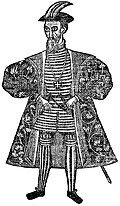
[[File:D._Pedro_Mascarenhas.jpg|thumb|upright|[[Pedro Mascarenhas]], [[List of governors of Portuguese India|Viceroy of Portuguese India]] and namesake of the [[Mascarene Islands]].]] | [[File:D._Pedro_Mascarenhas.jpg|thumb|upright|[[Pedro Mascarenhas]], [[List of governors of Portuguese India|Viceroy of Portuguese India]] and namesake of the [[Mascarene Islands]].]] | ||
The [[Treaty of Tordesillas]] purported to give [[Portugal]] the right to colonise this part of world. In 1507, | |||
The [[Treaty of Tordesillas]] purported to give the [[Kingdom of Portugal]] the right to colonise this part of the world. In 1507, Portuguese sailors came to the uninhabited island and established a visiting base. [[Diogo Fernandes Pereira]], a Portuguese navigator, was the first European known to land in Mauritius. He named the island "Ilha do Cisne" ("Island of the Swan"). The Portuguese did not stay long as they were not interested in these islands.<ref name="govt">{{Cite web |title=History |url=http://www.govmu.org/English/ExploreMauritius/Pages/History.aspx#dutch |access-date=22 January 2015 |website=Government of Mauritius |archive-date=16 October 2016 |archive-url=https://web.archive.org/web/20161016015207/http://www.govmu.org/English/ExploreMauritius/Pages/History.aspx#dutch }}</ref> | |||
The [[Mascarene Islands]] were named after [[Pedro Mascarenhas]], [[Viceroy of Portuguese India]], after his visit to the islands in 1512. | The [[Mascarene Islands]] were named after [[Pedro Mascarenhas]], [[Viceroy of Portuguese India]], after his visit to the islands in 1512. | ||
| Line 131: | Line 137: | ||
===Dutch Mauritius (1638–1710)=== | ===Dutch Mauritius (1638–1710)=== | ||
{{Main|Dutch Mauritius}} | {{Main|Dutch Mauritius}} | ||
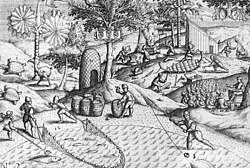
[[File:Het Tweede Boeck.jpg|thumb|Dutch activities on | |||
In 1598 a Dutch squadron under Admiral Wybrand Van Warwyck landed at [[Grand Port]] and named the island "Mauritius" after [[Maurice, Prince of Orange|Prince Maurice of Nassau]] ([[Dutch language|Dutch]]: ''Maurits van Nassau'') of the [[Dutch Republic]]. The Dutch inhabited the island in 1638, from which they exploited [[ebony]] trees and introduced [[sugar cane]], | [[File:Het Tweede Boeck.jpg|thumb|upright=1.35|left|Dutch activities on Mauritius, as well as the first published depiction of a [[dodo]] bird (2), 1601]] | ||
1755 article in the English ''[[Leeds Intelligencer]]'' claims that the island was abandoned due to the large number of [[long tailed macaque]] monkeys "which destroyed everything in it," and that it was also known at the time as the '''Island of Monkeys'''.<ref>{{ | |||
In 1598 a Dutch squadron under Admiral Wybrand Van Warwyck landed at [[Grand Port]] and named the island "Mauritius" after [[Maurice, Prince of Orange|Prince Maurice of Nassau]] ([[Dutch language|Dutch]]: ''Maurits van Nassau'') of the [[Dutch Republic]]. The Dutch inhabited the island in 1638, from which they exploited [[ebony]] trees and introduced [[sugar cane]], domestic animals and deer. It was from here that Dutch navigator [[Abel Tasman]] set out to seek the Great Southern Land, mapping parts of [[Tasmania]], New Zealand and [[New Guinea]]. The first Dutch settlement lasted 20 years. In 1639, slaves arrived in Mauritius from Madagascar. The Dutch East India Company brought them to cut down ebony trees and to work in the new tobacco and sugar cane plantations.<ref name="The slave trade on Mauritius">{{Cite web |title=The slave trade on Mauritius |url=https://www.roughguides.com/destinations/africa/mauritius/west-coast/le-morne-peninsula/slave-trade-mauritius |access-date=13 September 2020 |website=Rough Guides}}</ref> Several attempts to establish a colony permanently were subsequently made, but the settlements never developed enough to produce dividends, causing the Dutch to abandon Mauritius in 1710.<ref name="govt" /><ref>{{Cite web |title=History of Mauritius |url=http://culture.govmu.org/English//DOCUMENTS/PAMPHLET%20STRIPPED.PDF |access-date=22 January 2015 |website=Government of Mauritius}}</ref> A | |||
1755 article in the English ''[[Leeds Intelligencer]]'' claims that the island was abandoned due to the large number of [[long tailed macaque]] monkeys "which destroyed everything in it," and that it was also known at the time as the '''Island of Monkeys'''.<ref>{{Cite news |date=22 July 1755 |title=Sunday's POST |work=[[Leeds Intelligencer]] |url=https://www.britishnewspaperarchive.co.uk/viewer/bl/0000236/17550722/006/0002 |access-date=4 July 2021 |quote=The Island of Mauritius, which is also named the Island of Monkeys, on account of the Multitude of those Animals which destroyed everything in it, was discovered in 1698 by the Dutch, who named it Mauritius, of Maurice, of Orange, and quitted it by reason of the great Number of Monkeys on it.}}</ref> Portuguese sailors had brought these monkeys to the island from their native habitat in Southeast Asia, prior to Dutch rule.<ref>{{Cite web |title=Macaque monkeys on Mauritius, a sad monkey's tale|url=https://earthtimes.org/conservation/macaque-monkeys-mauritius-sad-monkey-tale/1501/ |access-date=12 March 2023 |website=earthtimes.org|date=11 October 2011 }}</ref> | |||
===French Mauritius (1715–1810)=== | ===French Mauritius (1715–1810)=== | ||
{{main|Isle de France (Mauritius)}} | {{main|Isle de France (Mauritius)}} | ||
France, which already controlled neighbouring Île Bourbon (now [[Réunion]]), took control of Mauritius in 1715 and renamed it [[Isle de France (Mauritius)|Isle de France]]. In 1723, the ''[[Code Noir]]'' was established to regulate | |||
France, which already controlled neighbouring Île Bourbon (now [[Réunion]]), took control of Mauritius in 1715 and renamed it [[Isle de France (Mauritius)|Isle de France]]. In 1723, the ''[[Code Noir]]'' was established to regulate slavery; categorise one group of human beings as "goods", for the owner of these goods to be able to obtain insurance money and compensation in case of loss of his "goods".<ref>{{Cite web |title=USIP |url=http://www.usip.org/sites/default/files/ROL/TJC_Vol1.pdf}}</ref> The 1735 arrival of French governor [[Bertrand-François Mahé de La Bourdonnais]] coincided with development of a prosperous economy based on sugar production. Mahé de La Bourdonnais established [[Port Louis]] as a naval base and a shipbuilding centre.<ref name="govt" /> Under his governorship, numerous buildings were erected, a number of which are still standing. These include part of Government House, the Château de Mon Plaisir, and the Line Barracks, the headquarters of the [[Mauritius Police Force|police force]]. The island was under the administration of the [[French East India Company]], which maintained its presence until 1767.<ref name="govt" /> During the French rule, slaves were brought from parts of Africa such as Mozambique and Zanzibar.<ref>{{Cite book |title=Creating the Creole Island: Slavery in Eighteenth-Century Mauritius |date=2005 |publisher=Duke University Press |isbn=978-0-8223-3402-6 |pages=277–304 |chapter=Notes |doi=10.1215/9780822386919-011}}</ref> As a result, the island's population rose dramatically from 15,000 to 49,000 within thirty years. During the late eighteenth century, African slaves accounted for around 80 percent of the island's population, and by the early nineteenth century there were 60,000 slaves on the island.<ref name="The slave trade on Mauritius" /> In early 1729, Indians from [[Pondicherry|Pondicherry, India]], arrived in Mauritius aboard the vessel ''La Sirène''. Work contracts for these craftsmen were signed in 1734 at the time when they acquired their freedom.<ref>{{Cite web |date=5 February 2004 |title=Tamouls, les racines de l'histoire |url=https://www.lexpress.mu/article/tamouls-les-racines-de-lhistoire |access-date=5 February 2004 |website=L'Express}}</ref> | |||
[[File:Combat de Grand Port mg 9425.jpg|thumb|The [[Battle of Grand Port]] between French and British naval forces, 20–27 August 1810]] | [[File:Combat de Grand Port mg 9425.jpg|thumb|The [[Battle of Grand Port]] between French and British naval forces, 20–27 August 1810]] | ||
From 1767 to 1810, except for a brief period during the [[French Revolution]] when the inhabitants set up a government virtually independent of France, the island was controlled by officials appointed by the French government. [[Jacques-Henri Bernardin de Saint-Pierre]] lived on the island from 1768 to 1771, then went back to France, where he wrote ''[[Paul et Virginie]]'', a love story that made the Isle de France famous wherever the French language was spoken. In 1796 the settlers broke away from French control when the government in Paris attempted to abolish slavery.<ref>{{ | |||
From 1767 to 1810, except for a brief period during the [[French Revolution]] when the inhabitants set up a government virtually independent of France, the island was controlled by officials appointed by the French government. [[Jacques-Henri Bernardin de Saint-Pierre]] lived on the island from 1768 to 1771, then went back to France, where he wrote ''[[Paul et Virginie]]'', a love story that made the [[Isle de France (Mauritius)|Isle de France]] famous wherever the French language was spoken. In 1796 the settlers broke away from French control when the government in Paris attempted to abolish slavery.<ref>{{Cite news |date=25 February 2019 |title=Mauritius profile – Timeline |work=[[BBC News]] |url=https://www.bbc.com/news/world-africa-13882731 |access-date=25 February 2019}}</ref> Two famous French governors were the Vicomte de Souillac (who constructed the Chaussée in Port Louis<ref name="Toussaint2">Port Louis, A tropical City, Auguste Toussaint. {{ISBN|0 04 969001 9}}</ref> and encouraged farmers to settle in the district of Savanne) and [[Antoine Bruni d'Entrecasteaux]] (who saw to it that the French in the Indian Ocean should have their headquarters in Mauritius instead of [[Pondicherry]] in India).<ref name="Toussaint">''A short History of Mauritius'', P.J. Barnwell & A. Toussaint</ref> [[Charles Mathieu Isidore Decaen]] was a successful general in the [[French Revolutionary Wars]] and, in some ways, a rival of [[Napoléon I]]. He ruled as [[Governor of Isle de France (Mauritius)|Governor of Isle de France]] and Réunion from 1803 to 1810. British naval [[cartographer]] and explorer [[Matthew Flinders]] was arrested and detained by General Decaen on the island from 1803 to 1810,<ref>{{Cite web |date=18 December 2015 |title=From Terra Australis to Australia Matthew Flinders' journeys |url=https://www.sl.nsw.gov.au/stories/terra-australis-australia/matthew-flinders-journeys |access-date=14 September 2020 |publisher=State Library of NSW}}</ref><ref>{{Cite web |last=Moheeputh |first=Anand |date=24 October 2003 |title=Matthew Flinders, an illustrious prisoner |url=https://www.lexpress.mu/article/matthew-flinders-illustrious-prisoner |access-date=24 October 2003 |website=L'Express}}</ref> in contravention of an order from Napoléon. During the [[Napoleonic Wars]], Mauritius became a base from which [[French corsairs]] organised successful raids on British commercial ships. The raids continued until 1810, when a [[Royal Navy]] expedition led by [[Commodore (Royal Navy)|Commodore]] [[Josias Rowley]], [[Royal Navy|R.N.]], an [[Anglo-Irish]] [[aristocracy (class)|aristocrat]], was sent to capture the island. Despite winning the [[Battle of Grand Port]] against the British, the [[Invasion of Île de France|French could not prevent the British from landing]] at [[Cap Malheureux]] three months later. They formally surrendered the island on the fifth day of the invasion, 3 December 1810,<ref name="Toussaint" /> on terms allowing settlers to keep their land and property and to use the French language and law of France in criminal and civil matters. Under British rule, the island's name reverted to Mauritius.<ref name="govt" /> The swift conquest of Mauritius was fictionalised in the novel ''[[The Mauritius Command]]'' by [[Patrick O'Brian]], first published in 1977. | |||
===British Mauritius (1810–1968)=== | ===British Mauritius (1810–1968)=== | ||
{{main|British Mauritius}} | {{main|British Mauritius}} | ||
[[File:Isle of France, 2 December 1810.jpg|thumb|British forces [[Invasion of Isle de France|seizing the Isle of France]] on 2 December 1810]] | [[File:Isle of France, 2 December 1810.jpg|thumb|British forces [[Invasion of Isle de France|seizing the Isle of France]] on 2 December 1810]] | ||
==== 1830–1835: British rule and reform ==== | ==== 1830–1835: British rule and reform ==== | ||
The British administration, which began with [[Robert Townsend Farquhar|Sir Robert Farquhar]] as [[Governor of British Mauritius|its first governor]], oversaw rapid social and economic changes. However, it was tainted by the [[Ratsitatanina|Ratsitatane]] episode. Ratsitatane, nephew of King Radama of [[Madagascar]], was brought to Mauritius as a political prisoner. He managed to escape from prison and plotted a rebellion that would free the island's slaves. He was betrayed by his associate Laizaf and was caught by a group of militiamen led by Franco-Mauritian lawyer [[Adrien d'Épinay]] and [[Summary execution|summarily executed]].<ref>{{Cite book |last=Carter |first=Marina |title=Murder and Mayhem in Mauritius: Historical Crime Stories |date=19 January 2015 |publisher=Pink Pigeon Press}}</ref> He was beheaded at Plaine Verte on 15 April 1822, and his head was displayed as a deterrent against possible slave rebellions.<ref name="Selvon">''A New Comprehensive History of Mauritius'', Sydney Selvon, 2012. {{ISBN|978-99949-34-91-1}}</ref> | |||
In 1832, d'Épinay launched the first Mauritian newspaper (''Le Cernéen''), which was not controlled by the government. In the same year, there was a move by the ''procureur-general'' to abolish slavery without compensation to the slave owners. This gave rise to discontent, and, to check an eventual rebellion, the government ordered all the inhabitants to surrender their arms. Furthermore, a stone fortress, Fort Adelaide, was built on a hill (now known as the Citadel hill) in the centre of Port Louis to quell any uprising.<ref name="Toussaint2" /> | |||
Slavery was gradually abolished over several years after 1833, and the planters ultimately received two million [[pounds sterling]] in compensation for the loss of their slaves, who had been imported from Africa and Madagascar during the French occupation.<ref>{{Cite web |title=Mauritius: Sugar, indentured labour and their consequences (1835–1910) |url=https://www.eisa.org/wep/mauoverview5.htm |access-date=20 September 2020 |publisher=EISA}}</ref><ref>{{Cite web |title=Legacies of British Slave-ownership project |url=https://www.ucl.ac.uk/lbs/search/ |access-date=7 July 2021 |publisher=University College London}}</ref> | |||
==== 1834–1921: Indian labour imported ==== | ==== 1834–1921: Indian labour imported ==== | ||
[[File:Visual Art of the first indentured Indian labourers arriving in Mauritius (1834).jpg|thumb | alt= Mixed emotions and feelings are portrayed |First indentured Indian workers (1834)]] | |||
The [[Abolitionism in the United Kingdom|abolition of slavery]] had important effects on Mauritius's society, economy and population. The planters brought a large number of [[Indentured servant|indentured labourers]] from India to work in the sugar cane fields. Between 1834 and 1921, around half a million indentured labourers were present on the island. They worked on sugar estates, factories, in transport and on construction sites. Additionally, the British brought 8,740 Indian soldiers to the island.<ref name="govt" /> [[Aapravasi Ghat]], in the bay at [[Port Louis]] and now a [[UNESCO]] site, was the first British colony to serve as a major reception centre for [[indentured servants]]. | |||
In 1885 [[Constitution of Mauritius (1885)|a new constitution]] was introduced. It was referred to as ''Cens Démocratique'' and it incorporated some of the principles advocated by one of the Creole leaders, Onésipho Beaugeard. It created elected positions in the Legislative Council | In 1885, [[Constitution of Mauritius (1885)|a new constitution]] was introduced. It was referred to as ''Cens Démocratique'' and it incorporated some of the principles advocated by one of the Creole leaders, [[Onésipho Beaugeard]]. It created elected positions in the Legislative Council – although the franchise was restricted mainly to the white French and fair-skinned Indian elite who owned real estate. In 1886, Governor [[John Pope Hennessy]] nominated [[Gnanadicarayen Arlanda]] as the first ever [[Indo-Mauritian]] member of the ruling council – despite the sugar oligarchy's preference for rival Indo-Mauritian [[Emile Sandapa]]. Arlanda served until 1891.<ref>{{Cite web |date=30 September 2012 |title=Nominated members pioneered by Pope Hennessy |url=https://www.lemauricien.com/actualites/politique/deputes-correctifs-nomines-gouverneur-john-pope-hennessy-en-fut-pionnier-avec-choix-conteste/114085/ |access-date=30 September 2012 |publisher=Le Mauricien}}</ref> | ||
Two main political parties were active at that time, the pro-Hennessy party being Sir [[William Newton (Mauritius)|William Newton]]'s Reform Party where as the anti-Hennessy party Democrats was led by Gustave de Coriolis and Onésipho Beaugeard.<ref>{{ | Two main political parties were active at that time, the pro-Hennessy party being Sir [[William Newton (Mauritius)|William Newton]]'s Reform Party where as the anti-Hennessy party Democrats was led by [[Gustave de Coriolis]] and [[Onésipho Beaugeard]].<ref>{{Cite web |date=2 June 2005 |title=Mauritian democracy: a caesarean birth |url=https://www.lexpress.mu/article/mauritian-democracy-caesarean-birth |access-date=3 December 2020 |website=L'Express}}</ref> | ||
[[File:Numa Desjardins Champ de Mars Port Louis 1880.jpg|thumb | [[File:Numa Desjardins Champ de Mars Port Louis 1880.jpg|thumb|[[Champ de Mars Racecourse]], Port Louis, 1880]] | ||
The labourers brought from India were not always fairly treated, and a German, Adolph von Plevitz, made himself the unofficial protector of these immigrants. He mixed with many of the labourers, and in 1871 helped them to write a petition that was sent to [[Arthur Hamilton-Gordon, 1st Baron Stanmore|Governor Gordon]]. A commission was appointed to look into the complaints made by the Indian immigrants, and in 1872 two lawyers, appointed by the British Crown, were sent from England to make an inquiry. This Royal Commission recommended several measures that would affect the lives of Indian labourers during the next fifty years.<ref name="Toussaint"/> | The labourers brought from India were not always fairly treated, and a German, [[Adolph von Plevitz]], made himself the unofficial protector of these immigrants. He mixed with many of the labourers, and in 1871 helped them to write a petition that was sent to [[Arthur Hamilton-Gordon, 1st Baron Stanmore|Governor Gordon]]. A commission was appointed to look into the complaints made by the Indian immigrants, and in 1872 two lawyers, appointed by the British Crown, were sent from England to make an inquiry. This Royal Commission recommended several measures that would affect the lives of Indian labourers during the next fifty years.<ref name="Toussaint" /> | ||
==== 1901–1914: Modernization and reform ==== | |||
In 1901, faster links were established with the island of Rodrigues thanks to [[radio|wireless]] communications.<ref name="Dinan">''Mauritius in the making across the censuses 1846–2000'', Monique Dinan. {{ISBN|99903-904-6-0}}</ref> | |||
In 1901, faster links were established with the island of Rodrigues thanks to | |||
In 1903, motorcars were introduced in Mauritius, and in 1910 the first taxis | In 1903, motorcars were introduced in Mauritius, and in 1910, the first taxis came into service. The electrification of Port Louis took place in 1909, and in the same decade the Mauritius Hydro Electric Company of the [[Amode Ibrahim Atchia|Atchia Brothers]] was authorised to provide power to the towns of upper [[Plaines Wilhems]]. | ||
[[File:The web of empire - a diary of the imperial tour of their Royal Highnesses the Duke and Duchess of Cornwall and York in 1901 (1902) (14763807672).jpg|thumb|Duke and Duchess of [[ | [[File:The web of empire - a diary of the imperial tour of their Royal Highnesses the Duke and Duchess of Cornwall and York in 1901 (1902) (14763807672).jpg|thumb|Visit of the Duke and Duchess of Cornwall and York (later [[George V|King George V]] and [[Mary of Teck|Queen Mary]]) to Mauritius, 1901]] | ||
The coat of arms of Mauritius was adopted in 1906, consisting of | The coat of arms of Mauritius was adopted in 1906, consisting of a [[Sambur deer]] and the extinct [[dodo]], which has currently been a symbol of national identity since independence.<ref>{{Cite web |title=Coat of Arms |url=http://www.gov.mu/portal/site/abtmtius/menuitem.64c8475c9c8cb1984d57241079b521ca/ |archive-url=https://web.archive.org/web/20060721150122/http://www.gov.mu/portal/site/abtmtius/menuitem.64c8475c9c8cb1984d57241079b521ca/ |archive-date=21 July 2006 |website=The Republic of Mauritius Web Portal}}</ref> | ||
The 1910s were a period of political agitation. The rising middle class (made up of doctors, lawyers, and teachers) began to challenge the political power of the sugar cane landowners. Dr. Eugène Laurent, mayor of Port Louis, was the leader of this new group; his party, Action Libérale, demanded that more people should be allowed to vote in the elections. Action Libérale was opposed by the Parti de l'Ordre, led by Henri Leclézio, the most influential of the sugar magnates.<ref name="Toussaint"/> | The 1910s were a period of political agitation. The rising middle class (made up of doctors, lawyers, and teachers) began to challenge the political power of the sugar cane landowners. Dr. [[Eugène Laurent]], mayor of Port Louis, was the leader of this new group; his party, [[Action Libérale]], demanded that more people should be allowed to vote in the elections. Action Libérale was opposed by the Parti de l'Ordre, led by [[Henri Leclézio]], the most influential of the sugar magnates.<ref name="Toussaint" /> | ||
In 1911, there were riots in Port Louis due to a false rumour that Dr. Eugène Laurent had been murdered by the oligarchs in Curepipe. This became known as the [[1911 Curepipe riots]]. Shops and offices were damaged in the capital, and one person was killed.<ref name="Dinan"/> | In 1911, there were riots in Port Louis due to a false rumour that Dr. [[Eugène Laurent]] had been murdered by the oligarchs in Curepipe. This became known as the [[1911 Curepipe riots]]. Shops and offices were damaged in the capital, and one person was killed.<ref name="Dinan" /> | ||
In the same year, 1911, the first public cinema shows took place in Curepipe, and, in the same town, a stone building was erected to house the Royal College.<ref name="Dinan"/> In 1912, a wider telephone network came into service, used by the government, business firms, and a few private households. | In the same year, 1911, the first public cinema shows took place in Curepipe, and, in the same town, a stone building was erected to house the Royal College.<ref name="Dinan" /> In 1912, a wider telephone network came into service, used by the government, business firms, and a few private households. | ||
==== 1914–1919: World War I prosperity ==== | ==== 1914–1919: World War I prosperity ==== | ||
==== 1920–1939: | [[World War I]] broke out in August 1914. Many Mauritians volunteered to fight in Europe against the Germans and in [[Mesopotamia]] against the Turks. But the war affected Mauritius much less than the wars of the eighteenth century. In fact, the 1914–1918 war was a period of great prosperity, due to a boom in sugar prices. In 1919, the Mauritius Sugar Syndicate came into being, which included 70% of all sugar producers.<ref name="Republic of Mauritius- History">{{Cite web |title=Republic of Mauritius- History |url=http://www.govmu.org/English/ExploreMauritius/Pages/History.aspx |access-date=29 May 2020 |website=govmu.org |archive-date=16 October 2016 |archive-url=https://web.archive.org/web/20161016015207/http://www.govmu.org/English/ExploreMauritius/Pages/History.aspx }}</ref> | ||
==== 1920–1939: Liberalisation and reaction ==== | |||
The 1920s saw the rise of a "retrocessionism" movement, which favoured the retrocession of Mauritius to France. The movement rapidly collapsed because none of the candidates who wanted Mauritius to be given back to France were elected in the 1921 elections. | The 1920s saw the rise of a "retrocessionism" movement, which favoured the retrocession of Mauritius to France. The movement rapidly collapsed because none of the candidates who wanted Mauritius to be given back to France were elected in the 1921 elections. | ||
In the post-war recession, there was a sharp drop in sugar prices. Many sugar estates closed down, marking the end of an era for the sugar magnates who had not only controlled the economy but also the political life of the country. | In the post-war recession, there was a sharp drop in sugar prices. Many sugar estates closed down, marking the end of an era for the sugar magnates who had not only controlled the economy but also the political life of the country. | ||
Raoul Rivet, the editor of ''Le Mauricien'' newspaper, campaigned for a revision of the constitution that would give the emerging middle class a greater role in the running of the country. The principles of [[Arya Samaj]] began to infiltrate the Hindu community, who clamoured for more social justice.<ref name="Dinan"/> | [[Raoul Rivet]], the editor of ''Le Mauricien'' newspaper, campaigned for a revision of the constitution that would give the emerging middle class a greater role in the running of the country. The principles of [[Arya Samaj]] began to infiltrate the Hindu community, who clamoured for more social justice.<ref name="Dinan" /> | ||
From the end of nominated Arlanda's term in 1891, until 1926, there had been no Indo-Mauritian representation in the Legislative Council. However, at the 1926 elections, Dunputh Lallah and Rajcoomar Gujadhur became the first [[Indo-Mauritians]] to be elected | From the end of nominated Arlanda's term in 1891, until 1926, there had been no Indo-Mauritian representation in the Legislative Council. However, at the 1926 elections, [[Dunputh Lallah]] and [[Rajcoomar Gujadhur]] became the first [[Indo-Mauritians]] to be elected to the Legislative Council. At Grand Port, Lallah won over rivals [[Fernand Louis Morel]] and [[Gaston Gebert]]; at Flacq, Gujadhur defeated [[Pierre Montocchio]].<ref>{{Cite web |date=2 July 2005 |title=Gujadhur and Lallah: Shock waves (1926) |url=https://www.lexpress.mu/article/gujadhur-and-lallah-shock-waves-1926 |access-date=2 July 2005 |website=L'Express}}</ref> | ||
1936 saw the birth of the [[Labour Party (Mauritius)|Labour Party]], launched by [[Maurice Curé]]. [[Emmanuel Anquetil]] rallied the urban workers while Pandit Sahadeo concentrated on the rural working class.<ref>{{ | 1936 saw the birth of the [[Labour Party (Mauritius)|Labour Party]], launched by [[Maurice Curé]]. [[Emmanuel Anquetil]] rallied the urban workers while [[Pandit Sahadeo]] concentrated on the rural working class.<ref>{{Cite web |last=Peerthum |first=Satyendra |date=18 February 2004 |title=The birth of the Mauritian Labour Party |url=https://www.lexpress.mu/article/birth-mauritian-labour-party |access-date=18 February 2004 |website=L'Express}}</ref> | ||
The [[Uba riots of 1937]] resulted in reforms by the local British government that improved labour conditions and led to the un-banning of labour unions.<ref name="js">{{Cite journal|title=Small-Scale Sugar Cane Farmers and Biotechnology in Mauritius: The "Uba" Riots of 1937 |journal = Agricultural History|volume = 69|issue = 2 | The [[Uba riots of 1937]] resulted in reforms by the local British government that improved labour conditions and led to the un-banning of labour unions.<ref name="js">{{Cite journal |last=Storey |first=William Kelleher |year=1995 |title=Small-Scale Sugar Cane Farmers and Biotechnology in Mauritius: The "Uba" Riots of 1937 |journal=Agricultural History |volume=69 |issue=2 |pages=163–176 |jstor=3744263}}</ref><ref name="rg">{{Cite journal |last1=Croucher |first1=Richard |last2=Mcilroy |first2=John |date=1 July 2013 |title=Mauritius 1937: The Origins of a Milestone in Colonial Trade Union Legislation |url=https://www.researchgate.net/publication/258935447 |journal=Labor History |volume=54 |issue=3 |pages=223–239 |doi=10.1080/0023656X.2013.804268 |access-date=18 August 2018 |s2cid=144176332}}</ref> Labour Day was celebrated for the first time in 1938. More than 30,000 workers sacrificed a day's wage and came from all over the island to attend a giant meeting at the Champ de Mars.<ref>''L'ile Maurice: Vingt-Cinq leçons d'Histoire (1598–1998)'', Benjamin Moutou. {{ISBN|99903-929-1-9}}</ref> | ||
Following the dockers' strikes, trade unionist [[Emmanuel Anquetil]] was deported to Rodrigues, [[Maurice Curé]] and Pandit Sahadeo were placed under house arrest, whilst numerous strikers were jailed. Governor Sir [[Bede Clifford]] assisted | Following the dockers' strikes, trade unionist [[Emmanuel Anquetil]] was deported to Rodrigues, [[Maurice Curé]] and [[Pandit Sahadeo]] were placed under house arrest, whilst numerous strikers were jailed. Governor Sir [[Bede Clifford]] assisted Mr [[Jules Leclezio]] of the Mauritius Sugar Syndicate to counter the effects of the strike by using alternative workers known as 'black legs'.<ref>{{Cite web |title=Report of Truth and Justice Commission |url=https://www.usip.org/sites/default/files/ROL/TJC_Vol1.pdf |access-date=25 October 2011 |publisher=Government of Mauritius |ref=ISBN 978-99903-1-025-2}}</ref> | ||
==== 1939–1945: World War II ==== | ==== 1939–1945: World War II ==== | ||
At the outbreak of [[World War II]] in 1939, many Mauritians volunteered to serve under the British flag in Africa and the Near East, fighting against the German and Italian armies. Some went to England to become pilots and ground staff in the [[Royal Air Force]]. Mauritius was never really threatened, but in 1943 several British ships were sunk outside Port Louis by German submarines. | At the outbreak of [[World War II]] in 1939, many Mauritians volunteered to serve under the British flag in Africa and the Near East, fighting against the German and Italian armies. Some went to England to become pilots and ground staff in the [[Royal Air Force]]. Mauritius was never really threatened, but in 1943, several British ships were sunk outside Port Louis by German submarines. In the initial stages of the war, locally recruited military formations were raised in order to defend the country in case the British imperial troops had to leave. Various formations such as the Home Guard, Coastal Defence Squadron and the Mauritian Royal Force were tasked with operating and working on flying boats in anticipation of possible naval raids or a Japanese invasion. On 24 March 1943, the [[Mauritius Regiment]], was created as an imperial unit and a new subsidiary of the East Africa Command (EAC), that could be used anywhere whereas previously Mauritian troops were only used for domestic affairs and garrisoning. In late 1943, the 1st Battalion of the Mauritius Regiment (1MR) was sent to Madagascar for training, and in their place a battalion of the [[King's African Rifles]] (KAR) was stationed in Mauritius. The dispatch of the 1MR proved to be politically unpopular on the basis of some troops resenting conscription and the battalion overseas comprising solely non-white troops, exacerbating racial tensions in the country. The 1MR troops were further aggrieved at the segregation they were subject to, unequal pay, physically demanding training, and were fearful of the Japanese soldiers, all these factors culminated in the 1MR mutinying.<ref>{{Cite journal |last=Jackson |first=Ashley |title=The Madagascar Mutiny of the First Battalion the Mauritius Regiment, December 1943 |date=2002 |url=https://www.jstor.org/stable/44230830 |journal=Journal of the Society for Army Historical Research |volume=80 |issue=323 |pages=232–250 |jstor=44230830 |issn=0037-9700}}</ref> | ||
During World War II, conditions were hard in the country; the prices of commodities doubled but workers' salaries increased only by 10 to 20 percent. There was civil unrest, and the colonial government censored all trade union activities. However, the labourers of Belle Vue Harel Sugar Estate went on strike on 27 September 1943.<ref>{{ | During World War II, conditions were hard in the country; the prices of commodities doubled but workers' salaries increased only by 10 to 20 percent. There was civil unrest, and the colonial government censored all trade union activities. However, the labourers of Belle Vue Harel Sugar Estate went on strike on 27 September 1943.<ref>{{Cite news |last=Karghoo |first=Christophe |title=Mémoire vivante |publisher=5plus.mu |agency=5Plus Dimanche |url=https://www.5plus.mu/node/14263 |access-date=27 September 2003}}</ref> Police officers eventually fired directly at the crowd, resulting in the deaths of four labourers: Soondrum Pavatdan (better known as Anjalay Coopen, a 32-year-old pregnant woman), Moonsamy Moonien (14-year-old boy), Kistnasamy Mooneesamy (37-year-old labourer), and Marday Panapen.<ref>{{Cite news |last=Peerthum |first=Satteeanund |title=Tribute to the Martyrs of Belle Vue Harel |work=L'Express |publisher=lexpress.mu |url=https://www.lexpress.mu/article/tribute-martyrs-belle-vue-harel |access-date=3 September 2003}}</ref> This became known as the [[1943 Belle Vue Harel Massacre]].<ref>''Our Struggle, 20th Century Mauritius'', Seewoosagur Ramgoolam, Anand Mulloo</ref><ref>{{Cite web |date=October 2007 |title=The historical significance of Anjalay Coopen |url=http://www.lexpress.mu/node/203804/ |access-date=22 January 2015 |website=[[L'Express (Mauritius)|L'Express]]}}</ref> Social worker and leader of the Jan Andolan movement [[Basdeo Bissoondoyal]] organised the funeral ceremonies of the four dead labourers.<ref>{{Cite news |last1=Peerthum |first1=Satteeanund |last2=Peerthum |first2=Satyendra |title=Labour Day: Remembering the Martyrdom of Anjalay |work=L'Express |publisher=lexpress.mu |url=https://www.lexpress.mu/article/labour-day-remembering-martyrdom-anjalay |access-date=28 April 2005}}</ref> | ||
Three months later, on December | Three months later, on 12 December 1943, Bissoondoyal organised a mass gathering at "Marie Reine de la Paix" in Port Louis, and the significant crowd of workers from all over the island confirmed the popularity of his movement Jan Andolan.<ref>{{Cite web |last=Soobarah |first=Paramanund |date=29 April 2019 |title=MBC defeats a government initiative |url=http://www.mauritiustimes.com/mt/the-mbc-defeats-a-government-initiative/ |access-date=29 April 2019 |website=Mauritius Times}}</ref> | ||
==== 1945–1960: Postwar politics, universal suffrage ==== | ==== 1945–1960: Postwar politics, universal suffrage ==== | ||
[[ | After the proclamation of the new [[1947 Constitution of Mauritius]], the general elections were held on 9 August 1948 – and, for the first time, the colonial government expanded the franchise to all adults who could write their name in one of the island's 19 languages, abolishing the previous gender and property qualifications.<ref name="CD">{{Cite web |title=Mauritius - Toward Independence |url=http://www.country-data.com/cgi-bin/query/r-8615.html |access-date=12 March 2023 |website=country-data.com}}</ref><ref>{{Cite encyclopedia |title=Mauritius: The road to independence (1945–1968) |encyclopedia=African Democracy Encyclopaedia Project |publisher=[[Electoral Institute for Sustainable Democracy in Africa]] |url=https://www.eisa.org/wep/mauoverview7.htm |access-date=1 July 2021 |date=September 2009 |archive-url=https://web.archive.org/web/20210508100629/https://www.eisa.org/wep/mauoverview7.htm |archive-date=8 May 2021 |url-status=live}}</ref> | ||
[[Guy Rozemont]]'s [[Labour Party (Mauritius)|Labour Party]] won the majority of the votes with 11 of the 19 elected seats won by [[Hinduism|Hindus]]. However, the [[Governor of British Mauritius|Governor-General]] [[Donald Mackenzie-Kennedy]] appointed 12 Conservatives to the Legislative Council on 23 August 1948 to perpetuate the predominance of white [[Franco-Mauritians]].<ref>[https://www.thegazette.co.uk/London/issue/38395/page/4816/data.pdf Colonial Office, The Church House] ''The London Gazette'', 3 September 1948</ref><ref name=CD/> In 1948, [[Emilienne Rochecouste]] became the first woman to be elected to the Legislative Council, serving until 1953.<ref name="RR">Ramola Ramtohul (2009) [https://www.researchgate.net/publication/283122722_Engendering_Mauritian_History_The_Hidden_Controversies_over_Female_Suffrage Engendering Mauritian History: The HiddenControversies over Female Suffrage] ''Afrika Zamani'', No. 17, pp63–80</ref> | |||
Guy Rozemont's party | [[Guy Rozemont]]'s party bettered its position in 1953, and, on the strength of the election results, demanded [[universal suffrage]]. Constitutional conferences were held in London in 1955 and 1957, and the ministerial system was introduced. Voting took place for the first time on the basis of universal adult suffrage on 9 March 1959. The general election was again won by the Labour Party, led this time by Sir [[Seewoosagur Ramgoolam]].<ref name="ram">{{Cite news |title=Histoire: Mauritius Independence 1961–1968 |work=Le Mauricien=9 March 2014 |url=http://www.lemauricien.com/article/histoire-mauritius-independence-1961-1968 |access-date=9 September 2014}}</ref> | ||
==== 1960–1968: Ethnic tensions ==== | ==== 1960–1968: Ethnic tensions ==== | ||
| Line 233: | Line 239: | ||
A Constitutional Review Conference was held in London in 1961, and a programme of further constitutional advance was established. The 1963 election was won by the Labour Party and its allies. The [[Colonial Office]] noted that politics of a communal nature was gaining ground in Mauritius and that the choice of candidates (by parties) and the voting behaviour (of electors) were governed by ethnic and caste considerations.<ref name=ram/> Around that time, two eminent British academics, [[Richard Titmuss]] and [[James Meade]], published a report of the island's social problems caused by overpopulation and the monoculture of sugar cane. This led to an intense campaign to halt the population explosion, and the decade registered a sharp decline in population growth. | A Constitutional Review Conference was held in London in 1961, and a programme of further constitutional advance was established. The 1963 election was won by the Labour Party and its allies. The [[Colonial Office]] noted that politics of a communal nature was gaining ground in Mauritius and that the choice of candidates (by parties) and the voting behaviour (of electors) were governed by ethnic and caste considerations.<ref name=ram/> Around that time, two eminent British academics, [[Richard Titmuss]] and [[James Meade]], published a report of the island's social problems caused by overpopulation and the monoculture of sugar cane. This led to an intense campaign to halt the population explosion, and the decade registered a sharp decline in population growth. | ||
In early 1965, a political assassination took place in the suburb of Belle-Rose, in the town of Quatre Bornes, where Labour activist Rampersad Surath was beaten to death by thugs of rival party Parti Mauricien.<ref>{{ | In early 1965, a political assassination took place in the suburb of Belle-Rose, in the town of Quatre Bornes, where Labour activist [[Rampersad Surath]] was beaten to death by thugs of rival party [[Parti Mauricien Social Démocrate|Parti Mauricien]].<ref>{{Cite news |title=Sécurité: des gros bras indispensables à certains politiciens |work=L'Express |publisher=lexpress.mu |url=https://www.lexpress.mu/article/350433/securite-gros-bras-indispensables-certains-politiciens |access-date=2 April 2019}}</ref><ref>{{Cite news |last=Li Ching Hum |first=Philip |title=Belle Rose-Quatre Bornes, Ville des Fleurs |work=Mauritius Times |url=http://www.mauritiustimes.com/mt/belle-rose-quatre-bornes-ville-des-fleurs/ |access-date=22 December 2017}}</ref> | ||
On 10 May 1965, [[1965 Mauritius race riots|racial riots]] broke out in the village of ''Trois Boutiques'' near [[Souillac, Mauritius|Souillac]] and progressed to the historic village of [[Mahébourg]]. A nationwide | On 10 May 1965, [[1965 Mauritius race riots|racial riots]] broke out in the village of ''Trois Boutiques'' near [[Souillac, Mauritius|Souillac]] and progressed to the historic village of [[Mahébourg]]. A nationwide [[state of emergency]] was declared on the whole British colony. The riot was initiated by the murder of Police Constable Beesoo in his vehicle by a Creole gang. This was followed by the murder of a civilian named Mr. Robert Brousse in Trois Boutiques.<ref>{{Cite news |last=Li Ching Hum |first=Philip |date=9 March 2018 |title=The downside of freedom |publisher=Defimedia |agency=Le Defi |url=https://defimedia.info/downside-freedom |access-date=9 March 2018}}</ref> The Creole gang then proceeded to the coastal historic village of Mahébourg to assault the Indo-Mauritian spectators who were watching a Hindustani movie at Cinéma Odéon. Mahébourg police recorded nearly 100 complaints of assaults on Indo-Mauritians.<ref name="vm">{{Cite web |date=18 July 2014 |title=Port Louis – Rioting against Independence at the General Elections of 1967 – Vintage Mauritius |url=http://vintagemauritius.org/port-louis/port-louis-rioting-independence-general-elections-1967/ |access-date=15 August 2018 |website=Vintage Mauritius |language=en-US}}</ref> | ||
===Independence (since 1968)=== | ===Independence (since 1968)=== | ||
{{main|Mauritius (1968–1992)}} | {{main|Mauritius (1968–1992)}} | ||
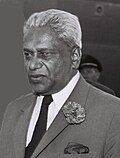
Later in 1965, after the Lancaster Conference, the [[Chagos Archipelago]] was excised from the territory of Mauritius to form the [[British Indian Ocean Territory]] (BIOT). A general election took place on 7 August 1967, and the [[Independence Party (Mauritius)|Independence Party]] obtained the majority of seats. In January 1968, six weeks before the declaration of independence the [[1968 Mauritian riots]] occurred in Port Louis leading to the deaths of 25 people.<ref name="mg">{{ | [[File:Seewoosagur Ramgoolam.jpg|thumb|upright|Sir [[Seewoosagur Ramgoolam]], first [[Prime Minister of Mauritius]] at Lod airport, Israel 1962]] | ||
At the Lancaster Conference of 1965, it became clear that Britain wanted to relieve itself of the colony of Mauritius. In 1959, [[Harold Macmillan]] had made his famous "[[Wind of Change (speech)|Wind of Change Speech]]" in which he acknowledged that the best option for Britain was to give complete independence to its colonies. Thus, since the late fifties, the way was paved for independence.<ref>{{Cite news |date=12 March 2014 |title=Why independence was irresistible (by Anand Moheeputh) |work=L'Express |url=http://www.lexpress.mu/node/243359/}}</ref> | |||
Later in 1965, after the Lancaster Conference, the [[Chagos Archipelago]] was excised from the territory of Mauritius to form the [[British Indian Ocean Territory]] (BIOT). A general election took place on 7 August 1967, and the [[Independence Party (Mauritius)|Independence Party]] obtained the majority of seats. In January 1968, six weeks before the declaration of independence the [[1968 Mauritian riots]] occurred in Port Louis leading to the deaths of 25 people.<ref name="mg">{{Cite web |date=6 October 2011 |title=An eye witness account of the 1968 riots |url=http://www.mauritiusmag.com/?p=598 |access-date=15 August 2018 |website=mauritiusmag.com |language=en-US}}</ref><ref name="eisa">{{Cite web |title=EISA Mauritius: The road to independence (1945–1968) |url=https://www.eisa.org.za/wep/mauoverview7.htm |access-date=15 August 2018 |website=eisa.org.za}}</ref> | |||
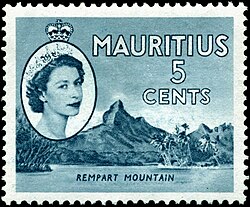
[[File:Stamp Mauritius 1954 5c.jpg|thumb|upright|[[Elizabeth II]] was [[Queen of Mauritius]] from 1968 to 1992.]] | [[File:Stamp Mauritius 1954 5c.jpg|thumb|upright|[[Elizabeth II]] was [[Queen of Mauritius]] from 1968 to 1992.]] | ||
The coalition government of the Labour Party and the PMSD (Parti Mauricien Social Démocrate) reacted by curtailing civil liberties and curbing freedom of the press.<ref name="Dinan"/> Two unsuccessful apparent assassination attempts were made against Paul Bérenger: | Mauritius adopted a new constitution, and independence was proclaimed on 12 March 1968. Sir [[Seewoosagur Ramgoolam]] became the first prime minister of an independent Mauritius – with [[Queen Elizabeth II]] remaining head of state as Queen of Mauritius. In 1969, the opposition party, [[Mauritian Militant Movement]] (MMM), was founded, led by [[Paul Bérenger]]. Later, in 1971, the MMM – backed by unions – called a series of strikes in the port, which caused a state of emergency in the country.<ref>{{Cite news |title=Mauritius profile |work=BBC News |url=https://www.bbc.co.uk/news/world-africa-13882731 |access-date=27 November 2012}}</ref> | ||
* On October | |||
The coalition government of the Labour Party and the PMSD (Parti Mauricien Social Démocrate) reacted by curtailing civil liberties and curbing [[freedom of the press]].<ref name="Dinan" /> Two unsuccessful apparent assassination attempts were made against Paul Bérenger: | |||
* On 1 October 1971, his supporter [[Fareed Muttur]] died in suspicious circumstances at Le Réduit, whilst driving Paul Bérenger's car.<ref>{{Cite web |title=Déjeuner à Rose Hill: Fareed Muttur est mort à ma place |date=18 July 2017 |url=https://www.lemauricien.com/le-mauricien/dejeuner-rose-hill-fareed-muttur-mort-ma-place-declare-paul-berenger/151890/ |access-date=18 July 2017 |publisher=Le Mauricien}}</ref> | |||
* The second led to the death of [[Azor Adelaide|Azor Adélaïde]], a dock worker and activist, on 25 November 1971.<ref>{{Cite news |date=25 June 2015 |title=Affaire Azor Adélaïde |work=Le Mauricien |url=http://www.lemauricien.com/article/affaire-azor-adelaide-reedition-du-livre-d-eric-bahloo-fils-l-des-condamnes/}}</ref> | |||
General elections were postponed and public meetings were prohibited. Members of the MMM, including Paul Bérenger, were imprisoned on 23 December 1971. The MMM leader was released a year later.<ref>{{Cite news |last=K.A. Cassimally |date=17–23 March 2016 |title=Why are we not taught our own history? |work=Weekly Magazine}}</ref> | |||
In May 1975, a student revolt that started at the [[University of Mauritius]] swept across the country.<ref>{{Cite web |title=HISTOIRE: Un des hommes derrière le 20 mai 75 raconte |url=http://www.lemauricien.com/actualites/magazine/histoire-des-hommes-derriere-20-mai-75-raconte/31853/ |website=Le Mauricien|date=8 June 2015 }}</ref> The students were unsatisfied with an education system that did not meet their aspirations, and that gave limited prospects for future employment. On 20 May, thousands of students tried to enter Port-Louis over the Grand River North West bridge, and clashed with police. An act of Parliament was passed on 16 December 1975 to extend the right to vote to 18-year-olds. This was seen as an attempt to appease the frustration of the younger generation.<ref name="Selvon" /> | |||
The next general elections took place on [[1976 Mauritian general election|20 December 1976]]. The Labour-CAM coalition won only 28 seats out of 62.<ref>''Untold Stories, A Collection of Socio-Political Essays, 1950–1995'', Sir Satcam Boolell, EOI. {{ISBN|99903-0-234-0}}</ref> The MMM secured 34 seats in Parliament but outgoing Prime Minister Sir [[Seewoosagur Ramgoolam]] managed to remain in office, with a two-seat majority, after striking an alliance with the PMSD of [[Gaetan Duval]]. | |||
In 1982 an [[Mauritian Militant Movement|MMM]]-[[Parti Socialiste Mauricien|PSM]] government (led by [[List of prime ministers of Mauritius|PM]] [[Anerood Jugnauth]], [[Deputy Prime Minister of Mauritius|Deputy PM]] [[Harish Boodhoo]] and Finance Minister [[Paul Bérenger]]) was elected. However, ideological and personality differences emerged within the MMM and PSM leadership. The power struggle between Bérenger and Jugnauth peaked in March 1983. Jugnauth travelled to New Delhi to attend a [[Non-Aligned Movement]] summit; on his return, Bérenger proposed constitutional changes that would strip power from the Prime Minister. At Jugnauth's request, PM [[Indira Gandhi]] of India planned an armed intervention involving the [[Indian Navy]] and [[Indian Army]] to prevent a coup under the code name [[Operation Lal Dora]].<ref>{{Cite news |date=10 March 2013 |title=When India drew Top Secret 'red line' in Mauritius |work=The Hindu |url=http://www.thehindu.com/todays-paper/when-india-drew-top-secret-red-line-in-mauritius/article4493495.ece |access-date=22 March 2013}}</ref><ref>{{Cite news |last=Medcalf |first=Rory |date=19 March 2013 |title=When India (Almost) Invaded Mauritius |work=The Diplomat |url=https://thediplomat.com/flashpoints-blog/2013/03/19/when-india-almost-invaded-mauritius/ |access-date=22 March 2013}}</ref><ref>{{Cite book |first=David |last=Brewster |url=https://www.academia.edu/7992843 |title=India's Ocean: the Story of India's Bid for Regional Leadership}}. Retrieved 13 August 2014</ref> | |||
That period saw growth in the EPZ (Export Processing Zone) sector. Industrialisation began to spread to villages as well, and attracted young workers from all ethnic communities. As a result, the sugar industry began to lose its hold on the economy. Large retail chains began opening stores in 1985 and offered credit facilities to low-income earners, thus allowing them to afford basic household appliances. There was also a boom in the tourism industry, and new hotels sprang up throughout the island. In 1989 the stock exchange opened its doors and in 1992 the freeport began operation.<ref name="Dinan"/> In 1990, the [[List of prime ministers of Mauritius|Prime Minister]] lost the vote on changing the Constitution to make the country a republic with Bérenger as president.<ref>{{ | The [[Mauritian Militant Movement|MMM]]-[[Parti Socialiste Mauricien|PSM]] government split up nine months after the June 1982 election. According to an Information Ministry official the nine months was a "socialist experiment".<ref>{{Cite news |first=John D. |last=Battersby |date=28 December 1987 |title=Port Louis Journal; Land of Apartheid Befriends an Indian Ocean Isle |work=[[The New York Times]] |url=https://www.nytimes.com/1987/12/28/world/port-louis-journal-land-of-apartheid-befriends-an-indian-ocean-isle.html |access-date=29 December 2016}}</ref> [[Harish Boodhoo]] dissolved his party [[Parti Socialiste Mauricien|PSM]] to enable all PSM parliamentarians to join Jugnauth's new party MSM, thus remaining in power whilst distancing themselves from [[Mauritian Militant Movement|MMM]].<ref>{{Cite web |last1=Lodge |first1=Tom |last2=Kadima |first2=Denis |last3=Pottie |first3=David |title=Mauritius: General election of August 1983 |url=https://www.eisa.org/wep/mau1983background.htm |access-date=28 November 2020 |publisher=EISA}}</ref> The MSM-Labour-PMSD coalition was victorious at the [[1983 Mauritian general election|August 1983]] elections, resulting in [[Anerood Jugnauth]] as PM and [[Gaëtan Duval]] as [[Deputy Prime Minister of Mauritius|Deputy PM]]. | ||
That period saw growth in the EPZ (Export Processing Zone) sector. Industrialisation began to spread to villages as well, and attracted young workers from all ethnic communities. As a result, the sugar industry began to lose its hold on the economy. Large retail chains began opening stores in 1985 and offered credit facilities to low-income earners, thus allowing them to afford basic household appliances. There was also a boom in the tourism industry, and new hotels sprang up throughout the island. In 1989 the stock exchange opened its doors, and in 1992, the freeport began operation.<ref name="Dinan" /> In 1990, the [[List of prime ministers of Mauritius|Prime Minister]] lost the vote on changing the Constitution to make the country a republic with Bérenger as president.<ref>{{Cite news |first=Jane |last=Perlez |date=27 August 1990 |title=Mauritius' Political Quarrel Saves the Queen |work=The New York Times |location=Great Britain; Mauritius |url=https://www.nytimes.com/1990/08/27/world/mauritius-political-quarrel-saves-the-queen.html |access-date=6 September 2016}}</ref> | |||
===Republic (since 1992)=== | ===Republic (since 1992)=== | ||
On 12 March 1992, twenty-four years after independence, Mauritius was proclaimed a republic within the [[Commonwealth of Nations]] and the British monarch removed as head of state.<ref name="govt" /> The last [[Governor-General of Mauritius]], [[Veerasamy Ringadoo|Sir Veerasamy Ringadoo]], became the first [[President of Mauritius|President]].<ref>{{Cite book |url=https://books.google.com/books?id=Bh7zAAAAMAAJ&q=The+last+Governor+General,+Sir+Veerasamy+Ringadoo+became+the+first+President |title=AAPS Newsletter |volume=1|issue= 5–19|page=20|date=1992 |publisher=African Association of Political Science |language=en}}</ref> This was under a transitional arrangement, in which he was replaced by [[Cassam Uteem]] later that year.<ref>{{Cite book |url=https://books.google.com/books?id=aM0bAQAAMAAJ&q=Cassam+Uteem |title=Country Profile: Mauritius, Seychelles |page=8|date=2001 |publisher=The Unit |language=en}}</ref> Political power remained with the prime minister. | |||
Despite an improvement in the economy, which coincided with a fall in the price of petrol and a favourable dollar exchange rate, the government did not enjoy full popularity. As early as 1984, there was discontent. Through the ''Newspapers and Periodicals Amendment Act'', the government tried to make every newspaper provide a bank guarantee of half a million rupees. Forty-three journalists protested by participating in a public demonstration in Port Louis, in front of Parliament. They were arrested and freed on bail. This caused a public outcry and the government had to review its policy.<ref name="Dinan" /> | |||
There was also dissatisfaction in the education sector. There were not enough high-quality secondary colleges to answer the growing demand of primary school leavers who had got through their CPE (Certificate of Primary Education). In 1991, a master plan for education failed to get national support and contributed to the government's downfall.<ref name="Dinan" /> | |||
In December 1995, [[Navin Ramgoolam]] was elected as [[List of prime ministers of Mauritius|PM]] of the Labour–MMM alliance. In October 1996, the triple murder of political activists at Gorah-Issac Street in Port Louis led to several arrests and a long investigation.<ref>{{Cite web |title=Shooting death of 3 Hizbullah activists at Gorah-Issac Rd |url=https://www.refworld.org/docid/3df4be75c.html |access-date=28 November 2020 |publisher=United Nations High Commission for Refugees}}</ref> | |||
[[ | The year 1999 was marked by civil unrest and riots in [[1999 Mauritian riots|February]] and then in [[1999 L'Amicale riots|May]]. Following the Kaya riots, President [[Cassam Uteem]] and Cardinal [[Jean Margéot]] toured the country and calm was restored after four days of turmoil.<ref>L'Express, Vendredi 26 février 1999</ref> A commission of enquiry was set up to investigate the root causes of the social disturbance. The resulting report delved into the cause of poverty and qualified many tenacious beliefs as perceptions.<ref>Rapport du Juge Matadeen sur les émeutes de 1999, Imprimerie du Gouvernement, 2000</ref> In January 2000, political activist Rajen Sabapathee was shot dead after he escaped from La Bastille jail.<ref>{{Cite web |title=La vérité sur la mort de mon père |url=https://www.5plus.mu/node/13712 |access-date=28 November 2020 |publisher=5 Plus}}</ref> | ||
[[File:Mauriceybbrfrinwodas.jpg|thumbnail|Perceived failure of [[Government of Mauritius|the government]] to respond promptly and effectively to the [[MV Wakashio oil spill|MV ''Wakashio'' oil spill]] resulted in anti-government protests.]] | |||
Sir [[Anerood Jugnauth]] of the MSM returned to power in September 2000 after securing an alliance with the MMM. In 2002, the island of [[Rodrigues]] became an autonomous entity within the republic and was thus able to elect its own representatives to administer the island. In 2003, the [[List of prime ministers of Mauritius|prime ministership]] was transferred to [[Paul Bérenger]] of the MMM, and Sir Anerood Jugnauth became President. Bérenger was the first Franco-Mauritian Prime Minister in the country's post-Independence history. | |||
In [[2005 Mauritian general election|2005 elections]], Navin Ramgoolam became PM under the new coalition of Labour–PMXD–VF–MR–MMSM. In the [[2010 Mauritian general election|2010 elections]] the Labour–MSM–PMSD alliance secured power and Navin Ramgoolam remained PM until 2014.<ref>{{Cite web |title=afrol News – Mauritius PM starts third term |url=http://www.afrol.com/articles/36129 |access-date=24 July 2021 |website=afrol.com}}</ref> | |||
The MSM–PMSD–ML coalition was victorious at the [[2014 Mauritian general election|2014 elections]] under Anerood Jugnauth's leadership. Despite disagreements within the ruling alliance that led to the departure of PMSD, the MSM–ML stayed in power for their full 5-year term.<ref>{{Cite web |title=Mauritius opposition wins surprise landslide victory |date=12 December 2014 |url=https://www.dw.com/en/mauritius-opposition-wins-surprise-landslide-victory/a-18125376 |access-date=24 July 2021 |publisher=Deutsche Welle |language=en-GB}}</ref> | |||
On 21 January 2017, Sir Anerood Jugnauth announced his resignation and that his son and Finance Minister [[Pravind Jugnauth]] would assume the office of prime minister.<ref>{{Cite web |first=Bob |last=Minzesheimer |date=22 January 2017 |title=Mauritius: PM Anerood Jugnauth to hand over to son |url=https://www.bbc.com/news/world-africa-38709203 |access-date=22 January 2017 |website=BBC News}}</ref> The transition took place as planned on 23 January 2017.<ref>{{Cite web |first=Jean Paul |last=Arouff |date=23 January 2017 |title=New Mauritius PM takes over from father, opponents cry foul |url=https://www.reuters.com/article/us-mauritius-politics-idUSKBN15715K |access-date=23 January 2017 |work=Reuters}}</ref> | |||
On 25 July 2020, Japanese-owned bulk carrier MV Wakashio ran aground on a coral reef off the coast of Mauritius, leaking up to 1,000 tonnes of heavy oil into a pristine lagoon.<ref>{{ | In 2018, Mauritian president [[Ameenah Gurib-Fakim]] resigned over a financial scandal.<ref>{{Cite news |date=13 March 2018 |title=Africa's only female president to quit |work=BBC News |url=https://www.bbc.com/news/world-africa-43343550}}</ref> The incumbent president is [[Prithvirajsing Roopun]]<ref>{{Cite web |title=Office of the President – Home |url=http://president.govmu.org/English/Pages/default.aspx |archive-url=https://web.archive.org/web/20150508045133/http://president.govmu.org/English/Pages/default.aspx |archive-date=8 May 2015 |access-date=22 February 2019 |website=Government of Mauritius}}</ref> who has served since December 2019. | ||
In the November 2019 [[2019 Mauritius General Elections|Mauritius general elections]], the ruling [[Militant Socialist Movement]] (MSM) won more than half of the seats in parliament, securing incumbent Prime Minister [[Pravind Jugnauth|Pravind Kumar Jugnauth]] a new five-year term.<ref>{{Cite news |date=8 November 2019 |title=Mauritius elects incumbent PM for five-year term |work=Reuters.com |agency=Reuters |url=https://www.reuters.com/article/us-mauritius-election-idUSKBN1XI177}}</ref> | |||
On 25 July 2020, Japanese-owned bulk carrier MV Wakashio ran aground on a coral reef off the coast of Mauritius, leaking up to 1,000 tonnes of heavy oil into a pristine lagoon.<ref>{{Cite news |date=24 September 2020 |title=Mauritius takes stock of oil spill two months later |publisher=France 24 |url=https://www.france24.com/en/20200924-mauritius-takes-stock-of-oil-spill-two-months-later}}</ref> Its location on the edge of protected fragile marine ecosystems and a wetland of international importance made the [[MV Wakashio oil spill|''MV Wakashio'' oil spill]] one of the worst [[environmental disaster]]s ever to hit the western Indian Ocean.<ref>{{Cite web |date=28 August 2020 |title=Mauritius oil spill compensation could be limited by maritime law technicality |url=https://www.climatechangenews.com/2020/08/28/mauritius-oil-spill-compensation-limited-maritime-law-technicality/ |access-date=24 July 2021 |website=Climate Home News}}</ref> | |||
==Geography== | ==Geography== | ||
{{main|Geography of Mauritius}} | {{main|Geography of Mauritius}} | ||
The total land area of the country is {{convert| | |||
The total land area of the country is {{convert|2040|km2|abbr=on}}. It is the [[List of countries and outlying territories by total area|170th largest nation]] in the world by size. The Republic of Mauritius comprises Mauritius Island and [[Outer Islands of Mauritius|several outlying islands]]. The nation's [[exclusive economic zone]] covers about {{convert|2.3|e6km2|sqmi|abbr=unit}} of the Indian Ocean, including approximately {{convert|400000|km2|abbr=on}} jointly managed with the [[Seychelles]].<ref>{{Cite magazine |title=Mauritius: Promoting the Development of an Ocean Economy |url=https://intercontinentaltrust.com/wp-content/uploads/2016/09/ITL-Newsletter-Vol-6-Issue-11-Mauritius-Exclusive-Economic-Zone.pdf |url-status=live |magazine=Intercontinental Trust Newsletter |archive-url=https://web.archive.org/web/20131109075149/http://www.intercontinentaltrust.com/admin/documents/all/ITL%20Newsletter%20Vol%206%20Issue%2011%20-%20Mauritius%20Exclusive%20Economic%20Zone.pdf |archive-date=9 November 2013 |access-date=25 November 2022}}</ref><ref>{{Cite web |title=National Coast Guard |url=http://police.govmu.org/English/Publication/Documents/NCG2013.pdf |access-date=22 January 2015 |website=Government of Mauritius}}</ref><ref>{{Cite web |title=Commission on the Limits of the Continental Shelf (CLCS) Outer limits of the continental shelf beyond 200 nautical miles from the baselines:Submissions to the Commission: Joint submission by the Republic of Mauritius and the Republic of Seychelles |url=https://www.un.org/Depts/los/clcs_new/submissions_files/submission_musc.htm |access-date=22 January 2015 |publisher=United Nations}}</ref> | |||
===Mauritius Island=== | ===Mauritius Island=== | ||
Mauritius is {{convert|2000|km|abbr=on}} off the southeast coast of Africa, between latitudes [[19th parallel south|19°58.8'S]] and [[20th parallel south|20°31.7'S]] and longitudes [[57th meridian east|57°18.0'E]] and [[57th meridian east|57°46.5'E]]. It is {{convert|65|km|abbr=on|round=5}} long and {{convert|45|km|abbr=on|round=5}} wide. Its land area is {{convert|1864.8|km2|abbr=on}}.<ref>{{Cite web |date=May 2008 |title=Meteorological Services − Monthly Bulletin of Climatological Summaries |url=http://metservice.intnet.mu/pdfs/monthly-climatological-summaries.pdf |access-date=22 January 2015 |publisher=Mauritius Meteorological Services |page=3}}</ref><ref>{{Cite web |title=General Info – Geography |url=http://www.mauritius.net/general_info/index.php |archive-url=https://web.archive.org/web/20120212061824/http://www.mauritius.net/general_info/index.php |archive-date=12 February 2012 |access-date=22 January 2015 |publisher=Mauritius.net}}</ref> The island is surrounded by more than {{convert|150|km|4=-2|abbr=on}} of white sandy beaches, and the lagoons are protected from the open sea by the world's third-largest coral reef, which surrounds the island.<ref>{{Cite web |title=Tourism − Overview of Mauritius |url=http://tourism.govmu.org/English/Tourism%20sector/Pages/Overview-of-Mauritius.aspx |archive-url=https://web.archive.org/web/20150403131312/http://tourism.govmu.org/English/Tourism%20sector/Pages/Overview-of-Mauritius.aspx |archive-date=3 April 2015 |access-date=4 January 2012 |website=Government of Mauritius}}</ref> Just off the Mauritian coast lie some 49 uninhabited islands and [[Islets of Mauritius|islets]], several of which have been declared natural reserves for endangered species. | |||
Mauritius Island ([[Mauritian Creole]]: ''Isle Moris''; {{lang-fr|Île Maurice}}, {{IPA-fr|il mɔʁis|pron}}) is relatively young geologically, having been created by volcanic activity some 8 million years ago. Together with Saint Brandon, Réunion, and Rodrigues, the island is part of the [[Mascarene Islands]]. These islands emerged as a result of gigantic underwater volcanic eruptions that happened thousands of kilometres to the east of the continental block made up of Africa and Madagascar.<ref name="territory"/> They are no longer volcanically active and the [[Réunion hotspot|hotspot]] now rests under Réunion Island. Mauritius is encircled by a broken ring of mountain ranges, varying in height from {{convert|300|to|800|metres|round=50}} above sea level. The land rises from coastal plains to a central plateau where it reaches a height of {{convert|670|m|abbr=on}}; the highest peak is in the south-west, [[Piton de la Petite Rivière Noire]] at {{convert|828|m|ft|0}}. Streams and rivers speckle the island, many formed in the cracks created by lava flows. | Mauritius Island ([[Mauritian Creole]]: ''Isle Moris''; {{lang-fr|link=no|Île Maurice}}, {{IPA-fr|il mɔʁis|pron}}) is relatively young geologically, having been created by volcanic activity some 8 million years ago. Together with Saint Brandon, Réunion, and Rodrigues, the island is part of the [[Mascarene Islands]]. These islands emerged as a result of gigantic underwater volcanic eruptions that happened thousands of kilometres to the east of the continental block made up of Africa and Madagascar.<ref name="territory" /> They are no longer volcanically active and the [[Réunion hotspot|hotspot]] now rests under Réunion Island. Mauritius is encircled by a broken ring of mountain ranges, varying in height from {{convert|300|to|800|metres|round=50}} above sea level. The land rises from coastal plains to a central plateau where it reaches a height of {{convert|670|m|abbr=on}}; the highest peak is in the south-west, [[Piton de la Petite Rivière Noire]] at {{convert|828|m|ft|0}}. Streams and rivers speckle the island, many formed in the cracks created by lava flows. | ||
[[File:Mauritius.png|thumb|center|650px|A panoramic view of Mauritius Island]] | [[File:Mauritius.png|thumb|center|650px|A panoramic view of Mauritius Island]] | ||
===Rodrigues Island=== | ===Rodrigues Island=== | ||
{{main|Rodrigues}} | {{main|Rodrigues}} | ||
The autonomous island of [[Rodrigues]] is located {{convert|560|km|abbr=on}} to the east of Mauritius, with an area {{convert|108|km2|abbr=on}}.<ref name="territory">{{ | |||
The autonomous island of [[Rodrigues]] is located {{convert|560|km|abbr=on}} to the east of Mauritius, with an area {{convert|108|km2|abbr=on}}.<ref name="territory">{{Cite web |title=The territory of Mauritius |url=http://www.govmu.org/English/ExploreMauritius/Geography-People/Pages/GeographyPeople/Location.aspx |access-date=22 January 2015 |website=Government of Mauritius}}</ref> Rodrigues is a [[volcanic island]] rising from a ridge along the edge of the [[Mascarene Plateau]]. The island is hilly with a central spine culminating in the highest peak, Mountain Limon at {{convert|398|m|ft|abbr=on}}. The island also has a [[coral reef]] and extensive [[limestone]] deposits. According to Statistics Mauritius, at 1 July 2019, the population of the island was estimated at 43,371.<ref name="1 July 2019 Statistics">{{Cite web |title=Population and Vital Statistics Republic of Mauritius, January – June 2019 |url=http://statsmauritius.govmu.org/English/Publications/Documents/2019/EI1471/Pop_Vital_Jan-Jun19.pdf |access-date=12 October 2019 |publisher=[[Statistics Mauritius]]}}</ref> | |||
===Chagos Archipelago=== | ===Chagos Archipelago=== | ||
{{main|Chagos Archipelago}} | {{main|Chagos Archipelago}} | ||
The Chagos Archipelago is composed of atolls and islands, and is located approximately 2,200 kilometres north-east of the main island of Mauritius. To the north of the Chagos Archipelago are [[Peros Banhos]], the [[Salomon Islands]] and [[Nelsons Island]]; to the south-west are [[Three Brothers, Chagos|The Three Brothers]], [[Eagle Islands]], [[Egmont Islands]] and [[Danger Island, Great Chagos Bank|Danger Island]]. [[Diego Garcia]] is in the south-east of the archipelago.<ref name="PCA Memorial Vol 1">{{Cite book | |||
The Chagos Archipelago is composed of atolls and islands, and is located approximately 2,200 kilometres north-east of the main island of Mauritius. To the north of the Chagos Archipelago are [[Peros Banhos]], the [[Salomon Islands]] and [[Nelsons Island]]; to the south-west are [[Three Brothers, Chagos|The Three Brothers]], [[Eagle Islands]], [[Egmont Islands]] and [[Danger Island, Great Chagos Bank|Danger Island]]. [[Diego Garcia]] is in the south-east of the archipelago.<ref name="PCA Memorial Vol 1">{{Cite book |url=https://pcacases.com/web/sendAttach/1796 |title=Memorial of the Republic of Mauritius |date=1 August 2012 |publisher=[[Permanent Court of Arbitration]] |volume=I |page=9}}</ref> In 2016, the Chagossian population was estimated at 8,700 in Mauritius, including 483 natives; 350 Chagossians live in the Seychelles, including 75 natives, while 3,000, including 127 natives, live in the UK (the population having grown from the 1200 Chagossians who moved there).<ref name="chif">{{Cite journal |date=5 July 2016 |title=La population chagossienne en chiffres |url=https://www.lexpress.mu/article/287013/population-chagossienne-en-chiffres |journal=[[L'Express (Mauritius)]]}}</ref> | |||
===St. Brandon=== | ===St. Brandon=== | ||
[[File:The Thirteen Islands of St Brandon - Images of L'Île Coco, Cargados Carajos in Mauritius 02.jpg|thumb|The Thirteen Islands of St Brandon - Images of L'Île Coco, Cargados Carajos in Mauritius]] | |||
{{main|St. Brandon}} | {{main|St. Brandon}} | ||
[[St. Brandon]], also known as [[Cargados Carajos]] Shoals, is located {{convert|402|km|mi}} northeast of [[ | |||
[[St. Brandon]], also known as [[Cargados Carajos]] Shoals, is located {{convert|402|km|mi}} northeast of Mauritius Island. [[St. Brandon|Saint Brandon]] is an archipelago composed of the remnants of the lost micro continent of Mauritia<ref>{{Cite web |last=Dujmovic |first=Jurica |title=What we know about Mauritia, the lost — and now found — continent |url=https://www.marketwatch.com/story/what-we-know-about-mauritia-the-lost-and-now-found-continent-2017-02-22 |access-date=23 January 2023 |website=MarketWatch |language=EN-US}}</ref> and consists of five island groups, with between 28 and 40 islands in total, depending on seasonal storms, cyclones, and related sand movements. In 2008, the [[Privy Council (United Kingdom)]] judgment (Article 71) confirmed [[Raphaël Fishing Company]] as ''the holder of a [[Permanent Grant]] of the thirteen islands mentioned in the 1901 Deed (transcribed in Vol TB25 No 342) subject to the conditions therein referred to;''<ref>{{Cite web |title=The Raphael Fishing Company Ltd v. The State of Mauritius & Anor (Mauritius) [2008] UKPC 43 (30 July 2008) |url=http://www.saflii.org/mu/cases/UKPC/2008/43.html |access-date=24 November 2017 |website=saflii.org}}</ref> | |||
===Agaléga Islands=== | ===Agaléga Islands=== | ||
{{main|Agaléga}} | {{main|Agaléga}} | ||
The twin islands of [[Agaléga]] are located some {{convert|1000|km|mi|-2|abbr=off}} to the north of Mauritius.<ref name="territory"/> Its North Island is {{convert|12.5|km|mi | |||
The twin islands of [[Agaléga]] are located some {{convert|1000|km|mi|-2|abbr=off}} to the north of Mauritius.<ref name="territory" /> Its North Island is {{convert|12.5|km|mi|abbr=on}} long and {{convert|1.5|km|mi|abbr=on}} wide, while its South Island is {{convert|7|by|4.5|km|abbr=on}}. The total area of both islands is {{convert|26|km2|abbr=on}}. According to Statistics Mauritius, at 1 July 2019, the population of Agaléga and St. Brandon was estimated at 274.<ref name="1 July 2019 Statistics" /> | |||
===Tromelin=== | ===Tromelin=== | ||
{{main|Tromelin Island}} | {{main|Tromelin Island}} | ||
[[File:Tromelin aerial photograph.JPG|thumb|Aerial view of Tromelin Island]] | [[File:Tromelin aerial photograph.JPG|thumb|Aerial view of Tromelin Island]] | ||
The French took control of Mauritius in 1715, renaming it [[Isle de France (Mauritius)|Isle de France]]. France officially ceded Mauritius including all its dependencies to Britain through the [[Treaty of Paris (1814)|Treaty of Paris]], signed on 30 May 1814 and in which [[Réunion]] was returned to France. The [[British Mauritius|British Colony of Mauritius]] consisted of the main island of Mauritius along with its dependencies [[Rodrigues]], [[Agaléga]], [[St. Brandon]], Tromelin (disputed) and the [[Chagos Archipelago]], while the [[Seychelles]] became a separate colony in 1906. It is disputed whether the transfer of Isle de France (as Mauritius was previously known under French rule) and its dependencies to Britain in 1814 included Tromelin island. Article 8 of the Treaty of Paris stipulate the cession by France to Britain of Isle de France "and its dependencies, namely Rodrigues and the Seychelles". France considers that the sovereignty of Tromelin island was never transferred to Britain. Mauritius's claim is based on the fact that the transfer of Isle de France and its dependencies to Britain in 1814 was general in nature, that it was beyond those called out in the Treaty of Paris, and that all the dependencies of Isle de France were not specifically mentioned in the Treaty. Mauritius's claim is that since Tromelin was a dependency of Isle de France, it was 'de facto' transferred to Britain in 1814. The islands of Agaléga, St Brandon and the Chagos Archipelago were also not specifically mentioned in the Treaty of Paris but became part of the British Colony of Mauritius as they were dependencies of Isle de France at that time. In addition, the British authorities in Mauritius | [[Tromelin Island]] lies 430 km north-west of Mauritius. Mauritius claims sovereignty over Tromelin island, though it is registered as a part of France. | ||
The French took control of Mauritius in 1715, renaming it [[Isle de France (Mauritius)|Isle de France]]. France officially ceded Mauritius including all its dependencies to Britain through the [[Treaty of Paris (1814)|Treaty of Paris]], signed on 30 May 1814 and in which [[Réunion]] was returned to France. The [[British Mauritius|British Colony of Mauritius]] consisted of the main island of Mauritius along with its dependencies [[Rodrigues]], [[Agaléga]], [[St. Brandon]], Tromelin (disputed) and the [[Chagos Archipelago]], while the [[Seychelles]] became a separate colony in 1906. It is disputed whether the transfer of Isle de France (as Mauritius was previously known under French rule) and its dependencies to Britain in 1814 included Tromelin island. Article 8 of the Treaty of Paris stipulate the cession by France to Britain of Isle de France "and its dependencies, namely Rodrigues and the Seychelles". France considers that the sovereignty of Tromelin island was never transferred to Britain. Mauritius's claim is based on the fact that the transfer of Isle de France and its dependencies to Britain in 1814 was general in nature, that it was beyond those called out in the Treaty of Paris, and that all the dependencies of Isle de France were not specifically mentioned in the Treaty. Mauritius's claim is that since Tromelin was a dependency of Isle de France, it was 'de facto' transferred to Britain in 1814. The islands of [[Agaléga]], [[St. Brandon|St Brandon]] and the [[Chagos Archipelago]] were also not specifically mentioned in the Treaty of Paris but became part of the British Colony of Mauritius as they were dependencies of Isle de France at that time. In addition, the British authorities in Mauritius had been taking administrative measures with respect to Tromelin over the years; for instance, British officials granted four guano operating concessions on Tromelin island between 1901 and 1951.<ref name="tromelin" /> In 1959, British officials in Mauritius informed the [[World Meteorological Organization]] that it considered Tromelin to be part of its territory.<ref>{{Cite book |last1=Rumley |first1=Dennis |title=Fisheries Exploitation in the Indian Ocean: Threats and Opportunities |last2=Chaturvedi |first2=Sanjay |last3=Sakhuja |first3=Vijay |year=2010 |isbn=9789812309860 |page=123}}</ref> A co-management treaty was reached by France and Mauritius in 2010 but has not been ratified.<ref name="diploma">{{Cite web |date=1 April 2020 |title=Political relations |url=https://www.diplomatie.gouv.fr/en/country-files/mauritius/ |access-date=25 April 2020 |publisher=France Ministry for Europe and Foreign Affairs}}</ref> | |||
== Chagos Archipelago territorial dispute == | == Chagos Archipelago territorial dispute == | ||
{{main|Chagos Archipelago sovereignty dispute|Expulsion of the Chagossians}} | {{main|Chagos Archipelago sovereignty dispute|Expulsion of the Chagossians}} | ||
[[File:Chagos map.PNG|thumb|Map of the [[Chagos Archipelago]]]] | [[File:Chagos map.PNG|thumb|Map of the [[Chagos Archipelago]]]] | ||
Mauritius has long sought [[sovereignty]] over the [[Chagos Archipelago]], located {{convert|1287|km|mi|abbr=on}} to the north-east. Chagos was administratively part of Mauritius from the 18th century when the French first settled the islands. All of the islands forming part of the French colonial territory of [[Isle de France (Mauritius)|Isle de France]] (as Mauritius was then known) were ceded to the British in 1810 under the Act of Capitulation signed between the two powers.<ref name="real">{{Cite web |date=6 April 2012 |title=Time for UK to Leave Chagos Archipelago |url=http://www.realclearworld.com/articles/2012/04/06/mauritius_chagos_archipelago_diego_garcia_99999.html |access-date=22 January 2015 |publisher=Real clear world}}</ref> In 1965, three years before the independence of Mauritius, the United Kingdom split the Chagos Archipelago from Mauritius and the islands of [[Aldabra]], [[Farquhar Group|Farquhar]] and [[Desroches]] from the [[Seychelles]] to form the [[British Indian Ocean Territory]] (BIOT). The islands were formally established as an overseas territory of the United Kingdom on 8 November 1965. On 23 June 1976, Aldabra, Farquhar and Desroches were returned to [[Seychelles]] as a result of its attaining independence. The BIOT now comprises the Chagos Archipelago only. The UK leased the main island of the archipelago, [[Diego Garcia]], to the United States under a 50-year lease to establish a military base.<ref name="real" /><ref>{{Cite web |title=Who Owns Diego Garcia? Decolonisation and Indigenous Rights in the Indian Ocean |url=http://www.geoffreyrobertson.com/documents/DiegoGarciaTheWesternAustraliaLawReviewPubilshedJune2012.pdf |archive-url=https://web.archive.org/web/20140502070735/http://www.geoffreyrobertson.com/documents/DiegoGarciaTheWesternAustraliaLawReviewPubilshedJune2012.pdf |archive-date=2 May 2014 |access-date=22 January 2015 |publisher=[[Geoffrey Robertson]]}}</ref> In 2016, Britain extended the lease to the US till 2036.<ref name="THE HINDU">{{Cite web |date=27 February 2019 |title=Decolonising Chagos |url=https://www.thehindu.com/opinion/editorial/decolonising-chagos/article26379247.ece |access-date=5 April 2019 |website=[[The Hindu]]}}</ref> Mauritius has repeatedly asserted that the separation of its territories is a violation of United Nations resolutions banning the dismemberment of colonial territories before independence and claims that the [[Chagos Archipelago]], including [[Diego Garcia]], forms an integral part of the territory of Mauritius under both Mauritian law and international law.<ref>{{Cite web |first=Indradev |last=Curpen |date=15 June 2012 |title=Chagos remains a matter for discussion |url=http://www.defimedia.info/news-sunday/nos-parliament/item/13899-chagos-remains-a-matter-for-discussion.html?tmpl=component&print=1 |archive-url=https://web.archive.org/web/20150427032857/http://www.defimedia.info/news-sunday/nos-parliament/item/13899-chagos-remains-a-matter-for-discussion.html?tmpl=component&print=1 |archive-date=27 April 2015 |access-date=22 January 2015 |publisher=[[Le Défi Media Group]]}}</ref> Between 1968 and 1973, British officials forcibly expelled over 1,000 [[Chagossians]] to Mauritius and the Seychelles. As part of the deportation, British officials have been accused of ordering the island's dog population of 1,000 to be gassed.<ref>{{Cite book |last1=Evers |first1=Sandra |url=https://archive.org/details/evictionfromchag00ever |title=Eviction from the Chagos Islands: Displacement and Struggle for Identity Against Two World Powers |last2=Kooy |first2=Marry |date=2011 |publisher=[[Brill Publishers]] |isbn=9789004202603 |page=[https://archive.org/details/evictionfromchag00ever/page/n21 3] |url-access=limited}}</ref><ref name="dog">{{Cite news |last=Cork |first=Tristan |title=The shocking reason there are dogs hanging from a tree in Bristol |work=Bristol Post |url=https://www.bristolpost.co.uk/news/bristol-news/shocking-reason-dogs-hanging-tree-2140149}}</ref> At the United Nations and in statements to its Parliament, the UK stated that there was no "permanent population" in the Chagos Archipelago and described the population as "contract labourers" who were relocated.<ref name="ICJ" /> Since 1971, only the atoll of Diego Garcia is inhabited, home to some 3,000 UK and US military and civilian contracted personnel. Chagossians have since engaged in activism to return to the archipelago, claiming that their forced expulsion and dispossession were illegal.<ref name="BBC">{{Cite news |date=22 July 2011 |title=Mauritius profile |work=BBC World |url=https://www.bbc.co.uk/news/world-africa-13882233 |access-date=22 January 2015}}</ref><ref>{{Cite web |title=History |url=http://archive.chagossupport.org.uk/index.php/background/history/ |archive-url=https://web.archive.org/web/20160401213846/http://archive.chagossupport.org.uk/index.php/background/history/ |archive-date=1 April 2016 |access-date=22 January 2015 |publisher=The UK Chagos Support Association}}</ref> | |||
Mauritius considers the territorial sea of the Chagos Archipelago and Tromelin island as part of its [[exclusive economic zone]].<ref name="EEZ 1977" /> | |||
( | [[File:Camp Justice --Diego Garcia.jpg|thumb|The military base of [[Camp Justice (Diego Garcia)|Camp Justice]] on [[Diego Garcia]]]] | ||
( | On 20 December 2010, Mauritius initiated proceedings against the United Kingdom under the [[United Nations Convention on the Law of the Sea]] (UNCLOS) to challenge the legality of the [[Chagos Marine Protected Area]] (MPA), which the UK purported to declare around the Chagos Archipelago in April 2010. The dispute was arbitrated by the [[Permanent Court of Arbitration]]. The Tribunal's decision determined that the UK's undertaking to return the Chagos Archipelago to Mauritius gives Mauritius an interest in significant decisions that bear upon possible future uses of the archipelago.<ref name="cha">{{Cite web |date=20 March 2015 |title=Sixth National Assembly Parliamentary Debates(Hansard) |url=http://mauritiusassembly.govmu.org/English/hansard/Documents/2015/hansard1215.pdf |access-date=21 January 2016 |publisher=[[National Assembly (Mauritius)]]}}</ref> | ||
On 25 February 2019, the judges of the [[International Court of Justice]] by thirteen votes to one stated that the United Kingdom is under an obligation to bring to an end its administration of the Chagos Archipelago as rapidly as possible. Only the American judge, [[Joan Donoghue]], voted in favor of the UK. The president of the court, [[Abdulqawi Ahmed Yusuf]], said the detachment of the Chagos Archipelago in 1965 from Mauritius had not been based on a "free and genuine expression of the people concerned". "This continued administration constitutes a wrongful act", he said, adding "The UK has an obligation to bring to an end its administration of the Chagos Archipelago as rapidly as possible and that all member states must co-operate with the United Nations to complete the decolonization of Mauritius."<ref>{{Cite news |last=Bowcott |first=Owen |date=25 February 2019 |title=UN court rejects UK's claim of sovereignty over Chagos Islands |work=[[The Guardian]] |url=https://www.theguardian.com/world/2019/feb/25/un-court-rejects-uk-claim-to-sovereignty-over-chagos-islands |access-date=26 February 2019}}</ref> | |||
On 22 May 2019, the United Nations General Assembly debated and adopted a resolution that affirmed that the Chagos Archipelago, which has been occupied by the UK for more than 50 years, "forms an integral part of the territory of Mauritius". The resolution gives effect to an advisory opinion of the International Court of Justice (ICJ), demanded that the UK "withdraw its colonial administration ... unconditionally within a period of no more than six months". 116 states voted in favour of the resolution, 55 abstained and only Australia, Hungary, Israel and Maldives supported the UK and US. During the debate, the Mauritian Prime Minister described the expulsion of Chagossians as "a [[Crimes against humanity|crime against humanity]]".<ref name="Resolution">{{Cite journal |last=Sands |first=Philippe |date=24 May 2019 |title=At last, the Chagossians have a real chance of going back home |url=https://www.theguardian.com/commentisfree/2019/may/24/chagossians-britain-colony-shameful-un-resolution? |journal=[[The Guardian]] |quote=Britain's behaviour towards its former colony has been shameful. The UN resolution changes everything}}</ref> While the resolution is not legally binding, it carries significant political weight since the ruling came from the UN's highest court and the assembly vote reflects world opinion.<ref>{{Cite journal |last=Osborne |first=Samuel |date=22 May 2019 |title=Chagos Islands: UN officially demands Britain and US withdraw from Indian Ocean archipelago |url=https://www.independent.co.uk/news/world/americas/chagos-islands-uk-un-resolution-general-assembly-vote-indian-ocean-a8924656.html%3famp |url-status=live |journal=[[The Independent]] |url-access=subscription |archive-url=https://ghostarchive.org/archive/20220512/https://www.independent.co.uk/news/world/americas/chagos-islands-uk-un-resolution-general-assembly-vote-indian-ocean-a8924656.html%3famp |archive-date=12 May 2022}}</ref> The resolution also has immediate practical consequences: the UN, its specialised agencies, and all other international organisations are now bound, as a matter of UN law, to support the decolonisation of Mauritius even if the UK claim that it has no doubt about its sovereignty.<ref name="Resolution" /> | |||
On 22 May 2019, the United Nations General Assembly debated and adopted a resolution that affirmed that the Chagos Archipelago, which has been occupied by the UK for more than 50 years, "forms an integral part of the territory of Mauritius". The resolution gives effect to an advisory opinion of the International Court of Justice (ICJ), demanded that the UK "withdraw its colonial administration ... unconditionally within a period of no more than six months". 116 states voted in favour of the resolution, 55 abstained and only Australia, Hungary, Israel and Maldives supported the UK and US. During the debate, the Mauritian Prime Minister described the expulsion of Chagossians as "a [[Crimes against humanity|crime against humanity]]".<ref name="Resolution">{{Cite journal |last=Sands |first=Philippe |date=2019 | |||
== Environment == | == Environment == | ||
===Biodiversity=== | ===Biodiversity=== | ||
{{main|Wildlife of Mauritius}} | {{main|Wildlife of Mauritius}} | ||
[[File:Dronte dodo Raphus cucullatus.jpg|thumb|Mauritius was the only known habitat of the extinct [[dodo]], a flightless bird.]][[File:Phelsuma ornata - journal.pbio.1001382.png|thumb|[[Mauritius ornate day gecko]]]] | [[File:Dronte dodo Raphus cucullatus.jpg|thumb|Mauritius was the only known habitat of the extinct [[dodo]], a flightless bird.]] [[File:Phelsuma ornata - journal.pbio.1001382.png|thumb|[[Mauritius ornate day gecko]]]] | ||
The country is home to some of the world's rarest plants and animals, but human habitation and the introduction of [[non-native species]] have threatened its indigenous flora and fauna.<ref name="BBC"/> Due to its volcanic origin, age, isolation, and unique terrain, Mauritius is home to a diversity of flora and fauna not usually found in such a small area. Before the Portuguese arrival in 1507, there were no terrestrial mammals on the island. This allowed the evolution of a number of flightless birds and large reptile species. The arrival of humans saw the introduction of invasive alien species, the rapid destruction of habitat and the loss of much of the endemic flora and fauna. In particular, the [[extinction]] of the flightless [[dodo]] bird, a species unique to Maurtitius, has become a representative example of human-driven extinction.<ref>{{ | |||
The country is home to some of the world's rarest plants and animals, but human habitation and the introduction of [[non-native species]] have threatened its indigenous flora and fauna.<ref name="BBC" /> Due to its volcanic origin, age, isolation, and unique terrain, Mauritius is home to a diversity of flora and fauna not usually found in such a small area. Before the Portuguese arrival in 1507, there were no terrestrial mammals on the island. This allowed the evolution of a number of flightless birds and large reptile species. The arrival of humans saw the introduction of invasive alien species, the rapid destruction of habitat and the loss of much of the endemic flora and fauna. In particular, the [[extinction]] of the flightless [[dodo]] bird, a species unique to Maurtitius, has become a representative example of human-driven extinction.<ref>{{Cite journal |last1=Shapiro |first1=Beth |last2=Sibthorpe |first2=Dean |last3=Rambaut |first3=Andrew |last4=Wragg |first4=Graham M. |last5=Bininda-Emonds |first5=Olaf R.P. |last6=Lee |first6=Patricia L.M. |last7=Coooper |first7=Alan |display-authors=3 |year=2002 |title=Flight of the Dodo |url=http://pgl.soe.ucsc.edu/dodo_Shapiro02.pdf |journal=Science |volume=295 |issue=5560 |page=1683 |doi=10.1126/science.295.5560.1683 |pmid=11872833}}</ref><ref>{{Cite book |last=Smaill |first=Belinda |url=https://books.google.com/books?id=3y8eDQAAQBAJ&dq=dodo+extinction+emblematic&pg=PA76 |title=Regarding Life: Animals and the Documentary Moving Image |date=21 September 2016 |publisher=SUNY Press |isbn=978-1-4384-6249-3}}</ref><ref>{{Cite book |last=Hollars |first=B. J. |url=https://books.google.com/books?id=K94nDwAAQBAJ&dq=dodo+%22poster+child%22&pg=PA3 |title=Flock Together: A Love Affair with Extinct Birds |date=1 February 2017 |publisher=U of Nebraska Press |isbn=978-0-8032-9642-8}}</ref> The dodo is prominently featured as a (heraldic) [[supporter]] of the national [[coat of arms of Mauritius]].<ref>{{Cite web |title=Republic of Mauritius- Coat of Arms |url=http://www.govmu.org/English/ExploreMauritius/NationalSymbols/Pages/Coat-of-Arms.aspx |access-date=27 March 2019 |website=govmu.org}}</ref> | |||
Less than 2% of the [[Forest|native forest]] now remains, concentrated in the [[Black River Gorges National Park]] in the south-west, the Bambous Mountain Range in the south-east, and the Moka-Port Louis Ranges in the north-west. There are some isolated mountains, [[Corps de Garde]], [[Le Morne Brabant]], and several [[Islets of Mauritius|offshore islands]], with remnants of coastal and mainland diversity. Over 100 species of plants and animals have become extinct and many more are threatened. Conservation activities began in the 1980s with the implementation of programmes for the reproduction of threatened bird and plant species as well as habitat restoration in the national parks and nature reserves.<ref>{{ | Less than 2% of the [[Forest|native forest]] now remains, concentrated in the [[Black River Gorges National Park]] in the south-west, the Bambous Mountain Range in the south-east, and the Moka-Port Louis Ranges in the north-west. There are some isolated mountains, [[Corps de Garde]], [[Le Morne Brabant]], and several [[Islets of Mauritius|offshore islands]], with remnants of coastal and mainland diversity. Over 100 species of plants and animals have become extinct and many more are threatened. Conservation activities began in the 1980s with the implementation of programmes for the reproduction of threatened bird and plant species as well as habitat restoration in the national parks and nature reserves.<ref>{{Cite book |publisher=National Parks and Conservation Services, Government of Mauritius |chapter=Chapter 1. Introduction to the Republic of Mauritius |access-date=22 January 2015 |chapter-url=http://npcs.govmu.org/English//DOCUMENTS/CHAP1.PDF |title=Archived copy |archive-date=3 April 2015 |archive-url=https://web.archive.org/web/20150403104113/http://npcs.govmu.org/English//DOCUMENTS/CHAP1.PDF }}</ref> | ||
In 2011, the Ministry of Environment & Sustainable Development issued the "Mauritius Environment Outlook Report," which recommended that St Brandon be declared a Marine | In 2011, the Ministry of Environment & Sustainable Development issued the "Mauritius Environment Outlook Report," which recommended that St Brandon be declared a [[Marine protected area]]. In the President's Report of the [[Mauritian Wildlife Foundation]] dated March 2016, St Brandon is declared an official MWF project to promote the conservation of the atoll. <ref>{{Cite web |title=President's Report of the Mauritian Wildlife Foundation dated March 2016 |url=http://www.mauritian-wildlife.org/application/includes/common/download.php?type=11&record=4E911EA9-BE8F-FB3C-1025-8CFF6C9D3136 |access-date=29 August 2017}}</ref> | ||
The [[Mauritian flying fox | The [[Mauritian flying fox]] is the only remaining mammal endemic to the island,and has been severely threatened in recent years due to the government sanctioned culling introduced in November 2015 due to the belief that they were a threat to fruit plantations. Prior to 2015 the lack of severe cyclone had seen the fruit bat population increase and the status of the species was then changed by the [[International Union for Conservation of Nature|IUCN]] from Endangered to Vulnerable in 2014. October 2018, saw the authorisation of the cull of 20% of the fruit bat population, amounting to 13,000 of the estimated 65,000 fruit bats remaining, although their status had already reverted to Endangered due to the previous years' culls.<ref>{{Cite web |title=Welcome to the Mauritian Wildlife Foundation (MWF) – In The Field – Mauritius – Mauritius Fruit Bat |url=http://www.mauritian-wildlife.org/application/index.php?tpid=30&tcid=81 |access-date=22 February 2019 |website=mauritian-wildlife.org |archive-date=16 March 2016 |archive-url=https://web.archive.org/web/20160316190712/http://www.mauritian-wildlife.org/application/index.php?tpid=30&tcid=81 }}</ref> | ||
===Environment and climate=== | ===Environment and climate=== | ||
[[File:Black River Gorges National Park, Mauritius.jpg|left|thumb|Black River Gorges National Park]] | [[File:Black River Gorges National Park, Mauritius.jpg|left|thumb|Black River Gorges National Park]] | ||
{{Anchor|Climate change in Mauritius}}The environment in Mauritius is typically tropical in the coastal regions with forests in the mountainous areas. Seasonal cyclones are destructive to its flora and fauna, although they recover quickly. Mauritius ranked second in an [[air quality index]] released by the [[World Health Organization]] in 2011.<ref>{{Cite web |date=26 September 2011 |title=Mauritius's air quality 2nd best in world |url=http://www.lematinal.com/mobile/sante/13945-Mauritiuss-air-quality-2nd-best-in-world.html |archive-url=https://web.archive.org/web/20131010163739/http://www.lematinal.com/mobile/sante/13945-Mauritiuss-air-quality-2nd-best-in-world.html |archive-date=10 October 2013 |access-date=22 January 2015 |publisher=Le Matinal}}</ref> It had a 2019 [[Forest Landscape Integrity Index]] mean score of 5.46/10, ranking it 100th globally out of 172 countries.<ref name="FLII-Supplementary">{{Cite journal |last1=Grantham |first1=H. S. |last2=Duncan |first2=A. |last3=Evans |first3=T. D. |last4=Jones |first4=K. R. |last5=Beyer |first5=H. L. |last6=Schuster |first6=R. |last7=Walston |first7=J. |last8=Ray |first8=J. C. |last9=Robinson |first9=J. G. |last10=Callow |first10=M. |last11=Clements |first11=T. |last12=Costa |first12=H. M. |last13=DeGemmis |first13=A. |last14=Elsen |first14=P. R. |last15=Ervin |first15=J. |display-authors=1 |year=2020 |title=Anthropogenic modification of forests means only 40% of remaining forests have high ecosystem integrity – Supplementary Material |journal=Nature Communications |volume=11 |issue=1 |page=5978 |bibcode=2020NatCo..11.5978G |doi=10.1038/s41467-020-19493-3 |issn=2041-1723 |pmc=7723057 |pmid=33293507 |doi-access=free |last16=Franco |first16=P. |last17=Goldman |first17=E. |last18=Goetz |first18=S. |last19=Hansen |first19=A. |last20=Hofsvang |first20=E. |last21=Jantz |first21=P. |last22=Jupiter |first22=S. |last23=Kang |first23=A. |last24=Langhammer |first24=P. |last25=Laurance |first25=W. F. |last26=Lieberman |first26=S. |last27=Linkie |first27=M. |last28=Malhi |first28=Y. |last29=Maxwell |first29=S. |last30=Mendez |first30=M. |last31=Mittermeier |first31=R. |last32=Murray |first32=N. J. |last33=Possingham |first33=H. |last34=Radachowsky |first34=J. |last35=Saatchi |first35=S. |last36=Samper |first36=C. |last37=Silverman |first37=J. |last38=Shapiro |first38=A. |last39=Strassburg |first39=B. |last40=Stevens |first40=T. |last41=Stokes |first41=E. |last42=Taylor |first42=R. |last43=Tear |first43=T. |last44=Tizard |first44=R. |last45=Venter |first45=O. |last46=Visconti |first46=P. |last47=Wang |first47=S. |last48=Watson |first48=J. E. M. |s2cid=228082162}}</ref> | |||
Prime Minister [[Pravind Jugnauth]] declared an environmental state of emergency after the 25 July [[2020 in East Africa|2020]] [[MV Wakashio oil spill|''MV Wakashio'' oil spill]].<ref>{{ | Situated near the [[Tropic of Capricorn]], Mauritius has a [[tropical climate]]. There are 2 seasons: a warm humid summer from November to April, with a mean temperature of {{convert|24.7|C}} and a relatively cool dry winter from June to September with a mean temperature of {{convert|20.4|C}}. The temperature difference between the seasons is only <!-- Please don't user convert template to describe a range -->4.3{{nbsp}}°C (7.7{{nbsp}}°F). The warmest months are January and February with average day maximum temperature reaching {{convert|29.2|C}} and the coolest months are July and August with average overnight minimum temperatures of {{convert|16.4|C}}. Annual rainfall ranges from {{convert|900|mm|abbr=on}} on the coast to {{convert|1500|mm|abbr=on}} on the central plateau. Although there is no marked rainy season, most of the rainfall occurs in the summer months. Sea temperature in the lagoon varies from {{convert|22|-|27|C}}. The central plateau is much cooler than the surrounding [[coastal]] areas and can experience as much as twice the rainfall. The prevailing trade winds keep the east side of the island cooler and bring more rain. Occasional [[tropical cyclones]] generally occur between January and March and tend to disrupt the weather for about three days, bringing heavy rain.<ref>{{Cite web |title=Climate of Mauritius |url=http://metservice.intnet.mu/climate-services/climate-of-mauritius.php |access-date=22 January 2015 |publisher=Mauritius Meteorological Services}}</ref> | ||
Prime Minister [[Pravind Jugnauth]] declared an environmental state of emergency after the 25 July [[2020 in East Africa|2020]] [[MV Wakashio oil spill|''MV Wakashio'' oil spill]].<ref>{{Cite web |last=Anna |first=Cara |title=Yahoo Search – Web Search |url=https://search.yahoo.com/web?guccounter=1&guce_referrer=aHR0cHM6Ly9uZXdzLnlhaG9vLmNvbS9tYXVyaXRpdXMtYXNrcy1mcmFuY2UtaGVscC1zdHJhbmRlZC0xOTA1MTQyNzEuaHRtbA&guce_referrer_sig=AQAAAFdVigZcsKY1jDl3VI6zSqcssII4JhjIcTc8Ewf9MsrpALcVyGHUye9WOZoJDSQj3IYrxtIy-WqIcCxZOvvl7_8VmZbRhWbCIVf0OKN53yZnAuFnD4lIQpLkHI6AHaXCsfb9_oVhAHPLTcM4-hrh2UETEmluNKcYORkAX5Px2hP6 |access-date=8 August 2020 |publisher=Yahoo! |agency=Associated Press}}</ref> France sent aircraft and specialists from [[Réunion]] and [[Greenpeace]] said that the leak threatened the survival of thousands of species, who are at "risk of drowning in a sea of pollution".<ref>{{Cite news |title=Oil spill threatens ecological disaster as Mauritius declares emergency |publisher=Yahoo! News |agency=Reuters |url=https://news.yahoo.com/france-offers-aid-mauritius-declares-122144531.html |access-date=8 August 2020}}</ref> | |||
==Government and politics== | ==Government and politics== | ||
{{main|Politics of Mauritius}} | {{main|Politics of Mauritius}} | ||
[[File:Government House Port Louis.JPG|thumb|Government House, Port Louis]] | [[File:Government House Port Louis.JPG|thumb|Government House, Port Louis]] | ||
The politics of Mauritius take place in a framework of a [[parliamentary system|parliamentary]] [[representative democracy|representative democratic]] republic, in which the [[President of Mauritius|President]] is the [[head of state]] and the [[Prime Minister of Mauritius|Prime Minister]] is the [[head of government]], assisted by a [[Cabinet of Ministers of Mauritius|Council of Ministers]]. Mauritius has a [[multi-party system]]. [[Executive power]] is exercised by the Government. [[Legislative power]] is vested in both the Government and the [[National Assembly of Mauritius|National Assembly]]. | The politics of Mauritius take place in a framework of a [[parliamentary system|parliamentary]] [[representative democracy|representative democratic]] republic, in which the [[President of Mauritius|President]] is the [[head of state]] and the [[Prime Minister of Mauritius|Prime Minister]] is the [[head of government]], assisted by a [[Cabinet of Ministers of Mauritius|Council of Ministers]]. Mauritius has a [[multi-party system]]. [[Executive power]] is exercised by the Government. [[Legislative power]] is vested in both the Government and the [[National Assembly of Mauritius|National Assembly]]. | ||
The National Assembly is Mauritius's [[unicameral]] legislature, which was called the Legislative Assembly until 1992, when the country became a republic. It consists of 70 members, 62 elected for four-year terms in multi-member [[constituency|constituencies]] and eight additional members, known as "best losers", appointed by the Electoral Service Commission to ensure that ethnic and religious minorities are equitably represented. The UN Human Rights Committee (UNHRC), which monitors member states' compliance with the International Covenant on Political and Civil Rights (ICPCR), has criticised the country's Best Loser System following a complaint by a local youth and trade union movement.<ref>{{ | The National Assembly is Mauritius's [[unicameral]] legislature, which was called the Legislative Assembly until 1992, when the country became a republic. It consists of 70 members, 62 elected for four-year terms in multi-member [[constituency|constituencies]] and eight additional members, known as "best losers", appointed by the Electoral Service Commission to ensure that ethnic and religious minorities are equitably represented. The UN Human Rights Committee (UNHRC), which monitors member states' compliance with the International Covenant on Political and Civil Rights (ICPCR), has criticised the country's Best Loser System following a complaint by a local youth and trade union movement.<ref>{{Cite web |title=UN Human Rights Committee criticises Best Loser System |url=http://country.eiu.com/article.aspx?articleid=59556590&Country=Mauritius&topic=Politics&subtopic=Forecast&subsubtopic=Election+watch&u=1&pid=1764509560&oid=1764509560&uid=1 |access-date=6 September 2016 |publisher=Country.eiu.com}}</ref> The president is elected for a five-year term by the Parliament. | ||
The island of Mauritius is divided into [[Constituencies of Mauritius|20 constituencies]] that return three members each. The island of Rodrigues is a single district that returns two members. | The island of Mauritius is divided into [[Constituencies of Mauritius|20 constituencies]] that return three members each. The island of Rodrigues is a single district that returns two members. | ||
After a general election, the Electoral Supervisory Commission may nominate up to eight additional members with a view to correct any imbalance in the representation of ethnic minorities in Parliament. This system of nominating members is commonly called the best loser system. | After a general election, the Electoral Supervisory Commission may nominate up to eight additional members with a view to correct any imbalance in the representation of ethnic minorities in Parliament. This system of nominating members is commonly called the [[best loser system]]. | ||
The political party or party alliance that wins the majority of seats in Parliament forms the government. Its leader becomes the Prime Minister, who selects the Cabinet from elected members of the Assembly, except for the Attorney General, who may not be an elected member of the Assembly. The political party or alliance which has the second largest group of representatives forms the Official Opposition and its leader is normally nominated by the President of the Republic as the Leader of the Opposition. The Assembly elects a Speaker, a Deputy Speaker and a Deputy Chairman of Committees as some of its first tasks. | The political party or party alliance that wins the majority of seats in Parliament forms the government. Its leader becomes the Prime Minister, who selects the Cabinet from elected members of the Assembly, except for the [[Attorney General of Mauritius]], who may not be an elected member of the Assembly. The political party or alliance which has the second largest group of representatives forms the Official Opposition and its leader is normally nominated by the President of the Republic as the Leader of the Opposition. The Assembly elects a Speaker, a Deputy Speaker and a Deputy Chairman of Committees as some of its first tasks. | ||
Mauritius is a democracy with a government elected every five years. The most recent National Assembly Election was held on | Mauritius is a democracy with a government elected every five years. The most recent National Assembly Election was held on 7 November 2019 in all the 20 mainland constituencies, and in the constituency covering the island of Rodrigues. Elections have tended to be a contest between two major coalitions of parties. | ||
The 2018 [[Ibrahim Index of African Governance]] ranked Mauritius first in good governance.<ref name="Ibrahim">{{ | The 2018 [[Ibrahim Index of African Governance]] ranked Mauritius first in good governance.<ref name="Ibrahim">{{Cite web |title=IBRAHIM INDEX OF AFRICAN GOVERNANCE 2018 |url=http://s.mo.ibrahim.foundation/u/2018/11/27173840/2018-Index-Report.pdf |access-date=13 October 2019 |publisher=Mo Ibrahim Foundation}}</ref> According to the 2017 [[Democracy Index]] compiled by the [[Economist Intelligence Unit]] that measures the state of democracy in 167 countries, Mauritius ranks 16th worldwide and is the only African-related country with "full democracy".<ref>{{Cite news |date=31 March 2012 |title=African democracy − A glass half-full |newspaper=The Economist |url=https://www.economist.com/node/21551494 |access-date=7 April 2012}}</ref> | ||
{| class="wikitable" | {| class="wikitable" | ||
|- | |- | ||
!Office held!!Office holder!!Incumbency<ref name="foreign">{{ | !Office held!!Office holder!!Incumbency<ref name="foreign">{{Cite web |date=14 October 2014 |title=National lists of precedence of Mauritius |url=http://foreign.govmu.org/English/Documents/List%20of%20Precedence118.pdf |archive-url=https://web.archive.org/web/20150211032755/http://foreign.govmu.org/English/Documents/List%20of%20Precedence118.pdf |archive-date=11 February 2015 |access-date=16 February 2015}}</ref> | ||
|- | |- | ||
|[[President of Mauritius|President]]||[[Prithvirajsing Roopun]]||2 December 2019 <ref name="president.govmu.org">{{ | |[[President of Mauritius|President]]||[[Prithvirajsing Roopun]]||2 December 2019<ref name="president.govmu.org">{{Cite web |title=The President of the Republic - Home |url=http://president.govmu.org/English/Pages/default.aspx |archive-url=https://web.archive.org/web/20150209062453/http://president.govmu.org/English/Pages/default.aspx |archive-date=9 February 2015}}</ref> | ||
|- | |- | ||
|[[Prime Minister of Mauritius|Prime Minister]]||[[Pravind Jugnauth]]|| 23 January 2017 | |[[Prime Minister of Mauritius|Prime Minister]]||[[Pravind Jugnauth]]|| 23 January 2017 | ||
|- | |- | ||
|[[Vice President of Mauritius|Vice President]]|| Marie Cyril Eddy Boissézon ||| 2 December 2019 <ref name="president.govmu.org"/> | |[[Vice President of Mauritius|Vice President]]|| [[Marie Cyril Eddy Boissézon]] ||| 2 December 2019<ref name="president.govmu.org" /> | ||
|- | |- | ||
|[[Deputy Prime Minister of Mauritius|Deputy Prime Minister]]|| Steven Obeegadoo || 25 June 2020 | |[[Deputy Prime Minister of Mauritius|Deputy Prime Minister]]|| [[Steven Obeegadoo]] || 25 June 2020 | ||
|- | |- | ||
|[[Supreme Court of Mauritius|Chief Justice]]||[[Supreme Court of Mauritius|Rehana Mungly-Gulbul]]|| 18 November 2021 | |[[Supreme Court of Mauritius|Chief Justice]]||[[Supreme Court of Mauritius|Rehana Mungly-Gulbul]]|| 18 November 2021 | ||
|- | |- | ||
|[[List of Speakers of the National Assembly of Mauritius|Speaker of the National Assembly]]||Sooroojdev Phokeer|| 21 November 2019 | |[[List of Speakers of the National Assembly of Mauritius|Speaker of the National Assembly]]||[[Sooroojdev Phokeer]]|| 21 November 2019 | ||
|- | |- | ||
|[[Leader of the Opposition (Mauritius)|Leader of the Opposition]]||[[Xavier-Luc Duval]]|| 4 March 2021 | |[[Leader of the Opposition (Mauritius)|Leader of the Opposition]]||[[Xavier-Luc Duval]]|| 4 March 2021 | ||
| Line 425: | Line 436: | ||
=== Administrative subdivisions === | === Administrative subdivisions === | ||
{{Main|Outer Islands of Mauritius|Districts of Mauritius}} | |||
{{Mauritius Districts Labelled Map|float=right}} | {{Mauritius Districts Labelled Map|float=right}} | ||
Mauritius has a single first-order administrative division, the [[Outer Islands of Mauritius]] ({{Lang-fr|link=no|Îles éparses de Maurice}}), which consists of the islands of Mauritius and several outlying islands.<ref name="gu">{{Cite web |title=Location – The territory of Mauritius |url=http://www.govmu.org/English/ExploreMauritius/Geography-People/Pages/GeographyPeople/Location.aspx |website=Government of Mauritius}}</ref> The island of Mauritius is subdivided into [[Districts of Mauritius|nine districts]], which are the country's second-order administrative divisions. | |||
Mauritius has a single first-order administrative division, the [[Outer Islands of Mauritius]] ({{Lang-fr|Îles éparses de Maurice}}), which consists of the islands of Mauritius and several outlying islands.<ref name="gu">{{ | |||
===Military=== | ===Military=== | ||
{{main|Military of Mauritius}} | {{main|Military of Mauritius}} | ||
All military, police, and security functions in Mauritius are carried out by 10,000 active-duty personnel under the Commissioner of Police. The 8,000-member National Police Force is responsible for domestic law enforcement. The 1,400-member [[Special Mobile Force]] (SMF) and the 688-member National Coast Guard are the only two paramilitary units in Mauritius. Both units are composed of police officers on lengthy rotations to those services. Mauritius has also a special operations military known as 'GIPM' that would intervene in any terrorist attack or high risk operations.<ref>{{ | |||
All military, police, and security functions in Mauritius are carried out by 10,000 active-duty personnel under the Commissioner of Police. The 8,000-member National Police Force is responsible for domestic law enforcement. The 1,400-member [[Special Mobile Force]] (SMF) and the 688-member National Coast Guard are the only two paramilitary units in Mauritius. Both units are composed of police officers on lengthy rotations to those services. Mauritius has also a special operations military known as 'GIPM' that would intervene in any terrorist attack or high risk operations.<ref>{{Cite web |title=Background Note: Mauritius – Scoop News |url=http://www.scoop.co.nz/stories/WO0901/S00160.htm |access-date=18 January 2017 |website=scoop.co.nz}}</ref> | |||
===Foreign relations=== | ===Foreign relations=== | ||
{{main|Foreign relations of Mauritius}} | {{main|Foreign relations of Mauritius}} | ||
Mauritius is a member of the | [[File:The Prime Minister, Shri Narendra Modi meeting the Prime Minister of Mauritius, Mr. Pravind Jugnauth, on the sidelines of CHOGM 2018, in London on April 19, 2018 (2).JPG|thumb|left|Prime Minister [[Pravind Jugnauth]] with Indian Prime Minister [[Narendra Modi]], 19 April 2018]] | ||
Mauritius has strong and friendly relations with various African, American, Asian, European and Oceanic countries. Considered part of Africa geographically, Mauritius has friendly relations with African states in the region, particularly [[South Africa]], by far its largest continental trading partner. Mauritian investors are gradually entering African markets, notably Madagascar, Mozambique and Zimbabwe. The country's political heritage and dependence on Western markets have led to close ties with the [[European Union]] and its member states, particularly France. Relations with India are very strong for both historical and commercial reasons. Mauritius established diplomatic relations with China in April 1972 and was forced to defend this decision, along with naval contracts with the USSR in the same year. It has also been extending its Middle East outreach with the setting up of an embassy in Saudi Arabia<ref>{{Cite web |title=Embassy of the Republic of Mauritius – Riyadh, Kingdom of Saudi Arabia |url=https://foreign.govmu.org/Pages/Embassies%20and%20Consulates/Mauritius%20Diplomatic%20Missions%20Overseas/EMBASSY-OF-THE-REPUBLIC-OF-MAURITIUS---RIYADH,-KINGDOM-OF-SAUDI-ARABIA.aspx |access-date=19 October 2020 |website=foreign.govmu.org}}</ref> whose Ambassador also doubles as the country's ambassador to Bahrain.<ref>{{Cite web |title=Presentation of Credentials of Ambassador Showkutally Soodhun, GCSK to the Kingdom of Bahrain |url=https://foreign.govmu.org/Pages/readmorenews.aspx?n=Presentation-of-Credentials-of-Ambassador-Showkutally-Soodhun,-GCSK-to-the-Kingdom-of-Bahrain.aspx |access-date=19 October 2020 |website=foreign.govmu.org |publisher=Ministry of Foreign Affairs, Regional Integration and International Trade}}</ref> | |||
Mauritius is a member of the United Nations, the [[World Trade Organization]], the [[African Union]], the [[Commonwealth of Nations]], [[La Francophonie]], the [[Southern Africa Development Community]], the [[Indian Ocean Commission]], the [[Common Market for Eastern and Southern Africa]], and the [[Indian Ocean Rim Association]]. | |||
===Legal system=== | ===Legal system=== | ||
Mauritius has a hybrid legal system derived from [[British common law]] and the [[French civil law]]. The [[Constitution of Mauritius]] established the [[separation of powers]] between the | |||
{{ | {{further|Laws and regulations for electronic payment in Mauritius}} | ||
Mauritius has a hybrid legal system derived from [[British common law]] and the [[French civil law]]. The [[Constitution of Mauritius]] established the [[separation of powers]] between the legislature, the executive and the [[judiciary]] and guaranteed the protection of the fundamental rights and freedoms of the individual. Mauritius has a single-structured judicial system consisting of two tiers, the [[Supreme Court of Mauritius|Supreme Court]] and subordinate courts. The Supreme Court is composed of various divisions exercising jurisdiction such as the Master's Court, the Family Division, the Commercial Division (Bankruptcy), the Criminal Division, the Mediation Division, the Court of First Instance in civil and criminal proceedings, the Appellate jurisdiction: the Court of Civil Appeal and the Court of Criminal Appeal. Subordinate courts consist of the Intermediate Court, the Industrial Court, the District Courts, the Bail and Remand Court and the Court of Rodrigues. The [[Judicial Committee of the Privy Council]] is the final court of appeal of Mauritius. After the independence of Mauritius in 1968, Mauritius maintained the Privy Council as its highest court of appeal. Appeals to the Judicial Committee from decisions of the Court of Appeal or the Supreme Court may be as of right or with the leave of the Court, as set out in section 81 of the Constitution and section 70A of the Courts Act. The Judicial Committee may also grant special leave to appeal from the decision of any court in any civil or criminal matter as per section 81(5) of the Constitution.<ref name="Constitution">{{Cite web |date=13 October 2019 |title=Constitution of Mauritius |url=http://mauritiusassembly.govmu.org/English/constitution/Pages/constitution2016.pdf |archive-url=https://web.archive.org/web/20180826223209/http://mauritiusassembly.govmu.org/English/constitution/Pages/constitution2016.pdf |archive-date=26 August 2018 |access-date=13 October 2019 |publisher=[[National Assembly (Mauritius)]]}}</ref> | |||
=== Human rights === | |||
{{See also|LGBT rights in Mauritius}} | |||
Although Mauritius does not allow [[same-sex marriage]], it is one of the only African countries to prohibit discrimination based on sexual orientation.<ref>{{cite web |title=LGBT Rights in Mauritius |url=https://www.equaldex.com/region/mauritius |website=Equaldex |access-date=3 August 2023}}</ref> | |||
==Demographics== | ==Demographics== | ||
{{Largest cities | |||
| country = Mauritius | |||
| stat_ref = Source:<ref name=MAURITIUSCITIES>{{cite web |url=https://www.geonames.org/MU/largest-cities-in-mauritius.html|archive-date=2023-06-23|title=Mauritius Cities by Population 2022}}</ref> | |||
| list_by_pop = | |||
| div_name = | |||
| div_link = Districts of Mauritius{{!}}District | |||
| city_1 = Port Louis| div_1 =Port Louis District{{!}}Port Louis| pop_1 = 155,226| img_1 = Port Louis Waterfront (4717482626).jpg | |||
| city_2 = Vacoas-Phoenix | div_2 = Plaines Wilhems| pop_2 = 115,289| img_2 = Bureau CEB Vacoas.jpg | |||
| city_3 =Beau Bassin-Rose Hill| div_3 =Plaines Wilhems| pop_3 = 111,355| img_3 =Plaza (Mauritius).jpg | |||
| city_4 = Curepipe | div_4 = Plaines Wilhems| pop_4 = 78,618| img_4 =Curepipe police station, Sir Winston Churchill Street.JPG | |||
| city_5 = Quatre Bornes | div_5 = Plaines Wilhems| pop_5 = 77,308 | |||
| city_6 = Triolet, Mauritius{{!}}Triolet| div_6 = Pamplemousses| pop_6 = 23,269 | |||
| city_7 = Goodlands, Mauritius{{!}}Goodlands| div_7 = Rivière du Rempart District{{!}}Rivière du Rempart | pop_7 = 20,910 | |||
| city_8 =Centre de Flacq| div_8 = Flacq| pop_8 = 17,710 | |||
| city_9 = Bel Air Rivière Sèche| div_9 =Flacq| pop_9 = 17,671 | |||
| city_10 = Mahébourg | div_10 = Grand Port| pop_10 = 17,042 | |||
}} | |||
{{main|Demographics of Mauritius}} | {{main|Demographics of Mauritius}} | ||
[[File:Mauritius population pyramid 2011.svg|thumb|[[Population pyramid]] (2011)]] | [[File:Mauritius population pyramid 2011.svg|thumb|[[Population pyramid]] (2011)]] | ||
The estimated population of the Republic of Mauritius was at 1,265,985, of whom 626,341 were males and 639,644 females as at 1 July 2019. The population on the island of Mauritius was 1,222,340, and that of Rodrigues island was 43,371; Agaléga and Saint Brandon had an estimated total population of 274.<ref name="1 July 2019 Statistics" /> Mauritius has the second highest [[List of African countries by population density|population density]] in Africa. Subsequent to a Constitutional amendment in 1982, the census does not compile data on ethnic identities anymore but still does on religious affiliation. The 1972 census was the last one to measure ethnicity.<ref>{{Cite news |date=5 June 2008 |title=A critical appraisal of the Best Loser System |work=[[L'Express (Mauritius)]] |url=https://www.lexpress.mu/article/critical-appraisal-best-loser-system |access-date=11 November 2017}}</ref><ref>{{Cite web |first=M. Rafic |last=Soormally |date=10 September 2012 |title=Debate on Best Loser System |url=http://www.defimedia.info/blog/item/18524-debate-on-best-loser-system.html |archive-url=https://web.archive.org/web/20150121084740/http://www.defimedia.info/blog/item/18524-debate-on-best-loser-system.html |archive-date=21 January 2015 |access-date=21 January 2015 |publisher=Le Défi Media Group}}</ref> Mauritius is a [[Multiracial|multiethnic]] society, drawn from [[Mauritians of Indian origin|Indian]], [[Mauritian Creoles|African]], [[Mauritians of Chinese origin|Chinese]] and European (mostly [[Mauritians of French origin|French]]) origin. | |||
As per the above constitutional provision, the 1972 ethnic statistics are used to implement the [[Best Loser System]], the method used in Mauritius since the 1950s to guarantee ethnic representation across the entire electorate in the [[National Assembly (Mauritius)|National Assembly]] without organising the representation wholly by ethnicity.<ref>{{ | According to the [[Constitution of Mauritius]], there are 4 distinct communities on the island for the purposes of representation in the National Assembly. Schedule I, Paragraph 3(4) of the Constitution states that ''The population of Mauritius shall be regarded as including a Hindu community, a Muslim community, and a Sino-Mauritian community, and every person who does not appear, from his way of life, to belong to one or other of those three communities shall be regarded as belonging to the General Population, which shall itself be regarded as a fourth community.''<ref>{{Cite web |last=Mathur |first=Raj |title=Party cooperation and the electoral system in Mauritius |url=http://press-files.anu.edu.au/downloads/press/p215941/pdf/ch052.pdf |access-date=26 September 2020 |publisher=Australian National University}}</ref> Thus each ethnic group in Mauritius falls within one of the four main communities known as [[Mauritians of Indian origin|Hindus]], [[General Population (Mauritius)|General Population]], [[Islam in Mauritius|Muslims]] and [[Mauritian of Chinese origin|Sino-Mauritians]].<ref>{{Cite book |last=Thi Keng Lau |first=Jean Claude |title=Inter-ethnicité et politique à l'île Maurice |date=1991 |publisher=L'Harmattan |isbn=2-7384-1046-4 |s2cid=175282041}}</ref><ref>{{Cite web |last=Virahsawmy |first=Dev |title=Testament of A Hindocreole or Who Are We Really? |url=https://defimedia.info/testament-hindocreole-or-who-are-we-really |access-date=16 November 2018 |publisher=Defimedia}}</ref> | ||
{{Pie chart | |||
|thumb = right | As per the above constitutional provision, the 1972 ethnic statistics are used to implement the [[Best Loser System]], the method used in Mauritius since the 1950s to guarantee ethnic representation across the entire electorate in the [[National Assembly (Mauritius)|National Assembly]] without organising the representation wholly by ethnicity.<ref>{{Cite web |last=Dobson |first=Reena Jane |title='The Most Cosmopolitan Island under the Sun'? Negotiating Ethnicity and Nationhood in Everyday Mauritius |url=https://researchdirect.westernsydney.edu.au/islandora/object/uws%3A8256/datastream/PDF/download/citation.pdf |access-date=15 December 2009 |publisher=Centre for Cultural Research University of Western Sydney}}</ref> | ||
|caption = Religion in Mauritius (2011)<ref name="2011 Census Religion"/> | {{Pie chart | ||
|label1 = [[Hinduism]] | |thumb = right | ||
|value1 = 48.54 | |caption = Religion in Mauritius (2011)<ref name="2011 Census Religion" /> | ||
|color1 = DarkOrange | |label1 = [[Hinduism]] | ||
|label2 = | |value1 = 48.54 | ||
|value2 = 32.71 | |color1 = DarkOrange | ||
|color2 = DodgerBlue | |label2 = Christianity | ||
|label3 = [[Islam]] | |value2 = 32.71 | ||
|value3 = 17.30 | |color2 = DodgerBlue | ||
|color3 = Green | |label3 = [[Islam]] | ||
|label4 = [[Buddhism]] | |value3 = 17.30 | ||
|value4 = 0.43 | |color3 = Green | ||
|color4 = Gold | |label4 = [[Buddhism]] | ||
|label5 = Other/Not stated | |value4 = 0.43 | ||
|value5 = 1.03 | |color4 = Gold | ||
|color5 = DarkRed | |label5 = Other/Not stated | ||
|value5 = 1.03 | |||
|color5 = DarkRed | |||
}} | }} | ||
[[File:Maurice religions 2011.png|thumb|Geographical distribution by religion (2011)]] | [[File:Maurice religions 2011.png|thumb|upright=1.5|Geographical distribution by religion (2011)]] | ||
=== Religion === | === Religion === | ||
{{main|Religion in Mauritius}} | {{main|Religion in Mauritius}} | ||
According to the 2011 census conducted by [[Statistics Mauritius]], 48.5% of the Mauritian population follows [[Hinduism]], followed by | According to the 2011 census conducted by [[Statistics Mauritius]], 48.5% of the Mauritian population follows [[Hinduism]], followed by Christianity (32.7%), out of which 26.3% are [[Catholic Church in Mauritius|Catholic]], [[Islam]] (17.2%) and other religions (0.7%). 0.7% reported themselves as [[irreligiosity|non-religious]] and 0.1% did not answer.<ref name="2011 Census Religion">{{Cite web |title=Resident population by religion and sex |url=http://statsmauritius.govmu.org/English/CensusandSurveys/Documents/HPC/2011/HPC_TR_Vol2_Demography_Yr11.pdf |access-date=13 April 2020 |website=Statistics Mauritius |page=68}}</ref> The constitution prohibits discrimination on religious grounds and provides for freedom to practice, change one's religion or not have any. The [[Catholic Church in Mauritius|Roman Catholic Church]], [[Church of the Province of the Indian Ocean|Church of England]], [[Presbyterian Church of Mauritius]], Seventh-day Adventists, Hindu Temples Associations and Muslim Mosques Organisations enjoy tax-exemptions and are allocated financial support based on their respective share of the population. Other religious groups can register and be tax-exempt but receive no financial support.<ref>{{Cite web |title=International Religious Freedom Report for 2015 |url=https://2009-2017.state.gov/j/drl/rls/irf/religiousfreedom/index.htm?year=2015&dlid=256049 |access-date=25 November 2016 |website=United States State Department}}</ref> Public holidays of religious origins are the Hindu festivals of [[Maha Shivaratri]], [[Ugadi|Ougadi]], [[Thaipusam|Thaipoosam Cavadee]], [[Ganesh Chaturthi]], and [[Diwali]]; the Christian festivals of [[All Saints Day]] and [[Christmas]]; and the Muslim festival of [[Eid al-Fitr]].<ref>{{Cite news |date=4 February 2016 |title=Public Holidays |language=en-ind |work=Mauritius |url=http://www.tourism-mauritius.mu/en-ind/plan/public-holidays |access-date=25 November 2016}}</ref> The state actively participates in their organisation with special committees presiding over the pilgrimage to [[Ganga Talao]] for [[Maha Shivaratri]] and the annual Catholic Procession to [[Jacques-Désiré Laval]]'s resting place at [[Sainte-Croix, Mauritius|Sainte-Croix]].<ref>{{Cite press release |title=Mauritius: Maha Shivratree 2022 - the Prime Minister Chairs the National Task Force |date=25 November 2021 |publisher=[[Government of Mauritius]] |url=https://allafrica.com/stories/202111260112.html |via=AllAfrica.com |place=Port Louis}}</ref> | ||
===Languages=== | ===Languages=== | ||
{{main|Languages of Mauritius}} | {{main|Languages of Mauritius}} | ||
The [[Constitution of Mauritius|Mauritian constitution]] makes no mention of an [[official language]]. The Constitution only mentions that the official language of the National Assembly is English; however, any member can also address the chair in French.<ref name="language">{{ | The [[Constitution of Mauritius|Mauritian constitution]] makes no mention of an [[official language]]. The Constitution only mentions that the official language of the National Assembly is English; however, any member can also address the chair in French.<ref name="language">{{Cite web |title=Constitution of Mauritius – 49. Official language |url=http://mauritiusassembly.govmu.org/English/constitution/Pages/Constitution-Contd1.aspx#assembly |access-date=11 November 2017 |website=[[National Assembly (Mauritius)|National Assembly]]}}</ref> English and French are generally considered to be de facto national and common languages of Mauritius, as they are the languages of government administration, courts, and business.<ref>{{Cite web |title=Language |url=http://www.govmu.org/English/ExploreMauritius/Geography-People/Pages/Language.aspx |access-date=11 November 2017 |website=Government of Mauritius}}</ref> The constitution of Mauritius is written in English, while some laws, such as the [[Civil code]] and [[Criminal code]], are in French. The Mauritian currency features the [[Latin script|Latin]], [[Tamil script|Tamil]] and [[Devanagari]] scripts. | ||
The Mauritian population is [[multilingual]]; while [[Mauritian Creole]] is the [[mother tongue]] of most Mauritians, most people are also fluent in French | The Mauritian population is [[multilingual]]; while [[Mauritian Creole]] is the [[mother tongue]] of most Mauritians, most people are also fluent in English and French; they tend to switch languages according to the situation.<ref>{{Cite web |title=People and languages on Mauritius |url=https://peoplemauritius.blogspot.com/}}</ref> French and English are favoured in educational and professional settings, while Asian languages are used mainly in music, religious and cultural activities. The media and literature are primarily in French. | ||
The Creole language, which is [[French-based creole languages|French-based]] with some additional influences, is spoken by the majority of the population as a native language.<ref>{{ | The [[Mauritian Creole language]], which is [[French-based creole languages|French-based]] with some additional influences, is spoken by the majority of the population as a native language.<ref>{{Cite web |title=Demographics |url=http://mauritiusgovernment.com/demographics.htm |archive-url=https://web.archive.org/web/20120425080648/http://mauritiusgovernment.com/demographics.htm |archive-date=25 April 2012 |access-date=7 November 2013 |publisher=mauritiusgovernment.com}}</ref> The Creole languages which are spoken in different islands of the country are more or less similar: [[Mauritian Creole]], [[Rodriguan creole]], [[Agalega creole]] and [[Chagossian creole]] are spoken by people from the islands of Mauritius, [[Rodrigues]], [[Agaléga]] and [[Chagos]]. The following ancestral languages, also spoken in Mauritius, have received official recognition by acts of parliament:<ref>{{cite web |url=https://adsdatabase.ohchr.org/IssueLibrary/MAURITIUS_Contribution%20to%20A_HRC_46_27.pdf |title=Inputs on Human Rights Council Resolution 46/27 on Combatting intolerance, negative stereotyping, stigmatization, discrimination, incitement to violence and violence against persons, based on religion or belief |publisher=Ministry of Foreign Affairs, Regional Integration and International Trade (Human Rights Division) |access-date=14 July 2023}}</ref> [[Bhojpuri]],<ref>{{Cite web |title=Bhojpuri-Speaking Union Act – 2011 |url=http://culture.govmu.org/English/Documents/legislations/Bhojpuri%20Speaking%20Union%20Act%202011.pdf |access-date=20 January 2019 |publisher=Ministry of Arts and Culture}}</ref> [[Chinese language|Chinese]],<ref name="chinese act">{{Cite web |title=Chinese-Speaking Union Act – 2011 |url=http://culture.govmu.org/English/Documents/legislations/Chinese%20Speaking%20Union%20Act%202011.pdf |access-date=20 January 2019 |publisher=Ministry of Arts and Culture}}</ref> [[Hindi]],<ref name="Hindi act">{{Cite web |title=The Hindi-Speaking Union Act – 1994 |url=http://culture.govmu.org/English/Documents/legislations/The%20Hindi%20Speaking%20Union%20%20Act%201994.pdf |access-date=20 January 2019 |publisher=Ministry of Arts and Culture}}</ref> [[Marathi language|Marathi]],<ref name="marathi act">{{Cite web |title=Marathi-Speaking Union Act – 2008 |url=http://culture.govmu.org/English/Documents/legislations/Marathi%20Speaking%20Union%20Act%202008.pdf |access-date=20 January 2019 |publisher=Ministry of Arts and Culture}}</ref> [[Sanskrit]],<ref name="sanskrit act">{{Cite web |title=Sanskrit-Speaking Union Act – 2011 |url=https://culture.govmu.org/Pages/Legislations/Sanskrit%20Speaking%20Union%20Act%202011.pdf|access-date=20 January 2019 |publisher=Ministry of Arts and Culture}}</ref> [[Tamil language|Tamil]],<ref name="tamil act">{{Cite web |title=Tamil-Speaking Union Act – 2008 |url=http://culture.govmu.org/English/Documents/legislations/Tamil%20Speaking%20Union%20Act%202008.pdf |access-date=20 January 2019 |publisher=Ministry of Arts and Culture}}</ref> [[Telugu language|Telugu]]<ref name="telegu act">{{Cite web |title=Telugu-Speaking Union Act – 2008 |url=http://culture.govmu.org/English/Documents/legislations/Telugu%20Speaking%20Union%20Act%202008.pdf |access-date=20 January 2019 |publisher=Ministry of Arts and Culture}}</ref> and [[Urdu]].<ref name="urdu act">{{Cite web |title=The Urdu-Speaking Union Act – 2002 |url=http://culture.govmu.org/English/Documents/legislations/The%20Urdu%20Speaking%20Union%20Act%202002.pdf |access-date=20 January 2019 |publisher=Ministry of Arts and Culture}}</ref> [[Bhojpuri]], once widely spoken as a mother tongue, has become less commonly spoken over the years. According to the 2011 census, Bhojpuri was spoken by 5% of the population compared to 12% in 2000.<ref name="2011census" /> | ||
School students must learn English and French; they may also opt for an Asian language or Mauritian Creole. The medium of instruction varies from school to school but is usually English for public and government subsidised private schools and mainly French for paid private ones. [[GCE Ordinary Level|O-Level]] and [[A-Level]] Exams are organised in public and government subsidised private schools in English by [[Cambridge Assessment International Education|Cambridge International Examinations]] while paid private schools mostly follow the [[Baccalauréat|French Baccalaureate]] model. | School students must learn English and French; they may also opt for an Asian language or Mauritian Creole. The medium of instruction varies from school to school but is usually English for public and government subsidised private schools and mainly French for paid private ones. [[GCE Ordinary Level|O-Level]] and [[A-Level]] Exams are organised in public and government subsidised private schools in English by [[Cambridge Assessment International Education|Cambridge International Examinations]] while paid private schools mostly follow the [[Baccalauréat|French Baccalaureate]] model. | ||
==Education== | ==Education== | ||
{{main|Education in Mauritius}} | {{main|Education in Mauritius}} | ||
The [[O-Level]] and [[A-Level]] examinations are carried out by the [[University of Cambridge]] through [[University of Cambridge International Examinations]] in collaboration with the [[Mauritius Examinations Syndicate|MES]]. The tertiary education sector includes universities and other technical institutions in Mauritius. The two main public universities are the [[University of Mauritius]] and the [[University of Technology, Mauritius|University of Technology]], in addition to the Université des Mascareignes, founded in 2012, and the Open University Mauritius. These four public universities and several other technical institutes and higher education colleges are tuition-free for students as of 2019.<ref>{{ | The education system in Mauritius consists of pre-primary, primary, secondary and tertiary sectors. The education structure consists of two to three years of pre-primary school, six years of primary schooling leading to the Primary School Achievement Certificate, five years of secondary education leading to the School Certificate, and two years of higher secondary ending with the Higher School Certificate. Secondary schools have "college" as part of their title. The government of Mauritius provides [[free education]] to its citizens from pre-primary to tertiary level. In 2013 government expenditure on education was estimated at ₨ 13,584 million, representing 13% of total expenditure.<ref>{{Cite web |year=2013 |title=Education statistics |url=http://statsmauritius.govmu.org/English/StatsbySubj/Documents/ei1063/edu.pdf |access-date=22 January 2015 |website=Statistics Mauritius}}</ref> As of January 2017, the government has introduced changes to the education system with the Nine-Year Continuous Basic Education programme, which abolished the Certificate of Primary Education (CPE).<ref>{{Cite web |date=18 December 2016 |title=Nine-Year Continuous Basic Education: What are the major changes brought to the system? |url=https://defimedia.info/nine-year-continuous-basic-education-what-are-major-changes-brought-system |publisher=Défi Media}}</ref> | ||
The [[O-Level]] and [[A-Level]] examinations are carried out by the [[University of Cambridge]] through [[University of Cambridge International Examinations]] in collaboration with the [[Mauritius Examinations Syndicate|MES]]. The tertiary education sector includes universities and other technical institutions in Mauritius. The two main public universities are the [[University of Mauritius]] and the [[University of Technology, Mauritius|University of Technology]], in addition to the Université des Mascareignes, founded in 2012, and the Open University Mauritius. These four public universities and several other technical institutes and higher education colleges are tuition-free for students as of 2019.<ref>{{Cite web |title=Communiqué- Free Education in Tertiary Education Institutions |url=http://ministry-education.govmu.org/English/educationsector/Documents/2019/Communique%20250119.pdf}}</ref> | |||
The adult [[literacy rate]] was estimated at 92.7% in 2015.<ref>{{ | The adult [[literacy rate]] was estimated at 92.7% in 2015.<ref>{{Cite web |title=Mauritius – Adult (15+) literacy rate |url=https://knoema.com/atlas/Mauritius/topics/Education/Literacy/Adult-literacy-rate |website=World Data Atlas |publisher=Knoema}}</ref> Mauritius was ranked 52nd in the [[Global Innovation Index]] in 2021, 1st in Africa.<ref>{{Cite web |title=Global Innovation Index 2021 |url=https://www.wipo.int/global_innovation_index/en/2021/ |access-date=5 March 2022 |website=[[World Intellectual Property Organization]] |publisher=United Nations |language=en}}</ref><ref>{{Cite web |title=RTD – Item |url=https://ec.europa.eu/newsroom/rtd/items/691898 |access-date=2 September 2021 |publisher=European Commission}}</ref><ref>{{Cite web |title=Global Innovation Index | What is the future of innovation-driven growth? |url=https://www.globalinnovationindex.org/Home |website=Global Innovation Index}}</ref> | ||
==Economy== | ==Economy== | ||
{{main|Economy of Mauritius|International rankings of Mauritius}} | {{main|Economy of Mauritius|International rankings of Mauritius}} | ||
[[File:Mauritius Product Exports (2019).svg|thumb|upright=1.25|A proportional representation of Mauritius exports, 2019]] | [[File:Mauritius Product Exports (2019).svg|thumb|upright=1.25|A proportional representation of Mauritius exports, 2019]] | ||
In recent years, information and communication technology, seafood, hospitality and property development, healthcare, renewable energy, and [[Education in Mauritius|education]] and training have emerged as important sectors, attracting substantial investment from both local and foreign investors.<ref>{{ | Since independence from Britain in 1968, Mauritius has developed from a low-income, agriculture-based economy to a [[World Bank high-income economy|high-income]] diversified economy, based on [[Tourism in Mauritius|tourism]], textiles, sugar, and financial services. The economic history of Mauritius since independence has been called "the Mauritian Miracle" and the "success of Africa" (Romer, 1992; Frankel, 2010; Stiglitz, 2011).<ref>{{Cite web |title=Mauritius: The Drivers of Growth – Can the Past be Extended? |url=https://www.imf.org/external/pubs/ft/wp/2014/wp14134.pdf |type=IMF Working paper 2014}}</ref> | ||
In recent years, information and communication technology, seafood, hospitality and property development, healthcare, renewable energy, and [[Education in Mauritius|education]] and training have emerged as important sectors, attracting substantial investment from both local and foreign investors.<ref>{{Cite web |title=Mauritius |url=https://www.cia.gov/the-world-factbook/countries/mauritius/ |access-date=4 January 2012 |website=The World Factbook}}</ref> | |||
Mauritius has no exploitable fossil fuel reserves and so relies on petroleum products to meet most of its energy requirements. Local and renewable energy sources are biomass, hydro, solar and wind energy.<ref>{{ | Mauritius has no exploitable fossil fuel reserves and so relies on petroleum products to meet most of its energy requirements. Local and renewable energy sources are biomass, hydro, solar and wind energy.<ref>{{Cite web |first=Joseph E. |last=Stiglitz |author-link=Joseph E. Stiglitz |date=7 March 2011 |title=The Mauritius Miracle |url=http://www.project-syndicate.org/commentary/the-mauritius-miracle |access-date=21 April 2012 |website=[[Project Syndicate]]}}</ref> | ||
Mauritius has one of the largest [[exclusive economic zone]]s in the world, and in 2012 the government announced its intention to develop the marine economy.<ref>{{ | Mauritius has one of the largest [[exclusive economic zone]]s in the world, and in 2012 the government announced its intention to develop the marine economy.<ref>{{Cite web |title=Moving the Nation Forward |url=http://www.movingthenationforward.com/pdf/Govt-Address-2012.pdf |archive-url=https://web.archive.org/web/20190413151110/http://www.movingthenationforward.com/pdf/Govt-Address-2012.pdf |archive-date=13 April 2019 |access-date=21 April 2012 |website=Government of Mauritius}}</ref> | ||
Mauritius is ranked high in terms of economic competitiveness, a friendly investment climate, good governance and a free economy.<ref name="heritage foundation">{{ | Mauritius is ranked high in terms of economic competitiveness, a friendly investment climate, good governance and a free economy.<ref name="heritage foundation">{{Cite news |title=Mauritius |publisher=[[The Heritage Foundation]] |url=http://www.heritage.org/index/country/mauritius |access-date=16 April 2012}}</ref><ref name="State.gov">{{Cite web |date=June 2012 |title=2012 Investment Climate Statement – Mauritius |url=https://2009-2017.state.gov/e/eb/rls/othr/ics/2012/191196.htm |access-date=8 August 2012 |website=U.S. Department of State}}</ref><ref name="Doing business">{{Cite web |title=Economy Rankings |url=http://www.doingbusiness.org/rankings |archive-url=https://web.archive.org/web/20121025055932/http://www.doingbusiness.org/rankings |archive-date=25 October 2012 |access-date=24 October 2012 |website=Doing Business}}</ref> The Gross Domestic Product (PPP) was estimated at US$29.187 billion in 2018, and [[List of countries by GDP (PPP) per capita|GDP (PPP) per capita]] was over US$22,909, the second highest in Africa.<ref name="heritage foundation" /><ref name="State.gov" /><ref name="Doing business" /> | ||
Mauritius has a [[World Bank high-income economy|high-income economy]], according to the [[World Bank]] in 2019.<ref name="WB GROUP">{{ | Mauritius has a [[World Bank high-income economy|high-income economy]], according to the [[World Bank]] in 2019.<ref name="WB GROUP">{{Cite web |title=World Bank Country and Lending Groups |url=https://datahelpdesk.worldbank.org/knowledgebase/articles/906519-world-bank-country-and-lending-groups |access-date=1 July 2020 |publisher=World Bank}}</ref> The World Bank's 2019 [[Ease of Doing Business Index]] ranks Mauritius 13th worldwide out of 190 economies in terms of ease of doing business. According to the Mauritian Ministry of Foreign Affairs, the country's challenges are heavy reliance on a few industry sectors, high brain drain, scarcity of skilled labour, ageing population and inefficient public companies and para-statal bodies.<ref>{{Cite web |title=UNCTAD |url=http://unctad.org/meetings/en/Presentation/ditc_tncd_2015_d12_Bhuglah.pdf}}</ref> | ||
Mauritius has built its success on a free market economy. According to the 2019 [[Economic Freedom of the World]] report, Mauritius is ranked as having the 9th most free economy in the world.<ref>{{ | Mauritius has built its success on a free market economy. According to the 2019 [[Economic Freedom of the World]] report, Mauritius is ranked as having the 9th most free economy in the world.<ref>{{Cite web |title=Economic Freedom of the World: 2019 Annual Report |url=https://www.fraserinstitute.org/sites/default/files/economic-freedom-of-the-world-2019.pdf |access-date=26 October 2019}}</ref> | ||
===Financial services=== | ===Financial services=== | ||
[[File:Evening Port Louis.jpg|thumb|[[Port-Louis]], the capital of Mauritius]] | [[File:Evening Port Louis.jpg|thumb|[[Port-Louis]], the capital of Mauritius]] | ||
Corporate tax rate ranges from 15% to 17% and individual tax rate ranges from 10% to 25%.<ref name="taxindividual">{{Cite web |url=https://www.dtos-mu.com/mauritius-personal-tax-solidarity-levy/| | According to the [[Financial Services Commission (Mauritius)|Financial Services Commission]], financial and insurance activities contributed to 11.1% of the country's GDP in 2018.<ref>{{Cite web |title=Contribution to GDP |url=https://www.fscmauritius.org/en/statistics/contribution-to-gdp |access-date=31 March 2019 |website=[[Financial Services Commission (Mauritius)]]}}</ref> Over the years, Mauritius has been positioning itself as the preferred hub for investment into Africa due its strategic location between Asia and Africa, hybrid regulatory framework, ease of doing business, investment protection treaties, non-double taxation treaties, highly qualified and multilingual workforce, political stability, low crime rate coupled with modern infrastructure and connectivity. It is home to a number of international banks, legal firms, corporate services, investment funds and private equity funds. Financial products and services include private banking, global business, insurance and reinsurance, limited companies, protected cell companies, trust and foundation, investment banking, global headquarter administration.<ref>{{Cite web |title=Overview of the Financial Services Sector |url=http://www.edbmauritius.org/opportunities/financial-services/fs-overview/#tabname-3901-2 |archive-url=https://web.archive.org/web/20190331181342/http://www.edbmauritius.org/opportunities/financial-services/fs-overview/#tabname-3901-2 |archive-date=31 March 2019 |access-date=31 March 2019 |website=Economic Development Board}}</ref><ref>{{Cite web |title=Africa Strategy |url=http://www.edbmauritius.org/africa-strategy/africa-strategy/ |archive-url=https://web.archive.org/web/20190331131530/http://www.edbmauritius.org/africa-strategy/africa-strategy/ |archive-date=31 March 2019 |access-date=31 March 2019 |website=Economic Development Board}}</ref> | ||
Corporate tax rate ranges from 15% to 17% and individual tax rate ranges from 10% to 25%.<ref name="taxindividual">{{Cite web |date=31 August 2020 |title=MAURITIUS PERSONAL TAX: SOLIDARITY LEVY |url=https://www.dtos-mu.com/mauritius-personal-tax-solidarity-levy/ |access-date=9 August 2021 |website=DTOS}}</ref><ref name="corporate tax">{{Cite web |title=Corporate – Taxes on corporate income |url=https://taxsummaries.pwc.com/mauritius/corporate/taxes-on-corporate-income |access-date=9 August 2021 |website=PWC}}</ref> While the country also offer incentives such as tax holidays and exemptions in some specific sectors to boost its competitiveness, the country is often tagged as a tax haven by the press due to individuals and companies who engaged in abusive practices in its financial sector.<ref name="icij">{{Cite web |date=23 July 2019 |title=Treasure Island: Leak Reveals How Mauritius Siphons Tax From Poor Nations to Benefit Elites |url=https://www.icij.org/investigations/mauritius-leaks/treasure-island-leak-reveals-how-mauritius-siphons-tax-from-poor-nations-to-benefit-elites/ |access-date=9 August 2021 |website=ICIJ}}</ref> The country has built up a solid reputation by making use of best practices and adopting a strong legal and regulatory framework to demonstrate its compliance with international demands for greater transparency.<ref name="lexpress">{{Cite web |date=August 2019 |title=Mauritius: Not a tax haven but a competitive and attractive cross-border investment platform |url=https://www.lexpress.mu/node/358225 |access-date=9 August 2021 |website=[[L'Express (Mauritius)]]}}</ref> In June 2015, Mauritius adhered to the multilateral [[Convention on Mutual Administrative Assistance in Tax Matters]], and has an exchange information mechanism with 127 jurisdictions. Mauritius is a founding member of the Eastern and Southern Africa Anti Money Laundering Group and has been at the forefront in the fight against money laundering and other forms of financial crime. The country has adopted exchange of information on an automatic basis under the [[Common Reporting Standard]] and the [[Foreign Accounts Tax Compliance Act]].<ref name="govt5">{{Cite web |title=Prime Minister denies Mauritius being a tax haven |url=http://www.govmu.org/English/News/Pages/-Prime-Minister-denies-Mauritius-being-a-tax-haven.aspx |access-date=31 March 2019 |website=[[Government of Mauritius]]}}</ref> | |||
===Tourism=== | ===Tourism=== | ||
{{main|Tourism in Mauritius}} | {{main|Tourism in Mauritius}} | ||
[[File:Mauritius beach.png|thumb|A tropical beach in [[Trou-aux-Biches]]]] | [[File:Mauritius beach.png|thumb|A tropical beach in [[Trou-aux-Biches]]]] | ||
Mauritius currently has two [[UNESCO]] [[World Heritage Sites]], namely, [[Aapravasi Ghat]] and [[Le Morne Brabant|Le Morne Cultural Landscape]]. Additionally, [[Black River Gorges National Park]] is currently in the UNESCO tentative list.<ref>{{ | Mauritius is a major tourist destination, and the tourism sector is one of the main pillars of the Mauritian economy. The island nation enjoys a tropical climate with clear warm sea waters, beaches, tropical fauna and flora, complemented by a multi-ethnic and cultural population.<ref>{{Cite web |title=Code of ethics of tourism for Mauritius |url=http://www.tourism-mauritius.mu/documents/ethic_code.pdf |archive-url=https://web.archive.org/web/20120121054348/http://www.tourism-mauritius.mu/documents/ethic_code.pdf |archive-date=21 January 2012 |access-date=28 January 2012 |publisher=MTPA}}</ref> The forecast of tourist arrivals for the year 2019 is maintained at 1,450,000, representing an increase of 3.6% over the figure of 1,399,408 in 2018.<ref name="Tou">{{Cite web |title=International Travel and Tourism Year 2018 |url=http://statsmauritius.govmu.org/English/Publications/Pages/Tourism_Yr18.aspx |access-date=6 April 2019}}</ref> | ||
Mauritius currently has two [[UNESCO]] [[World Heritage Sites]], namely, [[Aapravasi Ghat]] and [[Le Morne Brabant|Le Morne Cultural Landscape]]. Additionally, [[Black River Gorges National Park]] is currently in the UNESCO tentative list.<ref>{{Cite web |title=Mauritius |url=https://whc.unesco.org/en/statesparties/mu/ |access-date=20 May 2019 |website=UNESCO World Heritage Centre}}</ref> | |||
===Transport=== | ===Transport=== | ||
{{main|Transport in Mauritius}} | {{main|Transport in Mauritius}} | ||
[[File:Metro Express Mauritius.jpg|thumb|An [[CAF Urbos|Urbos 100–3]] at Rose Hill Central Station]] | [[File:Metro Express Mauritius.jpg|thumb|An [[CAF Urbos|Urbos 100–3]] at Rose Hill Central Station]] | ||
Since 2005 public buses in Mauritius have been free of charge for students, people with disabilities and senior citizens.<ref>{{ | |||
Since 2005 public buses, and later trains, in Mauritius have been free of charge for students, people with disabilities, and senior citizens.<ref>{{Cite web |title=Rs 32 M de plus pour le transport gratuit |url=http://www.lematinal.com/economie/3558-rs-32-m-de-plus-pour-le-transport-gratuit.html |access-date=22 August 2014 |publisher=Le Matinal |language=fr}}</ref> The [[Metro Express (Mauritius)|Metro Express]] railway currently links all five cities and the University of Mauritius at [[Réduit, Moka|Réduit]] with planned expansion to the east and south. Former privately owned industrial railways have been abandoned since the 1960s. The harbour of [[Port Louis]] handles international trade as well as a cruise terminal. The [[Sir Seewoosagur Ramgoolam International Airport]], the largest one in the Indian Ocean, is the main international airport and serves as the home operating base for the national airline [[Air Mauritius]].<ref>{{Cite web |title=Mauritius airport inaugurates US$305m terminal |url=http://www.passengerterminaltoday.com/viewnews.php?NewsID=51796 |access-date=22 August 2014 |publisher=Passenger Terminal Today}}</ref> The [[Sir Gaëtan Duval Airport]] operates from [[Rodrigues]] ensuring air link with the main island of Mauritius and international flights with [[Réunion]]. | |||
===Information and communications technology=== | ===Information and communications technology=== | ||
The information and communications technology (ICT) sector has contributed to 5.7% of its GDP in 2016.<ref>{{Cite web|url=http://statsmauritius.govmu.org/English/Publications/Pages/ICT_Stats_Yr2016.aspx| | |||
The information and communications technology (ICT) sector has contributed to 5.7% of its GDP in 2016.<ref>{{Cite web |title=Statistics Mauritius – ICT Statistics Year 2016 |url=http://statsmauritius.govmu.org/English/Publications/Pages/ICT_Stats_Yr2016.aspx |access-date=13 November 2018 |website=statsmauritius.govmu.org |language=en-US}}</ref> | |||
Additionally, the African Network Information Centre ([[AFRINIC]]) – the [[regional Internet registry]] for Africa – is headquartered in [[Ebene, Mauritius|Ebene]]. | Additionally, the African Network Information Centre ([[AFRINIC]]) – the [[regional Internet registry]] for Africa – is headquartered in [[Ebene, Mauritius|Ebene]]. | ||
| Line 541: | Line 601: | ||
==Culture== | ==Culture== | ||
{{main|Culture of Mauritius}} | {{main|Culture of Mauritius}} | ||
===Art=== | ===Art=== | ||
[[File:Place D’Armes, Port Louis, Mauritius 1930s.jpg | thumb | alt= Vintage Mauritius | | Prominent Mauritian painters include [[Henri Le Sidaner]], [[Malcolm de Chazal]], Raouf Oderuth and [[Vaco Baissac]] while [[Gabrielle Wiehe]] is a prominent illustrator and graphic designer.<ref>{{Cite magazine |title=Experience Mauritius Through Vaco Baissac |magazine=Kreol International Magazine |url=https://kreolmagazine.com/culture/art/experience-mauritius-through-vaco-baissac/}}</ref> | ||
[[File:Place D’Armes, Port Louis, Mauritius 1930s.jpg|thumb | alt= Vintage Mauritius | | |||
Historical Mauritius. A scene from the 1950s]] | Historical Mauritius. A scene from the 1950s]] | ||
[[File:Chinatown, Port Louis, Mauritius | [[File:Chinatown, Port Louis, Mauritius 1860s.jpg|thumb|alt= Vintage years |Chinatown 1960s]] | ||
The [[Mauritius "Post Office" stamps]], the first stamps produced outside Great Britain, among the rarest postage stamps in the world, are widely considered "the greatest item in all philately".<ref>David Feldman SA, ''Mauritius: Classic Postage Stamps and Postal History'', Switzerland (1993), ''Prices Realized supplement''.</ref> | |||
===Architecture=== | ===Architecture=== | ||
Decades of political, social, and economic change have resulted in the routine destruction of Mauritian architectural heritage. Between 1960 and 1980, the historic homes of the island's high grounds, known locally as campagnes, disappeared at alarming rates. More recent years have witnessed the demolition of plantations, residences, and civic buildings as they have been cleared or drastically renovated for new developments to serve an expanding tourism industry. The capital city of Port Louis remained relatively unchanged until the mid-1990s, yet now reflects the irreversible damage that has been inflicted on its built heritage. Rising land values are pitted against the cultural value of | The distinctive architecture of Mauritius reflects the island nation's history as a colonial trade base connecting Europe with the East. Styles and forms introduced by Dutch, French, and British settlers from the seventeenth century onward, mixed with influences from India and East Africa, resulted in a unique hybrid architecture of international historic, social, and artistic significance. Mauritian structures present a variety of designs, materials, and decorative elements that are unique to the country and inform the historical context of the Indian Ocean and European colonialism.<ref name="wmf.org">{{Cite web |title=Traditional Architecture of Mauritius |url=https://www.wmf.org/project/traditional-architecture-mauritius |website=World Monuments Fund}}</ref> | ||
Decades of political, social, and economic change have resulted in the routine destruction of Mauritian architectural heritage. Between 1960 and 1980, the historic homes of the island's high grounds, known locally as campagnes, disappeared at alarming rates. More recent years have witnessed the demolition of plantations, residences, and civic buildings as they have been cleared or drastically renovated for new developments to serve an expanding tourism industry. The capital city of Port Louis remained relatively unchanged until the mid-1990s, yet now reflects the irreversible damage that has been inflicted on its built heritage. Rising land values are pitted against the cultural value of historical structures in Mauritius, while the prohibitive costs of maintenance and the steady decline in traditional building skills make it harder to invest in preservation.<ref name="wmf.org" /> | |||
The general populace historically lived in what are termed creole houses.<ref>{{ | The general populace historically lived in what are termed creole houses.<ref>{{Cite web |date=6 June 2014 |title=Old Colonial and Creole-Style Houses in Mauritius – Part 1 – Vintage Mauritius |url=http://vintagemauritius.org/vintage-houses/old-colonial-creole-style-houses-mauritius-part-1/}}</ref> | ||
===Literature=== | ===Literature=== | ||
{{Main|Mauritian literature}} | {{Main|Mauritian literature}} | ||
Mauritius is remembered in literature mostly for the novel [[Paul et Virginie]], a classic of [[French Literature]], by [[Jacques-Henri Bernardin de Saint-Pierre|Bernardin de Saint-Pierre]] and for [[Dodo (Alice's Adventures in Wonderland)|Alice's Adventures in Wonderland's Dodo]] | |||
[[Eugénie Poujade]], [[Marie-Thérèse Humbert]], [[Malcolm de Chazal]], [[Ananda Devi]], [[Shenaz Patel]], [[Khal Torabully]], [[J. M. G. Le Clézio|Jean-Marie Le Clézio]], [[Aqiil Gopee]], [[Dev Virahsawmy]], [[South Africa|south-african]] born [[Lindsey Collen|Lindsey Collen-Seegobin]] writing in [[English Language|english]] and [[French language|french]] and [[Abhimanyu Unnuth]] writing in [[hindi]] are some of the most prominent Mauritian writers. Le Clézio, who won the [[Nobel Prize for Literature]] in 2008, is of Mauritian heritage and holds dual French-Mauritian citizenship. The island plays host to the Le Prince Maurice Prize. In keeping with the island's literary culture the prize alternates on a yearly basis between English-speaking and French-speaking writers. | |||
===Music=== | ===Music=== | ||
{{main|Music of Mauritius|Sega (genre)}} | {{main|Music of Mauritius|Sega (genre)}} | ||
The major musical genres of Mauritius are [[Sega (genre)|Sega]] and its [[fusion genre]], [[Seggae]], [[Bhojpuri language|Bhojpuri]] [[Indian folk music|folk songs]], [[Filmi|Indian movie music]] especially [[Bollywood]], and | |||
The major musical genres of Mauritius are [[Sega (genre)|Sega]] and its [[fusion genre]], [[Seggae]], [[Bhojpuri language|Bhojpuri]] [[Indian folk music|folk songs]], [[Filmi|Indian movie music]] especially [[Bollywood]], and Classical music mainly [[Western classical music]] and [[Indian classical music]]. | |||
===Cuisine=== | ===Cuisine=== | ||
{{Further|Mauritian cuisine}} | {{Further|Mauritian cuisine}} | ||
[[Mauritian cuisine]] is a combination of Indian, Creole, French and Chinese, with many dishes unique to the island. Spices are also a major component of Mauritian cuisine. There is a local variant of Persian [[falooda]], locally known as ''alouda'', which is a cold beverage made with milk, basil seeds, and agar-agar jelly. Locally made French pastry and bread are sold in most localities. Popular hawker meals include a wrap called ''dholl puri'', rice-based [[biryani]] and ''gâteau piment''.<ref>{{ | |||
<!---FA and GA review note ..Galleries or clusters of images are generally discouraged as they cause undue weight to one particular section of a summary article and may cause accessibility problems. See | [[Mauritian cuisine]] is a combination of Indian, Creole, French and Chinese, with many dishes unique to the island. Spices are also a major component of Mauritian cuisine. There is a local variant of Persian [[falooda]], locally known as ''alouda'', which is a cold beverage made with milk, basil seeds, and agar-agar jelly. Locally made French pastry and bread are sold in most localities. Popular hawker meals include a wrap called ''dholl puri'', rice-based [[biryani]] and ''gâteau piment''.<ref>{{Cite web |last=Roberts |first=Darlene |date=20 October 2016 |title=Mauritius Dholl Puri (Yellow Split Pea Wrap) |url=https://www.internationalcuisine.com/mauritius-dholl-puri/ |access-date=20 October 2016 |publisher=International Cuisine}}</ref> | ||
<!---FA and GA review note ..Galleries or clusters of images are generally discouraged as they cause undue weight to one particular section of a summary article and may cause accessibility problems. See BP:GALLERY for more information.---> | |||
<gallery mode="packed" heights="134"> | <gallery mode="packed" heights="134"> | ||
File:La Marmite Mauricienne (Flic-en-Flac) - beignets de poisson.jpg|Fish fritters | File:La Marmite Mauricienne (Flic-en-Flac) - beignets de poisson.jpg|Fish fritters | ||
| Line 578: | Line 648: | ||
===Holidays and festivals=== | ===Holidays and festivals=== | ||
The public holidays of Mauritius involve the blending of several cultures from Mauritius's history. There are [[Hindu festivals]], [[Christian festivals]], [[Chinese festivals]], and [[Muslim festivals]].<ref>{{ | |||
The public holidays of Mauritius involve the blending of several cultures from Mauritius's history. There are [[Hindu festivals]], [[Christian festivals]], [[Chinese festivals]], and [[Muslim festivals]].<ref>{{Cite web |title=Public Holidays - 2020.pdf |url=http://pmo.govmu.org/English/Documents/Communiqu%C3%A9%20and%20Reports/Public%20holidays%20-%202020.pdf |access-date=4 November 2019}}</ref> There are 14 annual public holidays in Mauritius with New Year celebrated over two days if it falls on a weekend. All the public holidays related to religious festivals have dates that vary from year to year except for Christmas. Other festivals such as [[Holi]], [[Raksha Bandhan]], [[Durga Puja]],<ref>{{Cite web |date=20 September 2017 |title=Mauritius: Celebration of Durga Puja over nine days for Hindu devotees of the island |url=https://mauritiushindinews.com/mauritius-hindu-festival/mauritius-celebration-durga-puja-nine-days-hindu-devotees-island/ |url-status=live |archive-url=https://web.archive.org/web/20221125034911/https://mauritiushindinews.com/mauritius-hindu-festival/mauritius-celebration-durga-puja-nine-days-hindu-devotees-island/ |archive-date=25 November 2022 |access-date=25 November 2022 |website=Hindi Pracharak |language=en-US}}</ref> [[Jacques-Désiré Laval|Père Laval Pilgrimage]] also enrich the cultural landscape of Mauritius. | |||
{| class="wikitable collapsible" style="text-align:left;" | {| class="wikitable collapsible" style="text-align:left;" | ||
|- style="text-align:left" | |- style="text-align:left" | ||
!Public holidays in Mauritius in 2022!! Date | !Public holidays in Mauritius in 2023<ref>{{cite web |url=https://pmo.govmu.org/Communique/Public_Holidays_2023.pdf |title=General Notice No 1218 of 2022 – Public Holidays – 2023 |publisher=Republic of Mauritius |access-date=14 July 2023}}</ref>!! Date | ||
|- | |- | ||
| [[New Year|New Year's Day]] || | | [[New Year|New Year's Day]] || Sunday 1 January – Monday 2 January | ||
|- | |- | ||
| [[ | | [[Chinese Spring Festival]] || Sunday 22 January | ||
|- | |- | ||
| [[Abolitionism in the United Kingdom|Abolition of slavery]] || | | [[Abolitionism in the United Kingdom|Abolition of slavery]] || Wednesday 1 February | ||
|- | |- | ||
| [[ | | [[Thaipusam|Thaipoosam Cavadee]] || Saturday 4 February | ||
|- | |- | ||
| [[Mahashivratri|Maha Shivaratri]] || | | [[Mahashivratri|Maha Shivaratri]] || Saturday 18 February | ||
|- | |- | ||
| [[History of Mauritius|Independence and Republic Day]] || | | [[History of Mauritius|Independence and Republic Day]] || Sunday 12 March | ||
|- | |- | ||
| [[Ugadi]] || | | [[Ugadi]] || Wednesday 22 March | ||
|- | |- | ||
| [[ | | [[Eid ul-Fitr]] (''Depending on the visibility of the moon'') || Saturday 22 April | ||
|- | |- | ||
| | | Labour Day || Monday 1 May | ||
|- | |- | ||
|[[ | | [[Ganesh Chaturthi]]|| Wednesday 20 September | ||
| | |||
|- | |- | ||
| [[ | |[[All Saints Day]] || Wednesday 1 November | ||
|- | |- | ||
| [[ | | [[Indian Arrival Day|Arrival of the Indentured Labourers]]|| Thursday 2 November | ||
|- | |- | ||
| [[ | | [[Diwali]]|| Sunday 12 November | ||
|- | |- | ||
| | | Christmas Day || Monday 25 December | ||
|} | |} | ||
===Sport=== | ===Sport=== | ||
[[File:Maiden Cup 2006, Champ de Mars Racecourse, Port Louis, Mauritius - 20060910.jpg|thumb|The Maiden Cup in 2006]] | [[File:Maiden Cup 2006, Champ de Mars Racecourse, Port Louis, Mauritius - 20060910.jpg|thumb|The Maiden Cup in 2006]] | ||
{{see also|Football in Mauritius}} | {{see also|Football in Mauritius}} | ||
The most popular sport in Mauritius is [[association football|football]]<ref>Richards, Alexandra.''Mauritius: Rodrigues, Réunion''. Bradt Travel Guides, 2009, p. 90</ref> and the national team is known as The Dodos or [[Mauritius national football team|Club M]]. Other popular sports in Mauritius include cycling, table tennis, horse racing, badminton, volleyball, basketball, handball, boxing, judo, karate, taekwondo, weightlifting, bodybuilding and athletics. Water sports include swimming, sailing, scuba diving, windsurfing and [[kitesurfing]]. | The most popular sport in Mauritius is [[association football|football]]<ref>Richards, Alexandra.''Mauritius: Rodrigues, Réunion''. Bradt Travel Guides, 2009, p. 90</ref> and the national team is known as The Dodos or [[Mauritius national football team|Club M]]. Other popular sports in Mauritius include cycling, table tennis, horse racing, badminton, volleyball, basketball, handball, boxing, judo, karate, taekwondo, weightlifting, bodybuilding and athletics. Water sports include swimming, sailing, scuba diving, windsurfing and [[kitesurfing]]. | ||
| Line 624: | Line 697: | ||
==See also== | ==See also== | ||
* [[St. Brandon|Cargados Carajos]] and [[Agaléga|Agalega]] | |||
* [[Raphaël Fishing Company]] | |||
* [[Constitution of Mauritius]] | |||
* [[Index of Mauritius-related articles]] | * [[Index of Mauritius-related articles]] | ||
* [[Judicial Committee of the Privy Council]] | |||
* [[List of Mauritius-related topics]] | * [[List of Mauritius-related topics]] | ||
* [[List of Sino-Mauritian dishes]] | * [[List of Sino-Mauritian dishes]] | ||
| Line 632: | Line 710: | ||
== Notes == | == Notes == | ||
{{Reflist|group=Note}} | {{Reflist|group=Note}} | ||
| Line 638: | Line 717: | ||
==Bibliography== | ==Bibliography== | ||
{{refbegin}} | {{refbegin}} | ||
* {{Cite book |last=Macdonald |first=Fiona |title=Peoples of Africa |pages=340–341 |chapter=Mauritius |display-authors=etal}} | |||
* ''This article incorporates public domain text from the websites of the <span class="plainlinks">[http://www.govmu.org/ Government of Mauritius]</span>, the [[United States Department of State]], the U.S. [[Library of Congress]], and the [[The World Factbook|CIA World Factbook]].'' | * ''This article incorporates public domain text from the websites of the <span class="plainlinks">[http://www.govmu.org/ Government of Mauritius]</span>, the [[United States Department of State]], the U.S. [[Library of Congress]], and the [[The World Factbook|CIA World Factbook]].'' | ||
{{refend}} | {{refend}} | ||
==Further reading== | ==Further reading== | ||
* {{ | |||
* {{ | * {{Cite book |last=Bahadur |first=Gaiutra |title=Coolie Woman: The Odyssey of Indenture |publisher=The University of Chicago |year=2014 |isbn=978-0-226-21138-1}} | ||
* {{ | * {{Cite book |last=Moree |first=Perry J. |title=A Concise History of Dutch Mauritius, 1598–1710: A Fruitful and Healthy Land |publisher=Routledge |year=1998}} | ||
* {{Cite journal |last=Vink |first=Markus |year=2003 |title='The World's Oldest Trade': Dutch Slavery and Slave Trade in the Indian Ocean in the Seventeenth Century |journal=[[Journal of World History]] |volume=14 |issue=2 |pages=131–177 |doi=10.1353/jwh.2003.0026 |s2cid=145450338}} | |||
==Novels== | ==Novels== | ||
* [[J.M.G. Le Clézio]], ''La quarantaine'', Gallimard, 1997{{ISBN|9782070402106}} | |||
* [[Nathacha Appanah]], ''Les rochers de poudre d'or'', Gallimard, 2006 | * [[Geneviève Dormann]], ''Le bal du dodo'', Albin Michel, 2000, {{ISBN|9782226036568}}. | ||
* [[J.M.G. Le Clézio]], ''La quarantaine'', Gallimard, 1997, {{ISBN|9782070402106}}. | |||
* [[Shenaz Patel]], ''Le silence des Chagos'', [[éditions de l'Olivier]], 2005 {{ISBN|9782879294544}} | * [[Nathacha Appanah]], ''Les rochers de poudre d'or'', Gallimard, 2006. | ||
* [[Shenaz Patel]], ''Le silence des Chagos'', [[éditions de l'Olivier]], 2005, {{ISBN|9782879294544}}. | |||
==External links== | ==External links== | ||
<!-- please only list links of nation-wide relevance here. Consider adding other links to the "External links" section of the sub-articles listed. --> | <!-- please only list links of nation-wide relevance here. Consider adding other links to the "External links" section of the sub-articles listed. --> | ||
'''Reference''' | '''Reference''' | ||
* {{curlie|Regional/Africa/Mauritius}} | * {{curlie|Regional/Africa/Mauritius}} | ||
* [https://www.bbc.co.uk/news/world-africa-13882233 Country Profile] from [[BBC News]] | * [https://www.bbc.co.uk/news/world-africa-13882233 Country Profile] from [[BBC News]] | ||
* [http://www.ifs.du.edu/ifs/frm_CountryProfile.aspx?Country=MU Key Development Forecasts for Mauritius] from [[International Futures]] | * [http://www.ifs.du.edu/ifs/frm_CountryProfile.aspx?Country=MU Key Development Forecasts for Mauritius] from [[International Futures]] | ||
* [https://web.archive.org/web/20080607053434/http://ucblibraries.colorado.edu/govpubs/for/mauritius.htm Mauritius] at ''UCB Libraries GovPubs'' | |||
* [https://www.britannica.com/EBchecked/topic/370153/Mauritius Mauritius] entry at ''[[Encyclopædia Britannica]]'' | |||
* [https://www.cia.gov/the-world-factbook/countries/mauritius/ Mauritius]. ''[[The World Factbook]]''. [[Central Intelligence Agency]]. | |||
'''Government''' | '''Government''' | ||
* [https://web.archive.org/web/20120101020658/http://www.boimauritius.com/ Board of Investment] | |||
* [http://www.govmu.org/ Mauritius Government portal] | * [http://www.govmu.org/ Mauritius Government portal] | ||
* [http://statsmauritius.govmu.org/ Statistics Mauritius] | * [http://statsmauritius.govmu.org/ Statistics Mauritius] | ||
'''Geography''' | '''Geography''' | ||
* {{osmrelation-inline|1=535828#map=10/-20.2963/57.6727}} | |||
* {{Wikiatlas|Mauritius}} | * {{Wikiatlas|Mauritius}} | ||
* [http://www.wikimapia.org/#lat=-20.2544671&lon=57.5614929&z=10&l=0&m=b&search=mauritius WikiSatellite view of Mauritius at WikiMapia] | * [http://www.wikimapia.org/#lat=-20.2544671&lon=57.5614929&z=10&l=0&m=b&search=mauritius WikiSatellite view of Mauritius at WikiMapia] | ||
| Line 687: | Line 768: | ||
Links that have not been verified WILL BE DELETED. | Links that have not been verified WILL BE DELETED. | ||
See [[ | See [[Bharatpedia:External links]] and [[Bharatpedia:Spam]] for details. | ||
=======({{NoMoreLinks}})====================== | =======({{NoMoreLinks}})====================== | ||
--> | --> | ||
| Line 704: | Line 785: | ||
{{Somali Plate}} | {{Somali Plate}} | ||
}} | }} | ||
[[Category:Mauritius| ]] | [[Category:Mauritius| ]] | ||
| Line 713: | Line 792: | ||
[[Category:Island countries]] | [[Category:Island countries]] | ||
[[Category:East African countries]] | [[Category:East African countries]] | ||
[[Category: | [[Category:Countries and territories where English is an official language]] | ||
[[Category:French-speaking countries and territories]] | [[Category:French-speaking countries and territories]] | ||
[[Category:Hotspot volcanoes]] | [[Category:Hotspot volcanoes]] | ||
Latest revision as of 16:31, 14 August 2023
Republic of Mauritius | |
|---|---|
 Flag
 Coat of arms
| |
| Motto: Stella Clavisque Maris Indici (Latin)[1] "Star and Key of the Indian Ocean" | |
| Anthem: "Motherland" | |
.svg) Islands of the Republic of Mauritius (excluding Chagos Archipelago and Tromelin Island) | |
.svg) Islands of the Republic of Mauritius labelled in black; Chagos Archipelago and Tromelin are claimed by Mauritius. | |
| Capital and largest city | Port Louis 20°12′S 57°30′E / 20.2°S 57.5°E |
| Official languages | None
(de jure) (de facto)[2] |
| Lingua franca | Mauritian Creole |
| Language Spoken at Home |
|
| Ethnic groups | |
| Religion (2011 census)[5] |
|
| Demonym | Mauritian |
| Government | Unitary parliamentary republic |
| Prithvirajsing Roopun | |
| Eddy Boissézon | |
| Pravind Jugnauth | |
| Sooroojdev Phokeer | |
| Legislature | National Assembly |
| Independence from the United Kingdom | |
| 12 March 1968 | |
• Republic | 12 March 1992 |
| Area | |
• Total | 2,040 km2 (790 sq mi) (169th) |
• Water (%) | 0.07 |
| Population | |
• 2019 estimate | 1,265,475[6] (158th) |
• 2011 census | 1,237,091[7] |
• Density | 618.24/km2 (1,601.2/sq mi) (21st) |
| GDP (PPP) | 2023 estimate |
• Total |  $36.794 billion[8] (139th) $36.794 billion[8] (139th) |
• Per capita | $29,164[8] (62nd) |
| GDP (nominal) | 2023 estimate |
• Total | $14.570 billion[8] (143th) |
• Per capita | $11,548[8] (73rd) |
| Gini (2017) | 36.8[9] medium inequality |
| HDI (2021) | 0.802[10] very high (63rd) |
| Currency | Mauritian rupee (MUR) |
| Time zone | UTC+4 (MUT) |
| Date format | dd/mm/yyyy (AD) |
| Calling code | +230 |
| ISO 3166 code | MU |
| Internet TLD | .mu |
Mauritius (/məˈrɪʃ(i)əs, mɔː-/ ( listen) mər-ISH-(ee-)əs, mor-; French: Maurice [mɔʁis, moʁis] (listen); Template:Lang-mfe Template:IPA-mfe), officially the Republic of Mauritius (French: République de Maurice; Template:Lang-mfe), is an Indian Ocean island country, approximately 2,000 kilometres (1,100 nautical miles) off the southeastern coast of East Africa, east of Madagascar. It includes the main island (also called Mauritius), as well as Rodrigues, Agaléga and St. Brandon.[11][12] The islands of Mauritius and Rodrigues, along with nearby Réunion (a French overseas department), are part of the Mascarene Islands. The main island of Mauritius, where most of the population is concentrated, hosts the capital and largest city, Port Louis. The country spans 2,040 square kilometres (790 sq mi) and has an exclusive economic zone covering 2,300,000 square kilometres (670,000 square nautical miles).[13]
It is believed Arab sailors first discovered the uninhabited island around 975 naming it Dina Arobi.[14][15] Portuguese sailors visited the uninhabited island in 1507 with the island appearing with the Portuguese names Cirne or Do-Cerne on early Portuguese maps.[16] A Dutch fleet, under the command of Admiral Van Warwyck landed at what is now Grand Port and took possession of the island in 1598, renaming the then uninhabited islands after Maurice, Prince of Orange. A succession of short-lived Dutch attempts at permanent settlement took place over a century with the aim of exploiting the local ebony forests, establishing a consistent sugar and arrack production using cane plant cuttings imported from Java along with over three hundred Malagasy slaves, before abandoning their efforts.[17] France took control in 1715, renaming it Isle de France. In 1810, the United Kingdom seized the island, and four years later, under the Treaty of Paris, France ceded Mauritius and its dependencies to the United Kingdom. The British colony of Mauritius included Rodrigues, Agaléga, St. Brandon, the Chagos Archipelago, and, until 1906, the Seychelles.[11][12] Mauritius and France dispute sovereignty over the island of Tromelin as the treaty failed to mention it specifically.[18] Mauritius, became the British Empire's main sugar-producing colony and remained a primarily sugar-dominated plantation-based colony until independence in 1968.[19]
In 1965, the UK split off the Chagos Archipelago from Mauritian territory to create the British Indian Ocean Territory (BIOT).[20] The local population was forcibly expelled and the largest island, Diego Garcia, was leased to the United States.[21] Ruling on the sovereignty dispute between Mauritius and the UK, the International Tribunal for the Law of the Sea has ordered the return of the Chagos Islands to Mauritius.[22]
Owing to its geographic location and centuries of colonialism, the people of Mauritius are highly diverse in ethnicity, culture, language and faith. It is the only country in Africa where Hinduism is the most practised religion.[23][24] Indo-Mauritians make up the bulk of the population with significant Creole, Sino-Mauritian and Franco-Mauritian minorities. The island's government is closely modelled on the Westminster parliamentary system and Mauritius is highly ranked for economic and political freedom being the only African country with full democracy.[25] Mauritius is also the continent's only country with very high Human Development Index and the World Bank, classifies it as a high-income economy.[26] It ranks highly among the most competitive and most developed economies in the African region.[27] The country is a welfare state. The government provides free universal healthcare, free education up through the tertiary level and free public transportation for students, senior citizens, and the disabled.[28] Mauritius is consistently ranked as the most peaceful African country.[29]
Along with the other Mascarene Islands, Mauritius is known for its biodiverse flora and fauna with many species endemic to the country. The main island was the only known home of the dodo, which, along with several other avian species, became extinct soon after human settlement. Other endemic animals, such as the echo parakeet, the Mauritius kestrel and the pink pigeon, have survived and are subject to intensive and successful conservation efforts.
Etymology[edit | edit source]
The first historical evidence of the existence of the island now known as Mauritius is on a 1502 map called the Cantino planisphere which was smuggled out of Portugal, for the Duke of Ferrara, by the Italian 'spy' Alberto Cantino. On this stolen Portuguese map, Mauritius bore the name Dina Arobi.[30][31] In 1507, Portuguese sailors visited the uninhabited island. The island appears with the Portuguese names Cirne or Do-Cerne on early Portuguese maps, probably from the name of a ship in the 1507 expedition. Another Portuguese sailor, Dom Pedro Mascarenhas, gave the name Mascarenes to the archipelago.
In 1598, a Dutch squadron under Admiral Wybrand van Warwyck landed at Grand Port and named the island Mauritius, in honour of Prince Maurice van Nassau, stadtholder of the Dutch Republic. Later the island became a French colony and was renamed Isle de France. On 3 December 1810, the French surrendered the island to the United Kingdom during the Napoleonic Wars. Under British rule, the island's name reverted to Mauritius /məˈrɪʃəs/ (listen). Mauritius is also commonly known as Maurice (pronounced [mɔˈʁis]) and Île Maurice in French, Moris (Template:IPA-mfe) in Mauritian Creole.[32]
History[edit | edit source]
Early history[edit | edit source]
The island of Mauritius was uninhabited before its first recorded visit by Portuguese sailors in the beginning of the 16th century. Its name Dina Arobi has been associated with Arab sailors who first discovered the island.
'Portuguese Mauritius' (1507–1590s)[edit | edit source]

The Treaty of Tordesillas purported to give the Kingdom of Portugal the right to colonise this part of the world. In 1507, Portuguese sailors came to the uninhabited island and established a visiting base. Diogo Fernandes Pereira, a Portuguese navigator, was the first European known to land in Mauritius. He named the island "Ilha do Cisne" ("Island of the Swan"). The Portuguese did not stay long as they were not interested in these islands.[33]
The Mascarene Islands were named after Pedro Mascarenhas, Viceroy of Portuguese India, after his visit to the islands in 1512.
Rodrigues Island was named after Portuguese explorer Diogo Rodrigues, who first came upon the island in 1528.
Dutch Mauritius (1638–1710)[edit | edit source]

In 1598 a Dutch squadron under Admiral Wybrand Van Warwyck landed at Grand Port and named the island "Mauritius" after Prince Maurice of Nassau (Dutch: Maurits van Nassau) of the Dutch Republic. The Dutch inhabited the island in 1638, from which they exploited ebony trees and introduced sugar cane, domestic animals and deer. It was from here that Dutch navigator Abel Tasman set out to seek the Great Southern Land, mapping parts of Tasmania, New Zealand and New Guinea. The first Dutch settlement lasted 20 years. In 1639, slaves arrived in Mauritius from Madagascar. The Dutch East India Company brought them to cut down ebony trees and to work in the new tobacco and sugar cane plantations.[34] Several attempts to establish a colony permanently were subsequently made, but the settlements never developed enough to produce dividends, causing the Dutch to abandon Mauritius in 1710.[33][35] A 1755 article in the English Leeds Intelligencer claims that the island was abandoned due to the large number of long tailed macaque monkeys "which destroyed everything in it," and that it was also known at the time as the Island of Monkeys.[36] Portuguese sailors had brought these monkeys to the island from their native habitat in Southeast Asia, prior to Dutch rule.[37]
French Mauritius (1715–1810)[edit | edit source]
France, which already controlled neighbouring Île Bourbon (now Réunion), took control of Mauritius in 1715 and renamed it Isle de France. In 1723, the Code Noir was established to regulate slavery; categorise one group of human beings as "goods", for the owner of these goods to be able to obtain insurance money and compensation in case of loss of his "goods".[38] The 1735 arrival of French governor Bertrand-François Mahé de La Bourdonnais coincided with development of a prosperous economy based on sugar production. Mahé de La Bourdonnais established Port Louis as a naval base and a shipbuilding centre.[33] Under his governorship, numerous buildings were erected, a number of which are still standing. These include part of Government House, the Château de Mon Plaisir, and the Line Barracks, the headquarters of the police force. The island was under the administration of the French East India Company, which maintained its presence until 1767.[33] During the French rule, slaves were brought from parts of Africa such as Mozambique and Zanzibar.[39] As a result, the island's population rose dramatically from 15,000 to 49,000 within thirty years. During the late eighteenth century, African slaves accounted for around 80 percent of the island's population, and by the early nineteenth century there were 60,000 slaves on the island.[34] In early 1729, Indians from Pondicherry, India, arrived in Mauritius aboard the vessel La Sirène. Work contracts for these craftsmen were signed in 1734 at the time when they acquired their freedom.[40]

From 1767 to 1810, except for a brief period during the French Revolution when the inhabitants set up a government virtually independent of France, the island was controlled by officials appointed by the French government. Jacques-Henri Bernardin de Saint-Pierre lived on the island from 1768 to 1771, then went back to France, where he wrote Paul et Virginie, a love story that made the Isle de France famous wherever the French language was spoken. In 1796 the settlers broke away from French control when the government in Paris attempted to abolish slavery.[41] Two famous French governors were the Vicomte de Souillac (who constructed the Chaussée in Port Louis[42] and encouraged farmers to settle in the district of Savanne) and Antoine Bruni d'Entrecasteaux (who saw to it that the French in the Indian Ocean should have their headquarters in Mauritius instead of Pondicherry in India).[43] Charles Mathieu Isidore Decaen was a successful general in the French Revolutionary Wars and, in some ways, a rival of Napoléon I. He ruled as Governor of Isle de France and Réunion from 1803 to 1810. British naval cartographer and explorer Matthew Flinders was arrested and detained by General Decaen on the island from 1803 to 1810,[44][45] in contravention of an order from Napoléon. During the Napoleonic Wars, Mauritius became a base from which French corsairs organised successful raids on British commercial ships. The raids continued until 1810, when a Royal Navy expedition led by Commodore Josias Rowley, R.N., an Anglo-Irish aristocrat, was sent to capture the island. Despite winning the Battle of Grand Port against the British, the French could not prevent the British from landing at Cap Malheureux three months later. They formally surrendered the island on the fifth day of the invasion, 3 December 1810,[43] on terms allowing settlers to keep their land and property and to use the French language and law of France in criminal and civil matters. Under British rule, the island's name reverted to Mauritius.[33] The swift conquest of Mauritius was fictionalised in the novel The Mauritius Command by Patrick O'Brian, first published in 1977.
British Mauritius (1810–1968)[edit | edit source]

1830–1835: British rule and reform[edit | edit source]
The British administration, which began with Sir Robert Farquhar as its first governor, oversaw rapid social and economic changes. However, it was tainted by the Ratsitatane episode. Ratsitatane, nephew of King Radama of Madagascar, was brought to Mauritius as a political prisoner. He managed to escape from prison and plotted a rebellion that would free the island's slaves. He was betrayed by his associate Laizaf and was caught by a group of militiamen led by Franco-Mauritian lawyer Adrien d'Épinay and summarily executed.[46] He was beheaded at Plaine Verte on 15 April 1822, and his head was displayed as a deterrent against possible slave rebellions.[47]
In 1832, d'Épinay launched the first Mauritian newspaper (Le Cernéen), which was not controlled by the government. In the same year, there was a move by the procureur-general to abolish slavery without compensation to the slave owners. This gave rise to discontent, and, to check an eventual rebellion, the government ordered all the inhabitants to surrender their arms. Furthermore, a stone fortress, Fort Adelaide, was built on a hill (now known as the Citadel hill) in the centre of Port Louis to quell any uprising.[42]
Slavery was gradually abolished over several years after 1833, and the planters ultimately received two million pounds sterling in compensation for the loss of their slaves, who had been imported from Africa and Madagascar during the French occupation.[48][49]
1834–1921: Indian labour imported[edit | edit source]
.jpg)
The abolition of slavery had important effects on Mauritius's society, economy and population. The planters brought a large number of indentured labourers from India to work in the sugar cane fields. Between 1834 and 1921, around half a million indentured labourers were present on the island. They worked on sugar estates, factories, in transport and on construction sites. Additionally, the British brought 8,740 Indian soldiers to the island.[33] Aapravasi Ghat, in the bay at Port Louis and now a UNESCO site, was the first British colony to serve as a major reception centre for indentured servants.
In 1885, a new constitution was introduced. It was referred to as Cens Démocratique and it incorporated some of the principles advocated by one of the Creole leaders, Onésipho Beaugeard. It created elected positions in the Legislative Council – although the franchise was restricted mainly to the white French and fair-skinned Indian elite who owned real estate. In 1886, Governor John Pope Hennessy nominated Gnanadicarayen Arlanda as the first ever Indo-Mauritian member of the ruling council – despite the sugar oligarchy's preference for rival Indo-Mauritian Emile Sandapa. Arlanda served until 1891.[50]
Two main political parties were active at that time, the pro-Hennessy party being Sir William Newton's Reform Party where as the anti-Hennessy party Democrats was led by Gustave de Coriolis and Onésipho Beaugeard.[51]

The labourers brought from India were not always fairly treated, and a German, Adolph von Plevitz, made himself the unofficial protector of these immigrants. He mixed with many of the labourers, and in 1871 helped them to write a petition that was sent to Governor Gordon. A commission was appointed to look into the complaints made by the Indian immigrants, and in 1872 two lawyers, appointed by the British Crown, were sent from England to make an inquiry. This Royal Commission recommended several measures that would affect the lives of Indian labourers during the next fifty years.[43]
1901–1914: Modernization and reform[edit | edit source]
In 1901, faster links were established with the island of Rodrigues thanks to wireless communications.[52]
In 1903, motorcars were introduced in Mauritius, and in 1910, the first taxis came into service. The electrification of Port Louis took place in 1909, and in the same decade the Mauritius Hydro Electric Company of the Atchia Brothers was authorised to provide power to the towns of upper Plaines Wilhems.
_(14763807672).jpg)
The coat of arms of Mauritius was adopted in 1906, consisting of a Sambur deer and the extinct dodo, which has currently been a symbol of national identity since independence.[53]
The 1910s were a period of political agitation. The rising middle class (made up of doctors, lawyers, and teachers) began to challenge the political power of the sugar cane landowners. Dr. Eugène Laurent, mayor of Port Louis, was the leader of this new group; his party, Action Libérale, demanded that more people should be allowed to vote in the elections. Action Libérale was opposed by the Parti de l'Ordre, led by Henri Leclézio, the most influential of the sugar magnates.[43]
In 1911, there were riots in Port Louis due to a false rumour that Dr. Eugène Laurent had been murdered by the oligarchs in Curepipe. This became known as the 1911 Curepipe riots. Shops and offices were damaged in the capital, and one person was killed.[52]
In the same year, 1911, the first public cinema shows took place in Curepipe, and, in the same town, a stone building was erected to house the Royal College.[52] In 1912, a wider telephone network came into service, used by the government, business firms, and a few private households.
1914–1919: World War I prosperity[edit | edit source]
World War I broke out in August 1914. Many Mauritians volunteered to fight in Europe against the Germans and in Mesopotamia against the Turks. But the war affected Mauritius much less than the wars of the eighteenth century. In fact, the 1914–1918 war was a period of great prosperity, due to a boom in sugar prices. In 1919, the Mauritius Sugar Syndicate came into being, which included 70% of all sugar producers.[54]
1920–1939: Liberalisation and reaction[edit | edit source]
The 1920s saw the rise of a "retrocessionism" movement, which favoured the retrocession of Mauritius to France. The movement rapidly collapsed because none of the candidates who wanted Mauritius to be given back to France were elected in the 1921 elections.
In the post-war recession, there was a sharp drop in sugar prices. Many sugar estates closed down, marking the end of an era for the sugar magnates who had not only controlled the economy but also the political life of the country.
Raoul Rivet, the editor of Le Mauricien newspaper, campaigned for a revision of the constitution that would give the emerging middle class a greater role in the running of the country. The principles of Arya Samaj began to infiltrate the Hindu community, who clamoured for more social justice.[52]
From the end of nominated Arlanda's term in 1891, until 1926, there had been no Indo-Mauritian representation in the Legislative Council. However, at the 1926 elections, Dunputh Lallah and Rajcoomar Gujadhur became the first Indo-Mauritians to be elected to the Legislative Council. At Grand Port, Lallah won over rivals Fernand Louis Morel and Gaston Gebert; at Flacq, Gujadhur defeated Pierre Montocchio.[55]
1936 saw the birth of the Labour Party, launched by Maurice Curé. Emmanuel Anquetil rallied the urban workers while Pandit Sahadeo concentrated on the rural working class.[56]
The Uba riots of 1937 resulted in reforms by the local British government that improved labour conditions and led to the un-banning of labour unions.[57][58] Labour Day was celebrated for the first time in 1938. More than 30,000 workers sacrificed a day's wage and came from all over the island to attend a giant meeting at the Champ de Mars.[59]
Following the dockers' strikes, trade unionist Emmanuel Anquetil was deported to Rodrigues, Maurice Curé and Pandit Sahadeo were placed under house arrest, whilst numerous strikers were jailed. Governor Sir Bede Clifford assisted Mr Jules Leclezio of the Mauritius Sugar Syndicate to counter the effects of the strike by using alternative workers known as 'black legs'.[60]
1939–1945: World War II[edit | edit source]
At the outbreak of World War II in 1939, many Mauritians volunteered to serve under the British flag in Africa and the Near East, fighting against the German and Italian armies. Some went to England to become pilots and ground staff in the Royal Air Force. Mauritius was never really threatened, but in 1943, several British ships were sunk outside Port Louis by German submarines. In the initial stages of the war, locally recruited military formations were raised in order to defend the country in case the British imperial troops had to leave. Various formations such as the Home Guard, Coastal Defence Squadron and the Mauritian Royal Force were tasked with operating and working on flying boats in anticipation of possible naval raids or a Japanese invasion. On 24 March 1943, the Mauritius Regiment, was created as an imperial unit and a new subsidiary of the East Africa Command (EAC), that could be used anywhere whereas previously Mauritian troops were only used for domestic affairs and garrisoning. In late 1943, the 1st Battalion of the Mauritius Regiment (1MR) was sent to Madagascar for training, and in their place a battalion of the King's African Rifles (KAR) was stationed in Mauritius. The dispatch of the 1MR proved to be politically unpopular on the basis of some troops resenting conscription and the battalion overseas comprising solely non-white troops, exacerbating racial tensions in the country. The 1MR troops were further aggrieved at the segregation they were subject to, unequal pay, physically demanding training, and were fearful of the Japanese soldiers, all these factors culminated in the 1MR mutinying.[61]
During World War II, conditions were hard in the country; the prices of commodities doubled but workers' salaries increased only by 10 to 20 percent. There was civil unrest, and the colonial government censored all trade union activities. However, the labourers of Belle Vue Harel Sugar Estate went on strike on 27 September 1943.[62] Police officers eventually fired directly at the crowd, resulting in the deaths of four labourers: Soondrum Pavatdan (better known as Anjalay Coopen, a 32-year-old pregnant woman), Moonsamy Moonien (14-year-old boy), Kistnasamy Mooneesamy (37-year-old labourer), and Marday Panapen.[63] This became known as the 1943 Belle Vue Harel Massacre.[64][65] Social worker and leader of the Jan Andolan movement Basdeo Bissoondoyal organised the funeral ceremonies of the four dead labourers.[66]
Three months later, on 12 December 1943, Bissoondoyal organised a mass gathering at "Marie Reine de la Paix" in Port Louis, and the significant crowd of workers from all over the island confirmed the popularity of his movement Jan Andolan.[67]
1945–1960: Postwar politics, universal suffrage[edit | edit source]
After the proclamation of the new 1947 Constitution of Mauritius, the general elections were held on 9 August 1948 – and, for the first time, the colonial government expanded the franchise to all adults who could write their name in one of the island's 19 languages, abolishing the previous gender and property qualifications.[68][69]
Guy Rozemont's Labour Party won the majority of the votes with 11 of the 19 elected seats won by Hindus. However, the Governor-General Donald Mackenzie-Kennedy appointed 12 Conservatives to the Legislative Council on 23 August 1948 to perpetuate the predominance of white Franco-Mauritians.[70][68] In 1948, Emilienne Rochecouste became the first woman to be elected to the Legislative Council, serving until 1953.[71]
Guy Rozemont's party bettered its position in 1953, and, on the strength of the election results, demanded universal suffrage. Constitutional conferences were held in London in 1955 and 1957, and the ministerial system was introduced. Voting took place for the first time on the basis of universal adult suffrage on 9 March 1959. The general election was again won by the Labour Party, led this time by Sir Seewoosagur Ramgoolam.[72]
1960–1968: Ethnic tensions[edit | edit source]
A Constitutional Review Conference was held in London in 1961, and a programme of further constitutional advance was established. The 1963 election was won by the Labour Party and its allies. The Colonial Office noted that politics of a communal nature was gaining ground in Mauritius and that the choice of candidates (by parties) and the voting behaviour (of electors) were governed by ethnic and caste considerations.[72] Around that time, two eminent British academics, Richard Titmuss and James Meade, published a report of the island's social problems caused by overpopulation and the monoculture of sugar cane. This led to an intense campaign to halt the population explosion, and the decade registered a sharp decline in population growth.
In early 1965, a political assassination took place in the suburb of Belle-Rose, in the town of Quatre Bornes, where Labour activist Rampersad Surath was beaten to death by thugs of rival party Parti Mauricien.[73][74]
On 10 May 1965, racial riots broke out in the village of Trois Boutiques near Souillac and progressed to the historic village of Mahébourg. A nationwide state of emergency was declared on the whole British colony. The riot was initiated by the murder of Police Constable Beesoo in his vehicle by a Creole gang. This was followed by the murder of a civilian named Mr. Robert Brousse in Trois Boutiques.[75] The Creole gang then proceeded to the coastal historic village of Mahébourg to assault the Indo-Mauritian spectators who were watching a Hindustani movie at Cinéma Odéon. Mahébourg police recorded nearly 100 complaints of assaults on Indo-Mauritians.[76]
Independence (since 1968)[edit | edit source]

At the Lancaster Conference of 1965, it became clear that Britain wanted to relieve itself of the colony of Mauritius. In 1959, Harold Macmillan had made his famous "Wind of Change Speech" in which he acknowledged that the best option for Britain was to give complete independence to its colonies. Thus, since the late fifties, the way was paved for independence.[77]
Later in 1965, after the Lancaster Conference, the Chagos Archipelago was excised from the territory of Mauritius to form the British Indian Ocean Territory (BIOT). A general election took place on 7 August 1967, and the Independence Party obtained the majority of seats. In January 1968, six weeks before the declaration of independence the 1968 Mauritian riots occurred in Port Louis leading to the deaths of 25 people.[78][79]

Mauritius adopted a new constitution, and independence was proclaimed on 12 March 1968. Sir Seewoosagur Ramgoolam became the first prime minister of an independent Mauritius – with Queen Elizabeth II remaining head of state as Queen of Mauritius. In 1969, the opposition party, Mauritian Militant Movement (MMM), was founded, led by Paul Bérenger. Later, in 1971, the MMM – backed by unions – called a series of strikes in the port, which caused a state of emergency in the country.[80]
The coalition government of the Labour Party and the PMSD (Parti Mauricien Social Démocrate) reacted by curtailing civil liberties and curbing freedom of the press.[52] Two unsuccessful apparent assassination attempts were made against Paul Bérenger:
- On 1 October 1971, his supporter Fareed Muttur died in suspicious circumstances at Le Réduit, whilst driving Paul Bérenger's car.[81]
- The second led to the death of Azor Adélaïde, a dock worker and activist, on 25 November 1971.[82]
General elections were postponed and public meetings were prohibited. Members of the MMM, including Paul Bérenger, were imprisoned on 23 December 1971. The MMM leader was released a year later.[83]
In May 1975, a student revolt that started at the University of Mauritius swept across the country.[84] The students were unsatisfied with an education system that did not meet their aspirations, and that gave limited prospects for future employment. On 20 May, thousands of students tried to enter Port-Louis over the Grand River North West bridge, and clashed with police. An act of Parliament was passed on 16 December 1975 to extend the right to vote to 18-year-olds. This was seen as an attempt to appease the frustration of the younger generation.[47]
The next general elections took place on 20 December 1976. The Labour-CAM coalition won only 28 seats out of 62.[85] The MMM secured 34 seats in Parliament but outgoing Prime Minister Sir Seewoosagur Ramgoolam managed to remain in office, with a two-seat majority, after striking an alliance with the PMSD of Gaetan Duval.
In 1982 an MMM-PSM government (led by PM Anerood Jugnauth, Deputy PM Harish Boodhoo and Finance Minister Paul Bérenger) was elected. However, ideological and personality differences emerged within the MMM and PSM leadership. The power struggle between Bérenger and Jugnauth peaked in March 1983. Jugnauth travelled to New Delhi to attend a Non-Aligned Movement summit; on his return, Bérenger proposed constitutional changes that would strip power from the Prime Minister. At Jugnauth's request, PM Indira Gandhi of India planned an armed intervention involving the Indian Navy and Indian Army to prevent a coup under the code name Operation Lal Dora.[86][87][88]
The MMM-PSM government split up nine months after the June 1982 election. According to an Information Ministry official the nine months was a "socialist experiment".[89] Harish Boodhoo dissolved his party PSM to enable all PSM parliamentarians to join Jugnauth's new party MSM, thus remaining in power whilst distancing themselves from MMM.[90] The MSM-Labour-PMSD coalition was victorious at the August 1983 elections, resulting in Anerood Jugnauth as PM and Gaëtan Duval as Deputy PM.
That period saw growth in the EPZ (Export Processing Zone) sector. Industrialisation began to spread to villages as well, and attracted young workers from all ethnic communities. As a result, the sugar industry began to lose its hold on the economy. Large retail chains began opening stores in 1985 and offered credit facilities to low-income earners, thus allowing them to afford basic household appliances. There was also a boom in the tourism industry, and new hotels sprang up throughout the island. In 1989 the stock exchange opened its doors, and in 1992, the freeport began operation.[52] In 1990, the Prime Minister lost the vote on changing the Constitution to make the country a republic with Bérenger as president.[91]
Republic (since 1992)[edit | edit source]
On 12 March 1992, twenty-four years after independence, Mauritius was proclaimed a republic within the Commonwealth of Nations and the British monarch removed as head of state.[33] The last Governor-General of Mauritius, Sir Veerasamy Ringadoo, became the first President.[92] This was under a transitional arrangement, in which he was replaced by Cassam Uteem later that year.[93] Political power remained with the prime minister.
Despite an improvement in the economy, which coincided with a fall in the price of petrol and a favourable dollar exchange rate, the government did not enjoy full popularity. As early as 1984, there was discontent. Through the Newspapers and Periodicals Amendment Act, the government tried to make every newspaper provide a bank guarantee of half a million rupees. Forty-three journalists protested by participating in a public demonstration in Port Louis, in front of Parliament. They were arrested and freed on bail. This caused a public outcry and the government had to review its policy.[52]
There was also dissatisfaction in the education sector. There were not enough high-quality secondary colleges to answer the growing demand of primary school leavers who had got through their CPE (Certificate of Primary Education). In 1991, a master plan for education failed to get national support and contributed to the government's downfall.[52]
In December 1995, Navin Ramgoolam was elected as PM of the Labour–MMM alliance. In October 1996, the triple murder of political activists at Gorah-Issac Street in Port Louis led to several arrests and a long investigation.[94]
The year 1999 was marked by civil unrest and riots in February and then in May. Following the Kaya riots, President Cassam Uteem and Cardinal Jean Margéot toured the country and calm was restored after four days of turmoil.[95] A commission of enquiry was set up to investigate the root causes of the social disturbance. The resulting report delved into the cause of poverty and qualified many tenacious beliefs as perceptions.[96] In January 2000, political activist Rajen Sabapathee was shot dead after he escaped from La Bastille jail.[97]

Sir Anerood Jugnauth of the MSM returned to power in September 2000 after securing an alliance with the MMM. In 2002, the island of Rodrigues became an autonomous entity within the republic and was thus able to elect its own representatives to administer the island. In 2003, the prime ministership was transferred to Paul Bérenger of the MMM, and Sir Anerood Jugnauth became President. Bérenger was the first Franco-Mauritian Prime Minister in the country's post-Independence history.
In 2005 elections, Navin Ramgoolam became PM under the new coalition of Labour–PMXD–VF–MR–MMSM. In the 2010 elections the Labour–MSM–PMSD alliance secured power and Navin Ramgoolam remained PM until 2014.[98]
The MSM–PMSD–ML coalition was victorious at the 2014 elections under Anerood Jugnauth's leadership. Despite disagreements within the ruling alliance that led to the departure of PMSD, the MSM–ML stayed in power for their full 5-year term.[99]
On 21 January 2017, Sir Anerood Jugnauth announced his resignation and that his son and Finance Minister Pravind Jugnauth would assume the office of prime minister.[100] The transition took place as planned on 23 January 2017.[101]
In 2018, Mauritian president Ameenah Gurib-Fakim resigned over a financial scandal.[102] The incumbent president is Prithvirajsing Roopun[103] who has served since December 2019.
In the November 2019 Mauritius general elections, the ruling Militant Socialist Movement (MSM) won more than half of the seats in parliament, securing incumbent Prime Minister Pravind Kumar Jugnauth a new five-year term.[104]
On 25 July 2020, Japanese-owned bulk carrier MV Wakashio ran aground on a coral reef off the coast of Mauritius, leaking up to 1,000 tonnes of heavy oil into a pristine lagoon.[105] Its location on the edge of protected fragile marine ecosystems and a wetland of international importance made the MV Wakashio oil spill one of the worst environmental disasters ever to hit the western Indian Ocean.[106]
Geography[edit | edit source]
The total land area of the country is 2,040 km2 (790 sq mi). It is the 170th largest nation in the world by size. The Republic of Mauritius comprises Mauritius Island and several outlying islands. The nation's exclusive economic zone covers about 2.3 million km2 (890,000 sq mi) of the Indian Ocean, including approximately 400,000 km2 (150,000 sq mi) jointly managed with the Seychelles.[107][108][109]
Mauritius Island[edit | edit source]
Mauritius is 2,000 km (1,200 mi) off the southeast coast of Africa, between latitudes 19°58.8'S and 20°31.7'S and longitudes 57°18.0'E and 57°46.5'E. It is 65 km (40 mi) long and 45 km (30 mi) wide. Its land area is 1,864.8 km2 (720.0 sq mi).[110][111] The island is surrounded by more than 150 km (100 mi) of white sandy beaches, and the lagoons are protected from the open sea by the world's third-largest coral reef, which surrounds the island.[112] Just off the Mauritian coast lie some 49 uninhabited islands and islets, several of which have been declared natural reserves for endangered species.
Mauritius Island (Mauritian Creole: Isle Moris; French: Île Maurice, pronounced [il mɔʁis]) is relatively young geologically, having been created by volcanic activity some 8 million years ago. Together with Saint Brandon, Réunion, and Rodrigues, the island is part of the Mascarene Islands. These islands emerged as a result of gigantic underwater volcanic eruptions that happened thousands of kilometres to the east of the continental block made up of Africa and Madagascar.[113] They are no longer volcanically active and the hotspot now rests under Réunion Island. Mauritius is encircled by a broken ring of mountain ranges, varying in height from 300 to 800 metres (1,000 to 2,600 ft) above sea level. The land rises from coastal plains to a central plateau where it reaches a height of 670 m (2,200 ft); the highest peak is in the south-west, Piton de la Petite Rivière Noire at 828 metres (2,717 ft). Streams and rivers speckle the island, many formed in the cracks created by lava flows.

Rodrigues Island[edit | edit source]
The autonomous island of Rodrigues is located 560 km (350 mi) to the east of Mauritius, with an area 108 km2 (42 sq mi).[113] Rodrigues is a volcanic island rising from a ridge along the edge of the Mascarene Plateau. The island is hilly with a central spine culminating in the highest peak, Mountain Limon at 398 m (1,306 ft). The island also has a coral reef and extensive limestone deposits. According to Statistics Mauritius, at 1 July 2019, the population of the island was estimated at 43,371.[114]
Chagos Archipelago[edit | edit source]
The Chagos Archipelago is composed of atolls and islands, and is located approximately 2,200 kilometres north-east of the main island of Mauritius. To the north of the Chagos Archipelago are Peros Banhos, the Salomon Islands and Nelsons Island; to the south-west are The Three Brothers, Eagle Islands, Egmont Islands and Danger Island. Diego Garcia is in the south-east of the archipelago.[12] In 2016, the Chagossian population was estimated at 8,700 in Mauritius, including 483 natives; 350 Chagossians live in the Seychelles, including 75 natives, while 3,000, including 127 natives, live in the UK (the population having grown from the 1200 Chagossians who moved there).[115]
St. Brandon[edit | edit source]

St. Brandon, also known as Cargados Carajos Shoals, is located 402 kilometres (250 mi) northeast of Mauritius Island. Saint Brandon is an archipelago composed of the remnants of the lost micro continent of Mauritia[116] and consists of five island groups, with between 28 and 40 islands in total, depending on seasonal storms, cyclones, and related sand movements. In 2008, the Privy Council (United Kingdom) judgment (Article 71) confirmed Raphaël Fishing Company as the holder of a Permanent Grant of the thirteen islands mentioned in the 1901 Deed (transcribed in Vol TB25 No 342) subject to the conditions therein referred to;[117]
Agaléga Islands[edit | edit source]
The twin islands of Agaléga are located some 1,000 kilometres (600 miles) to the north of Mauritius.[113] Its North Island is 12.5 km (7.8 mi) long and 1.5 km (0.93 mi) wide, while its South Island is 7 by 4.5 km (4.3 by 2.8 mi). The total area of both islands is 26 km2 (10 sq mi). According to Statistics Mauritius, at 1 July 2019, the population of Agaléga and St. Brandon was estimated at 274.[114]
Tromelin[edit | edit source]

Tromelin Island lies 430 km north-west of Mauritius. Mauritius claims sovereignty over Tromelin island, though it is registered as a part of France.
The French took control of Mauritius in 1715, renaming it Isle de France. France officially ceded Mauritius including all its dependencies to Britain through the Treaty of Paris, signed on 30 May 1814 and in which Réunion was returned to France. The British Colony of Mauritius consisted of the main island of Mauritius along with its dependencies Rodrigues, Agaléga, St. Brandon, Tromelin (disputed) and the Chagos Archipelago, while the Seychelles became a separate colony in 1906. It is disputed whether the transfer of Isle de France (as Mauritius was previously known under French rule) and its dependencies to Britain in 1814 included Tromelin island. Article 8 of the Treaty of Paris stipulate the cession by France to Britain of Isle de France "and its dependencies, namely Rodrigues and the Seychelles". France considers that the sovereignty of Tromelin island was never transferred to Britain. Mauritius's claim is based on the fact that the transfer of Isle de France and its dependencies to Britain in 1814 was general in nature, that it was beyond those called out in the Treaty of Paris, and that all the dependencies of Isle de France were not specifically mentioned in the Treaty. Mauritius's claim is that since Tromelin was a dependency of Isle de France, it was 'de facto' transferred to Britain in 1814. The islands of Agaléga, St Brandon and the Chagos Archipelago were also not specifically mentioned in the Treaty of Paris but became part of the British Colony of Mauritius as they were dependencies of Isle de France at that time. In addition, the British authorities in Mauritius had been taking administrative measures with respect to Tromelin over the years; for instance, British officials granted four guano operating concessions on Tromelin island between 1901 and 1951.[18] In 1959, British officials in Mauritius informed the World Meteorological Organization that it considered Tromelin to be part of its territory.[118] A co-management treaty was reached by France and Mauritius in 2010 but has not been ratified.[119]
Chagos Archipelago territorial dispute[edit | edit source]

Mauritius has long sought sovereignty over the Chagos Archipelago, located 1,287 km (800 mi) to the north-east. Chagos was administratively part of Mauritius from the 18th century when the French first settled the islands. All of the islands forming part of the French colonial territory of Isle de France (as Mauritius was then known) were ceded to the British in 1810 under the Act of Capitulation signed between the two powers.[120] In 1965, three years before the independence of Mauritius, the United Kingdom split the Chagos Archipelago from Mauritius and the islands of Aldabra, Farquhar and Desroches from the Seychelles to form the British Indian Ocean Territory (BIOT). The islands were formally established as an overseas territory of the United Kingdom on 8 November 1965. On 23 June 1976, Aldabra, Farquhar and Desroches were returned to Seychelles as a result of its attaining independence. The BIOT now comprises the Chagos Archipelago only. The UK leased the main island of the archipelago, Diego Garcia, to the United States under a 50-year lease to establish a military base.[120][121] In 2016, Britain extended the lease to the US till 2036.[122] Mauritius has repeatedly asserted that the separation of its territories is a violation of United Nations resolutions banning the dismemberment of colonial territories before independence and claims that the Chagos Archipelago, including Diego Garcia, forms an integral part of the territory of Mauritius under both Mauritian law and international law.[123] Between 1968 and 1973, British officials forcibly expelled over 1,000 Chagossians to Mauritius and the Seychelles. As part of the deportation, British officials have been accused of ordering the island's dog population of 1,000 to be gassed.[124][125] At the United Nations and in statements to its Parliament, the UK stated that there was no "permanent population" in the Chagos Archipelago and described the population as "contract labourers" who were relocated.[11] Since 1971, only the atoll of Diego Garcia is inhabited, home to some 3,000 UK and US military and civilian contracted personnel. Chagossians have since engaged in activism to return to the archipelago, claiming that their forced expulsion and dispossession were illegal.[126][127]
Mauritius considers the territorial sea of the Chagos Archipelago and Tromelin island as part of its exclusive economic zone.[13]

On 20 December 2010, Mauritius initiated proceedings against the United Kingdom under the United Nations Convention on the Law of the Sea (UNCLOS) to challenge the legality of the Chagos Marine Protected Area (MPA), which the UK purported to declare around the Chagos Archipelago in April 2010. The dispute was arbitrated by the Permanent Court of Arbitration. The Tribunal's decision determined that the UK's undertaking to return the Chagos Archipelago to Mauritius gives Mauritius an interest in significant decisions that bear upon possible future uses of the archipelago.[128]
On 25 February 2019, the judges of the International Court of Justice by thirteen votes to one stated that the United Kingdom is under an obligation to bring to an end its administration of the Chagos Archipelago as rapidly as possible. Only the American judge, Joan Donoghue, voted in favor of the UK. The president of the court, Abdulqawi Ahmed Yusuf, said the detachment of the Chagos Archipelago in 1965 from Mauritius had not been based on a "free and genuine expression of the people concerned". "This continued administration constitutes a wrongful act", he said, adding "The UK has an obligation to bring to an end its administration of the Chagos Archipelago as rapidly as possible and that all member states must co-operate with the United Nations to complete the decolonization of Mauritius."[129]
On 22 May 2019, the United Nations General Assembly debated and adopted a resolution that affirmed that the Chagos Archipelago, which has been occupied by the UK for more than 50 years, "forms an integral part of the territory of Mauritius". The resolution gives effect to an advisory opinion of the International Court of Justice (ICJ), demanded that the UK "withdraw its colonial administration ... unconditionally within a period of no more than six months". 116 states voted in favour of the resolution, 55 abstained and only Australia, Hungary, Israel and Maldives supported the UK and US. During the debate, the Mauritian Prime Minister described the expulsion of Chagossians as "a crime against humanity".[130] While the resolution is not legally binding, it carries significant political weight since the ruling came from the UN's highest court and the assembly vote reflects world opinion.[131] The resolution also has immediate practical consequences: the UN, its specialised agencies, and all other international organisations are now bound, as a matter of UN law, to support the decolonisation of Mauritius even if the UK claim that it has no doubt about its sovereignty.[130]
Environment[edit | edit source]
Biodiversity[edit | edit source]


The country is home to some of the world's rarest plants and animals, but human habitation and the introduction of non-native species have threatened its indigenous flora and fauna.[126] Due to its volcanic origin, age, isolation, and unique terrain, Mauritius is home to a diversity of flora and fauna not usually found in such a small area. Before the Portuguese arrival in 1507, there were no terrestrial mammals on the island. This allowed the evolution of a number of flightless birds and large reptile species. The arrival of humans saw the introduction of invasive alien species, the rapid destruction of habitat and the loss of much of the endemic flora and fauna. In particular, the extinction of the flightless dodo bird, a species unique to Maurtitius, has become a representative example of human-driven extinction.[132][133][134] The dodo is prominently featured as a (heraldic) supporter of the national coat of arms of Mauritius.[135]
Less than 2% of the native forest now remains, concentrated in the Black River Gorges National Park in the south-west, the Bambous Mountain Range in the south-east, and the Moka-Port Louis Ranges in the north-west. There are some isolated mountains, Corps de Garde, Le Morne Brabant, and several offshore islands, with remnants of coastal and mainland diversity. Over 100 species of plants and animals have become extinct and many more are threatened. Conservation activities began in the 1980s with the implementation of programmes for the reproduction of threatened bird and plant species as well as habitat restoration in the national parks and nature reserves.[136]
In 2011, the Ministry of Environment & Sustainable Development issued the "Mauritius Environment Outlook Report," which recommended that St Brandon be declared a Marine protected area. In the President's Report of the Mauritian Wildlife Foundation dated March 2016, St Brandon is declared an official MWF project to promote the conservation of the atoll. [137]
The Mauritian flying fox is the only remaining mammal endemic to the island,and has been severely threatened in recent years due to the government sanctioned culling introduced in November 2015 due to the belief that they were a threat to fruit plantations. Prior to 2015 the lack of severe cyclone had seen the fruit bat population increase and the status of the species was then changed by the IUCN from Endangered to Vulnerable in 2014. October 2018, saw the authorisation of the cull of 20% of the fruit bat population, amounting to 13,000 of the estimated 65,000 fruit bats remaining, although their status had already reverted to Endangered due to the previous years' culls.[138]
Environment and climate[edit | edit source]

The environment in Mauritius is typically tropical in the coastal regions with forests in the mountainous areas. Seasonal cyclones are destructive to its flora and fauna, although they recover quickly. Mauritius ranked second in an air quality index released by the World Health Organization in 2011.[139] It had a 2019 Forest Landscape Integrity Index mean score of 5.46/10, ranking it 100th globally out of 172 countries.[140]
Situated near the Tropic of Capricorn, Mauritius has a tropical climate. There are 2 seasons: a warm humid summer from November to April, with a mean temperature of 24.7 °C (76.5 °F) and a relatively cool dry winter from June to September with a mean temperature of 20.4 °C (68.7 °F). The temperature difference between the seasons is only 4.3 °C (7.7 °F). The warmest months are January and February with average day maximum temperature reaching 29.2 °C (84.6 °F) and the coolest months are July and August with average overnight minimum temperatures of 16.4 °C (61.5 °F). Annual rainfall ranges from 900 mm (35 in) on the coast to 1,500 mm (59 in) on the central plateau. Although there is no marked rainy season, most of the rainfall occurs in the summer months. Sea temperature in the lagoon varies from 22–27 °C (72–81 °F). The central plateau is much cooler than the surrounding coastal areas and can experience as much as twice the rainfall. The prevailing trade winds keep the east side of the island cooler and bring more rain. Occasional tropical cyclones generally occur between January and March and tend to disrupt the weather for about three days, bringing heavy rain.[141]
Prime Minister Pravind Jugnauth declared an environmental state of emergency after the 25 July 2020 MV Wakashio oil spill.[142] France sent aircraft and specialists from Réunion and Greenpeace said that the leak threatened the survival of thousands of species, who are at "risk of drowning in a sea of pollution".[143]
Government and politics[edit | edit source]

The politics of Mauritius take place in a framework of a parliamentary representative democratic republic, in which the President is the head of state and the Prime Minister is the head of government, assisted by a Council of Ministers. Mauritius has a multi-party system. Executive power is exercised by the Government. Legislative power is vested in both the Government and the National Assembly.
The National Assembly is Mauritius's unicameral legislature, which was called the Legislative Assembly until 1992, when the country became a republic. It consists of 70 members, 62 elected for four-year terms in multi-member constituencies and eight additional members, known as "best losers", appointed by the Electoral Service Commission to ensure that ethnic and religious minorities are equitably represented. The UN Human Rights Committee (UNHRC), which monitors member states' compliance with the International Covenant on Political and Civil Rights (ICPCR), has criticised the country's Best Loser System following a complaint by a local youth and trade union movement.[144] The president is elected for a five-year term by the Parliament.
The island of Mauritius is divided into 20 constituencies that return three members each. The island of Rodrigues is a single district that returns two members.
After a general election, the Electoral Supervisory Commission may nominate up to eight additional members with a view to correct any imbalance in the representation of ethnic minorities in Parliament. This system of nominating members is commonly called the best loser system.
The political party or party alliance that wins the majority of seats in Parliament forms the government. Its leader becomes the Prime Minister, who selects the Cabinet from elected members of the Assembly, except for the Attorney General of Mauritius, who may not be an elected member of the Assembly. The political party or alliance which has the second largest group of representatives forms the Official Opposition and its leader is normally nominated by the President of the Republic as the Leader of the Opposition. The Assembly elects a Speaker, a Deputy Speaker and a Deputy Chairman of Committees as some of its first tasks.
Mauritius is a democracy with a government elected every five years. The most recent National Assembly Election was held on 7 November 2019 in all the 20 mainland constituencies, and in the constituency covering the island of Rodrigues. Elections have tended to be a contest between two major coalitions of parties.
The 2018 Ibrahim Index of African Governance ranked Mauritius first in good governance.[145] According to the 2017 Democracy Index compiled by the Economist Intelligence Unit that measures the state of democracy in 167 countries, Mauritius ranks 16th worldwide and is the only African-related country with "full democracy".[146]
| Office held | Office holder | Incumbency[147] |
|---|---|---|
| President | Prithvirajsing Roopun | 2 December 2019[148] |
| Prime Minister | Pravind Jugnauth | 23 January 2017 |
| Vice President | Marie Cyril Eddy Boissézon | 2 December 2019[148] |
| Deputy Prime Minister | Steven Obeegadoo | 25 June 2020 |
| Chief Justice | Rehana Mungly-Gulbul | 18 November 2021 |
| Speaker of the National Assembly | Sooroojdev Phokeer | 21 November 2019 |
| Leader of the Opposition | Xavier-Luc Duval | 4 March 2021 |
Administrative subdivisions[edit | edit source]
Template:Mauritius Districts Labelled Map
Mauritius has a single first-order administrative division, the Outer Islands of Mauritius (French: Îles éparses de Maurice), which consists of the islands of Mauritius and several outlying islands.[149] The island of Mauritius is subdivided into nine districts, which are the country's second-order administrative divisions.
Military[edit | edit source]
All military, police, and security functions in Mauritius are carried out by 10,000 active-duty personnel under the Commissioner of Police. The 8,000-member National Police Force is responsible for domestic law enforcement. The 1,400-member Special Mobile Force (SMF) and the 688-member National Coast Guard are the only two paramilitary units in Mauritius. Both units are composed of police officers on lengthy rotations to those services. Mauritius has also a special operations military known as 'GIPM' that would intervene in any terrorist attack or high risk operations.[150]
Foreign relations[edit | edit source]
.JPG)
Mauritius has strong and friendly relations with various African, American, Asian, European and Oceanic countries. Considered part of Africa geographically, Mauritius has friendly relations with African states in the region, particularly South Africa, by far its largest continental trading partner. Mauritian investors are gradually entering African markets, notably Madagascar, Mozambique and Zimbabwe. The country's political heritage and dependence on Western markets have led to close ties with the European Union and its member states, particularly France. Relations with India are very strong for both historical and commercial reasons. Mauritius established diplomatic relations with China in April 1972 and was forced to defend this decision, along with naval contracts with the USSR in the same year. It has also been extending its Middle East outreach with the setting up of an embassy in Saudi Arabia[151] whose Ambassador also doubles as the country's ambassador to Bahrain.[152]
Mauritius is a member of the United Nations, the World Trade Organization, the African Union, the Commonwealth of Nations, La Francophonie, the Southern Africa Development Community, the Indian Ocean Commission, the Common Market for Eastern and Southern Africa, and the Indian Ocean Rim Association.
Legal system[edit | edit source]
Mauritius has a hybrid legal system derived from British common law and the French civil law. The Constitution of Mauritius established the separation of powers between the legislature, the executive and the judiciary and guaranteed the protection of the fundamental rights and freedoms of the individual. Mauritius has a single-structured judicial system consisting of two tiers, the Supreme Court and subordinate courts. The Supreme Court is composed of various divisions exercising jurisdiction such as the Master's Court, the Family Division, the Commercial Division (Bankruptcy), the Criminal Division, the Mediation Division, the Court of First Instance in civil and criminal proceedings, the Appellate jurisdiction: the Court of Civil Appeal and the Court of Criminal Appeal. Subordinate courts consist of the Intermediate Court, the Industrial Court, the District Courts, the Bail and Remand Court and the Court of Rodrigues. The Judicial Committee of the Privy Council is the final court of appeal of Mauritius. After the independence of Mauritius in 1968, Mauritius maintained the Privy Council as its highest court of appeal. Appeals to the Judicial Committee from decisions of the Court of Appeal or the Supreme Court may be as of right or with the leave of the Court, as set out in section 81 of the Constitution and section 70A of the Courts Act. The Judicial Committee may also grant special leave to appeal from the decision of any court in any civil or criminal matter as per section 81(5) of the Constitution.[153]
Human rights[edit | edit source]
Although Mauritius does not allow same-sex marriage, it is one of the only African countries to prohibit discrimination based on sexual orientation.[154]
Demographics[edit | edit source]
| Rank | District | Pop. | |||||||
|---|---|---|---|---|---|---|---|---|---|
.jpg) Port Louis  Vacoas-Phoenix |
1 | Port Louis | Port Louis | 155,226 | .jpg) Beau Bassin-Rose Hill  Curepipe | ||||
| 2 | Vacoas-Phoenix | Plaines Wilhems | 115,289 | ||||||
| 3 | Beau Bassin-Rose Hill | Plaines Wilhems | 111,355 | ||||||
| 4 | Curepipe | Plaines Wilhems | 78,618 | ||||||
| 5 | Quatre Bornes | Plaines Wilhems | 77,308 | ||||||
| 6 | Triolet | Pamplemousses | 23,269 | ||||||
| 7 | Goodlands | Rivière du Rempart | 20,910 | ||||||
| 8 | Centre de Flacq | Flacq | 17,710 | ||||||
| 9 | Bel Air Rivière Sèche | Flacq | 17,671 | ||||||
| 10 | Mahébourg | Grand Port | 17,042 | ||||||

The estimated population of the Republic of Mauritius was at 1,265,985, of whom 626,341 were males and 639,644 females as at 1 July 2019. The population on the island of Mauritius was 1,222,340, and that of Rodrigues island was 43,371; Agaléga and Saint Brandon had an estimated total population of 274.[114] Mauritius has the second highest population density in Africa. Subsequent to a Constitutional amendment in 1982, the census does not compile data on ethnic identities anymore but still does on religious affiliation. The 1972 census was the last one to measure ethnicity.[156][157] Mauritius is a multiethnic society, drawn from Indian, African, Chinese and European (mostly French) origin.
According to the Constitution of Mauritius, there are 4 distinct communities on the island for the purposes of representation in the National Assembly. Schedule I, Paragraph 3(4) of the Constitution states that The population of Mauritius shall be regarded as including a Hindu community, a Muslim community, and a Sino-Mauritian community, and every person who does not appear, from his way of life, to belong to one or other of those three communities shall be regarded as belonging to the General Population, which shall itself be regarded as a fourth community.[158] Thus each ethnic group in Mauritius falls within one of the four main communities known as Hindus, General Population, Muslims and Sino-Mauritians.[159][160]
As per the above constitutional provision, the 1972 ethnic statistics are used to implement the Best Loser System, the method used in Mauritius since the 1950s to guarantee ethnic representation across the entire electorate in the National Assembly without organising the representation wholly by ethnicity.[161]
Religion[edit | edit source]
According to the 2011 census conducted by Statistics Mauritius, 48.5% of the Mauritian population follows Hinduism, followed by Christianity (32.7%), out of which 26.3% are Catholic, Islam (17.2%) and other religions (0.7%). 0.7% reported themselves as non-religious and 0.1% did not answer.[162] The constitution prohibits discrimination on religious grounds and provides for freedom to practice, change one's religion or not have any. The Roman Catholic Church, Church of England, Presbyterian Church of Mauritius, Seventh-day Adventists, Hindu Temples Associations and Muslim Mosques Organisations enjoy tax-exemptions and are allocated financial support based on their respective share of the population. Other religious groups can register and be tax-exempt but receive no financial support.[163] Public holidays of religious origins are the Hindu festivals of Maha Shivaratri, Ougadi, Thaipoosam Cavadee, Ganesh Chaturthi, and Diwali; the Christian festivals of All Saints Day and Christmas; and the Muslim festival of Eid al-Fitr.[164] The state actively participates in their organisation with special committees presiding over the pilgrimage to Ganga Talao for Maha Shivaratri and the annual Catholic Procession to Jacques-Désiré Laval's resting place at Sainte-Croix.[165]
Languages[edit | edit source]
The Mauritian constitution makes no mention of an official language. The Constitution only mentions that the official language of the National Assembly is English; however, any member can also address the chair in French.[166] English and French are generally considered to be de facto national and common languages of Mauritius, as they are the languages of government administration, courts, and business.[167] The constitution of Mauritius is written in English, while some laws, such as the Civil code and Criminal code, are in French. The Mauritian currency features the Latin, Tamil and Devanagari scripts.
The Mauritian population is multilingual; while Mauritian Creole is the mother tongue of most Mauritians, most people are also fluent in English and French; they tend to switch languages according to the situation.[168] French and English are favoured in educational and professional settings, while Asian languages are used mainly in music, religious and cultural activities. The media and literature are primarily in French.
The Mauritian Creole language, which is French-based with some additional influences, is spoken by the majority of the population as a native language.[169] The Creole languages which are spoken in different islands of the country are more or less similar: Mauritian Creole, Rodriguan creole, Agalega creole and Chagossian creole are spoken by people from the islands of Mauritius, Rodrigues, Agaléga and Chagos. The following ancestral languages, also spoken in Mauritius, have received official recognition by acts of parliament:[170] Bhojpuri,[171] Chinese,[172] Hindi,[173] Marathi,[174] Sanskrit,[175] Tamil,[176] Telugu[177] and Urdu.[178] Bhojpuri, once widely spoken as a mother tongue, has become less commonly spoken over the years. According to the 2011 census, Bhojpuri was spoken by 5% of the population compared to 12% in 2000.[7]
School students must learn English and French; they may also opt for an Asian language or Mauritian Creole. The medium of instruction varies from school to school but is usually English for public and government subsidised private schools and mainly French for paid private ones. O-Level and A-Level Exams are organised in public and government subsidised private schools in English by Cambridge International Examinations while paid private schools mostly follow the French Baccalaureate model.
Education[edit | edit source]
The education system in Mauritius consists of pre-primary, primary, secondary and tertiary sectors. The education structure consists of two to three years of pre-primary school, six years of primary schooling leading to the Primary School Achievement Certificate, five years of secondary education leading to the School Certificate, and two years of higher secondary ending with the Higher School Certificate. Secondary schools have "college" as part of their title. The government of Mauritius provides free education to its citizens from pre-primary to tertiary level. In 2013 government expenditure on education was estimated at ₨ 13,584 million, representing 13% of total expenditure.[179] As of January 2017, the government has introduced changes to the education system with the Nine-Year Continuous Basic Education programme, which abolished the Certificate of Primary Education (CPE).[180]
The O-Level and A-Level examinations are carried out by the University of Cambridge through University of Cambridge International Examinations in collaboration with the MES. The tertiary education sector includes universities and other technical institutions in Mauritius. The two main public universities are the University of Mauritius and the University of Technology, in addition to the Université des Mascareignes, founded in 2012, and the Open University Mauritius. These four public universities and several other technical institutes and higher education colleges are tuition-free for students as of 2019.[181]
The adult literacy rate was estimated at 92.7% in 2015.[182] Mauritius was ranked 52nd in the Global Innovation Index in 2021, 1st in Africa.[183][184][185]
Economy[edit | edit source]
.svg)
Since independence from Britain in 1968, Mauritius has developed from a low-income, agriculture-based economy to a high-income diversified economy, based on tourism, textiles, sugar, and financial services. The economic history of Mauritius since independence has been called "the Mauritian Miracle" and the "success of Africa" (Romer, 1992; Frankel, 2010; Stiglitz, 2011).[186]
In recent years, information and communication technology, seafood, hospitality and property development, healthcare, renewable energy, and education and training have emerged as important sectors, attracting substantial investment from both local and foreign investors.[187]
Mauritius has no exploitable fossil fuel reserves and so relies on petroleum products to meet most of its energy requirements. Local and renewable energy sources are biomass, hydro, solar and wind energy.[188]
Mauritius has one of the largest exclusive economic zones in the world, and in 2012 the government announced its intention to develop the marine economy.[189]
Mauritius is ranked high in terms of economic competitiveness, a friendly investment climate, good governance and a free economy.[190][191][192] The Gross Domestic Product (PPP) was estimated at US$29.187 billion in 2018, and GDP (PPP) per capita was over US$22,909, the second highest in Africa.[190][191][192]
Mauritius has a high-income economy, according to the World Bank in 2019.[26] The World Bank's 2019 Ease of Doing Business Index ranks Mauritius 13th worldwide out of 190 economies in terms of ease of doing business. According to the Mauritian Ministry of Foreign Affairs, the country's challenges are heavy reliance on a few industry sectors, high brain drain, scarcity of skilled labour, ageing population and inefficient public companies and para-statal bodies.[193]
Mauritius has built its success on a free market economy. According to the 2019 Economic Freedom of the World report, Mauritius is ranked as having the 9th most free economy in the world.[194]
Financial services[edit | edit source]

According to the Financial Services Commission, financial and insurance activities contributed to 11.1% of the country's GDP in 2018.[195] Over the years, Mauritius has been positioning itself as the preferred hub for investment into Africa due its strategic location between Asia and Africa, hybrid regulatory framework, ease of doing business, investment protection treaties, non-double taxation treaties, highly qualified and multilingual workforce, political stability, low crime rate coupled with modern infrastructure and connectivity. It is home to a number of international banks, legal firms, corporate services, investment funds and private equity funds. Financial products and services include private banking, global business, insurance and reinsurance, limited companies, protected cell companies, trust and foundation, investment banking, global headquarter administration.[196][197]
Corporate tax rate ranges from 15% to 17% and individual tax rate ranges from 10% to 25%.[198][199] While the country also offer incentives such as tax holidays and exemptions in some specific sectors to boost its competitiveness, the country is often tagged as a tax haven by the press due to individuals and companies who engaged in abusive practices in its financial sector.[200] The country has built up a solid reputation by making use of best practices and adopting a strong legal and regulatory framework to demonstrate its compliance with international demands for greater transparency.[201] In June 2015, Mauritius adhered to the multilateral Convention on Mutual Administrative Assistance in Tax Matters, and has an exchange information mechanism with 127 jurisdictions. Mauritius is a founding member of the Eastern and Southern Africa Anti Money Laundering Group and has been at the forefront in the fight against money laundering and other forms of financial crime. The country has adopted exchange of information on an automatic basis under the Common Reporting Standard and the Foreign Accounts Tax Compliance Act.[202]
Tourism[edit | edit source]

Mauritius is a major tourist destination, and the tourism sector is one of the main pillars of the Mauritian economy. The island nation enjoys a tropical climate with clear warm sea waters, beaches, tropical fauna and flora, complemented by a multi-ethnic and cultural population.[203] The forecast of tourist arrivals for the year 2019 is maintained at 1,450,000, representing an increase of 3.6% over the figure of 1,399,408 in 2018.[204]
Mauritius currently has two UNESCO World Heritage Sites, namely, Aapravasi Ghat and Le Morne Cultural Landscape. Additionally, Black River Gorges National Park is currently in the UNESCO tentative list.[205]
Transport[edit | edit source]

Since 2005 public buses, and later trains, in Mauritius have been free of charge for students, people with disabilities, and senior citizens.[206] The Metro Express railway currently links all five cities and the University of Mauritius at Réduit with planned expansion to the east and south. Former privately owned industrial railways have been abandoned since the 1960s. The harbour of Port Louis handles international trade as well as a cruise terminal. The Sir Seewoosagur Ramgoolam International Airport, the largest one in the Indian Ocean, is the main international airport and serves as the home operating base for the national airline Air Mauritius.[207] The Sir Gaëtan Duval Airport operates from Rodrigues ensuring air link with the main island of Mauritius and international flights with Réunion.
Information and communications technology[edit | edit source]
The information and communications technology (ICT) sector has contributed to 5.7% of its GDP in 2016.[208]
Additionally, the African Network Information Centre (AFRINIC) – the regional Internet registry for Africa – is headquartered in Ebene.
Mauritius is also connected to global Internet infrastructure via multiple optical fibre submarine communications cables, including the Lower Indian Ocean Network (LION) cable, the Mauritius–Rodrigues Submarine Cable, and the South Africa Far East (SAFE) cable.
Culture[edit | edit source]
Art[edit | edit source]
Prominent Mauritian painters include Henri Le Sidaner, Malcolm de Chazal, Raouf Oderuth and Vaco Baissac while Gabrielle Wiehe is a prominent illustrator and graphic designer.[209]


The Mauritius "Post Office" stamps, the first stamps produced outside Great Britain, among the rarest postage stamps in the world, are widely considered "the greatest item in all philately".[210]
Architecture[edit | edit source]
The distinctive architecture of Mauritius reflects the island nation's history as a colonial trade base connecting Europe with the East. Styles and forms introduced by Dutch, French, and British settlers from the seventeenth century onward, mixed with influences from India and East Africa, resulted in a unique hybrid architecture of international historic, social, and artistic significance. Mauritian structures present a variety of designs, materials, and decorative elements that are unique to the country and inform the historical context of the Indian Ocean and European colonialism.[211]
Decades of political, social, and economic change have resulted in the routine destruction of Mauritian architectural heritage. Between 1960 and 1980, the historic homes of the island's high grounds, known locally as campagnes, disappeared at alarming rates. More recent years have witnessed the demolition of plantations, residences, and civic buildings as they have been cleared or drastically renovated for new developments to serve an expanding tourism industry. The capital city of Port Louis remained relatively unchanged until the mid-1990s, yet now reflects the irreversible damage that has been inflicted on its built heritage. Rising land values are pitted against the cultural value of historical structures in Mauritius, while the prohibitive costs of maintenance and the steady decline in traditional building skills make it harder to invest in preservation.[211]
The general populace historically lived in what are termed creole houses.[212]
Literature[edit | edit source]
Mauritius is remembered in literature mostly for the novel Paul et Virginie, a classic of French Literature, by Bernardin de Saint-Pierre and for Alice's Adventures in Wonderland's Dodo
Eugénie Poujade, Marie-Thérèse Humbert, Malcolm de Chazal, Ananda Devi, Shenaz Patel, Khal Torabully, Jean-Marie Le Clézio, Aqiil Gopee, Dev Virahsawmy, south-african born Lindsey Collen-Seegobin writing in english and french and Abhimanyu Unnuth writing in hindi are some of the most prominent Mauritian writers. Le Clézio, who won the Nobel Prize for Literature in 2008, is of Mauritian heritage and holds dual French-Mauritian citizenship. The island plays host to the Le Prince Maurice Prize. In keeping with the island's literary culture the prize alternates on a yearly basis between English-speaking and French-speaking writers.
Music[edit | edit source]
The major musical genres of Mauritius are Sega and its fusion genre, Seggae, Bhojpuri folk songs, Indian movie music especially Bollywood, and Classical music mainly Western classical music and Indian classical music.
Cuisine[edit | edit source]
Mauritian cuisine is a combination of Indian, Creole, French and Chinese, with many dishes unique to the island. Spices are also a major component of Mauritian cuisine. There is a local variant of Persian falooda, locally known as alouda, which is a cold beverage made with milk, basil seeds, and agar-agar jelly. Locally made French pastry and bread are sold in most localities. Popular hawker meals include a wrap called dholl puri, rice-based biryani and gâteau piment.[213]
-
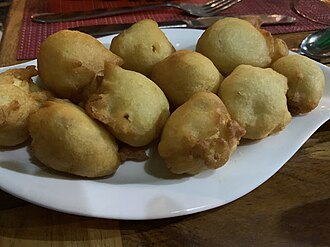 Fish fritters
 -
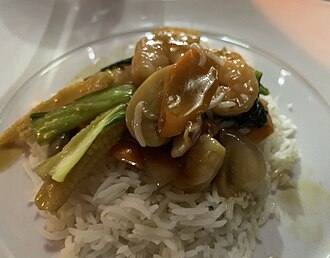 Chop suey shrimp
 -
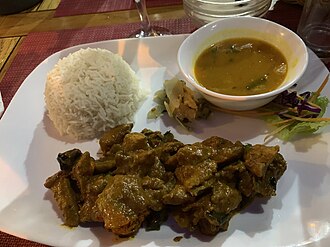 Fish curry
_-_beignets_de_poisson.jpg)
_-_chop_suey_crevettes_(1).jpg)
_-_curry_de_poisson_(1).jpg)
Holidays and festivals[edit | edit source]
The public holidays of Mauritius involve the blending of several cultures from Mauritius's history. There are Hindu festivals, Christian festivals, Chinese festivals, and Muslim festivals.[214] There are 14 annual public holidays in Mauritius with New Year celebrated over two days if it falls on a weekend. All the public holidays related to religious festivals have dates that vary from year to year except for Christmas. Other festivals such as Holi, Raksha Bandhan, Durga Puja,[215] Père Laval Pilgrimage also enrich the cultural landscape of Mauritius.
| Public holidays in Mauritius in 2023[216] | Date |
|---|---|
| New Year's Day | Sunday 1 January – Monday 2 January |
| Chinese Spring Festival | Sunday 22 January |
| Abolition of slavery | Wednesday 1 February |
| Thaipoosam Cavadee | Saturday 4 February |
| Maha Shivaratri | Saturday 18 February |
| Independence and Republic Day | Sunday 12 March |
| Ugadi | Wednesday 22 March |
| Eid ul-Fitr (Depending on the visibility of the moon) | Saturday 22 April |
| Labour Day | Monday 1 May |
| Ganesh Chaturthi | Wednesday 20 September |
| All Saints Day | Wednesday 1 November |
| Arrival of the Indentured Labourers | Thursday 2 November |
| Diwali | Sunday 12 November |
| Christmas Day | Monday 25 December |
Sport[edit | edit source]

The most popular sport in Mauritius is football[217] and the national team is known as The Dodos or Club M. Other popular sports in Mauritius include cycling, table tennis, horse racing, badminton, volleyball, basketball, handball, boxing, judo, karate, taekwondo, weightlifting, bodybuilding and athletics. Water sports include swimming, sailing, scuba diving, windsurfing and kitesurfing.
Horseracing, which dates from 1812 when the Champ de Mars Racecourse was inaugurated, remains popular. The country hosted the second (1985), fifth (2003) and tenth editions (2019) of the Indian Ocean Island Games. Mauritius won its first Olympic medal at the 2008 Summer Olympics in Beijing when boxer Bruno Julie won the bronze medal.
In golf, the former Mauritius Open and the current AfrAsia Bank Mauritius Open have been part of the European Tour.
See also[edit | edit source]
- Cargados Carajos and Agalega
- Raphaël Fishing Company
- Constitution of Mauritius
- Index of Mauritius-related articles
- Judicial Committee of the Privy Council
- List of Mauritius-related topics
- List of Sino-Mauritian dishes
- Mauritian rupee
- Outline of Mauritius
Notes[edit | edit source]
References[edit | edit source]
- ↑ "Government Information Service – Coat of Arms". govmu.org. Archived from the original on 12 June 2020. Retrieved 29 July 2019.
- ↑ The Mauritian constitution makes no mention of an official language. The Constitution only mentions that the official language of the National Assembly is English; however, any member can also address the chair in French.
- ↑ "Africa :: MAURITIUS". CIA The World Factbook. 22 September 2022.
- ↑ "Mauritius – the World Factbook". 27 December 2021.
- ↑ "Population and Housing Census 2010 Report" (PDF). Archived from the original (PDF) on 14 May 2014. Retrieved 26 April 2015.
- ↑ "Population and Vital Statistics – Year 2019". Statistics Mauritius. March 2020. Retrieved 6 May 2020.
- ↑ 7.0 7.1 "2011 Population Census – Main Results" (PDF). Statistics Mauritius. Archived from the original (PDF) on 11 November 2017. Retrieved 11 November 2017.
- ↑ 8.0 8.1 8.2 8.3 "World Economic Outlook Database, April 2023". IMF.org. International Monetary Fund. Retrieved 20 July 2023.
- ↑ "GINI index (World Bank estimate) – Mauritius". World Bank. Retrieved 1 July 2020.
- ↑ "Human Development Report 2021/2022" (PDF). United Nations Development Programme. 8 September 2022. Retrieved 8 September 2022.
- ↑ 11.0 11.1 11.2 "Written Statement of the Republic of Mauritius" (PDF). International Court of Justice. 1 March 2018. pp. 23–24. Archived from the original (PDF) on 16 December 2018. Retrieved 15 December 2018.
- ↑ 12.0 12.1 12.2 Memorial of the Republic of Mauritius. Vol. I. Permanent Court of Arbitration. 1 August 2012. p. 9.
- ↑ 13.0 13.1 "Figure 7: Mauritius' EEZ: 1977". Memorial of the Republic of Mauritius (PDF). Vol. IV. Permanent Court of Arbitration. 2012. Retrieved 12 October 2019.
- ↑ "History". Archived from the original on 28 June 2022. Retrieved 1 August 2021.
- ↑ International Education: An Encyclopedia of Contemporary Issues and Systems. Routledge. 17 March 2015. ISBN 9781317467519.
- ↑ "Republic of Mauritius- History". govmu.org. Archived from the original on 16 October 2016. Retrieved 12 March 2023.
- ↑ Allen, Richard B. (1 August 2003). "The Mascarene Slave-Trade and Labour Migration in the Indian Ocean during the Eighteenth and Nineteenth Centuries". Slavery & Abolition. 24 (2): 33–50. doi:10.1080/01440390308559154. ISSN 0144-039X. S2CID 143805648.
- ↑ 18.0 18.1 Gaymard, Hervé (20 March 2013). A. Un Différend Ancien Avec Maurice Quant À La Souveraineté Sur Tromelin. National Assembly (Report) (in français).
- ↑ "Rise of the Sugar Economy". countrystudies.us. Retrieved 14 July 2023.
- ↑ "Annex 11: Colonial Office Telegram No. 199 to Mauritius, No. 222 to Seychelles, 21 July 1965, FO 371/184524". Memorial of the Republic of Mauritius (PDF). Vol. II. Permanent Court of Arbitration.
- ↑ "Visiting British Indian Ocean Territory". Retrieved 16 December 2018.
- ↑ "UN court rules UK has no sovereignty over Chagos islands". BBC News. 28 January 2021. Retrieved 18 July 2021.
- ↑ "Religions in Africa | African Religions | PEW-GRF". www.globalreligiousfutures.org. Retrieved 28 April 2020.
- ↑ "The Global Religious Landscape". Pew Research Center's Religion & Public Life Project. 18 December 2012. Retrieved 28 April 2020.
- ↑ "Democracy Index 2021: The China challenge".
- ↑ 26.0 26.1 "World Bank Country and Lending Groups". World Bank. Retrieved 1 July 2020.
- ↑ "The Global Competitiveness Report 2017–2018" (PDF). Retrieved 24 December 2018.
- ↑ Stiglitz, Joseph (7 March 2011). "The Mauritius miracle, or how to make a big success of a small economy". The Guardian.
- ↑ "Global Peace Index Measuring Peace in a Complex World Global Peace Index 2019" (PDF). Institute for Economics and Peace. 2019. Archived from the original (PDF) on 27 August 2019. Retrieved 13 October 2019.
- ↑ Toorawa, S. (2007). The medieval Waqwaq islands and the Mascarenes. Hassam Toorawa Trust, Port Louis, Mauritius
- ↑ "Cantino Planisphere by anonymous Portuguese (1502) – Biblioteca Estense Universitaria, Modena, Italy, Public Domain". 1502.
- ↑ "Prime Minister's Office – Cabinet Decisions taken on 24 MAY 2019". pmo.govmu.org. Retrieved 25 June 2019.
- ↑ 33.0 33.1 33.2 33.3 33.4 33.5 33.6 "History". Government of Mauritius. Archived from the original on 16 October 2016. Retrieved 22 January 2015.
- ↑ 34.0 34.1 "The slave trade on Mauritius". Rough Guides. Retrieved 13 September 2020.
- ↑ "History of Mauritius" (PDF). Government of Mauritius. Retrieved 22 January 2015.
- ↑ "Sunday's POST". Leeds Intelligencer. 22 July 1755. Retrieved 4 July 2021.
The Island of Mauritius, which is also named the Island of Monkeys, on account of the Multitude of those Animals which destroyed everything in it, was discovered in 1698 by the Dutch, who named it Mauritius, of Maurice, of Orange, and quitted it by reason of the great Number of Monkeys on it.
- ↑ "Macaque monkeys on Mauritius, a sad monkey's tale". earthtimes.org. 11 October 2011. Retrieved 12 March 2023.
- ↑ "USIP" (PDF).
- ↑ "Notes". Creating the Creole Island: Slavery in Eighteenth-Century Mauritius. Duke University Press. 2005. pp. 277–304. doi:10.1215/9780822386919-011. ISBN 978-0-8223-3402-6.
- ↑ "Tamouls, les racines de l'histoire". L'Express. 5 February 2004. Retrieved 5 February 2004.
- ↑ "Mauritius profile – Timeline". BBC News. 25 February 2019. Retrieved 25 February 2019.
- ↑ 42.0 42.1 Port Louis, A tropical City, Auguste Toussaint. ISBN 0 04 969001 9
- ↑ 43.0 43.1 43.2 43.3 A short History of Mauritius, P.J. Barnwell & A. Toussaint
- ↑ "From Terra Australis to Australia Matthew Flinders' journeys". State Library of NSW. 18 December 2015. Retrieved 14 September 2020.
- ↑ Moheeputh, Anand (24 October 2003). "Matthew Flinders, an illustrious prisoner". L'Express. Retrieved 24 October 2003.
- ↑ Carter, Marina (19 January 2015). Murder and Mayhem in Mauritius: Historical Crime Stories. Pink Pigeon Press.
- ↑ 47.0 47.1 A New Comprehensive History of Mauritius, Sydney Selvon, 2012. ISBN 978-99949-34-91-1
- ↑ "Mauritius: Sugar, indentured labour and their consequences (1835–1910)". EISA. Retrieved 20 September 2020.
- ↑ "Legacies of British Slave-ownership project". University College London. Retrieved 7 July 2021.
- ↑ "Nominated members pioneered by Pope Hennessy". Le Mauricien. 30 September 2012. Retrieved 30 September 2012.
- ↑ "Mauritian democracy: a caesarean birth". L'Express. 2 June 2005. Retrieved 3 December 2020.
- ↑ 52.0 52.1 52.2 52.3 52.4 52.5 52.6 52.7 Mauritius in the making across the censuses 1846–2000, Monique Dinan. ISBN 99903-904-6-0
- ↑ "Coat of Arms". The Republic of Mauritius Web Portal. Archived from the original on 21 July 2006.
- ↑ "Republic of Mauritius- History". govmu.org. Archived from the original on 16 October 2016. Retrieved 29 May 2020.
- ↑ "Gujadhur and Lallah: Shock waves (1926)". L'Express. 2 July 2005. Retrieved 2 July 2005.
- ↑ Peerthum, Satyendra (18 February 2004). "The birth of the Mauritian Labour Party". L'Express. Retrieved 18 February 2004.
- ↑ Storey, William Kelleher (1995). "Small-Scale Sugar Cane Farmers and Biotechnology in Mauritius: The "Uba" Riots of 1937". Agricultural History. 69 (2): 163–176. JSTOR 3744263.
- ↑ Croucher, Richard; Mcilroy, John (1 July 2013). "Mauritius 1937: The Origins of a Milestone in Colonial Trade Union Legislation". Labor History. 54 (3): 223–239. doi:10.1080/0023656X.2013.804268. S2CID 144176332. Retrieved 18 August 2018.
- ↑ L'ile Maurice: Vingt-Cinq leçons d'Histoire (1598–1998), Benjamin Moutou. ISBN 99903-929-1-9
- ↑ "Report of Truth and Justice Commission" (PDF). Government of Mauritius. Retrieved 25 October 2011.
- ↑ Jackson, Ashley (2002). "The Madagascar Mutiny of the First Battalion the Mauritius Regiment, December 1943". Journal of the Society for Army Historical Research. 80 (323): 232–250. ISSN 0037-9700. JSTOR 44230830.
- ↑ Karghoo, Christophe. "Mémoire vivante". 5plus.mu. 5Plus Dimanche. Retrieved 27 September 2003.
- ↑ Peerthum, Satteeanund. "Tribute to the Martyrs of Belle Vue Harel". L'Express. lexpress.mu. Retrieved 3 September 2003.
- ↑ Our Struggle, 20th Century Mauritius, Seewoosagur Ramgoolam, Anand Mulloo
- ↑ "The historical significance of Anjalay Coopen". L'Express. October 2007. Retrieved 22 January 2015.
- ↑ Peerthum, Satteeanund; Peerthum, Satyendra. "Labour Day: Remembering the Martyrdom of Anjalay". L'Express. lexpress.mu. Retrieved 28 April 2005.
- ↑ Soobarah, Paramanund (29 April 2019). "MBC defeats a government initiative". Mauritius Times. Retrieved 29 April 2019.
- ↑ 68.0 68.1 "Mauritius - Toward Independence". country-data.com. Retrieved 12 March 2023.
- ↑ "Mauritius: The road to independence (1945–1968)". African Democracy Encyclopaedia Project. Electoral Institute for Sustainable Democracy in Africa. September 2009. Archived from the original on 8 May 2021. Retrieved 1 July 2021.
- ↑ Colonial Office, The Church House The London Gazette, 3 September 1948
- ↑ Ramola Ramtohul (2009) Engendering Mauritian History: The HiddenControversies over Female Suffrage Afrika Zamani, No. 17, pp63–80
- ↑ 72.0 72.1 "Histoire: Mauritius Independence 1961–1968". Le Mauricien=9 March 2014. Retrieved 9 September 2014.
- ↑ "Sécurité: des gros bras indispensables à certains politiciens". L'Express. lexpress.mu. Retrieved 2 April 2019.
- ↑ Li Ching Hum, Philip. "Belle Rose-Quatre Bornes, Ville des Fleurs". Mauritius Times. Retrieved 22 December 2017.
- ↑ Li Ching Hum, Philip (9 March 2018). "The downside of freedom". Defimedia. Le Defi. Retrieved 9 March 2018.
- ↑ "Port Louis – Rioting against Independence at the General Elections of 1967 – Vintage Mauritius". Vintage Mauritius. 18 July 2014. Retrieved 15 August 2018.
- ↑ "Why independence was irresistible (by Anand Moheeputh)". L'Express. 12 March 2014.
- ↑ "An eye witness account of the 1968 riots". mauritiusmag.com. 6 October 2011. Retrieved 15 August 2018.
- ↑ "EISA Mauritius: The road to independence (1945–1968)". eisa.org.za. Retrieved 15 August 2018.
- ↑ "Mauritius profile". BBC News. Retrieved 27 November 2012.
- ↑ "Déjeuner à Rose Hill: Fareed Muttur est mort à ma place". Le Mauricien. 18 July 2017. Retrieved 18 July 2017.
- ↑ "Affaire Azor Adélaïde". Le Mauricien. 25 June 2015.
- ↑ K.A. Cassimally (17–23 March 2016). "Why are we not taught our own history?". Weekly Magazine.
- ↑ "HISTOIRE: Un des hommes derrière le 20 mai 75 raconte". Le Mauricien. 8 June 2015.
- ↑ Untold Stories, A Collection of Socio-Political Essays, 1950–1995, Sir Satcam Boolell, EOI. ISBN 99903-0-234-0
- ↑ "When India drew Top Secret 'red line' in Mauritius". The Hindu. 10 March 2013. Retrieved 22 March 2013.
- ↑ Medcalf, Rory (19 March 2013). "When India (Almost) Invaded Mauritius". The Diplomat. Retrieved 22 March 2013.
- ↑ Brewster, David. India's Ocean: the Story of India's Bid for Regional Leadership.. Retrieved 13 August 2014
- ↑ Battersby, John D. (28 December 1987). "Port Louis Journal; Land of Apartheid Befriends an Indian Ocean Isle". The New York Times. Retrieved 29 December 2016.
- ↑ Lodge, Tom; Kadima, Denis; Pottie, David. "Mauritius: General election of August 1983". EISA. Retrieved 28 November 2020.
- ↑ Perlez, Jane (27 August 1990). "Mauritius' Political Quarrel Saves the Queen". The New York Times. Great Britain; Mauritius. Retrieved 6 September 2016.
- ↑ AAPS Newsletter. Vol. 1. African Association of Political Science. 1992. p. 20.
- ↑ Country Profile: Mauritius, Seychelles. The Unit. 2001. p. 8.
- ↑ "Shooting death of 3 Hizbullah activists at Gorah-Issac Rd". United Nations High Commission for Refugees. Retrieved 28 November 2020.
- ↑ L'Express, Vendredi 26 février 1999
- ↑ Rapport du Juge Matadeen sur les émeutes de 1999, Imprimerie du Gouvernement, 2000
- ↑ "La vérité sur la mort de mon père". 5 Plus. Retrieved 28 November 2020.
- ↑ "afrol News – Mauritius PM starts third term". afrol.com. Retrieved 24 July 2021.
- ↑ "Mauritius opposition wins surprise landslide victory". Deutsche Welle. 12 December 2014. Retrieved 24 July 2021.
- ↑ Minzesheimer, Bob (22 January 2017). "Mauritius: PM Anerood Jugnauth to hand over to son". BBC News. Retrieved 22 January 2017.
- ↑ Arouff, Jean Paul (23 January 2017). "New Mauritius PM takes over from father, opponents cry foul". Reuters. Retrieved 23 January 2017.
- ↑ "Africa's only female president to quit". BBC News. 13 March 2018.
- ↑ "Office of the President – Home". Government of Mauritius. Archived from the original on 8 May 2015. Retrieved 22 February 2019.
- ↑ "Mauritius elects incumbent PM for five-year term". Reuters.com. Reuters. 8 November 2019.
- ↑ "Mauritius takes stock of oil spill two months later". France 24. 24 September 2020.
- ↑ "Mauritius oil spill compensation could be limited by maritime law technicality". Climate Home News. 28 August 2020. Retrieved 24 July 2021.
- ↑ "Mauritius: Promoting the Development of an Ocean Economy" (PDF). Intercontinental Trust Newsletter. Archived (PDF) from the original on 9 November 2013. Retrieved 25 November 2022.
- ↑ "National Coast Guard" (PDF). Government of Mauritius. Retrieved 22 January 2015.
- ↑ "Commission on the Limits of the Continental Shelf (CLCS) Outer limits of the continental shelf beyond 200 nautical miles from the baselines:Submissions to the Commission: Joint submission by the Republic of Mauritius and the Republic of Seychelles". United Nations. Retrieved 22 January 2015.
- ↑ "Meteorological Services − Monthly Bulletin of Climatological Summaries" (PDF). Mauritius Meteorological Services. May 2008. p. 3. Retrieved 22 January 2015.
- ↑ "General Info – Geography". Mauritius.net. Archived from the original on 12 February 2012. Retrieved 22 January 2015.
- ↑ "Tourism − Overview of Mauritius". Government of Mauritius. Archived from the original on 3 April 2015. Retrieved 4 January 2012.
- ↑ 113.0 113.1 113.2 "The territory of Mauritius". Government of Mauritius. Retrieved 22 January 2015.
- ↑ 114.0 114.1 114.2 "Population and Vital Statistics Republic of Mauritius, January – June 2019" (PDF). Statistics Mauritius. Retrieved 12 October 2019.
- ↑ "La population chagossienne en chiffres". L'Express (Mauritius). 5 July 2016.
- ↑ Dujmovic, Jurica. "What we know about Mauritia, the lost — and now found — continent". MarketWatch. Retrieved 23 January 2023.
- ↑ "The Raphael Fishing Company Ltd v. The State of Mauritius & Anor (Mauritius) [2008] UKPC 43 (30 July 2008)". saflii.org. Retrieved 24 November 2017.
- ↑ Rumley, Dennis; Chaturvedi, Sanjay; Sakhuja, Vijay (2010). Fisheries Exploitation in the Indian Ocean: Threats and Opportunities. p. 123. ISBN 9789812309860.
- ↑ "Political relations". France Ministry for Europe and Foreign Affairs. 1 April 2020. Retrieved 25 April 2020.
- ↑ 120.0 120.1 "Time for UK to Leave Chagos Archipelago". Real clear world. 6 April 2012. Retrieved 22 January 2015.
- ↑ "Who Owns Diego Garcia? Decolonisation and Indigenous Rights in the Indian Ocean" (PDF). Geoffrey Robertson. Archived from the original (PDF) on 2 May 2014. Retrieved 22 January 2015.
- ↑ "Decolonising Chagos". The Hindu. 27 February 2019. Retrieved 5 April 2019.
- ↑ Curpen, Indradev (15 June 2012). "Chagos remains a matter for discussion". Le Défi Media Group. Archived from the original on 27 April 2015. Retrieved 22 January 2015.
- ↑ Evers, Sandra; Kooy, Marry (2011). Eviction from the Chagos Islands: Displacement and Struggle for Identity Against Two World Powers. Brill Publishers. p. 3. ISBN 9789004202603.
- ↑ Cork, Tristan. "The shocking reason there are dogs hanging from a tree in Bristol". Bristol Post.
- ↑ 126.0 126.1 "Mauritius profile". BBC World. 22 July 2011. Retrieved 22 January 2015.
- ↑ "History". The UK Chagos Support Association. Archived from the original on 1 April 2016. Retrieved 22 January 2015.
- ↑ "Sixth National Assembly Parliamentary Debates(Hansard)" (PDF). National Assembly (Mauritius). 20 March 2015. Retrieved 21 January 2016.
- ↑ Bowcott, Owen (25 February 2019). "UN court rejects UK's claim of sovereignty over Chagos Islands". The Guardian. Retrieved 26 February 2019.
- ↑ 130.0 130.1 Sands, Philippe (24 May 2019). "At last, the Chagossians have a real chance of going back home". The Guardian.
Britain's behaviour towards its former colony has been shameful. The UN resolution changes everything
- ↑ Osborne, Samuel (22 May 2019). "Chagos Islands: UN officially demands Britain and US withdraw from Indian Ocean archipelago". The Independent. Archived from the original on 12 May 2022.
- ↑ Shapiro, Beth; Sibthorpe, Dean; Rambaut, Andrew; et al. (2002). "Flight of the Dodo" (PDF). Science. 295 (5560): 1683. doi:10.1126/science.295.5560.1683. PMID 11872833.
- ↑ Smaill, Belinda (21 September 2016). Regarding Life: Animals and the Documentary Moving Image. SUNY Press. ISBN 978-1-4384-6249-3.
- ↑ Hollars, B. J. (1 February 2017). Flock Together: A Love Affair with Extinct Birds. U of Nebraska Press. ISBN 978-0-8032-9642-8.
- ↑ "Republic of Mauritius- Coat of Arms". govmu.org. Retrieved 27 March 2019.
- ↑ "Chapter 1. Introduction to the Republic of Mauritius" (PDF). Archived copy. National Parks and Conservation Services, Government of Mauritius. Archived from the original (PDF) on 3 April 2015. Retrieved 22 January 2015.
{{cite book}}: CS1 maint: archived copy as title (link) - ↑ "President's Report of the Mauritian Wildlife Foundation dated March 2016". Retrieved 29 August 2017.
- ↑ "Welcome to the Mauritian Wildlife Foundation (MWF) – In The Field – Mauritius – Mauritius Fruit Bat". mauritian-wildlife.org. Archived from the original on 16 March 2016. Retrieved 22 February 2019.
- ↑ "Mauritius's air quality 2nd best in world". Le Matinal. 26 September 2011. Archived from the original on 10 October 2013. Retrieved 22 January 2015.
- ↑ Grantham, H. S.; et al. (2020). "Anthropogenic modification of forests means only 40% of remaining forests have high ecosystem integrity – Supplementary Material". Nature Communications. 11 (1): 5978. Bibcode:2020NatCo..11.5978G. doi:10.1038/s41467-020-19493-3. ISSN 2041-1723. PMC 7723057. PMID 33293507. S2CID 228082162.
- ↑ "Climate of Mauritius". Mauritius Meteorological Services. Retrieved 22 January 2015.
- ↑ Anna, Cara. "Yahoo Search – Web Search". Yahoo!. Associated Press. Retrieved 8 August 2020.
- ↑ "Oil spill threatens ecological disaster as Mauritius declares emergency". Yahoo! News. Reuters. Retrieved 8 August 2020.
- ↑ "UN Human Rights Committee criticises Best Loser System". Country.eiu.com. Retrieved 6 September 2016.
- ↑ "IBRAHIM INDEX OF AFRICAN GOVERNANCE 2018" (PDF). Mo Ibrahim Foundation. Retrieved 13 October 2019.
- ↑ "African democracy − A glass half-full". The Economist. 31 March 2012. Retrieved 7 April 2012.
- ↑ "National lists of precedence of Mauritius" (PDF). 14 October 2014. Archived from the original (PDF) on 11 February 2015. Retrieved 16 February 2015.
- ↑ 148.0 148.1 "The President of the Republic - Home". Archived from the original on 9 February 2015.
- ↑ "Location – The territory of Mauritius". Government of Mauritius.
- ↑ "Background Note: Mauritius – Scoop News". scoop.co.nz. Retrieved 18 January 2017.
- ↑ "Embassy of the Republic of Mauritius – Riyadh, Kingdom of Saudi Arabia". foreign.govmu.org. Retrieved 19 October 2020.
- ↑ "Presentation of Credentials of Ambassador Showkutally Soodhun, GCSK to the Kingdom of Bahrain". foreign.govmu.org. Ministry of Foreign Affairs, Regional Integration and International Trade. Retrieved 19 October 2020.
- ↑ "Constitution of Mauritius" (PDF). National Assembly (Mauritius). 13 October 2019. Archived from the original (PDF) on 26 August 2018. Retrieved 13 October 2019.
- ↑ "LGBT Rights in Mauritius". Equaldex. Retrieved 3 August 2023.
- ↑ "Mauritius Cities by Population 2022".
{{cite web}}:|archive-date=requires|archive-url=(help) - ↑ "A critical appraisal of the Best Loser System". L'Express (Mauritius). 5 June 2008. Retrieved 11 November 2017.
- ↑ Soormally, M. Rafic (10 September 2012). "Debate on Best Loser System". Le Défi Media Group. Archived from the original on 21 January 2015. Retrieved 21 January 2015.
- ↑ Mathur, Raj. "Party cooperation and the electoral system in Mauritius" (PDF). Australian National University. Retrieved 26 September 2020.
- ↑ Thi Keng Lau, Jean Claude (1991). Inter-ethnicité et politique à l'île Maurice. L'Harmattan. ISBN 2-7384-1046-4. S2CID 175282041.
- ↑ Virahsawmy, Dev. "Testament of A Hindocreole or Who Are We Really?". Defimedia. Retrieved 16 November 2018.
- ↑ Dobson, Reena Jane. "'The Most Cosmopolitan Island under the Sun'? Negotiating Ethnicity and Nationhood in Everyday Mauritius" (PDF). Centre for Cultural Research University of Western Sydney. Retrieved 15 December 2009.
- ↑ 162.0 162.1 "Resident population by religion and sex" (PDF). Statistics Mauritius. p. 68. Retrieved 13 April 2020.
- ↑ "International Religious Freedom Report for 2015". United States State Department. Retrieved 25 November 2016.
- ↑ "Public Holidays". Mauritius. 4 February 2016. Retrieved 25 November 2016.
- ↑ "Mauritius: Maha Shivratree 2022 - the Prime Minister Chairs the National Task Force" (Press release). Port Louis: Government of Mauritius. 25 November 2021 – via AllAfrica.com.
- ↑ "Constitution of Mauritius – 49. Official language". National Assembly. Retrieved 11 November 2017.
- ↑ "Language". Government of Mauritius. Retrieved 11 November 2017.
- ↑ "People and languages on Mauritius".
- ↑ "Demographics". mauritiusgovernment.com. Archived from the original on 25 April 2012. Retrieved 7 November 2013.
- ↑ "Inputs on Human Rights Council Resolution 46/27 on Combatting intolerance, negative stereotyping, stigmatization, discrimination, incitement to violence and violence against persons, based on religion or belief" (PDF). Ministry of Foreign Affairs, Regional Integration and International Trade (Human Rights Division). Retrieved 14 July 2023.
- ↑ "Bhojpuri-Speaking Union Act – 2011" (PDF). Ministry of Arts and Culture. Retrieved 20 January 2019.
- ↑ "Chinese-Speaking Union Act – 2011" (PDF). Ministry of Arts and Culture. Retrieved 20 January 2019.
- ↑ "The Hindi-Speaking Union Act – 1994" (PDF). Ministry of Arts and Culture. Retrieved 20 January 2019.
- ↑ "Marathi-Speaking Union Act – 2008" (PDF). Ministry of Arts and Culture. Retrieved 20 January 2019.
- ↑ "Sanskrit-Speaking Union Act – 2011" (PDF). Ministry of Arts and Culture. Retrieved 20 January 2019.
- ↑ "Tamil-Speaking Union Act – 2008" (PDF). Ministry of Arts and Culture. Retrieved 20 January 2019.
- ↑ "Telugu-Speaking Union Act – 2008" (PDF). Ministry of Arts and Culture. Retrieved 20 January 2019.
- ↑ "The Urdu-Speaking Union Act – 2002" (PDF). Ministry of Arts and Culture. Retrieved 20 January 2019.
- ↑ "Education statistics" (PDF). Statistics Mauritius. 2013. Retrieved 22 January 2015.
- ↑ "Nine-Year Continuous Basic Education: What are the major changes brought to the system?". Défi Media. 18 December 2016.
- ↑ "Communiqué- Free Education in Tertiary Education Institutions" (PDF).
- ↑ "Mauritius – Adult (15+) literacy rate". World Data Atlas. Knoema.
- ↑ "Global Innovation Index 2021". World Intellectual Property Organization. United Nations. Retrieved 5 March 2022.
- ↑ "RTD – Item". European Commission. Retrieved 2 September 2021.
- ↑ "Global Innovation Index | What is the future of innovation-driven growth?". Global Innovation Index.
- ↑ "Mauritius: The Drivers of Growth – Can the Past be Extended?" (PDF) (IMF Working paper 2014).
- ↑ "Mauritius". The World Factbook. Retrieved 4 January 2012.
- ↑ Stiglitz, Joseph E. (7 March 2011). "The Mauritius Miracle". Project Syndicate. Retrieved 21 April 2012.
- ↑ "Moving the Nation Forward" (PDF). Government of Mauritius. Archived from the original (PDF) on 13 April 2019. Retrieved 21 April 2012.
- ↑ 190.0 190.1 "Mauritius". The Heritage Foundation. Retrieved 16 April 2012.
- ↑ 191.0 191.1 "2012 Investment Climate Statement – Mauritius". U.S. Department of State. June 2012. Retrieved 8 August 2012.
- ↑ 192.0 192.1 "Economy Rankings". Doing Business. Archived from the original on 25 October 2012. Retrieved 24 October 2012.
- ↑ "UNCTAD" (PDF).
- ↑ "Economic Freedom of the World: 2019 Annual Report" (PDF). Retrieved 26 October 2019.
- ↑ "Contribution to GDP". Financial Services Commission (Mauritius). Retrieved 31 March 2019.
- ↑ "Overview of the Financial Services Sector". Economic Development Board. Archived from the original on 31 March 2019. Retrieved 31 March 2019.
- ↑ "Africa Strategy". Economic Development Board. Archived from the original on 31 March 2019. Retrieved 31 March 2019.
- ↑ "MAURITIUS PERSONAL TAX: SOLIDARITY LEVY". DTOS. 31 August 2020. Retrieved 9 August 2021.
- ↑ "Corporate – Taxes on corporate income". PWC. Retrieved 9 August 2021.
- ↑ "Treasure Island: Leak Reveals How Mauritius Siphons Tax From Poor Nations to Benefit Elites". ICIJ. 23 July 2019. Retrieved 9 August 2021.
- ↑ "Mauritius: Not a tax haven but a competitive and attractive cross-border investment platform". L'Express (Mauritius). August 2019. Retrieved 9 August 2021.
- ↑ "Prime Minister denies Mauritius being a tax haven". Government of Mauritius. Retrieved 31 March 2019.
- ↑ "Code of ethics of tourism for Mauritius" (PDF). MTPA. Archived from the original (PDF) on 21 January 2012. Retrieved 28 January 2012.
- ↑ "International Travel and Tourism Year 2018". Retrieved 6 April 2019.
- ↑ "Mauritius". UNESCO World Heritage Centre. Retrieved 20 May 2019.
- ↑ "Rs 32 M de plus pour le transport gratuit" (in français). Le Matinal. Retrieved 22 August 2014.
- ↑ "Mauritius airport inaugurates US$305m terminal". Passenger Terminal Today. Retrieved 22 August 2014.
- ↑ "Statistics Mauritius – ICT Statistics Year 2016". statsmauritius.govmu.org. Retrieved 13 November 2018.
- ↑ "Experience Mauritius Through Vaco Baissac". Kreol International Magazine.
- ↑ David Feldman SA, Mauritius: Classic Postage Stamps and Postal History, Switzerland (1993), Prices Realized supplement.
- ↑ 211.0 211.1 "Traditional Architecture of Mauritius". World Monuments Fund.
- ↑ "Old Colonial and Creole-Style Houses in Mauritius – Part 1 – Vintage Mauritius". 6 June 2014.
- ↑ Roberts, Darlene (20 October 2016). "Mauritius Dholl Puri (Yellow Split Pea Wrap)". International Cuisine. Retrieved 20 October 2016.
- ↑ "Public Holidays - 2020.pdf" (PDF). Retrieved 4 November 2019.
- ↑ "Mauritius: Celebration of Durga Puja over nine days for Hindu devotees of the island". Hindi Pracharak. 20 September 2017. Archived from the original on 25 November 2022. Retrieved 25 November 2022.
- ↑ "General Notice No 1218 of 2022 – Public Holidays – 2023" (PDF). Republic of Mauritius. Retrieved 14 July 2023.
- ↑ Richards, Alexandra.Mauritius: Rodrigues, Réunion. Bradt Travel Guides, 2009, p. 90
Bibliography[edit | edit source]
- Macdonald, Fiona; et al. "Mauritius". Peoples of Africa. pp. 340–341.
- This article incorporates public domain text from the websites of the Government of Mauritius, the United States Department of State, the U.S. Library of Congress, and the CIA World Factbook.
Further reading[edit | edit source]
- Bahadur, Gaiutra (2014). Coolie Woman: The Odyssey of Indenture. The University of Chicago. ISBN 978-0-226-21138-1.
- Moree, Perry J. (1998). A Concise History of Dutch Mauritius, 1598–1710: A Fruitful and Healthy Land. Routledge.
- Vink, Markus (2003). "'The World's Oldest Trade': Dutch Slavery and Slave Trade in the Indian Ocean in the Seventeenth Century". Journal of World History. 14 (2): 131–177. doi:10.1353/jwh.2003.0026. S2CID 145450338.
Novels[edit | edit source]
- Geneviève Dormann, Le bal du dodo, Albin Michel, 2000, ISBN 9782226036568.
- J.M.G. Le Clézio, La quarantaine, Gallimard, 1997, ISBN 9782070402106.
- Nathacha Appanah, Les rochers de poudre d'or, Gallimard, 2006.
- Shenaz Patel, Le silence des Chagos, éditions de l'Olivier, 2005, ISBN 9782879294544.
External links[edit | edit source]
Reference
- Mauritius at Curlie
- Country Profile from BBC News
- Key Development Forecasts for Mauritius from International Futures
- Mauritius at UCB Libraries GovPubs
- Mauritius entry at Encyclopædia Britannica
- Mauritius. The World Factbook. Central Intelligence Agency.
Government
Geography
 Geographic data related to Mauritius at OpenStreetMap
 Wikimedia Atlas of Mauritius
- WikiSatellite view of Mauritius at WikiMapia
Articles relating to Mauritius | |||||||||||
|---|---|---|---|---|---|---|---|---|---|---|---|
Template:Southern African Development Community Template:African Union Template:La Francophonie Template:Community of Portuguese Language Countries Template:English dialects by continent Template:Somali Plate | |||||||||||


- Articles containing French-language text
- Pages using Lang-xx templates
- Pages with plain IPA
- Mauritius
- Mascarene Islands
- Republics in the Commonwealth of Nations
- Island countries of the Indian Ocean
- Island countries
- East African countries
- Countries and territories where English is an official language
- French-speaking countries and territories
- Hotspot volcanoes
- Islands of Mauritius
- Member states of the Organisation internationale de la Francophonie
- Member states of the African Union
- Member states of the Commonwealth of Nations
- Member states of the United Nations
- Miocene Africa
- Miocene volcanism
- Volcanoes of Mauritius
- Small Island Developing States
- States and territories established in 1968
- 1968 establishments in Mauritius
- 1968 establishments in Africa
- Populated places established in 1638
- Populated places established by the Dutch East India Company
- 1638 establishments in the Dutch Empire
- Countries in Africa