


No edit summary |
WikiDwarfBOT (talk | contribs) Cleanup: Information added. |
||
| Line 1: | Line 1: | ||
{{Short description|Traditional Indian drum}} | |||
{{More citations needed|date=April 2021}} | {{More citations needed|date=April 2021}} | ||
{{Use dmy dates|date=August 2020}} | {{Use dmy dates|date=August 2020}} | ||
{{Use Indian English|date=August 2020}} | {{Use Indian English|date=August 2020}} | ||
[[File:Parai back side.JPG|thumb | [[File:Parai back side.JPG|thumb|Underside of a parai, [[Percussion mallet|sticks]] on left]] | ||
The '''parai''' is a frame drum about 35 centimeters in diameter. It consists of a shallow ring of wood, covered on one side with a stretched cow hide that is glued to the wooden frame. The preferred wood is neem wood although other types may be used. The shell is made up of three | The '''parai''' is a traditional [[Tamil people|Tamil]] frame drum about 35 centimeters in diameter, used in the [[Parai Attam|parai attam]] dance. It consists of a shallow ring of wood, covered on one side with a stretched cow hide that is glued to the wooden frame. The preferred wood is [[neem]] wood, although other types may be used. The shell is made up of three pieces of wood each in the shape of an arc, held together by three metal plates. The parai is played with two sticks. | ||
==Technique== | ==Technique== | ||
[[File:A tamil thappu.ogv|thumb|Video of a boy's parai recital]] | [[File:A tamil thappu.ogv|thumb|Video of a boy's parai recital]] | ||
[[File:Parai attam.jpg|thumb|Parai attam]] | [[File:Parai attam.jpg|thumb|upright=.7|Parai attam]] | ||
The parai is slung by a strap over one shoulder (weak | The parai is slung by a strap over one shoulder (weak or off-hand side) and is held vertically by pushing it towards the performer's body. This harness allows the drummer to play while standing, walking, or dancing. It is played with two sticks: a long, thin flat bamboo stick (approx. 28 cm) called ''Sindu Kuchi'' or ''Sundu Kuchi'' ([[Tamil language|Tamil]]:சுண்டு குச்சி) and a short, thick stick (approx. 18 cm) that may be of any wood, called ''Adi Kucchi'' ([[Tamil language|Tamil]]:அடி குச்சி).<ref name="auto">{{cite web|url=http://www.vikatan.com/new/article.php?module=magazine&aid=102105|title=உலகம் முழுக்க பறை ஒலிக்கட்டும்!|publisher=Vikatan|access-date=11 September 2016|date=1 January 2015 |language=ta}}</ref> | ||
The short stick is loosely held between the thumb and three other fingers, index, middle, and ring, of the strong or dominant hand. It is held vertically, positioned near the lower rim of the drum. The off or weak hand, which holds the long stick, rests on the upper part of the frame. This stick is positioned at a downward-pointing angle. The base of the stick is gripped by the thumb and index fingers and balanced between the middle and ring fingers; the stick is moved back and forth using the ring finger and thumb respectively. There are three fundamental strokes from which all of the rhythmic patterns are derived: striking the center of the drum with the shorter stick; "slapping" the center of the drum with the long stick; and striking the drum with both sticks, the dominant immediately followed by the off. | |||
Just before the commencement of every performance, drummers will heat the | Just before the commencement of every performance, drummers will heat the parai, holding it close to a small bonfire, so that the heat absorbs the moisture in the drum heads and tightens them considerably. After heating, the drums produce a loud, high-pitched cracking sound when struck. | ||
===Rhythms=== | ===Rhythms=== | ||
| Line 23: | Line 24: | ||
==History== | ==History== | ||
In Tamil, the word ''parai'' means | In Tamil, the word ''parai'' means "to speak" or "to tell". The drums were used for multiple purposes including signaling people to gather,<ref name=gosahim>{{Cite web |title=Parai Attam Folk Dance, Origin, History, Information, Style |url=https://www.gosahin.com/places-to-visit/parai-attam-dance/ |access-date=2022-07-03 |website=Gosahin }}</ref> alerting them to upcoming war, requesting civilians to leave the battlefield, announcing victory or defeat, stopping a breach of water body, gathering farmers for farming activities, warning wild animals about people's presence, during festivals, weddings and other celebrations, and as part of worship of nature.<ref>{{cite web|url=http://www.thehindu.com/features/friday-review/music/secular-and-sacred/article4268995.ece|title=Secular and sacred|work=The Hindu|date=3 January 2013|access-date=11 September 2016}}</ref> There were as many as 156 traditional drum beats or ''adi'' for different purposes and designating different emotions.<ref>{{Cite news |last=Anantharam |first=Chitradeepa |date=2018-01-16 |title=Striving to 'parai' relevant to young audiences |work=The Hindu |url=https://www.thehindu.com/society/history-and-culture/parai-attam-the-ancinet-folk-dance-of-tamil-nadu/article22449763.ece |access-date=2022-07-03 |issn=0971-751X}}</ref> The drums were played in the royal courts of Sangam, Chola, and Pandiyan rulers. It is one of the earliest percussion instruments and is mentioned in ''[[Tolkāppiyam|Tholkaapiam]]'' as a standard musical instrument. It and the parai attam dance have become symbols of Tamil culture.<ref name=gosahim/> It was only later called ''thappu'' (meaning "inauspicious") to derogate Tamil arts during the 14th century AD Vijayanagara rule of Tamil land.<ref>{{Cite web |first=Priya Sengutpa |last=Das |date=2022-01-06 |title=Parai Attam is a Special Type of Dance in Tamil |url=https://bharatstories.com/parai-attam-is-a-special-type-of-dance-in-tamil/ |access-date=2022-07-03 |website=Bharat Stories }}</ref><ref>{{Cite web |date=2021-08-21 |title=The parai: Then and now, the instrument plays a key role in anti-caste struggle |url=https://www.thenewsminute.com/article/parai-then-and-now-instrument-plays-key-role-anti-caste-struggle-154197 |access-date=2022-07-03 |website=The News Minute }}</ref><ref>{{cite web |last1=Thirumurthy |first1=Priyanka |title=Watch: The Parai is breaking frontiers but its makers still face discrimination |url=https://www.thenewsminute.com/article/watch-parai-breaking-frontiers-its-makers-still-face-discrimination-119212 |website=The News Minute |date=29 February 2020 |publisher=The News Minute |access-date=7 July 2022}}</ref> | ||
==Types== | ==Types== | ||
| Line 61: | Line 60: | ||
* Panchamasatham | * Panchamasatham | ||
}} | }} | ||
==See also== | ==See also== | ||
*[[Paraiyar]] | *[[Paraiyar]] | ||
*[[Tamil culture]] | *[[Tamil culture]] | ||
==References== | ==References== | ||
| Line 97: | Line 69: | ||
==External links== | ==External links== | ||
* [https://www.youtube.com/channel/UCmdYjV_afwJGqeriIWhF4bw Australia Tamil Arts Tamil Arts - YouTube] | * [https://www.youtube.com/channel/UCmdYjV_afwJGqeriIWhF4bw Australia Tamil Arts Tamil Arts - YouTube] | ||
* [https://www.youtube.com/watch?v=w4WLQb57Q9g&list=PL887D53C4C5213A0F ''Parai: Mother of Percussion''], a short video by The Educational Multimedia Research Center of [[Anna University]] | * [https://www.youtube.com/watch?v=w4WLQb57Q9g&list=PL887D53C4C5213A0F ''Parai: Mother of Percussion''], a short video by The Educational Multimedia Research Center of [[Anna University]] | ||
Latest revision as of 11:32, 22 July 2023
 | This article needs more citations. (April 2021) |

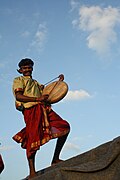
The parai is a traditional Tamil frame drum about 35 centimeters in diameter, used in the parai attam dance. It consists of a shallow ring of wood, covered on one side with a stretched cow hide that is glued to the wooden frame. The preferred wood is neem wood, although other types may be used. The shell is made up of three pieces of wood each in the shape of an arc, held together by three metal plates. The parai is played with two sticks.
Technique[edit | edit source]

The parai is slung by a strap over one shoulder (weak or off-hand side) and is held vertically by pushing it towards the performer's body. This harness allows the drummer to play while standing, walking, or dancing. It is played with two sticks: a long, thin flat bamboo stick (approx. 28 cm) called Sindu Kuchi or Sundu Kuchi (Tamil:சுண்டு குச்சி) and a short, thick stick (approx. 18 cm) that may be of any wood, called Adi Kucchi (Tamil:அடி குச்சி).[1]
The short stick is loosely held between the thumb and three other fingers, index, middle, and ring, of the strong or dominant hand. It is held vertically, positioned near the lower rim of the drum. The off or weak hand, which holds the long stick, rests on the upper part of the frame. This stick is positioned at a downward-pointing angle. The base of the stick is gripped by the thumb and index fingers and balanced between the middle and ring fingers; the stick is moved back and forth using the ring finger and thumb respectively. There are three fundamental strokes from which all of the rhythmic patterns are derived: striking the center of the drum with the shorter stick; "slapping" the center of the drum with the long stick; and striking the drum with both sticks, the dominant immediately followed by the off.
Just before the commencement of every performance, drummers will heat the parai, holding it close to a small bonfire, so that the heat absorbs the moisture in the drum heads and tightens them considerably. After heating, the drums produce a loud, high-pitched cracking sound when struck.
Rhythms[edit | edit source]
- Otthaiyadi (Tamil: ஒத்தையடி)
- Thenmangu (Tamil: தென்மாங்கு)
- Samiaatam (Tamil: சாமியாட்டம்)
- Thullal (Tamil: துள்ளல்)
- Uyirppu (Tamil: உயிர்ப்பு)
History[edit | edit source]
In Tamil, the word parai means "to speak" or "to tell". The drums were used for multiple purposes including signaling people to gather,[2] alerting them to upcoming war, requesting civilians to leave the battlefield, announcing victory or defeat, stopping a breach of water body, gathering farmers for farming activities, warning wild animals about people's presence, during festivals, weddings and other celebrations, and as part of worship of nature.[3] There were as many as 156 traditional drum beats or adi for different purposes and designating different emotions.[4] The drums were played in the royal courts of Sangam, Chola, and Pandiyan rulers. It is one of the earliest percussion instruments and is mentioned in Tholkaapiam as a standard musical instrument. It and the parai attam dance have become symbols of Tamil culture.[2] It was only later called thappu (meaning "inauspicious") to derogate Tamil arts during the 14th century AD Vijayanagara rule of Tamil land.[5][6][7]
Types[edit | edit source]
- Ariparai
- Areriparai
- Uvagaiparai
- Saaparai or Sakaatuparai
- Vettiyanparai
- Neytharparai
- Pampai
- Meenkotparai
- Maruthanilaparai
- Kallavadam
- Kuravaiparai
- Thadaru
- Kurumparai
- Kodukotti
- Kotparai
- Thamuku
- Nisaalam
- Soosikam
- Thakkai
- Thadaari
- Parathappattai
- Thalaiparai
- Padalai
- Pandaramelam
- Panriparai
- Murasu, Veparai
- Poosatrunnumai
- Murugiyam
- Veriyaatuparai
- Veeranam
- Panchamasatham
See also[edit | edit source]
References[edit | edit source]
- ↑ "உலகம் முழுக்க பறை ஒலிக்கட்டும்!" (in தமிழ்). Vikatan. 1 January 2015. Retrieved 11 September 2016.
- ↑ 2.0 2.1 "Parai Attam Folk Dance, Origin, History, Information, Style". Gosahin. Retrieved 3 July 2022.
- ↑ "Secular and sacred". The Hindu. 3 January 2013. Retrieved 11 September 2016.
- ↑ Anantharam, Chitradeepa (16 January 2018). "Striving to 'parai' relevant to young audiences". The Hindu. ISSN 0971-751X. Retrieved 3 July 2022.
- ↑ Das, Priya Sengutpa (6 January 2022). "Parai Attam is a Special Type of Dance in Tamil". Bharat Stories. Retrieved 3 July 2022.
- ↑ "The parai: Then and now, the instrument plays a key role in anti-caste struggle". The News Minute. 21 August 2021. Retrieved 3 July 2022.
- ↑ Thirumurthy, Priyanka (29 February 2020). "Watch: The Parai is breaking frontiers but its makers still face discrimination". The News Minute. The News Minute. Retrieved 7 July 2022.
External links[edit | edit source]
- Australia Tamil Arts Tamil Arts - YouTube
- Parai: Mother of Percussion, a short video by The Educational Multimedia Research Center of Anna University
- This Is a Music: Reclaiming an Untouchable Drum (2011), description of an ethnomusicological documentary film about parai drummers
- உலகம் முழுக்க பறை ஒலிக்கட்டும்!
- "பறை இனி இறப்புக்கான இசை இல்லை!"
| Wind (Sushir) |  | |
|---|---|---|
| Plucked Stringed (Tat) | ||
| Bowed Stringed (Vitat) | ||
| Membranous Percussion (Avanaddh) | ||
| Non-Membranous Percussion (Ghan) | ||
| Other | ||
| Historical/ possibly extinct | ||
 | This article may be expanded with text translated from the corresponding article in தமிழ். (March 2015) Click [show] for important translation instructions.
|