



imported>Jayanthkumar123 No edit summary |
robot: Create/update articles. If there is a mistake please report on my talk page. |
||
| (One intermediate revision by one other user not shown) | |||
| Line 3: | Line 3: | ||
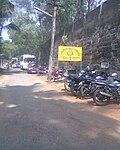
[[File:Udayakiri fort.jpg|thumb|250px|Udayakiri Fort]] | [[File:Udayakiri fort.jpg|thumb|250px|Udayakiri Fort]] | ||
There are two forts named '''Udayagiri Fort''' in South India. | There are two forts named '''Udayagiri Fort''' in South India. | ||
==Fort in Udayagiri, Andhra Pradesh== | |||
[[Udayagiri, Andhra Pradesh#History|Udayagiri Fort]] in Andhra Pradesh was constructed by Langula Gajapathi, chieftain to [[Gajapati Empire|Gajapatis]] of Odisha approximately between 1434 and 1512 CE. | |||
== Fort in Tamil Nadu (Kanyakumari District) == | == Fort in Tamil Nadu (Kanyakumari District) == | ||
| Line 9: | Line 11: | ||
===Location=== | ===Location=== | ||
The fort in [[Tamil Nadu]] is located {{convert|14|km}} from [[Nagercoil]] in Thuckalay Town, Kanyakumari District on the [[Thiruvananthapuram]]-[[Nagercoil]] National highway at Puliyoorkurichi. This was the most important military barracks of the | The fort in [[Tamil Nadu]] is located {{convert|14|km}} from [[Nagercoil]] in Thuckalay Town, Kanyakumari District on the [[Thiruvananthapuram]]-[[Nagercoil]] National highway at Puliyoorkurichi. This was the most important military barracks of the rulers, when Padmanabhapuram was their capital. | ||
===History=== | ===History=== | ||
| Line 26: | Line 28: | ||
The fort is built of massive granite blocks around an isolated hillock. | The fort is built of massive granite blocks around an isolated hillock. | ||
The tombs of the Dutch Admiral Eustachius De Lannoy, (in whose honour the fort was once called Dillanai Kottai— De Lennoy's Fort), and of his wife and son can still be found inside a partly ruined chapel in the fort. | The tombs of the Dutch Admiral [[Eustachius De Lannoy]], (in whose honour the fort was once called Dillanai Kottai— De Lennoy's Fort), and of his wife and son can still be found inside a partly ruined chapel in the fort. | ||
De Lannoy's body was buried within the fort and a chapel was built at his burial site. De Lannoy's tombstone lies within the walls of the ruined chapel. The inscriptions on his stone are both in Tamil and in Latin. His wife and son were buried by his side. | De Lannoy's body was buried within the fort and a chapel was built at his burial site. De Lannoy's tombstone lies within the walls of the ruined chapel. The inscriptions on his stone are both in Tamil and in Latin. His wife and son were buried by his side. | ||
| Line 46: | Line 48: | ||
{{Forts in Tamil Nadu}}{{Forts in Andhra Pradesh}}{{Forts in India}} | {{Forts in Tamil Nadu}}{{Forts in Andhra Pradesh}}{{Forts in India}} | ||
{{Kingdom of Travancore}} | {{Kingdom of Travancore}} | ||
{{Coord|8.243|77.335|display=title}} | |||
{{DEFAULTSORT:History of Kerala}} | {{DEFAULTSORT:History of Kerala}} | ||
[[Category:History of Kerala]] | [[Category:History of Kerala]] | ||
[[Category:Kanyakumari]] | [[Category:Kanyakumari]] | ||
[[Category:Forts in Tamil Nadu]] | [[Category:Forts in Tamil Nadu]] | ||
Latest revision as of 22:42, 4 December 2022

There are two forts named Udayagiri Fort in South India.
Fort in Udayagiri, Andhra Pradesh[edit | edit source]
Udayagiri Fort in Andhra Pradesh was constructed by Langula Gajapathi, chieftain to Gajapatis of Odisha approximately between 1434 and 1512 CE.
Fort in Tamil Nadu (Kanyakumari District)[edit | edit source]

Location[edit | edit source]
The fort in Tamil Nadu is located 14 kilometres (8.7 mi) from Nagercoil in Thuckalay Town, Kanyakumari District on the Thiruvananthapuram-Nagercoil National highway at Puliyoorkurichi. This was the most important military barracks of the rulers, when Padmanabhapuram was their capital.
History[edit | edit source]
Originally built in the 17th century, the fort was rebuilt by Maharaja Marthanda Varma of Travancore in the 18th century.
Enclosing an area of about 90 acres (36 ha), including an isolated 260 feet (79 m) hillock. The fort contains an old foundry which was used for casting guns.
The fort was rebuilt during the reign of Marthanda Varma, between 1741-44 under the supervision of Eustachius De Lannoy, a Flemish naval commander of the Dutch East India Company, who later served as the Chief of the Travancore Army.[1]
In the early days, the fort was of strategic importance. Prisoners captured in the campaign against Tippu Sultan were confined in the fort for some time. In 1810, the East India Company's Army under Colonel Leger marched into Travancore through the Aramboly Pass (Aralvaimozhi) to quell a rebellion under the leadership of Velu Thambi Dalava.
In later years, English East India Company troops were stationed at the fort until the middle of the 19th century. A foundry for the manufacture of guns, mortars, and cannonballs was established within the fort under the supervision of the resident General.
Architecture[edit | edit source]

The fort is built of massive granite blocks around an isolated hillock.
The tombs of the Dutch Admiral Eustachius De Lannoy, (in whose honour the fort was once called Dillanai Kottai— De Lennoy's Fort), and of his wife and son can still be found inside a partly ruined chapel in the fort.
De Lannoy's body was buried within the fort and a chapel was built at his burial site. De Lannoy's tombstone lies within the walls of the ruined chapel. The inscriptions on his stone are both in Tamil and in Latin. His wife and son were buried by his side.
Recently, officials of the Department of Archaeology found a tunnel within the fort.
Presently, the fort has been turned into a bio-diversity park by the Tamil Nadu forest department, with sites of historical importance, such as De Lannoy's tomb, remaining as protected archaeological sites under the Archaeological Department of India.[2]
References[edit | edit source]
- ↑ Kanyakumari tourism
- ↑ "Udhayagiri Fort - Excellent Eco – Tourism Spot". OnlineKanyakumari.Com. Retrieved 29 March 2016.
External links[edit | edit source]

| Vijayanagara | |
|---|---|
| Deccan sultanates | |
| Gujarat Sultanate | |
| Delhi Sultanate | |
| Nayak dynasty | |
| Malwa Sultanate | |
| Faruqi dynasty | |
| Rajputs | |
| Maratha Empire | |
| Mughal Empire | |
| Jat | |
| Kingdom of Mysore | |
| Siddi | |
| Travancore | |
| Portuguese |
|
| Sikh Empire | |
| British Raj | |
| Sur Empire | |
| Eastern Ganga dynasty | |
| Ahom dynasty | |
| Kakatiya dynasty | |
| Bahmani Sultanate | |

| History | |
|---|---|
| Royal family (Maharajas) |
|
| Chiefs & Leading Families | |
| Dalawas | |
| Administrators |
|
| Divisions | |
| Landmarks | |
| Other notable people | |
| Related information | |

