

>Nolicmahr No edit summary |
robot: Create/update articles. If there is a mistake please report on my talk page. |
||
| (One intermediate revision by one other user not shown) | |||
| Line 33: | Line 33: | ||
|caption2 = | |caption2 = | ||
}} | }} | ||
'''Kolaba Fort''' | '''Kolaba Fort''' located at Alibag beach is an old [[fortified]] maritime base in [[Alibaug]], [[Konkan]], India. It is situated in the sea at a distance of 1–2 km from the shores of [[Alibag]], 35 km south of [[Mumbai]], in the [[Konkan]] region of [[Maharashtra]], [[India]]. It is a popular tourist destination and a protected monument.<ref>{{cite web |url=http://www.asimumbaicircle.com/images/list-of-protected-monuments-n-forts.pdf |archive-url=https://web.archive.org/web/20130606093840/http://www.asimumbaicircle.com/images/list-of-protected-monuments-n-forts.pdf |url-status=usurped |archive-date=6 June 2013 |title=List of the protected monuments of Mumbai Circle district-wise }}</ref> | ||
== History == | == History == | ||
The first mention of | The first mention of Kulaba fort is when it was chosen by [[Shivaji]] to be fortified after the whole of South Konkan became free.{{citation needed|date=May 2021}} The work of constructing the fort started in 19 March 1680. In 1662, he strengthened and fortified Kolaba fort to make it one of his chief naval stations.<ref name="sen2">{{Cite book |last=Sen |first=Sailendra |title=A Textbook of Medieval Indian History |publisher=Primus Books |year=2013 |isbn=978-9-38060-734-4 |pages=207}}</ref> The command of the fort was given to Darya Sarang and Mainak Bhandari under whom Kolaba Fort became the centre of the Maratha attacks on British ships.<ref name=gazette/> Kolaba Fort was captured by Chatrapati Shivaji. | ||
The fort was completed by Sambhaji after the death of [[Shivaji]] | The fort was completed in June 1681 by Chatrapati Sambhaji Raje after the death (in 1680) of [[Shivaji]].<ref>[http://trekshitiz.com/trekshitiz/marathi/Colaba-Trek-Raigad-District.html Colaba Trek Raigad District]</ref> In 1713, under a treaty with Peshwa [[Balaji Vishwanath]], Kolaba along with several other forts was given over to [[Sarkhel Kanhoji Angre]].<ref>{{Cite web|last=Centre|first=UNESCO World Heritage|title=Serial Nomination of Maratha Military Architecture in Maharashtra|url=http://whc.unesco.org/en/tentativelists/6533/|access-date=2021-06-26|website=UNESCO World Heritage Centre|language=en}}</ref> He used it as his main base from which to launch raids on British ships. In 17 November 1721, the British, incensed at Angre's activities, joined the Portuguese in an expedition against Kolaba. A Portuguese land force of 6000 and three English ships of the line under Commodore Mathews co-operated but the attempt failed. The British blamed the failure on the "cowardice of the Portuguese". About this time Kolaba is described by Hamilton as a fort built on a rock, a little way from the mainland and at high water an island.<ref name=gazette/> On 4 July 1729, Kanhoji Raje Angre died on the Kolaba Fort. In 1729, many buildings were destroyed due to a major fire incident near the Pinjara Bastion. In 1787, another major fire incident took place in which the Angre Wada was destroyed. In 1842, the British sold the wooden structures in the fort by auction and used the stones for the construction of Alibag water works.{{cn|date=January 2019}} | ||
==Etymology== | |||
The exact origin of the name Kolaba is unclear, but has been suggested to be derived from ''kolvan'' or ''kolbhat'', meaning a [[Koli people|Koli]] hamlet, and also from ''kalabeh'', which means a neck of land jutting out into the sea.<ref name="Hakluyt ">{{cite book|author=Hakluyt Society|url=https://www.google.com/books/edition/Works/eIHgAAAAMAAJ|title=Works by Hakluyt Society|publisher=Kraus Reprint|year=1967|isbn=|page=7}}</ref> | |||
== Major features == | == Major features == | ||
The average height of the fort walls is 25 feet. It has two main entrances, one on the seaside and the other towards Alibag. An interesting feature of this fort is that it has [[freshwater]] wells in its premises even though it is a seaside fort. In the [[monsoons]], the fort can be reached by wading through waist-deep water at low tide. However, at high tide, boats must be used to reach it. | The average height of the fort walls is 25 feet. It has two main entrances, one on the seaside and the other towards Alibag. An interesting feature of this fort is that it has [[freshwater]] wells in its premises even though it is a seaside fort. In the [[monsoons]], the fort can be reached by wading through waist-deep water at low tide. However, at high tide, boats must be used to reach it. | ||
In that fort, there are temples. Many tourists come to visit Kolaba Fort. In the fort are houses in which several people stay to take care of that fort. The celebration of Ganesh festival. Many people come to in this festival. The fort should be visited during the low sea tide timings. There is a Dargah of Haji Kamaluddin Shah on the fort. Near the northern wall of the fort lie, two English cannons mounted on wheels. The inscription on the cannon is " | In that fort, there are temples. Many tourists come to visit Kolaba Fort. In the fort are houses in which several people stay to take care of that fort. The celebration of Ganesh festival. Many people come to in this festival. The fort should be visited during the low sea tide timings. There is a Dargah of Haji Kamaluddin Shah on the fort. Near the northern wall of the fort lie, two English cannons mounted on wheels. The inscription on the cannon is "Dawson Hardy Field, [[Low Moor Ironworks]], Yorkshire, England".Dawson,Hardy and Field were directors of this major ironworks from c1790 . The Siddhivinayak temple inside the fort was built by [[Raghoji Angre]] in 1759.<ref name="gazette">{{cite book|title=Gazetteer of the Bombay Presidency|publisher=Govt Central Press|date=1883|pages=261–265|url=https://books.google.com/books?id=4bMIAAAAQAAJ&q=kolaba+fort&pg=PA260|access-date=2009-03-19}}</ref> | ||
<gallery> | <gallery> | ||
| Line 58: | Line 61: | ||
* [[List of forts in Maharashtra]] | * [[List of forts in Maharashtra]] | ||
* [[List of forts in India]] | * [[List of forts in India]] | ||
* [[List of Maratha dynasties and states]] | * [[List of Maratha dynasties and states]] | ||
* [[Maratha War of Independence]] | * [[Maratha War of Independence]] | ||
Latest revision as of 10:58, 29 October 2022
| Kolaba | |
|---|---|
| Raigad District, Maharashtra | |
 Kolaba fort from Alibag | |
  Kolaba | |
| Coordinates | 18°38′04″N 72°51′51″E / 18.6344°N 72.8642°E |
| Height | sea level |
| Site information | |
| Controlled by | Indian Govt. |
| Open to the public | Yes |
| Condition | Fairly good |
| Site history | |
| Materials | stone |
| Garrison information | |
| Occupants | Nil |
Kolaba Fort located at Alibag beach is an old fortified maritime base in Alibaug, Konkan, India. It is situated in the sea at a distance of 1–2 km from the shores of Alibag, 35 km south of Mumbai, in the Konkan region of Maharashtra, India. It is a popular tourist destination and a protected monument.[1]
History[edit | edit source]
The first mention of Kulaba fort is when it was chosen by Shivaji to be fortified after the whole of South Konkan became free.[citation needed] The work of constructing the fort started in 19 March 1680. In 1662, he strengthened and fortified Kolaba fort to make it one of his chief naval stations.[2] The command of the fort was given to Darya Sarang and Mainak Bhandari under whom Kolaba Fort became the centre of the Maratha attacks on British ships.[3] Kolaba Fort was captured by Chatrapati Shivaji.
The fort was completed in June 1681 by Chatrapati Sambhaji Raje after the death (in 1680) of Shivaji.[4] In 1713, under a treaty with Peshwa Balaji Vishwanath, Kolaba along with several other forts was given over to Sarkhel Kanhoji Angre.[5] He used it as his main base from which to launch raids on British ships. In 17 November 1721, the British, incensed at Angre's activities, joined the Portuguese in an expedition against Kolaba. A Portuguese land force of 6000 and three English ships of the line under Commodore Mathews co-operated but the attempt failed. The British blamed the failure on the "cowardice of the Portuguese". About this time Kolaba is described by Hamilton as a fort built on a rock, a little way from the mainland and at high water an island.[3] On 4 July 1729, Kanhoji Raje Angre died on the Kolaba Fort. In 1729, many buildings were destroyed due to a major fire incident near the Pinjara Bastion. In 1787, another major fire incident took place in which the Angre Wada was destroyed. In 1842, the British sold the wooden structures in the fort by auction and used the stones for the construction of Alibag water works.[citation needed]
Etymology[edit | edit source]
The exact origin of the name Kolaba is unclear, but has been suggested to be derived from kolvan or kolbhat, meaning a Koli hamlet, and also from kalabeh, which means a neck of land jutting out into the sea.[6]
Major features[edit | edit source]
The average height of the fort walls is 25 feet. It has two main entrances, one on the seaside and the other towards Alibag. An interesting feature of this fort is that it has freshwater wells in its premises even though it is a seaside fort. In the monsoons, the fort can be reached by wading through waist-deep water at low tide. However, at high tide, boats must be used to reach it. In that fort, there are temples. Many tourists come to visit Kolaba Fort. In the fort are houses in which several people stay to take care of that fort. The celebration of Ganesh festival. Many people come to in this festival. The fort should be visited during the low sea tide timings. There is a Dargah of Haji Kamaluddin Shah on the fort. Near the northern wall of the fort lie, two English cannons mounted on wheels. The inscription on the cannon is "Dawson Hardy Field, Low Moor Ironworks, Yorkshire, England".Dawson,Hardy and Field were directors of this major ironworks from c1790 . The Siddhivinayak temple inside the fort was built by Raghoji Angre in 1759.[3]
-
 Colaba or Kolaba Fort, 1855.
 -
 Kolaba Fort walls hugging the sea
 -
 Water tank at the centre of Kolaba Fort
 -
 Siddhivinayak temple in Kolaba Fort
 -
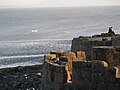 Looking out to sea
 -
 Kolaba Fort entrance


See also[edit | edit source]
- List of forts in Maharashtra
- List of forts in India
- List of Maratha dynasties and states
- Maratha War of Independence
- Battles involving the Maratha Empire
- Maratha Army
- Military history of India
- Kanhoji Angre
References[edit | edit source]
- ↑ "List of the protected monuments of Mumbai Circle district-wise" (PDF). Archived from the original on 6 June 2013.
- ↑ Sen, Sailendra (2013). A Textbook of Medieval Indian History. Primus Books. p. 207. ISBN 978-9-38060-734-4.
- ↑ 3.0 3.1 3.2 Gazetteer of the Bombay Presidency. Govt Central Press. 1883. pp. 261–265. Retrieved 19 March 2009.
- ↑ Colaba Trek Raigad District
- ↑ Centre, UNESCO World Heritage. "Serial Nomination of Maratha Military Architecture in Maharashtra". UNESCO World Heritage Centre. Retrieved 26 June 2021.
- ↑ Hakluyt Society (1967). Works by Hakluyt Society. Kraus Reprint. p. 7.
