


Created page with "{{Use dmy dates|date=April 2018}}{{Use American English|date=July 2015}} {{Infobox planet <!-----------------------------------------------------------------------------------..." |
WikiDwarfBOT (talk | contribs) m robot: Trimming article to decrease server load |
||
| (One intermediate revision by one other user not shown) | |||
| Line 4: | Line 4: | ||
This infobox has been formatted in the same way as those for other Solar System | This infobox has been formatted in the same way as those for other Solar System | ||
planets and bodies, so please do not change it without discussion on the talkpage. | planets and bodies, so please do not change it without discussion on the talkpage. | ||
---------------------------------------------------------------------------------------->|background=#f8f9fa|name=Earth|adjectives=Earthly, terrestrial|symbol=[[File:Earth symbol.svg| | ---------------------------------------------------------------------------------------->|background=#f8f9fa|name=Earth|adjectives=Earthly, terrestrial, terran, tellurian|symbol=[[File:Earth symbol (small, bold).svg|24px|alt=🜨|Astronomical symbol of Earth]]|image=The Blue Marble (remastered).jpg|image_alt="[[The Blue Marble]]" photograph of Earth taken by the ''[[Apollo 17]]'' mission. The Arabian peninsula, Africa and Madagascar lie in the upper half of the disc, whereas Antarctica is at the bottom.|caption=''[[The Blue Marble]]'', the first full-view photograph of the planet <br/> taken by [[Apollo 17]] [[astronaut]]s in 1972|alt_names=<!--{{Unbulleted list|style=padding-top:0.1em;|li_style=line-height:1.3em; |{{hlist|the Earth|the World}} |{{hlist|Blue Planet|[[The Blue Marble|Blue Marble]]|''[[Terra]]''|[[Gaia (mythology)|Gaia]]}} }}-->|epoch=[[J2000.0|J2000]]<ref name="epoch">All astronomical quantities vary, both in time (secularly) and frequency (periodically). The quantities given are the values at the instant [[J2000.0]] of the secular variation, ignoring all periodic variations.</ref>|aphelion={{convert|152100000|km|mi AU|comma=gaps|abbr=on|disp=x|<ref name="apsis">aphelion = ''a'' × (1 + ''e''); perihelion = ''a'' × (1 – ''e''), where ''a'' is the semi-major axis and ''e'' is the eccentricity. The difference between Earth's perihelion and aphelion is 5 million kilometers.</ref><br /><small>(|)</small>}}|perihelion={{convert|147095000|km|mi AU|comma=gaps|abbr=on|disp=x|<ref name="apsis" /><br /><small>(|)</small>}}|semimajor={{convert|149598023|km|mi AU|comma=gaps|abbr=on|disp=x|<ref name="VSOP87">{{cite journal |title=Numerical expressions for precession formulae and mean elements for the Moon and planets |journal=Astronomy and Astrophysics |volume=282 |issue=2 |pages=663–83 |date=February 1994 |last1=Simon |first1=J.L. |last2=Bretagnon |first2=P. |last3=Chapront |first3=J. |last4=Chapront-Touzé |first4=M. |last5=Francou |first5=G. |last6=Laskar |first6=J. |bibcode=1994A&A...282..663S}}</ref><br /><small>(|)</small>}}|eccentricity={{val|0.0167086}}<ref name="VSOP87" />|period={{convert|365.256363004|d|years|comma=gaps|abbr=on|lk=out|disp=x|<ref name="IERS"/><br /><small>(|)</small>}}|avg_speed={{convert|29.78|km/s|km/h mph|comma=gaps|abbr=on|disp=x|<ref name="earth_fact_sheet">{{cite web |url=https://nssdc.gsfc.nasa.gov/planetary/factsheet/earthfact.html |title=Earth Fact Sheet |publisher=NASA/Goddard Space Flight Center |first=David R. |last=Williams |date=16 March 2017 |accessdate=26 July 2018}}</ref><br /><small>(|)</small>}}|mean_anomaly={{val|358.617|u=°}}|inclination={{Unbulleted list|class=nowrap |{{val|7.155|u=°}} to the [[Sun]]'s [[equator]]; |{{val|1.57869|u=°}}<ref name="Allen294">{{cite book| last1 = Allen| first1 = Clabon Walter| last2 = Cox| first2 = Arthur N.| title = Allen's Astrophysical Quantities| url = https://books.google.com/books?id=w8PK2XFLLH8C&pg=PA294| accessdate = 13 March 2011| date = 2000| publisher = Springer| isbn = 978-0-387-98746-0| page = 294 }}</ref> to [[invariable plane]]; |{{val|0.00005|u=°}} to J2000 [[ecliptic]]}}|asc_node={{val|-11.26064|u=°}}<ref name="earth_fact_sheet" /> to J2000 ecliptic|arg_peri={{val|114.20783|u=°}}<ref name="earth_fact_sheet" />|satellites={{unbulleted list | ||
| 1 natural satellite: the [[Moon]] | | 1 natural satellite: the [[Moon]] | ||
| 5 [[quasi-satellite]]s | | 5 [[quasi-satellite]]s | ||
| >1 800 operational [[artificial satellite]]s<ref name="ucs">{{cite web |url=https://www.ucsusa.org/nuclear-weapons/space-weapons/satellite-database |title=UCS Satellite Database |work=Nuclear Weapons & Global Security |publisher=Union of Concerned Scientists |date=10 August 2018 |accessdate=27 September 2018}}</ref> | | >1 800 operational [[artificial satellite]]s<ref name="ucs">{{cite web |url=https://www.ucsusa.org/nuclear-weapons/space-weapons/satellite-database |title=UCS Satellite Database |work=Nuclear Weapons & Global Security |publisher=Union of Concerned Scientists |date=10 August 2018 |accessdate=27 September 2018}}</ref> | ||
| >16 000 [[space debris]]<ref name="space_debris">As of 4 January 2018, the United States Strategic Command tracked a total of 18,835 artificial objects, mostly debris. See: {{cite journal |url=https://orbitaldebris.jsc.nasa.gov/quarterly-news/pdfs/odqnv22i1.pdf |title=Satellite Box Score |journal=Orbital Debris Quarterly News |editor1-first=Phillip |editor1-last=Anz-Meador |editor2-first=Debi |editor2-last=Shoots |volume=22 |issue=1 |page=12 |date=February 2018 |accessdate=18 April 2018}}</ref> | | >16 000 [[space debris]]<ref name="space_debris">As of 4 January 2018, the United States Strategic Command tracked a total of 18,835 artificial objects, mostly debris. See: {{cite journal |url=https://orbitaldebris.jsc.nasa.gov/quarterly-news/pdfs/odqnv22i1.pdf |title=Satellite Box Score |journal=Orbital Debris Quarterly News |editor1-first=Phillip |editor1-last=Anz-Meador |editor2-first=Debi |editor2-last=Shoots |volume=22 |issue=1 |page=12 |date=February 2018 |accessdate=18 April 2018}}</ref> | ||
}}|allsatellites=yes|mean_radius={{convert|6371.0|km|mi|comma=gaps|abbr=on|disp=x| <small>(|)</small>}}<ref name="hbcp2000">{{cite book| last = Lide| first = David R.| title = Handbook of Chemistry and Physics| edition = 81st| date = 2000| publisher = CRC| isbn = 978-0-8493-0481-1| editor = David R. Lide }}</ref>|equatorial_radius={{convert|6378.1|km|mi|comma=gaps|abbr=on|disp=x| <small>(|)</small>}}<ref name="usno">{{cite web |title=Selected Astronomical Constants, 2011 |work=The Astronomical Almanac |url=http://asa.usno.navy.mil/SecK/2011/Astronomical_Constants_2011.txt |archiveurl=https://web.archive.org/web/20130826043456/http://asa.usno.navy.mil/SecK/2011/Astronomical_Constants_2011.txt |archivedate=26 August 2013 |accessdate=25 February 2011}}</ref><ref name="WGS-84"/>|polar_radius={{convert|6356.8|km|mi|comma=gaps|abbr=on|disp=x| <small>(|)</small>}}<ref name="cazenave_ahrens1995">{{cite book |first1=Anny |last1=Cazenave |editor=Ahrens, Thomas J |date=1995 |title=Global Earth Physics: A Handbook of Physical Constants |journal=Global Earth Physics: A Handbook of Physical Constants |issue=1 |publisher=American Geophysical Union |location=Washington, DC |isbn=978-0-87590-851-9 |chapter-url=http://www.agu.org/reference/gephys/5_cazenave.pdf |archiveurl=https://web.archive.org/web/20061016024803/http://www.agu.org/reference/gephys/5_cazenave.pdf |archivedate=16 October 2006 |accessdate=3 August 2008 |chapter=Geoid, Topography and Distribution of Landforms|bibcode=1995geph.conf.....A }}</ref>|flattening={{val|0.0033528}}<ref name="IERS2004">{{cite book| author = International Earth Rotation and Reference Systems Service (IERS) Working Group| others = Dennis D. McCarthy, Gérard Petit, IERS Convertions Centre| editor-last = McCarthy| editor-first = Dennis D.| editor2-last = Petit| editor2-first = Gérard| title = IERS Conventions (2003| url = http://www.iers.org/SharedDocs/Publikationen/EN/IERS/Publications/tn/TechnNote32/tn32.pdf?__blob=publicationFile&v=1| format = PDF| accessdate = 29 April 2016| year = 2004| publisher = Verlag des Bundesamts für Kartographie und Geodäsie| location = Frankfurt am Main| isbn = 978-3-89888-884-4| page = 12| chapter = General Definitions and Numerical Standards| chapter-url = http://www.iers.org/SharedDocs/Publikationen/EN/IERS/Publications/tn/TechnNote32/tn32_009.pdf?__blob=publicationFile&v=1| work = IERS Technical Note No. 32 }}</ref><br />1/{{val|298.257222101}} ([[ETRS89]])|circumference={{unbulleted list |class=nowrap | }}|allsatellites=yes|mean_radius={{convert|6371.0|km|mi|comma=gaps|abbr=on|disp=x| <small>(|)</small>}}<ref name="hbcp2000">{{cite book| last = Lide| first = David R.| title = Handbook of Chemistry and Physics| url = https://archive.org/details/crchandbookofche0000unse_u9i8| edition = 81st| date = 2000| publisher = CRC| isbn = 978-0-8493-0481-1| editor = David R. Lide }}</ref>|equatorial_radius={{convert|6378.1|km|mi|comma=gaps|abbr=on|disp=x| <small>(|)</small>}}<ref name="usno">{{cite web |title=Selected Astronomical Constants, 2011 |work=The Astronomical Almanac |url=http://asa.usno.navy.mil/SecK/2011/Astronomical_Constants_2011.txt |archiveurl=https://web.archive.org/web/20130826043456/http://asa.usno.navy.mil/SecK/2011/Astronomical_Constants_2011.txt |archivedate=26 August 2013 |accessdate=25 February 2011}}</ref><ref name="WGS-84"/>|polar_radius={{convert|6356.8|km|mi|comma=gaps|abbr=on|disp=x| <small>(|)</small>}}<ref name="cazenave_ahrens1995">{{cite book |first1=Anny |last1=Cazenave |editor=Ahrens, Thomas J |date=1995 |title=Global Earth Physics: A Handbook of Physical Constants |journal=Global Earth Physics: A Handbook of Physical Constants |issue=1 |publisher=American Geophysical Union |location=Washington, DC |isbn=978-0-87590-851-9 |chapter-url=http://www.agu.org/reference/gephys/5_cazenave.pdf |archiveurl=https://web.archive.org/web/20061016024803/http://www.agu.org/reference/gephys/5_cazenave.pdf |archivedate=16 October 2006 |accessdate=3 August 2008 |chapter=Geoid, Topography and Distribution of Landforms|series=AGU Reference Shelf |volume=1 |doi=10.1029/RF001 |bibcode=1995geph.conf.....A }}</ref>|flattening={{val|0.0033528}}<ref name="IERS2004">{{cite book| author = International Earth Rotation and Reference Systems Service (IERS) Working Group| others = Dennis D. McCarthy, Gérard Petit, IERS Convertions Centre| editor-last = McCarthy| editor-first = Dennis D.| editor2-last = Petit| editor2-first = Gérard| title = IERS Conventions (2003| url = http://www.iers.org/SharedDocs/Publikationen/EN/IERS/Publications/tn/TechnNote32/tn32.pdf?__blob=publicationFile&v=1| format = PDF| accessdate = 29 April 2016| year = 2004| publisher = Verlag des Bundesamts für Kartographie und Geodäsie| location = Frankfurt am Main| isbn = 978-3-89888-884-4| page = 12| chapter = General Definitions and Numerical Standards| chapter-url = http://www.iers.org/SharedDocs/Publikationen/EN/IERS/Publications/tn/TechnNote32/tn32_009.pdf?__blob=publicationFile&v=1| work = IERS Technical Note No. 32 }}</ref><br />1/{{val|298.257222101}} ([[ETRS89]])|circumference={{unbulleted list |class=nowrap | ||
| {{convert|40075.017|km|mi|comma=gaps|abbr=on|disp=x| <small>[[equator]]ial (|)</small>}}<ref name="WGS-84">[[World Geodetic System]] (''WGS-84''). [http://earth-info.nga.mil/GandG/wgs84/ Available online] {{Webarchive|url=https://web.archive.org/web/20200311023739/https://earth-info.nga.mil/GandG/wgs84/ |date=2020-03-11 }} from [[National Geospatial-Intelligence Agency]].</ref> | | {{convert|40075.017|km|mi|comma=gaps|abbr=on|disp=x| <small>[[equator]]ial (|)</small>}}<ref name="WGS-84">[[World Geodetic System]] (''WGS-84''). [http://earth-info.nga.mil/GandG/wgs84/ Available online] {{Webarchive|url=https://web.archive.org/web/20200311023739/https://earth-info.nga.mil/GandG/wgs84/ |date=2020-03-11 }} from [[National Geospatial-Intelligence Agency]].</ref> | ||
| {{convert|40007.86|km|mi|comma=gaps|abbr=on|disp=x| <small>[[meridional]] (|)</small>}}<ref name="WGS-84-2">{{cite web |first1=Sigurd |last1=Humerfelt |date=26 October 2010 |title=How WGS 84 defines Earth |url=http://home.online.no/~sigurdhu/WGS84_Eng.html |accessdate=29 April 2011 |url-status=dead |archiveurl=https://web.archive.org/web/20110424104419/http://home.online.no/~sigurdhu/WGS84_Eng.html |archivedate=24 April 2011 }}</ref><ref name="circ">Earth's [[circumference]] is almost exactly 40,000 km because the metre was calibrated on this measurement—more specifically, 1/10-millionth of the distance between the poles and the equator.</ref> | | {{convert|40007.86|km|mi|comma=gaps|abbr=on|disp=x| <small>[[meridional]] (|)</small>}}<ref name="WGS-84-2">{{cite web |first1=Sigurd |last1=Humerfelt |date=26 October 2010 |title=How WGS 84 defines Earth |url=http://home.online.no/~sigurdhu/WGS84_Eng.html |accessdate=29 April 2011 |url-status=dead |archiveurl=https://web.archive.org/web/20110424104419/http://home.online.no/~sigurdhu/WGS84_Eng.html |archivedate=24 April 2011 }}</ref><ref name="circ">Earth's [[circumference]] is almost exactly 40,000 km because the metre was calibrated on this measurement—more specifically, 1/10-millionth of the distance between the poles and the equator.</ref> | ||
}}|surface_area={{unbulleted list |class=nowrap | }}|surface_area={{unbulleted list |class=nowrap | ||
| {{convert|510072000|km2|sqmi|comma=gaps|abbr=on|disp=x| <small>(|)</small>}}<ref name="Pidwirny 2006_8">{{cite journal |last1=Pidwirny |first1=Michael |date=2 February 2006 |title=Surface area of our planet covered by oceans and continents.(Table 8o-1) |publisher=University of British Columbia, Okanagan |url=http://www.physicalgeography.net/fundamentals/8o.html |accessdate=26 November 2007}}</ref><ref name="cia">{{cite web |author=Staff |date=24 July 2008 |url=https://www.cia.gov/library/publications/the-world-factbook/geos/xx.html |title=World |work=The World Factbook |publisher=Central Intelligence Agency |accessdate=5 August 2008}}</ref><ref name="surfacecover">Due to natural fluctuations, ambiguities surrounding [[Ice shelf|ice shelves]], and mapping conventions for [[vertical datum]]s, exact values for land and ocean coverage are not meaningful. Based on data from the [[Vector Map]] and [http://www.landcover.org/ Global Landcover] {{Webarchive|url=https://web.archive.org/web/20150326085837/http://www.landcover.org/ |date=2015-03-26 }} datasets, extreme values for coverage of lakes and streams are 0.6% and 1.0% of Earth's surface. The ice shields of [[Antarctica]] and [[Greenland]] are counted as land, even though much of the rock that supports them lies below sea level.</ref> | | {{convert|510072000|km2|sqmi|comma=gaps|abbr=on|disp=x| <small>(|)</small>}}<ref name="Pidwirny 2006_8">{{cite journal |last1=Pidwirny |first1=Michael |date=2 February 2006 |title=Surface area of our planet covered by oceans and continents.(Table 8o-1) |publisher=University of British Columbia, Okanagan |url=http://www.physicalgeography.net/fundamentals/8o.html |accessdate=26 November 2007}}</ref><ref name="cia">{{cite web |author=Staff |date=24 July 2008 |url=https://www.cia.gov/library/publications/the-world-factbook/geos/xx.html |title=World |work=The World Factbook |publisher=Central Intelligence Agency |accessdate=5 August 2008 |archive-date=5 January 2010 |archive-url=https://web.archive.org/web/20100105171656/https://www.cia.gov/library/publications/the-world-factbook/geos/xx.html |url-status=dead }}</ref><ref name="surfacecover">Due to natural fluctuations, ambiguities surrounding [[Ice shelf|ice shelves]], and mapping conventions for [[vertical datum]]s, exact values for land and ocean coverage are not meaningful. Based on data from the [[Vector Map]] and [http://www.landcover.org/ Global Landcover] {{Webarchive|url=https://web.archive.org/web/20150326085837/http://www.landcover.org/ |date=2015-03-26 }} datasets, extreme values for coverage of lakes and streams are 0.6% and 1.0% of Earth's surface. The ice shields of [[Antarctica]] and [[Greenland]] are counted as land, even though much of the rock that supports them lies below sea level.</ref> | ||
| {{convert|148940000|km2|sqmi|comma=gaps|abbr=on|disp=x| land <small>(|; 29.2%)</small>}} | | {{convert|148940000|km2|sqmi|comma=gaps|abbr=on|disp=x| land <small>(|; 29.2%)</small>}} | ||
| {{convert|361132000|km2|sqmi|comma=gaps|abbr=on|disp=x| water <small>(|; 70.8%)</small>}} | | {{convert|361132000|km2|sqmi|comma=gaps|abbr=on|disp=x| water <small>(|; 70.8%)</small>}} | ||
}}|volume=260 billion cubic miles <ref name="devansh">{{cite web |url= https://factshungry.com/mind-blowing-facts-about-earth/| title= Earth's facts| publisher= factshungry}}</ref>|mass={{val|5.97237|e=24|u=kg}} <small>({{val|1.31668|e=25|u=lb}})</small><ref name="Luzum2011">{{cite journal |last1=Luzum |first1=Brian |last2=Capitaine |first2=Nicole |last3=Fienga |first3=Agnès |last4=Folkner |first4=William |last5=Fukushima |first5=Toshio |last6=Hilton |first6=James |last7=Hohenkerk |first7=Catherine |last8=Krasinsky |first8=George |last9=Petit |first9=Gérard |last10=Pitjeva |first10=Elena |last11=Soffel |first11=Michael |last12=Wallace |first12=Patrick |display-authors=5 |title=The IAU 2009 system of astronomical constants: The report of the IAU working group on numerical standards for Fundamental Astronomy |journal=Celestial Mechanics and Dynamical Astronomy |volume=110 |issue=4 |date=August 2011 |pages=293–304 |bibcode=2011CeMDA.110..293L |doi=10.1007/s10569-011-9352-4}}</ref> <br /> <small>({{val|3.0|e=-6|ul=solar mass}})</small>|density={{convert|5.514|g/cm3|lb/cuin|comma=gaps|abbr=on|disp=x| <small>(|)</small>}}<ref name="earth_fact_sheet" />|surface_grav={{convert|9.807|m/s2|ft/s2|comma=gaps|abbr=on|disp=x| <small>([[Gravity of Earth|{{val|1|u=''g''}}]]; |)</small>}}<ref name="NIST2008">{{cite book |url=http://physics.nist.gov/Pubs/SP330/sp330.pdf |title=The international system of units (SI) |publisher=United States Department of Commerce, National Institute of Standards and Technology Special Publication 330 |edition=2008 |page=52}}</ref>|moment_of_inertia_factor=0.3307<ref name="Williams1994">{{cite journal |last1=Williams |first1=James G. |title=Contributions to the Earth's obliquity rate, precession, and nutation |journal=The Astronomical Journal |volume=108 |year=1994 |page=711 |issn=0004-6256 |doi=10.1086/117108 |bibcode=1994AJ....108..711W}}</ref>|escape_velocity={{convert|11.186|km/s|km/h mph|comma=gaps|abbr=on|disp=x|<ref name="earth_fact_sheet" /> <br /> <small>(|)</small>}}|sidereal_day={{longitem|{{val|0.99726968|u=d}}<ref name="Allen296">{{cite book| last1 = Allen| first1 = Clabon Walter| last2 = Cox| first2 = Arthur N.| title = Allen's Astrophysical Quantities| url = https://books.google.com/?id=w8PK2XFLLH8C&pg=PA296| accessdate = 17 August 2010| date = 2000| publisher = Springer| isbn = 978-0-387-98746-0| page = 296 }}</ref> <br /> <small>(23h 56m 4.100s)</small>}}|rot_velocity={{convert|1674.4|km/h|km/s km/h mph|order=out|comma=gaps|abbr=on|disp=x|<ref name="Cox2000">{{cite book| last1 = Allen| first1 = Clabon Walter| last2 = Cox| first2 = Arthur N.| title = Allen's Astrophysical Quantities| url = https://books.google.com/?id=w8PK2XFLLH8C&pg=PA244| accessdate = 17 August 2010| edition = 4th| date = 2000| publisher = AIP Press| location = New York| isbn = 978-0-387-98746-0| page = 244| editor = Arthur N. Cox }}</ref> <br /> <small>(|)</small>}}|axial_tilt={{val|23.4392811|u=°}}<ref name="IERS"/>|albedo={{Unbulleted list|class=nowrap |0.367 [[Geometric albedo|geometric]]<ref name="earth_fact_sheet" /> |0.306 [[Bond albedo|Bond]]<ref name="earth_fact_sheet" />}}|atmosphere=yes|temp_name1=[[Kelvin]]|min_temp_1=184 K<ref name="asu_lowest_temp">{{cite web |url=http://wmo.asu.edu/world-lowest-temperature |title=World: Lowest Temperature |work=[[WMO]] Weather and Climate Extremes Archive |publisher=[[Arizona State University]] |accessdate=7 August 2010 |url-status=dead |archiveurl=https://web.archive.org/web/20100616025722/http://wmo.asu.edu/world-lowest-temperature |archivedate=16 June 2010 }}</ref>|mean_temp_1=288 K<ref name="kinver20091210">{{cite news |url=http://news.bbc.co.uk/2/hi/science/nature/8406839.stm |title=Global average temperature may hit record level in 2010 |last1=Kinver |first1=Mark |date=10 December 2009 |publisher=BBC |accessdate=22 April 2010}}</ref>|max_temp_1=330 K<ref name="asu_highest_temp">{{cite web |url=http://wmo.asu.edu/world-highest-temperature |title=World: Highest Temperature |work=[[WMO]] Weather and Climate Extremes Archive |publisher=[[Arizona State University]] |accessdate=7 August 2010 |url-status=dead |archiveurl=https://web.archive.org/web/20130104143844/http://wmo.asu.edu/world-highest-temperature |archivedate=4 January 2013 |df=dmy}}</ref>|temp_name2=Celsius|min_temp_2=−89.2 °C|mean_temp_2=14.9 °C|max_temp_2=56.9 °C|temp_name3=Fahrenheit|min_temp_3=−128.5 °F|mean_temp_3=58.7 °F|max_temp_3=134.3 °F|surface_pressure={{val|101.325|ul=kPa}} (at [[Sea level|MSL]])|atmosphere_composition={{unbulleted list |class=nowrap | }}|volume=260 billion cubic miles <ref name="devansh">{{cite web |url= https://factshungry.com/mind-blowing-facts-about-earth/| title= Earth's facts| date= 10 May 2021| publisher= factshungry}}</ref>|mass={{val|5.97237|e=24|u=kg}} <small>({{val|1.31668|e=25|u=lb}})</small><ref name="Luzum2011">{{cite journal |last1=Luzum |first1=Brian |last2=Capitaine |first2=Nicole |last3=Fienga |first3=Agnès |last4=Folkner |first4=William |last5=Fukushima |first5=Toshio |last6=Hilton |first6=James |last7=Hohenkerk |first7=Catherine |last8=Krasinsky |first8=George |last9=Petit |first9=Gérard |last10=Pitjeva |first10=Elena |last11=Soffel |first11=Michael |last12=Wallace |first12=Patrick |display-authors=5 |title=The IAU 2009 system of astronomical constants: The report of the IAU working group on numerical standards for Fundamental Astronomy |journal=Celestial Mechanics and Dynamical Astronomy |volume=110 |issue=4 |date=August 2011 |pages=293–304 |bibcode=2011CeMDA.110..293L |doi=10.1007/s10569-011-9352-4|s2cid=122755461 }}</ref> <br /> <small>({{val|3.0|e=-6|ul=solar mass}})</small>|density={{convert|5.514|g/cm3|lb/cuin|comma=gaps|abbr=on|disp=x| <small>(|)</small>}}<ref name="earth_fact_sheet" />|surface_grav={{convert|9.807|m/s2|ft/s2|comma=gaps|abbr=on|disp=x| <small>([[Gravity of Earth|{{val|1|u=''g''}}]]; |)</small>}}<ref name="NIST2008">{{cite book |url=http://physics.nist.gov/Pubs/SP330/sp330.pdf |title=The international system of units (SI) |publisher=United States Department of Commerce, National Institute of Standards and Technology Special Publication 330 |edition=2008 |page=52 |access-date=2019-06-13 |archive-date=2016-06-03 |archive-url=https://web.archive.org/web/20160603215953/http://physics.nist.gov/Pubs/SP330/sp330.pdf |url-status=dead }}</ref>|moment_of_inertia_factor=0.3307<ref name="Williams1994">{{cite journal |last1=Williams |first1=James G. |title=Contributions to the Earth's obliquity rate, precession, and nutation |journal=The Astronomical Journal |volume=108 |year=1994 |page=711 |issn=0004-6256 |doi=10.1086/117108 |bibcode=1994AJ....108..711W}}</ref>|escape_velocity={{convert|11.186|km/s|km/h mph|comma=gaps|abbr=on|disp=x|<ref name="earth_fact_sheet" /> <br /> <small>(|)</small>}}|sidereal_day={{longitem|{{val|0.99726968|u=d}}<ref name="Allen296">{{cite book| last1 = Allen| first1 = Clabon Walter| last2 = Cox| first2 = Arthur N.| title = Allen's Astrophysical Quantities| url = https://books.google.com/books?id=w8PK2XFLLH8C&pg=PA296| accessdate = 17 August 2010| date = 2000| publisher = Springer| isbn = 978-0-387-98746-0| page = 296 }}</ref> <br /> <small>(23h 56m 4.100s)</small>}}|rot_velocity={{convert|1674.4|km/h|km/s km/h mph|order=out|comma=gaps|abbr=on|disp=x|<ref name="Cox2000">{{cite book| last1 = Allen| first1 = Clabon Walter| last2 = Cox| first2 = Arthur N.| title = Allen's Astrophysical Quantities| url = https://books.google.com/books?id=w8PK2XFLLH8C&pg=PA244| accessdate = 17 August 2010| edition = 4th| date = 2000| publisher = AIP Press| location = New York| isbn = 978-0-387-98746-0| page = 244| editor = Arthur N. Cox }}</ref> <br /> <small>(|)</small>}}|axial_tilt={{val|23.4392811|u=°}}<ref name="IERS"/>|albedo={{Unbulleted list|class=nowrap |0.367 [[Geometric albedo|geometric]]<ref name="earth_fact_sheet" /> |0.306 [[Bond albedo|Bond]]<ref name="earth_fact_sheet" />}}|atmosphere=yes|temp_name1=[[Kelvin]]|min_temp_1=184 K<ref name="asu_lowest_temp">{{cite web |url=http://wmo.asu.edu/world-lowest-temperature |title=World: Lowest Temperature |work=[[WMO]] Weather and Climate Extremes Archive |publisher=[[Arizona State University]] |accessdate=7 August 2010 |url-status=dead |archiveurl=https://web.archive.org/web/20100616025722/http://wmo.asu.edu/world-lowest-temperature |archivedate=16 June 2010 }}</ref>|mean_temp_1=288 K<ref name="kinver20091210">{{cite news |url=http://news.bbc.co.uk/2/hi/science/nature/8406839.stm |title=Global average temperature may hit record level in 2010 |last1=Kinver |first1=Mark |date=10 December 2009 |publisher=BBC |accessdate=22 April 2010}}</ref>|max_temp_1=330 K<ref name="asu_highest_temp">{{cite web |url=http://wmo.asu.edu/world-highest-temperature |title=World: Highest Temperature |work=[[WMO]] Weather and Climate Extremes Archive |publisher=[[Arizona State University]] |accessdate=7 August 2010 |url-status=dead |archiveurl=https://web.archive.org/web/20130104143844/http://wmo.asu.edu/world-highest-temperature |archivedate=4 January 2013 |df=dmy}}</ref>|temp_name2=Celsius|min_temp_2=−89.2 °C|mean_temp_2=14.9 °C|max_temp_2=56.9 °C|temp_name3=Fahrenheit|min_temp_3=−128.5 °F|mean_temp_3=58.7 °F|max_temp_3=134.3 °F|surface_pressure={{val|101.325|ul=kPa}} (at [[Sea level|MSL]])|atmosphere_composition={{unbulleted list |class=nowrap | ||
| 78.08% [[nitrogen]] ({{chem2|N2}}; dry air)<ref name="earth_fact_sheet" /> | | 78.08% [[nitrogen]] ({{chem2|N2}}; dry air)<ref name="earth_fact_sheet" /> | ||
| 20.95% [[oxygen]] ({{chem2|O2}}) | | 20.95% [[oxygen]] ({{chem2|O2}}) | ||
| Line 24: | Line 24: | ||
}}|note=no}} | }}|note=no}} | ||
'''Earth'''<!-- is the [[planet]] we live on. It--> is the third planet from the [[Sun]]. It is the only planet known to have [[life]] on it. The Earth [[Age of the Earth|formed | '''Earth'''<!-- is the [[planet]] we live on. It--> is the third [[planet]] from the [[Sun]] in the [[Solar System]]. It is the only planet known to have [[life]] on it. The Earth [[Age of the Earth|formed about 4.5 billion years ago]].<ref name="age earth">{{cite journal|url=http://sp.lyellcollection.org/cgi/content/abstract/190/1/205|title=The age of the Earth in the twentieth century: a problem (mostly) solved|year=2001 |accessdate=2009-07-28|journal=Geological Society, London, Special Publications|doi=10.1144/GSL.SP.2001.190.01.14 |last1=Dalrymple |first1=G. Brent |volume=190 |pages=205–221 |bibcode=2001GSLSP.190..205D |s2cid=130092094 }}</ref><ref>Dalrymple G. Brent 2004. ''Ancient Earth, ancient skies: the age of Earth and its cosmic surroundings''. Stanford. p26, table 3.1</ref> It is one of four [[terrestrial planet|rocky planets]] on the inner side of the [[Solar System]]. The other three are [[Mercury (planet)|Mercury]], [[Venus]], and [[Mars (planet)|Mars]]. | ||
The large [[mass]] of the Sun keeps the Earth in [[orbit]] | The large [[mass]] of the Sun keeps the Earth in [[orbit]] through the force of [[gravity]].<ref>See [[Formation and evolution of the Solar System]] for an account</ref> Earth also turns around in space, so that different parts face the Sun at different times. Earth goes around the Sun once (one [[year]]) for every 365{{Frac|4}} times it turns around (one [[day]]). | ||
Earth is the only [[planet]] in the Solar System that has a large amount of [[liquid]] [[water]].<ref>{{cite web|last=|first=|date=|title=Rover reveals Mars was once wet enough for life|url=http://www.msnbc.msn.com/id/4202901/|url-status=dead|archive-url=https://web.archive.org/web/20040210011241/http://www.msnbc.msn.com/id/4202901/|archive-date=February 10, 2004|accessdate=28 July 2009|website=|publisher=[[Microsoft]]}}</ref> About 74% of the surface of Earth is covered by liquid or frozen water. Because of this, people sometimes call it the blue planet.{{refn|''Blue Planet'' is a poetic title for the Earth used in [[movie]]s, in [[magazine|cheap paper book]]s, in [[poetry]], and in government reports (such as the [[European Space Agency]]'s [http://www.esa.int/esapub/bulletin/bulletin137/bul137b_drinkwater.pdf Exploring the water cycle of the Blue Planet])}} | Earth is the only [[planet]] in the Solar System that has a large amount of [[liquid]] [[water]] on its surface.<ref>name="Gomes">{{cite journal | url=http://www.nature.com/nature/journal/v435/n7041/pdf/nature03676.pdf | title=Origin of the cataclysmic Late Heavy Bombardment period of the terrestrial planets | author=R. Gomes H.F. |display-authors = etal | journal=Nature | year=2005 | volume=435 | pages=466–469 | doi=10.1038/nature03676| pmid=15917802 | issue=7041| bibcode=2005Natur.435..466G | s2cid=4398337 }}</ref><ref>{{cite journal | author= A. Morbidelli J. |display-authors = etal | title= Source regions and timescales for the delivery of water to the Earth | journal= Meteoritics & Planetary Science | volume=35 | pages=1309–1320 | issn= 1086-9379 | year=2000|issue = 6 |doi=10.1111/j.1945-5100.2000.tb01518.x |bibcode = 2000M&PS...35.1309M |s2cid = 129817341 }}</ref><ref>{{cite web|last=|first=|date=|title=Rover reveals Mars was once wet enough for life|url=http://www.msnbc.msn.com/id/4202901/|url-status=dead|archive-url=https://web.archive.org/web/20040210011241/http://www.msnbc.msn.com/id/4202901/|archive-date=February 10, 2004|accessdate=28 July 2009|website=|publisher=[[Microsoft]]}}</ref> About 74% of the surface of Earth is covered by liquid or frozen water. Because of this, people sometimes call it the blue planet.{{refn|''Blue Planet'' is a poetic title for the Earth used in [[movie]]s, in [[magazine|cheap paper book]]s, in [[poetry]], and in government reports (such as the [[European Space Agency]]'s [http://www.esa.int/esapub/bulletin/bulletin137/bul137b_drinkwater.pdf Exploring the water cycle of the Blue Planet])}} | ||
Because of its water, Earth is home to millions of [[species]] of [[plant]]s and [[animal]]s which | Because of its water, Earth is home to millions of [[species]] of [[plant]]s and [[animal]]s which need water to survive.<ref>{{cite journal|url=http://adsabs.harvard.edu/abs/1988Sci...241.1441M|title= How many species are there on Earth.|publisher=Harvard University|bibcode= 1988Sci...241.1441M|accessdate=2009-07-28|last1= May|first1= Robert M.|journal= Science|year= 1988|volume= 241|issue= 4872|pages= 1441–1449|doi= 10.1126/science.241.4872.1441|pmid= 17790039|s2cid= 34992724}}</ref><ref name="purves_et_al2001">{{cite book| last = Purves| first = William Kirkwood| title = Life, the science of biology| year = 2001| publisher = Macmillan| isbn = 978-0-7167-3873-2| page = 455 }}</ref> The things that live on Earth have changed its surface greatly. For example, early [[cyanobacteria]] changed the [[Atmosphere of Earth#History of Earth's atmosphere|air]] and gave it [[oxygen]]. The living part of Earth's surface is called the "[[biosphere]]".<ref>{{cite web|url=http://www.space.com/searchforlife/life_origins_001205.html|title=Origins of life on Earth|accessdate=2009-07-28|publisher=Space.com|archive-date=2009-07-28|archive-url=https://web.archive.org/web/20090728104629/http://www.space.com/searchforlife/life_origins_001205.html|url-status=dead}}</ref> | ||
==Orbit and turning== | ==Orbit and turning== | ||
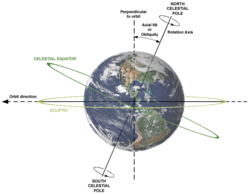
[[File:AxialTiltObliquity.png|thumb| | [[File:AxialTiltObliquity.png|thumb|350px|Earth turns at an angle (an "[[axial tilt]]") in relation to its path around the Sun]] | ||
Earth is | Earth is one of the eight [[planet]]s in the Solar System. There are also thousands of small bodies which move around the Sun. The Solar System is moving through the [[Orion Arm]] of the [[Milky Way]] [[galaxy]], and will be for about the next 10,000 years.<ref>{{cite web|url=http://imagine.gsfc.nasa.gov/docs/ask_astro/answers/030827a.html|title=Earth's location in the Milky Way|accessdate=2009-08-06|publisher=NASA}}</ref><ref>[https://www.forbes.com/sites/startswithabang/2016/04/01/how-fast-does-earth-move-through-the-universe/#42d2c37e4d5c Forbes: How fast does the Earth move through the universe?]</ref> | ||
Earth is about {{convert|150,000,000|km|mi|abbr=off|disp=or}} away from the Sun (this distance is called an "[[Astronomical Unit]]"). It moves on its [[orbit]] at an [[average]] speed of about {{convert|30|km/s|mi/s|abbr=on|lk=on}}.<ref>{{cite web|url=http://nssdc.gsfc.nasa.gov/planetary/factsheet/earthfact.html|title=NASA- an Earth fact sheet|accessdate=2009-08-06|publisher=NASA}}</ref> Earth turns all the way around about 365{{Frac|4}} times in the time it takes for Earth to go all the way around the Sun.<ref name="IERS">{{cite web | author=Staff | date=2007-08-07 | url=http://hpiers.obspm.fr/eop-pc/models/constants.html | title=Useful Constants | publisher=International Earth Rotation and Reference Systems Service| accessdate=2008-09-23 }}</ref> To make up this extra bit of a day every year, an [[leap day|additional day]] is used every four years. This is named a "[[leap year]]". | Earth is about {{convert|150,000,000|km|mi|abbr=off|disp=or}} away from the Sun (this distance is called an "[[Astronomical Unit]]"). It moves on its [[orbit]] at an [[average]] speed of about {{convert|30|km/s|mi/s|abbr=on|lk=on}}.<ref>{{cite web|url=http://nssdc.gsfc.nasa.gov/planetary/factsheet/earthfact.html|title=NASA- an Earth fact sheet|accessdate=2009-08-06|publisher=NASA}}</ref> Earth turns all the way around about 365{{Frac|4}} times in the time it takes for Earth to go all the way around the Sun.<ref name="IERS">{{cite web | author=Staff | date=2007-08-07 | url=http://hpiers.obspm.fr/eop-pc/models/constants.html | title=Useful Constants | publisher=International Earth Rotation and Reference Systems Service| accessdate=2008-09-23 }}</ref> To make up this extra bit of a day every year, an [[leap day|additional day]] is used every four years. This is named a "[[leap year]]". | ||
The [[Moon]] goes around Earth at an [[average]] distance of {{convert|250,000|mi|km|abbr=off|order=flip|disp=or}}. It is locked to Earth, so that it always has the same half facing Earth; the other half is called the "dark side of the moon". It takes about 27{{Frac|3}} days for the Moon to go all the way around Earth, but because Earth is moving around the Sun at the same time, it takes about 29{{Frac|2}} days for the Moon to go from dark to bright to dark again. This is where the word "[[month]]" came from, even though most months now have 30 or 31 days. | The [[Moon]] goes around Earth at an [[average]] distance of {{convert|250,000|mi|km|abbr=off|order=flip|disp=or}}. It is locked to Earth, so that it always has the same half facing Earth; the other half is called the "dark side of the moon". It takes about 27{{Frac|3}} days for the Moon to go all the way around Earth, but because Earth is moving around the Sun at the same time, it takes about 29{{Frac|2}} days for the Moon to go from dark to bright to dark again. This is where the word "[[month]]" came from, even though most months now have 30 or 31 days.<ref>{{Cite web|last=Espenak|first=Fred|title=Eclipses and the Moon's Orbit|url=https://eclipse.gsfc.nasa.gov/SEhelp/moonorbit.html|access-date=2022-08-10|website=|publisher=[[NASA]]}}</ref> | ||
== History of Earth == | == History of Earth == | ||
{{Other pages|Historical geology|Age of the Earth|Giant impact hypothesis|Great Oxygenation Event}} | {{Other pages|Historical geology|Age of the Earth|Giant impact hypothesis|Great Oxygenation Event}} | ||
[[Age of the Earth|Earth]] and the other [[planet]]s formed about 4.6 billion years ago.<ref>{{cite journal| last=Dalrymple | first=G. Brent| title=The age of the Earth in the twentieth century: a problem (mostly) solved | journal=Special Publications, Geological Society of London| year=2001 | volume=190| issue=1 | pages=205–221| doi=10.1144/GSL.SP.2001.190.01.14 |bibcode = 2001GSLSP.190..205D }} | [[Age of the Earth|Earth]] and the other [[planet]]s formed about 4.6 billion years ago.<ref>{{cite journal| last=Dalrymple | first=G. Brent| title=The age of the Earth in the twentieth century: a problem (mostly) solved | journal=Special Publications, Geological Society of London| year=2001 | volume=190| issue=1 | pages=205–221| doi=10.1144/GSL.SP.2001.190.01.14 |bibcode = 2001GSLSP.190..205D | s2cid=130092094}} | ||
</ref> | </ref> Their origin was quite different from that of the [[Formation and evolution of the Solar System|Sun]]. The Sun was formed almost entirely of [[hydrogen]], while the planets were formed mostly from higher elements. The smaller "rocky" planets are made almost entirely of higher elements. The Sun must have moved through areas where [[Supernova|supernovae]] had previously exploded.<ref>Sun's motion and in general the motion of stars in the [[Milky Way]] is known from [[Gaia (spacecraft)|Gaia]] data release #2.</ref> All the planets have higher elements which are only made in supernovae.<ref>Burbidge, E.M; Burbidge G.R.; Fowler W.A.; Hoyle F. 1957. Synthesis of the elements in stars. Reviews of Modern Physics. '''29''' (4): 547–650.[https://journals.aps.org/rmp/abstract/10.1103/RevModPhys.29.547]</ref><ref>Clayton D. 2003. ''Handbook of isotopes in the cosmos''. Cambridge University Press. ISBN 978-0-521-82381-4</ref><ref> Kasen D; Metzger B; Barnes J; Quataert E; Ramirez-Ruiz, E. 2017. Origin of the heavy elements in binary neutron-star mergers from a gravitational-wave event. ''Nature''. '''551''' (7678): 80–84.</ref> Only the so-called "[[gas giants]]" have much hydrogen and [[helium]]. | ||
Earth' | The Moon may have been formed after a collision between the early Earth and a smaller planet (sometimes called ''[[Theia]]''). Scientists believe that parts of both planets broke off {{ndash}} becoming (by [[gravity]]) the Moon.<ref>{{cite journal|url=http://www.nature.com/nature/journal/v412/n6848/abs/412708a0.html|title=Origin of the Moon in a giant impact near the end of the Earth's formation|year=2001|accessdate=2009-07-28|publisher=Nature.com|doi=10.1038/35089010|last1=Canup|first1=Robin M.|last2=Asphaug|first2=Erik|journal=Nature|volume=412|issue=6848|pages=708–712|pmid=11507633|bibcode=2001Natur.412..708C|s2cid=4413525}}</ref> | ||
Earth's land and [[climate]] has been very different in the past. About 3 to 3.5 | Earth's water came from different places. [[Condensation|Condensing]] [[water vapour]], and [[comet]]s and [[asteroid]]s hitting Earth, made the [[ocean]]s. Within a billion years (that is at about 3.6 billion years ago) the first [[life]] [[evolution|evolved]], in the [[Archaean]] [[era]].<ref>{{cite web|url=http://www.spaceref.com/news/viewnews.html?id=258|title=Earth life appeared on land 1.5 billion years earlier than previously thought|accessdate=2009-07-03|publisher=SpaceRef.com}}</ref><ref>Ghosh, Pallab 2017. Earliest evidence of life on Earth 'found'. BBC News Science & Environment. [2]</ref> Some [[bacteria]] developed [[photosynthesis]], which let them make [[food]] from the Sun's [[light]] and [[water]]. This released a lot of [[oxygen]], which was first taken up by [[iron]] in [[solution]]. Eventually, free oxygen got into the [[atmosphere]] or air, making Earth's surface [[wikt:suitable|suitable]] for [[aerobic]] life (see [[Great Oxygenation Event]]). This oxygen also formed the [[ozone]] [[wikt:layer|layer]] which protects life from [[ultraviolet]] [[radiation]] from the Sun. Complex life on the surface of the land did not exist before the ozone layer. | ||
Earth's land and [[climate]] has been very different in the past. About 3 to 3.5 billion years ago almost all land was in one place. This is called a [[continent|supercontinent]]. The earliest known supercontinent was called [[Vaalbara]]. Much later, there was a time (the [[Cryogenian]]) when Earth was almost entirely covered by thick ice sheets ([[glacier]]s).<ref name="snearth">{{cite web|last=|first=|date=August 8, 1999|title=The Snowball Earth|url=http://www.eps.harvard.edu/people/faculty/hoffman/snowball_paper.html|url-status=dead|archiveurl=https://web.archive.org/web/20090910075356/http://www.eps.harvard.edu/people/faculty/hoffman/snowball_paper.html|archivedate=2009-09-10|accessdate=2009-07-28|work=Paul F. Hoffman and Daniel P. Schrag|publisher=Harvard University}}</ref> This is discussed as the [[Snowball Earth]] [[theory]].<ref name=snearth /> | |||
== What it is made of == | == What it is made of == | ||
| Line 57: | Line 59: | ||
=== Chemical make-up === | === Chemical make-up === | ||
Overall, Earth is made of [[iron]] (32.1[[percent|%]]), [[oxygen]] (30.1[[percent|%]]), [[silicon]] (15.1[[percent|%]]), [[magnesium]] (13.9[[percent|%]]), [[sulfur]] (2.9[[percent|%]]), [[nickel]] (1.8[[percent|%]]), [[calcium]] (1.5[[percent|%]]), and [[aluminium]] (1.4[[percent|%]]). The 1.2[[percent|%]] left over is made of many different kinds of other chemicals. | Overall, Earth is made of [[iron]] (32.1[[percent|%]]), [[oxygen]] (30.1[[percent|%]]), [[silicon]] (15.1[[percent|%]]), [[magnesium]] (13.9[[percent|%]]), [[sulfur]] (2.9[[percent|%]]), [[nickel]] (1.8[[percent|%]]), [[calcium]] (1.5[[percent|%]]), and [[aluminium]] (1.4[[percent|%]]). The 1.2[[percent|%]] left over is made of many different kinds of other chemicals. Some rare metals (not just [[gold]] and [[platinum]]) are very valuable. [[Rare earth element|Rare Earth]] metals are used in all types of electronic phones and computers. | ||
The structure of Earth changes from the inside to the outside. The [[Planetary core|center of earth]] ([[Earth's core]]) is mostly iron (88.8%), nickel (5.8%), sulfur (4.5%), and less than 1% other things.<ref>Morgan J.W. & Anders E. 1980. Chemical composition of Earth, Venus, and Mercury. ''Proceedings of the National Academy of Science'' '''77''' (12): 6973–6977. [https://www.ncbi.nlm.nih.gov/pmc/articles/PMC350422/?tool=pmcentrez Chemical composition of Earth, Venus, and Mercury] Full free text</ref> The [[Earth's crust]] is largely [[oxygen]] (47[[percent|%]]). Oxygen is normally a gas but it can [[oxide|join]] with other [[chemicals]] to make [[chemical compound|compounds]] like [[water]] and rocks. 99.22[[percent|%]] of rocks have [[oxygen]] in them. The most common [[oxygen]]-having rocks are [[silica]] (made with [[silicon]]), [[alumina]] (made with [[aluminum|aluminium]]), [[rust]] (made with [[iron]]), [[lime (chemical)|lime]] (made with [[calcium]]), [[magnesia]] (made with [[magnesium]]), [[potash]] (made with [[potassium]]), and [[sodium]] oxide, and there are others as well.<ref>Chisholm, Hugh (editor). 1911. "Petrology" in the ''Encyclopædia Britannica'', 11th edition. Cambridge University Press.</ref> | The structure of Earth changes from the inside to the outside. The [[Planetary core|center of earth]] ([[Earth's core]]) is mostly iron (88.8%), nickel (5.8%), sulfur (4.5%), and less than 1% other things.<ref>Morgan J.W. & Anders E. 1980. Chemical composition of Earth, Venus, and Mercury. ''Proceedings of the National Academy of Science'' '''77''' (12): 6973–6977. [https://www.ncbi.nlm.nih.gov/pmc/articles/PMC350422/?tool=pmcentrez Chemical composition of Earth, Venus, and Mercury] Full free text</ref> The [[Earth's crust]] is largely [[oxygen]] (47[[percent|%]]). Oxygen is normally a gas but it can [[oxide|join]] with other [[chemicals]] to make [[chemical compound|compounds]] like [[water]] and rocks. 99.22[[percent|%]] of rocks have [[oxygen]] in them. The most common [[oxygen]]-having rocks are [[silica]] (made with [[silicon]]), [[alumina]] (made with [[aluminum|aluminium]]), [[rust]] (made with [[iron]]), [[lime (chemical)|lime]] (made with [[calcium]]), [[magnesia]] (made with [[magnesium]]), [[potash]] (made with [[potassium]]), and [[sodium]] oxide, and there are others as well.<ref>Chisholm, Hugh (editor). 1911. "Petrology" in the ''Encyclopædia Britannica'', 11th edition. Cambridge University Press.</ref> | ||
==== Density ==== | |||
*The Earth is the [[density|densest]] of all the planets.<ref>Planetary Fact Sheet - Ratio to Earth Values</ref> It has a lot of heavy metals in it.<ref>Williams, David R. (16 March 2017). "Earth Fact Sheet". NASA/Goddard Space Flight Center. Retrieved 26 July 2018. [https://nssdc.gsfc.nasa.gov/planetary/factsheet/earthfact.html]</ref> | |||
=== Shape === | === Shape === | ||
[[Geoid|Earth's shape]] is a [[spheroid]]: not quite a [[sphere]] because it is slightly [[oblate|squashed]] on the top and bottom. The shape is called an [[oblate spheroid]]. As Earth spins around itself, [[centrifugal force]] forces the [[equator]] out a little and pulls the [[geographical pole|poles]] in a little. The equator, around the middle of Earth's surface, is about {{convert|40,075|km|mi|sp=us|disp=or|sigfig=4}} long.<ref>Measuring the Earth is part of [[geodesy]]</ref> | [[Geoid|Earth's shape]] is a [[spheroid]]: not quite a [[sphere]] because it is slightly [[oblate|squashed]] on the top and bottom. The shape is called an [[oblate spheroid]]. As Earth spins around itself, [[centrifugal force]] forces the [[equator]] out a little and pulls the [[geographical pole|poles]] in a little. The equator, around the middle of Earth's surface, is about {{convert|40,075|km|mi|sp=us|disp=or|sigfig=4}} long.<ref>Measuring the Earth is part of [[geodesy]]</ref> The reason the Earth is roughly a [[sphere]] (and so are all planets and stars) is [[gravity]].<ref>Tipler, Paul A. 1999. ''Physics for scientists and engineers''. 4th ed, New York: W.H. Freeman/Worth Publishers. pp. 336–337. ISBN 9781572594913</ref> Meteorites, on the other hand may be any shape because, in their case, the force of gravity is too weak to change their shape. | ||
The highest mountain above [[sea level]]—the well-known [[Mount Everest]] (which is {{convert|8848|m|abbr=off|disp=or}} [[elevation|above sea level]])—is ''not'' actually the one that is the farthest away from the center of the Earth. Instead, the sleeping [[volcano]] [[Mount Chimborazo]] in [[Ecuador]] is; it is only {{convert| | The highest mountain above [[sea level]]—the well-known [[Mount Everest]] (which is {{convert|8848|m|abbr=off|disp=or}} [[elevation|above sea level]])—is ''not'' actually the one that is the farthest away from the center of the Earth. Instead, the sleeping [[volcano]] [[Mount Chimborazo]] in [[Ecuador]] is; it is only {{convert| | ||
6263|m|abbr=off|disp=or}} [[elevation|above sea level]] but it is almost at the [[equator]]. Because of this, Mount Chimborazo is {{convert|6,384|km|abbr=off|disp=or}} from the center of the Earth, while [[Mount Everest]] is {{convert|2|km|abbr=off|disp=or}} closer to it.<ref>{{cite web|url=http://www.profsurv.com/archive.php?issue=42&article=589|title=Did Edmund Hillary climb the wrong mountain?|work = Professional Surveyor Magazine | volume=20 |issue=5 |first = Joseph H. |last = Senne| date = May 2000|accessdate = 2008-10-24}}</ref><ref name="lancet365_9462_831">{{cite journal | last=Sharp | first=David | title=Chimborazo and the old kilogram | journal=The Lancet | date=2005-03-05 | volume=365 | issue=9462 | pages=831–832 | doi=10.1016/S0140-6736(05)71021-7 }}</ref><ref name="tall_tales">{{cite web | url=http://www.abc.net.au/science/k2/moments/s1086384.htm | title=Tall tales about highest peaks | publisher=Australian Broadcasting Corporation | accessdate=2008-12-29}}</ref> Similarly, the lowest point below sea level that we are conscious of is the [[Challenger Deep]] in the [[Mariana Trench]] in the [[Pacific Ocean]]. It is about {{convert|10971|m|abbr=off|disp=or}} [[depth|below sea level]],<ref name="kaiko7000">{{cite web|title=7,000 m Class Remotely Operated Vehicle ''KAIKO 7000''|url=http://www.jamstec.go.jp/e/about/equipment/ships/kaiko7000.html|publisher=Japan Agency for Marine-Earth Science and Technology (JAMSTEC)|accessdate=2008-06-07}}</ref> but, again, there are probably places at the bottom of the [[Arctic Ocean]] that are nearer to the center of the Earth. | 6263|m|abbr=off|disp=or}} [[elevation|above sea level]] but it is almost at the [[equator]]. Because of this, Mount Chimborazo is {{convert|6,384|km|abbr=off|disp=or}} from the center of the Earth, while [[Mount Everest]] is {{convert|2|km|abbr=off|disp=or}} closer to it.<ref>{{cite web|url=http://www.profsurv.com/archive.php?issue=42&article=589|title=Did Edmund Hillary climb the wrong mountain?|work = Professional Surveyor Magazine | volume=20 |issue=5 |first = Joseph H. |last = Senne| date = May 2000|accessdate = 2008-10-24}}</ref><ref name="lancet365_9462_831">{{cite journal | last=Sharp | first=David | title=Chimborazo and the old kilogram | journal=The Lancet | date=2005-03-05 | volume=365 | issue=9462 | pages=831–832 | doi=10.1016/S0140-6736(05)71021-7 | pmid=15752514 | s2cid=41080944 }}</ref><ref name="tall_tales">{{cite web | url=http://www.abc.net.au/science/k2/moments/s1086384.htm | title=Tall tales about highest peaks | date=16 April 2004 | publisher=Australian Broadcasting Corporation | accessdate=2008-12-29}}</ref> Similarly, the lowest point below sea level that we are conscious of is the [[Challenger Deep]] in the [[Mariana Trench]] in the [[Pacific Ocean]]. It is about {{convert|10971|m|abbr=off|disp=or}} [[depth|below sea level]],<ref name="kaiko7000">{{cite web|title=7,000 m Class Remotely Operated Vehicle ''KAIKO 7000''|url=http://www.jamstec.go.jp/e/about/equipment/ships/kaiko7000.html|publisher=Japan Agency for Marine-Earth Science and Technology (JAMSTEC)|accessdate=2008-06-07}}</ref> but, again, there are probably places at the bottom of the [[Arctic Ocean]] that are nearer to the center of the Earth. | ||
=== Earth’s core === | === Earth’s core === | ||
[[File:Earth-crust-cutaway-english.svg|thumb|right|A picture of the inside of the Earth, showing the different levels. In fact, the air and the outside levels are much thinner than shown here]] | [[File:Earth-crust-cutaway-english.svg|thumb|right|220px|A picture of the inside of the Earth, showing the different levels. In fact, the air and the outside levels are much thinner than shown here]] | ||
The [[Kola superdeep borehole|deepest hole ever dug]] is only about {{convert|12.3|km|mi|disp=or|sp=us|sigfig=2}}. We know something about the inside of the Earth, though, because we can learn things from [[earthquake]]s and the times when [[volcano]]es [[Volcanic eruption|erupt]]. We are able to see how quickly the [[shock wave]]s move through Earth in different places. | The [[Kola superdeep borehole|deepest hole ever dug]] is only about {{convert|12.3|km|mi|disp=or|sp=us|sigfig=2}}. We know something about the inside of the Earth, though, because we can learn things from [[earthquake]]s and the times when [[volcano]]es [[Volcanic eruption|erupt]]. We are able to see how quickly the [[shock wave]]s move through Earth in different places. | ||
The inside of Earth is very different from the outside. Almost all of Earth's liquid water is in the [[ocean|sea]]s or close to the surface. The surface also has a lot of [[oxygen]], which comes from plants. Small and simple kinds of life can live far under the surface, but animals and plants only live on the surface or in the seas. The rocks on the surface of Earth ([[Earth's crust]]) are well known. They are thicker where there is land, between {{convert|30|to|50|km|mi|disp=or|sp=us|abbr=on|sigfig=2}} thick. Under the [[ocean|sea]]s they are sometimes only {{convert|6|km|mi|disp=or|sp=us|abbr=on|sigfig=2}} thick.<ref>{{cite web|author=Toshiro Tanimoto | The inside of Earth is very different from the outside. Almost all of Earth's liquid water is in the [[ocean|sea]]s or close to the surface. The surface also has a lot of [[oxygen]], which comes from plants. Small and simple kinds of life can live far under the surface, but animals and plants only live on the surface or in the seas. The rocks on the surface of Earth ([[Earth's crust]]) are well known. They are thicker where there is land, between {{convert|30|to|50|km|mi|disp=or|sp=us|abbr=on|sigfig=2}} thick. Under the [[ocean|sea]]s they are sometimes only {{convert|6|km|mi|disp=or|sp=us|abbr=on|sigfig=2}} thick.<ref>{{cite web|author=Toshiro Tanimoto|date=|title=Crustal Surface of the Earth|url=http://www.agu.org/reference/gephys/15_tanimoto.pdf|url-status=dead|archive-url=https://web.archive.org/web/20030410215144/http://www.agu.org/reference/gephys/15_tanimoto.pdf|archive-date=April 10, 2003|accessdate=2009-08-02|website=|publisher=American Geophysical Union}}</ref> There are three groups of rocks that make up most of the Earth's crust. Some rock is made when the hot liquid rock comes from inside the earth ([[igneous rock]]s); another type of rock is made when [[sediment]] is laid down, usually under the sea ([[sedimentary rock]]s); and a third kind of rock is made when the other two are changed by very high [[temperature]] or [[pressure]] ([[metamorphic rock]]s). A very few rocks also fall out of the sky ([[meteorite]]s). | ||
Below the crust is | Below the crust is hot and almost-[[liquid]] rock which is always moving around (the [[Earth's mantle]]). Then, there is a thin liquid layer of heated rock (the [[outer core]]). This is very hot: {{convert|7000|°C|°F K|disp=or|sigfig=2}}.<ref>{{cite web|url=http://chianti.geol.ucl.ac.uk/~dario/pubblicazioni/PTRSA2002.pdf|title=The ab initio simulation of the Earth's core|date=2002-04-25|accessdate=2009-08-02|publisher=The Royal Society|author=D. Alfé}}</ref> The middle of the inside of the Earth would be liquid as well but all the pressure of the rock above it makes it a solid. This solid middle part (the [[inner core]]) is almost all [[iron]]. It is what makes the Earth [[magnetic field|magnetic]]. | ||
=== Pieces of the crust form plates === | === Pieces of the crust form plates === | ||
| Line 80: | Line 85: | ||
{{main|Plate tectonics}} | {{main|Plate tectonics}} | ||
The [[Earth's crust]] is solid but made of [[plate tectonics|parts]] which move very slowly.<ref name="jour">{{cite journal| last=Tackley | first=Paul J.| title=Mantle convection and plate tectonics: towards an integrated physical and chemical theory| journal=Science | date=2000-06-16| volume=288 | issue=5473 | pages=2002–2007| doi=10.1126/science.288.5473.2002| pmid=10856206 }}</ref> The thin | The [[Earth's crust]] is solid but made of [[plate tectonics|parts]] which move very slowly.<ref name="jour">{{cite journal| last=Tackley | first=Paul J.| title=Mantle convection and plate tectonics: towards an integrated physical and chemical theory| journal=Science | date=2000-06-16| volume=288 | issue=5473 | pages=2002–2007| doi=10.1126/science.288.5473.2002| pmid=10856206 | bibcode=2000Sci...288.2002T}}</ref> The thin skin of hard rock on the outside of the Earth rests on hot liquid material below it in the deeper [[mantle (geology)|mantle]].<ref name="TecPlates">{{cite web|last=|first=|date=|title=The Crust|url=http://volcano.oregonstate.edu/education/vwlessons/lessons/Earths_layers/Earths_layers4.html|url-status=dead|archive-url=https://web.archive.org/web/20091213011245/http://volcano.oregonstate.edu/education/vwlessons/lessons/Earths_layers/Earths_layers4.html|archive-date=December 13, 2009|accessdate=2009-07-03|website=|publisher=Oregon State University}}</ref> This liquid material moves because it gets heat from the hot center of the Earth. The slow movement of the plates is what causes [[earthquake]]s, [[volcano]]es and large groups of mountains on the Earth. | ||
There are three ways plates can come together. Two plates can move towards each other ("convergent" plate edges). This can form [[island]]s | There are three ways plates can come together. Two plates can move towards each other ("convergent" plate edges). This can form [[island]]s, [[volcanoes]], and high [[mountain range]]s (such as the [[Andes]] and [[Himalayas]]).<ref name="book1">{{cite book| last1 = Seyfert| first1 = Carl K.| last2 = Seyfert| first2 = Carl| last3 = Seyfert| first3 = Claus| title = The encyclopedia of structural geology and plate tectonics| url = https://archive.org/details/encyclopediaofst0000unse| year = 1987| publisher = Springer| isbn = 978-0-442-28125-0 }}</ref> Two plates can move away from each other ("divergent" plate edges). This gives the [[magma|warm liquid rock inside the earth]] a place to come out. This makes [[mid-ocean ridge|special mountain range]]s below the sea or large low lands like [[Africa]]'s [[Great Rift Valley]].<ref name="'platetectonics.com'">{{cite web |title=Plate Tectonics: plate boundaries |url=http://www.platetectonics.com/book/page_5.asp |publisher=platetectonics.com |accessdate=12 June 2010 |archive-date=16 June 2010 |archive-url=https://web.archive.org/web/20100616062513/http://www.platetectonics.com/book/page_5.asp |url-status=dead }}</ref><ref name="'usgs.understanding.com'">{{cite web |title=Understanding plate motions |url= http://pubs.usgs.gov/gip/dynamic/understanding.html|publisher=USGS|accessdate=12 June 2010}}</ref> Plates are able to move beside each other as well ("transform" plate edges, such as the [[San Andreas Fault]]). This makes their edges crush against each other and makes many [[earthquakes|shocks as they move]].<ref name="book2">{{cite book|title=Plate tectonics: an insider's history of the modern theory of the Earth|isbn=0813341329|last=Oreskes|first=Naomi|publisher=Westview Press|year=2003}}</ref> | ||
=== Surface === | === Surface === | ||
| Line 92: | Line 97: | ||
{{Life timeline}} | {{Life timeline}} | ||
{{main|Atmosphere}} | {{main|Atmosphere}} | ||
All around the Earth is | All around the Earth is the of air (the [[atmosphere]]). The mass of the Earth holds the [[gas]]ses in the air down and does not let them go into outer space. The air is mostly made of [[nitrogen]] (about 78[[percent|%]]) and [[oxygen]] (about 21[[percent|%]]) and there are a few other gasses as well.<ref>{{cite web|url=http://www.nasa.gov/audience/forstudents/9-12/features/912_liftoff_atm.html|title=NASA - Earth's atmosphere|accessdate=2009-08-06|publisher=NASA}}</ref> Most living things need the air (or parts of the air gripped in the water) to breathe and live. They use the gasses—especially [[oxygen]] and [[carbon dioxide]]—to make and use [[sugar]] and to give themselves power. | ||
The air animals and plants use to live is only the first level of the air around the Earth (the [[troposphere]]). The day to day changes in this level of air are | The air animals and plants use to live is only the first level of the air around the Earth (the [[troposphere]]). The day to day changes in this level of air are called [[weather]]; the larger differences between distant places and from year to year are called the [[climate]]. [[Rain]] and [[storm]]s come about because this part of the air gets colder as it goes up. [[convection|Cold air becomes thicker and falls, and warm air becomes thinner and goes up]].<ref name="NASA">{{cite web|last=|first=|date=|title=What causes weather?|url=http://www.nasa.gov/worldbook/weather_worldbook.html|url-status=dead|archive-url=https://web.archive.org/web/20050501070321/http://www.nasa.gov/worldbook/weather_worldbook.html|archive-date=May 1, 2005|accessdate=2009-08-06|website=|publisher=NASA}}</ref> The turning Earth moves the air as well and air moves north and south because the middle of the Earth generally gets more power from the Sun and is warmer than the north and south points. Air over warm water [[evaporation|evaporates]] but, because cold air is not able to take in as much water, it starts to make [[cloud]]s and [[rain]] as it gets colder. The way water moves around in a circle like this is called the [[water cycle]].<ref name= NASA /> | ||
Above this first level, there are four other levels. The air gets colder as it goes up in the first level; in the second level (the [[stratosphere]]), the air gets warmer as it goes up. This level has a special kind of [[oxygen]] called [[ozone]]. The [[ozone]] in this air keeps living things safe from [[ultraviolet radiation|damaging rays from the Sun]]. The power from these rays is what makes this level warmer and warmer. The middle level (the [[mesosphere]]) gets colder and colder with height; the fourth level (the [[thermosphere]]) gets warmer and warmer; and the last level (the [[exosphere]]) is almost outer space and has very little air at all. It reaches about half the way to the Moon. The three outer levels have a lot of [[electricity|electric power]] moving through them; this is called the [[ionosphere]] and is important for [[radio]] and other electric waves in the air. It is also where the [[Northern Lights]] are. | Above this first level, there are four other levels. The air gets colder as it goes up in the first level; in the second level (the [[stratosphere]]), the air gets warmer as it goes up. This level has a special kind of [[oxygen]] called [[ozone]]. The [[ozone]] in this air keeps living things safe from [[ultraviolet radiation|damaging rays from the Sun]]. The power from these rays is what makes this level warmer and warmer. The middle level (the [[mesosphere]]) gets colder and colder with height; the fourth level (the [[thermosphere]]) gets warmer and warmer; and the last level (the [[exosphere]]) is almost outer space and has very little air at all. It reaches about half the way to the Moon. The three outer levels have a lot of [[electricity|electric power]] moving through them; this is called the [[ionosphere]] and is important for [[radio]] and other electric waves in the air. It is also where the [[Northern Lights]] are. | ||
Even though air seems very light, the weight of all of the air above the outside of the Earth ([[air pressure]]) is important. Generally, from [[sea level]] to the top of [[exosphere|the outer level of the air]], a space of air one [[square centimeter|cm<sup>2</sup>]] across has a mass of about 1.03 [[kilogram|kg]] and a space of air one [[square inch|sq in]] across has a weight of about 14.7 [[Pound (mass)|lb]] | Even though air seems very light, the weight of all of the air above the outside of the Earth ([[air pressure]]) is important. Generally, from [[sea level]] to the top of [[exosphere|the outer level of the air]], a space of air one [[square centimeter|cm<sup>2</sup>]] across has a mass of about 1.03 [[kilogram|kg]] and a space of air one [[square inch|sq in]] across has a weight of about 14.7 [[Pound (mass)|lb]]. Because of the air, small meteorites generally burn up long before they get to the earth. | ||
The air also keeps the Earth warm, specially the half turned away from the Sun. Some gasses – especially [[methane]] and [[carbon dioxide]] – [[greenhouse effect|work like a blanket to keep things warm]].<ref>{{cite web|url=http://www.physicalgeography.net/fundamentals/7h.html|title=Fundamentals of physical geography - the greenhouse effect|accessdate=2009-08-06|publisher=Physical Geography}}</ref> [[#History of Earth|In the past]], the Earth has been much warmer and much colder than it is now. Since people have grown used to the heat we have now, though, we do not want the Earth to be too much warmer or colder. Most of the ways people create [[electricity|electric power]] use burning kinds of [[carbon]]—especially [[coal]], [[oil]], and [[natural gas]]. Burning these creates new [[carbon dioxide]] and can cause more warming. A [[climate change|large discussion]] is going on now about what people should do about [[global warming|the Earth's latest warming]], which has gone on for about 150 years. So far, this warming has been | The air also keeps the Earth warm, specially the half turned away from the Sun. Some gasses – especially [[methane]] and [[carbon dioxide]] – [[greenhouse effect|work like a blanket to keep things warm]].<ref>{{cite web|url=http://www.physicalgeography.net/fundamentals/7h.html|title=Fundamentals of physical geography - the greenhouse effect|accessdate=2009-08-06|publisher=Physical Geography}}</ref> [[#History of Earth|In the past]], the Earth has been much warmer and much colder than it is now. Since people have grown used to the heat we have now, though, we do not want the Earth to be too much warmer or colder. Most of the ways people create [[electricity|electric power]] use burning kinds of [[carbon]]—especially [[coal]], [[oil]], and [[natural gas]]. Burning these creates new [[carbon dioxide]] and can cause more warming. A [[climate change|large discussion]] is going on now about what people should do about [[global warming|the Earth's latest warming]], which has gone on for about 150 years. So far, this warming has been acceptable: plants have grown better. The weather has been better than [[Little Ice Age|when it was colder]]. Bad things will possibly come about if the warming goes on. | ||
== People == | == People == | ||
{{main|Human}} | {{main|Human}} | ||
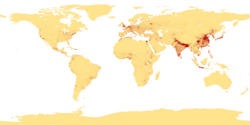
About eight [[billion]] people live on Earth. They live in about 200 different lands called [[countries]]. Some, for example, [[Russia]], are large with many large cities. Others, for example, [[Vatican City]], are small. The | About eight [[billion]] people live on Earth. They live in about 200 different lands called [[countries]]. Some, for example, [[Russia]], are large with many large cities. Others, for example, [[Vatican City]], are small. The seven countries with the most people are [[China]], [[India]], the [[United States]], [[Indonesia]], [[Pakistan]], [[Brazil]] and [[Nigeria]]. About 90% of people live in the [[northern hemisphere]] of the world, which has most of the land. Human beings originally came from [[Africa]]. Now, 70% of all people do not live in Africa but in [[Europe]] and [[Asia]].<ref>Diamond, Jared. 1997. ''[[Guns, Germs, and Steel]]: the fate of human societies''. New York: Norton.</ref> | ||
[[File:Population_density.png|link=https://en.wikipedia.org/wiki/File:Population_density.png|alt=|thumb|center|350px|The distribution of human [[world population]] in 2018]] | [[File:Population_density.png|link=https://en.wikipedia.org/wiki/File:Population_density.png|alt=|thumb|center|350px|The distribution of human [[world population]] in 2018]] | ||
| Line 126: | Line 131: | ||
{{reflist|2}} | {{reflist|2}} | ||
== | == External links == | ||
{{Commons|Earth}} | {{Commons|Earth}} | ||
{{wiktionary|Earth|earth}} | {{wiktionary|Earth|earth}} | ||
Latest revision as of 12:18, 25 October 2022
.jpg) | |||||||||||||||||
| Designations | |||||||||||||||||
|---|---|---|---|---|---|---|---|---|---|---|---|---|---|---|---|---|---|
| Adjectives | Earthly, terrestrial, terran, tellurian | ||||||||||||||||
| Symbol | .svg) | ||||||||||||||||
| Orbital characteristics | |||||||||||||||||
| Epoch J2000[1] | |||||||||||||||||
| Aphelion | 152100000 km[2] (94500000 mi; 1.017 AU) | ||||||||||||||||
| Perihelion | 147095000 km[2] (91401000 mi; 0.98327 AU) | ||||||||||||||||
| 149598023 km[3] (92955902 mi; 1.00000102 AU) | |||||||||||||||||
| Eccentricity | 0.0167086[3] | ||||||||||||||||
| 365.256363004 d[4] (1.00001742096 yr) | |||||||||||||||||
Average orbital speed | 29.78 km/s[5] (107200 km/h; 66600 mph) | ||||||||||||||||
| Lua error in package.lua at line 80: module 'Module:Val/units' not found. | |||||||||||||||||
| Inclination |
| ||||||||||||||||
| Lua error in package.lua at line 80: module 'Module:Val/units' not found.[5] to J2000 ecliptic | |||||||||||||||||
| Lua error in package.lua at line 80: module 'Module:Val/units' not found.[5] | |||||||||||||||||
| Satellites |
| ||||||||||||||||
| Physical characteristics | |||||||||||||||||
| 6371.0 km (3958.8 mi)[9] | |||||||||||||||||
Equatorial radius | 6378.1 km (3963.2 mi)[10][11] | ||||||||||||||||
Polar radius | 6356.8 km (3949.9 mi)[12] | ||||||||||||||||
| Flattening | 0.0033528[13] 1/298.257222101 (ETRS89) | ||||||||||||||||
| Circumference |
| ||||||||||||||||
| Volume | 260 billion cubic miles [19] | ||||||||||||||||
| Mass | Lua error in package.lua at line 80: module 'Module:Val/units' not found. (Lua error in package.lua at line 80: module 'Module:Val/units' not found.)[20] (Lua error in package.lua at line 80: module 'Module:Val/units' not found.) | ||||||||||||||||
Mean density | 5.514 g/cm3 (0.1992 lb/cu in)[5] | ||||||||||||||||
| 9.807 m/s2 (Lua error in package.lua at line 80: module 'Module:Val/units' not found.; 32.18 ft/s2)[21] | |||||||||||||||||
| 0.3307[22] | |||||||||||||||||
| 11.186 km/s[5] (40270 km/h; 25020 mph) | |||||||||||||||||
Equatorial rotation velocity | 0.4651 km/s[24] (1674.4 km/h; 1040.4 mph) | ||||||||||||||||
| Lua error in package.lua at line 80: module 'Module:Val/units' not found.[4] | |||||||||||||||||
| Albedo | |||||||||||||||||
| |||||||||||||||||
| Atmosphere | |||||||||||||||||
Surface pressure | Lua error in package.lua at line 80: module 'Module:Val/units' not found. (at MSL) | ||||||||||||||||
| Composition by volume |
| ||||||||||||||||
Earth is the third planet from the Sun in the Solar System. It is the only planet known to have life on it. The Earth formed about 4.5 billion years ago.[29][30] It is one of four rocky planets on the inner side of the Solar System. The other three are Mercury, Venus, and Mars.
The large mass of the Sun keeps the Earth in orbit through the force of gravity.[31] Earth also turns around in space, so that different parts face the Sun at different times. Earth goes around the Sun once (one year) for every 3651⁄4 times it turns around (one day).
Earth is the only planet in the Solar System that has a large amount of liquid water on its surface.[32][33][34] About 74% of the surface of Earth is covered by liquid or frozen water. Because of this, people sometimes call it the blue planet.[35]
Because of its water, Earth is home to millions of species of plants and animals which need water to survive.[36][37] The things that live on Earth have changed its surface greatly. For example, early cyanobacteria changed the air and gave it oxygen. The living part of Earth's surface is called the "biosphere".[38]
Orbit and turning[edit | edit source]

Earth is one of the eight planets in the Solar System. There are also thousands of small bodies which move around the Sun. The Solar System is moving through the Orion Arm of the Milky Way galaxy, and will be for about the next 10,000 years.[39][40]
Earth is about 150,000,000 kilometres or 93,000,000 miles away from the Sun (this distance is called an "Astronomical Unit"). It moves on its orbit at an average speed of about 30 km/s (19 mi/s).[41] Earth turns all the way around about 3651⁄4 times in the time it takes for Earth to go all the way around the Sun.[4] To make up this extra bit of a day every year, an additional day is used every four years. This is named a "leap year".
The Moon goes around Earth at an average distance of 400,000 kilometres or 250,000 miles. It is locked to Earth, so that it always has the same half facing Earth; the other half is called the "dark side of the moon". It takes about 271⁄3 days for the Moon to go all the way around Earth, but because Earth is moving around the Sun at the same time, it takes about 291⁄2 days for the Moon to go from dark to bright to dark again. This is where the word "month" came from, even though most months now have 30 or 31 days.[42]
History of Earth[edit | edit source]
Earth and the other planets formed about 4.6 billion years ago.[43] Their origin was quite different from that of the Sun. The Sun was formed almost entirely of hydrogen, while the planets were formed mostly from higher elements. The smaller "rocky" planets are made almost entirely of higher elements. The Sun must have moved through areas where supernovae had previously exploded.[44] All the planets have higher elements which are only made in supernovae.[45][46][47] Only the so-called "gas giants" have much hydrogen and helium.
The Moon may have been formed after a collision between the early Earth and a smaller planet (sometimes called Theia). Scientists believe that parts of both planets broke off – becoming (by gravity) the Moon.[48]
Earth's water came from different places. Condensing water vapour, and comets and asteroids hitting Earth, made the oceans. Within a billion years (that is at about 3.6 billion years ago) the first life evolved, in the Archaean era.[49][50] Some bacteria developed photosynthesis, which let them make food from the Sun's light and water. This released a lot of oxygen, which was first taken up by iron in solution. Eventually, free oxygen got into the atmosphere or air, making Earth's surface suitable for aerobic life (see Great Oxygenation Event). This oxygen also formed the ozone layer which protects life from ultraviolet radiation from the Sun. Complex life on the surface of the land did not exist before the ozone layer.
Earth's land and climate has been very different in the past. About 3 to 3.5 billion years ago almost all land was in one place. This is called a supercontinent. The earliest known supercontinent was called Vaalbara. Much later, there was a time (the Cryogenian) when Earth was almost entirely covered by thick ice sheets (glaciers).[51] This is discussed as the Snowball Earth theory.[51]
What it is made of[edit | edit source]

Earth is rocky. It is the largest of the rocky planets moving around the Sun by mass and by size. It is much smaller than the gas giants such as Jupiter.
Chemical make-up[edit | edit source]
Overall, Earth is made of iron (32.1%), oxygen (30.1%), silicon (15.1%), magnesium (13.9%), sulfur (2.9%), nickel (1.8%), calcium (1.5%), and aluminium (1.4%). The 1.2% left over is made of many different kinds of other chemicals. Some rare metals (not just gold and platinum) are very valuable. Rare Earth metals are used in all types of electronic phones and computers.
The structure of Earth changes from the inside to the outside. The center of earth (Earth's core) is mostly iron (88.8%), nickel (5.8%), sulfur (4.5%), and less than 1% other things.[52] The Earth's crust is largely oxygen (47%). Oxygen is normally a gas but it can join with other chemicals to make compounds like water and rocks. 99.22% of rocks have oxygen in them. The most common oxygen-having rocks are silica (made with silicon), alumina (made with aluminium), rust (made with iron), lime (made with calcium), magnesia (made with magnesium), potash (made with potassium), and sodium oxide, and there are others as well.[53]
Density[edit | edit source]
Shape[edit | edit source]
Earth's shape is a spheroid: not quite a sphere because it is slightly squashed on the top and bottom. The shape is called an oblate spheroid. As Earth spins around itself, centrifugal force forces the equator out a little and pulls the poles in a little. The equator, around the middle of Earth's surface, is about 40,075 kilometers or 24,900 miles long.[56] The reason the Earth is roughly a sphere (and so are all planets and stars) is gravity.[57] Meteorites, on the other hand may be any shape because, in their case, the force of gravity is too weak to change their shape.
The highest mountain above sea level—the well-known Mount Everest (which is 8,848 metres or 29,029 feet above sea level)—is not actually the one that is the farthest away from the center of the Earth. Instead, the sleeping volcano Mount Chimborazo in Ecuador is; it is only 6,263 metres or 20,548 feet above sea level but it is almost at the equator. Because of this, Mount Chimborazo is 6,384 kilometres or 3,967 miles from the center of the Earth, while Mount Everest is 2 kilometres or 1.2 miles closer to it.[58][59][60] Similarly, the lowest point below sea level that we are conscious of is the Challenger Deep in the Mariana Trench in the Pacific Ocean. It is about 10,971 metres or 35,994 feet below sea level,[61] but, again, there are probably places at the bottom of the Arctic Ocean that are nearer to the center of the Earth.
Earth’s core[edit | edit source]

The deepest hole ever dug is only about 12.3 kilometers or 7.6 miles. We know something about the inside of the Earth, though, because we can learn things from earthquakes and the times when volcanoes erupt. We are able to see how quickly the shock waves move through Earth in different places.
The inside of Earth is very different from the outside. Almost all of Earth's liquid water is in the seas or close to the surface. The surface also has a lot of oxygen, which comes from plants. Small and simple kinds of life can live far under the surface, but animals and plants only live on the surface or in the seas. The rocks on the surface of Earth (Earth's crust) are well known. They are thicker where there is land, between 30 to 50 km or 19 to 31 mi thick. Under the seas they are sometimes only 6 km or 3.7 mi thick.[62] There are three groups of rocks that make up most of the Earth's crust. Some rock is made when the hot liquid rock comes from inside the earth (igneous rocks); another type of rock is made when sediment is laid down, usually under the sea (sedimentary rocks); and a third kind of rock is made when the other two are changed by very high temperature or pressure (metamorphic rocks). A very few rocks also fall out of the sky (meteorites).
Below the crust is hot and almost-liquid rock which is always moving around (the Earth's mantle). Then, there is a thin liquid layer of heated rock (the outer core). This is very hot: 7,000 °C or 13,000 °F or 7,300 K.[63] The middle of the inside of the Earth would be liquid as well but all the pressure of the rock above it makes it a solid. This solid middle part (the inner core) is almost all iron. It is what makes the Earth magnetic.
Pieces of the crust form plates[edit | edit source]

The Earth's crust is solid but made of parts which move very slowly.[64] The thin skin of hard rock on the outside of the Earth rests on hot liquid material below it in the deeper mantle.[65] This liquid material moves because it gets heat from the hot center of the Earth. The slow movement of the plates is what causes earthquakes, volcanoes and large groups of mountains on the Earth.
There are three ways plates can come together. Two plates can move towards each other ("convergent" plate edges). This can form islands, volcanoes, and high mountain ranges (such as the Andes and Himalayas).[66] Two plates can move away from each other ("divergent" plate edges). This gives the warm liquid rock inside the earth a place to come out. This makes special mountain ranges below the sea or large low lands like Africa's Great Rift Valley.[67][68] Plates are able to move beside each other as well ("transform" plate edges, such as the San Andreas Fault). This makes their edges crush against each other and makes many shocks as they move.[69]
Surface[edit | edit source]
The outside of the Earth is not even. There are high places called mountains, and high flat places called plateaus. There are low places called valleys and canyons. For the most part, moving air and water from the sky and seas damages rocks in high places and breaks them into small pieces. The air and water then move these pieces to lower places. Because of this, the Earth would have been very flat a long time before now. The fundamental cause of the differences in the Earth's surface is plate tectonics. The shape of the entire planet itself is not even a ball. Because of its velocity, Earth has a slight bulge at the Equator. Other than that, Earth is shaped more like a pear than an actual sphere.
All places on Earth are made of, or are on top of, rocks. The outside of the Earth is usually not uncovered rock. Over 70% of the Earth is covered by seas full of salty water.[70] This salty water makes up about 971⁄2% of all Earth's water. The fresh water people can drink is mostly ice. Only a very small amount is in rivers and under the Earth for people to drink and use.[71] The air above the Earth stops the water from going away into outer space. Also, much of the land on Earth is covered with plants, or with what is left from earlier living things. Places with very little rain are dry wastes called deserts. Deserts usually have few living things, but life is able to grow very quickly when these wastes have rainfall. Places with large amounts of rain may be large woods. Lately, people have changed the environment of the Earth a great deal.
Air[edit | edit source]
All around the Earth is the of air (the atmosphere). The mass of the Earth holds the gasses in the air down and does not let them go into outer space. The air is mostly made of nitrogen (about 78%) and oxygen (about 21%) and there are a few other gasses as well.[72] Most living things need the air (or parts of the air gripped in the water) to breathe and live. They use the gasses—especially oxygen and carbon dioxide—to make and use sugar and to give themselves power.
The air animals and plants use to live is only the first level of the air around the Earth (the troposphere). The day to day changes in this level of air are called weather; the larger differences between distant places and from year to year are called the climate. Rain and storms come about because this part of the air gets colder as it goes up. Cold air becomes thicker and falls, and warm air becomes thinner and goes up.[73] The turning Earth moves the air as well and air moves north and south because the middle of the Earth generally gets more power from the Sun and is warmer than the north and south points. Air over warm water evaporates but, because cold air is not able to take in as much water, it starts to make clouds and rain as it gets colder. The way water moves around in a circle like this is called the water cycle.[73]
Above this first level, there are four other levels. The air gets colder as it goes up in the first level; in the second level (the stratosphere), the air gets warmer as it goes up. This level has a special kind of oxygen called ozone. The ozone in this air keeps living things safe from damaging rays from the Sun. The power from these rays is what makes this level warmer and warmer. The middle level (the mesosphere) gets colder and colder with height; the fourth level (the thermosphere) gets warmer and warmer; and the last level (the exosphere) is almost outer space and has very little air at all. It reaches about half the way to the Moon. The three outer levels have a lot of electric power moving through them; this is called the ionosphere and is important for radio and other electric waves in the air. It is also where the Northern Lights are.
Even though air seems very light, the weight of all of the air above the outside of the Earth (air pressure) is important. Generally, from sea level to the top of the outer level of the air, a space of air one cm2 across has a mass of about 1.03 kg and a space of air one sq in across has a weight of about 14.7 lb. Because of the air, small meteorites generally burn up long before they get to the earth.
The air also keeps the Earth warm, specially the half turned away from the Sun. Some gasses – especially methane and carbon dioxide – work like a blanket to keep things warm.[74] In the past, the Earth has been much warmer and much colder than it is now. Since people have grown used to the heat we have now, though, we do not want the Earth to be too much warmer or colder. Most of the ways people create electric power use burning kinds of carbon—especially coal, oil, and natural gas. Burning these creates new carbon dioxide and can cause more warming. A large discussion is going on now about what people should do about the Earth's latest warming, which has gone on for about 150 years. So far, this warming has been acceptable: plants have grown better. The weather has been better than when it was colder. Bad things will possibly come about if the warming goes on.
People[edit | edit source]
About eight billion people live on Earth. They live in about 200 different lands called countries. Some, for example, Russia, are large with many large cities. Others, for example, Vatican City, are small. The seven countries with the most people are China, India, the United States, Indonesia, Pakistan, Brazil and Nigeria. About 90% of people live in the northern hemisphere of the world, which has most of the land. Human beings originally came from Africa. Now, 70% of all people do not live in Africa but in Europe and Asia.[75]

People change the Earth in many ways. They have been able to grow plants for food and clothes for about ten thousand years. When there was enough food, they were able to build towns and cities. Near these places, men and women were able to change rivers, bring water to farms, and stop floods (rising water) from coming over their land. People found useful animals and bred them so they were easier to keep.
Gallery[edit | edit source]
Template:LifeOnEarthTemplate:LocationOfEarth
Related pages[edit | edit source]
References[edit | edit source]
- ↑ All astronomical quantities vary, both in time (secularly) and frequency (periodically). The quantities given are the values at the instant J2000.0 of the secular variation, ignoring all periodic variations.
- ↑ 2.0 2.1 aphelion = a × (1 + e); perihelion = a × (1 – e), where a is the semi-major axis and e is the eccentricity. The difference between Earth's perihelion and aphelion is 5 million kilometers.
- ↑ 3.0 3.1 Simon, J.L.; Bretagnon, P.; Chapront, J.; Chapront-Touzé, M.; Francou, G.; Laskar, J. (February 1994). "Numerical expressions for precession formulae and mean elements for the Moon and planets". Astronomy and Astrophysics. 282 (2): 663–83. Bibcode:1994A&A...282..663S.
- ↑ 4.0 4.1 4.2 Staff (7 August 2007). "Useful Constants". International Earth Rotation and Reference Systems Service. Retrieved 23 September 2008.
- ↑ 5.0 5.1 5.2 5.3 5.4 5.5 5.6 5.7 Williams, David R. (16 March 2017). "Earth Fact Sheet". NASA/Goddard Space Flight Center. Retrieved 26 July 2018.
- ↑ Allen, Clabon Walter; Cox, Arthur N. (2000). Allen's Astrophysical Quantities. Springer. p. 294. ISBN 978-0-387-98746-0. Retrieved 13 March 2011.
- ↑ "UCS Satellite Database". Nuclear Weapons & Global Security. Union of Concerned Scientists. 10 August 2018. Retrieved 27 September 2018.
- ↑ As of 4 January 2018, the United States Strategic Command tracked a total of 18,835 artificial objects, mostly debris. See: Anz-Meador, Phillip; Shoots, Debi, eds. (February 2018). "Satellite Box Score" (PDF). Orbital Debris Quarterly News. 22 (1): 12. Retrieved 18 April 2018.
- ↑ Lide, David R. (2000). David R. Lide (ed.). Handbook of Chemistry and Physics (81st ed.). CRC. ISBN 978-0-8493-0481-1.
- ↑ "Selected Astronomical Constants, 2011". The Astronomical Almanac. Archived from the original on 26 August 2013. Retrieved 25 February 2011.
- ↑ 11.0 11.1 World Geodetic System (WGS-84). Available online Archived 2020-03-11 at the Wayback Machine from National Geospatial-Intelligence Agency.
- ↑ International Earth Rotation and Reference Systems Service (IERS) Working Group (2004). "General Definitions and Numerical Standards" (PDF). In McCarthy, Dennis D.; Petit, Gérard (eds.). IERS Conventions (2003 (PDF). Dennis D. McCarthy, Gérard Petit, IERS Convertions Centre. Frankfurt am Main: Verlag des Bundesamts für Kartographie und Geodäsie. p. 12. ISBN 978-3-89888-884-4. Retrieved 29 April 2016.
{{cite book}}:|work=ignored (help) - ↑ Humerfelt, Sigurd (26 October 2010). "How WGS 84 defines Earth". Archived from the original on 24 April 2011. Retrieved 29 April 2011.
- ↑ Earth's circumference is almost exactly 40,000 km because the metre was calibrated on this measurement—more specifically, 1/10-millionth of the distance between the poles and the equator.
- ↑ Pidwirny, Michael (2 February 2006). "Surface area of our planet covered by oceans and continents.(Table 8o-1)". University of British Columbia, Okanagan. Retrieved 26 November 2007.
{{cite journal}}: Cite journal requires|journal=(help) - ↑ Staff (24 July 2008). "World". The World Factbook. Central Intelligence Agency. Archived from the original on 5 January 2010. Retrieved 5 August 2008.
- ↑ Due to natural fluctuations, ambiguities surrounding ice shelves, and mapping conventions for vertical datums, exact values for land and ocean coverage are not meaningful. Based on data from the Vector Map and Global Landcover Archived 2015-03-26 at the Wayback Machine datasets, extreme values for coverage of lakes and streams are 0.6% and 1.0% of Earth's surface. The ice shields of Antarctica and Greenland are counted as land, even though much of the rock that supports them lies below sea level.
- ↑ "Earth's facts". factshungry. 10 May 2021.
- ↑ Luzum, Brian; Capitaine, Nicole; Fienga, Agnès; Folkner, William; Fukushima, Toshio; et al. (August 2011). "The IAU 2009 system of astronomical constants: The report of the IAU working group on numerical standards for Fundamental Astronomy". Celestial Mechanics and Dynamical Astronomy. 110 (4): 293–304. Bibcode:2011CeMDA.110..293L. doi:10.1007/s10569-011-9352-4. S2CID 122755461.
- ↑ The international system of units (SI) (PDF) (2008 ed.). United States Department of Commerce, National Institute of Standards and Technology Special Publication 330. p. 52. Archived from the original (PDF) on 3 June 2016. Retrieved 13 June 2019.
- ↑ Williams, James G. (1994). "Contributions to the Earth's obliquity rate, precession, and nutation". The Astronomical Journal. 108: 711. Bibcode:1994AJ....108..711W. doi:10.1086/117108. ISSN 0004-6256.
- ↑ Allen, Clabon Walter; Cox, Arthur N. (2000). Allen's Astrophysical Quantities. Springer. p. 296. ISBN 978-0-387-98746-0. Retrieved 17 August 2010.
- ↑ Allen, Clabon Walter; Cox, Arthur N. (2000). Arthur N. Cox (ed.). Allen's Astrophysical Quantities (4th ed.). New York: AIP Press. p. 244. ISBN 978-0-387-98746-0. Retrieved 17 August 2010.
- ↑ "World: Lowest Temperature". WMO Weather and Climate Extremes Archive. Arizona State University. Archived from the original on 16 June 2010. Retrieved 7 August 2010.
- ↑ Kinver, Mark (10 December 2009). "Global average temperature may hit record level in 2010". BBC. Retrieved 22 April 2010.
- ↑ "World: Highest Temperature". WMO Weather and Climate Extremes Archive. Arizona State University. Archived from the original on 4 January 2013. Retrieved 7 August 2010.
- ↑ "Trends in Atmospheric Carbon Dioxide: Recent Global CO
2 Trend". Earth System Research Laboratory. National Oceanic and Atmospheric Administration. 26 July 2018. Archived from the original on 26 July 2018. - ↑ Dalrymple, G. Brent (2001). "The age of the Earth in the twentieth century: a problem (mostly) solved". Geological Society, London, Special Publications. 190: 205–221. Bibcode:2001GSLSP.190..205D. doi:10.1144/GSL.SP.2001.190.01.14. S2CID 130092094. Retrieved 28 July 2009.
- ↑ Dalrymple G. Brent 2004. Ancient Earth, ancient skies: the age of Earth and its cosmic surroundings. Stanford. p26, table 3.1
- ↑ See Formation and evolution of the Solar System for an account
- ↑ name="Gomes">R. Gomes H.F.; et al. (2005). "Origin of the cataclysmic Late Heavy Bombardment period of the terrestrial planets" (PDF). Nature. 435 (7041): 466–469. Bibcode:2005Natur.435..466G. doi:10.1038/nature03676. PMID 15917802. S2CID 4398337.
- ↑ A. Morbidelli J.; et al. (2000). "Source regions and timescales for the delivery of water to the Earth". Meteoritics & Planetary Science. 35 (6): 1309–1320. Bibcode:2000M&PS...35.1309M. doi:10.1111/j.1945-5100.2000.tb01518.x. ISSN 1086-9379. S2CID 129817341.
- ↑ "Rover reveals Mars was once wet enough for life". Microsoft. Archived from the original on 10 February 2004. Retrieved 28 July 2009.
- ↑ Blue Planet is a poetic title for the Earth used in movies, in cheap paper books, in poetry, and in government reports (such as the European Space Agency's Exploring the water cycle of the Blue Planet)
- ↑ May, Robert M. (1988). "How many species are there on Earth". Science. 241 (4872). Harvard University: 1441–1449. Bibcode:1988Sci...241.1441M. doi:10.1126/science.241.4872.1441. PMID 17790039. S2CID 34992724. Retrieved 28 July 2009.
- ↑ Purves, William Kirkwood (2001). Life, the science of biology. Macmillan. p. 455. ISBN 978-0-7167-3873-2.
- ↑ "Origins of life on Earth". Space.com. Archived from the original on 28 July 2009. Retrieved 28 July 2009.
- ↑ "Earth's location in the Milky Way". NASA. Retrieved 6 August 2009.
- ↑ Forbes: How fast does the Earth move through the universe?
- ↑ "NASA- an Earth fact sheet". NASA. Retrieved 6 August 2009.
- ↑ Espenak, Fred. "Eclipses and the Moon's Orbit". NASA. Retrieved 10 August 2022.
- ↑ Dalrymple, G. Brent (2001). "The age of the Earth in the twentieth century: a problem (mostly) solved". Special Publications, Geological Society of London. 190 (1): 205–221. Bibcode:2001GSLSP.190..205D. doi:10.1144/GSL.SP.2001.190.01.14. S2CID 130092094.
- ↑ Sun's motion and in general the motion of stars in the Milky Way is known from Gaia data release #2.
- ↑ Burbidge, E.M; Burbidge G.R.; Fowler W.A.; Hoyle F. 1957. Synthesis of the elements in stars. Reviews of Modern Physics. 29 (4): 547–650.[1]
- ↑ Clayton D. 2003. Handbook of isotopes in the cosmos. Cambridge University Press. ISBN 978-0-521-82381-4
- ↑ Kasen D; Metzger B; Barnes J; Quataert E; Ramirez-Ruiz, E. 2017. Origin of the heavy elements in binary neutron-star mergers from a gravitational-wave event. Nature. 551 (7678): 80–84.
- ↑ Canup, Robin M.; Asphaug, Erik (2001). "Origin of the Moon in a giant impact near the end of the Earth's formation". Nature. 412 (6848). Nature.com: 708–712. Bibcode:2001Natur.412..708C. doi:10.1038/35089010. PMID 11507633. S2CID 4413525. Retrieved 28 July 2009.
- ↑ "Earth life appeared on land 1.5 billion years earlier than previously thought". SpaceRef.com. Retrieved 3 July 2009.
- ↑ Ghosh, Pallab 2017. Earliest evidence of life on Earth 'found'. BBC News Science & Environment. [2]
- ↑ 51.0 51.1 "The Snowball Earth". Paul F. Hoffman and Daniel P. Schrag. Harvard University. 8 August 1999. Archived from the original on 10 September 2009. Retrieved 28 July 2009.
- ↑ Morgan J.W. & Anders E. 1980. Chemical composition of Earth, Venus, and Mercury. Proceedings of the National Academy of Science 77 (12): 6973–6977. Chemical composition of Earth, Venus, and Mercury Full free text
- ↑ Chisholm, Hugh (editor). 1911. "Petrology" in the Encyclopædia Britannica, 11th edition. Cambridge University Press.
- ↑ Planetary Fact Sheet - Ratio to Earth Values
- ↑ Williams, David R. (16 March 2017). "Earth Fact Sheet". NASA/Goddard Space Flight Center. Retrieved 26 July 2018. [2]
- ↑ Measuring the Earth is part of geodesy
- ↑ Tipler, Paul A. 1999. Physics for scientists and engineers. 4th ed, New York: W.H. Freeman/Worth Publishers. pp. 336–337. ISBN 9781572594913
- ↑ Senne, Joseph H. (May 2000). "Did Edmund Hillary climb the wrong mountain?". Professional Surveyor Magazine. Retrieved 24 October 2008.
- ↑ Sharp, David (5 March 2005). "Chimborazo and the old kilogram". The Lancet. 365 (9462): 831–832. doi:10.1016/S0140-6736(05)71021-7. PMID 15752514. S2CID 41080944.
- ↑ "Tall tales about highest peaks". Australian Broadcasting Corporation. 16 April 2004. Retrieved 29 December 2008.
- ↑ "7,000 m Class Remotely Operated Vehicle KAIKO 7000". Japan Agency for Marine-Earth Science and Technology (JAMSTEC). Retrieved 7 June 2008.
- ↑ Toshiro Tanimoto. "Crustal Surface of the Earth" (PDF). American Geophysical Union. Archived from the original (PDF) on 10 April 2003. Retrieved 2 August 2009.
- ↑ D. Alfé (25 April 2002). "The ab initio simulation of the Earth's core" (PDF). The Royal Society. Retrieved 2 August 2009.
- ↑ Tackley, Paul J. (16 June 2000). "Mantle convection and plate tectonics: towards an integrated physical and chemical theory". Science. 288 (5473): 2002–2007. Bibcode:2000Sci...288.2002T. doi:10.1126/science.288.5473.2002. PMID 10856206.
- ↑ "The Crust". Oregon State University. Archived from the original on 13 December 2009. Retrieved 3 July 2009.
- ↑ Seyfert, Carl K.; Seyfert, Carl; Seyfert, Claus (1987). The encyclopedia of structural geology and plate tectonics. Springer. ISBN 978-0-442-28125-0.
- ↑ "Plate Tectonics: plate boundaries". platetectonics.com. Archived from the original on 16 June 2010. Retrieved 12 June 2010.
- ↑ "Understanding plate motions". USGS. Retrieved 12 June 2010.
- ↑ Oreskes, Naomi (2003). Plate tectonics: an insider's history of the modern theory of the Earth. Westview Press. ISBN 0813341329.
- ↑ "Chapter 8: Introduction to the Hydrosphere". Physical Geography. Retrieved 6 August 2009.
- ↑ "World water resources and their uses". UNESCO. Archived from the original on 20 July 2001. Retrieved 6 August 2009.
- ↑ "NASA - Earth's atmosphere". NASA. Retrieved 6 August 2009.
- ↑ 73.0 73.1 "What causes weather?". NASA. Archived from the original on 1 May 2005. Retrieved 6 August 2009.
- ↑ "Fundamentals of physical geography - the greenhouse effect". Physical Geography. Retrieved 6 August 2009.
- ↑ Diamond, Jared. 1997. Guns, Germs, and Steel: the fate of human societies. New York: Norton.
External links[edit | edit source]
- "Solar Views". Calvin J. Hamilton.
- "Earth – Science questions". NASA.
- "Earth – Speed through space – about 1 million miles an hour" (PDF). NASA. ("WP discussion")
- "3 unique feature of earth". Technological-Sci.