


>Kamtal75 Cleaned up the writing a bit |
robot: Update article (please report if you notice any mistake or error in this edit) |
||
| (2 intermediate revisions by 2 users not shown) | |||
| Line 1: | Line 1: | ||
{{Short description|Traditional foods eaten in Sikkim, India}} | |||
{{Use dmy dates|date=July 2018}} | {{Use dmy dates|date=July 2018}} | ||
{{Use Indian English|date=July 2018}} | {{Use Indian English|date=July 2018}} | ||
{{Indian cuisine}}''' | {{Indian cuisine}}In the '''cuisine of [[Sikkim]]''', in [[Northeast India|northeastern India]], [[rice]] is a staple food, and [[fermented foods]] traditionally constitute a significant portion of the cuisine.<ref>{{Cite web|title=Sikkim Cuisine - Cuisine of Sikkim, Traditional Food of Sikkim, Sikkim Local Food|url=http://www.bharatonline.com/sikkim/culture/cuisine.html|access-date=2020-07-05|website=www.bharatonline.com}}</ref> [[Nepalese cuisine]] is popular, as Sikkim is the only state of India with an ethnic [[Nepali people|Nepali]] majority. Many restaurants in Sikkim serve various types of Nepalese cuisine, such as the [[Limbu people|Limbu]], [[Newa cuisine|Newa]] and [[Nepalese cuisine#Thakali cuisine|Thakali]] cuisines. [[Tibetan cuisine|Tibetan]] cuisine has also influenced Sikkimese cuisine. The combination of various cuisines has resulted in one specific cuisine. | ||
== Agriculture == | == Agriculture == | ||
The geography and modes of food production within Sikkim inform the food culture within the state.<ref>{{Cite journal|last=Tamang|first=Jyoti Prakash|title=Food culture in the Eastern Himalayas|url=http://www.himalayanresearch.org/pdf/2000-2002/Vol05%20N3-4final.pdf#page=113|journal=Journal of Himalayan Research and Cultural Foundation|volume=5|pages= | [[File:Chhurpi.jpg|thumb|left|''[[Chhurpi]]'']] | ||
The geography and modes of food production within Sikkim inform the food culture within the state.<ref>{{Cite journal|last=Tamang|first=Jyoti Prakash|title=Food culture in the Eastern Himalayas|url=http://www.himalayanresearch.org/pdf/2000-2002/Vol05%20N3-4final.pdf#page=113|journal=Journal of Himalayan Research and Cultural Foundation|volume=5|pages=107–118}}</ref> The economy of Sikkim is largely agrarian.<ref>{{Cite web|title=Agriculture|url=http://sikenvis.nic.in/Database/Agriculture_777.aspx|access-date=2020-07-05|website=sikenvis.nic.in}}</ref> Due to the state's mountainous terrain, much of the land is unsuitable for farming, so [[Terrace (earthworks)|terrace farming]], particularly of rice, is common. In addition to rice,<ref>{{Cite journal |date=March 2006 |title=Amended Final Report on the Safety Assessment of Oryza Sativa (Rice) Bran Oil, Oryza Sativa (Rice) Germ Oil, Rice Bran Acid, Oryza Sativa (Rice) Bran Wax, Hydrogenated Rice Bran Wax, Oryza Sativa (Rice) Bran Extract, Oryza Sativa (Rice) Extract, Oryza Sativa (Rice) Germ Powder, Oryza Sativa (Rice) Starch, Oryza Sativa (Rice) Bran, Hydrolyzed Rice Bran Extract Hydrolyzed Rice Bran Protein, Hydrolyzed Rice Extract, and Hydrolyzed Rice Protein1 |url=http://dx.doi.org/10.1080/10915810600964626 |journal=International Journal of Toxicology |volume=25 |issue=2_suppl |pages=91–120 |doi=10.1080/10915810600964626 |pmid=17090480 |issn=1091-5818}}</ref> other [[cereal crops]] cultivated in Sikkim include [[wheat]], [[maize]], [[barley]], and [[millet]]. [[Potato]]es, [[ginger]], [[Orange (fruit)|oranges]], [[tea]], and [[cardamom]] are also cultivated.<ref>{{Cite web|title=Crops|url=https://sikkim.gov.in/departments/food-security-and-agriculture-development-department/crops|website=Government of Sikkim}}</ref><ref>{{Cite web|title=Sikkim Agriculture|url=https://www.mapsofindia.com/sikkim/geography/agriculture.html|access-date=2020-07-05|website=www.mapsofindia.com}}</ref> Sikkim produces the most cardamom <ref>{{Citation |title=CHAPTER 7. Cardamom – Small Cardamom, Green Cardamom, True Cardamom, Ceylon Cardamom, Malabar Cardamom ''(Elettaria cardamomum)'' |date=2021 |url=http://dx.doi.org/10.1039/9781839164446-00099 |work=Culinary Herbs and Spices |pages=99–130 |place=Cambridge |publisher=Royal Society of Chemistry |doi=10.1039/9781839164446-00099 |isbn=978-1-83916-156-8 |s2cid=240792462 |access-date=2022-03-26}}</ref> of any Indian state, about 4200 tons annually.<ref>{{Cite news|last=ANI|date=2016-08-18|title=Sikkim, India's hub of cardamom farming|work=Business Standard India|url=https://www.business-standard.com/article/news-ani/sikkim-india-s-hub-of-cardamom-farming-116081801046_1.html|access-date=2020-07-05}}</ref> Vegetables commonly grown include [[tomato]]es, [[broccoli]], and [[Chayote|iskus]].<ref>{{Cite web|title=Horticulture Department {{!}} State Portal-Sikkim|url=https://sikkim.gov.in/departments/horticulture-cash-crop-department/vegetables|access-date=2020-03-18|website=sikkim.gov.in}}</ref> | |||
Although [[dairy]] and, to a lesser extent, [[meat]] and [[egg]] products are common elements of the Sikkimese diet, livestock primarily plays a subsidiary role in Sikkim's agricultural sector. [[Cattle]], [[sheep]], [[goat]]s, [[pig]]s and [[yak]]s are raised. 11.7% of people in the rural areas of Sikkim are vegetarian.<ref name=":0">{{Cite journal|last1=Tamang|first1=Jyoti Prakash|last2=Mukhopadhyay|first2=Barun|last3=Pal|first3=Baidyanath|title=Food Consumption in Sikkim With Special Reference to Traditional Fermented Foods and Beverages: A Micro Level Study|url=http://14.139.206.50:8080/jspui/bitstream/1/1031/1/JHR-Suppl-Consumption%20(2007).pdf|journal=Journal of Hill Research|publisher=Sikkim Science Society}}</ref> | |||
In 2016, Sikkim became India's first "organic state" after fully converting its agricultural land to [[Organic farming|sustainable farming practices]].<ref>{{Cite web|date=2016-01-16|title=Sikkim becomes India's first organic state|url=https://www.dnaindia.com/india/report-sikkim-becomes-india-s-first-organic-state-2166492|access-date=2020-07-05|website=DNA India|language=en}}</ref> | In 2016, Sikkim became India's first "organic state" after fully converting its agricultural land to [[Organic farming|sustainable farming practices]].<ref>{{Cite web|date=2016-01-16|title=Sikkim becomes India's first organic state|url=https://www.dnaindia.com/india/report-sikkim-becomes-india-s-first-organic-state-2166492|access-date=2020-07-05|website=DNA India|language=en}}</ref> | ||
== Fermented foods and | == Fermented foods and common dishes == | ||
Fermented foods | [[File:Tomba (6829385585).jpg|thumb|Tomba is a Sikkimese drink made from fermented [[millet]]: warm water is added to the millet and the liquid is consumed.]] | ||
[[Fermentation in food processing|Fermented foods]] are an integral part of Sikkimese cuisine, comprising 12.6% of total food consumption in the state. Polling indicates that 67.7% of Sikkimese people prepare fermented foods at home rather than purchasing them. This suggests that most fermentation is done at the household level with the notable exceptions of chhurpi and marchaa (a starter culture for fermentation), which are purchased in markets.<ref name=":0" /> | |||
Various fermented alcoholic beverages are produced by the introduction of marchaa to cereal grain and subsequent saccharification and fermentation in an airtight vessel. Millet, rice, and maize are commonly used. The grain is washed, cooked, combined with marchaa, then saccharified in an earthware pot for about | Various fermented alcoholic beverages are produced by the introduction of marchaa to cereal grain and subsequent saccharification and fermentation in an airtight vessel. Millet, rice, and maize are commonly used. The grain is washed, cooked, combined with marchaa, then saccharified in an earthware pot for about 1–2 days, then fermented for 2–8 days.<ref>{{Cite journal|last1=Tamang|first1=JP|last2=Thapa|first2=S|last3=Tamang|first3=N|last4=Rai|first4=B|title=Indigenous Fermented Food Beverages of Darjeeling Hills and Sikkim: Process and Product Characterization|url=http://14.139.206.50:8080/jspui/bitstream/1/1366/1/JHR-Beverage%20(1996).pdf|journal=Journal of Hill Research|publisher=Sikkim Science Society}}</ref> | ||
Examples of traditional fermented foods are [[kinema]], [[gundruk]], [[Sinki (food)|sinki]], [[Masyaura|maseura]], and khalpi. Traditional fermented beverages include [[Chhaang|chyang]], [[tongba]], [[raksi]], and kodo ko jaanr. | Examples of traditional fermented foods are [[kinema]], [[gundruk]], [[Sinki (food)|sinki]], [[Masyaura|maseura]], and khalpi. Traditional fermented beverages include [[Chhaang|chyang]], [[tongba]], [[raksi]], and kodo ko jaanr. | ||
==Dishes== | ===Dishes=== | ||
Sikkimese meals typically follow a bhat-dal-tharkari-achar (Rice-Pulses-Curry-Pickle) pattern.<ref name=":0" /> | Sikkimese meals typically follow a bhat-dal-tharkari-achar (Rice-Pulses-Curry-Pickle) pattern.<ref name=":0" /> | ||
[[File:Gundruk (Pickled Leafy Vegetables).jpg|thumb|''[[Gundruk]]'' (Dried leafy Vegetable)]] | |||
{| class="wikitable" | {| class="wikitable" | ||
!Name | !Name | ||
| Line 24: | Line 27: | ||
|- | |- | ||
|[[Chhurpi]] | |[[Chhurpi]] | ||
| | |Traditional Nepalese cheese made from [[buttermilk]]. Two varieties of chhurpi exist, one being a soft variety that is usually eaten as a side dish, and a hard variety that is chewed.<ref>{{Cite web|date=2016-04-22|title=The two lives of chhurpi|url=https://indianexpress.com/article/lifestyle/food-wine/the-two-lives-of-chhurpi-2765459/|access-date=2020-07-05|website=[[The Indian Express]]|language=en}}</ref> | ||
|- | |- | ||
|[[Dal bhat]] | |[[Dal bhat]] | ||
| | |Boiled rice and pulses. It is often cooked with [[onion]], [[garlic]], [[ginger]], [[Chili pepper|chili]], [[tomato]]es, or [[tamarind]] and served with a [[Tarkari|vegetable tarkari.]] | ||
|- | |- | ||
|[[Dhindo]] | |[[Dhindo]] | ||
| | |Nepalese meal prepared by gradual addition of flour to boiling water. | ||
|- | |- | ||
|[[Gundruk]] | |[[Gundruk]] | ||
| | |Nepalese fermented leafy green vegetable. Surplus [[Brassica juncea|mustard]], radish, and [[cauliflower]] leaves are gathered, shredded, then sealed in an earthenware pot and stored in a warm place. | ||
|- | |- | ||
|[[Kinema]] | |[[Kinema]] | ||
| | |Nepalese fermented [[soybean]] dish, traditionally combined in a soup with rice, but sometimes served as a side dish with rice or bread. | ||
|- | |- | ||
|[[Momo (food)|Momo]] | |[[Momo (food)|Momo]] | ||
| | |Steamed dumpling popular throughout the Himalayas and the Indian subcontinent. This food is usually associated with Tibetan and Nepalese people. It is stuffed with minced meat or vegetable like [[chayote]] or [[cabbage]] in a roll of dough and then steamed. It is eaten with vegetable or meat soup and tomato achar.<ref name=":1">{{Cite journal |last1=Tamang |first1=Jyoti Prakash |last2=Thapa |first2=Namrata |date=2014-12-01 |title=Some nonfermented ethnic foods of Sikkim in India |journal=Journal of Ethnic Foods |language=en |volume=1 |issue=1 |pages=29–33 |doi=10.1016/j.jef.2014.11.008 |issn=2352-6181 |doi-access=free}}</ref> | ||
|- | |- | ||
|Phagshapa | |Phagshapa | ||
| | |Nepalese dish of strips of pork fat stewed with radishes and dried [[Chili pepper|chillies]].<ref>{{Cite book|last=Verma|first=Rajesh|title=Sikkim: A guide and handbook|year=2000|pages=14}}</ref> | ||
|- | |- | ||
|[[Sel roti]] | |[[Sel roti]] | ||
| | |Nepalese rice bread which is ring shaped and sweet to taste. It is commonly prepared during the [[Dashain]] and [[Tihar (festival)|Tihar]] festivals. | ||
|- | |- | ||
|[[Sinki (food)|Sinki]] | |[[Sinki (food)|Sinki]] | ||
| | |Nepalese fermented vegetable prepared by shredding radish roots and storing them for about a month in a sealed hole. | ||
|- | |- | ||
|[[Sha phaley|Shabhaley]] | |[[Sha phaley|Shabhaley]] | ||
| | |Tibetan bread stuffed with seasoned beef and cabbage. | ||
|- | |- | ||
|[[Thukpa]] | |[[Thukpa]] | ||
| | |Tibetan noodle soup with vegetables or meat.<ref>{{Cite web|title=:: Welcome to the Official Web Portal of Sikkim Tourism :: Sikkim at a Glance {{!}} Cuisines of Sikkim {{!}}|url=http://www.sikkimtourism.gov.in/Webforms/General/SikkimAtAGlance/Cuisines.aspx|access-date=2020-07-05|website=www.sikkimtourism.gov.in}}</ref> | ||
|} | |} | ||
==References== | ==References== | ||
| Line 64: | Line 64: | ||
==External links== | ==External links== | ||
*[https://archive. | {{commons}} | ||
*[https://archive.today/20130103232126/http://www.indiatravelite.com/goodfood/sikkimcuisine.htm Sikkimese cuisine] | |||
*[http://www.maharashtraweb.com/Sikkim/Sikkimcuisine.htm Recipes] | *[http://www.maharashtraweb.com/Sikkim/Sikkimcuisine.htm Recipes] | ||
| Line 73: | Line 74: | ||
[[Category:Nepalese cuisine]] | [[Category:Nepalese cuisine]] | ||
[[Category:Tibetan cuisine]] | [[Category:Tibetan cuisine]] | ||
Latest revision as of 11:09, 21 June 2022
| This article is part of the series on |
| Indian cuisine |
|---|
 |

In the cuisine of Sikkim, in northeastern India, rice is a staple food, and fermented foods traditionally constitute a significant portion of the cuisine.[1] Nepalese cuisine is popular, as Sikkim is the only state of India with an ethnic Nepali majority. Many restaurants in Sikkim serve various types of Nepalese cuisine, such as the Limbu, Newa and Thakali cuisines. Tibetan cuisine has also influenced Sikkimese cuisine. The combination of various cuisines has resulted in one specific cuisine.
Agriculture[edit | edit source]

The geography and modes of food production within Sikkim inform the food culture within the state.[2] The economy of Sikkim is largely agrarian.[3] Due to the state's mountainous terrain, much of the land is unsuitable for farming, so terrace farming, particularly of rice, is common. In addition to rice,[4] other cereal crops cultivated in Sikkim include wheat, maize, barley, and millet. Potatoes, ginger, oranges, tea, and cardamom are also cultivated.[5][6] Sikkim produces the most cardamom [7] of any Indian state, about 4200 tons annually.[8] Vegetables commonly grown include tomatoes, broccoli, and iskus.[9]
Although dairy and, to a lesser extent, meat and egg products are common elements of the Sikkimese diet, livestock primarily plays a subsidiary role in Sikkim's agricultural sector. Cattle, sheep, goats, pigs and yaks are raised. 11.7% of people in the rural areas of Sikkim are vegetarian.[10]
In 2016, Sikkim became India's first "organic state" after fully converting its agricultural land to sustainable farming practices.[11]
Fermented foods and common dishes[edit | edit source]

Fermented foods are an integral part of Sikkimese cuisine, comprising 12.6% of total food consumption in the state. Polling indicates that 67.7% of Sikkimese people prepare fermented foods at home rather than purchasing them. This suggests that most fermentation is done at the household level with the notable exceptions of chhurpi and marchaa (a starter culture for fermentation), which are purchased in markets.[10]
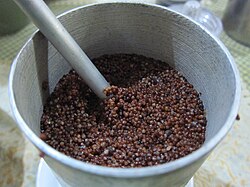
Various fermented alcoholic beverages are produced by the introduction of marchaa to cereal grain and subsequent saccharification and fermentation in an airtight vessel. Millet, rice, and maize are commonly used. The grain is washed, cooked, combined with marchaa, then saccharified in an earthware pot for about 1–2 days, then fermented for 2–8 days.[12] Examples of traditional fermented foods are kinema, gundruk, sinki, maseura, and khalpi. Traditional fermented beverages include chyang, tongba, raksi, and kodo ko jaanr.
Dishes[edit | edit source]
Sikkimese meals typically follow a bhat-dal-tharkari-achar (Rice-Pulses-Curry-Pickle) pattern.[10]

| Name | Description |
|---|---|
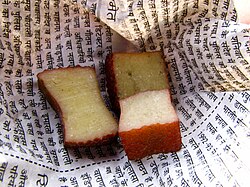
| Chhurpi | Traditional Nepalese cheese made from buttermilk. Two varieties of chhurpi exist, one being a soft variety that is usually eaten as a side dish, and a hard variety that is chewed.[13] |
| Dal bhat | Boiled rice and pulses. It is often cooked with onion, garlic, ginger, chili, tomatoes, or tamarind and served with a vegetable tarkari. |
| Dhindo | Nepalese meal prepared by gradual addition of flour to boiling water. |
| Gundruk | Nepalese fermented leafy green vegetable. Surplus mustard, radish, and cauliflower leaves are gathered, shredded, then sealed in an earthenware pot and stored in a warm place. |
| Kinema | Nepalese fermented soybean dish, traditionally combined in a soup with rice, but sometimes served as a side dish with rice or bread. |
| Momo | Steamed dumpling popular throughout the Himalayas and the Indian subcontinent. This food is usually associated with Tibetan and Nepalese people. It is stuffed with minced meat or vegetable like chayote or cabbage in a roll of dough and then steamed. It is eaten with vegetable or meat soup and tomato achar.[14] |
| Phagshapa | Nepalese dish of strips of pork fat stewed with radishes and dried chillies.[15] |
| Sel roti | Nepalese rice bread which is ring shaped and sweet to taste. It is commonly prepared during the Dashain and Tihar festivals. |
| Sinki | Nepalese fermented vegetable prepared by shredding radish roots and storing them for about a month in a sealed hole. |
| Shabhaley | Tibetan bread stuffed with seasoned beef and cabbage. |
| Thukpa | Tibetan noodle soup with vegetables or meat.[16] |
References[edit | edit source]
- ↑ "Sikkim Cuisine - Cuisine of Sikkim, Traditional Food of Sikkim, Sikkim Local Food". www.bharatonline.com. Retrieved 5 July 2020.
- ↑ Tamang, Jyoti Prakash. "Food culture in the Eastern Himalayas" (PDF). Journal of Himalayan Research and Cultural Foundation. 5: 107–118.
- ↑ "Agriculture". sikenvis.nic.in. Retrieved 5 July 2020.
- ↑ "Amended Final Report on the Safety Assessment of Oryza Sativa (Rice) Bran Oil, Oryza Sativa (Rice) Germ Oil, Rice Bran Acid, Oryza Sativa (Rice) Bran Wax, Hydrogenated Rice Bran Wax, Oryza Sativa (Rice) Bran Extract, Oryza Sativa (Rice) Extract, Oryza Sativa (Rice) Germ Powder, Oryza Sativa (Rice) Starch, Oryza Sativa (Rice) Bran, Hydrolyzed Rice Bran Extract Hydrolyzed Rice Bran Protein, Hydrolyzed Rice Extract, and Hydrolyzed Rice Protein1". International Journal of Toxicology. 25 (2_suppl): 91–120. March 2006. doi:10.1080/10915810600964626. ISSN 1091-5818. PMID 17090480.
- ↑ "Crops". Government of Sikkim.
- ↑ "Sikkim Agriculture". www.mapsofindia.com. Retrieved 5 July 2020.
- ↑ "CHAPTER 7. Cardamom – Small Cardamom, Green Cardamom, True Cardamom, Ceylon Cardamom, Malabar Cardamom (Elettaria cardamomum)", Culinary Herbs and Spices, Cambridge: Royal Society of Chemistry, pp. 99–130, 2021, doi:10.1039/9781839164446-00099, ISBN 978-1-83916-156-8, S2CID 240792462, retrieved 26 March 2022
{{citation}}: CS1 maint: work parameter with ISBN (link) - ↑ ANI (18 August 2016). "Sikkim, India's hub of cardamom farming". Business Standard India. Retrieved 5 July 2020.
- ↑ "Horticulture Department | State Portal-Sikkim". sikkim.gov.in. Retrieved 18 March 2020.
- ↑ 10.0 10.1 10.2 Tamang, Jyoti Prakash; Mukhopadhyay, Barun; Pal, Baidyanath. "Food Consumption in Sikkim With Special Reference to Traditional Fermented Foods and Beverages: A Micro Level Study" (PDF). Journal of Hill Research. Sikkim Science Society.
- ↑ "Sikkim becomes India's first organic state". DNA India. 16 January 2016. Retrieved 5 July 2020.
- ↑ Tamang, JP; Thapa, S; Tamang, N; Rai, B. "Indigenous Fermented Food Beverages of Darjeeling Hills and Sikkim: Process and Product Characterization" (PDF). Journal of Hill Research. Sikkim Science Society.
- ↑ "The two lives of chhurpi". The Indian Express. 22 April 2016. Retrieved 5 July 2020.
- ↑ Tamang, Jyoti Prakash; Thapa, Namrata (1 December 2014). "Some nonfermented ethnic foods of Sikkim in India". Journal of Ethnic Foods. 1 (1): 29–33. doi:10.1016/j.jef.2014.11.008. ISSN 2352-6181.
- ↑ Verma, Rajesh (2000). Sikkim: A guide and handbook. p. 14.
- ↑ ":: Welcome to the Official Web Portal of Sikkim Tourism :: Sikkim at a Glance | Cuisines of Sikkim |". www.sikkimtourism.gov.in. Retrieved 5 July 2020.


