
imported>J947 Adding local short description: "Species of fish", overriding Wikidata description "species of fish" (Shortdesc helper) |
robot: Update article (please report if you notice any mistake or error in this edit) |
||
| (One intermediate revision by one other user not shown) | |||
| Line 4: | Line 4: | ||
{{Speciesbox | {{Speciesbox | ||
| name = Barca snakehead | | name = Barca snakehead | ||
| image = Channa barca | | image = Channa barca - Hamilton 35 (cropped).jpg | ||
| status = | | status = DD | ||
| status_system = IUCN3.1 | | status_system = IUCN3.1 | ||
| status_ref = <ref name= | | status_ref = <ref name="iucn status 19 November 2021">{{cite iucn |author=Chaudhry, S. |date=2010 |title=''Channa barca'' |volume=2010 |page=e.T166596A6244166 |doi=10.2305/IUCN.UK.2010-4.RLTS.T166596A6244166.en |access-date=19 November 2021}}</ref> | ||
| genus = Channa | | genus = Channa | ||
| species = barca | | species = barca | ||
| Line 16: | Line 16: | ||
}} | }} | ||
The '''Barca snakehead''' (''Channa barca'') is a rare species of [[Snakehead (fish)|snakehead]]. It is [[Endemism|endemic]] to the upper [[Brahmaputra river]] basin in northeastern [[India]] and [[Bangladesh]].<ref name=FishBase>{{FishBase | genus = Channa | species = barca | month = February | year = 2019}}</ref><ref name=":0">{{Cite web|url=http://www.iucnredlistbd.org/Species/Single/FI0003|title=Details - Updating Species Red List of Bangladesh|website=www.iucnredlistbd.org|access-date=2018-01-06}}</ref> Records from [[Nepal]] are of doubtful validity.<ref name= | The '''Barca snakehead''' (''Channa barca'') is a rare species of [[Snakehead (fish)|snakehead]]. It is [[Endemism|endemic]] to the upper [[Brahmaputra river]] basin in northeastern [[India]] and [[Bangladesh]].<ref name=FishBase>{{FishBase | genus = Channa | species = barca | month = February | year = 2019}}</ref><ref name=":0">{{Cite web|url=http://www.iucnredlistbd.org/Species/Single/FI0003|title=Details - Updating Species Red List of Bangladesh|website=www.iucnredlistbd.org|access-date=2018-01-06}}</ref> Records from [[Nepal]] are of doubtful validity.<ref name="iucn status 19 November 2021" /> Overall it has been assessed as [[data deficient]] by the [[IUCN]],<ref name="iucn status 19 November 2021" /> and in 2014 it was assessed as [[critically endangered]] in Bangladesh by the IUCN.<ref name=":0" /> In Assam, it is locally known as ''cheng garaka'' or ''garaka cheng''. | ||
This is a relatively large snakehead, reaching a [[total length]] of up to {{cvt|105|cm|ft|1}}.<ref name=FishBase/> The species is regarded as an excellent [[food fish]],<ref name=FishBase/> and it is also highly desired by aquarists, but its rarity, behavior and large size makes it unsuitable for most aquariums.<ref name=SeriouslyFish>SeriouslyFish: [http://www.seriouslyfish.com/species/channa-barca/ Channa barca]. Retrieved 14 February 2019.</ref> | This is a relatively large snakehead, reaching a [[total length]] of up to {{cvt|105|cm|ft|1}}.<ref name=FishBase/> The species is regarded as an excellent [[food fish]],<ref name=FishBase/> and it is also highly desired by aquarists, but its rarity, behavior and large size makes it unsuitable for most aquariums.<ref name=SeriouslyFish>SeriouslyFish: [http://www.seriouslyfish.com/species/channa-barca/ Channa barca]. Retrieved 14 February 2019.</ref> | ||
| Line 22: | Line 22: | ||
== Distribution, habitat and behavior== | == Distribution, habitat and behavior== | ||
The barca snakehead is only known from the upper Brahmaputra river basin | The barca snakehead is only known from the upper Brahmaputra river basin | ||
the [[Assam]] and [[Nagaland]] in India,<ref name= | the [[Assam]] and [[Nagaland]] in India,<ref name="iucn status 19 November 2021" /> and [[Sylhet Division|Sylhet]] in Bangladesh.<ref name=":0"/> Records from [[Nepal]] are of doubtful validity.<ref name="iucn status 19 November 2021" /> It mostly inhabits wetlands, often near the margins, but can also be seen in riverine habitats.<ref name=Choudhury2003>Choudhury, M., and S.P. Biswas (2003). Maturity and spawning habit of an ornamental snakehead fish Channa barca (Hamilton). J. Ecophysiol. Occup. Hlth. 3: 149-152.</ref><ref name=Goswami2006>Goswami, M.M., B. Arunav, and P. Janardan (2006). Comparative biometry, habitat structure and distribution of endemic snakehead (Teleostei: Channidae) species of Assam, India. Journal of the Inland Fisheries Society of India 38(1): 1-8.</ref> It is able to withstand large variations in water temperature and oxygen levels as its habitat experiences large seasonal changes in flood levels.<ref name=Choudhury2003/> It often inhabits a vertical tunnel that typically is around {{convert|1|m|ft|spell=in}} long and goes down to the [[water table]]. The tunnel ends in a chamber where the fish may spend the dry season when the wetlands above it disappear.<ref name=SeriouslyFish/> Some other snakeheads that inhabit the same general region as the barca snakehead have also been reported to "[[hibernate]]" during the dry season, including the closely related [[orange-spotted snakehead]] (''C. aurantimaculata'').<ref name=Gogoi2016>Gogoi, N., L.P. Hazarika and S.P. Biswas (2016). Studies on the reproductive biology and captive breeding of an endemic fish from Assam Channa aurantimaculata. Journal of Environmental Biology 37: 369-374. {{doi|10.13140/RG.2.1.1548.3763}}</ref> The overall conservation status of the barca snakehead is poorly known, but it appears to generally be a scarce or rare species.<ref name="iucn status 19 November 2021" /><ref name=SeriouslyFish/> | ||
The species is highly carnivorous,<ref>{{Cite book|title=Freshwater fishes of Bangladesh|last=Rahman|first=A.K. Ataur|publisher=Zoological Society of Bangladesh, Department of Zoology, University of Dhaka|year=2005|location=Dhaka, Bangladesh}}</ref> feeding mostly on fish.<ref name=Choudhury2003/> Little is known about the breeding behavior, but like its nearest relatives it is likely a [[mouthbrooder]].<ref name=SeriouslyFish/> Maturity may occur when only {{cvt|12.5|cm|0}} long, but most individuals are around two or three times that size before they reach it.<ref name=Choudhury2003/> The breeding season is prolonged and begins when the [[beel]]s they inhabit are flooded by pre-[[Monsoon of South Asia|monsoonal]] rain in April–May. The species has a low [[fecundity]] and both parents take care of the young.<ref name=Choudhury2003/> | The species is highly carnivorous,<ref>{{Cite book|title=Freshwater fishes of Bangladesh|last=Rahman|first=A.K. Ataur|publisher=Zoological Society of Bangladesh, Department of Zoology, University of Dhaka|year=2005|location=Dhaka, Bangladesh}}</ref> feeding mostly on fish.<ref name=Choudhury2003/> Little is known about the breeding behavior, but like its nearest relatives it is likely a [[mouthbrooder]].<ref name=SeriouslyFish/> Maturity may occur when only {{cvt|12.5|cm|0}} long, but most individuals are around two or three times that size before they reach it.<ref name=Choudhury2003/> The breeding season is prolonged and begins when the [[beel]]s they inhabit are flooded by pre-[[Monsoon of South Asia|monsoonal]] rain in April–May. The species has a low [[fecundity]] and both parents take care of the young.<ref name=Choudhury2003/> | ||
Latest revision as of 19:45, 11 February 2022
| Barca snakehead | |
|---|---|
.jpg)
| |
Scientific classification 
| |
| : | [[Template:Taxonomy/Channa]] |
| Species: | Template:Taxonomy/ChannaC. barca
|
| Binomial name | |
| Template:Taxonomy/ChannaChanna barca (F. Hamilton, 1822)
| |
| Synonyms[2] | |
| |
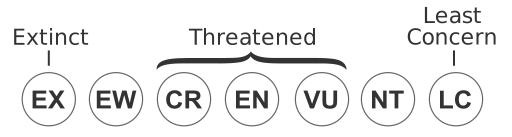
The Barca snakehead (Channa barca) is a rare species of snakehead. It is endemic to the upper Brahmaputra river basin in northeastern India and Bangladesh.[2][3] Records from Nepal are of doubtful validity.[1] Overall it has been assessed as data deficient by the IUCN,[1] and in 2014 it was assessed as critically endangered in Bangladesh by the IUCN.[3] In Assam, it is locally known as cheng garaka or garaka cheng.
This is a relatively large snakehead, reaching a total length of up to 105 cm (3.4 ft).[2] The species is regarded as an excellent food fish,[2] and it is also highly desired by aquarists, but its rarity, behavior and large size makes it unsuitable for most aquariums.[4]
Distribution, habitat and behavior[edit | edit source]
The barca snakehead is only known from the upper Brahmaputra river basin the Assam and Nagaland in India,[1] and Sylhet in Bangladesh.[3] Records from Nepal are of doubtful validity.[1] It mostly inhabits wetlands, often near the margins, but can also be seen in riverine habitats.[5][6] It is able to withstand large variations in water temperature and oxygen levels as its habitat experiences large seasonal changes in flood levels.[5] It often inhabits a vertical tunnel that typically is around 1 metre (3.3 ft)* long and goes down to the water table. The tunnel ends in a chamber where the fish may spend the dry season when the wetlands above it disappear.[4] Some other snakeheads that inhabit the same general region as the barca snakehead have also been reported to "hibernate" during the dry season, including the closely related orange-spotted snakehead (C. aurantimaculata).[7] The overall conservation status of the barca snakehead is poorly known, but it appears to generally be a scarce or rare species.[1][4]
The species is highly carnivorous,[8] feeding mostly on fish.[5] Little is known about the breeding behavior, but like its nearest relatives it is likely a mouthbrooder.[4] Maturity may occur when only 12.5 cm (5 in) long, but most individuals are around two or three times that size before they reach it.[5] The breeding season is prolonged and begins when the beels they inhabit are flooded by pre-monsoonal rain in April–May. The species has a low fecundity and both parents take care of the young.[5]
References[edit | edit source]
- ↑ 1.0 1.1 1.2 1.3 1.4 1.5 Chaudhry, S. (2010). "Channa barca". IUCN Red List of Threatened Species. 2010: e.T166596A6244166. doi:10.2305/IUCN.UK.2010-4.RLTS.T166596A6244166.en. Retrieved 19 November 2021.
- ↑ 2.0 2.1 2.2 2.3 Template:FishBase
- ↑ 3.0 3.1 3.2 "Details - Updating Species Red List of Bangladesh". www.iucnredlistbd.org. Retrieved 6 January 2018.
- ↑ 4.0 4.1 4.2 4.3 SeriouslyFish: Channa barca. Retrieved 14 February 2019.
- ↑ 5.0 5.1 5.2 5.3 5.4 Choudhury, M., and S.P. Biswas (2003). Maturity and spawning habit of an ornamental snakehead fish Channa barca (Hamilton). J. Ecophysiol. Occup. Hlth. 3: 149-152.
- ↑ Goswami, M.M., B. Arunav, and P. Janardan (2006). Comparative biometry, habitat structure and distribution of endemic snakehead (Teleostei: Channidae) species of Assam, India. Journal of the Inland Fisheries Society of India 38(1): 1-8.
- ↑ Gogoi, N., L.P. Hazarika and S.P. Biswas (2016). Studies on the reproductive biology and captive breeding of an endemic fish from Assam Channa aurantimaculata. Journal of Environmental Biology 37: 369-374. doi:10.13140/RG.2.1.1548.3763
- ↑ Rahman, A.K. Ataur (2005). Freshwater fishes of Bangladesh. Dhaka, Bangladesh: Zoological Society of Bangladesh, Department of Zoology, University of Dhaka.
External links[edit | edit source]
- "Channa barca". Integrated Taxonomic Information System. Retrieved 18 April 2006.