

>GreenC bot Rescued 1 archive link. Wayback Medic 2.5 |
robot: Update article (please report if you notice any mistake or error in this edit) |
||
| Line 25: | Line 25: | ||
Rama Rao chose to depict Gautama Buddha because "he was a humanitarian who told the whole truth to the people. It is our pride."<ref name="history"/> After a long search, he found a solid white granite rock near Raigiri, [[Bhongir]] (Nalgonda district) on a mountainside 46 km outside Hyderabad. In October 1985 NTR inaugurated work on structure. For over a year, hundreds of labourers helped the temple architect and builder [[S. M. Ganapathy|S.M.Ganapathi Sthapati]] create the statue. After five years and the expenditure of [[United States dollar|US$]]3 million,<ref name="history"/> the statue stood at {{convert|58|ft|m}} and weighed 350 tons, making it the world's tallest monolithic statue of the Buddha.<ref name="retrieval">{{cite news | url=http://www.highbeam.com/doc/1P2-8738705.html | archive-url=https://web.archive.org/web/20150924201708/http://www.highbeam.com/doc/1P2-8738705.html | url-status=dead | archive-date=24 September 2015 | title=Up from the bottom | work=The Boston Globe | date=19 April 1992 | accessdate=9 September 2012 | location=Boston, MA}}{{Subscription required| via=[[HighBeam Research]]}}</ref> A concrete platform measuring {{convert|15|ft|m}}, now referred to as the "Rock of Gibraltar,"<ref name="gibraltar">{{cite news | url=http://articles.timesofindia.indiatimes.com/2012-01-23/news-interviews/30659786_1_buddha-statue-ram-charan-teja-iconic | archive-url=https://archive.today/20130103125928/http://articles.timesofindia.indiatimes.com/2012-01-23/news-interviews/30659786_1_buddha-statue-ram-charan-teja-iconic | url-status=dead | archive-date=3 January 2013 | title=Ram Charan Teja shoots at iconic Buddha statue | work=[[The Times of India]] | date=23 January 2012 | agency=Times News Network | accessdate=9 September 2012 | author=Raje, Abhishek | location=Hyderabad}}</ref> was constructed in the middle of [[Hussain Sagar]] to aid in erecting the statue. The roads of the city were also widened for this purpose.<ref name="history"/> | Rama Rao chose to depict Gautama Buddha because "he was a humanitarian who told the whole truth to the people. It is our pride."<ref name="history"/> After a long search, he found a solid white granite rock near Raigiri, [[Bhongir]] (Nalgonda district) on a mountainside 46 km outside Hyderabad. In October 1985 NTR inaugurated work on structure. For over a year, hundreds of labourers helped the temple architect and builder [[S. M. Ganapathy|S.M.Ganapathi Sthapati]] create the statue. After five years and the expenditure of [[United States dollar|US$]]3 million,<ref name="history"/> the statue stood at {{convert|58|ft|m}} and weighed 350 tons, making it the world's tallest monolithic statue of the Buddha.<ref name="retrieval">{{cite news | url=http://www.highbeam.com/doc/1P2-8738705.html | archive-url=https://web.archive.org/web/20150924201708/http://www.highbeam.com/doc/1P2-8738705.html | url-status=dead | archive-date=24 September 2015 | title=Up from the bottom | work=The Boston Globe | date=19 April 1992 | accessdate=9 September 2012 | location=Boston, MA}}{{Subscription required| via=[[HighBeam Research]]}}</ref> A concrete platform measuring {{convert|15|ft|m}}, now referred to as the "Rock of Gibraltar,"<ref name="gibraltar">{{cite news | url=http://articles.timesofindia.indiatimes.com/2012-01-23/news-interviews/30659786_1_buddha-statue-ram-charan-teja-iconic | archive-url=https://archive.today/20130103125928/http://articles.timesofindia.indiatimes.com/2012-01-23/news-interviews/30659786_1_buddha-statue-ram-charan-teja-iconic | url-status=dead | archive-date=3 January 2013 | title=Ram Charan Teja shoots at iconic Buddha statue | work=[[The Times of India]] | date=23 January 2012 | agency=Times News Network | accessdate=9 September 2012 | author=Raje, Abhishek | location=Hyderabad}}</ref> was constructed in the middle of [[Hussain Sagar]] to aid in erecting the statue. The roads of the city were also widened for this purpose.<ref name="history"/> | ||
This statue is located at [[Lumbini Park]] in the Hussain Sagar Island can be reached by boat in 15 minutes.<ref>Goldberg, Kory., | This statue is located at [[Lumbini Park]] in the Hussain Sagar Island can be reached by boat in 15 minutes.<ref>Goldberg, Kory., Décary, Michelle.(2012), "The South: Hydrabad", Along the Path: The Meditator's Companion to the Buddha's Land, Pariyatti Publisher, p.372. {{ISBN|1938754034}}, 9781938754036</ref> The statue is near to Lakdi-Ka-Pul, Khairatabad and Assembly [[Hyderabad metro]] stations. | ||
==The accident== | ==The accident== | ||
| Line 34: | Line 34: | ||
==See also== | ==See also== | ||
* ''[[Statue of Ahimsa]]'' | * ''[[Statue of Ahimsa]]'' | ||
* [[List of statues | * [[List of tallest statues]] | ||
==Gallery== | ==Gallery== | ||
Latest revision as of 14:05, 17 April 2022
| Buddha Statue of Hyderabad | |
|---|---|
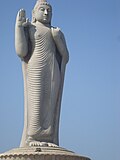
 Standing Buddha in abhay mudra | |
| Location | Hussain Sagar, Hyderabad, Telangana, India |
| Coordinates | 17°24′56″N 78°28′30″E / 17.41556°N 78.47500°E |
| Height | 58 feet (18 meters) |
| Dedicated | 1 December 1992 |
| Sculptor | S.M.Ganapathi Sthapathi |
| Governing body | Buddha Purnima Project Authority, HMDA |
  Location of Buddha Statue in Hussain Sagar | |
The Buddha Statue of Hyderabad is a monolith located in India. It is the world's tallest monolith of Gautama Buddha, erected on Gibraltar Rock in the middle of Hussain Sagar.
History[edit | edit source]
Hyderabad is the capital of the state of Telangana (separated from Andhra Pradesh on 2 June 2014). Between 1983 and 1989, N. T. Rama Rao served as the Chief Minister of Andhra Pradesh. During his tenure, he spent large sums to erect several statues of people from the region's political and religious history. During his visit to New York, he saw the Statue of Liberty and was inspired by the efforts to restore it. He said "I wanted something like that great place to visit... That would have been my contribution to society."[1]
Rama Rao chose to depict Gautama Buddha because "he was a humanitarian who told the whole truth to the people. It is our pride."[1] After a long search, he found a solid white granite rock near Raigiri, Bhongir (Nalgonda district) on a mountainside 46 km outside Hyderabad. In October 1985 NTR inaugurated work on structure. For over a year, hundreds of labourers helped the temple architect and builder S.M.Ganapathi Sthapati create the statue. After five years and the expenditure of US$3 million,[1] the statue stood at 58 feet (18 m) and weighed 350 tons, making it the world's tallest monolithic statue of the Buddha.[2] A concrete platform measuring 15 feet (4.6 m), now referred to as the "Rock of Gibraltar,"[3] was constructed in the middle of Hussain Sagar to aid in erecting the statue. The roads of the city were also widened for this purpose.[1]
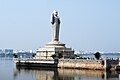
This statue is located at Lumbini Park in the Hussain Sagar Island can be reached by boat in 15 minutes.[4] The statue is near to Lakdi-Ka-Pul, Khairatabad and Assembly Hyderabad metro stations.
The accident[edit | edit source]
Then government of Andhra Pradesh led by N. T. Rama Rao was ousted in 1989. By the next year, the statue was ready for erection. ABC Limited, a local company, was given the responsibility of transferring the statue onto the concrete platform. Using a trailer vehicle, the statue was brought to the shore of Hussain Sagar. On 10 March 1990, company workers shifted the statue on top of a barge. After traveling only 100 yards (91 m), the statue tipped and fell into the lake.[1][5] The accident killed 10 people.[6]
After a two-year salvage operation, the statue was pulled out of the lake.[2] On 1 December 1992, the statue was installed on the platform successfully. In 2006, the Dalai Lama consecrated the statue after performing a ritual.[7]
See also[edit | edit source]
Gallery[edit | edit source]
-
 Standing Buddha in abhya mudra
 -
 Closeup view
 -
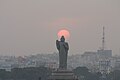 Sunset on Buddha Statue, Hussain Sagar
 -
 Evening View
 -
 Night View on a moon day
 -
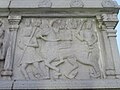 A sculpture on the basement of Buddha statue.
 -
 Buddha statue at Hussain sagar
 -


References[edit | edit source]
- ↑ 1.0 1.1 1.2 1.3 1.4 Coll, Steve (9 April 1990). "Buddha of the Lake Bottom". The Washington Post. Archived from the original on 24 September 2015. Retrieved 9 September 2012. – via HighBeam Research (subscription required)
- ↑ 2.0 2.1 "Up from the bottom". The Boston Globe. Boston, MA. 19 April 1992. Archived from the original on 24 September 2015. Retrieved 9 September 2012. – via HighBeam Research (subscription required)
- ↑ Raje, Abhishek (23 January 2012). "Ram Charan Teja shoots at iconic Buddha statue". The Times of India. Hyderabad. Times News Network. Retrieved 9 September 2012.
{{cite news}}: CS1 maint: deprecated archival service (link) - ↑ Goldberg, Kory., Décary, Michelle.(2012), "The South: Hydrabad", Along the Path: The Meditator's Companion to the Buddha's Land, Pariyatti Publisher, p.372. ISBN 1938754034, 9781938754036
- ↑ "10 drown as the statue of Buddha takes a dip". New Straits Times. New Delhi. 11 March 1990. Retrieved 9 September 2012.
- ↑ "Buddha Statue Sinks Barge, Drowning 10". St. Louis Post-Dispatch. New Delhi. Associated Press. 11 March 1990. pp. 13A.
- ↑ "Buddha statue consecrated". The Hindu. Hyderabad. 3 January 2006. Archived from the original on 18 October 2007. Retrieved 9 September 2012.
- Shifting Stones, Shaping the Past: Sculpture from the Buddhist Stupas of Andhra Pradesh - Book