



m 1 revision imported: as per requested by user:SonOfZeus |
Updating Tags: Mobile edit Mobile web edit |
||
| (8 intermediate revisions by the same user not shown) | |||
| Line 1: | Line 1: | ||
{{ | {{Distinguish|Panthoibi}} | ||
'''Moirang Thoibi''' or '''Ewanglon Thoibi''' is | {{Infobox character | ||
|name= Thoibi <br /> ({{lang-omp|Thoipi}}) | |||
|image= PRINCESS THOIBI TRICKED KONGYAMBA AND ESCAPED FROM HIM.jpg | |||
|caption= Princess Thoibi tricked [[Nongban|Angom Nongban Kongyamba]] and escaped from him | |||
|alias= | |||
* Moirang Thoibi | |||
* Moilang Thoipi | |||
* Ewanglon Thoibi | |||
* Iwanglon Thoibi | |||
|gender=Female | |||
|title=Langlen Thadoi | |||
|family=Moirang Royal Family | |||
|spouse=[[Khuman Khamba]] | |||
|occupation=Princess of the [[Ancient Moirang|Moirang kingdom]] | |||
|relatives=[[Chingkhu Akhuba]], [[Chingkhu Telheiba]] | |||
|religion=[[Meitei religion]] ([[Sanamahism]]) | |||
|origin=[[Ancient Moirang|Moirang kingdom]] | |||
|home=[[Ancient Moirang]] | |||
|affiliation= | |||
** [[Khamba Thoibi]], | |||
*** [[Moirang Saiyon]], | |||
**** [[Moirang Kangleirol]], | |||
***** [[Meitei mythology]], | |||
****** [[Meitei folklore]], | |||
******* [[History of Manipur]] | |||
}} | |||
'''Moirang Thoibi''' ({{lang-omp|Moilang Thoipi}}) or '''Ewanglon Thoibi''' ({{lang-omp|Ewanglon Thoipi}}) is the heroine of the [[Khamba Thoibi]] epic of the ancient [[Moirang Kangleirol]] legends.<ref>Panchani, Chander Sheikhar (1987). Manipur, Religion, Culture, and Society. Konark Publishers. ISBN 978-81-220-0047-4.</ref><ref name = "google1">Freda Marie Houlston Bedi (1967). Social Welfare. Publications Division.</ref> She is a [[princess]] of the [[Ancient Moirang]] kingdom,<ref>Eurasian Studies Yearbook. Eurolingua. 1996.</ref> daughter of King's younger brother ''Chingkhu Akhuba'' and [[:en:wikt:fraternal niece|fraternal niece]] of King ''Chingkhu Telheiba'' of [[Ancient Moirang|Moirang]].<ref>Moirangthem Kirti (1993). Folk Culture of Manipur. Manas Publications. ISBN 978-81-7049-063-0.</ref><ref name = "google2">{{cite book| last = Dalal| first = Roshen| title = India at 70: snapshots since Independenc| url = https://books.google.com/books?id=JYswDwAAQBAJ&pg=PA304| year = 2017| publisher = Penguin Random House India Private Limited| isbn = 9789386815378| page = 304 }}</ref><ref name = "google3">{{cite book| last = Datta| first = Amaresh| title = Encyclopaedia of Indian Literature: A-Devo| url = https://books.google.com/books?id=ObFCT5_taSgC&pg=PA222| year = 1987| publisher = Sahitya Akademi| isbn = 978-81-260-1803-1| page = 222 }}</ref> She is a [[:en:wikt:ladylove|ladylove]] of [[Khuman Khamba]], a poor orphan prince.<ref name="google1"/><ref>{{cite book| last1 = Chandra| first1 = N.D.R.| last2 = Das| first2 = Nigamananda| title = Ecology, Myth, and Mystery: Contemporary Poetry in English from Northeast India| url = https://books.google.com/books?id=Cfg6fjTBK1cC&pg=PA83| year = 2007| publisher = Sarup & Sons| isbn = 978-81-7625-742-8| page = 83 }}</ref><ref name="google2"/><ref name="google3"/> | |||
The term "Thoibi" means perfection or completion of beauty and accomplishments.<ref>https://books.google. | The term "Thoibi" means perfection or completion of beauty and accomplishments.<ref>{{cite web|url=https://books.google.com/books?id=8EMKAQAAIAAJ&q=khamba+thoibi|title=Khamba and Thoibi: The Unscaled Height of Love|first=N. Tombi|last=Singh|date=29 August 1976|publisher=Chitrebirentombichand Khorjeirup|via=Google Books}}</ref> | ||
== | == Early life == | ||
=== Meeting Khamnu === | |||
[[File:THOIBI, SENU AND KHAMNU.jpg|thumb|300px|Princess Thoibi meeting [[Khamnu]] in a marketplace.]] | |||
One day, Princess Thoibi visited the marketplace of [[Ancient Moirang|Moirang]]. She saw [[Khamnu]] selling woods in a market. She asked Khamnu many questions. She even gifted her foods and jewelry. Thoibi and Khamnu became good friends. In the next time, Thoibi met her once again. Thoibi asked Khamnu to accompany her in fishing in the [[Loktak lake]]. The King heard that the princess and her companions were to sport on the lake. So, he ordered that no man should go to the lake. So, Khamnu told Khamba of the royal order. On the next day, she left him at home. Khamba was sleeping and had a dream.<ref>{{Cite book|url=https://archive.org/details/meitheis01hods/page/n181/mode/2up|title=The Meitheis|last=Hodson|first=T. C. (Thomas Callan)|date=1908|publisher=London, D. Nutt|others=Duke University Libraries|year=1908|pages=181}}</ref> | |||
=== Meeting Khamba === | |||
[[File:Khuman Khamba in the Loktak lake.jpg|thumb|300px|Thoibi saw Khamba sailing on a boat in the [[Loktak lake]].]] | |||
In Khamba's dream, Goddess [[Ayangleima (disambiguation)|Ayangleima]] (either [[Panthoibi]] or [[Koiren Leima]])(in the form of [[Khamnu]]) asked him to get vegetables. Khamba woke up and wondered about his dream. God [[Thangjing]] made him think that he had truly seen his sister [[Khamnu]]. So, he rowed down on a boat in the lake. He went to a wrong direction. God [[Thangjing]] spread a veil of clouds over the hills. A storm suddenly occurred. It blew the boat towards where Thoibi was fishing. Thoibi saw Khamba standing close to her. She asked Khamnu if she knew the strange man disobeying the royal order. Khamnu said no. Khamba did not know what to do. Hearing his sister’s voice, he went closer. Thoibi saw that he was handsome, manly, muscular and well fashioned. Khamba was also amazed at Thoibi's beauty and glamour. It was God's will that they should be lovers. Khamnu worried that her brother might get punished for disobedience. Thoibi noticed a piece of Khamnu's cloth matching Khamba’s headdress. She also discovered Khamba wearing the bracelet she had given to Khamnu. Later, Khamnu revealed the truth. Then, Thoibi became kind to Khamba. She offered him delicate foods. She pleasantly told him to go home before the King's notice.<ref name=":0">{{Cite book|url=https://archive.org/details/meitheis01hods/page/136/mode/2up|title=The Meitheis|last=Hodson|first=T. C. (Thomas Callan)|date=1908|publisher=London, D. Nutt|others=Duke University Libraries|year=1908|pages=136}}</ref> | |||
== | == Oath to her lover == | ||
Once Princess Thoibi visited [[Khamnu]]'s house. Thoibi sat on the red cloth near the post of the north side (ukoklel). The old house was full of holes. So, Khamba hid himself within a mat. Thoibi asked Khamnu about the very mat. Khamnu said that it was the worshipping place of God [[Khuman Pokpa]]. So, Thoibi asked if she could pray to the God. She wanted to be blessed by the God. Thoibi knew the fact very well. But she pretended if she knew nothing. She prayed aloud to the God to allow her to worship him daily in the house. Khamba heard her voices. He laughed aloud. Thoibi said the God was speaking. She came out in the veranda. Meanwhile, Khamba sent his sister to the market to bring some fruits. At Khamnu's absence, Thoibi presented him gifts. The two bound themselves by an oath before the God [[Khuman Pokpa]]. They drank the water in which the golden bracelet was dipped. They vowed to be lovers forever. After this oath, Thoibi addresed Khamnu as "sister".<ref name=":0" /><ref>{{Cite book|url=https://archive.org/details/meitheis01hods/page/137/mode/2up|title=The Meitheis|last=Hodson|first=T. C. (Thomas Callan)|date=1908|publisher=London, D. Nutt|others=Duke University Libraries|year=1908|pages=137}}</ref> | |||
== Legendary Dance == | |||
[[File:KHAMBA THOIBI EPIC - THE DANCE BEFORE THE KING.jpg|thumb|300px|[[Khuman Khamba]] and Moirang Thoibi performing the [[Khamba Thoibi Jagoi]] at the premise of the [[Ebudhou Thangjing Temple]] at the [[Lai Haraoba]] festival in [[Ancient Moirang]].]] | |||
The King made Khamba the ''"Khuntak Leiroi Hanjaba"'' (Floriculture Minister) to gather flowers from the hills.<ref>{{Cite book|url=https://archive.org/details/meitheis01hods/page/138/mode/2up|title=The Meitheis|last=Hodson|first=T. C. (Thomas Callan)|date=1908|publisher=London, D. Nutt|others=Duke University Libraries|year=1908|pages=138}}</ref> Thoibi prepared delicious foods for Khamba. She tied it in a bundle of leaves. She fastened it with silks of seven kinds. By the grace of God [[Thangjing]], not a petal of a single flower brought by Khamba was broken. At Khamba's return, Thoibi washed his feet and offered him fruits.<ref>{{Cite book|url=https://archive.org/details/meitheis01hods/page/139/mode/2up|title=The Meitheis|last=Hodson|first=T. C. (Thomas Callan)|date=1908|publisher=London, D. Nutt|others=Duke University Libraries|year=1908|pages=139}}</ref> | |||
On the day of customary rituals to be performed, Khamba first offer his flowers to God [[Thangjing]]. After that, Khamba presented the flowers to the the King, to the Queen and then to the High Officers of [[Ancient Moirang|Moirang]]. | |||
Everyone was pleased with the flowers of Khamba. So, they gave him rare gifts.<ref>{{Cite book|url=https://archive.org/details/meitheis01hods/page/140/mode/2up|title=The Meitheis|last=Hodson|first=T. C. (Thomas Callan)|date=1908|publisher=London, D. Nutt|others=Duke University Libraries|year=1908|pages=140}}</ref> Khamba and Thoibi danced before God Thangjing's holy shrine. The pairing was great. The audiences shouted with joy during the dance. Finally, Khamba and Thoibi knelt before God [[Thangjing]].<ref>{{Cite book|url=https://archive.org/details/meitheis01hods/page/141/mode/2up|title=The Meitheis|last=Hodson|first=T. C. (Thomas Callan)|date=1908|publisher=London, D. Nutt|others=Duke University Libraries|year=1908|pages=141}}</ref> | |||
== Exile == | |||
[[File:PRINCESS THOIBI BEING BEATEN BY HER FATHER CHINGKHUBA.jpg|thumb|300px|Thoibi being beaten by her father for not obeying him]] | |||
Thoibi was asked by her father to marry [[Nongban|Nongban Kongyamba]]. But she rejected. Getting angered, her father said, "I will be better to be childless than be the father of this evil girl." He asked his Minister Hanjaba to sell Thoibi to the Kabaw chief for silver and gold. He exiled her to Kabaw chiefdom. He did not want to see her anymore. Meanwhile, Thoibi told Khamba about her misfortune. For his sake, she had to go exile to Kabaw. She pleaded Khamba not to forget her. | |||
On the day of her exile, she wept so bitterly that her lamented cries were like the thunder. The Queen and all her maids also wept. Minister Hanjaba took her away to Kabaw. On her way, she met Khamba. He wept with her remembering the past happy days. Both the lovers felt the pains of separation.<ref>{{Cite book|url=https://archive.org/details/meitheis01hods/page/148/mode/2up|title=The Meitheis|last=Hodson|first=T. C. (Thomas Callan)|date=1908|publisher=London, D. Nutt|others=Duke University Libraries|year=1908|pages=148}}</ref> | |||
Thoibi was given a staff by her beloved Khamba to lean on by the way. They departed. On her way further, Thoibi planted the staff by the roadside. She wished it to blossom into a leafy tree if she remain chaste for Khamba. She also marked upon a roadside stone as the record. Finally, she reached Kabaw. But Chief Tamurakpa of Kabaw fell pity on her sadness. He kept her as a guest in his place. Thoibi became a friend of Changning Kanbi, the daughter of the Chief. The evil women of Kabaw persuaded Changning to treat Thoibi like a servant. So, Thoibi was sent to catch fish and to gather fuel woods. Thoibi was busy with her tasks. However, she always dreamed that Khamba was with her. God [[Thangjing]] took pity on her. Chief Tamurakpa got notice of harsh treatments to Thoibi by his own daughter. So, he asked all the women to weave a cloth each. Changning called Thoibi a wayward child. It was because of Thoibi's denial of marrying Kongyamba. Changning knew Kongyamba was muscular, attractive and a blood of a famed race. So, she thought Kongyamba as a good man. | |||
Tamurakpa heard his daughter's words. He was angry with her. He was about to strike her but Thoibi stopped him. The two ladies wove their respective clothes. Changning was jealous of Thoibi. In the night, Changning tore holes in Thoibi's cloth with a porcupine quill. Later, Thoibi found all that had been done. However, she intelligently mended all the holes into a more beautiful cloth. Tamurakpa liked Thoibi's cloth very much. For his own daughter's cloth, he threw it aside. | |||
One day, when Thoibi was working at the loom, a wind brought ashes towards her loom. She knew it was from Moirang. She wept remembering her beloved Khamba as well as her hometown. God Thangjing softened her father's heart. He sent men to bring her back. However, he asked Kongyamba to forcibly elope Thoibi from her return journey. On the other hand, Thoibi prayed to the patron deity of Kabaw chiefdom. She thanked Chief Tamurakpa for his generous hospitality. | |||
On her way, she saw the stone on which she had marked the token of her chastity. She prayed to it and offered gold and silver on it. She saw Khamba's staff which she had planted. It blossomed into a leafy tree.<ref>{{Cite book|url=https://archive.org/details/meitheis01hods/page/149/mode/2up|title=The Meitheis|last=Hodson|first=T. C. (Thomas Callan)|date=1908|publisher=London, D. Nutt|others=Duke University Libraries|year=1908|pages=149}}</ref> | |||
== Escape from Kongyamba == | |||
[[File:KHAMBA THOIBI EPIC - THOIBI TRICKS KONGYAMBA.jpg|thumb|300px|Thoibi escaped from [[Nongban|Angom Nongban Kongyamba]] by tricking him]] | |||
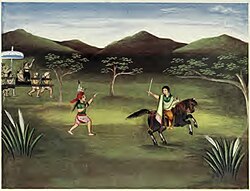
When Thoibi was on her way back to hometown, she was awaited by her suitor, [[Nongban|Angom Nongban Kongyamba]]. [[Nongban|Angom Nongban Kongyamba]] asked his watchmen if Princess Thoibi was coming. After looking carefully, they shouted, | |||
"Lo, the Princess is at band." | |||
Thoibi heard the shout. She instructed her companions to sit near her if the man was Khamba but far away if the man was Kongyamba." | |||
It was Kongyamba and not [[Khamba]]. | |||
However, she went on. She pretended to be friendly with him. She sat on the red carpet of Kongyamba's possession. However, she placed a stick between Kongyamba and her. She asked him for fruits to eat. Kongyamba brought her fruits. But she did not eat the fruits. She pretended to get ill due to her long journey from Kabaw. Kongyamba was worried. | |||
She asked Kongyamba to let her ride on his horse. He agreed. So, Thoibi rode Kongyamba's horse. Kongyamba rode in Thoibi's palanquin. | |||
Surprisingly, Thoibi galloped off on the horse towards Khamba's house. Khamba received her from the long time exile at his house. They wept for their reunion. | |||
On the other hand, Kongyamba was angry for being tricked by a girl. He tried to gain support from the King's ministers to intervene into the matter. In the meantime, Minister Thonglen and Minister Nongtholba sent men to guard Khamba and Thoibi. | |||
The matter was set before the King in the Royal Court. The king wanted to solve the issue by the trial of the spear. During the discussion, an old man came to the meet the king. The old man informed him that a ferocious tiger was a great threat to the villagers of Khoirentak region. | |||
The King changed his mind. He announced that the tiger will be the determining point of the matter. He added that the killer of the tiger will marry Princess Thoibi.<ref>{{Cite book|url=https://archive.org/details/meitheis01hods/page/150/mode/2up|title=The Meitheis|last=Hodson|first=T. C. (Thomas Callan)|date=1908|publisher=London, D. Nutt|others=Duke University Libraries|year=1908|pages=150}}</ref> | |||
== Marriage and death == | |||
Khamba succeeded in killing the ferocious man-eating tiger. | |||
Thus, Khamba and Thoibi got wedded in high state by the King of [[Moirang]]. | |||
One day, Khamba got suspicious of Thoibi if she was not faithful to him. He wanted to test her chastity. One night, he pretended to get away from home. Then, he secretly returned home. In disguise as a stranger, he pierced a stick through the wall of Thoibi’s room. He was teasing Thoibi. Thoibi was not aware of all this. So, she thought it was done by a stranger. She got furious. | |||
She thrusted a spear through the wall to pierce the stranger. Khamba was severely wounded. He called her. Thoibi knew his voice. She immediately went out and carried him in. Khamba was dying. She was extremely shocked. Before he died, she killed herself upon him with the same spear. | |||
Khamba and Thoibi are the incarnations of a god and a goddess. They were sent by God [[Thangjing]]. Unlike normal mortal beings, God Thangjing denied their happiness of long life and children.<ref>{{Cite book|url=https://archive.org/details/meitheis01hods/page/151/mode/2up|title=The Meitheis|last=Hodson|first=T. C. (Thomas Callan)|date=1908|publisher=London, D. Nutt|others=Duke University Libraries|year=1908|pages=151}}</ref> | |||
== In popular culture == | |||
[[File:ꯍꯤꯌꯥꯡ ꯇꯥꯟꯅꯕ꯱.jpg|thumb|Dancers performing the [[Khamba Thoibi Jagoi]] in [[Manipur]].]] | |||
* The well celebrated folk dance, [[Khamba Thoibi Jagoi]], was first performed by [[Khuman Khamba]] and his lady love Thoibi in the premise of the [[Ebudhou Thangjing Temple]]. It's now a popular form of folk dance in [[Manipur]].<ref>{{Cite web |title=Khamba Thoibi-Folk Dance Of Manipur |url=http://www.detailsofindia.com/folk-dance-of-india/manipur-khamba-thoibi-dance/ |access-date=2021-01-27 |archive-date=2021-02-01 |archive-url=https://web.archive.org/web/20210201030549/http://www.detailsofindia.com/folk-dance-of-india/manipur-khamba-thoibi-dance/ |url-status=dead }}</ref><ref>[http://www.dance.anantagroup.com/khamba-thaibi-dance/ Khamba Thaibi Manipur Dancers, Khamba Thaibi Folk Dance Troupe, Khamba Thaibi Dancers Delhi]</ref><ref>[http://everythingexperiential.businessworld.in/tags/Khamba-Thoibi-Dance-91441/ Khamba Thoibi Dance - Everything Experiential]</ref><ref>[http://www.indianfolkdances.com/khamba-thoibi-folk-dance-of-manipur.html khamba Thoibi Folk Dance of Manipur]</ref> | |||
* "Moirang Thoibi", a literary work, composed by A. Dorendrajit, was one of the author's first three books.<ref>Mayembama Anandamohana (2002). A. Dorendrajit Singh. Sahitya Akademi. ISBN 978-81-260-1112-4.</ref> | |||
* Moirang Thoibi is a protagonist in the celebrated epic poem [[Khamba Thoibi]].<ref>[http://www.e-pao.net/epSubPageExtractor.asp?src=reviews.books.Khamba_Thoibi_and_Poems_on_Manipur_Book_Review_By_James_Oinam Khamba Thoibi and Poems on Manipur Book Review By James Oinam]</ref><ref>[https://archive.org/details/in.ernet.dli.2015.460207 Khamba Thoibi And Poems On Manipur : Raina, Vimala : Internet Archive]</ref> | |||
== References == | |||
{{Reflist}} | {{Reflist}} | ||
[[Category: | |||
[[Category:Meitei folklore]] | |||
[[Category:Meitei literature]] | |||
[[Category:Meitei mythology]] | [[Category:Meitei mythology]] | ||
{{simple-Wikipedia}} | |||
Latest revision as of 17:01, 26 March 2022
| Thoibi (Old Manipuri: Thoipi) | |
|---|---|
 Princess Thoibi tricked Angom Nongban Kongyamba and escaped from him | |
| In-universe information | |
| Alias |
|
| Gender | Female |
| Title | Langlen Thadoi |
| Occupation | Princess of the Moirang kingdom |
| Affiliation | |
| Family | Moirang Royal Family |
| Spouse | Khuman Khamba |
| Relatives | Chingkhu Akhuba, Chingkhu Telheiba |
| Religion | Meitei religion (Sanamahism) |
| Origin | Moirang kingdom |
Moirang Thoibi (Old Manipuri: Moilang Thoipi) or Ewanglon Thoibi (Old Manipuri: Ewanglon Thoipi) is the heroine of the Khamba Thoibi epic of the ancient Moirang Kangleirol legends.[1][2] She is a princess of the Ancient Moirang kingdom,[3] daughter of King's younger brother Chingkhu Akhuba and fraternal niece of King Chingkhu Telheiba of Moirang.[4][5][6] She is a ladylove of Khuman Khamba, a poor orphan prince.[2][7][5][6]
The term "Thoibi" means perfection or completion of beauty and accomplishments.[8]
Early life[edit | edit source]
Meeting Khamnu[edit | edit source]

One day, Princess Thoibi visited the marketplace of Moirang. She saw Khamnu selling woods in a market. She asked Khamnu many questions. She even gifted her foods and jewelry. Thoibi and Khamnu became good friends. In the next time, Thoibi met her once again. Thoibi asked Khamnu to accompany her in fishing in the Loktak lake. The King heard that the princess and her companions were to sport on the lake. So, he ordered that no man should go to the lake. So, Khamnu told Khamba of the royal order. On the next day, she left him at home. Khamba was sleeping and had a dream.[9]
Meeting Khamba[edit | edit source]

In Khamba's dream, Goddess Ayangleima (either Panthoibi or Koiren Leima)(in the form of Khamnu) asked him to get vegetables. Khamba woke up and wondered about his dream. God Thangjing made him think that he had truly seen his sister Khamnu. So, he rowed down on a boat in the lake. He went to a wrong direction. God Thangjing spread a veil of clouds over the hills. A storm suddenly occurred. It blew the boat towards where Thoibi was fishing. Thoibi saw Khamba standing close to her. She asked Khamnu if she knew the strange man disobeying the royal order. Khamnu said no. Khamba did not know what to do. Hearing his sister’s voice, he went closer. Thoibi saw that he was handsome, manly, muscular and well fashioned. Khamba was also amazed at Thoibi's beauty and glamour. It was God's will that they should be lovers. Khamnu worried that her brother might get punished for disobedience. Thoibi noticed a piece of Khamnu's cloth matching Khamba’s headdress. She also discovered Khamba wearing the bracelet she had given to Khamnu. Later, Khamnu revealed the truth. Then, Thoibi became kind to Khamba. She offered him delicate foods. She pleasantly told him to go home before the King's notice.[10]
Oath to her lover[edit | edit source]
Once Princess Thoibi visited Khamnu's house. Thoibi sat on the red cloth near the post of the north side (ukoklel). The old house was full of holes. So, Khamba hid himself within a mat. Thoibi asked Khamnu about the very mat. Khamnu said that it was the worshipping place of God Khuman Pokpa. So, Thoibi asked if she could pray to the God. She wanted to be blessed by the God. Thoibi knew the fact very well. But she pretended if she knew nothing. She prayed aloud to the God to allow her to worship him daily in the house. Khamba heard her voices. He laughed aloud. Thoibi said the God was speaking. She came out in the veranda. Meanwhile, Khamba sent his sister to the market to bring some fruits. At Khamnu's absence, Thoibi presented him gifts. The two bound themselves by an oath before the God Khuman Pokpa. They drank the water in which the golden bracelet was dipped. They vowed to be lovers forever. After this oath, Thoibi addresed Khamnu as "sister".[10][11]
Legendary Dance[edit | edit source]

The King made Khamba the "Khuntak Leiroi Hanjaba" (Floriculture Minister) to gather flowers from the hills.[12] Thoibi prepared delicious foods for Khamba. She tied it in a bundle of leaves. She fastened it with silks of seven kinds. By the grace of God Thangjing, not a petal of a single flower brought by Khamba was broken. At Khamba's return, Thoibi washed his feet and offered him fruits.[13] On the day of customary rituals to be performed, Khamba first offer his flowers to God Thangjing. After that, Khamba presented the flowers to the the King, to the Queen and then to the High Officers of Moirang. Everyone was pleased with the flowers of Khamba. So, they gave him rare gifts.[14] Khamba and Thoibi danced before God Thangjing's holy shrine. The pairing was great. The audiences shouted with joy during the dance. Finally, Khamba and Thoibi knelt before God Thangjing.[15]
Exile[edit | edit source]

Thoibi was asked by her father to marry Nongban Kongyamba. But she rejected. Getting angered, her father said, "I will be better to be childless than be the father of this evil girl." He asked his Minister Hanjaba to sell Thoibi to the Kabaw chief for silver and gold. He exiled her to Kabaw chiefdom. He did not want to see her anymore. Meanwhile, Thoibi told Khamba about her misfortune. For his sake, she had to go exile to Kabaw. She pleaded Khamba not to forget her. On the day of her exile, she wept so bitterly that her lamented cries were like the thunder. The Queen and all her maids also wept. Minister Hanjaba took her away to Kabaw. On her way, she met Khamba. He wept with her remembering the past happy days. Both the lovers felt the pains of separation.[16] Thoibi was given a staff by her beloved Khamba to lean on by the way. They departed. On her way further, Thoibi planted the staff by the roadside. She wished it to blossom into a leafy tree if she remain chaste for Khamba. She also marked upon a roadside stone as the record. Finally, she reached Kabaw. But Chief Tamurakpa of Kabaw fell pity on her sadness. He kept her as a guest in his place. Thoibi became a friend of Changning Kanbi, the daughter of the Chief. The evil women of Kabaw persuaded Changning to treat Thoibi like a servant. So, Thoibi was sent to catch fish and to gather fuel woods. Thoibi was busy with her tasks. However, she always dreamed that Khamba was with her. God Thangjing took pity on her. Chief Tamurakpa got notice of harsh treatments to Thoibi by his own daughter. So, he asked all the women to weave a cloth each. Changning called Thoibi a wayward child. It was because of Thoibi's denial of marrying Kongyamba. Changning knew Kongyamba was muscular, attractive and a blood of a famed race. So, she thought Kongyamba as a good man. Tamurakpa heard his daughter's words. He was angry with her. He was about to strike her but Thoibi stopped him. The two ladies wove their respective clothes. Changning was jealous of Thoibi. In the night, Changning tore holes in Thoibi's cloth with a porcupine quill. Later, Thoibi found all that had been done. However, she intelligently mended all the holes into a more beautiful cloth. Tamurakpa liked Thoibi's cloth very much. For his own daughter's cloth, he threw it aside. One day, when Thoibi was working at the loom, a wind brought ashes towards her loom. She knew it was from Moirang. She wept remembering her beloved Khamba as well as her hometown. God Thangjing softened her father's heart. He sent men to bring her back. However, he asked Kongyamba to forcibly elope Thoibi from her return journey. On the other hand, Thoibi prayed to the patron deity of Kabaw chiefdom. She thanked Chief Tamurakpa for his generous hospitality. On her way, she saw the stone on which she had marked the token of her chastity. She prayed to it and offered gold and silver on it. She saw Khamba's staff which she had planted. It blossomed into a leafy tree.[17]
Escape from Kongyamba[edit | edit source]

When Thoibi was on her way back to hometown, she was awaited by her suitor, Angom Nongban Kongyamba. Angom Nongban Kongyamba asked his watchmen if Princess Thoibi was coming. After looking carefully, they shouted, "Lo, the Princess is at band." Thoibi heard the shout. She instructed her companions to sit near her if the man was Khamba but far away if the man was Kongyamba." It was Kongyamba and not Khamba. However, she went on. She pretended to be friendly with him. She sat on the red carpet of Kongyamba's possession. However, she placed a stick between Kongyamba and her. She asked him for fruits to eat. Kongyamba brought her fruits. But she did not eat the fruits. She pretended to get ill due to her long journey from Kabaw. Kongyamba was worried. She asked Kongyamba to let her ride on his horse. He agreed. So, Thoibi rode Kongyamba's horse. Kongyamba rode in Thoibi's palanquin. Surprisingly, Thoibi galloped off on the horse towards Khamba's house. Khamba received her from the long time exile at his house. They wept for their reunion. On the other hand, Kongyamba was angry for being tricked by a girl. He tried to gain support from the King's ministers to intervene into the matter. In the meantime, Minister Thonglen and Minister Nongtholba sent men to guard Khamba and Thoibi. The matter was set before the King in the Royal Court. The king wanted to solve the issue by the trial of the spear. During the discussion, an old man came to the meet the king. The old man informed him that a ferocious tiger was a great threat to the villagers of Khoirentak region. The King changed his mind. He announced that the tiger will be the determining point of the matter. He added that the killer of the tiger will marry Princess Thoibi.[18]
Marriage and death[edit | edit source]
Khamba succeeded in killing the ferocious man-eating tiger. Thus, Khamba and Thoibi got wedded in high state by the King of Moirang. One day, Khamba got suspicious of Thoibi if she was not faithful to him. He wanted to test her chastity. One night, he pretended to get away from home. Then, he secretly returned home. In disguise as a stranger, he pierced a stick through the wall of Thoibi’s room. He was teasing Thoibi. Thoibi was not aware of all this. So, she thought it was done by a stranger. She got furious. She thrusted a spear through the wall to pierce the stranger. Khamba was severely wounded. He called her. Thoibi knew his voice. She immediately went out and carried him in. Khamba was dying. She was extremely shocked. Before he died, she killed herself upon him with the same spear. Khamba and Thoibi are the incarnations of a god and a goddess. They were sent by God Thangjing. Unlike normal mortal beings, God Thangjing denied their happiness of long life and children.[19]
In popular culture[edit | edit source]

- The well celebrated folk dance, Khamba Thoibi Jagoi, was first performed by Khuman Khamba and his lady love Thoibi in the premise of the Ebudhou Thangjing Temple. It's now a popular form of folk dance in Manipur.[20][21][22][23]
- "Moirang Thoibi", a literary work, composed by A. Dorendrajit, was one of the author's first three books.[24]
- Moirang Thoibi is a protagonist in the celebrated epic poem Khamba Thoibi.[25][26]
References[edit | edit source]
- ↑ Panchani, Chander Sheikhar (1987). Manipur, Religion, Culture, and Society. Konark Publishers. ISBN 978-81-220-0047-4.
- ↑ 2.0 2.1 Freda Marie Houlston Bedi (1967). Social Welfare. Publications Division.
- ↑ Eurasian Studies Yearbook. Eurolingua. 1996.
- ↑ Moirangthem Kirti (1993). Folk Culture of Manipur. Manas Publications. ISBN 978-81-7049-063-0.
- ↑ 5.0 5.1 Dalal, Roshen (2017). India at 70: snapshots since Independenc. Penguin Random House India Private Limited. p. 304. ISBN 9789386815378.
- ↑ 6.0 6.1 Datta, Amaresh (1987). Encyclopaedia of Indian Literature: A-Devo. Sahitya Akademi. p. 222. ISBN 978-81-260-1803-1.
- ↑ Chandra, N.D.R.; Das, Nigamananda (2007). Ecology, Myth, and Mystery: Contemporary Poetry in English from Northeast India. Sarup & Sons. p. 83. ISBN 978-81-7625-742-8.
- ↑ Singh, N. Tombi (29 August 1976). "Khamba and Thoibi: The Unscaled Height of Love". Chitrebirentombichand Khorjeirup – via Google Books.
- ↑ Hodson, T. C. (Thomas Callan) (1908). The Meitheis. Duke University Libraries. London, D. Nutt. p. 181.
{{cite book}}: CS1 maint: date and year (link) - ↑ 10.0 10.1 Hodson, T. C. (Thomas Callan) (1908). The Meitheis. Duke University Libraries. London, D. Nutt. p. 136.
{{cite book}}: CS1 maint: date and year (link) - ↑ Hodson, T. C. (Thomas Callan) (1908). The Meitheis. Duke University Libraries. London, D. Nutt. p. 137.
{{cite book}}: CS1 maint: date and year (link) - ↑ Hodson, T. C. (Thomas Callan) (1908). The Meitheis. Duke University Libraries. London, D. Nutt. p. 138.
{{cite book}}: CS1 maint: date and year (link) - ↑ Hodson, T. C. (Thomas Callan) (1908). The Meitheis. Duke University Libraries. London, D. Nutt. p. 139.
{{cite book}}: CS1 maint: date and year (link) - ↑ Hodson, T. C. (Thomas Callan) (1908). The Meitheis. Duke University Libraries. London, D. Nutt. p. 140.
{{cite book}}: CS1 maint: date and year (link) - ↑ Hodson, T. C. (Thomas Callan) (1908). The Meitheis. Duke University Libraries. London, D. Nutt. p. 141.
{{cite book}}: CS1 maint: date and year (link) - ↑ Hodson, T. C. (Thomas Callan) (1908). The Meitheis. Duke University Libraries. London, D. Nutt. p. 148.
{{cite book}}: CS1 maint: date and year (link) - ↑ Hodson, T. C. (Thomas Callan) (1908). The Meitheis. Duke University Libraries. London, D. Nutt. p. 149.
{{cite book}}: CS1 maint: date and year (link) - ↑ Hodson, T. C. (Thomas Callan) (1908). The Meitheis. Duke University Libraries. London, D. Nutt. p. 150.
{{cite book}}: CS1 maint: date and year (link) - ↑ Hodson, T. C. (Thomas Callan) (1908). The Meitheis. Duke University Libraries. London, D. Nutt. p. 151.
{{cite book}}: CS1 maint: date and year (link) - ↑ "Khamba Thoibi-Folk Dance Of Manipur". Archived from the original on 2021-02-01. Retrieved 2021-01-27.
- ↑ Khamba Thaibi Manipur Dancers, Khamba Thaibi Folk Dance Troupe, Khamba Thaibi Dancers Delhi
- ↑ Khamba Thoibi Dance - Everything Experiential
- ↑ khamba Thoibi Folk Dance of Manipur
- ↑ Mayembama Anandamohana (2002). A. Dorendrajit Singh. Sahitya Akademi. ISBN 978-81-260-1112-4.
- ↑ Khamba Thoibi and Poems on Manipur Book Review By James Oinam
- ↑ Khamba Thoibi And Poems On Manipur : Raina, Vimala : Internet Archive