


File:Acuna-Soto EID-v8n4p360 Fig1.png

Size of this preview: 220 × 172 pixels. Other resolutions: 308 × 240 pixels | 768 × 599 pixels.
Original file (768 × 599 pixels, file size: 38 KB, MIME type: image/png)


|
This graph image could be re-created using vector graphics as a SVG file. This has several advantages; see Commons:Media for cleanup for more information. If a SVG form of this image is available, please upload it and afterwards replace this template with
{{vector version available|new image name}}.It is recommended to name the SVG file “Acuna-Soto EID-v8n4p360 Fig1.svg”—then the template Vector version available (or Vva) does not need the new image name parameter. |
Summary
| DescriptionAcuna-Soto EID-v8n4p360 Fig1.png |
English: (original caption) Figure 1. The 16th-century population collapse in Mexico, based on estimates of Cook and Simpson (1). The 1545 and 1576 cocoliztli epidemics appear to have been hemorrhagic fevers caused by an indigenous viral agent and aggravated by unusual climatic conditions. The Mexican population did not recover to pre-Hispanic levels until the 20th century. |
| Date | |
| Source | “Megadrought and Megadeath in 16th Century Mexico” (PDF). Emerging Infectious Diseases 8 (4): 360–362. Atlanta, GA: Centers for Disease Control and Prevention. DOI:10.3201/eid0804.010175. PMID 11971767. PMC: 2730237. ISSN 1080-6059. Retrieved on 2018-12-07. |
| Author | Rodolfo Acuna-Soto, David W. Stahle, Malcolm K. Cleaveland, and Matthew D. Therrell |
| Permission (Reusing this file) |
(from source) All material published in Emerging Infectious Diseases is in the public domain and may be used and reprinted without special permission; proper citation, however, is appreciated. |
Licensing
 
|
This file is made available under the Creative Commons CC0 1.0 Universal Public Domain Dedication. |
| The person who associated a work with this deed has dedicated the work to the public domain by waiving all of their rights to the work worldwide under copyright law, including all related and neighboring rights, to the extent allowed by law. You can copy, modify, distribute and perform the work, even for commercial purposes, all without asking permission.
http://creativecommons.org/publicdomain/zero/1.0/deed.enCC0Creative Commons Zero, Public Domain Dedicationfalsefalse |
From the inside from cover of the same issue: All material published in Emerging Infectious Diseases is in the public domain and may be used and reprinted without special permission; proper citation, however, is appreciated.
Captions
Indigenous population collapse in colonial Mexico
File history
Click on a date/time to view the file as it appeared at that time.
| Date/Time | Thumbnail | Dimensions | User | Comment | |
|---|---|---|---|---|---|
| current | 07:09, 9 December 2015 | 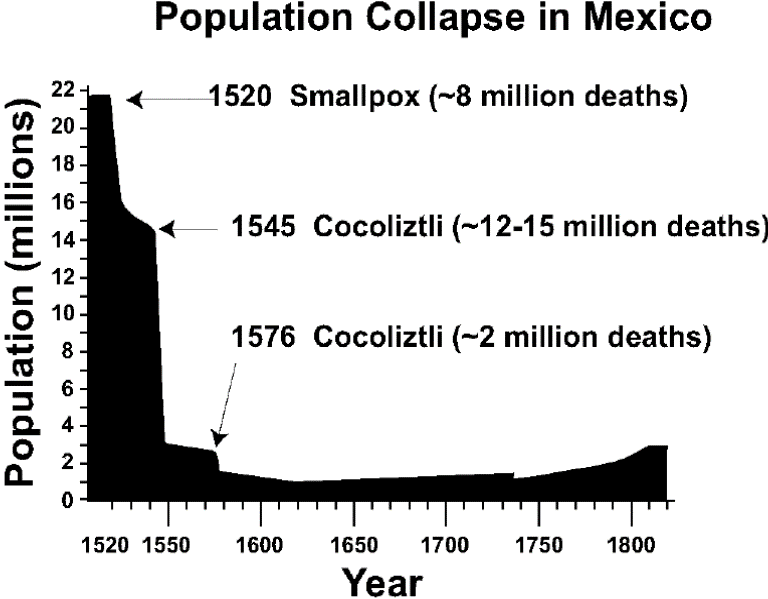 | 768 × 599 (38 KB) | smartcommons>Soupvector | User created page with UploadWizard |
File usage
There are no pages that use this file.
