

| Fagus orientalis | |
|---|---|
.jpg)
| |
| Oriental beech foliage, fruits and trunk. | |
Scientific classification 
| |
| : | [[Template:Taxonomy/Fagus]] |
| Species: | Template:Taxonomy/FagusF. orientalis
|
| Binomial name | |
| Template:Taxonomy/FagusFagus orientalis | |
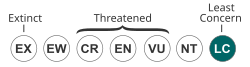
Fagus orientalis, commonly known as the Oriental beech, is a deciduous tree in the beech family Fagaceae. It is native to Eurasia, in Eastern Europe and Western Asia.
Description[edit | edit source]

Fagus orientalis is a large tree, capable of reaching heights of up to 45 m (148 ft) tall and 3 m (9.8 ft) trunk diameter, though more typically 25–35 m (82–115 ft) tall and up to 1.5 m (4 ft 11 in) trunk diameter.
The leaves are alternate, simple, and entire or with a slightly crenate margin, 7–15 cm (2.8–5.9 in) long and 5–9 cm (2.0–3.5 in) broad, with 7–13 veins on each side of the leaf (6–7 veins in F. sylvatica). The buds are long and slender, 15–30 millimetres (0.59–1.18 in) long and 2–3 mm (0.079–0.118 in) thick, but thicker, till 4–5 mm (0.16–0.20 in), where the buds include flower buds.
The flowers are small catkins which appear shortly after the leaves in spring.
The seeds are small triangular nuts 15–20 mm (0.59–0.79 in) long and 7–10 mm (0.28–0.39 in) wide at the base; there are two nuts in each cupule, maturing in the autumn 5–6 months after pollination. The cupule differs from that of European Beech in having flattened, slightly leaf-like appendages at the base (slender, soft spines in European Beech).
Taxonomy[edit | edit source]
Fagus orientalis is closely related to the Fagus sylvatica (European Beech), and intergrades with it in the Balkans and northwestern Turkey. These hybrids with European Beech are named Fagus × taurica.
Distribution and habitat[edit | edit source]
The tree's natural range extends from southeastern Bulgaria's Strandja mountain, through northwest Turkey, and east to the Caucasus Mountains in Georgia and Russia, to the Alborz Mountains in Iran.
Its habitat is restricted to mountain forests, at 500–2,100 m (1,600–6,900 ft) of altitude.
The Oriental beech has colonized even lower altitudes in the Strandja mountain of Bulgaria as low as 200–300 m (660–980 ft) above sea-level, due to the unique local micro-climate, where it forms typical Fagus orientalis−Rhododendron ponticum forests as well as with other evergreen shrubs.
Use[edit | edit source]
The wood of Fagus orientalis is heavy, hard, strong and highly resistant to shock. These features makes it suitable for steam bending. The wood is also a source to fuelwood and can be used for constructions particleboard, furniture, flooring veneer, mining poles, railway tiles and paper.[2]
See also[edit | edit source]
- Caucasus mixed forests ecoregion — key species in the ecoregion
References[edit | edit source]
- ↑ Rivers, M.C.; Barstow, M. (2017). "Fagus orientalis". IUCN Red List of Threatened Species. 2017: e.T79914188A109616835. doi:10.2305/IUCN.UK.2017-3.RLTS.T79914188A109616835.en. Retrieved 18 November 2021.
- ↑ Kandemirm, G.; Kaya, Z. (2009). "Oriental beech - Fagus orientalis: Technical guidelines for genetic conservation and use" (PDF). EUFORGEN: European Forest Genetic Resources Programme.
{{cite journal}}: Cite journal requires|journal=(help)
External links[edit | edit source]
- Oriental beech on Floridata
- Fagus orientalis, Plants for a Future
- Fagus orientalis - distribution map, genetic conservation units and related resources. European Forest Genetic Resources Programme (EUFORGEN)