

| Faisal Mosque | |
|---|---|
فیصل مسجد[A 1] | |
| Religion | |
| Affiliation | Islam |
| Branch/tradition | Sunni Islam |
| Location | |
| Location | Islamabad,  Pakistan Pakistan |
  Location in Pakistan | |
| Coordinates | 33°43′48″N 73°02′18″E / 33.729944°N 73.038436°E |
| Architecture | |
| Architect | Vedat Dalokay |
| Type | Mosque |
| Style | Contemporary Islamic |
| Established | 1987 |
Construction cost | 12 crore USD |
| Specifications | |
| Capacity | 10,000 (in hall) 24,000 (in porticoes) 40,000 (in courtyard) |
| Minaret | 4 |
Minaret height | 90 m (300 ft) |
Faisal Mosque stands as Pakistan's national mosque, situated in Islamabad, the nation's capital.[1][2] Perched at the foothills of the Margalla Hills, it ranks as the sixth-largest mosque globally and bears the name of the late Saudi Arabian King Faisal (r. 1964–75). The mosque's contemporary design, created by Turkish architect Vedat Dalokay, features eight-sided concrete shell structures inspired by traditional Bedouin tent architecture.[3]
Recognised as a major tourist attraction and influential piece of Islamic architecture, the Faisal Mosque is celebrated as a masterpiece of modern Islamic design. Its cultural significance is complemented by nearby landmarks like the Pakistan Monument, which showcases the country's heritage, enhancing Islamabad's appeal to visitors.[4]
Construction commenced in 1976 following an 2.8 crore grant from King Faisal, whose name memorialises the mosque.[5] After Dalokay's unconventional design was selected through international competition,[6] the mosque emerged without a traditional dome, instead featuring a Bedouin tent-like form surrounded by four towering 90-meter minarets. The distinctive eight-sided sloping roofs create a triangular worship hall accommodating 10,000 Muslims.
The expansive structure spans 1,30,000 square meters (33 acres), dominating Islamabad's landscape. Located at the northern terminus of Faisal Avenue, it sits at the city's northern edge against the scenic backdrop of Margalla Hills in the Himalayan foothills. The Faisal Mosque held the distinction of being the world's largest mosque from 1986 until 1993, when surpassed by Saudi Arabian mosques.
Gallery[edit | edit source]
-
 Front view
 -
 Portrait
 -
 Aerial view
 -
 The mosque and Snow-capped Margalla Hills
 -
 Elevation view of the mosque
 -
 During 27th Ramadan
 -

-
 From Daman-e-Koh
 -
 View from Margalla Hills
 -
 View before sunset
 -
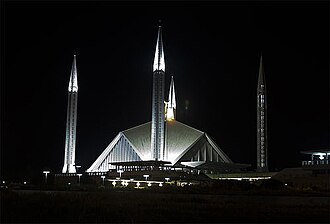 The mosque at night during prayer times
 -
 Faisal Masjid in cloudy weather
 -
 View of Faisal Mosque and Jamia Faridia from Daman-e-Koh, Islamabad
 -
 Faisal Masjid at twilight
 -
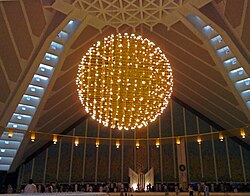 Faisal mosque main hall chandelier


References[edit | edit source]
- ↑ Len McGrane (January–February 1992). "A Mosque in Islamabad". Saudi Aramco World magazine. Aramco Services Company. Archived from the original on 18 February 2007. Retrieved 29 November 2007.
- ↑ Neelam Naz (13 September 2005). "Contribution of Turkish architects to the national architecture of Pakistan: Vedat Dalokay" (PDF). Journal of the Faculty of Architecture. 22 (2). Ankara, Turkey: Middle East Technical University: 56–64. Archived from the original (PDF) on 23 November 2018. Retrieved 29 November 2007.
- ↑ "Three Pakistani mosques make it to 'world's most beautiful mosques' list". The Express Tribune. 3 August 2015. Archived from the original on 4 March 2022. Retrieved 2 March 2021.
- ↑ "Faisal Mosque attracts visitors from all over country". The News International. Archived from the original on 30 September 2022. Retrieved 17 December 2019.
- ↑ "Faisal Mosque not a 'gift' by Saudi Arabia". Daily Times. 13 February 2017. Archived from the original on 23 October 2020. Retrieved 8 August 2020.
- ↑ Mass, Leslie Noyes (2011). Back to Pakistan: A Fifty-Year Journey. Rowman & Littlefield. p. 157. ISBN 978-1-4422-1319-7.
- ↑ फ़ैसल मस्जिद
Other websites[edit | edit source]
- Click here to see a highly detailed 3D Model of Faisal Masjid in Google Earth.
- Faisal Mosque - ArchNet Digital Library Archived 2005-12-01 at the Wayback Machine
- Faisal Mosque - World is Round Archived 2008-01-18 at the Wayback Machine
 | This religion-related article is a stub. You can help Bharatpedia by expanding it. |