

| White-striped viper gecko | |
|---|---|

| |
Scientific classification 
| |
| : | [[Template:Taxonomy/Hemidactylus]] |
| Species: | Template:Taxonomy/HemidactylusH. albofasciatus
|
| Binomial name | |
| Template:Taxonomy/HemidactylusHemidactylus albofasciatus Grandison and Soman, 1963[2]
| |
| Synonyms | |
|
Teratolepis albofasciatus (Grandison and Soman, 1963) | |
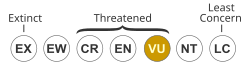
The white-striped viper gecko (Hemidactylus albofasciatus) is a species of gecko endemic to India.[1][3] The species, mostly found under the loose rocks on rock outcrops of the Konkan region is known to be threatened by the land-use changes.[4][5] This is an uncommon, slender gecko found only in the lateritic plateaus of Maharashtra.[6] This patchily distributed ground-dwelling species hides generally under the rocks during the daytime[7][8]
Distribution
The species is currently known from few localities in the Maharashtra state. The type locality is Dorle Village in Rajapur Taluka, Ratnagiri district, Maharashtra.[3] Its distribution is poorly known, and it could be more widely spread.[1] The conversion of lateritic plateaus to mango orchards, due to the increasing culinary popularity of the Alphononso mango varietal, has decreased populations of specialist species such as the white-striped viper gecko in their endemic region.[9]

References
- ↑ 1.0 1.1 1.2 Srinivasulu, C.; Srinivasulu, B. (2013). "Hemidactylus albofasciatus". IUCN Red List of Threatened Species. 2013 e.T194104A2299155. doi:10.2305/IUCN.UK.2013-1.RLTS.T194104A2299155.en. Retrieved 20 November 2021.
- ↑ Grandison, A. G. C.; Soman, P. W. (1963). "Description of a new geckonid lizard from Maharashtra, India". Journal of the Bombay Natural History Society. 60: 322–325.
- ↑ 3.0 3.1 Template:NRDB species
- ↑ "Land-use changes put rocky addresses of animals under stress in Maharashtra's Sahyadri plateau". The Hindu. 2023-07-28. ISSN 0971-751X. Retrieved 2023-08-02.
- ↑ Jithin, Vijayan; Rane, Manali; Watve, Aparna; Giri, Varad B.; Naniwadekar, Rohit (2023-10-01). "Between a rock and a hard place: Comparing rock-dwelling animal prevalence across abandoned paddy, orchards, and rock outcrops in a biodiversity hotspot". Global Ecology and Conservation. 46 e02582. Bibcode:2023GEcoC..4602582J. doi:10.1016/j.gecco.2023.e02582. ISSN 2351-9894.
- ↑ Grandison, A. G. C.; Soman, P.W. (1963). "Description of a new geckonid lizard from Maharashtra, India". Journal of the Bombay Natural History Society. 60 (2): 322–325.
- ↑ Gaikwad, K.S.; Kulkarni, H.; Bhambure, R.; Giri, V.B. (2009). "Notes on the distribution, natural history and variation of Hemidactylus albofasciatus (Grandison and Soman, 1963)(Squamata: Gekkonidae)". Journal of the Bombay Natural History Society. 106 (3): 305.
- ↑ Mirza, Z.; Sanap, R. (2012). "Notes on the natural history of Hemidactylus albofasciatus Grandison and Soman, 1963 (Reptilia: Gekkonidae)". Hamadryad. 36 (1): 56–58.
- ↑ Amberkar, Prathamesh; Mungikar, Rahul (2024-10-07). "More the merrier? influence of mango orchards on the composition of the reptile communities of the lateritic plateaus, Maharashtra, India". Biotropica. doi:10.1111/btp.13388. ISSN 0006-3606.