

| Dysphaea ethela | |
|---|---|
_male._(25602242838).jpg)
| |
| Male | |
.jpg)
| |
| Female | |
| Scientific classification | |
| Kingdom: | |
| Phylum: | |
| Class: | |
| Order: | |
| Suborder: | |
| Family: | |
| Genus: | |
| Species: | D. ethela
|
| Binomial name | |
| Dysphaea ethela Fraser, 1924[2]
| |
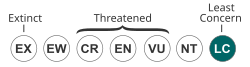
Dysphaea ethela,[3][1] black torrent dart,[4][5] is a species of damselfly in the family Euphaeidae. The insect is named after Frederic Charles Fraser's wife, Ethel Grace Fraser (née Varrall) (1881-1960), a constant companion of his collecting trips in India.[2][6]
It is found in Karnataka and Kerala and Tamil Nadu in Western Ghats.[1] This species is also known from the Eastern Ghats and central India.[7][4][8]
Description
It is a medium sized damselfly with black head and brown-capped pale grey eyes. Its thorax is black, marked with narrow antehumeral and humeral greenish-yellow stripes. There are another yellow stripes on the base of lateral sides. These marks will get obscured by pruinescence in old males. Wings are transparent; but evenly enfumed with brown. Abdomen is black, marked with yellow apical annules up to segment 8. There are yellow lateral stripes up to segment 6. Anal appendages are black.[9]
Female is short and robust; the yellow marks are more broad and vivid. The yellow lateral stripes continued to segment 7. Segment 8 has a narrow and 9 has a broad yellow apical annule, covering dorsal half.[9]
Habitat
It breeds in streams and rivers. Commonly seen perched on reeds or bushes on the river's bank or settled on rocks far inside the stream.[9][2][7][4][5]
- The female laying eggs on a submerged plants in a slow flowing stream
-

-

-


_female.jpg)

See also
References
- ↑ 1.0 1.1 1.2 Dow, R.A. 2019. Dysphaea ethela. The IUCN Red List of Threatened Species 2019: e.T163734A122208779. https://doi.org/10.2305/IUCN.UK.2019-2.RLTS.T163734A122208779.en. Downloaded on 26 July 2019.
- ↑ 2.0 2.1 2.2 C FC Lt. Fraser (1924). A Survey of the Odonate (Dragonfly) Fauna of Western India and Descriptions of Thirty New Species (PDF). pp. 480–481.
- ↑ Template:World Odonata List
- ↑ 4.0 4.1 4.2 "Dysphaea ethela Fraser, 1924". India Biodiversity Portal. Retrieved 2017-03-07.
- ↑ 5.0 5.1 "Dysphaea ethela Fraser, 1924". Odonata of India, v. 1.00. Indian Foundation for Butterflies. Retrieved 2017-03-07.
- ↑ Hämäläinen, Matti (2015). "Catalogue of individuals commemorated in the scientific names of extant dragonflies, including lists of all available eponymous species-group and genus-group names" (PDF). International Dragonfly Fund (IDF) - Report. 80: 1–168. ISSN 1435-3393. Retrieved 18 September 2020.
- ↑ 7.0 7.1 Subramanian, K. A. (2005). Dragonflies and Damselflies of Peninsular India - A Field Guide.
- ↑ K.A., Subramanian; K.G., Emiliyamma; R., Babu; C., Radhakrishnan; S.S., Talmale (2018). Atlas of Odonata (Insecta) of the Western Ghats, India. Zoological Survey of India. pp. 82–83. ISBN 9788181714954.
- ↑ 9.0 9.1 9.2 C FC Lt. Fraser (1934). The Fauna of British India, including Ceylon and Burma, Odonata Vol. II. Red Lion Court, Fleet Street, London: Taylor and Francis. pp. 92-94.