



| Battle of Yarmuk | |||||||||
|---|---|---|---|---|---|---|---|---|---|
 Illustration of the Battle of Yarmuk by an anonymous Catalan illustrator (c. 1310 – 1325) | |||||||||
| |||||||||
| Belligerents | |||||||||
| Rashidun Caliphate | |||||||||
| Commanders and leaders | |||||||||
|
Khalid ibn al-Walid Abu Ubayda ibn al-Jarrah Amr ibn al-As Abu Sufyan ibn Harb Yazid ibn Abi Sufyan Shurahbil ibn Hasana Ikrima ibn Amr † Zubayr ibn al-Awwam Al-Qa'qa' ibn 'Amr Dirar ibn al-Azwar Ubadah ibn al-Samit Suhayl ibn Amr Safwan ibn Umayya |
Vahan †[g] Theodore Trithyrius † Jabalah ibn al-Aiham Dairjan † Niketas the Persian Buccinator (Qanatir) Gregory[1] | ||||||||
| Strength | |||||||||
|
15,000–40,000 (modern estimates)[d] 24,000–40,000 (primary Arab sources)[e] |
| ||||||||
| Casualties and losses | |||||||||
|
4,000 killed[2] Total casualties: 5,000[3]–17,000[4] |
70,000–120,000 killed (primary Arab sources)[f] 50,000+ killed[5] (modern estimates) | ||||||||
The Battle of the Yarmuk (also spelled Yarmouk; Arabic: معركة اليرموك) was a major battle between the Byzantine Empire and the Rashidun Caliphate near the Yarmouk River in Byzantine Syria that marked a crucial point in the Muslim conquest of Syria. The result of the battle was a decisive Arab victory that effectively ended Byzantine rule in Syria.
The battle consisted of a series of engagements that lasted for six days in August 636, near the Yarmouk River, along what are now the borders between Syria and Jordan and Syria and Israel, southeast of the Sea of Galilee. To check the Arab advance and to recover lost territory, Emperor Heraclius had sent a massive expedition to the Levant in May 636. As the Byzantine army approached, the Arabs tactically withdrew from Syria and regrouped all their forces at the Yarmuk plains close to the Arabian Peninsula, where they were reinforced, and defeated the numerically superior Byzantine army.
The Battle of the Yarmuk is regarded as one of the most decisive battles in military history.[6][7] It was also Khalid ibn al-Walid's greatest military victory and cemented his reputation as one of the greatest tacticians and cavalry commanders in history.[8] The battle marked the culmination of the first great wave of early Muslim conquests after the death of the Islamic prophet Muhammad, which witnessed the rapid advance of the Rashidun Caliphate into both the Sasanian Empire and the Byzantine Empire.
Background
In 610, during the Byzantine–Sasanian War of 602–628, Heraclius became the emperor of the Byzantine Empire,[9] after overthrowing Phocas. Meanwhile, the Sasanian Empire conquered Mesopotamia and in 611 they overran Syria and entered Anatolia, occupying Caesarea Mazaca (now Kayseri, Turkey). In 612, Heraclius managed to expel the Persians from Anatolia but was decisively defeated in 613 when he launched a major offensive in Syria against the Persians.[10] Over the following decade, the Persians were able to conquer Palestine and Egypt. Meanwhile, Heraclius prepared for a counterattack and rebuilt his army.
In 622, Heraclius finally launched his offensive.[11] After his overwhelming victories over the Persians and their allies in the Caucasus and Armenia, Heraclius launched a winter offensive against the Persians in Mesopotamia in 627, winning a decisive victory at the Battle of Nineveh, thus threatening the Persian capital city of Ctesiphon. Discredited by the series of disasters, Khosrow II was overthrown and killed in a coup led by his son Kavad II,[12] who immediately sued for peace and agreed to withdraw from all occupied territories of the Byzantine Empire. Heraclius restored the True Cross to Jerusalem with a majestic ceremony in 629.[13]
Meanwhile, there had been rapid political development in the Arabian Peninsula, where Muhammad had been preaching Islam and, by 630, had successfully annexed most of Arabia under a single political authority. When Muhammad died in June 632, Abu Bakr was chosen as caliph and his political successor. Troubles emerged soon after Abu Bakr's succession, and several Arab tribes openly revolted against him. He declared war against the rebels. In what became known as the Ridda Wars of 632–633, Abu Bakr managed to defeat his opponents and unite Arabia under the central authority of the caliph at Medina.[14]


Once the rebels had been subdued, Abu Bakr began a war of conquest, beginning with Iraq. His most brilliant general, Khalid ibn al-Walid, conquered Iraq in a series of successful campaigns against the Sasanian Empire. Abu Bakr's confidence grew, and once Khalid had established his stronghold in Iraq, Abu Bakr issued a call to arms for the invasion of Syria in February 634.[15] The Muslim invasion of Syria was a series of carefully planned and well-coordinated military operations, which employed strategy, instead of pure strength, to deal with the Byzantine defensive measures.[16]
The Muslim armies, however, soon proved to be too small to handle the Byzantine response, and their commanders called for reinforcements. Khalid was sent by Abu Bakr from Iraq to Syria with reinforcements and to lead the invasion. In July, the Byzantines were decisively defeated at Ajnadayn. Damascus fell in September, followed by the Battle of Fahl, in which the last significant garrison of Palestine was routed.[17]
After Abu Bakr died in 634, his successor Umar was determined to continue the Caliphate's expansion deeper into Syria.[18] Though previous campaigns led by Khalid had been successful, he was replaced by Abu Ubayda ibn al-Jarrah. Having secured southern Palestine, Muslim forces now advanced up the trade route, and Tiberias and Baalbek fell without much struggle and conquered Emesa early in 636.[19]
Byzantine counterattack
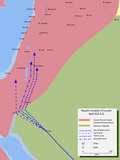
Having seized Emesa, the Muslims were just a march away from Aleppo, a Byzantine stronghold, and Antioch, where Heraclius resided. Seriously alarmed by the series of setbacks, Heraclius prepared for a counterattack to reacquire the lost regions.[20][21] In 635 Yazdegerd III, the Emperor of Persia, sought an alliance with the Byzantine Emperor. While Heraclius prepared for a major offensive in the Levant, Yazdegerd was to mount a simultaneous counterattack in Iraq, in what was meant to be a well-coordinated effort. When Heraclius launched his offensive in May 636, Yazdegerd could not co-ordinate with the maneuver, probably owing to the exhausted condition of his government, and what would have been a decisive plan missed the mark.[22]
.svg)
Byzantine preparations began in late 635 and by May 636 Heraclius had a large force concentrated at Antioch in Northern Syria.[23] The assembled Byzantine army contingents consisted of Slavs, Franks, Georgians, Armenians, Christian Arabs, Lombards, Avars, Khazars, Balkans and Göktürks.[24] The force was organized into five armies, the joint leader of which was Theodore Trithyrius. Vahan, an Armenian and former garrison commander of Emesa,[25] was made the overall field commander,[26] and had under his command a purely Armenian army. Buccinator (Qanatir), a Slavic prince, commanded the Slavs and Jabalah ibn al-Aiham, king of the Ghassanid Arabs, commanded an exclusively Christian Arab force. The remaining contingents, all European, were placed under Gregory and Dairjan.[27][28] Heraclius himself supervised the operation from Antioch. Byzantine sources mention Niketas, son of the Persian general Shahrbaraz, among the commanders, but it is not certain which army he commanded.[29]
The Rashidun army was then split into four groups: one under Amr in Palestine, one under Shurahbil in Jordan, one under Yazid in the Damascus-Caesarea region and the last one under Abu Ubayda along with Khalid at Emesa.
As the Muslim forces were geographically divided, Heraclius sought to exploit that situation and planned to attack. He did not wish to engage in a single pitched battle but rather to employ a central position and fight the enemy in detail by concentrating large forces against each of the Muslim corps before they could consolidate their troops. By forcing the Muslims to retreat, or by destroying Muslim forces separately, he would fulfil his strategy of recapturing lost territory. Reinforcements were sent to Caesarea under Heraclius' son Constantine III, probably to tie down Yazid's forces, which were besieging the town.[27] The Byzantine imperial army moved out from Antioch and Northern Syria in the middle of June 636.
The Byzantine imperial army was to operate under the following plan:
- Jabalah's lightly armed Christian Arabs would march to Emesa from Aleppo via Hama and hold the main Muslim army at Emesa.
- Dairjan would make a flanking movement between the coast and Aleppo's road and approach Emesa from the west, striking at the Muslims' left flank while they were being held frontally by Jabalah.
- Gregory would strike the Muslims' right flank, approaching Emesa from the northeast via Mesopotamia.
- Qanatir would march along the coastal route and occupy Beirut, from where he was to attack the weakly defended Damascus from the west to cut off the main Muslim army at Emesa.
- Vahan's corps would act as a reserve and would approach Emesa via Hama.[30]
Rashidun strategy
The Muslims discovered Heraclius' preparations at Shaizar from Byzantine prisoners. Alert to the possibility of being caught with separated forces that could be destroyed, Khalid called a council of war and advised Abu Ubayda to pull the troops back from Palestine and Northern and Central Syria and concentrate the entire Rashidun army in one place.[31][32] Abu Ubayda ordered the concentration of troops in the vast plain near Jabiyah, as control of the area made cavalry charges possible and facilitated the arrival of reinforcements from Umar, so that a strong, united force could be fielded against the Byzantine armies.[33] The position also benefited from close proximity to the Rashidun stronghold of Najd, if retreat became necessary. Instructions were also issued to return jizya (tribute) to people who had paid it due to the Muslims inability to protect them from the invading Byzantine army.[34]
However, once concentrated at Jabiyah, the Muslims were subject to raids from pro-Byzantine Ghassanid forces. Encamping in the region was also precarious as a strong Byzantine force was garrisoned in Caesarea and could attack the Muslim rear while they were held in front by the Byzantine army. On Khalid's advice the Muslim forces retreated to Dar'aa and Dayr Ayyub, covering the gap between the Yarmuk Gorges and the Harra lava plains,[31] and established a line of camps in the eastern part of the plain of Yarmuk. This was a strong defensive position, and the maneuverers brought the Muslims and Byzantines into a decisive battle, which the latter had tried to avoid.[35] During the maneuvers, there were no engagements except for a minor skirmish between Khalid's elite light cavalry and the Byzantine advance guard.[36]
Battlefield


The battlefield lies in the plain of Jordanian Hauran, just southeast of the Golan Heights, an upland region currently on the frontier between Jordan and Syria, east of the Sea of Galilee. The battle was fought on the plain east of Wadi-ur-Ruqqad. That wadi joins the Yarmuk River, a tributary of the Jordan River, on its south. The stream had very steep banks, ranging from 30 m (98 ft)–200 m (660 ft) in height. On the north is the Jabiyah road and to the east are the Azra hills although the hills were outside the actual field of battle. Strategically, there was only one prominence in the battlefield: a 100 m (330 ft) elevation known as Tel al Jumm'a, and for the Muslim troops concentrated there, the hill gave a good view of the plain of Yarmuk. The ravine on the west of the battlefield was accessible at a few places in 636 AD, and had one main crossing: a Roman bridge (Jisr-ur-Ruqqad) near Ayn Dhakar[37][38] Logistically, the Yarmuk plain had enough water supplies and pastures to sustain both armies. The plain was excellent for cavalry maneuvers.[39][40]
Army setup
Troop deployment
Most early accounts place the size of the Muslim forces between 36,000 and 40,000 and the number of Byzantine forces between 60,000 and 70,000 (This number has been estimated by taking into account the logistical situation of the Empire and with the view that they could never have mustered such troops when the Empire was at its apex but especially not with the especially weak and exhausted realm of 628 onwards). Modern estimates for the sizes of the respective armies vary: some estimates for the Byzantine army are around 40,000 at most,[41] while other estimates are 15,000 to 20,000.[42] Estimates for the Rashidun army are between 15,000 and 40,000,[43] most likely around 36,000.[41] Original accounts are mostly from Arab sources, generally agreeing that the Byzantine army and their allies outnumbered the Muslim Arabs by a 2 to 1.[m] Some modern historians have argued for a substantially larger Byzantine army at Yarmouk. Warren Treadgold, emphasizing the continued administrative and fiscal capacity of the East Roman state in the early seventh century, has suggested that the empire retained the ability to field very large field armies when resources were concentrated for major campaigns. Based on reconstructions of imperial military structures and pay records, Treadgold has estimated total Byzantine field forces at approximately 150,000 empire-wide during this period, and interprets the army assembled for Yarmouk as potentially numbering 80,000–100,000 or more, though he acknowledges the uncertainty of precise figures. This view contrasts with other scholars, who emphasize logistical constraints and avoid assigning specific numerical estimates to the Byzantine army at Yarmouk.[44] The only early Byzantine source is Theophanes, who wrote a century later. Accounts of the battle vary, some stating it lasted a day, others six days.[43]
Rashidun army
During a council of war, the command of the Muslim army was transferred to Khalid[i] by Abu Ubayda, Commander in Chief of the Muslim army.[45] After taking command, Khalid reorganized the army into 36 infantry regiments and four cavalry regiments, with his cavalry elite, the mobile guard, held in reserve. The army was organised in the Tabi'a formation, a tight, defensive infantry formation.[46] The army was lined up on a front of 12 kilometres (7.5 mi), facing west, with its left flank lying south on the Yarmuk River a mile before the ravines of Wadi al-Allan began. The army's right flank was on the Jabiyah road in the north across the heights of Tel al Jumm'a,[47] with substantial gaps between the divisions so that their frontage would match that of the Byzantine battle line at 13 kilometres (8.1 mi). The centre of the army was under the command of Abu Ubayda (left centre) and Shurahbil (right centre). The left wing was under the command of Yazid and the right wing was under Amr.[45]
The centre, left and right wings were given cavalry regiments, to be used as a reserve for a counterattack if they were pushed back by the Byzantines. Behind the centre stood the mobile guard under the personal command of Khalid. If Khalid was too occupied in leading the general army, Dhirar ibn al-Azwar would command the mobile guard. Over the course of the battle, Khalid would repeatedly make critical and decisive use of that mounted reserve.[45]
Khalid sent out several scouts to keep the Byzantines under observation.[48] In late July, Vahan sent Jabalah with his lightly armoured Christian-Arab forces to reconnoitre-in-force, but they were repulsed by the mobile guard. After the skirmish, no engagement occurred for about a month.[49]
Weaponry
Helmets used included gilded helmets similar to the silver helmets of the Sassanid empire. Mail was commonly used to protect the face, neck, and cheeks as an aventail from the helmet or as a mail coif. Heavy leather sandals, as well as Roman-type sandal boots, were also typical of the early Muslim soldiers.[50] Armour included hardened leather scale or lamellar armour and mail armour. Infantry soldiers were more heavily armoured than horsemen. Large wooden or wickerwork shields were used. Long-shafted spears were used, with infantry spears being 2.5 m (8.2 ft) long and cavalry spears being up to 5.5 m (18 ft) long. Short infantry swords like the Roman gladius and Sassanid long swords were used; long swords were usually carried by horsemen. Swords were hung in baldrics. Bows were about 2 metres (6.6 ft) long when unbraced, similar in size to the famous English longbow. The maximum useful range of the traditional Arabian bow was about 150 m (490 ft). Early Muslim archers, while being infantry archers without the mobility of horseback archer regiments, proved to be very effective in defending against light and unarmoured cavalry attacks.[51]
Byzantine army
A few days after the Muslims encamped at the Yarmuk plain, the Byzantine army, preceded by the lightly armed Ghassanids of Jabalah, moved forward and established strongly fortified camps just north of the Wadi-ur-Ruqqad.[52][j]
The right flank of the Byzantine army was at the south end of the plains, near the Yarmuk River and about a mile before the ravines of Wadi al-Allan began. The left flank of the Byzantines was at the north, a short distance before the Hills of Jabiyah began, and was relatively exposed. Vahan deployed the Imperial Army facing east, with a front about 13 kilometres (8.1 mi) long,[37] as he was trying to cover the whole area between the Yarmuk gorge in the south and the Roman road to Egypt in the north, and substantial gaps had been left between the Byzantine divisions. The right wing was commanded by Gregory and the left by Qanatir. The centre was formed by the army of Dairjan and the Armenian army of Vahan, both under the overall command of Dairjan. The Byzantine regular heavy cavalry, the cataphract, was distributed equally among the four armies, each army deploying its infantry at the forefront and its cavalry as a reserve in the rear. Vahan deployed Jabalah's Christian Arabs, mounted on horses and camels, as a skirmishing force, screening the main army until its arrival.[53]
Early Muslim sources mention that the army of Gregory had used chains to link together its foot soldiers, who had all taken an oath of death. The chains were in 10-man lengths as a proof of unshakeable courage on the part of the men, who thus displayed their willingness to die where they stood and not to retreat. The chains also acted as an insurance against a breakthrough by enemy cavalry. However, modern historians suggest that the Byzantines adopted the Graeco-Roman testudo military formation in which soldiers would stand shoulder-to-shoulder with shields held high and an arrangement of 10 to 20 men would be completely shielded on all sides from missile fire, each soldier providing cover for an adjoining companion.[37]
Weaponry
The Byzantine cavalry was armed with a long sword, known as the spathion. They would also have had a light wooden lance, known as a kontarion and a bow (toxarion) with forty arrows in a quiver, hung from a saddle or from the belt.[54] Heavy infantry, known as Skoutatoi, had a short sword and a short spear. The lightly armed Byzantine troops and the archers carried a small shield, a bow hung from the shoulder across the back and a quiver of arrows. Cavalry armour consisted of a hauberk with a mail coif and a helmet with a pendant: a throat-guard lined with fabric and having a fringe and cheek piece. Infantry was similarly equipped with a hauberk, a helmet and leg armour. Light lamellar and scale armour was also used.[55]
Tensions in Byzantine army
Khalid's strategy of withdrawing from the occupied areas and concentrating all of his troops for a decisive battle forced the Byzantines to concentrate their five armies in response. The Byzantines had for centuries avoided engaging in large-scale decisive battles, and the concentration of their forces created logistical strains for which the empire was ill-prepared.[35][56]
Damascus was the closest logistical base, but Mansur ibn Sarjun, leader of Damascus, could not fully supply the massive Byzantine army that was gathered at the Yarmuk plain. Several clashes were reported with local citizens over supply requisition, as summer was at an end and there was a decline of pasturage. Greek court sources accused Vahan of treason for his disobedience to Heraclius' command not to engage in large-scale battle with Arabs. Given the massing of the Muslim armies at Yarmuk, however, Vahan had little choice but to respond in kind. Relations between the various Byzantine commanders were also fraught with tension. There was a struggle for power between Trithyrius and Vahan, Jarajis, and Qanatir (Buccinator).[57] Jabalah, the Christian Arab leader, was largely ignored, to the detriment of the Byzantines given his knowledge of the local terrain. An atmosphere of mistrust thus existed between the Romans, Armenians and Arabs. Longstanding ecclesiastical feuds between the Monophysite and Chalcedonian factions, of negligible direct impact, certainly inflamed underlying tensions. The effect of the feuds was decreased coordination and planning, one of the reasons for the catastrophic Byzantine defeat.[58]
Battle
The battle lines of the Muslims and the Byzantines were divided into four sections: the left wing, the left centre, the right centre and the right wing. Note that the descriptions of the Muslim and the Byzantine battle lines are exactly each other's opposite: the Muslim right wing faced the Byzantine left wing (see image[n]).


Vahan was instructed by Heraclius not to engage in battle until all avenues of diplomacy had been explored,[59] probably because Yazdegerd III's forces were not yet ready for the offensive in Iraq. Accordingly, Vahan sent Gregory and then Jabalah to negotiate, but their efforts proved futile. Before the battle, on Vahan's invitation, Khalid came to negotiate peace, with a similar end. The negotiations delayed the battles for a month.[37]
On the other hand, Umar, whose forces at Qadisiyah were threatened with confronting the Sassanid armies, ordered Sa'd ibn Abi Waqqas to enter negotiations with the Persians and to send emissaries to Yazdegerd III and his commander Rostam Farrokhzād, apparently inviting them to Islam. That was most probably the delaying tactic employed by Umar on the Persian front.[60] Meanwhile, he sent reinforcements[37] of 6,000 troops, mostly from Yemen, to Khalid. The force included 1,000 companions of Muhammad, among whom were 100 veterans of the Battle of Badr, the first battle in Islamic history, and included citizens of the highest rank, such as Zubayr ibn al-Awwam, Abu Sufyan, and his wife Hind bint Utbah.[61][62] As it was a citizen army, in contrast to a mercenary army, the age of the soldiers ranged from 20 (in the case of Khalid's son) to 70 (in the case of Ammar). Three of the ten companions promised paradise by Muhammad, namely Sa'id, Zubayr and Abu Ubayda, were present at Yarmuk.
Umar, apparently wanting to defeat the Byzantines first, used the best Muslim troops against them. The continuing stream of Muslim reinforcements worried the Byzantines, who fearing that the Muslims with such reinforcements would grow powerful, decided that they had no choice but to attack. The reinforcements that were sent to the Muslims at Yarmuk arrived in small bands, giving the impression of a continuous stream of reinforcements to demoralize the Byzantines to compel them to attack.[63] The same tactic would be repeated again during the Battle of Qadisiyah.[48]
Day 1

The battle began on 15 August.[64] At dawn, both armies lined up for battle less than a mile apart. It is recorded in Muslim chronicles that before the battle started, George, a unit commander in the Byzantine right centre, rode up to the Muslim line and converted to Islam; he would die the same day fighting on the Muslim side.[65] The battle began as the Byzantine army sent its champions to duel with the Muslim mubarizun. The mubarizun were specially trained swordsmen and lancers, with the objective to slay as many enemy commanders as possible to damage their morale. At midday, after losing a number of commanders in the duels, Vahan ordered a limited attack with a third of his infantry forces to test the strength and strategy of the Muslim army and, using their overwhelming numerical and weaponry superiority, achieve a breakthrough wherever the Muslim battle line was weak. However the Byzantine assault lacked determination; many Byzantine soldiers were unable to press the attack against the Muslim veterans.[66] The fighting was generally moderate although in some places, it was especially intense. Vahan did not reinforce his forward infantry, two thirds of which was kept in reserve with one third deployed to engage the Muslims, and at sunset, both armies broke contact and returned to their respective camps.[65]
Day 2


Phase 1: On 16 August, Vahan decided in a council of war to launch his attack just before dawn, to catch the Muslim force unprepared as they conducted their morning prayers. He planned to engage his two central armies with the Muslim centre in an effort to stall them while the main thrusts would be against the wings of the Muslim army, which would then be driven away from the battlefield or pushed towards the centre.[65][67] To observe the battlefield, Vahan had a large pavilion built behind his right wing with an Armenian bodyguard force. He ordered the army to prepare for the surprise attack.
However, Khalid had prepared for such a contingency by placing a strong outpost line in front during the night to counter surprises, which gave the Muslims time to prepare for battle. At the centre, the Byzantines did not press hard, intending to pin down the Muslim centre corps in their position and preventing them from aiding the Muslim army in other areas. Thus the centre remained stable, but on the wings the situation was different. Qanatir, commanding the Byzantine left flank, which consisted of mainly Slavs, attacked in force, and the Muslim infantry on the right flank had to retreat. Amr, the Muslim right wing commander ordered his cavalry regiment to counterattack, which neutralized the Byzantine advance and stabilized the battle line on the right for some time, but the Byzantine numerical superiority caused them to retreat towards the Muslim base camp.[68]
Phase 2: Khalid, aware of the situation at the wings, ordered the cavalry of the right wing to attack the northern flank of the Byzantine left wing while he with his mobile guard attacked the southern flank of the Byzantine left wing, and the Muslim right wing infantry attacked from the front. The three-pronged attack forced the Byzantine left wing to abandon the Muslim positions they had gained on, and Amr regained his lost ground and started reorganizing his corps for another round.[68]
The situation on the Muslim left wing, which Yazid commanded was considerably more serious. The Muslim right wing enjoyed assistance from the mobile guard but not the left wing, and the numerical advantage the Byzantines enjoyed caused the Muslim positions to be overrun, with soldiers retreating towards base camps.[61] There, the Byzantines had broken through the corps. The testudo formation that Gregory's army had adopted moved slowly but also had a good defence. Yazid used his cavalry regiment to counterattack but was repulsed. Despite stiff resistance, the warriors of Yazid on the left flank finally fell back to their camps and for a moment Vahan's plan appeared to be succeeding. The centre of the Muslim army was pinned down and its flanks had been pushed back. However, neither flank had broken though
- ↑ Nicolle 1994, pp. 64–65.
- ↑ Akram 2004, p. 425.
- ↑ "Battle of Yarmouk". Encyclopædia Britannica. Encyclopædia Britannica, Inc. Retrieved 5 June 2025.
Losses: Byzantine allied, 40,000; Arab, 5,000.
- ↑ Bolshakov (2002), p. 67.
- ↑ "Khālid ibn al-Walīd". Encyclopædia Britannica. Encyclopædia Britannica–, Inc. Retrieved 17 June 2025.
Early in 636 he withdrew south of the Yarmūk River before a powerful Byzantine force that advanced from the north and from the coast of Palestine. The Byzantine armies were composed mainly of Christian Arab, Armenian, and other auxiliaries, however; and when many of these deserted the Byzantines, Khālid, reinforced from Medina and possibly from the Syrian Arab tribes, attacked and destroyed the remaining Byzantine forces along the ravines of the Yarmūk valley (Aug. 20, 636). Almost 50,000 Byzantine troops were slaughtered, which opened the way for many other Islamic conquests.
- ↑ Nafziger & Walton 2003, p. 30.
- ↑ Nicolle 1994, p. 6.
- ↑ Nicolle 1994, p. 19.
- ↑ Haldon 1997, p. 41.
- ↑ Greatrex & Lieu 2002, pp. 189–90.
- ↑ Greatrex & Lieu 2002, p. 196.
- ↑ Greatrex & Lieu 2002, pp. 217–27.
- ↑ Haldon 1997, p. 46.
- ↑ Nicolle 1994, pp. 12–14.
- ↑ Luttwak 2009, p. 199.
- ↑ Nicolle 1994, p. 87.
- ↑ Akram 2004, p. 246.
- ↑ Runciman 1987, p. 15.
- ↑ Akram 2004, p. 298.
- ↑ Nicolle 1994, p. 60.
- ↑ Kaegi 1995, p. 112.
- ↑ Akram 2009, p. 133.
- ↑ Akram 2004, p. 402.
- ↑ Al-Waqidi, p. 100
- ↑ (in Armenian) Bartikyan, Hrach. «Վահան» (Vahan). Armenian Soviet Encyclopedia. vol. xi. Yerevan: Armenian Academy of Sciences, 1985, p. 243.
- ↑ Kennedy 2007, p. 82.
- ↑ 27.0 27.1 Akram 2004, p. 409.
- ↑ Al-Waqidi, p. 106.
- ↑ Nicolle 1994, p. 16.
- ↑ Akram 2004, p. 399.
- ↑ 31.0 31.1 Nicolle 1994, p. 61.
- ↑ Kaegi 1995, p. 67.
- ↑ Akram 2004, p. 401.
- ↑ Al-Baladhuri, p. 143.
- ↑ 35.0 35.1 Kaegi 1995, p. 134.
- ↑ Akram 2004, p. 407.
- ↑ 37.0 37.1 37.2 37.3 37.4 Nicolle 1994, p. 64.
- ↑ Schumacher, Oliphant & Le Strange 1889, pp. 77–79.
- ↑ Kaegi 1995, p. 122.
- ↑ Nicolle 1994, p. 63.
- ↑ 41.0 41.1 Jandora, John W. (1985). "The Battle of the Yarmūk: A Reconstruction". Journal of Asian History. 19 (1): 8–21. ISSN 0021-910X. JSTOR 41930557.
- ↑ Kaegi 2003, p. 242: "The Byzantines, together with their Christian Arab allies, probably enjoyed numerical superiority, having troops that totalled up to 15–20,000 men, possibly more." Haldon 2008, pp. 48–49: "The numbers fighting on each side are impossible to determine. [...] A total imperial force of about 20,000 would, therefore, be not unreasonable, although this remains a guess."
- ↑ 43.0 43.1 Reich, Aaron (20 April 2021). "On This Day: Arabs defeat the Byzantines at Battle of Yarmuk". The Jerusalem Post. Retrieved 10 June 2024.
- ↑ Treadgold, Warren (1995). Byzantium and Its Army, 284–1081. Stanford University Press. pp. 137–145.
- ↑ 45.0 45.1 45.2 Nicolle 1994, p. 66.
- ↑ Nicolle 1994, p. 34.
- ↑ Nafziger & Walton 2003, p. 29.
- ↑ 48.0 48.1 Akram 2004, p. 411.
- ↑ Akram 2004, p. 413.
- ↑ Nicolle 1994, p. 39.
- ↑ Nicolle 1994, p. 36.
- ↑ Kaegi 1995, p. 124.
- ↑ Nicolle 1994, p. 65.
- ↑ Nicolle 1994, p. 29.
- ↑ Nicolle 1994, p. 30.
- ↑ Kaegi 1995, p. 39.
- ↑ Kaegi 1995, pp. 132–33.
- ↑ Kaegi 1995, p. 121.
- ↑ Kaegi 1995, p. 130.
- ↑ Akram 2009, p. 132.
- ↑ 61.0 61.1 Nicolle 1994, p. 70.
- ↑ "The Islamic Conquest of Syria". Archived from the original on 9 April 2015. Retrieved 20 March 2016.
- ↑ Kaegi 1995, p. 129.
- ↑ Nicolle 1994, p. 92.
- ↑ 65.0 65.1 65.2 Nicolle 1994, p. 68.
- ↑ Akram 2004, p. 415.
- ↑ Akram 2004, p. 417.
- ↑ 68.0 68.1 Nicolle 1994, p. 71.