


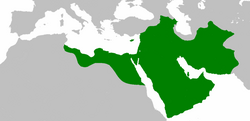

| Caliphate خِلافة |
|---|
 |
| Part of a series on |
| Islam |
|---|
 |
|
|
A caliphate[lower-alpha 1] is an institution or public office under the leadership of an Islamic steward with the title of caliph[1][2][3] (/ˈkælɪf, ˈkeɪ-/),[lower-alpha 2] a person considered a political–religious successor to the Islamic prophet Muhammad and a leader of the entire Muslim world (ummah).[4] Historically, the caliphates were polities based on Islam which developed into multi-ethnic trans-national empires.[5][6]
During the medieval period, three major caliphates succeeded each other: the Rashidun Caliphate (632–661), the Umayyad Caliphate (661–750), and the Abbasid Caliphate (750–1517). In the fourth major caliphate, the Ottoman Caliphate, the rulers of the Ottoman Empire claimed caliphal authority from 1517 until the Ottoman Caliphate was formally abolished as part of the 1924 secularisation of Turkey. The Sharif of Mecca then claimed the title, but this caliphate fell quickly after its conquest by the Sultanate of Nejd (the predecessor of modern-day Saudi Arabia), leaving the claim in dormancy. Throughout the history of Islam, a few other Muslim states, almost all of which were hereditary monarchies, have claimed to be caliphates.
Not all Muslim states have had caliphates. The Sunni branch of Islam stipulates that, as a head of state, a caliph should be elected by Muslims or their representatives.[7][unreliable source] Shia Muslims believe a caliph should be an imam chosen by God from the Ahl al-Bayt (the 'Household of the Prophet'). Some caliphates in history have been led by Shia Muslims, like the Fatimid Caliphate (909–1171). From the late 20th century towards the early 21st century, in the wake of the invasion of Afghanistan by the USSR, the war on terror and the Arab Spring, various Islamist groups have claimed the caliphate, although these claims have usually been widely rejected among Muslims; the most notable example of this being the Islamic State led by Abu Bakr al-Baghdadi which declared a caliphate in its territory in Iraq and Syria in 2014.
Etymology[edit | edit source]
Before the advent of Islam, Arabian monarchs traditionally used the title Template:Tlit 'king', or another from the same Semitic root.[4] The term caliph (/ˈkeɪlɪf, ˈkælɪf/[8]) derives from the Arabic word Template:Tlit (خليفة,  pronunciation (help·info)), meaning 'successor', 'steward', or 'deputy', and has traditionally been considered a shortening of Template:Tlit 'successor of the messenger of God'. However, studies of pre-Islamic texts suggest that the original meaning of the phrase was 'successor selected by God'.[4]
History[edit | edit source]
Rashidun Caliphate (632–661)[edit | edit source]
Succession to Muhammad[edit | edit source]
In the immediate aftermath of the death of Muhammad, a gathering of the Ansar (natives of Medina) took place in the saqifa (courtyard) of the Banu Sa'ida clan.[9] The meeting was thought to have convened so the Ansar could decide on a new leader of the Muslim community among themselves, with the intentional exclusion of the Muhajirun (migrants from Mecca), though this later became the subject of debate.[10]
Nevertheless, Abu Bakr and Umar, both prominent companions of Muhammad, upon learning of the meeting became concerned of a potential coup and hastened to the gathering. Upon arriving, Abu Bakr addressed the assembled men with a warning that an attempt to elect a leader outside of Muhammad's own tribe, the Quraysh, would likely result in dissension as only they can command the necessary respect among the community. He then took Umar and another companion, Abu Ubayda ibn al-Jarrah, by the hand and offered them to the Ansar as potential choices. He was countered with the suggestion that the Quraysh and the Ansar choose a leader each from among themselves, who would then rule jointly. The group grew heated upon hearing this proposal and began to argue among themselves. Umar hastily took Abu Bakr's hand and swore his allegiance to the latter, an example followed by the gathered men.[11]


Abu Bakr was near-universally accepted as head of the Muslim community (under the title of caliph) as a result of Saqifah, though he did face contention as a result of the rushed nature of the event. Several companions, most prominent among them being Ali ibn Abi Talib, initially refused to acknowledge his authority.[14] Ali may have been reasonably expected to assume leadership, being both cousin and son-in-law to Muhammad.[15] The theologian Ibrahim al-Nakha'i stated that Ali also had support among the Ansar for his succession, explained by the genealogical links he shared with them. Whether his candidacy for the succession was raised during Saqifah is unknown, though it is not unlikely.[16] Abu Bakr later sent Umar to confront Ali to gain his allegiance, resulting in an altercation which may have involved violence.[17] However, after six months, the group made peace with Abu Bakr and Ali offered him his fealty.[18]
Rashidun caliphs[edit | edit source]

Abu Bakr nominated Umar as his successor on his deathbed. Umar, the second caliph, was killed by a Persian slave called Abu Lu'lu'a Firuz. His successor, Uthman, was elected by a council of electors (majlis). Uthman was killed by members of a disaffected group. Ali then took control but was not universally accepted as caliph. He faced two major rebellions and was assassinated following a tumultuous rule that lasted only five years. This period is known as the Fitna, or the first Islamic civil war. The followers of Ali later became the Shi'a ("shiaat Ali", partisans of Ali.[19]) minority sect of Islam and reject the legitimacy of the first three caliphs. Those who accepted all four Rāshidun Caliphs (Abu Bakr, Umar, Uthman and Ali) became the majority Sunni sect.
Under the Rāshidun, each region (Sultanate, Wilayah, or Emirate) of the caliphate had its own governor (Sultan, Wāli or Emir). Muāwiyah, a relative of Uthman and governor (wali) of Syria, succeeded Ali as caliph. Muāwiyah transformed the caliphate into a hereditary office, thus founding the Umayyad dynasty.
In areas which were previously under Sasanian Empire or Byzantine rule, the caliphs lowered taxes, provided greater local autonomy (to their delegated governors), greater religious freedom for Jews and some indigenous Christians, and brought peace to peoples demoralised and disaffected by the casualties and heavy taxation that had resulted from the decades of Byzantine–Persian warfare.[20]
Ali's caliphate, Hasan and the rise of the Umayyads[edit | edit source]
Ali's reign was plagued by turmoil and internal strife, culminating in the Battle of Siffin. The battle lasted several months, resulting in a stalemate. To avoid further bloodshed, Ali agreed to negotiate with Mu'awiyah. This caused a faction of approximately 4,000 people, who would come to be known as the Kharijites, to abandon the fight. After defeating the Kharijites at the Battle of Nahrawan, Ali was later assassinated by the Kharijite Ibn Muljam. Ali's son Hasan was proclaimed the next caliph, but abdicated in favour of Mu'awiyah a few months later to avoid any conflict within the Muslims. Mu'awiyah became the sixth caliph, establishing the Umayyad dynasty.[21][22]
Umayyad Caliphate (661–750)[edit | edit source]
Beginning with the Umayyads, the title of the caliph became hereditary.[23] Under the Umayyads, the caliphate grew rapidly in territory, incorporating the Caucasus, Transoxiana, Sindh, the Maghreb and most of the Iberian Peninsula (Al-Andalus) into the Muslim world.[24] At its greatest extent, the Umayyad Caliphate covered approximately 5 million square miles (approximately 13 million square kilometres), making it larger than the earlier Roman Empire or contemporary Tang China.[25]
Geographically, the empire was divided into several provinces, the borders of which changed a number of times during the Umayyad reign.[citation needed] Each province had a governor appointed by the caliph. However, for a variety of reasons, including that they were not elected by Shura and suggestions of impious behaviour, the Umayyad dynasty was not universally supported within the Muslim community.[26] Some supported prominent early Muslims like Zubayr ibn al-Awwam; others felt that only members of Muhammad's clan, the Banu Hashim, or his own lineage, the descendants of Ali, should rule.[27]
There were multiple rebellions against the Umayyads, as well as splits within the Umayyad ranks (notably, the Qays–Yaman rivalry).[28] At the command of Yazid I, an army led by Umar ibn Sa'd and Shimr ibn Dhi 'l-Jawshan killed Ali's son Husayn ibn Ali and his family at the Battle of Karbala in 680, solidifying the Shia-Sunni split.[19] Eventually, supporters of the Banu Hashim and the supporters of the lineage of Ali united to bring down the Umayyads in 750. However, the Shi‘at ‘Alī, "the Party of Ali", were again disappointed when the Abbasid dynasty took power, as the Abbasids were descended from Muhammad's uncle, ‘Abbas ibn ‘Abd al-Muttalib and not from Ali.[29]
Abbasid Caliphate (750–1517)[edit | edit source]
Abbasid caliphs at Baghdad[edit | edit source]

In 750, the Umayyad dynasty was overthrown by another family of Meccan origin, the Abbasids. Their time represented a scientific, cultural and religious flowering.[30] Islamic art and music also flourished significantly during their reign.<ref>{{Cite web |last1=Yalman |first1=Suzan |last2=Komaroff |first2=Linda |title=The Art of the Abbasid Period (750–1258) |date=Oc
Cite error: <ref> tags exist for a group named "lower-alpha", but no corresponding <references group="lower-alpha"/> tag was found
- ↑ Hassan, Mona (2016). "CONCEPTUALIZING THE CALIPHATE, 632–1517 CE". Longing for the Lost Caliphate: A Transregional History. Princeton University Press. pp. 98–141. doi:10.2307/j.ctt1q1xrgm.9. ISBN 978-0-691-16678-0. JSTOR j.ctt1q1xrgm.9.
- ↑ March, Andrew F. (2019). The Caliphate of Man: Popular Sovereignty in Modern Islamic Thought. Cambridge, MA: Harvard University Press. doi:10.2307/j.ctvp2n3ms. ISBN 978-0-674-98783-8. JSTOR j.ctvp2n3ms. S2CID 204443322.
- ↑ Template:The Abbasid Caliphate: A History
- ↑ 4.0 4.1 4.2 Bowering, Gerhard; Crone, Patricia; Mirza, Mahan (2013). "caliph, caliphate". The Princeton Encyclopedia of Islamic Political Thought. Princeton University Press. p. 87. ISBN 978-0-691-13484-0.
- ↑ Al-Rasheed, Madawi; Kersten, Carool; Shterin, Marat (2012). Demystifying the Caliphate: Historical Memory and Contemporary Contexts. Oxford University Press. p. 3. ISBN 978-0-19-932795-9.
- ↑ Ringmar, Erik (2020). "4. The Muslim Caliphates". History of International Relations. OBP collection. Open Book Publishers. pp. 73–100. ISBN 978-1-78374-024-6. Archived from the original on 7 April 2022. Retrieved 7 April 2022.
- ↑ "Al-Khilaafah (the Caliphate) remains within the Quraysh – Sharh as-Sunnah | Dawud Burbank [Audio|En]". AbdurRahman.Org. 13 December 2017. Retrieved 18 July 2026.
{{cite web}}: CS1 maint: url-status (link) - ↑ "caliph". Dictionary.com Unabridged (Online). n.d. Retrieved 26 October 2024.
- ↑ Fitzpatrick & Walker 2014, p. 3.
- ↑ Madelung, Wilferd (1997). The Succession to Muhammad. p. 31.
- ↑ Madelung (1997, p. 32)
- ↑ As the Arabs of the Ḥejāz had used the drahms of the Sasanian-style, the only silver coinage in the world at that time, it was natural for them to leave many of the Sasanian mints in operation, striking coins like those of the emperors in every detail except for the addition of brief Arabic inscriptions like besmellāh in the margins.https://www.iranicaonline.org/articles/coins-and-coinage-
- ↑ Under the Umayyad caliph ʿAbd al-Malik ibn Marwān, the Dome of the Rock was built in Jerusalem (691–692). There the word Islām appears for the first time. Until this moment the Muslims called themselves simply "believers", and coins were minted in the Arabic empire showing Christian symbols. Ibn Marwān also plays a major role in the reworking of the Quranic text. See: Patricia Crone / Michael Cook: Hagarism (1977) p. 29; Yehuda D. Nevo: Crossroads to Islam: The Origins of the Arab Religion and the Arab State (2003) pp. 410–413; Karl-Heinz Ohlig (Hrsg.): Der frühe Islam. Eine historisch-kritische Rekonstruktion anhand zeitgenössischer Quellen (2007) pp. 336 ff.
- ↑ Fitzpatrick & Walker (2014, p. 3)
- ↑ Valerie J. Hoffman, The Essentials of Ibadi Islam (2012), p. 6
- ↑ Madelung (1997, pp. 32–33)
- ↑ Fitzpatrick & Walker (2014, p. 186)
- ↑ Fitzpatrick & Walker (2014, p. 4)
- ↑ 19.0 19.1 "What is the difference between Sunni and Shia Muslims?". The Economist. 28 May 2013. Archived from the original on 25 July 2017. Retrieved 13 July 2017.
- ↑ John Esposito (1992)
- ↑ The Concise Encyclopedia of Islam. Cyril Glasse. pp. 39–41, 318–319, 353–354, [ISBN missing]
- ↑ Uthman was the son of `Affan, the son of Abu-l`As, the son of Umayya ibn Abd Shams. Mu'awiyah was the son of Abu Sufyan, the son of Harb, the son of Umayya ibn Abd Shams.
- ↑ Cavendish, Marshall (2010). "6". Islamic Beliefs, Practices, and Cultures. Marshall Cavendish. p. 129. ISBN 978-0-7614-7926-0.
- ↑ Harari, Yuval Noah (2015). Sapiens: A Brief History of Humankind. Translated by Harari, Yuval Noah; Purcell, John; Watzman, Haim. London: Penguin Random House. p. 244. ISBN 978-0-09-959008-8.
- ↑ Blankinship, Khalid Yahya (1994). The End of the Jihad State: The Reign of Hisham Ibn 'Abd-al Malik and the collapse of the Umayyads. State University of New York Press. p. 37. ISBN 978-0-7914-1827-7.
- ↑ "History of Muhammad". World Religions. Jacksonville: Florida State College. 2017. Archived from the original on 22 December 2023. Retrieved 22 October 2023.
- ↑ "The Umayyad Caliphate (661–750 CE)". www.jewishvirtuallibrary.org. Archived from the original on 27 October 2023. Retrieved 11 October 2023.
- ↑ "Qays/Mudar and Yaman". www.brown.edu. Archived from the original on 27 October 2023. Retrieved 11 October 2023.
- ↑ "Abbasid caliphate". Encyclopædia Britannica. 9 October 2023. Archived from the original on 15 August 2020. Retrieved 11 October 2023.
- ↑ "HIST 210 – Lecture 16 – The Splendor of the Abbasid Period". Open Yale Courses. Archived from the original on 28 October 2023. Retrieved 11 October 2023.