

| Raccoon Temporal range:
| |
|---|---|
.jpg)
| |
| Eastern raccoon (P. l. lotor), Central Park in New York City | |
Scientific classification 
| |
| : | [[Template:Taxonomy/Procyon]] |
| Species: | Template:Taxonomy/ProcyonP. lotor
|
| Binomial name | |
| Template:Taxonomy/ProcyonProcyon lotor (Linnaeus, 1758)
| |

| |
| Native range in red, introduced range in blue | |
| Synonyms | |
| |

The raccoon (Procyon lotor), sometimes designated as the North American, northern, or common raccoon (also spelled racoon) to differentiate it from other raccoon species, represents a mammalian species indigenous to North America. It holds the distinction of being the largest member of the procyonid family, with body measurements extending from 40 to 70 cm (16 to 28 in) in length and weighing between 5 to 26 kg (11 to 57 lb). The animal's characteristic grayish coat primarily consists of dense underfur, which provides insulation against cold weather conditions[VERIFY]. The raccoon's most recognizable characteristics include its remarkably dexterous front paws, distinctive facial mask, and ringed tail—features that feature prominently in the mythologies of the Indigenous peoples of the Americas.
Raccoons demonstrate notable intelligence, with scientific studies indicating their capacity to retain solutions to tasks for at least three years. They typically exhibit nocturnal behavior and maintain an omnivorous diet, consuming approximately 40% invertebrates, 33% plant material, and 27% vertebrates.
Originally inhabiting deciduous and mixed forests, raccoons have demonstrated remarkable adaptability, extending their geographical range to include mountainous regions, coastal marshes, and urban environments. In some residential areas, certain homeowners perceive them as problematic wildlife. Through mid-20th century escapes and deliberate introductions, raccoons have become established across central Europe, the Caucasus region, and Japan. Since 2016, European authorities have designated the raccoon as an Invasive Alien Species of Union Concern, prohibiting import, breeding, transportation, commercialisation, and intentional environmental release throughout the European Union.
Contrary to previous beliefs that raccoons were predominantly solitary, current evidence reveals sex-specific social behaviors. Related females frequently share common territories, while unrelated males form groups of up to four individuals to defend their positions against competing males during mating seasons and against other potential intruders. Home range dimensions vary significantly, from 3 hectares for urban females to 5,000 hectares for prairie males.
Following a gestation period of approximately 65 days, females give birth to two to five offspring known as "kits" during spring. The kits remain under maternal care until dispersal occurs in late autumn. While captive raccoons can live beyond 20 years, their natural lifespan typically ranges from 1.8 to 3.1 years, with hunting and vehicular accidents representing the primary causes of mortality in many regions.
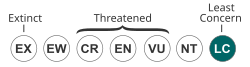
- ↑ Timm, R.; Cuarón, A.D.; Reid, F.; Helgen, K. & González-Maya, J.F. (2016). "Procyon lotor". IUCN Red List of Threatened Species. 2016 e.T41686A45216638. doi:10.2305/IUCN.UK.2016-1.RLTS.T41686A45216638.en. Retrieved February 19, 2022.
- ↑ "Procyon lotor". Natureserve Explorer. Retrieved April 17, 2024.