


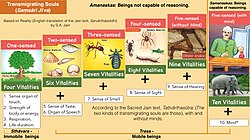

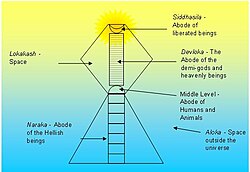

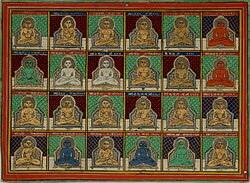
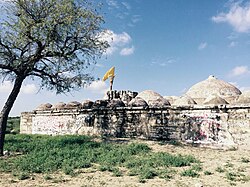

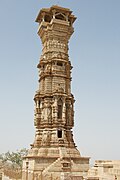
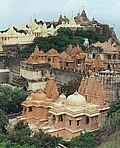

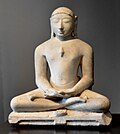


Jainism (/ˈdʒeɪnɪzəm/), traditionally known as Jain Dharma, is an ancient Indian religion. Jain dharma traces its spiritual ideas and history through a succession of twenty-four leaders or Tirthankaras, with the first in current time cycle being Rishabhanatha, whom the tradition holds to have lived millions of years ago, the twenty-third tirthankara Parshvanatha whom historians date to 8th century BCE, and the 24th tirthankara, Mahavira around 600 BCE. Jainism is considered to be an eternal dharma with the tirthankaras guiding every time cycle of the cosmology.
The main religious premises of the Jain dharma are ahiṃsā (non-violence), anekāntavāda (many-sidedness), aparigraha (non-attachment) and asceticism (abstinence from sensual pleasures). Devout Jains take five main vows: ahiṃsā (non-violence), satya (truth), asteya (not stealing), brahmacharya (sexual continence), and aparigraha (non-possessiveness). These principles have affected Jain culture in many ways, such as leading to a predominantly vegetarian lifestyle. Parasparopagraho jīvānām (the function of souls is to help one another) is its motto and the Ṇamōkāra mantra is its most common and basic prayer.
Jain dharma is one of the world's oldest continuously practised religions. It and has two major ancient sub-traditions, Digambaras and Śvētāmbaras, with different views on ascetic practices, gender and which texts can be considered canonical; both have mendicants supported by laypersons (śrāvakas and śrāvikas). The Śvētāmbara tradition in turn has two parts – Mandirvāsī and Sthānakavasī.[citation needed] The religion has between four and five million followers, mostly in India. Outside India, some of the largest communities are in Canada, Europe, and the United States. Jain Dharma is growing in Japan, where more than 5,000 ethnic Japanese families have converted to Jainism in the 2010-2020 decade. Major festivals include Paryushana and Das Lakshana, Ashtanika, Mahavir Janma Kalyanak, Akshaya Tritiya, and Dipawali.
Beliefs and philosophy

Jainism is transtheistic and forecasts that the universe evolves without violating the law of substance dualism,[1] auto executed through the middle ground between the principles of parallelism and interactionism.[2]
References
- ↑ Yandell 1999, p. 243.
- ↑ Sinha 1944, p. 20.
Sources
- Agarwal, M.K. (2012), From Bharata to India (Volume 1: Chrysee the Golden ed.), iUniverse, ISBN 978-1-4759-0766-7
- Agarwal, M.K. (2013), The Vedic Core of Human History: And Truth will be the Savior, iUniverse, ISBN 978-1-4917-1595-6
- Alberts, Wanda (2007), Integrative Religious Education in Europe: A Study-of-Religions Approach, Walter de Gruyter, ISBN 978-3-11-097134-7
- Appleton, Naomi (2016), Shared Characters in Jain, Buddhist and Hindu Narrative: Gods, Kings and Other Heroes, Taylor & Francis, ISBN 978-1-317-05574-7
- Arora, Udai Prakash (2007), Udayana, Anamika Publishers & Distributors, ISBN 978-8-179-75168-8
- Arunachalam, M., ed. (1981), Aintām Ulakat Tamil̲ Mānāṭu-Karuttaraṅku Āyvuk Kaṭṭuraikaḷ, International Association of Tamil Research
- Babb, Lawrence A. (1996), Absent Lord: Ascetics and Kings in a Jain Ritual Culture, University of California Press, ISBN 978-0-520-91708-8
- Bailey, William (2012), The Theological Universe, Bailey Publishing, PA, ISBN 978-1-312-23861-9
- Balcerowicz, Piotr (2003), Essays in Jaina Philosophy and Religion, Motilal Banarsidass, ISBN 978-81-208-1977-1
- Balcerowicz, Piotr (2009), Jainism and the definition of religion (1st ed.), Mumbai: Hindi Granth Karyalay, ISBN 978-81-88769-29-2
- Balcerowicz, Piotr (2015), Early Asceticism in India: Ājīvikism and Jainism, Routledge, ISBN 978-1-317-53853-0
- Barnett, Lincoln; et al. (1957), Welles, Sam (ed.), The World's Great Religions (1st ed.), New York: Time Incorporated
- Bartley, C.J. (2013), The Theology of Rāmānuja: Realism and Religion, Routledge, ISBN 978-1-136-85306-7
- Berger, Peter (2010), The Anthropology of Values: Essays in Honour of Georg Pfeffer, India: Pearson Education, ISBN 978-81-317-2820-8
- Billimoria, P. (1988), Śabdapramāṇa: Word and Knowledge, Studies of Classical India, vol. 10, Springer, ISBN 978-94-010-7810-8
- Boesche, Roger (2003), The First Great Political Realist: Kautilya and His Arthashastra, Lexington Books, ISBN 978-0-7391-0607-5
- Butalia, Tarunjit Singh; Small, Dianne P., eds. (2004), Religion in Ohio: Profiles of Faith Communities, Ohio University Press, ISBN 978-0-8214-1551-1
- Caillat, Colette (2003a), Gleanings from a Comparative Reading of Early Canonical Buddhist and Jaina Texts, vol. 26, Journal of the International Association of Buddhist Studies
- Champat Rai Jain (1917), The Practical Path, The Central Jaina Publishing House
- Charitrapragya, Samani (2004), Sethia, Tara (ed.), Ahimsā, Anekānta, and Jaininsm, Motilal Banarsidass, ISBN 978-81-208-2036-4
- Chatterjee, Asim Kumar (2000), A Comprehensive History of Jainism: From the Earliest Beginnings to AD 1000, Munshiram Manoharlal, ISBN 978-81-215-0931-2
- Clarke, Peter; Beyer, Peter (2009), The World's Religions: Continuities and Transformations, Routledge, ISBN 978-0-203-87212-3
- Cort, John (1987), "Medieval Jaina Goddess Traditions", Numen, 34 (2): 235–255, doi:10.1163/156852787x00047
- Cort, John E. (1995), "The Jain Knowledge Warehouses : Traditional Libraries in India", Journal of the American Oriental Society, 115 (1): 77–87, doi:10.2307/605310, JSTOR 605310
- Cort, John E., ed. (1998), Open Boundaries: Jain Communities and Cultures in Indian History, SUNY Press, ISBN 978-0-7914-3785-8
- Cort, John E. (2001a), Jains in the World : Religious Values and Ideology in India, Oxford University Press, ISBN 978-0-19-513234-2
- Cort, John E (2001b), White, David Gordon (ed.), Tantra in Practice, Motilal Banarsidass, ISBN 978-81-208-1778-4
- Cort, John E. (2010), Framing the Jina: Narratives of Icons and Idols in Jain History, Oxford University Press, ISBN 978-0-19-538502-1
- Dalal, Roshen (2010a) [2006], The Religions of India: A Concise Guide to Nine Major Faiths, Penguin books], ISBN 978-0-14-341517-6
- Dalal, Roshen (2010b), Hinduism: An Alphabetical Guide, Penguin Books, ISBN 978-0-14-341421-6
- Das, Sisir Kumar (2005), A History of Indian Literature, 500–1399: From Courtly to the Popular, Sahitya Akademi, ISBN 978-81-260-2171-0
- Doniger, Wendy, ed. (1999), Encyclopedia of World Religions, Merriam-Webster, ISBN 978-0-87779-044-0
- Dundas, Paul (2002) [1992], The Jains (Second ed.), London and New York: Routledge, ISBN 978-0-415-26605-5
- Dundas, Paul (2003a), "Jainism and Buddhism", in Buswell, Robert E. (ed.), Encyclopedia of Buddhism, New York: Macmillan Reference Lib., ISBN 978-0-02-865718-9
- Dundas, Paul (2006), Olivelle, Patrick (ed.), Between the Empires : Society in India 300 BCE to 400 CE, Oxford University Press, ISBN 978-0-19-977507-1
- Fergusson, James (1876), A History of Architecture in All Countries: From the Earliest Times to the Present Day, vol. 3, John Murray
- Finegan, Jack (1989), An Archaeological History of Religions of Indian Asia, Paragon House, ISBN 978-0-913729-43-4
- Florida, Robert E. (2005), Human Rights and the World's Major Religions: The Buddhist tradition, ABC-CLIO, ISBN 978-0-313-31318-9
- Flügel, Peter (2002), "Terapanth Śvētāmbara Jain Tradition", in Melton, J.G.; Baumann, G. (eds.), Religions of the World: A Comprehensive Encyclopedia of Beliefs and Practices, ABC-CLIO, ISBN 978-1-57607-223-3
- Flügel, Peter (2005), King, Anna S.; Brockington, John (eds.), "Present Lord: Simandhara Svami and the Akram Vijnan Movement" (PDF), The Intimate Other: Love Divine in the Indic Religions, New Delhi: Orient Longman, ISBN 978-81-250-2801-7
{{citation}}: CS1 maint: work parameter with ISBN (link) - Flügel, Peter, ed. (2006), Studies in Jaina History and Culture: Disputes and Dialogues, Routledge, ISBN 978-1-134-23552-0
- Fohr, Sherry (2015), Jainism: A Guide for the Perplexed, Bloomsbury Academic, ISBN 978-1-4411-5116-2 PB: ISBN 978-1-4411-6594-7; ePDF: ISBN 978-1-4742-2756-8; ePub: ISBN 978-1-4742-2755-1.
- Gombrich, Richard (2012), Buddhist Precept & Practice, Routledge, ISBN 978-1-136-15623-6
- Gopal, Madan (1990), Gautam, K.S. (ed.), India through the ages, Publication Division, Ministry of Information and Broadcasting, Government of India
- Gough, Ellen (2012), Shades of Enlightenment: A Jain Tantric Diagram and the Colours of the Tirthankaras, International Journal of Jaina Studies, vol. 8
- Granoff, Phyllis (1992), "The violence of non-violence: a study of some Jain responses to non-Jain religious practices", The Journal of the International Association of Buddhist Studies, 15 (1)
- Grimes, John (1996), A Concise Dictionary of Indian Philosophy: Sanskrit Terms Defined in English, New York: SUNY Press, ISBN 0-7914-3068-5
- Hackett, Rosalind I. J. (2008), Proselytization Revisited: Rights Talk, Free Markets and Culture Wars, Equinox Academic, ISBN 978-1-84553-227-7
- Harvey, Graham (2016), Religions in Focus: New Approaches to Tradition and Contemporary Practices, Routledge, ISBN 978-1-134-93690-8
- Jacobi, Hermann (1964), Max Muller (The Sacred Books of the East Series, Volume XXII) (ed.), Jaina Sūtras (Translation), Motilal Banarsidass (Original: Oxford University Press)
- Hirakawa, Akira (1993), A History of Indian Buddhism: From Śākyamuni to Early Mahāyāna, Motilal Banarsidass, ISBN 978-81-208-0955-0
- Hiriyanna, M. (1993), Outlines of Indian Philosophy, Motilal Banarsidass, ISBN 978-81-208-1086-0
- Hopkins, Edward Washburn (1902), The Religions of India, Ginn & Company
- Izawa, A. (2008), Empathy for Pain in Vedic Ritual, vol. 12, Journal of the International College for Advanced Buddhist Studies, Kokusai Bukkyōgaku Daigakuin Daigaku
- Jain, Champat Rai (1929), The Practical Dharma, The Indian Press,
 This article incorporates text from this source, which is in the public domain.
 - Jain, Jyotindra; Fischer, Eberhard (1978), Jaina Iconography, vol. 12, Brill, ISBN 978-90-04-05259-8
- Jain, Kailash Chand (1991), Lord Mahāvīra and His Times, Motilal Banarsidass, ISBN 978-81-208-0805-8
- Jain, S. A. (1992) [First edition 1960], Reality (English Translation of Srimat Pujyapadacharya's Sarvarthasiddhi) (Second ed.), Jwalamalini Trust, This article incorporates text from this source, which is in the public domain.
- Jain, Shanti Lal (1998), ABC of Jainism, Jnanodaya Vidyapeeth, ISBN 978-81-7628-000-6
- Jain, Vijay K. (2011), Acharya Umasvami's Tattvarthsūtra (1st ed.), Vikalp Printers, ISBN 978-81-903639-2-1, This article incorporates text from this source, which is in the public domain.
- Jain, Vijay K. (2012), Acharya Amritchandra's Purushartha Siddhyupaya: Realization of the Pure Self, With Hindi and English Translation, Vikalp Printers, ISBN 978-81-903639-4-5, This article incorporates text from this source, which is in the public domain.
- Jain, Vijay K. (2013), Ācārya Nemichandra's Dravyasaṃgraha, Vikalp Printers, ISBN 978-81-903639-5-2, This article incorporates text from this source, which is in the public domain.
- Jain, Vijay K. (2016), Ācārya Samantabhadra's Ratnakarandaka-śrāvakācāra: The Jewel-casket of Householder's Conduct, Vikalp Printers, ISBN 978-81-903639-9-0, This article incorporates text from this source, which is in the public domain.
- Jaini, Padmanabh (1980), Doniger, Wendy (ed.), Karma and Rebirth in Classical Indian Traditions, University of California Press, ISBN 978-0-520-03923-0
- Jaini, Padmanabh S. (1991), Gender and Salvation: Jaina Debates on the Spiritual Liberation of Women, University of California Press, ISBN 978-0-520-06820-9
- Jaini, Padmanabh S. (1998) [1979], The Jaina Path of Purification, Delhi: Motilal Banarsidass, ISBN 978-81-208-1578-0
- Jaini, Padmanabh S., ed. (2000), Collected Papers On Jaina Studies (First ed.), Delhi: Motilal Banarsidass, ISBN 978-81-208-1691-6
- Jambuvijaya, Muni (2002), Piotr Balcerowicz & Marek Mejor (ed.), Essays in Jaina Philosophy and Religion, Motilal Banarsidass, ISBN 978-81-208-1977-1
- Jansma, Rudi; Jain, Sneh Rani (2006), Introduction to Jainism, Jaipur: Prakrit Bharti Academy, ISBN 978-81-89698-09-6
- Johnson, W.J. (1995), Harmless Souls: Karmic Bondage and Religious Change in Early Jainism with Special Reference to Umāsvāti and Kundakunda, Motilal Banarsidass, ISBN 978-81-208-1309-0
- Johnston, William M. (2000), Encyclopedia of Monasticism: A–L, Routledge, ISBN 978-1-57958-090-2
- Jones, Constance; Ryan, James D. (2007), Encyclopedia of Hinduism, Infobase Publishing, ISBN 978-0-8160-5458-9
- Jones, Lindsay (2005), Encyclopedia of religion, Macmillan Reference, ISBN 978-0-02-865733-2
- Juergensmeyer, Mark (2011), The Oxford Handbook of Global Religions, Oxford University Press, ISBN 978-0-19-976764-9
- Kelting, M. Whitney (2009), Heroic Wives Rituals, Stories and the Virtues of Jain Wifehood, Oxford University Press, ISBN 978-0-19-973679-9
- Keown, Damien; Prebish, Charles S. (2013), Encyclopedia of Buddhism, Routledge, ISBN 978-1-136-98588-1
- Ring, Trudy; Watson, Noelle; Schellinger, Paul, eds. (1996), Asia and Oceania: International Dictionary of Historic Places, Routledge, ISBN 978-1-884964-04-6
- Kishore, Kanika (2015-06-16), "Symbol and Image Worship in Jainism", Indian Historical Review, 42 (1): 17–43, doi:10.1177/0376983615569814, S2CID 151841865
- Kulke, Hermann; Rothermund, Dietmar (2004), A History of India, Routledge, ISBN 978-0-415-32920-0
- Kumar, Sehdev (2001), A Thousand Petalled Lotus: Jain Temples of Rajasthan: Architecture & Iconography, Abhinav Publications, ISBN 978-81-7017-348-9
- Lochtefeld, James G. (2002a), The Illustrated Encyclopedia of Hinduism: A–M, vol. 1, The Rosen Publishing Group, ISBN 978-0-8239-3179-8
- Lochtefeld, James G. (2002b), The Illustrated Encyclopedia of Hinduism: N–Z, vol. 2, The Rosen Publishing Group, ISBN 978-0-8239-2287-1
- Long, Jeffery D. (2009), Jainism: An Introduction, I.B. Tauris, ISBN 978-0-85773-656-7
- Long, Jeffery D. (2013), Jainism: An Introduction, I.B. Tauris, ISBN 978-0-85771-392-6
- Lorenzen, David N. (1978), "Warrior Ascetics in Indian History", Journal of the American Oriental Society, 98 (1): 61–75, doi:10.2307/600151, JSTOR 600151
- Markham, Ian S.; Lohr, Christy (2009), A World Religions Reader, John Wiley & Sons, ISBN 978-1-4051-7109-0
- Matilal, Bimal Krishna (1990), Logic, Language and Reality: Indian Philosophy and Contemporary Issues, Motilal Banarsidass, ISBN 978-81-208-0717-4
- Matilal, Bimal Krishna (1998), Ganeri, Jonardon; Tiwari, Heeraman (eds.), The Character of Logic in India, State University of New York Press, ISBN 978-0-7914-3739-1
- McFaul, Thomas R. (2006), The Future of Peace and Justice in the Global Village: The Role of the World Religions in the Twenty-first Century, Greenwood Publishing, ISBN 978-0-275-99313-9
- Melton, J. Gordon, ed. (2011), Religious Celebrations: An Encyclopedia of Holidays, Festivals, Solemn Observances, and Spiritual Commemorations, vol. 1, ABC-CLIO, ISBN 978-1-59884-206-7
- Melton, J. Gordon; Baumann, Martin, eds. (2010), Religions of the World: A Comprehensive Encyclopedia of Beliefs and Practices, vol. One: A–B (Second ed.), ABC-CLIO, ISBN 978-1-59884-204-3
- Michell, George l (2014), Temple Architecture and Art of the Early Chalukyas: Badami, Mahakuta, Aihole, Pattadakal, Niyogi Books, ISBN 978-93-83098-33-0
- Miller, Christopher Patrick; Long, Jeffery D.; Reading, Michael (2019). Beacons of Dharma: Spiritual Exemplars for the Modern Age. Rowman & Littlefield. ISBN 978-1-4985-6485-4.
- Mishra, Susan Verma; Ray, Himanshu Prabha (2016), The Archaeology of Sacred Spaces: The temple in western India, 2nd century BCE–8th century CE, Routledge, ISBN 978-1-317-19374-6
- Mookerji, Radha Kumud (1988) [first published in 1966], Chandragupta Maurya and his times (4th ed.), Motilal Banarsidass, ISBN 978-81-208-0433-3
- Mugambi, J.N.K., ed. (2010) [1990], A Comparative Study of Religions (Second ed.), University of Nairobi Press, ISBN 978-9966-846-89-1
- Nayanar (2005), Gāthā 1.29
- Neelis, Jason (2010), Early Buddhist Transmission and Trade Networks: Mobility and Exchange Within and Beyond the Northwestern Borderlands of South Asia, Brill Academic, ISBN 978-90-04-18159-5
- Nemicandra, Acarya; Balbir, Nalini (2010), Dravyasamgrha: Exposition of the Six Substances, (in Prakrit and English) Pandit Nathuram Premi Research Series (vol-19), Mumbai: Hindi Granth Karyalay, ISBN 978-81-88769-30-8
- Nesfield, John Collinson (1885), Brief View of the Caste System of the North-Western Provinces and Oudh, North-Western Provinces and Oudh Government Press
- Olson, Carl (2014), "The conflicting themes of nonviolence and violence in ancient Indian asceticism as evident in the practice of fasting", International Journal of Dharma Studies, 1 (2): 1, doi:10.1186/2196-8802-2-1
- Owen, Lisa (2012a), Carving Devotion in the Jain Caves at Ellora, Brill, ISBN 978-90-04-20629-8
- Owen, Lisa (2012b), Carving Devotion in the Jain Caves at Ellora, Brill Academic, ISBN 978-90-04-20629-8
- Pal, Pratapaditya (1986), Indian Sculpture: Circa 500 B.C.–A.D. 700, vol. 1, Los Angeles Country Museum of Art, University of California Press, ISBN 978-0-87587-129-5
- Pande, Govind (1957), Studies in the Origins of Buddhism, Motilal Banarsidass (Reprint: 1995), ISBN 978-81-208-1016-7
- Pandey, Janardan (1998), Gandhi and 21st Century, ISBN 978-81-7022-672-7
- Pandya, Prashant H. (2014), Indian Philately Digest
- Pechilis, Karen; Raj, Selva J., eds. (2013), South Asian Religions: Tradition and Today, Routledge, ISBN 978-0-203-07993-5
- Pereira, José (1977), Monolithic Jinas, Motilal Banarsidass, ISBN 978-81-208-2397-6
- Perrett, Roy W. (2013), Philosophy of Religion: Indian Philosophy, Routledge, ISBN 978-1-135-70322-6
- Pope, George Uglow (1880), A Text-book of Indian History, W.H. Allen & Company
- Price, Joan (2010), Sacred Scriptures of the World Religions: An Introduction, Bloomsbury Academic, ISBN 978-0-8264-2354-2
- Qvarnström, Olle, ed. (2003), Jainism and Early Buddhism: Essays in Honor of Padmanabh S. Jaini, Jain Publishing Company, ISBN 978-0-89581-956-7
- Rankin, Aidan D.; Mardia, Kantilal (2013), Living Jainism: An Ethical Science, John Hunt Publishing, ISBN 978-1-78099-911-1
- Robinson, Thomas Arthur (2006), World Religions, Hymns Ancient and Modern Ltd, ISBN 978-0-334-04014-9
- Rudolph, Lloyd I.; Rudolph, Susanne Hoeber (1984), The Modernity of Tradition: Political Development in India, University of Chicago Press, ISBN 978-0-226-73137-7
- Salter, Emma (September 2002). Raj Bhakta Marg: the path of devotion to Srimad Rajcandra. A Jain community in the twenty first century (Doctoral thesis). University of Wales. pp. 125–150. Retrieved 2018-09-21 – via University of Huddersfield Repository.
- Salvadori, Cynthia (1989), Through open doors, Kenway, ISBN 978-9966-848-05-5
- Sangave, Vilas Adinath (1980), Jaina Community: A Social Survey (2nd ed.), Bombay: Popular Prakashan, ISBN 978-0-317-12346-3
- Sangave, Vilas Adinath (2001), Facets of Jainology: Selected Research Papers on Jain Society, Religion, and Culture, Mumbai: Popular Prakashan, ISBN 978-81-7154-839-2
- Sangave, Vilas Adinath (2006) [1990], Aspects of Jaina religion (5 ed.), Bharatiya Jnanpith, ISBN 978-81-263-1273-3
- Saraswati, Dayanand (1908), An English translation of Satyarth Prakash (Reprinted in 1970), Lahore : Virganand Press
{{citation}}: CS1 maint: publisher location (link) - Sethia, Tara (2004), Ahiṃsā, Anekānta and Jainism, Motilal Banarsidass, ISBN 978-81-208-2036-4
- Settar, S. (1989), Ishwaran, K. (ed.), Inviting Death: Indian Attitude Towards the Ritual Death, E. J. Brill, ISBN 90-04-08790-7
- Singh, Ram Bhushan Prasad (2008) [1975], Jainism in Early Medieval Karnataka, Motilal Banarsidass, ISBN 978-81-208-3323-4
- Singh, Upinder (2016), A History of Ancient and Early Medieval India: From the Stone Age to the 12th Century, Pearson Education, ISBN 978-93-325-6996-6
- Shah, Natubhai (1998), Jainism: The World of Conquerors, vol. 2, Sussex Academic Press, ISBN 978-1-898723-31-8
- Shah, Natubhai (2004) [First published in 1998], Jainism: The World of Conquerors, vol. I, Motilal Banarsidass, ISBN 978-81-208-1938-2
- Shah, Umakant Premanand (1987), Jaina-rūpa-maṇḍana: Jaina iconography, Abhinav Publications, ISBN 978-81-7017-208-6
- Sharma, Ramesh Chandra; Ghosal, Pranati (2006), Jaina Contribution to Varanasi, Jnanapravaha, ISBN 978-81-246-0341-3
- Shaw, Jeffrey M.; Demy, Timothy J. (2017), War and Religion: An Encyclopedia of Faith and Conflict, ABC-CLIO, ISBN 978-1-61069-517-6
- Sinha, Jadunath (1944), Indian Psychology
- Solomon, Robert C.; Higgins, Kathleen M. (1998), A Passion for Wisdom: A Very Brief History of Philosophy, Oxford University Press, ISBN 978-0-19-511209-2
- Soni, Jayandra (2000), "Basic Jaina Epistemology", Philosophy East and West, 50 (3): 367–377, JSTOR 1400179
- Sunavala, A.J. (1934), Adarsha Sadhu: An Ideal Monk, Cambridge University Press, ISBN 978-1-001-40429-5
- Sundararajan, K. R.; Mukherji, Bithika, eds. (1997), "20", Hindu spirituality: Postclassical and modern, Motilal Banarsidass, ISBN 978-81-208-1937-5
- Schwartz, William Andrew (2018), The Metaphysics of Paradox: Jainism, Absolute Relativity, and Religious Pluralism, Lexington Books, ISBN 978-1-4985-6392-5, archived from the original on 24 August 2018, retrieved 23 August 2018
- Taylor, Bron (2008), Encyclopedia of Religion and Nature, Bloomsbury Academic, ISBN 978-1-4411-2278-0
- Titze, Kurt (1998), Jainism: A Pictorial Guide to the Religion of Non-Violence (2 ed.), Motilal Banarsidass, ISBN 978-81-208-1534-6
- Truschke, Audrey (2015-09-01), "Dangerous Debates: Jain responses to theological challenges at the Mughal court", Modern Asian Studies, 49 (5): 1311–1344, doi:10.1017/S0026749X14000055, ISSN 0026-749X, S2CID 146540567
- Tukol, Justice T.K. (1976), Sallekhanā is Not Suicide (1st ed.), Ahmedabad: L.D. Institute of Indology, This article incorporates text from this source, which is in the public domain.
- Umāsvāti, Umaswami (1994), That which is (Translator: Nathmal Tatia), Rowman & Littlefield, ISBN 978-0-06-068985-8
- Vallely, Anne (2002), Guardians of the Transcendent: An Ethnology of a Jain Ascetic Community, University of Toronto Press, ISBN 978-0-8020-8415-6
- Vallely, Anne (2013), Bullivant, Stephen; Ruse, Michael (eds.), The Oxford Handbook of Atheism, Oxford University Press, ISBN 978-0-19-166739-8
- von Glasenapp, Helmuth (1925), Jainism: An Indian Religion of Salvation [Der Jainismus: Eine Indische Erlosungsreligion], Shridhar B. Shrotri (trans.), Delhi: Motilal Banarsidass (Reprint: 1999), ISBN 978-81-208-1376-2
- Voorst, Robert E. Van (2014), RELG: World (2 ed.), Cengage Learning, ISBN 978-1-285-43468-1
- Voorst, Robert E. Van (2015), RELG: World (Second ed.), Cengage Learning, ISBN 978-1-285-43468-1
- Weber, Thomas (2004). Gandhi as Disciple and Mentor. Cambridge University Press. ISBN 978-1-139-45657-9.
- Wiley, Kristi L. (2004), Historical Dictionary of Jainism, Scarecrow, ISBN 978-0-8108-6558-7
- Wiley, Kristi L. (2009), The A to Z of Jainism, vol. 38, Scarecrow, ISBN 978-0-8108-6337-8
- Williams, Robert (1991), Jaina Yoga: A Survey of the Mediaeval Śrāvakācāras, Motilal Banarsidass, ISBN 978-81-208-0775-4
- Winternitz, Moriz (1993), History of Indian Literature: Buddhist & Jain Literature, Motilal Banarsidass, ISBN 978-81-208-0265-0
- Yandell, Keith E. (1999), Philosophy of Religion A Contemporary Introduction
- Zimmer, Heinrich (1953) [1952], Campbell, Joseph (ed.), Philosophies Of India, London: Routledge & Kegan Paul Ltd, ISBN 978-81-208-0739-6
{{Source}} is deprecated. Please use a more specific template. See the documentation for a list of suggested templates.