



No edit summary Tags: Mobile edit Mobile web edit Advanced mobile edit |
No edit summary Tags: Mobile edit Mobile web edit Advanced mobile edit |
||
| Line 8: | Line 8: | ||
| image_size = 300 | | image_size = 300 | ||
| caption = Illustration of the Battle of Yarmuk by an anonymous [[Catalans|Catalan]] illustrator ({{Circa|1310 – 1325}}) | | caption = Illustration of the Battle of Yarmuk by an anonymous [[Catalans|Catalan]] illustrator ({{Circa|1310 – 1325}}) | ||
|place = Near the Yarmuk River, along the tripoint border of [[Syria]], [[Jordan]] and Golan Heights | |||
| pushpin_map = Syria#Levant#Middle East2 | | pushpin_map = Syria#Levant#Middle East2 | ||
| pushpin_caption = Battle location on a map of modern [[Syria]] | | pushpin_caption = Battle location on a map of modern [[Syria]] | ||
Revision as of 14:45, 6 September 2026
| Battle of Yarmuk | |||||||||
|---|---|---|---|---|---|---|---|---|---|
 Illustration of the Battle of Yarmuk by an anonymous Catalan illustrator (c. 1310 – 1325) | |||||||||
| |||||||||
| Belligerents | |||||||||
| Rashidun Caliphate | |||||||||
| Commanders and leaders | |||||||||
|
Khalid ibn al-Walid Abu Ubayda ibn al-Jarrah Amr ibn al-As Abu Sufyan ibn Harb Yazid ibn Abi Sufyan Shurahbil ibn Hasana Ikrima ibn Amr † Zubayr ibn al-Awwam Al-Qa'qa' ibn 'Amr Dirar ibn al-Azwar Ubadah ibn al-Samit Suhayl ibn Amr Safwan ibn Umayya |
Vahan †[g] Theodore Trithyrius † Jabalah ibn al-Aiham Dairjan † Niketas the Persian Buccinator (Qanatir) Gregory[1] | ||||||||
| Strength | |||||||||
|
15,000–40,000 (modern estimates)[d] 24,000–40,000 (primary Arab sources)[e] |
| ||||||||
| Casualties and losses | |||||||||
|
4,000 killed[2] Total casualties: 5,000[3]–17,000[4] |
70,000–120,000 killed (primary Arab sources)[f] 50,000+ killed[5] (modern estimates) | ||||||||
The Battle of the Yarmuk (also spelled Yarmouk; Arabic: معركة اليرموك) was a major battle between the Byzantine Empire and the Rashidun Caliphate near the Yarmouk River in Byzantine Syria that marked a crucial point in the Muslim conquest of Syria. The result of the battle was a decisive Arab victory that effectively ended Byzantine rule in Syria.
The battle consisted of a series of engagements that lasted for six days in August 636, near the Yarmouk River, along what are now the borders between Syria and Jordan and Syria and Israel, southeast of the Sea of Galilee. To check the Arab advance and to recover lost territory, Emperor Heraclius had sent a massive expedition to the Levant in May 636. As the Byzantine army approached, the Arabs tactically withdrew from Syria and regrouped all their forces at the Yarmuk plains close to the Arabian Peninsula, where they were reinforced, and defeated the numerically superior Byzantine army.
The Battle of the Yarmuk is regarded as one of the most decisive battles in military history.[6][7] It was also Khalid ibn al-Walid's greatest military victory and cemented his reputation as one of the greatest tacticians and cavalry commanders in history.[8] The battle marked the culmination of the first great wave of early Muslim conquests after the death of the Islamic prophet Muhammad, which witnessed the rapid advance of the Rashidun Caliphate into both the Sasanian Empire and the Byzantine Empire.
Background
In 610, during the Byzantine–Sasanian War of 602–628, Heraclius became the emperor of the Byzantine Empire,[9] after overthrowing Phocas. Meanwhile, the Sasanian Empire conquered Mesopotamia and in 611 they overran Syria and entered Anatolia, occupying Caesarea Mazaca (now Kayseri, Turkey). In 612, Heraclius managed to expel the Persians from Anatolia but was decisively defeated in 613 when he launched a major offensive in Syria against the Persians.[10] Over the following decade, the Persians were able to conquer Palestine and Egypt. Meanwhile, Heraclius prepared for a counterattack and rebuilt his army.
In 622, Heraclius finally launched his offensive.[11] After his overwhelming victories over the Persians and their allies in the Caucasus and Armenia, Heraclius launched a winter offensive against the Persians in Mesopotamia in 627, winning a decisive victory at the Battle of Nineveh, thus threatening the Persian capital city of Ctesiphon. Discredited by the series of disasters, Khosrow II was overthrown and killed in a coup led by his son Kavad II,[12] who immediately sued for peace and agreed to withdraw from all occupied territories of the Byzantine Empire. Heraclius restored the True Cross to Jerusalem with a majestic ceremony in 629.[13]
Meanwhile, there had been rapid political development in the Arabian Peninsula, where Muhammad had been preaching Islam and, by 630, had successfully annexed most of Arabia under a single political authority. When Muhammad died in June 632, Abu Bakr was chosen as caliph and his political successor. Troubles emerged soon after Abu Bakr's succession, and several Arab tribes openly revolted against him. He declared war against the rebels. In what became known as the Ridda Wars of 632–633, Abu Bakr managed to defeat his opponents and unite Arabia under the central authority of the caliph at Medina.[14]


Once the rebels had been subdued, Abu Bakr began a war of conquest, beginning with Iraq. His most brilliant general, Khalid ibn al-Walid, conquered Iraq in a series of successful campaigns against the Sasanian Empire. Abu Bakr's confidence grew, and once Khalid had established his stronghold in Iraq, Abu Bakr issued a call to arms for the invasion of Syria in February 634.[15] The Muslim invasion of Syria was a series of carefully planned and well-coordinated military operations, which employed strategy, instead of pure strength, to deal with the Byzantine defensive measures.[16]
The Muslim armies, however, soon proved to be too small to handle the Byzantine response, and their commanders called for reinforcements. Khalid was sent by Abu Bakr from Iraq to Syria with reinforcements and to lead the invasion. In July, the Byzantines were decisively defeated at Ajnadayn. Damascus fell in September, followed by the Battle of Fahl, in which the last significant garrison of Palestine was routed.[17]
After Abu Bakr died in 634, his successor Umar was determined to continue the Caliphate's expansion deeper into Syria.[18] Though previous campaigns led by Khalid had been successful, he was replaced by Abu Ubayda ibn al-Jarrah. Having secured southern Palestine, Muslim forces now advanced up the trade route, and Tiberias and Baalbek fell without much struggle and conquered Emesa early in 636.[19]
Byzantine counterattack
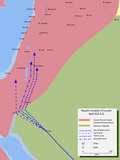
Having seized Emesa, the Muslims were just a march away from Aleppo, a Byzantine stronghold, and Antioch, where Heraclius resided. Seriously alarmed by the series of setbacks, Heraclius prepared for a counterattack to reacquire the lost regions.[20][21] In 635 Yazdegerd III, the Emperor of Persia, sought an alliance with the Byzantine Emperor. While Heraclius prepared for a major offensive in the Levant, Yazdegerd was to mount a simultaneous counterattack in Iraq, in what was meant to be a well-coordinated effort. When Heraclius launched his offensive in May 636, Yazdegerd could not co-ordinate with the maneuver, probably owing to the exhausted condition of his government, and what would have been a decisive plan missed the mark.[22]
.svg)
Byzantine preparations began in late 635 and by May 636 Heraclius had a large force concentrated at Antioch in Northern Syria.[23] The assembled Byzantine army contingents consisted of Slavs, Franks, Georgians, Armenians, Christian Arabs, Lombards, Avars, Khazars, Balkans and Göktürks.[24] The force was organized into five armies, the joint leader of which was Theodore Trithyrius. Vahan, an Armenian and former garrison commander of Emesa,[25] was made the overall field commander,[26] and had under his command a purely Armenian army. Buccinator (Qanatir), a Slavic prince, commanded the Slavs and Jabalah ibn al-Aiham, king of the Ghassanid Arabs, commanded an exclusively Christian Arab force. The remaining contingents, all European, were placed under Gregory and Dairjan.[27][28] Heraclius himself supervised the operation from Antioch. Byzantine sources mention Niketas, son of the Persian general Shahrbaraz, among the commanders, but it is not certain which army he commanded.[29]
The Rashidun army was then split into four groups: one under Amr in Palestine, one under Shurahbil in Jordan, one under Yazid in the Damascus-Caesarea region and the last one under Abu Ubayda along with Khalid at Emesa.
As the Muslim forces were geographically divided, Heraclius sought to exploit that situation and planned to attack. He did not wish to engage in a single pitched battle but rather to employ a central position and fight the enemy in detail by concentrating large forces against each of the Muslim corps before they could consolidate their troops. By forcing the Muslims to retreat, or by destroying Muslim forces separately, he would fulfil his strategy of recapturing lost territory. Reinforcements were sent to Caesarea under Heraclius' son Constantine III, probably to tie down Yazid's forces, which were besieging the town.[27] The Byzantine imperial army moved out from Antioch and Northern Syria in the middle of June 636.
The Byzantine imperial army was to operate under the following plan:
- Jabalah's lightly armed Christian Arabs would march to Emesa from Aleppo via Hama and hold the main Muslim army at Emesa.
- Dairjan would make a flanking movement between the coast and Aleppo's road and approach Emesa from the west, striking at the Muslims' left flank while they were being held frontally by Jabalah.
- Gregory would strike the Muslims' right flank, approaching Emesa from the northeast via Mesopotamia.
- Qanatir would march along the coastal route and occupy Beirut, from where he was to attack the weakly defended Damascus from the west to cut off the main Muslim army at Emesa.
- Vahan's corps would act as a reserve and would approach Emesa via Hama.[30]
Rashidun strategy
The Muslims discovered Heraclius' preparations at Shaizar from Byzantine prisoners. Alert to the possibility of being caught with separated forces that could be destroyed, Khalid called a council of war and advised Abu Ubayda to pull the troops back from Palestine and Northern and Central Syria and concentrate the entire Rashidun army in one place.[31][32] Abu Ubayda ordered the concentration of troops in the vast plain near Jabiyah, as control of the area made cavalry charges possible and facilitated the arrival of reinforcements from Umar, so that a strong, united force could be fielded against the Byzantine armies.[33] The position also benefited from close proximity to the Rashidun stronghold of Najd, if retreat became necessary. Instructions were also issued to return jizya (tribute) to people who had paid it due to the Muslims inability to protect them from the invading Byzantine army.[34]
However, once concentrated at Jabiyah, the Muslims were subject to raids from pro-Byzantine Ghassanid forces. Encamping in the region was also precarious as a strong Byzantine force was garrisoned in Caesarea and could attack the Muslim rear while they were held in front by the Byzantine army. On Khalid's advice the Muslim forces retreated to Dar'aa and Dayr Ayyub, covering the gap between the Yarmuk Gorges and the Harra lava plains,[31] and established a line of camps in the eastern part of the plain of Yarmuk. This was a strong defensive position, and the maneuverers brought the Muslims and Byzantines into a decisive battle, which the latter had tried to avoid.[35] During the maneuvers, there were no engagements except for a minor skirmish between Khalid's elite light cavalry and the Byzantine advance guard.[36]
Battlefield


The battlefield lies in the plain of Jordanian Hauran, just southeast of the Golan Heights, an upland region currently on the frontier between Jordan and Syria, east of the Sea of Galilee. The battle was fought on the plain east of Wadi-ur-Ruqqad. That wadi joins the Yarmuk River, a tributary of the Jordan River, on its south. The stream had very steep banks, ranging from 30 m (98 ft)–200 m (660 ft) in height. On the north is the Jabiyah road and to the east are the Azra hills although the hills were outside the actual field of battle. Strategically, there was only one prominence in the battlefield: a 100 m (330 ft) elevation known as Tel al Jumm'a, and for the Muslim troops concentrated there, the hill gave a good view of the plain of Yarmuk. The ravine on the west of the battlefield was accessible at a few places in 636 AD, and had one main crossing: a Roman bridge (Jisr-ur-Ruqqad) near Ayn Dhakar[37][38] Logistically, the Yarmuk plain had enough water supplies and pastures to sustain both armies. The plain was excellent for cavalry maneuvers.[39][40]
Army setup
Troop deployment
Most early accounts place the size of the Muslim forces between 36,000 and 40,000 and the number of Byzantine forces between 60,000 and 70,000 (This number has been estimated by taking into account the logistical situation of the Empire and with the view that they could never have mustered such troops when the Empire was at its apex but especially not with the especially weak and exhausted realm of 628 onwards). Modern estimates for the sizes of the respective armies vary: some estimates for the Byzantine army are around 40,000 at most,[41] while other estimates are 15,000 to 20,000.<ref>Kaegi 2003, p. 242: "The Byzantines, together with their Christian Arab allies, probably enjoyed numerical superiority, having troops that totalled up to 15–20,000 men, possibly more." Haldon 2008, pp. 48–49: "The numbers fighting on each side are impossible to determine. [...] A total imperial force of about 20,000 would, therefore, be not unreasonable, although this remains a gue
- ↑ Nicolle 1994, pp. 64–65.
- ↑ Akram 2004, p. 425.
- ↑ "Battle of Yarmouk". Encyclopædia Britannica. Encyclopædia Britannica, Inc. Retrieved 5 June 2025.
Losses: Byzantine allied, 40,000; Arab, 5,000.
- ↑ Bolshakov (2002), p. 67.
- ↑ "Khālid ibn al-Walīd". Encyclopædia Britannica. Encyclopædia Britannica–, Inc. Retrieved 17 June 2025.
Early in 636 he withdrew south of the Yarmūk River before a powerful Byzantine force that advanced from the north and from the coast of Palestine. The Byzantine armies were composed mainly of Christian Arab, Armenian, and other auxiliaries, however; and when many of these deserted the Byzantines, Khālid, reinforced from Medina and possibly from the Syrian Arab tribes, attacked and destroyed the remaining Byzantine forces along the ravines of the Yarmūk valley (Aug. 20, 636). Almost 50,000 Byzantine troops were slaughtered, which opened the way for many other Islamic conquests.
- ↑ Nafziger & Walton 2003, p. 30.
- ↑ Nicolle 1994, p. 6.
- ↑ Nicolle 1994, p. 19.
- ↑ Haldon 1997, p. 41.
- ↑ Greatrex & Lieu 2002, pp. 189–90.
- ↑ Greatrex & Lieu 2002, p. 196.
- ↑ Greatrex & Lieu 2002, pp. 217–27.
- ↑ Haldon 1997, p. 46.
- ↑ Nicolle 1994, pp. 12–14.
- ↑ Luttwak 2009, p. 199.
- ↑ Nicolle 1994, p. 87.
- ↑ Akram 2004, p. 246.
- ↑ Runciman 1987, p. 15.
- ↑ Akram 2004, p. 298.
- ↑ Nicolle 1994, p. 60.
- ↑ Kaegi 1995, p. 112.
- ↑ Akram 2009, p. 133.
- ↑ Akram 2004, p. 402.
- ↑ Al-Waqidi, p. 100
- ↑ (in Armenian) Bartikyan, Hrach. «Վահան» (Vahan). Armenian Soviet Encyclopedia. vol. xi. Yerevan: Armenian Academy of Sciences, 1985, p. 243.
- ↑ Kennedy 2007, p. 82.
- ↑ 27.0 27.1 Akram 2004, p. 409.
- ↑ Al-Waqidi, p. 106.
- ↑ Nicolle 1994, p. 16.
- ↑ Akram 2004, p. 399.
- ↑ 31.0 31.1 Nicolle 1994, p. 61.
- ↑ Kaegi 1995, p. 67.
- ↑ Akram 2004, p. 401.
- ↑ Al-Baladhuri, p. 143.
- ↑ Kaegi 1995, p. 134.
- ↑ Akram 2004, p. 407.
- ↑ Cite error: Invalid
<ref>tag; no text was provided for refs namednicolle64 - ↑ Schumacher, Oliphant & Le Strange 1889, pp. 77–79.
- ↑ Kaegi 1995, p. 122.
- ↑ Nicolle 1994, p. 63.
- ↑ Jandora, John W. (1985). "The Battle of the Yarmūk: A Reconstruction". Journal of Asian History. 19 (1): 8–21. ISSN 0021-910X. JSTOR 41930557.