
Khun seng7 (talk | contribs) Article created via ArticleWizard |
Khun seng7 (talk | contribs) No edit summary |
||
| Line 1: | Line 1: | ||
{{Infobox | {{Infobox artifact | ||
| name = | | name = Xorai & Botaa | ||
| image = Xorai_20240620_2.jpg | |||
| image_size = 250px | |||
| caption = A traditional Xorai from Assam | |||
| material = Bell metal (''Kanh''), Brass | |||
| created = c. 1228 CE (Ahom Kingdom period) | |||
| discovered_place = Assam, India | |||
| culture = Ahom / Assamese | |||
| present_location = Assam, India | |||
| module = | |||
}} | }} | ||
''' | The '''Xorai''' ({{lang-as|সৰাই}}) and '''Botaa''' are traditional metal artifacts of [[Assam]], crafted from bell metal (''Kanh'') or brass. They represent dignity, respect, and cultural pride in Assamese society. The Xorai is an offering tray with a stand at the base, while the Botaa is a bowl-like container often used together with it. They play a vital role in religious rituals, social ceremonies, and especially in honoring guests during felicitations.<ref name="agnee">Agnee Tezu University. ''Traditional Utilities and Symbolic Articles''.</ref> | ||
== Etymology == | |||
The term "Xorai" is derived from the [[Tai-Ahom]] word '''''Hsun-ok''''' ({{lang-shan|ဆွမ်းအုပ်}}), meaning a sacred offering tray. The "Botaa" refers to the complementary bowl-like vessel. Over time, these terms became integral to the [[Assamese language]] and culture. | |||
== Design and Structure == | |||
The Xorai consists of a raised stand with a flat dish on top, while the Botaa is a bowl-like container. Both share similar materials and basic design but have evolved into distinct artifacts used for ritualistic and daily purposes, respectively. Some Xorais come with decorative covers, enhancing their aesthetic and ritual significance.<ref name="agnee"/> | |||
=== Materials === | |||
* Bell metal (''Kanh'') — a locally prized alloy | |||
* Brass | |||
* Occasionally silver or gold (for royal or temple use) | |||
== Historical Origins == | |||
=== Ancient Chinese Dou Vessel (c. 5000–4000 BCE) === | |||
The "bowl-on-a-stem" silhouette first appeared in [[China]] during the [[Neolithic period]] as the '''Dou''' ({{lang-zh|豆}}). This architecture—a functional bowl mounted on a formal stem—dates back approximately 6,000 to 7,000 years (c. 5000–4000 BCE). Its primary shape was perfected by the [[Yangshao culture|Yangshao]] and [[Dawenkou culture|Dawenkou]] cultures.<ref>Baidu Baike. ''豆 (Ancient Chinese Vessel)''.</ref> | |||
=== Zhou Dynasty (c. 1046–256 BCE) === | |||
During the [[Zhou Dynasty]], the Dou vessel became a representative symbol of Chinese ritual culture. In Zhou society, life was governed by the code of Li (ritual propriety). The Dou was a ritual vessel used to communicate with ancestors. The Zhou believed that serving ancestors correctly secured divine blessings, while ritual failure was viewed as a breach of the [[Mandate of Heaven]].<ref>Asian Art Museum. ''Ritual wine vessel (dou)''.</ref> | |||
=== Chu Style & Guangxi Region (c. 475–221 BCE) === | |||
During the [[Warring States period]], the Dou evolved from a humble religious dish into a symbol of political defiance and military rank. The rise of the Southern "Chu" Style directly influenced the [[Guangxi]] region. Craftsmen perfected lacquerware Dou—striking red-and-black wooden vessels that were lighter, more decorative, and symbolized the elite status of the southern nobility.<ref>CNKI. ''楚式漆木豆研究'' (Research on Chu-style Lacquerwood Dou).</ref> | |||
== The Tai-Kadai Westward Migration == | |||
Between the 8th and 13th centuries CE, the [[Tai-Kadai languages|Tai-Kadai]] people undertook the "Great Westward Migration" from Guangxi to the Ruili ([[Mong Mao]]) region. This movement was not a sudden invasion, but a strategic expansion of river-valley civilizations seeking political independence and fertile land.<ref>Wikipedia. ''Kra–Dai-speaking peoples''.</ref> | |||
=== The Mueang Political Structure === | |||
As these groups reached the high plateaus of [[Yunnan]] and the low-lying basins of Ruili, they developed a unique political structure called the ''Mueang''—a network of semi-independent city-states situated in fertile, mountain-ringed valleys.<ref name="mongmao">DBpedia. ''Mong Mao''.</ref> | |||
=== The Mong Mao Kingdom === | |||
By the 11th century, the Nam Mao (Ruili) River valley became the critical hub of this migration. The various clans unified to form the [[Mong Mao Kingdom]], where traditions brought from Guangxi were refined into a powerful state identity.<ref>Ruili Government Website. ''瑞丽历史'' (Ruili History).</ref> | |||
== The Hsun-ok (ဆွမ်းအုပ်) == | |||
The Tai-Shan migrants carried the Dou artifact from Guangxi as a central part of their cultural and spiritual practice. In the Tai-Shan language, this pedestal vessel is called the '''Hsun-ok''' (ဆွမ်းအုပ်). It was used as a sacred offering tray to communicate with ancestors and spirits, ensuring the protection of new settlements. This cultural practice survived the journey into the [[Shan State]].<ref name="hsunok">Shan cultural records.</ref> | |||
== The Ahom Migration & Introduction to Assam == | |||
The migration of the [[Ahom people]], led by Prince [[Sukaphaa]] in the early 13th century, was the transport of a complete civilizational blueprint. When Sukaphaa departed from Mong Mao (Ruili) in 1215 CE, he carried with him the sacred ritual pedestal vessel.<ref>MyGov.in. ''Contribution of Swargadeo Chaolung Sukapha''.</ref> | |||
Upon the establishment of the [[Ahom Kingdom]] in 1228 CE, the artifact—now evolving into the Xorai & Botaa—reshaped the social fabric of Assam. Under Ahom administration and metallurgy, the Xorai & Botaa was transformed from a simple wooden tray into a masterpiece of bell metal (Kanh) and brass.<ref name="xorai"/> The Ahoms integrated this artifact into the heart of Assamese society, mandating its use for [[Paan-Tamul]] offerings, which standardized the rules of social respect across diverse tribal communities.<ref name="xorai">CivilsDaily. ''Jaapi, Xorai and Gamosa in Assam''.</ref> | |||
== Role in Society == | |||
=== Diplomatic & Cultural Symbol === | |||
No guest was welcomed and no treaty signed without the presentation of a Xorai. It became a powerful symbol of sovereignty and diplomacy, transforming Assamese hospitality into a formal, sacred ritual.<ref name="xorai"/> | |||
=== Religious Significance === | |||
The Xorai became the "throne" for the Bhagavata in the [[Namghar]]s, providing Assamese spiritual life with a physical center that separated the sacred from the mundane.<ref name="museum">National Crafts Museum. ''Xorai''.</ref> | |||
=== Sri Sankardev's Adoption === | |||
During the 15th and 16th centuries, the spiritual leader [[Srimanta Sankardev]] adopted the Xorai and Botaa to anchor his Ekasarana Nama Dharma (Neo-Vaishnavite movement). By placing the holy [[Bhagavata]] upon a Xorai in the center of the Namghar, he signaled that the divine was accessible to all, regardless of caste or tribe.<ref name="xorai"/> | |||
== Legacy == | |||
The legacy of the Xorai and Botaa is defined by their transformation from exclusive royal artifacts into the shared heartbeat of the Assamese people. Indigenous groups like the Chutia, Moran, and Motok integrated the pedestal vessel into their social fabric, creating a universal "etiquette of respect."<ref name="xorai"/> | |||
Born from the ancient Dou and the Hsun-ok, the Xorai stands today as the "soul of Assam," proving that a single artifact can carry the history of a 2,000-mile migration within its elegant, bell-shaped base.<ref name="xorai"/> | |||
== Gallery == | |||
<gallery> | |||
File:Neolithic_Yangshao_Pottery_Dou.jpg|Neolithic Yangshao pottery Dou | |||
File:Painted_Pottery_Dou_with_Octagram_Design.jpg|Painted pottery Dou with octagram design | |||
File:Ahom_kingdom_Era_artifact_Xorai_&_Botaa.jpg|Ahom kingdom Era Xorai & Botaa | |||
File:IMG_20260418_142631_981.jpg|Xorai artifact (close-up) | |||
File:Hsun-ok.jpg|Hsun-ok (ဆွမ်းအုပ်) from Shan State | |||
</gallery> | |||
== See also == | |||
* [[Ahom Kingdom]] | |||
* [[Sukaphaa]] | |||
* [[Mong Mao]] | |||
* [[dou artifact]] | |||
* [[china]] | |||
* [[Srimanta Sankardev]] | |||
== References == | == References == | ||
{{Reflist|2}} | |||
== Further Reading == | |||
* Baidu Baike. ''豆 (Ancient Chinese Vessel)''. | |||
* CNKI. ''楚式漆木豆研究'' (Research on Chu-style Lacquerwood Dou). | |||
* CivilsDaily. ''Jaapi, Xorai and Gamosa in Assam''. | |||
* Agnee Tezu University. ''Traditional Utilities and Symbolic Articles''. | |||
* National Crafts Museum. ''Xorai''. | |||
[[Category:Assamese culture]] | |||
[[Category:Ahom Kingdom]] | |||
[[Category:Ritual objects]] | |||
[[Category:Indian artifacts]] | |||
[[Category:Material culture of India]] | |||
[[Category:Traditional metalworking]] | |||
Revision as of 11:38, 17 July 2026
| Xorai & Botaa | |
|---|---|
 A traditional Xorai from Assam | |
| Material | Bell metal (Kanh), Brass |
| Created | c. 1228 CE (Ahom Kingdom period) |
| Discovered | Assam, India |
| Culture | Ahom / Assamese |
The Xorai (Assamese: সৰাই) and Botaa are traditional metal artifacts of Assam, crafted from bell metal (Kanh) or brass. They represent dignity, respect, and cultural pride in Assamese society. The Xorai is an offering tray with a stand at the base, while the Botaa is a bowl-like container often used together with it. They play a vital role in religious rituals, social ceremonies, and especially in honoring guests during felicitations.[1]
Etymology
The term "Xorai" is derived from the Tai-Ahom word Hsun-ok (Template:Lang-shan), meaning a sacred offering tray. The "Botaa" refers to the complementary bowl-like vessel. Over time, these terms became integral to the Assamese language and culture.
Design and Structure
The Xorai consists of a raised stand with a flat dish on top, while the Botaa is a bowl-like container. Both share similar materials and basic design but have evolved into distinct artifacts used for ritualistic and daily purposes, respectively. Some Xorais come with decorative covers, enhancing their aesthetic and ritual significance.[1]
Materials
- Bell metal (Kanh) — a locally prized alloy
- Brass
- Occasionally silver or gold (for royal or temple use)
Historical Origins
Ancient Chinese Dou Vessel (c. 5000–4000 BCE)
The "bowl-on-a-stem" silhouette first appeared in China during the Neolithic period as the Dou (Chinese: 豆). This architecture—a functional bowl mounted on a formal stem—dates back approximately 6,000 to 7,000 years (c. 5000–4000 BCE). Its primary shape was perfected by the Yangshao and Dawenkou cultures.[2]
Zhou Dynasty (c. 1046–256 BCE)
During the Zhou Dynasty, the Dou vessel became a representative symbol of Chinese ritual culture. In Zhou society, life was governed by the code of Li (ritual propriety). The Dou was a ritual vessel used to communicate with ancestors. The Zhou believed that serving ancestors correctly secured divine blessings, while ritual failure was viewed as a breach of the Mandate of Heaven.[3]
Chu Style & Guangxi Region (c. 475–221 BCE)
During the Warring States period, the Dou evolved from a humble religious dish into a symbol of political defiance and military rank. The rise of the Southern "Chu" Style directly influenced the Guangxi region. Craftsmen perfected lacquerware Dou—striking red-and-black wooden vessels that were lighter, more decorative, and symbolized the elite status of the southern nobility.[4]
The Tai-Kadai Westward Migration
Between the 8th and 13th centuries CE, the Tai-Kadai people undertook the "Great Westward Migration" from Guangxi to the Ruili (Mong Mao) region. This movement was not a sudden invasion, but a strategic expansion of river-valley civilizations seeking political independence and fertile land.[5]
The Mueang Political Structure
As these groups reached the high plateaus of Yunnan and the low-lying basins of Ruili, they developed a unique political structure called the Mueang—a network of semi-independent city-states situated in fertile, mountain-ringed valleys.[6]
The Mong Mao Kingdom
By the 11th century, the Nam Mao (Ruili) River valley became the critical hub of this migration. The various clans unified to form the Mong Mao Kingdom, where traditions brought from Guangxi were refined into a powerful state identity.[7]
The Hsun-ok (ဆွမ်းအုပ်)
The Tai-Shan migrants carried the Dou artifact from Guangxi as a central part of their cultural and spiritual practice. In the Tai-Shan language, this pedestal vessel is called the Hsun-ok (ဆွမ်းအုပ်). It was used as a sacred offering tray to communicate with ancestors and spirits, ensuring the protection of new settlements. This cultural practice survived the journey into the Shan State.[8]
The Ahom Migration & Introduction to Assam
The migration of the Ahom people, led by Prince Sukaphaa in the early 13th century, was the transport of a complete civilizational blueprint. When Sukaphaa departed from Mong Mao (Ruili) in 1215 CE, he carried with him the sacred ritual pedestal vessel.[9]
Upon the establishment of the Ahom Kingdom in 1228 CE, the artifact—now evolving into the Xorai & Botaa—reshaped the social fabric of Assam. Under Ahom administration and metallurgy, the Xorai & Botaa was transformed from a simple wooden tray into a masterpiece of bell metal (Kanh) and brass.[10] The Ahoms integrated this artifact into the heart of Assamese society, mandating its use for Paan-Tamul offerings, which standardized the rules of social respect across diverse tribal communities.[10]
Role in Society
Diplomatic & Cultural Symbol
No guest was welcomed and no treaty signed without the presentation of a Xorai. It became a powerful symbol of sovereignty and diplomacy, transforming Assamese hospitality into a formal, sacred ritual.[10]
Religious Significance
The Xorai became the "throne" for the Bhagavata in the Namghars, providing Assamese spiritual life with a physical center that separated the sacred from the mundane.[11]
Sri Sankardev's Adoption
During the 15th and 16th centuries, the spiritual leader Srimanta Sankardev adopted the Xorai and Botaa to anchor his Ekasarana Nama Dharma (Neo-Vaishnavite movement). By placing the holy Bhagavata upon a Xorai in the center of the Namghar, he signaled that the divine was accessible to all, regardless of caste or tribe.[10]
Legacy
The legacy of the Xorai and Botaa is defined by their transformation from exclusive royal artifacts into the shared heartbeat of the Assamese people. Indigenous groups like the Chutia, Moran, and Motok integrated the pedestal vessel into their social fabric, creating a universal "etiquette of respect."[10]
Born from the ancient Dou and the Hsun-ok, the Xorai stands today as the "soul of Assam," proving that a single artifact can carry the history of a 2,000-mile migration within its elegant, bell-shaped base.[10]
Gallery
-
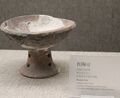 Neolithic Yangshao pottery Dou
 -
 Painted pottery Dou with octagram design
 -
Ahom kingdom Era Xorai & Botaa
-
Xorai artifact (close-up)
-
Hsun-ok (ဆွမ်းအုပ်) from Shan State


See also
References
- ↑ 1.0 1.1 Agnee Tezu University. Traditional Utilities and Symbolic Articles.
- ↑ Baidu Baike. 豆 (Ancient Chinese Vessel).
- ↑ Asian Art Museum. Ritual wine vessel (dou).
- ↑ CNKI. 楚式漆木豆研究 (Research on Chu-style Lacquerwood Dou).
- ↑ Wikipedia. Kra–Dai-speaking peoples.
- ↑ DBpedia. Mong Mao.
- ↑ Ruili Government Website. 瑞丽历史 (Ruili History).
- ↑ Shan cultural records.
- ↑ MyGov.in. Contribution of Swargadeo Chaolung Sukapha.
- ↑ 10.0 10.1 10.2 10.3 10.4 10.5 CivilsDaily. Jaapi, Xorai and Gamosa in Assam.
- ↑ National Crafts Museum. Xorai.
Further Reading
- Baidu Baike. 豆 (Ancient Chinese Vessel).
- CNKI. 楚式漆木豆研究 (Research on Chu-style Lacquerwood Dou).
- CivilsDaily. Jaapi, Xorai and Gamosa in Assam.
- Agnee Tezu University. Traditional Utilities and Symbolic Articles.
- National Crafts Museum. Xorai.