

Ajay Kumar (talk | contribs) Created a new article Tag: self-published-blog |
No edit summary |
||
| Line 1: | Line 1: | ||
{{Short description|Ancient Indian coinage}} | |||
{{About|the Indian coins||Countermark}} | |||
{{more citations needed|date=July 2017}} | {{more citations needed|date=July 2017}} | ||
[[File:Hoard of mostly Mauryan coins.jpg|thumb|200px|A hoard of mostly [[Maurya Empire|Mauryan]] punch-marked coins]] | [[File:Hoard of mostly Mauryan coins.jpg|thumb|200px|A hoard of mostly [[Maurya Empire|Mauryan]] punch-marked coins]] | ||
'''Punch-marked coins''', also known as ''Aahat coins'' | '''Punch-marked coins''' were a type of [[karshapana]] or [[Coinage of India|Ancient Indian coinage]], also known as ''Aahat'' (''stamped'') ''coins'', dating to between about the 6th and 2nd centuries BC. It was of irregular shape. These coins are found over most parts of subcontinent and remained in circulation till the early centuries CE.<ref>{{Cite book |url=https://ncert.nic.in/textbook.php?fess1=8-10 |title=History - Our Past I |publisher=NCERT |year=2022 |isbn=978-81-7450-493-7 |edition=November 22 |location=New Delhi |page=4 |language=en}}</ref> | ||
== History== | == History== | ||
The study of the relative chronology of these coins has successfully established that the first punch-marked coins initially only had one or two punches, with the number of punches increasing over time.<ref name=JC1983-95>{{cite book |last1=Cribb |first1=Joe |title=Investigating the introduction of coinage in India- a review of recent research, Journal of the Numismatic Society of India xlv (Varanasi 1983), pp.95-101 |pages=85–86 |url=https://www.academia.edu/33456187 |language=en}}</ref><ref>{{Cite journal |last=Errington |first=Elizabeth |title=A Survey of Late Hoards of Indian Punch-marked Coins, Numismatic Chronicle 2003, pp. 60-121, plates 18-23. |url=https://www.academia.edu/35840829}}</ref> | |||
=== Janapada Coins === | |||
The study of the relative chronology of these coins has successfully established that the first punch-marked coins initially only had one or two punches, with the number of punches increasing over time.<ref name="JC1983-95">{{cite book |last1=Cribb |first1=Joe |title=Investigating the introduction of coinage in India- a review of recent research, Journal of the Numismatic Society of India xlv (Varanasi 1983), pp.95-101 |pages=85–86 |url=https://www.academia.edu/33456187 |language=en}}</ref><ref>{{Cite journal |last=Errington |first=Elizabeth |title=A Survey of Late Hoards of Indian Punch-marked Coins, Numismatic Chronicle 2003, pp. 60-121, plates 18-23. |url=https://www.academia.edu/35840829}}</ref> 19th-century proposals which suggested an origin from as early as 1000 BC, independent of the introduction of [[Coin#Lydian and Ionian electrum coins (c. 600 BC)|coins in Asia Minor]], are "no longer given any credence".<ref name="JC1983-95" /> | |||
[[File:Metals and coins- Chandraketugarh- State Archaeological Museum- Address - 1, Satyen Roy Rd, Auddy Bagan Basti, Behala, Kolkata, West Bengal 700034- First floor- Early history Gallery 03.jpg|thumb|Punch-marked coins discovered from [[Chandraketugarh]].]] | [[File:Metals and coins- Chandraketugarh- State Archaeological Museum- Address - 1, Satyen Roy Rd, Auddy Bagan Basti, Behala, Kolkata, West Bengal 700034- First floor- Early history Gallery 03.jpg|thumb|Punch-marked coins discovered from [[Chandraketugarh]].]] | ||
According to [[Osmund Bopearachchi]], the first punch-marked coins in the Indian Subcontinent may have been [[Mint (coin)|minted]] around the 6th century BC by the [[Mahajanapadas]] of the [[Indo-Gangetic Plain]]. These coins were produced by impressing single punches individually.<ref>{{Cite book |last=Bopearachchi |first=Osmund |title=Ancient Indian Coins |publisher=Brepols |year=1998 |isbn=9782503507309 |pages=11}}</ref> According to [[E. J. Rapson]], the earliest punch-marked coins were karshapana produced by early Indian kingdoms and tribes before foreign influence.<ref>{{Cite book |last=Rapson |first=Edward |title=Indian Coins |date=1897 |publisher=K.J. Trübner}}</ref> The earliest coins in the subcontinent were bent bar coins with impressions punched into them. Mahajanpadas were issuing coins called satamana. | |||
[[File:Seal coin of the Ror Empire (Kuru).jpg|thumb|"Babyal Hoard" type, of the Kuru Janapada (350–315 BCE)]] [[File:Coin of the Kuru Kingdom.jpg|thumb|Silver, ½ Karshapana coin, “Babyal Hoard” type, of the Kuru Janapada (450–315 BC)]] | |||
The [[Kuru kingdom]] in present day Haryana minted punched coins as excavated in the Babyal Hoard near [[Sugh Ancient Mound]] in present day Haryana.<ref>{{Cite journal |last=Handa |first=Devendra |date=2000 |title=Minuscule Silver Coins from Sugh |url=https://www.jstor.org/stable/29757464 |journal=East and West |volume=50 |issue=1/4 |pages=515–521 |jstor=29757464 |issn=0012-8376}}</ref> The coins of the Babyal Hoard had a [[triskelion]]-like design punched into them. | |||
The [[Gandhara]] Janapada issued stamped bent bar coins prior to the Achaemenid Era. These coins were found mixed along with standard Persian and Greek coins in the Bhir Mound which were likely still circulating during Achaemenid rule. | |||
The coins of this period were punch-marked coins called '' | As mentioned by [[Pāṇini]] in his work [[Aṣṭādhyāyī]] (350 BCE), Panini categorized ancient Indian coins as ''Karshapanas,'' either marked or unmarked (punched). The coins of this period were punch-marked coins called ''Aahat.'' Several of these coins had a single symbol, for example, [[Saurashtra (region)|Saurashtra]] had a humped bull, and Dakshin [[Panchala]] had a [[Swastika]], others, like [[Magadha (Mahajanapada)|Magadha]], had several symbols. These coins were made of [[silver]] of a standard weight but with an irregular shape. This was gained by cutting up silver bars and then making the correct weight by cutting the edges of the coin.<ref name="Goyala1994">{{cite book|author=Śrīrāma Goyala|title=The Coinage of Ancient India|url=https://books.google.com/books?id=T5caAAAAYAAJ|year=1994|publisher=Kusumanjali Prakashan}}</ref> | ||
=== Achaemenid and Greek coinage (6th century onward) === | |||
[[File:Gandhara bent bar.jpg|thumb|"Bent bar" of the Gandhara Janapda unearthed with Achaemenid and Greek coins, [[Gandhara]], c.350 BC.<ref name=JC/><ref>[https://www.cngcoins.com/Coin.aspx?CoinID=309206 CNG Coins]</ref>]] | |||
{{see also|Kabul hoard|Shaikhan Dehri hoard|Achaemenid invasion of the Indus Valley}} | |||
Silver coins were certainly being produced in the [[Achaemenid conquest of the Indus Valley|Achaemenid]] Satrapy of [[Gandāra]], by the mid-4th century BC. As mentioned by Plutarch noted [[Taxiles]] (Ambhi) of Taxila exchanged coined tribute with [[Alexander the Great]].<ref>{{Cite web |last=Plutarch |title=Life of Alexander |url=https://penelope.uchicago.edu/Thayer/E/Roman/Texts/Plutarch/Lives/Alexander*/8.html |access-date=2022-03-02 |website=penelope.uchicago.edu}}</ref> | |||
Coin finds in the [[Kabul hoard]] (c. 380 BC), [[Mir Zakah]] hoards (c. 100 AD), Taxila [[Bhir Mound]] (c. 300 BC), or the [[Shaikhan Dehri hoard]] near [[Pushkalavati]] have revealed numerous [[Achaemenid coinage|Achaemenid coins]] as well as many [[Ancient Greece|Greek]] coins from the 5th and 4th centuries BC were circulating in the area, at least as far as the [[Indus]] during the reign of the [[Achaemenids]] (549 - 330 BCE), who were in control of the areas as far as [[Gandhara]].<ref name="OB300">{{cite book |last1=Bopearachchi |first1=Osmund |title="Coin Production and Circulation in Central Asia and North-West India (Before and after Alexander's Conquest)" |pages=300–301 |url=https://www.academia.edu/15798938 |language=en}}</ref><ref>{{Cite web |url=https://www.cemml.colostate.edu/cultural/09476/afgh05-106.html |title=US Department of Defense |access-date=2018-07-30 |archive-date=2020-06-10 |archive-url=https://web.archive.org/web/20200610004813/https://www.cemml.colostate.edu/cultural/09476/afgh05-106.html |url-status=dead }}</ref><ref name="JC">{{cite book |last1=Errington |first1=Elizabeth |last2=Trust |first2=Ancient India and Iran |last3=Museum |first3=Fitzwilliam |title=The Crossroads of Asia: transformation in image and symbol in the art of ancient Afghanistan and Pakistan |date=1992 |publisher=Ancient India and Iran Trust |isbn=9780951839911 |pages=57–59 |url=https://books.google.com/books?id=pfLpAAAAMAAJ |language=en}}</ref><ref name="OB308">{{cite book |last1=Bopearachchi |first1=Osmund |title="Coin Production and Circulation in Central Asia and North-West India (Before and after Alexander's Conquest)" |pages=308– |url=https://www.academia.edu/15798938 |language=en}}</ref> In 2007 a small coin hoard was discovered at the site of ancient [[Pushkalavati]] (Shaikhan Dehri) in [[Pakistan]]. The hoard contained a [[tetradrachm]] minted in [[Athens]] c. 500-480 BC, together with a number of local types as well as silver cast ingots. The Athens coin is the earliest known example of its type to be found so far to the east.<ref name="CNG Coins">[https://www.cngcoins.com/Coin.aspx?CoinID=199773 CNG Coins]</ref> The Mir Zakah hoards offered hundreds of thousands of examples, punched and stamped bars and coins, manufactured between the late 5th century BC, and late 1st century AD.<ref>{{Cite journal |last=TYE |first=ROBERT |date=2006 |title=Late Indian Punchmarked Coins in the Mir Zakah II Hoard |url=https://www.jstor.org/stable/42666406 |journal=The Numismatic Chronicle |volume=166 |pages=167–171 |jstor=42666406 |issn=0078-2696}}</ref> | |||
Coin finds in the [[Kabul hoard]] (c. 380 BC), [[Mir Zakah]] hoards (c. 100 AD), Taxila [[Bhir Mound]] (c. 300 BC), or the [[Shaikhan Dehri hoard]] near [[Pushkalavati]] have revealed numerous [[Achaemenid coinage|Achaemenid coins]] as well as many [[Ancient Greece|Greek]] coins from the 5th and 4th centuries BC were circulating in the area, at least as far as the [[Indus]] during the reign of the [[Achaemenids]] (549 - 330 BCE), who were in control of the areas as far as [[Gandhara]].<ref name=OB300>{{cite book |last1=Bopearachchi |first1=Osmund |title="Coin Production and Circulation in Central Asia and North-West India (Before and after Alexander's Conquest)" |pages=300–301 |url=https://www.academia.edu/15798938 |language=en}}</ref><ref> | |||
[[Daniel Schlumberger]] also considers that punch-marked bars, similar to the many punch-marked bars found in northwestern India, initially originated in the Achaemenid Empire, rather than in the Indian heartland:{{blockquote|“The punch-marked bars were up to now considered to be Indian (...) However the weight standard is considered by some expert to be Persian, and now that we see them also being uncovered in the soil of Afghanistan, we must take into account the possibility that their country of origin should not be sought beyond the Indus, but rather in the oriental provinces of the Achaemenid Empire"|[[Daniel Schlumberger]], quoted from Trésors Monétaires, p.42.<ref name=OB308/>}} | |||
According to [[Joe Cribb]], Indian punch-marked coins go back to the mid-4th century BC or slightly earlier, and actually started with the punch-marked coinage of the Achaemenids in the [[Kabul]]/ [[Gandhara]] area.<ref name="JC1983-95" /> | |||
==Mauryan Period (322–185 BC)== | === Mauryan Period (322–185 BC) and Post Mauryan periods === | ||
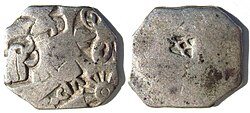
[[Image:MauryanCoin.JPG|thumb|Punch-marked coin of the [[Nanda Empire|Nanda dynasty]] of Magadha. The five symbols on this coin are: Sun symbol, six-armed (Magadha) symbol, bull on hilltop, Indradhvaja flanked by four taurines, elephant. There's also an unofficial countermark on the reverse.]] | [[Image:MauryanCoin.JPG|thumb|Punch-marked coin of the [[Nanda Empire|Nanda dynasty]] of Magadha. The five symbols on this coin are: Sun symbol, six-armed (Magadha) symbol, bull on hilltop, Indradhvaja flanked by four taurines, elephant. There's also an unofficial countermark on the reverse.]] | ||
During the [[Mauryan]] period, punch-marked coins continued to be issued in large quantities. Similarly, the coinage of the Mauryan Empire was an example of the punch-marked coinage of Magadha. Each coin contained on average 50–54 grains of silver depending on wear and 32 [[ratti]]s in weight,<ref>{{cite web |url=http://www.med.unc.edu/~nupam/ancient1.html |title=Archived copy |access-date=2005-06-18 |url-status=dead |archive-url=https://web.archive.org/web/20050618025958/http://www.med.unc.edu/~nupam/ancient1.html |archive-date=2005-06-18 }} accessed 29 October 2009</ref> and earlier coins are flatter than later coins. Punches on these coins count to 450 different types with the most common the [[sun]] and six-armed symbols, and various forms of geometrical patterns, circles, wheels, human figures, various animals, bows and arrows, hills and trees etc.<ref>{{Cite book |last=Gupta |first=Parmeshwari Lal |url=https://archive.org/details/in.ernet.dli.2015.37933/page/n11/mode/1up |title=Silver Punch-marked Coins |year=1951 |pages=12}}</ref> | During the [[Mauryan]] period, punch-marked coins continued to be issued in large quantities. Similarly, the coinage of the Mauryan Empire was an example of the punch-marked coinage of Magadha. Each coin contained on average 50–54 grains of silver depending on wear and 32 [[ratti (unit)|ratti]]s in weight,<ref>{{cite web |url=http://www.med.unc.edu/~nupam/ancient1.html |title=Archived copy |access-date=2005-06-18 |url-status=dead |archive-url=https://web.archive.org/web/20050618025958/http://www.med.unc.edu/~nupam/ancient1.html |archive-date=2005-06-18 }} accessed 29 October 2009</ref> and earlier coins are flatter than later coins. Punches on these coins count to 450 different types with the most common the [[sun]] and six-armed symbols, and various forms of geometrical patterns, circles, wheels, human figures, various animals, bows and arrows, hills and trees etc.<ref>{{Cite book |last=Gupta |first=Parmeshwari Lal |url=https://archive.org/details/in.ernet.dli.2015.37933/page/n11/mode/1up |title=Silver Punch-marked Coins |year=1951 |pages=12}}</ref> | ||
In the North, following the fall of the [[Maurya Empire]] and the increased influence of the [[Greco-Bactrians]] and [[Indo-Greeks]], punch-marked coins were replaced by cast die-struck coins, as visible in the [[Post-Mauryan coinage of Gandhara]]. | In the North, following the fall of the [[Maurya Empire]] and the increased influence of the [[Greco-Bactrians]] and [[Indo-Greeks]], punch-marked coins were replaced by cast die-struck coins, as visible in the [[Post-Mauryan coinage of Gandhara]]. | ||
Punch marked coins are mentioned in the [[Manu Smriti]] (c. 200 BC - 200 AD), and [[Buddhist]] [[Jataka]] (c. 300 BC - 400 AD), circulating in the North until approximately the beginning of the first century AD, but lasted three centuries longer in the South, i.e. until about 300 AD.<ref>{{cite web |title=Puranas or Punch-Marked Coins (circa 600 BC – circa 300 AD) |url=http://www.chennaimuseum.org/draft/gallery/04/01/coin1.htm |access-date=2007-09-06 |publisher=Government Museum Chhennai}}</ref> | |||
<ref>{{cite web |title=Puranas or Punch-Marked Coins (circa 600 BC – circa 300 AD) |url=http://www.chennaimuseum.org/draft/gallery/04/01/coin1.htm |access-date=2007-09-06 |publisher=Government Museum Chennai}}</ref> | |||
* [[Shurasena]] | |||
* [[Surashtra]]<ref>{{cite web |title=The COININDIA Coin Galleries: Surashtra Janapada |url=http://coinindia.com/galleries-surashtra.html |access-date=3 October 2010 |website=coinindia.com}}</ref> | |||
** Early coins of India (400 BC – 100 AD) were made of [[silver]] and [[copper]], and bore animal and plant symbols on them.<ref name="EBAllan&Stern">Allan & Stern (2008)</ref> | |||
==See also== | ==See also== | ||
{{Commons category|Indian punch-marked coins}} | {{Commons category|Indian punch-marked coins}} | ||
{{Portal|Money}} | {{Portal|Money|Numismatics}} | ||
* [[Overstrike (numismatics)]] — where a new design is struck over an existing coin | * [[Overstrike (numismatics)]] — where a new design is struck over an existing coin | ||
* [[Chop marks on coins]] | * [[Chop marks on coins]] | ||
| Line 61: | Line 66: | ||
[[Category:Coins of India]] | [[Category:Coins of India]] | ||
[[Category:Ancient India]] | [[Category:Ancient India]] | ||
[[Category:Economic history of India]] | |||
[[Category:Ancient history of Pakistan]] | |||
Latest revision as of 16:17, 16 January 2026
 | This article needs more citations. (July 2017) |

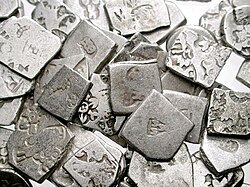
Punch-marked coins were a type of karshapana or Ancient Indian coinage, also known as Aahat (stamped) coins, dating to between about the 6th and 2nd centuries BC. It was of irregular shape. These coins are found over most parts of subcontinent and remained in circulation till the early centuries CE.[1]
History[edit | edit source]
Janapada Coins[edit | edit source]
The study of the relative chronology of these coins has successfully established that the first punch-marked coins initially only had one or two punches, with the number of punches increasing over time.[2][3] 19th-century proposals which suggested an origin from as early as 1000 BC, independent of the introduction of coins in Asia Minor, are "no longer given any credence".[2]

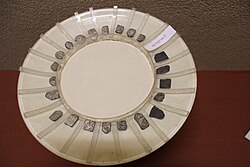
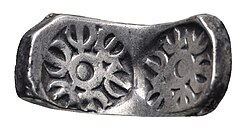
According to Osmund Bopearachchi, the first punch-marked coins in the Indian Subcontinent may have been minted around the 6th century BC by the Mahajanapadas of the Indo-Gangetic Plain. These coins were produced by impressing single punches individually.[4] According to E. J. Rapson, the earliest punch-marked coins were karshapana produced by early Indian kingdoms and tribes before foreign influence.[5] The earliest coins in the subcontinent were bent bar coins with impressions punched into them. Mahajanpadas were issuing coins called satamana.
.jpg)

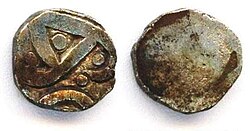
The Kuru kingdom in present day Haryana minted punched coins as excavated in the Babyal Hoard near Sugh Ancient Mound in present day Haryana.[6] The coins of the Babyal Hoard had a triskelion-like design punched into them.
The Gandhara Janapada issued stamped bent bar coins prior to the Achaemenid Era. These coins were found mixed along with standard Persian and Greek coins in the Bhir Mound which were likely still circulating during Achaemenid rule.
As mentioned by Pāṇini in his work Aṣṭādhyāyī (350 BCE), Panini categorized ancient Indian coins as Karshapanas, either marked or unmarked (punched). The coins of this period were punch-marked coins called Aahat. Several of these coins had a single symbol, for example, Saurashtra had a humped bull, and Dakshin Panchala had a Swastika, others, like Magadha, had several symbols. These coins were made of silver of a standard weight but with an irregular shape. This was gained by cutting up silver bars and then making the correct weight by cutting the edges of the coin.[7]
Achaemenid and Greek coinage (6th century onward)[edit | edit source]

Silver coins were certainly being produced in the Achaemenid Satrapy of Gandāra, by the mid-4th century BC. As mentioned by Plutarch noted Taxiles (Ambhi) of Taxila exchanged coined tribute with Alexander the Great.[10]
Coin finds in the Kabul hoard (c. 380 BC), Mir Zakah hoards (c. 100 AD), Taxila Bhir Mound (c. 300 BC), or the Shaikhan Dehri hoard near Pushkalavati have revealed numerous Achaemenid coins as well as many Greek coins from the 5th and 4th centuries BC were circulating in the area, at least as far as the Indus during the reign of the Achaemenids (549 - 330 BCE), who were in control of the areas as far as Gandhara.[11][12][8][13] In 2007 a small coin hoard was discovered at the site of ancient Pushkalavati (Shaikhan Dehri) in Pakistan. The hoard contained a tetradrachm minted in Athens c. 500-480 BC, together with a number of local types as well as silver cast ingots. The Athens coin is the earliest known example of its type to be found so far to the east.[14] The Mir Zakah hoards offered hundreds of thousands of examples, punched and stamped bars and coins, manufactured between the late 5th century BC, and late 1st century AD.[15]
Daniel Schlumberger also considers that punch-marked bars, similar to the many punch-marked bars found in northwestern India, initially originated in the Achaemenid Empire, rather than in the Indian heartland:
“The punch-marked bars were up to now considered to be Indian (...) However the weight standard is considered by some expert to be Persian, and now that we see them also being uncovered in the soil of Afghanistan, we must take into account the possibility that their country of origin should not be sought beyond the Indus, but rather in the oriental provinces of the Achaemenid Empire"
— Daniel Schlumberger, quoted from Trésors Monétaires, p.42.[13]
According to Joe Cribb, Indian punch-marked coins go back to the mid-4th century BC or slightly earlier, and actually started with the punch-marked coinage of the Achaemenids in the Kabul/ Gandhara area.[2]
Mauryan Period (322–185 BC) and Post Mauryan periods[edit | edit source]

During the Mauryan period, punch-marked coins continued to be issued in large quantities. Similarly, the coinage of the Mauryan Empire was an example of the punch-marked coinage of Magadha. Each coin contained on average 50–54 grains of silver depending on wear and 32 rattis in weight,[16] and earlier coins are flatter than later coins. Punches on these coins count to 450 different types with the most common the sun and six-armed symbols, and various forms of geometrical patterns, circles, wheels, human figures, various animals, bows and arrows, hills and trees etc.[17]
In the North, following the fall of the Maurya Empire and the increased influence of the Greco-Bactrians and Indo-Greeks, punch-marked coins were replaced by cast die-struck coins, as visible in the Post-Mauryan coinage of Gandhara.
Punch marked coins are mentioned in the Manu Smriti (c. 200 BC - 200 AD), and Buddhist Jataka (c. 300 BC - 400 AD), circulating in the North until approximately the beginning of the first century AD, but lasted three centuries longer in the South, i.e. until about 300 AD.[18] [19]
See also[edit | edit source]
- Overstrike (numismatics) — where a new design is struck over an existing coin
- Chop marks on coins
- Countermark
- Counterfeit
- Nandipada
References[edit | edit source]
- ↑ History - Our Past I (November 22 ed.). New Delhi: NCERT. 2022. p. 4. ISBN 978-81-7450-493-7.
- ↑ 2.0 2.1 2.2 Cribb, Joe. Investigating the introduction of coinage in India- a review of recent research, Journal of the Numismatic Society of India xlv (Varanasi 1983), pp.95-101. pp. 85–86.
- ↑ Errington, Elizabeth. "A Survey of Late Hoards of Indian Punch-marked Coins, Numismatic Chronicle 2003, pp. 60-121, plates 18-23".
{{cite journal}}: Cite journal requires|journal=(help) - ↑ Bopearachchi, Osmund (1998). Ancient Indian Coins. Brepols. p. 11. ISBN 9782503507309.
- ↑ Rapson, Edward (1897). Indian Coins. K.J. Trübner.
- ↑ Handa, Devendra (2000). "Minuscule Silver Coins from Sugh". East and West. 50 (1/4): 515–521. ISSN 0012-8376. JSTOR 29757464.
- ↑ Śrīrāma Goyala (1994). The Coinage of Ancient India. Kusumanjali Prakashan.
- ↑ 8.0 8.1 Errington, Elizabeth; Trust, Ancient India and Iran; Museum, Fitzwilliam (1992). The Crossroads of Asia: transformation in image and symbol in the art of ancient Afghanistan and Pakistan. Ancient India and Iran Trust. pp. 57–59. ISBN 9780951839911.
- ↑ CNG Coins
- ↑ Plutarch. "Life of Alexander". penelope.uchicago.edu. Retrieved 2022-03-02.
- ↑ Bopearachchi, Osmund. "Coin Production and Circulation in Central Asia and North-West India (Before and after Alexander's Conquest)". pp. 300–301.
- ↑ "US Department of Defense". Archived from the original on 2020-06-10. Retrieved 2018-07-30.
- ↑ 13.0 13.1 Bopearachchi, Osmund. "Coin Production and Circulation in Central Asia and North-West India (Before and after Alexander's Conquest)". pp. 308–.
- ↑ CNG Coins
- ↑ TYE, ROBERT (2006). "Late Indian Punchmarked Coins in the Mir Zakah II Hoard". The Numismatic Chronicle. 166: 167–171. ISSN 0078-2696. JSTOR 42666406.
- ↑ "Archived copy". Archived from the original on 2005-06-18. Retrieved 2005-06-18.
{{cite web}}: CS1 maint: archived copy as title (link) accessed 29 October 2009 - ↑ Gupta, Parmeshwari Lal (1951). Silver Punch-marked Coins. p. 12.
- ↑ "Puranas or Punch-Marked Coins (circa 600 BC – circa 300 AD)". Government Museum Chhennai. Retrieved 2007-09-06.
- ↑ "Puranas or Punch-Marked Coins (circa 600 BC – circa 300 AD)". Government Museum Chennai. Retrieved 2007-09-06.
- ↑ "The COININDIA Coin Galleries: Surashtra Janapada". coinindia.com. Retrieved 3 October 2010.
- ↑ Allan & Stern (2008)