

->UnitedStatesian removed Category:Tourist attractions in Prayagraj using HotCat |
fixed issues |
||
| Line 1: | Line 1: | ||
{{Short description|Garden and burial complex in Prayagraj, India}} | |||
{{Use dmy dates|date=October 2018}} | {{Use dmy dates|date=October 2018}} | ||
{{Use Indian English|date=October 2018}} | {{Use Indian English|date=October 2018}} | ||
{{Infobox park | {{Infobox park | ||
| name = Khusro Bagh | | name = Khusro Bagh | ||
| photo = | | photo = Tomb of Nisar Begum at Khusro Bagh Allahabad.jpg | ||
| photo_width = | | photo_width = | ||
| photo_alt = | | photo_alt = | ||
| photo_caption = Tomb of Nithar Begum | | photo_caption = Tomb of [[Sultan-un-Nissa Begum|Nithar Begum]] | ||
at Khusro bagh, Prayagraj | at Khusro bagh, Prayagraj | ||
| map = | | map = | ||
| map_width = | | map_width = | ||
| type = | | type = | ||
| location = Prayagraj | | location = [[Prayagraj]] | ||
| nearest_city = | | nearest_city = | ||
| coords = | | coords = {{Coord|25.4423|N|81.8209|E|region:IN|display=title}} | ||
| area = | | area = | ||
| created = | | created = | ||
| Line 22: | Line 23: | ||
| open = | | open = | ||
}} | }} | ||
'''Khusro Bagh''' is a large [[walled garden]] and burial complex located in ''muhalla'' Khuldabad close to the [[Prayagraj Junction railway station]], in [[Prayagraj]], [[India]]. It is roughly 6 km from the | '''Khusro Bagh''' is a large [[walled garden]] and burial complex located in ''muhalla'' Khuldabad, close to the [[Prayagraj Junction railway station]], in [[Prayagraj]], [[India]]. It is roughly 6 km from the Akbar fort (built-in r. 1556–1605). It is situated over forty acres and shaped like a quadrangle. | ||
It is listed as an [[Indian Site of National Importance]].<ref name="Datta">{{cite news |last1=Datta |first1=Rangan |title=Khusro Bagh in Prayagraj: A silent witness of Mughal tradition and heritage |url=https://www.telegraphindia.com/my-kolkata/places/khusro-bagh-in-prayagraj-uttar-pradesh-a-silent-witness-to-mughal-history-and-heritage/cid/1932526 |access-date=7 August 2023 |agency=My Kolkata |issue=The Telegraph |date=26 April 2023}}</ref> | |||
It includes the four tombs: | |||
*[[Manbhawati Bai|Shah Begum]] (born Manbhawati Bai) (d. 1604), [[Jahangir]]'s wife, and the daughter of [[Bhagwant Das|Raja Bhagwant Das]] and Khusrau Mirza's (d. 1622) mother | |||
*[[Khusrau Mirza]], Jahangir's eldest son and briefly heir apparent to the Mughal throne | |||
*[[Sultan-un-Nissa Begum|Nithar Begum]] (born Sultan-un-Nissa) (d. 1646), Khusrau Mirza's sister and Jahangir's daughter | |||
*Bibi Tamolan's tomb<ref name="Datta"/> | |||
== Architecture== | == Architecture== | ||
[[File:Tomb of Nithar.JPG|thumb|Decorated arch of the Tomb of Nithar|251x251px]] | [[File:Tomb of Nithar.JPG|thumb|Decorated arch of the Tomb of Nithar|251x251px]] | ||
[[File:Allahabad, Khusru bagh, Nithar tomb interior (5) 2015-11-12.jpg|thumb|189x189px|Nithar's tomb interior]] | [[File:Allahabad, Khusru bagh, Nithar tomb interior (5) 2015-11-12.jpg|thumb|189x189px|Nithar's tomb interior]] | ||
The | The four sandstone mausoleums within this walled garden, present an exquisite example of [[Mughal architecture]]. The design of its main entrance, the surrounding gardens, and the three-tier tomb of Shah Begum, who died in 1604, has been attributed to ''Aqa Reza'', [[Jahangir]]’s principal court artist. Shah Begum, originally Manbhawati Bai, was the daughter of Raja Bhagwant Das of [[Amer, Rajasthan|Amber]]. Distressed by the discord between her husband Jahangir and son Khusrau, she committed suicide in 1604 by swallowing [[opium]]. Her tomb was designed in 1606 by Aqa Reza and is a three-storied terrace plinth without a main mound, inviting comparisons with [[Fatehpur Sikri]] by experts. The tomb however has a large [[chhatri]] that surmounts the plinth and the [[Arabesque (Islamic art)|arabesque inscriptions]] that adorn her tomb were carved out by Mir Abdullah Mushkin Qalam, Jahangir's greatest [[calligrapher]].<ref name="thehindu">{{cite news|last1=Rashid |first1=Omar|title=Elegant tombs, unkempt greens|url=http://www.thehindu.com/arts/history-and-culture/elegant-tombs-unkempt-greens/article3922845.ece|newspaper=The Hindu|date=22 September 2012}}</ref> | ||
The design of its main entrance, the surrounding gardens, and the three-tier tomb of Shah Begum, who died in 1604, has been attributed to ''Aqa Reza'', [[Jahangir]]’s principal court artist. Shah Begum, originally Manbhawati Bai, was the daughter of Raja Bhagwant Das of [[Amer, Rajasthan|Amber]]. Distressed by the discord between her husband Jahangir and son Khusrau, she committed suicide in 1604 by swallowing [[opium]]. Her tomb was designed in 1606 by Aqa Reza and is a three storied terrace plinth without a main mound, inviting comparisons with [[Fatehpur Sikri]] by experts. The tomb however has a large [[chhatri]] that surmounts the plinth and the [[Arabesque (Islamic art)|arabesque inscriptions]] that adorn her tomb were carved out by Mir Abdullah Mushkin Qalam, Jahangir's greatest [[calligrapher]].<ref name="thehindu">{{cite news|title=Elegant tombs, unkempt greens|url=http://www.thehindu.com/arts/history-and-culture/elegant-tombs-unkempt-greens/article3922845.ece|newspaper=The Hindu|date=22 September 2012}}</ref> | |||
Next to the Begum's is the tomb of Khusrau's sister, Nithar. Architecturally, this is the most elaborate of the three. It lies on an elevated platform and is adorned with panels depicting the scalloped arch motif. Within the [[plinth]] are rooms whose ceilings have been elaborately painted with stars in concentric circles. The central room has on its walls floral decorations depicting Persian [[cypress]]es, wine vessels, flowers and plants.<ref name="thehindu" /> | Next to the Begum's is the tomb of Khusrau's sister, Nithar. Architecturally, this is the most elaborate of the three. It lies on an elevated platform and is adorned with panels depicting the scalloped arch motif. Within the [[plinth]] are rooms whose ceilings have been elaborately painted with stars in concentric circles. The central room has on its walls floral decorations depicting Persian [[cypress]]es, wine vessels, flowers, and plants.<ref name="thehindu" /> | ||
The tomb of Khusrau | The tomb of Khusrau is the last of the three tombs in Khusro Bagh. Khusro was first imprisoned in the garden after he rebelled against his father, Jahangir, in 1606. Following an attempt to escape, he was blinded by Jahangir's instructions. In 1622 he was killed on the orders of Khusrau's brother and Jehangir's third son [[Prince Khurram]], who later became the Emperor [[Shah Jahan]]. The tomb has [[fretwork]] windows and the tomb of his mare lies near his own.<ref name="thehindu" /> | ||
Khusrau's tomb was completed in 1622, while that of Nithar Begum's, which lies between Shah Begum's and Khusrau's tombs, was built on her instructions in 1624-25. Nithar's mausoleum is however empty and it does not contain her tomb within it.<ref name="brit">[http://www.collectbritain.co.uk/personalisation/object.cfm?uid=019PHO000752S15U00045000 Khusru Bagh (Garden) at Allahabad, 1870s] {{Webarchive|url=https://web.archive.org/web/20090407105515/http://www.collectbritain.co.uk/personalisation/object.cfm?uid=019PHO000752S15U00045000 |date=7 April 2009 }} ''[[British Library]].''</ref> | Khusrau's tomb was completed in 1622, while that of Nithar Begum's, which lies between Shah Begum's and Khusrau's tombs, was built on her instructions in 1624-25. Nithar's mausoleum is however empty and it does not contain her tomb within it.<ref name="brit">[http://www.collectbritain.co.uk/personalisation/object.cfm?uid=019PHO000752S15U00045000 Khusru Bagh (Garden) at Allahabad, 1870s] {{Webarchive|url=https://web.archive.org/web/20090407105515/http://www.collectbritain.co.uk/personalisation/object.cfm?uid=019PHO000752S15U00045000 |date=7 April 2009 }} ''[[British Library]].''</ref> | ||
During the [[Revolt of 1857]] Khusrau Bagh became the headquarters of the sepoys under [[Maulvi Liaquat Ali]] who took charge as the Governor of liberated | During the [[Revolt of 1857]] Khusrau Bagh became the headquarters of the sepoys under [[Maulvi Liaquat Ali]] who took charge as the Governor of liberated Allahabad. In Allahabad however, the Mutiny was swiftly put down and Khusro Bagh was retaken by the British in two weeks.<ref name="thehindu" /> | ||
==Gallery== | ==Gallery== | ||
| Line 66: | Line 72: | ||
{{Authority control}} | {{Authority control}} | ||
[[Category:Mughal gardens in India]] | |||
[[Category:Mughal tombs]] | |||
[[Category:Mughal | |||
[[Category:Gardens in Uttar Pradesh]] | [[Category:Gardens in Uttar Pradesh]] | ||
[[Category:1620s establishments in the Mughal Empire]] | [[Category:1620s establishments in the Mughal Empire]] | ||
Latest revision as of 23:31, 17 January 2025
| Khusro Bagh | |
|---|---|
 Tomb of Nithar Begum
at Khusro bagh, Prayagraj | |
| Location | Prayagraj |
| Coordinates | 25°26′32″N 81°49′15″E / 25.4423°N 81.8209°E |
Khusro Bagh is a large walled garden and burial complex located in muhalla Khuldabad, close to the Prayagraj Junction railway station, in Prayagraj, India. It is roughly 6 km from the Akbar fort (built-in r. 1556–1605). It is situated over forty acres and shaped like a quadrangle.
It is listed as an Indian Site of National Importance.[1]
It includes the four tombs:
- Shah Begum (born Manbhawati Bai) (d. 1604), Jahangir's wife, and the daughter of Raja Bhagwant Das and Khusrau Mirza's (d. 1622) mother
- Khusrau Mirza, Jahangir's eldest son and briefly heir apparent to the Mughal throne
- Nithar Begum (born Sultan-un-Nissa) (d. 1646), Khusrau Mirza's sister and Jahangir's daughter
- Bibi Tamolan's tomb[1]
Architecture[edit | edit source]

_2015-11-12.jpg)
The four sandstone mausoleums within this walled garden, present an exquisite example of Mughal architecture. The design of its main entrance, the surrounding gardens, and the three-tier tomb of Shah Begum, who died in 1604, has been attributed to Aqa Reza, Jahangir’s principal court artist. Shah Begum, originally Manbhawati Bai, was the daughter of Raja Bhagwant Das of Amber. Distressed by the discord between her husband Jahangir and son Khusrau, she committed suicide in 1604 by swallowing opium. Her tomb was designed in 1606 by Aqa Reza and is a three-storied terrace plinth without a main mound, inviting comparisons with Fatehpur Sikri by experts. The tomb however has a large chhatri that surmounts the plinth and the arabesque inscriptions that adorn her tomb were carved out by Mir Abdullah Mushkin Qalam, Jahangir's greatest calligrapher.[2]
Next to the Begum's is the tomb of Khusrau's sister, Nithar. Architecturally, this is the most elaborate of the three. It lies on an elevated platform and is adorned with panels depicting the scalloped arch motif. Within the plinth are rooms whose ceilings have been elaborately painted with stars in concentric circles. The central room has on its walls floral decorations depicting Persian cypresses, wine vessels, flowers, and plants.[2]
The tomb of Khusrau is the last of the three tombs in Khusro Bagh. Khusro was first imprisoned in the garden after he rebelled against his father, Jahangir, in 1606. Following an attempt to escape, he was blinded by Jahangir's instructions. In 1622 he was killed on the orders of Khusrau's brother and Jehangir's third son Prince Khurram, who later became the Emperor Shah Jahan. The tomb has fretwork windows and the tomb of his mare lies near his own.[2]
Khusrau's tomb was completed in 1622, while that of Nithar Begum's, which lies between Shah Begum's and Khusrau's tombs, was built on her instructions in 1624-25. Nithar's mausoleum is however empty and it does not contain her tomb within it.[3]
During the Revolt of 1857 Khusrau Bagh became the headquarters of the sepoys under Maulvi Liaquat Ali who took charge as the Governor of liberated Allahabad. In Allahabad however, the Mutiny was swiftly put down and Khusro Bagh was retaken by the British in two weeks.[2]
Gallery[edit | edit source]
-
 Bibi Tamolan's tomb
 -
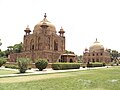 Tomb of Nithar and Khusrau
 -
 Nithar's tomb interior
 -
 Shah Begum's tomb
 -
 Mausoleums of Sultan Begum, Nithar Begum, and Khusrau; Khusru Bagh photographed in the 1870s.
 -
 Coloured aquatint by Thomas Daniell, 1796


_2015-11-12.jpg)


See also[edit | edit source]
References[edit | edit source]
- ↑ 1.0 1.1 Datta, Rangan (26 April 2023). "Khusro Bagh in Prayagraj: A silent witness of Mughal tradition and heritage". No. The Telegraph. My Kolkata. Retrieved 7 August 2023.
- ↑ 2.0 2.1 2.2 2.3 Rashid, Omar (22 September 2012). "Elegant tombs, unkempt greens". The Hindu.
- ↑ Khusru Bagh (Garden) at Allahabad, 1870s Archived 7 April 2009 at the Wayback Machine British Library.