



Ajay Kumar (talk | contribs) Created a new article |
Rajeev Menon (talk | contribs) slightly improved formatting to improve readability and cleaned formatting as per guidelines |
||
| Line 1: | Line 1: | ||
{{ | {{Short description|Senior military officer entitled to fly a flag of rank}} | ||
{{Military ranks}} | {{Military ranks}} | ||
A '''flag officer''' is a [[Officer (armed forces)|commissioned officer]] in a nation's [[armed forces]] senior enough to be entitled to fly a [[flag]] to mark the position from which that officer exercises command. | |||
*In many countries, a flag officer is a senior officer of the [[navy]], specifically | Different countries use the term "flag officer" in different ways: | ||
*In some countries, such as | |||
*In most Arab armies, ''liwa'' (Arabic: لواء), which can be translated as flag officer, is a specific rank, equivalent to a [[major general]]. However, | * In many countries, such as the [[United States]], a flag officer is a senior officer of the [[navy]], specifically one holding any of the [[admiral]] ranks; the term may or may not include the [[Military rank|rank]] of [[Commodore (rank)|commodore]].<ref>{{Cite web |title=Statutory Framework for Congressional Management of DOD General and Flag Officers |url=https://www.congress.gov/crs-product/R44389 |access-date=2026-02-09 |website=www.congress.gov}}</ref> | ||
* In some countries, such as [[India]] and [[Bangladesh]], the designation may apply in all [[armed forces]], not just in the navy. This means generals can also be considered flag officers. | |||
* In most Arab armies, [[Liwa (Arabic) | ''liwa'']] (Arabic: لواء), which can be translated as "flag officer", is a specific rank, equivalent to a [[major general]]. However, [[Ensign (rank)| "ensign"]] is debatably a more exact literal translation of the word. In principle, a ''liwa'' commands several units called "flags" or "ensigns" (i.e. brigades, also called ''liwa''). | |||
* Russian navies refer to the approximate equivalent of a British Royal Navy flag officer as a {{lang | ru | flagman}} (флагман).<ref> | |||
[https://ru.wiktionary.org/wiki/%D1%84%D0%BB%D0%B0%D0%B3%D0%BC%D0%B0%D0%BD флагман] | |||
</ref> Before the formation of the [[Soviet Navy]] in 1918, the [[Imperial Russian Navy]] also had officers with the function of a {{lang | ru | flag-ofitser}} (флаг-офицер), subordinate to a {{lang | ru | flagman}} and especially charged with adjutant duties and signals.<ref> | |||
[https://ru.wikisource.org/wiki/%D0%A2%D0%A1%D0%942/%D0%A4%D0%BB%D0%B0%D0%B3 Флаг-офице́р состоящий при флагмане, для сигналов и в виде адъютанта.] | |||
</ref> | |||
==General usage== | ==General usage== | ||
| Line 15: | Line 21: | ||
==Canada== | ==Canada== | ||
In the [[Canadian Armed Forces]], a flag officer ([[French language|French]]: ''officier général'', "general officer") is an [[admiral]], [[vice admiral]], [[rear admiral]], or [[Commodore_(Canada)|commodore]], the naval equivalent of a [[general officer]] of the army or air force. It is a somewhat counterintuitive usage of the term, as only flag officers in command of commands or formations actually have their own flags (technically a commodore has only a [[broad pennant]], not a flag), and army and air force generals in command of commands or formations also have their own flags, but are not called flag officers. Base commanders, usually full [[colonel]]s, have a pennant that flies from the mast or flagpole on the base, when resident, or on vehicles that carry them.<ref>Canada – National Defence: A-AD-200-000/AG-000 The Heritage Structure of the Canadian Forces, Chapter 14, Section 3.</ref> | In the [[Canadian Armed Forces]], a flag officer ([[French language|French]]: ''officier général'', "general officer") is an [[admiral]], [[vice admiral]], [[rear admiral]], or [[Commodore_(Canada)|commodore]], the naval equivalent of a [[general officer]] of the army or air force. It is a somewhat counterintuitive usage of the term, as only flag officers in command of commands or formations actually have their own flags (technically, a commodore has only a [[broad pennant]], not a flag), and army and air force generals in command of commands or formations also have their own flags, but are not called flag officers. Base commanders, usually full [[colonel]]s, have a pennant that flies from the mast or flagpole on the base, when resident, or on vehicles that carry them.<ref>Canada – National Defence: A-AD-200-000/AG-000 The Heritage Structure of the Canadian Forces, Chapter 14, Section 3.</ref> | ||
A flag officer's rank is denoted by a wide strip of gold braid on the cuff of the service dress tunic, one to four gold [[maple leaves]] over a crossed sword and baton, all beneath a royal crown, on [[epaulette]]s and [[Shoulder mark|shoulder board]]s; and two rows of gold oak leaves on the peak of the service cap.<ref>Canada - National Defence: "[http://www.forces.gc.ca/site/acf-apfc/Insig/navy-marine-eng.asp#gen/ Navy Rank and Appointment Insignia: Navy] {{webarchive|url=https://web.archive.org/web/20110814055417/http://www.forces.gc.ca/site/acf-apfc/Insig/navy-marine-eng.asp |date=2011-08-14 }}"</ref> Since the [[unification of the Canadian Forces]] in 1968, a flag officer's dress tunic had a single broad stripe on the sleeve and epaulettes. | A flag officer's rank is denoted by a wide strip of gold braid on the cuff of the service dress tunic, one to four gold [[maple leaves]] over a crossed sword and baton, all beneath a royal crown, on [[epaulette]]s and [[Shoulder mark|shoulder board]]s; and two rows of gold oak leaves on the peak of the service cap.<ref>Canada - National Defence: "[http://www.forces.gc.ca/site/acf-apfc/Insig/navy-marine-eng.asp#gen/ Navy Rank and Appointment Insignia: Navy] {{webarchive|url=https://web.archive.org/web/20110814055417/http://www.forces.gc.ca/site/acf-apfc/Insig/navy-marine-eng.asp |date=2011-08-14 }}"</ref> Since the [[unification of the Canadian Forces]] in 1968, a flag officer's dress tunic had a single broad stripe on the sleeve and epaulettes. | ||
In May 2010 the naval uniform dark dress tunic was adjusted—exterior epaulettes were removed, reverting to the sleeve ring and [[executive curl]]-rank insignia used by most navies. [[Commodore (rank)|commodore]]s' uniforms display a broad stripe, and each succeeding rank receives an additional sleeve ring. There are no epaulettes on the exterior of the tunic, but they are still worn on the uniform shirt underneath.<ref>Note: The referenced website, above, has not yet been updated to reflect the change as of July 9, 2010.</ref> | In May 2010, the naval uniform dark dress tunic was adjusted—exterior epaulettes were removed, reverting to the sleeve ring and [[executive curl]]-rank insignia used by most navies. [[Commodore (rank)|commodore]]s' uniforms display a broad stripe, and each succeeding rank receives an additional sleeve ring. There are no epaulettes on the exterior of the tunic, but they are still worn on the uniform shirt underneath.<ref>Note: The referenced website, above, has not yet been updated to reflect the change as of July 9, 2010.</ref> | ||
==India== | ==India== | ||
{{see also|Indian Armed Forces rank flags}} | {{see also|Indian Armed Forces rank flags}} | ||
In the [[Indian Armed Forces]], it is applied to [[Brigadier (India)|brigadier]]s, [[Major general (India)|major general]]s, [[Lieutenant general (India)|lieutenant general]]s and [[General (India)|general]]s in the [[Indian Army|Army]]; [[Commodore (India)|commodores]], [[Rear admiral (India)|rear admiral]]s, [[Vice Admiral (India)|vice admiral]]s and [[Admiral (India)|admiral]]s in the [[Indian Navy|Navy]]; and [[Air commodore (India)|air commodore]]s, [[Air vice marshal (India)|air vice marshal]]s, [[Air marshal (India)|air marshal]]s and [[Air chief marshal (India)|air chief marshal]]s in the [[Indian Air Force|Air Force]]. Each of these flag officers | In the [[Indian Armed Forces]], it is applied to [[Brigadier (India)|brigadier]]s, [[Major general (India)|major general]]s, [[Lieutenant general (India)|lieutenant general]]s and [[General (India)|general]]s in the [[Indian Army|Army]]; [[Commodore (India)|commodores]], [[Rear admiral (India)|rear admiral]]s, [[Vice Admiral (India)|vice admiral]]s and [[Admiral (India)|admiral]]s in the [[Indian Navy|Navy]]; and [[Air commodore (India)|air commodore]]s, [[Air vice marshal (India)|air vice marshal]]s, [[Air marshal (India)|air marshal]]s and [[Air chief marshal (India)|air chief marshal]]s in the [[Indian Air Force|Air Force]]. Each of these flag officers is designated with a specific flag. India's honorary ranks ([[five star rank]]s) are [[Field marshal (India)|field marshal]] in the Army, [[Marshal of the Indian Air Force]] in the Air Force and [[admiral of the fleet]] in the Navy. A similar equivalence is applied to senior police officers of rank [[Deputy inspector general of police|Deputy Inspector General (DIG)]], [[Inspector general|Inspector General (IG)]], [[Additional director general of police|Additional Director General (ADG)]] and [[Director general of police|Director General (DG)]]. | ||
==United Kingdom== | ==United Kingdom== | ||
In the United Kingdom, the term is | In the United Kingdom, the term is used for only the [[Royal Navy]], with there being a more specific distinction between a "flag officer" and an "officer of flag rank". Formerly, all officers promoted to flag rank were considered to be "flag officers".<ref>See e.g.''King's Regulations and Admiralty Instructions Volume I 1913.'', §192</ref> The term is still widely used to refer to any officer of flag rank. Present usage is that [[Rear admiral (Royal Navy)|rear admirals]] and above are officers of flag rank, but only those officers who are authorised to fly a flag are formally called "flag officers" and have different flags for different ranks of [[Admiral (United Kingdom)|admiral]].<ref>{{cite web |url=https://www.royalnavy.mod.uk/-/media/royal-navy-responsive/documents/reference-library/brd2/brd_2_book.pdf?la=en-gb&hash=F885CC19F9BA23B8BE3A9E1DE0E25CA8 |title=BRd 2 THE QUEEN'S REGULATIONS FOR THE ROYAL NAVY Version 5 |author=<!--Not stated--> |date=1 April 2017 |website=royalnavy.mod.uk |publisher=UK Defence Council |access-date=9 November 2020 |quote=Flag Officer. An officer of the rank of Rear-Admiral or above. |archive-date=9 November 2020 |archive-url=https://web.archive.org/web/20201109072148/https://www.royalnavy.mod.uk/-/media/royal-navy-responsive/documents/reference-library/brd2/brd_2_book.pdf?la=en-gb&hash=F885CC19F9BA23B8BE3A9E1DE0E25CA8 |url-status=dead }}</ref> | ||
Of the 39 officers of flag rank in the Royal Navy in 2006, very few were "flag officers" with entitlement to fly a flag. For example, a [[Commander-in-Chief Fleet]] flies an admiral's flag whether ashore or afloat and is a "flag officer". The chief of staff (support), a rear admiral, is not entitled to fly a flag and is an "officer of flag rank" rather than a "flag officer". [[List of fleets and major commands of the Royal Navy]] lists most admirals who were "flag officers". A flag officer's junior officer is often known as "Flags".{{citation needed|date=June 2014}} Flag Officers in the Royal Navy are considered as Rear-Admirals and above.<ref>{{cite web |url=https://www.royalnavy.mod.uk/-/media/royal-navy-responsive/documents/reference-library/brd2/brd_2_book.pdf?la=en-gb&hash=F885CC19F9BA23B8BE3A9E1DE0E25CA8 |title=BRd 2 THE QUEEN'S REGULATIONS FOR THE ROYAL NAVY Version 5 |author=<!--Not stated--> |date=1 April 2017 |website=royalnavy.mod.uk |publisher=UK Defence Council |access-date=9 November 2020 |quote=Flag Officer. An officer of the rank of Rear-Admiral or above. |archive-date=9 November 2020 |archive-url=https://web.archive.org/web/20201109072148/https://www.royalnavy.mod.uk/-/media/royal-navy-responsive/documents/reference-library/brd2/brd_2_book.pdf?la=en-gb&hash=F885CC19F9BA23B8BE3A9E1DE0E25CA8 |url-status=dead }}</ref> | Of the 39 officers of flag rank in the Royal Navy in 2006, very few were "flag officers" with entitlement to fly a flag. For example, a [[Commander-in-Chief Fleet]] flies an admiral's flag whether ashore or afloat and is a "flag officer". The chief of staff (support), a rear admiral, is not entitled to fly a flag and is an "officer of flag rank" rather than a "flag officer". [[List of fleets and major commands of the Royal Navy]] lists most admirals who were "flag officers". A flag officer's junior officer is often known as "Flags".{{citation needed|date=June 2014}} Flag Officers in the Royal Navy are considered as Rear-Admirals and above.<ref>{{cite web |url=https://www.royalnavy.mod.uk/-/media/royal-navy-responsive/documents/reference-library/brd2/brd_2_book.pdf?la=en-gb&hash=F885CC19F9BA23B8BE3A9E1DE0E25CA8 |title=BRd 2 THE QUEEN'S REGULATIONS FOR THE ROYAL NAVY Version 5 |author=<!--Not stated--> |date=1 April 2017 |website=royalnavy.mod.uk |publisher=UK Defence Council |access-date=9 November 2020 |quote=Flag Officer. An officer of the rank of Rear-Admiral or above. |archive-date=9 November 2020 |archive-url=https://web.archive.org/web/20201109072148/https://www.royalnavy.mod.uk/-/media/royal-navy-responsive/documents/reference-library/brd2/brd_2_book.pdf?la=en-gb&hash=F885CC19F9BA23B8BE3A9E1DE0E25CA8 |url-status=dead }}</ref> | ||
Equivalent ranks in the [[British Army]] and [[Royal Marines]] are called [[general officer]] rather than flag officers, and those in the [[Royal Air Force]] (as well as the rank of [[air commodore]]) are called [[air officer]]s, although all are entitled to fly flags of rank.{{citation needed|date=November 2020}} | Equivalent ranks in the [[British Army]] and [[Royal Marines]] are called [[general officer]]s rather than flag officers, and those in the [[Royal Air Force]] (as well as the rank of [[air commodore]]) are called [[air officer]]s, although all are entitled to fly flags of rank.{{citation needed|date=November 2020}} | ||
==United States== | ==United States== | ||
<!-- [[United States Senate]] links here --> | <!-- [[United States Senate]] links here --> | ||
{{Overly detailed|section|date=February 2026}} | |||
{{See also|Admiral (United States)#History}} | {{See also|Admiral (United States)#History}} | ||
The term "flag officer" is still in use today, explicitly defined as an officer of the U.S. Navy or Coast Guard serving in or having the grade of admiral, vice admiral, rear admiral, or rear admiral (lower half),<ref name=code>{{Cite web |url=https://www.law.cornell.edu/uscode/text/10/101- |title=§101 of Title 10, US Code on law.cornell.edu |access-date=2017-05-09 |archive-date=2023-03-24 |archive-url=https://web.archive.org/web/20230324122438/https://www.law.cornell.edu/uscode/text/10/101 |url-status=live }}</ref> equivalent to general officers of an army. | Captain was the highest rank in the [[United States Navy]] from its beginning in 1775 until 1857. The early US republic felt that the title Admiral was "too royal" for a country without a king.<ref>{{Cite web |title=Insignia: The Way You Tell Who's Who in the Military |url=https://www.dvidshub.net/news/529004/insignia-way-you-tell-whos-who-military |access-date=2025-07-30 |website=DVIDS |language=en}}</ref> By 1852, the Navy had the ranks of Captain, Senior Captain and Commander-in-Chief of a Squadron.<ref>{{Cite web |title=Uniform Regulations, 1852 |url=https://www.history.navy.mil/research/library/online-reading-room/title-list-alphabetically/u/1852.html |archive-url=https://web.archive.org/web/20250401034045/https://www.history.navy.mil/research/library/online-reading-room/title-list-alphabetically/u/1852.html |archive-date=2025-04-01 |access-date=2025-07-30 |website=www.history.navy.mil |language=en-US |url-status=live }}</ref> | ||
From at least the early 1800s, commodores flew broad pennants as a sign of their command, an early example of this was [[William Bainbridge|Commodore William Bainbridge]] who flew one from his command the [[USS President (1800)|USS President]] in 1808 [https://www.history.navy.mil/research/histories/ship-histories/danfs/b/bainbridge-i.html]. These pennants were usually swallow-tailed and blue after the tradition of the British Royal Navy.<ref>{{Cite web |title=Broad pennant {{!}} Royal Museums Greenwich |url=https://www.rmg.co.uk/collections/objects/rmgc-object-902 |access-date=2025-07-30 |website=www.rmg.co.uk}}</ref> | |||
In 1857, [[United States Congress|Congress]] created the temporary rank of flag officer, which was bestowed on senior Navy [[Captain (United States O-6)|captains]] who were assigned to lead a squadron of vessels in addition to command of their own ship.<ref>{{cite web|url=https://www.history.navy.mil/research/library/online-reading-room/title-list-alphabetically/w/naval-traditions-names-of-rank/officer/navy-captain.html|title=Naval History and Heritage Command - Navy Captain|website=History.navy.mil|date=13 May 2014|access-date=8 June 2016|archive-date=23 October 2016|archive-url=https://web.archive.org/web/20161023223349/https://www.history.navy.mil/research/library/online-reading-room/title-list-alphabetically/w/naval-traditions-names-of-rank/officer/navy-captain.html|url-status=live}}</ref> This temporary usage gave way to the permanent ranks of commodore and rear admiral in 1862. The 1857 regulations allowed for a solid color rectangular flag to indicate a flag officer - blue represented the senior flag officer, red for the next most senior if two or more were present and white the third most senior.<ref name=":0">{{Cite web |title=Flag Officers of the U.S. Navy |url=https://www.seaflags.us/personal/fo.html |access-date=2025-07-30 |website=www.seaflags.us}}</ref> Otherwise a flag officer flew a blue flag and this would continue for Commodores until 1865. | |||
{| class="wikitable" | |||
|+ | |||
! colspan="3" |US Navy Flag Officer Flags 1857-1865<ref name=":0" /> | |||
|- | |||
|[[File:Flag of a United States Navy Flag Officer Senior 1857.png|upright=0.4|center|frameless]] | |||
|[[File:Flag of a United States Navy Flag Officer 1st Subordinate 1857.png|upright=0.4|center|frameless]] | |||
|[[File:Flag of a United States Navy Flag Officer 2nd Subordinate 1857.png|upright=0.4|center|frameless|border]] | |||
|- | |||
|{{Center|US Navy Senior Flag Officer (later Commodore) 1857-1865}} | |||
|{{Center|US Navy First Subordinate Flag Officer (later Commodore) 1857-1865}} | |||
|{{Center|US Navy Second Most Subordinate Flag Officer (later Commodore) 1857-1865}} | |||
|} | |||
Arguably the most famous naval figure of the US Civil War, [[David Farragut]], was one of the first Flag Officers and in 1862 after capturing New Orleans, Congress made him a [[Rear admiral (United States)|Rear Admiral]].<ref>{{Cite web |title=David G. Farragut |url=https://www.battlefields.org/learn/biographies/david-g-farragut |access-date=2025-07-30 |website=American Battlefield Trust |language=en}}</ref> After the [[Battle of Mobile Bay]] he was made a [[Vice admiral (United States)|Vice Admiral]] and finally after the war ended a full [[Admiral (United States)|Admiral]]. | |||
In 1865, the Navy regulations specified the flags of Vice and Rear Admirals. A Vice admiral was to have a blue flag with three white stars arranged in an equilateral triangle and a Rear admiral will have two stars arranged vertically. A Commodore's broad pennant will hold one white star on a blue pennant.<ref>{{Cite web |date=1865 |title=Regulations for the Government of the United States Navy. |url=https://archive.org/details/regulationsforg05statgoog/page/n248/mode/2up?q=flag |website=The Internet Archive}}</ref> | |||
{| class="wikitable" | |||
|+ | |||
! colspan="3" |US Navy Flag Officer's Flags 1865 Regulations | |||
|- | |||
|[[File:Flag of a United States Navy vice admiral.svg|center|frameless|upright=0.4]] | |||
|[[File:Flag of a United States Navy rear admiral.svg|center|frameless|upright=0.4]] | |||
|[[File:Flag of a United States Navy Commodore.svg|center|frameless|upright=0.4]] | |||
|- | |||
|{{Center|Vice Admiral's Flag 1865 Navy Regulations}} | |||
|{{Center|Rear Admiral's Flag 1865 Navy Regulations}} | |||
|{{Center|Commodore's Broad Pennant 1865 Navy Regulations}} | |||
|} | |||
From 1865 until 1915, no officer was promoted to Admiral except in special circumstances. The Congress felt that the rank of Admiral was a reward for gallantry in battle and not something the country should enshrine permanently.<ref name="USCongRec_48_H7126">{{cite book |url=https://books.google.com/books?id=rTFCAQAAMAAJ&pg=PA7126 |title=Congressional Record: Containing the Proceedings and Debates of the Sixty-Second Congress, Second Session |date=May 24, 1912 |publisher=U.S. Government Printing Office |volume=XLVIII |place=Washington, D.C. |page=7126 |via=Google Books}}</ref> After the Civil War, there were only two men promoted to Admiral - [[George Dewey]] in 1899 and [[David Porter (naval officer)|David Porter]] in 1870. | |||
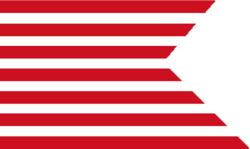
For a brief time, between 1870 and 1876, the Navy dropped the easy to recognize system of stars on flags, for the more complex flags of 13 stripes (resembling the [[first Navy Jack]]) and stars.<ref>{{Cite web |last=Langley |first=Harold D. |date=2003 |title=Military Collector & Historian |url=https://www.flagcollection.com/itemdetails-print.php?CollectionItem_ID=3226 |website=Zaricor Flag Collection}}</ref> | |||
{| class="wikitable" | |||
|+ | |||
! colspan="4" |US Navy Flag Officer's Flags 1870 | |||
|- | |||
|[[File:Flag of a United States Navy Admiral At The Main 1870.png|upright=0.4|thumb|Flag of a United States Navy Admiral At The Main 1870]] | |||
|[[File:Flag of a United States Navy vice admiral 1870.png|upright=0.4|thumb|Flag of a United States Navy Vice Admiral 1870]] | |||
|[[File:Flag of a United States Navy rear admiral 1870.png|upright=0.4|thumb|Flag of a United States Navy Rear Admiral 1870]] | |||
|[[File:Broad Pennant of a United States Navy Commodore 1870.png|upright=0.4|thumb|Broad Pennant of a US Navy Commodore 1870]] | |||
|} | |||
The 1876 Signal Book showed that there were four stars in a diamond shape on an Admiral's flag (for Porter) as well as red and white flags for both Rear Admirals and Commodores to indicate subordinates as with the previous Flag Officer flags of 1857.<ref name=":1">{{Cite book |last=United States. Navy Department. Bureau of Navigation |url=http://archive.org/details/generalsignalboo00unit |title=General signal book of the Navy of the United States of America |date=1876 |publisher=Washington : Govt. Print. Off |others=Phillips Library at The Peabody Essex Museum}}</ref> | |||
{| class="wikitable" | |||
! colspan="4" |US Navy Flag Officer's Flags 1876 Regulations<ref name=":1" /> | |||
|- | |||
|[[File:Flag of a United States Navy admiral.svg|center|frameless|upright=0.4]] | |||
|[[File:Flag of a United States Navy vice admiral.svg|center|frameless|upright=0.4]] | |||
|[[File:Flag of a United States Navy rear admiral.svg|center|frameless|upright=0.4]] | |||
|[[File:Flag of a United States Navy Commodore.svg|center|frameless|upright=0.4]] | |||
|- | |||
|{{Center|Admiral's Flag 1876 Navy Regulations}} | |||
|{{Center|Vice Admiral's Flag 1876 Navy Regulations}} | |||
|{{Center|Rear Admiral's Flag 1876 Navy Regulations}} | |||
|{{Center|Commodore's Broad Pennant 1876 Navy Regulations}} | |||
|- | |||
| | |||
| | |||
|[[File:Flag of a United States Navy rear admiral 1st subordinate 1876.png|center|frameless|upright=0.4]] | |||
|[[File:Flag of a United States Navy Commodore 1876 v2.png|center|frameless|upright=0.4]] | |||
|- | |||
| | |||
| | |||
|{{Center|Rear Admiral First Subordinate's Flag 1876 Regulations}} | |||
|{{Center|Commodore First Subordinate's Broad Pennant 1876 Regulations}} | |||
|- | |||
| | |||
| | |||
|[[File:Flag of a United States Navy rear admiral (non-executive).svg|center|frameless|upright=0.4]] | |||
|[[File:Flag of a United States Navy Commodore 1876 v3.png|center|frameless|upright=0.4]] | |||
|- | |||
| | |||
| | |||
|{{Center|Rear Admiral Second Subordinate's Flag 1876 Regulations}} | |||
|{{Center|Commodore Second Subordinate's Broad Pennant 1876 Regulations}} | |||
|} | |||
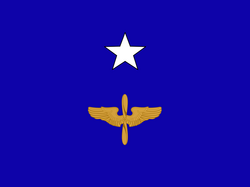
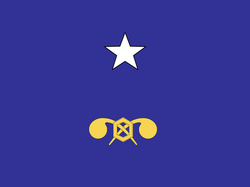
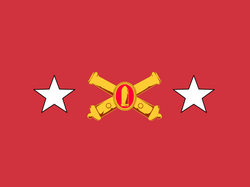
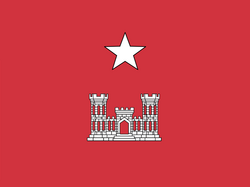
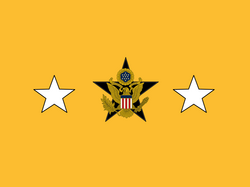
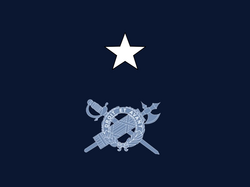
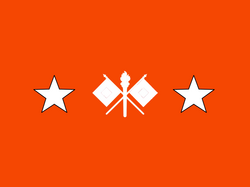
In 1903, the War Department first authorized flags for US Army general officers. The first flags were "boat flags" for when army officers visited navy ships. By 1923, these flags were expanded so that they were also for use on automobiles and field or office flags. Line officers were to have a scarlet flag with one to four stars based on rank. Staff officers flags would be in the colors of their branch with one or two stars and their branch insignia.<ref>{{Cite web |title=Brigadier General |url=https://tioh.army.mil/Catalog/Heraldry.aspx?HeraldryId=16174&CategoryId=9355&grp=2&menu=Uniformed%20Services&ps=24&p=0 |archive-url=https://web.archive.org/web/20250603090428/https://tioh.army.mil/Catalog/Heraldry.aspx?HeraldryId=16174&CategoryId=9355&grp=2&menu=Uniformed%20Services&ps=24&p=0 |archive-date=2025-06-03 |access-date=2025-08-02 |website=tioh.army.mil |language=en |url-status=live }}</ref> | |||
{| class="wikitable" | |||
|+ | |||
! colspan="4" |US Army General Officers Field / Office Flags 1923 | |||
|- | |||
|[[File:Flag of a United States Army brigadier general.svg|center|frameless|upright=0.4]] | |||
|[[File:Flag of a United States Army major general.svg|center|frameless|upright=0.4]] | |||
|[[File:Flag of a United States Army lieutenant general.svg|center|frameless|upright=0.4]] | |||
|[[File:Flag of a United States Army general.svg|center|frameless|upright=0.4]] | |||
|- | |||
|{{Center|Brigadier General's Flag 1923}} | |||
|{{Center|Major General's Flag 1926}} | |||
|{{Center|Lieutenant General's Flag 1923}} | |||
|{{Center|General's Flag 1923}} | |||
|- | |||
|[[File:US Army AG Corps 2 Star 1923.png|center|frameless|upright=0.4]] | |||
|[[File:US Army Air Corps 1 Star 1923.png|center|frameless|upright=0.4]] | |||
|[[File:US Army Chemical 1 Star 1923.png|center|frameless|upright=0.4]] | |||
|[[File:US Army Coast Arty 2 Star 1923.png|center|frameless|upright=0.4]] | |||
|- | |||
|{{Center|Adjutant Generals Corps Major General's Flag 1923}} | |||
|{{Center|Air Corps Brigadier General's Flag 1923}} | |||
|{{Center|Chemical Corps Brigadier General's Flag 1923}} | |||
|{{Center|Coastal Artillery Corps Major General's Flag 1923}} | |||
|- | |||
|[[File:US Army Engineer 1 Star 1923.png|center|frameless|upright=0.4]] | |||
|[[File:US Army Finance 2 Star 1923.png|center|frameless|upright=0.4]] | |||
|[[File:US Army General Staff 2 Star 1923.png|center|frameless|upright=0.4]] | |||
|[[File:US Army IG 1 Star 1923.png|center|frameless|upright=0.4]] | |||
|- | |||
|{{Center|Engineer Corps Brigadier General's Flag 1923}} | |||
|{{Center|Finance Corps Major General's Flag 1923}} | |||
|{{Center|General Staff Corps Major General's Flag 1923}} | |||
|{{Center|Inspector General Corps Brigadier General's Flag 1923}} | |||
|- | |||
|[[File:US Army Insular Affairs 2 Star 1923.png|center|frameless|upright=0.4]] | |||
|[[File:US Army JAG 1 Star 1923.png|center|frameless|upright=0.4]] | |||
|[[File:US Army Militia Bureau 2 Star 1923.png|center|frameless|upright=0.4]] | |||
|[[File:US Army Medical 1 Star 1923.png|center|frameless|upright=0.4]] | |||
|- | |||
|{{Center|Bureau of Insular Affairs Major General's Flag 1923}} | |||
|{{Center|Judge Advocate Corps Brigadier General's Flag 1923}} | |||
|{{Center|Militia Bureau Major General's Flag 1923}} | |||
|{{Center|Medical Department Brigadier General's Flag 1923}} | |||
|- | |||
| | |||
|[[File:US Army QM 1 Star 1923.png|center|frameless|upright=0.4]] | |||
|[[File:US Army Signal Corps 2 Star 1923.png|center|frameless|upright=0.4]] | |||
| | |||
|- | |||
| | |||
|{{Center|Quartermaster Corps Brigadier General's Flag 1923}} | |||
|{{Center|Signal Corps Major General's Flag 1923}} | |||
| | |||
|} | |||
In the 1920s, the Marine Corps first gave a flag to their commandant who was, at the time a major general.<ref>{{Cite web |title=Marine Corps - Major General (U.S.) |url=https://www.crwflags.com/fotw/flags/us%5Emc2s.html |access-date=2025-08-02 |website=www.crwflags.com}}</ref><ref>{{Cite web |title=Flags of the U.S. Marine Corps |url=https://www.seaflags.us/usmc/marine.html |access-date=2025-08-02 |website=www.seaflags.us}}</ref> In 1942 it was redesigned to reflect that their commandant was now a lieutenant general<ref>{{Cite web |last=Jackson |first=Myers |date=2022-03-19 |title=18th Commandant of USMC Artifact Tour |url=https://myersjackson.com/18th-commandant-of-usmc-artifact-tour/ |access-date=2025-08-02 |website=Myers Jackson, High Quality Real Estate Broker & Auctioneer |language=en-US}}</ref> and again in 1945 when their commandant was a full general.<ref>{{Cite web |title=Marine Corps - Commandant (U.S.) |url=https://www.crwflags.com/fotw/flags/us%5Emccos.html |access-date=2025-08-02 |website=www.crwflags.com}}</ref> The 1945 design would last until at least the early Cold War era when it would be replaced by the current design.<ref>{{Cite web |title=At Auction: Vintage 1978 Official Flag of the Commandant of the U.S. Marine Corps, Gen. Louis H. Wilson Jr. Era, DPSC Contract |url=https://www.invaluable.com/auction-lot/vintage-1978-official-flag-of-the-commandant-of-t-622367-c-ad9468bb8b |access-date=2025-08-02 |website=invaluable.com |language=en}}</ref> | |||
{| class="wikitable" | |||
|+ | |||
! colspan="4" |Flag Officer flags of the Commandant of the Marine Corps | |||
|- | |||
|[[File:Flag of a United States Marine Corps Commandant Major General 1920.png|center|frameless|upright=0.4]] | |||
|[[File:Flag of a United States Marine Corps Commandant Lieutenant General 1942.png|center|frameless|upright=0.4]] | |||
|[[File:Flag of the Commandant of the United States Marine Corps 1944.png|center|frameless|upright=0.4]] | |||
|[[File:Flag of the Commandant of the United States Marine Corps.svg|center|frameless|upright=0.4]] | |||
|- | |||
|{{Center|Flag of the Commandant of the Marine Corps 1920s}} | |||
|{{Center|Flag of the Commandant of the Marine Corps 1942}} | |||
|{{Center|Flag of the Commandant of the Marine Corps 1945}} | |||
|{{Center|Flag of the Commandant of the Marine Corps, Present Day}} | |||
|} | |||
In 1934, the [[United States Coast and Geodetic Survey|US Coast & Geodetic Survey]] created a new director's flag with a white triangle representing the C&GS and two white stars representing a Rear Admiral.<ref>{{Cite web |date=2024-06-14 |title=A proud tradition: The evolution of NOAA’s flags {{!}} National Oceanic and Atmospheric Administration |url=https://www.noaa.gov/heritage/stories/proud-tradition-evolution-of-noaas-flags |access-date=2025-08-03 |website=www.noaa.gov |language=en}}</ref> In 1936, [[Raymond Stanton Patton|Raymond Patton]] became the first Director of the C&GS that was a Rear Admiral. In 1965, the C&GS made [[Henry Arnold Karo|Henry A. Karo]] the first Vice Admiral as the organization became the [[Environmental Science Services Administration Corps]]. Finally, in 1985, the NOAA Corps like the other services split their Rear Admirals into a 2-star and 1-star version (Rear Admiral Lower Half). | |||
{| class="wikitable" | |||
|+ | |||
! colspan="3" |US NOAA Corps Flag Officer flags | |||
|- | |||
|[[File:NOAA Vice Admiral Flag.png|center|frameless|upright=0.4]] | |||
|[[File:NOAA Rear Admiral (upper half) Flag.png|center|frameless|upright=0.4]] | |||
|[[File:NOAA Rear Admiral (lower half) Flag.png|center|frameless|upright=0.4]] | |||
|- | |||
|{{Center|NOAA Corps Vice Admiral's Flag 1965}} | |||
|{{Center|NOAA Corps Rear Admiral's Flag 1934}} | |||
|{{Center|NOAA Corps Rear Admiral Lower Half's Flag 1985}} | |||
|} | |||
In 1940, the Navy dropped the red and white subordinate flags for Rear Admirals and Commodores.<ref name=":2">{{Cite web |title=Flag Officers of the U.S. Navy |url=https://www.seaflags.us/personal/fo.html |access-date=2025-07-30 |website=www.seaflags.us}}</ref> And in 1944 when the Navy created the rank of Fleet Admiral, they also authorized a new blue flag with five white stars arranged in a pentagon shape.<ref>{{Cite web |title=Flag Tells Story of the Stars |url=https://www.history.navy.mil/content/history/museums/nnam/education/articles/history-up-close/flag-tells-story-of-the-stars.html |archive-url=https://web.archive.org/web/20250401135020/https://www.history.navy.mil/content/history/museums/nnam/education/articles/history-up-close/flag-tells-story-of-the-stars.html |archive-date=2025-04-01 |access-date=2025-07-30 |website=www.history.navy.mil |language=en-US |url-status=live }}</ref> The most recent change was in 1948, when the Chief of Naval Operations created white flags for non-line officers such as medical, supply, chaplains, engineers, etc. The new flags would be for ranks of Rear Admiral (Lower Half) through Admiral. [[Commodore (United States)#World War II and the Cold War|Commodore rank]] was retired in 1948 as was any future promotions to [[Fleet admiral (United States)|Fleet Admiral]]. Both Rear Admiral (Lower Half) and Rear Admirals used a two-star flag.<ref name=":2" /> | |||
{| class="wikitable" | |||
! colspan="5" |US Navy Flag Officer's Flags 1948 Regulations<ref name=":2" /> | |||
|- | |||
|[[File:Flag of a United States Navy fleet admiral.svg|center|frameless|upright=0.4]] | |||
|[[File:Flag of a United States Navy admiral.svg|center|frameless|upright=0.4]] | |||
|[[File:Flag of a United States Navy vice admiral.svg|center|frameless|upright=0.4]] | |||
|[[File:Flag of a United States Navy rear admiral.svg|center|frameless|upright=0.4]] | |||
|[[File:Flag of a United States Navy rear admiral.svg|center|frameless|upright=0.4]] | |||
|- | |||
|{{Center|Fleet Admiral Flag (still in use in 1948) but no further promotions were authorized.}} | |||
|{{Center|Admiral's Flag 1948 Navy Regulations}} | |||
|{{Center|Vice Admiral's Flag 1948 Navy Regulations}} | |||
|{{Center|Rear Admiral's Flag 1948 Navy Regulations}} | |||
|{{Center|Rear Admiral (Lower Half) Flag 1948 Navy Regulations}} | |||
|- | |||
| | |||
|[[File:Flag of a United States Navy admiral (non-executive).svg|center|frameless|upright=0.4]] | |||
|[[File:Flag of a United States Navy vice admiral (non-executive).svg|center|frameless|upright=0.4]] | |||
|[[File:Flag of a United States Navy rear admiral (non-executive).svg|center|frameless|upright=0.4]] | |||
|[[File:Flag of a United States Navy rear admiral (non-executive).svg|center|frameless|upright=0.4]] | |||
|- | |||
| | |||
|{{Center|Admiral's Flag Restricted Line Officer / Staff Officer 1948 Navy Regulations}} | |||
|{{Center|Vice Admiral's Flag Restricted Line Officer / Staff Officer 1948 Navy Regulations}} | |||
|{{Center|Rear Admiral's Flag 1948 Restricted Line Officer / Staff Officer Navy Regulations}} | |||
|{{Center|Rear Admiral (Lower Half) Flag Restricted Line Officer / Staff Officer 1948 Navy Regulations}} | |||
|} | |||
Near the end of World War II, the Army and the Navy created five-star [[General of the Army (United States)|General of the Army]] and [[Fleet admiral (United States)|Fleet Admiral]] ranks. This was mainly to keep the American commanders from being "outranked" by British Field Marshalls and Admirals of the Fleet. The rank was authorized by Congress in 1944 and made "permanent" in 1946. General [[Henry H. Arnold]] was made [[General of the Air Force]] in 1947 having already been a General of the Army since 1944. The flags are no longer in use since the death of [[Omar Bradley|General Omar Bradley]] in 1981. | |||
{| class="wikitable" | |||
|+ | |||
! colspan="3" |5-Star Flag Officer Flags | |||
|- | |||
|[[File:Flag of a U.S. General of the Army.svg|center|frameless|upright=0.4]] | |||
|[[File:Flag of a United States Navy fleet admiral.svg|center|frameless|upright=0.4]] | |||
|[[File:Flag of a General of the Air Force of the United States.svg|center|frameless|upright=0.4]] | |||
|- | |||
|{{Center|General of the Army Flag 1944}} | |||
|{{Center|Admiral of the Fleet Flag 1944}} | |||
|{{Center|General of the Air Force Flag 1947}} | |||
|} | |||
At about the same time, the US Coast Guard was also developing new flags for their Admirals. The USCG had expanded greatly during World War II and was in the post-war was allowed a full admiral for its [[Commandant of the Coast Guard|commandant]]. Before the war, there are no reliable records as to whether the few Rear Admirals the USCG had were allowed flag officer flags or not. In 1945, the Coast Guard took the flags of the US Navy's admirals and added a white version of their official seal over crossed anchors.<ref>{{Cite web |title=U.S. Coast Guard Flags |url=https://www.seaflags.us/uscg/uscg.html |access-date=2025-07-31 |website=www.seaflags.us}}</ref> | |||
{| class="wikitable" | |||
! colspan="4" |US Coast Guard Flag Officer's Flags 1945 | |||
|- | |||
|[[File:Flag of a United States Coast Guard admiral.png|center|frameless|upright=0.4]] | |||
|[[File:Flag of a United States Coast Guard vice admiral.png|center|frameless|upright=0.4]] | |||
|[[File:Flag of a United States Coast Guard rear admiral.svg|center|frameless|upright=0.4]] | |||
|[[File:Flag of a United States Coast Guard rear admiral.svg|center|frameless|upright=0.4]] | |||
|- | |||
|{{Center|US Coast Guard Commandant's Flag 1945 }} | |||
|{{Center|US Coast Guard Vice Commandant's Flag 1945 }} | |||
|{{Center|US Coast Guard Rear Admiral's Flag 1945 }} | |||
|{{Center|US Coast Guard Rear Admiral (Lower Half) Flag 1945 }} | |||
|} | |||
In 1947, the US Air Force changed from the flags of the Army Air Force to the white on blue flags that they still use today and the first officer to get one was Harry "Hap" Arnold who was the General of the Air Force a five-star general.<ref>{{Cite web |title=Flag, General of the Air Force, H.H. Arnold {{!}} National Air and Space Museum |url=https://airandspace.si.edu/collection-objects/flag-general-of-the-air-force-hh-arnold/nasm_A19800475000# |access-date=2025-08-04 |website=airandspace.si.edu}}</ref> | |||
{| class="wikitable" | |||
|+ | |||
! colspan="5" |US Air Force General Officer Flags 1947 | |||
|- | |||
|[[File:Flag of a General of the Air Force of the United States.svg|center|frameless|upright=0.4]] | |||
|[[File:Flag of a United States Air Force general.svg|center|frameless|upright=0.4]] | |||
|[[File:Flag of a United States Air Force lieutenant general.svg|center|frameless|upright=0.4]] | |||
|[[File:Flag of a United States Air Force major general.svg|center|frameless|upright=0.4]] | |||
|[[File:Flag of a United States Air Force brigadier general.svg|center|frameless|upright=0.4]] | |||
|- | |||
|{{Center|Air Force General of the Air Force Flag 1947}} | |||
|{{Center|Air Force General Flag 1947}} | |||
|{{Center|Air Force Lieutenant General Flag 1947}} | |||
|{{Center|Air Force Major General Flag 1947}} | |||
|{{Center|Air Force Brigadier General Flag 1947}} | |||
|} | |||
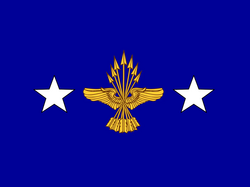
In 1975, the National Guard Bureau gave its Chief (a major general at the time) a positional color flag. It would not contain any stars like most flag officer's flags.<ref>{{Cite web |title=Wayback Machine |url=https://www.nationalguard.mil/About-the-Guard/Historical-Publications/Annual-Reports/FileId/134563/ |archive-url=http://web.archive.org/web/20250315231917/https://www.nationalguard.mil/About-the-Guard/Historical-Publications/Annual-Reports/FileId/134563/ |archive-date=2025-03-15 |access-date=2025-12-24 |website=www.nationalguard.mil}}</ref> The colors dark blue and ultramarine blue are to represent the Army and the Air Force, which make up the Guard.<ref>{{Cite web |title=National Guard Bureau (U.S.) |url=https://www.crwflags.com/fotw/flags/us%5Echng.html |access-date=2025-12-24 |website=www.crwflags.com}}</ref> The two gold arrowheads are "flight devices" representing the Air Guard. In 1998, the Bureau added the two scrolls. In 2008, the Guard would get the final version of the Chief's flag with four stars added and the flight devices removed. In 2012, the Vice Chief<ref>{{Cite web |title=Office of the Vice Chief, National Guard Bureau |url=https://tioh.army.mil/Catalog/HeraldryMulti.aspx?CategoryId=9354&grp=2&menu=Uniformed%20Services |archive-url=http://web.archive.org/web/20251116210304/https://tioh.army.mil/Catalog/HeraldryMulti.aspx?CategoryId=9354&grp=2&menu=Uniformed%20Services |archive-date=2025-11-16 |access-date=2025-12-24 |website=tioh.army.mil |language=en}}</ref> would get a three star version of the flag that resembled the Deputy Chief of Staff of the Army's pattern and in 2024, that flag would get its fourth star. | |||
{| class="wikitable" | |||
|+ | |||
! colspan="5" |National Guard Chief and Vice Chief Flags 1975-present | |||
|- | |||
|[[File:Flag of the Chief of the National Guard Bureau (1975).png|center|frameless|upright=0.4]] | |||
|[[File:Flag of the Chief of the National Guard Bureau (1998).png|center|frameless|upright=0.4]] | |||
|[[File:Flag of the National Guard Bureau.svg|center|frameless|upright=0.4]] | |||
|[[File:Flag of the Vice Chief of the National Guard Bureau.svg|center|frameless|upright=0.4]] | |||
|[[File:Flag of the Vice Chief of the National Guard Bureau (2024).png|center|frameless|upright=0.4]] | |||
|- | |||
|Flag of the Chief of the National Guard Bureau 1975–1998 | |||
|Flag of the Chief of the National Guard Bureau 1998–2008 | |||
|Flag of the Chief of the National Guard Bureau 2008–present | |||
|Flag of the Vice Chief of the National Guard Bureau 2012–2024 | |||
|Flag of the Vice Chief of the National Guard Bureau 2024–present | |||
|} | |||
In 1979, the US Coast Guard created a flag for the Commandant and the Vice Commandant that were similar to the Chief of Naval Operations and Vice Chief of Naval Operations. In 1985, both the Navy and the USCG changed Rear Admiral Lower Half to one star to match the O-7 Brigadier General ranks of the other services.<ref name=":3">{{Cite web |title=U.S. Coast Guard Flags |url=https://www.seaflags.us/uscg/uscg.html |access-date=2025-07-31 |website=www.seaflags.us}}</ref> In 2016, the USCG made the first Vice Commandant full admiral and thus a four-star Vice Commandant flag.<ref>{{Cite news |title=Admiral Charles D. Michel |url=https://www.history.uscg.mil/Browse-by-Topic/Notable-People/All/Article/1778350/admiral-charles-d-michel/ |archive-url=https://web.archive.org/web/20250708090543/https://www.history.uscg.mil/Browse-by-Topic/Notable-People/All/Article/1778350/admiral-charles-d-michel/ |archive-date=2025-07-08 |access-date=2025-08-01 |work=United States Coast Guard |language=en-US |url-status=live }}</ref> | |||
{| class="wikitable" | |||
|+ | |||
! colspan="6" |US Coast Guard Flag Officer's Flags 1979-present<ref name=":3" /> | |||
|- | |||
|[[File:Flag of the Commandant of the United States Coast Guard.svg|center|frameless|upright=0.4]] | |||
|[[File:Flag of the Vice Commandant of the United States Coast Guard.svg|center|frameless|upright=0.4]] | |||
|[[File:Flag of a United States Coast Guard admiral.png|center|frameless|upright=0.4]] | |||
|[[File:Flag of a United States Coast Guard vice admiral.png|center|frameless|upright=0.4]] | |||
|[[File:Flag of a United States Coast Guard rear admiral.svg|center|frameless|upright=0.4]] | |||
|[[File:USCG Rear Admiral Flag (Lower Half).svg|center|frameless|upright=0.4]] | |||
|- | |||
|{{Center|USCG Commandant's Flag 1979}} | |||
|{{Center|USCG Vice Commandant's Flag 1979}} | |||
|{{Center|US Coast Guard Admiral's Flag 1985 }} | |||
|{{Center|US Coast Guard Vice Admiral's Flag 1985 }} | |||
|{{Center|US Coast Guard Rear Admiral's Flag 1985 }} | |||
|{{Center|US Coast Guard Rear Admiral Lower Half's Flag 1985}} | |||
|} | |||
The term "flag officer" is still in use today, explicitly defined as an officer of the U.S. Navy or Coast Guard serving in or having the grade of admiral, vice admiral, rear admiral, or rear admiral (lower half),<ref name="code">{{Cite web |url=https://www.law.cornell.edu/uscode/text/10/101- |title=§101 of Title 10, US Code on law.cornell.edu |access-date=2017-05-09 |archive-date=2023-03-24 |archive-url=https://web.archive.org/web/20230324122438/https://www.law.cornell.edu/uscode/text/10/101 |url-status=live }}</ref> equivalent to general officers of an army. | |||
In the United States [[United States Army|Army]], [[United States Air Force|Air Force]], and [[United States Marine Corps|Marine Corps]], the term "flag officer" generally is applied to all general officers authorized to fly their own [[Flags of the United States Armed Forces#Personal flags|command flags]]—i.e., [[brigadier general (United States)|brigadier general]], or pay grade O-7, and above.<ref name="GENERAL AND FLAG OFFICER AUTHORIZATIONS FOR THE ACTIVE AND RESERVE COMPONENTS: A COMPARATIVE AND HISTORICAL ANALYSIS">{{cite web|last1=Offenhauer|first1=Priscilla|title=General and flag officer authorizations for the active and reserve components: A comparative and historical analysis |url=https://www.loc.gov/rr/frd/pdf-files/CNGR_General-Flag-Officer-Authorizations.pdf |publisher=Federal Research Division of the Library of Congress |date=December 2007|access-date=15 August 2015|archive-date=7 August 2015 |archive-url=https://web.archive.org/web/20150807062743/http://www.loc.gov/rr/frd/pdf-files/CNGR_General-Flag-Officer-Authorizations.pdf|url-status=live}}</ref><ref>Kapp, Lawrence. [https://fas.org/sgp/crs/natsec/R44389.pdf General and Flag Officers in the U.S. Armed Forces: Background and Considerations for Congress] {{Webarchive|url=https://web.archive.org/web/20160611145129/http://www.fas.org/sgp/crs/natsec/R44389.pdf |date=2016-06-11 }}, Congressional Research Service, February 18, 2016.</ref> As a matter of law, [[Title 10 of the United States Code]] makes a distinction between general officers and flag officers (general officer for the Army, Marine Corps, and Air Force; flag officer for the Navy and Coast Guard).<ref name=code/> Non-naval officers usually fly their flags from their headquarters, vessels, or vehicles, typically for only the most senior officer present.<ref>[http://www.apd.army.mil/pdffiles/r840_10.pdf Army Regulation 840-10, Flags, Guidons, Streamers, Tabards, and Automobile and Aircraft Plates] {{webarchive|url=https://web.archive.org/web/20100607221710/http://www.apd.army.mil/pdffiles/r840_10.pdf |date=2010-06-07 }}</ref><ref>[http://www.tioh.hqda.pentagon.mil/Flags_Guidons/GeneralOfficerFlags.htm Department of the Army Institute of Heraldry website on General Officer Flags] {{webarchive|url=https://web.archive.org/web/20080614035611/http://www.tioh.hqda.pentagon.mil/Flags_Guidons/GeneralOfficerFlags.htm |date=2008-06-14 }}</ref> | |||
In the United States, all flag and general officers must be nominated by the [[President of the United States|President]] and confirmed by the [[United States Senate|Senate]]. Each subsequent promotion requires renomination and re-approval. For the Navy, each flag officer assignment is usually limited to a maximum of two years, followed by either [[Up or out|reassignment, reassignment and promotion, or retirement]].<ref>{{Cite web |url=http://doni.daps.dla.mil/Directives/01000%20Military%20Personnel%20Support/01-300%20Assignment%20and%20Distribution%20Services/1300.15A.PDF |title=Chief of Naval Operations. Navy Military Personnel Assignment Policy |date=2006 |page=6 |access-date=2013-09-19 |archive-url=https://web.archive.org/web/20130224112019/https://doni.daps.dla.mil/Directives/01000%20Military%20Personnel%20Support/01-300%20Assignment%20and%20Distribution%20Services/1300.15A.PDF |archive-date=2013-02-24 |url-status=dead }}</ref> | |||
The chiefs of the various US military services have their own flags. The US Army was the first to develop a special flag for the Chief of Staff of the US Army in 1917.<ref>{{Cite web |title=Office of the Chief of Staff, United States Army |url=https://tioh.army.mil/Catalog/Heraldry.aspx?HeraldryId=16159&CategoryId=9353&grp=2&menu=Uniformed%20Services&ps=24&p=0 |archive-url=https://web.archive.org/web/20250603090807/https://tioh.army.mil/Catalog/Heraldry.aspx?HeraldryId=16159&CategoryId=9353&grp=2&menu=Uniformed%20Services&ps=24&p=0 |archive-date=2025-06-03 |access-date=2025-08-01 |website=tioh.army.mil |language=en |url-status=live }}</ref> The Navy created a flag for the Chief of Naval Operations in 1964.<ref>{{Cite web |title=Flag Officers of the U.S. Navy |url=https://www.seaflags.us/personal/fo.html |access-date=2025-08-01 |website=www.seaflags.us}}</ref> The Air Force redesigned their Chief of Staff's flag in 1977.<ref>{{Cite web |title=Air Force - Secretary of the Air Force (U.S.) |url=https://www.crwflags.com/fotw/flags/us%5Esecaf.html |access-date=2025-08-01 |website=www.crwflags.com}}</ref> The Coast Guard Commandant received a new design (similar to the CNO) in 1979.<ref name=":3" /> And the Space Force Chief of Space Operations got a flag quickly in 2020.<ref>{{Cite web |title=Space Force (U.S.) |url=https://www.crwflags.com/fotw/flags/us%5Esf.html |access-date=2025-08-01 |website=www.crwflags.com}}</ref> | |||
{| class="wikitable" | |||
|+ | |||
! colspan="5" |Flags of the Service Chief Flag Officers of the United States | |||
|- | |||
|[[File:Flag of the Chief of Staff of the United States Army.svg|center|frameless|upright=0.4]] | |||
|[[File:Flag of the United States Chief of Naval Operations.svg|center|frameless|upright=0.4]] | |||
|[[File:Flag of the Chief of Staff of the United States Air Force.svg|center|frameless|upright=0.4]] | |||
|[[File:Flag of the Commandant of the United States Coast Guard.svg|center|frameless|upright=0.4]] | |||
|[[File:Flag of the Chief of Space Operations.svg|center|frameless|upright=0.4]] | |||
|- | |||
|{{Center|Flag of the Chief of Staff US Army 1917}} | |||
|{{Center|Flag of the Chief of Naval Operations 1964}} | |||
|{{Center|Flag of the Chief of Staff of the US Air Force 1977}} | |||
|{{Center|Flag of the Commandant of the US Coast Guard 1979}} | |||
|{{Center|Flag of the Chief of Space Operations 2020}} | |||
|} | |||
The Flag of the Chief of Staff of the US Army began when Major General [[Hugh L. Scott]] was the CSA, as he and his immediate successor were 2-star generals, the flag has two stars.<ref>{{Cite book |last=National Geographic Society (U.S.) |url=https://www.biodiversitylibrary.org/item/125177 |title=The National geographic magazine |last2=Society (U.S.) |first2=National Geographic |date=1917 |publisher=National Geographic Society |volume=v.32:no.1-6 (1917) |location=Washington}}</ref> The flag would not get a third star until 1923 under Lt. Gen. [[John J. Pershing]].<ref>{{Cite web |title=Army - Lieutenant General (U.S.) |url=https://www.crwflags.com/fotw/flags/us%5Ear3s.html |access-date=2025-12-20 |website=www.crwflags.com}}</ref> The final design would happen under Gen. [[Charles Pelot Summerall|Charles Summerall]] in 1927. | |||
{| class="wikitable" | |||
|+ | |||
! colspan="3" |Historical Flags of the Chief of Staff of the United States Army | |||
|- | |||
|[[File:Flag of the Chief of Staff of the United States Army (1917).png|center|frameless|upright=0.4]] | |||
|[[File:Flag of the Chief of Staff of the United States Army (1923).png|center|frameless|upright=0.4]] | |||
|[[File:Flag of the Chief of Staff of the United States Army.svg|center|frameless|upright=0.4]] | |||
|- | |||
|{{Center|Flag of the Chief of Staff US Army 1917–1922}} | |||
|{{Center|Flag of the Chief of Staff US Army 1923–1927}} | |||
|{{Center|Flag of the Chief of Staff US Army 1927–present}} | |||
|} | |||
Beginning in 1949 with the US Army,<ref>{{Cite web |title=Positional Colors for Military Officials Headquarters Department of the Army |url=https://tioh.army.mil/Catalog/Heraldry.aspx?HeraldryId=16160&CategoryId=9353&grp=2&menu=Uniformed%20Services&ps=24&p=0 |access-date=August 1, 2025 |website=US Army Institute of Heraldry}}</ref> their deputies (or vice chiefs) began to also get a distinctive flag of office. In 2015, the USCG had its first full admiral Vice Commandant. | |||
{| class="wikitable" | |||
! colspan="5" |Flags of the Vice Service Chief Flag Officers of the United States | |||
|- | |||
|[[File:Flag of the Vice Chief of Staff of the United States Army.svg|center|frameless|upright=0.4]] | |||
|[[File:Flag of the United States Vice Chief of Naval Operations.svg|center|frameless|upright=0.4]] | |||
|[[File:Flag of the Vice Chief of Staff of the Air Force.svg|center|frameless|upright=0.4]] | |||
|[[File:Flag of the Vice Commandant of the United States Coast Guard.png|center|frameless|upright=0.4]] | |||
|[[File:Flag of the Vice Chief of Space Operations.svg|center|frameless|upright=0.4]] | |||
|- | |||
|{{Center|Flag of the Vice Chief of Staff US Army 1949}} | |||
|{{Center|Flag of the Vice Chief of Naval Operations 1970}} | |||
|{{Center|Flag of the Vice Chief of Staff of the US Air Force 1977}} | |||
|{{Center|Flag of the Vice Commandant of the US Coast Guard 2015}} | |||
|{{Center|Flag of the Vice Chief of Space Operations 2020}} | |||
|} | |||
The first Chairman of the Joint Chiefs of Staff, General Omar Bradley, had a special flag created for the CJCS in 1950.<ref>{{Cite web |date=January 26, 2019 |title=The Joint Staff |url=https://www.facebook.com/TheJointStaff/posts/otd-in-1950-the-official-flag-for-the-chairman-of-the-joint-chiefs-of-staff-was-/2049908435088923/ |website=Facebook}}</ref> The CJCS' deputy would get a flag in 1986.<ref>{{Cite web |title=Joint Chiefs of Staff |url=https://www.seaflags.us/personal/jcs.html |access-date=2025-08-02 |website=www.seaflags.us}}</ref> | |||
{| class="wikitable" | |||
|+ | |||
! colspan="2" |Flags of the Joint Chiefs of Staff flag officers | |||
|- | |||
|[[File:Flag of the Chairman of the U.S. Joint Chiefs of Staff.svg|center|frameless|upright=0.4]] | |||
|[[File:Flag of the Vice Chairman of the Joint Chiefs of Staff.svg|center|frameless|upright=0.4]] | |||
|- | |||
|{{Center|Flag of the Chairman of the Joint Chiefs of Staff 1950}} | |||
|{{Center|Flag of the Vice Chairman of the Joint Chiefs of Staff 1986}} | |||
|} | |||
==References== | ==References== | ||
Latest revision as of 06:37, 7 March 2026
A flag officer is a commissioned officer in a nation's armed forces senior enough to be entitled to fly a flag to mark the position from which that officer exercises command.
Different countries use the term "flag officer" in different ways:
- In many countries, such as the United States, a flag officer is a senior officer of the navy, specifically one holding any of the admiral ranks; the term may or may not include the rank of commodore.[1]
- In some countries, such as India and Bangladesh, the designation may apply in all armed forces, not just in the navy. This means generals can also be considered flag officers.
- In most Arab armies, liwa (Arabic: لواء), which can be translated as "flag officer", is a specific rank, equivalent to a major general. However, "ensign" is debatably a more exact literal translation of the word. In principle, a liwa commands several units called "flags" or "ensigns" (i.e. brigades, also called liwa).
- Russian navies refer to the approximate equivalent of a British Royal Navy flag officer as a flagman (флагман).[2] Before the formation of the Soviet Navy in 1918, the Imperial Russian Navy also had officers with the function of a flag-ofitser (флаг-офицер), subordinate to a flagman and especially charged with adjutant duties and signals.[3]
General usage[edit | edit source]
The generic title of flag officer is used in many modern navies and coast guards to denote those who hold the rank of rear admiral or its equivalent and above, also called "flag ranks". In some navies, this also includes the rank of commodore. Flag officer corresponds to the generic terms general officer, used by land and some air forces to describe all grades of generals, and air officer, used by other air forces to describe all grades of air marshals and air commodores.
A flag officer sometimes is a junior officer, called a flag lieutenant or flag adjutant, attached as a personal adjutant or aide-de-camp.
Canada[edit | edit source]
In the Canadian Armed Forces, a flag officer (French: officier général, "general officer") is an admiral, vice admiral, rear admiral, or commodore, the naval equivalent of a general officer of the army or air force. It is a somewhat counterintuitive usage of the term, as only flag officers in command of commands or formations actually have their own flags (technically, a commodore has only a broad pennant, not a flag), and army and air force generals in command of commands or formations also have their own flags, but are not called flag officers. Base commanders, usually full colonels, have a pennant that flies from the mast or flagpole on the base, when resident, or on vehicles that carry them.[4]
A flag officer's rank is denoted by a wide strip of gold braid on the cuff of the service dress tunic, one to four gold maple leaves over a crossed sword and baton, all beneath a royal crown, on epaulettes and shoulder boards; and two rows of gold oak leaves on the peak of the service cap.[5] Since the unification of the Canadian Forces in 1968, a flag officer's dress tunic had a single broad stripe on the sleeve and epaulettes.
In May 2010, the naval uniform dark dress tunic was adjusted—exterior epaulettes were removed, reverting to the sleeve ring and executive curl-rank insignia used by most navies. commodores' uniforms display a broad stripe, and each succeeding rank receives an additional sleeve ring. There are no epaulettes on the exterior of the tunic, but they are still worn on the uniform shirt underneath.[6]
India[edit | edit source]
In the Indian Armed Forces, it is applied to brigadiers, major generals, lieutenant generals and generals in the Army; commodores, rear admirals, vice admirals and admirals in the Navy; and air commodores, air vice marshals, air marshals and air chief marshals in the Air Force. Each of these flag officers is designated with a specific flag. India's honorary ranks (five star ranks) are field marshal in the Army, Marshal of the Indian Air Force in the Air Force and admiral of the fleet in the Navy. A similar equivalence is applied to senior police officers of rank Deputy Inspector General (DIG), Inspector General (IG), Additional Director General (ADG) and Director General (DG).
United Kingdom[edit | edit source]
In the United Kingdom, the term is used for only the Royal Navy, with there being a more specific distinction between a "flag officer" and an "officer of flag rank". Formerly, all officers promoted to flag rank were considered to be "flag officers".[7] The term is still widely used to refer to any officer of flag rank. Present usage is that rear admirals and above are officers of flag rank, but only those officers who are authorised to fly a flag are formally called "flag officers" and have different flags for different ranks of admiral.[8]
Of the 39 officers of flag rank in the Royal Navy in 2006, very few were "flag officers" with entitlement to fly a flag. For example, a Commander-in-Chief Fleet flies an admiral's flag whether ashore or afloat and is a "flag officer". The chief of staff (support), a rear admiral, is not entitled to fly a flag and is an "officer of flag rank" rather than a "flag officer". List of fleets and major commands of the Royal Navy lists most admirals who were "flag officers". A flag officer's junior officer is often known as "Flags".[citation needed] Flag Officers in the Royal Navy are considered as Rear-Admirals and above.[9]
Equivalent ranks in the British Army and Royal Marines are called general officers rather than flag officers, and those in the Royal Air Force (as well as the rank of air commodore) are called air officers, although all are entitled to fly flags of rank.[citation needed]
United States[edit | edit source]
 | This section may contain an excessive amount of intricate detail that may interest only a particular audience. (February 2026) |
Captain was the highest rank in the United States Navy from its beginning in 1775 until 1857. The early US republic felt that the title Admiral was "too royal" for a country without a king.[10] By 1852, the Navy had the ranks of Captain, Senior Captain and Commander-in-Chief of a Squadron.[11]
From at least the early 1800s, commodores flew broad pennants as a sign of their command, an early example of this was Commodore William Bainbridge who flew one from his command the USS President in 1808 [1]. These pennants were usually swallow-tailed and blue after the tradition of the British Royal Navy.[12]
In 1857, Congress created the temporary rank of flag officer, which was bestowed on senior Navy captains who were assigned to lead a squadron of vessels in addition to command of their own ship.[13] This temporary usage gave way to the permanent ranks of commodore and rear admiral in 1862. The 1857 regulations allowed for a solid color rectangular flag to indicate a flag officer - blue represented the senior flag officer, red for the next most senior if two or more were present and white the third most senior.[14] Otherwise a flag officer flew a blue flag and this would continue for Commodores until 1865.
| US Navy Flag Officer Flags 1857-1865[14] | ||
|---|---|---|
 |
 |
 |
US Navy Senior Flag Officer (later Commodore) 1857-1865
|
US Navy First Subordinate Flag Officer (later Commodore) 1857-1865
|
US Navy Second Most Subordinate Flag Officer (later Commodore) 1857-1865
|
Arguably the most famous naval figure of the US Civil War, David Farragut, was one of the first Flag Officers and in 1862 after capturing New Orleans, Congress made him a Rear Admiral.[15] After the Battle of Mobile Bay he was made a Vice Admiral and finally after the war ended a full Admiral.
In 1865, the Navy regulations specified the flags of Vice and Rear Admirals. A Vice admiral was to have a blue flag with three white stars arranged in an equilateral triangle and a Rear admiral will have two stars arranged vertically. A Commodore's broad pennant will hold one white star on a blue pennant.[16]
| US Navy Flag Officer's Flags 1865 Regulations | ||
|---|---|---|
 |
 |
 |
Vice Admiral's Flag 1865 Navy Regulations
|
Rear Admiral's Flag 1865 Navy Regulations
|
Commodore's Broad Pennant 1865 Navy Regulations
|
From 1865 until 1915, no officer was promoted to Admiral except in special circumstances. The Congress felt that the rank of Admiral was a reward for gallantry in battle and not something the country should enshrine permanently.[17] After the Civil War, there were only two men promoted to Admiral - George Dewey in 1899 and David Porter in 1870.
For a brief time, between 1870 and 1876, the Navy dropped the easy to recognize system of stars on flags, for the more complex flags of 13 stripes (resembling the first Navy Jack) and stars.[18]
| US Navy Flag Officer's Flags 1870 | |||
|---|---|---|---|
 |
 |
 |
 |
The 1876 Signal Book showed that there were four stars in a diamond shape on an Admiral's flag (for Porter) as well as red and white flags for both Rear Admirals and Commodores to indicate subordinates as with the previous Flag Officer flags of 1857.[19]
| US Navy Flag Officer's Flags 1876 Regulations[19] | |||
|---|---|---|---|
 |
|
|
|
Admiral's Flag 1876 Navy Regulations
|
Vice Admiral's Flag 1876 Navy Regulations
|
Rear Admiral's Flag 1876 Navy Regulations
|
Commodore's Broad Pennant 1876 Navy Regulations
|
 |
 | ||
Rear Admiral First Subordinate's Flag 1876 Regulations
|
Commodore First Subordinate's Broad Pennant 1876 Regulations
| ||
.svg) |
 | ||
Rear Admiral Second Subordinate's Flag 1876 Regulations
|
Commodore Second Subordinate's Broad Pennant 1876 Regulations
| ||
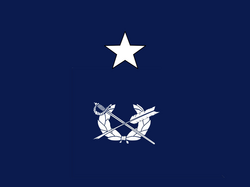
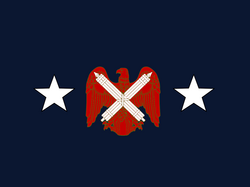
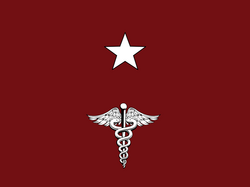
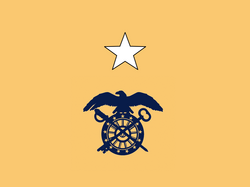
In 1903, the War Department first authorized flags for US Army general officers. The first flags were "boat flags" for when army officers visited navy ships. By 1923, these flags were expanded so that they were also for use on automobiles and field or office flags. Line officers were to have a scarlet flag with one to four stars based on rank. Staff officers flags would be in the colors of their branch with one or two stars and their branch insignia.[20]
| US Army General Officers Field / Office Flags 1923 | |||
|---|---|---|---|
 |
 |
 |
 |
Brigadier General's Flag 1923
|
Major General's Flag 1926
|
Lieutenant General's Flag 1923
|
General's Flag 1923
|
 |
 |
 |
 |
Adjutant Generals Corps Major General's Flag 1923
|
Air Corps Brigadier General's Flag 1923
|
Chemical Corps Brigadier General's Flag 1923
|
Coastal Artillery Corps Major General's Flag 1923
|
 |
 |
 |
 |
Engineer Corps Brigadier General's Flag 1923
|
Finance Corps Major General's Flag 1923
|
General Staff Corps Major General's Flag 1923
|
Inspector General Corps Brigadier General's Flag 1923
|
 |
 |
 |
 |
Bureau of Insular Affairs Major General's Flag 1923
|
Judge Advocate Corps Brigadier General's Flag 1923
|
Militia Bureau Major General's Flag 1923
|
Medical Department Brigadier General's Flag 1923
|
 |
 |
||
Quartermaster Corps Brigadier General's Flag 1923
|
Signal Corps Major General's Flag 1923
|
||
In the 1920s, the Marine Corps first gave a flag to their commandant who was, at the time a major general.[21][22] In 1942 it was redesigned to reflect that their commandant was now a lieutenant general[23] and again in 1945 when their commandant was a full general.[24] The 1945 design would last until at least the early Cold War era when it would be replaced by the current design.[25]
| Flag Officer flags of the Commandant of the Marine Corps | |||
|---|---|---|---|
 |
 |
 |
 |
Flag of the Commandant of the Marine Corps 1920s
|
Flag of the Commandant of the Marine Corps 1942
|
Flag of the Commandant of the Marine Corps 1945
|
Flag of the Commandant of the Marine Corps, Present Day
|
In 1934, the US Coast & Geodetic Survey created a new director's flag with a white triangle representing the C&GS and two white stars representing a Rear Admiral.[26] In 1936, Raymond Patton became the first Director of the C&GS that was a Rear Admiral. In 1965, the C&GS made Henry A. Karo the first Vice Admiral as the organization became the Environmental Science Services Administration Corps. Finally, in 1985, the NOAA Corps like the other services split their Rear Admirals into a 2-star and 1-star version (Rear Admiral Lower Half).
| US NOAA Corps Flag Officer flags | ||
|---|---|---|
 |
_Flag.png) |
_Flag.png) |
NOAA Corps Vice Admiral's Flag 1965
|
NOAA Corps Rear Admiral's Flag 1934
|
NOAA Corps Rear Admiral Lower Half's Flag 1985
|
In 1940, the Navy dropped the red and white subordinate flags for Rear Admirals and Commodores.[27] And in 1944 when the Navy created the rank of Fleet Admiral, they also authorized a new blue flag with five white stars arranged in a pentagon shape.[28] The most recent change was in 1948, when the Chief of Naval Operations created white flags for non-line officers such as medical, supply, chaplains, engineers, etc. The new flags would be for ranks of Rear Admiral (Lower Half) through Admiral. Commodore rank was retired in 1948 as was any future promotions to Fleet Admiral. Both Rear Admiral (Lower Half) and Rear Admirals used a two-star flag.[27]
| US Navy Flag Officer's Flags 1948 Regulations[27] | ||||
|---|---|---|---|---|
 |
|
|
|
|
Fleet Admiral Flag (still in use in 1948) but no further promotions were authorized.
|
Admiral's Flag 1948 Navy Regulations
|
Vice Admiral's Flag 1948 Navy Regulations
|
Rear Admiral's Flag 1948 Navy Regulations
|
Rear Admiral (Lower Half) Flag 1948 Navy Regulations
|
.svg) |
.svg) |
|
| |
Admiral's Flag Restricted Line Officer / Staff Officer 1948 Navy Regulations
|
Vice Admiral's Flag Restricted Line Officer / Staff Officer 1948 Navy Regulations
|
Rear Admiral's Flag 1948 Restricted Line Officer / Staff Officer Navy Regulations
|
Rear Admiral (Lower Half) Flag Restricted Line Officer / Staff Officer 1948 Navy Regulations
| |
Near the end of World War II, the Army and the Navy created five-star General of the Army and Fleet Admiral ranks. This was mainly to keep the American commanders from being "outranked" by British Field Marshalls and Admirals of the Fleet. The rank was authorized by Congress in 1944 and made "permanent" in 1946. General Henry H. Arnold was made General of the Air Force in 1947 having already been a General of the Army since 1944. The flags are no longer in use since the death of General Omar Bradley in 1981.
| 5-Star Flag Officer Flags | ||
|---|---|---|
 |
|
 |
General of the Army Flag 1944
|
Admiral of the Fleet Flag 1944
|
General of the Air Force Flag 1947
|
At about the same time, the US Coast Guard was also developing new flags for their Admirals. The USCG had expanded greatly during World War II and was in the post-war was allowed a full admiral for its commandant. Before the war, there are no reliable records as to whether the few Rear Admirals the USCG had were allowed flag officer flags or not. In 1945, the Coast Guard took the flags of the US Navy's admirals and added a white version of their official seal over crossed anchors.[29]
| US Coast Guard Flag Officer's Flags 1945 | |||
|---|---|---|---|
 |
 |
 |
|
US Coast Guard Commandant's Flag 1945
|
US Coast Guard Vice Commandant's Flag 1945
|
US Coast Guard Rear Admiral's Flag 1945
|
US Coast Guard Rear Admiral (Lower Half) Flag 1945
|
In 1947, the US Air Force changed from the flags of the Army Air Force to the white on blue flags that they still use today and the first officer to get one was Harry "Hap" Arnold who was the General of the Air Force a five-star general.[30]
| US Air Force General Officer Flags 1947 | ||||
|---|---|---|---|---|
|
 |
 |
 |
 |
Air Force General of the Air Force Flag 1947
|
Air Force General Flag 1947
|
Air Force Lieutenant General Flag 1947
|
Air Force Major General Flag 1947
|
Air Force Brigadier General Flag 1947
|
In 1975, the National Guard Bureau gave its Chief (a major general at the time) a positional color flag. It would not contain any stars like most flag officer's flags.[31] The colors dark blue and ultramarine blue are to represent the Army and the Air Force, which make up the Guard.[32] The two gold arrowheads are "flight devices" representing the Air Guard. In 1998, the Bureau added the two scrolls. In 2008, the Guard would get the final version of the Chief's flag with four stars added and the flight devices removed. In 2012, the Vice Chief[33] would get a three star version of the flag that resembled the Deputy Chief of Staff of the Army's pattern and in 2024, that flag would get its fourth star.
| National Guard Chief and Vice Chief Flags 1975-present | ||||
|---|---|---|---|---|
.png) |
.png) |
 |
 |
.png) |
| Flag of the Chief of the National Guard Bureau 1975–1998 | Flag of the Chief of the National Guard Bureau 1998–2008 | Flag of the Chief of the National Guard Bureau 2008–present | Flag of the Vice Chief of the National Guard Bureau 2012–2024 | Flag of the Vice Chief of the National Guard Bureau 2024–present |
In 1979, the US Coast Guard created a flag for the Commandant and the Vice Commandant that were similar to the Chief of Naval Operations and Vice Chief of Naval Operations. In 1985, both the Navy and the USCG changed Rear Admiral Lower Half to one star to match the O-7 Brigadier General ranks of the other services.[34] In 2016, the USCG made the first Vice Commandant full admiral and thus a four-star Vice Commandant flag.[35]
| US Coast Guard Flag Officer's Flags 1979-present[34] | |||||
|---|---|---|---|---|---|
 |
 |
|
|
|
.svg) |
USCG Commandant's Flag 1979
|
USCG Vice Commandant's Flag 1979
|
US Coast Guard Admiral's Flag 1985
|
US Coast Guard Vice Admiral's Flag 1985
|
US Coast Guard Rear Admiral's Flag 1985
|
US Coast Guard Rear Admiral Lower Half's Flag 1985
|
The term "flag officer" is still in use today, explicitly defined as an officer of the U.S. Navy or Coast Guard serving in or having the grade of admiral, vice admiral, rear admiral, or rear admiral (lower half),[36] equivalent to general officers of an army.
In the United States Army, Air Force, and Marine Corps, the term "flag officer" generally is applied to all general officers authorized to fly their own command flags—i.e., brigadier general, or pay grade O-7, and above.[37][38] As a matter of law, Title 10 of the United States Code makes a distinction between general officers and flag officers (general officer for the Army, Marine Corps, and Air Force; flag officer for the Navy and Coast Guard).[36] Non-naval officers usually fly their flags from their headquarters, vessels, or vehicles, typically for only the most senior officer present.[39][40]
In the United States, all flag and general officers must be nominated by the President and confirmed by the Senate. Each subsequent promotion requires renomination and re-approval. For the Navy, each flag officer assignment is usually limited to a maximum of two years, followed by either reassignment, reassignment and promotion, or retirement.[41]
The chiefs of the various US military services have their own flags. The US Army was the first to develop a special flag for the Chief of Staff of the US Army in 1917.[42] The Navy created a flag for the Chief of Naval Operations in 1964.[43] The Air Force redesigned their Chief of Staff's flag in 1977.[44] The Coast Guard Commandant received a new design (similar to the CNO) in 1979.[34] And the Space Force Chief of Space Operations got a flag quickly in 2020.[45]
| Flags of the Service Chief Flag Officers of the United States | ||||
|---|---|---|---|---|
 |
 |
 |
|
 |
Flag of the Chief of Staff US Army 1917
|
Flag of the Chief of Naval Operations 1964
|
Flag of the Chief of Staff of the US Air Force 1977
|
Flag of the Commandant of the US Coast Guard 1979
|
Flag of the Chief of Space Operations 2020
|
The Flag of the Chief of Staff of the US Army began when Major General Hugh L. Scott was the CSA, as he and his immediate successor were 2-star generals, the flag has two stars.[46] The flag would not get a third star until 1923 under Lt. Gen. John J. Pershing.[47] The final design would happen under Gen. Charles Summerall in 1927.
| Historical Flags of the Chief of Staff of the United States Army | ||
|---|---|---|
.png) |
.png) |
|
Flag of the Chief of Staff US Army 1917–1922
|
Flag of the Chief of Staff US Army 1923–1927
|
Flag of the Chief of Staff US Army 1927–present
|
Beginning in 1949 with the US Army,[48] their deputies (or vice chiefs) began to also get a distinctive flag of office. In 2015, the USCG had its first full admiral Vice Commandant.
| Flags of the Vice Service Chief Flag Officers of the United States | ||||
|---|---|---|---|---|
 |
 |
 |
 |
 |
Flag of the Vice Chief of Staff US Army 1949
|
Flag of the Vice Chief of Naval Operations 1970
|
Flag of the Vice Chief of Staff of the US Air Force 1977
|
Flag of the Vice Commandant of the US Coast Guard 2015
|
Flag of the Vice Chief of Space Operations 2020
|
The first Chairman of the Joint Chiefs of Staff, General Omar Bradley, had a special flag created for the CJCS in 1950.[49] The CJCS' deputy would get a flag in 1986.[50]
| Flags of the Joint Chiefs of Staff flag officers | |
|---|---|
 |
 |
Flag of the Chairman of the Joint Chiefs of Staff 1950
|
Flag of the Vice Chairman of the Joint Chiefs of Staff 1986
|
References[edit | edit source]
- ↑ "Statutory Framework for Congressional Management of DOD General and Flag Officers". www.congress.gov. Retrieved 2026-02-09.
- ↑ флагман
- ↑ Флаг-офице́р состоящий при флагмане, для сигналов и в виде адъютанта.
- ↑ Canada – National Defence: A-AD-200-000/AG-000 The Heritage Structure of the Canadian Forces, Chapter 14, Section 3.
- ↑ Canada - National Defence: "Navy Rank and Appointment Insignia: Navy Archived 2011-08-14 at the Wayback Machine"
- ↑ Note: The referenced website, above, has not yet been updated to reflect the change as of July 9, 2010.
- ↑ See e.g.King's Regulations and Admiralty Instructions Volume I 1913., §192
- ↑ "BRd 2 THE QUEEN'S REGULATIONS FOR THE ROYAL NAVY Version 5" (PDF). royalnavy.mod.uk. UK Defence Council. 1 April 2017. Archived from the original (PDF) on 9 November 2020. Retrieved 9 November 2020.
Flag Officer. An officer of the rank of Rear-Admiral or above.
- ↑ "BRd 2 THE QUEEN'S REGULATIONS FOR THE ROYAL NAVY Version 5" (PDF). royalnavy.mod.uk. UK Defence Council. 1 April 2017. Archived from the original (PDF) on 9 November 2020. Retrieved 9 November 2020.
Flag Officer. An officer of the rank of Rear-Admiral or above.
- ↑ "Insignia: The Way You Tell Who's Who in the Military". DVIDS. Retrieved 2025-07-30.
- ↑ "Uniform Regulations, 1852". www.history.navy.mil. Archived from the original on 2025-04-01. Retrieved 2025-07-30.
- ↑ "Broad pennant | Royal Museums Greenwich". www.rmg.co.uk. Retrieved 2025-07-30.
- ↑ "Naval History and Heritage Command - Navy Captain". History.navy.mil. 13 May 2014. Archived from the original on 23 October 2016. Retrieved 8 June 2016.
- ↑ 14.0 14.1 "Flag Officers of the U.S. Navy". www.seaflags.us. Retrieved 2025-07-30.
- ↑ "David G. Farragut". American Battlefield Trust. Retrieved 2025-07-30.
- ↑ "Regulations for the Government of the United States Navy". The Internet Archive. 1865.
- ↑ Congressional Record: Containing the Proceedings and Debates of the Sixty-Second Congress, Second Session. Vol. XLVIII. Washington, D.C.: U.S. Government Printing Office. May 24, 1912. p. 7126 – via Google Books.
- ↑ Langley, Harold D. (2003). "Military Collector & Historian". Zaricor Flag Collection.
- ↑ 19.0 19.1 United States. Navy Department. Bureau of Navigation (1876). General signal book of the Navy of the United States of America. Phillips Library at The Peabody Essex Museum. Washington : Govt. Print. Off.
- ↑ "Brigadier General". tioh.army.mil. Archived from the original on 2025-06-03. Retrieved 2025-08-02.
- ↑ "Marine Corps - Major General (U.S.)". www.crwflags.com. Retrieved 2025-08-02.
- ↑ "Flags of the U.S. Marine Corps". www.seaflags.us. Retrieved 2025-08-02.
- ↑ Jackson, Myers (2022-03-19). "18th Commandant of USMC Artifact Tour". Myers Jackson, High Quality Real Estate Broker & Auctioneer. Retrieved 2025-08-02.
- ↑ "Marine Corps - Commandant (U.S.)". www.crwflags.com. Retrieved 2025-08-02.
- ↑ "At Auction: Vintage 1978 Official Flag of the Commandant of the U.S. Marine Corps, Gen. Louis H. Wilson Jr. Era, DPSC Contract". invaluable.com. Retrieved 2025-08-02.
- ↑ "A proud tradition: The evolution of NOAA's flags | National Oceanic and Atmospheric Administration". www.noaa.gov. 2024-06-14. Retrieved 2025-08-03.
- ↑ 27.0 27.1 27.2 "Flag Officers of the U.S. Navy". www.seaflags.us. Retrieved 2025-07-30.
- ↑ "Flag Tells Story of the Stars". www.history.navy.mil. Archived from the original on 2025-04-01. Retrieved 2025-07-30.
- ↑ "U.S. Coast Guard Flags". www.seaflags.us. Retrieved 2025-07-31.
- ↑ "Flag, General of the Air Force, H.H. Arnold | National Air and Space Museum". airandspace.si.edu. Retrieved 2025-08-04.
- ↑ "Wayback Machine". www.nationalguard.mil. Archived from the original on 2025-03-15. Retrieved 2025-12-24.
{{cite web}}: Cite uses generic title (help) - ↑ "National Guard Bureau (U.S.)". www.crwflags.com. Retrieved 2025-12-24.
- ↑ "Office of the Vice Chief, National Guard Bureau". tioh.army.mil. Archived from the original on 2025-11-16. Retrieved 2025-12-24.
- ↑ 34.0 34.1 34.2 "U.S. Coast Guard Flags". www.seaflags.us. Retrieved 2025-07-31.
- ↑ "Admiral Charles D. Michel". United States Coast Guard. Archived from the original on 2025-07-08. Retrieved 2025-08-01.
- ↑ 36.0 36.1 "§101 of Title 10, US Code on law.cornell.edu". Archived from the original on 2023-03-24. Retrieved 2017-05-09.
- ↑ Offenhauer, Priscilla (December 2007). "General and flag officer authorizations for the active and reserve components: A comparative and historical analysis" (PDF). Federal Research Division of the Library of Congress. Archived (PDF) from the original on 7 August 2015. Retrieved 15 August 2015.
- ↑ Kapp, Lawrence. General and Flag Officers in the U.S. Armed Forces: Background and Considerations for Congress Archived 2016-06-11 at the Wayback Machine, Congressional Research Service, February 18, 2016.
- ↑ Army Regulation 840-10, Flags, Guidons, Streamers, Tabards, and Automobile and Aircraft Plates Archived 2010-06-07 at the Wayback Machine
- ↑ Department of the Army Institute of Heraldry website on General Officer Flags Archived 2008-06-14 at the Wayback Machine
- ↑ "Chief of Naval Operations. Navy Military Personnel Assignment Policy" (PDF). 2006. p. 6. Archived from the original (PDF) on 2013-02-24. Retrieved 2013-09-19.
- ↑ "Office of the Chief of Staff, United States Army". tioh.army.mil. Archived from the original on 2025-06-03. Retrieved 2025-08-01.
- ↑ "Flag Officers of the U.S. Navy". www.seaflags.us. Retrieved 2025-08-01.
- ↑ "Air Force - Secretary of the Air Force (U.S.)". www.crwflags.com. Retrieved 2025-08-01.
- ↑ "Space Force (U.S.)". www.crwflags.com. Retrieved 2025-08-01.
- ↑ National Geographic Society (U.S.); Society (U.S.), National Geographic (1917). The National geographic magazine. Vol. v.32:no.1-6 (1917). Washington: National Geographic Society.
- ↑ "Army - Lieutenant General (U.S.)". www.crwflags.com. Retrieved 2025-12-20.
- ↑ "Positional Colors for Military Officials Headquarters Department of the Army". US Army Institute of Heraldry. Retrieved August 1, 2025.
- ↑ "The Joint Staff". Facebook. January 26, 2019.
- ↑ "Joint Chiefs of Staff". www.seaflags.us. Retrieved 2025-08-02.
External links[edit | edit source]
Template:Military ranks by country Template:Star officer ranks Template:Highest Military Ranks