




m Removed empty portal template using script |
Svetlanayrd (talk | contribs) updated section |
||
| Line 1: | Line 1: | ||
{{Short description|Series of Soviet attack aircraft}} | {{Short description|Series of 1970s Soviet attack aircraft}} | ||
{{Use dmy dates|date=February 2016}} | {{Use dmy dates|date=February 2016}} | ||
{{More citations needed|date=September 2011}} | {{More citations needed|date=September 2011}} | ||
<!-- This article is a part of [[Wikipedia:WikiProject Aircraft]]. Please see [[Wikipedia:WikiProject Aircraft/page content]] for recommended layout and guidelines. --> | <!-- This article is a part of [[Wikipedia:WikiProject Aircraft]]. Please see [[Wikipedia:WikiProject Aircraft/page content]] for recommended layout and guidelines. --> | ||
{{Infobox aircraft | |||
|name= MiG-27 | |name= MiG-27 | ||
|image= File:MiG-27 | |image= File:MiG-27 (cropped).jpg | ||
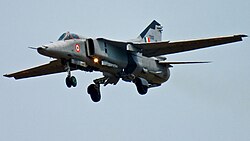
|caption= A MiG-27 of the [[ | |caption= A MiG-27 of the [[Soviet Air Force]] | ||
|type= [[Attack aircraft|Ground-attack aircraft]] | |type= [[Attack aircraft|Ground-attack aircraft]] | ||
| | |national_origin= Soviet Union | ||
|manufacturer= [[Mikoyan]] | |manufacturer= [[Mikoyan]] | ||
|designer= | |designer= | ||
| | |first_flight= 20 August 1970 | ||
| | |introduction= 1975 | ||
|retired= 1993 (Russia)<br /> 2019 (India) | |retired= 1993 (Russia)<br /> 2019 (India)<br /> 2023 (Kazakhstan) | ||
|status= | |status= Retired | ||
| | |primary_user= [[Soviet Air Forces]] (historical) | ||
| | |more_users= [[Russian Air Force]] (historical) <br /> [[Indian Air Force]] (historical) <br /> [[Kazakh Air Force]] (historical) | ||
|produced= | |produced= 1972–1995 | ||
| | |number_built= 1,075 (including licensed production)<ref>[http://www.globalsecurity.org/military/world/russia/mig-27.htm "MiG-27 Flogger/Q-6."] ''Global security''. Retrieved 18 October 2009.</ref> | ||
| | |developed_from= [[Mikoyan-Gurevich MiG-23]] | ||
|variants | |variants= | ||
}} | }} | ||
The '''Mikoyan MiG-27''' ({{ | The '''Mikoyan MiG-27''' ({{langx|ru|Микоян МиГ-27}}; [[NATO reporting name]]: '''Flogger-D/J''') is a [[variable-sweep wing|variable-sweep]] [[attack aircraft|ground-attack aircraft]], originally built by the [[Mikoyan|Mikoyan-Gurevich]] design bureau in the [[Soviet Union]] and later licence-produced in [[India]] by [[Hindustan Aeronautics]] as the '''''Bahadur''''' ("Valiant"). It is based on the [[Mikoyan-Gurevich MiG-23]] [[fighter aircraft]], but optimised for air-to-ground attack. Unlike the MiG-23, the MiG-27 did not have widespread use outside the Soviet Union, as most countries opted for the [[Mikoyan-Gurevich MiG-23|Mikoyan-Gurevich MiG-23BN]] and [[Sukhoi Su-22]] instead. As of late 2023, all Russian, Indian, Sri Lankan, Ukrainian, and Kazakh MiG-27s have been retired, bringing the type's service to an end. | ||
==Design and development== | ==Design and development== | ||
[[File:MiG-27K 2008 G6.jpg|thumb | [[File:MiG-27K 2008 G6.jpg|thumb|Optical windows of the laser-television sighting system Kayra-23 MiG-27K (kayra [кайра] is Russian for [[guillemot]]). Bottom box under the TV channel with a [[laser rangefinder]]-[[laser designator]], the top receiver for a laser rangefinder]] | ||
The MiG-27 shares the basic [[airframe]] of the MiG-23, but with a revised nose – nicknamed "''Utkonos''" ("Platypus") in Russian service, first introduced on the MiG-23B. Dissatisfaction with the MiG-23BN led to the further development of the basic airframe to accommodate a stronger undercarriage, simpler intakes and a shorter exhaust nozzle,<ref name="frawley_1996"/> without radar in | The MiG-27 shares the basic [[airframe]] of the MiG-23, but with a revised nose – nicknamed "''Utkonos''" ("[[Platypus]]") or "''[[Gena the Crocodile|Krokodil Gena]]''" in Russian service, first introduced on the MiG-23B. Dissatisfaction with the MiG-23BN led to the further development of the basic airframe to accommodate a stronger undercarriage, simpler intakes and a shorter exhaust nozzle,<ref name="frawley_1996"/> without radar in favour of a downward-sloping profile for improved pilot visibility,<ref>{{cite web|url=http://www.airforceworld.com/attacker/eng/mig27-fighter-bomber-russia-1.htm|title=Mig-27 fighter bomber, Flogger, Russia, Soviet Union|access-date=14 November 2014|archive-date=22 September 2014|archive-url=https://web.archive.org/web/20140922135323/http://airforceworld.com/attacker/eng/mig27-fighter-bomber-russia-1.htm|url-status=dead}}</ref> a [[laser rangefinder]] and marked-target seeker.<ref name="Winchester p. 169">Winchester 2006, p. 169.</ref> Among its test pilots, it was also called "''Balkon''" ("Balcony") because of the increased frontal view from the cockpit. Additional cockpit armor was installed, along with a totally new [[nav/attack system]]. | ||
Since the MiG-27 was intended to fly most of its missions at low altitude, the MiG-23's variable [[intake ramp]]s and exhaust nozzles were discarded in favor of a simpler fixed configuration, reducing weight and maintenance requirements. The aircraft also has larger, heavy-duty [[landing gear]] to facilitate operation from poorer-quality airfields. In accordance with the MiG-27's strike and low-level attack requirements, provisions were made to mount missiles and [[precision-guided munition]]s, as well as retaining a nuclear capability in line with other Soviet combat aircraft by introducing specialized navigation systems.<ref name="Winchester p. 169"/> | Since the MiG-27 was intended to fly most of its missions at low altitude, the MiG-23's variable [[intake ramp]]s and exhaust nozzles were discarded in favor of a simpler fixed configuration, reducing weight and maintenance requirements. The aircraft also has larger, heavy-duty [[landing gear]] to facilitate operation from poorer-quality airfields. In accordance with the MiG-27's strike and low-level attack requirements, provisions were made to mount missiles and [[precision-guided munition]]s, as well as retaining a nuclear capability in line with other Soviet combat aircraft by introducing specialized navigation systems.<ref name="Winchester p. 169"/> | ||
| Line 36: | Line 34: | ||
The improved MiG-27M/D versions were introduced during the 1980s, followed by the -K version, which could carry a much larger range of weapons including tactical nuclear bombs. | The improved MiG-27M/D versions were introduced during the 1980s, followed by the -K version, which could carry a much larger range of weapons including tactical nuclear bombs. | ||
Aircraft deployed to Afghanistan were upgraded with the installation of BVP-50-60 [[flare]] dispensers and the NAZ-7B emergency survival kit, as well as engine modifications for the hot and high conditions.<ref name="Gordon 2019 362">{{Cite book|last=Gordon|first=E. | Aircraft deployed to Afghanistan were upgraded with the installation of BVP-50-60 [[flare]] dispensers and the NAZ-7B emergency survival kit, as well as engine modifications for the hot and high conditions.<ref name="Gordon 2019 362">{{Cite book|last=Gordon|first=E.|title=Mikoyan MiG-23 and MiG-27|date=2019|others=Dmitriĭ Komissarov|isbn=978-1-910809-31-0|location=Manchester|pages=362|oclc=1108690733}}</ref> | ||
==Operational history== | ==Operational history== | ||
| Line 42: | Line 40: | ||
=== Soviet Union === | === Soviet Union === | ||
The MiG-27 entered frontline service with Soviet Air Force Tactical Aviation in 1975, with the 722nd Regiment. It replaced earlier MiG-23B/BN and outdated [[Sukhoi Su-7]] attack aircraft and equipped 22 of the 40 Soviet fighter-bomber regiments, being deployed all over the Soviet Union and other Warsaw Pact countries.<ref>{{Cite book|last=Gordon|first=E. | The MiG-27 entered frontline service with Soviet Air Force Tactical Aviation in 1975, with the 722nd Regiment. It replaced earlier MiG-23B/BN and outdated [[Sukhoi Su-7]] attack aircraft and equipped 22 of the 40 Soviet fighter-bomber regiments, being deployed all over the Soviet Union and other Warsaw Pact countries.<ref>{{Cite book|last=Gordon|first=E.|title=Mikoyan MiG-23 and MiG-27|date=2019|others=Dmitriĭ Komissarov|isbn=978-1-910809-31-0|location=Manchester|pages=342|oclc=1108690733}}</ref> Soviet MiG-27s were permanently deployed to five foreign countries: East Germany, Hungary, Poland, Czechoslovakia and Mongolia until the 1990s.<ref>{{Cite book|last=Gordon|first=E.|title=Mikoyan MiG-23 and MiG-27|date=2019|others=Dmitriĭ Komissarov|isbn=978-1-910809-31-0|location=Manchester|pages=350–360|oclc=1108690733}}</ref> | ||
Soviet forces used the MiG-27 during the later stages of the [[Soviet–Afghan War|Afghanistan conflict]] in 1987–89, which was the only time the Soviets used this aircraft in action.<ref name="Gordon 2019 362"/> During the initial stages of the war, MiG-27s were not deployed to support ground troops in combat, as the [[Sukhoi Su-17]]s of the [[Turkestan Military District|Turkestan]] and [[Central Asian Military District|Central Asian]] military districts together with [[Afghan Air Force|DRAAF]] [[Su-7]]s were considered sufficient to support the 40th Army's operations against the Afghan [[Mujahideen]]. However, in 1988 it was decided to deploy MiG-27s to support the existing forces in theatre. The 134th APIB, formed of three squadrons of MiG-27D/Ms and MiG-23UB trainers, was deployed to [[Shindand Air Base]] in October after extensive training in Kazakhstan. The most modern variant, the MiG-27K, was not deployed due to its lack of armour for the pilot. MiG-27s, in common with all other Soviet attack aircraft in the conflict, were limited in effectiveness by the 5,000 metre (16,400 | Soviet forces used the MiG-27 during the later stages of the [[Soviet–Afghan War|Afghanistan conflict]] in 1987–89, which was the only time the Soviets used this aircraft in action.<ref name="Gordon 2019 362"/> During the initial stages of the war, MiG-27s were not deployed to support ground troops in combat, as the [[Sukhoi Su-17]]s of the [[Turkestan Military District|Turkestan]] and [[Central Asian Military District|Central Asian]] military districts together with [[Afghan Air Force|DRAAF]] [[Su-7]]s were considered sufficient to support the 40th Army's operations against the Afghan [[Mujahideen]]. However, in 1988 it was decided to deploy MiG-27s to support the existing forces in theatre. The 134th APIB, formed of three squadrons of MiG-27D/Ms and MiG-23UB trainers, was deployed to [[Shindand Air Base]] in October after extensive training in Kazakhstan. The most modern variant, the MiG-27K, was not deployed due to its lack of armour for the pilot. MiG-27s, in common with all other Soviet attack aircraft in the conflict, were limited in effectiveness by the 5,000 metre (16,400 ft) minimum altitude imposed due to the threat from [[MANPAD]]s. As such they were only able to deploy unguided bombs and rockets against Afghan targets. Missions included bombing of supply convoys, night bombing of troop concentrations, scattering landmines with cluster munitions, and marking or illuminating targets for artillery with SAB-100 flare bombs. The 134th regiment remained in Afghanistan until the Soviet withdrawal, taking part in the siege of Kandahar. They were withdrawn on the 4th February 1989, flying to Kalay-Mor airbase in the [[Turkmen SSR]] where they waited in reserve until March of that year, when they returned to their home base in Kazakhstan.<ref>{{Cite book|last=Gordon|first=E.|title=Mikoyan MiG-23 and MiG-27|date=2019|others=Dmitriĭ Komissarov|isbn=978-1-910809-31-0|location=Manchester|oclc=1108690733}}</ref> | ||
Around the same time, MiG-27s started to be gradually replaced by more advanced [[Sukhoi Su-24]] and [[ | Around the same time, MiG-27s started to be gradually replaced by more advanced [[Sukhoi Su-24]] and [[Su-25]] aircraft in the ground attack role at home. Other MiG-27 units, such as the 642nd GvAIP, re-equipped with [[Mig 29|MiG-29]] fighters. Additionally, between 1990 and 1994 a single regiment of MiG-27s (88th Separate Fighter Bomber Regiment) served with [[Soviet Naval Aviation]] as a way to save the unit from being dissolved under the [[Treaty on Conventional Armed Forces in Europe]].<ref>{{Cite book|last=Gordon|first=E.|title=Mikoyan MiG-23 and MiG-27|date=2019|others=Dmitriĭ Komissarov|isbn=978-1-910809-31-0|location=Manchester|pages=360–362|oclc=1108690733}}</ref> During the [[Collapse of the Soviet Union (1985-1991)|collapse of the Soviet Union]], a number of MiG-27s remained in active service, which were then split amongst the air forces of the various former Soviet republics. | ||
=== Russia === | |||
The [[Air Force of the Russian Federation]] inherited most of the Soviet MiG-27s. However, on 1 July 1993 the Air Force decreed that single-engined attack aircraft such as the MiG-27 were to be phased out.<ref>{{Cite book|last=Gordon|first=E.|title=Mikoyan MiG-23 and MiG-27|date=2019|others=Dmitriĭ Komissarov|isbn=978-1-910809-31-0|location=Manchester|pages=369–370|oclc=1108690733}}</ref> | |||
===India=== | |||
[[File:MiG-27 from No.18 Squad, Kalaikunda.jpg|thumb|A MiG-27 of the IAF No. 18 Squadron]] | |||
The MiG-27 was inducted into the Indian Air Force in 1985.<ref name="Life">{{cite web|url=https://indianexpress.com/article/explained/explained-the-story-of-the-mig-27-the-iafs-now-retired-ground-attack-bahadur-6197047/|title=The story of the MiG-27, the IAF’s now-retired ground attack Bahadur|date=3 January 2020|access-date=1 June 2025|work=[[The Indian Express]]}}</ref> The Indian Air Force used various combat aircraft including the MiG-27 to bombard Pakistani positions during the [[Kargil War]].<ref>{{cite book |last1=Ganguly |first1=Sumit |last2=Kapur |first2=S. Paul |title=Nuclear Proliferation in South Asia: Crisis Behaviour and the Bomb |date=6 August 2008 |publisher=Routledge |isbn=978-1-134-06962-0 |page=104 |url=https://books.google.com/books?id=DaI8tyczNigC |access-date=23 August 2023 |language=en |archive-date=23 August 2023 |archive-url=https://web.archive.org/web/20230823011550/https://books.google.com/books?id=DaI8tyczNigC |url-status=live }}</ref> On 27 May 1999, an Indian MiG-27L suffered an engine flameout while firing [[S-8 (rocket)|80 mm rockets]], possibly due to a [[MANPADS]] hit, and its pilot [[Kambampati Nachiketa]] was captured by the Pakistani forces.<ref>{{cite web | url=http://www.globalsecurity.org/military/world/war/kargil-99.htm | title=1999 Kargil Conflict |work=Global Security}}</ref><ref>{{Cite web|url=https://www.indiatoday.in/india/story/kambampati-nachiketa-kargil-war-india-pakistan-indian-pilot-arrested-1466400-2019-02-27|title = This is what Pakistan did last time one of our pilots was in its custody| date=27 February 2019 }}</ref> | |||
= | The entire fleet of Indian MiG-27s underwent a midlife upgrade starting in 2006 to extend its lifetime.<ref name="Life"/> In mid-February 2010, India grounded its entire fleet of over 150 aircraft after a MiG-27 crashed on 16 February 2010 in Siliguri, West Bengal. The crash was attributed to defects in the [[Tumansky R-29|R-29]] engines of the aircraft, suspected to have occurred during the overhauling of the aircraft by [[Hindustan Aeronautics Limited]].<ref>{{cite web | url=http://news.in.msn.com/internalsecurity/features/article.aspx?cp-documentid=3652502 | archive-url=https://web.archive.org/web/20100225023403/http://news.in.msn.com/internalsecurity/features/article.aspx?cp-documentid=3652502 | archive-date=25 February 2010 | title=After fatal crash, Indian Air Force grounds 100 MiG-27s |work=MSN India |access-date=1 June 2010}}</ref> Another MiG-27 crashed in the Barmer area on 27 January 2015.<ref>{{Cite news|url=https://timesofindia.indiatimes.com/india/mig-27-crashes-in-barmer-pilot-ejects-safely/articleshow/46029528.cms|title=MiG-27 crashes in Barmer, pilot ejects safely|work=[[The Times of India]]|date=27 January 2015 }}</ref> India retired the last MiG-27ML squadron on 27 December 2019, with a farewell ceremony at the [[Jodhpur Airport|Jodhpur airbase]].<ref>{{Cite news|url=http://www.business-standard.com/article/current-affairs/iaf-bid-farewell-to-mig-27-ml-bahadur-as-india-retires-the-strike-aircraft-117122900800_1.html|title=IAF bid farewell to MiG-27 ML Bahadur as India retires the strike aircraft|newspaper=[[Business Standard]]|date=29 December 2017|agency=[[Press Trust of India]]}}</ref><ref>{{cite web|url=https://timesofindia.indiatimes.com/india/iafs-mig-27-to-take-to-skies-one-last-time-today/articleshow/72989283.cms|title=IAF's MiG-27 to take to skies one last time today|work=[[The Times of India]]|access-date=27 December 2019}}</ref> | ||
The [[ | |||
===Sri Lanka=== | ===Sri Lanka=== | ||
[[File:Sri Lanka Military 0031.jpg|thumb|Sri Lanka Air Force | [[File:Sri Lanka Military 0031.jpg|thumb|Sri Lanka Air Force MiG-27M]] | ||
MiG-27 aircraft entered service with the [[Sri Lanka Air Force]] in 2000, with the purchase of four remanufactured MiG-27s from Ukrinmash in May 2000 at US$1.75 million each. This was followed by another ordered for two more in October 2000 at US$1.6 million and a MiG-23UB trainer aircraft for US$900,000. Initially piloted by Ukrainian pilots until local pilots could be trained and was attached to the [[No. 5 Squadron SLAF|No. 5 "Jet" Squadron SLAF]]. During the [[Eelam War III]] phase of the [[Sri Lankan civil war|Sri Lankan Civil War]], they saw considerable action bombing targets and providing close air support. In August 2000, a MiG-27 crashed near [[Bandaranaike International Airport|Colombo International Airport]], killing its Ukrainian pilot. In July 2001, a second MiG-27 was destroyed and another damaged on the ground during [[Bandaranaike Airport attack|an assault on the same air force base]] by the [[Liberation Tigers of Tamil Eelam]]. | |||
A MiG-27 crashed into the sea near the airport in June 2004. With the resumption of hostilities in 2006 as peace talks broke down and the [[Eelam War IV]] phase of the war starting, MiG-27 were once again flying combat sorties. In 2007, three MiG-27s and a MiG-23UB trainer were overhauled as part of a life-extension program. Four MiG-27s were purchased at US$10 million. This led to the [[Gotabaya Rajapaksa#Legal dispute with Lasantha Wickrematunge|MiG deal scandal]]. The MiG-27s and the MiG-23UB were reorganized into the newly formed [[No. 12 Squadron SLAF|No. 12 Squadron]]. Another MiG-27 fighter jet crashed on a routine training mission on 13 February 2012 near the Dummalasuriya area at around 1.35 pm. The pilot managed to eject from the jet without sustaining injuries.<ref>{{cite web | url=http://blog.kievukraine.info/2006/12/sri-lanka-to-buy-mig-aircraft-from.html | archive-url=https://web.archive.org/web/20110927141345/http://blog.kievukraine.info/2006/12/sri-lanka-to-buy-mig-aircraft-from.html | archive-date=27 September 2011 | title=Kiev Ukraine News Blog }}</ref> | |||
===Kazakhstan=== | ===Kazakhstan=== | ||
12 MiG-27s | 12 MiG-27s remained in service with the [[Kazakh Air Force]] until 2023 or so. In October 2023, the aircraft were retired and put up for auction.<ref>{{cite web|url=https://www.eurasiantimes.com/on-sale-117-mig-31-mig-29-heres-why/|title=117 MiG-31, MiG-29 & Other Russian-Origin Fighter Jets Put Up On Auction By Kazakhstan; Here's Why|date=28 October 2023|access-date=29 April 2024}}</ref><ref>{{cite web|url=https://mil.in.ua/en/news/kazakhstan-sells-over-100-military-aircraft/|title=Kazakhstan sells over 100 military aircraft|date=27 October 2023|access-date=29 April 2024}}</ref> In April 2024, the ''Kyiv Post'' reported that the US purchased 81 aircraft to transfer to Ukraine. The Kazakh state-owned weapons importer and exporter Kazspetexport denied such claims, saying that foreign companies were not allowed to bid.<ref>{{cite news |title=Did the US buy old aircraft from Kazakhstan? |url=https://censor.net/en/news/3486827/did_the_us_buy_old_aircraft_from_kazakhstan |access-date=17 July 2024 |work=Censor.NET |date=24 April 2024 |archive-url=https://web.archive.org/web/20240508033135/https://censor.net/en/news/3486827/did_the_us_buy_old_aircraft_from_kazakhstan |archive-date=8 May 2024}}</ref><ref>{{cite news |last1=Spirlet |first1=Thibault |last2=Rommen |first2=Rebecca |title=Claims that the US bought 81 Soviet-era combat aircraft from a close Russian ally are likely false, experts say |url=https://www.businessinsider.com/claims-us-buying-soviet-era-aircraft-from-kazakhstan-likely-false-2024-4 |access-date=17 July 2024 |work=Business Insider |date=30 April 2024 |archive-url=https://web.archive.org/web/20240430152115/https://www.businessinsider.com/claims-us-buying-soviet-era-aircraft-from-kazakhstan-likely-false-2024-4 |archive-date=30 April 2024}}</ref> | ||
==Variants== | ==Variants== | ||
| Line 75: | Line 71: | ||
;MiG-23B | ;MiG-23B | ||
The first Flogger attack variant was powered by the AL-21F. Only 24 were produced, due a lack of engines (the AL-21F was destined for the Sukhoi [[Sukhoi Su-17|Su-17/22]] and the [[Sukhoi Su-24|Su-24]] Fencer). It was armed with the [[GSh-23L]] cannon, carrying 200 rounds. | The first Flogger attack variant was powered by the AL-21F. Only 24 were produced, due to a lack of engines (the AL-21F was destined for the Sukhoi [[Sukhoi Su-17|Su-17/22]] and the [[Sukhoi Su-24|Su-24]] Fencer). It was armed with the [[GSh-23L]] cannon, carrying 200 rounds. | ||
;MiG-23BN | ;MiG-23BN | ||
| Line 88: | Line 84: | ||
;MiG-27M | ;MiG-27M | ||
[[NATO reporting name]]: ''Flogger-J''. This model was a cheaper variant than the MiG-27K, but much better than the MiG-23B, MiG-23BN, and MiG-27 (MiG-23BM), with the electro-optical and radio-frequency heads above the glove pylons deleted. It was first armed with the [[Gryazev-Shipunov GSh-6-23|GSh-6-23M]] Gatling gun, but this was later replaced by a new 30 mm [[Gryazev-Shipunov GSh-6-30|GSh-6-30]] six-barrel cannon with 260 rounds of ammunition in a fuselage gondola. It also received much-improved [[electronic countermeasures|electronic countermeasure]] (ECM) systems, and a new PrNK-23K nav/attack system providing automatic flight control, gun firing, and weapons release. However, this modification was not very successful because of the heavy recoil from the new cannon, and bursts longer than two or three seconds often led to permanent damage to the airframe. | [[NATO reporting name]]: ''Flogger-J''. This model was a cheaper variant than the MiG-27K, but much better than the MiG-23B, MiG-23BN, and MiG-27 (MiG-23BM), with the electro-optical and radio-frequency heads above the glove pylons deleted. It was first armed with the [[Gryazev-Shipunov GSh-6-23|GSh-6-23M]] Gatling gun, but this was later replaced by a new 30 mm [[Gryazev-Shipunov GSh-6-30|GSh-6-30]] six-barrel cannon with 260 rounds of ammunition in a fuselage gondola. It also received much-improved [[electronic countermeasures|electronic countermeasure]] (ECM) systems, and a new PrNK-23K nav/attack system providing automatic flight control, gun firing, and weapons release. However, this modification was not very successful because of the heavy recoil from the new cannon, and bursts longer than two or three seconds often led to permanent damage to the airframe. | ||
Test pilot V. N. Kondaurov described the first firing of the GSh-6-30А:{{Citation needed|date=August 2025}}{{Request quotation|date=February 2010}}<blockquote>"As I imposed the central mark on the air target and pressed the trigger to shoot, I heard such noise that I involuntarily drew my hand aside. The whole plane began to vibrate from the shooting and had almost stopped from the strong recoil of the gun. The pilotless target, which was just making a turn ahead of me, was literally disintegrating into pieces. I have hardly come to my senses from unexpectedness and admiration: This is a calibre! Such a beast! If you hit something — it will be plenty enough [to wipe it out]".</blockquote>A total of 200 MiG-27Ms were built from 1978 to 1983, plus 160 for India. Sri Lanka used second-hand Soviet MiG-27Ms. | |||
;MiG-27D | ;MiG-27D | ||
[[File:Mikoyan MiG-27 Flogger-D 01 red (10044642364).jpg|thumb| | [[File:Mikoyan MiG-27 Flogger-D 01 red (10044642364).jpg|thumb|MiG-27D]] | ||
All MiG- | All MiG-27Ds are MiG-23BMs upgraded to MiG-27M standard. It is very difficult to distinguish from the MiG-27M. 305 were upgraded. | ||
;MiG-27ML | ;MiG-27ML | ||
[[File:TU591 MiG-27ML.jpg|thumb| | [[File:TU591 MiG-27ML.jpg|thumb|MiG-27ML 'TU591' of No. 29 Sqn. "Scorpions" at IAF Museum Palam.]] | ||
This was an export variant of the MiG-27M provided in 1986 to India in knock-down kits for | This was an export variant of the MiG-27M provided in 1986 to India in knock-down kits for licensed assembly. It was the same as the MiG-27M, except the undernose fairing for the [[infra-red search and track]] (IRST) sensor had a single window instead of several, like the one on the original MiG-27M. A total of 150 were assembled by India. India refers to this model as the MiG-27M ''Bahadur'', while MiG-27L is the Mikoyan export designation.<ref name="frawley_1996">{{harvnb|Frawley|Thorn|1996|p=115}}</ref> | ||
;MiG-27H | ;MiG-27H | ||
{{clarify|date=September 2011|reason=What's with the present tense? Has the upgrade been done or not?}} | {{clarify|date=September 2011|reason=What's with the present tense? Has the upgrade been done or not?}} | ||
This was a 1988 indigenous Indian upgrade of its license-assembled MiG- | This was a 1988 indigenous Indian upgrade of its license-assembled MiG-27Ls with French [[avionics]], which provides the same level of performance, but with much reduced size and weight. The capabilities of the aircraft are being enhanced by the incorporation of modern avionics systems consisting primarily of two Multi-Function Displays (MFDs) Mission and Display Processor (MDP), Sextant Ring Laser Gyros (RLG INSI), combined GPS/GLONASS navigation, HUD with UFCP, Digital Map Generator (DMG), jam-resistant Secured Communication, stand-by UHF communication, data link and a comprehensive Electronic Warfare suite. A mission planning and retrieval facility, VTR and HUD Camera will also be fitted. The aircraft retains stand-by (conventional) instrumentation, including artificial horizon, altimeter and airspeed indicator, to cater for the failure of HUD and the MFDs. The MiG-27s are also being equipped with the French Agave or Russian Komar [[radar]]. The installation of the radar would give the MiG-27 anti-ship and some air-to-air capability. It is expected that at least 140 of the 180 aircraft will be converted from MiG-27MLs. | ||
==Operators== | ==Operators== | ||
{{main|List of MiG-27 operators}} | {{main|List of MiG-27 operators}} | ||
[[File:MiG 27 operators.png|thumb|Current MiG-27 operators in blue, former operators in red]] | [[File:MiG 27 operators.png|thumb|Current MiG-27 operators in blue, former operators in red]] | ||
===Former operators=== | ===Former operators=== | ||
'''{{Flag|Democratic Republic of Afghanistan|1987|name=Afghanistan}}''' | |||
* The [[ | * The [[Afghan Air Force]] received MiG-27s as military aid from the Soviet Union following the [[Soviet withdrawal from Afghanistan]].<ref>{{Cite web |title=Lessons of the Soviet Withdrawal from Afghanistan {{!}} Middle East Policy Council |url=https://mepc.org/commentary/lessons-soviet-withdrawal-afghanistan |access-date=2023-03-14 |website=mepc.org |date=9 March 2011 |language=en}}</ref> | ||
;{{flag|Belarus}} | ;{{flag|Belarus}} | ||
* The [[Belarusian Air Force]] inherited a small number of aircraft from the 911th Fighter-Bomber regiment based at Lida. These were scrapped or used as instructional airframes at the Minsk State Aviation College. | * The [[Belarusian Air Force]] inherited a small number of aircraft from the 911th Fighter-Bomber regiment based at Lida. These were scrapped or used as instructional airframes at the Minsk State Aviation College. | ||
;{{IND}} | |||
* The [[Indian Air Force]] has retired their aircraft (165 MiG-27Ms licensed built by HAL). The first batch of MiG-27MLs was retired in December 2017, and the final batch was retired from service on 27 December 2019.<ref>{{cite news|last=Ray |first=Kalyan |newspaper=Deccan Herald |url=https://www.deccanherald.com/national/north-and-central/iaf-to-bid-adieu-to-its-last-mig-27-swing-wing-squadron-788922.html|title=IAF to bid adieu to its last MiG-27 swing-wing squadron |date=26 December 2019 |access-date=26 December 2019}}</ref> | |||
;{{KAZ}} | |||
*The Kazakh Air Force operated 12 MiG-27Ms as of December 2022.<ref>{{cite report |title=2023 World Air Forces |publisher=FlightGlobal |page=22 |url=https://www.flightglobal.com/download?ac=90688 |language=en}}</ref> These were retired in 2023, put up for auction, and sold in April 2024. | |||
;{{RUS}} | ;{{RUS}} | ||
* The [[Russian Air Force]] retired their aircraft from front-line use. | * The [[Russian Air Force]] retired their aircraft from front-line use. | ||
; {{flag|Sri Lanka}} | ; {{flag|Sri Lanka}} | ||
* [[Sri Lanka Air Force]] | * [[Sri Lanka Air Force]] had 4 MiG-27Ms in 2011.{{sfn|Wragg|2011|pages=265−266}} | ||
;{{UKR}} | ;{{UKR}} | ||
* The [[Ukrainian Air Force]] has retired their aircraft.<ref>{{cite web|url=http://www.mil.gov.ua/index.php?lang=en&part=structure&sub=air_force|title=Міністерство|work=Міністерство оборони України|access-date=14 November 2014}}</ref> | * The [[Ukrainian Air Force]] has retired their aircraft.<ref>{{cite web|url=http://www.mil.gov.ua/index.php?lang=en&part=structure&sub=air_force|title=Міністерство|work=Міністерство оборони України|access-date=14 November 2014}}</ref>{{Verify source|date=January 2024}} | ||
;{{ | ;{{USSR}} | ||
* The [[ | * The [[Soviet Air Force]] passed their aircraft on to four of their successor states. | ||
==Specifications (MiG-27K)== | ==Specifications (MiG-27K)== | ||
[[File:Mikoyan MiG-27 3-view.svg|thumb| | [[File:Mikoyan MiG-27 3-view.svg|thumb|3-view drawing of MiG-27]] | ||
{{Aircraft specs | {{Aircraft specs | ||
|ref= airforce-technology.com,<ref> | |ref= airforce-technology.com,<ref>{{cite web | url=http://www.airforce-technology.com/projects/mig27/ | title=MiG-27K (MiG 23) Flogger Fighter Bomber }}</ref> deagel.com<ref>{{Cite web|url=http://www.deagel.com/Combat-Aircraft/Mig-27_a000741002.aspx|title = Ancile}}</ref> | ||
|prime units?=met | |prime units?=met | ||
<!-- | <!-- | ||
| Line 164: | Line 164: | ||
--> | --> | ||
|max speed kmh=1885 | |max speed kmh=1885 | ||
|max speed note= / M1.7 at {{cvt|8000|m | |max speed note= / M1.7 at {{cvt|8000|m}} | ||
::::{{cvt|1350|km/h|mph kn}} / M1.09 at sea level | ::::{{cvt|1350|km/h|mph kn}} / M1.09 at sea level | ||
|max speed mach=<!-- supersonic aircraft --> | |max speed mach=<!-- supersonic aircraft --> | ||
| Line 176: | Line 176: | ||
|range note= | |range note= | ||
|combat range km=780 | |combat range km=780 | ||
|combat range note=<br> | |combat range note=<br /> | ||
::::{{cvt|540|km|mi nmi}} with two [[Kh-29]] missiles and three drop tanks | ::::{{cvt|540|km|mi nmi}} with two [[Kh-29]] missiles and three drop tanks | ||
::::{{cvt|225|km|mi nmi}} with two [[Kh-29]] missiles and no external fuel | ::::{{cvt|225|km|mi nmi}} with two [[Kh-29]] missiles and no external fuel | ||
| Line 198: | Line 198: | ||
Armament | Armament | ||
--> | --> | ||
|guns=<br> | |guns=<br /> | ||
**1 × [[30 mm caliber|30 mm]] [[Gryazev-Shipunov GSh-6-30]] [[rotary cannon]] | **1 × [[30 mm caliber|30 mm]] [[Gryazev-Shipunov GSh-6-30]] [[rotary cannon]], 300 rounds, or, can be modified in a workshop to: | ||
**1 × [[23×115mm|23 mm]] [[Gryazev-Shipunov GSh-23]] [[autocannon]] | **1 × [[23×115mm|23 mm]] [[Gryazev-Shipunov GSh-23]] [[autocannon]], 200 rounds. | ||
**Alternatively, a basic maintenance kit can be carried in place of a gun pod. | **Alternatively, a basic maintenance kit can be carried in place of a gun pod. | ||
|hardpoints= 1 × centerline, 4 × fuselage and 2 × wing glove pylons | |hardpoints= 1 × centerline, 4 × fuselage and 2 × wing glove pylons | ||
|hardpoint capacity= {{convert|4000|kg|lb|abbr=on}}<ref name="frawley_1996"/> | |hardpoint capacity= {{convert|4000|kg|lb|abbr=on}}<ref name="frawley_1996"/> | ||
|hardpoint rockets=<br> | |hardpoint rockets=<br /> | ||
***[[S-5 rocket|S-5]] | ***[[S-5 rocket|S-5]] | ||
***[[S-8 rocket|S-8]] | ***[[S-8 rocket|S-8]] | ||
***[[S-25 (rocket)|S-25]] | ***[[S-25 (rocket)|S-25]] | ||
***[[S-24 rocket|S-24]] | ***[[S-24 rocket|S-24]] | ||
|hardpoint missiles=<br> | |hardpoint missiles=<br /> | ||
***[[Air-to-air missiles]]: | ***[[Air-to-air missiles]]: | ||
****[[R-60 (missile)|R-60]]M | ****[[R-60 (missile)|R-60]]M | ||
| Line 219: | Line 219: | ||
****[[Kh-25#Variants|Kh-27]]PS | ****[[Kh-25#Variants|Kh-27]]PS | ||
****[[Kh-31]]P (MiG-27K, evaluation only) | ****[[Kh-31]]P (MiG-27K, evaluation only) | ||
|hardpoint bombs=<br> | |hardpoint bombs=<br /> | ||
***[[Unguided bomb|Dumb bombs]] | ***[[Unguided bomb|Dumb bombs]] | ||
****[[FAB-100]] | ****[[FAB-100]] | ||
| Line 234: | Line 234: | ||
****[[SAB-250-200]] | ****[[SAB-250-200]] | ||
***[[Television guidance|TV-guided bombs]] | ***[[Television guidance|TV-guided bombs]] | ||
****[[KAB- | ****[[KAB-500Kr]] | ||
***[[Laser-guided bombs]] | ***[[Laser-guided bombs]] | ||
****[[KAB-500L]] | ****[[KAB-500L]] | ||
***[[Fuel-air bomb]]s | ***[[Fuel-air bomb]]s | ||
****[[ODAB-500S]] | ****[[FAB-500#Variants|ODAB-500S]] | ||
****[[ODAB-500P]] | ****[[FAB-500#Variants|ODAB-500P]] | ||
****[[KAB-500-OD]] | ****[[KAB-500-OD]] | ||
|avionics= | |avionics= | ||
| Line 245: | Line 245: | ||
==See also== | ==See also== | ||
{{Portal|Aviation}} | |||
{{Aircontent | {{Aircontent | ||
|related= | |related= | ||
| Line 268: | Line 268: | ||
===Bibliography=== | ===Bibliography=== | ||
{{Refbegin | {{Refbegin}} | ||
* Eden, Paul, ed. "Mikoyan MiG-27". ''Encyclopedia of Modern Military Aircraft''. London: Amber Books, 2004. . | * Eden, Paul, ed. "Mikoyan MiG-27". ''Encyclopedia of Modern Military Aircraft''. London: Amber Books, 2004. . | ||
* Frawley | * {{cite book |last1=Frawley |first1=Gerard |first2=Jim |last2=Thorn |title=The International Directory Of Military Aircraft 1996/97 |place=Weston Creek, Australia |publisher=Aerospace Publications Pty Ltd |date=1996 |isbn=1-875671-20-X}}. | ||
* Green, William and Gordon Swanborough. ''The Great Book of Fighters''. St. Paul, Minnesota, USA: Motorbooks International Publishing, 2001. {{ISBN|978-1-910809-31-0}}. | * Green, William and Gordon Swanborough. ''The Great Book of Fighters''. St. Paul, Minnesota, USA: Motorbooks International Publishing, 2001. {{ISBN|978-1-910809-31-0}}. | ||
* Gordon, Yefim and Komissarov, Dmitry, "Mikoyan MiG-23 and MiG-27", Crecy Publishing, Manchester, 2019 {{ISBN|0-7603-1194-3}}. | * Gordon, Yefim and Komissarov, Dmitry, "Mikoyan MiG-23 and MiG-27", Crecy Publishing, Manchester, 2019 {{ISBN|0-7603-1194-3}}. | ||
* Wilson, Stewart. ''Combat Aircraft since 1945''. Fyshwick, Australia: Aerospace Publications, 2000. {{ISBN|1-875671-50-1}}. | * Wilson, Stewart. ''Combat Aircraft since 1945''. Fyshwick, Australia: Aerospace Publications, 2000. {{ISBN|1-875671-50-1}}. | ||
* Winchester, Jim, ed. "Mikoyan MiG-27 'Flogger d/J'." ''Military Aircraft of the Cold War'' (The Aviation Factfile). London: Grange Books plc, 2006. {{ISBN|1-84013-929-3|}}{{Refend}} | * Winchester, Jim, ed. "Mikoyan MiG-27 'Flogger d/J'." ''Military Aircraft of the Cold War'' (The Aviation Factfile). London: Grange Books plc, 2006. {{ISBN|1-84013-929-3|}} | ||
*{{cite book |last1=Wragg |first1=David |title=The World Air Power Guide |date=23 February 2011 |publisher=Casemate Publishers |isbn=978-1-84468-784-8 |url=https://books.google.com/books?id=s2PNDwAAQBAJ |language=en}} | |||
{{Refend}} | |||
==External links== | ==External links== | ||
{{Commons category|Mikoyan-Gurevich MiG-27|Mikoyan MiG-27}} | {{Commons category|Mikoyan-Gurevich MiG-27|Mikoyan MiG-27}} | ||
* [http://www.globalaircraft.org/planes/mig-27_flogger.pl MiG-27 Flogger from Global Aircraft] | * [http://www.globalaircraft.org/planes/mig-27_flogger.pl MiG-27 Flogger from Global Aircraft] | ||
* [http://www.fas.org/man/dod-101/sys/ac/row/mig-27.htm MiG-27 from FAS] | * [http://www.fas.org/man/dod-101/sys/ac/row/mig-27.htm MiG-27 from FAS] | ||
* [http://www.military-today.com/aircraft/mikoyan_mig27_flogger.htm Mikoyan MiG-27 Flogger] | * {{usurped|1=[https://web.archive.org/web/20070515001520/http://www.military-today.com/aircraft/mikoyan_mig27_flogger.htm Mikoyan MiG-27 Flogger]}} | ||
{{Mikoyan aircraft}} | {{Mikoyan aircraft}} | ||
{{NATO fighter reporting names}} | |||
{{DEFAULTSORT:Mikoyan Mig-27}} | {{DEFAULTSORT:Mikoyan Mig-27}} | ||
| Line 290: | Line 292: | ||
[[Category:Single-engined jet aircraft]] | [[Category:Single-engined jet aircraft]] | ||
[[Category:Aircraft first flown in 1970]] | [[Category:Aircraft first flown in 1970]] | ||
[[Category:Variable-sweep-wing aircraft]] | |||
[[Category:High-wing aircraft]] | |||
[[Category:Aircraft with retractable tricycle landing gear]] | |||
Latest revision as of 09:50, 17 February 2026
 | This article needs more citations. (September 2011) |
| MiG-27 | |
|---|---|
.jpg) A MiG-27 of the Soviet Air Force | |
| General information | |
| Type | Ground-attack aircraft |
National origin | Soviet Union |
| Manufacturer | Mikoyan |
| Status | Retired |
| Primary users | Soviet Air Forces (historical) |
| Number built | 1,075 (including licensed production)[1] |
| History | |
| Manufactured | 1972–1995 |
Introduction date | 1975 |
| First flight | 20 August 1970 |
| Retired | 1993 (Russia) 2019 (India) 2023 (Kazakhstan) |
Developed from | Mikoyan-Gurevich MiG-23 |
The Mikoyan MiG-27 (Russian: Микоян МиГ-27; NATO reporting name: Flogger-D/J) is a variable-sweep ground-attack aircraft, originally built by the Mikoyan-Gurevich design bureau in the Soviet Union and later licence-produced in India by Hindustan Aeronautics as the Bahadur ("Valiant"). It is based on the Mikoyan-Gurevich MiG-23 fighter aircraft, but optimised for air-to-ground attack. Unlike the MiG-23, the MiG-27 did not have widespread use outside the Soviet Union, as most countries opted for the Mikoyan-Gurevich MiG-23BN and Sukhoi Su-22 instead. As of late 2023, all Russian, Indian, Sri Lankan, Ukrainian, and Kazakh MiG-27s have been retired, bringing the type's service to an end.
Design and development[edit | edit source]

The MiG-27 shares the basic airframe of the MiG-23, but with a revised nose – nicknamed "Utkonos" ("Platypus") or "Krokodil Gena" in Russian service, first introduced on the MiG-23B. Dissatisfaction with the MiG-23BN led to the further development of the basic airframe to accommodate a stronger undercarriage, simpler intakes and a shorter exhaust nozzle,[2] without radar in favour of a downward-sloping profile for improved pilot visibility,[3] a laser rangefinder and marked-target seeker.[4] Among its test pilots, it was also called "Balkon" ("Balcony") because of the increased frontal view from the cockpit. Additional cockpit armor was installed, along with a totally new nav/attack system.
Since the MiG-27 was intended to fly most of its missions at low altitude, the MiG-23's variable intake ramps and exhaust nozzles were discarded in favor of a simpler fixed configuration, reducing weight and maintenance requirements. The aircraft also has larger, heavy-duty landing gear to facilitate operation from poorer-quality airfields. In accordance with the MiG-27's strike and low-level attack requirements, provisions were made to mount missiles and precision-guided munitions, as well as retaining a nuclear capability in line with other Soviet combat aircraft by introducing specialized navigation systems.[4]
The improved MiG-27M/D versions were introduced during the 1980s, followed by the -K version, which could carry a much larger range of weapons including tactical nuclear bombs.
Aircraft deployed to Afghanistan were upgraded with the installation of BVP-50-60 flare dispensers and the NAZ-7B emergency survival kit, as well as engine modifications for the hot and high conditions.[5]
Operational history[edit | edit source]
The MiG-27 saw service with the Soviet Air Force in Afghanistan. Although several Western observers considered the MiG-27 widely exported, confusing it with the MiG-23BN, the aircraft type was only exported to India and Sri Lanka which also utilized the MiG-27 in regional conflicts.[4]
Soviet Union[edit | edit source]
The MiG-27 entered frontline service with Soviet Air Force Tactical Aviation in 1975, with the 722nd Regiment. It replaced earlier MiG-23B/BN and outdated Sukhoi Su-7 attack aircraft and equipped 22 of the 40 Soviet fighter-bomber regiments, being deployed all over the Soviet Union and other Warsaw Pact countries.[6] Soviet MiG-27s were permanently deployed to five foreign countries: East Germany, Hungary, Poland, Czechoslovakia and Mongolia until the 1990s.[7]
Soviet forces used the MiG-27 during the later stages of the Afghanistan conflict in 1987–89, which was the only time the Soviets used this aircraft in action.[5] During the initial stages of the war, MiG-27s were not deployed to support ground troops in combat, as the Sukhoi Su-17s of the Turkestan and Central Asian military districts together with DRAAF Su-7s were considered sufficient to support the 40th Army's operations against the Afghan Mujahideen. However, in 1988 it was decided to deploy MiG-27s to support the existing forces in theatre. The 134th APIB, formed of three squadrons of MiG-27D/Ms and MiG-23UB trainers, was deployed to Shindand Air Base in October after extensive training in Kazakhstan. The most modern variant, the MiG-27K, was not deployed due to its lack of armour for the pilot. MiG-27s, in common with all other Soviet attack aircraft in the conflict, were limited in effectiveness by the 5,000 metre (16,400 ft) minimum altitude imposed due to the threat from MANPADs. As such they were only able to deploy unguided bombs and rockets against Afghan targets. Missions included bombing of supply convoys, night bombing of troop concentrations, scattering landmines with cluster munitions, and marking or illuminating targets for artillery with SAB-100 flare bombs. The 134th regiment remained in Afghanistan until the Soviet withdrawal, taking part in the siege of Kandahar. They were withdrawn on the 4th February 1989, flying to Kalay-Mor airbase in the Turkmen SSR where they waited in reserve until March of that year, when they returned to their home base in Kazakhstan.[8]
Around the same time, MiG-27s started to be gradually replaced by more advanced Sukhoi Su-24 and Su-25 aircraft in the ground attack role at home. Other MiG-27 units, such as the 642nd GvAIP, re-equipped with MiG-29 fighters. Additionally, between 1990 and 1994 a single regiment of MiG-27s (88th Separate Fighter Bomber Regiment) served with Soviet Naval Aviation as a way to save the unit from being dissolved under the Treaty on Conventional Armed Forces in Europe.[9] During the collapse of the Soviet Union, a number of MiG-27s remained in active service, which were then split amongst the air forces of the various former Soviet republics.
Russia[edit | edit source]
The Air Force of the Russian Federation inherited most of the Soviet MiG-27s. However, on 1 July 1993 the Air Force decreed that single-engined attack aircraft such as the MiG-27 were to be phased out.[10]
India[edit | edit source]

The MiG-27 was inducted into the Indian Air Force in 1985.[11] The Indian Air Force used various combat aircraft including the MiG-27 to bombard Pakistani positions during the Kargil War.[12] On 27 May 1999, an Indian MiG-27L suffered an engine flameout while firing 80 mm rockets, possibly due to a MANPADS hit, and its pilot Kambampati Nachiketa was captured by the Pakistani forces.[13][14]
The entire fleet of Indian MiG-27s underwent a midlife upgrade starting in 2006 to extend its lifetime.[11] In mid-February 2010, India grounded its entire fleet of over 150 aircraft after a MiG-27 crashed on 16 February 2010 in Siliguri, West Bengal. The crash was attributed to defects in the R-29 engines of the aircraft, suspected to have occurred during the overhauling of the aircraft by Hindustan Aeronautics Limited.[15] Another MiG-27 crashed in the Barmer area on 27 January 2015.[16] India retired the last MiG-27ML squadron on 27 December 2019, with a farewell ceremony at the Jodhpur airbase.[17][18]
Sri Lanka[edit | edit source]

MiG-27 aircraft entered service with the Sri Lanka Air Force in 2000, with the purchase of four remanufactured MiG-27s from Ukrinmash in May 2000 at US$1.75 million each. This was followed by another ordered for two more in October 2000 at US$1.6 million and a MiG-23UB trainer aircraft for US$900,000. Initially piloted by Ukrainian pilots until local pilots could be trained and was attached to the No. 5 "Jet" Squadron SLAF. During the Eelam War III phase of the Sri Lankan Civil War, they saw considerable action bombing targets and providing close air support. In August 2000, a MiG-27 crashed near Colombo International Airport, killing its Ukrainian pilot. In July 2001, a second MiG-27 was destroyed and another damaged on the ground during an assault on the same air force base by the Liberation Tigers of Tamil Eelam.
A MiG-27 crashed into the sea near the airport in June 2004. With the resumption of hostilities in 2006 as peace talks broke down and the Eelam War IV phase of the war starting, MiG-27 were once again flying combat sorties. In 2007, three MiG-27s and a MiG-23UB trainer were overhauled as part of a life-extension program. Four MiG-27s were purchased at US$10 million. This led to the MiG deal scandal. The MiG-27s and the MiG-23UB were reorganized into the newly formed No. 12 Squadron. Another MiG-27 fighter jet crashed on a routine training mission on 13 February 2012 near the Dummalasuriya area at around 1.35 pm. The pilot managed to eject from the jet without sustaining injuries.[19]
Kazakhstan[edit | edit source]
12 MiG-27s remained in service with the Kazakh Air Force until 2023 or so. In October 2023, the aircraft were retired and put up for auction.[20][21] In April 2024, the Kyiv Post reported that the US purchased 81 aircraft to transfer to Ukraine. The Kazakh state-owned weapons importer and exporter Kazspetexport denied such claims, saying that foreign companies were not allowed to bid.[22][23]
Variants[edit | edit source]
| This section needs more citations. (April 2010) |
.jpg)
- MiG-23B
The first Flogger attack variant was powered by the AL-21F. Only 24 were produced, due to a lack of engines (the AL-21F was destined for the Sukhoi Su-17/22 and the Su-24 Fencer). It was armed with the GSh-23L cannon, carrying 200 rounds.
- MiG-23BN
Derived from the MiG-23B, but powered by the R29B-300 engine. This gave the advantage of making this variant exportable (the AL-21F was a restricted engine at the time, unlike the R29B-300). The R29B-300 also offered commonality with the MiG-23MS and MiG-23MF fighter variants already sold to the rest of world. It was armed with the GSh-23L cannon, with 200 rounds.
- MiG-27 (MiG-23BM)
This was the first in the MiG-27 family to have a canopy without the central frame, suggesting that the ejection seat was designed to directly break through the transparency. The dielectric head above the pylon on the MiG-23 was used on the MiG-27 to house electro-optical and radio-frequency gear instead. It was also the first variant armed with a Gryazev-Shipunov GSh-6-30M Gatling gun. Its NATO reporting name was Flogger-D.
- MiG-27K

NATO reporting name: Flogger-J2. The MiG-27K was the most advanced Soviet variant, with a laser designator and compatibility with TV-guided electro-optical weapons. It carried the GSh-6-30 cannon. Around 200 were built.
- MiG-27M
NATO reporting name: Flogger-J. This model was a cheaper variant than the MiG-27K, but much better than the MiG-23B, MiG-23BN, and MiG-27 (MiG-23BM), with the electro-optical and radio-frequency heads above the glove pylons deleted. It was first armed with the GSh-6-23M Gatling gun, but this was later replaced by a new 30 mm GSh-6-30 six-barrel cannon with 260 rounds of ammunition in a fuselage gondola. It also received much-improved electronic countermeasure (ECM) systems, and a new PrNK-23K nav/attack system providing automatic flight control, gun firing, and weapons release. However, this modification was not very successful because of the heavy recoil from the new cannon, and bursts longer than two or three seconds often led to permanent damage to the airframe.
Test pilot V. N. Kondaurov described the first firing of the GSh-6-30А:[citation needed][need quotation to verify]
"As I imposed the central mark on the air target and pressed the trigger to shoot, I heard such noise that I involuntarily drew my hand aside. The whole plane began to vibrate from the shooting and had almost stopped from the strong recoil of the gun. The pilotless target, which was just making a turn ahead of me, was literally disintegrating into pieces. I have hardly come to my senses from unexpectedness and admiration: This is a calibre! Such a beast! If you hit something — it will be plenty enough [to wipe it out]".
A total of 200 MiG-27Ms were built from 1978 to 1983, plus 160 for India. Sri Lanka used second-hand Soviet MiG-27Ms.
- MiG-27D
.jpg)
All MiG-27Ds are MiG-23BMs upgraded to MiG-27M standard. It is very difficult to distinguish from the MiG-27M. 305 were upgraded.
- MiG-27ML

This was an export variant of the MiG-27M provided in 1986 to India in knock-down kits for licensed assembly. It was the same as the MiG-27M, except the undernose fairing for the infra-red search and track (IRST) sensor had a single window instead of several, like the one on the original MiG-27M. A total of 150 were assembled by India. India refers to this model as the MiG-27M Bahadur, while MiG-27L is the Mikoyan export designation.[2]
- MiG-27H
[clarification needed] This was a 1988 indigenous Indian upgrade of its license-assembled MiG-27Ls with French avionics, which provides the same level of performance, but with much reduced size and weight. The capabilities of the aircraft are being enhanced by the incorporation of modern avionics systems consisting primarily of two Multi-Function Displays (MFDs) Mission and Display Processor (MDP), Sextant Ring Laser Gyros (RLG INSI), combined GPS/GLONASS navigation, HUD with UFCP, Digital Map Generator (DMG), jam-resistant Secured Communication, stand-by UHF communication, data link and a comprehensive Electronic Warfare suite. A mission planning and retrieval facility, VTR and HUD Camera will also be fitted. The aircraft retains stand-by (conventional) instrumentation, including artificial horizon, altimeter and airspeed indicator, to cater for the failure of HUD and the MFDs. The MiG-27s are also being equipped with the French Agave or Russian Komar radar. The installation of the radar would give the MiG-27 anti-ship and some air-to-air capability. It is expected that at least 140 of the 180 aircraft will be converted from MiG-27MLs.
Operators[edit | edit source]

Former operators[edit | edit source]
Template:Country data Democratic Republic of Afghanistan
- The Afghan Air Force received MiG-27s as military aid from the Soviet Union following the Soviet withdrawal from Afghanistan.[24]

- The Belarusian Air Force inherited a small number of aircraft from the 911th Fighter-Bomber regiment based at Lida. These were scrapped or used as instructional airframes at the Minsk State Aviation College.

- The Indian Air Force has retired their aircraft (165 MiG-27Ms licensed built by HAL). The first batch of MiG-27MLs was retired in December 2017, and the final batch was retired from service on 27 December 2019.[25]

- The Kazakh Air Force operated 12 MiG-27Ms as of December 2022.[26] These were retired in 2023, put up for auction, and sold in April 2024.

- The Russian Air Force retired their aircraft from front-line use.

- Sri Lanka Air Force had 4 MiG-27Ms in 2011.[27]

- The Ukrainian Air Force has retired their aircraft.[28][verification needed]
- The Soviet Air Force passed their aircraft on to four of their successor states.
Specifications (MiG-27K)[edit | edit source]

Data from airforce-technology.com,[29] deagel.com[30]
General characteristics
- Crew: 1
- Length: 17.08 m (56 ft 0 in)
- Wingspan: 13.97 m (45 ft 10 in) wings spread
- 7.78 m (26 ft) wings swept
- Height: 5 m (16 ft 5 in)
- Wing area: 37.35 m2 (402.0 sq ft) wings spread
- 34.16 m2 (368 sq ft) wings swept
- Airfoil: root: TsAGI SR-12S (6.5%); tip: TsAGI SR-12S (5.5%)[31]
- Empty weight: 11,908 kg (26,253 lb)
- Gross weight: 20,300 kg (44,754 lb)
- Max takeoff weight: 20,670 kg (45,570 lb)
- Powerplant: 1 × Tumansky R-29-B-300 afterburning turbojet, 78.5 kN (17,600 lbf) thrust dry, 112.8 kN (25,400 lbf) with afterburner
Performance
- Maximum speed: 1,885 km/h (1,171 mph, 1,018 kn) / M1.7 at 8,000 m (26,000 ft)
- 1,350 km/h (840 mph; 730 kn) / M1.09 at sea level
- Combat range: 780 km (480 mi, 420 nmi)
- Ferry range: 2,500 km (1,600 mi, 1,300 nmi)
- Service ceiling: 14,000 m (46,000 ft)
- Rate of climb: 200 m/s (39,000 ft/min)
- Wing loading: 605 kg/m2 (124 lb/sq ft)
- Thrust/weight: 0.62
Armament
- Guns:
- 1 × 30 mm Gryazev-Shipunov GSh-6-30 rotary cannon, 300 rounds, or, can be modified in a workshop to:
- 1 × 23 mm Gryazev-Shipunov GSh-23 autocannon, 200 rounds.
- Alternatively, a basic maintenance kit can be carried in place of a gun pod.
- Hardpoints: 1 × centerline, 4 × fuselage and 2 × wing glove pylons with a capacity of 4,000 kg (8,800 lb)[2], with provisions to carry combinations of:
- Rockets:
- Missiles:
- Bombs:
- Dumb bombs
- Fragmentation / HE bombs
- Incendiary Bombs
- Flare bombs
- TV-guided bombs
- Laser-guided bombs
- Fuel-air bombs
- Rockets:
See also[edit | edit source]
Related development
Aircraft of comparable role, configuration, and era
Related lists
References[edit | edit source]
Notes[edit | edit source]
- ↑ "MiG-27 Flogger/Q-6." Global security. Retrieved 18 October 2009.
- ↑ 2.0 2.1 2.2 Frawley & Thorn 1996, p. 115
- ↑ "Mig-27 fighter bomber, Flogger, Russia, Soviet Union". Archived from the original on 22 September 2014. Retrieved 14 November 2014.
- ↑ 4.0 4.1 4.2 Winchester 2006, p. 169.
- ↑ 5.0 5.1 Gordon, E. (2019). Mikoyan MiG-23 and MiG-27. Dmitriĭ Komissarov. Manchester. p. 362. ISBN 978-1-910809-31-0. OCLC 1108690733.
{{cite book}}: CS1 maint: location missing publisher (link) - ↑ Gordon, E. (2019). Mikoyan MiG-23 and MiG-27. Dmitriĭ Komissarov. Manchester. p. 342. ISBN 978-1-910809-31-0. OCLC 1108690733.
{{cite book}}: CS1 maint: location missing publisher (link) - ↑ Gordon, E. (2019). Mikoyan MiG-23 and MiG-27. Dmitriĭ Komissarov. Manchester. pp. 350–360. ISBN 978-1-910809-31-0. OCLC 1108690733.
{{cite book}}: CS1 maint: location missing publisher (link) - ↑ Gordon, E. (2019). Mikoyan MiG-23 and MiG-27. Dmitriĭ Komissarov. Manchester. ISBN 978-1-910809-31-0. OCLC 1108690733.
{{cite book}}: CS1 maint: location missing publisher (link) - ↑ Gordon, E. (2019). Mikoyan MiG-23 and MiG-27. Dmitriĭ Komissarov. Manchester. pp. 360–362. ISBN 978-1-910809-31-0. OCLC 1108690733.
{{cite book}}: CS1 maint: location missing publisher (link) - ↑ Gordon, E. (2019). Mikoyan MiG-23 and MiG-27. Dmitriĭ Komissarov. Manchester. pp. 369–370. ISBN 978-1-910809-31-0. OCLC 1108690733.
{{cite book}}: CS1 maint: location missing publisher (link) - ↑ 11.0 11.1 "The story of the MiG-27, the IAF's now-retired ground attack Bahadur". The Indian Express. 3 January 2020. Retrieved 1 June 2025.
- ↑ Ganguly, Sumit; Kapur, S. Paul (6 August 2008). Nuclear Proliferation in South Asia: Crisis Behaviour and the Bomb. Routledge. p. 104. ISBN 978-1-134-06962-0. Archived from the original on 23 August 2023. Retrieved 23 August 2023.
- ↑ "1999 Kargil Conflict". Global Security.
- ↑ "This is what Pakistan did last time one of our pilots was in its custody". 27 February 2019.
- ↑ "After fatal crash, Indian Air Force grounds 100 MiG-27s". MSN India. Archived from the original on 25 February 2010. Retrieved 1 June 2010.
- ↑ "MiG-27 crashes in Barmer, pilot ejects safely". The Times of India. 27 January 2015.
- ↑ "IAF bid farewell to MiG-27 ML Bahadur as India retires the strike aircraft". Business Standard. Press Trust of India. 29 December 2017.
- ↑ "IAF's MiG-27 to take to skies one last time today". The Times of India. Retrieved 27 December 2019.
- ↑ "Kiev Ukraine News Blog". Archived from the original on 27 September 2011.
- ↑ "117 MiG-31, MiG-29 & Other Russian-Origin Fighter Jets Put Up On Auction By Kazakhstan; Here's Why". 28 October 2023. Retrieved 29 April 2024.
- ↑ "Kazakhstan sells over 100 military aircraft". 27 October 2023. Retrieved 29 April 2024.
- ↑ "Did the US buy old aircraft from Kazakhstan?". Censor.NET. 24 April 2024. Archived from the original on 8 May 2024. Retrieved 17 July 2024.
- ↑ Spirlet, Thibault; Rommen, Rebecca (30 April 2024). "Claims that the US bought 81 Soviet-era combat aircraft from a close Russian ally are likely false, experts say". Business Insider. Archived from the original on 30 April 2024. Retrieved 17 July 2024.
- ↑ "Lessons of the Soviet Withdrawal from Afghanistan | Middle East Policy Council". mepc.org. 9 March 2011. Retrieved 14 March 2023.
- ↑ Ray, Kalyan (26 December 2019). "IAF to bid adieu to its last MiG-27 swing-wing squadron". Deccan Herald. Retrieved 26 December 2019.
- ↑ 2023 World Air Forces (Report). FlightGlobal. p. 22.
- ↑ Wragg 2011, pp. 265−266.
- ↑ "Міністерство". Міністерство оборони України. Retrieved 14 November 2014.
- ↑ "MiG-27K (MiG 23) Flogger Fighter Bomber".
- ↑ "Ancile".
- ↑ Lednicer, David. "The Incomplete Guide to Airfoil Usage". m-selig.ae.illinois.edu. Retrieved 16 April 2019.
Bibliography[edit | edit source]
- Eden, Paul, ed. "Mikoyan MiG-27". Encyclopedia of Modern Military Aircraft. London: Amber Books, 2004. .
- Frawley, Gerard; Thorn, Jim (1996). The International Directory Of Military Aircraft 1996/97. Weston Creek, Australia: Aerospace Publications Pty Ltd. ISBN 1-875671-20-X..
- Green, William and Gordon Swanborough. The Great Book of Fighters. St. Paul, Minnesota, USA: Motorbooks International Publishing, 2001. ISBN 978-1-910809-31-0.
- Gordon, Yefim and Komissarov, Dmitry, "Mikoyan MiG-23 and MiG-27", Crecy Publishing, Manchester, 2019 ISBN 0-7603-1194-3.
- Wilson, Stewart. Combat Aircraft since 1945. Fyshwick, Australia: Aerospace Publications, 2000. ISBN 1-875671-50-1.
- Winchester, Jim, ed. "Mikoyan MiG-27 'Flogger d/J'." Military Aircraft of the Cold War (The Aviation Factfile). London: Grange Books plc, 2006. ISBN 1-84013-929-3
- Wragg, David (23 February 2011). The World Air Power Guide. Casemate Publishers. ISBN 978-1-84468-784-8.
External links[edit | edit source]
Template:Mikoyan aircraft Template:NATO fighter reporting names
- Pages using the JsonConfig extension
- Articles needing additional references from September 2011
- Articles needing additional references from April 2010
- Aircraft specs templates using afterburner without dry parameter
- Mikoyan aircraft
- 1970s Soviet attack aircraft
- Single-engined jet aircraft
- Aircraft first flown in 1970
- Variable-sweep-wing aircraft
- High-wing aircraft
- Aircraft with retractable tricycle landing gear