

WikiDwarfBOT (talk | contribs) robot: add new article |
reworked page after review to improve readability |
||
| Line 1: | Line 1: | ||
{{Short description|Symbol in Dharmic religions}} | |||
{{Short description|Symbol in | |||
{{Use dmy dates|date=December 2015}} | {{Use dmy dates|date=December 2015}} | ||
{{Use Indian English|date=December 2015}} | {{Use Indian English|date=December 2015}} | ||
[[File:Ashoka Chakra Y.svg|thumb|The ancient Dharmachakra symbol used by Emperor [[Ashoka]].]] | |||
{{Buddhism|terse=1}} | {{Buddhism|terse=1}} | ||
The '''dharmachakra''' ([[Sanskrit]]: धर्मचक्र, {{langx|pi|'''dhammacakka'''}}) or '''wheel of dharma''' is a [[symbol]] used in the [[Dharmic religions]]. It has a widespread use in [[Buddhism]].<ref name=":1">John C. Huntington, Dina Bangdel, ''The Circle of Bliss: Buddhist Meditational Art,'' p. 524.</ref><ref>{{cite web|url=http://www.ancient-symbols.com/buddhist-symbols.html|title=Buddhist Symbols|website=Ancient-symbols.com|access-date=22 June 2018}}</ref> In [[Hinduism]], the symbol is particularly used in places that underwent religious transformation.<ref>{{Cite book |last=Mansinha |first=Mayadhar |url=https://books.google.com/books?id=fMC5zgEACAAJ |section=CHAPTER VIII. THE POST SARALA PERIOD - A PERIOD OF EXPERIMENTS: I.The Buddhist Influence - ''The Metaphysical Poets'' |section-url=https://archive.org/details/dli.bengal.10689.13018/page/n83/mode/2up?view=theater |title=History of Oriya Literature |publisher=Creative Media Partners, LLC |date=10 September 2021 |orig-year=1960 |isbn=978-1015025486 }}</ref><ref>{{Cite web |last=Nayak |first=Dr. Ganeswar |url=https://ddceutkal.ac.in/Syllabus/MA_history/Paper_15.pdf |title=History of Odisha (From earliest times to 1434 A.D) |publisher=[[Shri Krushna Chandra Gajapati Autonomous College]] |location=Paralakhemundi |date=11 March 2014 |page=107 }}</ref><ref>{{Cite book|last=Misra|first=Bijoy M.|editor-last=Bryant |editor-first=Edwin Francis|title=Krishna: A Sourcebook|url=https://books.google.com/books?id=0z02cZe8PU8C&pg=PA141 |year=2007|publisher=Oxford University Press|isbn=978-0195148923|pages=141}}</ref><ref>{{Cite book |last=Sahu |first=Nabin Kumar|url=https://books.google.com/books?id=4GMEAAAAYAAJ |title=Buddhism in Orissa |section=Sailodbhavas, Bhaumakaras and Somavamśīs |section-url=https://archive.org/details/buddhism-in-orissa-1958/page/n9/mode/2up?view=theater |publisher=Utkal University |year=1958 |location=Bhubaneshwar |oclc=1391872675 |page=x }}</ref> The symbol also finds its usage in modern India. | |||
The '''dharmachakra''' ([[Sanskrit]]: धर्मचक्र | |||
Historically, the dharmachakra was often used as a decoration in [[East Asian]] statues and [[Epigraphy|inscriptions]], beginning with the earliest period of [[Buddhism in Southeast Asia |East Asian culture]] to the present.<ref>{{Cite web|title=Dharma And Ethics The Indian Ideal Of Human Perfection 1st Published|url=https://priscilla.work/download/4574591-dharma-and-ethics-the-indian-ideal-of-human-perfection-1st-published|access-date=2021-10-29|website=priscilla.work|language=EN}}</ref> It remains a major symbol of the Buddhist religion today. | Historically, the dharmachakra was often used as a decoration in [[East Asian]] statues and [[Epigraphy|inscriptions]], beginning with the earliest period of [[Buddhism in Southeast Asia |East Asian culture]] to the present.<ref>{{Cite web|title=Dharma And Ethics The Indian Ideal Of Human Perfection 1st Published|url=https://priscilla.work/download/4574591-dharma-and-ethics-the-indian-ideal-of-human-perfection-1st-published|access-date=2021-10-29|website=priscilla.work|language=EN|archive-date=29 October 2021|archive-url=https://web.archive.org/web/20211029150304/https://priscilla.work/download/4574591-dharma-and-ethics-the-indian-ideal-of-human-perfection-1st-published|url-status=dead}}</ref> It remains a major symbol of the Buddhist religion today. | ||
==Etymology== | ==Etymology== | ||
The [[Sanskrit]] noun ''[[dharma]]'' ( धर्म ) is a derivation from the root ''dhṛ'' 'to hold, maintain, keep',<ref name="Monier Williams">[[Monier Williams]], ''A Sanskrit Dictionary'' (1899): "to hold, bear (also: bring forth), carry, maintain, preserve, keep, possess, have, use, employ, practise, undergo"</ref> and means 'what is established or firm | The [[Sanskrit]] noun ''[[dharma]]'' ({{lang|sa|धर्म}}) is a derivation from the root ''dhṛ'' 'to hold, maintain, keep',<ref name="Monier Williams">[[Monier Williams]], ''A Sanskrit Dictionary'' (1899): "to hold, bear (also: bring forth), carry, maintain, preserve, keep, possess, have, use, employ, practise, undergo"</ref> and means 'what is established or firm'. The word derives from the [[Vedic Sanskrit]] ''n''-stem ''dharman-'' with the meaning "bearer, supporter". The [[historical Vedic religion]] apparently conceived of ''dharma'' as an aspect of [[Ṛta]].<ref>{{cite book |last=Day |first=Terence |date=2006 |orig-date=1982 |chapter=The Concept of Obligation |title=The Conception of Punishment in Early Indian Literature |url=https://books.google.com/books?id=sJtkDQAAQBAJ |series=Editions SR |volume=2 |location=Waterloo, Ontario |publisher=Wilfrid Laurier University Press |pages=42 |isbn=9780889208384 |access-date=5 March 2024 |quote=The importance of the conception of Dharma in early brāhmanic thought is so considerable that it has seemed either that it replaced Ṛta as the leading philosophical and religious conception or that the earlier concept was at some time absorbed into it. It is probably more true that Dharma was conceived as an aspect of Ṛta which became so useful for framing religious, moral and social regulations, that interest in it and discussion of its applications to social and moral order eclipsed all discussions of metaphysical and theological ideas.}}</ref> | ||
==History and usage== | ==History and usage== | ||
Similar wheel | [[File:The 'Ten Indus Scripts' discovered near the northern gateway of the Dholavira citadel.jpg|left|thumb|Ten [[Indus script|Indus characters]] from the northern gate of [[Dholavira]], dubbed the [[Dholavira Signboard]].]] | ||
By Jane McIntosh. p. 377</ref> Notably, it is present in a sequence of ten signs on the [[Dholavira Signboard]].<ref name="ReferenceA"/> | Similar chakra (spoked-wheel) symbols are among the most ancient in all Indian history. Madhavan and Parpola note that a wheel symbol appears frequently in [[Indus Valley civilization]] artifacts, particularly on several [[Indus valley seals and scripts|seals]].<ref name="ReferenceA">The Ancient Indus Valley: New Perspectives | ||
By Jane McIntosh. p. 377</ref>{{Efn|These symbols, however, are elongated and not circular. Spoked wheel vehicle are virtually absent in [[Harappan civilisation]].<ref>{{Cite web |last=Shahane |first=Girish |date=2014-10-08 |title=What the absence of chariots in ancient Harappa means for Modi's Clean India plan |url=http://scroll.in/article/682712/what-the-absence-of-chariots-in-ancient-harappa-means-for-modis-clean-india-plan |archive-url=https://web.archive.org/web/20141010234514/http://scroll.in/article/682712/what-the-absence-of-chariots-in-ancient-harappa-means-for-modis-clean-india-plan |archive-date=10 October 2014 |access-date=2024-01-16 |website=Scroll.in |language=en-US}}</ref> Therefore interpreting these symbols as spoked wheel is a matter of debate.|group=note}} Notably, it is present in a sequence of ten signs on the [[Dholavira Signboard]].<ref name="ReferenceA"/>{{sfn|Beer|2003|p=14}} | |||
Some historians associate the ancient chakra symbols with [[solar symbol]]ism.<ref>Issitt, Micah. Main, Carlyn. (2014). ''Hidden Religion: The Greatest Mysteries and Symbols of the World's Religious Beliefs,'' ABC-CLIO, p. 185.</ref> In the [[Vedas]], the god [[Surya]] is associated with the solar disc, which is said to be a chariot of one wheel (cakra). [[Mitra]], a form of Surya, is described as "the eye of the world", and thus the sun is conceived of as an eye (cakṣu) which illuminates and perceives the world.<ref name=":2">T. B. Karunaratne (1969), ''The Buddhist Wheel Symbol'', The Wheel Publication No. 137/138, Buddhist Publication Society, Kandy • Sri Lanka.<br /></ref> Such a wheel is also the main attribute of [[Vishnu]].{{sfn|Beer|2003|p=14}} Thus, a wheel symbol might also be associated with light and knowledge. | |||
Some historians associate the ancient chakra symbols with [[solar symbol]]ism.<ref>Issitt, Micah. Main, Carlyn. (2014). ''Hidden Religion: The Greatest Mysteries and Symbols of the World's Religious Beliefs,'' ABC-CLIO, p. 185.</ref> In the [[Vedas]], the god [[Surya]] is associated with the solar disc, which is said to be a chariot of one wheel (cakra). [[Mitra]], a form of Surya, is described as "the eye of the world", and thus the sun is conceived of as an eye (cakṣu) which illuminates and perceives the world.<ref name=":2">T. B. Karunaratne (1969), ''The Buddhist Wheel Symbol'', The Wheel Publication No. 137/138, Buddhist Publication Society, Kandy • Sri Lanka.<br /></ref> Thus, a wheel symbol might also be associated with light and knowledge. | |||
===Buddhist usage and significance=== | ===Buddhist usage and significance=== | ||
<!--"Buddhist devotion#Symbols" links here. If this section should ever be renamed or removed, please adjust the corresponding wikilink. Thank you.--> | <!--"Buddhist devotion#Symbols" links here. If this section should ever be renamed or removed, please adjust the corresponding wikilink. Thank you.--> | ||
[[File:Dharmachakra on Pillar - South Face - West Pillar - South Gateway - Stupa 1 - Sanchi Hill 2013-02-21 4355.JPG|thumb | [[File:Dharmachakra on Pillar - South Face - West Pillar - South Gateway - Stupa 1 - Sanchi Hill 2013-02-21 4355.JPG|thumb|Worshipers and Dharmachakra, [[Sanchi Stupa]], South Face, West Pillar.]] | ||
In Buddhism, the Dharma Chakra is widely used to represent the Buddha's [[Dharma]] ([[Gautama Buddha|Buddha]]'s teaching and the universal moral order), [[Gautama Buddha]] himself and the walking of the path to [[Enlightenment | In Buddhism, the Dharma Chakra is widely used to represent the Buddha's [[Dharma]] ([[Gautama Buddha|Buddha]]'s teaching and the universal moral order), [[Gautama Buddha]] himself and the walking of the path to [[Enlightenment in Buddhism|enlightenment]], since the time of [[Pre-sectarian Buddhism|Early Buddhism]].{{sfn|Grünwedel|Gibson|Burgess|1901|p=67}}<ref name=":1" />{{refn|group=note|name="Grunwedel"}} The symbol is also sometimes connected to the [[Four Noble Truths]], the [[Noble Eightfold Path]] and [[Pratītyasamutpāda|Dependent Origination.]] | ||
The pre-Buddhist dharmachakra ([[Pali]]: ''dhammacakka'') is considered one of the [[ashtamangala]] (auspicious signs) in Hinduism and Buddhism and often used as a symbol of both faiths.{{sfn|Goetz|1964|p=52}}{{refn|group=note|Goetz: "dharmachakra, symbol of the Buddhist faith".{{sfn|Goetz|1964|p=52}}}} It is one of the oldest known Indian symbols found in [[Indian art]], appearing with the first surviving post-[[Indus Valley Civilisation]] Indian iconography in the time of the Buddhist king [[Ashoka]].{{sfn|Grünwedel|Gibson|Burgess|1901|p=67}}{{refn|group=note|name="Grunwedel"|Grünwedel e.a.:"The wheel (''dharmachakra'') as already mentioned, was adopted by Buddha's disciples as the symbol of his doctrine, and combined with other symbols—a trident placed above it, etc.—stands for him on the sculptures of the Asoka period."{{sfn|Grünwedel|Gibson|Burgess|1901|p=67}}}} | The pre-Buddhist dharmachakra ([[Pali]]: ''dhammacakka'') is considered one of the [[ashtamangala]] (auspicious signs) in Hinduism and Buddhism and often used as a symbol of both faiths.{{sfn|Goetz|1964|p=52}}{{refn|group=note|Goetz: "dharmachakra, symbol of the Buddhist faith".{{sfn|Goetz|1964|p=52}}}} It is one of the oldest known Indian symbols found in [[Indian art]], appearing with the first surviving post-[[Indus Valley Civilisation]] Indian iconography in the time of the Buddhist king [[Ashoka]].{{sfn|Grünwedel|Gibson|Burgess|1901|p=67}}{{refn|group=note|name="Grunwedel"|Grünwedel e.a.:"The wheel (''dharmachakra'') as already mentioned, was adopted by Buddha's disciples as the symbol of his doctrine, and combined with other symbols—a trident placed above it, etc.—stands for him on the sculptures of the Asoka period."{{sfn|Grünwedel|Gibson|Burgess|1901|p=67}}}} | ||
The Buddha is said to have set the "wheel of dharma" in motion when he delivered his first sermon,{{sfn|Pal|1986|p=42}} which is described in the ''[[Dhammacakkappavattana Sutta]]''. This "turning of the wheel" signifies a great and revolutionary change with universal consequences, brought about by an exceptional human being. Buddhism adopted the wheel as a symbol from the Indian mythical idea of the ideal king, called a [[chakravartin]] ("wheel-turner", or "universal monarch"),{{sfn|Beer|2003|p=14}}{{sfn|Pal|1986|p=42}} who was said to possess several mythical objects, including the ''ratana cakka'' (the ideal wheel). The ''Mahā Sudassana Sutta'' of the [[Dīgha Nikāya|Digha Nikaya]] describes this wheel as having a nave (nābhi), a thousand spokes (sahassārāni) and a felly (nemi), all of which are perfect in every respect.<ref name=":2" /> [[Gautama Buddha|Siddhartha Gautama]] was said to have been a "mahapurisa" (great man) who could have chosen to become a wheel turning king, but instead became the spiritual counterpart to such a king, a wheel turning sage, | The Buddha is said to have set the "wheel of dharma" in motion when he delivered his first sermon,{{sfn|Pal|1986|p=42}} which is described in the ''[[Dhammacakkappavattana Sutta]]''. This "turning of the wheel" signifies a great and revolutionary change with universal consequences, brought about by an exceptional human being. Buddhism adopted the wheel as a symbol from the Indian mythical idea of the ideal king, called a [[chakravartin]] ("wheel-turner", or "universal monarch"),{{sfn|Beer|2003|p=14}}{{sfn|Pal|1986|p=42}} who was said to possess several mythical objects, including the ''ratana cakka'' (the ideal wheel). The ''Mahā Sudassana Sutta'' of the [[Dīgha Nikāya|Digha Nikaya]] describes this wheel as having a nave (nābhi), a thousand spokes (sahassārāni) and a felly (nemi), all of which are perfect in every respect.<ref name=":2" /> [[Gautama Buddha|Siddhartha Gautama]] was said to have been a "mahapurisa" (great man) who could have chosen to become a wheel turning king, but instead became the spiritual counterpart to such a king, a wheel turning sage, that is, a [[Buddhahood|Buddha]].<ref name=":0">Ludowyk, E.F.C. (2013) ''The Footprint of the Buddha,'' Routledge, p. 22.</ref> | ||
In his explanation of the term "turning the wheel of Dharma", the Theravada exegete [[Buddhaghosa]] explains that this "wheel" which the Buddha turned is primarily to be understood as wisdom, knowledge, and insight ([[Jnana|ñāṇa]]). This wisdom has two aspects, paṭivedha-ñāṇa, the wisdom of self-realisation of the Truth and desanā-ñāṇa, the wisdom of proclamation of the Truth.<ref name=":2" /> The dharmachakra symbol also points to the central Indian idea of "[[Dharma]]", a complex and multivalent term which refers to the eternal cosmic law, universal moral order and in Buddhism, the very teaching and path expounded by the Buddha.<ref>Issitt, Micah. Main, Carlyn. (2014). ''Hidden Religion: The Greatest Mysteries and Symbols of the World's Religious Beliefs,'' ABC-CLIO, p. 186.</ref> | |||
In the [[Buddhist art|Buddhist Art]] at early sites such as [[Bharhut]] and [[Sanchi]], the dharmachakra was often used as a symbol of Gautama Buddha himself.<ref name=":0" /><ref name=":2" /> The symbol is often paired with the [[triratna]] (triple jewel) or [[trishula]] (trident) symbolizing the [[Refuge (Buddhism)|triple gem]], umbrellas ([[Chatra (umbrella)|chatra]]), symbols of [[sovereignty]] and royal power, gems and garlands. It is also sometimes depicted alongside animals such as lions,<ref name=":2" /> or deer. | In the [[Buddhist art|Buddhist Art]] at early sites such as [[Bharhut]] and [[Sanchi]], the dharmachakra was often used as a symbol of Gautama Buddha himself.<ref name=":0" /><ref name=":2" /> The symbol is often paired with the [[triratna]] (triple jewel) or [[trishula]] (trident) symbolizing the [[Refuge (Buddhism)|triple gem]], umbrellas ([[Chatra (umbrella)|chatra]]), symbols of [[sovereignty]] and royal power, gems and garlands. It is also sometimes depicted alongside animals such as lions,<ref name=":2" /> or deer. | ||
There are different designs of the Buddhist dharmachakra with 8, 12, 24 or more [[spoke]]s. In different Buddhist traditions, the different number of spokes may represent different aspects of the Buddha's Dharma (teaching). In the Indo-Tibetan Buddhist tradition for example, the 8 spoked wheel represents the [[Noble Eightfold Path|noble eightfold path]], and the hub, rim and spokes are also said to represent the three trainings ([[Buddhist ethics|sila]], [[Prajñā (Buddhism)|prajña]] and [[samadhi]]).<ref>''A Lamp Illuminating the Path to Liberation: An Explanation of Essential Topics for Dharma Students'' by Khenpo Gyaltsen (translated by Lhasey Lotsawa Translations, Nepal: 2014, pp. 247–248).</ref> | There are different designs of the Buddhist dharmachakra with 8, 12, 24 or more [[spoke]]s. In different Buddhist traditions, the different number of spokes may represent different aspects of the Buddha's Dharma (teaching). In the [[Tibetan Buddhism|Indo-Tibetan Buddhist]] tradition for example, the 8 spoked wheel represents the [[Noble Eightfold Path|noble eightfold path]], and the hub, rim and spokes are also said to represent the three trainings ([[Buddhist ethics|sila]], [[Prajñā (Buddhism)|prajña]] and [[samadhi]]).<ref>''A Lamp Illuminating the Path to Liberation: An Explanation of Essential Topics for Dharma Students'' by Khenpo Gyaltsen (translated by Lhasey Lotsawa Translations, Nepal: 2014, pp. 247–248).</ref> | ||
In Buddhism, the cyclical movement of a wheel is also used to symbolize the cyclical nature of life in the world (also referred to as the "wheel of [[Saṃsāra|samsara]]", ''samsara-chakra'' or the "wheel of becoming"'', bhava-cakra'').<ref name=":2" /> This wheel of suffering can be reversed or "turned" through the practice of the Buddhist path. The Buddhist terms for "suffering" ([[dukkha]]) and happiness ([[sukha]]) may also originally be related to the proper or improper fitting of wheels on a [[Chariot|chariot's]] [[axle]].<ref>Sargeant, Winthrop (2009), The Bhagavad Gita, SUNY Press, p. 303.</ref> The Indo-Tibetan tradition has developed elaborate depictions called [[Bhavacakra]]s which depict the many realms of [[Rebirth (Buddhism)|rebirth]] in [[Buddhist cosmology]]. | In Buddhism, the cyclical movement of a wheel is also used to symbolize the cyclical nature of life in the world (also referred to as the "wheel of [[Saṃsāra|samsara]]", ''samsara-chakra'' or the "wheel of becoming"'', bhava-cakra'').<ref name=":2" /> This wheel of suffering can be reversed or "turned" through the practice of the Buddhist path. The Buddhist terms for "suffering" ([[dukkha]]) and happiness ([[sukha]]) may also originally be related to the proper or improper fitting of wheels on a [[Chariot|chariot's]] [[axle]].<ref>Sargeant, Winthrop (2009), The Bhagavad Gita, SUNY Press, p. 303.</ref> The Indo-Tibetan tradition has developed elaborate depictions called [[Bhavacakra]]s which depict the many realms of [[Rebirth (Buddhism)|rebirth]] in [[Buddhist cosmology]]. | ||
The spokes of a wheel are also often used as symbols of the Buddhist doctrine of [[Pratītyasamutpāda|dependent origination]]. According to the Theravada scholar [[Buddhaghosa]]: | The spokes of a wheel are also often used as symbols of the Buddhist doctrine of [[Pratītyasamutpāda|dependent origination]]. According to the Theravada scholar [[Buddhaghosa]]: | ||
<blockquote>“It is the beginningless round of rebirths that is called the ’Wheel of the round of rebirths’ (saṃsāracakka). Ignorance ([[Avidyā (Buddhism)|avijjā]]) is its hub (or nave) because it is its root. Ageing-and-death ([[Jarāmaraṇa|jarā-maraṇa]]) is its rim (or felly) because it terminates it. The remaining ten links [of Dependent Origination] are its spokes [i.e. [[saṅkhāra]] up to the process of becoming, [[bhava]]].”<ref name=":2" /></blockquote> | |||
[[File:Sarnath_Ashoka_Lions_with_Dharma_Wheel.jpg|thumb|200px|The original [[Lion Capital of Ashoka]], from Sarnath. It originally supported a large dharmachakra on the top (reconstitution).]] | |||
[[ | The earliest Indian monument featuring dharmachakras are the [[Pillars of Ashoka|Ashokan Pillars]], such as the lion pillar at Sanchi, built at the behest of the [[Maurya Empire|Mauryan]] emperor [[Ashoka]]. According to Benjamin Rowland:<ref name=":2" /> | ||
[[ | |||
<blockquote>”The Sārnāth column may be interpreted, therefore, not only as a glorification of the Buddha’s preaching symbolised by the crowning wheel, but also through the [[Cosmology|cosmological]] implications of the whole pillar as a symbol of the universal extension of the power of the Buddha’s Law as typified by the sun that dominates all space and all time, and simultaneously an emblem of the universal extension of [[Maurya Empire|Mauryan]] imperialism through the Dharma. The whole structure is then a translation of age-old Indian and Asiatic cosmology into artistic terms of essentially foreign origin and dedicated, like all Asoka’s monuments, to the glory of Buddhism and the [[List of Maurya emperors|royal house]].”</blockquote> | |||
According to Harrison, the symbolism of "the wheel of the law" and the order of Nature is also visible in the Tibetan [[prayer wheel]]s. The moving wheels symbolize the movement of cosmic order (''[[ṛta]]'').{{sfn|Harrison|2010|p=526}} | |||
The 24 spoke [[Ashoka Chakra|Ashoka dharmachakra]] is present in the modern [[flag of India]], representing the [[Indian religions|pan-Indian]] concept of [[Dharma]].<ref name="auto"/> The modern [[State Emblem of India]] is a depiction of the [[Lion Capital of Ashoka]] (Sanchi), which includes the dharmachakra. An integral part of the emblem is the [[motto]] inscribed in [[Devanagari]] script: ''[[Satyameva Jayate]]'' ({{ | ===Buddha Dhamma and its modern Indian usage=== | ||
[[File:Stone wheel engraved in the 13th century built Konark Sun Temple in Orissa, India.jpg|thumb|left|Wheel of the chariot of the sun, [[Konark Sun Temple]].]] | |||
[[File:Emblem_of_India.svg|thumb|200px|right|The [[State Emblem of India]] features the 24 spoke Dharmachakra from the [[Lion Capital of Ashoka]].]] | |||
The dharmachakra is a symbol in the [[Śramaṇa|sramana]] religion of Buddha Dhamma.<ref>Asha Kalia, ''Art of Osian Temples: Socio-economic and Religious Life in India, 8th–12th Centuries A.D.'' Abhinav Publications, 1982, chapter 16.</ref><ref>Sharma, Savita (1990). ''Early Indian Symbols: Numismatic Evidence,'' Agam Kala Prakashan, 1990 p. 51.</ref> | |||
Wheel symbolism was also used in Indian temples in places that underwent a religious transformation from Buddhism,{{sfn|Misra|2007}}{{sfn|Sahu|1958}} such as [[Jagannath Temple, Puri|Jagannath temple]], whose deity is believed by some scholars to have a [[Jagannath#Buddhist_origins|Buddhist origin]].{{sfn|Nayak|2014}}{{sfn|Mansinha|2021}} It also finds use in other ancient temples of Odisha, the most famous of which is the [[Konark Sun Temple]]. | |||
The 24 spoke [[Ashoka Chakra|Ashoka dharmachakra]] is present in the modern [[flag of India]], representing the [[Indian religions|pan-Indian]] concept of [[Dharma]].<ref name="auto"/> The modern [[State Emblem of India]] is a depiction of the [[Lion Capital of Ashoka]] (Sanchi), which includes the dharmachakra. An integral part of the emblem is the [[motto]] inscribed in [[Devanagari]] script: ''[[Satyameva Jayate]]'' ({{langx|en|Truth Alone Triumphs}}).<ref>{{cite court|litigants=Kamal Dey v. Union of India and State of West Bengal|court=Calcutta High Court|date=2011-07-14|url=http://mha.nic.in/pdfs/WP-No.32027W.pdf|access-date=2012-04-16}}</ref> This is a quote from the ''[[Mundaka Upanishad]]'',<ref>{{cite web|url=http://rajyasabha.nic.in/rsnew/resume/193/scp.html.pdf|title=Rajya Sabha Parliamentary Standing Committee On Home Affairs: 116th Report on The State Emblem Of India (Prohibition Of Improper Use) Bill, 2004|archive-url=https://web.archive.org/web/20130308060826/http://rajyasabha.nic.in/rsnew/resume/193/scp.html.pdf|archive-date=8 March 2013|url-status=dead}}</ref> the concluding part of the [[Vedas]]. | |||
[[Sarvepalli Radhakrishnan]], the first Vice President of India, stated that the [[Ashoka Chakra]] of India represents the "wheel of the law of [[dharma]]", as well as "Truth or ''[[satya]]''", "Virtue" as well as "motion", as in the "dynamism of a peaceful change".<ref name="auto">{{cite web|url=http://www.mahapolice.gov.in/mahapolice/jsp/temp/html/flag_code_of_india.pdf|title=The national flag code|website=Mahapolice.gov.in|access-date=22 June 2018|archive-url=https://web.archive.org/web/20171215055705/http://mahapolice.gov.in/mahapolice/jsp/temp/html/flag_code_of_india.pdf|archive-date=15 December 2017|url-status=dead}}</ref> | [[Sarvepalli Radhakrishnan]], the first Vice President of India, stated that the [[Ashoka Chakra]] of India represents the "wheel of the law of [[dharma]]", as well as "Truth or ''[[satya]]''", "Virtue" as well as "motion", as in the "dynamism of a peaceful change".<ref name="auto">{{cite web|url=http://www.mahapolice.gov.in/mahapolice/jsp/temp/html/flag_code_of_india.pdf|title=The national flag code|website=Mahapolice.gov.in|access-date=22 June 2018|archive-url=https://web.archive.org/web/20171215055705/http://mahapolice.gov.in/mahapolice/jsp/temp/html/flag_code_of_india.pdf|archive-date=15 December 2017|url-status=dead}}</ref> | ||
===Other uses and similar symbols=== | ===Other uses and similar symbols=== | ||
*The main attribute of [[Vishnu]] is a wheel like weapon called the [[Sudarshana Chakra|{{IAST|Sudarśanacakra}}]].{{sfn|Beer|2003|p=14}} | * The main attribute of [[Vishnu]] is a wheel like weapon called the [[Sudarshana Chakra|{{IAST|Sudarśanacakra}}]].{{sfn|Beer|2003|p=14}} | ||
* Similar wheel symbols were used as a solar symbol by the [[Ancient Egypt]]ians.<ref>{{cite book|last=Hall|first=Adelaide S.|title=A Glossary of Important Symbols in Their Hebrew: Pagan and Christian Forms|year=2005|isbn=978-1-59605-593-3|page=56|url=https://books.google.com/books?id=OxcOmjiAWXAC}}</ref> | * Similar wheel symbols were used as a solar symbol by the [[Ancient Egypt]]ians.<ref>{{cite book|last=Hall|first=Adelaide S.|title=A Glossary of Important Symbols in Their Hebrew: Pagan and Christian Forms|year=2005|isbn=978-1-59605-593-3|page=56|publisher=Cosimo |url=https://books.google.com/books?id=OxcOmjiAWXAC}}</ref> | ||
* Some Buddha statues also depict the related [[Mudra#Dharmachakra Mudrā|Dharmachakra Mudrā]], a hand sign depicting the turning of the Dharma wheel. | * Some Buddha statues also depict the related [[Mudra#Dharmachakra Mudrā|Dharmachakra Mudrā]], a hand sign depicting the turning of the Dharma wheel. | ||
* A very similar wheel symbol also appears in the [[flag of the Romani people]], hinting to their nomadic history | * A very similar wheel symbol also appears in the [[flag of the Romani people]], hinting to their [[Romani culture|nomadic]] history. | ||
* In non-Buddhist cultural contexts, an eight-spoked wheel resembles a traditional [[ship's wheel]]. As a nautical emblem, this image is a common [[sailor tattoos|sailor tattoo]], which may be misidentified as a dharmachakra or vice versa. | * In non-Buddhist cultural contexts, an eight-spoked wheel resembles a traditional [[ship's wheel]]. As a nautical emblem, this image is a common [[sailor tattoos|sailor tattoo]], which may be misidentified as a dharmachakra or vice versa. | ||
* The ''[[Black Sun (symbol)|sonnenrad]]'' is a similar symbol used by occultists and neo-nazis. | * The ''[[Black Sun (symbol)|sonnenrad]]'' is a similar symbol used by [[Occult|occultists]] and [[Neo-Nazism|neo-nazis]]. | ||
* [[Falun Gong]] uses the concept of a similar wheel as a central concept | * [[Falun Gong]] uses the concept of [[Falun (symbol)|a similar wheel]] as a central concept. | ||
* In the [[Unicode]] computer standard, the dharmachakra is called the "Wheel of [[Dharma]]" and found in the eight-spoked form. It is represented as U+2638 <big>(☸)</big>. As [[emoji]]: ☸️. | * In the [[Unicode]] computer standard, the dharmachakra is called the "Wheel of [[Dharma]]" and found in the eight-spoked form. It is represented as U+2638 <big>(☸)</big>. As [[emoji]]: ☸️. | ||
| Line 66: | Line 68: | ||
=== Historical and archeological examples === | === Historical and archeological examples === | ||
<gallery> | <gallery> | ||
File:Sanchi Great Stupa Mauryan configuration.jpg|Reconstitution of approximate layout of Sanchi at the time of the Mauryas, showing the pillar topped by a dharmachakra. | File:Sanchi Great Stupa Mauryan configuration.jpg|Reconstitution of approximate layout of Sanchi at the time of the [[Maurya Empire|Mauryas]], showing the pillar topped by a dharmachakra. | ||
File:Worship of Chakra - Sandstone - ca 2nd Century BCE - Sunga Period - Bharhut - ACCN 305 - Indian Museum - Kolkata 2016-03-06 1563.JPG|Sandstone depiction, c. 2nd Century BCE, Bharhut, Indian Museum – Kolkata. | File:Worship of Chakra - Sandstone - ca 2nd Century BCE - Sunga Period - Bharhut - ACCN 305 - Indian Museum - Kolkata 2016-03-06 1563.JPG|Sandstone depiction, c. 2nd Century BCE, [[Bharhut]], Indian Museum – [[Kolkata]]. | ||
File:Bharhut pinnacles.jpg|Illustrated reconstruction of the pinnacles at Bharhut by Alexander Cunningham | File:Bharhut pinnacles.jpg|Illustrated reconstruction of the pinnacles at [[Bharhut]] by [[Alexander Cunningham]] | ||
File:Bharhut Eastern gateway.jpg|Eastern gateway of Bharhut stupa topped with a dharmachakra pinnacle | File:Bharhut Eastern gateway.jpg|Eastern gateway of [[Bharhut]] stupa topped with a dharmachakra pinnacle | ||
File:057 Buddha represented by Dharmacakra (33749746625).jpg|Buddha represented by Dharmacakra, [[Sanchi Stupa]] no. 3. | File:057 Buddha represented by Dharmacakra (33749746625).jpg|Buddha represented by Dharmacakra, [[Sanchi Stupa]] no. 3. | ||
File:063 Dharmacakra on Pillar (33620519361).jpg|Dharmacakra on Pillar, Sanchi Stupa no. 3 | File:063 Dharmacakra on Pillar (33620519361).jpg|Dharmacakra on Pillar, Sanchi Stupa no. 3 | ||
File:Adoration of the pillar of Ashoka Sanchi Stupa 3 South Gateway Right pillar top panel.jpg|Adoration of the pillar of Ashoka, Sanchi Stupa no. 3. | File:Adoration of the pillar of Ashoka Sanchi Stupa 3 South Gateway Right pillar top panel.jpg|Adoration of the pillar of Ashoka, Sanchi Stupa no. 3. | ||
File:Sculptures at Sanchi Stupa Cultus of the Chakra, or Wheel of the Law.jpg|Illustration from Sanchi Stupa | File:Sculptures at Sanchi Stupa Cultus of the Chakra, or Wheel of the Law.jpg|Illustration from Sanchi Stupa | ||
File:31.1. Pilaster-Swing Chakra-2nd century CE-Limestone-Amravati-Andhra Pradesh-Sculpture Gallery-Indian Museum-Kolkata-A2-A25076.jpg|Limestone Pilaster, 2nd century CE, [[ | File:31.1. Pilaster-Swing Chakra-2nd century CE-Limestone-Amravati-Andhra Pradesh-Sculpture Gallery-Indian Museum-Kolkata-A2-A25076.jpg|Limestone Pilaster, 2nd century CE, [[Amaravathi]], Indian Museum, Kolkata. | ||
File:Feet of Buddha at ASI Museum, Amaravathi.jpg|Buddha footprints with dharmachakras, Archaeological Museum, Amaravati | File:Feet of Buddha at ASI Museum, Amaravathi.jpg|[[Buddha footprint|Buddha footprints]] with dharmachakras, [[Archaeological Museum, Amaravati]] | ||
File:1st century Gandhara Buddha footprint with five swastikas on sole under each toe.jpg|1st century Gandhara Buddha footprint | File:1st century Gandhara Buddha footprint with five swastikas on sole under each toe.jpg|1st century Gandhara [[Buddha footprint]] | ||
File:Buddha's first sermon at Sarnath. Gandhara.Met.jpg|Gandharan Stele illustrating the first sermon at [[Sarnath]], 2nd century, Metropolitan Museum of Art. | File:Buddha's first sermon at Sarnath. Gandhara.Met.jpg|[[Gandhara|Gandharan]] Stele illustrating the first sermon at [[Sarnath]], 2nd century, [[Metropolitan Museum of Art]]. | ||
File:Arte de Gandhara. Dahlem. 05.TIF|Stele from Gandhara | File:Arte de Gandhara. Dahlem. 05.TIF|[[Stele]] from Gandhara | ||
File:A sculpture depicting the Dharma chakra in the museum of Amaravathi.jpg|A sculpture depicting the | File:A sculpture depicting the Dharma chakra in the museum of Amaravathi.jpg|A sculpture depicting the Dharmachakra in the museum of [[Amaravathi]] | ||
File:Taxila coin with wheel and Buddhist symbols.jpg|[[Taxila]] coin with wheel and Buddhist symbols | File:Taxila coin with wheel and Buddhist symbols.jpg|[[Taxila]] coin with wheel and Buddhist symbols | ||
File:Tilia Tepe gold token. Kabub Museum.jpg|Coin found in Afghanistan, 50 BCE – c. 30 CE, at the latest before 50 CE. | File:Tilia Tepe gold token. Kabub Museum.jpg|Coin found in [[Afghanistan]], 50 BCE – c. 30 CE, at the latest before 50 CE. | ||
File:SAMA Triratna.jpg|Three Jewels, or Triratna. Eastern Afghanistan. [[Kushan period]]. 2–3 century. | File:SAMA Triratna.jpg|Three Jewels, or Triratna. Eastern Afghanistan. [[Kushan period]]. 2–3 century. | ||
File:Buddha in Sarnath Museum (Dhammajak Mutra).jpg|[[Dharmachakra Pravartana Buddha at Sarnath|Dharmachakra Pravartana Mudra]], Gupta period, 5th CE. | File:Buddha in Sarnath Museum (Dhammajak Mutra).jpg|[[Dharmachakra Pravartana Buddha at Sarnath|Dharmachakra Pravartana Mudra]], [[Gupta Empire|Gupta period]], 5th CE. | ||
File:001 Dhammacakka, 7c, Dwaravati (35252600795).jpg|Dhammacakka, National Museum, Bangkok, Thailand | File:001 Dhammacakka, 7c, Dwaravati (35252600795).jpg|Dhammacakka, [[Bangkok National Museum|National Museum, Bangkok]], Thailand. | ||
File:002 Dhammacakka, Dwaravati (35252600135).jpg|Dhammacakka, National Museum, | File:002 Dhammacakka, Dwaravati (35252600135).jpg|Dhammacakka, National Museum, Bangkok, Thailand. | ||
File:Khao Khlang Nai-004.jpg|Khao Klang Nai, Si Thep Historical Park, Thailand. | File:Khao Khlang Nai-004.jpg|Khao Klang Nai, [[Si Thep Historical Park]], Thailand. | ||
File:113 Yakkha upholding the Dhammacakka (9206899756).jpg|Seal of [[Chai Nat Province]] (a garuda upholding the dhammacakka in front of the mountain and river), [[Wat Sri Suphan]], [[Chiang Mai]], Thailand. | |||
File:Flickr - dalbera - La Roue de la Loi au musée Guimet.jpg|Mon dharmachakra, VII or IX century, Sandstone | File:Flickr - dalbera - La Roue de la Loi au musée Guimet.jpg|Mon dharmachakra, VII or IX century, Sandstone | ||
File:Dharma wheel, Japan, Kamakura period, 1200s AD, bronze - Tokyo National Museum - Tokyo, Japan - DSC09326.jpg|Dharma wheel, Japan, [[Kamakura period]], 1200s CE, bronze – [[Tokyo National Museum]]. | File:Dharma wheel, Japan, Kamakura period, 1200s AD, bronze - Tokyo National Museum - Tokyo, Japan - DSC09326.jpg|Dharma wheel, Japan, [[Kamakura period]], 1200s CE, bronze – [[Tokyo National Museum]]. | ||
File:Five disciples at Sarnath.jpg|Part of a Buddha-statue, showing the first five disciples of the Buddha at Sarnath and dharmachakra. | File:Five disciples at Sarnath.jpg|Part of a Buddha-statue, showing the first five disciples of the Buddha at Sarnath and dharmachakra. | ||
File:輪宝-Wheel of the Buddhist Law (Rinpō) MET DT352194.jpg|Japanese dharmachakra, late 13th century. | File:輪宝-Wheel of the Buddhist Law (Rinpō) MET DT352194.jpg|Japanese dharmachakra, late 13th century. | ||
File:China, Ming dynasty - Mandala Base - 1987.58 - Cleveland Museum of Art.tif|Mandala Base, China, Ming dynasty, Cleveland Museum of Art. | File:China, Ming dynasty - Mandala Base - 1987.58 - Cleveland Museum of Art.tif|Mandala Base, China, Ming dynasty, [[Cleveland Museum of Art]]. | ||
File:Dharma wheel, China, Qing dynasty, Qianlong period, 1736-1795 AD, famille rose with golden glaze - Sichuan Provincial Museum - Chengdu, China - DSC04134.jpg|Dharma wheel, China, Qing dynasty, Qianlong period, 1736–1795 CE. | File:Dharma wheel, China, Qing dynasty, Qianlong period, 1736-1795 AD, famille rose with golden glaze - Sichuan Provincial Museum - Chengdu, China - DSC04134.jpg|Dharma wheel, China, Qing dynasty, [[Qianlong Emperor|Qianlong period]], 1736–1795 CE. | ||
File:China, Qing dynasty (1644-1912), Jiaqing reign - Box with Ink Cakes- Yellow Ink Stick in Shape of a Buddhist "Wheel of th - 1942.206.e - Cleveland Museum of Art.tif|Box with Ink Cakes: Yellow Ink Stick, China, [[Qing dynasty]] (1644–1912). | File:China, Qing dynasty (1644-1912), Jiaqing reign - Box with Ink Cakes- Yellow Ink Stick in Shape of a Buddhist "Wheel of th - 1942.206.e - Cleveland Museum of Art.tif|Box with Ink Cakes: Yellow Ink Stick, China, [[Qing dynasty]] (1644–1912). | ||
File:Dharmachakra Pravartana - National Museum, New Delhi.jpg|Dharmachakra Pravartana at National Museum, New Delhi | File:Dharmachakra Pravartana - National Museum, New Delhi.jpg|Dharmachakra Pravartana at [[National Museum of India|National Museum]], New Delhi | ||
</gallery> | </gallery> | ||
| Line 103: | Line 106: | ||
File:003 Dhammacakka Wheel (9140985559).jpg|Wat Phothivihan, Tumpat, [[Kelantan]] | File:003 Dhammacakka Wheel (9140985559).jpg|Wat Phothivihan, Tumpat, [[Kelantan]] | ||
File:Wat Phra Sing, Chiang Rai - 2017-06-27 (002).jpg|Entrance to [[Wat Phra Sing, Chiang Rai|Wat Phra Sing]] | File:Wat Phra Sing, Chiang Rai - 2017-06-27 (002).jpg|Entrance to [[Wat Phra Sing, Chiang Rai|Wat Phra Sing]] | ||
File:Boudhanath 2016-04-15a.jpg|Dharmachakra at Boudanath | |||
File:Boudhanath 2016-04-15a.jpg|Dharmachakra at | File:011 Dhammacakka on Main Gable (9204016689).jpg|Dhammacakka on Main Gable, Wat Phra Putthabat Tak Pha, [[Lamphun]] | ||
File:011 Dhammacakka on Main Gable (9204016689).jpg|Dhammacakka on Main Gable, Wat Phra Putthabat Tak Pha, Lamphun | File:Pagoda Mumbai Entrance 01.jpg|Entrance to the [[Global Vipassana Pagoda]] | ||
File:Pagoda Mumbai | File:Glimpses of the new Parliament Building, in New Delhi.jpg|Lok Sabha chamber of the [[Parliament House, New Delhi|New Parliament building]], New Delhi | ||
File:Glimpses of the new Parliament Building, in New Delhi.jpg|Lok Sabha chamber of the New Parliament building, New Delhi | File:Dharmachakra with huge statue of Padmasambhava behind. Lake Rewalsar. HP, India.jpg|Dharmachakra in front of a statue of [[Padmasambhava]]. [[Lake Rewalsar]], [[Himachal Pradesh]] | ||
</gallery> | </gallery> | ||
| Line 115: | Line 118: | ||
File:Emblem of Sri Lanka.svg|The [[Emblem of Sri Lanka]], featuring a blue dharmachakra as the [[crest (heraldry)|crest]] | File:Emblem of Sri Lanka.svg|The [[Emblem of Sri Lanka]], featuring a blue dharmachakra as the [[crest (heraldry)|crest]] | ||
File:Emblem of India.svg|The [[Emblem of India]], featuring the [[Ashoka Chakra]] on the base panel representing the Dharmachakra | File:Emblem of India.svg|The [[Emblem of India]], featuring the [[Ashoka Chakra]] on the base panel representing the Dharmachakra | ||
File:Emblem of the Supreme Court of India.svg|Emblem of the Supreme Court of India, which shows the dharmachakra on top of the Lion Capital | File:Emblem of the Supreme Court of India.svg|Emblem of the [[Supreme Court of India]], which shows the dharmachakra on top of the Lion Capital (as was originally found in the [[Lion Capital of Ashoka]]). | ||
File:Flag of India.svg|The [[Flag of India]] has the [[Ashoka Chakra]] at its center representing the Dharmachakra.<ref name="auto"/> | File:Flag of India.svg|The [[Flag of India]] has the [[Ashoka Chakra]] at its center representing the Dharmachakra.<ref name="auto"/> | ||
File:Flag of Sikkim (1967-1975).svg|The [[Flag of Sikkim|flag]] of the [[Sikkim|former Kingdom of Sikkim]] featured a version of the Dharmachakra | File:Flag of Sikkim (1967-1975).svg|The [[Flag of Sikkim|flag]] of the [[Sikkim|former Kingdom of Sikkim]] featured a version of the Dharmachakra | ||
File:Emblem of Tibet.svg|Emblem of [[Central Tibetan Administration]] with Tibetan Buddhist style Dharmachakra | File:Emblem of Tibet.svg|Emblem of [[Central Tibetan Administration]] with Tibetan Buddhist style Dharmachakra | ||
File:Dharmacakra flag (Thailand).svg|The dhammacakka flag, the symbol of Buddhism in Thailand | File:Dharmacakra flag (Thailand).svg|The dhammacakka flag, the symbol of Buddhism in Thailand | ||
File:Emblem of Thammasat University.svg|The seal of [[Thammasat University]] in Thailand consisting of a [[Constitution of Thailand|Constitution]] on [[Phan (tray)|phan]] with a twelve-spoked dhammacakka | File:Emblem of Thammasat University.svg|The seal of [[Thammasat University]] in Thailand consisting of a [[Constitution of Thailand|Constitution]] on [[Phan (tray)|phan]] with a twelve-spoked dhammacakka | ||
File:Colours of the National Scout Organization of Thailand.svg|Colours of the National Scout Organization of Thailand | File:Colours of the National Scout Organization of Thailand.svg|Colours of the [[National Scout Organization of Thailand]] | ||
File:Flag of various Republican Parties of India.svg|Flag used by the Indian [[Dalit Buddhist Movement]] | File:Flag of various Republican Parties of India.svg|Flag used by the Indian [[Dalit Buddhist Movement]] | ||
File:USAF Religion Pin 3.svg|The insignia for Buddhist [[chaplain]]s in the [[United States Armed Forces]]. | File:USAF Religion Pin 3.svg|The insignia for Buddhist [[chaplain]]s in the [[United States Armed Forces]]. | ||
File:Ahimsa Jainism Gradient.jpg|Wheel in [[Jain]] ''[[Jain symbols#Symbol of Ahimsa|Symbol of Ahimsa]]'' represents dharmachakra | File:Ahimsa Jainism Gradient.jpg|Wheel in [[Jain]] ''[[Jain symbols#Symbol of Ahimsa|Symbol of Ahimsa]]'' represents dharmachakra | ||
File:Ahinsa Parmo Dharm.jpg|Jain illustration with dharmachakra and the motto ''[[Ahiṃsā]] Paramo [[Dharma (Jainism)|Dharma]]'' (non-violence is the highest dharma). | |||
File:Flag.for.abolition.of.meat.and.specism.jpg|Flag for [[Abolitionism (animal rights)|abolition]] of [[Psychology of eating meat|meat]] and [[speciesism]], modeled after the flag of the [[Republic of India]], with the [[Ashoka]]'s [[Wheel of Dharma]] in the center. | |||
File:USVA headstone emb-02.svg|[[United States Department of Veterans Affairs emblems for headstones and markers|USVA]] headstone emblem 2 | File:USVA headstone emb-02.svg|[[United States Department of Veterans Affairs emblems for headstones and markers|USVA]] headstone emblem 2 | ||
File:Flag of the Romani people.svg|[[Flag of the Romani people|Flag of the Romani People]]. It contains blue and red colour to represent the heaven and earth respectively, and uses a 16 spoke Dharmachakra to symbolise their tradition and to pay homage to their Indian origin. | File:Flag of the Romani people.svg|[[Flag of the Romani people|Flag of the Romani People]]. It contains blue and red colour to represent the heaven and earth respectively, and uses a 16 spoke Dharmachakra to symbolise their tradition and to pay homage to their Indian origin. | ||
| Line 144: | Line 148: | ||
* {{Citation | last1 =Grünwedel | first1 =Albert | last2 =Gibson | first2 =Agnes C. | last3 = Burgess | first3 =James | year =1901 | title =Buddhist art in India | publisher =Bernard Quaritch}} | * {{Citation | last1 =Grünwedel | first1 =Albert | last2 =Gibson | first2 =Agnes C. | last3 = Burgess | first3 =James | year =1901 | title =Buddhist art in India | publisher =Bernard Quaritch}} | ||
* {{Citation | last =Harrison | first =Jane Ellen | year =2010 |orig-year=1912 | title =Themis: A Study of the Social Origins of Greek Religion | publisher =Cambridge University Press}} | * {{Citation | last =Harrison | first =Jane Ellen | year =2010 |orig-year=1912 | title =Themis: A Study of the Social Origins of Greek Religion | publisher =Cambridge University Press}} | ||
* {{Citation | last =Hiltebeitel | first =Alf | * {{Citation | last =Hiltebeitel | first =Alf |author-link=Alf Hiltebeitel | year =2007 | title =Hinduism. In: Joseph Kitagawa, "The Religious Traditions of Asia: Religion, History, and Culture". Digital printing 2007 | publisher =Routledge | isbn =9781136875908 | url =https://books.google.com/books?id=9fyzAAAAQBAJ }} | ||
* {{Citation | last =Inden | first =Ronald | year =1998 | title =Ritual, Authority, And Cycle Time in Hindu Kingship. In: JF Richards, ed., "Kingship and Authority in South Asia" | place =New Delhi | publisher =Oxford University Press}} | * {{Citation | last =Inden | first =Ronald | year =1998 | title =Ritual, Authority, And Cycle Time in Hindu Kingship. In: JF Richards, ed., "Kingship and Authority in South Asia" | place =New Delhi | publisher =Oxford University Press}} | ||
* {{Citation | last =Mallory | first =J.P. | year =1997 | title =Encyclopedia of Indo-European Culture | place =London | publisher =Fitzroy Dearborn Publishers | isbn =978-1-884964-98-5}} | * {{Citation | last =Mallory | first =J.P. | year =1997 | title =Encyclopedia of Indo-European Culture | place =London | publisher =Fitzroy Dearborn Publishers | isbn =978-1-884964-98-5}} | ||
| Line 158: | Line 162: | ||
== External links == | == External links == | ||
* | * {{Commons category-inline}} | ||
{{Wikiquote}} | |||
* [http://www.religionfacts.com/buddhism/symbols/wheel.htm Buddhist Wheel Symbol (Dharmachakra)] | * [http://www.religionfacts.com/buddhism/symbols/wheel.htm Buddhist Wheel Symbol (Dharmachakra)] | ||
| Line 167: | Line 171: | ||
[[Category:Buddhist symbols]] | [[Category:Buddhist symbols]] | ||
[[Category:Tibetan Buddhist practices]] | [[Category:Tibetan Buddhist practices]] | ||
[[Category: | [[Category:Culture of India]] | ||
[[Category:Romani culture]] | |||
[[Category:Wheels in culture]] | |||
Latest revision as of 20:06, 24 March 2026

| Part of a series on |
| Buddhism |
|---|
 |
The dharmachakra (Sanskrit: धर्मचक्र, Pali: dhammacakka) or wheel of dharma is a symbol used in the Dharmic religions. It has a widespread use in Buddhism.[1][2] In Hinduism, the symbol is particularly used in places that underwent religious transformation.[3][4][5][6] The symbol also finds its usage in modern India.
Historically, the dharmachakra was often used as a decoration in East Asian statues and inscriptions, beginning with the earliest period of East Asian culture to the present.[7] It remains a major symbol of the Buddhist religion today.
Etymology[edit | edit source]
The Sanskrit noun dharma (धर्म) is a derivation from the root dhṛ 'to hold, maintain, keep',[8] and means 'what is established or firm'. The word derives from the Vedic Sanskrit n-stem dharman- with the meaning "bearer, supporter". The historical Vedic religion apparently conceived of dharma as an aspect of Ṛta.[9]
History and usage[edit | edit source]

Similar chakra (spoked-wheel) symbols are among the most ancient in all Indian history. Madhavan and Parpola note that a wheel symbol appears frequently in Indus Valley civilization artifacts, particularly on several seals.[10][note 1] Notably, it is present in a sequence of ten signs on the Dholavira Signboard.[10][12]
Some historians associate the ancient chakra symbols with solar symbolism.[13] In the Vedas, the god Surya is associated with the solar disc, which is said to be a chariot of one wheel (cakra). Mitra, a form of Surya, is described as "the eye of the world", and thus the sun is conceived of as an eye (cakṣu) which illuminates and perceives the world.[14] Such a wheel is also the main attribute of Vishnu.[12] Thus, a wheel symbol might also be associated with light and knowledge.
Buddhist usage and significance[edit | edit source]

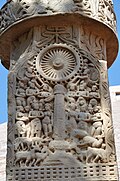
In Buddhism, the Dharma Chakra is widely used to represent the Buddha's Dharma (Buddha's teaching and the universal moral order), Gautama Buddha himself and the walking of the path to enlightenment, since the time of Early Buddhism.[15][1][note 2] The symbol is also sometimes connected to the Four Noble Truths, the Noble Eightfold Path and Dependent Origination. The pre-Buddhist dharmachakra (Pali: dhammacakka) is considered one of the ashtamangala (auspicious signs) in Hinduism and Buddhism and often used as a symbol of both faiths.[16][note 3] It is one of the oldest known Indian symbols found in Indian art, appearing with the first surviving post-Indus Valley Civilisation Indian iconography in the time of the Buddhist king Ashoka.[15][note 2]
The Buddha is said to have set the "wheel of dharma" in motion when he delivered his first sermon,[17] which is described in the Dhammacakkappavattana Sutta. This "turning of the wheel" signifies a great and revolutionary change with universal consequences, brought about by an exceptional human being. Buddhism adopted the wheel as a symbol from the Indian mythical idea of the ideal king, called a chakravartin ("wheel-turner", or "universal monarch"),[12][17] who was said to possess several mythical objects, including the ratana cakka (the ideal wheel). The Mahā Sudassana Sutta of the Digha Nikaya describes this wheel as having a nave (nābhi), a thousand spokes (sahassārāni) and a felly (nemi), all of which are perfect in every respect.[14] Siddhartha Gautama was said to have been a "mahapurisa" (great man) who could have chosen to become a wheel turning king, but instead became the spiritual counterpart to such a king, a wheel turning sage, that is, a Buddha.[18]
In his explanation of the term "turning the wheel of Dharma", the Theravada exegete Buddhaghosa explains that this "wheel" which the Buddha turned is primarily to be understood as wisdom, knowledge, and insight (ñāṇa). This wisdom has two aspects, paṭivedha-ñāṇa, the wisdom of self-realisation of the Truth and desanā-ñāṇa, the wisdom of proclamation of the Truth.[14] The dharmachakra symbol also points to the central Indian idea of "Dharma", a complex and multivalent term which refers to the eternal cosmic law, universal moral order and in Buddhism, the very teaching and path expounded by the Buddha.[19]
In the Buddhist Art at early sites such as Bharhut and Sanchi, the dharmachakra was often used as a symbol of Gautama Buddha himself.[18][14] The symbol is often paired with the triratna (triple jewel) or trishula (trident) symbolizing the triple gem, umbrellas (chatra), symbols of sovereignty and royal power, gems and garlands. It is also sometimes depicted alongside animals such as lions,[14] or deer.
There are different designs of the Buddhist dharmachakra with 8, 12, 24 or more spokes. In different Buddhist traditions, the different number of spokes may represent different aspects of the Buddha's Dharma (teaching). In the Indo-Tibetan Buddhist tradition for example, the 8 spoked wheel represents the noble eightfold path, and the hub, rim and spokes are also said to represent the three trainings (sila, prajña and samadhi).[20]
In Buddhism, the cyclical movement of a wheel is also used to symbolize the cyclical nature of life in the world (also referred to as the "wheel of samsara", samsara-chakra or the "wheel of becoming", bhava-cakra).[14] This wheel of suffering can be reversed or "turned" through the practice of the Buddhist path. The Buddhist terms for "suffering" (dukkha) and happiness (sukha) may also originally be related to the proper or improper fitting of wheels on a chariot's axle.[21] The Indo-Tibetan tradition has developed elaborate depictions called Bhavacakras which depict the many realms of rebirth in Buddhist cosmology.
The spokes of a wheel are also often used as symbols of the Buddhist doctrine of dependent origination. According to the Theravada scholar Buddhaghosa:
“It is the beginningless round of rebirths that is called the ’Wheel of the round of rebirths’ (saṃsāracakka). Ignorance (avijjā) is its hub (or nave) because it is its root. Ageing-and-death (jarā-maraṇa) is its rim (or felly) because it terminates it. The remaining ten links [of Dependent Origination] are its spokes [i.e. saṅkhāra up to the process of becoming, bhava].”[14]

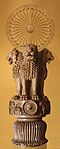
The earliest Indian monument featuring dharmachakras are the Ashokan Pillars, such as the lion pillar at Sanchi, built at the behest of the Mauryan emperor Ashoka. According to Benjamin Rowland:[14]
”The Sārnāth column may be interpreted, therefore, not only as a glorification of the Buddha’s preaching symbolised by the crowning wheel, but also through the cosmological implications of the whole pillar as a symbol of the universal extension of the power of the Buddha’s Law as typified by the sun that dominates all space and all time, and simultaneously an emblem of the universal extension of Mauryan imperialism through the Dharma. The whole structure is then a translation of age-old Indian and Asiatic cosmology into artistic terms of essentially foreign origin and dedicated, like all Asoka’s monuments, to the glory of Buddhism and the royal house.”
According to Harrison, the symbolism of "the wheel of the law" and the order of Nature is also visible in the Tibetan prayer wheels. The moving wheels symbolize the movement of cosmic order (ṛta).[22]
Buddha Dhamma and its modern Indian usage[edit | edit source]


The dharmachakra is a symbol in the sramana religion of Buddha Dhamma.[23][24]
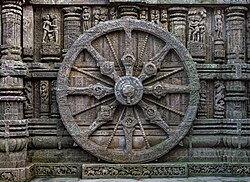
Wheel symbolism was also used in Indian temples in places that underwent a religious transformation from Buddhism,[25][26] such as Jagannath temple, whose deity is believed by some scholars to have a Buddhist origin.[27][28] It also finds use in other ancient temples of Odisha, the most famous of which is the Konark Sun Temple.
The 24 spoke Ashoka dharmachakra is present in the modern flag of India, representing the pan-Indian concept of Dharma.[29] The modern State Emblem of India is a depiction of the Lion Capital of Ashoka (Sanchi), which includes the dharmachakra. An integral part of the emblem is the motto inscribed in Devanagari script: Satyameva Jayate (English: Truth Alone Triumphs).[30] This is a quote from the Mundaka Upanishad,[31] the concluding part of the Vedas.
Sarvepalli Radhakrishnan, the first Vice President of India, stated that the Ashoka Chakra of India represents the "wheel of the law of dharma", as well as "Truth or satya", "Virtue" as well as "motion", as in the "dynamism of a peaceful change".[29]
Other uses and similar symbols[edit | edit source]
- The main attribute of Vishnu is a wheel like weapon called the Sudarśanacakra.[12]
- Similar wheel symbols were used as a solar symbol by the Ancient Egyptians.[32]
- Some Buddha statues also depict the related Dharmachakra Mudrā, a hand sign depicting the turning of the Dharma wheel.
- A very similar wheel symbol also appears in the flag of the Romani people, hinting to their nomadic history.
- In non-Buddhist cultural contexts, an eight-spoked wheel resembles a traditional ship's wheel. As a nautical emblem, this image is a common sailor tattoo, which may be misidentified as a dharmachakra or vice versa.
- The sonnenrad is a similar symbol used by occultists and neo-nazis.
- Falun Gong uses the concept of a similar wheel as a central concept.
- In the Unicode computer standard, the dharmachakra is called the "Wheel of Dharma" and found in the eight-spoked form. It is represented as U+2638 (☸). As emoji: ☸️.
Gallery[edit | edit source]
Historical and archeological examples[edit | edit source]
-
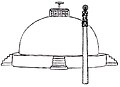 Reconstitution of approximate layout of Sanchi at the time of the Mauryas, showing the pillar topped by a dharmachakra.
 -
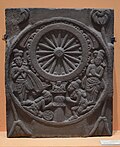
-
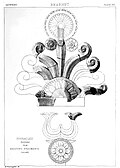 Illustrated reconstruction of the pinnacles at Bharhut by Alexander Cunningham
 -
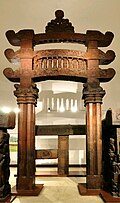 Eastern gateway of Bharhut stupa topped with a dharmachakra pinnacle
 -
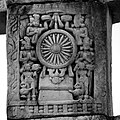 Buddha represented by Dharmacakra, Sanchi Stupa no. 3.
 -
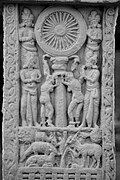 Dharmacakra on Pillar, Sanchi Stupa no. 3
 -
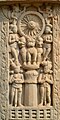 Adoration of the pillar of Ashoka, Sanchi Stupa no. 3.
 -
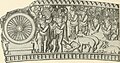 Illustration from Sanchi Stupa
 -
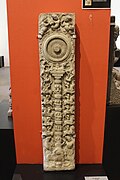 Limestone Pilaster, 2nd century CE, Amaravathi, Indian Museum, Kolkata.
 -
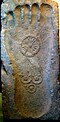
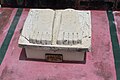 Buddha footprints with dharmachakras, Archaeological Museum, Amaravati
 -
 1st century Gandhara Buddha footprint
 -
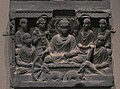
-
Stele from Gandhara
-
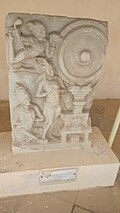 A sculpture depicting the Dharmachakra in the museum of Amaravathi
 -
 Taxila coin with wheel and Buddhist symbols
 -
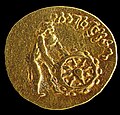 Coin found in Afghanistan, 50 BCE – c. 30 CE, at the latest before 50 CE.
 -
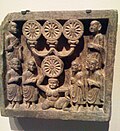 Three Jewels, or Triratna. Eastern Afghanistan. Kushan period. 2–3 century.
 -
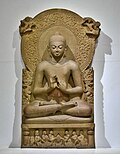 Dharmachakra Pravartana Mudra, Gupta period, 5th CE.
 -
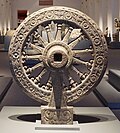 Dhammacakka, National Museum, Bangkok, Thailand.
 -
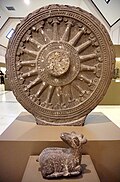 Dhammacakka, National Museum, Bangkok, Thailand.
 -
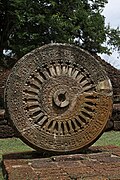 Khao Klang Nai, Si Thep Historical Park, Thailand.
 -
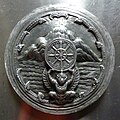 Seal of Chai Nat Province (a garuda upholding the dhammacakka in front of the mountain and river), Wat Sri Suphan, Chiang Mai, Thailand.
 -
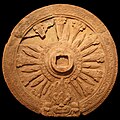 Mon dharmachakra, VII or IX century, Sandstone
 -
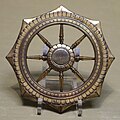 Dharma wheel, Japan, Kamakura period, 1200s CE, bronze – Tokyo National Museum.
 -
 Part of a Buddha-statue, showing the first five disciples of the Buddha at Sarnath and dharmachakra.
 -
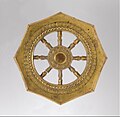 Japanese dharmachakra, late 13th century.
 -
Mandala Base, China, Ming dynasty, Cleveland Museum of Art.
-
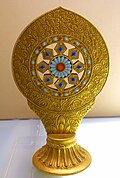 Dharma wheel, China, Qing dynasty, Qianlong period, 1736–1795 CE.
 -
Box with Ink Cakes: Yellow Ink Stick, China, Qing dynasty (1644–1912).
-
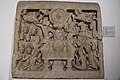 Dharmachakra Pravartana at National Museum, New Delhi


.jpg)
.jpg)


.jpg)
.jpg)
.jpg)

.jpg)


_MET_DT352194.jpg)


Contemporary examples[edit | edit source]
-
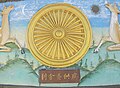
-
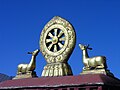
-
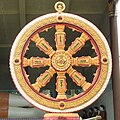 Wat Phothivihan, Tumpat, Kelantan
 -
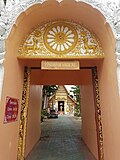 Entrance to Wat Phra Sing
 -
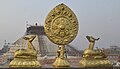 Dharmachakra at Boudanath
 -
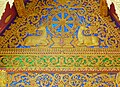 Dhammacakka on Main Gable, Wat Phra Putthabat Tak Pha, Lamphun
 -
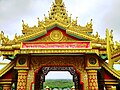 Entrance to the Global Vipassana Pagoda
 -
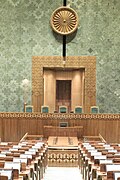 Lok Sabha chamber of the New Parliament building, New Delhi
 -
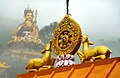
.JPG)

.jpg)
.jpg)

.jpg)


National flags and official symbolism[edit | edit source]
-
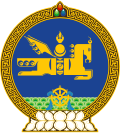 The Emblem of Mongolia includes the dharmachakra, a cintamani, a padma, blue khata and the Soyombo symbol
 -
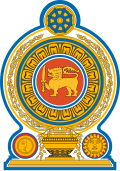 The Emblem of Sri Lanka, featuring a blue dharmachakra as the crest
 -
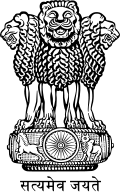 The Emblem of India, featuring the Ashoka Chakra on the base panel representing the Dharmachakra
 -
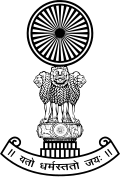 Emblem of the Supreme Court of India, which shows the dharmachakra on top of the Lion Capital (as was originally found in the Lion Capital of Ashoka).
 -
![The Flag of India has the Ashoka Chakra at its center representing the Dharmachakra.[29]](/w/images/thumb/4/41/Flag_of_India.svg/120px-Flag_of_India.svg.png)
-
 The flag of the former Kingdom of Sikkim featured a version of the Dharmachakra
 -
 Emblem of Central Tibetan Administration with Tibetan Buddhist style Dharmachakra
 -
 The dhammacakka flag, the symbol of Buddhism in Thailand
 -
 The seal of Thammasat University in Thailand consisting of a Constitution on phan with a twelve-spoked dhammacakka
 -
 Colours of the National Scout Organization of Thailand
 -
 Flag used by the Indian Dalit Buddhist Movement
 -
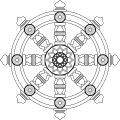 The insignia for Buddhist chaplains in the United States Armed Forces.
 -
 Wheel in Jain Symbol of Ahimsa represents dharmachakra
 -
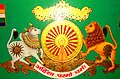
-
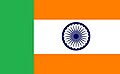 Flag for abolition of meat and speciesism, modeled after the flag of the Republic of India, with the Ashoka's Wheel of Dharma in the center.
 -
 USVA headstone emblem 2
 -
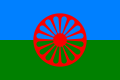 Flag of the Romani People. It contains blue and red colour to represent the heaven and earth respectively, and uses a 16 spoke Dharmachakra to symbolise their tradition and to pay homage to their Indian origin.


![The Flag of India has the Ashoka Chakra at its center representing the Dharmachakra.[29]](/wiki/File:Flag_of_India.svg)
.svg)

.svg)


Notes[edit | edit source]
- ↑ These symbols, however, are elongated and not circular. Spoked wheel vehicle are virtually absent in Harappan civilisation.[11] Therefore interpreting these symbols as spoked wheel is a matter of debate.
- ↑ 2.0 2.1 Grünwedel e.a.:"The wheel (dharmachakra) as already mentioned, was adopted by Buddha's disciples as the symbol of his doctrine, and combined with other symbols—a trident placed above it, etc.—stands for him on the sculptures of the Asoka period."[15]
- ↑ Goetz: "dharmachakra, symbol of the Buddhist faith".[16]
References[edit | edit source]
- ↑ 1.0 1.1 John C. Huntington, Dina Bangdel, The Circle of Bliss: Buddhist Meditational Art, p. 524.
- ↑ "Buddhist Symbols". Ancient-symbols.com. Retrieved 22 June 2018.
- ↑ Mansinha, Mayadhar (10 September 2021) [1960]. "CHAPTER VIII. THE POST SARALA PERIOD - A PERIOD OF EXPERIMENTS: I.The Buddhist Influence - The Metaphysical Poets". History of Oriya Literature. Creative Media Partners, LLC. ISBN 978-1015025486.
- ↑ Nayak, Dr. Ganeswar (11 March 2014). "History of Odisha (From earliest times to 1434 A.D)" (PDF). Paralakhemundi: Shri Krushna Chandra Gajapati Autonomous College. p. 107.
- ↑ Misra, Bijoy M. (2007). Bryant, Edwin Francis (ed.). Krishna: A Sourcebook. Oxford University Press. p. 141. ISBN 978-0195148923.
- ↑ Sahu, Nabin Kumar (1958). "Sailodbhavas, Bhaumakaras and Somavamśīs". Buddhism in Orissa. Bhubaneshwar: Utkal University. p. x. OCLC 1391872675.
- ↑ "Dharma And Ethics The Indian Ideal Of Human Perfection 1st Published". priscilla.work. Archived from the original on 29 October 2021. Retrieved 29 October 2021.
- ↑ Monier Williams, A Sanskrit Dictionary (1899): "to hold, bear (also: bring forth), carry, maintain, preserve, keep, possess, have, use, employ, practise, undergo"
- ↑ Day, Terence (2006) [1982]. "The Concept of Obligation". The Conception of Punishment in Early Indian Literature. Editions SR. Vol. 2. Waterloo, Ontario: Wilfrid Laurier University Press. p. 42. ISBN 9780889208384. Retrieved 5 March 2024.
The importance of the conception of Dharma in early brāhmanic thought is so considerable that it has seemed either that it replaced Ṛta as the leading philosophical and religious conception or that the earlier concept was at some time absorbed into it. It is probably more true that Dharma was conceived as an aspect of Ṛta which became so useful for framing religious, moral and social regulations, that interest in it and discussion of its applications to social and moral order eclipsed all discussions of metaphysical and theological ideas.
- ↑ 10.0 10.1 The Ancient Indus Valley: New Perspectives By Jane McIntosh. p. 377
- ↑ Shahane, Girish (8 October 2014). "What the absence of chariots in ancient Harappa means for Modi's Clean India plan". Scroll.in. Archived from the original on 10 October 2014. Retrieved 16 January 2024.
- ↑ 12.0 12.1 12.2 12.3 Beer 2003, p. 14.
- ↑ Issitt, Micah. Main, Carlyn. (2014). Hidden Religion: The Greatest Mysteries and Symbols of the World's Religious Beliefs, ABC-CLIO, p. 185.
- ↑ 14.0 14.1 14.2 14.3 14.4 14.5 14.6 14.7 T. B. Karunaratne (1969), The Buddhist Wheel Symbol, The Wheel Publication No. 137/138, Buddhist Publication Society, Kandy • Sri Lanka.
- ↑ 15.0 15.1 15.2 Grünwedel, Gibson & Burgess 1901, p. 67.
- ↑ 16.0 16.1 Goetz 1964, p. 52.
- ↑ 17.0 17.1 Pal 1986, p. 42.
- ↑ 18.0 18.1 Ludowyk, E.F.C. (2013) The Footprint of the Buddha, Routledge, p. 22.
- ↑ Issitt, Micah. Main, Carlyn. (2014). Hidden Religion: The Greatest Mysteries and Symbols of the World's Religious Beliefs, ABC-CLIO, p. 186.
- ↑ A Lamp Illuminating the Path to Liberation: An Explanation of Essential Topics for Dharma Students by Khenpo Gyaltsen (translated by Lhasey Lotsawa Translations, Nepal: 2014, pp. 247–248).
- ↑ Sargeant, Winthrop (2009), The Bhagavad Gita, SUNY Press, p. 303.
- ↑ Harrison 2010, p. 526.
- ↑ Asha Kalia, Art of Osian Temples: Socio-economic and Religious Life in India, 8th–12th Centuries A.D. Abhinav Publications, 1982, chapter 16.
- ↑ Sharma, Savita (1990). Early Indian Symbols: Numismatic Evidence, Agam Kala Prakashan, 1990 p. 51.
- ↑ Misra 2007.
- ↑ Sahu 1958.
- ↑ Nayak 2014.
- ↑ Mansinha 2021.
- ↑ 29.0 29.1 29.2 "The national flag code" (PDF). Mahapolice.gov.in. Archived from the original (PDF) on 15 December 2017. Retrieved 22 June 2018.
- ↑ Kamal Dey v. Union of India and State of West Bengal (Calcutta High Court 2011-07-14).Text
- ↑ "Rajya Sabha Parliamentary Standing Committee On Home Affairs: 116th Report on The State Emblem Of India (Prohibition Of Improper Use) Bill, 2004" (PDF). Archived from the original (PDF) on 8 March 2013.
- ↑ Hall, Adelaide S. (2005). A Glossary of Important Symbols in Their Hebrew: Pagan and Christian Forms. Cosimo. p. 56. ISBN 978-1-59605-593-3.
Sources[edit | edit source]
- Anthony, David W. (2007), The Horse The Wheel and Language. How Bronze-Age Riders From The Eurasian Steppes Shaped The Modern World, Princeton University Press
- Beer, Robert (2003), The Handbook of Tibetan Buddhist Symbols, Serindia Publications, Inc., ISBN 978-1932476033
- Day, Terence P. (1982), The Conception of Punishment in Early Indian Literature, Ontario: Wilfrid Laurier University Press, ISBN 0-919812-15-5
- Goetz, Hermann (1964), The art of India: five thousand years of Indian art, Crown
- Grünwedel, Albert; Gibson, Agnes C.; Burgess, James (1901), Buddhist art in India, Bernard Quaritch
- Harrison, Jane Ellen (2010) [1912], Themis: A Study of the Social Origins of Greek Religion, Cambridge University Press
- Hiltebeitel, Alf (2007), Hinduism. In: Joseph Kitagawa, "The Religious Traditions of Asia: Religion, History, and Culture". Digital printing 2007, Routledge, ISBN 9781136875908
- Inden, Ronald (1998), Ritual, Authority, And Cycle Time in Hindu Kingship. In: JF Richards, ed., "Kingship and Authority in South Asia", New Delhi: Oxford University Press
- Mallory, J.P. (1997), Encyclopedia of Indo-European Culture, London: Fitzroy Dearborn Publishers, ISBN 978-1-884964-98-5
- Nath, Vijay (March–April 2001), "From 'Brahmanism' to 'Hinduism': Negotiating the Myth of the Great Tradition", Social Scientist, 29 (3/4): 19–50, doi:10.2307/3518337, JSTOR 3518337
- Pal, Pratapaditya (1986), Indian Sculpture: Circa 500 B.C.–A.D. 700, University of California Press, ISBN 9780520059917
- Queen, Christopher S.; King, Sallie B. (1996), Engaged Buddhism: Buddhist liberation movements in Asia., SUNY Press, ISBN 9780791428443
- Samuel, Geoffrey (2010), The Origins of Yoga and Tantra. Indic Religions to the Thirteenth Century, Cambridge University Press
- Yan, Xiaojing (2009), The confluence of East and West in Nestorian Arts in China. In: Dietmar W. Winkler, Li Tang (eds.), Hidden Treasures and Intercultural Encounters: Studies on East Syriac Christianity in China and Central Asia, LIT Verlag Münster, ISBN 9783643500458
Further reading[edit | edit source]
- Dorothy C. Donath (1971). Buddhism for the West: Theravāda, Mahāyāna and Vajrayāna; a comprehensive review of Buddhist history, philosophy, and teachings from the time of the Buddha to the present day. Julian Press. ISBN 0-07-017533-0.

