


Ajay Kumar (talk | contribs) Created a new article |
m expanded information further and corrected details for consistency |
||
| Line 1: | Line 1: | ||
{{Short description|Railway signaling system}} | {{Short description|Railway signaling system}} | ||
{{redirect|CBTC}} | |||
{{multiple image | {{multiple image | ||
| align = right | | align = right | ||
| Line 6: | Line 7: | ||
| width1 = 150 | | width1 = 150 | ||
| alt1 = An underground station with two tracks in Madrid. A blue and white subway train is entering the station on the left. | | alt1 = An underground station with two tracks in Madrid. A blue and white subway train is entering the station on the left. | ||
| caption1 = CBTC deployment in [[Madrid Metro]], Spain | | caption1 = CBTC deployment in [[Madrid Metro]], Spain | ||
| image2 = Estação Santo Amaro Linha 5.jpg | | image2 = Estação Santo Amaro Linha 5.jpg | ||
| width2 = 266 | | width2 = 266 | ||
| alt2 = An elevated station in Sao Paolo has a design like a cable-stayed bridge. | | alt2 = An elevated station in Sao Paolo has a design like a cable-stayed bridge. | ||
| caption2 = Santo Amaro station on [[Line 5 (São Paulo Metro)|Line 5]] of the partially CBTC-enabled [[São Paulo Metro]] | | caption2 = Santo Amaro station on [[Line 5 (São Paulo Metro)|Line 5]] of the partially CBTC-enabled [[São Paulo Metro]] | ||
| footer = | | footer = | ||
}} | }} | ||
{{Automated track-bound traffic}} | {{Automated track-bound traffic}} | ||
'''Communications-based train control''' ('''CBTC''') is a [[railway signaling]] system that uses [[telecommunications]] between the [[train]] and track equipment for traffic management and infrastructure control. CBTC allows a train's position to be known more accurately than with traditional signaling systems. This can make railway traffic management safer and more efficient. [[Rapid transit]] systems (and other railway systems) are able to reduce [[headway]]s while maintaining or even improving safety. | |||
'''Communications-based train control''' ('''CBTC''') is a [[railway signaling]] system that uses [[telecommunications]] between the [[train]] and track equipment for traffic management and infrastructure control. CBTC allows a train's position to be known more accurately than with traditional signaling systems. This | |||
A CBTC system is a "continuous, [[automatic train control]] system utilizing high-resolution train location determination, independent from [[track circuits]]; continuous, high-capacity, bidirectional train-to-wayside data communications; and trainborne and wayside [[processors]] capable of implementing [[automatic train protection]] (ATP) functions, as well as optional [[automatic train operation]] (ATO) and '''automatic train supervision''' ('''ATS''') functions," as defined in the [[IEEE]] 1474 standard.<ref name="IEEE1474">1474.1–1999 – IEEE Standard for Communications-Based Train Control (CBTC) Performance and Functional Requirements.[https://ieeexplore.ieee.org/document/815310] (Accessed at January 14, 2019).</ref> | A CBTC system is a "continuous, [[automatic train control]] system utilizing high-resolution train location determination, independent from [[track circuits]]; continuous, high-capacity, bidirectional train-to-wayside data communications; and trainborne and wayside [[Processor (computing)|processors]] capable of implementing [[automatic train protection]] (ATP) functions, as well as optional [[automatic train operation]] (ATO) and '''automatic train supervision''' ('''ATS''') functions," as defined in the [[IEEE]] 1474 standard.<ref name="IEEE1474">1474.1–1999 – IEEE Standard for Communications-Based Train Control (CBTC) Performance and Functional Requirements.[https://ieeexplore.ieee.org/document/815310] (Accessed at January 14, 2019).</ref> | ||
== Background and origin == | == Background and origin == | ||
CBTC is a signalling standard defined by the [[IEEE]] 1474 standard.<ref name="IEEE1474" /> The original version was introduced in 1999 and updated in 2004.<ref name="IEEE1474" /> The aim was to create consistency and standardisation between digital railway signalling systems that allow for an increase in train capacity through what the standard defines as high-resolution train location determination.<ref name="IEEE1474" /> The standard therefore does not require the use of [[moving block]] railway signalling, but in practice this is the most common arrangement.<ref>{{Cite book |last1=Wu |first1=Qing |url=https://acquire.cqu.edu.au/articles/conference_contribution/Communication_based_train_control_CBTC_Train_controller_and_dynamics/25806895 |title=Communication based train control (CBTC): Train controller and dynamics |last2=Ge |first2=Xiahau |last3=Cole |first3=Colin |last4=Spiryagin |first4=Maksym |last5=Bernal Arango |first5=Esteban |date=2023-01-01 |publisher=CQUniversity |isbn=978-1-925627-79-4 |language=en}}</ref><ref name=":1" /><ref name="SSR" /><ref name="mdm" /><ref name="ttc-service-2019-03" /><ref name="TTC-2017-01-18" /> | |||
=== Moving block === | |||
{{Main|Moving block}} | |||
Traditional signalling systems detect trains in discrete sections of the track called '[[Block signal|blocks]]', each protected by signals that prevent a train entering an occupied block. Since every block is a fixed section of track, these systems are referred to as [[ | Traditional signalling systems detect trains in discrete sections of the track called '[[Block signal|blocks]]', each protected by signals that prevent a train entering an occupied block. Since every block is a fixed section of track, these systems are referred to as [[fixed block]] systems. | ||
In a | In a moving block CBTC system the protected section for each train is a "block" that moves with and trails behind it, and provides continuous communication of the train's exact position via radio, inductive loop, etc.<ref name="digitalradio">Digital radio shows great potential for Rail [http://findarticles.com/p/articles/mi_m0BQQ/is_5_41/ai_80931845/] Bruno Gillaumin, International Railway Journal, May 2001. Retrieved by findarticles.com in June 2011.</ref> | ||
[[File:AirTrain SFO tracks.jpg|thumb|The SFO [[AirTrain (SFO)|AirTrain]] in [[San Francisco Airport]] was the first radio-based CBTC system. | alt=]] | [[File:AirTrain SFO tracks.jpg|thumb|The SFO [[AirTrain (SFO)|AirTrain]] in [[San Francisco Airport]] was the first radio-based CBTC system. | alt=]] | ||
As a result, [[Bombardier Transportation|Bombardier]] opened the world's first radio-based CBTC system at [[San Francisco airport]]'s [[automated people mover]] (APM) in February 2003.<ref name="CBTC15">{{Cite press release |date=March 29, 2018 |title=Bombardier Marks 15th Anniversary of Its World-First Radio-Based, Driverless Rail Control System |publisher=Bombardier Transportation |agency=MarketWired |url=http://www.marketwired.com/press-release/bombardier-marks-15th-anniversary-its-world-first-radio-based-driverless-rail-control-tsx-bbd.a-2246505.htm |access-date=January 22, 2019 |archive-url=https://web.archive.org/web/20190122095005/http://www.marketwired.com/press-release/bombardier-marks-15th-anniversary-its-world-first-radio-based-driverless-rail-control-tsx-bbd.a-2246505.htm |archive-date=January 22, 2019}}</ref> A few months later, in June 2003, [[Alstom]] introduced the railway application of its radio technology on the [[North East | As a result, [[Bombardier Transportation|Bombardier]] opened the world's first radio-based CBTC system at [[San Francisco airport]]'s [[automated people mover]] (APM) in February 2003.<ref name="CBTC15">{{Cite press release |date=March 29, 2018 |title=Bombardier Marks 15th Anniversary of Its World-First Radio-Based, Driverless Rail Control System |publisher=Bombardier Transportation |agency=MarketWired |url=http://www.marketwired.com/press-release/bombardier-marks-15th-anniversary-its-world-first-radio-based-driverless-rail-control-tsx-bbd.a-2246505.htm |access-date=January 22, 2019 |archive-url=https://web.archive.org/web/20190122095005/http://www.marketwired.com/press-release/bombardier-marks-15th-anniversary-its-world-first-radio-based-driverless-rail-control-tsx-bbd.a-2246505.htm |archive-date=January 22, 2019}}</ref> A few months later, in June 2003, [[Alstom]] introduced the railway application of its radio technology on the [[North East Line|Singapore North East Line]]. CBTC has its origins in the [[Inductive loop|loop-based]] systems developed by [[Alcatel-Lucent|Alcatel SEL]] (later [[Thales Group|Thales]], now [[Hitachi Rail]]) for the [[Bombardier Advanced Rapid Transit|Bombardier Automated Rapid Transit]] (ART) systems in [[Canada]] during the mid-1980s. | ||
These systems, which were also referred to as [[transmission-based train control]] (TBTC), made use of [[inductive loop]] transmission techniques for track to train communication, introducing an alternative to [[track circuit]] based communication. This technology, operating in the 30–60 [[kHz]] [[frequency]] range to communicate trains and wayside equipment, was widely adopted by the [[Rapid transit|metro]] operators in spite of some [[electromagnetic compatibility]] (EMC) issues, as well as other installation and maintenance concerns (see [[SelTrac]] for further information regarding | These systems, which were also referred to as [[transmission-based train control]] (TBTC), made use of [[inductive loop]] transmission techniques for track to train communication, introducing an alternative to [[track circuit]] based communication. This technology, operating in the 30–60 [[kHz]] [[frequency]] range to communicate trains and wayside equipment, was widely adopted by the [[Rapid transit|metro]] operators in spite of some [[electromagnetic compatibility]] (EMC) issues, as well as other installation and maintenance concerns (see [[SelTrac]] for further information regarding transmission-based train-control). | ||
As with new application of any technology, some problems arose at the beginning mainly due to compatibility and interoperability aspects.<ref name="cbtcprojects">CBTC Projects. [http://www.tsd.org/cbtc/projects/index.htm] {{Webarchive|url=https://web.archive.org/web/20150614033641/http://www.tsd.org/cbtc/projects/index.htm|date=2015-06-14}} www.tsd.org/cbtc/projects, 2005. Accessed June 2011.</ref><ref name="radiopdf">CBTC radios: What to do? Which way to go? [http://www.tsd.org/papers/CBTCRadios.pdf] {{Webarchive|url=https://web.archive.org/web/20110728134242/http://www.tsd.org/papers/CBTCRadios.pdf|date=2011-07-28}} Tom Sullivan, 2005. www.tsd.org. Accessed May 2011.</ref> However, there have been relevant improvements since then, and currently the reliability of the radio-based communication systems has grown significantly. | As with new application of any technology, some problems arose at the beginning, mainly due to compatibility and interoperability aspects.<ref name="cbtcprojects">CBTC Projects. [http://www.tsd.org/cbtc/projects/index.htm] {{Webarchive|url=https://web.archive.org/web/20150614033641/http://www.tsd.org/cbtc/projects/index.htm|date=2015-06-14}} www.tsd.org/cbtc/projects, 2005. Accessed June 2011.</ref><ref name="radiopdf">CBTC radios: What to do? Which way to go? [http://www.tsd.org/papers/CBTCRadios.pdf] {{Webarchive|url=https://web.archive.org/web/20110728134242/http://www.tsd.org/papers/CBTCRadios.pdf|date=2011-07-28}} Tom Sullivan, 2005. www.tsd.org. Accessed May 2011.</ref> However, there have been relevant improvements since then, and currently the reliability of the radio-based communication systems has grown significantly. | ||
Moreover, it is important to highlight that not all the systems using [[radio communication]] technology are considered to be CBTC systems. So, for clarity and to keep in line with the [[state-of-the-art]] solutions for operator's requirements,<ref name="radiopdf" /> this article only covers the latest [[moving block]] principle based (either true [[moving block]] or [[virtual block]], so not dependent on track-based detection of the trains)<ref name="IEEE1474" /> CBTC solutions that make use of the [[radio communications]]. | Moreover, it is important to highlight that not all the systems using [[radio communication]] technology are considered to be CBTC systems. So, for clarity and to keep in line with the [[state-of-the-art]] solutions for operator's requirements,<ref name="radiopdf" /> this article only covers the latest [[moving block]] principle based (either true [[moving block]] or [[virtual block]], so not dependent on track-based detection of the trains)<ref name="IEEE1474" /> CBTC solutions that make use of the [[radio communications]]. | ||
| Line 42: | Line 45: | ||
CBTC systems are modern railway signaling systems that can mainly be used in urban railway lines (either [[Light rail|light]] or [[Rapid transit|heavy]]) and [[Automated people mover|APMs]], although it could also be deployed on [[Commuter rail|commuter lines]]. For [[Main line (railway)|main lines]], a similar system might be the [[European Railway Traffic Management System]] ERTMS Level 3 (not yet fully defined {{when|date=November 2017}}). | CBTC systems are modern railway signaling systems that can mainly be used in urban railway lines (either [[Light rail|light]] or [[Rapid transit|heavy]]) and [[Automated people mover|APMs]], although it could also be deployed on [[Commuter rail|commuter lines]]. For [[Main line (railway)|main lines]], a similar system might be the [[European Railway Traffic Management System]] ERTMS Level 3 (not yet fully defined {{when|date=November 2017}}). | ||
In the modern CBTC systems the trains continuously calculate and communicate their status via radio to the wayside equipment distributed along the line. This status includes, among other parameters, the exact position, speed, travel direction and [[braking distance]]. | In the modern CBTC systems the trains continuously calculate and communicate their status via radio to the wayside equipment distributed along the line. This status includes, among other parameters, the exact position, speed, travel direction and [[braking distance]]. | ||
This information allows calculation of the area potentially occupied by the train on the track. It also enables the wayside equipment to define the points on the line that must never be passed by the other trains on the same track. These points are communicated to make the trains automatically and continuously adjust their speed while maintaining the [[safety engineering|safety]] and comfort ([[Jerk (physics)|jerk]]) requirements. So, the trains continuously receive information regarding the distance to the preceding train and are then able to adjust their [[safety distance]] accordingly. | This information allows calculation of the area potentially occupied by the train on the track. It also enables the wayside equipment to define the points on the line that must never be passed by the other trains on the same track. These points are communicated to make the trains automatically and continuously adjust their speed while maintaining the [[safety engineering|safety]] and comfort ([[Jerk (physics)|jerk]]) requirements. So, the trains continuously receive information regarding the distance to the preceding train and are then able to adjust their [[safety distance]] accordingly. | ||
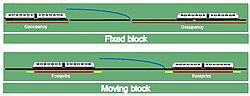
[[File:FB vs MB.jpg|thumb|center|800px|The safety distance (safe-braking distance) between trains in fixed block and moving block signalling systems|alt=Source: Bombardier Transportation for Wikimedia Commons]] | [[File:FB vs MB.jpg|thumb|center|800px|The safety distance (safe-braking distance) between trains in fixed block and moving block signalling systems|alt=Source: Bombardier Transportation for Wikimedia Commons]] | ||
From the [[Railway signal|signalling system]] perspective, the first figure shows the total occupancy of the leading train by including the whole [[Block signal|blocks]] which the train is located on. This is due to the fact that it is impossible for the system to know exactly where the train actually is within these [[Block signal|blocks]]. Therefore, the [[ | From the [[Railway signal|signalling system]] perspective, the first figure shows the total occupancy of the leading train by including the whole [[Block signal|blocks]] which the train is located on. This is due to the fact that it is impossible for the system to know exactly where the train actually is within these [[Block signal|blocks]]. Therefore, the [[fixed block]] system only allows the following train to move up to the last unoccupied [[Block signal|block]]'s border. | ||
In a [[moving block]] system as shown in the second figure, the train position and its [[braking curve]] is continuously calculated by the trains, and then communicated via radio to the wayside equipment. Thus, the wayside equipment is able to establish protected areas, each one called Limit of Movement Authority (LMA), up to the nearest obstacle (in the figure the tail of the train in front). Movement Authority (MA) is the permission for a train to move to a specific location within the constraints of the infrastructure and with supervision of speed.<ref name=":0">{{Cite book|url=https://www.era.europa.eu/node/641/210_en|title=Subset-023. "ERTMS/ETCS-Glossary of Terms and Abbreviations"|publisher=ERTMS USERS GROUP|year=2014|access-date=2018-12-21|archive-url=https://web.archive.org/web/20181221134721/https://www.era.europa.eu/node/641/210_en|archive-date=2018-12-21|url-status=dead}}</ref> | In a [[moving block]] system as shown in the second figure, the train position and its [[braking curve]] is continuously calculated by the trains, and then communicated via radio to the wayside equipment. Thus, the wayside equipment is able to establish protected areas, each one called Limit of Movement Authority (LMA), up to the nearest obstacle (in the figure the tail of the train in front). Movement Authority (MA) is the permission for a train to move to a specific location within the constraints of the infrastructure and with supervision of speed.<ref name=":0">{{Cite book|url=https://www.era.europa.eu/node/641/210_en|title=Subset-023. "ERTMS/ETCS-Glossary of Terms and Abbreviations"|publisher=ERTMS USERS GROUP|year=2014|access-date=2018-12-21|archive-url=https://web.archive.org/web/20181221134721/https://www.era.europa.eu/node/641/210_en|archive-date=2018-12-21|url-status=dead}}</ref> | ||
End of Authority is the location to which the train is permitted to proceed and where target speed is equal to zero. End of Movement is the location to which the train is permitted to proceed according to an MA. When transmitting an MA, it is the end of the last section given in the MA.<ref name=":0" /> | End of Authority is the location to which the train is permitted to proceed and where target speed is equal to zero. End of Movement is the location to which the train is permitted to proceed according to an MA. When transmitting an MA, it is the end of the last section given in the MA.<ref name=":0" /> | ||
| Line 58: | Line 61: | ||
=== Grades of automation === | === Grades of automation === | ||
Modern CBTC systems allow different levels of automation or [[ | Modern CBTC systems allow different levels of automation or [[Automatic train operation|grades of automation]] (GoA), as defined and classified in the [[IEC]] 62290–1.<ref name="iec">IEC 62290-1, Railway applications – Urban guided transport management and command/control systems – Part 1: System principles and fundamental concepts.[http://webstore.iec.ch/webstore/webstore.nsf/ArtNum_PK/36384?OpenDocument] IEC, 2006. Accessed February 2014</ref> In fact, CBTC is not a synonym for "[[Automatic train operation|driverless]]" or "automated trains" although it is considered as a basic enabler technology for this purpose. | ||
There are four grades of automation available: | |||
* GoA 0 - On-sight, with no automation | |||
* GoA 1 - Manual, with a driver controlling all train operations. | |||
* GoA 2 - Semi-automatic Operation (STO), starting and stopping are automated, but a driver who sits in the cab operates the doors and drives in emergencies | |||
* GoA 3 - Driverless Train Operation (DTO), starting and stopping are automated, but a crew member operates the doors from within the train | |||
* GoA 4 - Unattended Train Operation (UTO), starting, stopping and doors are all automated, with no required crew member on board | |||
=== Main applications === | === Main applications === | ||
| Line 69: | Line 77: | ||
=== Main benefits === | === Main benefits === | ||
The evolution of the technology and the experience gained in operation over the last 30 years means that modern CBTC systems are more reliable and less prone to failure than older train control systems. CBTC systems normally have less wayside equipment and their diagnostic and monitoring tools have been improved, which makes them easier to implement and, more importantly, easier to maintain.<ref name="IRSE" /> | The evolution of the technology and the experience gained in operation over the last 30 years means that modern CBTC systems are more reliable and less prone to failure than older train control systems. CBTC systems normally have less wayside equipment and their diagnostic and monitoring tools have been improved, which makes them easier to implement and, more importantly, easier to maintain.<ref name="IRSE">Semi-automatic, driverless, and unattended operation of trains.[http://www.irse-itc.net/index.php?option=com_content&view=article&id=85:semi-automatic-driverless-and-unattended-operation-of-trains&catid=36:published-itc-publications&Itemid=29] {{Webarchive|url=https://web.archive.org/web/20101119000836/http://www.irse-itc.net/index.php?option=com_content&view=article&id=85:semi-automatic-driverless-and-unattended-operation-of-trains&catid=36:published-itc-publications&Itemid=29|date=2010-11-19}} IRSE-ITC, 2010. Accessed through www.irse-itc.net in June 2011</ref> | ||
CBTC technology is evolving, making use of the latest techniques and components to offer more compact systems and simpler architectures. For instance, with the advent of modern electronics it has been possible to build in redundancy so that single failures do not adversely impact operational availability. | CBTC technology is evolving, making use of the latest techniques and components to offer more compact systems and simpler architectures. For instance, with the advent of modern electronics it has been possible to build in redundancy so that single failures do not adversely impact operational availability. | ||
| Line 78: | Line 86: | ||
=== Risks === | === Risks === | ||
The primary risk of an electronic train control system is that if the communications link between any of the trains is disrupted | The primary risk of an electronic train control system is that if the communications link between any of the trains is disrupted, all or part of the system might have to enter a [[failsafe]] state until the problem is remedied. Depending on the severity of the communication loss, this state can range from vehicles temporarily reducing speed, coming to a halt or operating in a degraded mode until communications are re-established. If communication outage is permanent, some sort of [[Contingency plan|contingency operation]] must be implemented which may consist of manual operation using [[absolute block]] or, in the worst case, the [[Bustitution|substitution of an alternative form of transportation]].<ref>ETRMS Level 3 Risks and Benefits to UK Railways, pg 19 [https://web.archive.org/web/20110204131707/http://www.trl.co.uk/downloads/general/20100929_ERTMS_Level_3_Final_Report.pdf] Transport Research Laboratory. Accessed December 2011</ref> | ||
As a result, high availability of CBTC systems is crucial for proper operation, especially if such systems are used to increase transport capacity and reduce headway. System redundancy and recovery mechanisms must then be thoroughly checked to achieve a high robustness in operation. | As a result, high availability of CBTC systems is crucial for proper operation, especially if such systems are used to increase transport capacity and reduce headway. System redundancy and recovery mechanisms must then be thoroughly checked to achieve a high robustness in operation. | ||
| Line 85: | Line 93: | ||
Communications failures can result from equipment malfunction, [[electromagnetic interference]], weak signal strength or saturation of the communications medium.<ref>ETRMS Level 3 Risks and Benefits to UK Railways, Table 5 [https://web.archive.org/web/20110204131707/http://www.trl.co.uk/downloads/general/20100929_ERTMS_Level_3_Final_Report.pdf] Transport Research Laboratory. Accessed December 2011</ref> In this case, an interruption can result in a service brake or [[emergency brake (train)|emergency brake]] application as real time situational awareness is a critical safety requirement for CBTC and if these interruptions are frequent enough it could seriously impact service. This is the reason why, historically, CBTC systems first implemented radio communication systems in 2003, when the required technology was mature enough for critical applications. | Communications failures can result from equipment malfunction, [[electromagnetic interference]], weak signal strength or saturation of the communications medium.<ref>ETRMS Level 3 Risks and Benefits to UK Railways, Table 5 [https://web.archive.org/web/20110204131707/http://www.trl.co.uk/downloads/general/20100929_ERTMS_Level_3_Final_Report.pdf] Transport Research Laboratory. Accessed December 2011</ref> In this case, an interruption can result in a service brake or [[emergency brake (train)|emergency brake]] application as real time situational awareness is a critical safety requirement for CBTC and if these interruptions are frequent enough it could seriously impact service. This is the reason why, historically, CBTC systems first implemented radio communication systems in 2003, when the required technology was mature enough for critical applications. | ||
In systems with poor [[ | In systems with poor [[line of sight]] or spectrum/bandwidth limitations a larger than anticipated number of transponders may be required to enhance the service. This is usually more of an issue with applying CBTC to existing transit systems in tunnels that were not designed from the outset to support it. An alternate method to improve system availability in tunnels is the use of leaky feeder cable that, while having higher initial costs (material + installation) achieves a more reliable radio link. | ||
With the emerging services over open ISM radio bands (i.e. 2.4 GHz and 5.8 GHz) and the potential disruption over critical CBTC services, there is an increasing pressure in the international community (ref. report 676 of UITP organization, Reservation of a Frequency Spectrum for Critical Safety Applications dedicated to Urban Rail Systems) to reserve a frequency band specifically for radio-based urban rail systems. Such decision would help standardize CBTC systems across the market (a growing demand from most operators) and ensure availability for those critical systems. | With the emerging services over open ISM radio bands (i.e. 2.4 GHz and 5.8 GHz) and the potential disruption over critical CBTC services, there is an increasing pressure in the international community (ref. report 676 of UITP organization, Reservation of a Frequency Spectrum for Critical Safety Applications dedicated to Urban Rail Systems) to reserve a frequency band specifically for radio-based urban rail systems. Such decision would help standardize CBTC systems across the market (a growing demand from most operators) and ensure availability for those critical systems. | ||
As a CBTC system is required to have [[high availability]] and particularly, allow for a graceful degradation, a secondary method of signaling might be provided to ensure some level of non-degraded service upon partial or complete CBTC unavailability.<ref>ETRMS Level 3 Risks and Benefits to UK Railways, pg 18 [https://web.archive.org/web/20110204131707/http://www.trl.co.uk/downloads/general/20100929_ERTMS_Level_3_Final_Report.pdf] Transport Research Laboratory. Accessed December 2011</ref> This is particularly relevant for brownfield implementations (lines with an already existing signalling system) where the infrastructure design cannot be controlled and coexistence with legacy systems is required, at least, temporarily.<ref>CBTC World Congress Presentations, Stockholm, November 2011 [https://web.archive.org/web/20120303131523/http://www.cbtcworldcongress.com/presentations] Global Transport Forum. Accessed December 2011</ref> | As a CBTC system is required to have [[high availability]] and particularly, allow for a graceful degradation, a secondary method of signaling might be provided to ensure some level of non-degraded service upon partial or complete CBTC unavailability.<ref>ETRMS Level 3 Risks and Benefits to UK Railways, pg 18 [https://web.archive.org/web/20110204131707/http://www.trl.co.uk/downloads/general/20100929_ERTMS_Level_3_Final_Report.pdf] Transport Research Laboratory. Accessed December 2011</ref> This is particularly relevant for brownfield implementations (lines with an already existing signalling system) where the infrastructure design cannot be controlled and coexistence with legacy systems is required, at least, temporarily.<ref name="web.archive.org">CBTC World Congress Presentations, Stockholm, November 2011 [https://web.archive.org/web/20120303131523/http://www.cbtcworldcongress.com/presentations] Global Transport Forum. Accessed December 2011</ref> | ||
For example, the | For example, the [[BMT Canarsie Line]] in New York City was outfitted with a backup [[automatic block signaling]] system capable of supporting 12 trains per hour (tph), compared with the 26 tph of the CBTC system. Although this is a rather common architecture for resignalling projects, it can negate some of the cost savings of CBTC if applied to new lines. This is still a key point in the CBTC development (and is still being discussed), since some providers and operators argue that a fully redundant architecture of the CBTC system may however achieve high availability values by itself.<ref name="web.archive.org"/> | ||
In principle, CBTC systems may be designed with centralized supervision systems in order to improve maintainability and reduce installation costs. If so, there is an increased risk of a single point of failure that could disrupt service over an entire system or line. Fixed block systems usually work with distributed logic that are normally more resistant to such outages. Therefore, a careful analysis of the benefits and risks of a given CBTC architecture (centralized vs. distributed) must be done during system design. | In principle, CBTC systems may be designed with centralized supervision systems in order to improve maintainability and reduce installation costs. If so, there is an increased risk of a single point of failure that could disrupt service over an entire system or line. Fixed block systems usually work with distributed logic that are normally more resistant to such outages. Therefore, a careful analysis of the benefits and risks of a given CBTC architecture (centralized vs. distributed) must be done during system design. | ||
| Line 98: | Line 106: | ||
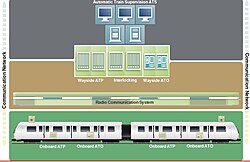
== Architecture == | == Architecture == | ||
[[File:CBTC Arch.jpg|thumb|center|400px|The architecture of a CBTC system | [[File:CBTC Arch.jpg|thumb|center|400px|The architecture of a CBTC system]] | ||
The typical architecture of a modern CBTC system comprises the following main subsystems: | The typical architecture of a modern CBTC system comprises the following main subsystems: | ||
| Line 106: | Line 114: | ||
Thus, although a CBTC architecture is always depending on the supplier and its technical approach, the following logical components may be found generally in a typical CBTC architecture: | Thus, although a CBTC architecture is always depending on the supplier and its technical approach, the following logical components may be found generally in a typical CBTC architecture: | ||
* '''Onboard ATP system'''. This subsystem is in charge of the continuous control of the train speed according to the safety profile, and applying the brake if it is necessary. It is also in charge of the communication with the wayside ATP subsystem in order to exchange the information needed for a safe operation (sending speed and braking distance, and receiving the limit of movement authority for a safe operation). | |||
*'''Onboard | * '''Onboard ATO system'''. It is responsible for the automatic control of the traction and braking effort in order to keep the train under the threshold established by the ATP subsystem. Its main task is either to facilitate the driver or attendant functions, or even to operate the train in a fully automatic mode while maintaining the traffic regulation targets and passenger comfort. It also allows the selection of different automatic driving strategies to adapt the runtime or even reduce the power consumption. | ||
*'''Onboard ATO system'''. It is responsible for the automatic control of the traction and braking effort in order to keep the train under the threshold established by the ATP subsystem. Its main task is either to facilitate the driver or attendant functions, or even to operate the train in a fully automatic mode while maintaining the traffic regulation targets and passenger comfort. It also allows the selection of different automatic driving strategies to adapt the runtime or even reduce the power consumption. | * '''Wayside ATP system'''. This subsystem undertakes the management of all the communications with the trains in its area. Additionally, it calculates the limits of movement authority that every train must respect while operating in the mentioned area. This task is therefore critical for the operation safety. | ||
*'''Wayside | * '''Wayside ATO system'''. It is in charge of controlling the destination and regulation targets of every train. The wayside ATO functionality provides all the trains in the system with their destination as well as with other data such as the [[terminal dwell time|dwell time]] in the stations. Additionally, it may also perform auxiliary and non-safety related tasks, for instance alarm/event communication and management, or handling skip/hold station commands. | ||
*'''Wayside ATO system'''. It is in charge of controlling the destination and regulation targets of every train. The wayside ATO functionality provides all the trains in the system with their destination as well as with other data such as the [[terminal dwell time|dwell time]] in the stations. Additionally, it may also perform auxiliary and non-safety related tasks | * '''Communication system'''. The CBTC systems integrate a [[Digital radio|digital networked radio]] system by means of [[antennas]] or [[leaky feeder]] cable for the bi-directional communication between the track equipment and the trains. The 2,4[[GHz]] [[Radio frequency|band]] is commonly used in these systems (same as [[WiFi]]), though other alternative [[Radio frequency|frequencies]] such as 900 MHz ([[US]]), 5.8 GHz or other licensed bands may be used as well. | ||
*'''Communication system'''. The CBTC systems integrate a [[Digital radio|digital networked radio]] system by means of [[antennas]] or [[leaky feeder]] cable for the bi-directional communication between the track equipment and the trains. The 2,4[[GHz]] [[Radio frequency|band]] is commonly used in these systems (same as [[WiFi]]), though other alternative [[Radio frequency|frequencies]] such as 900 MHz ([[US]]), 5.8 GHz or other licensed bands may be used as well. | * '''ATS system'''. The ATS system is commonly integrated within most of the CBTC solutions. Its main task is to act as the interface between the operator and the system, managing the traffic according to the specific regulation criteria. Other tasks may include the event and alarm management as well as acting as the interface with external systems. | ||
*'''ATS system'''. The ATS system is commonly integrated within most of the CBTC solutions. Its main task is to act as the interface between the operator and the system, managing the traffic according to the specific regulation criteria. Other tasks may include the event and alarm management as well as acting as the interface with external systems. | * '''[[Interlocking]] system'''. When needed as an independent subsystem (for instance as a fallback system), it will be in charge of the vital control of the trackside objects such as [[Railway switch|switches]] or [[Railway signal|signals]], as well as other related functionality. In the case of simpler networks or lines, the functionality of the interlocking may be integrated into the wayside ATP system. | ||
*'''[[Interlocking]] system'''. When needed as an independent subsystem (for instance as a fallback system), it will be in charge of the vital control of the trackside objects such as [[Railway switch|switches]] or [[Railway signal|signals]], as well as other related functionality. In the case of simpler networks or lines, the functionality of the interlocking may be integrated into the wayside ATP system. | |||
==Projects== | ==Projects== | ||
CBTC technology has been (and is being) successfully implemented for a variety of applications as shown in the figure below (mid 2011). They range from some implementations with short track, limited numbers of vehicles and few operating modes (such as the airport [[Automated people mover|APMs]] in | CBTC technology has been (and is being) successfully implemented for a variety of applications as shown in the figure below (mid 2011). They range from some implementations with short track, limited numbers of vehicles and few operating modes (such as the airport [[Automated people mover|APMs]] in Heathrow or Gatwick), to complex overlays on existing railway networks carrying more than a million passengers each day and with more than 100 trains (such as [[London Underground]] [[Jubilee Line]] and [[Northern Line]], [[MTR]] [[Tuen Ma Line]], [[Klang Valley Mass Rapid Transit]] [[Kajang Line]] and [[Putrajaya Line]]).<ref name="SSR">Bombardier to Deliver Major London Underground Signalling.[http://www.bombardier.com/en/transportation/media-centre/press-releases/details?docID=0901260d80181411] Press release, Bombardier Transportation Media Center, 2011. Accessed June 2011</ref> | ||
<br /> | <br /> | ||
Despite the difficulty, the table below tries to summarize and reference the main radio-based CBTC systems deployed around the world as well as those ongoing projects being developed. Besides, the table distinguishes between the implementations performed over existing and operative systems ([[Brownfield | Despite the difficulty, the table below tries to summarize and reference the main radio-based CBTC systems deployed around the world as well as those ongoing projects being developed. Besides, the table distinguishes between the implementations performed over existing and operative systems ([[Brownfield land|brownfield]]) and those undertaken on completely new lines ([[Greenfield project|greenfield]]). | ||
===List=== | ===List=== | ||
{{ | {{dynamic list|date=July 2018}} | ||
{{ | {{self-reference inline|This list is sortable, and is initially sorted by year. Click on the [[File:Sort both.gif]] icon on the right side of the column header to change sort key and sort order.}} | ||
{| class="wikitable sortable" | <!--2018--> | ||
<!--2019--> | |||
<!--2016--> | |||
<!--2021--> | |||
{| class="wikitable sortable" | |||
|- | |||
! scope="col" ; width: 200px;" | Location/system | |||
! scope="col" class="unsortable" ; width: 200px;" | Lines | |||
! scope="col" ; width: 150px;" | Supplier | |||
! scope="col" ; width: 150px;" | Solution | |||
! scope="col" ; width: 80px;" | Commissioning | |||
! scope="col" ; width: 75px;" | km | |||
! scope="col" ; width: 75px;" | No. of trains | |||
! scope="col" class="unsortable" ; width: 150px;" | Type of field | |||
! scope="col" width: 100px;" | [[Automatic train operation|Grade of automation]] | |||
! scope="col" class="unsortable" ; width: 150px;" | Notes | |||
|- | |- | ||
| [[Toronto Subway]] || [[Line 3 Scarborough|Line 3 (SRT)]] || {{center|Thales}} || [[SelTrac]] || {{center|1985}} || {{center|6.4}} || {{center|7}} || Greenfield || UTO || With train attendants who monitor door status, and drive trains in the event of a disruption. | |||
|- | |- | ||
|''[[Réseau express métropolitain]]'' ''(Montréal)'' | |||
| [[ | |A1-4 | ||
|{{center|Alstrom}} | |||
|Urbalis 400<ref>{{Cite web |last1=November 16 |last2=Staff |first2=2020 • METRO |title=Montreal Unveils first Alstom REM Car |url=https://www.metro-magazine.com/10130428/montreal-unveils-first-alstom-rem-car |access-date=2026-01-12 |website=www.metro-magazine.com |language=en-US}}</ref> | |||
|{{center|2023-2027}} | |||
|{{center|67}} | |||
|{{center|212}} | |||
|Greenfield | |||
|UTO | |||
|Initially opened in 2023, The full 67 km is projected to be opened in 2027 | |||
|- | |- | ||
| [[SkyTrain (Vancouver)]] || [[Expo Line (TransLink)|Expo Line]], [[Millennium Line]], [[Canada Line]] || {{center|Thales}} || [[SelTrac]] || {{center|1985}} || {{center|85.4}} || {{center|176}} || Greenfield || UTO || | |||
| [[SkyTrain (Vancouver)]] || [[Expo Line (TransLink)|Expo Line]], [[Millennium Line]], [[Canada Line]]|| {{center|Thales}} || [[SelTrac]] || {{center| | |||
|- | |- | ||
| [[Detroit]] || [[Detroit People Mover]] || {{center|Thales}} || SelTrac || {{center|1987}} || {{center|4.7}} || {{center|12}} || Greenfield || UTO || | |||
| [[Detroit]] || [[Detroit People Mover]] || {{center|Thales}} || SelTrac || {{center|1987}} || {{center|4.7}} || {{center|12}} || Greenfield || UTO || | |||
|- | |- | ||
| [[London]] || [[Docklands Light Railway]] || {{center|Thales}} || SelTrac || {{center|1987}} || {{center|38}} || {{center|149}} || Greenfield || DTO || With train attendants (T\train captains) who drive trains in the event of a disruption. | |||
| [[London]] || [[Docklands Light Railway]] || {{center|Thales}} || SelTrac || {{center|1987}} || {{center|38}} || {{center|149}} || Greenfield || DTO || | |||
|- | |- | ||
| [[San Francisco Airport]] || [[AirTrain (San Francisco International Airport)|AirTrain]] || {{center|Bombardier}} || ''CITYFLO'' 650 || {{center|2003}} || {{center|5}} || {{center|38}} || Greenfield || UTO || | |||
| [[ | |||
|- | |- | ||
| [[ | | [[Seattle-Tacoma Airport]] || [[Satellite Transit System]] || {{center|Bombardier}} || ''CITYFLO'' 650 || {{center|2003}} || {{center|3}} || {{center|22}} || Brownfield || UTO || | ||
|- | |- | ||
| [[ | | [[Singapore MRT]] || [[North East Line]] || {{center|Alstom}} || Urbalis 300 || {{center|2003}} || {{center|20}} || {{center|43}} || Greenfield || UTO || With train attendants (train captains) who drive trains in the event of a disruption. | ||
|- | |- | ||
| [[ | | rowspan="2" | [[Hong Kong MTR]] || [[Tuen Ma line]] || rowspan="2" | {{center|Thales}} || rowspan="2" | SelTrac || 2020 (Tuen Ma Line Phase 1) | ||
2021 (Tuen Ma Line and former West Rail Line) | 2021 (Tuen Ma Line and former West Rail Line) | ||
| {{center|57}} ||{{center|65}} || Greenfield (Tai Wai to Hung Hom section only) | | {{center|57}} || {{center|65}} || Greenfield (Tai Wai to Hung Hom section only) | ||
Brownfield (other sections) | Brownfield (other sections) | ||
| STO ||Existing sections were upgraded from SelTrac IS | | STO || Existing sections were upgraded from SelTrac IS | ||
|- | |- | ||
| [[Disneyland Resort line]] || {{center|2005}} || {{center|3}} || {{center|3}} || Greenfield || UTO || | |||
| [[ | |||
|- | |- | ||
| [[ | | [[Las Vegas Valley|Las Vegas]] || [[Las Vegas Monorail|Monorail]] || {{center|Thales}} || SelTrac || {{center|2004}} || {{center|6}} || {{center|36}} || Greenfield || UTO || | ||
|- | |- | ||
| [[Dallas/Fort Worth International Airport|Dallas–Fort Worth Airport]] || [[DFW Skylink]] || {{center|Bombardier}} || [[Cityflo 650 CBTC|''CITYFLO'' 650]] || {{center|2005}} || {{center|10}} || {{center|64}} || Greenfield || UTO || | |||
| [[Dallas/Fort Worth International Airport|Dallas–Fort Worth Airport]] || [[DFW Skylink]] || {{center|Bombardier}} || [[Cityflo 650 CBTC|''CITYFLO'' 650]]|| {{center|2005}} || {{center|10}} || {{center|64}} || Greenfield || UTO || | |||
|- | |- | ||
| [[ | | [[Lausanne Metro]] || [[Lausanne Métro line 2|M2]] || {{center|Alstom}} || Urbalis 300 || {{center|2008}} || {{center|6}} || {{center|18}} || Greenfield || UTO || | ||
|- | |- | ||
| [[London Heathrow Airport]] || [[Heathrow Terminal 5#Satellite terminal buildings|Heathrow APM]] || {{center|Bombardier}} || ''CITYFLO'' 650 || {{center|2008}} || {{center|1}} || {{center|9}} || Greenfield || UTO || | |||
| [[ | |||
|- | |- | ||
| [[ | | [[Madrid Metro]] {{rint|madrid|metro}} || {{rint|madrid|1}}, {{rint|madrid|6}} || {{center|Bombardier}} || ''CITYFLO'' 650 || {{center|2008}} || {{center|48}} || {{center|143}} || Brownfield || STO || | ||
|- | |- | ||
| [[ | | [[McCarran Airport]] || [[McCarran International Airport Automated People Movers|McCarran Airport APM]] || {{center|Bombardier}} || ''CITYFLO'' 650 || {{center|2008}} || {{center|2}} || {{center|10}} || Brownfield || UTO || | ||
|- | |- | ||
| [[ | | rowspan="2" | [[BTS Skytrain|Bangkok BTS Skytrain]] || [[Silom Line]], [[Sukhumvit Line]] || rowspan="2" | {{center|Bombardier}} || ''CITYFLO'' 450<ref>{{Cite web |date=2022-01-01 |title=Mass transit signalling |url=https://rail.bombardier.com/en/solutions-and-technologies/signalling-and-infrastructure/mass-transit-signalling.html |access-date=2024-11-26 |archive-url=https://web.archive.org/web/20220101063113/https://rail.bombardier.com/en/solutions-and-technologies/signalling-and-infrastructure/mass-transit-signalling.html |archive-date=1 January 2022 }}</ref> || {{center|2009 (Mo Chit - On Nut & National Stadium - Wongwian Yai sections)}}{{center|2011 (On Nut extension)}}{{center|2015 (Samrong extension)}}{{center|2018 (Kheha extension)}}{{center|2019 (Khu Khot extension)}} || {{center|64.26}} || {{center|98}} || Brownfield (Mo Chit to On Nut and National Stadium to Saphan Taksin sections) | ||
<br />Greenfield (other sections) | |||
| STO ||Upgraded from Siemens Trainguard LZB700M CTC in 2009. | |||
|- | |- | ||
|[[Gold Line (Bangkok)|Gold Line]] | |||
| [[ | |''CITYFLO'' 650 | ||
|{{center|2020}} | |||
|{{center|1.7}} | |||
|{{center|3}} | |||
|Greenfield | |||
|UTO | |||
| | |||
|- | |- | ||
| [[ | | rowspan="2" |[[Bangkok MRT]] | ||
|[[MRT Purple Line|Purple Line]] | |||
| rowspan="2" |{{center|Bombardier}} | |||
| rowspan="2" |[[Cityflo 650 CBTC|''CITYFLO'' 650]] | |||
|{{center|2015}} | |||
|{{center|23}} | |||
|{{center|21}} | |||
| rowspan="2" |Greenfield | |||
|STO | |||
|With train attendants who drive trains in the event of a disruption. These train attendants are on standby in the train. | |||
|- | |- | ||
| [[ | |[[MRTA Pink Line|Pink]], [[MRTA Yellow Line|Yellow]] | ||
|{{center|2021}} | |||
|{{center|62.52}} | |||
|{{center|58}} | |||
|UTO | |||
| | |||
| | |||
|- | |- | ||
| [[ | | [[Barcelona Metro]] {{rint|barcelona|metro}} || {{rint|barcelona|L9|size=15}}, {{rint|barcelona|L10|size=15}}, {{rint|barcelona|L11|size=15}} || {{center|Siemens}} || [[Trainguard MT CBTC]] || {{center|2009 (Line 9, Line 11)}}{{center|2010 (Line 10)}} || {{center|46}} || {{center|50}} || Greenfield || UTO || | ||
|- | |- | ||
| [[ | | [[New York City Subway]] || [[BMT Canarsie Line]], [[IRT Flushing Line]] || {{center|Siemens}} || Trainguard MT CBTC || {{center|2009}} || {{center|17}} || style="text-align:center;" |69<ref group="note" name="nyc subway canarsie line">This is the number of four-car train sets available. The BMT Canarsie Line runs trains with eight cars.</ref> || Brownfield || STO || | ||
|- | |- | ||
| [[ | | [[Singapore MRT]] || [[Circle Line (Singapore)|Circle Line]] || {{center|Alstom}} || Urbalis 300 || {{center|2009}} || {{center|35}} || {{center|64}} || Greenfield || UTO || With train attendants (Rovers) who drive trains in the event of a disruption. These train attendants are also on standby between [[Botanic Gardens MRT station|Botanic Gardens]] and [[Caldecott MRT station|Caldecott]] stations. | ||
|- | |- | ||
| [[ | | [[Taipei Metro]] || [[Neihu Line (TRTS)|Neihu-Mucha]] || {{center|Bombardier}} || [[Cityflo 650 CBTC|''CITYFLO'' 650]] || {{center|2009}} || {{center|26}} || {{center|76}} || Greenfield and Brownfield || UTO || | ||
|- | |- | ||
| [[ | | [[Washington Dulles International Airport|Washington-Dulles Airport]] || [[AeroTrain (Washington Dulles International Airport)|Dulles APM]] || {{center|Thales}} || SelTrac || {{center|2009}} || {{center|8}} || {{center|29}} || Greenfield || UTO || | ||
|- | |- | ||
| rowspan="2" | [[São Paulo Metro]] || [[Line 1 (São Paulo Metro)|1]], [[Line 2 (São Paulo Metro)|2]], [[Line 3 (São Paulo Metro)|3]] || {{center|Alstom}} || Urbalis || rowspan="2" | {{center|2010}} || {{center|62}} || {{center|142}} || Greenfield and Brownfield || rowspan="2" | UTO || CBTC operates in Lines 1 and 2 and it is being installed in Line 3 | |||
| [[ | |||
|- | |- | ||
| [[ | | [[Line 4 (São Paulo Metro)|4]] || {{center|Siemens}} || Trainguard MT CBTC || {{center|13}} || {{center|29}} || Greenfield || First UTO line in Latin America | ||
|- | |- | ||
| [[ | | [[London Underground]] || [[Jubilee line]] || {{center|Thales}} || SelTrac || {{center|2010}} || {{center|37}} || {{center|63}} || Brownfield || STO || | ||
|- | |- | ||
| [[ | | [[London Gatwick Airport]] || [[Gatwick Airport Shuttle Transit|Shuttle Transit APM]] || {{center|Bombardier}} || ''CITYFLO'' 650 || {{center|2010}} || {{center|1}} || {{center|6}} || Brownfield || UTO || | ||
|- | |- | ||
| [[ | | [[Milan Metro]] || [[Milan Metro Line 1|1]] || {{center|Alstom}} || Urbalis || {{center|2010}} || {{center|27}} || {{center|68}} || Brownfield || STO || | ||
|- | |- | ||
| [[ | | [[SEPTA|Philadelphia SEPTA]] || [[SEPTA subway–surface trolley lines]] || {{center|Bombardier}} || ''CITYFLO'' 650 || {{center|2010}} || {{center|8}} || {{center|115}} || || STO || | ||
|- | |- | ||
| [[ | | [[B&G Metro]] || [[Busan-Gimhae Light Rail Transit]] || {{center|Thales}} || SelTrac || {{center|2011}} || {{center|23.5}} || {{center|25}} || Greenfield || UTO || | ||
|- | |- | ||
| [[ | | [[Dubai Metro]] || [[Red Line (Dubai Metro)|Red]], [[Green Line (Dubai Metro)|Green]] || {{center|Thales}} || SelTrac || {{center|2011}} || {{center|70}} || {{center|85}} || Greenfield || UTO || | ||
|- | |- | ||
| [[ | | [[Madrid Metro]] {{rint|madrid|metro}} || {{rint|madrid|7}} [[Line 7 (Madrid Metro)|Extension MetroEste]] || {{center|Invensys}} || Sirius || {{center|2011}} || {{center|9}} || data-sort-value="0" style="text-align:center;" |? || Brownfield || STO || | ||
|- | |- | ||
| [[ | | [[Paris Métro]] || [[Paris Métro Line 1|1]] || {{center|Siemens}} || Trainguard MT CBTC || {{center|2011}} || {{center|16}} || {{center|53}} || Brownfield || DTO || | ||
|- | |- | ||
| [[ | | [[Sacramento International Airport]] || Sacramento APM || {{center|Bombardier}} || ''CITYFLO'' 650 || {{center|2011}} || {{center|1}} || {{center|2}} || Greenfield || UTO || | ||
|- | |- | ||
| [[Yongin]] || [[EverLine]] || {{center|Bombardier}} || [[Cityflo 650 CBTC|''CITYFLO'' 650]] || {{center|2011}} || {{center|19}} || {{center|30}} || || UTO || | |||
| [[ | |||
|- | |- | ||
| [[ | | [[Algiers Metro]] || [[Algiers Metro#History of the project|1]] || {{center|Siemens}} || Trainguard MT CBTC || {{center|2012}} || {{center|9}} || {{center|14}} || Greenfield || STO || | ||
|- | |- | ||
| [[ | | rowspan="2" |[[Istanbul Metro]] || [[M4 (Istanbul Metro)|M4]] || {{center|Thales}} || SelTrac || {{center|2012}} || {{center|21.7}} || || Greenfield || || | ||
|- | |- | ||
|[[M5 (Istanbul Metro)|M5]] || [[Bombardier Transportation|Bombardier]] || [[Cityflo 650 CBTC|CityFLO 650]] || {{center|2017-2018}}|| {{center|16.9}} || {{center|21}} || Greenfield || UTO ||Opened in 2 phases the first in 2017 and the second in 2018 | |||
|[[M5 (Istanbul Metro)|M5]] | |||
|[[Bombardier Transportation|Bombardier]] | |||
|[[Cityflo 650 CBTC|CityFLO 650]] | |||
| | |||
|{{center|16.9}} | |||
|{{center|21}} | |||
|Greenfield | |||
|UTO | |||
| | |||
|- | |- | ||
| rowspan="4" |[[Ankara Metro]] | | rowspan="4" |[[Ankara Metro]] | ||
|M1 | |M1 | ||
|[[ | |[[Ansaldo STS]] | ||
|CBTC | |CBTC | ||
|{{center|2018}} | |{{center|2018}} | ||
| Line 277: | Line 276: | ||
|- | |- | ||
|M2 | |M2 | ||
|[[ | |[[Ansaldo STS]] | ||
|CBTC | |CBTC | ||
|{{center|2014}} | |{{center|2014}} | ||
| Line 287: | Line 286: | ||
|- | |- | ||
|M3 | |M3 | ||
|[[ | |[[Ansaldo STS]] | ||
|CBTC | |CBTC | ||
|{{center|2014}} | |{{center|2014}} | ||
| Line 297: | Line 296: | ||
|- | |- | ||
|M4 | |M4 | ||
|[[ | |[[Ansaldo STS]] | ||
|CBTC | |CBTC | ||
|{{center|2017}} | |{{center|2017}} | ||
| Line 306: | Line 305: | ||
| | | | ||
|- | |- | ||
| [[Mexico City Metro]] || | | rowspan="2" | [[Mexico City Metro]] || {{rint|mexicocity|12}} || {{center|Alstom}} || Urbalis || {{center|2012}} || {{center|25}} || {{center|30}} || Greenfield || STO || | ||
|- | |- | ||
| | | {{rint|mexicocity|1}} || {{center|Siemens}} || Trainguard MT CBTC || {{center|2022-2024}} || {{center|18}} || {{center|39}} || Brownfield || DTO || | ||
|- | |- | ||
| [[ | | [[New York City Subway]] || [[IND Culver Line]] || {{center| Thales & Siemens }} || Various || {{center|2012}} || || || Greenfield || || A test track was retrofitted in 2012; the line's other tracks will be retrofitted by the early 2020s. | ||
|- | |- | ||
| [[ | | [[Phoenix Sky Harbor Airport]] || [[PHX Sky Train]] || {{center|Bombardier}} || ''CITYFLO'' 650 || {{center|2012}} || {{center|3}} || {{center|18}} || Greenfield || UTO || | ||
|- | |- | ||
| [[ | | [[Riyadh]] || [https://web.archive.org/web/20120323161017/http://us.mobile.reuters.com/article/article/idUS45885+11-Apr-2011+HUG20110411 KAFD Monorail] || {{center|Bombardier}} || ''CITYFLO'' 650 || {{center|2012}} || {{center|4}} || {{center|12}} || Greenfield || UTO || | ||
|- | |- | ||
| [[Companhia Paulista de Trens Metropolitanos|São Paulo Commuter Lines]] || [[Line 8 (CPTM)|8]], [[Line 10 (CPTM)|10]], [[Line 11 (CPTM)|11]] || {{center|Invensys}} || Sirius || {{center|2012}} || {{center|107}} || {{center|136}} || Brownfield || UTO || | | [[Companhia Paulista de Trens Metropolitanos|São Paulo Commuter Lines]] || [[Line 8 (CPTM)|8]], [[Line 10 (CPTM)|10]], [[Line 11 (CPTM)|11]] || {{center|Invensys}} || Sirius || {{center|2012}} || {{center|107}} || {{center|136}} || Brownfield || UTO || | ||
|- | |- | ||
| [[ | | [[Caracas Metro]] || [[List of Caracas Metro stations|1]] || {{center|Invensys}} || Sirius || {{center|2013}} || {{center|21}} || data-sort-value="0" |{{center|48}} || Brownfield || | ||
|- | |- | ||
| [[Málaga Metro]] {{rint|malaga|metro}} || {{rint|malaga|1}}, {{rint|malaga|2}} || {{center|Alstom}} || Urbalis || {{center|2013}} || {{center|17}} || {{center|15}} || Greenfield || ATO || | |||
| [[ | |||
|- | |- | ||
| [[ | | rowspan="2" | [[Paris Métro]] || [[Paris Métro Line 3|3]], [[Paris Métro Line 5|5]] || style="text-align:center;" |Ansaldo STS / Siemens || Inside RATP's<br />Ouragan project || rowspan="2" data-sort-value="2013" | {{center|2010, 2013}} || {{center|26}} || {{center|40}} || rowspan="2" | Brownfield || rowspan="2" | STO || rowspan="2" | | ||
|- | |- | ||
| [[ | | [[Paris Métro Line 13|13]] || {{center|Thales}} || SelTrac || {{center|23}} || {{center|66}} | ||
|- | |- | ||
| [[ | | [[Toronto subway]] || [[Line 1 Yonge–University|1]] || {{center|Alstom}} || Urbalis 400 || {{center|2017 to 2022 }} || style="text-align:center;" |76.78<ref name="ttc-service-2019-03" /> || style="text-align:center;" |65<ref name="ttc-service-2019-03">{{cite web|url=http://www.ttc.ca/PDF/Transit_Planning/Service%20Summary_2019-03-31.pdf|title=Service Summary|website=Toronto Transit Commission}}</ref> || Brownfield <small>(Finch to Sheppard West)</small><br />Greenfield <small>(Sheppard West to Vaughan)</small> || STO || CBTC active between [[Vaughan Metropolitan Centre station|Vaughan Metropolitan Centre]] and [[Eglinton station|Eglinton]] stations as of October 2021.<ref>{{Cite tweet |number=1444431122998431746 |user=TTCStuart |title=This weekend's scheduled #TTC subway closure is now over and full service has resumed. Crews have completed the work on this phase of the new Automatic Train Control signaling system on Line 1. ATC now operating Vaughan MC to Eglinton. |author=Stuart Green |date=2021-10-02}}</ref> The entire line is scheduled to be fully upgraded by 2022.<ref>{{cite web|url=https://www.cp24.com/news/new-signal-system-is-three-years-behind-schedule-and-98m-over-budget-report-1.4367107|title=New signal system is three years behind schedule and $98M over budget: report|last=Fox|first=Chris|date=2019-04-05|website=CP24|language=en|access-date=2019-04-10}}</ref><ref name="TTC-2017-01-18">{{cite web|url=https://www.youtube.com/watch?v=FcGhkh10Q3I|title=Modernizing the signal system: 2017 subway closures|date=January 18, 2017|publisher=[[Toronto Transit Commission]]|access-date=January 23, 2017|quote=[video position 1:56]Trains will be able to operate as frequently as every 1 minute and 55 seconds instead of the current limit of two and a half minutes. [2:19]When installation is completed along the entire line in 2019, it will allow for as much as 25% more capacity. [2:33]ATC will come online on all of Line 1 in phases by the end of 2019 starting with the portion of Line 1 between Spadina and Wilson stations and with the Line 1 extension into [[York Region]] that opens at the end of this year.}}</ref> | ||
|- | |- | ||
| [[ | | [[Singapore MRT]] || [[Downtown Line]] || {{center|Invensys}} || Sirius || {{center|2013}} || {{center|42}} || {{center|92}} || Greenfield || UTO || With train attendants who drive trains in the event of a disruption. | ||
|- | |- | ||
| [[Budapest Metro]] || [[Line 2 (Budapest Metro)|M2]], [[Line 4 (Budapest Metro)|M4]] || {{center|Siemens}} || Trainguard MT CBTC || data-sort-value="2014" style="text-align:center;" |2013 (M2)<br /> 2014 (M4) || {{center|17}} || {{center|41}} || | |||
| [[Budapest Metro]] || [[Line 2 (Budapest Metro)|M2]], [[Line 4 (Budapest Metro)|M4]] || {{center|Siemens}} || Trainguard MT CBTC || data-sort-value="2014" style="text-align:center;" |2013 (M2)<br /> 2014 (M4) || {{center|17}} || {{center|41}} || | |||
| Line M2: STO | | Line M2: STO | ||
| Line 346: | Line 335: | ||
| | | | ||
|- | |- | ||
| [[Dubai Metro]] || [[Al Sufouh Tramway|Al Sufouh LRT]] || {{center|Alstom}} || Urbalis || {{center|2014}} || {{center|10}} || {{center|11}} || Greenfield || STO || | | [[Dubai Metro]] || [[Al Sufouh Tramway|Al Sufouh LRT]] || {{center|Alstom}} || Urbalis || {{center|2014}} || {{center|10}} || {{center|11}} || Greenfield || STO || | ||
|- | |- | ||
| [[Edmonton | | [[Edmonton LRT]] || [[Capital Line]], [[Metro Line]] || {{center|Thales}} || SelTrac || {{center|2014}} || {{center|24 double track}} || {{center|94}} || Brownfield || DTO || | ||
|- | |- | ||
| [[Helsinki Metro]] || [[Helsinki metro#Network|1]] || {{center|Siemens}} || Trainguard MT CBTC || {{center|2014}} || {{center|35}} || data-sort-value="0"| {{center|45.5}} || Greenfield and Brownfield || STO<ref name="Helsinki_STO">Helsinki Metro automation ambitions are scaled back. [http://www.railwaygazette.com/news/urban-rail/single-view/view/helsinki-automation-ambitions-scaled-back.html Urban Rail News] ''[[Railway Gazette International]]'' 2012</ref> || | | [[Helsinki Metro]] || [[Helsinki metro#Network|1]] || {{center|Siemens}} || Trainguard MT CBTC || {{center|2014}} || {{center|35}} || data-sort-value="0" | {{center|45.5}} || Greenfield and Brownfield || STO<ref name="Helsinki_STO">Helsinki Metro automation ambitions are scaled back. [http://www.railwaygazette.com/news/urban-rail/single-view/view/helsinki-automation-ambitions-scaled-back.html Urban Rail News] ''[[Railway Gazette International]]'' 2012</ref> || | ||
|- | |- | ||
| Hong Kong | | Hong Kong International Airport || [[Hong Kong International Airport Automated People Mover]] || {{center|Thales}} || SelTrac || {{center|2014}} || {{center|4}} || {{center|14}} || Brownfield || UTO || | ||
|- | |- | ||
| [[Incheon Subway]] || [[Incheon Subway Line 2|2]] || {{center|Thales}} || SelTrac || {{center|2014}} || {{center|29}} || {{center|37}} || Greenfield || UTO || | | [[Incheon Subway]] || [[Incheon Subway Line 2|2]] || {{center|Thales}} || SelTrac || {{center|2014}} || {{center|29}} || {{center|37}} || Greenfield || UTO || | ||
|- | |- | ||
| [[ | | [[Jeddah Airport]] || [http://www.tradearabia.com/news/TTN_198715.html King Abdulaziz APM] || {{center|Bombardier}} || ''CITYFLO'' 650 || {{center|2014}} || {{center|2}} || {{center|6}} || Greenfield || UTO || | ||
|- | |- | ||
| [[London Underground]] || [[Northern line]] || {{center|Thales}} || SelTrac || {{center|2014}} || {{center|58}} || {{center|106}} || Brownfield || STO || | | [[London Underground]] || [[Northern line]] || {{center|Thales}} || SelTrac || {{center|2014}} || {{center|58}} || {{center|106}} || Brownfield || STO || | ||
|- | |- | ||
| [[Salvador Metro]] || [[Line 4 (São Paulo Metro)|4]] || style="text-align:center;" |Thales<ref>{{cite web|url=https://www.thalesgroup.com/en/worldwide/transportation/press-release/thales-awarded-signalling-contract-new-salvador-metro |title=Thales awarded signalling contract for new Salvador metro |publisher=Thales Group |date=2014-03-24 |access-date=2019-05-09}}</ref> || SelTrac || data-sort-value="9999"| {{center|2014}} || {{center|33}} || {{center|29}} || Greenfield || DTO || | | [[Salvador Metro]] || [[Line 4 (São Paulo Metro)|4]] || style="text-align:center;" |Thales<ref name=":1">{{cite web|url=https://www.thalesgroup.com/en/worldwide/transportation/press-release/thales-awarded-signalling-contract-new-salvador-metro |title=Thales awarded signalling contract for new Salvador metro |publisher=Thales Group |date=2014-03-24 |access-date=2019-05-09}}</ref>|| SelTrac || data-sort-value="9999" | {{center|2014}} || {{center|33}} || {{center|29}} || Greenfield || DTO || | ||
|- | |- | ||
| [[Massachusetts Bay Transportation Authority]] || [[ | | [[Massachusetts Bay Transportation Authority]] || [[Mattapan Line]] || {{center|Argenia}} || SafeNet CBTC || {{center|2014}} || {{center|6}} || {{center|12}} || Greenfield || STO || | ||
|- | |- | ||
| [[Munich Airport]] || [[Munich Airport#Terminal 2 Satellite|Munich Airport T2 APM]] || {{center|Bombardier}} || ''CITYFLO'' 650 || {{center|2014}} || {{center|1}} || {{center|12}} || Greenfield || UTO || | | [[Munich Airport]] || [[Munich Airport#Terminal 2 Satellite|Munich Airport T2 APM]] || {{center|Bombardier}} || ''CITYFLO'' 650 || {{center|2014}} || {{center|1}} || {{center|12}} || Greenfield || UTO || | ||
|- | |- | ||
| [[ | | [[Shinbundang Line]] || [[Dx Line]] || {{center|Thales}} || SelTrac || {{center|2014}} || {{center|30.5}} || {{center|12}} || Greenfield || UTO || | ||
|- | |- | ||
| [[ | | [[Panama Metro]] || [[Panama Metro|1]] || {{center|Alstom}} || Urbalis || {{center|2014}} || {{center|13.7}} || {{center|17}} || Greenfield || ATO || | ||
|- | |- | ||
| [[ | | [[São Paulo Metro]] || [[Line 15 (São Paulo Metro)|15]] || {{center|Bombardier}} || ''CITYFLO'' 650 || {{center|2014}} || {{center|14}} || {{center|27}} || Greenfield || UTO || | ||
|- | |- | ||
| [[ | | [[Amsterdam Metro]] || [[Amsterdam Metro|50]], [[Amsterdam Metro|51]], [[Amsterdam Metro|52]], [[Amsterdam Metro|53]], [[Amsterdam Metro|54]] || {{center|Alstom}} || Urbalis || {{center|2015}} || {{center|62}} || {{center|85}} || Greenfield and Brownfield || STO || | ||
|- | |- | ||
| [[ | | [[Delhi Metro]] || Line 7, Line 9 || {{center|Bombardier}} || ''CITYFLO'' 650 || {{center|2018 (Temp. Driver on Board) 2021 (Full ATO Operations) 2024 (transitioning to UTO)}} || {{center|55}} || || || || | ||
|- | |- | ||
| [[ | | [[São Paulo Metro]] || [[Line 5 (São Paulo Metro)|5]] || {{center|Bombardier}} || ''CITYFLO'' 650 || {{center|2015}} || {{center|20}} || {{center|34}} || Brownfield & Greenfield || UTO || | ||
|- | |- | ||
| [[ | | rowspan="2" | [[Buenos Aires Underground]] || {{rint|buenosaires|H}} || rowspan="2" | {{center|Siemens}} || rowspan="2" | Trainguard MT CBTC || rowspan="2" | {{center|2016}} || {{center|8}} || {{center|20}} || rowspan="2" | ? || rowspan="2" | ? || | ||
|- | |- | ||
| {{rint|buenosaires|C}} || {{center|4.5}} || {{center|18}} || | |||
|- | |- | ||
| [[ | | [[Hong Kong MTR]] || [[South Island line]] || {{center|Alstom}} || Urbalis 400 || {{center|2016}} || {{center|7}} || {{center|10}} || Greenfield || UTO || | ||
|- | |- | ||
| [[ | | [[Hyderabad Metro]] || L1, L2, L3 || {{center|Thales}} || SelTrac || {{center|2016}} || {{center|72}} || {{center|57}} || Greenfield || STO || | ||
|- | |- | ||
| [[ | | [[Kochi Metro]] || L1 || {{center|Alstom}} || Urbalis 400 || {{center|2016}} || {{center|26}} || {{center|25}} || Greenfield || ATO || | ||
|- | |- | ||
| [[ | | rowspan="2" | [[New York City Subway]] || [[IRT Flushing Line]] || {{center|Thales}} || SelTrac || {{center|2016}} || {{center|17}} || style="text-align:center;" |46<ref group="note" name="nyc subway flushing line">This is the number of eleven-car train sets available. The IRT Flushing Line runs trains with eleven cars, though they are not all linked together; they are arranged in five- and six-car sets.</ref> || Brownfield and Greenfield || STO || | ||
|- | |- | ||
| [[ | | [[IND Queens Boulevard Line]] || style="text-align:center;" |Siemens/Thales || Trainguard MT CBTC || data-sort-value="2017" | {{center|2017–2022}}<ref group="note">Work being done in phases; the main phase between [[50th Street station (IND lines)|50th Street]] and [[Kew Gardens–Union Turnpike station]]s was completed in 2022</ref> || {{center|21.9}}<ref group="note">Includes a 1.48 km "express bypass" where non-stopping [[express train]]s take a different route than stopping local trains.</ref> || style="text-align:center;" |309{{refn|name=Crosstown-QBL|group="note"|1=This is the number of four- and five- car sets to be equipped with CBTC; they will be linked up in sets of 8 or 10 cars each. The routes that use the Queens Boulevard and Crosstown lines are serviced by trains from [[Jamaica Yard]] and [[East New York Yard]].}} || Brownfield || ATO || Train conductors will be located aboard the train because other parts of the routes using the Queens Boulevard Line will not be equipped with CBTC. | ||
|- | |- | ||
| [[ | | [[Rapid Rail|Kuala Lumpur Metro (LRT)]] || [[Kelana Jaya Line|Line 5, Kelana Jaya Line]] | ||
| {{center|Thales}} || SelTrac || {{center|2016}} || {{center|91.5}}|| {{center|126}}|| Brownfield || UTO || | |||
|- | |- | ||
| [[ | | [[Metro Santiago]] || {{rint|santiago|1}} || {{center|Alstom}} || Urbalis || {{center|2016}} || {{center|20}} || {{center|42}} || Greenfield and Brownfield || DTO || | ||
|- | |- | ||
| | | [[Walt Disney World]] || [[Walt Disney World Monorail System]] || {{center|Thales}} || SelTrac || {{center|2016}} || {{center|22}} || {{center|15}} || Brownfield || UTO || | ||
|- | |- | ||
| | | Delhi Metro || Line-8 || Nippon Signal || SPARCS || 2017 (Temp. Driver on Board) 2021 (Full ATO Operations) || || || Greenfield || UTO || | ||
|- | |- | ||
|[[ | | [[Lille Metro]] || [[Lille Metro|1]] || {{center|Alstom}} || Urbalis || {{center|2017}} || {{center|15}} || {{center|27}} || Brownfield || UTO || | ||
|[[ | |||
|{{center| | |||
| | |||
|{{center| | |||
|{{center| | |||
|{{center| | |||
| | |||
| | |||
| | |||
|- | |- | ||
| [[Lucknow Metro]] || L1 || {{center|Alstom}} || Urbalis || {{center|2017}} || {{center|23}} || {{center|20}} || Greenfield || ATO || | |||
| [[ | |||
|- | |- | ||
| [[ | | [[Metro Santiago]] || {{rint|santiago|6}} || {{center|Thales}} || SelTrac || {{center|2017}} || {{center|15.4}} || {{center|15}} || Greenfield || UTO || | ||
|- | |- | ||
| [[ | | [[Stockholm Metro]] || [[Stockholm Metro#Lines|Red line]] || {{center|Ansaldo STS}} || CBTC || {{center|2017}} || {{center|41}} || {{center|30}} || Brownfield || STO->UTO || | ||
|- | |- | ||
| [[ | | rowspan="2" | [[Singapore MRT]] || [[North–South Line (Singapore)|North–South Line]] || rowspan="2" | {{center|Thales}} || rowspan="2" | SelTrac || {{center|2017}} || {{center|45.3}} || {{center|198}} || Brownfield || rowspan="2" | UTO<ref name="thales-sg">{{cite news|last=Cheng|first=Kenneth|date=2017-04-12|url=https://www.todayonline.com/new-nsl-signalling-system-be-tested-sundays-two-months|title=Full-day signalling tests on North-South Line to start on Sunday|work=TODAY Online|language=en|access-date=2022-05-22}}</ref> || With train attendants (train captains) who drive trains in the event of a disruption. These train attendants are on standby in the train. | ||
|- | |- | ||
| [[ | | [[East–West Line (Singapore)|East–West Line]] || {{center|2018}} || {{center|57.2}} || {{center|198}} || Brownfield (original line)<br />Greenfield<br />(Tuas West Extension only) || With train attendants who drive trains in the event of a disruption. These train attendants are on standby in the train. | ||
|- | |- | ||
| [[ | | [[Copenhagen S-Train]] || All lines || {{center|Siemens}} || Trainguard MT CBTC || {{center|2021}} || {{center|170}} || {{center|136}} || Brownfield || STO || | ||
|- | |- | ||
| [[ | | [[Doha Metro]] || L1 || {{center|Thales}} || SelTrac || {{center|2018}} || {{center|33}} || {{center|35}} || Greenfield || ATO || | ||
|- | |- | ||
| [[ | | [[New York City Subway]] || [[IND Eighth Avenue Line]] || style="text-align:center;" |Siemens/Thales || Trainguard MT CBTC || data-sort-value="2018" | {{center|2018–2024}}<ref group="note">Work being done in phases; the first phase is between [[59th Street–Columbus Circle station (IND Eighth Avenue Line)|59th]] and [[High Street station (IND Eighth Avenue Line)|High Street station]]s.</ref> || {{center|9.3}} || || Brownfield || ATO || Train conductors will be located aboard the train because other parts of the routes using the Eighth Avenue Line will not be equipped with CBTC. | ||
|- | |- | ||
| [[ | | [[O-Train]] || {{rint|ottawa|1}} || {{center|Thales}} || SelTrac || {{center|2018}} || {{center|12.5}} || {{center|34}} || Greenfield || STO || | ||
|- | |- | ||
| [[ | | [[Port Authority Trans-Hudson (PATH)]] || All lines || {{center|Siemens}} || Trainguard MT CBTC || {{center|2018}} || {{center|22.2}} || {{center|50}} || Brownfield || ATO || | ||
|- | |- | ||
| [[ | | [[Rennes Metro|Rennes ART]] || [[Rennes Metro#Plans|B]] || {{center|Siemens}} || Trainguard MT CBTC || {{center|2018}} || {{center|12}} || {{center|19}} || Greenfield || UTO || | ||
|- | |- | ||
| [[Riyadh Metro]] || L4, L5 and L6 || {{center|Alstom}} || Urbalis || {{center|2018}} || {{center|64}} || {{center|69}} || Greenfield || ATO || | |||
| [[ | |||
|- | |- | ||
| | | Sosawonsi Co. ([[Gyeonggi-do]]) || [[Seohae Line]] || {{center|Siemens}} || Trainguard MT CBTC || {{center|2018}} || {{center|23.3}} || {{center|7}} || {{center|Greenfield}} || ATO || | ||
|- | |- | ||
| [[Buenos Aires Underground]] || {{rint|buenosaires|D}} || {{center|TBD}} || TBD || {{center|2019}} || {{center|11}} || {{center|26}} || TBD || TBD || | |||
| [[ | |||
|- | |- | ||
| [[ | | [[Gimpo]] || [[Gimpo Goldline]] || {{center|Nippon Signal}} || SPARCS || {{center|2019}} || {{center|23.63}} || {{center|23}} || Greenfield || UTO || | ||
|- | |- | ||
| [[ | | [[Jakarta MRT]] || [[Jakarta MRT#Network|North–south line]] || {{center|Nippon Signal}} || SPARCS || {{center|2019}} || {{center|20.1}} || {{center|16}} || Greenfield || STO || | ||
|- | |- | ||
| [[ | | [[Panama Metro]] || [[Panama Metro|2]] || {{center|Alstom}} || Urbalis || {{center|2019}} || {{center|21}} || {{center|21}} || Greenfield || ATO || | ||
|- | |- | ||
| [[ | | [[Metro Santiago]] || {{rint|santiago|3}} || {{center|Thales}} || SelTrac || {{center|2019}} || {{center|21.7}} || {{center|22}} || Greenfield || UTO || | ||
|- | |- | ||
| | | [[Sydney Metro]] || [[Metro North West & Bankstown Line]] || {{center|Alstom}} || Urbalis 400 || {{center|2019}} || {{center|37}} || {{center|22}} || Brownfield || UTO || | ||
|- | |- | ||
| [[ | | [[Singapore MRT]] || [[Thomson–East Coast Line]] || {{center|Alstom}} || Urbalis 400 || {{center|2020}} || {{center|43}} || {{center|91}} || Greenfield || UTO || | ||
|- | |- | ||
| [[ | | [[Suvarnabhumi Airport APM]] || [[MNTB to SAT-1]] || {{center|Siemens}} || Trainguard MT CBTC || {{center|2020}} || {{center|1}} || {{center|6}} || Greenfield || UTO || | ||
|- | |- | ||
| [[ | |[[Bucharest Metro]] || Line M5 || Alstom || Urbalis 400 || {{center|2020}} || {{center|6.9}} || {{center|13}} || || STO || To be fully operational after the delivery of the 13 Alstom Metropolis BM4 trains. | ||
|- | |- | ||
| | | [[Bay Area Rapid Transit]] || [[Red Line (BART)|Red Line]], [[Orange Line (BART)|Orange Line]], [[Yellow Line (BART)|Yellow Line]], [[Green Line (BART)|Green Line]], [[Blue Line (BART)|Blue Line]] || {{center|Hitachi Rail STS}} || CBTC || {{center|2030}} || || {{center|211.5}} || Brownfield || STO || | ||
|- | |- | ||
| Lahore || Orange Line || Alstom-Casco || Urabliss888 || {{center|2020}} || {{center|27}} || {{center|27 (CRRC)}} || Greenfield || ATO || | |||
| | |||
|- | |- | ||
| [[ | | [[Hong Kong MTR]] || [[East Rail line]] || {{center|Siemens}} || Trainguard MT CBTC || {{center|2021}} || {{center|41.5}} || {{center|37}} || Brownfield || STO || | ||
|- | |- | ||
| [[ | | [[Lisbon Metro]] || [[Lisbon Metro Blue Line|Blue Line]], [[Lisbon Metro Yellow Line|Yellow Line]], [[Lisbon Metro Green Line|Green Line]]<ref>{{Cite press release |date=May 10, 2021 |title=Siemens Mobility and Stadler consortium wins contract to modernize and upgrade the Lisbon Metro |publisher=Siemens Mobility |url=https://press.siemens.com/global/en/pressrelease/siemens-mobility-and-stadler-consortium-wins-contract-modernize-and-upgrade-lisbon?linkId=300000001147478 |access-date=September 25, 2024 |archive-url=https://web.archive.org/web/20240925154746/https://press.siemens.com/global/en/pressrelease/siemens-mobility-and-stadler-consortium-wins-contract-modernize-and-upgrade-lisbon?linkId=300000001147478 |archive-date=September 25, 2024}}</ref> || {{center|Siemens}} || Trainguard MT CBTC || {{center|2021-2027}} || {{center|33.7}} || {{center|84}} || Brownfield || STO || | ||
|- | |- | ||
| [[ | | [[Baselland Transport|Baselland Transport (BLT)]] || [[Waldenburg railway|Line 19 Waldenburgerbahn]] || [[Stadler Rail|{{center|Stadler}}]] || NOVA Pro CBTC || {{center|2022}} || {{center|13.2}} || {{center|10}} || Greenfield || STO || | ||
|- | |- | ||
| [[ | | [[São Paulo Metro]] || [[Line 17 (São Paulo Metro)|17]] || {{center|Thales}} || SelTrac || {{center|2022}} || {{center|17.7}} || {{center|24}} || Greenfield || UTO || Under construction | ||
|- | |- | ||
| [[ | |[[Metro Trains Melbourne|Melbourne]] || [[Cranbourne line]], [[Pakenham line]], [[Sunbury line]], [[Metro Tunnel]] || {{center|Bombardier}} || CITYFLO 650 || {{center|2023}} || {{center|115.8}} || {{center|70}} || Brownfield || STO || CBTC only available between [[West Footscray railway station|West Footscray]] and [[Clayton railway station, Melbourne|Clayton]] stations | ||
|- | |- | ||
| [[ | | [[São Paulo Metro]] || [[Line 6 (São Paulo Metro)|Line 6]] || {{center|Nippon Signal}} || SPARCS || {{center|2023}} || {{center|15}} || {{center|24}} || Greenfield || UTO || Under construction | ||
|- | |- | ||
| [[ | | rowspan="2" | [[Tokyo]] || [[Tokyo Metro Marunouchi Line]]<ref>[https://news.mynavi.jp/article/20180222-587991/ 三菱電機、東京メトロ丸ノ内線に列車制御システム向け無線装置を納入] {{in lang|ja}}, [[Mynavi Corporation]], February 22, 2018</ref> || {{center|Mitsubishi}} || ? || rowspan="2" data-sort-value="9999" style="text-align:center;" |2023<!--2022年度末 (March, 2023)--> || {{center|27.4}} || {{center|53}} || rowspan="2" | Brownfield || ? || | ||
|- | |- | ||
| [[Tokyo Metro Hibiya Line]] || style="text-align:center;" |? || ? || {{center|20.3}} || {{center|42}} || ? || | |||
|- | |- | ||
|[[Seoul]] | |[[Seoul]] | ||
|[[Sillim Line]] | |[[Sillim Line]] | ||
|{{center|[[LS Group|LS ELECTRIC]]}} | |{{center|[[LS Group|LS ELECTRIC]]}} | ||
|LTran-CX | |||
|{{center|2023}} | |{{center|2023}} | ||
|{{center|7.8}} | |{{center|7.8}} | ||
| Line 553: | Line 467: | ||
| | | | ||
|- | |- | ||
| [[JR West]] || [[Wakayama Line]] || style="text-align:center;" |? || ? || | | [[JR West]] || [[Wakayama Line]] || style="text-align:center;" |? || ? || data-sort-value="9999" | {{center|2023}} || {{center|42.5}} || style="text-align:center;" |? || Brownfield || ? || | ||
|- | |- | ||
| [[Rapid Rail|Kuala Lumpur Metro (LRT)]] || [[Shah Alam Line|Line 11, Shah Alam Line]] || {{center|Thales}} || SelTrac || {{center|2024}} || {{center|36}} || {{center|25}}|| Brownfield || UTO || | |||
| [[Rapid Rail|Kuala Lumpur Metro (LRT)]] || [[Shah Alam Line|Line 11, Shah Alam Line]] || {{center|Thales}} || SelTrac || {{center|2024}} || {{center|36}} || | |||
|- | |- | ||
| [[Marmaray]] Lines || Commuter Lines || {{center|Invensys}} || Sirius || data-sort-value="9999" style="text-align:center;" |? || {{center|77}} || style="text-align:center;" |? || Greenfield || STO || | |||
|- | |- | ||
| [[ | | [[Hong Kong MTR]] || [[Kwun Tong line]], [[Tsuen Wan line]], [[Island line (MTR)|Island line]], [[Tseung Kwan O line]] || {{center|Alstom-Hitachi Rail (formerly Thales)}}|| Advanced SelTrac || style="text-align:center;" |2025-2029 || {{center|58.1}} || {{center|128}} || Brownfield || STO & DTO || | ||
|- | |- | ||
| [[ | | [[New York City Subway]] || [[IND Crosstown Line]]<ref>{{cite web | last=Artymiuk | first=Simon | title=MTA awards Crosstown Line CBTC contract to Thales and TCE | website=International Railway Journal | date=March 7, 2023 | url=https://www.railjournal.com/signalling/mta-awards-crosstown-line-cbtc-contract-to-thales-and-tce/ | access-date=August 4, 2024}}</ref> || {{center|Hitachi Rail (formerly Thales)}}|| SelTrac || {{center|2029}} || {{center|16}} || style="text-align:center;" | 309{{refn|name=Crosstown-QBL|group="note"}} || Brownfield || STO || | ||
|- | |- | ||
| [[Porto Metro]] || {{rint|porto|g}}<ref>{{Cite press release |date=March 12, 2024 |title=Alstom's leading urban signalling technology selected to enhance passenger connectivity on the Metro do Porto Pink Line in Portugal |publisher=Alstom |url=https://www.alstom.com/press-releases-news/2024/3/alstoms-leading-urban-signalling-technology-selected-enhance-passenger-connectivity-metro-do-porto-pink-line-portugal |access-date=September 25, 2024 |archive-url=https://web.archive.org/web/20240524034020/https://www.alstom.com/press-releases-news/2024/3/alstoms-leading-urban-signalling-technology-selected-enhance-passenger-connectivity-metro-do-porto-pink-line-portugal |archive-date=May 24, 2024}}</ref> || {{center|Alstom}} || Cityflo 250 || {{center|2024}} || {{center|3.0}} || {{center|18}} || Greenfield || STO || | |||
| [[ | |||
|- | |- | ||
| | | Ahmedabad || MEGA || Nippon Signal || SPARCS || style="text-align:center;" |? || {{center|39.259}} || {{center|96 coaches (rolling stock)}}|| ? || ? || | ||
|- | |- | ||
|[[ | | [[Baltimore]] || [[Baltimore Metro SubwayLink]] || {{center|Hitachi Rail STS}} || CBTC || {{center|2025}} || {{center|24.8}} || {{center|78<ref group="note">Total number of railcars ordered, service is typically operated using four-car trains.</ref>}} || Brownfield || STO || New railcars and signalling system undergoing testing, expected to enter service in mid-2025<ref>{{cite press release |date=October 2, 2024 | title=MDOT MTA to test CTBC system on Metro Subway stations | website=Mass Transit Magazine | url=https://www.masstransitmag.com/rail/railroad-signals-ptc-control-systems-and-products/press-release/55180169/maryland-transit-administration-mta-mdot-mta-to-test-ctbc-system-on-metro-subway-stations | access-date=December 15, 2024}}</ref> | ||
|[[ | |- | ||
| | | [[Transport for London]] || [[Elizabeth line]] || {{center|Siemens}} || Trainguard MT CBTC || {{center|2022}} || {{center|42}} || {{center|70}} || Brownfield || STO || Paddington to Abbey Wood / Stratford | ||
| | |- | ||
| | |[[Jabodebek LRT]] | ||
| | |[[Bekasi Line]] | ||
[[Cibubur Line]] | |||
|{{center|PT. INKA}} | |||
|? | |? | ||
| | |{{center|2023}} | ||
|{{center|44.4}} | |||
|{{center|31}} | |||
| | |||
| | |||
| | |||
|Greenfield | |Greenfield | ||
| | |DTO | ||
| | | | ||
|- | |- | ||
| | |[[Oslo Metro]] | ||
|All lines | |||
|{{center|Siemens}} | |||
|Trainguard MT CBTC | |||
|{{center|2025-2030}} | |||
|{{center|85}} | |||
|{{center|115}} | |||
|Greenfield ([[Fornebu Line]])<br>Brownfield (other lines) | |||
|STO | |||
|Being gradually rolled out throughout the system, first commissioned between [[Brattlikollen (station)|Brattlikollen]] and Lambertseter on [[Lambertseter Line]].<ref>{{Cite web |last=Juven |first=Olav |date=2025-12-02 |title=T-banen får nytt signalanlegg – skal bli flere tog og færre forsinkelser |url=https://www.nrk.no/stor-oslo/t-banen-far-nytt-signalanlegg-_-skal-bli-flere-tog-og-faerre-forsinkelser-1.17675373 |access-date=2025-12-30 |website=NRK |language=nb-NO}}</ref><ref>{{Cite web |title=Siemens powers Oslo's metro digitalization with state-of-the-art ... |url=https://press.siemens.com/global/en/pressrelease/siemens-powers-oslos-metro-digitalization-state-art-cbtc-system |access-date=2025-12-30 |website=press.siemens.com |language=en}}</ref> | |||
|- | |- | ||
| | |[[MARTA|Atlanta MARTA]] | ||
| | |All lines | ||
| | |{{center|Stadler}} | ||
| | |NOVA Pro CBTC | ||
| | |{{center|2024}} | ||
| | |{{center|77}} | ||
| | |{{center|354}} | ||
| | |Brownfield | ||
| | |STO | ||
| | | | ||
|- | |- | ||
|[[ | |[[Hartsfield–Jackson Atlanta International Airport]] | ||
|[[ | |[[The Plane Train]] | ||
| | |{{center|Alstom}} | ||
| | |? | ||
| | |{{center|2024}} | ||
| | |{{center|4.5}} | ||
| | |{{center|63}} | ||
|Brownfield | |Brownfield | ||
| | |UTO | ||
| | | | ||
|} | |} | ||
== Notes and references == | == Notes and references == | ||
=== Notes === | === Notes === | ||
{{reflist|group=note}} | {{reflist|group=note}} | ||
| Line 628: | Line 543: | ||
* [http://www.argeniarailwaytech.com Argenia Railway Technologies SafeNet CBTC] | * [http://www.argeniarailwaytech.com Argenia Railway Technologies SafeNet CBTC] | ||
* [https://web.archive.org/web/20140218094134/https://www.thalesgroup.com/en/content/seltracr-cbtc-communications-based-train-control-urban-rail Thales SelTrac(R) CBTC] | * [https://web.archive.org/web/20140218094134/https://www.thalesgroup.com/en/content/seltracr-cbtc-communications-based-train-control-urban-rail Thales SelTrac(R) CBTC] | ||
{{refend}} | {{refend}} | ||
{{Railwaysignalling}} | {{Railwaysignalling}} | ||
Latest revision as of 05:13, 9 February 2026


| Automated track-bound traffic |
|---|
 |
| Automatic train operation |
| Lists of automated train systems |
| Related topics |
Communications-based train control (CBTC) is a railway signaling system that uses telecommunications between the train and track equipment for traffic management and infrastructure control. CBTC allows a train's position to be known more accurately than with traditional signaling systems. This can make railway traffic management safer and more efficient. Rapid transit systems (and other railway systems) are able to reduce headways while maintaining or even improving safety.
A CBTC system is a "continuous, automatic train control system utilizing high-resolution train location determination, independent from track circuits; continuous, high-capacity, bidirectional train-to-wayside data communications; and trainborne and wayside processors capable of implementing automatic train protection (ATP) functions, as well as optional automatic train operation (ATO) and automatic train supervision (ATS) functions," as defined in the IEEE 1474 standard.[1]
Background and origin[edit | edit source]
CBTC is a signalling standard defined by the IEEE 1474 standard.[1] The original version was introduced in 1999 and updated in 2004.[1] The aim was to create consistency and standardisation between digital railway signalling systems that allow for an increase in train capacity through what the standard defines as high-resolution train location determination.[1] The standard therefore does not require the use of moving block railway signalling, but in practice this is the most common arrangement.[2][3][4][5][6][7]
Moving block[edit | edit source]
Traditional signalling systems detect trains in discrete sections of the track called 'blocks', each protected by signals that prevent a train entering an occupied block. Since every block is a fixed section of track, these systems are referred to as fixed block systems.
In a moving block CBTC system the protected section for each train is a "block" that moves with and trails behind it, and provides continuous communication of the train's exact position via radio, inductive loop, etc.[8]

As a result, Bombardier opened the world's first radio-based CBTC system at San Francisco airport's automated people mover (APM) in February 2003.[9] A few months later, in June 2003, Alstom introduced the railway application of its radio technology on the Singapore North East Line. CBTC has its origins in the loop-based systems developed by Alcatel SEL (later Thales, now Hitachi Rail) for the Bombardier Automated Rapid Transit (ART) systems in Canada during the mid-1980s.
These systems, which were also referred to as transmission-based train control (TBTC), made use of inductive loop transmission techniques for track to train communication, introducing an alternative to track circuit based communication. This technology, operating in the 30–60 kHz frequency range to communicate trains and wayside equipment, was widely adopted by the metro operators in spite of some electromagnetic compatibility (EMC) issues, as well as other installation and maintenance concerns (see SelTrac for further information regarding transmission-based train-control).
As with new application of any technology, some problems arose at the beginning, mainly due to compatibility and interoperability aspects.[10][11] However, there have been relevant improvements since then, and currently the reliability of the radio-based communication systems has grown significantly.
Moreover, it is important to highlight that not all the systems using radio communication technology are considered to be CBTC systems. So, for clarity and to keep in line with the state-of-the-art solutions for operator's requirements,[11] this article only covers the latest moving block principle based (either true moving block or virtual block, so not dependent on track-based detection of the trains)[1] CBTC solutions that make use of the radio communications.
Main features[edit | edit source]
CBTC and moving block[edit | edit source]
CBTC systems are modern railway signaling systems that can mainly be used in urban railway lines (either light or heavy) and APMs, although it could also be deployed on commuter lines. For main lines, a similar system might be the European Railway Traffic Management System ERTMS Level 3 (not yet fully defined [when?]). In the modern CBTC systems the trains continuously calculate and communicate their status via radio to the wayside equipment distributed along the line. This status includes, among other parameters, the exact position, speed, travel direction and braking distance.
This information allows calculation of the area potentially occupied by the train on the track. It also enables the wayside equipment to define the points on the line that must never be passed by the other trains on the same track. These points are communicated to make the trains automatically and continuously adjust their speed while maintaining the safety and comfort (jerk) requirements. So, the trains continuously receive information regarding the distance to the preceding train and are then able to adjust their safety distance accordingly.

From the signalling system perspective, the first figure shows the total occupancy of the leading train by including the whole blocks which the train is located on. This is due to the fact that it is impossible for the system to know exactly where the train actually is within these blocks. Therefore, the fixed block system only allows the following train to move up to the last unoccupied block's border.
In a moving block system as shown in the second figure, the train position and its braking curve is continuously calculated by the trains, and then communicated via radio to the wayside equipment. Thus, the wayside equipment is able to establish protected areas, each one called Limit of Movement Authority (LMA), up to the nearest obstacle (in the figure the tail of the train in front). Movement Authority (MA) is the permission for a train to move to a specific location within the constraints of the infrastructure and with supervision of speed.[12]
End of Authority is the location to which the train is permitted to proceed and where target speed is equal to zero. End of Movement is the location to which the train is permitted to proceed according to an MA. When transmitting an MA, it is the end of the last section given in the MA.[12]
It is important to mention that the occupancy calculated in these systems must include a safety margin for location uncertainty (in yellow in the figure) added to the length of the train. Both of them form what is usually called 'Footprint'. This safety margin depends on the accuracy of the odometry system in the train.
CBTC systems based on moving block allows the reduction of the safety distance between two consecutive trains. This distance is varying according to the continuous updates of the train location and speed, maintaining the safety requirements. This results in a reduced headway between consecutive trains and an increased transport capacity.
Grades of automation[edit | edit source]
Modern CBTC systems allow different levels of automation or grades of automation (GoA), as defined and classified in the IEC 62290–1.[13] In fact, CBTC is not a synonym for "driverless" or "automated trains" although it is considered as a basic enabler technology for this purpose.
There are four grades of automation available:
- GoA 0 - On-sight, with no automation
- GoA 1 - Manual, with a driver controlling all train operations.
- GoA 2 - Semi-automatic Operation (STO), starting and stopping are automated, but a driver who sits in the cab operates the doors and drives in emergencies
- GoA 3 - Driverless Train Operation (DTO), starting and stopping are automated, but a crew member operates the doors from within the train
- GoA 4 - Unattended Train Operation (UTO), starting, stopping and doors are all automated, with no required crew member on board
Main applications[edit | edit source]
CBTC systems allow optimal use of the railway infrastructure as well as achieving maximum capacity and minimum headway between operating trains, while maintaining the safety requirements. These systems are suitable for the new highly demanding urban lines, but also to be overlaid on existing lines in order to improve their performance.[5]
Of course, in the case of upgrading existing lines the design, installation, test and commissioning stages are much more critical. This is mainly due to the challenge of deploying the overlying system without disrupting the revenue service.[14]
Main benefits[edit | edit source]
The evolution of the technology and the experience gained in operation over the last 30 years means that modern CBTC systems are more reliable and less prone to failure than older train control systems. CBTC systems normally have less wayside equipment and their diagnostic and monitoring tools have been improved, which makes them easier to implement and, more importantly, easier to maintain.[15]
CBTC technology is evolving, making use of the latest techniques and components to offer more compact systems and simpler architectures. For instance, with the advent of modern electronics it has been possible to build in redundancy so that single failures do not adversely impact operational availability.
Moreover, these systems offer complete flexibility in terms of operational schedules or timetables, enabling urban rail operators to respond to the specific traffic demand more swiftly and efficiently and to solve traffic congestion problems. In fact, automatic operation systems have the potential to significantly reduce the headway and improve the traffic capacity compared to manual driving systems.[16][17]
Finally, it is important to mention that the CBTC systems have proven to be more energy efficient than traditional manually driven systems.[15] The use of new functionalities, such as automatic driving strategies or a better adaptation of the transport offer to the actual demand, allows significant energy savings reducing the power consumption.
Risks[edit | edit source]
The primary risk of an electronic train control system is that if the communications link between any of the trains is disrupted, all or part of the system might have to enter a failsafe state until the problem is remedied. Depending on the severity of the communication loss, this state can range from vehicles temporarily reducing speed, coming to a halt or operating in a degraded mode until communications are re-established. If communication outage is permanent, some sort of contingency operation must be implemented which may consist of manual operation using absolute block or, in the worst case, the substitution of an alternative form of transportation.[18]
As a result, high availability of CBTC systems is crucial for proper operation, especially if such systems are used to increase transport capacity and reduce headway. System redundancy and recovery mechanisms must then be thoroughly checked to achieve a high robustness in operation. With the increased availability of the CBTC system, there is also a need for extensive training and periodical refresh of system operators on the recovery procedures. In fact, one of the major system hazards in CBTC systems is the probability of human error and improper application of recovery procedures if the system becomes unavailable.
Communications failures can result from equipment malfunction, electromagnetic interference, weak signal strength or saturation of the communications medium.[19] In this case, an interruption can result in a service brake or emergency brake application as real time situational awareness is a critical safety requirement for CBTC and if these interruptions are frequent enough it could seriously impact service. This is the reason why, historically, CBTC systems first implemented radio communication systems in 2003, when the required technology was mature enough for critical applications.
In systems with poor line of sight or spectrum/bandwidth limitations a larger than anticipated number of transponders may be required to enhance the service. This is usually more of an issue with applying CBTC to existing transit systems in tunnels that were not designed from the outset to support it. An alternate method to improve system availability in tunnels is the use of leaky feeder cable that, while having higher initial costs (material + installation) achieves a more reliable radio link.
With the emerging services over open ISM radio bands (i.e. 2.4 GHz and 5.8 GHz) and the potential disruption over critical CBTC services, there is an increasing pressure in the international community (ref. report 676 of UITP organization, Reservation of a Frequency Spectrum for Critical Safety Applications dedicated to Urban Rail Systems) to reserve a frequency band specifically for radio-based urban rail systems. Such decision would help standardize CBTC systems across the market (a growing demand from most operators) and ensure availability for those critical systems.
As a CBTC system is required to have high availability and particularly, allow for a graceful degradation, a secondary method of signaling might be provided to ensure some level of non-degraded service upon partial or complete CBTC unavailability.[20] This is particularly relevant for brownfield implementations (lines with an already existing signalling system) where the infrastructure design cannot be controlled and coexistence with legacy systems is required, at least, temporarily.[21]
For example, the BMT Canarsie Line in New York City was outfitted with a backup automatic block signaling system capable of supporting 12 trains per hour (tph), compared with the 26 tph of the CBTC system. Although this is a rather common architecture for resignalling projects, it can negate some of the cost savings of CBTC if applied to new lines. This is still a key point in the CBTC development (and is still being discussed), since some providers and operators argue that a fully redundant architecture of the CBTC system may however achieve high availability values by itself.[21]
In principle, CBTC systems may be designed with centralized supervision systems in order to improve maintainability and reduce installation costs. If so, there is an increased risk of a single point of failure that could disrupt service over an entire system or line. Fixed block systems usually work with distributed logic that are normally more resistant to such outages. Therefore, a careful analysis of the benefits and risks of a given CBTC architecture (centralized vs. distributed) must be done during system design.
When CBTC is applied to systems that previously ran under complete human control with operators working on sight it may actually result in a reduction in capacity (albeit with an increase in safety). This is because CBTC operates with less positional certainty than human sight and also with greater margins for error as worst-case train parameters are applied for the design (e.g. guaranteed emergency brake rate vs. nominal brake rate). For instance, CBTC introduction in Philly's Center City trolley tunnel resulted initially in a marked increase in travel time and corresponding decrease in capacity when compared with the unprotected manual driving. This was the offset to finally eradicate vehicle collisions which on-sight driving cannot avoid and showcases the usual conflicts between operation and safety.
Architecture[edit | edit source]

The typical architecture of a modern CBTC system comprises the following main subsystems:
- Wayside equipment, which includes the interlocking and the subsystems controlling every zone in the line or network (typically containing the wayside ATP and ATO functionalities). Depending on the suppliers, the architectures may be centralized or distributed. The control of the system is performed from a central command ATS, though local control subsystems may be also included as a fallback.
- CBTC onboard equipment, including ATP and ATO subsystems in the vehicles.
- Train to wayside communication subsystem, currently based on radio links.
Thus, although a CBTC architecture is always depending on the supplier and its technical approach, the following logical components may be found generally in a typical CBTC architecture:
- Onboard ATP system. This subsystem is in charge of the continuous control of the train speed according to the safety profile, and applying the brake if it is necessary. It is also in charge of the communication with the wayside ATP subsystem in order to exchange the information needed for a safe operation (sending speed and braking distance, and receiving the limit of movement authority for a safe operation).
- Onboard ATO system. It is responsible for the automatic control of the traction and braking effort in order to keep the train under the threshold established by the ATP subsystem. Its main task is either to facilitate the driver or attendant functions, or even to operate the train in a fully automatic mode while maintaining the traffic regulation targets and passenger comfort. It also allows the selection of different automatic driving strategies to adapt the runtime or even reduce the power consumption.
- Wayside ATP system. This subsystem undertakes the management of all the communications with the trains in its area. Additionally, it calculates the limits of movement authority that every train must respect while operating in the mentioned area. This task is therefore critical for the operation safety.
- Wayside ATO system. It is in charge of controlling the destination and regulation targets of every train. The wayside ATO functionality provides all the trains in the system with their destination as well as with other data such as the dwell time in the stations. Additionally, it may also perform auxiliary and non-safety related tasks, for instance alarm/event communication and management, or handling skip/hold station commands.
- Communication system. The CBTC systems integrate a digital networked radio system by means of antennas or leaky feeder cable for the bi-directional communication between the track equipment and the trains. The 2,4GHz band is commonly used in these systems (same as WiFi), though other alternative frequencies such as 900 MHz (US), 5.8 GHz or other licensed bands may be used as well.
- ATS system. The ATS system is commonly integrated within most of the CBTC solutions. Its main task is to act as the interface between the operator and the system, managing the traffic according to the specific regulation criteria. Other tasks may include the event and alarm management as well as acting as the interface with external systems.
- Interlocking system. When needed as an independent subsystem (for instance as a fallback system), it will be in charge of the vital control of the trackside objects such as switches or signals, as well as other related functionality. In the case of simpler networks or lines, the functionality of the interlocking may be integrated into the wayside ATP system.
Projects[edit | edit source]
CBTC technology has been (and is being) successfully implemented for a variety of applications as shown in the figure below (mid 2011). They range from some implementations with short track, limited numbers of vehicles and few operating modes (such as the airport APMs in Heathrow or Gatwick), to complex overlays on existing railway networks carrying more than a million passengers each day and with more than 100 trains (such as London Underground Jubilee Line and Northern Line, MTR Tuen Ma Line, Klang Valley Mass Rapid Transit Kajang Line and Putrajaya Line).[4]
Despite the difficulty, the table below tries to summarize and reference the main radio-based CBTC systems deployed around the world as well as those ongoing projects being developed. Besides, the table distinguishes between the implementations performed over existing and operative systems (brownfield) and those undertaken on completely new lines (greenfield).
List[edit | edit source]
Template:Self-reference inline
| Location/system | Lines | Supplier | Solution | Commissioning | km | No. of trains | Type of field | Grade of automation | Notes |
|---|---|---|---|---|---|---|---|---|---|
| Toronto Subway | Line 3 (SRT) | Thales |
SelTrac | 1985 |
6.4 |
7 |
Greenfield | UTO | With train attendants who monitor door status, and drive trains in the event of a disruption. |
| Réseau express métropolitain (Montréal) | A1-4 | Alstrom
|
Urbalis 400[22] | 2023-2027
|
67
|
212
|
Greenfield | UTO | Initially opened in 2023, The full 67 km is projected to be opened in 2027 |
| SkyTrain (Vancouver) | Expo Line, Millennium Line, Canada Line | Thales |
SelTrac | 1985 |
85.4 |
176 |
Greenfield | UTO | |
| Detroit | Detroit People Mover | Thales |
SelTrac | 1987 |
4.7 |
12 |
Greenfield | UTO | |
| London | Docklands Light Railway | Thales |
SelTrac | 1987 |
38 |
149 |
Greenfield | DTO | With train attendants (T\train captains) who drive trains in the event of a disruption. |
| San Francisco Airport | AirTrain | Bombardier |
CITYFLO 650 | 2003 |
5 |
38 |
Greenfield | UTO | |
| Seattle-Tacoma Airport | Satellite Transit System | Bombardier |
CITYFLO 650 | 2003 |
3 |
22 |
Brownfield | UTO | |
| Singapore MRT | North East Line | Alstom |
Urbalis 300 | 2003 |
20 |
43 |
Greenfield | UTO | With train attendants (train captains) who drive trains in the event of a disruption. |
| Hong Kong MTR | Tuen Ma line | Thales |
SelTrac | 2020 (Tuen Ma Line Phase 1)
2021 (Tuen Ma Line and former West Rail Line) |
57 |
65 |
Greenfield (Tai Wai to Hung Hom section only)
Brownfield (other sections) |
STO | Existing sections were upgraded from SelTrac IS |
| Disneyland Resort line | 2005 |
3 |
3 |
Greenfield | UTO | ||||
| Las Vegas | Monorail | Thales |
SelTrac | 2004 |
6 |
36 |
Greenfield | UTO | |
| Dallas–Fort Worth Airport | DFW Skylink | Bombardier |
CITYFLO 650 | 2005 |
10 |
64 |
Greenfield | UTO | |
| Lausanne Metro | M2 | Alstom |
Urbalis 300 | 2008 |
6 |
18 |
Greenfield | UTO | |
| London Heathrow Airport | Heathrow APM | Bombardier |
CITYFLO 650 | 2008 |
1 |
9 |
Greenfield | UTO | |
Madrid Metro  |
 , ,  |
Bombardier |
CITYFLO 650 | 2008 |
48 |
143 |
Brownfield | STO | |
| McCarran Airport | McCarran Airport APM | Bombardier |
CITYFLO 650 | 2008 |
2 |
10 |
Brownfield | UTO | |
| Bangkok BTS Skytrain | Silom Line, Sukhumvit Line | Bombardier |
CITYFLO 450[23] | 2009 (Mo Chit - On Nut & National Stadium - Wongwian Yai sections) 2011 (On Nut extension) 2015 (Samrong extension) 2018 (Kheha extension) 2019 (Khu Khot extension) |
64.26 |
98 |
Brownfield (Mo Chit to On Nut and National Stadium to Saphan Taksin sections)
|
STO | Upgraded from Siemens Trainguard LZB700M CTC in 2009. |
| Gold Line | CITYFLO 650 | 2020
|
1.7
|
3
|
Greenfield | UTO | |||
| Bangkok MRT | Purple Line | Bombardier
|
CITYFLO 650 | 2015
|
23
|
21
|
Greenfield | STO | With train attendants who drive trains in the event of a disruption. These train attendants are on standby in the train. |
| Pink, Yellow | 2021
|
62.52
|
58
|
UTO | |||||
Barcelona Metro  |
 , ,  , ,  |
Siemens |
Trainguard MT CBTC | 2009 (Line 9, Line 11) 2010 (Line 10) |
46 |
50 |
Greenfield | UTO | |
| New York City Subway | BMT Canarsie Line, IRT Flushing Line | Siemens |
Trainguard MT CBTC | 2009 |
17 |
69[note 1] | Brownfield | STO | |
| Singapore MRT | Circle Line | Alstom |
Urbalis 300 | 2009 |
35 |
64 |
Greenfield | UTO | With train attendants (Rovers) who drive trains in the event of a disruption. These train attendants are also on standby between Botanic Gardens and Caldecott stations. |
| Taipei Metro | Neihu-Mucha | Bombardier |
CITYFLO 650 | 2009 |
26 |
76 |
Greenfield and Brownfield | UTO | |
| Washington-Dulles Airport | Dulles APM | Thales |
SelTrac | 2009 |
8 |
29 |
Greenfield | UTO | |
| São Paulo Metro | 1, 2, 3 | Alstom |
Urbalis | 2010 |
62 |
142 |
Greenfield and Brownfield | UTO | CBTC operates in Lines 1 and 2 and it is being installed in Line 3 |
| 4 | Siemens |
Trainguard MT CBTC | 13 |
29 |
Greenfield | First UTO line in Latin America | |||
| London Underground | Jubilee line | Thales |
SelTrac | 2010 |
37 |
63 |
Brownfield | STO | |
| London Gatwick Airport | Shuttle Transit APM | Bombardier |
CITYFLO 650 | 2010 |
1 |
6 |
Brownfield | UTO | |
| Milan Metro | 1 | Alstom |
Urbalis | 2010 |
27 |
68 |
Brownfield | STO | |
| Philadelphia SEPTA | SEPTA subway–surface trolley lines | Bombardier |
CITYFLO 650 | 2010 |
8 |
115 |
STO | ||
| B&G Metro | Busan-Gimhae Light Rail Transit | Thales |
SelTrac | 2011 |
23.5 |
25 |
Greenfield | UTO | |
| Dubai Metro | Red, Green | Thales |
SelTrac | 2011 |
70 |
85 |
Greenfield | UTO | |
| Madrid Metro |
 Extension MetroEste Extension MetroEste |
Invensys |
Sirius | 2011 |
9 |
? | Brownfield | STO | |
| Paris Métro | 1 | Siemens |
Trainguard MT CBTC | 2011 |
16 |
53 |
Brownfield | DTO | |
| Sacramento International Airport | Sacramento APM | Bombardier |
CITYFLO 650 | 2011 |
1 |
2 |
Greenfield | UTO | |
| Yongin | EverLine | Bombardier |
CITYFLO 650 | 2011 |
19 |
30 |
UTO | ||
| Algiers Metro | 1 | Siemens |
Trainguard MT CBTC | 2012 |
9 |
14 |
Greenfield | STO | |
| Istanbul Metro | M4 | Thales |
SelTrac | 2012 |
21.7 |
Greenfield | |||
| M5 | Bombardier | CityFLO 650 | 2017-2018 |
16.9 |
21 |
Greenfield | UTO | Opened in 2 phases the first in 2017 and the second in 2018 | |
| Ankara Metro | M1 | Ansaldo STS | CBTC | 2018
|
14.6
|
Brownfield | STO | ||
| M2 | Ansaldo STS | CBTC | 2014
|
16.5
|
Greenfield | STO | |||
| M3 | Ansaldo STS | CBTC | 2014
|
15.5
|
Greenfield | STO | |||
| M4 | Ansaldo STS | CBTC | 2017
|
9.2
|
Greenfield | STO | |||
| Mexico City Metro |  |
Alstom |
Urbalis | 2012 |
25 |
30 |
Greenfield | STO | |
 |
Siemens |
Trainguard MT CBTC | 2022-2024 |
18 |
39 |
Brownfield | DTO | ||
| New York City Subway | IND Culver Line | Thales & Siemens |
Various | 2012 |
Greenfield | A test track was retrofitted in 2012; the line's other tracks will be retrofitted by the early 2020s. | |||
| Phoenix Sky Harbor Airport | PHX Sky Train | Bombardier |
CITYFLO 650 | 2012 |
3 |
18 |
Greenfield | UTO | |
| Riyadh | KAFD Monorail | Bombardier |
CITYFLO 650 | 2012 |
4 |
12 |
Greenfield | UTO | |
| São Paulo Commuter Lines | 8, 10, 11 | Invensys |
Sirius | 2012 |
107 |
136 |
Brownfield | UTO | |
| Caracas Metro | 1 | Invensys |
Sirius | 2013 |
21 |
48 |
Brownfield | ||
Málaga Metro  |
 , ,  |
Alstom |
Urbalis | 2013 |
17 |
15 |
Greenfield | ATO | |
| Paris Métro | 3, 5 | Ansaldo STS / Siemens | Inside RATP's Ouragan project |
2010, 2013 |
26 |
40 |
Brownfield | STO | |
| 13 | Thales |
SelTrac | 23 |
66
| |||||
| Toronto subway | 1 | Alstom |
Urbalis 400 | 2017 to 2022 |
76.78[6] | 65[6] | Brownfield (Finch to Sheppard West) Greenfield (Sheppard West to Vaughan) |
STO | CBTC active between Vaughan Metropolitan Centre and Eglinton stations as of October 2021.[24] The entire line is scheduled to be fully upgraded by 2022.[25][7] |
| Singapore MRT | Downtown Line | Invensys |
Sirius | 2013 |
42 |
92 |
Greenfield | UTO | With train attendants who drive trains in the event of a disruption. |
| Budapest Metro | M2, M4 | Siemens |
Trainguard MT CBTC | 2013 (M2) 2014 (M4) |
17 |
41 |
Line M2: STO
Line M4: UTO |
||
| Dubai Metro | Al Sufouh LRT | Alstom |
Urbalis | 2014 |
10 |
11 |
Greenfield | STO | |
| Edmonton LRT | Capital Line, Metro Line | Thales |
SelTrac | 2014 |
24 double track |
94 |
Brownfield | DTO | |
| Helsinki Metro | 1 | Siemens |
Trainguard MT CBTC | 2014 |
35 |
45.5 |
Greenfield and Brownfield | STO[26] | |
| Hong Kong International Airport | Hong Kong International Airport Automated People Mover | Thales |
SelTrac | 2014 |
4 |
14 |
Brownfield | UTO | |
| Incheon Subway | 2 | Thales |
SelTrac | 2014 |
29 |
37 |
Greenfield | UTO | |
| Jeddah Airport | King Abdulaziz APM | Bombardier |
CITYFLO 650 | 2014 |
2 |
6 |
Greenfield | UTO | |
| London Underground | Northern line | Thales |
SelTrac | 2014 |
58 |
106 |
Brownfield | STO | |
| Salvador Metro | 4 | Thales[3] | SelTrac | 2014 |
33 |
29 |
Greenfield | DTO | |
| Massachusetts Bay Transportation Authority | Mattapan Line | Argenia |
SafeNet CBTC | 2014 |
6 |
12 |
Greenfield | STO | |
| Munich Airport | Munich Airport T2 APM | Bombardier |
CITYFLO 650 | 2014 |
1 |
12 |
Greenfield | UTO | |
| Shinbundang Line | Dx Line | Thales |
SelTrac | 2014 |
30.5 |
12 |
Greenfield | UTO | |
| Panama Metro | 1 | Alstom |
Urbalis | 2014 |
13.7 |
17 |
Greenfield | ATO | |
| São Paulo Metro | 15 | Bombardier |
CITYFLO 650 | 2014 |
14 |
27 |
Greenfield | UTO | |
| Amsterdam Metro | 50, 51, 52, 53, 54 | Alstom |
Urbalis | 2015 |
62 |
85 |
Greenfield and Brownfield | STO | |
| Delhi Metro | Line 7, Line 9 | Bombardier |
CITYFLO 650 | 2018 (Temp. Driver on Board) 2021 (Full ATO Operations) 2024 (transitioning to UTO) |
55 |
||||
| São Paulo Metro | 5 | Bombardier |
CITYFLO 650 | 2015 |
20 |
34 |
Brownfield & Greenfield | UTO | |
| Buenos Aires Underground |  |
Siemens |
Trainguard MT CBTC | 2016 |
8 |
20 |
? | ? | |
 |
4.5 |
18 |
|||||||
| Hong Kong MTR | South Island line | Alstom |
Urbalis 400 | 2016 |
7 |
10 |
Greenfield | UTO | |
| Hyderabad Metro | L1, L2, L3 | Thales |
SelTrac | 2016 |
72 |
57 |
Greenfield | STO | |
| Kochi Metro | L1 | Alstom |
Urbalis 400 | 2016 |
26 |
25 |
Greenfield | ATO | |
| New York City Subway | IRT Flushing Line | Thales |
SelTrac | 2016 |
17 |
46[note 2] | Brownfield and Greenfield | STO | |
| IND Queens Boulevard Line | Siemens/Thales | Trainguard MT CBTC | 2017–2022 [note 3] |
21.9 [note 4] |
309[note 5] | Brownfield | ATO | Train conductors will be located aboard the train because other parts of the routes using the Queens Boulevard Line will not be equipped with CBTC. | |
| Kuala Lumpur Metro (LRT) | Line 5, Kelana Jaya Line | Thales |
SelTrac | 2016 |
91.5 |
126 |
Brownfield | UTO | |
| Metro Santiago |  |
Alstom |
Urbalis | 2016 |
20 |
42 |
Greenfield and Brownfield | DTO | |
| Walt Disney World | Walt Disney World Monorail System | Thales |
SelTrac | 2016 |
22 |
15 |
Brownfield | UTO | |
| Delhi Metro | Line-8 | Nippon Signal | SPARCS | 2017 (Temp. Driver on Board) 2021 (Full ATO Operations) | Greenfield | UTO | |||
| Lille Metro | 1 | Alstom |
Urbalis | 2017 |
15 |
27 |
Brownfield | UTO | |
| Lucknow Metro | L1 | Alstom |
Urbalis | 2017 |
23 |
20 |
Greenfield | ATO | |
| Metro Santiago |  |
Thales |
SelTrac | 2017 |
15.4 |
15 |
Greenfield | UTO | |
| Stockholm Metro | Red line | Ansaldo STS |
CBTC | 2017 |
41 |
30 |
Brownfield | STO->UTO | |
| Singapore MRT | North–South Line | Thales |
SelTrac | 2017 |
45.3 |
198 |
Brownfield | UTO[27] | With train attendants (train captains) who drive trains in the event of a disruption. These train attendants are on standby in the train. |
| East–West Line | 2018 |
57.2 |
198 |
Brownfield (original line) Greenfield (Tuas West Extension only) |
With train attendants who drive trains in the event of a disruption. These train attendants are on standby in the train. | ||||
| Copenhagen S-Train | All lines | Siemens |
Trainguard MT CBTC | 2021 |
170 |
136 |
Brownfield | STO | |
| Doha Metro | L1 | Thales |
SelTrac | 2018 |
33 |
35 |
Greenfield | ATO | |
| New York City Subway | IND Eighth Avenue Line | Siemens/Thales | Trainguard MT CBTC | 2018–2024 [note 6] |
9.3 |
Brownfield | ATO | Train conductors will be located aboard the train because other parts of the routes using the Eighth Avenue Line will not be equipped with CBTC. | |
| O-Train |  |
Thales |
SelTrac | 2018 |
12.5 |
34 |
Greenfield | STO | |
| Port Authority Trans-Hudson (PATH) | All lines | Siemens |
Trainguard MT CBTC | 2018 |
22.2 |
50 |
Brownfield | ATO | |
| Rennes ART | B | Siemens |
Trainguard MT CBTC | 2018 |
12 |
19 |
Greenfield | UTO | |
| Riyadh Metro | L4, L5 and L6 | Alstom |
Urbalis | 2018 |
64 |
69 |
Greenfield | ATO | |
| Sosawonsi Co. (Gyeonggi-do) | Seohae Line | Siemens |
Trainguard MT CBTC | 2018 |
23.3 |
7 |
Greenfield |
ATO | |
| Buenos Aires Underground |  |
TBD |
TBD | 2019 |
11 |
26 |
TBD | TBD | |
| Gimpo | Gimpo Goldline | Nippon Signal |
SPARCS | 2019 |
23.63 |
23 |
Greenfield | UTO | |
| Jakarta MRT | North–south line | Nippon Signal |
SPARCS | 2019 |
20.1 |
16 |
Greenfield | STO | |
| Panama Metro | 2 | Alstom |
Urbalis | 2019 |
21 |
21 |
Greenfield | ATO | |
| Metro Santiago |  |
Thales |
SelTrac | 2019 |
21.7 |
22 |
Greenfield | UTO | |
| Sydney Metro | Metro North West & Bankstown Line | Alstom |
Urbalis 400 | 2019 |
37 |
22 |
Brownfield | UTO | |
| Singapore MRT | Thomson–East Coast Line | Alstom |
Urbalis 400 | 2020 |
43 |
91 |
Greenfield | UTO | |
| Suvarnabhumi Airport APM | MNTB to SAT-1 | Siemens |
Trainguard MT CBTC | 2020 |
1 |
6 |
Greenfield | UTO | |
| Bucharest Metro | Line M5 | Alstom | Urbalis 400 | 2020 |
6.9 |
13 |
STO | To be fully operational after the delivery of the 13 Alstom Metropolis BM4 trains. | |
| Bay Area Rapid Transit | Red Line, Orange Line, Yellow Line, Green Line, Blue Line | Hitachi Rail STS |
CBTC | 2030 |
211.5 |
Brownfield | STO | ||
| Lahore | Orange Line | Alstom-Casco | Urabliss888 | 2020 |
27 |
27 (CRRC) |
Greenfield | ATO | |
| Hong Kong MTR | East Rail line | Siemens |
Trainguard MT CBTC | 2021 |
41.5 |
37 |
Brownfield | STO | |
| Lisbon Metro | Blue Line, Yellow Line, Green Line[28] | Siemens |
Trainguard MT CBTC | 2021-2027 |
33.7 |
84 |
Brownfield | STO | |
| Baselland Transport (BLT) | Line 19 Waldenburgerbahn | Stadler |
NOVA Pro CBTC | 2022 |
13.2 |
10 |
Greenfield | STO | |
| São Paulo Metro | 17 | Thales |
SelTrac | 2022 |
17.7 |
24 |
Greenfield | UTO | Under construction |
| Melbourne | Cranbourne line, Pakenham line, Sunbury line, Metro Tunnel | Bombardier |
CITYFLO 650 | 2023 |
115.8 |
70 |
Brownfield | STO | CBTC only available between West Footscray and Clayton stations |
| São Paulo Metro | Line 6 | Nippon Signal |
SPARCS | 2023 |
15 |
24 |
Greenfield | UTO | Under construction |
| Tokyo | Tokyo Metro Marunouchi Line[29] | Mitsubishi |
? | 2023 | 27.4 |
53 |
Brownfield | ? | |
| Tokyo Metro Hibiya Line | ? | ? | 20.3 |
42 |
? | ||||
| Seoul | Sillim Line | LTran-CX | 2023
|
7.8
|
?
|
?
|
?
|
||
| JR West | Wakayama Line | ? | ? | 2023 |
42.5 |
? | Brownfield | ? | |
| Kuala Lumpur Metro (LRT) | Line 11, Shah Alam Line | Thales |
SelTrac | 2024 |
36 |
25 |
Brownfield | UTO | |
| Marmaray Lines | Commuter Lines | Invensys |
Sirius | ? | 77 |
? | Greenfield | STO | |
| Hong Kong MTR | Kwun Tong line, Tsuen Wan line, Island line, Tseung Kwan O line | Alstom-Hitachi Rail (formerly Thales) |
Advanced SelTrac | 2025-2029 | 58.1 |
128 |
Brownfield | STO & DTO | |
| New York City Subway | IND Crosstown Line[30] | Hitachi Rail (formerly Thales) |
SelTrac | 2029 |
16 |
309[note 5] | Brownfield | STO | |
| Porto Metro |  [31] [31] |
Alstom |
Cityflo 250 | 2024 |
3.0 |
18 |
Greenfield | STO | |
| Ahmedabad | MEGA | Nippon Signal | SPARCS | ? | 39.259 |
96 coaches (rolling stock) |
? | ? | |
| Baltimore | Baltimore Metro SubwayLink | Hitachi Rail STS |
CBTC | 2025 |
24.8 |
78[note 7] |
Brownfield | STO | New railcars and signalling system undergoing testing, expected to enter service in mid-2025[32] |
| Transport for London | Elizabeth line | Siemens |
Trainguard MT CBTC | 2022 |
42 |
70 |
Brownfield | STO | Paddington to Abbey Wood / Stratford |
| Jabodebek LRT | Bekasi Line | PT. INKA
|
? | 2023
|
44.4
|
31
|
Greenfield | DTO | |
| Oslo Metro | All lines | Siemens
|
Trainguard MT CBTC | 2025-2030
|
85
|
115
|
Greenfield (Fornebu Line) Brownfield (other lines) |
STO | Being gradually rolled out throughout the system, first commissioned between Brattlikollen and Lambertseter on Lambertseter Line.[33][34] |
| Atlanta MARTA | All lines | Stadler
|
NOVA Pro CBTC | 2024
|
77
|
354
|
Brownfield | STO | |
| Hartsfield–Jackson Atlanta International Airport | The Plane Train | Alstom
|
? | 2024
|
4.5
|
63
|
Brownfield | UTO |
Notes and references[edit | edit source]
Notes[edit | edit source]
- ↑ This is the number of four-car train sets available. The BMT Canarsie Line runs trains with eight cars.
- ↑ This is the number of eleven-car train sets available. The IRT Flushing Line runs trains with eleven cars, though they are not all linked together; they are arranged in five- and six-car sets.
- ↑ Work being done in phases; the main phase between 50th Street and Kew Gardens–Union Turnpike stations was completed in 2022
- ↑ Includes a 1.48 km "express bypass" where non-stopping express trains take a different route than stopping local trains.
- ↑ 5.0 5.1 This is the number of four- and five- car sets to be equipped with CBTC; they will be linked up in sets of 8 or 10 cars each. The routes that use the Queens Boulevard and Crosstown lines are serviced by trains from Jamaica Yard and East New York Yard.
- ↑ Work being done in phases; the first phase is between 59th and High Street stations.
- ↑ Total number of railcars ordered, service is typically operated using four-car trains.
References[edit | edit source]
- ↑ 1.0 1.1 1.2 1.3 1.4 1474.1–1999 – IEEE Standard for Communications-Based Train Control (CBTC) Performance and Functional Requirements.[1] (Accessed at January 14, 2019).
- ↑ Wu, Qing; Ge, Xiahau; Cole, Colin; Spiryagin, Maksym; Bernal Arango, Esteban (2023-01-01). Communication based train control (CBTC): Train controller and dynamics. CQUniversity. ISBN 978-1-925627-79-4.
- ↑ 3.0 3.1 "Thales awarded signalling contract for new Salvador metro". Thales Group. 2014-03-24. Retrieved 2019-05-09.
- ↑ 4.0 4.1 Bombardier to Deliver Major London Underground Signalling.[2] Press release, Bombardier Transportation Media Center, 2011. Accessed June 2011
- ↑ 5.0 5.1 CITYFLO 650 Metro de Madrid, Solving the capacity challenge.[3] Archived 2012-03-30 at the Wayback Machine Bombardier Transportation Rail Control Solutions, 2010. Accessed June 2011
- ↑ 6.0 6.1 6.2 "Service Summary" (PDF). Toronto Transit Commission.
- ↑ 7.0 7.1 "Modernizing the signal system: 2017 subway closures". Toronto Transit Commission. January 18, 2017. Retrieved January 23, 2017.
[video position 1:56]Trains will be able to operate as frequently as every 1 minute and 55 seconds instead of the current limit of two and a half minutes. [2:19]When installation is completed along the entire line in 2019, it will allow for as much as 25% more capacity. [2:33]ATC will come online on all of Line 1 in phases by the end of 2019 starting with the portion of Line 1 between Spadina and Wilson stations and with the Line 1 extension into York Region that opens at the end of this year.
- ↑ Digital radio shows great potential for Rail [4] Bruno Gillaumin, International Railway Journal, May 2001. Retrieved by findarticles.com in June 2011.
- ↑ "Bombardier Marks 15th Anniversary of Its World-First Radio-Based, Driverless Rail Control System" (Press release). Bombardier Transportation. MarketWired. March 29, 2018. Archived from the original on January 22, 2019. Retrieved January 22, 2019.
- ↑ CBTC Projects. [5] Archived 2015-06-14 at the Wayback Machine www.tsd.org/cbtc/projects, 2005. Accessed June 2011.
- ↑ 11.0 11.1 CBTC radios: What to do? Which way to go? [6] Archived 2011-07-28 at the Wayback Machine Tom Sullivan, 2005. www.tsd.org. Accessed May 2011.
- ↑ 12.0 12.1 Subset-023. "ERTMS/ETCS-Glossary of Terms and Abbreviations". ERTMS USERS GROUP. 2014. Archived from the original on 2018-12-21. Retrieved 2018-12-21.
- ↑ IEC 62290-1, Railway applications – Urban guided transport management and command/control systems – Part 1: System principles and fundamental concepts.[7] IEC, 2006. Accessed February 2014
- ↑ Madrid's silent revolution.[8] in International Railway Journal, Keith Barrow, 2010. Accessed through goliath.ecnext.com in June 2011
- ↑ 15.0 15.1 Semi-automatic, driverless, and unattended operation of trains.[9] Archived 2010-11-19 at the Wayback Machine IRSE-ITC, 2010. Accessed through www.irse-itc.net in June 2011
- ↑ CBTC: más trenes en hora punta.[10][permanent dead link] Comunidad de Madrid, www.madrig.org, 2010. Accessed June 2011
- ↑ How CBTC can Increase capacity – communications-based train control. [11] William J. Moore, Railway Age, 2001. Accessed through findarticles.com in June 2011
- ↑ ETRMS Level 3 Risks and Benefits to UK Railways, pg 19 [12] Transport Research Laboratory. Accessed December 2011
- ↑ ETRMS Level 3 Risks and Benefits to UK Railways, Table 5 [13] Transport Research Laboratory. Accessed December 2011
- ↑ ETRMS Level 3 Risks and Benefits to UK Railways, pg 18 [14] Transport Research Laboratory. Accessed December 2011
- ↑ 21.0 21.1 CBTC World Congress Presentations, Stockholm, November 2011 [15] Global Transport Forum. Accessed December 2011
- ↑ November 16; Staff, 2020 • METRO. "Montreal Unveils first Alstom REM Car". www.metro-magazine.com. Retrieved 2026-01-12.
{{cite web}}: CS1 maint: numeric names: authors list (link) - ↑ "Mass transit signalling". 2022-01-01. Archived from the original on 1 January 2022. Retrieved 2024-11-26.
- ↑ Stuart Green [@TTCStuart] (2021-10-02). "This weekend's scheduled #TTC subway closure is now over and full service has resumed. Crews have completed the work on this phase of the new Automatic Train Control signaling system on Line 1. ATC now operating Vaughan MC to Eglinton" (Tweet) – via Twitter.
- ↑ Fox, Chris (2019-04-05). "New signal system is three years behind schedule and $98M over budget: report". CP24. Retrieved 2019-04-10.
- ↑ Helsinki Metro automation ambitions are scaled back. Urban Rail News Railway Gazette International 2012
- ↑ Cheng, Kenneth (2017-04-12). "Full-day signalling tests on North-South Line to start on Sunday". TODAY Online. Retrieved 2022-05-22.
- ↑ "Siemens Mobility and Stadler consortium wins contract to modernize and upgrade the Lisbon Metro" (Press release). Siemens Mobility. May 10, 2021. Archived from the original on September 25, 2024. Retrieved September 25, 2024.
- ↑ 三菱電機、東京メトロ丸ノ内線に列車制御システム向け無線装置を納入 (in Japanese), Mynavi Corporation, February 22, 2018
- ↑ Artymiuk, Simon (March 7, 2023). "MTA awards Crosstown Line CBTC contract to Thales and TCE". International Railway Journal. Retrieved August 4, 2024.
- ↑ "Alstom's leading urban signalling technology selected to enhance passenger connectivity on the Metro do Porto Pink Line in Portugal" (Press release). Alstom. March 12, 2024. Archived from the original on May 24, 2024. Retrieved September 25, 2024.
- ↑ "MDOT MTA to test CTBC system on Metro Subway stations". Mass Transit Magazine (Press release). October 2, 2024. Retrieved December 15, 2024.
- ↑ Juven, Olav (2025-12-02). "T-banen får nytt signalanlegg – skal bli flere tog og færre forsinkelser". NRK (in norsk bokmål). Retrieved 2025-12-30.
- ↑ "Siemens powers Oslo's metro digitalization with state-of-the-art ..." press.siemens.com. Retrieved 2025-12-30.