



Ajay Kumar (talk | contribs) Created a new article |
m general cleaned up intro for clarity and updated info |
||
| Line 1: | Line 1: | ||
{{ | {{Short description|Species of tropical evergreen tree}} | ||
{{for|other plants called "sapote"|Sapote}} | |||
{{stack| | {{stack| | ||
{{speciesbox | {{speciesbox | ||
| Line 6: | Line 7: | ||
|status = LC | |status = LC | ||
|status_system = IUCN3.1 | |status_system = IUCN3.1 | ||
|status_ref = <ref name=IUCN>{{cite iucn | author1 = Martínez Salas, E. | author2 = Samain, M. | author3 = Oldfield, S. | name-list-style = amp | title = ''Manilkara zapota'' | | |status_ref = <ref name=IUCN>{{cite iucn | author1 = Martínez Salas, E. | author2 = Samain, M. | author3 = Oldfield, S. | name-list-style = amp | title = ''Manilkara zapota'' | article-number = e.T61964429A61964470 | year = 2021 | access-date = 23 June 2022}}</ref> | ||
|genus = Manilkara | |genus = Manilkara | ||
|species = zapota | |species = zapota | ||
| Line 14: | Line 15: | ||
{{nutritional value | {{nutritional value | ||
| name=Sapodilla, raw | | name=Sapodilla, raw | ||
| image=Sapodilla.jpg | | image=Sapodilla Malay with seeds.jpg | ||
| caption=Fruit, cross-section | | caption=Fruit, cross-section | ||
| kJ=347 | | kJ=347 | ||
| Line 35: | Line 36: | ||
| folate_ug=14 | | folate_ug=14 | ||
| source_usda = 1 | | source_usda = 1 | ||
| note=[https://fdc.nal.usda.gov | | note=[https://fdc.nal.usda.gov/food-details/167759/nutrients Link to USDA Database entry] | ||
}} | }} | ||
}} | }} | ||
'''''Manilkara zapota''''', commonly known as '''sapodilla''' ({{IPAc-es|ˌ|s|a|p|o|ˈ|d|i|y|a}}),<ref name=PLANTS>{{PLANTS | symbol = MAZA | taxon = Manilkara zapota | access-date = 23 June 2022}}</ref> '''sapote''', '''chicozapote''', '''chicoo''', '''chicle''', '''naseberry''', or ''' | '''''Manilkara zapota''''', commonly known as '''sapodilla''' ({{IPAc-es|lang|ˌ|s|a|p|o|ˈ|d|i|y|a}}),<ref name=PLANTS>{{PLANTS | symbol = MAZA | taxon = Manilkara zapota | access-date = 23 June 2022}}</ref> '''sapote''', '''chicozapote''', '''chico''', '''chicoo''', '''chicle''', '''naseberry''', '''nispero''', or '''soapapple''', among other names,<ref name="GRIN">{{GRIN | access-date = 23 June 2022}}</ref><ref name="Small">{{cite book |last1=Small |first1=Ernest |year=2011 |title=Top 100 Exotic Food Plants |location=Boca Raton, Louisiana, USA |publisher=CRC Press |isbn=978-1-4398-5688-8 |pages=515–524}}</ref>{{rp|515}} is an [[evergreen]] tree native to southern Mexico and Central America. An example natural occurrence is in coastal [[Yucatán Peninsula|Yucatán]], in the [[Petenes mangroves]] ecoregion, where it is a subdominant plant species.<ref>World Wildlife Fund. eds. Mark McGinley, C.Michael Hogan & C. Cleveland. 2010. [http://www.eoearth.org/article/Petenes_mangroves?topic=49597 ''Petenes mangroves''. Encyclopedia of Earth. National Council for Science and the Environment. Washington DC] {{webarchive|url=https://web.archive.org/web/20111015030054/http://www.eoearth.org/article/Petenes_mangroves?topic=49597 |date=2011-10-15 }}</ref> It was introduced to the Philippines during Spanish colonization.<ref>{{cite book |last=Fernandez |first=Doreen G. |year=1997 |title=Fruits of the Philippines |location=Makati City, Luzon, Philippines |publisher=Bookmark Inc |page=22 |isbn=971-569-261-3}}</ref> It is grown in large quantities in Mexico and in tropical Asia, including India, Pakistan, Thailand, Malaysia, Cambodia, Indonesia, Vietnam, Bangladesh, as well as in the Caribbean. | ||
== Common names == | |||
Most of the common names of ''Manilkara zapota'' like "sapodilla", "chiku", and "chicozapote" come from [[Spanish language|Spanish]] meaning "little [[sapote]]".<ref name="Small"/>{{rp|515}} Other common names in English include '''bully tree''', '''soapapple tree''', '''sawo''', '''marmalade plum'''<ref name=EPPO>{{cite web | title = ''Manilkara zapota'' | url = https://gd.eppo.int/taxon/MNKZA | publisher = [[European and Mediterranean Plant Protection Organization]] (EPPO) | access-date = 23 June 2022}}</ref> and '''dilly tree'''.<ref name=DILLY>{{cite journal | title = ''Manilkara zapota (Naseberry): Medicinal Properties and Food Applications'' | date = 2020 | journal = [[International Journal of Fruit Science]] | doi = 10.1080/15538362.2019.1687071 | last1 = Tulloch | first1 = Adrian | last2 = Goldson-Barnaby | first2 = Andrea | last3 = Bailey | first3 = Dennis | last4 = Gupte | first4 = Sonal | volume = 20 | pages = S1–S7 | bibcode = 2020IJFS...20S...1T }}</ref> | |||
==Description== | The [[Specific epithet (botany)|specific epithet]] ''zapota'' is from the Spanish {{lang|es|zapote}} {{IPA|es|saˈpote|}}, which ultimately derives from the [[Nahuatl]] word {{lang|nah|[[sapote|tzapotl]]}} used for other similar-looking fruits.<ref name="Small"/>{{rp|519, 521}} | ||
== Description == | |||
[[image:Sapodilla tree.jpg|thumb|left|Sapodilla tree]] | [[image:Sapodilla tree.jpg|thumb|left|Sapodilla tree]] | ||
The | A sapodilla tree can live up to one hundred years.<ref>[https://indiaagronet.com/horticulture/CONTENTS/sapota.htm#:~:text=It%20is%20evergreen%2C%20tropical%20fruit,is%20eaten%20as%20dessert%20fruit. Horticulture: Crop Plantation Guidence <nowiki>[sic]</nowiki> - The Sapota (Chickoo)]. ''India Agro''. Retrieved 8 August, 2023.</ref><ref>[https://www.agrifarming.in/sapota-grafting-methodschikoo-pruning-training#introduction-to-sapota Introduction to Sapota]. ''Agri Farming''. Retrieved 14 August, 2023.</ref> It can grow to more than {{convert|30|m|ft|0|abbr=on}} tall with a trunk diameter of up to {{convert|1.5|m|ft|0|abbr=on}}; but the average height of cultivated specimens is usually between {{convert|9|and|15|m|ft|abbr=on}} with a trunk diameter not exceeding {{convert|50|cm|in|abbr=on}}.<ref>[http://www.worldagroforestry.org/treedb2/AFTPDFS/Manilkara_zapota.pdf ''Manilkara zapota'' Sapotaceae (L.) van Royen], Orwa C, Mutua A, Kindt R, Jamnadass R, Simons A. 2009. Agroforestree Database:a tree reference and selection guide version 4.0 (http://www.worldagroforestry.org/af/treedb/ {{Webarchive|url=https://web.archive.org/web/20171023084159/http://www.worldagroforestry.org/af/treedb/ |date=2017-10-23 }})</ref> It is wind-resistant and the bark is rich in a white, gummy [[latex]] called [[chicle]]. Its leaves are elliptic to ovate {{convert|6–15|cm|0|abbr=on}}<!-- min lgth fr FoNA ref --> long with entire margins on {{convert|1–3|cm|0|abbr=on}} long petioles; they are medium green and glossy with brown and slightly furry midribs. They are arranged alternately.<ref name="FoNA">{{cite book |chapter=Manilkara zapota |chapter-url=http://www.efloras.org/florataxon.aspx?flora_id=1&taxon_id=200017540 |title=Flora of North America |year=2009 |location=New York and Oxford<!-- fr "how to cite" hmpg --> |publisher=Flora of North America Association |volume=8 |pages=232, 234–235 |via=eFloras}}</ref> | ||
The trees can survive only in warm, typically tropical environments (although it has low tolerance to drought and heat in its early years),<ref>[https://gardenoracle.com/images/manilkara-zapota.html#:~:text=Heat%20tolerant%3A%20These%20trees%20have,part%20shade%20in%20hot%20climates. Growing Sapodilla: Manilkara zapota]. ''Garden Oracle''. Retrieved 8 August, 2023. "Heat tolerant: These trees have difficulty when young, over 90°F, and when mature, over 105°F. They will need afternoon shade and extra water in these temperatures. Drought tolerant: Yes, after three years."</ref> dying easily if the temperature drops below freezing. From germination, the sapodilla tree will usually take anywhere from five to eight years to bear fruit. The sapodilla trees yield fruit twice a year, though flowering may continue year round.<ref>{{cite book |last1=Kute |first1=L.S. |last2=Shete |first2=M.B. |title=Handbook of Fruit Science and Technology |chapter=Sapota (Sapodilla) |date=1995 |publisher=CRC Press |pages=475–476 |doi=10.1201/9781482273458-31 |isbn=978-0-429-15273-3 }}</ref> | |||
The white flowers are inconspicuous and bell-like, with a six-lobed corolla. | |||
=== Fruit === | |||
[[File:Sapodilla in Guntur .jpg|thumb|right|Sapodilla fruits being sold on a street in [[Guntur]], [[Andhra Pradesh]], India]] | |||
The fruit is a large berry, {{convert|4–8|cm|0|abbr=on}} in diameter.<ref name="FoNA"/><ref name="Harris2009">{{cite book|last1=Harris|first1=Kate|title=Trees of Belize|date=2009|publisher=Bay Cedar Publishing|location=Belize|isbn=978-0-9927582-0-2|pages=94–95}}</ref> An unripe fruit has a firm outer skin and when picked, releases white latex (chicle) from its stem. A fully ripened fruit has saggy skin and does not release chicle when picked. Inside, its flesh ranges from a pale yellow to an earthy brown color with a grainy texture akin to that of a well-ripened pear. Each fruit contains one to six seeds.<ref name="Harris2009"/> The seeds are hard, glossy, and black, resembling beans, with a hook at one end that can catch in the throat if swallowed. | |||
<!--[[Image:Chikoo.JPG|thumb|left|Fruit]]--> | <!--[[Image:Chikoo.JPG|thumb|left|Fruit]]--> | ||
The fruit has an exceptionally sweet, malty flavor. The unripe fruit is hard to the touch and contains high amounts of [[saponin]], which has [[astringent]] properties similar to [[tannin]], drying out the mouth. | The ripe fruit has an exceptionally sweet, malty flavor. The unripe fruit is hard to the touch and contains high amounts of [[saponin]], which has [[astringent]] properties similar to [[tannin]], drying out the mouth.{{citation needed|date= May 2024}} | ||
{{clear left}} | {{clear left}} | ||
== Biological studies == | |||
Compounds extracted from the leaves showed [[anti-diabetic]], [[antioxidant]] and [[Cholesterol-lowering drug|hypocholesterolemic]] ([[cholesterol]]-lowering) effects in rats.<ref>{{cite journal|vauthors=Fayek NM, Monem AR, Mossa MY, Meselhy MR, Shazly AH | title = Chemical and biological study of ''Manilkara zapota'' (L.) Van Royen leaves (Sapotaceae) cultivated in Egypt. | journal = Pharmacognosy Research | volume = 4 | issue = 2 | pages = 85–91 | year = 2012 | pmid = 22518080 | doi = 10.4103/0974-8490.94723 | pmc=3326762 | doi-access = free }}</ref> | |||
==Biological studies== | |||
Compounds extracted from the leaves showed [[anti-diabetic]], [[antioxidant]] and [[Cholesterol-lowering drug|hypocholesterolemic]] ([[cholesterol]]-lowering) effects in rats.<ref>{{cite journal|vauthors=Fayek NM, Monem AR, Mossa MY, Meselhy MR, Shazly AH | title = Chemical and biological study of ''Manilkara zapota'' (L.) Van Royen leaves (Sapotaceae) cultivated in Egypt. | journal = Pharmacognosy Research | volume = 4 | issue = 2 | pages = 85–91 | year = 2012 | pmid = 22518080 | doi = 10.4103/0974-8490.94723 | pmc=3326762}}</ref> | |||
Acetone extracts of the seeds exhibited ''[[in vitro]]'' antibacterial effects against strains of ''[[Pseudomonas oleovorans]]'' and ''[[Vibrio cholerae]]''.<ref>{{cite journal |vauthors=Kothari V, Seshadri S | title = In vitro antibacterial activity in seed extracts of ''Manilkara zapota'', ''Anona squamosa'', and ''Tamarindus indica''. | journal = Biol. Res. | volume = 43 | issue = 2 | pages = 165–8 | year = 2010 | pmid = 21031260 | doi = 10.4067/S0716-97602010000200003| doi-access = free }}</ref> | Acetone extracts of the seeds exhibited ''[[in vitro]]'' antibacterial effects against strains of ''[[Pseudomonas oleovorans]]'' and ''[[Vibrio cholerae]]''.<ref>{{cite journal |vauthors=Kothari V, Seshadri S | title = In vitro antibacterial activity in seed extracts of ''Manilkara zapota'', ''Anona squamosa'', and ''Tamarindus indica''. | journal = Biol. Res. | volume = 43 | issue = 2 | pages = 165–8 | year = 2010 | pmid = 21031260 | doi = 10.4067/S0716-97602010000200003| doi-access = free }}</ref> | ||
| Line 72: | Line 78: | ||
File:Manilkara zapota - Nispero fruit and leaves 04.jpg | File:Manilkara zapota - Nispero fruit and leaves 04.jpg | ||
File:Chikoo.JPG | File:Chikoo.JPG | ||
File:Sapodilla fruit from Bangladesh.jpg | |||
File:Sapodilla plant in Bangladesh.jpg | |||
</gallery> | </gallery> | ||
==Synonyms== | ==Synonyms== | ||
[[Synonym (taxonomy)|Synonyms]] of this species include:<ref>{{ | [[Synonym (taxonomy)|Synonyms]] of this species include:<ref>{{cite web |url=https://powo.science.kew.org/taxon/urn:lsid:ipni.org:names:152641-2#synonyms |title=''Calotropis gigantea'' (L.) P. Royen |date=2024 |website=Plants of the World Online |publisher=Royal Botanic Gardens, Kew |access-date=4 May 2024}}</ref> | ||
|url= | |||
|title= | |||
|access-date= | |||
{{columns-list|colwidth=22em| | {{columns-list|colwidth=22em| | ||
*''Achradelpha mammosa'' <small>(L.) O.F.Cook</small> | *''Achradelpha mammosa'' <small>(L.) O.F.Cook</small> | ||
| Line 142: | Line 148: | ||
==References== | ==References== | ||
{{Commons category}} | |||
{{Wikispecies}} | |||
{{Reflist|32em}} | {{Reflist|32em}} | ||
==External links== | ==External links== | ||
* [http://www.crfg.org/pubs/ff/sapodilla.html CRFG Publications: Sapodilla] | * [http://www.crfg.org/pubs/ff/sapodilla.html CRFG Publications: Sapodilla] {{Webarchive|url=https://web.archive.org/web/20081206195216/http://www.crfg.org/pubs/ff/sapodilla.html |date=2008-12-06 }} | ||
* [ | * [https://www.hort.purdue.edu/newcrop/morton/sapodilla.html Sapodilla – Fruits of Warm Climates – Julia F. Morton] | ||
{{Taxonbar|from=Q14959}} | {{Taxonbar|from=Q14959}} | ||
| Line 160: | Line 166: | ||
[[Category:Saponaceous plants]] | [[Category:Saponaceous plants]] | ||
[[Category:Plants described in 1753]] | [[Category:Plants described in 1753]] | ||
[[Category: | [[Category:Botanical taxa named by Carl Linnaeus]] | ||
Latest revision as of 05:13, 13 March 2026
| Manilkara zapota | |
|---|---|

| |
Scientific classification 
| |
| : | [[Template:Taxonomy/Manilkara]] |
| Species: | Template:Taxonomy/ManilkaraM. zapota
|
| Binomial name | |
| Template:Taxonomy/ManilkaraManilkara zapota (L.) P.Royen
| |
| Synonyms | |
Manilkara zapota, commonly known as sapodilla (Spanish: [Template:C-esTemplate:C-esTemplate:C-esTemplate:C-esTemplate:C-esTemplate:C-esTemplate:C-esTemplate:C-esTemplate:C-esTemplate:C-es]),[2] sapote, chicozapote, chico, chicoo, chicle, naseberry, nispero, or soapapple, among other names,[3][4]:515 is an evergreen tree native to southern Mexico and Central America. An example natural occurrence is in coastal Yucatán, in the Petenes mangroves ecoregion, where it is a subdominant plant species.[5] It was introduced to the Philippines during Spanish colonization.[6] It is grown in large quantities in Mexico and in tropical Asia, including India, Pakistan, Thailand, Malaysia, Cambodia, Indonesia, Vietnam, Bangladesh, as well as in the Caribbean.
Common names[edit | edit source]
Most of the common names of Manilkara zapota like "sapodilla", "chiku", and "chicozapote" come from Spanish meaning "little sapote".[4]:515 Other common names in English include bully tree, soapapple tree, sawo, marmalade plum[7] and dilly tree.[8]
The specific epithet zapota is from the Spanish zapote [saˈpote], which ultimately derives from the Nahuatl word tzapotl used for other similar-looking fruits.[4]:519, 521
Description[edit | edit source]

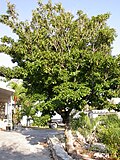
A sapodilla tree can live up to one hundred years.[9][10] It can grow to more than 30 m (98 ft) tall with a trunk diameter of up to 1.5 m (5 ft); but the average height of cultivated specimens is usually between 9 and 15 m (30 and 49 ft) with a trunk diameter not exceeding 50 cm (20 in).[11] It is wind-resistant and the bark is rich in a white, gummy latex called chicle. Its leaves are elliptic to ovate 6–15 cm (2–6 in) long with entire margins on 1–3 cm (0–1 in) long petioles; they are medium green and glossy with brown and slightly furry midribs. They are arranged alternately.[12]
The trees can survive only in warm, typically tropical environments (although it has low tolerance to drought and heat in its early years),[13] dying easily if the temperature drops below freezing. From germination, the sapodilla tree will usually take anywhere from five to eight years to bear fruit. The sapodilla trees yield fruit twice a year, though flowering may continue year round.[14]
The white flowers are inconspicuous and bell-like, with a six-lobed corolla.
Fruit[edit | edit source]

The fruit is a large berry, 4–8 cm (2–3 in) in diameter.[12][15] An unripe fruit has a firm outer skin and when picked, releases white latex (chicle) from its stem. A fully ripened fruit has saggy skin and does not release chicle when picked. Inside, its flesh ranges from a pale yellow to an earthy brown color with a grainy texture akin to that of a well-ripened pear. Each fruit contains one to six seeds.[15] The seeds are hard, glossy, and black, resembling beans, with a hook at one end that can catch in the throat if swallowed.
The ripe fruit has an exceptionally sweet, malty flavor. The unripe fruit is hard to the touch and contains high amounts of saponin, which has astringent properties similar to tannin, drying out the mouth.[citation needed]
Biological studies[edit | edit source]
Compounds extracted from the leaves showed anti-diabetic, antioxidant and hypocholesterolemic (cholesterol-lowering) effects in rats.[16]
Acetone extracts of the seeds exhibited in vitro antibacterial effects against strains of Pseudomonas oleovorans and Vibrio cholerae.[17]


Synonyms[edit | edit source]
Synonyms of this species include:[18]
- Achradelpha mammosa (L.) O.F.Cook
- Achras breviloba (Gilly) Lundell
- Achras calderonii (Gilly) Lundell
- Achras conzattii (Gilly) Lundell
- Achras coriacea Lundell
- Achras dactylina Lundell
- Achras gaumeri (Gilly) Lundell
- Achras latiloba Lundell
- Achras lobulata (Lundell) Lundell
- Achras lucuma Blanco
- Achras mammosa L. nom. illeg.
- Achras meridionalis (Gilly) Lundell
- Achras occidentalis Cels ex Ten.
- Achras paludosa Lundell
- Achras petenensis (Lundell) Lundell
- Achras rojasii (Gilly) Lundell
- Achras sapatilla J.Paul & W.Arnold
- Achras sapota L. [Spelling variant]
- Achras striata (Gilly) Lundell
- Achras tabogaensis (Gilly) Lundell
- Achras tainteriana Lundell
- Achras tchicoomame Perr.
- Achras verrucosa Stokes
- Achras zapota L.
- Achras zapotilla (Jacq.) Nutt.
- Calocarpum mammosum (L.) Pierre
- Calospermum mammosum (L.) Pierre
- Gambeya mammosa (L.) Pierre
- Lucuma mammosa (L.) C.F.Gaertn.
- Lucuma zapota (L.) Urb.
- Manilkara achras (Mill.) Fosberg
- Manilkara breviloba Gilly
- Manilkara calderonii Gilly
- Manilkara conzattii Gilly
- Manilkara gaumeri Gilly
- Manilkara grisebachii (Pierre) Dubard
- Manilkara meridionalis Gilly
- Manilkara rojasii Gilly
- Manilkara striata Gilly
- Manilkara tabogaensis Gilly
- Manilkara zapotilla (Jacq.) Gilly
- Manilkariopsis lobulata Lundell
- Manilkariopsis meridionalis (Gilly) Lundell
- Manilkariopsis petenensis Lundell
- Manilkariopsis rojasii (Gilly) Lundell
- Manilkariopsis striata (Gilly) Lundell
- Manilkariopsis tabogaensis (Gilly) Lundell
- Mimusops grisebachii Pierre
- Nispero achras (Mill.) Aubrév.
- Pouteria mammosa (L.) Cronquist
- Sapota achras Mill.
- Sapota zapotilla (Jacq.) Coville ex Safford
- Vitellaria mammosa (L.) Radlk.
Uses[edit | edit source]
The fruit is edible and a favorite in the tropical Americas.[19] Chicle from the bark is used to make chewing gum.
See also[edit | edit source]
References[edit | edit source]
- ↑ Martínez Salas, E.; Samain, M. & Oldfield, S. (2021). "Manilkara zapota". IUCN Red List of Threatened Species. 2021 e.T61964429A61964470.
{{cite journal}}:|access-date=requires|url=(help) - ↑ NRCS. "Manilkara zapota". PLANTS Database. United States Department of Agriculture (USDA). Retrieved 23 June 2022.
- ↑ [{{#property:P1421|}} "{{#Property:P225}}"]. Germplasm Resources Information Network (GRIN). Agricultural Research Service (ARS), United States Department of Agriculture (USDA). Retrieved 23 June 2022.
{{citation}}: Check|url=value (help) - ↑ 4.0 4.1 4.2 Small, Ernest (2011). Top 100 Exotic Food Plants. Boca Raton, Louisiana, USA: CRC Press. pp. 515–524. ISBN 978-1-4398-5688-8.
- ↑ World Wildlife Fund. eds. Mark McGinley, C.Michael Hogan & C. Cleveland. 2010. Petenes mangroves. Encyclopedia of Earth. National Council for Science and the Environment. Washington DC Archived 2011-10-15 at the Wayback Machine
- ↑ Fernandez, Doreen G. (1997). Fruits of the Philippines. Makati City, Luzon, Philippines: Bookmark Inc. p. 22. ISBN 971-569-261-3.
- ↑ "Manilkara zapota". European and Mediterranean Plant Protection Organization (EPPO). Retrieved 23 June 2022.
- ↑ Tulloch, Adrian; Goldson-Barnaby, Andrea; Bailey, Dennis; Gupte, Sonal (2020). "Manilkara zapota (Naseberry): Medicinal Properties and Food Applications". International Journal of Fruit Science. 20: S1–S7. Bibcode:2020IJFS...20S...1T. doi:10.1080/15538362.2019.1687071.
- ↑ Horticulture: Crop Plantation Guidence [sic] - The Sapota (Chickoo). India Agro. Retrieved 8 August, 2023.
- ↑ Introduction to Sapota. Agri Farming. Retrieved 14 August, 2023.
- ↑ Manilkara zapota Sapotaceae (L.) van Royen, Orwa C, Mutua A, Kindt R, Jamnadass R, Simons A. 2009. Agroforestree Database:a tree reference and selection guide version 4.0 (http://www.worldagroforestry.org/af/treedb/ Archived 2017-10-23 at the Wayback Machine)
- ↑ 12.0 12.1 "Manilkara zapota". Flora of North America. Vol. 8. New York and Oxford: Flora of North America Association. 2009. pp. 232, 234–235 – via eFloras.
- ↑ Growing Sapodilla: Manilkara zapota. Garden Oracle. Retrieved 8 August, 2023. "Heat tolerant: These trees have difficulty when young, over 90°F, and when mature, over 105°F. They will need afternoon shade and extra water in these temperatures. Drought tolerant: Yes, after three years."
- ↑ Kute, L.S.; Shete, M.B. (1995). "Sapota (Sapodilla)". Handbook of Fruit Science and Technology. CRC Press. pp. 475–476. doi:10.1201/9781482273458-31. ISBN 978-0-429-15273-3.
- ↑ 15.0 15.1 Harris, Kate (2009). Trees of Belize. Belize: Bay Cedar Publishing. pp. 94–95. ISBN 978-0-9927582-0-2.
- ↑ Fayek NM, Monem AR, Mossa MY, Meselhy MR, Shazly AH (2012). "Chemical and biological study of Manilkara zapota (L.) Van Royen leaves (Sapotaceae) cultivated in Egypt". Pharmacognosy Research. 4 (2): 85–91. doi:10.4103/0974-8490.94723. PMC 3326762. PMID 22518080.
- ↑ Kothari V, Seshadri S (2010). "In vitro antibacterial activity in seed extracts of Manilkara zapota, Anona squamosa, and Tamarindus indica". Biol. Res. 43 (2): 165–8. doi:10.4067/S0716-97602010000200003. PMID 21031260.
- ↑ "Calotropis gigantea (L.) P. Royen". Plants of the World Online. Royal Botanic Gardens, Kew. 2024. Retrieved 4 May 2024.
- ↑ Hargreaves, Dorothy; Hargreaves, Bob (1964). Tropical Trees of Hawaii. Kailua, Hawaii: Hargreaves. p. 14.
External links[edit | edit source]
- Pages using the JsonConfig extension
- Cite iucn maint
- IUCN Red List least concern species
- Articles containing Spanish-language text
- Pages with Spanish IPA
- Manilkara
- Flora of Mexico
- Flora of Belize
- Flora of Guatemala
- Crops originating from indigenous Americans
- Tropical fruit
- Saponaceous plants
- Plants described in 1753
- Botanical taxa named by Carl Linnaeus