

m added info |
|||
| Line 1: | Line 1: | ||
{{Short description|Species of flowering plant in the moschatel family | {{Short description|Species of flowering plant in the moschatel family}} | ||
{{Redirect|Black elderberry|the species native to North America sometimes known by the same name|Sambucus canadensis}} | {{Redirect|Black elderberry|the species native to North America sometimes known by the same name|Sambucus canadensis}} | ||
{{Speciesbox | {{Speciesbox | ||
|image = Sambucus nigra 004.jpg | |image = Sambucus nigra 004.jpg | ||
|image_caption = Shrub in flower | |image_caption = Shrub in flower | ||
|genus = Sambucus | |genus = Sambucus | ||
|species = nigra | |species = nigra | ||
|authority = [[Carl Linnaeus|L.]] | |authority = [[Carl Linnaeus|L.]] | ||
| range_map = Sambucus nigra range.svg | | range_map = Sambucus nigra range.svg | ||
| range_map_caption = Distribution in Europe | | range_map_caption= Distribution in Europe | ||
| range_map2 = Sambucus nigra canadensis & cerulea range map 2.png | | range_map2 = Sambucus nigra canadensis & cerulea range map 2.png | ||
| range_map2_caption = Natural range of North American subspecies: ''[[Sambucus cerulea|S.{{nbsp}}cerulea]]'' (dark/light blue) and ''[[Sambucus canadensis|S.{{nbsp}}canadensis]]'' (green/red) | | range_map2_caption= Natural range of North American subspecies: ''[[Sambucus cerulea|S.{{nbsp}}cerulea]]'' (dark/light blue) and ''[[Sambucus canadensis|S.{{nbsp}}canadensis]]'' (green/red) | ||
}} | }} | ||
'''''Sambucus nigra''''' is a [[species complex]] of [[flowering plant]]s in the | '''''Sambucus nigra''''' is a [[species complex]] of [[flowering plant]]s in the family [[Viburnaceae]] native to most of Europe.<ref>{{cite web|url=http://rbg-web2.rbge.org.uk/cgi-bin/nph-readbtree.pl/feout?FAMILY_XREF=&GENUS_XREF=Sambucus&SPECIES_XREF=nigra&TAXON_NAME_XREF=&RANK=|title=Flora Europaea Search Results|website=Rbg-web2.rbge.org.uk|access-date=13 October 2017}}</ref> Common names include '''elder''', '''elderberry''', '''black elder''', '''European elder''', ''' European elderberry''', and '''European black elderberry'''.<ref>{{ITIS |id= 35324 |taxon= ''Sambucus nigra''}}</ref><ref>{{cite web|url=https://plants.usda.gov/home/plantProfile?symbol=SANI4|title=Plants profile for ''Sambucus nigra'' L. (black elderberry)|publisher=Natural Resources Conservation Service, US Department of Agriculture|date=2023|access-date=13 June 2023}}</ref> It grows in a variety of conditions including both wet and dry fertile soils, primarily in sunny locations. The plant is widely grown as an [[Ornamental plant|ornamental]] shrub or small tree. | ||
Although | Both the flowers and the berries have a long tradition of culinary use, primarily for [[Elderflower cordial|cordial]] and wine.<ref name= RHSAZ/> Although the plant is commonly used in [[dietary supplement]]s and [[traditional medicine]], there is no [[evidence-based medicine|scientific evidence]] that it provides any significant health benefit. | ||
==Description== | ==Description== | ||
| Line 25: | Line 25: | ||
The [[fruit]] is a glossy, dark purple to black [[berry (botany)|berry]] 3–5 mm diameter, produced in drooping clusters in late autumn.<ref name=RHSAZ /> The dark color of elderberry fruit occurs from its rich [[polyphenol|phenolic]] content, particularly from [[anthocyanin]]s.<ref name="drugs">{{cite web |date=4 August 2021 |title=Elderberry |url=https://www.drugs.com/npp/elderberry.html |access-date=4 September 2021 |publisher=Drugs.com}}</ref> | The [[fruit]] is a glossy, dark purple to black [[berry (botany)|berry]] 3–5 mm diameter, produced in drooping clusters in late autumn.<ref name=RHSAZ /> The dark color of elderberry fruit occurs from its rich [[polyphenol|phenolic]] content, particularly from [[anthocyanin]]s.<ref name="drugs">{{cite web |date=4 August 2021 |title=Elderberry |url=https://www.drugs.com/npp/elderberry.html |access-date=4 September 2021 |publisher=Drugs.com}}</ref> | ||
<gallery> | |||
File:Flowers Black Elder.jpg|Flowers | |||
|Sambucus nigra2.jpg|Fruit cluster | File:Sambucus nigra RF.jpg|Inflorescences and leaves | ||
File:Sambucus nigra2.jpg|Fruit cluster | |||
File:Elder growing on Sycamore, Dalry, Scotland.JPG|Growing as an [[epiphyte]] on a [[sycamore]] | |||
</gallery> | |||
== Taxonomy == | == Taxonomy == | ||
| Line 39: | Line 40: | ||
=== Etymology === | === Etymology === | ||
The Latin [[specific epithet]] ''nigra'' means "black", and refers to the deeply dark colour of the berries.<ref name=RHSLG>{{cite book | last=Harrison |first=Lorraine | title=RHS Latin for Gardeners | year=2012 |publisher=Mitchell Beazley | location=United Kingdom | isbn=978-1845337315 }}</ref> The English term for the tree is not believed to come from the word "old", but from the [[Middle English|Anglo Saxon]] | The Latin [[specific epithet]] ''nigra'' means "black", and refers to the deeply dark colour of the berries.<ref name=RHSLG>{{cite book | last=Harrison |first=Lorraine | title=RHS Latin for Gardeners | year=2012 |publisher=Mitchell Beazley | location=United Kingdom | isbn=978-1845337315 }}</ref> The English term for the tree is not believed to come from the word "old", but from the [[Middle English|Anglo Saxon]] {{Lang|enm|æld}}, meaning fire, because the hollow stems of the branches were used as [[bellows]] to blow air into a fire.<ref>{{cite web |title=Elder (Sambucus nigra) - British trees - |url=https://www.woodlandtrust.org.uk/visiting-woods/trees-woods-and-wildlife/british-trees/native-trees/elder/ |access-date=3 November 2017 |publisher=Woodland Trust |language=en}}</ref> | ||
==Distribution and habitat== | ==Distribution and habitat== | ||
''Sambucus nigra'' is native to [[Europe]] as far east as [[Turkey]].<ref name="POWO">{{cite web |title=''Sambucus nigra'' L. |work=Plants of the World Online |publisher=Royal Botanic Gardens, Kew |access-date=10 February 2022 |url=https://powo.science.kew.org/taxon/urn:lsid:ipni.org:names:30122169-2 }}</ref> It is native in, and common throughout, the [[British Isles]].<ref name="BRC">{{cite web |title=''Sambucus nigra'' |work=Online Atlas of the British and Irish Flora |publisher=Biological Records Centre and Botanical Society of Britain and Ireland |url=https://www.brc.ac.uk/plantatlas/plant/sambucus-nigra |access-date=10 February 2022 }}</ref> It has been introduced to parts of most other continents of the world.<ref name="POWO" /> | ''Sambucus nigra'' is native to [[Europe]] as far east as [[Turkey]].<ref name="POWO">{{cite web |title=''Sambucus nigra'' L. |work=Plants of the World Online |publisher=Royal Botanic Gardens, Kew |access-date=10 February 2022 |url=https://powo.science.kew.org/taxon/urn:lsid:ipni.org:names:30122169-2 }}</ref> It is native in, and common throughout, the [[British Isles]].<ref name="BRC">{{cite web |title=''Sambucus nigra'' |work=Online Atlas of the British and Irish Flora |publisher=Biological Records Centre and Botanical Society of Britain and Ireland |url=https://www.brc.ac.uk/plantatlas/plant/sambucus-nigra |access-date=10 February 2022 |archiveurl=https://web.archive.org/web/20220211023852/https://www.brc.ac.uk/plantatlas/plant/sambucus-nigra |archivedate=2022-02-11}}</ref> It has been introduced to parts of most other continents of the world.<ref name="POWO" /> | ||
Hedges, waste-ground roadsides, and woods are the typical habitats for the species.<ref name="Parnell 12" /> | Hedges, waste-ground roadsides, and woods are the typical habitats for the species.<ref name="Parnell 12" /> | ||
| Line 50: | Line 51: | ||
== Ecology == | == Ecology == | ||
{{multiple image | {{multiple image | ||
|direction=vertical | |||
|perrow=2 | |perrow=2 | ||
|image1=Hyphodontia sambuci Eglinton.JPG | |image1=Hyphodontia sambuci Eglinton.JPG | ||
| Line 57: | Line 59: | ||
}} | }} | ||
Like other elderberries, ''Sambucus nigra'' is subject to [[elder whitewash fungus]] and [[Auricularia auricula-judae|jelly ear fungus]]. | Like other elderberries, ''Sambucus nigra'' is subject to [[elder whitewash fungus]] and [[Auricularia auricula-judae|jelly ear fungus]]. Strong-scented flowers in wild populations of ''S. nigra'' attract numerous, minute flower [[thrips]] which may contribute to the transfer of pollen between inflorescences.<ref>{{cite journal |last1=Scott-Brown |first1=A.S. |last2=Arnold |first2=S.E.J. |last3=Kite |first3=G.C. |last4=Farrell |first4=I. |last5=Farman |first5=D.I. |last6=Collins |first6=D.W. |last7=Stevenson |first7=P.C. |title=Mechanisms in mutualisms: A chemically mediated thrips pollination strategy in common elder |journal=Planta |date=2019 |volume=250 |issue=1 |pages=367–379 |doi=10.1007/s00425-019-03176-5|pmid=31069523 |s2cid=253886497 |doi-access=free |bibcode=2019Plant.250..367S |url=http://gala.gre.ac.uk/id/eprint/23721/3/23721%20ARNOLD%20Planta%20Sambucus%20and%20Thrips%20AAM%202019.pdf }}</ref> | ||
=== Wildlife value === | === Wildlife value === | ||
Elder rates as fair to good forage for animals such as [[mule deer]], [[elk]], [[sheep]], and small birds. The fruit are an important food for many fruit-eating birds, notably [[blackcap]]s. Ripe elderberries are a favorite food for migrating [[band-tailed pigeon]]s in northern California, which may sometimes strip an entire bush in a short time. The species provides good habitat for large and small mammals,<ref>{{cite web |title=Sambucus nigra subsp. cerulea |url=http://www.fs.fed.us/database/feis/plants/shrub/samnigc/all.html#MANAGEMENT |access-date=13 October 2017 |website=Fs.fed.us}}</ref> as well as nesting habitat for many birds, including hummingbirds, warblers, and vireos. It is also a larval host to the [[spring azure]].<ref>The Xerces Society (2016), ''Gardening for Butterflies: How You Can Attract and Protect Beautiful, Beneficial Insects'', Timber Press.</ref> | Elder rates as fair to good forage for animals such as [[mule deer]], [[elk]], [[sheep]], and small birds. The fruit are an important food for many fruit-eating birds, notably [[blackcap]]s. Ripe elderberries are a favorite food for migrating [[band-tailed pigeon]]s in northern California, which may sometimes strip an entire bush in a short time. The species provides good habitat for large and small mammals,<ref>{{cite web |title=Sambucus nigra subsp. cerulea |url=http://www.fs.fed.us/database/feis/plants/shrub/samnigc/all.html#MANAGEMENT |access-date=13 October 2017 |website=Fs.fed.us |archiveurl=https://web.archive.org/web/20170528224449/https://www.fs.fed.us/database/feis/plants/shrub/samnigc/all.html |archivedate=2017-05-28}}</ref> as well as nesting habitat for many birds, including hummingbirds, warblers, and vireos. It is also a larval host to the [[spring azure]].<ref>The Xerces Society (2016), ''Gardening for Butterflies: How You Can Attract and Protect Beautiful, Beneficial Insects'', Timber Press.</ref> | ||
Except for the flowers and ripe berries (but including the ripe seeds), all parts of the plant are poisonous to mammals, containing the [[cyanogenic glycoside]] [[sambunigrin]] (C<sub>14</sub>H<sub>17</sub>NO<sub>6</sub>, [[CAS registry number|CAS number]] | Except for the flowers and ripe berries (but including the ripe seeds), all parts of the plant are poisonous to mammals, containing the [[cyanogenic glycoside]] [[sambunigrin]] (C<sub>14</sub>H<sub>17</sub>NO<sub>6</sub>, [[CAS registry number|CAS number]] 99–19–4).<ref>{{cite journal |last1=Campa |first1=Cristiana |last2=Schmitt-Kopplin |first2=P |last3=Cataldi |first3=T R |last4=Bufo |first4=S A |last5=Freitag |first5=D |last6=Kettrup |first6=A |name-list-style=vanc |year=2000 |title=Analysis of cyanogenic glycosides by micellar capillary electrophoresis |journal=[[Journal of Chromatography B]] |volume=739 |issue=1 |pages=95–100 |doi=10.1016/S0378-4347(99)00375-8 |pmid=10744317}}</ref> The bark contains [[calcium oxalate]] crystals.{{Citation needed|date=September 2023}} | ||
==Cultivation== | ==Cultivation== | ||
| Line 70: | Line 72: | ||
The following cultivars have gained the [[Royal Horticultural Society]]'s [[Award of Garden Merit]]:<ref>{{cite web | url = https://www.rhs.org.uk/plants/pdfs/agm-lists/agm-ornamentals.pdf | title = AGM Plants - Ornamental | date = July 2017 | page = 95 | publisher = Royal Horticultural Society | access-date = 21 October 2018}}</ref> | The following cultivars have gained the [[Royal Horticultural Society]]'s [[Award of Garden Merit]]:<ref>{{cite web | url = https://www.rhs.org.uk/plants/pdfs/agm-lists/agm-ornamentals.pdf | title = AGM Plants - Ornamental | date = July 2017 | page = 95 | publisher = Royal Horticultural Society | access-date = 21 October 2018}}</ref> | ||
*''S. nigra'' f. ''laciniata'' (cut-leaved | *''S. nigra'' f. ''laciniata'' (cut-leaved elder)<ref>{{cite web|url=https://www.rhs.org.uk/Plants/50846/Sambucus-nigra-f-laciniata/Details |title=''Sambucus nigra'' f. ''laciniata'' / RHS Gardening |publisher=Apps.rhs.org.uk |access-date=2021-03-06}}</ref> | ||
*''S. nigra'' f. ''porphyrophylla'' 'Eva'<ref>{{cite web | url = https://www.rhs.org.uk/Plants/197771/i-Sambucus-nigra-i-f-i-porphyrophylla-i-Eva-sup-(PBR)-sup/Details | title = RHS Plantfinder - ''Sambucus nigra'' 'Eva' | access-date = 21 October 2018}}</ref> | *''S. nigra'' f. ''porphyrophylla'' 'Eva'<ref>{{cite web | url = https://www.rhs.org.uk/Plants/197771/i-Sambucus-nigra-i-f-i-porphyrophylla-i-Eva-sup-(PBR)-sup/Details | title = RHS Plantfinder - ''Sambucus nigra'' 'Eva' | access-date = 21 October 2018}}</ref> ('Black Lace')<ref>{{cite web | url = https://www.rhs.org.uk/plants/194381/sambucus-black-lace/details | title = "Sambucus" 'Black Lace' | publisher = RHS | access-date = 2 June 2024}}</ref> | ||
*''S. nigra'' f. ''porphyrophylla'' 'Gerda'<ref>{{cite web|url=https://www.rhs.org.uk/Plants/139890/Sambucus-nigra-f-porphyrophylla-Gerda-(PBR)/Details |title=''Sambucus'' nigra f. ''porphyrophylla'' 'Gerda'|publisher=Apps.rhs.org.uk |access-date=2021-03-06}}</ref> | *''S. nigra'' f. ''porphyrophylla'' 'Gerda'<ref>{{cite web|url=https://www.rhs.org.uk/Plants/139890/Sambucus-nigra-f-porphyrophylla-Gerda-(PBR)/Details |title=''Sambucus'' nigra f. ''porphyrophylla'' 'Gerda'|publisher=Apps.rhs.org.uk |access-date=2021-03-06}}</ref> | ||
[[File:PurpleLacyElderberryflowers.jpg|thumb|150px|A purple, cut-leafed elder variety with pale pink flowers]] | |||
==Toxicity== | ==Toxicity== | ||
Components of the elderberry plant, including its fruit, contain diverse [[phytochemical]]s, such as [[alkaloid]]s, [[lectin]]s, and cyanogenic glycosides, which may be toxic if consumed raw.<ref name="drugs" /> The seeds and all green parts of the plant contain cyanogenic glycosides.<ref name="nccih" /> Consumption of berries, leaves, bark or stems, if not properly prepared, may cause [[nausea]], vomiting, and severe [[diarrhea]].<ref name="nccih" /><ref name="drugs" /><ref name="msk">{{cite web |date=2020 |title=Elderberry |url=https://www.mskcc.org/cancer-care/integrative-medicine/herbs/elderberry-01 |access-date=11 July 2020 |publisher=Memorial Sloan Kettering Cancer Center}}</ref> Elderberry plant constituents or products should not be consumed during pregnancy or by people with [[allergy|allergies]] or [[gastrointestinal disease]]s.<ref name="drugs" /><ref name="msk" /> Elderberry products may cause [[adverse effect]]s when used with [[prescription drug]]s.<ref name="drugs" /><ref name="msk" /> | Components of the elderberry plant, including its fruit, contain diverse [[phytochemical]]s, such as [[alkaloid]]s, [[lectin]]s, and cyanogenic glycosides, which may be toxic if consumed raw.<ref name="drugs" /> The seeds and all green parts of the plant contain cyanogenic glycosides.<ref name="nccih">{{cite web |date=1 August 2020 |title=European elder |url=https://www.nccih.nih.gov/health/elderberry |access-date=4 September 2021 |publisher=National Center for Complementary and Integrative Health, US National Library of Medicine}}</ref> Consumption of berries, leaves, bark or stems, if not properly prepared, may cause [[nausea]], vomiting, and severe [[diarrhea]].<ref name="nccih" /><ref name="drugs" /><ref name="msk">{{cite web |date=2020 |title=Elderberry |url=https://www.mskcc.org/cancer-care/integrative-medicine/herbs/elderberry-01 |access-date=11 July 2020 |publisher=Memorial Sloan Kettering Cancer Center}}</ref> Elderberry plant constituents or products should not be consumed during pregnancy or by people with [[allergy|allergies]] or [[gastrointestinal disease]]s.<ref name="drugs" /><ref name="msk" /> Elderberry products may cause [[adverse effect]]s when used with [[prescription drug]]s.<ref name="drugs" /><ref name="msk" /> | ||
==Uses== | ==Uses== | ||
The dark blue or purple berries are mildly poisonous in their raw state, but are edible after cooking.<ref name="nccih" /><ref name=" | The dark blue or purple berries are mildly poisonous in their raw state, but are edible after cooking.<ref name="nccih" /><ref name="Fagan-2019" /> They can be used to make [[Fruit preserves|jam]], jelly,<ref name="Fagan-2019">{{Cite book|last=Fagan|first=Damian|title=Wildflowers of Oregon: A Field Guide to Over 400 Wildflowers, Trees, and Shrubs of the Coast, Cascades, and High Desert|publisher=[[FalconGuides]]|year=2019|isbn=978-1-4930-3633-2|location=Guilford, CT|pages=16|oclc=1073035766}}</ref> [[chutney]], and Pontack sauce. In Scandinavia and Germany, soup made from the elderberry (e.g. the German ''Fliederbeersuppe'') is a traditional meal.<ref name="jorg">{{cite journal | last1=Jørgensen | first1=Ulla | last2=Hansen | first2=Merete | last3=Christensen | first3=Lars P. | last4=Jensen | first4=Karina | last5=Kaack | first5=Karl | title=Olfactory and Quantitative Analysis of Aroma Compounds in Elder Flower (''Sambucus nigra'' L.) Drink Processed from Five Cultivars | journal=Journal of Agricultural and Food Chemistry | volume=48 | issue=6 | date=2000-05-12 | issn=0021-8561 | doi=10.1021/jf000005f | pages=2376–2383| pmid=10888553 | bibcode=2000JAFC...48.2376J }}</ref> | ||
Commonly, the flowerheads are used in [[infusion]]s, giving a drink in Northern Europe and the [[Balkans]]. These drinks are sold commercially as [[elderflower cordial]] or [[elderflower pressé]] .<ref>Kikbracken, J. 1995. ''Easy way guide Trees''. Larousse.</ref> In [[Europe]], the flowers are made into a [[syrup]] or [[Squash (drink)|cordial]] (in Romanian: [[ | Commonly, the flowerheads are used in [[infusion]]s, giving a drink in Northern Europe and the [[Balkans]]. These drinks are sold commercially as [[elderflower cordial]] or [[elderflower pressé]].<ref>Kikbracken, J. 1995. ''Easy way guide Trees''. Larousse.</ref> In [[Europe]], the flowers are made into a [[syrup]] or [[Squash (drink)|cordial]] (in Romanian: [[socată]], in Swedish: fläder(blom)saft, in Danish: hyldeblomstsaft / hyldedrik), which is diluted with water before drinking. The popularity of this traditional drink recently has encouraged some commercial [[soft drink]] producers to introduce elderflower-flavoured drinks ([[Fanta]] Shokata, Freaky Fläder). The flowers also may be dipped into a light batter and then fried to make elderflower fritters.<ref>{{Cite book |last=Mabey |first=Richard |title=Food for free |date=2012 |publisher=Collins |isbn=978-0-00-743847-1 |edition= |location=London |pages=83 |oclc=761378530}}</ref> | ||
The berries may be made into [[elderberry wine]].<ref name=" | The berries may be made into [[elderberry wine]].<ref name="Fagan-2019" /> In [[Hungary]], an elderberry [[brandy]] is made that requires 50 kilograms of fruit to produce 1 [[litre]] of brandy. In south-western [[Sweden]], it is traditional to make a [[snaps]] liqueur flavoured with elderflower. Elderflowers are used in liqueurs such as [[St-Germain (liqueur)|St-Germain]], and in a mildly alcoholic sparkling elderflower 'champagne', although a more alcoholic home-made version can be made. In [[Beerse]], Belgium, a variety of [[jenever]] called ''beers vlierke'' is made from the berries.{{Citation needed|date=September 2023}} | ||
<gallery> | |||
File:Elderberry-jam.JPG|Elderberry jam | |||
File:Sambuci flos dried.jpg|''Sambuci flos'': dried sambucus nigra flowers as used in herbal tea | |||
File:"Godfrey's Extract of Elder-Flowers" ad - Woman's Exhibition, 1900, Earl's Court, London, S.W. - official fine art, historical and general catalogue (IA gri 33125013839424) (page 7 crop).jpg|"Godfrey's Extract of Elder-Flowers" ad in 1900 | |||
</gallery> | |||
=== Traditional medicine === | === Traditional medicine === | ||
| Line 112: | Line 115: | ||
[[Category:Berries]] | [[Category:Berries]] | ||
[[Category:Flora of Europe]] | [[Category:Flora of Europe]] | ||
[[Category:Flora of Northern America]] | |||
[[Category:Flora of | |||
[[Category:Flora of temperate Asia]] | [[Category:Flora of temperate Asia]] | ||
[[Category:Flora of the Eastern United States]] | [[Category:Flora of the Eastern United States]] | ||
[[Category:Flora of the Western United States]] | [[Category:Flora of the Western United States]] | ||
[[Category:Plants described in 1753]] | [[Category:Plants described in 1753]] | ||
[[Category: | [[Category:Botanical taxa named by Carl Linnaeus]] | ||
[[Category:Medicinal plants]] | [[Category:Medicinal plants]] | ||
[[Category:Garden plants of Asia]] | [[Category:Garden plants of Asia]] | ||
Latest revision as of 20:30, 21 March 2026
| Sambucus nigra | |
|---|---|

| |
| Shrub in flower | |
Scientific classification 
| |
| : | [[Template:Taxonomy/Sambucus]] |
| Species: | Template:Taxonomy/SambucusS. nigra
|
| Binomial name | |
| Template:Taxonomy/SambucusSambucus nigra | |

| |
| Distribution in Europe | |
| Error creating thumbnail: File with dimensions greater than 12.5 MP | |
| Natural range of North American subspecies: S. cerulea (dark/light blue) and S. canadensis (green/red) | |
Sambucus nigra is a species complex of flowering plants in the family Viburnaceae native to most of Europe.[1] Common names include elder, elderberry, black elder, European elder, European elderberry, and European black elderberry.[2][3] It grows in a variety of conditions including both wet and dry fertile soils, primarily in sunny locations. The plant is widely grown as an ornamental shrub or small tree.
Both the flowers and the berries have a long tradition of culinary use, primarily for cordial and wine.[4] Although the plant is commonly used in dietary supplements and traditional medicine, there is no scientific evidence that it provides any significant health benefit.
Description[edit | edit source]
Elderberry is a deciduous shrub or small tree growing to 6 metres (20 ft) tall and wide,[4] rarely reaching 10 m (33 ft) tall. The bark, light gray when young, changes to a coarse gray outer bark with lengthwise furrowing, lenticels prominent.[5] The leaves are arranged in opposite pairs, 10–30 centimetres (4–12 inches) long, pinnate with five to seven (rarely nine) leaflets, the leaflets 5–12 cm (2–4+3⁄4 in) long and 3–5 cm (1+1⁄4–2 in) broad, with a serrated margin. The young stems are hollow.[6]
The hermaphroditic flowers have five stamens,[7] which are borne in large, flat corymbs 10–25 cm in diameter in late spring to mid-summer. The individual flowers are ivory white, 5–6 millimetres (3⁄16–1⁄4 in) in diameter, with five petals, and are pollinated by flies.
The fruit is a glossy, dark purple to black berry 3–5 mm diameter, produced in drooping clusters in late autumn.[4] The dark color of elderberry fruit occurs from its rich phenolic content, particularly from anthocyanins.[8]
-
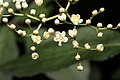 Flowers
 -
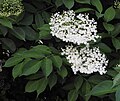 Inflorescences and leaves
 -
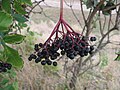 Fruit cluster
 -
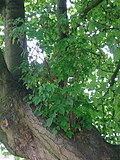


Taxonomy[edit | edit source]
Subspecies[edit | edit source]
There are several other closely related species, native to Asia and North America, which are similar, and sometimes treated as subspecies of Sambucus nigra, including S. nigra subsp. canadensis[9] and S. nigra subsp. cerulea.[10]
Etymology[edit | edit source]
The Latin specific epithet nigra means "black", and refers to the deeply dark colour of the berries.[11] The English term for the tree is not believed to come from the word "old", but from the Anglo Saxon æld, meaning fire, because the hollow stems of the branches were used as bellows to blow air into a fire.[12]
Distribution and habitat[edit | edit source]
Sambucus nigra is native to Europe as far east as Turkey.[13] It is native in, and common throughout, the British Isles.[14] It has been introduced to parts of most other continents of the world.[13]
Hedges, waste-ground roadsides, and woods are the typical habitats for the species.[7] S. nigra is recorded as very common in Ireland in hedges as scrub in woods.[15][16]
Ecology[edit | edit source]


Like other elderberries, Sambucus nigra is subject to elder whitewash fungus and jelly ear fungus. Strong-scented flowers in wild populations of S. nigra attract numerous, minute flower thrips which may contribute to the transfer of pollen between inflorescences.[17]
Wildlife value[edit | edit source]
Elder rates as fair to good forage for animals such as mule deer, elk, sheep, and small birds. The fruit are an important food for many fruit-eating birds, notably blackcaps. Ripe elderberries are a favorite food for migrating band-tailed pigeons in northern California, which may sometimes strip an entire bush in a short time. The species provides good habitat for large and small mammals,[18] as well as nesting habitat for many birds, including hummingbirds, warblers, and vireos. It is also a larval host to the spring azure.[19]
Except for the flowers and ripe berries (but including the ripe seeds), all parts of the plant are poisonous to mammals, containing the cyanogenic glycoside sambunigrin (C14H17NO6, CAS number 99–19–4).[20] The bark contains calcium oxalate crystals.[citation needed]
Cultivation[edit | edit source]
It is a very common feature of hedgerows and scrubland in Britain and northern Europe.
Some selections and cultivars have variegated or coloured leaves and other distinctive qualities, and are grown as ornamental plants. S. nigra f. porphyrophylla has dark maroon or black leaves, and pale pink flowers.
The following cultivars have gained the Royal Horticultural Society's Award of Garden Merit:[21]
- S. nigra f. laciniata (cut-leaved elder)[22]
- S. nigra f. porphyrophylla 'Eva'[23] ('Black Lace')[24]
- S. nigra f. porphyrophylla 'Gerda'[25]

Toxicity[edit | edit source]
Components of the elderberry plant, including its fruit, contain diverse phytochemicals, such as alkaloids, lectins, and cyanogenic glycosides, which may be toxic if consumed raw.[8] The seeds and all green parts of the plant contain cyanogenic glycosides.[26] Consumption of berries, leaves, bark or stems, if not properly prepared, may cause nausea, vomiting, and severe diarrhea.[26][8][27] Elderberry plant constituents or products should not be consumed during pregnancy or by people with allergies or gastrointestinal diseases.[8][27] Elderberry products may cause adverse effects when used with prescription drugs.[8][27]
Uses[edit | edit source]
The dark blue or purple berries are mildly poisonous in their raw state, but are edible after cooking.[26][28] They can be used to make jam, jelly,[28] chutney, and Pontack sauce. In Scandinavia and Germany, soup made from the elderberry (e.g. the German Fliederbeersuppe) is a traditional meal.[29]
Commonly, the flowerheads are used in infusions, giving a drink in Northern Europe and the Balkans. These drinks are sold commercially as elderflower cordial or elderflower pressé.[30] In Europe, the flowers are made into a syrup or cordial (in Romanian: socată, in Swedish: fläder(blom)saft, in Danish: hyldeblomstsaft / hyldedrik), which is diluted with water before drinking. The popularity of this traditional drink recently has encouraged some commercial soft drink producers to introduce elderflower-flavoured drinks (Fanta Shokata, Freaky Fläder). The flowers also may be dipped into a light batter and then fried to make elderflower fritters.[31]
The berries may be made into elderberry wine.[28] In Hungary, an elderberry brandy is made that requires 50 kilograms of fruit to produce 1 litre of brandy. In south-western Sweden, it is traditional to make a snaps liqueur flavoured with elderflower. Elderflowers are used in liqueurs such as St-Germain, and in a mildly alcoholic sparkling elderflower 'champagne', although a more alcoholic home-made version can be made. In Beerse, Belgium, a variety of jenever called beers vlierke is made from the berries.[citation needed]
-
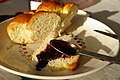 Elderberry jam
 -
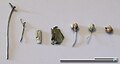 Sambuci flos: dried sambucus nigra flowers as used in herbal tea
 -
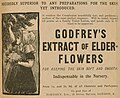 "Godfrey's Extract of Elder-Flowers" ad in 1900


_(page_7_crop).jpg)

Traditional medicine[edit | edit source]
This plant is used in traditional medicine by native peoples and herbalists.[26][32] Extracts of the flowers and fruits are used for cold and flu symptoms,[26][8] although there is no high-quality clinical evidence that it is effective for treating any disease.[26][8]
References[edit | edit source]
- ↑ "Flora Europaea Search Results". Rbg-web2.rbge.org.uk. Retrieved 13 October 2017.
- ↑ "Sambucus nigra". Integrated Taxonomic Information System.
- ↑ "Plants profile for Sambucus nigra L. (black elderberry)". Natural Resources Conservation Service, US Department of Agriculture. 2023. Retrieved 13 June 2023.
- ↑ 4.0 4.1 4.2 RHS A-Z encyclopedia of garden plants. United Michael and Vikram: Dorling Kindersley. 2008. ISBN 978-1405332965.
- ↑ Clapham, A.R., Tutin, T.G. and Warburg, E.F. 1968 Excursion Flora of the British Isles Second Edition Cambridge.ISBN 0-521-04656-4
- ↑ Vedel, H. and Lange, J. 1971. Trees and Bushes in Wood and Hedgerow. p. 196. Methuen and Co. Ltd. ISBN 0416-61780-8
- ↑ 7.0 7.1 Parnell, J. and Curtis, T. 2012. Webb's An Irish Flora. Cork University Press. ISBN 978-185918-4783
- ↑ 8.0 8.1 8.2 8.3 8.4 8.5 8.6 "Elderberry". Drugs.com. 4 August 2021. Retrieved 4 September 2021.
- ↑ "Sambucus mexicana". Calflora. Retrieved 2012-07-16.
- ↑ "Sambucus nigra ssp. caerulea". Calflora. Retrieved 2012-07-16.
- ↑ Harrison, Lorraine (2012). RHS Latin for Gardeners. United Kingdom: Mitchell Beazley. ISBN 978-1845337315.
- ↑ "Elder (Sambucus nigra) - British trees -". Woodland Trust. Retrieved 3 November 2017.
- ↑ 13.0 13.1 "Sambucus nigra L." Plants of the World Online. Royal Botanic Gardens, Kew. Retrieved 10 February 2022.
- ↑ "Sambucus nigra". Online Atlas of the British and Irish Flora. Biological Records Centre and Botanical Society of Britain and Ireland. Archived from the original on 2022-02-11. Retrieved 10 February 2022.
- ↑ Hackney, P. 1992. Stewarts and Corry's Flora of the North-east of Ireland. Institute of Irish Studies The Queen's University of Belfast. ISBN 0 85389 446 9(HB)
- ↑ Webb, D.A., Parnell, J. and Doogue, D. 1996. An Irish Flora. Dundalgan Press Ltd, Dundalk. ISBN 0-85221-131-7
- ↑ Scott-Brown, A.S.; Arnold, S.E.J.; Kite, G.C.; Farrell, I.; Farman, D.I.; Collins, D.W.; Stevenson, P.C. (2019). "Mechanisms in mutualisms: A chemically mediated thrips pollination strategy in common elder" (PDF). Planta. 250 (1): 367–379. Bibcode:2019Plant.250..367S. doi:10.1007/s00425-019-03176-5. PMID 31069523. S2CID 253886497.
- ↑ "Sambucus nigra subsp. cerulea". Fs.fed.us. Archived from the original on 2017-05-28. Retrieved 13 October 2017.
- ↑ The Xerces Society (2016), Gardening for Butterflies: How You Can Attract and Protect Beautiful, Beneficial Insects, Timber Press.
- ↑ Campa C, Schmitt-Kopplin P, Cataldi TR, Bufo SA, Freitag D, Kettrup A (2000). "Analysis of cyanogenic glycosides by micellar capillary electrophoresis". Journal of Chromatography B. 739 (1): 95–100. doi:10.1016/S0378-4347(99)00375-8. PMID 10744317.
- ↑ "AGM Plants - Ornamental" (PDF). Royal Horticultural Society. July 2017. p. 95. Retrieved 21 October 2018.
- ↑ "Sambucus nigra f. laciniata / RHS Gardening". Apps.rhs.org.uk. Retrieved 2021-03-06.
- ↑ "RHS Plantfinder - Sambucus nigra 'Eva'". Retrieved 21 October 2018.
- ↑ ""Sambucus" 'Black Lace'". RHS. Retrieved 2 June 2024.
- ↑ "Sambucus nigra f. porphyrophylla 'Gerda'". Apps.rhs.org.uk. Retrieved 2021-03-06.
- ↑ 26.0 26.1 26.2 26.3 26.4 26.5 "European elder". National Center for Complementary and Integrative Health, US National Library of Medicine. 1 August 2020. Retrieved 4 September 2021.
- ↑ 27.0 27.1 27.2 "Elderberry". Memorial Sloan Kettering Cancer Center. 2020. Retrieved 11 July 2020.
- ↑ 28.0 28.1 28.2 Fagan, Damian (2019). Wildflowers of Oregon: A Field Guide to Over 400 Wildflowers, Trees, and Shrubs of the Coast, Cascades, and High Desert. Guilford, CT: FalconGuides. p. 16. ISBN 978-1-4930-3633-2. OCLC 1073035766.
- ↑ Jørgensen, Ulla; Hansen, Merete; Christensen, Lars P.; Jensen, Karina; Kaack, Karl (2000-05-12). "Olfactory and Quantitative Analysis of Aroma Compounds in Elder Flower (Sambucus nigra L.) Drink Processed from Five Cultivars". Journal of Agricultural and Food Chemistry. 48 (6): 2376–2383. Bibcode:2000JAFC...48.2376J. doi:10.1021/jf000005f. ISSN 0021-8561. PMID 10888553.
- ↑ Kikbracken, J. 1995. Easy way guide Trees. Larousse.
- ↑ Mabey, Richard (2012). Food for free. London: Collins. p. 83. ISBN 978-0-00-743847-1. OCLC 761378530.
- ↑ "Sambucus nigra: Elderberry - European Elder, Black elderberry, American black elderberry, Blue elderberry". Plants for a Future. Retrieved 13 October 2017.
Further reading[edit | edit source]
- Blanchan, Neltje (1900). Wild Flowers: An Aid to Knowledge of our Wild Flowers and their Insect Visitors. New York City: Doubleday. OCLC 16950204.
- Rushforth, K. (1999). Trees of Britain and Europe. HarperCollins ISBN 0-00-220013-9.
External links[edit | edit source]
- Pages using the JsonConfig extension
- Sambucus
- Berries
- Flora of Europe
- Flora of Northern America
- Flora of temperate Asia
- Flora of the Eastern United States
- Flora of the Western United States
- Plants described in 1753
- Botanical taxa named by Carl Linnaeus
- Medicinal plants
- Garden plants of Asia
- Garden plants of Europe
- Garden plants of North America
- Edible fruits
- Flora of Algeria
- Flora without expected TNC conservation status