


imported>Prathamsjg No edit summary |
further expand layout for accuracy and cleaned formatting |
||
| Line 1: | Line 1: | ||
{{Short description|Hot springs town in Himachal Pradesh, India}} | |||
{{Use dmy dates|date=February 2017}} | {{Use dmy dates|date= February 2017}} | ||
{{Use Indian English|date=February 2017}} | {{Use Indian English|date=February 2017}} | ||
'''Manikaran''' is located in the [[Parvati Valley]] on river [[Parvati River (Himachal Pradesh)|Parvati]], northeast of [[Bhuntar]] in the [[Kullu District]] of [[Himachal Pradesh]]. It is at an altitude of 1760 m and is located 4 | '''Manikaran''' is a town located in the [[Parvati Valley]] on river [[Parvati River (Himachal Pradesh)|Parvati]], northeast of [[Bhuntar]] in the [[Kullu District]] of [[Himachal Pradesh]], India. It is at an altitude of 1760 m and is located 4 km from [[Kasol]], about 45 km from [[Kullu]] and about 35 km from [[Bhunter|Bhuntar]]. The small town is known for its [[Manikaran hot springs|hot springs]] and pilgrim centres of [[Manali, Himachal Pradesh|Manali]] and [[Kullu]]. An experimental [[geothermal energy]] plant has also been set up here. | ||
[[File:Gurdwara at Manikarn.jpg|thumb|Gurudwara at Manikarn]] | |||
[[File:Manikaran.jpg|thumb|right|Manikaran]] | |||
[[File:Outer view of the temple's hot water well and the parvati river flowing by it.jpg|thumb|Outer view of the Manikaran temple and Manikaran Sahib [[gurudwara]] located at Manikaran featuring the hot water well and the Parvati river flowing past.]] | |||
==Religious centre== | ==Religious centre== | ||
Manikaran is a pilgrimage centre for [[Hindus]] and [[Sikhs]]. The Hindus believe that [[Manu (Hinduism)|Manu]] recreated human life in Manikaran after the flood, making it a sacred area. It has many temples and a [[gurdwara]].<ref>{{cite web | |||
Manikaran is a pilgrimage centre for [[Hindus]] and [[Sikhs]]. The Hindus believe that [[Manu (Hinduism)|Manu]] recreated human life in Manikaran after the flood, making it a sacred area. It has many temples and a [[ | |||
|url=http://www.world66.com/asia/southasia/india/himachalpradesh/manikaran | |url=http://www.world66.com/asia/southasia/india/himachalpradesh/manikaran | ||
|title=Manikaran Travel Guide | |title=Manikaran Travel Guide | ||
| Line 28: | Line 28: | ||
}}</ref> and its beautiful landscape. | }}</ref> and its beautiful landscape. | ||
According to legend, when the Hindu | According to legend, when the Hindu gods [[Shiva]] and [[Parvati]] were walking in the valley, Parvati dropped one of her earrings. The jewel was seized by [[Shesha]], the serpent deity, who then disappeared into the earth with it. Shesha only surrendered the jewel when Shiva performed the cosmic dance, the [[Tandava]], and shot the jewel up through the water. Apparently, jewels continued to be thrown up in the waters at Manikaran until the [[1905 Kangra earthquake]].<ref>Minakshi Chaudhry, Destination Himachal, p. 208. Rupa and Co. Publ. (2006) {{ISBN|81-291-0715-5}}</ref> | ||
==Sikh belief== | ==Sikh belief== | ||
[[File:ManikaranGurdwara.JPG|thumb|Manikaran | [[File:ManikaranGurdwara.JPG|thumb|Manikaran gurdwara]] | ||
{{Unreferenced section|date=October 2024}} | |||
According to the [[Sikhs]], during [[Udasis|third Udasi]], the founder of Sikhism, [[Guru Nanak]], came to this place in 15 Asu 1574 Bikrami with his disciple [[Bhai Mardana]]. Mardana felt hungry and they had no food. Guru Nanak sent Mardana to collect food for the [[langar (Sikhism)|langar]] (the community kitchen). Many people donated ''[[Atta flour|atta]]'' (flour) to make ''[[roti]]'' (bread). The one problem was that there was no fire to cook the food. Guru Nanak asked Mardana to lift a stone and he complied and a hot spring appeared. As directed by Guru Nanak, Mardana put the rolled [[chapatis]] in the spring, but to his despair, the chapatis sank. Guru Nanak then told him to pray to God saying that if his chapatis float back then he would donate one chapati in His name. When he prayed all the chapatis started floating up duly baked. Guru Nanak said that when anyone who donates in the name of God, his drowned items float back. | |||
According to the [[Sikhs]], during [[Udasis|third Udasi]], the founder of Sikhism [[Guru Nanak]] came to this place in 15 Asu 1574 Bikrami with his disciple [[Bhai Mardana]]. Mardana felt hungry and they had no food. Guru Nanak sent Mardana to collect food for the [[ | |||
==Hindu belief== | ==Hindu belief== | ||
{{Unreferenced section|date=October 2024}} | |||
The [[legend]] of Manikaran says that while walking around, Shiva and Parvati once chanced upon a lush green place surrounded by mountains. Enamoured by the beauty of the place, they decided to spend some time there. It is believed that they actually spent eleven hundred years here. | |||
During their stay, Parvati lost her earring in the waters of a stream. Upset over the loss, she asked Shiva to retrieve it. Shiva commanded his attendant to find the earring for Parvati. However, when they failed, he was extremely angry. He opened his third eye, a tremendously inauspicious event which led to disturbances in the universe. An appeal was made before the serpent god, [[Shesha]], to pacify Shiva. Sheshnag hissed, thereby giving rise to a flow of boiling water. The water spread over the entire area, resulting in the emergence of precious stones of the type Parvati had lost, and Shiva and Parvati were happy. | |||
== | ==Hindu temples at Manikaran== | ||
===Lord Ram Chandra | ===Lord Ram Chandra Ji Temple=== | ||
'''History''' | '''History''' | ||
The temple was constructed by [[Raja Jagat Singh]] in the 15th century. | |||
It is at an altitude of 1756 m and is located about 35 km from Kullu.<ref>{{Cite web |title=Google Maps elevation for a route |url=https://www.doogal.co.uk/RouteElevation.php |access-date=2017-09-19 |website=www.doogal.co.uk |language=en}}</ref> | |||
It is claimed that even before 1905, these hot water springs, sprang with full force, making an 11 to 14 feet high fountain. The temperature of different springs at Manikaran is 64 to 80 °C . There is no sulphur in these springs. | |||
Food is cooked in these springs. Bathing here is considered a balm for arthritis. | |||
It is claimed | |||
Food is cooked in these springs. | |||
Bathing here is | |||
[[ | ===Temple of Shiva=== | ||
However, an earthquake in 1905 caused damage to the temple and it was slightly tilted. The importance of Manikaran is also judged from the fact that [[deva (Hinduism)|devas]] of Kullu valley pay regular visit to this place on specified dates.<ref>[http://www.gurudwarasahibmanikaran.org/index.php Official Website of Gurudwara Sahib Manikaran] {{webarchive|url=https://web.archive.org/web/20140203212404/http://www.gurudwarasahibmanikaran.org/index.php |date=3 February 2014 }}</ref> | |||
== | == Gallery == | ||
<gallery> | |||
Manikaran Gurdwara, a Holy place for Shikhs at Manikaran 01.jpg|Bridge of Manikaran Gurdwara | |||
Upstream view of Parwati river from Manikaran.jpg|Upstream view of Parwati river from Manikaran | |||
Diners at Manikaran Gurdwara.jpg|Traditional feeding (Langar) of visitors at Manikaran | |||
Hot springs at Manikaran,Himachal Pradesh.jpg|Tourists and pilgrims having a bath in a hot spring | |||
Manikaran view from Shiva Temple.jpg|Manikaran viewed from Shiva temple | |||
Manikaran Vashnu temple.JPG|[[Shiv Parvati]] Temple at Manikaran | |||
Manikaran Gurdwara, a Holy place for Shikhs at Manikaran 16.jpg|Outer view of Manikaran Gurdwara | |||
</gallery> | |||
==References== | ==References== | ||
| Line 72: | Line 70: | ||
==External links== | ==External links== | ||
{{commons category}} | {{commons category}} | ||
* [http://www.kasol.net/p/manikaran.html MANIKARAN] | * [http://www.kasol.net/p/manikaran.html MANIKARAN] {{Webarchive|url=https://web.archive.org/web/20171226182325/https://www.kasol.net/p/manikaran.html |date=26 December 2017 }} | ||
* [https://www.tripadvisor.com/Attraction_Review-g297618-d1590585-Reviews-Manikaran_Gurudwara-Manali_Manali_Tehsil_Kullu_District_Himachal_Pradesh.html Manikaran Gurudwara] at [[TripAdvisor]] | * [https://www.tripadvisor.com/Attraction_Review-g297618-d1590585-Reviews-Manikaran_Gurudwara-Manali_Manali_Tehsil_Kullu_District_Himachal_Pradesh.html Manikaran Gurudwara] at [[TripAdvisor]] | ||
[[Category:Hindu temples in Himachal Pradesh]] | [[Category:Hindu temples in Himachal Pradesh]] | ||
| Line 80: | Line 77: | ||
[[Category:Buildings and structures in Kullu district]] | [[Category:Buildings and structures in Kullu district]] | ||
[[Category:Hot springs of India]] | [[Category:Hot springs of India]] | ||
[[Category:Villages in Kullu district]] | |||
Latest revision as of 14:23, 5 December 2025
Manikaran is a town located in the Parvati Valley on river Parvati, northeast of Bhuntar in the Kullu District of Himachal Pradesh, India. It is at an altitude of 1760 m and is located 4 km from Kasol, about 45 km from Kullu and about 35 km from Bhuntar. The small town is known for its hot springs and pilgrim centres of Manali and Kullu. An experimental geothermal energy plant has also been set up here.


Religious centre[edit | edit source]
Manikaran is a pilgrimage centre for Hindus and Sikhs. The Hindus believe that Manu recreated human life in Manikaran after the flood, making it a sacred area. It has many temples and a gurdwara.[1] There are temples of the Hindu deities Rama, Krishna, and Vishnu.[2] The area is well known for its hot springs[3] and its beautiful landscape.
According to legend, when the Hindu gods Shiva and Parvati were walking in the valley, Parvati dropped one of her earrings. The jewel was seized by Shesha, the serpent deity, who then disappeared into the earth with it. Shesha only surrendered the jewel when Shiva performed the cosmic dance, the Tandava, and shot the jewel up through the water. Apparently, jewels continued to be thrown up in the waters at Manikaran until the 1905 Kangra earthquake.[4]
Sikh belief[edit | edit source]

 |
According to the Sikhs, during third Udasi, the founder of Sikhism, Guru Nanak, came to this place in 15 Asu 1574 Bikrami with his disciple Bhai Mardana. Mardana felt hungry and they had no food. Guru Nanak sent Mardana to collect food for the langar (the community kitchen). Many people donated atta (flour) to make roti (bread). The one problem was that there was no fire to cook the food. Guru Nanak asked Mardana to lift a stone and he complied and a hot spring appeared. As directed by Guru Nanak, Mardana put the rolled chapatis in the spring, but to his despair, the chapatis sank. Guru Nanak then told him to pray to God saying that if his chapatis float back then he would donate one chapati in His name. When he prayed all the chapatis started floating up duly baked. Guru Nanak said that when anyone who donates in the name of God, his drowned items float back.
Hindu belief[edit | edit source]
|
The legend of Manikaran says that while walking around, Shiva and Parvati once chanced upon a lush green place surrounded by mountains. Enamoured by the beauty of the place, they decided to spend some time there. It is believed that they actually spent eleven hundred years here.
During their stay, Parvati lost her earring in the waters of a stream. Upset over the loss, she asked Shiva to retrieve it. Shiva commanded his attendant to find the earring for Parvati. However, when they failed, he was extremely angry. He opened his third eye, a tremendously inauspicious event which led to disturbances in the universe. An appeal was made before the serpent god, Shesha, to pacify Shiva. Sheshnag hissed, thereby giving rise to a flow of boiling water. The water spread over the entire area, resulting in the emergence of precious stones of the type Parvati had lost, and Shiva and Parvati were happy.
Hindu temples at Manikaran[edit | edit source]
Lord Ram Chandra Ji Temple[edit | edit source]
History The temple was constructed by Raja Jagat Singh in the 15th century. It is at an altitude of 1756 m and is located about 35 km from Kullu.[5]
It is claimed that even before 1905, these hot water springs, sprang with full force, making an 11 to 14 feet high fountain. The temperature of different springs at Manikaran is 64 to 80 °C . There is no sulphur in these springs. Food is cooked in these springs. Bathing here is considered a balm for arthritis.
Temple of Shiva[edit | edit source]
However, an earthquake in 1905 caused damage to the temple and it was slightly tilted. The importance of Manikaran is also judged from the fact that devas of Kullu valley pay regular visit to this place on specified dates.[6]
Gallery[edit | edit source]
-
 Bridge of Manikaran Gurdwara
 -
 Upstream view of Parwati river from Manikaran
 -
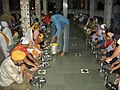 Traditional feeding (Langar) of visitors at Manikaran
 -
 Tourists and pilgrims having a bath in a hot spring
 -
 Manikaran viewed from Shiva temple
 -
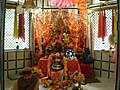 Shiv Parvati Temple at Manikaran
 -
 Outer view of Manikaran Gurdwara


References[edit | edit source]
- ↑ "Manikaran Travel Guide". Retrieved 23 September 2006.
- ↑ "Lord Shiva, the principle deity of Himachal Pradesh". Retrieved 23 September 2006.
- ↑ "Hot Springs in Himachal Pradesh". Retrieved 23 September 2006.
- ↑ Minakshi Chaudhry, Destination Himachal, p. 208. Rupa and Co. Publ. (2006) ISBN 81-291-0715-5
- ↑ "Google Maps elevation for a route". www.doogal.co.uk. Retrieved 19 September 2017.
- ↑ Official Website of Gurudwara Sahib Manikaran Archived 3 February 2014 at the Wayback Machine
External links[edit | edit source]
- MANIKARAN Archived 26 December 2017 at the Wayback Machine
- Manikaran Gurudwara at TripAdvisor