


Ajay Kumar (talk | contribs) Created a new article |
updated page |
||
| Line 1: | Line 1: | ||
{{short description|Stage of development of English, starting | {{short description|Stage of development of English, starting late 15th century}} | ||
{{About|the stage of the language|the historical period|Early Modern Britain}} | |||
{{Use dmy dates|date=March 2020}} | {{Use dmy dates|date=March 2020}} | ||
{{Use British English|date=May 2021}} | {{Use British English|date=May 2021}} | ||
{{Infobox language | {{Infobox language | ||
| name = Early Modern English | | name = Early Modern English | ||
| altname = Shakespeare's English, King James English | | altname = Shakespeare's English, Shakespearean English, King James' English | ||
| nativename = English | | nativename = English | ||
| image = File:Sonnet 132 1609.jpg | | image = File:Sonnet 132 1609.jpg | ||
| imagescale = 1.45 | | imagescale = 1.45 | ||
| imagecaption = [[William Shakespeare]]'s [[Sonnet 132]] in the 1609 Quarto | | imagecaption = [[William Shakespeare]]'s [[Sonnet 132]] in the 1609 Quarto | ||
| | | states = [[England]], [[Wales]], [[Scotland]], [[Ireland]] and [[English overseas possessions]] | ||
| era = developed into [[Modern English]] in the late 17th century | | region = | ||
| ethnicity = | |||
| era = [[Early modern period]]; developed into [[Modern English]] in the late 17th century | |||
| familycolor = Indo-European | | familycolor = Indo-European | ||
| fam2 = [[Germanic languages|Germanic]] | | fam2 = [[Germanic languages|Germanic]] | ||
| Line 18: | Line 20: | ||
| fam5 = [[Anglo-Frisian languages|Anglo-Frisian]] | | fam5 = [[Anglo-Frisian languages|Anglo-Frisian]] | ||
| fam6 = [[Anglic languages|Anglic]] | | fam6 = [[Anglic languages|Anglic]] | ||
| ancestor = [[Proto-Indo-European]] | | ancestor = [[Proto-Indo-European]] | ||
| ancestor2 = [[Proto-Germanic]] | | ancestor2 = [[Proto-Germanic]] | ||
| ancestor3 = [[Old English]] | | ancestor3 = [[Proto-West Germanic]] | ||
| | | ancestor4 = [[Proto-English]] | ||
| ancestor5 = [[Old English]] | |||
| ancestor6 = [[Middle English]] | |||
| isoexception = historical | | isoexception = historical | ||
| iso6 = emen | | iso6 = emen | ||
| Line 30: | Line 33: | ||
}} | }} | ||
'''Early Modern English''' (sometimes abbreviated '''EModE''' | '''Early Modern English''' (sometimes abbreviated '''EModE'''<ref name=":0">For example, {{cite journal|last=Río-Rey|first=Carmen|date=9 October 2002|title=Subject control and coreference in Early Modern English free adjuncts and absolutes|journal=English Language and Linguistics|publisher=Cambridge University Press|volume=6|issue=2|pages=309–323|url=http://journals.cambridge.org/action/displayAbstract?aid=124085|access-date=12 March 2009|doi=10.1017/s1360674302000254|s2cid=122740133|archive-date=21 February 2016|archive-url=https://web.archive.org/web/20160221025332/http://journals.cambridge.org/action/displayAbstract?aid=124085|url-status=live|url-access=subscription}}</ref> or '''EMnE'''), also known as '''Early New English''' ('''ENE'''), and colloquially '''Shakespeare's English''', '''Shakespearean English''', or '''King James' English''', is the stage of the [[English language]] from the beginning of the [[Tudor period]] to the English [[Interregnum (England)|Interregnum]] and [[Stuart Restoration|Restoration]], or from the transition from [[Middle English]], in the late 15th century, to the transition to [[Modern English]], in the mid-to-late 17th century.<ref>Nevalainen, Terttu (2006). ''An Introduction to Early Modern English''. Edinburgh: Edinburgh University Press</ref> | ||
Before and after the accession of [[James VI and I|James I]] to the English throne in 1603, the emerging English standard began to influence the spoken and written [[Middle Scots]] of Scotland. | Before and after the accession of [[James VI and I|James I]] to the English throne in 1603, the emerging English standard began to influence the spoken and written [[Middle Scots]] of Scotland. | ||
The grammatical and orthographical conventions of literary English in the late 16th century and the 17th century are still very influential on modern [[Standard English]]. Most modern readers of English can understand texts written in the late phase of | The grammatical and orthographical conventions of literary English in the late 16th century and the 17th century are still very influential on modern [[Standard English]]. Most modern readers of English can understand texts written in the late phase of early modern English, such as the ''[[King James Bible]]'' and the works of [[William Shakespeare]], and they have greatly influenced Modern English. | ||
Texts from the earlier phase of early modern English, such as the late-15th-century ''[[Le Morte d'Arthur]]'' (1485) and the mid-16th-century ''[[Gorboduc (play)|Gorboduc]]'' (1561), may present more difficulties but are still closer to Modern English grammar, lexicon and phonology than are 14th-century Middle English texts, such as the works of [[Geoffrey Chaucer]]. | |||
[[File:Psalm 23.jpg|[[King James Version]] of [[Psalm 23]]|thumb]] | |||
==History== | ==History== | ||
{{more citations needed section|date=July 2024}} | |||
===English Renaissance=== | ===English Renaissance=== | ||
{{See also|English Renaissance}} | {{See also|English Renaissance}} | ||
====Transition from Middle English==== | ====Transition from Middle English==== | ||
{{further|Late Middle English}} | {{further|Late Middle English}} | ||
The change from [[Middle English]] to | The change from [[Middle English]] to early modern English affected much more than just vocabulary and pronunciation.<ref name=":0" /> | ||
Middle English underwent significant change over time and contained large dialectical variations. Early Modern English, on the other hand, became more standardised and developed an established canon of literature that survives today. | |||
*1476 – [[William Caxton]] started printing in [[Westminster]]; however, the language that he used reflected the variety of styles and dialects used by the authors who originally wrote the material. | *1476 – [[William Caxton]] started printing in [[Westminster]]; however, the language that he used reflected the variety of styles and dialects used by the authors who originally wrote the material. | ||
=====Tudor period (1485–1603)===== | =====Tudor period (1485–1603)===== | ||
*1485 – Caxton published [[Thomas Malory]]'s ''[[Le Morte d'Arthur]]'', the first print bestseller in English. Malory's language, while archaic in some respects, was clearly | *1485 – Caxton published [[Thomas Malory]]'s ''[[Le Morte d'Arthur]]'', the first print bestseller in English. Malory's language, while archaic in some respects, was clearly early modern and was possibly a Yorkshire or Midlands dialect. | ||
*1491 or 1492 – [[Richard Pynson]] started printing in London; his style tended to prefer [[Middle English#Chancery Standard|Chancery Standard]], the form of English used by the government. | *1491 or 1492 – [[Richard Pynson]] started printing in London; his style tended to prefer [[Middle English#Chancery Standard|Chancery Standard]], the form of English used by the government. | ||
| Line 62: | Line 70: | ||
[[File:Gorboduc TP 1565.jpg|thumb|Title page of ''[[Gorboduc (play)|Gorboduc]]'' (printed 1565). ''The Tragedie of Gorbodvc, whereof three Actes were wrytten by Thomas Nortone, and the two laste by Thomas Sackuyle. Sett forthe as the same was shewed before the Qvenes most excellent Maiestie, in her highnes Court of Whitehall, the .xviii. day of January, Anno Domini .1561. By the Gentlemen of Thynner Temple in London.'']] | [[File:Gorboduc TP 1565.jpg|thumb|Title page of ''[[Gorboduc (play)|Gorboduc]]'' (printed 1565). ''The Tragedie of Gorbodvc, whereof three Actes were wrytten by Thomas Nortone, and the two laste by Thomas Sackuyle. Sett forthe as the same was shewed before the Qvenes most excellent Maiestie, in her highnes Court of Whitehall, the .xviii. day of January, Anno Domini .1561. By the Gentlemen of Thynner Temple in London.'']] | ||
;[[Elizabethan era]] (1558–1603) | ;[[Elizabethan era]] (1558–1603) | ||
*1560 – The [[Geneva Bible]] was published. The New Testament was completed in 1557 by English Reformed exiles on the continent during the reign of Mary, and the complete Bible three years later, after Elizabeth succeeded the throne. | *1560 – The [[Geneva Bible]] was published. The New Testament was completed in 1557 by English Reformed exiles on the continent during the reign of Mary, and the complete Bible three years later, after Elizabeth succeeded the throne. This version was favoured by the [[Puritans]] and [[Pilgrims]] due to its more vigorous and forceful language. Its popularity and proliferation (due in large part to its copious notes) over the following decades sparked the production of the [[King James Bible]] to counter it. | ||
*1582 – The [[Douay–Rheims Bible|Rheims and Douai Bible]] was completed, and the New Testament was released in [[Rheims]], France, in 1582. It was the first complete English translation of the Bible that was officially sponsored and carried out by the [[Catholic Church]] (earlier translations into English, especially of the Psalms and Gospels existed as far back as the 9th century, but it was the first Catholic English translation of the full Bible). Though the Old Testament was already complete, it was not published until 1609–1610, when it was released in two volumes. While it did not make a large impact on the English language at large, it certainly played a role in the development of English, especially in heavily Catholic English-speaking areas. | *1582 – The [[Douay–Rheims Bible|Rheims and Douai Bible]] was completed, and the [[New Testament]] was released in [[Rheims]], [[France]], in 1582. It was the first complete English translation of the Bible that was officially sponsored and carried out by the [[Catholic Church]] (earlier translations into English, especially of the Psalms and Gospels, existed as far back as the 9th century, but it was the first Catholic English translation of the full Bible). Though the Old Testament was already complete, it was not published until 1609–1610, when it was released in two volumes. While it did not make a large impact on the English language at large, it certainly played a role in the development of English, especially in heavily Catholic English-speaking areas. | ||
*[[Christopher Marlowe]], {{floruit|1586–1593}} | *[[Christopher Marlowe]], {{floruit|1586–1593}} | ||
*1592 – ''[[The Spanish Tragedy]]'' by [[Thomas Kyd]] | *1592 – ''[[The Spanish Tragedy]]'' by [[Thomas Kyd]] | ||
| Line 79: | Line 87: | ||
**[[Beaumont and Fletcher]] ([[Francis Beaumont]] and [[John Fletcher (playwright)|John Fletcher]]) | **[[Beaumont and Fletcher]] ([[Francis Beaumont]] and [[John Fletcher (playwright)|John Fletcher]]) | ||
**[[John Webster]] | **[[John Webster]] | ||
*1607 – The first successful permanent English colony in the New World, [[Jamestown, Virginia|Jamestown]], is established in Virginia. Early vocabulary specific to [[American English]] comes from indigenous languages (such as [[:wikt:moose|moose]], [[:wikt:racoon|racoon]]). | *1607 – The first successful permanent English colony in the New World, [[Jamestown, Virginia|Jamestown]], is established in [[Virginia]]. Early vocabulary specific to [[American English]] comes from indigenous languages (such as [[:wikt:moose|moose]], [[:wikt:racoon|racoon]]). | ||
*1611 – The | *1611 – The [[King James Version]] of the Bible was published. It was largely based on the [[Bishops' Bible]] translation and revision of 1602. The "Authorised Version" as it is called in the U.K. remained the standard Bible in the [[Church of England]] until the [[1769 Oxford edition]] supplanted it with updated modern English spelling and grammar. | ||
*1623 – Shakespeare's ''[[First Folio]]'' published | *1623 – Shakespeare's ''[[First Folio]]'' published | ||
| Line 94: | Line 102: | ||
*1660–1669 – [[Samuel Pepys]] wrote his diary, which will become an important eyewitness account of the Restoration Era. | *1660–1669 – [[Samuel Pepys]] wrote his diary, which will become an important eyewitness account of the Restoration Era. | ||
*1662 – New edition of the ''Book of Common Prayer'', largely based on the 1549 and subsequent editions. It long remained a standard work in English. | *1662 – New edition of the ''Book of Common Prayer'', largely based on the 1549 and subsequent editions. It long remained a standard work in English. | ||
*1667 – Publication of ''[[Paradise Lost]]'' by [[John Milton]] and of ''[[Annus Mirabilis (poem)|Annus Mirabilis]]'' by [[John Dryden]] | *1667 – Publication of ''[[Paradise Lost]]'' by [[John Milton]] and of ''[[Annus Mirabilis (poem)|Annus Mirabilis]]'' by [[John Dryden]]. | ||
===Development to Modern English=== | ===Development to Modern English=== | ||
{{main|Modern English}} | {{main|Modern English}} | ||
The 17th-century [[port town]]s and their forms of speech gained influence over the old [[county town]]s. From around the 1690s onwards, England experienced a new period of internal peace and relative stability, which encouraged the arts including literature. | The 17th-century [[port town]]s and their forms of speech gained influence over the old [[county town]]s. From around the 1690s onwards, England experienced a new period of internal peace and relative stability, which encouraged the arts, including literature. Modern English can be taken to have emerged fully by the beginning of the [[Georgian era]] in 1714, but [[English orthography]] remained somewhat fluid until the publication of Johnson's ''[[A Dictionary of the English Language]]'', in 1755. | ||
The [[Proceedings in Courts of Justice Act 1730]] made English, instead of Law French and [[Latin]], the obligatory language for use in the courts of England and in the [[Court of Exchequer (Scotland)|court of exchequer]] in Scotland. It was later extended to Wales, and seven years later a similar act was passed in Ireland, the [[Administration of Justice (Language) Act (Ireland) 1737]].<ref>{{Cite web |title=Northern Ireland Act 1998 (Amendment No. 1) |url=https://assets.publishing.service.gov.uk/government/uploads/system/uploads/attachment_data/file/857001/Final_Combined_Legislation_for_publication.pdf |access-date=30 July 2024 |website=www.assets.publishing.service.gov.uk}}</ref> | |||
The towering importance of [[William Shakespeare]] over the other Elizabethan authors was the result of his [[William Shakespeare's influence|reception]] during the 17th and the 18th centuries, which directly contributes to the development of [[Standard English]].{{Citation needed|date=May 2018}} [[Shakespeare's plays]] are therefore still familiar and comprehensible 400 years after they were written,<ref>[[Fausto Cercignani|Cercignani, Fausto]], ''Shakespeare's Works and Elizabethan Pronunciation'', Oxford, Clarendon Press, 1981.</ref> but the works of [[Geoffrey Chaucer]] and [[William Langland]], which had been written only 200 years earlier, are considerably more difficult for the average modern reader. | The towering importance of [[William Shakespeare]] over the other Elizabethan authors was the result of his [[William Shakespeare's influence|reception]] during the 17th and the 18th centuries, which directly contributes to the development of [[Standard English]].{{Citation needed|date=May 2018}} [[Shakespeare's plays]] are therefore still familiar and comprehensible 400 years after they were written,<ref>[[Fausto Cercignani|Cercignani, Fausto]], ''Shakespeare's Works and Elizabethan Pronunciation'', Oxford, Clarendon Press, 1981.</ref> but the works of [[Geoffrey Chaucer]] and [[William Langland]], which had been written only 200 years earlier, are considerably more difficult for the average modern reader. | ||
==Orthography== | ==Orthography== | ||
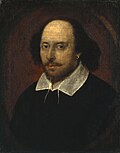
[[File:Shakespeare.jpg|thumb|upright=0.9|right|[[Shakespeare]]'s writings are universally associated with | [[File:William Shakespeare by John Taylor, edited.jpg|thumb|upright=0.9|right|[[Shakespeare]]'s writings are universally associated with early modern English.]] | ||
The [[orthography]] of | The [[orthography]] of early modern English is recognisably similar to [[English orthography|that of today]], but spelling was unstable. Early Modern and Modern English both retain various orthographical conventions that predate the [[Great Vowel Shift]]. | ||
Early Modern English spelling was similar to [[Middle English orthography]]. | Early Modern English spelling was broadly similar to that encountered [[Middle English orthography|in Middle English]]. Some of the changes that occurred were based on etymology (as with the [[silent b|silent {{vr|b}}]] that was added to words like {{lang|italic=yes|en-emodeng|debt}}, {{lang|italic=yes|en-emodeng|doubt}} and {{lang|italic=yes|en-emodeng|subtle}}). Many spellings had still not been standardised. For example, ''he'' was spelled as both {{lang|italic=yes|en-emodeng|he}} and {{lang|italic=yes|en-emodeng|hee}} in the same sentence in Shakespeare's plays and elsewhere. | ||
Certain key orthographic features of early modern English spelling have not been retained: | |||
*The letter {{angle bracket|S}} had two distinct [[lowercase]] forms: {{angle bracket|s}} (short ''s''), as is still used today, and {{angle bracket|ſ}} ([[long s|long ''s'']]). The short ''s'' was always used at the end of a word and often elsewhere. The long ''s'', if used, could appear anywhere except at the end of a word. The double lowercase ''S'' was written variously {{angle bracket|ſſ}}, {{angle bracket|ſs}} or {{angle bracket|ß}} (the last [[Ligature (writing)|ligature]] is still used in German [[ß]]).<ref>{{cite book|last=Burroughs|first=Jeremiah|author-link=Jeremiah Burroughs|author2=Greenhill, William|title=The Saints Happinesse|publisher=M.S.|url=https://archive.org/details/saintshappiness00greegoog|year=1660}} Introduction uses both {{lang|italic=yes|en-emodeng|happineſs}} and {{lang|italic=yes|en-emodeng|[[wikt:blessedness|bleſſedneſs]]}}.</ref> That is similar to the alternation between medial (σ) and final lowercase [[sigma]] (ς) in Greek. | *The letter {{angle bracket|S}} had two distinct [[lowercase]] forms: {{angle bracket|s}} (short ''s''), as is still used today, and {{angle bracket|ſ}} ([[long s|long ''s'']]). The short ''s'' was always used at the end of a word and often elsewhere. The long ''s'', if used, could appear anywhere except at the end of a word. The double lowercase ''S'' was written variously {{angle bracket|ſſ}}, {{angle bracket|ſs}} or {{angle bracket|ß}} (the last [[Ligature (writing)|ligature]] is still used in German [[ß]]).<ref>{{cite book|last=Burroughs|first=Jeremiah|author-link=Jeremiah Burroughs|author2=Greenhill, William|title=The Saints Happinesse|publisher=M.S.|url=https://archive.org/details/saintshappiness00greegoog|year=1660}} Introduction uses both {{lang|italic=yes|en-emodeng|happineſs}} and {{lang|italic=yes|en-emodeng|[[wikt:blessedness|bleſſedneſs]]}}.</ref> That is similar to the alternation between medial (σ) and final lowercase [[sigma]] (ς) in Greek. | ||
*[[U|{{angle bracket|u}}]] and [[V|{{angle bracket|v}}]] were not considered two distinct letters then but as still different forms of the same letter. Typographically, {{angle bracket|v}} was frequent at the start of a word and {{angle bracket|u}} elsewhere:<ref>{{Cite book|author=Sacks, David|title=The Alphabet|year=2004|publisher=Arrow|location=London|isbn=0-09-943682-5|page=[https://archive.org/details/alphabetunraveli0000sack/page/316 316]|url-access=registration|url=https://archive.org/details/alphabetunraveli0000sack/page/316}}</ref> hence ''{{lang|en-emodeng|vnmoued}}'' (for modern ''unmoved'') and {{lang|italic=yes|en-emodeng|loue}} (for ''love''). The modern convention of using {{vr|u}} for the vowel sounds and {{vr|v}} for the consonant appears to have been introduced in the 1630s. | *[[U|{{angle bracket|u}}]] and [[V|{{angle bracket|v}}]] were not considered two distinct letters then but as still different forms of the same letter. Typographically, {{angle bracket|v}} was frequent at the start of a word and {{angle bracket|u}} elsewhere:<ref>{{Cite book|author=Sacks, David|title=The Alphabet|year=2004|publisher=Arrow|location=London|isbn=0-09-943682-5|page=[https://archive.org/details/alphabetunraveli0000sack/page/316 316]|url-access=registration|url=https://archive.org/details/alphabetunraveli0000sack/page/316}}</ref> hence ''{{lang|en-emodeng|vnmoued}}'' (for modern ''unmoved'') and {{lang|italic=yes|en-emodeng|loue}} (for ''love''). The modern convention of using {{vr|u}} for the vowel sounds and {{vr|v}} for the consonant appears to have been introduced in the 1630s.{{sfnp|Salmon|1999|p=39}} Also, {{angle bracket|w}} was frequently represented by {{angle bracket|vv}}. | ||
*Similarly, [[I|{{angle bracket|i}}]] and [[J|{{angle bracket|j}}]] were also still considered not as two distinct letters, but as different forms of the same letter: hence ''{{lang|en-emodeng|ioy}}'' for ''joy'' and {{lang|italic=yes|en-emodeng|iust}} for ''just''. Again, the custom of using {{vr|i}} as a vowel and {{vr|j}} as a consonant began in the 1630s. | *Similarly, [[I|{{angle bracket|i}}]] and [[J|{{angle bracket|j}}]] were also still considered not as two distinct letters, but as different forms of the same letter: hence ''{{lang|en-emodeng|ioy}}'' for ''joy'' and {{lang|italic=yes|en-emodeng|iust}} for ''just''. Again, the custom of using {{vr|i}} as a vowel and {{vr|j}} as a consonant began in the 1630s.{{sfnp|Salmon|1999|p=39}} | ||
*The letter {{angle bracket|þ}} ([[thorn (letter)|thorn]]) was still in use during the | *The letter {{angle bracket|þ}} ([[thorn (letter)|thorn]]) was still in use during the early modern English period but was increasingly limited to handwritten texts. In Early Modern English printing, {{angle bracket|þ}} was represented by the Latin {{angle bracket|Y}} (see [[Ye olde]]), which appeared similar to thorn in blackletter typeface <big>{{angle bracket|𝖞}}</big>. Thorn had become nearly totally disused by the late early modern English period, the last vestiges of the letter being its ligatures, {{lang|italic=yes|en-emodeng|y<sup>e</sup>}} (thee), {{lang|italic=yes|en-emodeng|y<sup>t</sup>}} (that), {{lang|italic=yes|en-emodeng|y<sup>u</sup>}} (thou), which were still seen occasionally in the 1611 ''King James Version'' and in Shakespeare's Folios.<ref>{{Cite book|author=Sacks, David|title=Language Visible|year=2003|publisher=Knopf|location=Canada|isbn=0-676-97487-2|pages=356–57}}</ref> | ||
*A [[silent e|silent {{angle bracket|e}}]] was often appended to words, as in ''{{lang|en-emodeng|ſpeake}}'' and ''{{lang|en-emodeng|cowarde}}''. The last [[consonant]] was sometimes doubled when the {{angle bracket|e}} was added: hence ''{{lang|en-emodeng|manne}}'' (for ''man'') and ''{{lang|en-emodeng|runne}}'' (for ''run''). | *A [[silent e|silent {{angle bracket|e}}]] was often appended to words, as in ''{{lang|en-emodeng|ſpeake}}'' and ''{{lang|en-emodeng|cowarde}}''. The last [[consonant]] was sometimes doubled when the {{angle bracket|e}} was added: hence ''{{lang|en-emodeng|manne}}'' (for ''man'') and ''{{lang|en-emodeng|runne}}'' (for ''run''). | ||
*The sound {{IPA|/ʌ/}} was often written {{angle bracket|o}} (as in ''son''): hence ''{{lang|en-emodeng|ſommer}}'', ''{{lang|en-emodeng|plombe}}'' (for modern ''summer'', ''plumb'').<ref>[[W. W. Skeat]], in ''Principles of English Etymology'', claims that the substitution was encouraged by the ambiguity between ''u'' and ''n''; if ''{{lang|en-emodeng|sunne}}'' could just as easily be misread as ''{{not a typo|sunue}}'' or ''{{not a typo|suvne}}'', it made sense to write it as ''{{lang|en-emodeng|sonne}}''. (Skeat, ''Principles of English Etymology'', Second Series. Clarendon Press, 1891, [https://archive.org/details/principlesengli00skeagoog/page/n137 page 99].)</ref> | *The sound that became Modern English {{IPA|/ʌ/}} was often written {{angle bracket|o}} (as in ''son''): hence ''{{lang|en-emodeng|ſommer}}'', ''{{lang|en-emodeng|plombe}}'' (for modern ''summer'', ''plumb'').<ref>[[W. W. Skeat]], in ''Principles of English Etymology'', claims that the substitution was encouraged by the ambiguity between ''u'' and ''n''; if ''{{lang|en-emodeng|sunne}}'' could just as easily be misread as ''{{not a typo|sunue}}'' or ''{{not a typo|suvne}}'', it made sense to write it as ''{{lang|en-emodeng|sonne}}''. (Skeat, ''Principles of English Etymology'', Second Series. Clarendon Press, 1891, [https://archive.org/details/principlesengli00skeagoog/page/n137 page 99].)</ref> | ||
*The final syllable of words like ''public'' was variously spelt but came to be standardised as ''-ick''. The modern spellings with ''-ic'' did not come into use until the mid-18th century.<ref>Fischer, A., Schneider, P., "The dramatick disappearance of the {{vr|-ick}} spelling", in ''Text Types and Corpora'', Gunter Narr Verlag, 2002, pp. 139ff.</ref> | *The final syllable of words like ''public'' was variously spelt but came to be standardised as ''-ick''. The modern spellings with ''-ic'' did not come into use until the mid-18th century.<ref>Fischer, A., Schneider, P., "The dramatick disappearance of the {{vr|-ick}} spelling", in ''Text Types and Corpora'', Gunter Narr Verlag, 2002, pp. 139ff.</ref> | ||
*{{angle bracket|y}} was often used instead of {{angle bracket|i}}.<ref name=" | *{{angle bracket|y}} was often used instead of {{angle bracket|i}}.<ref name=":1">{{Cite news |date=2012-08-16 |title=Early modern English pronunciation and spelling {{!}} Oxford English Dictionary |url=https://public.oed.com/blog/early-modern-english-pronunciation-and-spelling/ |archive-url=https://web.archive.org/web/20190626171245/https://public.oed.com/blog/early-modern-english-pronunciation-and-spelling/ |archive-date=2019-06-26 |access-date=2025-12-05 |work=Oxford English Dictionary |language=en-US}}</ref> | ||
*The vowels represented by {{angle bracket|ee}} and {{angle bracket|e_e}} (for example in ''meet'' and ''{{lang|en-emodeng|mete}}'') changed, and {{angle bracket|ea}} became an alternative.<ref name=" | *The vowels represented by {{angle bracket|ee}} and {{angle bracket|e_e}} (for example in ''meet'' and ''{{lang|en-emodeng|mete}}'') changed, and {{angle bracket|ea}} became an alternative.<ref name=":1" /> | ||
==Phonology== | |||
{{Contains special characters|IPA|section}} | |||
The phonology of early modern English is reconstructed from a variety of sources, including phonetic descriptions by orthoepists, spellings, and usage in poetry.{{sfnp|Lass|1999|pp=58-67}} | |||
===Consonants=== | ===Consonants=== | ||
{| class="wikitable | {| class="wikitable" style="text-align: center;" | ||
|+Early Modern English consonants | |+Early Modern English consonants | ||
! | ! | ||
| Line 138: | Line 147: | ||
|- | |- | ||
![[Nasal consonant|Nasal]] | ![[Nasal consonant|Nasal]] | ||
|{{IPA|m}} | |{{IPA link|m}} | ||
| | | | ||
|{{IPA|n}} | |{{IPA link|n}} | ||
| | | | ||
| | | | ||
| | |({{IPA link|ŋ}}) | ||
| | | | ||
|- | |- | ||
![[Stop consonant|Stop]] | ![[Stop consonant|Stop]] | ||
|{{IPA|p}} • {{IPA|b}} | |{{IPA link|p}} • {{IPA link|b}} | ||
| | | | ||
|{{IPA|t}} • {{IPA|d}} | |{{IPA link|t}} • {{IPA link|d}} | ||
|{{IPA|tʃ}} • {{IPA|dʒ}} | |{{IPA link|tʃ}} • {{IPA link|dʒ}} | ||
| | | | ||
|{{IPA|k}} • {{IPA| | |{{IPA link|k}} • {{IPA link|ɡ}} | ||
| | | | ||
|- | |- | ||
![[Fricative consonant|Fricative]] | ![[Fricative consonant|Fricative]] | ||
|{{IPA|f}} • {{IPA|v}} | |{{IPA link|f}} • {{IPA link|v}} | ||
|{{IPA|θ}} • {{IPA|ð}} | |{{IPA link|θ}} • {{IPA link|ð}} | ||
|{{IPA|s}} • {{IPA|z}} | |{{IPA link|s}} • {{IPA link|z}} | ||
|{{IPA|ʃ}} • | |{{IPA link|ʃ}} • ({{IPA link|ʒ}}) | ||
| | | colspan=3 | {{IPA link|ç}} ~ {{IPA link|x}} ~ {{IPA link|h}} | ||
|- | |- | ||
![[Approximant]] | ![[Approximant]] | ||
| | | | ||
| | | | ||
| | | | ||
|{{IPA|j}} | | | ||
| | |{{IPA link|j}} | ||
|{{IPA link|w}} | |||
| | |||
|- | |||
![[Rhotic consonant|Rhotic]] | |||
| | |||
| | |||
| colspan=2 | {{IPA link|r}} ~ {{IPA link|ɹ}} | |||
| | |||
| | |||
| | | | ||
|- | |- | ||
| Line 176: | Line 191: | ||
| | | | ||
| | | | ||
|{{IPA|l}} | |{{IPA link|l}} | ||
| | | | ||
| | | | ||
| Line 182: | Line 197: | ||
| | | | ||
|} | |} | ||
Most consonant sounds of | Most consonant sounds of early modern English have survived into present-day English; however, there are still a few notable differences in pronunciation: | ||
* | * Many initial [[consonant cluster]]s which have disappeared in the modern day were still fully pronounced. These include {{IPA|/wr kn gn hw/}}. All but {{IPA|/hw/}} have [[Phonological history of English consonant clusters#Other initial cluster reductions|fully reduced]] in the 16th and 17th centuries.{{sfnp|Lass|1999|p=122}} | ||
* | ** {{IPA|/wr/}} as in ''write'' was the first to disappear, merging into {{IPA|/r/}} in the first half of the 17th century.{{sfnp|Dobson|1968|pp=975-976}} | ||
** {{IPA|/kn/}} as in ''knife'' evolved into a variety of pronunciations including {{IPA|[tn,n̥]}}, some of which remained into the 18th century until it merged with {{IPA|/n/}}.{{sfnp|Dobson|1968|pp=976-977}}{{sfnp|Lass|1999|p=123}} | |||
* | ** Similarly, {{IPA|/gn/}} as in ''gnat'' evolved into {{IPA|[ŋn]}} or merged into {{IPA|/kn/}} or {{IPA|/n/}}.{{sfnp|Lass|1999|p=123}}{{sfnp|Dobson|1968|pp=977-979}} | ||
* | ** {{IPA|/hw/}}, spelled {{angbr|wh}} such as in ''what'', ''where'' and ''whale'', were still pronounced {{IPAblink|ʍ|audio=y}}, rather than {{IPAblink|w|audio=y}}. That means, for example, that ''wine'' and ''whine'' were [[Wine–whine merger|still pronounced differently]], unlike in most varieties of English today. A merger into {{IPA|/w/}} had started by 1700, but did not become common until the late 18th century.{{sfnp|Lass|1999|pp=123-124}} | ||
* Much variation existed in words with postvocalic {{IPA|/x/}}, like ''night'', ''thought'', and ''daughter'', written {{angbr|[[Gh (digraph)|gh]]}}. In Middle English, this phoneme had allophones {{IPA|[x~ç]}}. While {{IPA|[ç]}} dropped entirely via {{IPA|[h]}}, {{IPA|[x]}} either dropped via the same path or became {{IPA|[f]}}. The most conservative dialects retained the original allophones until the 1630s, but ''gh''-dropping dialects had already started appearing in Middle English.{{sfnp|Lass|1999|pp=117-118}} | |||
* | * ''Would'' and ''should'' had started losing {{IPA|/l/}} in weak forms by the 1640s,{{sfnp|Dobson|1968|pp=456-457,462-463}} but may have persisted several decades longer in the [[British American colonies]].<ref>The American Language 2nd ed. p. 71</ref> While the {{angbr|l}} in ''could'' is unetymological, having descended from [[Old English]] {{lang|ang|cūþe}}, both its spelling and its pronunciation were affected by analogy with ''would'' and ''should'', showing {{IPA|/l/}} in its strong forms.{{sfnp|Dobson|1968|pp=451-452}} | ||
* The modern phoneme {{IPA|/ʒ/}} was not documented as occurring until the mid-17th century, when it formed from coalescence of the sequence {{IPA|/zj/}}.{{sfnp|Lass|1999|p=121}} The word ''vision'' was pronounced {{IPA|[ˈvɪzjən]}} prior to the change.{{sfnp|Barber|1997|p=125}} | |||
* Early Modern English was [[rhoticity in English|rhotic]], as postvocalic {{IPA|/r/}} was not lost until the late 1700s.{{sfnp|Dobson|1968|pp=992-993}} It was a trill {{IPA|[r]}} or tap {{IPA|[ɾ]}} word-initially and an approximant {{IPA|[ɹ]}} finally, but [[Eric John Dobson|Dobson]] and [[Roger Lass|Lass]] disagree on which was the intervocalic allophone based on different sources.{{sfnp|Dobson|1968|pp=945-946}}{{sfnp|Lass|1999|p=115}} | |||
*In Early Modern English, the precise nature of the light and dark [[allophone|variants]] of the ''l'' consonant, respectively {{IPAblink|l|audio=y}} and {{IPAblink|ɫ|audio=y}}, remains unclear. | *In Early Modern English, the precise nature of the light and dark [[allophone|variants]] of the ''l'' consonant, respectively {{IPAblink|l|audio=y}} and {{IPAblink|ɫ|audio=y}}, remains unclear. | ||
*Word-final {{angbr|ng}}, as in ''sing'', was still pronounced {{IPA|[ŋɡ]}} until the late 16th century, when it began to [[ng-coalescence|coalesce]] into the usual modern pronunciation, {{IPAblink|ŋ}}. The original pronunciation {{IPA|[ŋɡ]}} is preserved in parts of England, in dialects such as [[Brummie]], [[Manchester dialect|Mancunian]] and Scouse. | * Word-final {{angbr|ng}}, as in ''sing'', was still pronounced {{IPA|[ŋɡ]}} until the late 16th century, when it began to [[ng-coalescence|coalesce]] into the usual modern pronunciation, {{IPAblink|ŋ}}. Coalescence happened at morpheme boundaries in the 17th century, except in inflected adjectives, giving us modern "si{{IPA|/ŋ/}}er" and "stro{{IPA|/ŋg/}}er". However, coalescence happened earlier in unstressed ''-ing'' and the nasal further changed to {{IPA|/n/}}, becoming more and more common until the end of the 17th century.{{sfnp|Lass|1999|pp=119-120}} The original pronunciation {{IPA|[ŋɡ]}} is preserved in parts of England, in dialects such as [[Brummie dialect|Brummie]], [[Manchester dialect|Mancunian]] and Scouse. | ||
*[[H-dropping]] at the start of words was common | * [[H-dropping]] at the start of words was common. In loanwords taken from [[Latin]], Greek, or any [[Romance language]], a written ''h'' was increasingly pronounced from the 17th to 18th centuries, e.g. in ''humble'', ''host'', and British ''herb''.{{sfnp|Lass|1999|pp=118-119}} | ||
===Vowels=== | ===Vowels=== | ||
{| class="wikitable" | {| class="wikitable" style="text-align:center;" | ||
|+Early modern English vowels | |+Early modern English vowels | ||
! colspan="2" rowspan="2" | | ! colspan="2" rowspan="2" | | ||
! colspan="2" |[[Monophthong | ! colspan="2" |[[Monophthong]]s | ||
! colspan="2" |[[Diphthongs]] | ! colspan="2" |[[Diphthongs]] | ||
|- | |- | ||
| Line 273: | Line 288: | ||
|} | |} | ||
The following information primarily comes from studies of the [[Great Vowel Shift]];<ref>Stemmler, Theo. ''Die Entwicklung der englischen Haupttonvokale: eine Übersicht in Tabellenform'' [Trans: The development of the English primary-stressed-vowels: an overview in table form] (Göttingen: Vandenhoeck & Ruprecht, 1965).</ref><ref>{{cite web|first=William Elford|last=Rogers|publisher=[[Furman University]]|title=Early Modern English vowels|url=http://facweb.furman.edu/~wrogers/phonemes/phone/eme/evowel.htm|archive-url=https://web.archive.org/web/20150113011226/http://facweb.furman.edu/~wrogers/phonemes/phone/eme/evowel.htm|archive-date=13 January 2015|url-status=dead|access-date=5 December 2014}}</ref> see the related chart. | The following information primarily comes from studies of the [[Great Vowel Shift]];<ref>Stemmler, Theo. ''Die Entwicklung der englischen Haupttonvokale: eine Übersicht in Tabellenform'' [Trans: The development of the English primary-stressed-vowels: an overview in table form] (Göttingen: Vandenhoeck & Ruprecht, 1965).</ref><ref>{{cite web|first=William Elford|last=Rogers|publisher=[[Furman University]]|title=Early Modern English vowels|url=http://facweb.furman.edu/~wrogers/phonemes/phone/eme/evowel.htm|archive-url=https://web.archive.org/web/20150113011226/http://facweb.furman.edu/~wrogers/phonemes/phone/eme/evowel.htm|archive-date=13 January 2015|url-status=dead|access-date=5 December 2014}}</ref> see the related chart. | ||
*The modern English [[phoneme]] {{IPAc-en|audio=En-us-I.ogg|aɪ}}, as in ''glide'', ''rhyme'' and ''eye'', was {{IPA- | *The modern English [[phoneme]] {{IPAc-en|audio=En-us-I.ogg|aɪ}}, as in ''glide'', ''rhyme'' and ''eye'', was {{IPA|en-emodeng|əi|}}, and was reduced word-finally. Early Modern rhymes indicate that {{IPA|en-emodeng|əi|}} was similar to the vowel that was used at the end of words like ''happy'', ''melody'' and ''busy''. | ||
*{{IPAc-en|audio=En-us-ow.ogg|aʊ}}, as in ''now'', ''out'' and ''ploughed'', was {{IPA- | *{{IPAc-en|audio=En-us-ow.ogg|aʊ}}, as in ''now'', ''out'' and ''ploughed'', was {{IPA|en-emodeng|əu||audio=en-uk-oh.ogg}}. | ||
*{{IPAc-en|audio=Open-mid front unrounded vowel.ogg|ɛ}}, as in ''fed'', ''elm'' and ''hen'', was more or less the same as the phoneme represents today, sometimes approaching {{IPAblink|ɪ|audio=y}} (which is still in the word ''pretty'').<ref name="Hark"/> | *{{IPAc-en|audio=Open-mid front unrounded vowel.ogg|ɛ}}, as in ''fed'', ''elm'' and ''hen'', was more or less the same as the phoneme represents today, sometimes approaching {{IPAblink|ɪ|audio=y}} (which is still in the word ''pretty'').<ref name="Hark">{{cite web|last=Crystal|first=David|title=David Crystal – Home |url=http://www.davidcrystal.com/?fileid=-4254|archive-url=https://web.archive.org/web/20171020080412/http://www.davidcrystal.com/?fileid=-4254|archive-date=20 October 2017|quote="Hark, hark, what shout is that?" Around the Globe 31. [based on article written for the Troilus programme, Shakespeare's Globe, August 2005: 'Saying it like it was'}}</ref> | ||
* {{IPAc-en|audio=en-uk-a.ogg|eɪ}}, as in ''name'', ''case'' and ''sake'', was a long [[monophthong]]. It shifted from {{IPAblink|æː|audio=y}} to {{IPAblink|ɛː|audio=y}} and finally to {{IPAblink|eː|audio=y}}. Earlier in | * {{IPAc-en|audio=en-uk-a.ogg|eɪ}}, as in ''name'', ''case'' and ''sake'', was a long [[monophthong]]. It shifted from {{IPAblink|æː|audio=y}} to {{IPAblink|ɛː|audio=y}} and finally to {{IPAblink|eː|audio=y}}. Earlier in early modern English, ''mat'' and ''mate'' were near-homophones, with a longer vowel in the second word. Thus, [[Shakespeare]] rhymed words like ''haste'', ''taste'' and ''waste'' with ''last'' and ''shade'' with ''sad''.{{sfnp|Crystal|2011|pp=298-300}} The more open pronunciation remains in some [[Northern England English]] and rarely in Irish English. During the 17th century, the phoneme variably [[Phonological change|merged]] with the phoneme {{IPA|en-emodeng|ɛi||audio=Nl-ei.ogg}} as in ''day'', ''weigh'', and the merger survived into standard forms of Modern English, though a few dialects kept these vowels distinct at least to the 20th century (see [[Pane–pain merger|''pane''–''pain'' merger]]). | ||
*{{IPAc-en|audio=Close front unrounded vowel.ogg|iː}} (typically spelled {{angbr|ee}} or {{angbr|ie}}) as in ''see'', ''bee'' and ''meet'', was more or less the same as the phoneme represents today, but it had not yet [[fleece merger|merged]] with the phoneme represented by the spellings {{angbr|ea}} or {{angbr|ei}} (and perhaps {{angbr|ie}}, particularly with ''fiend'', ''field'' and ''friend''), as in ''east'', ''meal'' and ''feat'', which were pronounced with {{IPAblink|eː|audio=y}} or {{IPAblink|ɛ̝ː}}.<ref>Cercignani, Fausto (1981), ''Shakespeare's Works and Elizabethan Pronunciation'', Oxford: Clarendon Press.</ref> | *{{IPAc-en|audio=Close front unrounded vowel.ogg|iː}} (typically spelled {{angbr|ee}} or {{angbr|ie}}) as in ''see'', ''bee'' and ''meet'', was more or less the same as the phoneme represents today, but it had not yet [[fleece merger|merged]] with the phoneme represented by the spellings {{angbr|ea}} or {{angbr|ei}} (and perhaps {{angbr|ie}}, particularly with ''fiend'', ''field'' and ''friend''), as in ''east'', ''meal'' and ''feat'', which were pronounced with {{IPAblink|eː|audio=y}} or {{IPAblink|ɛ̝ː}}.<ref>Cercignani, Fausto (1981), ''Shakespeare's Works and Elizabethan Pronunciation'', Oxford: Clarendon Press.</ref>{{sfnp|Crystal|2011|pp=298-300}}> However, words like ''breath'', ''dead'' and ''head'' may have already split off towards {{IPAc-en|audio=Open-mid front unrounded vowel.ogg|ɛ}}). | ||
*{{IPAc-en|audio=Near-close_near-front_unrounded_vowel.ogg|ɪ}}, as in ''bib'', ''pin'' and ''thick'', was more or less the same as the phoneme represents today. | *{{IPAc-en|audio=Near-close_near-front_unrounded_vowel.ogg|ɪ}}, as in ''bib'', ''pin'' and ''thick'', was more or less the same as the phoneme represents today. | ||
*{{IPAc-en|audio=en-us-o.ogg|oʊ}}, as in ''stone'', ''bode'' and ''yolk'', was {{IPAblink|oː|audio=y}} or {{IPAblink|o̞ː|audio=y}}. The phoneme was probably just beginning the process of merging with the phoneme {{IPA- | *{{IPAc-en|audio=en-us-o.ogg|oʊ}}, as in ''stone'', ''bode'' and ''yolk'', was {{IPAblink|oː|audio=y}} or {{IPAblink|o̞ː|audio=y}}. The phoneme was probably just beginning the process of merging with the phoneme {{IPA|en-emodeng|ow|}}, as in ''grow'', ''know'' and ''mow'', without yet achieving today's [[toe–tow merger|complete merger]]. The old pronunciation remains in some dialects, such as in [[Yorkshire dialect|Yorkshire]], [[East Anglia]], and [[Scottish English|Scotland]]. | ||
*{{IPAc-en|audio=En-us-awe.ogg|ɒ}}, as in ''rod'', ''top'' and ''pot'', was {{IPAblink|ɒ}} or {{IPAblink|ɔ|audio=y}}, much like the corresponding RP sound. | *{{IPAc-en|audio=En-us-awe.ogg|ɒ}}, as in ''rod'', ''top'' and ''pot'', was {{IPAblink|ɒ}} or {{IPAblink|ɔ|audio=y}}, much like the corresponding RP sound. | ||
*{{IPAc-en|audio=Open-mid back rounded vowel.ogg|ɔː}}, as in ''taut'', ''taught'' and ''law'' was more open than in contemporary RP, being {{IPAblink|ɔː}} or {{IPAblink|ɑː|audio=y}} (and thus being closer to Welsh and General American {{IPA|/ɔː/}}) | *{{IPAc-en|audio=Open-mid back rounded vowel.ogg|ɔː}}, as in ''taut'', ''taught'' and ''law'' was more open than in contemporary RP, being {{IPAblink|ɔː}} or {{IPAblink|ɑː|audio=y}} (and thus being closer to Welsh and General American {{IPA|/ɔː/}}) | ||
*{{IPAc-en|audio=en-uk-oi.ogg|ɔɪ}}, as in ''boy'', ''choice'' and ''toy'', is even less clear than other vowels. In the late 16th century, the similar but distinct phonemes {{IPA|/ɔi/}}, {{IPA|/ʊi/}} and {{IPA|/əi/}} all existed. By the late 17th century, they all merged. | *{{IPAc-en|audio=en-uk-oi.ogg|ɔɪ}}, as in ''boy'', ''choice'' and ''toy'', is even less clear than other vowels. In the late 16th century, the similar but distinct phonemes {{IPA|/ɔi/}}, {{IPA|/ʊi/}} and {{IPA|/əi/}} all existed. By the late 17th century, they all merged.{{sfnp|Barber|1997|pp=108-116}} Because those phonemes were in such a state of flux during the whole early modern period (with evidence of rhyming occurring among them as well as with the precursor to {{IPA|/aɪ/}}), scholars<ref name="OP">See [http://www.thehistoryofenglish.com/history_early_modern.html The History of English (online)] {{Webarchive|url=https://web.archive.org/web/20141209013306/http://www.thehistoryofenglish.com/history_early_modern.html |date=9 December 2014 }} as well as [[David Crystal]]'s [http://originalpronunciation.com/ Original Pronunciation (online).] {{Webarchive|url=https://web.archive.org/web/20141209064651/http://originalpronunciation.com/ |date=9 December 2014 }}</ref> often assume only the most neutral possibility for the pronunciation of {{IPA|/ɔɪ/}} as well as its similar phonemes in early modern English: {{IPA|[əɪ]}} (which, if accurate, would constitute an early instance of the [[line–loin merger]] since {{IPA|/aɪ/}} had not yet fully developed in English). | ||
*{{IPAc-en|audio=en-us-uh.ogg|ʌ}} (as in ''drum'', ''enough'' and ''love'') and {{IPAc-en|audio=Near-close near-back rounded vowel.ogg|ʊ}} (as in ''could'', ''full'', ''put'') had not yet [[foot–strut split|split]] and so were both pronounced in the vicinity of {{IPAblink| | *{{IPAc-en|audio=en-us-uh.ogg|ʌ}} (as in ''drum'', ''enough'' and ''love'') and {{IPAc-en|audio=Near-close near-back rounded vowel.ogg|ʊ}} (as in ''could'', ''full'', ''put'') had not yet [[foot–strut split|split]] and so were both pronounced in the vicinity of {{IPAblink|ʊ|audio=Near-close_near-back_rounded_vowel.ogg}}. | ||
*{{IPAc-en|audio=En-us-ooh.ogg|uː}} occurred not only in words like ''food'', ''moon'' and ''stool'', but also all other words spelled with {{angbr|oo}} like ''blood'', ''cook'' and ''foot''. | *{{IPAc-en|audio=En-us-ooh.ogg|uː}} occurred not only in words like ''food'', ''moon'' and ''stool'', but also all other words spelled with {{angbr|oo}} like ''blood'', ''cook'' and ''foot''. However, the vowel for some of those words was shortened at an early stage: either beginning or already in the process of approximating the early modern English {{IPAblink|ʊ|audio=y}}. That phonological split among the {{angbr|oo}} words was a catalyst for the later [[foot–strut split]] and is called "early shortening" by [[John C. Wells]].<ref>{{cite book | author=Wells, John C. | author-link=John C. Wells | title=Accents of English | location=[[Cambridge]] | publisher=[[Cambridge University Press]] | year=1982 | isbn=0-521-22919-7 | id=(vol. 1). (vol. 2)., (vol. 3)| page=199}}</ref> The {{angbr|oo}} words that came to be pronounced with the shortened vowel {{IPAblink|ʊ|audio=y}} included, for example, ''good'' and ''blood''. They, like other words with /ʊ/, were subsequently subject to the [[foot–strut split]] and many of them, like ''drum'' and ''love'', came to be pronounced with the vowel {{IPAblink|ɤ|audio=y}} and eventually {{IPAc-en|audio=en-us-uh.ogg|ʌ}}. However, the words with a shortened vowel also seem to have included, at least in some pronunciations such as Shakespeare's and at certain stages, some words that are pronounced with the original non-shortened vowel {{IPAc-en|audio=En-us-ooh.ogg|uː}} in Present-Day English - e.g. ''brood'', ''doom'' and ''noon''. For example, ''doom'' and ''come'' rhyme in Shakespeare's writing for this reason.{{sfnp|Crystal|2011|pp=300}} | ||
*{{IPA|/ɪw/}} or {{IPA|/iw/}}<ref> | *{{IPA|/ɪw/}} or {{IPA|/iw/}}<ref>{{harvp|Dobson|1968}} and other scholars before him postulated the existence of a vowel /y/ beside /iu̯/ in early Modern English. But see {{harvp|Cercignani|2022}}</ref> occurred in words spelled with ''ew'' or ''ue'' such as ''due'' and ''dew''. In most dialects of Modern English, it became {{IPA|/juː/}} and {{IPA|/uː/}} by [[yod-dropping]] and so ''do'', ''dew'' and ''due'' are now perfect homophones in most American pronunciations, but a distinction between the two phonemes remains in other versions of English. There is, however, an additional complication in dialects with [[yod-coalescence]] (such as [[Australian English]] and younger RP), in which ''dew'' and ''due'' {{IPA|/dʒuː/}} (homophonous with ''jew'') are distinguished from ''do'' {{IPA|/duː/}} purely by the initial consonant, without any vowel distinction. | ||
The difference between the transcription of the EME diphthong offsets with {{angbr IPA|j w}}, as opposed to the usual modern English transcription with {{angbr IPA|ɪ̯ ʊ̯}} is not meaningful in any way. The precise EME realizations are not known, and they vary even in modern English. | The difference between the transcription of the EME diphthong offsets with {{angbr IPA|j w}}, as opposed to the usual modern English transcription with {{angbr IPA|ɪ̯ ʊ̯}} is not meaningful in any way. The precise EME realizations are not known, and they vary even in modern English. | ||
=== Rhoticity | ===Rhoticity=== | ||
The ''r'' sound (the phoneme {{IPAc-en|r}}) was probably always pronounced | The ''r'' sound (the phoneme {{IPAc-en|r}}) was probably always pronounced following vowel sounds, as in modern [[General American]], [[West Country Accent|West Country English]], [[Hiberno-English|Irish English]], and [[Scottish English]]. | ||
At the beginning of the early modern English period there were three non-open and non-[[schwa]] short vowels before {{IPA|/r/}} in the [[syllable coda]]: {{IPA|/e/}}, {{IPA|/i/}} and {{IPA|/u/}} (roughly equivalent to modern {{IPA|/ɛ/}}, {{IPA|/ɪ/}} and {{IPA|/ʊ/}}; {{IPA|/ʌ/}} had not yet developed). In [[London English]] they gradually merged into a phoneme that became modern {{IPAc-en|ɜr}}, known as the {{sc2|NURSE}} mergers. While {{angbr|ur}} spellings for {{angbr|ir}} words exist in the 1500s, these are descended from Old English words with the segments {{IPA|/yr/}} and {{IPA|/ri/}} suggesting that they may not be part of the merger. The earliest native speaker to comment on mergers between the classes is [[John Wallis]] in 1653, showing a near merger of {{IPA|/ur/}} and {{IPA|/ir/}}, with "turn" and "burn" having the vowel of "dull", and "virtue" with a slightly closer or unrounded vowel. However, a smaller number of speakers merge {{IPA|/ir/}} and {{IPA|/er/}} instead. The full three-way {{sc2|NURSE}} mergers only completed in England around 1800.{{sfnp|Lass|1999|pp=112-113}} | |||
===Specific words=== | ===Specific words=== | ||
''Nature'' was pronounced approximately as {{IPA|[ˈnɛːtəɹ]}}<ref name="Hark"/> and may have rhymed with ''letter'' or, early on, even ''latter''. ''One'' may have been pronounced ''own'', with both ''one'' and ''other'' using the era's long {{sc2|GOAT}} vowel, rather than today's {{sc2|STRUT}} vowels.<ref name="Hark"/> ''Tongue'' derived from the sound of ''tong'' and rhymed with ''song''. | ''Nature'' was pronounced approximately as {{IPA|[ˈnɛːtəɹ]}}<ref name="Hark"/> and may have rhymed with ''letter'' or, early on, even ''latter''. ''One'' may have been pronounced ''own'', with both ''one'' and ''other'' using the era's long {{sc2|GOAT}} vowel, rather than today's {{sc2|STRUT}} vowels.<ref name="Hark"/> ''Tongue'' derived from the sound of ''tong'' and rhymed with ''song''.{{sfnp|Crystal|2011|pp=298-300}} | ||
==Grammar== | ==Grammar== | ||
| Line 305: | Line 318: | ||
"Thou" and "ye" were both common in the early 16th century (they can be seen, for example, in the disputes over [[Tyndale]]'s translation of the Bible in the 1520s and the 1530s) but by 1650, "thou" seems old-fashioned or literary. It has effectively completely disappeared from Modern [[Standard English]]. | "Thou" and "ye" were both common in the early 16th century (they can be seen, for example, in the disputes over [[Tyndale]]'s translation of the Bible in the 1520s and the 1530s) but by 1650, "thou" seems old-fashioned or literary. It has effectively completely disappeared from Modern [[Standard English]]. | ||
The translators of the ''King James Version'' of the Bible (begun 1604 and published 1611, while Shakespeare was at the height of his popularity) had a particular reason for keeping the informal "thou/thee/thy/thine" forms that were slowly beginning to fall out of spoken use, as it enabled them to match the [[Hebrew]] and [[Ancient Greek]] distinction between second person singular ("thou") and plural ("ye"). It was not to denote reverence (in the ''King James Version'', God addresses individual people and even Satan as "thou") | The translators of the ''[[King James Version]]'' of the Bible (begun 1604 and published 1611, while Shakespeare was at the height of his popularity) had a particular reason for keeping the informal "thou/thee/thy/thine/thyself" forms that were slowly beginning to fall out of spoken use, as it enabled them to match the [[Hebrew]] and [[Ancient Greek]] distinction between second person singular ("thou") and plural ("ye"). It was not to denote reverence but only to denote the singular (in the ''King James Version'', God addresses individual people and even Satan as "thou"). Over the centuries, however, the very fact that "thou" was dropping out of normal use gave it a special aura and so it gradually and ironically came to be used to express reverence in hymns and in prayers.{{Citation needed|date=February 2012}} | ||
Like other personal pronouns, ''thou'' and ''ye'' have different forms dependent on their [[grammatical case]]; specifically, the objective form of ''thou'' is ''thee'', its possessive forms are ''thy'' and ''thine'', and its reflexive or emphatic form is ''thyself''. | Like other personal pronouns, ''thou'' and ''ye'' have different forms dependent on their [[grammatical case]]; specifically, the objective form of ''thou'' is ''thee'', its possessive forms are ''thy'' and ''thine'', and its reflexive or emphatic form is ''thyself''. The objective form of ''ye'' was ''you'', its possessive forms are ''your'' and ''yours'' and its reflexive or emphatic forms are ''yourself'' and ''yourselves''. The older forms "mine" and "thine" had become "my" and "thy" before words beginning with a consonant other than ''h'', and "mine" and "thine" were retained before words beginning with a vowel or an ''h'', as in ''mine eyes'' or ''thine hand''.{{Early Modern English personal pronouns (table)}} | ||
The objective form of ''ye'' was ''you'', its possessive forms are ''your'' and ''yours'' and its reflexive or emphatic forms are ''yourself'' and ''yourselves''. | |||
The older forms "mine" and "thine" had become "my" and "thy" before words beginning with a consonant other than ''h'', and "mine" and "thine" were retained before words beginning with a vowel or an ''h'', as in ''mine eyes'' or ''thine hand''. | |||
{{Early Modern English personal pronouns (table)}} | |||
===Verbs=== | ===Verbs=== | ||
====Tense and number==== | ====Tense and number==== | ||
During the | During the early modern period, the verb inflections became simplified as they evolved towards their modern forms: | ||
*The third-person singular present lost its alternate inflections: ''-eth'' and ''-th'' became obsolete, and ''-s'' survived. (Both forms can be seen together in Shakespeare: "With her, that ''hateth'' thee and ''hates'' us all".) | *The third-person singular present lost its alternate inflections: ''-eth'' and ''-th'' became obsolete, and ''-s'' survived. (Both forms can be seen together in Shakespeare: "With her, that ''hateth'' thee and ''hates'' us all".){{sfnp|Lass|1999|p=163}} | ||
*The plural present form became uninflected. Present plurals had been marked with ''-en'' and singulars with ''-th'' or ''-s'' (''-th'' and ''-s'' survived the longest, especially with the singular use of ''is'', ''hath'' and ''doth''). | *The plural present form became uninflected. Present plurals had been marked with ''-en'' and singulars with ''-th'' or ''-s'' (''-th'' and ''-s'' survived the longest, especially with the singular use of ''is'', ''hath'' and ''doth'').{{sfnp|Lass|1999|pp=165-166}} Marked present plurals were rare throughout the early modern period and ''-en'' was probably used only as a stylistic affectation to indicate rural or old-fashioned speech.{{sfnp|Barber|1997|p=171}} | ||
*The second-person singular indicative was marked in both the present and past tenses with ''-st'' or ''-est'' (for example, in the past tense, ''walkedst'' or ''gav'st''). | *The second-person singular indicative was marked in both the present and past tenses with ''-st'' or ''-est'' (for example, in the past tense, ''walkedst'' or ''gav'st'').{{sfnp|Barber|1997|p=165}} Since the indicative past was not and still is not otherwise marked for person or number,{{sfnp|Barber|1997|p=172}} the loss of ''[[thou]]'' made the past subjunctive indistinguishable from the indicative past for all verbs except ''to be''. | ||
====Modal auxiliaries==== | ====Modal auxiliaries==== | ||
The [[English modal verbs|modal auxiliaries]] cemented their distinctive syntactical characteristics during the | The [[English modal verbs|modal auxiliaries]] cemented their distinctive syntactical characteristics during the early modern period. Thus, the use of modals without an infinitive became rare (as in "I must to Coventry"; "I'll none of that"). The use of modals' present participles to indicate aspect (as in "Maeyinge suffer no more the loue & deathe of Aurelio" from 1556), and of their preterite forms to indicate tense (as in "he follow'd Horace so very close, that of necessity he must fall with him") also became uncommon.{{sfnp|Rissanen|1999|pp=231-35}} | ||
Some verbs ceased to function as modals during the | Some verbs ceased to function as modals during the early modern period. The present form of ''must'', ''mot'', became obsolete. ''Dare'' also lost the syntactical characteristics of a modal auxiliary and evolved a new past form (''dared''), distinct from the modal ''durst''.{{sfnp|Rissanen|1999|p=232}} | ||
====Perfect and progressive forms==== | ====Perfect and progressive forms==== | ||
The [[perfect (grammar)|perfect]] of the verbs had not yet been standardised to use only the auxiliary verb "to have". Some took as their auxiliary verb "to be", such as this example from the ''King James Version'': "But which of you... will say unto him... when he '''is''' come from the field, Go and sit down..." [Luke XVII:7]. The rules for the auxiliaries for different verbs were similar to those that are still observed in German and French (see [[unaccusative verb]]). | The [[perfect (grammar)|perfect]] of the verbs had not yet been standardised to use only the auxiliary verb "to have". Some took as their auxiliary verb "to be", such as this example from the ''King James Version'': "But which of you... will say unto him... when he '''is''' come from the field, Go and sit down..." [Luke XVII:7]. The rules for the auxiliaries for different verbs were similar to those that are still observed in German and French (see [[unaccusative verb]]). | ||
The modern syntax used for the [[progressive aspect]] ("I am walking") became dominant by the end of the | The modern syntax used for the [[progressive aspect]] ("I am walking") became dominant by the end of the early modern period, but other forms were also common such as the prefix ''a-'' ("I am a-walking") and the infinitive paired with "do" ("I do walk"). Moreover, the ''to be'' + -''ing'' verb form could be used to express a passive meaning without any additional markers: "The house is building" could mean "The house is being built".{{sfnp|Rissanen|1999|pp=217-18}} | ||
==Vocabulary== | ==Vocabulary== | ||
A number of words that are still in common use in Modern English have undergone [[semantic field|semantic narrowing]]. | A number of words that are still in common use in Modern English have undergone [[semantic field|semantic narrowing]]. The use of the verb "to suffer" in the sense of "to allow" survived into early modern English, as in the phrase "suffer the little children" of the ''King James Version'', but it has mostly been lost in Modern English.<ref>{{Cite web |last=Doughlas |first=Harper |title=suffer {{!}} Origin and meaning of suffer by Online Etymology Dictionary |url=https://www.etymonline.com/word/suffer#etymonline_v_22311 |archive-url=https://web.archive.org/web/20181104010424/https://www.etymonline.com/word/suffer#etymonline_v_22311 |archive-date=2018-11-04 |access-date=2025-12-05 |website=www.etymonline.com |language=en}}</ref> This use still exists in the [[idiom]] "[[suffer fools gladly|to suffer fools gladly]]". Also, this period includes one of the earliest Russian borrowings to English (which is historically a rare occasion itself<ref>Mirosława Podhajecka Russian borrowings in English: A dictionary and corpus study, p.19</ref>); at least as early as 1600, the word "[[:wikt: steppe|steppe]]" (rus. [[:wikt: степь|степь]]<ref>Max Vasmer, Etymological dictionary of the Russian language</ref>) first appeared in English in [[William Shakespeare]]'s comedy ''[[A Midsummer Night's Dream]]''. It is believed that this is a possible indirect borrowing via either German or French. The substantial borrowing of Latin and sometimes Greek words for abstract concepts, begun in Middle English, continued unabated, often terms for abstract concepts not available in English.<ref>{{Cite web |last=Franklin |first=James |date=1983 |title=Mental furniture from the philosophers |url=http://www.maths.unsw.edu.au/~jim/mental.pdf |archive-url=https://web.archive.org/web/20081123101442/http://www.maths.unsw.edu.au/~jim/mental.pdf |archive-date=2008-11-23 |access-date=2025-12-05 |website=www.maths.unsw.edu.au |pages=177–191}}</ref> | ||
The use of the verb "to suffer" in the sense of "to allow" survived into | |||
Also, this period includes one of the earliest Russian borrowings to English (which is historically a rare occasion itself<ref>Mirosława Podhajecka Russian borrowings in English: A dictionary and corpus study, p.19</ref>); at least as early as 1600, the word "[[:wikt: steppe|steppe]]" (rus. [ | |||
The substantial borrowing of Latin and sometimes Greek words for abstract concepts, begun in Middle English, continued unabated, often terms for abstract concepts not available in English.<ref>{{ | |||
==See also== | ==See also== | ||
| Line 348: | Line 350: | ||
*[[English Renaissance]] | *[[English Renaissance]] | ||
*[[Shakespeare's influence]] | *[[Shakespeare's influence]] | ||
*[[ | *[[Old English]], [[Middle English]], [[Modern English]] | ||
==References== | ==References== | ||
{{reflist}} | {{reflist}} | ||
===Works cited=== | |||
* {{cite book | |||
| surname = Barber | |||
| given = Charles Laurence | |||
| year = 1997 | |||
| orig-year = 1976 | |||
| title = Early Modern English | |||
| edition = 2nd | |||
| location = Edinburgh | |||
| publisher = Edinburgh University Press | |||
| url = https://books.google.com/books?id=Iat4Bk_YeR4C | |||
| access-date = 31 August 2020 | |||
| archive-date = 9 November 2023 | |||
| archive-url = https://web.archive.org/web/20231109181145/https://books.google.com/books?id=Iat4Bk_YeR4C | |||
| url-status = live | |||
| isbn = 978-0-7486-0835-5 | |||
}} | |||
* {{cite journal | |||
| last1 = Cercignani | |||
| first1 = Fausto | |||
| author-link = Fausto Cercignani | |||
| date = 2022 | |||
| title = On the alleged existence of a vowel /y:/ in early Modern English | |||
| url = https://www.cambridge.org/core/journals/english-language-and-linguistics/article/on-the-alleged-existence-of-a-vowel-y-in-early-modern-english/AC739707E998A98AFFD515678D9B1E14 | |||
| journal = English Language and Linguistics | |||
| volume = 26 | |||
| issue = 2 | |||
| publisher = | |||
| pages = 263–277 | |||
| doi = 10.1017/S1360674321000083 | |||
| archive-url = https://web.archive.org/web/20231109181252/https://www.cambridge.org/core/journals/english-language-and-linguistics/article/abs/on-the-alleged-existence-of-a-vowel-y-in-early-modern-english/AC739707E998A98AFFD515678D9B1E14 | |||
| archive-date = 9 November 2023 | |||
| access-date = | |||
| url-access= subscription | |||
}} | |||
* {{citation | |||
| surname = Crystal | |||
| given = David | |||
| author-link = David Crystal | |||
| year = 2011 | |||
| chapter = Sounding out Shakespeare: Sonnet Rhymes in Original Pronunciation | |||
| chapter-url = http://www.davidcrystal.com/?fileid=-4836 | |||
| archive-url = https://web.archive.org/web/20171020080423/http://www.davidcrystal.com/?fileid=-4836 | |||
| archive-date = 20 October 2017 | |||
| title = Jezik u Upotrebi: primenjena lingvsitikja u cast Ranku Bugarskom | |||
| trans-title = Language in use: applied linguistics in honour of Ranko Bugarski | |||
| editor-surname = Vasić | |||
| editor-given = Vera | |||
| location = Novi Sad | |||
| publisher = Društvo za primenjenu lingvistiku Srbije [Applied Linguistics Association of Serbia] | |||
| pages = 295–306 | |||
| isbn = 978-86-6065-068-1 | |||
}} | |||
* {{cite book | |||
| surname = Dobson | |||
| given = E.J. | |||
| year = 1968 | |||
| orig-year = 1957 | |||
| title = English Pronunciation, 1500–1700, Volume II: Phonology | |||
| edition = 2nd | |||
| location = Oxford | |||
| publisher = Clarendon Press | |||
}} | |||
* {{citation | |||
| surname = Lass | |||
| given = Roger | |||
| author-link = Roger Lass | |||
| year = 1999 | |||
| chapter = 3. Phonology and morphology | |||
| title = The Cambridge History of the English Language, Volume III: 1476–1776 | |||
| editor-surname = Lass | |||
| editor-given = Roger | |||
| location = Cambridge | |||
| publisher = Cambridge University Press | |||
| pages = 56–186 | |||
| isbn = 0-521-26476-6 | |||
}} | |||
* {{citation | |||
| surname = Rissanen | |||
| given = Matti | |||
| author-link = Matti Rissanen | |||
| year = 1999 | |||
| chapter = 4. Syntax | |||
| title = The Cambridge History of the English Language, Volume III: 1476–1776 | |||
| editor-surname = Lass | |||
| editor-given = Roger | |||
| location = Cambridge | |||
| publisher = Cambridge University Press | |||
| pages = 187–331 | |||
| isbn = 0-521-26476-6 | |||
}} | |||
* {{citation | |||
| surname = Salmon | |||
| given = Vivian | |||
| year = 1999 | |||
| chapter = 2. Orthography and punctuation | |||
| title = The Cambridge History of the English Language, Volume III: 1476–1776 | |||
| editor-surname = Lass | |||
| editor-given = Roger | |||
| location = Cambridge | |||
| publisher = Cambridge University Press | |||
| pages = 13–55 | |||
| isbn = 0-521-26476-6 | |||
}} | |||
===Primary sources cited=== | |||
* {{citation | |||
| surname = Jonson | |||
| given = Ben | |||
| author-link = Ben Jonson | |||
| year = 1640 | |||
| chapter = The English grammar | |||
| title = The Workes of Benjamin Jonson, the Second Volume | |||
}} | |||
* {{cite book | |||
| surname = Wallis | |||
| given = John | |||
| author-link = John Wallis | |||
| year = 1653 | |||
| title = Grammatica linguae Anglicanae | |||
}} | |||
==External links== | ==External links== | ||
* [https://web.archive.org/web/20100616095827/http://beinecke.library.yale.edu/digitallibrary/paleography.html English Paleography]: Examples for the study of English handwriting from the 16th–18th centuries from the [[Beinecke Rare Book and Manuscript Library]] at Yale University{{ | * [https://web.archive.org/web/20100616095827/http://beinecke.library.yale.edu/digitallibrary/paleography.html English Paleography]: Examples for the study of English handwriting from the 16th–18th centuries from the [[Beinecke Rare Book and Manuscript Library]] at Yale University{{dead link|date=March 2019}} | ||
[[Category:Early Modern English| ]] | [[Category:Early Modern English| ]] | ||
[[Category:History of the English language]] | [[Category:History of the English language]] | ||
[[Category:Early | [[Category:Early modern languages|English]] | ||
[[Category:Languages attested from the 15th century]] | [[Category:Languages attested from the 15th century]] | ||
[[Category:15th-century establishments in Europe]] | [[Category:15th-century establishments in Europe]] | ||
[[Category:Languages extinct in the 17th century]] | [[Category:Languages extinct in the 17th century]] | ||
[[Category:17th-century disestablishments in Europe]] | [[Category:17th-century disestablishments in Europe]] | ||
Latest revision as of 06:04, 26 March 2026
| Early Modern English | |
|---|---|
| Shakespeare's English, Shakespearean English, King James' English | |
| English | |
 William Shakespeare's Sonnet 132 in the 1609 Quarto | |
| Native to | England, Wales, Scotland, Ireland and English overseas possessions |
| Era | Early modern period; developed into Modern English in the late 17th century |
Indo-European
| |
Early forms | |
| Language codes | |
| ISO 639-3 | – |
| ISO 639-6 | emen |
| Glottolog | None |
| IETF | en-emodeng |
Early Modern English (sometimes abbreviated EModE[1] or EMnE), also known as Early New English (ENE), and colloquially Shakespeare's English, Shakespearean English, or King James' English, is the stage of the English language from the beginning of the Tudor period to the English Interregnum and Restoration, or from the transition from Middle English, in the late 15th century, to the transition to Modern English, in the mid-to-late 17th century.[2]
Before and after the accession of James I to the English throne in 1603, the emerging English standard began to influence the spoken and written Middle Scots of Scotland.
The grammatical and orthographical conventions of literary English in the late 16th century and the 17th century are still very influential on modern Standard English. Most modern readers of English can understand texts written in the late phase of early modern English, such as the King James Bible and the works of William Shakespeare, and they have greatly influenced Modern English.
Texts from the earlier phase of early modern English, such as the late-15th-century Le Morte d'Arthur (1485) and the mid-16th-century Gorboduc (1561), may present more difficulties but are still closer to Modern English grammar, lexicon and phonology than are 14th-century Middle English texts, such as the works of Geoffrey Chaucer.

History[edit | edit source]
 | This section needs more citations. (July 2024) |
English Renaissance[edit | edit source]
Transition from Middle English[edit | edit source]
The change from Middle English to early modern English affected much more than just vocabulary and pronunciation.[1]
Middle English underwent significant change over time and contained large dialectical variations. Early Modern English, on the other hand, became more standardised and developed an established canon of literature that survives today.
- 1476 – William Caxton started printing in Westminster; however, the language that he used reflected the variety of styles and dialects used by the authors who originally wrote the material.
Tudor period (1485–1603)[edit | edit source]
- 1485 – Caxton published Thomas Malory's Le Morte d'Arthur, the first print bestseller in English. Malory's language, while archaic in some respects, was clearly early modern and was possibly a Yorkshire or Midlands dialect.
- 1491 or 1492 – Richard Pynson started printing in London; his style tended to prefer Chancery Standard, the form of English used by the government.
Henry VIII[edit | edit source]
- c. 1509 – Pynson became the king's official printer.
- From 1525 – Publication of William Tyndale's Bible translation, which was initially banned.
- 1539 – Publication of the Great Bible, the first officially authorised Bible in English. Edited by Myles Coverdale, it was largely from the work of Tyndale. It was read to congregations regularly in churches, which familiarised much of the population of England with a standard form of the language.
- 1549 – Publication of the first edition of the Book of Common Prayer in English, under the supervision of Thomas Cranmer (revised in 1552, 1559, 1604, and 1662), which standardised much of the wording of church services. Some have argued that since attendance at prayer book services was required by law for many years, the repetitive use of its language helped to standardise Modern English even more than the King James Bible (1611) did.[3]
- 1557 – Publication of Tottel's Miscellany.
Elizabethan English[edit | edit source]

- Elizabethan era (1558–1603)
- 1560 – The Geneva Bible was published. The New Testament was completed in 1557 by English Reformed exiles on the continent during the reign of Mary, and the complete Bible three years later, after Elizabeth succeeded the throne. This version was favoured by the Puritans and Pilgrims due to its more vigorous and forceful language. Its popularity and proliferation (due in large part to its copious notes) over the following decades sparked the production of the King James Bible to counter it.
- 1582 – The Rheims and Douai Bible was completed, and the New Testament was released in Rheims, France, in 1582. It was the first complete English translation of the Bible that was officially sponsored and carried out by the Catholic Church (earlier translations into English, especially of the Psalms and Gospels, existed as far back as the 9th century, but it was the first Catholic English translation of the full Bible). Though the Old Testament was already complete, it was not published until 1609–1610, when it was released in two volumes. While it did not make a large impact on the English language at large, it certainly played a role in the development of English, especially in heavily Catholic English-speaking areas.
- Christopher Marlowe, fl. 1586–1593
- 1592 – The Spanish Tragedy by Thomas Kyd
- c. 1590 – c. 1612 – Shakespeare's plays written
17th century[edit | edit source]
Jacobean and Caroline eras[edit | edit source]
Jacobean era (1603–1625)[edit | edit source]
- 1609 – Shakespeare's sonnets published
- Other playwrights:
- 1607 – The first successful permanent English colony in the New World, Jamestown, is established in Virginia. Early vocabulary specific to American English comes from indigenous languages (such as moose, racoon).
- 1611 – The King James Version of the Bible was published. It was largely based on the Bishops' Bible translation and revision of 1602. The "Authorised Version" as it is called in the U.K. remained the standard Bible in the Church of England until the 1769 Oxford edition supplanted it with updated modern English spelling and grammar.
- 1623 – Shakespeare's First Folio published
Caroline era and English Civil War (1625–1649)[edit | edit source]
- 1630–1651 – William Bradford, Governor of Plymouth Colony, wrote his journal. It will become Of Plymouth Plantation, one of the earliest texts written in the American Colonies.
- 1647 – Publication of the first Beaumont and Fletcher folio
Interregnum and Restoration[edit | edit source]
The English Civil War and the Interregnum were times of social and political upheaval and instability. The dates for Restoration literature are a matter of convention and differ markedly from genre to genre. In drama, the "Restoration" may last until 1700, but in poetry, it may last only until 1666, the annus mirabilis (year of wonders), and in prose lasts until 1688. With the increasing tensions over succession and the corresponding rise in journalism and periodicals, or until possibly 1700, when those periodicals grew more stabilised.
- 1651 – Publication of Leviathan by Thomas Hobbes.
- 1660–1669 – Samuel Pepys wrote his diary, which will become an important eyewitness account of the Restoration Era.
- 1662 – New edition of the Book of Common Prayer, largely based on the 1549 and subsequent editions. It long remained a standard work in English.
- 1667 – Publication of Paradise Lost by John Milton and of Annus Mirabilis by John Dryden.
Development to Modern English[edit | edit source]
The 17th-century port towns and their forms of speech gained influence over the old county towns. From around the 1690s onwards, England experienced a new period of internal peace and relative stability, which encouraged the arts, including literature. Modern English can be taken to have emerged fully by the beginning of the Georgian era in 1714, but English orthography remained somewhat fluid until the publication of Johnson's A Dictionary of the English Language, in 1755.
The Proceedings in Courts of Justice Act 1730 made English, instead of Law French and Latin, the obligatory language for use in the courts of England and in the court of exchequer in Scotland. It was later extended to Wales, and seven years later a similar act was passed in Ireland, the Administration of Justice (Language) Act (Ireland) 1737.[4]
The towering importance of William Shakespeare over the other Elizabethan authors was the result of his reception during the 17th and the 18th centuries, which directly contributes to the development of Standard English.[citation needed] Shakespeare's plays are therefore still familiar and comprehensible 400 years after they were written,[5] but the works of Geoffrey Chaucer and William Langland, which had been written only 200 years earlier, are considerably more difficult for the average modern reader.
Orthography[edit | edit source]

The orthography of early modern English is recognisably similar to that of today, but spelling was unstable. Early Modern and Modern English both retain various orthographical conventions that predate the Great Vowel Shift.
Early Modern English spelling was broadly similar to that encountered in Middle English. Some of the changes that occurred were based on etymology (as with the [[silent b|silent Template:Vr]] that was added to words like debt, doubt and subtle). Many spellings had still not been standardised. For example, he was spelled as both he and hee in the same sentence in Shakespeare's plays and elsewhere.
Certain key orthographic features of early modern English spelling have not been retained:
- The letter ⟨S⟩ had two distinct lowercase forms: ⟨s⟩ (short s), as is still used today, and ⟨ſ⟩ (long s). The short s was always used at the end of a word and often elsewhere. The long s, if used, could appear anywhere except at the end of a word. The double lowercase S was written variously ⟨ſſ⟩, ⟨ſs⟩ or ⟨ß⟩ (the last ligature is still used in German ß).[6] That is similar to the alternation between medial (σ) and final lowercase sigma (ς) in Greek.
- ⟨u⟩ and ⟨v⟩ were not considered two distinct letters then but as still different forms of the same letter. Typographically, ⟨v⟩ was frequent at the start of a word and ⟨u⟩ elsewhere:[7] hence vnmoued (for modern unmoved) and loue (for love). The modern convention of using Template:Vr for the vowel sounds and Template:Vr for the consonant appears to have been introduced in the 1630s.[8] Also, ⟨w⟩ was frequently represented by ⟨vv⟩.
- Similarly, ⟨i⟩ and ⟨j⟩ were also still considered not as two distinct letters, but as different forms of the same letter: hence ioy for joy and iust for just. Again, the custom of using Template:Vr as a vowel and Template:Vr as a consonant began in the 1630s.[8]
- The letter ⟨þ⟩ (thorn) was still in use during the early modern English period but was increasingly limited to handwritten texts. In Early Modern English printing, ⟨þ⟩ was represented by the Latin ⟨Y⟩ (see Ye olde), which appeared similar to thorn in blackletter typeface ⟨𝖞⟩. Thorn had become nearly totally disused by the late early modern English period, the last vestiges of the letter being its ligatures, ye (thee), yt (that), yu (thou), which were still seen occasionally in the 1611 King James Version and in Shakespeare's Folios.[9]
- A silent ⟨e⟩ was often appended to words, as in ſpeake and cowarde. The last consonant was sometimes doubled when the ⟨e⟩ was added: hence manne (for man) and runne (for run).
- The sound that became Modern English /ʌ/ was often written ⟨o⟩ (as in son): hence ſommer, plombe (for modern summer, plumb).[10]
- The final syllable of words like public was variously spelt but came to be standardised as -ick. The modern spellings with -ic did not come into use until the mid-18th century.[11]
- ⟨y⟩ was often used instead of ⟨i⟩.[12]
- The vowels represented by ⟨ee⟩ and ⟨e_e⟩ (for example in meet and mete) changed, and ⟨ea⟩ became an alternative.[12]
Phonology[edit | edit source]
![[]](/w/images/smartcommons/thumbs/commons/1/1a/Parentesi_Quadre.svg/30px-Parentesi_Quadre.svg.png)
The phonology of early modern English is reconstructed from a variety of sources, including phonetic descriptions by orthoepists, spellings, and usage in poetry.[13]
Consonants[edit | edit source]
| Labial | Dental | Alveolar | Postalveolar | Palatal | Velar | Glottal | |
|---|---|---|---|---|---|---|---|
| Nasal | m | n | (ŋ) | ||||
| Stop | p • b | t • d | tʃ • dʒ | k • ɡ | |||
| Fricative | f • v | θ • ð | s • z | ʃ • (ʒ) | ç ~ x ~ h | ||
| Approximant | j | w | |||||
| Rhotic | r ~ ɹ | ||||||
| Lateral | l | ||||||
Most consonant sounds of early modern English have survived into present-day English; however, there are still a few notable differences in pronunciation:
- Many initial consonant clusters which have disappeared in the modern day were still fully pronounced. These include /wr kn gn hw/. All but /hw/ have fully reduced in the 16th and 17th centuries.[14]
- /wr/ as in write was the first to disappear, merging into /r/ in the first half of the 17th century.[15]
- /kn/ as in knife evolved into a variety of pronunciations including [tn,n̥], some of which remained into the 18th century until it merged with /n/.[16][17]
- Similarly, /gn/ as in gnat evolved into [ŋn] or merged into /kn/ or /n/.[17][18]
- /hw/, spelled ⟨wh⟩ such as in what, where and whale, were still pronounced [ʍ] (
 listen), rather than [w] (listen). That means, for example, that wine and whine were still pronounced differently, unlike in most varieties of English today. A merger into /w/ had started by 1700, but did not become common until the late 18th century.[19]
- Much variation existed in words with postvocalic /x/, like night, thought, and daughter, written ⟨gh⟩. In Middle English, this phoneme had allophones [x~ç]. While [ç] dropped entirely via [h], [x] either dropped via the same path or became [f]. The most conservative dialects retained the original allophones until the 1630s, but gh-dropping dialects had already started appearing in Middle English.[20]
- Would and should had started losing /l/ in weak forms by the 1640s,[21] but may have persisted several decades longer in the British American colonies.[22] While the ⟨l⟩ in could is unetymological, having descended from Old English cūþe, both its spelling and its pronunciation were affected by analogy with would and should, showing /l/ in its strong forms.[23]
- The modern phoneme /ʒ/ was not documented as occurring until the mid-17th century, when it formed from coalescence of the sequence /zj/.[24] The word vision was pronounced [ˈvɪzjən] prior to the change.[25]
- Early Modern English was rhotic, as postvocalic /r/ was not lost until the late 1700s.[26] It was a trill [r] or tap [ɾ] word-initially and an approximant [ɹ] finally, but Dobson and Lass disagree on which was the intervocalic allophone based on different sources.[27][28]
- In Early Modern English, the precise nature of the light and dark variants of the l consonant, respectively [l] (listen) and [ɫ] (listen), remains unclear.
- Word-final ⟨ng⟩, as in sing, was still pronounced [ŋɡ] until the late 16th century, when it began to coalesce into the usual modern pronunciation, [ŋ]. Coalescence happened at morpheme boundaries in the 17th century, except in inflected adjectives, giving us modern "si/ŋ/er" and "stro/ŋg/er". However, coalescence happened earlier in unstressed -ing and the nasal further changed to /n/, becoming more and more common until the end of the 17th century.[29] The original pronunciation [ŋɡ] is preserved in parts of England, in dialects such as Brummie, Mancunian and Scouse.
- H-dropping at the start of words was common. In loanwords taken from Latin, Greek, or any Romance language, a written h was increasingly pronounced from the 17th to 18th centuries, e.g. in humble, host, and British herb.[30]
Vowels[edit | edit source]
| Monophthongs | Diphthongs | ||||
|---|---|---|---|---|---|
| Short | Long | +/j/ | +/w/ | ||
| Close | Front | ɪ | iː | ɪw | |
| Back | ʊ | uː | |||
| Close-mid | Front | eː | |||
| Back | oː | ||||
| Mid | ə | əj | əw | ||
| Open-mid | Front | ɛ | ɛj | ||
| Back | ɤ | ɔː | ɔj | ɔw | |
| Near-open | Front | ||||
| Back | ɒ | ||||
| Open | a | aː | |||
The following information primarily comes from studies of the Great Vowel Shift;[31][32] see the related chart.
- The modern English phoneme /aɪ/ (listen), as in glide, rhyme and eye, was [əi], and was reduced word-finally. Early Modern rhymes indicate that [əi] was similar to the vowel that was used at the end of words like happy, melody and busy.
- /aʊ/ (listen), as in now, out and ploughed, was [əu] [[:Media:en-uk-oh.ogg|]] (help·info).
- /ɛ/ (listen), as in fed, elm and hen, was more or less the same as the phoneme represents today, sometimes approaching [ɪ] (listen) (which is still in the word pretty).[33]
- /eɪ/ (listen), as in name, case and sake, was a long monophthong. It shifted from [æː] (listen) to [ɛː] (listen) and finally to [eː] (listen). Earlier in early modern English, mat and mate were near-homophones, with a longer vowel in the second word. Thus, Shakespeare rhymed words like haste, taste and waste with last and shade with sad.[34] The more open pronunciation remains in some Northern England English and rarely in Irish English. During the 17th century, the phoneme variably merged with the phoneme [ɛi] [[:Media:Nl-ei.ogg|]] (help·info) as in day, weigh, and the merger survived into standard forms of Modern English, though a few dialects kept these vowels distinct at least to the 20th century (see pane–pain merger).
- /iː/ (listen) (typically spelled ⟨ee⟩ or ⟨ie⟩) as in see, bee and meet, was more or less the same as the phoneme represents today, but it had not yet merged with the phoneme represented by the spellings ⟨ea⟩ or ⟨ei⟩ (and perhaps ⟨ie⟩, particularly with fiend, field and friend), as in east, meal and feat, which were pronounced with [eː] (listen) or [ɛ̝ː].[35][34]> However, words like breath, dead and head may have already split off towards /ɛ/ (listen)).
- /ɪ/ (listen), as in bib, pin and thick, was more or less the same as the phoneme represents today.
- /oʊ/ (listen), as in stone, bode and yolk, was [oː] (listen) or [o̞ː] (listen). The phoneme was probably just beginning the process of merging with the phoneme [ow], as in grow, know and mow, without yet achieving today's complete merger. The old pronunciation remains in some dialects, such as in Yorkshire, East Anglia, and Scotland.
- /ɒ/ (listen), as in rod, top and pot, was [ɒ] or [ɔ] (listen), much like the corresponding RP sound.
- /ɔː/ (listen), as in taut, taught and law was more open than in contemporary RP, being [ɔː] or [ɑː] (listen) (and thus being closer to Welsh and General American /ɔː/)
- /ɔɪ/ (listen), as in boy, choice and toy, is even less clear than other vowels. In the late 16th century, the similar but distinct phonemes /ɔi/, /ʊi/ and /əi/ all existed. By the late 17th century, they all merged.[36] Because those phonemes were in such a state of flux during the whole early modern period (with evidence of rhyming occurring among them as well as with the precursor to /aɪ/), scholars[37] often assume only the most neutral possibility for the pronunciation of /ɔɪ/ as well as its similar phonemes in early modern English: [əɪ] (which, if accurate, would constitute an early instance of the line–loin merger since /aɪ/ had not yet fully developed in English).
- /ʌ/ (listen) (as in drum, enough and love) and /ʊ/ (listen) (as in could, full, put) had not yet split and so were both pronounced in the vicinity of [ʊ] (listen).
- /uː/ (listen) occurred not only in words like food, moon and stool, but also all other words spelled with ⟨oo⟩ like blood, cook and foot. However, the vowel for some of those words was shortened at an early stage: either beginning or already in the process of approximating the early modern English [ʊ] (listen). That phonological split among the ⟨oo⟩ words was a catalyst for the later foot–strut split and is called "early shortening" by John C. Wells.[38] The ⟨oo⟩ words that came to be pronounced with the shortened vowel [ʊ] (listen) included, for example, good and blood. They, like other words with /ʊ/, were subsequently subject to the foot–strut split and many of them, like drum and love, came to be pronounced with the vowel [ɤ] (listen) and eventually /ʌ/ (listen). However, the words with a shortened vowel also seem to have included, at least in some pronunciations such as Shakespeare's and at certain stages, some words that are pronounced with the original non-shortened vowel /uː/ (listen) in Present-Day English - e.g. brood, doom and noon. For example, doom and come rhyme in Shakespeare's writing for this reason.[39]
- /ɪw/ or /iw/[40] occurred in words spelled with ew or ue such as due and dew. In most dialects of Modern English, it became /juː/ and /uː/ by yod-dropping and so do, dew and due are now perfect homophones in most American pronunciations, but a distinction between the two phonemes remains in other versions of English. There is, however, an additional complication in dialects with yod-coalescence (such as Australian English and younger RP), in which dew and due /dʒuː/ (homophonous with jew) are distinguished from do /duː/ purely by the initial consonant, without any vowel distinction.
The difference between the transcription of the EME diphthong offsets with ⟨j w⟩, as opposed to the usual modern English transcription with ⟨ɪ̯ ʊ̯⟩ is not meaningful in any way. The precise EME realizations are not known, and they vary even in modern English.
Rhoticity[edit | edit source]
The r sound (the phoneme /r/) was probably always pronounced following vowel sounds, as in modern General American, West Country English, Irish English, and Scottish English.
At the beginning of the early modern English period there were three non-open and non-schwa short vowels before /r/ in the syllable coda: /e/, /i/ and /u/ (roughly equivalent to modern /ɛ/, /ɪ/ and /ʊ/; /ʌ/ had not yet developed). In London English they gradually merged into a phoneme that became modern /ɜːr/, known as the Template:Sc2 mergers. While ⟨ur⟩ spellings for ⟨ir⟩ words exist in the 1500s, these are descended from Old English words with the segments /yr/ and /ri/ suggesting that they may not be part of the merger. The earliest native speaker to comment on mergers between the classes is John Wallis in 1653, showing a near merger of /ur/ and /ir/, with "turn" and "burn" having the vowel of "dull", and "virtue" with a slightly closer or unrounded vowel. However, a smaller number of speakers merge /ir/ and /er/ instead. The full three-way Template:Sc2 mergers only completed in England around 1800.[41]
Specific words[edit | edit source]
Nature was pronounced approximately as [ˈnɛːtəɹ][33] and may have rhymed with letter or, early on, even latter. One may have been pronounced own, with both one and other using the era's long Template:Sc2 vowel, rather than today's Template:Sc2 vowels.[33] Tongue derived from the sound of tong and rhymed with song.[34]
Grammar[edit | edit source]
Pronouns[edit | edit source]
Early Modern English had two second-person personal pronouns: thou, the informal singular pronoun, and ye, the plural (both formal and informal) pronoun and the formal singular pronoun.
"Thou" and "ye" were both common in the early 16th century (they can be seen, for example, in the disputes over Tyndale's translation of the Bible in the 1520s and the 1530s) but by 1650, "thou" seems old-fashioned or literary. It has effectively completely disappeared from Modern Standard English.
The translators of the King James Version of the Bible (begun 1604 and published 1611, while Shakespeare was at the height of his popularity) had a particular reason for keeping the informal "thou/thee/thy/thine/thyself" forms that were slowly beginning to fall out of spoken use, as it enabled them to match the Hebrew and Ancient Greek distinction between second person singular ("thou") and plural ("ye"). It was not to denote reverence but only to denote the singular (in the King James Version, God addresses individual people and even Satan as "thou"). Over the centuries, however, the very fact that "thou" was dropping out of normal use gave it a special aura and so it gradually and ironically came to be used to express reverence in hymns and in prayers.[citation needed]
Like other personal pronouns, thou and ye have different forms dependent on their grammatical case; specifically, the objective form of thou is thee, its possessive forms are thy and thine, and its reflexive or emphatic form is thyself. The objective form of ye was you, its possessive forms are your and yours and its reflexive or emphatic forms are yourself and yourselves. The older forms "mine" and "thine" had become "my" and "thy" before words beginning with a consonant other than h, and "mine" and "thine" were retained before words beginning with a vowel or an h, as in mine eyes or thine hand.Template:Early Modern English personal pronouns (table)
Verbs[edit | edit source]
Tense and number[edit | edit source]
During the early modern period, the verb inflections became simplified as they evolved towards their modern forms:
- The third-person singular present lost its alternate inflections: -eth and -th became obsolete, and -s survived. (Both forms can be seen together in Shakespeare: "With her, that hateth thee and hates us all".)[42]
- The plural present form became uninflected. Present plurals had been marked with -en and singulars with -th or -s (-th and -s survived the longest, especially with the singular use of is, hath and doth).[43] Marked present plurals were rare throughout the early modern period and -en was probably used only as a stylistic affectation to indicate rural or old-fashioned speech.[44]
- The second-person singular indicative was marked in both the present and past tenses with -st or -est (for example, in the past tense, walkedst or gav'st).[45] Since the indicative past was not and still is not otherwise marked for person or number,[46] the loss of thou made the past subjunctive indistinguishable from the indicative past for all verbs except to be.
Modal auxiliaries[edit | edit source]
The modal auxiliaries cemented their distinctive syntactical characteristics during the early modern period. Thus, the use of modals without an infinitive became rare (as in "I must to Coventry"; "I'll none of that"). The use of modals' present participles to indicate aspect (as in "Maeyinge suffer no more the loue & deathe of Aurelio" from 1556), and of their preterite forms to indicate tense (as in "he follow'd Horace so very close, that of necessity he must fall with him") also became uncommon.[47]
Some verbs ceased to function as modals during the early modern period. The present form of must, mot, became obsolete. Dare also lost the syntactical characteristics of a modal auxiliary and evolved a new past form (dared), distinct from the modal durst.[48]
Perfect and progressive forms[edit | edit source]
The perfect of the verbs had not yet been standardised to use only the auxiliary verb "to have". Some took as their auxiliary verb "to be", such as this example from the King James Version: "But which of you... will say unto him... when he is come from the field, Go and sit down..." [Luke XVII:7]. The rules for the auxiliaries for different verbs were similar to those that are still observed in German and French (see unaccusative verb).
The modern syntax used for the progressive aspect ("I am walking") became dominant by the end of the early modern period, but other forms were also common such as the prefix a- ("I am a-walking") and the infinitive paired with "do" ("I do walk"). Moreover, the to be + -ing verb form could be used to express a passive meaning without any additional markers: "The house is building" could mean "The house is being built".[49]
Vocabulary[edit | edit source]
A number of words that are still in common use in Modern English have undergone semantic narrowing. The use of the verb "to suffer" in the sense of "to allow" survived into early modern English, as in the phrase "suffer the little children" of the King James Version, but it has mostly been lost in Modern English.[50] This use still exists in the idiom "to suffer fools gladly". Also, this period includes one of the earliest Russian borrowings to English (which is historically a rare occasion itself[51]); at least as early as 1600, the word "steppe" (rus. степь[52]) first appeared in English in William Shakespeare's comedy A Midsummer Night's Dream. It is believed that this is a possible indirect borrowing via either German or French. The substantial borrowing of Latin and sometimes Greek words for abstract concepts, begun in Middle English, continued unabated, often terms for abstract concepts not available in English.[53]
See also[edit | edit source]
- Early modern Britain
- English literature
- History of English
- Inkhorn term
- Elizabethan era, Jacobean era, Caroline era
- English Renaissance
- Shakespeare's influence
- Old English, Middle English, Modern English
References[edit | edit source]
- ↑ 1.0 1.1 For example, Río-Rey, Carmen (9 October 2002). "Subject control and coreference in Early Modern English free adjuncts and absolutes". English Language and Linguistics. 6 (2). Cambridge University Press: 309–323. doi:10.1017/s1360674302000254. S2CID 122740133. Archived from the original on 21 February 2016. Retrieved 12 March 2009.
- ↑ Nevalainen, Terttu (2006). An Introduction to Early Modern English. Edinburgh: Edinburgh University Press
- ↑ Stephen L. White, "The Book of Common Prayer and the Standardization of the English Language" The Anglican, 32:2(4-11), April 2003
- ↑ "Northern Ireland Act 1998 (Amendment No. 1)" (PDF). www.assets.publishing.service.gov.uk. Retrieved 30 July 2024.
- ↑ Cercignani, Fausto, Shakespeare's Works and Elizabethan Pronunciation, Oxford, Clarendon Press, 1981.
- ↑ Burroughs, Jeremiah; Greenhill, William (1660). The Saints Happinesse. M.S. Introduction uses both happineſs and bleſſedneſs.
- ↑ Sacks, David (2004). The Alphabet. London: Arrow. p. 316. ISBN 0-09-943682-5.
- ↑ 8.0 8.1 Salmon (1999), p. 39.
- ↑ Sacks, David (2003). Language Visible. Canada: Knopf. pp. 356–57. ISBN 0-676-97487-2.
- ↑ W. W. Skeat, in Principles of English Etymology, claims that the substitution was encouraged by the ambiguity between u and n; if sunne could just as easily be misread as sunue or suvne, it made sense to write it as sonne. (Skeat, Principles of English Etymology, Second Series. Clarendon Press, 1891, page 99.)
- ↑ Fischer, A., Schneider, P., "The dramatick disappearance of the Template:Vr spelling", in Text Types and Corpora, Gunter Narr Verlag, 2002, pp. 139ff.
- ↑ 12.0 12.1 "Early modern English pronunciation and spelling | Oxford English Dictionary". Oxford English Dictionary. 16 August 2012. Archived from the original on 26 June 2019. Retrieved 5 December 2025.
- ↑ Lass (1999), pp. 58-67.
- ↑ Lass (1999), p. 122.
- ↑ Dobson (1968), pp. 975-976.
- ↑ Dobson (1968), pp. 976-977.
- ↑ 17.0 17.1 Lass (1999), p. 123.
- ↑ Dobson (1968), pp. 977-979.
- ↑ Lass (1999), pp. 123-124.
- ↑ Lass (1999), pp. 117-118.
- ↑ Dobson (1968), pp. 456-457,462-463.
- ↑ The American Language 2nd ed. p. 71
- ↑ Dobson (1968), pp. 451-452.
- ↑ Lass (1999), p. 121.
- ↑ Barber (1997), p. 125.
- ↑ Dobson (1968), pp. 992-993.
- ↑ Dobson (1968), pp. 945-946.
- ↑ Lass (1999), p. 115.
- ↑ Lass (1999), pp. 119-120.
- ↑ Lass (1999), pp. 118-119.
- ↑ Stemmler, Theo. Die Entwicklung der englischen Haupttonvokale: eine Übersicht in Tabellenform [Trans: The development of the English primary-stressed-vowels: an overview in table form] (Göttingen: Vandenhoeck & Ruprecht, 1965).
- ↑ Rogers, William Elford. "Early Modern English vowels". Furman University. Archived from the original on 13 January 2015. Retrieved 5 December 2014.
- ↑ 33.0 33.1 33.2 Crystal, David. "David Crystal – Home". Archived from the original on 20 October 2017.
"Hark, hark, what shout is that?" Around the Globe 31. [based on article written for the Troilus programme, Shakespeare's Globe, August 2005: 'Saying it like it was'
- ↑ 34.0 34.1 34.2 Crystal (2011), pp. 298-300.
- ↑ Cercignani, Fausto (1981), Shakespeare's Works and Elizabethan Pronunciation, Oxford: Clarendon Press.
- ↑ Barber (1997), pp. 108-116.
- ↑ See The History of English (online) Archived 9 December 2014 at the Wayback Machine as well as David Crystal's Original Pronunciation (online). Archived 9 December 2014 at the Wayback Machine
- ↑ Wells, John C. (1982). Accents of English. Cambridge: Cambridge University Press. p. 199. ISBN 0-521-22919-7. (vol. 1). (vol. 2)., (vol. 3).
- ↑ Crystal (2011), pp. 300.
- ↑ Dobson (1968) and other scholars before him postulated the existence of a vowel /y/ beside /iu̯/ in early Modern English. But see Cercignani (2022)
- ↑ Lass (1999), pp. 112-113.
- ↑ Lass (1999), p. 163.
- ↑ Lass (1999), pp. 165-166.
- ↑ Barber (1997), p. 171.
- ↑ Barber (1997), p. 165.
- ↑ Barber (1997), p. 172.
- ↑ Rissanen (1999), pp. 231-35.
- ↑ Rissanen (1999), p. 232.
- ↑ Rissanen (1999), pp. 217-18.
- ↑ Doughlas, Harper. "suffer | Origin and meaning of suffer by Online Etymology Dictionary". www.etymonline.com. Archived from the original on 4 November 2018. Retrieved 5 December 2025.
- ↑ Mirosława Podhajecka Russian borrowings in English: A dictionary and corpus study, p.19
- ↑ Max Vasmer, Etymological dictionary of the Russian language
- ↑ Franklin, James (1983). "Mental furniture from the philosophers" (PDF). www.maths.unsw.edu.au. pp. 177–191. Archived from the original (PDF) on 23 November 2008. Retrieved 5 December 2025.
Works cited[edit | edit source]
- Barber, Charles Laurence (1997) [1976]. Early Modern English (2nd ed.). Edinburgh: Edinburgh University Press. ISBN 978-0-7486-0835-5. Archived from the original on 9 November 2023. Retrieved 31 August 2020.
- Cercignani, Fausto (2022). "On the alleged existence of a vowel /y:/ in early Modern English". English Language and Linguistics. 26 (2): 263–277. doi:10.1017/S1360674321000083. Archived from the original on 9 November 2023.
- Crystal, David (2011), "Sounding out Shakespeare: Sonnet Rhymes in Original Pronunciation", in Vasić, Vera (ed.), Jezik u Upotrebi: primenjena lingvsitikja u cast Ranku Bugarskom [Language in use: applied linguistics in honour of Ranko Bugarski], Novi Sad: Društvo za primenjenu lingvistiku Srbije [Applied Linguistics Association of Serbia], pp. 295–306, ISBN 978-86-6065-068-1, archived from the original on 20 October 2017
- Dobson, E.J. (1968) [1957]. English Pronunciation, 1500–1700, Volume II: Phonology (2nd ed.). Oxford: Clarendon Press.
- Lass, Roger (1999), "3. Phonology and morphology", in Lass, Roger (ed.), The Cambridge History of the English Language, Volume III: 1476–1776, Cambridge: Cambridge University Press, pp. 56–186, ISBN 0-521-26476-6
- Rissanen, Matti (1999), "4. Syntax", in Lass, Roger (ed.), The Cambridge History of the English Language, Volume III: 1476–1776, Cambridge: Cambridge University Press, pp. 187–331, ISBN 0-521-26476-6
- Salmon, Vivian (1999), "2. Orthography and punctuation", in Lass, Roger (ed.), The Cambridge History of the English Language, Volume III: 1476–1776, Cambridge: Cambridge University Press, pp. 13–55, ISBN 0-521-26476-6
Primary sources cited[edit | edit source]
- Jonson, Ben (1640), "The English grammar", The Workes of Benjamin Jonson, the Second Volume
- Wallis, John (1653). Grammatica linguae Anglicanae.
External links[edit | edit source]
- English Paleography: Examples for the study of English handwriting from the 16th–18th centuries from the Beinecke Rare Book and Manuscript Library at Yale University[dead link]
- Pages using the JsonConfig extension
- Languages with ISO6 code
- Languages without Glottolog code
- Language articles with IETF language tag
- Historical forms of languages with ISO codes
- Language articles with unreferenced extinction date
- Language articles with unsupported infobox fields
- Articles needing additional references from July 2024
- Pages with plain IPA
- Pages with Early Modern English IPA
- Early Modern English
- History of the English language
- Early modern languages
- Languages attested from the 15th century
- 15th-century establishments in Europe
- Languages extinct in the 17th century
- 17th-century disestablishments in Europe