



>245CMR Undid revision 1029982517 by 103.25.240.1 (talk), unnecessary addition. Also unsourced |
refined section also and cleaned formatting |
||
| Line 1: | Line 1: | ||
{{Short description|Mother of Pandavas in Hindu epic Mahabharata}} | |||
{{other uses}} | {{other uses}} | ||
{{Use Indian English|date=January 2016}} | {{Use Indian English|date=January 2016}} | ||
{{Use dmy dates|date=January 2016}} | {{Use dmy dates|date=January 2016}} | ||
{{Infobox deity | {{Infobox deity | ||
| type = Hindu | |||
| member_of = [[Panchakanya]] | | member_of = [[Panchakanya]] | ||
| image = File:The Festival of Cakes.jpg | |||
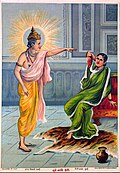
| image = | | caption = A 20th century painting by [[Nandalal Bose]], presumed to depict Kunti feeding the [[Pandavas]] | ||
| caption = | | gender = Female | ||
| devanagari = | |||
| other_names = Pritha | |||
| parents = [[Shurasena]] (father<br/>[[Characters in the Mahabharata#Marisha|Marisha]] (mother)<br>[[Kuntibhoja]] (adoptive father) | |||
| siblings = * [[Vasudeva]] and 13 others (siblings) | |||
* Purujit (adoptive brother) | |||
| spouse = [[Pandu]] | | spouse = [[Pandu]] | ||
| children = [[Karna]] | | children = '''Sons'''{{bulleted list|[[Karna]] by [[Surya]]<br>(pre-marital)|[[Yudhishthira]] by [[Yama (Hinduism)|Dharmaraja]]|[[Bhima]] by [[Vayu]]|[[Arjuna]] by [[Indra]]}} | ||
'''Step-sons'''{{bulleted list|[[Nakula]] and [[Sahadeva]]}} | |||
| affiliation = [[Panchakanya]] | |||
| dynasty = [[Yadava|Yaduvamsha]]-[[Lunar dynasty|Chandravamsha]] (by birth)<br/>[[Kuru dynasty|Kuruvamsha]]-[[Lunar dynasty|Chandravamsha]] (by marriage) | |||
| affiliation = | |||
| | |||
| | |||
| | |||
}} | }} | ||
'''Kunti''' ({{langx|sa|कुन्ती}}, {{IAST3|Kuntī}}), also known as '''Pritha''' ({{langx|sa|पृथा}}, {{IAST3|Pṛthā}}), is a prominent character in the ''[[Mahabharata]]'', an ancient [[Itihasa-Purana|Sanskrit epic poem]]. A princess of the [[Vrishni]] dynasty, she becomes the wife of [[Pandu]], king of the [[Kuru kingdom|Kuru Kingdom]], and is chiefly known as the mother of the five [[Pandava|Pandavas]]—having given birth to the three eldest, [[Yudhishthira]], [[Bhima]], and [[Arjuna]]—and raising their younger stepbrothers, [[Nakula]] and [[Sahadeva]], as her own. | |||
Kunti is one of the few female figures in the epic whose early life is described in detail. Born to [[Shurasena]], she is adopted by her childless uncle, [[Kuntibhoja]], and during her adolescence, she receives a divine mantra from the sage [[Durvasa]], which allows her to invoke any deity and bear a child by them. Out of curiosity, she uses the mantra to invoke the sun god [[Surya]], resulting in the concealed birth of her first son, [[Karna]]. Due to the societal stigma surrounding childbirth outside of marriage, she abandons Karna shortly after his birth. | |||
Kunti plays a significant role in the [[Kuru dynasty]]. After marrying Pandu, who is cursed to die instantly if he engages in intercourse, Kunti uses her boon to bear Yudhishthira, Bhima, and Arjuna by invoking the gods [[Yama|Dharma]], [[Vayu]], and [[Indra]], in accordance with Pandu’s request to have children through the practice of ''[[niyoga]].'' She later shares the boon with her co-wife, [[Madri]], who gives birth to Nakula and Sahadeva. Following Pandu’s death and Madri’s [[Sati (practice)|self-immolation]], Kunti assumes responsibility for all five children and raises them in [[Hastinapur|Hastinapura]], the capital of the Kuru Kingdom. A misunderstanding on Kunti’s part results in the polyandrous marriage of [[Draupadi]], the princess of [[Panchala]], to all five Pandava brothers. Kunti then serves as the queen-mother of [[Indraprastha]] until the Pandavas are exiled. Prior to the [[Kurukshetra War]], Kunti meets Karna, who had joined the opposing [[Kaurava]] side, and discloses his true parentage, urging him to join the Pandava side. Although Karna refuses to switch allegiance, he agrees to spare all of Kunti’s sons except Arjuna. Following the Pandavas’ victory, Kunti reveals Karna’s identity to them and later retires to the forest with other elders of the Kuru dynasty and eventually dies in a forest fire. | |||
Within Hindu tradition, Kunti is venerated as one of the [[panchakanya]] ("five maidens"), embodying ideals of female chastity. Her name is believed to possess purifying qualities, capable of dispelling sin when recited. Kunti is lauded as the epitome of dutiful womanhood, noted for her intelligence, beauty, foresight and political acumen. | |||
==Literary background== | |||
Kunti appears in the ''Mahabharata'', one of the [[Sanskrit]] epics originating from the [[Indian subcontinent]], which primarily narrates about conflict between two groups of cousins—the [[Pandavas]] and the [[Kaurava|Kauravas]]. Composed in [[Classical Sanskrit]], the text is a composite work shaped through centuries of revisions, editing, and interpolations. The text is primarily composed between 300 BCE - 300 CE, with the oldest portions of the extant text likely date to around 400 BCE.{{sfn|Brockington|1998|p=26}} Manuscripts of the ''Mahabharata'' exist in numerous versions, with substantial variations in the details of key characters and events. An exception is the section containing the ''[[Bhagavad Gita]]'', which remains notably consistent across different manuscripts.{{sfn|Minor|1982|p=1-11}} Significant differences exist between the Northern and Southern recensions, with the Southern versions generally being more elaborate and extended. Scholars have undertaken the creation of a [[critical edition]], primarily drawing from the "Bombay", "Poona", "Calcutta", and "South Indian" editions of the text. The most widely accepted version is that compiled by a team led by [[Vishnu Sitaram Sukthankar|Vishnu Sukthankar]] at the [[Bhandarkar Oriental Research Institute]], with copies preserved at [[Kyoto University]], [[Cambridge University]], and various institutions across India.{{sfn|McGrath|2004|p=9-26}} | |||
Quickly after her introduction in the ''[[Adi Parva]]''—the first of the eighteen books of the ''Mahabharata''—Kunti emerges as a foundational female figure whose narrative significance sets her apart from her contemporaries, playing a central role in shaping the future course of the epic. Early in the royal genealogies, as Bhishma arranges the marriages intended to restore the Kuru lineage, three women—[[Gandhari]], Kunti, and [[Madri]]—are brought into focus. Scholar [[Alf Hiltebeitel]] points out that it is Kunti who quickly becomes the "rising star" of the narrative skein that spans chapters 103 to 119. Kunti is uniquely privileged in this section of the text. While Gandhari and Madri are introduced more briefly, an entire ''adhyaya'' (chapter 104) is devoted to Kunti’s childhood—making her the only woman marrying into a central royal line in either the ''[[Mahabharata]]'' or the ''[[Ramayana]]'' whose girlhood is explored in such depth. Quantitative evidence from this narrative arc underscores Kunti’s prominence: between chapters 103.9 and 119.12, the text allocates 195 verses to Kunti, compared to 85 for Madri and just 36 for Gandhari.{{sfn|Hiltebeitel|2011|p=383}} According to [[James L. Fitzgerald]], Kunti's main scenes in the ''Mahabharata'' all involve her premarital son [[Karna]],{{sfn|Fitzgerald|1973|p=21}} and within the epic, which follows the [[story within a story]] style of narration, the account of Kunti's origin and Karna's birth has been narrated multiple times, with the most detailed one being found in the ''[[Vana Parva]]'' (3.287.1-3.292.1).{{sfn|McGrath|2004|p=2}} | |||
Pradeep Bhattacharya observes that Kunti’s pivotal decision in the later part of the ''Adi Parva''—having her sons share [[Draupadi]]—not only influences the trajectory of the plot but also marks a transition in the epic’s focus from Kunti to Draupadi as the central female figure in the following books. Kunti remains largely in the background following the ''Adi Parva'' until the ''[[Udyoga Parva]]'', the fifth book of the ''Mahabharata''. Here, she re-emerges during [[Krishna]]’s peace mission, having multiple dialogues while blessing Yudhishthira and pursuing Karna, who has aligned himself with the Kauravas, to join the Pandava side.<ref name=":2" /> In last part of the eleventh book, ''[[Stri Parva]]'', Kunti—who has remained the most reticent among the epic’s principal female figures after [[Kurukshetra war]]—finally speaks up to reveal Karna's true lineage to the Pandavas.{{sfn|Fitzgerald|1973|p=21}} She exits the main narrative in the ''[[Ashramavasika Parva]]'', the fifteenth book.{{sfn|McGrath|2004|p=9-26}} | |||
== Etymology == | |||
The feminine epithet ''Kuntī'' (Sanskrit: कुन्ती) is a [[patronymic]] derivative, which the character acquired through her adoption by Kunti-bhoja.{{sfn|Hiltebeitel|2011|p=388}} The epithet has its roots in the masculine noun ''[[Kunti kingdom|Kunti]]'' (कुन्ति), which originally referred to a group of people. This ethnonym appears in classical Sanskrit texts such as the ''Kathaka Samhita'', [[Pāṇini]]’s ''[[Aṣṭādhyāyī]]'' (4.1.176), and the ''Mahabharata''. The male variant of the epithet is also used to denote rulers or princes of this lineage.{{sfn|Monier-Williams|1999|p=291}} | |||
Kunti's original name is ''Pṛthā'' (Sanskrit: पृथा). According to scholar [[Alf Hiltebeitel]], this name means 'the Wide', evoking both the goddess ''[[Prithvi|Pṛthivī]]'' (lit. 'the Broad Earth') and the description of her as a girl with "wide eyes" in the ''Mahabharata'' (3.287.12), reinforcing a symbolic alignment with the vastness and nurturing aspect of the Earth.{{sfn|Hiltebeitel|2011|p=388}} [[Madeleine Biardeau]] observes that while other prominent women in the epic—such as [[Gandhari (Mahabharata)|Gandhari]] ('Woman of [[Gandhara|Gāndhāra]]') and [[Madri]] ('Woman of [[Madra]]')—derive their identities from specific geographic regions, Kunti’s name Pritha links her to the Earth as a whole, not to any one territory.{{sfn|Hiltebeitel|2011|p=384}} | |||
From a lexical standpoint, linguist [[Monier Monier-Williams|Monier-Williams]] derives ''Pṛthā'' from the root ''pṛtha'', related to ''pṛth'', and suggest that it can also mean “the flat or palm of the hand', attested in texts such as the ''[[Shatapatha Brahmana|Śatapatha Brāhmaṇa]]''.{{sfn|Monier-Williams|1999|p=645}} Building on this, sociologist [[Irawati Karve]] interpreted the name to suggest a physical characteristic, writing that it "shows that she was apparently a large big-boned girl". However, Lavanya Vemsani contests Karve’s interpretation, arguing that there is neither linguistic nor textual justification for linking the meaning "palm" to Kunti’s body type. Vemsani emphasizes that the ''Mahabharata'' explicitly describes Kunti as a woman of stunning beauty, and instead interprets the palm symbolism as reflecting her supportive hand and steadfast nature, aligning it with broader themes of motherhood and nurturing stability.{{sfn|Vemsani|2021|p=46}} | |||
==Biography== | |||
===Early life=== | |||
Kunti, originally named Pritha, is born into the lineage of the [[Yadavas|Yadava clan]]. She is the eldest child of [[Shurasena]], a chief among the Yadavas and the father of several other children, most notably [[Vasudeva]], the father of [[Krishna]].{{sfn|Hiltebeitel|2011|p=388}}{{sfn|Bhattacharya|1971|p=21}}{{Refn|Kunti’s family is further detailed in the ''[[Bhagavata Purana]]'', a later text focusing primarily on the life of Krishna. According to this account, her mother is identified as Marisha, a princess of the [[Bhoja]] lineage. The text also states that Pritha has ten brothers and four sisters.<ref>{{Cite book |last=Tripathi |first=Kishori Sharan |url=https://books.google.com/books?id=g7Y2AAAAIAAJ&q=kunti+marisa |title=A Cultural Study of the Śrīmad-Bhāgavata |date=1969 |publisher=Banaras Hindu Univ. |language=en}}</ref>|group=note}} Shurasena had promised to give his eldest child to his childless cousin and close friend, [[Kuntibhoja]], who was the son of Shurasena’s paternal aunt. As a result, Pritha is given in adoption by Shurasena to Kuntibhoja.{{sfn|Hiltebeitel|2011|p=388}}{{Refn|While Kuntibhoja is initially introduced as childless, it is later revealed that he has sons—most notably his successor, Purujit—who participates in the [[Kurukshetra war]] on the side of the [[Pandavas]].{{sfn|Mani|1975|p=444}}|group=note}} Following the adoption, Pritha becomes known as Kunti and is raised in the royal household of Kuntibhoja, where she is trained in royal duties and received instruction in various disciplines, without a maternal presence. Later in life, Kunti reveals that she resents this act of adoption, recalling that she was merely playing with a ball when her father transferred her like wealth, and she felt humiliated by this decision of her family.{{sfn|Hiltebeitel|2011|p=388}}{{sfn|Bhattacharya|1971|p=21}} | |||
During her adolescence, Kuntibhoja entrusts her to the care of the powerful and temperamental sage [[Durvasa]], who arrives at the court seeking hospitality under strict conditions. Kuntibhoja, confident in his daughter's humility and devotion, promises that she will serve him faithfully. Aware of the potential consequences of offending such a volatile figure, Kuntibhoja sternly warns Kunti that any lapse in service could bring dishonour upon both his dynasty and her birth family. Despite the pressure, Kunti submits to her duties with remarkable discipline, attending to the sage with devotion, enduring his sharp speech and frequent criticisms without complaint. Over the course of a year, Kunti’s service gradually earns the satisfaction of the sage. Eventually, Durvasa offers her a boon. Though she initially expresses contentment in having pleased both him and her father, she ultimately accepts his insistence on granting her a ''[[mantra]]'' (incantation). The mantra enables her to summon any deity, who is then bound to appear and obey her command, whether willingly or not. Compelled by fear of his curse, she receives the spell. Following this, Durvasa departs, leaving Kuntibhoja astonished and deeply gratified by his daughter’s endurance and virtue.{{sfn|Bhattacharya|1971|p=21}}{{sfn|Buitenen|1975|p=784-791}} | |||
===Birth of Karna=== | |||
[[File:Sury_gives_boon_to_Kunti.jpg|alt=|left|303x303px|thumb|Kunti invokes Surya out of curiosity.]] | |||
Driven by a mixture of curiosity and youthful impulsiveness, she decides to test the ''mantra'' shortly after her first menstruation. Observing the radiant form of the sun at dawn, she invokes [[Surya]], the sun god. Surya appears, assuring Kunti that refusal is impossible, as a summoned deity must not return unsatisfied. Though she pleads with him to depart, declaring herself still an unmarried girl, Surya insists. He attempts to allay her fears by promising that her virginity will remain intact and that their son will be born with divine qualities. | |||
Compelled by divine persuasion and desire for Surya, Kunti consents under the condition that her son resembles his celestial father. Thus, Kunti becomes pregnant, which she hides from everyone. When the son is born, Surya's promise is fulfilled: [[Karna]] is born with golden armor and earrings, divine gifts signifying his celestial origin. Despite the miracle, Kunti, terrified of social shame and her family's disapproval, places the newborn in a basket and sets him adrift on the Ashvanadi river, lamenting the fate of the child and the unknown woman who would raise him. | |||
Karna is discovered and adopted by a charioteer [[Adhiratha]] and his wife [[Radha]], while Kunti returns to the palace, burdened with grief and secrecy. She remains a [[Panchakanya|kanya]]—a virgin girl—both in body and status, as Surya’s divine power leaves her visibly untouched, preserving her social reputation. | |||
== Marriage and children == | === Marriage and children === | ||
[[File:Raja Pandu and Matakunti LACMA M.69.13.6.jpg|thumb|A late 17th-century painting of Pandu and Kunti from [[Kashmir]]]] | |||
Kuntibhoja organised Kunti's [[swayamvara]]. Kunti chose King [[Pandu]] of [[Hastinapur]], making her the Queen of Hastinapur.<ref name=":2" /><ref name="mahab1">{{Cite web|title=The Mahabharata, Book 1: Adi Parva: Sambhava Parva: Section CXII|url=https://www.sacred-texts.com/hin/m01/m01113.htm|access-date=2020-08-31|website=www.sacred-texts.com}}</ref> Soon after, during his mission to expand his empire, Pandu, on Bhishma's proposal, married [[Madri]], a princess of [[Madra]] in order to secure the vassalage of [[Madra Kingdom|Madra]].<ref name=":2"/> Kunti was disturbed by her husband's actions, but eventually reconciled with him and treated Madri as a sister. | |||
Pandu, while hunting in a forest, mistakenly shot and killed Rishi Kindama and his wife as they had taken the form of [[deer]] to mate. The dying sage then cursed him to die if he tries to embrace or touch his wives. Pandu renounced the kingdom and went into exile with Kunti and Madri.<ref>{{cite book|last=Ramankutty|first=P.V.|title=Curse as a motif in the Mahābhārata|year=1999|publisher=Nag Publishers|location=Delhi|isbn=9788170814320|edition=1.}}</ref> | |||
Pandu could not sire children with his wives due to the curse by sage [[Kindama]]. A remorseful Pandu met some sages and asked them a way for heaven and salvation. They said, without children, one can never aspire for heaven. When Pandu expressed to Kunti his despair at the prospect of dying childless, she mentioned the boon granted to her. He happily advised her to beget children by suitable, illustrious men. Thus, Kunti used the boon granted to her by Sage [[Durvasa]] to bear three sons—[[Yudhishthira]] by [[Yama (Hinduism)|Dharmaraja]] – [[deva (Hinduism)|god]] of Justice; [[Bhima]] by [[Vayu]] – god of [[wind]], and [[Arjuna]] by [[Indra]] – the king of [[Svarga]] (Heaven). She also invoked [[Ashvins]] for Madri on her behest and Madri gave birth to twin sons, [[Nakula]] and [[Sahadeva]].<ref>{{cite journal|jstor=592191|title=Indra in the Rig-Veda |publisher=Journal of the American Oriental Society vol. 11.1885 |page=121 |last1=Perry |first1=Edward Delavan |journal=Journal of the American Oriental Society |year=1885 |volume=11 |doi=10.2307/592191 }}</ref><ref>{{Cite journal |last=Bhattacharya |first=Pratip |date=2004 |title=''She Who Must Be Obeyed'', Draupadi: The ill fated one |url=http://www.manushi-india.org/pdfs_issues/PDF%20144/Panchkanya%2019-30.pdf |volume=Panchakanya 19–30 |journal=[[Manushi]]}}</ref> | |||
'' | Kunti gave special care to Madreyas (sons of Madri) especially Sahadeva, the youngest one. Madri gave tribute to Kunti by saying | ||
''"You are blessed.'' | |||
''There is none like you'' | ''There is none like you'' | ||
''you are my light,'' | ''you are my light,'' | ||
''my guide'', | ''my guide'', | ||
''most respect-worthy'', | ''most respect-worthy'', | ||
''reater in status,'' | |||
''purer in virtue. | ''purer in virtue."'' | ||
'' | ''<ref name=":2"/>'' | ||
==Widowhood== | ===Widowhood=== | ||
One day, Pandu, forgetting his curse, attempted to embrace his wife Madri. But, as a result of Kindama's curse, he died. Madri committed suicide out of remorse that caused her husband's death. Kunti was left helpless in the forest with her children.<ref>{{Cite web|date=2017-08-31|title=Chapter 60-Death of King Pandu and Madri at the same time|url=https://anamikaghose.wordpress.com/death-of-king-pandu-and-madri-at-the-same-time/|access-date=2020-08-31|website=The Tales of India|language=en}}</ref> | |||
One day, Pandu, forgetting his curse, attempted to | |||
After the death of Pandu and Madri, Kunti took care of all five Pandava children taking them back to Hastinapur. Dhritrashtra's sons never liked them. During their childhood, [[Duryodhana]] poisoned and tried to kill Bhima but he was saved. Kunti was hurt by this but was consoled by [[Vidura]]. Later the Kuru | After the death of Pandu and Madri, Kunti took care of all five Pandava children taking them back to Hastinapur. Dhritrashtra's sons never liked them. During their childhood, [[Duryodhana]] poisoned and tried to kill Bhima but he was saved. Kunti was hurt by this but was consoled by [[Vidura]]. Later the Kuru princes were sent to train under [[Drona]].<ref>https://web.archive.org/web/20110713024835/http://www.india-intro.com/religion/mahabharat/210-mahabharat-the-story-of-drona-teacher-of-kauravas-and-pandavas.html The Story of Drona – the Teacher of Kauravas and Pandavas</ref> | ||
==Hiding== | ===Hiding=== | ||
[[File: Pandavs Journeying With Their Mother.jpg|thumb|180px|Pandavas travelling with their mother | [[File: Pandavs Journeying With Their Mother.jpg|thumb|180px|The Pandavas travelling with their mother]] | ||
After surviving from the Lakshagriha Kunti and five Pandavas lived in [[Ekachakra|Ekachakra village]].<ref>{{Cite | After the princes finished their training, they returned to Hastinapura. After some time [[Duryodhana]] and his maternal uncle [[Shakuni]] tried to burn Pandavas alive along with Kunti for which they built the palace out of lac ([[Lakshagriha]]) in a village named Varanāvata. The Pandavas, though, managed to escape the house of lac with the help of [[Vidura]] through a secret tunnel.<ref>{{Cite web|date=2019-08-07|title=Lakshagraha of Mahabharat|url=http://www.nerdstravel.com/lakshagraha-of-mahabharat/|access-date=2020-08-31|website=Nerd's Travel|language=en-US|archive-date=22 March 2023|archive-url=https://web.archive.org/web/20230322214842/https://www.nerdstravel.com/lakshagraha-of-mahabharat/|url-status=dead}}</ref> | ||
After surviving from the Lakshagriha Kunti and five Pandavas lived in [[Ekachakra|Ekachakra village]].<ref>{{Cite magazine|date=November 2, 2017 |title=ASI grants permission to excavate palace Kauravas commissioned to kill Pandavas|url=https://www.indiatoday.in/fyi/story/asi-house-of-lac-lakshagriha-mahabharata-kauravas-pandavas-yudhishthira-bhima-duryodhana-1077215-2017-11-02|access-date=2020-08-08|magazine=India Today|language=en}}</ref> During their stay, Kunti and the Pandavas become aware of a demon, [[Bakasura]], who ate people. Villagers had to send one member of their family and food to Bakasura, who devour both. When Kunti heard the cries of a Brahmin – who had provided her and her son's shelter in Ekachakra, Kunti consoled him and suggested that instead of a Brahmin's family, her son Bhima would face the demon. Kunti engineered a plot where Bhima would be able to face and kill the demon. The powerful Bhima brought his might to the fore and defeated Bakasura.<ref>{{cite book|title=India through the ages|url=https://archive.org/details/indiathroughages00mada|last=Gopal|first=Madan|year= 1990| page= [https://archive.org/details/indiathroughages00mada/page/75 75]|editor=K.S. Gautam|publisher=Publication Division, Ministry of Information and Broadcasting, Government of India}}</ref> | |||
{{Multiple image | {{Multiple image | ||
| image1 = | | image1 = | ||
| width1 = 135px | | width1 = 135px | ||
| caption1 = Kunti accepting Hidimbi's request | | caption1 = Kunti accepting Hidimbi's request | ||
| image2 = | | image2 = | ||
| caption2 = Kunti apologises in front of Draupadi and Yudhishthira. | | caption2 = Kunti apologises in front of Draupadi and Yudhishthira. | ||
| width2 = 150px | | width2 = 150px | ||
| Line 79: | Line 100: | ||
| alt1 = | | alt1 = | ||
}} | }} | ||
Later, Bhima slays the [[rakshasa]] [[Hidimba]] and he is beseeched by [[Hidimbi]], Hidimba's sister, to wed her. Bhima is reluctant, but Kunti ordered Bhima to marry Hidimbi seeing merit in the woman. Hidimbi would go on to birth [[Ghatotkacha]], who later takes part in the [[Kurukshetra War]]. | Later, Bhima slays the [[rakshasa]] [[Hidimba]] and he is beseeched by [[Hidimbi]], Hidimba's sister, to wed her. Bhima is reluctant, but Kunti ordered Bhima to marry Hidimbi seeing merit in the woman. Hidimbi would go on to birth [[Ghatotkacha]], who later takes part in the [[Kurukshetra War]].{{Cn|date=September 2022}} | ||
The Pandavas attended the [[swayamvara]] of [[Draupadi]] in [[Panchala]]. [[Arjuna]] was able to win [[Draupadi]]'s hand. The Pandavas returned to their hut and said that they have bought alms (signifying [[Kanyadan]]). Kunti misunderstood them and asked the Pandavas to share whatever they had brought. Kunti was shocked after realizing the implications of her words, that is, all of the [[Pandavas]] married [[Draupadi]] thinking that they are obeying their mother's orders. Therefore she scolded her children for treating a woman like alms. However, Draupadi accepted this as her fate.<ref name="johnson-arjuna">{{cite encyclopedia|last=Johnson|first=W. J. |article=Arjuna |title=A Dictionary of Hinduism|publisher=Oxford University Press|year=2009|doi=10.1093/acref/9780198610250.001.0001|isbn=978-0-19861-025-0}}</ref> | The Pandavas attended the [[swayamvara]] of [[Draupadi]] in [[Panchala]]. [[Arjuna]] was able to win [[Draupadi]]'s hand. The Pandavas returned to their hut and said that they have bought alms (signifying [[Kanyadan]]). Kunti misunderstood them and asked the Pandavas to share whatever they had brought. Kunti was shocked after realizing the implications of her words, that is, all of the [[Pandavas]] married [[Draupadi]] thinking that they are obeying their mother's orders. Therefore, she scolded her children for treating a woman like alms. However, Draupadi accepted this as her fate.<ref name="johnson-arjuna">{{cite encyclopedia|last=Johnson|first=W. J. |article=Arjuna |title=A Dictionary of Hinduism|publisher=Oxford University Press|year=2009|doi=10.1093/acref/9780198610250.001.0001|isbn=978-0-19861-025-0}}</ref> | ||
==Role in the events of Hastinapura== | ===Role in the events of Hastinapura=== | ||
When Kunti, along with the Pandavas | When Kunti, along with the Pandavas and Draupadi, returned to Hastinapura, they faced many problems including succession dispute between Yudhishthira and Duryodhana. On the advice of [[Bhishma]], Pandavas were given a barren land to rule which was developed into [[Indraprastha]].<ref>{{Cite book|last1=Narlikar|first1=Amrita|url=https://books.google.com/books?id=uMn6AgAAQBAJ&pg=PA225|title=Bargaining with a Rising India: Lessons from the Mahabharata|last2=Narlikar|first2=Aruna|date=2014-03-20|publisher=OUP Oxford|isbn=978-0-19-161205-3|language=en}}</ref> | ||
When the Pandavas lose the kingdom in a dice game and are forced to go into exile for thirteen years, Kunti is forced by King Dhritarashtra to remain in the capital. She chose to stay in [[Vidura]]'s house rather than the royal palace.<ref>{{Cite book|last=Mani|first=Vettam|url=https://books.google.com/books?id=mvXsDwAAQBAJ&q=kunti+vidura%27s+palace&pg=PA443|title=Puranic Encyclopedia: A Comprehensive Work with Special Reference to the Epic and Puranic Literature|date=2015-01-01|publisher=Motilal Banarsidass|isbn=978-81-208-0597-2|language=en}}</ref> | When the Pandavas lose the kingdom in a dice game and are forced to go into exile for thirteen years, Kunti is forced by King Dhritarashtra to remain in the capital. She chose to stay in [[Vidura]]'s house rather than the royal palace.<ref>{{Cite book|last=Mani|first=Vettam|url=https://books.google.com/books?id=mvXsDwAAQBAJ&q=kunti+vidura%27s+palace&pg=PA443|title=Puranic Encyclopedia: A Comprehensive Work with Special Reference to the Epic and Puranic Literature|date=2015-01-01|publisher=Motilal Banarsidass|isbn=978-81-208-0597-2|language=en}}</ref> | ||
== | ===Reconciliation with Karna=== | ||
As war approached, Kunti met [[Karna]] and in desperation to keep her all children alive, asked Karna to leave the side of [[Duryodhana]] and join the Pandavas. Karna denied the offer, as he could not betray his friend. However, he promised Kunti that he would not kill any of his brothers except Arjuna, thus following both Mitra dharma and Putra dharma. He also promised that at the end of the war she would still have five sons, the fifth one be either Arjuna or Karna himself.{{sfn|McGrath|2004}}{{pn|date=May 2025}} | |||
Despite supporting her children, Kunti stayed in the [[Kaurava]] camp along with her sister-in-law [[Gandhari (character)|Gandhari]]. After the death of Karna, Kunti disclosed the secret of Karna's birth to the Pandavas. A grief-stricken Yudhisthira would curse the women of the world that they shall be unable to keep any secret anymore.<ref>{{cite web | url=https://sacred-texts.com/hin/m12/m12a006.htm | title=The Mahabharata, Book 12: Santi Parva: Rajadharmanusasana Parva: Section VI }}</ref> | |||
===Later life and death=== | |||
After the [[Kurukshetra war]], Kunti lived with her sons for many years. After she felt that her job in the world was over, she moved to a forest near the Himalayas with her brothers-in-law [[Vidura]] and [[Dhritarashtra]], [[Sanjaya]] and Dhritarashtra's wife [[Gandhari (character)|Gandhari]]. Vidura died two years after they left. Later Sanjaya left for the Himalayas and those remaining perished in a forest fire.<ref name=":2">{{Cite web|last=Bhattacharya|first=Pradip|url=http://www.manushi-india.org/pdfs_issues/PDF%20143/05%20Panchkanya%2025-33%20%202-9.pdf|title="One-in Herself" Why Kunti Remains a Kanya|access-date=10 January 2013|publisher=Manushi India Organization}}</ref><ref>Mani pp.442–3</ref> | |||
== Assessment == | |||
According to [[J. A. B. van Buitenen]], translator of the Critical Edition, Kunti is depicted largely self-effacing, conforming to her role as wife and mother, though she asserts herself at key moments.{{sfn|Buitenen|1973|p=16}} | |||
Pradip Bhattacharya, a scholar of the ''Mahabharata'' and author of ''Panchakanya: "One-in Herself" Why Kunti Remains a Kanya'', highlights her as a symbol of strong womanhood, noting her resolve, adaptability, and the critical role she played in her sons’ lives. Kunti’s agency is first demonstrated in her selection of [[Pandu]] at her [[svayamvara]] and her subsequent loyalty in following him into exile, despite his marriage to [[Madri]]. When Pandu requests that Kunti conceive sons through other men, she initially resists, revealing her personal integrity and resolve. She ultimately agrees, however, the choice of divine progenitors is not hers; it rests with Pandu, underlining the limitations of her autonomy within her marriage. Bhattacharya emphasizes her strength and strategic wisdom in managing this role, as she conceals her pre-marital son, [[Karna]], to safeguard Pandu’s honor and to preserve her reputation within the royal household. This contrasts her with her grandmother-in-law, [[Satyavati]], who called upon her pre-marital son [[Vyasa]] to extend the royal line of Hastinapura without hesitation. Her refusal to bear a fourth child, invoking scripture as justification, showcases her deep understanding of [[dharma]], which she uses both to assert her autonomy and to protect her dignity.<ref name=":2" /> | |||
Within the complex social structure of the Hastinapura court, Kunti carefully navigates adversities, often relying on her confidant [[Vidura]]. Bhattacharya highlights her strategic acumen in orchestrating [[Draupadi|Draupadi’s]] marriage to all five Pandavas, ensuring unity among her sons and forestalling potential conflicts. This decision, based on customs of the “northern Kurus,” is portrayed as a calculated move that consolidates family loyalty by centering it around a single wife, underscoring Kunti’s commitment to her sons’ shared purpose. Her pragmatism as a mother is further reflected in her morally complex actions to protect her family’s welfare, as seen in her plea to Karna before the war, where she secures his promise to spare all the Pandavas except Arjuna. Though Karna rejects her, Kunti’s determination to shield her sons from harm exemplifies her selfless devotion and emotional resilience.<ref name=":2" /> | |||
Kunti’s final retreat to the forest with [[Dhritarashtra]] and [[Gandhari (Mahabharata)|Gandhari]], after her sons’ victory, symbolises a profound act of renunciation. Bhattacharya interprets this as Kunti’s transcendence beyond worldly attachments and family ties, an act that affirms her as a “[[Panchakanya|kanya]]” or “one-in-herself”—a woman who has achieved independence of spirit and self-possession. Through this retreat, Kunti’s life comes full circle, as she embodies the archetype of the empowered single mother who navigates the vicissitudes of life with resilience and fortitude.<ref name=":2" /> | |||
== | == Notes == | ||
{{Reflist|group=note}} | |||
==References== | ==References== | ||
{{Reflist}} | {{Reflist}} | ||
===Bibliography=== | |||
* {{Cite book |last=Buitenen |first=Johannes Adrianus Bernardus |url=https://books.google.com/books?id=i8oe5fY5_3UC&q=van+buiten+book+of+beginnings |title=The Mahābhārata: The Book Of Beginning |date=1973 |publisher=University of Chicago Press |isbn=978-0-226-84663-7 |language=en}} | |||
* {{Cite book |last=Buitenen |first=J. A. B. van |url=https://books.google.com/books?id=ieYvzgEACAAJ |title=The Mahabharata, Volume 2: Book 2: The Book of Assembly; Book 3: The Book of the Forest |date=1975 |publisher=University of Chicago Press |isbn=978-0-226-84649-1 |language=en}} | |||
* {{Cite book |url=https://books.google.com/books?id=p9SzCuLIlQ0C&q=book+of+women+mahabharata |title=The Mahabharata, Volume 7: Book 11: The Book of the Women Book 12: The Book of Peace, Part 1 |last=Fitzgerald |first=James L. |date=1973 |publisher=University of Chicago Press |isbn=978-0-226-25250-6 |language=en}} | |||
* {{Cite journal |last=Bhattacharya |first=Pradip |title="One-in Herself" Why Kunti Remains a Kanya |url=http://www.manushi-india.org/pdfs_issues/PDF%20143/05%20Panchkanya%2025-33%20%202-9.pdf |date=2004 |journal=Manushi India Organization}} | |||
* {{Cite journal |last=Bhattacharya |first=Pradip |date=1971 |title="Of Kunti and Satyawati." Five Holy Virgins, Five Sacred Myths |url=http://www.manushi-india.org/pdfs_issues/PDF%20142/04%20panchakanya%20pg%2021-25.pdf |journal=Manushi |pages=25}} | |||
* {{Cite book |last=Mani|first=Vettam |url=https://archive.org/details/puranicencyclopa00maniuoft/page/564/mode/2up |title=Puranic encyclopaedia : a comprehensive dictionary with special reference to the epic and Puranic literature |date=1975 |publisher=Delhi : Motilal Banarsidass |others=Robarts - University of Toronto |isbn=978-0-8426-0822-0}} | |||
* {{Cite book |last=Brodbeck |first=Simon Pearse |url=https://books.google.com/books?id=wapBDgAAQBAJ&dq=M%C4%81dr%C4%AB&pg=PT163 |title=The Mahabharata Patriline: Gender, Culture, and the Royal Hereditary |date=2017-03-02 |publisher=Routledge |isbn=978-1-351-88630-7 |language=en}} | |||
* {{Cite book |last1=Brodbeck |first1=Simon |url=https://books.google.com/books?id=YLB8AgAAQBAJ&dq=kunti+siddhi&pg=PT376 |title=Gender and Narrative in the Mahabharata |last2=Black |first2=Brian |year=2007|publisher=Routledge |isbn=978-1-134-11994-3 |language=en}} | |||
* {{Cite book |last=Karve |first=Irawati |url=https://books.google.com/books?id=uJz4ZWsRcsAC&q=yugantar |title=Yuganta: The End of an Epoch |date=July 2006 |publisher=Orient Longman |isbn=978-81-250-1424-9 |language=en}} | |||
* {{Cite book |last=Hiltebeitel |first=Alf |url=https://books.google.com/books?id=ZUaeAgAAQBAJ&pg=PA3 |title=Dharma: Its Early History in Law, Religion, and Narrative |date=2011-07-28 |publisher=Oxford University Press |isbn=978-0-19-987524-5 |language=en}} | |||
* {{Cite book |last=Vemsani |first=Lavanya |url=https://books.google.com/books?id=56QvEAAAQBAJ&pg=PA1 |title=Feminine Journeys of the Mahabharata: Hindu Women in History, Text, and Practice |date=2021-05-21 |publisher=Springer Nature |isbn=978-3-030-73165-6 |language=en}} | |||
* {{cite book|last=Brockington |first=J. L. |year=1998 |url=https://books.google.com/books?id=HR-_LK5kl18C&pg=PA26 |title=The Sanskrit Epics |publisher=Brill Academic |isbn=978-9-00410-260-6 |page=26}} | |||
* {{cite book|first= Robert N.|last= Minor|title= Bhagavad Gita: An Exegetical Commentary|url= https://books.google.com/books?id=ru_RjwEACAAJ|year= 1982|publisher= South Asia Books|isbn= 978-0-8364-0862-1|pages= l–li|access-date= 28 June 2020|archive-date= 16 April 2023|archive-url= https://web.archive.org/web/20230416075912/https://books.google.com/books?id=ru_RjwEACAAJ|url-status= live}} | |||
* {{Cite book |last=Doniger |first=Wendy |url=https://books.google.com/books?id=iM_QAgAAQBAJ&q=wendy+doniger+madri |title=On Hinduism |date=March 2014 |publisher=OUP USA |isbn=978-0-19-936007-9 |language=en}} | |||
* {{cite book |last=McGrath |first=Kevin |year=2004 |title=The Sanskrit Hero: Karna in Epic Mahabharata |publisher=Brill Academic |url=https://books.google.com/books?id=YkmXk3-1j7UC&pg=PA19 |pages=19–26 |isbn=978-9-00413-729-5 |access-date=28 June 2020 |archive-date=16 April 2023 |archive-url=https://web.archive.org/web/20230416075934/https://books.google.com/books?id=YkmXk3-1j7UC&pg=PA19 |url-status=live }} | |||
* {{Cite book |last=Pattanaik |first=Devdutt |url=https://books.google.com/books?id=gzN2_fu0mIYC&q=jaya+an+illustrated+retelling+of+the+mahabharata |title=Jaya: An Illustrated Retelling of the Mahabharata |date=2010 |publisher=Penguin Books India |isbn=978-0-14-310425-4 |language=en}} | |||
* {{Cite book |last=Walker |first=Benjamin |url=https://books.google.com/books?id=6zj3DwAAQBAJ&dq=madri+dark&pg=PA202 |title=Hindu World: An Encyclopedic Survey of Hinduism. In Two Volumes. Volume I A-L |date=2019-04-09 |publisher=Routledge |isbn=978-0-429-62465-0 |language=en}} | |||
* {{Cite book |last=Ghosh |first=Baisakhi |url=https://www.academia.edu/download/107078603/JDH-004-2016-FP.pdf |title="Women of Mahabharata in play of power and politics: Sublimation from deprivation to empowerment."|date=2016 |publisher=Journal of Innovative Research and Solutions (JIRAS) 2.2 ()|isbn= |language=en}} | |||
* {{Cite book |last=Monier-Williams |first=Sir Monier |url=https://books.google.com/books?id=dLUKaou4KcMC&q=kunti&pg=PA862 |title=A Sanskrit-English Dictionary: Etymological and Philologically Arranged with Special Reference to Cognate Indo-European Languages |date=1999 |publisher=Asian Educational Services |isbn=978-81-206-0369-1 |language=en}} | |||
* {{Cite book |last1=Chakrabarti |first1=Arindam |url=https://books.google.com/books?id=HuffCgAAQBAJ&q=mahabharata+now+narration+aesthetics+ethics |title=Mahabharata Now: Narration, Aesthetics, Ethics |last2=Bandyopadhyay |first2=Sibaji |year=2017|publisher=Routledge |isbn=978-1-317-34213-7 |language=en}} | |||
* {{Cite book |last=Dikshitar |first=V R Ramachandra |url=https://archive.org/details/in.ernet.dli.2015.142283/page/n696/mode/1up?q= |title=The Purana Index (from T To M) Vol-II |date=1952}} | |||
* {{Cite book|last=Sharma|first=Arvind|url=https://books.google.com/books?id=KnCxH85Vra4C&q=duryodhana+wife&pg=PA298|title=Essays on the Mahābhārata|date=2007|publisher=Motilal Banarsidass Publishers|isbn=978-81-208-2738-7|language=en}} | |||
==External links== | ==External links== | ||
| Line 133: | Line 166: | ||
[[Category: People related to Krishna]] | [[Category: People related to Krishna]] | ||
[[Category: Characters in the Mahabharata]] | [[Category: Characters in the Mahabharata]] | ||
[[Category: | [[Category:Queens in Hindu mythology]] | ||
[[Category: Ancient Indian women]] | [[Category: Ancient Indian women]] | ||
[[Category: Characters in the Bhagavata Purana]] | [[Category: Characters in the Bhagavata Purana]] | ||
[[Category:Women in Hindu mythology]] | |||
[[Category:Princesses in Hindu mythology]] | |||
Latest revision as of 19:18, 26 December 2025
| Kunti | |
|---|---|
| Member of Panchakanya | |
 A 20th century painting by Nandalal Bose, presumed to depict Kunti feeding the Pandavas | |
| Other names | Pritha |
| Affiliation | Panchakanya |
| Gender | Female |
| Personal information | |
| Parents | Shurasena (father Marisha (mother) Kuntibhoja (adoptive father) |
| Siblings |
|
| Spouse | Pandu |
| Children | Sons
|
| Dynasty | Yaduvamsha-Chandravamsha (by birth) Kuruvamsha-Chandravamsha (by marriage) |
Kunti (Sanskrit: कुन्ती, IAST: Kuntī), also known as Pritha (Sanskrit: पृथा, IAST: Pṛthā), is a prominent character in the Mahabharata, an ancient Sanskrit epic poem. A princess of the Vrishni dynasty, she becomes the wife of Pandu, king of the Kuru Kingdom, and is chiefly known as the mother of the five Pandavas—having given birth to the three eldest, Yudhishthira, Bhima, and Arjuna—and raising their younger stepbrothers, Nakula and Sahadeva, as her own.
Kunti is one of the few female figures in the epic whose early life is described in detail. Born to Shurasena, she is adopted by her childless uncle, Kuntibhoja, and during her adolescence, she receives a divine mantra from the sage Durvasa, which allows her to invoke any deity and bear a child by them. Out of curiosity, she uses the mantra to invoke the sun god Surya, resulting in the concealed birth of her first son, Karna. Due to the societal stigma surrounding childbirth outside of marriage, she abandons Karna shortly after his birth.
Kunti plays a significant role in the Kuru dynasty. After marrying Pandu, who is cursed to die instantly if he engages in intercourse, Kunti uses her boon to bear Yudhishthira, Bhima, and Arjuna by invoking the gods Dharma, Vayu, and Indra, in accordance with Pandu’s request to have children through the practice of niyoga. She later shares the boon with her co-wife, Madri, who gives birth to Nakula and Sahadeva. Following Pandu’s death and Madri’s self-immolation, Kunti assumes responsibility for all five children and raises them in Hastinapura, the capital of the Kuru Kingdom. A misunderstanding on Kunti’s part results in the polyandrous marriage of Draupadi, the princess of Panchala, to all five Pandava brothers. Kunti then serves as the queen-mother of Indraprastha until the Pandavas are exiled. Prior to the Kurukshetra War, Kunti meets Karna, who had joined the opposing Kaurava side, and discloses his true parentage, urging him to join the Pandava side. Although Karna refuses to switch allegiance, he agrees to spare all of Kunti’s sons except Arjuna. Following the Pandavas’ victory, Kunti reveals Karna’s identity to them and later retires to the forest with other elders of the Kuru dynasty and eventually dies in a forest fire.
Within Hindu tradition, Kunti is venerated as one of the panchakanya ("five maidens"), embodying ideals of female chastity. Her name is believed to possess purifying qualities, capable of dispelling sin when recited. Kunti is lauded as the epitome of dutiful womanhood, noted for her intelligence, beauty, foresight and political acumen.
Literary background[edit | edit source]
Kunti appears in the Mahabharata, one of the Sanskrit epics originating from the Indian subcontinent, which primarily narrates about conflict between two groups of cousins—the Pandavas and the Kauravas. Composed in Classical Sanskrit, the text is a composite work shaped through centuries of revisions, editing, and interpolations. The text is primarily composed between 300 BCE - 300 CE, with the oldest portions of the extant text likely date to around 400 BCE.[1] Manuscripts of the Mahabharata exist in numerous versions, with substantial variations in the details of key characters and events. An exception is the section containing the Bhagavad Gita, which remains notably consistent across different manuscripts.[2] Significant differences exist between the Northern and Southern recensions, with the Southern versions generally being more elaborate and extended. Scholars have undertaken the creation of a critical edition, primarily drawing from the "Bombay", "Poona", "Calcutta", and "South Indian" editions of the text. The most widely accepted version is that compiled by a team led by Vishnu Sukthankar at the Bhandarkar Oriental Research Institute, with copies preserved at Kyoto University, Cambridge University, and various institutions across India.[3]
Quickly after her introduction in the Adi Parva—the first of the eighteen books of the Mahabharata—Kunti emerges as a foundational female figure whose narrative significance sets her apart from her contemporaries, playing a central role in shaping the future course of the epic. Early in the royal genealogies, as Bhishma arranges the marriages intended to restore the Kuru lineage, three women—Gandhari, Kunti, and Madri—are brought into focus. Scholar Alf Hiltebeitel points out that it is Kunti who quickly becomes the "rising star" of the narrative skein that spans chapters 103 to 119. Kunti is uniquely privileged in this section of the text. While Gandhari and Madri are introduced more briefly, an entire adhyaya (chapter 104) is devoted to Kunti’s childhood—making her the only woman marrying into a central royal line in either the Mahabharata or the Ramayana whose girlhood is explored in such depth. Quantitative evidence from this narrative arc underscores Kunti’s prominence: between chapters 103.9 and 119.12, the text allocates 195 verses to Kunti, compared to 85 for Madri and just 36 for Gandhari.[4] According to James L. Fitzgerald, Kunti's main scenes in the Mahabharata all involve her premarital son Karna,[5] and within the epic, which follows the story within a story style of narration, the account of Kunti's origin and Karna's birth has been narrated multiple times, with the most detailed one being found in the Vana Parva (3.287.1-3.292.1).[6]
Pradeep Bhattacharya observes that Kunti’s pivotal decision in the later part of the Adi Parva—having her sons share Draupadi—not only influences the trajectory of the plot but also marks a transition in the epic’s focus from Kunti to Draupadi as the central female figure in the following books. Kunti remains largely in the background following the Adi Parva until the Udyoga Parva, the fifth book of the Mahabharata. Here, she re-emerges during Krishna’s peace mission, having multiple dialogues while blessing Yudhishthira and pursuing Karna, who has aligned himself with the Kauravas, to join the Pandava side.[7] In last part of the eleventh book, Stri Parva, Kunti—who has remained the most reticent among the epic’s principal female figures after Kurukshetra war—finally speaks up to reveal Karna's true lineage to the Pandavas.[5] She exits the main narrative in the Ashramavasika Parva, the fifteenth book.[3]
Etymology[edit | edit source]
The feminine epithet Kuntī (Sanskrit: कुन्ती) is a patronymic derivative, which the character acquired through her adoption by Kunti-bhoja.[8] The epithet has its roots in the masculine noun Kunti (कुन्ति), which originally referred to a group of people. This ethnonym appears in classical Sanskrit texts such as the Kathaka Samhita, Pāṇini’s Aṣṭādhyāyī (4.1.176), and the Mahabharata. The male variant of the epithet is also used to denote rulers or princes of this lineage.[9]
Kunti's original name is Pṛthā (Sanskrit: पृथा). According to scholar Alf Hiltebeitel, this name means 'the Wide', evoking both the goddess Pṛthivī (lit. 'the Broad Earth') and the description of her as a girl with "wide eyes" in the Mahabharata (3.287.12), reinforcing a symbolic alignment with the vastness and nurturing aspect of the Earth.[8] Madeleine Biardeau observes that while other prominent women in the epic—such as Gandhari ('Woman of Gāndhāra') and Madri ('Woman of Madra')—derive their identities from specific geographic regions, Kunti’s name Pritha links her to the Earth as a whole, not to any one territory.[10]
From a lexical standpoint, linguist Monier-Williams derives Pṛthā from the root pṛtha, related to pṛth, and suggest that it can also mean “the flat or palm of the hand', attested in texts such as the Śatapatha Brāhmaṇa.[11] Building on this, sociologist Irawati Karve interpreted the name to suggest a physical characteristic, writing that it "shows that she was apparently a large big-boned girl". However, Lavanya Vemsani contests Karve’s interpretation, arguing that there is neither linguistic nor textual justification for linking the meaning "palm" to Kunti’s body type. Vemsani emphasizes that the Mahabharata explicitly describes Kunti as a woman of stunning beauty, and instead interprets the palm symbolism as reflecting her supportive hand and steadfast nature, aligning it with broader themes of motherhood and nurturing stability.[12]
Biography[edit | edit source]
Early life[edit | edit source]
Kunti, originally named Pritha, is born into the lineage of the Yadava clan. She is the eldest child of Shurasena, a chief among the Yadavas and the father of several other children, most notably Vasudeva, the father of Krishna.[8][13][note 1] Shurasena had promised to give his eldest child to his childless cousin and close friend, Kuntibhoja, who was the son of Shurasena’s paternal aunt. As a result, Pritha is given in adoption by Shurasena to Kuntibhoja.[8][note 2] Following the adoption, Pritha becomes known as Kunti and is raised in the royal household of Kuntibhoja, where she is trained in royal duties and received instruction in various disciplines, without a maternal presence. Later in life, Kunti reveals that she resents this act of adoption, recalling that she was merely playing with a ball when her father transferred her like wealth, and she felt humiliated by this decision of her family.[8][13]
During her adolescence, Kuntibhoja entrusts her to the care of the powerful and temperamental sage Durvasa, who arrives at the court seeking hospitality under strict conditions. Kuntibhoja, confident in his daughter's humility and devotion, promises that she will serve him faithfully. Aware of the potential consequences of offending such a volatile figure, Kuntibhoja sternly warns Kunti that any lapse in service could bring dishonour upon both his dynasty and her birth family. Despite the pressure, Kunti submits to her duties with remarkable discipline, attending to the sage with devotion, enduring his sharp speech and frequent criticisms without complaint. Over the course of a year, Kunti’s service gradually earns the satisfaction of the sage. Eventually, Durvasa offers her a boon. Though she initially expresses contentment in having pleased both him and her father, she ultimately accepts his insistence on granting her a mantra (incantation). The mantra enables her to summon any deity, who is then bound to appear and obey her command, whether willingly or not. Compelled by fear of his curse, she receives the spell. Following this, Durvasa departs, leaving Kuntibhoja astonished and deeply gratified by his daughter’s endurance and virtue.[13][16]
Birth of Karna[edit | edit source]

Driven by a mixture of curiosity and youthful impulsiveness, she decides to test the mantra shortly after her first menstruation. Observing the radiant form of the sun at dawn, she invokes Surya, the sun god. Surya appears, assuring Kunti that refusal is impossible, as a summoned deity must not return unsatisfied. Though she pleads with him to depart, declaring herself still an unmarried girl, Surya insists. He attempts to allay her fears by promising that her virginity will remain intact and that their son will be born with divine qualities.
Compelled by divine persuasion and desire for Surya, Kunti consents under the condition that her son resembles his celestial father. Thus, Kunti becomes pregnant, which she hides from everyone. When the son is born, Surya's promise is fulfilled: Karna is born with golden armor and earrings, divine gifts signifying his celestial origin. Despite the miracle, Kunti, terrified of social shame and her family's disapproval, places the newborn in a basket and sets him adrift on the Ashvanadi river, lamenting the fate of the child and the unknown woman who would raise him.
Karna is discovered and adopted by a charioteer Adhiratha and his wife Radha, while Kunti returns to the palace, burdened with grief and secrecy. She remains a kanya—a virgin girl—both in body and status, as Surya’s divine power leaves her visibly untouched, preserving her social reputation.
Marriage and children[edit | edit source]

Kuntibhoja organised Kunti's swayamvara. Kunti chose King Pandu of Hastinapur, making her the Queen of Hastinapur.[7][17] Soon after, during his mission to expand his empire, Pandu, on Bhishma's proposal, married Madri, a princess of Madra in order to secure the vassalage of Madra.[7] Kunti was disturbed by her husband's actions, but eventually reconciled with him and treated Madri as a sister.
Pandu, while hunting in a forest, mistakenly shot and killed Rishi Kindama and his wife as they had taken the form of deer to mate. The dying sage then cursed him to die if he tries to embrace or touch his wives. Pandu renounced the kingdom and went into exile with Kunti and Madri.[18]
Pandu could not sire children with his wives due to the curse by sage Kindama. A remorseful Pandu met some sages and asked them a way for heaven and salvation. They said, without children, one can never aspire for heaven. When Pandu expressed to Kunti his despair at the prospect of dying childless, she mentioned the boon granted to her. He happily advised her to beget children by suitable, illustrious men. Thus, Kunti used the boon granted to her by Sage Durvasa to bear three sons—Yudhishthira by Dharmaraja – god of Justice; Bhima by Vayu – god of wind, and Arjuna by Indra – the king of Svarga (Heaven). She also invoked Ashvins for Madri on her behest and Madri gave birth to twin sons, Nakula and Sahadeva.[19][20]
Kunti gave special care to Madreyas (sons of Madri) especially Sahadeva, the youngest one. Madri gave tribute to Kunti by saying
"You are blessed. There is none like you you are my light, my guide, most respect-worthy, reater in status, purer in virtue." [7]
Widowhood[edit | edit source]
One day, Pandu, forgetting his curse, attempted to embrace his wife Madri. But, as a result of Kindama's curse, he died. Madri committed suicide out of remorse that caused her husband's death. Kunti was left helpless in the forest with her children.[21]
After the death of Pandu and Madri, Kunti took care of all five Pandava children taking them back to Hastinapur. Dhritrashtra's sons never liked them. During their childhood, Duryodhana poisoned and tried to kill Bhima but he was saved. Kunti was hurt by this but was consoled by Vidura. Later the Kuru princes were sent to train under Drona.[22]
Hiding[edit | edit source]

After the princes finished their training, they returned to Hastinapura. After some time Duryodhana and his maternal uncle Shakuni tried to burn Pandavas alive along with Kunti for which they built the palace out of lac (Lakshagriha) in a village named Varanāvata. The Pandavas, though, managed to escape the house of lac with the help of Vidura through a secret tunnel.[23]
After surviving from the Lakshagriha Kunti and five Pandavas lived in Ekachakra village.[24] During their stay, Kunti and the Pandavas become aware of a demon, Bakasura, who ate people. Villagers had to send one member of their family and food to Bakasura, who devour both. When Kunti heard the cries of a Brahmin – who had provided her and her son's shelter in Ekachakra, Kunti consoled him and suggested that instead of a Brahmin's family, her son Bhima would face the demon. Kunti engineered a plot where Bhima would be able to face and kill the demon. The powerful Bhima brought his might to the fore and defeated Bakasura.[25] Later, Bhima slays the rakshasa Hidimba and he is beseeched by Hidimbi, Hidimba's sister, to wed her. Bhima is reluctant, but Kunti ordered Bhima to marry Hidimbi seeing merit in the woman. Hidimbi would go on to birth Ghatotkacha, who later takes part in the Kurukshetra War.[citation needed]
The Pandavas attended the swayamvara of Draupadi in Panchala. Arjuna was able to win Draupadi's hand. The Pandavas returned to their hut and said that they have bought alms (signifying Kanyadan). Kunti misunderstood them and asked the Pandavas to share whatever they had brought. Kunti was shocked after realizing the implications of her words, that is, all of the Pandavas married Draupadi thinking that they are obeying their mother's orders. Therefore, she scolded her children for treating a woman like alms. However, Draupadi accepted this as her fate.[26]
Role in the events of Hastinapura[edit | edit source]
When Kunti, along with the Pandavas and Draupadi, returned to Hastinapura, they faced many problems including succession dispute between Yudhishthira and Duryodhana. On the advice of Bhishma, Pandavas were given a barren land to rule which was developed into Indraprastha.[27]
When the Pandavas lose the kingdom in a dice game and are forced to go into exile for thirteen years, Kunti is forced by King Dhritarashtra to remain in the capital. She chose to stay in Vidura's house rather than the royal palace.[28]
Reconciliation with Karna[edit | edit source]
As war approached, Kunti met Karna and in desperation to keep her all children alive, asked Karna to leave the side of Duryodhana and join the Pandavas. Karna denied the offer, as he could not betray his friend. However, he promised Kunti that he would not kill any of his brothers except Arjuna, thus following both Mitra dharma and Putra dharma. He also promised that at the end of the war she would still have five sons, the fifth one be either Arjuna or Karna himself.[29][page needed]
Despite supporting her children, Kunti stayed in the Kaurava camp along with her sister-in-law Gandhari. After the death of Karna, Kunti disclosed the secret of Karna's birth to the Pandavas. A grief-stricken Yudhisthira would curse the women of the world that they shall be unable to keep any secret anymore.[30]
Later life and death[edit | edit source]
After the Kurukshetra war, Kunti lived with her sons for many years. After she felt that her job in the world was over, she moved to a forest near the Himalayas with her brothers-in-law Vidura and Dhritarashtra, Sanjaya and Dhritarashtra's wife Gandhari. Vidura died two years after they left. Later Sanjaya left for the Himalayas and those remaining perished in a forest fire.[7][31]
Assessment[edit | edit source]
According to J. A. B. van Buitenen, translator of the Critical Edition, Kunti is depicted largely self-effacing, conforming to her role as wife and mother, though she asserts herself at key moments.[32]
Pradip Bhattacharya, a scholar of the Mahabharata and author of Panchakanya: "One-in Herself" Why Kunti Remains a Kanya, highlights her as a symbol of strong womanhood, noting her resolve, adaptability, and the critical role she played in her sons’ lives. Kunti’s agency is first demonstrated in her selection of Pandu at her svayamvara and her subsequent loyalty in following him into exile, despite his marriage to Madri. When Pandu requests that Kunti conceive sons through other men, she initially resists, revealing her personal integrity and resolve. She ultimately agrees, however, the choice of divine progenitors is not hers; it rests with Pandu, underlining the limitations of her autonomy within her marriage. Bhattacharya emphasizes her strength and strategic wisdom in managing this role, as she conceals her pre-marital son, Karna, to safeguard Pandu’s honor and to preserve her reputation within the royal household. This contrasts her with her grandmother-in-law, Satyavati, who called upon her pre-marital son Vyasa to extend the royal line of Hastinapura without hesitation. Her refusal to bear a fourth child, invoking scripture as justification, showcases her deep understanding of dharma, which she uses both to assert her autonomy and to protect her dignity.[7]
Within the complex social structure of the Hastinapura court, Kunti carefully navigates adversities, often relying on her confidant Vidura. Bhattacharya highlights her strategic acumen in orchestrating Draupadi’s marriage to all five Pandavas, ensuring unity among her sons and forestalling potential conflicts. This decision, based on customs of the “northern Kurus,” is portrayed as a calculated move that consolidates family loyalty by centering it around a single wife, underscoring Kunti’s commitment to her sons’ shared purpose. Her pragmatism as a mother is further reflected in her morally complex actions to protect her family’s welfare, as seen in her plea to Karna before the war, where she secures his promise to spare all the Pandavas except Arjuna. Though Karna rejects her, Kunti’s determination to shield her sons from harm exemplifies her selfless devotion and emotional resilience.[7]
Kunti’s final retreat to the forest with Dhritarashtra and Gandhari, after her sons’ victory, symbolises a profound act of renunciation. Bhattacharya interprets this as Kunti’s transcendence beyond worldly attachments and family ties, an act that affirms her as a “kanya” or “one-in-herself”—a woman who has achieved independence of spirit and self-possession. Through this retreat, Kunti’s life comes full circle, as she embodies the archetype of the empowered single mother who navigates the vicissitudes of life with resilience and fortitude.[7]
Notes[edit | edit source]
- ↑ Kunti’s family is further detailed in the Bhagavata Purana, a later text focusing primarily on the life of Krishna. According to this account, her mother is identified as Marisha, a princess of the Bhoja lineage. The text also states that Pritha has ten brothers and four sisters.[14]
- ↑ While Kuntibhoja is initially introduced as childless, it is later revealed that he has sons—most notably his successor, Purujit—who participates in the Kurukshetra war on the side of the Pandavas.[15]
References[edit | edit source]
- ↑ Brockington 1998, p. 26.
- ↑ Minor 1982, p. 1-11.
- ↑ 3.0 3.1 McGrath 2004, p. 9-26.
- ↑ Hiltebeitel 2011, p. 383.
- ↑ 5.0 5.1 Fitzgerald 1973, p. 21.
- ↑ McGrath 2004, p. 2.
- ↑ 7.0 7.1 7.2 7.3 7.4 7.5 7.6 7.7 Bhattacharya, Pradip. ""One-in Herself" Why Kunti Remains a Kanya" (PDF). Manushi India Organization. Retrieved 10 January 2013.
- ↑ 8.0 8.1 8.2 8.3 8.4 Hiltebeitel 2011, p. 388.
- ↑ Monier-Williams 1999, p. 291.
- ↑ Hiltebeitel 2011, p. 384.
- ↑ Monier-Williams 1999, p. 645.
- ↑ Vemsani 2021, p. 46.
- ↑ 13.0 13.1 13.2 Bhattacharya 1971, p. 21.
- ↑ Tripathi, Kishori Sharan (1969). A Cultural Study of the Śrīmad-Bhāgavata. Banaras Hindu Univ.
- ↑ Mani 1975, p. 444.
- ↑ Buitenen 1975, p. 784-791.
- ↑ "The Mahabharata, Book 1: Adi Parva: Sambhava Parva: Section CXII". www.sacred-texts.com. Retrieved 31 August 2020.
- ↑ Ramankutty, P.V. (1999). Curse as a motif in the Mahābhārata (1. ed.). Delhi: Nag Publishers. ISBN 9788170814320.
- ↑ Perry, Edward Delavan (1885). "Indra in the Rig-Veda". Journal of the American Oriental Society. 11. Journal of the American Oriental Society vol. 11.1885: 121. doi:10.2307/592191. JSTOR 592191.
- ↑ Bhattacharya, Pratip (2004). "She Who Must Be Obeyed, Draupadi: The ill fated one" (PDF). Manushi. Panchakanya 19–30.
- ↑ "Chapter 60-Death of King Pandu and Madri at the same time". The Tales of India. 31 August 2017. Retrieved 31 August 2020.
- ↑ https://web.archive.org/web/20110713024835/http://www.india-intro.com/religion/mahabharat/210-mahabharat-the-story-of-drona-teacher-of-kauravas-and-pandavas.html The Story of Drona – the Teacher of Kauravas and Pandavas
- ↑ "Lakshagraha of Mahabharat". Nerd's Travel. 7 August 2019. Archived from the original on 22 March 2023. Retrieved 31 August 2020.
- ↑ "ASI grants permission to excavate palace Kauravas commissioned to kill Pandavas". India Today. 2 November 2017. Retrieved 8 August 2020.
- ↑ Gopal, Madan (1990). K.S. Gautam (ed.). India through the ages. Publication Division, Ministry of Information and Broadcasting, Government of India. p. 75.
- ↑ Johnson, W. J. (2009). "Arjuna". A Dictionary of Hinduism. Oxford University Press. doi:10.1093/acref/9780198610250.001.0001. ISBN 978-0-19861-025-0.
- ↑ Narlikar, Amrita; Narlikar, Aruna (20 March 2014). Bargaining with a Rising India: Lessons from the Mahabharata. OUP Oxford. ISBN 978-0-19-161205-3.
- ↑ Mani, Vettam (1 January 2015). Puranic Encyclopedia: A Comprehensive Work with Special Reference to the Epic and Puranic Literature. Motilal Banarsidass. ISBN 978-81-208-0597-2.
- ↑ McGrath 2004.
- ↑ "The Mahabharata, Book 12: Santi Parva: Rajadharmanusasana Parva: Section VI".
- ↑ Mani pp.442–3
- ↑ Buitenen 1973, p. 16.
Bibliography[edit | edit source]
- Buitenen, Johannes Adrianus Bernardus (1973). The Mahābhārata: The Book Of Beginning. University of Chicago Press. ISBN 978-0-226-84663-7.
- Buitenen, J. A. B. van (1975). The Mahabharata, Volume 2: Book 2: The Book of Assembly; Book 3: The Book of the Forest. University of Chicago Press. ISBN 978-0-226-84649-1.
- Fitzgerald, James L. (1973). The Mahabharata, Volume 7: Book 11: The Book of the Women Book 12: The Book of Peace, Part 1. University of Chicago Press. ISBN 978-0-226-25250-6.
- Bhattacharya, Pradip (2004). ""One-in Herself" Why Kunti Remains a Kanya" (PDF). Manushi India Organization.
- Bhattacharya, Pradip (1971). ""Of Kunti and Satyawati." Five Holy Virgins, Five Sacred Myths" (PDF). Manushi: 25.
- Mani, Vettam (1975). Puranic encyclopaedia : a comprehensive dictionary with special reference to the epic and Puranic literature. Robarts - University of Toronto. Delhi : Motilal Banarsidass. ISBN 978-0-8426-0822-0.
{{cite book}}: CS1 maint: publisher location (link) - Brodbeck, Simon Pearse (2 March 2017). The Mahabharata Patriline: Gender, Culture, and the Royal Hereditary. Routledge. ISBN 978-1-351-88630-7.
- Brodbeck, Simon; Black, Brian (2007). Gender and Narrative in the Mahabharata. Routledge. ISBN 978-1-134-11994-3.
- Karve, Irawati (July 2006). Yuganta: The End of an Epoch. Orient Longman. ISBN 978-81-250-1424-9.
- Hiltebeitel, Alf (28 July 2011). Dharma: Its Early History in Law, Religion, and Narrative. Oxford University Press. ISBN 978-0-19-987524-5.
- Vemsani, Lavanya (21 May 2021). Feminine Journeys of the Mahabharata: Hindu Women in History, Text, and Practice. Springer Nature. ISBN 978-3-030-73165-6.
- Brockington, J. L. (1998). The Sanskrit Epics. Brill Academic. p. 26. ISBN 978-9-00410-260-6.
- Minor, Robert N. (1982). Bhagavad Gita: An Exegetical Commentary. South Asia Books. pp. l–li. ISBN 978-0-8364-0862-1. Archived from the original on 16 April 2023. Retrieved 28 June 2020.
- Doniger, Wendy (March 2014). On Hinduism. OUP USA. ISBN 978-0-19-936007-9.
- McGrath, Kevin (2004). The Sanskrit Hero: Karna in Epic Mahabharata. Brill Academic. pp. 19–26. ISBN 978-9-00413-729-5. Archived from the original on 16 April 2023. Retrieved 28 June 2020.
- Pattanaik, Devdutt (2010). Jaya: An Illustrated Retelling of the Mahabharata. Penguin Books India. ISBN 978-0-14-310425-4.
- Walker, Benjamin (9 April 2019). Hindu World: An Encyclopedic Survey of Hinduism. In Two Volumes. Volume I A-L. Routledge. ISBN 978-0-429-62465-0.
- Ghosh, Baisakhi (2016). "Women of Mahabharata in play of power and politics: Sublimation from deprivation to empowerment." (PDF). Journal of Innovative Research and Solutions (JIRAS) 2.2 ().
- Monier-Williams, Sir Monier (1999). A Sanskrit-English Dictionary: Etymological and Philologically Arranged with Special Reference to Cognate Indo-European Languages. Asian Educational Services. ISBN 978-81-206-0369-1.
- Chakrabarti, Arindam; Bandyopadhyay, Sibaji (2017). Mahabharata Now: Narration, Aesthetics, Ethics. Routledge. ISBN 978-1-317-34213-7.
- Dikshitar, V R Ramachandra (1952). The Purana Index (from T To M) Vol-II.
- Sharma, Arvind (2007). Essays on the Mahābhārata. Motilal Banarsidass Publishers. ISBN 978-81-208-2738-7.