
>Jaysonsands Changing short description from "kampaheswarar Temple, Thirubuvanam" to "Shiva temple in Tamil Nadu, India" (Shortdesc helper) |
Nobranding1 (talk | contribs) small changes |
||
| Line 4: | Line 4: | ||
{{Infobox Hindu temple | {{Infobox Hindu temple | ||
| name = Kampaheswarar Temple | | name = Kampaheswarar Temple | ||
| image = | | image = Thirubuvanam (12).jpg | ||
| alt = | | alt = | ||
| caption = | | caption = | ||
| map_type = India Tamil Nadu | | map_type = India Tamil Nadu | ||
| map_caption = Location in [[Tamil Nadu]] | | map_caption = Location in [[Tamil Nadu]] | ||
| coordinates = {{coord|10|59|24 | | coordinates = {{coord|10|59|24|N|79|26|00|E|type:landmark_region:IN|display=inline,title}} | ||
| native_name = | | native_name = | ||
| country = [[India]] | | country = [[India]] | ||
| state = [[Tamil Nadu]] | | state = [[Tamil Nadu]] | ||
| district = [[Thanjavur district|Thanjavur]] | | district = [[Thanjavur district|Thanjavur]] | ||
| location = [[Thirubuvanam]] | | location = [[Thirubuvanam]] | ||
| elevation_m = | | elevation_m = | ||
| deity = Kampaheswarar([[Shiva]]) | | deity = Kampaheswarar ([[Shiva]])<br> Dharmasamvarthini([[Ambal]]) | ||
([[ | | Direction_posture = | ||
| Direction_posture = | | Pushakarani = | ||
| Pushakarani = | | Vimanam = | ||
| Vimanam = | | Prathyaksham = | ||
| Prathyaksham = | | festivals= | ||
| festivals= | |||
| architecture = [[Dravidian architecture]] | | architecture = [[Dravidian architecture]] | ||
| temple_quantity = | | temple_quantity = | ||
| monument_quantity= | | monument_quantity= | ||
| inscriptions = | | inscriptions = | ||
| year_completed = | | year_completed = | ||
| creator = | | creator = | ||
| website = | | website = | ||
}} | }} | ||
| Line 37: | Line 36: | ||
==Legend== | ==Legend== | ||
As per Hindu legend, Shiva is believed to have relieved ''Kampa'' (quaking) of a king haunted by evil spirits on account of the king killing a [[Brahmin]] by mistake. This led to the name of Kampahareshvara.<ref name=Ayyar>[[#Ayyar|Ayyar 1993]], pp. | As per Hindu legend, Shiva is believed to have relieved ''Kampa'' (quaking) of a king haunted by evil spirits on account of the king killing a [[Brahmin]] by mistake. This led to the name of Kampahareshvara.<ref name=Ayyar>[[#Ayyar|Ayyar 1993]], pp. 316–320</ref> As per another legend, Shiva is believed to have assumed the form to quench the fury of [[Narasimha]], an [[avatar]] of Vishnu.<ref name=Meena>{{cite book|title=Temples in South India|last=V.|first=Meena|publisher=Harikumar Arts|location=Kanniyakumari|year=1974|edition=1st|page=29}}</ref> | ||
==Vaippu Sthalam== | ==Vaippu Sthalam== | ||
| Line 57: | Line 56: | ||
|footer=Sculptures in the panels of the temple | |footer=Sculptures in the panels of the temple | ||
}} | }} | ||
The temple is in [[Thirubuvanam]], a village in [[Thanjavur district]] in the [[South India]]n State of [[Tamil Nadu]], on the [[Mayiladuthurai]]-[[Kumbakonam]] road.<ref>{{cite book|title=The Top Ten Temple Towns of India|publisher=Mark Age Publication|first=S.C.|last=Karkar|location=Kolkota|isbn=978-81-87952-12-1|year=2009|page=84}}</ref> It follows the Dravidian style of architecture. Its ''vimana'' is extremely high compared with other Dravidian-style South Indian temples. The temple's architecture is similar to that of the [[Big Temple]] at [[Thanjavur]], [[Airavatesvara Temple]] at [[Darasuram]] and [[Gangaikonda Cholapuram]] temples. The distinct features of all the temples is the ''[[vimana]]'', the structure over the sanctum, being taller than the gateway tower, which is an unusual feature in [[Tamil architecture|Tamil temples]].<ref>{{Cite journal |last=Rajarajan |first=R.K.K. |date=2021 |title=Stucco Images of Tribhuvanam |url=https://www.academia.edu/81539675/Rajarajan_2021_Stucco_Images_of_Tribhuvanam |journal=History Today. Journal of History and Historical Archaeology |volume=22 |pages=36–45}}</ref> There is a separate shrine for Sarabeswarar and a metal icon of the same deity within the sanctum, which has fine artistic work.<ref name=Ayyar/><ref name="tourist">[[#tourist|Tourist guide to Tamil Nadu 2007]], p. 71</ref> ''Yali'', a mythical creature with the face of a lion, otherwise considered a symbol of Nayak architecture, has its earliest representation in Chola art in the temple. The temple was built by the [[Kulottunga Chola III]] of the [[Later Cholas]], who ruled between 1176–1218 AD of the 13th century.<ref>{{cite journal|title='Expanding Form': The Architectural Sculpture of the South Indian Temple, ca. 1500–1700|last=Branfoot|first=Crispin |journal=Artibus Asiae|volume=62|issue=2|pages=204|issn = 0004-3648|jstor=3250266|year=2002|publisher=Artibus Asiae Publishers|doi=10.2307/3250266}}{{Registration required }}</ref> The two circular pilasters with circular shafts on four sides of the ''vimana'' indicate the temple's antiquity, and is possibly termed ''Vrittasputitas'' in ''silpa'' texts like ''[[Shilparatna]]''. This feature is found only in a few other temples like [[Neyyadiappar Temple, Tillaistanam]], [[Tiruttalinathar Temple]] in [[Thiruputhur]], the central shrine in [[Moovar Koil]] in [[Kodumbalur]], [[Vijayalaya Choleeswaram]] in [[Narthamalai]], and Anantheswara temple in Udayarkudi.<ref>{{cite report|title=The Mahadeva temple of Tillaisthanam|last=D.|first=Devakunjari|volume=II|issue=III|journal=Damilica|publisher=The State Department of Archaeology, Government of Tamil Nadu|editor-last=R.|editor-first=nagaswamy|year=1973|url=https://www.tnarch.gov.in/Library%20BOOk%20PDF/Damalica%20vol-II.pdf|page=44}}</ref> | |||
The temple follows the | |||
==Complex== | ==Complex== | ||
[[File:Munneswaram Sharabha.jpg|200px|thumb|left|Image of [[Sarabeswarar]]]] | [[File:Munneswaram Sharabha.jpg|200px|thumb|left|Image of [[Sarabeswarar]]]] | ||
The temple is approached through a five-tiered pyramidal '' | The temple is approached through a five-tiered pyramidal ''[[rajagopuram]]'', the original structure, according to Sarkar, is from Kuluthonga's regime. The [[Vimana (architectural feature)|vimana]], the shrine over the sanctum is axial and of same height of that of the ''gopuram''. The temple's gopuram is similar to its counterparts at [[Thyagaraja Temple, Tiruvarur]], [[Someswarar Temple, Pazhayarai]] and [[Nageswaraswamy Temple, Kumbakonam]], which all belong to the same period. | ||
The presiding deity of the temple is Shiva [[lingam]] in the form of Kampaheswarar and is housed in the central shrine. | The presiding deity of the temple is Shiva [[lingam]] in the form of Kampaheswarar and is housed in the central shrine. | ||
There is a separate shrine for the deity [[Sharabha|Sarabeswarar]],<ref>[[#Smith|Smith 2003]], p. 193</ref> a fusion of man, eagle and lion, who is believed to have relieved the [[Deva (Hinduism)|''deva'']]s (celestial deities) from the fury of [[Vishnu]] in the form of [[Narasimha]] after he slayed [[Hiranyakasipu]].<ref name="tourist" /> Sharbeshwaramurti is depicted with six legs, the body and face of a lion, and a tail. It has four human arms, with an axe held in the right upper hand, a noose in the lower right hand, a deer in the upper left hand, and fire in the lower left hand. Narasimha is shown with eight arms, flailing and struggling under Sharbeshwaramurti's feet.<ref name="Rao p.174">[[#Rao|Rao]] p. 174</ref> The shrine also has sculptures of Sridevi and Bhudevi, the consorts of Vishnu.<ref name="tourist" /> The bronze image of Sarabheswara temple is believed to be from the period of [[Kulothunga Chola III]].<ref name="sarkar">{{cite book|title=The Kampahesvara temple at Thirubuvanam|last=H.|first=Sarkar|publisher=Department of Archaeology, Government of Tamil Nadu|year=1974|location=Madras|page=9|url=https://www.tnarch.gov.in/Library%20BOOk%20PDF/KAMPAHARESVARA%20TEMPLE%20AT%20TRIBHUVANAM.pdf}}</ref> | |||
==Gallery== | ==Gallery== | ||
<gallery> | <gallery> | ||
File:Kampaheswara Temple Entrance.JPG|Main entrance and | File:Kampaheswara Temple Entrance.JPG|Main entrance and [[Rajagopura]] | ||
File: Tirubuvanam temple2.jpg|[[Dwajasthambam]] | File: Tirubuvanam temple2.jpg|[[Dwajasthambam]] | ||
File:Kampaheswar1.JPG|Outer [[prakara]] | File:Kampaheswar1.JPG|Outer [[prakara]] | ||
File:Kampaheswara2.JPG|[[Vimana (architectural feature)|Vimana]] | File:Kampaheswara2.JPG|[[Vimana (architectural feature)|Vimana]] | ||
File: Tirubuvanam temple3.jpg|Inner [[gopura]] | File: Tirubuvanam temple3.jpg|Inner [[gopura]] | ||
File: Tirubuvanam temple7.jpg|Pillars in the mandapa | File: Tirubuvanam temple7.jpg|Pillars in the mandapa | ||
| Line 78: | Line 77: | ||
== Notes == | == Notes == | ||
{{reflist}} | {{reflist|20em}} | ||
==References== | ==References== | ||
| Line 85: | Line 84: | ||
* {{Cite book|last= Smith |first= David |title= The Dance of Siva: Religion, Art and Poetry in South India: Volume 7 of Cambridge Studies in Religious Traditions|page=193|access-date=2010-01-15|url=https://books.google.com/books?id=fTLlcGlkdjkC&q=sarabha&pg=PA191|publisher= Cambridge University Press |year=2003 |isbn=0-521-52865-8|ref=Smith}} | * {{Cite book|last= Smith |first= David |title= The Dance of Siva: Religion, Art and Poetry in South India: Volume 7 of Cambridge Studies in Religious Traditions|page=193|access-date=2010-01-15|url=https://books.google.com/books?id=fTLlcGlkdjkC&q=sarabha&pg=PA191|publisher= Cambridge University Press |year=2003 |isbn=0-521-52865-8|ref=Smith}} | ||
* {{cite book|title=South Indian Shrines Illustrated|last=Ayyar|first=P.V. Jagadisa|location=New Delhi|publisher=Asian Educational Services|year=1993|isbn=81-206-0151-3|ref=Ayyar}} | * {{cite book|title=South Indian Shrines Illustrated|last=Ayyar|first=P.V. Jagadisa|location=New Delhi|publisher=Asian Educational Services|year=1993|isbn=81-206-0151-3|ref=Ayyar}} | ||
*{{Cite book |url=https://books.google.com/books?id=nGxbJqdEQrwC&q=thiruvidaimarudur&pg=PA71|last=Tourist guide to Tamil Nadu |title=Tourist guide to Tamil Nadu|year=2007|publisher=T. Krishna Press |location=Chennai |isbn=978-81-7478-177-2|ref=tourist}} | * {{Cite book |url=https://books.google.com/books?id=nGxbJqdEQrwC&q=thiruvidaimarudur&pg=PA71|last=Tourist guide to Tamil Nadu |title=Tourist guide to Tamil Nadu|year=2007|publisher=T. Krishna Press |location=Chennai |isbn=978-81-7478-177-2|ref=tourist}} | ||
* {{Cite book|last= Rao |first= T. A.Gopinatha |title= Elements of Hindu iconography | * {{Cite book|last= Rao |first= T. A.Gopinatha |title= Elements of Hindu iconography|volume =2|pages=171–173|access-date=2010-01-15|url=https://books.google.com/books?id=e7mP3kDzGuoC&q=sarabha&pg=PA174|publisher= Motilal Banarsidass Publishers|year=1997|isbn=81-208-0878-9|ref=Rao}} | ||
{{refend}} | {{refend}} | ||
==External links== | |||
{{Hindu Temples of Kumbakonam}} | {{Hindu Temples of Kumbakonam}} | ||
{{Thanjavur district}} | {{Thanjavur district}} | ||
Latest revision as of 22:59, 9 November 2024
| Kampaheswarar Temple | |
|---|---|
| Religion | |
| Affiliation | Hinduism |
| District | Thanjavur |
| Deity | Kampaheswarar (Shiva) Dharmasamvarthini(Ambal) |
| Location | |
| Location | Thirubuvanam |
| State | Tamil Nadu |
| Country | India |
  Location in Tamil Nadu | |
| Coordinates | 10°59′24″N 79°26′00″E / 10.99000°N 79.43333°E |
| Architecture | |
| Type | Dravidian architecture |
The Kampaheswarar Temple or kampa-hara-ishvarar ( kampa-hareswarar ) is a Hindu temple dedicated to the god Shiva. It is situated in Thirubuvanam, a village in Thanjavur district in the South Indian State of Tamil Nadu, on the Mayiladuthurai-Kumbakonam road. Shiva is worshiped as "Kampahareswarar" as he removed the quaking (Skt. Kampa) of a king who was being haunted by a Brahmarakshasa. It was built by Kulothunga Chola III and is considered the last of the four masterpieces built during the Medieval Chola era.
The temple has a shrine for Sharabha, a depiction of Shiva, a part-lion and part-bird beast in Hindu mythology, who, according to Sanskrit literature, is eight-legged and more powerful than a lion or an elephant, possessing the ability to clear a valley in one jump. The temple is considered in the line of Brihadisvara Temple at Thanjavur, Gangaikonda Cholapuram temple and Airavatesvara temple, with the trio forming the Great Living Chola Temples.
Legend[edit | edit source]
As per Hindu legend, Shiva is believed to have relieved Kampa (quaking) of a king haunted by evil spirits on account of the king killing a Brahmin by mistake. This led to the name of Kampahareshvara.[1] As per another legend, Shiva is believed to have assumed the form to quench the fury of Narasimha, an avatar of Vishnu.[2]
Vaippu Sthalam[edit | edit source]
It is one of the shrines of the Vaippu Sthalams sung by Tamil Saivite Nayanar Appar.[3][4]
History[edit | edit source]

As per inscriptions found in the south wall of the temple, the shrine was constructed by the Chola king Kulothunga Chola III as a memorial of his successful North Indian campaign.[5] The inscriptions indicate the contribution towards the construction of the Nataraja shrine and the mukhamandapa. Some of the other temples that figure in the inscriptions are the Nataraja temple in Chidambaram, the Ekambareswarar temple at Kanchipuram, the Meenakshi temple at Madurai, the Mahalingeswarar Temple at Thiruvidamaruthur and the Brihadisvara Temple at Thanjavur.[6] The inscriptions in the shrine of the presiding deity is similar to the one in the outer gopuram (gateway tower), which indicates the building of the temple by Kulottunga-Choladeva. While it is unclear which Kulottunga it is, scholars have placed it at 1176 CE, which is closer to the reign of Kulothunga Chola III, who is believed to have been the last powerful Chola king. There are four inscriptions from Kulothunga Chola in Grantha script. The inscription 189 of 1907, the one on the southern wall of the central shrine, is damaged and mentions Arya Sri-Somanatha. Inscription 190 on the same wall indicates the building operations of Kulothunga Chola. 191, at the entrance of outer gopura, is a duplicate of the 190. On the same gopura, inscription 192 indicates record of king Kulothunga Chola. There are two inscriptions in Tamil from the period of Jatavarman Tribuvanachakravarthin Parakrama Pandyadeva registered by Epigraphy Department in 1911. One of them, 159, registers a contract between the residents of Tribhuvanavirapuram and Kulamangalanadu, who were urkaval (watchmen) of the village. On the same wall, the inscription numbered 160, records a similar contract in the presence of chief Udaiyar Kulasekharadeva.[1]
Architecture[edit | edit source]
.jpg)
.jpg)
The temple is in Thirubuvanam, a village in Thanjavur district in the South Indian State of Tamil Nadu, on the Mayiladuthurai-Kumbakonam road.[7] It follows the Dravidian style of architecture. Its vimana is extremely high compared with other Dravidian-style South Indian temples. The temple's architecture is similar to that of the Big Temple at Thanjavur, Airavatesvara Temple at Darasuram and Gangaikonda Cholapuram temples. The distinct features of all the temples is the vimana, the structure over the sanctum, being taller than the gateway tower, which is an unusual feature in Tamil temples.[8] There is a separate shrine for Sarabeswarar and a metal icon of the same deity within the sanctum, which has fine artistic work.[1][5] Yali, a mythical creature with the face of a lion, otherwise considered a symbol of Nayak architecture, has its earliest representation in Chola art in the temple. The temple was built by the Kulottunga Chola III of the Later Cholas, who ruled between 1176–1218 AD of the 13th century.[9] The two circular pilasters with circular shafts on four sides of the vimana indicate the temple's antiquity, and is possibly termed Vrittasputitas in silpa texts like Shilparatna. This feature is found only in a few other temples like Neyyadiappar Temple, Tillaistanam, Tiruttalinathar Temple in Thiruputhur, the central shrine in Moovar Koil in Kodumbalur, Vijayalaya Choleeswaram in Narthamalai, and Anantheswara temple in Udayarkudi.[10]
Complex[edit | edit source]

The temple is approached through a five-tiered pyramidal rajagopuram, the original structure, according to Sarkar, is from Kuluthonga's regime. The vimana, the shrine over the sanctum is axial and of same height of that of the gopuram. The temple's gopuram is similar to its counterparts at Thyagaraja Temple, Tiruvarur, Someswarar Temple, Pazhayarai and Nageswaraswamy Temple, Kumbakonam, which all belong to the same period. The presiding deity of the temple is Shiva lingam in the form of Kampaheswarar and is housed in the central shrine.
There is a separate shrine for the deity Sarabeswarar,[11] a fusion of man, eagle and lion, who is believed to have relieved the devas (celestial deities) from the fury of Vishnu in the form of Narasimha after he slayed Hiranyakasipu.[5] Sharbeshwaramurti is depicted with six legs, the body and face of a lion, and a tail. It has four human arms, with an axe held in the right upper hand, a noose in the lower right hand, a deer in the upper left hand, and fire in the lower left hand. Narasimha is shown with eight arms, flailing and struggling under Sharbeshwaramurti's feet.[12] The shrine also has sculptures of Sridevi and Bhudevi, the consorts of Vishnu.[5] The bronze image of Sarabheswara temple is believed to be from the period of Kulothunga Chola III.[13]
Gallery[edit | edit source]
-
 Main entrance and Rajagopura
 -

-
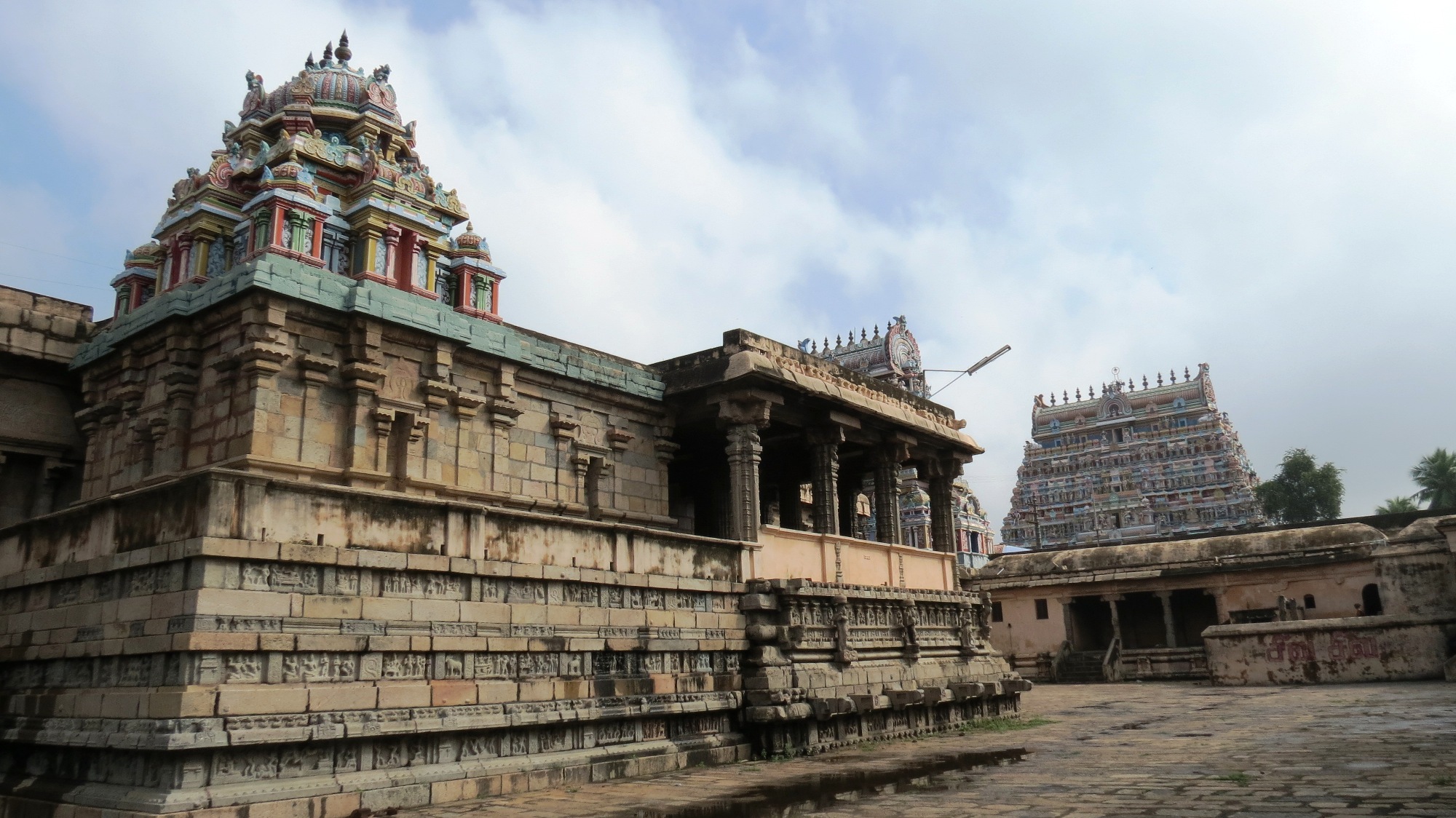 Outer prakara
 -

-
 Inner gopura
 -
 Pillars in the mandapa
 -
 Vimana rear view


Notes[edit | edit source]
- ↑ 1.0 1.1 1.2 Ayyar 1993, pp. 316–320
- ↑ V., Meena (1974). Temples in South India (1st ed.). Kanniyakumari: Harikumar Arts. p. 29.
- ↑ பு.மா.ஜெயசெந்தில்நாதன், தேவார வைப்புத்தலங்கள், வர்த்தமானன் பதிப்பகம், சென்னை, 2009
- ↑ மூவர் தேவார வைப்புத் தலங்கள், Muvar Thevara Vaippu Thalangal, திருபுவனம் (Thirubuvanam), 6-51-11
- ↑ 5.0 5.1 5.2 5.3 Tourist guide to Tamil Nadu 2007, p. 71
- ↑ Kapoor, Subodh (2002). Encyclopaedia of Ancient Indian Geography, Volume 2. Genesis Publishing Pvt Ltd. p. 656. ISBN 9788177552997.
- ↑ Karkar, S.C. (2009). The Top Ten Temple Towns of India. Kolkota: Mark Age Publication. p. 84. ISBN 978-81-87952-12-1.
- ↑ Rajarajan, R.K.K. (2021). "Stucco Images of Tribhuvanam". History Today. Journal of History and Historical Archaeology. 22: 36–45.
- ↑ Branfoot, Crispin (2002). "'Expanding Form': The Architectural Sculpture of the South Indian Temple, ca. 1500–1700". Artibus Asiae. 62 (2). Artibus Asiae Publishers: 204. doi:10.2307/3250266. ISSN 0004-3648. JSTOR 3250266.Template:Registration required
- ↑ D., Devakunjari (1973). R., nagaswamy (ed.). The Mahadeva temple of Tillaisthanam (PDF). Damilica (Report). Vol. II. The State Department of Archaeology, Government of Tamil Nadu. p. 44.
- ↑ Smith 2003, p. 193
- ↑ Rao p. 174
- ↑ H., Sarkar (1974). The Kampahesvara temple at Thirubuvanam (PDF). Madras: Department of Archaeology, Government of Tamil Nadu. p. 9.
References[edit | edit source]
- Smith, David (2003). The Dance of Siva: Religion, Art and Poetry in South India: Volume 7 of Cambridge Studies in Religious Traditions. Cambridge University Press. p. 193. ISBN 0-521-52865-8. Retrieved 15 January 2010.
- Ayyar, P.V. Jagadisa (1993). South Indian Shrines Illustrated. New Delhi: Asian Educational Services. ISBN 81-206-0151-3.
- Tourist guide to Tamil Nadu (2007). Tourist guide to Tamil Nadu. Chennai: T. Krishna Press. ISBN 978-81-7478-177-2.
- Rao, T. A.Gopinatha (1997). Elements of Hindu iconography. Vol. 2. Motilal Banarsidass Publishers. pp. 171–173. ISBN 81-208-0878-9. Retrieved 15 January 2010.
External links[edit | edit source]
Template:Hindu Temples of Kumbakonam
| District headquarters |  | |
|---|---|---|
| Country | ||
| State | ||
| Region | ||
| Divisions | ||
| Taluks | ||
| Revenue blocks | ||
| Municipal Corporations | ||
| Municipalities | ||
| Rivers | ||
| History | ||
| Places of interest |
| |
| Religious and monastic institutions | ||
| Universities | ||