->Alpinu m →Rerences: → References + {{reflist}} |
m further enhanced formatting as per guidelines additionally and cleaned formatting |
||
| Line 1: | Line 1: | ||
{{short description|Islamic mausoleum}} | {{short description|Islamic mausoleum}} | ||
{{Use dmy dates|date=July 2019}} | {{Use dmy dates|date=July 2019}} | ||
{{ | {{refimprove|date=February 2023}} | ||
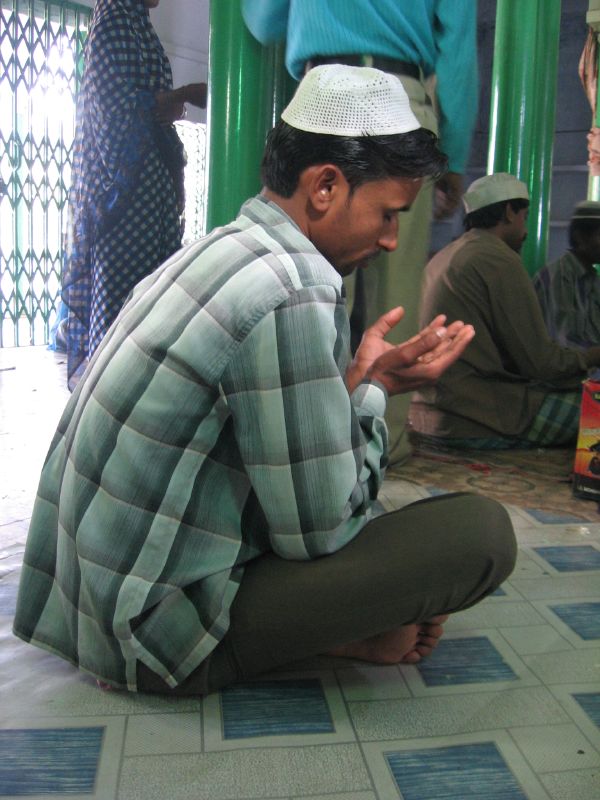
[[File:Kannam Parambu Masjidh, Kozhikode.jpg|thumbnail|Kannam Parambu Maqbarah in [[Kozhikode]]]] | [[File:Kannam Parambu Masjidh, Kozhikode.jpg|thumbnail|Kannam Parambu Maqbarah in [[Kozhikode]]]] | ||
The [[Arabic language|Arabic]] word ''' | The [[Arabic language|Arabic]] word '''{{Lang|ar-latn|maqbara}}''' ({{lang|ar|مقبرة المسلمين}} "[[mausoleum]]"; ''plural'': {{lang|ar|مقابر}} '''''maqâbir''''') is derived from the word '''qabr''', which means [[grave (burial)|grave]]. Though {{lang|ar-latn|maqbara}} refers to the graves of all [[Muslims]], it refers especially to a Muslim [[cemetery]]. In some Islamic cultures (especially Indo-Pak-influenced) it refers also to the graves (raula or [[rauza]]) of religious figures or Waliyullahs considered to have dedicated their life to [[Islam]], striving to be true Muslims and training others to follow Islam as preached by the [[Islamic prophet]] [[Muhammad]]. | ||
In Asian countries, {{lang|ar-latn|maqbara}} also refers to the [[dargah]] of Waliyullahs, [[Sufis]], [[Sheikhs]], [[Imams]], Qutbs and Ghouses. There are many dargahs of Waliyullahs all over India, and their {{lang|ar-latn|maqbaras}} are found therein.<ref>{{cite book |title=The Norwalk Hour |publisher=The Norwalk Hour |url=https://books.google.com/books?id=3U81AAAAIBAJ&dq=%22Maqbara%22&pg=PA25&article_id=4402,5425659 |language=en}}</ref> | |||
{{ | |||
==Notable maqbara== | |||
=== Egypt === | |||
* [[Al-Rifa'i Mosque]] | |||
* [[City of the Dead (Cairo)|City of the Dead]] | |||
=== Saudi Arabia === | |||
* [[Al-Baqi Cemetery]] | |||
* [[Jannat al-Mu'alla]] | |||
* [[Al Oud cemetery]] | |||
=== India === | |||
* [[Madurai Maqbara]] | |||
=== Canada === | |||
* [[Assyrian Muslim Cemetery]] | |||
==See also== | ==See also== | ||
| Line 18: | Line 31: | ||
{{reflist}} | {{reflist}} | ||
{{Islamic architecture}} | {{Islamic architecture}} | ||
{{Sufism terminology}} | {{Sufism terminology}} | ||
{{Authority control}} | |||
{{Portal bar|Religion|Islam|Education|Psychology|Art|Architecture}} | |||
[[Category: | [[Category:Death customs]] | ||
[[Category: | [[Category:Islam and death]] | ||
[[Category:Muslim cemeteries]] | |||
[[Category: | |||
Latest revision as of 00:38, 5 February 2025
 | This article needs additional citations for verification. (February 2023) |

The Arabic word maqbara (مقبرة المسلمين "mausoleum"; plural: مقابر maqâbir) is derived from the word qabr, which means grave. Though maqbara refers to the graves of all Muslims, it refers especially to a Muslim cemetery. In some Islamic cultures (especially Indo-Pak-influenced) it refers also to the graves (raula or rauza) of religious figures or Waliyullahs considered to have dedicated their life to Islam, striving to be true Muslims and training others to follow Islam as preached by the Islamic prophet Muhammad.
In Asian countries, maqbara also refers to the dargah of Waliyullahs, Sufis, Sheikhs, Imams, Qutbs and Ghouses. There are many dargahs of Waliyullahs all over India, and their maqbaras are found therein.[1]
Notable maqbara[edit | edit source]
Egypt[edit | edit source]
Saudi Arabia[edit | edit source]
India[edit | edit source]
Canada[edit | edit source]
See also[edit | edit source]
References[edit | edit source]
- ↑ The Norwalk Hour. The Norwalk Hour.