

->Citation bot Alter: url. URLs might have been anonymized. | Use this bot. Report bugs. | Suggested by AManWithNoPlan | #UCB_webform 540/2199 |
EddieFrine (talk | contribs) small changes |
||
| Line 1: | Line 1: | ||
{{Short description|Tomb complex near Manek Chowk, Ahmedabad, India}} | |||
{{Use dmy dates|date=July 2018}} | {{Use dmy dates|date=July 2018}} | ||
{{Use Indian English|date=July 2018}} | {{Use Indian English|date=July 2018}} | ||
| Line 64: | Line 65: | ||
''Rani no Hajiro'' is located near Manek Chowk on east of the [[Ahmed Shah's Tomb]]. The enclosure is high above the ground entered by a lofty gateway and the courtyard surrounded by a trellised cloister. The walls of cloister are fitted with carved stone screens. The square open enclosure of 36.58 meters side is probably built in 1445. The courtyard contains eight marble tombs of queens of [[Ahmed Shah I]] and other [[Gujarat Sultanate]] rulers. They are elaborately carved and inlaid with work of [[mother-of-pearl]] and metal. | ''Rani no Hajiro'' is located near Manek Chowk on east of the [[Ahmed Shah's Tomb]]. The enclosure is high above the ground entered by a lofty gateway and the courtyard surrounded by a trellised cloister. The walls of cloister are fitted with carved stone screens. The square open enclosure of 36.58 meters side is probably built in 1445. The courtyard contains eight marble tombs of queens of [[Ahmed Shah I]] and other [[Gujarat Sultanate]] rulers. They are elaborately carved and inlaid with work of [[mother-of-pearl]] and metal. | ||
The principal tomb belongs to Mughalai Bibi, the wife of Muhammad Shah II and mother of [[Mahmud Begada]]. It is richly carved in white marble, and girt with a Persian inscription in minute relief. An adjacent tomb in black marble, once inlaid with mother-of-pearl, belongs to Mirki or Murki Bibi, the wife of [[Shah e Alam]], the sister of queen and the daughter of Jam of [[Sindh]]. These tombs are covered with rich [[brocade]] works, the textile style developed during reign of Ahmed Shah I. The intricate stone tracery and carving is an amalgamation of Hindu, Jain, and Islamic architectural styles. Some Muslim families live inside complex which take care of the tombs.<ref>{{cite book|title=Gazetteer of the Bombay Presidency: Ahmedabad|year=1879|url=https://archive.org/details/dli.csl.3354|publisher=Government Central Press|page=[https://archive.org/details/dli.csl.3354/page/n278 272]}}</ref><ref>{{cite web|url=http://www.bl.uk/onlinegallery/onlineex/apac/other/019wdz000002220u00044000.html|title =Ahmedabad: Two marble tombs of the Queens of Ahmed Shah|publisher=British Library |accessdate=31 December 2014}}</ref><ref name="igg">{{cite book | title=India Guide Gujarat | publisher=India Guide Publications | year=2007 | pages=93–94 | isbn= 9780978951702 | url=https://books.google.com/books?id=gZRLGZNZEoEC&dq=manek+chowk+ahmedabad&pg=PA93 | editor=Desai, Anjali H.}}</ref> | The principal tomb belongs to Mughalai Bibi, the wife of Muhammad Shah II and mother of [[Mahmud Begada]]. It is richly carved in white marble, and girt with a Persian inscription in minute relief. An adjacent tomb in black marble, once inlaid with mother-of-pearl, belongs to Mirki or Murki Bibi, the wife of [[Shah e Alam]], the sister of queen and the daughter of Jam of [[Sindh]]. These tombs are covered with rich [[brocade]] works, the textile style developed during reign of Ahmed Shah I. The intricate stone tracery and carving is an amalgamation of Hindu, Jain, and Islamic architectural styles. Some Muslim families live inside complex which take care of the tombs.<ref>{{cite book|title=Gazetteer of the Bombay Presidency: Ahmedabad|year=1879|url=https://archive.org/details/dli.csl.3354|publisher=Government Central Press|page=[https://archive.org/details/dli.csl.3354/page/n278 272]}}</ref><ref>{{cite web|url=http://www.bl.uk/onlinegallery/onlineex/apac/other/019wdz000002220u00044000.html|title=Ahmedabad: Two marble tombs of the Queens of Ahmed Shah|publisher=British Library|accessdate=31 December 2014|archive-date=5 March 2016|archive-url=https://web.archive.org/web/20160305005950/http://www.bl.uk/onlinegallery/onlineex/apac/other/019wdz000002220u00044000.html|url-status=dead}}</ref><ref name="igg">{{cite book | title=India Guide Gujarat | publisher=India Guide Publications | year=2007 | pages=93–94 | isbn= 9780978951702 | url=https://books.google.com/books?id=gZRLGZNZEoEC&dq=manek+chowk+ahmedabad&pg=PA93 | editor=Desai, Anjali H.}}</ref> | ||
[[File:Siesta in Rani no hajiro (2140992778).jpg|Siesta in Rani no Hajiro|thumb]] | [[File:Siesta in Rani no hajiro (2140992778).jpg|Siesta in Rani no Hajiro|thumb]] | ||
| Line 91: | Line 92: | ||
[[Category:Tombs in Ahmedabad]] | [[Category:Tombs in Ahmedabad]] | ||
[[Category:Monuments of National Importance in Gujarat]] | [[Category:Monuments of National Importance in Gujarat]] | ||
[[Category:Buildings and structures of the Gujarat Sultanate]] | |||
Latest revision as of 06:17, 7 August 2025
| Rani no Hajiro | |
|---|---|
| Religion | |
| Affiliation | Islam |
| Status | Active |
| Location | |
| Location | Manek Chowk, Ahmedabad |
| Municipality | Ahmedabad Municipal Corporation |
| State | Gujarat |
  Location in Ahmedabad, Gujarat, India  Rani no Hajiro (Gujarat) | |
| Coordinates | 23°01′26″N 72°35′21″E / 23.0237592°N 72.5890972°E |
| Architecture | |
| Type | Mosque and tomb |
| Style | Indo-Islamic architecture |
| Completed | c. 1440 |
Rani no Hajiro, also known as Mughalai Bibi's Tomb or Tombs of Ahmed Shah's Queens, is a tomb complex near Manek Chowk, Ahmedabad, India.
History and architecture[edit | edit source]

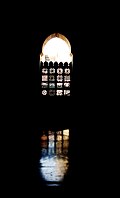
Rani no Hajiro is located near Manek Chowk on east of the Ahmed Shah's Tomb. The enclosure is high above the ground entered by a lofty gateway and the courtyard surrounded by a trellised cloister. The walls of cloister are fitted with carved stone screens. The square open enclosure of 36.58 meters side is probably built in 1445. The courtyard contains eight marble tombs of queens of Ahmed Shah I and other Gujarat Sultanate rulers. They are elaborately carved and inlaid with work of mother-of-pearl and metal.
The principal tomb belongs to Mughalai Bibi, the wife of Muhammad Shah II and mother of Mahmud Begada. It is richly carved in white marble, and girt with a Persian inscription in minute relief. An adjacent tomb in black marble, once inlaid with mother-of-pearl, belongs to Mirki or Murki Bibi, the wife of Shah e Alam, the sister of queen and the daughter of Jam of Sindh. These tombs are covered with rich brocade works, the textile style developed during reign of Ahmed Shah I. The intricate stone tracery and carving is an amalgamation of Hindu, Jain, and Islamic architectural styles. Some Muslim families live inside complex which take care of the tombs.[1][2][3]
.jpg)
Market[edit | edit source]
The area surrounding the complex is now a market for women's clothing, jewellery and accessories. Best Traditional Garba clothes are also sold there. Many types of mouth fresheners, Mukhwas, stalls are nearby.[3]
Gallery[edit | edit source]
-
 Cloister
 -
 Lattice work in stone window
 -
 Lattice work
 -
 Lattice work in windows
 -
 Details of the tomb


See also[edit | edit source]
References[edit | edit source]
- ↑ Gazetteer of the Bombay Presidency: Ahmedabad. Government Central Press. 1879. p. 272.
- ↑ "Ahmedabad: Two marble tombs of the Queens of Ahmed Shah". British Library. Archived from the original on 5 March 2016. Retrieved 31 December 2014.
- ↑ 3.0 3.1 Desai, Anjali H., ed. (2007). India Guide Gujarat. India Guide Publications. pp. 93–94. ISBN 9780978951702.
- This article includes public domain text from Gazetteer of the Bombay Presidency: Ahmedabad. Government Central Press. 1879. p. 272.
