



Ajay Kumar (talk | contribs) Created a new article |
small changes |
||
| Line 1: | Line 1: | ||
{{Coords|52.7282|-1.7285|display=title}} | {{Coords|52.7282|-1.7285|display=title}} | ||
{{Short description|Site of remembrance, Staffordshire, England}} | {{Short description|Site of remembrance, Staffordshire, England}} | ||
The '''National Memorial Arboretum''' is a British site of national remembrance at [[Alrewas]], near [[Lichfield]], [[Staffordshire]]. Its objective is to honour the fallen, recognise service and sacrifice, and foster pride in | [[File:The National Memorial Arboretum, Alrewas.jpg|thumb|upright=1.2|right|Aerial view of the National Memorial Arboretum, with the River Tame at bottom]] | ||
The '''National Memorial Arboretum''' is a British site of national remembrance at [[Alrewas]], near [[Lichfield]], [[Staffordshire]], England. Its objective is to honour the fallen, recognise service and sacrifice, and foster pride in [[British Armed Forces|His Majesty's Armed Forces]] and the associated civilian community.<ref name=":0">{{Cite web |title=About us {{!}} National Memorial Arboretum |url=https://www.thenma.org.uk/visit-us/what's-here/woodland-landscape |access-date=15 June 2018 |website=thenma.org.uk |language=en}}</ref> | |||
In 2017, after undergoing a large scale regeneration project, the | In 2017, after undergoing a large scale regeneration project, the arboretum's new award-winning Remembrance Centre was officially opened by the [[William, Prince of Wales|Duke of Cambridge]] on 23 March.<ref name="thenma.org.uk">{{Cite web|url=http://www.thenma.org.uk/whats-here/the-remembrance-centre/|title=The Remembrance Centre {{!}} National Memorial Arboretum|website=thenma.org.uk|language=en|access-date=15 June 2018}}</ref> It features three exhibition galleries, a larger restaurant and shop, separate coffee shop and a courtyard with garden.<ref name="thenma.org.uk"/> | ||
In 2018 the National Memorial Arboretum was awarded Gold Large Visitor Attraction of the Year in [[VisitEngland|VisitEngland's]] Awards for Excellence, as well as Coach Friendly Attraction of the Year in the British Coach Tourism Awards.<ref name="ReferenceA">{{Cite web|url=http://www.thenma.org.uk/about-us/awards/|title=Awards {{!}} National Memorial Arboretum|website= | In 2018, the National Memorial Arboretum was awarded Gold Large Visitor Attraction of the Year in [[VisitEngland|VisitEngland's]] Awards for Excellence, as well as Coach Friendly Attraction of the Year in the British Coach Tourism Awards.<ref name="ReferenceA">{{Cite web|url=http://www.thenma.org.uk/about-us/awards/|title=Awards {{!}} National Memorial Arboretum|website=thenma.org.uk|language=en|access-date=15 June 2018}}</ref> | ||
==Origins== | ==Origins== | ||
The idea for the | The idea for the arboretum was conceived by [[Commander (Royal Navy)|Commander]] David Childs, [[Order of the British Empire|CBE]], in 1988, who wished to establish a national focus or 'centre' for remembrance to those that had died after giving to their community or country. An appeal was launched in 1994 by the then [[Prime Minister of the United Kingdom|Prime Minister]], [[John Major]]. He believed that the arboretum would form a living tribute to service men and women for future generations to reflect upon and enjoy while walking through a beautiful green scenery.<ref name="ReferenceB">{{Cite web|url=http://www.thenma.org.uk/about-us/who-we-are/|title=Who we are {{!}} National Memorial Arboretum|website=thenma.org.uk|language=en|access-date=15 June 2018}}</ref> | ||
The future of the project became assured when three proposals were agreed. These were: for the site to be the location of the [[Armed Forces Memorial]]; for the [[Ministry of Defence (United Kingdom)|Ministry of Defence]] to pay a significant grant-in-aid to allow for free entry and that [[The Royal British Legion]] would accept the gift of the site as the focus for the | The future of the project became assured when three proposals were agreed. These were: for the site to be the location of the [[Armed Forces Memorial]]; for the [[Ministry of Defence (United Kingdom)|Ministry of Defence]] to pay a significant grant-in-aid to allow for free entry and that [[The Royal British Legion]] would accept the gift of the site as the focus for the nation's year-round remembrance. | ||
The project began with no money, no land, no staff and no trees, just an idea which was yet to exist in reality. [[National Lottery (United Kingdom)|The National Lottery]], in the form of the Millennium Commission, granted some forty per cent of the funds needed and this was matched by thousands of donations | The project began with no money, no land, no staff and no trees, just an idea which was yet to exist in reality. [[National Lottery (United Kingdom)|The National Lottery]], in the form of the Millennium Commission, granted some forty per cent of the funds needed and this was matched by thousands of donations from a wide variety of organisations both military and civilian, men and women, corporate and voluntary.<ref name="ReferenceB"/> | ||
Planting began on the reclaimed gravel workings, bordered by the Rivers Trent and Tame, gifted to the charity by Tarmac [[Lafarge (company)|Lafarge]] in 1997. The initial planting took place thanks to grants from the [[Forestry Commission]] and the [[The National Forest (England)|National Forest]], and since then has been shaped by a staff of thousands: a small paid group; a dedicated and active Friends of the National Memorial Arboretum organisation; and countless others who have either planted individual trees or helped create a memorial for their organisation. | Planting began on the reclaimed gravel workings, bordered by the [[River Trent|Rivers Trent]] and [[River Tame (West Midlands)|Tame]], gifted to the charity by Tarmac [[Lafarge (company)|Lafarge]] in 1997. The initial planting took place thanks to grants from the [[Forestry Commission]] and the [[The National Forest (England)|National Forest]], and since then has been shaped by a staff of thousands: a small paid group; a dedicated and active Friends of the National Memorial Arboretum organisation; and countless others who have either planted individual trees or helped create a memorial for their organisation. | ||
The | The arboretum was officially opened on 16 May 2001. It is a [[Charitable organization|registered charity]] and is part of The [[Royal British Legion]] family of charities.<ref>{{Cite news|url=https://www.britishlegion.org.uk/about-us/governance/associated-charities/|title=Associated charities|access-date=15 June 2018}}</ref> | ||
==Location== | ==Location== | ||
The National Memorial Arboretum is situated just south of [[Alrewas]] on approximately {{convert|150|acre|ha sqmi}} of old gravel workings, {{convert|5|mi}} north of [[Lichfield]], [[Staffordshire]]. It is adjacent to the confluence of the [[River Tame, West Midlands|River Tame]] with the [[River Trent]], and directly neighbouring [[Croxall Lakes]]. It is at the western end of the [[National Forest, England|National Forest]], just off the [[A38 road]]. | The National Memorial Arboretum is situated just south of [[Alrewas]] on approximately {{convert|150|acre|ha sqmi}} of old gravel workings, {{convert|5|mi}} north of [[Lichfield]], [[Staffordshire]]. It is adjacent to the confluence of the [[River Tame, West Midlands|River Tame]] with the [[River Trent]], and directly neighbouring [[Croxall Lakes]]. It is at the western end of the [[National Forest, England|National Forest]], just off the [[A38 road]]. | ||
==Features== | ==Features== | ||
[[File:The Polar Bear Memorial.jpg|alt=The Polar Bear Memorial|left|thumb|The Polar Bear Memorial was the first memorial dedicated on site, on 7 June 1998.]] | [[File:The Polar Bear Memorial.jpg|alt=The Polar Bear Memorial|left|thumb|upright|The Polar Bear Memorial was the first memorial dedicated on site, on 7 June 1998.]] | ||
The | The arboretum contains more than 25,000 trees.<ref name=":0" /> There are more than 400 memorials for the armed forces, civilian organisations and voluntary bodies who have played a part in serving the country; and even [[Simon (cat)|HMS ''Amethyst's'' cat]] Simon.<ref>{{Cite web|url=http://www.thenma.org.uk/whats-here/the-memorials/memorial-listing/|title=Memorial listing {{!}} National Memorial Arboretum|website=thenma.org.uk|language=en|access-date=15 June 2018}}</ref> | ||
The largest section is the [[Armed Forces Memorial]], at the heart of the arboretum, which is a tribute to over 16,000 service personnel who have lost their lives in conflict or as a result of terrorism since the end of the [[Second World War]]. At 11 am on 11 November each year the sun shines through two slits in the outer and inner walls of the memorial, casting a shaft of light across a wreath in the centre. The Armed Forces Memorial was dedicated in October 2007 by the [[Archbishop of Canterbury]] in the presence of [[Elizabeth II]].<ref>{{Cite web|url=http://www.thenma.org.uk/whats-here/the-memorials/armed-forces-memorial/|title=Armed Forces Memorial {{!}} National Memorial Arboretum|website=thenma.org.uk|language=en|access-date=15 June 2018}}</ref> | |||
Other areas of the site include an RAF 'wing', Naval review and Army parade. Civilian areas include 'The Beat' which contains memorials and dedications to police forces from around the UK and commonwealth. There is a Wartime Nurses Memorial, to 1,300 [[Voluntary Aid Detachment|VAD]] and professional nurses who died in the First and Second World Wars.<ref>{{Cite web|date=22 August 2018|title=Wartime Nurses Memorial|url=https://www.militaryimages.net/media/albums/wartime-nurses-memorial.702/|access-date=27 September 2021|website=MilitaryImages.Net|language=en-US}}</ref> | |||
Within the arboretum is the Millennium Chapel of Peace and Forgiveness where, at 11 am each day, an act of remembrance takes place. Following the [[two-minute silence]], accompanied by the [[Last Post]] and [[Reveille]], there is an introductory talk about the arboretum.<ref>{{Cite web|url=http://www.thenma.org.uk/whats-here/millennium-chapel/|title=Millennium chapel {{!}} National Memorial Arboretum|website=thenma.org.uk|language=en|access-date=15 June 2018}}</ref> The Bastion Memorial commemorates British casualties of the [[War in Afghanistan (2001–2021)]].<ref name=BBCOct21>{{cite news|url=https://www.bbc.co.uk/news/uk-58822435|title=Afghanistan war: Services mark 20th anniversary of UK operations|date=7 October 2021|work=[[BBC News]]|access-date=7 October 2021}}</ref> A memorial to the ''[[Lisbon Maru]]'' was unveiled in 2021.<ref name=LitchOct21>{{cite news|url=https://lichfieldlive.co.uk/2021/10/04/memorial-unveiled-to-british-prisoners-of-war-who-died-after-ship-was-sunk-during-the-second-world-war/|title=Memorial unveiled to British prisoners of war who died after ship was sunk during the Second World War|date=4 October 2021|work=[[Lichfield Live]]|access-date=7 October 2021}}</ref> | |||
A 'remembrance glade' was unveiled at the arboretum by the [[Royal British Legion]] in September 2021, featuring plants chosen for their symbolic meanings in relation to grief and new beginnings.<ref name=LitchSep21>{{cite news|url=https://lichfieldlive.co.uk/2021/09/15/new-remembrance-glade-launched-at-the-national-memorial-arboretum/|title=New Remembrance Glade launched at the National Memorial Arboretum |date=15 September 2021|work=[[Lichfield Live]]|archive-url=https://web.archive.org/web/20210916041529/https://lichfieldlive.co.uk/2021/09/15/new-remembrance-glade-launched-at-the-national-memorial-arboretum/ |access-date=7 October 2021|archive-date=16 September 2021}}</ref> | |||
Daily activities on site include guided walks, buggy tours, [[land train]] rides and free talks, as well as the Daily Act of Remembrance.<ref>{{Cite web|url=http://www.thenma.org.uk/plan-your-visit/daily-activities/|title=Daily activities {{!}} National Memorial Arboretum|website=thenma.org.uk|language=en|access-date=15 June 2018}}</ref> Most of these activities are conducted by a team of over 260 volunteers, who collectively dedicate more than 52,000 hours of their time per year to the arboretum. In 2010, the Volunteers of the National Memorial Arboretum were awarded [[Queen's Award for Voluntary Service|The Queen's Award for Voluntary Service]].<ref name="ReferenceA"/> | |||
=== Memorials === | === Memorials === | ||
{{Main|List of memorials at the National Memorial Arboretum}} | {{Main|List of memorials at the National Memorial Arboretum}} | ||
The [[Armed Forces Memorial]] commemorates service men and women killed since 1945. The two curved walls and two straight walls are made from bricks covered with Portland stone panels. At the centre of the Memorial are two bronze sculptures created by [[Ian Rank-Broadley]]. This memorial remembers over 16,000 people who have been killed or sacrificed their lives while on duty or targeted by terrorists or who died in operational theatres. Their names have been written in a panel to signify their significance in the Armed Forces. | |||
<gallery mode="packed" heights="160" caption="Armed Forces Memorial"> | |||
File: | File:The Armed Forces Memorial - geograph.org.uk - 4563356.jpg | ||
File: | File:Armed Forces Memorial - geograph.org.uk - 845903.jpg | ||
File: | File:Armed Forces Memorial, National Memorial Arboretum (05).JPG | ||
</gallery> | </gallery> | ||
| Line 56: | Line 52: | ||
!Year | !Year | ||
|- | |- | ||
| [[File:Jewish | | [[File:Association of Jewish Ex-Servicemen and Women.jpg|200x200px]]|| '''Association of Jewish Ex-Service Men and Women''' | ||
Made from Chinese granite and designed to give a different perspective when viewed from different angles, the Star of David memorial is dedicated to Jewish servicemen who were killed on duty. | Made from Chinese granite and designed to give a different perspective when viewed from different angles, the Star of David memorial is dedicated to Jewish servicemen who were killed on duty. | ||
|- | |- | ||
| [[File:Berlin Airlift Memorial | | [[File:Berlin Airlift Memorial.jpg|200x200px]]|| '''Berlin Airlift Monument''' The memorial is erected in tribute to those who took part in the [[Berlin Blockade|Berlin Airlift]], the operation to deliver food and supplies to Berlin between June 1948 and May 1949. | ||
|- | |- | ||
| [[File:Boys' Brigade Memorial at National Memorial Arboretum.JPG|200px]]|| '''Boys' Brigade''' | | [[File:Boys' Brigade Memorial at National Memorial Arboretum.JPG|200px]]|| '''Boys' Brigade''' | ||
The elements of this garden represent all parts of the UK and Ireland. The [[Boys' Brigade]] Garden is designed to remember those who have served in the Brigade since 1883. Sixteen [[Victoria Cross]]es have been awarded to former and serving Brigade members. | The elements of this garden represent all parts of the UK and Ireland. The [[Boys' Brigade]] Garden is designed to remember those who have served in the Brigade since 1883. Sixteen [[Victoria Cross]]es have been awarded to former and serving Brigade members. | ||
|- | |- | ||
| [[File:Burma Railway Memorial | | [[File:Burma Railway Memorial.jpg|200x200px]]|| '''Burma Railway''' | ||
The memorial is constructed from 30 | The memorial is constructed from {{convert|30|m}} of the original rails and sleepers used on the [[Burma Railway]], which were brought to the arboretum from [[Thailand]] in HMS ''Northumberland'' in 2002. The memorial is a permanent tribute to those who were forced to construct the infamous 'Railway of Death' and the benches and trees around the railway track have relevant dedications. The memorial was dedicated on 15 August 2002.<ref>{{cite news |author=<!--not stated--> |date=7 January 2002 |title='Railway of death' sleepers arrive |url=https://news.bbc.co.uk/2/hi/uk_news/england/1747391.stm |work=BBC News |access-date=9 February 2024}}</ref> | ||
| | |2002 | ||
|- | |- | ||
|[[File:Christmas truce.jpg|200px]]|| '''Christmas Truce Memorial''' | |[[File:Christmas truce.jpg|200px]]|| '''Christmas Truce Memorial''' | ||
On 12 December 2014, a memorial on the centenary of the World War I [[Christmas truce]], when British and German soldiers stopped fighting in the trenches and played football in [[no man's land]], was unveiled by [[Prince William, Duke of Cambridge]], the [[England national football team]] manager [[Roy Hodgson]] and [[Greg Dyke]], chairman of the [[Football Association]].<ref name="2014 memorial"> | On 12 December 2014, a memorial on the centenary of the World War I [[Christmas truce]], when British and German soldiers stopped fighting in the trenches and played football in [[no man's land]], was unveiled by [[William, Prince of Wales|Prince William, Duke of Cambridge]], the [[England national football team]] manager [[Roy Hodgson]] and [[Greg Dyke]], chairman of the [[Football Association]].<ref name="2014 memorial">{{cite news |author=<!--not stated--> |date=12 December 2014 |title=Prince William hails 'lasting memorial' to WW1 Christmas truce |url=https://www.bbc.co.uk/news/uk-30444024 |work=BBC News |access-date=9 February 2024}}</ref> The Football Remembers memorial was designed by ten-year-old Spencer Turner after a UK-wide competition.<ref name="2014 memorial"/> | ||
|2014 | |2014 | ||
|- | |- | ||
| [[File:Commandos memorial at National Memorial Arboretum.JPG|200px]]|| '''Commandos''' | | [[File:Commandos memorial at National Memorial Arboretum.JPG|200px]]|| '''Commandos''' | ||
The [[British Commandos|Commandos]] were formed by the Army in June 1940 as a well-armed but non-regimental raider force employing unconventional and irregular tactics to assault, disrupt and reconnoitre the enemy. | The [[British Commandos|Commandos]] were formed by the Army in June 1940 as a well-armed but non-regimental raider force employing unconventional and irregular tactics to assault, disrupt and [[reconnoitre]] the enemy. | ||
This memorial consists of a reproduction of part of the Association badge – the wreath in copper and the [[Fairbairn–Sykes fighting knife]] in stainless steel. It was created at Anwick Forge in Lincolnshire. | This memorial consists of a reproduction of part of the Association badge – the wreath in copper and the [[Fairbairn–Sykes fighting knife]] in stainless steel. It was created at Anwick Forge in Lincolnshire. | ||
|- | |- | ||
|[[File:Navy Memorial at the National Memorial Arboretum.JPG|200px]] | |[[File:Navy Memorial at the National Memorial Arboretum.JPG|200px]] | ||
|'''Navy Memorial''' | |'''Navy Memorial''' | ||
Unveiled on 15 June 2014 the memorial to navy personnel is made up from a number of large pieces of coloured glass and a lone figure with bowed head.<ref>{{cite news | url=https://www.bbc.co.uk/news/uk-27856838 | title=Monument to navy personnel unveiled in the National Memorial Arboretum | publisher=BBC News | access-date=21 August 2015}}</ref> | By [[Graeme Mitcheson]]. Unveiled on 15 June 2014 the memorial to navy personnel is made up from a number of large pieces of coloured glass and a lone figure with bowed head.<ref>{{cite news |url=https://www.bbc.co.uk/news/av/uk-27856838 |title=Monument to navy personnel unveiled in the National Memorial Arboretum |publisher=BBC News |access-date=21 August 2015}}</ref> | ||
| | |2014 | ||
|- | |- | ||
| [[File:Polar Bear Memorial | | [[File:Polar Bear Memorial.jpg|200x200px]]|| '''Polar Bear Memorial''' | ||
The Polar Bear Association Memorial was the first monument and sculpture to be erected at the National Memorial Arboretum. It is a tribute to the [[49th (West Riding) Infantry Division|49th Infantry West Riding Division]] and was dedicated on 7 June 1998. In the Second World War they were stationed in [[Iceland]] and | The Polar Bear Association Memorial was the first monument and sculpture to be erected at the National Memorial Arboretum. It is a tribute to the [[49th (West Riding) Infantry Division|49th Infantry West Riding Division]] and was dedicated on 7 June 1998. In the Second World War they were stationed in [[Iceland]] and as they were snowed in under {{convert|20|ft|m}} of snow for most of the campaign, their commanding officer called the men 'his Polar Bears' and the [[polar bear]] on a block of ice was soon adopted as their mascot and [[shoulder flash]]. Made from yellow hardwood, the bear is {{convert|9|ft|m|abbr=on|adj=mid|long}} and {{convert|5|ft|m|abbr=on|adj=mid|high}} and weighs 2.5 tonnes; it was created by the Essex Woodcarvers and took six men a year to carve. Inside the bear is a capsule containing the names of the members of the 49th Division who died, together with relevant letters and documents. | ||
|1998 | |||
|- | |- | ||
|[[File:NMA Polish Service Men And Women Memorial.jpg|200px]] || '''The Polish Service Men and Women Memorial''' | |[[File:NMA Polish Service Men And Women Memorial.jpg|200px]] || '''The Polish Service Men and Women Memorial''' | ||
{{main|Polish Forces War Memorial | {{main|Polish Forces War Memorial}} | ||
A dedicated memorial has been erected in recognition of the contribution made by Polish service men and women to the Allied Forces during the [[Second World War]]. The centre monument sculptured by Robert Sobocinski was unveiled by | A dedicated memorial has been erected in recognition of the contribution made by Polish service men and women to the Allied Forces during the [[Second World War]]. The centre monument sculptured by Robert Sobocinski was unveiled by [[Prince Edward, Duke of Kent]] on 19 September 2009.<ref>{{cite news|last=Jamieson|first=Alastair|title=Memorial statue for Polish servicemen and women unveiled|url=https://www.telegraph.co.uk/news/uknews/6210099/Memorial-statue-for-Polish-servicemen-and-women-unveiled.html|newspaper=Telegraph|date=20 September 2009}}</ref> | ||
|2009 | |||
|- | |- | ||
| [[File:RNLI | | [[File:RNLI Memorial.jpg|268x268px]]|| '''Royal National Lifeboat Institution (RNLI)''' | ||
The [[RNLI]] memorial has been landscaped as a pebble, shingle and sand beach. The dramatic figure of a lifeboat man in his | The [[RNLI]] memorial has been landscaped as a pebble, shingle and sand beach. The dramatic figure of a lifeboat man in his 19th-century oilskins and cork life jacket was sculpted by Andrew Fitchett. | ||
|- | |- | ||
| [[File:Shot at Dawn | | [[File:Shot at Dawn Memorial.jpg|200x200px]]|| '''Shot at Dawn''' | ||
{{main|Shot at Dawn Memorial}} | {{main|Shot at Dawn Memorial}} | ||
During the First World War some 306 British and Commonwealth soldiers were shot for desertion or cowardice; the real cause for their offences was often a psychological reaction to the stresses of war which today would be diagnosed as [[Posttraumatic stress disorder|post-traumatic stress syndrome]] or [[combat stress reaction]]. ''Shot at Dawn'' is modelled on Private [[Herbert Burden]], of the 1st Battalion [[Northumberland Fusiliers]], who was shot at Ypres in 1915 aged 17. | During the First World War some 306 British and Commonwealth soldiers were shot for desertion or cowardice; the real cause for their offences was often a psychological reaction to the stresses of war which today would be diagnosed as [[Posttraumatic stress disorder|post-traumatic stress syndrome]] or [[combat stress reaction]]. ''Shot at Dawn'' is modelled on Private [[Herbert Burden]], of the 1st Battalion [[Northumberland Fusiliers]], who was shot at Ypres in 1915 aged 17. | ||
| Line 98: | Line 96: | ||
|[[File:SANDS Garden NMA.JPG|200px]] || '''[[Stillbirth and Neonatal Death Society]] (SANDS) Garden''' | |[[File:SANDS Garden NMA.JPG|200px]] || '''[[Stillbirth and Neonatal Death Society]] (SANDS) Garden''' | ||
The SANDS Garden is for bereaved parents. At the centre of the garden is a sculpture of the SANDS tear drop logo which was created by John Roberts and the Portland Sculpture Trust to encourage people to sit and touch the central carved figure of the baby. | The SANDS Garden is for bereaved parents. At the centre of the garden is a sculpture of the SANDS tear drop logo which was created by John Roberts and the Portland Sculpture Trust to encourage people to sit and touch the central carved figure of the baby. | ||
| | |||
|- | |- | ||
|[[File: | |[[File:Sumatra Railway Memorial.jpg|200x200px]]||'''Sumatra Railway Memorial''' | ||
Unveiled in 2001, the Sumatra Railway Memorial was designed by Jack Plant who was captured by the Japanese and forced to work constructing the railway. The memorial commemorates the 700 Allied PoWs who died building the [[Sumatra Railway]]. Several thousand captured Allied troops were forced to work on the {{convert|100|miles|km}} railway.<ref>{{cite news | url= | Unveiled in 2001, the Sumatra Railway Memorial was designed by Jack Plant who was captured by the Japanese and forced to work constructing the railway. The memorial commemorates the 700 Allied PoWs who died building the [[Sumatra Railway]]. Several thousand captured Allied troops were forced to work on the {{convert|100|miles|km}} railway.<ref>{{cite news |url=https://news.bbc.co.uk/1/hi/uk/1492191.stm |title=Memorial to Sumatra railway dead |date=15 August 2001 |publisher=BBC News |access-date=20 August 2015}}</ref> | ||
|2001 | |||
|- | |- | ||
|} | |} | ||
| Line 110: | Line 110: | ||
{{Commons category}} | {{Commons category}} | ||
* {{Official website|http://www.thenma.org.uk/}} | * {{Official website|http://www.thenma.org.uk/}} | ||
{{Authority control}} | {{Authority control}} | ||
Latest revision as of 14:50, 9 February 2026
52°43′42″N 1°43′43″W / 52.7282°N 1.7285°W

The National Memorial Arboretum is a British site of national remembrance at Alrewas, near Lichfield, Staffordshire, England. Its objective is to honour the fallen, recognise service and sacrifice, and foster pride in His Majesty's Armed Forces and the associated civilian community.[1]
In 2017, after undergoing a large scale regeneration project, the arboretum's new award-winning Remembrance Centre was officially opened by the Duke of Cambridge on 23 March.[2] It features three exhibition galleries, a larger restaurant and shop, separate coffee shop and a courtyard with garden.[2]
In 2018, the National Memorial Arboretum was awarded Gold Large Visitor Attraction of the Year in VisitEngland's Awards for Excellence, as well as Coach Friendly Attraction of the Year in the British Coach Tourism Awards.[3]
Origins[edit | edit source]
The idea for the arboretum was conceived by Commander David Childs, CBE, in 1988, who wished to establish a national focus or 'centre' for remembrance to those that had died after giving to their community or country. An appeal was launched in 1994 by the then Prime Minister, John Major. He believed that the arboretum would form a living tribute to service men and women for future generations to reflect upon and enjoy while walking through a beautiful green scenery.[4]
The future of the project became assured when three proposals were agreed. These were: for the site to be the location of the Armed Forces Memorial; for the Ministry of Defence to pay a significant grant-in-aid to allow for free entry and that The Royal British Legion would accept the gift of the site as the focus for the nation's year-round remembrance.
The project began with no money, no land, no staff and no trees, just an idea which was yet to exist in reality. The National Lottery, in the form of the Millennium Commission, granted some forty per cent of the funds needed and this was matched by thousands of donations from a wide variety of organisations both military and civilian, men and women, corporate and voluntary.[4]
Planting began on the reclaimed gravel workings, bordered by the Rivers Trent and Tame, gifted to the charity by Tarmac Lafarge in 1997. The initial planting took place thanks to grants from the Forestry Commission and the National Forest, and since then has been shaped by a staff of thousands: a small paid group; a dedicated and active Friends of the National Memorial Arboretum organisation; and countless others who have either planted individual trees or helped create a memorial for their organisation.
The arboretum was officially opened on 16 May 2001. It is a registered charity and is part of The Royal British Legion family of charities.[5]
Location[edit | edit source]
The National Memorial Arboretum is situated just south of Alrewas on approximately 150 acres (61 ha; 0.23 sq mi) of old gravel workings, 5 miles (8.0 km) north of Lichfield, Staffordshire. It is adjacent to the confluence of the River Tame with the River Trent, and directly neighbouring Croxall Lakes. It is at the western end of the National Forest, just off the A38 road.
Features[edit | edit source]

The arboretum contains more than 25,000 trees.[1] There are more than 400 memorials for the armed forces, civilian organisations and voluntary bodies who have played a part in serving the country; and even HMS Amethyst's cat Simon.[6]
The largest section is the Armed Forces Memorial, at the heart of the arboretum, which is a tribute to over 16,000 service personnel who have lost their lives in conflict or as a result of terrorism since the end of the Second World War. At 11 am on 11 November each year the sun shines through two slits in the outer and inner walls of the memorial, casting a shaft of light across a wreath in the centre. The Armed Forces Memorial was dedicated in October 2007 by the Archbishop of Canterbury in the presence of Elizabeth II.[7]
Other areas of the site include an RAF 'wing', Naval review and Army parade. Civilian areas include 'The Beat' which contains memorials and dedications to police forces from around the UK and commonwealth. There is a Wartime Nurses Memorial, to 1,300 VAD and professional nurses who died in the First and Second World Wars.[8]
Within the arboretum is the Millennium Chapel of Peace and Forgiveness where, at 11 am each day, an act of remembrance takes place. Following the two-minute silence, accompanied by the Last Post and Reveille, there is an introductory talk about the arboretum.[9] The Bastion Memorial commemorates British casualties of the War in Afghanistan (2001–2021).[10] A memorial to the Lisbon Maru was unveiled in 2021.[11]
A 'remembrance glade' was unveiled at the arboretum by the Royal British Legion in September 2021, featuring plants chosen for their symbolic meanings in relation to grief and new beginnings.[12]
Daily activities on site include guided walks, buggy tours, land train rides and free talks, as well as the Daily Act of Remembrance.[13] Most of these activities are conducted by a team of over 260 volunteers, who collectively dedicate more than 52,000 hours of their time per year to the arboretum. In 2010, the Volunteers of the National Memorial Arboretum were awarded The Queen's Award for Voluntary Service.[3]
Memorials[edit | edit source]
The Armed Forces Memorial commemorates service men and women killed since 1945. The two curved walls and two straight walls are made from bricks covered with Portland stone panels. At the centre of the Memorial are two bronze sculptures created by Ian Rank-Broadley. This memorial remembers over 16,000 people who have been killed or sacrificed their lives while on duty or targeted by terrorists or who died in operational theatres. Their names have been written in a panel to signify their significance in the Armed Forces.
- Armed Forces Memorial
-

-

-


.JPG)
Some of the other features of the National Memorial Arboretum are described below.
| Image | Description | Year |
|---|---|---|
 |
Association of Jewish Ex-Service Men and Women
Made from Chinese granite and designed to give a different perspective when viewed from different angles, the Star of David memorial is dedicated to Jewish servicemen who were killed on duty. | |
 |
Berlin Airlift Monument The memorial is erected in tribute to those who took part in the Berlin Airlift, the operation to deliver food and supplies to Berlin between June 1948 and May 1949. | |
 |
Boys' Brigade
The elements of this garden represent all parts of the UK and Ireland. The Boys' Brigade Garden is designed to remember those who have served in the Brigade since 1883. Sixteen Victoria Crosses have been awarded to former and serving Brigade members. | |
 |
Burma Railway
The memorial is constructed from 30 metres (98 ft) of the original rails and sleepers used on the Burma Railway, which were brought to the arboretum from Thailand in HMS Northumberland in 2002. The memorial is a permanent tribute to those who were forced to construct the infamous 'Railway of Death' and the benches and trees around the railway track have relevant dedications. The memorial was dedicated on 15 August 2002.[14] |
2002 |
 |
Christmas Truce Memorial
On 12 December 2014, a memorial on the centenary of the World War I Christmas truce, when British and German soldiers stopped fighting in the trenches and played football in no man's land, was unveiled by Prince William, Duke of Cambridge, the England national football team manager Roy Hodgson and Greg Dyke, chairman of the Football Association.[15] The Football Remembers memorial was designed by ten-year-old Spencer Turner after a UK-wide competition.[15] |
2014 |
 |
Commandos
The Commandos were formed by the Army in June 1940 as a well-armed but non-regimental raider force employing unconventional and irregular tactics to assault, disrupt and reconnoitre the enemy. This memorial consists of a reproduction of part of the Association badge – the wreath in copper and the Fairbairn–Sykes fighting knife in stainless steel. It was created at Anwick Forge in Lincolnshire. | |

|
Navy Memorial
By Graeme Mitcheson. Unveiled on 15 June 2014 the memorial to navy personnel is made up from a number of large pieces of coloured glass and a lone figure with bowed head.[16] |
2014 |
 |
Polar Bear Memorial
The Polar Bear Association Memorial was the first monument and sculpture to be erected at the National Memorial Arboretum. It is a tribute to the 49th Infantry West Riding Division and was dedicated on 7 June 1998. In the Second World War they were stationed in Iceland and as they were snowed in under 20 feet (6.1 m) of snow for most of the campaign, their commanding officer called the men 'his Polar Bears' and the polar bear on a block of ice was soon adopted as their mascot and shoulder flash. Made from yellow hardwood, the bear is 9 ft long (2.7 m) and 5 ft high (1.5 m) and weighs 2.5 tonnes; it was created by the Essex Woodcarvers and took six men a year to carve. Inside the bear is a capsule containing the names of the members of the 49th Division who died, together with relevant letters and documents. |
1998 |
 |
The Polish Service Men and Women Memorial
A dedicated memorial has been erected in recognition of the contribution made by Polish service men and women to the Allied Forces during the Second World War. The centre monument sculptured by Robert Sobocinski was unveiled by Prince Edward, Duke of Kent on 19 September 2009.[17] |
2009 |
 |
Royal National Lifeboat Institution (RNLI)
The RNLI memorial has been landscaped as a pebble, shingle and sand beach. The dramatic figure of a lifeboat man in his 19th-century oilskins and cork life jacket was sculpted by Andrew Fitchett. | |
 |
Shot at Dawn
During the First World War some 306 British and Commonwealth soldiers were shot for desertion or cowardice; the real cause for their offences was often a psychological reaction to the stresses of war which today would be diagnosed as post-traumatic stress syndrome or combat stress reaction. Shot at Dawn is modelled on Private Herbert Burden, of the 1st Battalion Northumberland Fusiliers, who was shot at Ypres in 1915 aged 17. |
2001 |
 |
Stillbirth and Neonatal Death Society (SANDS) Garden
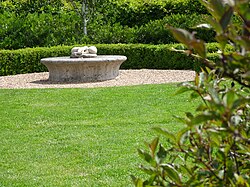
The SANDS Garden is for bereaved parents. At the centre of the garden is a sculpture of the SANDS tear drop logo which was created by John Roberts and the Portland Sculpture Trust to encourage people to sit and touch the central carved figure of the baby. |
|
 |
Sumatra Railway Memorial
Unveiled in 2001, the Sumatra Railway Memorial was designed by Jack Plant who was captured by the Japanese and forced to work constructing the railway. The memorial commemorates the 700 Allied PoWs who died building the Sumatra Railway. Several thousand captured Allied troops were forced to work on the 100 miles (160 km) railway.[18] |
2001 |
References[edit | edit source]
- ↑ 1.0 1.1 "About us | National Memorial Arboretum". thenma.org.uk. Retrieved 15 June 2018.
- ↑ 2.0 2.1 "The Remembrance Centre | National Memorial Arboretum". thenma.org.uk. Retrieved 15 June 2018.
- ↑ 3.0 3.1 "Awards | National Memorial Arboretum". thenma.org.uk. Retrieved 15 June 2018.
- ↑ 4.0 4.1 "Who we are | National Memorial Arboretum". thenma.org.uk. Retrieved 15 June 2018.
- ↑ "Associated charities". Retrieved 15 June 2018.
- ↑ "Memorial listing | National Memorial Arboretum". thenma.org.uk. Retrieved 15 June 2018.
- ↑ "Armed Forces Memorial | National Memorial Arboretum". thenma.org.uk. Retrieved 15 June 2018.
- ↑ "Wartime Nurses Memorial". MilitaryImages.Net. 22 August 2018. Retrieved 27 September 2021.
- ↑ "Millennium chapel | National Memorial Arboretum". thenma.org.uk. Retrieved 15 June 2018.
- ↑ "Afghanistan war: Services mark 20th anniversary of UK operations". BBC News. 7 October 2021. Retrieved 7 October 2021.
- ↑ "Memorial unveiled to British prisoners of war who died after ship was sunk during the Second World War". Lichfield Live. 4 October 2021. Retrieved 7 October 2021.
- ↑ "New Remembrance Glade launched at the National Memorial Arboretum". Lichfield Live. 15 September 2021. Archived from the original on 16 September 2021. Retrieved 7 October 2021.
- ↑ "Daily activities | National Memorial Arboretum". thenma.org.uk. Retrieved 15 June 2018.
- ↑ "'Railway of death' sleepers arrive". BBC News. 7 January 2002. Retrieved 9 February 2024.
- ↑ 15.0 15.1 "Prince William hails 'lasting memorial' to WW1 Christmas truce". BBC News. 12 December 2014. Retrieved 9 February 2024.
- ↑ "Monument to navy personnel unveiled in the National Memorial Arboretum". BBC News. Retrieved 21 August 2015.
- ↑ Jamieson, Alastair (20 September 2009). "Memorial statue for Polish servicemen and women unveiled". Telegraph.
- ↑ "Memorial to Sumatra railway dead". BBC News. 15 August 2001. Retrieved 20 August 2015.
External links[edit | edit source]
- Pages using the JsonConfig extension
- National Memorial Arboretum
- 2001 establishments in England
- Arboreta in England
- British military memorials and cemeteries
- Charities based in Staffordshire
- Monuments and memorials in Staffordshire
- Parks and open spaces in Staffordshire
- The Royal British Legion
- Protected areas established in 2001