

Sanjanadalvi (talk | contribs) m fixed issues |
|||
| Line 1: | Line 1: | ||
{{Short description|Species of conifer}} | {{Short description|Species of conifer}} | ||
{{Speciesbox | {{Speciesbox | ||
| image = Picea | | image = Picea omorika, Zaovine, Serbia 1.jpg | ||
| image_caption = | | image_caption = In its native range near [[Zaovine]], Serbia. Note the extremely slender crown. | ||
| status = EN | | status = EN | ||
| status_system = IUCN3.1 | | status_system = IUCN3.1 | ||
| status_ref = <ref name="iucn status 12 November 2021">{{cite iucn |author=Aleksić, J.M. |author2=Ballian, D. |author3=Isajev, D. |author4=Mataruga, M. |author5=Christian, T. |author6=Gardner, M. |date=2017 |title=''Picea omorika'' |volume=2017 | | | status_ref = <ref name="iucn status 12 November 2021">{{cite iucn |author=Aleksić, J.M. |author2=Ballian, D. |author3=Isajev, D. |author4=Mataruga, M. |author5=Christian, T. |author6=Gardner, M. |date=2017 |title=''Picea omorika'' |volume=2017 |article-number=e.T30313A84039544 |doi=10.2305/IUCN.UK.2017-2.RLTS.T30313A84039544.en |access-date=12 November 2021}}</ref> | ||
| genus = Picea | | genus = Picea | ||
| species = omorika | | species = omorika | ||
| authority = ([[Josif Pančić|Pančić]]) [[Emanuel von Purkyne|Purk.]] | | authority = ([[Josif Pančić|Pančić]]) [[Emanuel von Purkyne|Purk.]] | ||
| range_map = Picea omorika range.svg | | range_map = Picea omorika range.svg | ||
| range_map_caption = Natural range | | range_map_caption = Natural range | ||
}} | }} | ||
'''''Picea omorika''''', | '''''Picea omorika''''', the '''Serbian spruce'''<ref name="iucn status 12 November 2021"/> (in {{langx|sr|Панчићева оморика, Pančićeva omorika}}, {{IPA|sh|pâːnt͡ʃit͡ɕɛv̞a ɔmɔ̌rika|pron}}, "Pančić's spruce"),<ref>{{cite web | url = https://www.plantea.com.hr/panciceva-omorika/ | title = ''Pančićeva omorika''| author = Gligić, Vojin| author2 = Šilić, Čedomil| author3 = Vukičević, Emilija| name-list-style = amp| year = 2021| access-date = 2021-03-20}}</ref> is a [[species]] of [[Pinophyta|coniferous tree]] [[endemic (ecology)|endemic]] to the [[Drina]] River valley in western [[Serbia]], and eastern [[Bosnia and Herzegovina]], with a total range of only about 60 [[hectare|ha]], at {{convert|800-1600|m|ft||abbr=on|sigfig=2}} altitude. It was originally discovered near the Serbian village of [[Zaovine]], on Mount [[Tara (mountain)|Tara]], in 1875, and named by the Serbian botanist [[Josif Pančić]];<ref name=farjon>Farjon, A. (1990). ''Pinaceae. Drawings and Descriptions of the Genera''. Koeltz Scientific Books {{ISBN|3-87429-298-3}}.</ref><ref name=rushforthc>Rushforth, K. (1987). ''Conifers''. Helm {{ISBN|0-7470-2801-X}}.</ref><ref name=rushforth>Rushforth, K. (1999). ''Trees of Britain and Europe''. Collins {{ISBN|0-00-220013-9}}.</ref> the [[Botanical name#Binary name|specific epithet]] {{lang|sr|omorika}} is simply the Serbian word for the tree (other spruces are {{lang|sr|smrča}} in Serbian). | ||
==Description== | == Description == | ||
[[ | It is a medium-sized [[evergreen]] [[tree]] growing to {{convert|20|m|ft|0|abbr=on}} tall, exceptionally {{convert|33|m|ft|abbr=on|sigfig=2}}, with a trunk diameter of up to {{convert|0.7|m|ft|0|abbr=on}}, and a conic crown; the crown is very narrow on high altitude trees, broader at lower altitudes.<ref name=rushforthc/> The shoots are buff-brown, and densely pubescent (hairy). The [[leaf|leaves]] are needle-like, 10–20 mm long, flattened in cross-section, dark green above, and with two glaucous blue-white [[stomata|stomatal stripes]] below. The [[conifer cone|cones]] are {{convert|4|-|7|cm|0|abbr=on}} long, [[fusiform]] (spindle-shaped, broadest in the middle), dark purple (almost black) when young, maturing dark brown 5–7 months after pollination, with stiff scales.<ref name=farjon/><ref name=rushforthc/><ref name=rushforth/> | ||
[[ | |||
[[ | |||
The tallest specimen in the wild currently known is 30.2 m tall;<ref name="MT1">{{cite web | title=Serbian Spruces in Nacionalni park Tara in Zaovine, Šumadija and Western Serbia, Serbia | website=Monumental trees | url=https://www.monumentaltrees.com/en/srb/sumadijawesternserbia/zlatibor/22630_nacionalniparktara/ | access-date=2025-06-19}}</ref> older claims of trees up to 50 m tall are now unverifiable.<ref name="MT1"/> In cultivation, the tallest currently known is 33 m tall, in the [[Arboretum Mustila]] in Finland,<ref name="MT2">{{cite web | title=Serbian Spruce in Arboretum Mustila, Elimäki, Kymenlaakso, Finland | website=Monumental trees | date=2014-09-30 | url=https://www.monumentaltrees.com/en/fin/kymenlaakso/kouvola/9016_arboretummustila/23154/ | access-date=2025-06-19}}</ref> with another not far behind at 31.5 m at [[Murthly Castle]] in Scotland.<ref name="MT3">{{cite web | title=Serbian Spruce at Murthly Castle estate, Birnam, Scotland, United Kingdom | website=Monumental trees | date=2017-06-22 | url=https://www.monumentaltrees.com/en/gbr/scotland/perthandkinross/7374_murthlycastleestate/31522/ | access-date=2025-06-19}}</ref> | |||
==Cultivation== | == Ecology == | ||
Outside its native range, Serbian spruce is of major importance as an [[ornamental tree]] in large gardens, valued in northern Europe and North America for its very attractive crown form and ability to grow on a wide range of soils, including alkaline, clay, acid and sandy soil, although it prefers moist, drained loam. | Because of its limited range, it is not a major source of nutrition to wildlife, but does provide cover for birds and small mammals. Prior to the [[Pleistocene]] [[ice ages]], it had a much larger range throughout most of [[Europe]].<ref name=farjon/> | ||
<gallery widths="160px" heights="160px"> | |||
File:Picea omorika, Zaovine, Serbia 5.jpg|Foliage, showing the glossy green upper side of the needles | |||
File:Picea omorika, Zaovine, Serbia 6.jpg|Foliage, showing the glaucous blue-green [[stomata|stomatal stripes]] on the underside of needles | |||
File:Picea omorika young female cone - Keila.jpg|Immature female cone | |||
File:Fichtenzapfen P4202419.jpg|Mature female cone | |||
File:PiceaOmorika30yearsFull.jpg|Although some trees are very slender, this is not invariable; many are broader, such as this cultivated tree in France | |||
File:Manabe-nouen201605-07.jpg|Cultivar 'Pendula' | |||
</gallery> | |||
== Cultivation == | |||
Outside its native range, Serbian spruce is of major importance as an [[ornamental tree]] in large gardens, valued in northern Europe and North America for its very attractive crown form and ability to grow on a wide range of soils, including alkaline, clay, acid and sandy soil, although it prefers moist, drained loam. The crown shape is heritable, with high altitude seed sources retaining the narrow crown in cultivation, and lower altitude sources their broader crown.<ref name=rushforthc/> | |||
It is also grown to a small extent in [[forestry]] for [[Christmas tree]]s, [[timber]] and [[paper]] production, particularly in northern Europe, though its slow growth makes it less important than [[Sitka spruce]] or [[Norway spruce]]. In cultivation, it has produced [[Hybrid (biology)|hybrids]] with the closely related [[ | It is also grown to a small extent in [[forestry]] for [[Christmas tree]]s, [[timber]] and [[paper]] production, particularly in northern Europe, though its slow growth makes it less important than [[Sitka spruce]] or [[Norway spruce]]. In cultivation, it has produced [[Hybrid (biology)|hybrids]] with the closely related [[black spruce]] (named as ''P. × mariorika''),<ref>{{cite web | title=Picea × mariorika | website=/RHS | date=2025-05-09 | url=https://www.rhs.org.uk/plants/45102/picea-mariorika/details | access-date=2025-06-19}}</ref> and also with Sitka spruce.<ref name=farjon/><ref name=rushforthc/> | ||
===AGM cultivars=== | === AGM cultivars === | ||
The following [[cultivars]] have gained the [[Royal Horticultural Society]]'s [[Award of Garden Merit]]:<ref>{{cite web | url = https://www.rhs.org.uk/plants/pdfs/agm-lists/agm-ornamentals.pdf | title = AGM Plants - Ornamental | date = July 2017 | page = 78 | publisher = Royal Horticultural Society | access-date = 25 April 2018}}</ref> | The following [[cultivars]] have gained the [[Royal Horticultural Society]]'s [[Award of Garden Merit]]:<ref>{{cite web | url = https://www.rhs.org.uk/plants/pdfs/agm-lists/agm-ornamentals.pdf | title = AGM Plants - Ornamental | date = July 2017 | page = 78 | publisher = Royal Horticultural Society | access-date = 25 April 2018}}</ref> | ||
== | * ''Picea omorika'' 'Nana'<ref>{{cite web|url=https://www.rhs.org.uk/Plants/99400/Picea-omorika-Nana/Details |title=RHS Plant Selector Picea omorika 'Nana' AGM / RHS Gardening |publisher=Apps.rhs.org.uk |date= |access-date=10 February 2021}}</ref> – a dwarf form | ||
* ''Picea omorika'' 'Pendula'<ref>{{cite web|url=https://www.rhs.org.uk/Plants/90723/Picea-omorika-Pendula/Details |title=RHS Plant Selector Picea omorika 'Pendula' AGM / RHS Gardening |publisher=Apps.rhs.org.uk |date= |access-date=10 February 2021}}</ref> – a weeping form | |||
==References== | == References == | ||
{{Reflist}} | {{Reflist|2}} | ||
==External links== | == External links == | ||
* {{Commons-inline|Picea omorika}} | * {{Commons category-inline|Picea omorika|''Picea omorika''}} | ||
* [ | * ''[https://www.euforgen.org/species/picea-omorika/ Picea omorika]'' – information, genetic conservation units, and related resources. [[European Forest Genetic Resources Programme]] (EUFORGEN) | ||
{{Taxonbar|from=Q147824}} | {{Taxonbar|from=Q147824}} | ||
| Line 50: | Line 56: | ||
[[Category:Picea|omorika]] | [[Category:Picea|omorika]] | ||
[[Category:Vulnerable plants]] | [[Category:Vulnerable plants]] | ||
[[Category: | [[Category:Flora of Serbia]] | ||
[[Category:Flora of Bosnia and Herzegovina]] | |||
Latest revision as of 03:11, 4 October 2025
| Picea omorika | |
|---|---|

| |
| In its native range near Zaovine, Serbia. Note the extremely slender crown. | |
Scientific classification 
| |
| : | [[Template:Taxonomy/Picea]] |
| Species: | Template:Taxonomy/PiceaP. omorika
|
| Binomial name | |
| Template:Taxonomy/PiceaPicea omorika | |

| |
| Natural range | |
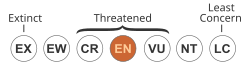
Picea omorika, the Serbian spruce[1] (in Serbian: Панчићева оморика, Pančićeva omorika, pronounced [pâːnt͡ʃit͡ɕɛv̞a ɔmɔ̌rika], "Pančić's spruce"),[2] is a species of coniferous tree endemic to the Drina River valley in western Serbia, and eastern Bosnia and Herzegovina, with a total range of only about 60 ha, at 800–1,600 m (2,600–5,200 ft) altitude. It was originally discovered near the Serbian village of Zaovine, on Mount Tara, in 1875, and named by the Serbian botanist Josif Pančić;[3][4][5] the specific epithet omorika is simply the Serbian word for the tree (other spruces are smrča in Serbian).
Description[edit | edit source]
It is a medium-sized evergreen tree growing to 20 m (66 ft) tall, exceptionally 33 m (110 ft), with a trunk diameter of up to 0.7 m (2 ft), and a conic crown; the crown is very narrow on high altitude trees, broader at lower altitudes.[4] The shoots are buff-brown, and densely pubescent (hairy). The leaves are needle-like, 10–20 mm long, flattened in cross-section, dark green above, and with two glaucous blue-white stomatal stripes below. The cones are 4–7 cm (2–3 in) long, fusiform (spindle-shaped, broadest in the middle), dark purple (almost black) when young, maturing dark brown 5–7 months after pollination, with stiff scales.[3][4][5]
The tallest specimen in the wild currently known is 30.2 m tall;[6] older claims of trees up to 50 m tall are now unverifiable.[6] In cultivation, the tallest currently known is 33 m tall, in the Arboretum Mustila in Finland,[7] with another not far behind at 31.5 m at Murthly Castle in Scotland.[8]
Ecology[edit | edit source]
Because of its limited range, it is not a major source of nutrition to wildlife, but does provide cover for birds and small mammals. Prior to the Pleistocene ice ages, it had a much larger range throughout most of Europe.[3]
-
 Foliage, showing the glossy green upper side of the needles
 -
 Foliage, showing the glaucous blue-green stomatal stripes on the underside of needles
 -
 Immature female cone
 -
 Mature female cone
 -
 Although some trees are very slender, this is not invariable; many are broader, such as this cultivated tree in France
 -
 Cultivar 'Pendula'


Cultivation[edit | edit source]
Outside its native range, Serbian spruce is of major importance as an ornamental tree in large gardens, valued in northern Europe and North America for its very attractive crown form and ability to grow on a wide range of soils, including alkaline, clay, acid and sandy soil, although it prefers moist, drained loam. The crown shape is heritable, with high altitude seed sources retaining the narrow crown in cultivation, and lower altitude sources their broader crown.[4]
It is also grown to a small extent in forestry for Christmas trees, timber and paper production, particularly in northern Europe, though its slow growth makes it less important than Sitka spruce or Norway spruce. In cultivation, it has produced hybrids with the closely related black spruce (named as P. × mariorika),[9] and also with Sitka spruce.[3][4]
AGM cultivars[edit | edit source]
The following cultivars have gained the Royal Horticultural Society's Award of Garden Merit:[10]
References[edit | edit source]
- ↑ 1.0 1.1 Aleksić, J.M.; Ballian, D.; Isajev, D.; Mataruga, M.; Christian, T.; Gardner, M. (2017). "Picea omorika". IUCN Red List of Threatened Species. 2017 e.T30313A84039544. doi:10.2305/IUCN.UK.2017-2.RLTS.T30313A84039544.en. Retrieved 12 November 2021.
- ↑ Gligić, Vojin; Šilić, Čedomil & Vukičević, Emilija (2021). "Pančićeva omorika". Retrieved 2021-03-20.
- ↑ 3.0 3.1 3.2 3.3 Farjon, A. (1990). Pinaceae. Drawings and Descriptions of the Genera. Koeltz Scientific Books ISBN 3-87429-298-3.
- ↑ 4.0 4.1 4.2 4.3 4.4 Rushforth, K. (1987). Conifers. Helm ISBN 0-7470-2801-X.
- ↑ 5.0 5.1 Rushforth, K. (1999). Trees of Britain and Europe. Collins ISBN 0-00-220013-9.
- ↑ 6.0 6.1 "Serbian Spruces in Nacionalni park Tara in Zaovine, Šumadija and Western Serbia, Serbia". Monumental trees. Retrieved 2025-06-19.
- ↑ "Serbian Spruce in Arboretum Mustila, Elimäki, Kymenlaakso, Finland". Monumental trees. 2014-09-30. Retrieved 2025-06-19.
- ↑ "Serbian Spruce at Murthly Castle estate, Birnam, Scotland, United Kingdom". Monumental trees. 2017-06-22. Retrieved 2025-06-19.
- ↑ "Picea × mariorika". /RHS. 2025-05-09. Retrieved 2025-06-19.
- ↑ "AGM Plants - Ornamental" (PDF). Royal Horticultural Society. July 2017. p. 78. Retrieved 25 April 2018.
- ↑ "RHS Plant Selector Picea omorika 'Nana' AGM / RHS Gardening". Apps.rhs.org.uk. Retrieved 10 February 2021.
- ↑ "RHS Plant Selector Picea omorika 'Pendula' AGM / RHS Gardening". Apps.rhs.org.uk. Retrieved 10 February 2021.
External links[edit | edit source]
- Picea omorika – information, genetic conservation units, and related resources. European Forest Genetic Resources Programme (EUFORGEN)