


robot: Create/upgrade articles. If there is a mistake please report on my talk page. |
brief refined references per sources and fixed typos per standard format |
||
| Line 1: | Line 1: | ||
{{Short description|Artillery used by the Mughal empire}} | |||
{{Cannon}} | {{Cannon}} | ||
'''Mughal artillery''' included a variety of cannons, rockets, and mines employed by the [[Mughal Empire]]. | '''Mughal artillery''' included a variety of cannons, rockets, and mines employed by the [[Mughal Empire]]. This gunpowder technology played an important role in the formation and expansion of the empire. In the opening lines of [[Abu'l-Fazl ibn Mubarak|Abul Fazl's]] famous text [[Ain-i-Akbari]], he claims that "except for the Mediterranean/Ottoman territories (Rumistan), in no other place was gunpowder artillery available in such abundance as in the Mughal Empire."<ref name=":0">{{Cite journal |last=Khan |first=Iqtidar Alam |date=2009 |title=Nature of Gunpowder Artillery in India during the Sixteenth Century – a Reappraisal of the Impact of European Gunnery |url=https://www.cambridge.org/core/journals/journal-of-the-royal-asiatic-society/article/abs/nature-of-gunpowder-artillery-in-india-during-the-sixteenth-century-a-reappraisal-of-the-impact-of-european-gunnery/9B7DF92AA239AA30904D1713B3A92FAD |journal=Journal of the Royal Asiatic Society |publisher=Cambridge University Press |volume=9 |issue=1 |pages=27–34 |doi=10.1017/S1356186300015911 |via=Cambridge Core|url-access=subscription }}</ref> Thereby subtly referring to the superiority of the empire's artillery<ref>{{Cite journal |last=Athar Ali |first=M |date=1971 |title=Presidential Address |url=https://www.jstor.org/stable/44145330 |journal=Proceedings of the Indian History Congress |publisher=Indian History Congress |volume=33 |pages=175–188 |jstor=44145330 }}</ref> over the [[Safavid dynasty|Safavids]] and [[Shaybanids|Shaibanids]]. During the reign of the first three Timurid rulers of India—[[Babur]], [[Humayun]], and [[Akbar]]—gunpowder artillery had "emerged as an important equipage of war, contributing significantly to the establishment of a highly centralized state structure under Akbar and to the consolidation of Mughal rule in conquered territories."<ref name=":0" /> | ||
==History== | ==History== | ||
[[File:1526-First Battle of Panipat-Ibrahim Lodhi and Babur.jpg|thumb|left|150px|Battle of Panipat<ref>{{cite web|last=unknown |url=http://warfare.uphero.com/Moghul/Baburnama/1526-First_Battle_of_Panipat-Ibrahim_Lodhi_and_Babur.htm |title=1526, First Battle of Panipat, Ibrahim Lodhi and Babur |date=1590s |work=Baburnama}}</ref>]] | [[File:1526-First Battle of Panipat-Ibrahim Lodhi and Babur.jpg|thumb|left|150px|Battle of Panipat<ref>{{cite web|last=unknown |url=http://warfare.uphero.com/Moghul/Baburnama/1526-First_Battle_of_Panipat-Ibrahim_Lodhi_and_Babur.htm |title=1526, First Battle of Panipat, Ibrahim Lodhi and Babur |date=1590s |work=Baburnama}}</ref>]] | ||
Artillery was not widely employed in Central Asia prior to the 16th century, despite Chinese mortars having been known to the Mongols hundreds of years earlier. | Artillery was not widely employed in Central Asia prior to the 16th century, despite Chinese mortars having been known to the Mongols hundreds of years earlier. Even some use of cannon at [[Hisar (city)|Hisar]] by the [[Timurid dynasty|Timurid]] [[Husayn Bayqarah|Sultan Husayn Mirza]] in 1496 did not lead to a substantial military role for artillery in India,<ref name="Adle2004"/> nor did the presence of Portuguese ship's cannon at the 1509 [[Battle of Diu (1509)|Battle of Diu]].<ref name="Grant2010"/> However, following the decisive [[Ottoman Empire|Ottoman]] victory over the [[Safavid Empire]] at the 1514 [[Battle of Chaldiran]], [[Babur]] incorporated artillery and Ottoman artillery tactics into his military.<ref name="Adle2004"/> Although authorities disagree about how many cannons he brought to India,<ref name="Barua2005"/> Babur's artillery played a "key role" in the establishment of the Mughal Empire.<ref name="Kinard2007"/> In 1526, the [[Battle of Panipat (1526)|First Battle of Panipat]] saw the introduction of massed artillery tactics to Indian warfare.<ref name="Barua2005"/> Under the guidance of [[Ottoman Empire|Ottoman]] gun master<ref name="Adle2004"/> [[Ustad Ali Quli]], Babur deployed cannons behind a screening row of carts. Enemy commander [[Ibrahim Lodi]] was provoked into a frontal attack against Babur's position, allowing him to make ideal use of his firepower.<ref name="Archer2002"/><ref name="Singh2011"/> This tactic also panicked Lodi's elephant cavalry, beginning the end of elephant warfare as a dominant offensive strategy in India.<ref name="Barua2005"/> These new weapons and tactics were even more important<ref name="Archer2002"/> against the more formidable army faced in the [[Battle of Khanwa]] the following year.<ref name="Barua2005"/> | ||
[[File:Portable Cannon.jpg|thumb|Portable Cannon]] | |||
Later emperors paid less attention to the technical aspects of artillery, allowing the Mughal Empire to gradually fall behind in weapon technology,<ref name="Richards1996"/> although the degree to which this decline affected military operations is debated.<ref name="Gommans2002"/> | Artillery remained an important part of the Mughal military, in both field deployment and incorporation into defensive forts. However, transportation of the extremely heavy guns remained problematic,<ref name="Archer2002"/> even as weapon technology improved during the reign of [[Akbar]].<ref name="Gommans2002"/> In 1582, [[Fathullah Shirazi]], a [[Persian people|Persian]]-[[History of India|Indian]] Mughal officer, developed a seventeen-barrelled cannon, fired with a [[matchlock]].<ref>{{citation |title=Science and technology in early modern Islam, c.1450-c.1850 |first=William Gervase |last=Clarence-Smith |url=http://www.lse.ac.uk/collections/economicHistory/GEHN/GEHNPDF/ScienceandTechnology-WGCS.pdf |publisher=Global economic history network, [[London School of Economics]] |page=7 }}</ref> Shirazi also invented an anti-infantry [[volley gun]] with multiple [[gun barrel]]s similar to a [[hand cannon]].<ref name="Autocannon">{{Citation|first=A. K.|last=Bag|year=2005|title=Fathullah Shirazi: Cannon, Multi-barrel Gun and Yarghu|publisher=Indian Journal of History of Science|pages=431–436|postscript=.}}</ref> | ||
Later emperors paid less attention to the technical aspects of artillery, allowing the Mughal Empire to gradually fall behind in weapon technology,<ref name="Richards1996"/> although the degree to which this decline affected military operations is debated.<ref name="Gommans2002"/> Under [[Aurangzeb]], the Mughal technology remained superior to that of the breakaway [[Maratha Empire]],<ref name="Barua2005"/> but traditional Mughal artillery tactics were difficult to employ against Maratha guerrilla raids.<ref name="Chaurasia2011"/> In 1652 and 1653, during the [[Mughal–Safavid War (1649–1653)|Mughal–Safavid War]], prince [[Dara Shikoh]] was able to move light artillery through the [[Bolan Pass]] to assist in the siege of [[Qandahar]].<ref name="Gommans2002"/> But problems with the accuracy and reliability of the weapons,<ref name="Richards1996"/> as well as the inherent defensive strengths of the fort,<ref name="Chandra2000"/> failed to produce a victory. By the 18th century, the obsolete bronze guns of the declining empire were unable to compete with newer cast-iron weapons,<ref name="Gommans2002"/> and performed poorly against forces that employed them, such as [[Jean Law de Lauriston]]'s French troops.<ref name="Regani1988"/> | |||
==Weaponry== | ==Weaponry== | ||
The Mughal military employed a broad array of gunpowder weapons larger than personal firearms, from rockets and mobile guns to an enormous cannon, over 14 | [[File:Yarghu.jpg|thumb|"Yarghu": machine for cleaning gun barrels]] | ||
Archaeological research has recovered guns made of [[bronze]] from [[Kozhikode]], dating from 1504, and [[Diu, India]] which dates from 1533.<ref name="Partington226">{{cite book |last=Partington |first=James Riddick |title=A History of Greek Fire and Gunpowder |url=https://archive.org/details/historyofgreekfi00part/page/226 |page=[https://archive.org/details/historyofgreekfi00part/page/226 226] |year=1999 |orig-year=First published 1960 |place=Baltimore |publisher=Johns Hopkins University Press |isbn=978-0-8018-5954-0 |author-link=J. R. Partington}}</ref> | |||
Mughal [[cannon]] making skills advanced during the 17th century.<ref>{{cite book |title=Modern World System and Indian Proto-industrialization: Bengal 1650–1800 |volume=1 |first=Abhay Kumar |last=Singh |pages=351–352 |publisher=Northern Book Centre |location=New Delhi |year=2006 |isbn=978-81-7211-201-1 |url=https://books.google.com/books?id=WwNUblS-jpwC&pg=PA351 |access-date=30 September 2012}}</ref> One of the most impressive Mughal cannons is known as the Zafarbaksh, which is a very rare composite cannon, the production of which required skills in both wrought-iron forge welding and [[bronze]]-casting technologies as well as in-depth knowledge of the qualities of both metals.<ref>{{cite journal |last1=Balasubramaniam |first1=R. |last2=Chattopadhyay |first2=Pranab K. |year=2007 |title=''Zafarbaksh'' – The Composite Mughal Cannon of Aurangzeb at Fort William in Kolkata |url=http://www.insa.nic.in/writereaddata/UpLoadedFiles/IJHS/Vol42_2_5_RBalasubramaniam.pdf |journal=Indian Journal of History of Science |volume=42 |archive-url=https://web.archive.org/web/20151222081939/http://www.insa.nic.in/writereaddata/UpLoadedFiles/IJHS/Vol42_2_5_RBalasubramaniam.pdf |archive-date=22 December 2015}}</ref> Some devices to support the maintenance of these cannons also developed, such as a machine invented by the Mughal officer [[Fathullah Shirazi]] known as the ''"Yarghu"'' which could clean sixteen gun barrels simultaneously and was operated by a cow.<ref name="FS">{{Cite book |last1=Alvi |first1=M.A. |last2=Rahman |first2=Abdur |title=Fathullah Shirazi: A Sixteenth Century Indian Scientist |publisher=National Institute of Sciences of India |year=1968 |location=New Delhi |language=en}}</ref> Shirazi also developed an early multi-gun shot. Similar to the [[polybolos]] and [[repeating crossbow]]s which were used in [[ancient Greece]] and China respectively, Shirazi's rapid-firing [[hand cannon]] had multiple [[gun barrel]]s that fired gunpowder, akin to a [[volley gun]].<ref name="Fathullah Shirazi">{{Cite journal |last=Bag |first=A.K. |year=2005 |title=Fathullah Shirazi: Cannon, Multi-barrel Gun and Yarghu |journal=Indian Journal of History of Science |volume=40 |issue=3 |pages=431–436 |issn=0019-5235}}</ref> | |||
The ''Ibrahim Rauza'' was a famed cannon which was well known for its multiple barrels.<ref>{{Cite book |url=https://books.google.com/books?id=lDRbAAAAQAAJ |title=Bombay and western India: a series of stray papers |volume=2 |first=James |last=Douglas |publisher=Sampson Low, Marston & Company |year=1893}}</ref> [[François Bernier]], the personal physician to Aurangzeb, observed Mughal gun-carriages each drawn by two horses, an improvement over the bullock-drawn gun-carriages used elsewhere in India.<ref>{{Cite book |last1=Khan |first1=Iqtidar Alam |editor-last=Buchanan |editor-first=Brenda J. |chapter=The Indian Response to Firearms, 1300–1750 |title=Gunpowder, Explosives And the State: A Technological History |chapter-url=https://books.google.com/books?id=7n6Cg9znFrUC&pg=PA59 |publisher=Ashgate Publishing |year=2006 |page=59 |isbn=978-0-7546-5259-5}}</ref> | |||
<gallery> | |||
File:Daulatabad fort N-MH-A50-3.JPG|Daulatabad cannon | |||
File:Kalak Bangadi,Janjira Fort.jpg|Kalak Bangadi cannon. | |||
File:Daulatabad cannon1.jpg|One of the Daulatabad cannons | |||
File:Kilkila cannon.jpg|Kilkila cannon | |||
File:Aurangabad - Daulatabad Fort (69).JPG|Aurangabad cannon | |||
</gallery> | |||
The Mughal military employed a broad array of gunpowder weapons larger than personal firearms, from rockets and mobile guns to an enormous cannon, over {{convert|14|ft|m|abbr=on}}, once described as the "largest piece of ordnance in the world."<ref name="Irvine1903"/> This array of weapons was divided into heavy and light artillery.<ref name="Gommans2002"/><ref name="Irvine1903"/><ref name=":0" /> According to [[historian]] [[Irfan Habib]], one cannot "estimate the amount of metal used in the artillery of the Mughal army, or the amount of gunpowder it consumed, but in view of the numbers employed in the artillery (over 40,000 men), it is certain that at any time some tens of thousands of matchlocks (surely not less than 25,000, on these numbers) must have been in use; and we know that excessively heavy cannon were much favored in India."<ref>{{Cite journal |last=Habib |first=Irfan |date=2011 |title=Potentialities of Capitalistic Development in the Economy of Mughal India |url=https://www.cambridge.org/core/journals/journal-of-economic-history/article/abs/potentialities-of-capitalistic-development-in-the-economy-of-mughal-india/1817BC3259C3D46D38D4579E3D3950FE |journal=The Journal of Economic History |publisher=Cambridge University Press |volume=29 |issue=1 |pages=32–78 |doi=10.1017/S0022050700097825 |via=Cambridge Core|url-access=subscription }}</ref> | |||
[[File:Bullocks dragging siege-guns up hill during the attack on Ranthambhor Fort.jpg|thumb|left|150px|Bullocks dragging siege-guns up hill during Akbar's attack on Ranthambhor Fort<ref>{{cite web |last=Unknown |url=http://warfare2.likamva.in/Moghul/Akbar/1568-Bullocks_dragging_siege-guns_up_hill_during_the_attack_on_Ranthambhor_Fort.htm |title=Bullocks dragging siege-guns up hill during Akbar's attack on Ranthambhor Fort |date=1590–95 |work=the Akbarnama |access-date=2014-05-19 |archive-url=https://web.archive.org/web/20140519132308/http://warfare2.likamva.in/Moghul/Akbar/1568-Bullocks_dragging_siege-guns_up_hill_during_the_attack_on_Ranthambhor_Fort.htm |archive-date=2014-05-19 |url-status=dead }}</ref>]] | [[File:Bullocks dragging siege-guns up hill during the attack on Ranthambhor Fort.jpg|thumb|left|150px|Bullocks dragging siege-guns up hill during Akbar's attack on Ranthambhor Fort<ref>{{cite web |last=Unknown |url=http://warfare2.likamva.in/Moghul/Akbar/1568-Bullocks_dragging_siege-guns_up_hill_during_the_attack_on_Ranthambhor_Fort.htm |title=Bullocks dragging siege-guns up hill during Akbar's attack on Ranthambhor Fort |date=1590–95 |work=the Akbarnama |access-date=2014-05-19 |archive-url=https://web.archive.org/web/20140519132308/http://warfare2.likamva.in/Moghul/Akbar/1568-Bullocks_dragging_siege-guns_up_hill_during_the_attack_on_Ranthambhor_Fort.htm |archive-date=2014-05-19 |url-status=dead }}</ref>]] | ||
===Heavy artillery=== | ===Heavy artillery=== | ||
Extremely heavy artillery was an important part of the Mughal military, especially under its early emperors. | Extremely heavy artillery was an important part of the Mughal military, especially under its early emperors. | ||
Emperor Babur reportedly deployed guns capable of firing cannonballs weighing between {{convert|225|and|315|lb|kg|abbr=on}} during a 1527 siege, and had previously employed a cannon capable of firing a {{convert|540|lb|kg|abbr=on}} stone ball. [[Humayun]] did not field such massive artillery at the [[Battle of Kannauj]] in 1540, but still had heavy cannons capable of firing 46 pound lead balls at a distance of one ''[[farsakh]]''.<ref name="Schimmel2004"/> These large weapons were often given heroic names, such as Tiger Mouth (''Sher Dahan''), Lord Champion (''Ghazi Khan''), or Conqueror of the Army (''Fath-i-Lashkar''),<ref name="Irvine1903"/><ref name="Mason1974"/> and inscriptions, sometimes in verse. They were not only considered weapons, but real works of art.<ref name="Schimmel2004"/> | |||
These heavy artillery pieces were not easy to move. Rugged passes and water crossings were insurmountable barriers,<ref name="Irvine1903"/> and even when they could be moved, it was a slow process requiring sixteen<ref name="Schimmel2004"/> or twenty oxen for relatively moderate cannons such as Humayun's. [[Muhammad Azam Shah]] was forced to abandon his heavy artillery en route to the [[Battle of Jajau]].<ref name="Irvine1903"/> The largest such weapons, such as [[Muhammad Shah]]'s "Fort Opener", required a team of "four elephants and thousands of oxen" and only rarely reached their siege targets.<ref name="Smith2012"/> | |||
Other heavy artillery used by the Mughals were ''Wökhul''<ref>{{harvtxt|James Prinsep |year=2007|volume= 65 part 1 |2007|p=294}}</ref> ([[Mortar (weapon)|mortars]]).<ref name="Gommans2002"/><ref name="Irvine1903"/> The largest recorded Mughal mortar was designed by Shirazi, which when used during the [[Siege of Chittorgarh (1567–1568)|Siege of Chittorgarh]] were capable firing a cannonball as heavy as 3,000 lbs.<ref name="Masters of Warfare Fifty Underrated Military Commanders from Classical Antiquity to the Cold War; Pinzelli; Akbar">{{cite book |author1=Eric G. L. Pinzelli |title=Masters of Warfare Fifty Underrated Military Commanders from Classical Antiquity to the Cold War |date=2022 |publisher=Pen & Sword Books |isbn=9781399070157 |pages=140–142 |url=https://books.google.com/books?id=W62ZEAAAQBAJ |access-date=14 April 2024 |language=En}}</ref> Mines were also deployed by sappers against fortress walls.<ref name="Irvine1903"/> Although these weapons had noticeable successes, such as the victory at the Siege of Chittorgarh in 1567, their preparation and deployment came at the cost of substantial Mughal losses.<ref name="Schimmel2004"/><ref>{{cite book |author1=Asiatic Society, Asiatic Society of Bengal |location=Kolkata, India|title=Journal of the Asiatic Society of Bengal, Volume 65, Part 1 |url=https://books.google.com/books?id=hOnRAAAAMAAJ|date=2007 |publisher=Asiatic Society of Bengal |isbn=978-9693519242 |page=294 |access-date=13 July 2024}}</ref> Another recorded usage of mortars also occurred in 1659 during the conflict between Aurangzeb against his brother, [[Shah Shuja (Mughal prince)|Shah Shuja]].<ref>{{cite book |author1=James Prinsep |editor1-last=Sarkar |editor1-first=Jadunath |editor1-link=Jadunath Sarkar |title=Journal of the Asiatic Society of Bengal (first published in 1896) |url=https://books.google.com/books?id=2WHf7oZgguEC |year=2007|volume= 65 part 1 |publisher=Asiatic Society, Asiatic Society of Bengal |location=Kolkata, India |isbn=978-9693519242 |page=187 |access-date=13 July 2024}}</ref><ref>{{cite book |author1=William Irvine |editor1-last=Sarkar |editor1-first=Jadunath |editor1-link=Jadunath Sarkar |title=Later Mughals |url=https://books.google.com/books?id=VOk2AQAAMAAJ |year=2007|series= Journal of the Asiatic Society of Bengal |publisher=Asiatic Society, Asiatic Society of Bengal |location=Kolkata, India |isbn=978-9693519242 |page=199 |access-date=13 July 2024}}</ref> | |||
The Mughals artillery corps employed hand [[grenade|grenades]]<ref name="Irvine1903">{{cite book |author=Irvine W. |author-link=William Irvine (historian) |title=The Army Of The Indian Moghuls: Its Organization And Administration |url=https://archive.org/details/armyofindianmogh00irvirich |publisher=Luzac |year=1903 |pages=113–159}}</ref> and [[rocket artillery]].<ref name="The Mughal Empire at War Babur, Akbar and the Indian Military Revolution, 1500-1605" />{{rp|48}}<ref name="Throwing Fire Projectile Technology Through History" />{{rp|133}} Under [[Akbar]]'s reign, Mughal [[rockets]] began to use [[metal]] casing, which made them more weatherproof and allowed a larger amount of gunpowder, increasing their destructive power.<ref name="The Mughal Empire at War Babur, Akbar and the Indian Military Revolution, 1500-1605" />{{rp|48}} Mughal ''ban'' [[iron]] rockets were described by European visitors, including [[François Bernier]] who witnessed the 1658 [[Battle of Samugarh]] fought between brothers [[Aurangzeb]] and [[Dara Shikoh]].<ref name="Throwing Fire Projectile Technology Through History" />{{rp|133}} Mughal rockets are considered a predecessor to the [[Mysorean rockets]] later employed by [[Hyder Ali]] and [[Tipu Sultan]] in the 18th century. | |||
By the 17th century, Indians were manufacturing a diverse variety of firearms; large guns in particular became visible in [[Tanjore]], [[Dacca]], [[Bijapur, Karnataka|Bijapur]] and [[Murshidabad]].<ref>{{cite book |last=Partington |first=James Riddick |title=A History of Greek Fire and Gunpowder |url=https://archive.org/details/historyofgreekfi00part/page/225 |page=[https://archive.org/details/historyofgreekfi00part/page/225 225] |year=1999 |orig-year=First published 1960 |place=Baltimore |publisher=Johns Hopkins University Press |isbn=978-0-8018-5954-0}}</ref> | |||
{{clear|left}} | {{clear|left}} | ||
===Light artillery=== | ===Light artillery=== | ||
[[File:Reminiscences of Imperial Delhi Camel Artillery Man.PNG|thumb|Camel-mounted swivel gun (''zamburak'')]] | [[File:Reminiscences of Imperial Delhi Camel Artillery Man.PNG|thumb|Camel-mounted swivel gun (''zamburak'')]] | ||
Mughal light artillery, also known as artillery of the stirrup,<ref name="Gommans2002"/><ref name="Chandra2000"/> consisted of a variety of smaller weapons. | Mughal light artillery, also known as artillery of the stirrup,<ref name="Gommans2002"/><ref name="Chandra2000"/> consisted of a variety of smaller weapons. Animal-borne [[swivel guns]] saw widespread use in several forms.<ref name="Richards1996"/> Elephants carried two pieces of "elephant barrel" (''gajnal'' and ''hathnal'') artillery and two soldiers to fire them. The elephants served only to transport the weapons and their crew and they dismounted before firing. "Camel guns" (''shutarnal'' or ''[[zamburak]]'') and "swivel guns" on the other hand were carried on camel-back and were fired while mounted.''<ref name="Irvine1903" />'' Other light guns were mounted on wheeled carts, pulled by oxen<ref name="Irvine1903" /> or horses.<ref name="Grant2010" /> | ||
Mobile field artillery was a core part of the military power of the Mughal empire that distinguished Mughal troops from most of their enemies. A status symbol for the emperor, pieces of artillery would always accompany the Mughal emperor on his journeys through the empire. The main role of Mughal artillery in battle was to counter hostile [[war elephant]]s which were common in warfare on the Indian subcontinent. But although emperor [[Akbar]] personally designed gun carriages to improve the accuracy of his cannons, Mughal artillery was more effective at scaring the opponent's elephants off the battlefield. The ensuing chaos in the hostile ranks would enable the Mughal armies to defeat the enemy's troops.<ref name=Rothermund/> | |||
[[Grenadier]]s and rocket-bearing soldiers were also considered part of the Mughal light artillery corps.<ref name="Irvine1903"/> The Mughal artillery corps employed rockets,<ref name="The Mughal Empire at War Babur, Akbar and the Indian Military Revolution, 1500-1605">{{cite book |author1=Andrew de la Garza |title=The Mughal Empire at War Babur, Akbar and the Indian Military Revolution, 1500–1605 |date=2016 |publisher=Taylor & Francis |isbn=9781317245315 |url=https://books.google.com/books?id=OGERDAAAQBAJ |access-date=6 December 2023 |language=En}}</ref>{{rp|48}}<ref name="Throwing Fire Projectile Technology Through History">{{cite book |author1=Alfred W. Crosby |title=Throwing Fire Projectile Technology Through History |date=2002 |publisher=Cambridge University Press |isbn=9780521791588 |url=https://books.google.com/books?id=vyFxldb2GJQC |access-date=6 December 2023 |language=En |format=Hardcover}}</ref>{{rp|133}} which are considered to be the predecessor of [[Mysorean rockets]] that employed by [[Hyder Ali]] and [[Tipu Sultan]]<ref>"{{cite book |author1=Will Slatyer |title=The Life/Death Rhythms of Capitalist Regimes – Debt Before Dishonour Timetable of World Dominance 1400–2100 |date=2015 |publisher=Partridge Publishing Singapore |isbn=9781482829617 |url=https://books.google.com/books?id=tprrCQAAQBAJ |access-date=6 December 2023 |language=En |quote=rockets were upgraded versions of Mughal rockets utilised during the Siege of Jinji by the progeny of the Nawab of Arcot}}</ref> Despite packing a considerable punch on the battlefield, the rockets were quite lightweight and easy to transport, as it was recorded that a camel can carry up to 20 Mughal rockets.<ref name="The Mughal Empire at War Babur, Akbar and the Indian Military Revolution, 1500-1605" /> During the reign of [[Akbar]], he ordered many rockets. It is recorded that he once ordered 16,000 rockets for a single garrison.<ref name="The Mughal Empire at War Babur, Akbar and the Indian Military Revolution, 1500-1605" /> | |||
{{clear|both}} | {{clear|both}} | ||
==See also== | ==See also== | ||
* | * [[Mughal weapons]] | ||
==References== | ==References== | ||
| Line 48: | Line 76: | ||
<ref name="Gommans2002">{{cite book |author=Gommans JJL. |title=Mughal Warfare: Indian Frontiers and Highroads to Empire 1500-1700 |publisher=Routledge |year=2002 |isbn=978-0415239899}}</ref> | <ref name="Gommans2002">{{cite book |author=Gommans JJL. |title=Mughal Warfare: Indian Frontiers and Highroads to Empire 1500-1700 |publisher=Routledge |year=2002 |isbn=978-0415239899}}</ref> | ||
<ref name="Grant2010">{{cite book |author=Grant RG. |title=Warrior: A Visual History of the Fighting Man |publisher=DK | <ref name="Grant2010">{{cite book |author=Grant RG. |title=Warrior: A Visual History of the Fighting Man |publisher=DK Adult |year=2010 |isbn=978-0756665418 |pages=126–127}}</ref> | ||
<ref name="Irvine1903">{{cite book |author=Irvine W. |author-link=William Irvine (historian) |title=The Army Of The Indian Moghuls: Its Organization And Administration |publisher=Luzac |year=1903 |pages=113–159}}</ref> | <ref name="Irvine1903">{{cite book |author=Irvine W. |author-link=William Irvine (historian) |title=The Army Of The Indian Moghuls: Its Organization And Administration |url=https://archive.org/details/armyofindianmogh00irvirich |publisher=Luzac |year=1903 |pages=113–159}}</ref> | ||
<ref name="Kinard2007">{{cite book |author=Kinard J. |title=Artillery: An Illustrated History of Its Impact |publisher=ABC-CLIO |year=2007 |isbn=978-1851095568 |pages=95–96}}</ref> | <ref name="Kinard2007">{{cite book |author=Kinard J. |title=Artillery: An Illustrated History of Its Impact |publisher=ABC-CLIO |year=2007 |isbn=978-1851095568 |pages=95–96}}</ref> | ||
| Line 56: | Line 84: | ||
<ref name="Mason1974">{{cite book |author=Mason P. |title=A Matter of Honour: An Account of the Indian Army, Its Officers and Men |publisher=Jonathan Cape Limited |year=1974 |isbn=978-0224009782 |page=47}}</ref> | <ref name="Mason1974">{{cite book |author=Mason P. |title=A Matter of Honour: An Account of the Indian Army, Its Officers and Men |publisher=Jonathan Cape Limited |year=1974 |isbn=978-0224009782 |page=47}}</ref> | ||
<ref name="Regani1988">{{cite book |author=Ragani S. |title=Nizam-British Relations | <ref name="Regani1988">{{cite book |author=Ragani S. |title=Nizam-British Relations 1724–1857 |publisher=Concept Publishing |year=1988 |orig-year=1st. pub. 1963 |isbn=978-81-7022-195-1 |page=101}}</ref> | ||
<ref name="Richards1996">{{cite book |author=Richard JF. |title=The Mughal Empire |publisher=Cambridge University Press |year=1996 |isbn=978-0521566032 |pages=288–289}}</ref> | <ref name="Richards1996">{{cite book |author=Richard JF. |title=The Mughal Empire |publisher=Cambridge University Press |year=1996 |isbn=978-0521566032 |pages=288–289}}</ref> | ||
| Line 69: | Line 97: | ||
}} | }} | ||
==External links== | ==Further reading== | ||
# Khan, Iqtidar Alam. (1991). "The Nature of Handguns in Mughal India: 16th and 17th Centuries." ''Proceedings of the Indian History Congress'', ''52'', 378–389. {{JSTOR|44142632}} | |||
# Khan, Iqtidar Alam. (2004). ''Gunpowder and Firearms: Warfare in Medieval India.'' Delhi, Oxford University Press. {{ISBN|0195665260}} | |||
# Khan, Iqtidar Alam. (2005). "Gunpowder and Empire: Indian Case." ''Social Scientist'', ''33''(3/4), 54–65. {{JSTOR|3518112}} | |||
# Nath, Pratyay. (2019). ''Climate of Conquest: War, Environment, and Empire in Mughal North India''. Delhi, Oxford University Press. {{doi|10.1093/oso/9780199495559.001.0001}} | |||
# Roy, Kaushik. (2012). "Horses, guns and governments: A comparative study of the military transition in the Manchu, Mughal, Ottoman and Safavid empires, circa 1400 to circa 1750''." International Area Studies Review, 15(2), 99–121.'' {{doi|10.1177/2233865912447087}} Accessed here: https://journals.sagepub.com/doi/abs/10.1177/2233865912447087?journalCode=iasb | |||
# {{cite book |author1=Francisco Bethencourt |author2=Cátia A.P. Antunes |author1-link=Francisco Bethencourt |title=Merchant Cultures A Global Approach to Spaces, Representations and Worlds of Trade, 1500–1800 |date=2022 |publisher=Brill |isbn=9789004506572 |url=https://books.google.com/books?id=mplcEAAAQBAJ |access-date=21 March 2024 |language=En}} | |||
== External links == | |||
{{commons category-inline|Mughal artillery}} | {{commons category-inline|Mughal artillery}} | ||
| Line 75: | Line 112: | ||
[[Category:Military of the Mughal Empire]] | [[Category:Military of the Mughal Empire]] | ||
[[Category:Artillery of India]] | [[Category:Artillery of India]] | ||
[[Category:Warfare of the | [[Category:Warfare of the early modern period]] | ||
Latest revision as of 15:50, 24 November 2025
Mughal artillery included a variety of cannons, rockets, and mines employed by the Mughal Empire. This gunpowder technology played an important role in the formation and expansion of the empire. In the opening lines of Abul Fazl's famous text Ain-i-Akbari, he claims that "except for the Mediterranean/Ottoman territories (Rumistan), in no other place was gunpowder artillery available in such abundance as in the Mughal Empire."[1] Thereby subtly referring to the superiority of the empire's artillery[2] over the Safavids and Shaibanids. During the reign of the first three Timurid rulers of India—Babur, Humayun, and Akbar—gunpowder artillery had "emerged as an important equipage of war, contributing significantly to the establishment of a highly centralized state structure under Akbar and to the consolidation of Mughal rule in conquered territories."[1]
History[edit | edit source]

Artillery was not widely employed in Central Asia prior to the 16th century, despite Chinese mortars having been known to the Mongols hundreds of years earlier. Even some use of cannon at Hisar by the Timurid Sultan Husayn Mirza in 1496 did not lead to a substantial military role for artillery in India,[4] nor did the presence of Portuguese ship's cannon at the 1509 Battle of Diu.[5] However, following the decisive Ottoman victory over the Safavid Empire at the 1514 Battle of Chaldiran, Babur incorporated artillery and Ottoman artillery tactics into his military.[4] Although authorities disagree about how many cannons he brought to India,[6] Babur's artillery played a "key role" in the establishment of the Mughal Empire.[7] In 1526, the First Battle of Panipat saw the introduction of massed artillery tactics to Indian warfare.[6] Under the guidance of Ottoman gun master[4] Ustad Ali Quli, Babur deployed cannons behind a screening row of carts. Enemy commander Ibrahim Lodi was provoked into a frontal attack against Babur's position, allowing him to make ideal use of his firepower.[8][9] This tactic also panicked Lodi's elephant cavalry, beginning the end of elephant warfare as a dominant offensive strategy in India.[6] These new weapons and tactics were even more important[8] against the more formidable army faced in the Battle of Khanwa the following year.[6]

Artillery remained an important part of the Mughal military, in both field deployment and incorporation into defensive forts. However, transportation of the extremely heavy guns remained problematic,[8] even as weapon technology improved during the reign of Akbar.[10] In 1582, Fathullah Shirazi, a Persian-Indian Mughal officer, developed a seventeen-barrelled cannon, fired with a matchlock.[11] Shirazi also invented an anti-infantry volley gun with multiple gun barrels similar to a hand cannon.[12]
Later emperors paid less attention to the technical aspects of artillery, allowing the Mughal Empire to gradually fall behind in weapon technology,[13] although the degree to which this decline affected military operations is debated.[10] Under Aurangzeb, the Mughal technology remained superior to that of the breakaway Maratha Empire,[6] but traditional Mughal artillery tactics were difficult to employ against Maratha guerrilla raids.[14] In 1652 and 1653, during the Mughal–Safavid War, prince Dara Shikoh was able to move light artillery through the Bolan Pass to assist in the siege of Qandahar.[10] But problems with the accuracy and reliability of the weapons,[13] as well as the inherent defensive strengths of the fort,[15] failed to produce a victory. By the 18th century, the obsolete bronze guns of the declining empire were unable to compete with newer cast-iron weapons,[10] and performed poorly against forces that employed them, such as Jean Law de Lauriston's French troops.[16]
Weaponry[edit | edit source]

Archaeological research has recovered guns made of bronze from Kozhikode, dating from 1504, and Diu, India which dates from 1533.[17]
Mughal cannon making skills advanced during the 17th century.[18] One of the most impressive Mughal cannons is known as the Zafarbaksh, which is a very rare composite cannon, the production of which required skills in both wrought-iron forge welding and bronze-casting technologies as well as in-depth knowledge of the qualities of both metals.[19] Some devices to support the maintenance of these cannons also developed, such as a machine invented by the Mughal officer Fathullah Shirazi known as the "Yarghu" which could clean sixteen gun barrels simultaneously and was operated by a cow.[20] Shirazi also developed an early multi-gun shot. Similar to the polybolos and repeating crossbows which were used in ancient Greece and China respectively, Shirazi's rapid-firing hand cannon had multiple gun barrels that fired gunpowder, akin to a volley gun.[21]
The Ibrahim Rauza was a famed cannon which was well known for its multiple barrels.[22] François Bernier, the personal physician to Aurangzeb, observed Mughal gun-carriages each drawn by two horses, an improvement over the bullock-drawn gun-carriages used elsewhere in India.[23]
-
 Daulatabad cannon
 -
 Kalak Bangadi cannon.
 -
 One of the Daulatabad cannons
 -
 Kilkila cannon
 -
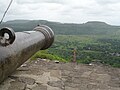 Aurangabad cannon


.JPG)
The Mughal military employed a broad array of gunpowder weapons larger than personal firearms, from rockets and mobile guns to an enormous cannon, over 14 ft (4.3 m), once described as the "largest piece of ordnance in the world."[24] This array of weapons was divided into heavy and light artillery.[10][24][1] According to historian Irfan Habib, one cannot "estimate the amount of metal used in the artillery of the Mughal army, or the amount of gunpowder it consumed, but in view of the numbers employed in the artillery (over 40,000 men), it is certain that at any time some tens of thousands of matchlocks (surely not less than 25,000, on these numbers) must have been in use; and we know that excessively heavy cannon were much favored in India."[25]

Heavy artillery[edit | edit source]
Extremely heavy artillery was an important part of the Mughal military, especially under its early emperors.
Emperor Babur reportedly deployed guns capable of firing cannonballs weighing between 225 and 315 lb (102 and 143 kg) during a 1527 siege, and had previously employed a cannon capable of firing a 540 lb (240 kg) stone ball. Humayun did not field such massive artillery at the Battle of Kannauj in 1540, but still had heavy cannons capable of firing 46 pound lead balls at a distance of one farsakh.[27] These large weapons were often given heroic names, such as Tiger Mouth (Sher Dahan), Lord Champion (Ghazi Khan), or Conqueror of the Army (Fath-i-Lashkar),[24][28] and inscriptions, sometimes in verse. They were not only considered weapons, but real works of art.[27]
These heavy artillery pieces were not easy to move. Rugged passes and water crossings were insurmountable barriers,[24] and even when they could be moved, it was a slow process requiring sixteen[27] or twenty oxen for relatively moderate cannons such as Humayun's. Muhammad Azam Shah was forced to abandon his heavy artillery en route to the Battle of Jajau.[24] The largest such weapons, such as Muhammad Shah's "Fort Opener", required a team of "four elephants and thousands of oxen" and only rarely reached their siege targets.[29]
Other heavy artillery used by the Mughals were Wökhul[30] (mortars).[10][24] The largest recorded Mughal mortar was designed by Shirazi, which when used during the Siege of Chittorgarh were capable firing a cannonball as heavy as 3,000 lbs.[31] Mines were also deployed by sappers against fortress walls.[24] Although these weapons had noticeable successes, such as the victory at the Siege of Chittorgarh in 1567, their preparation and deployment came at the cost of substantial Mughal losses.[27][32] Another recorded usage of mortars also occurred in 1659 during the conflict between Aurangzeb against his brother, Shah Shuja.[33][34]
The Mughals artillery corps employed hand grenades[24] and rocket artillery.[35]:48[36]:133 Under Akbar's reign, Mughal rockets began to use metal casing, which made them more weatherproof and allowed a larger amount of gunpowder, increasing their destructive power.[35]:48 Mughal ban iron rockets were described by European visitors, including François Bernier who witnessed the 1658 Battle of Samugarh fought between brothers Aurangzeb and Dara Shikoh.[36]:133 Mughal rockets are considered a predecessor to the Mysorean rockets later employed by Hyder Ali and Tipu Sultan in the 18th century.
By the 17th century, Indians were manufacturing a diverse variety of firearms; large guns in particular became visible in Tanjore, Dacca, Bijapur and Murshidabad.[37]
Light artillery[edit | edit source]

Mughal light artillery, also known as artillery of the stirrup,[10][15] consisted of a variety of smaller weapons. Animal-borne swivel guns saw widespread use in several forms.[13] Elephants carried two pieces of "elephant barrel" (gajnal and hathnal) artillery and two soldiers to fire them. The elephants served only to transport the weapons and their crew and they dismounted before firing. "Camel guns" (shutarnal or zamburak) and "swivel guns" on the other hand were carried on camel-back and were fired while mounted.[24] Other light guns were mounted on wheeled carts, pulled by oxen[24] or horses.[5]
Mobile field artillery was a core part of the military power of the Mughal empire that distinguished Mughal troops from most of their enemies. A status symbol for the emperor, pieces of artillery would always accompany the Mughal emperor on his journeys through the empire. The main role of Mughal artillery in battle was to counter hostile war elephants which were common in warfare on the Indian subcontinent. But although emperor Akbar personally designed gun carriages to improve the accuracy of his cannons, Mughal artillery was more effective at scaring the opponent's elephants off the battlefield. The ensuing chaos in the hostile ranks would enable the Mughal armies to defeat the enemy's troops.[38]
Grenadiers and rocket-bearing soldiers were also considered part of the Mughal light artillery corps.[24] The Mughal artillery corps employed rockets,[35]:48[36]:133 which are considered to be the predecessor of Mysorean rockets that employed by Hyder Ali and Tipu Sultan[39] Despite packing a considerable punch on the battlefield, the rockets were quite lightweight and easy to transport, as it was recorded that a camel can carry up to 20 Mughal rockets.[35] During the reign of Akbar, he ordered many rockets. It is recorded that he once ordered 16,000 rockets for a single garrison.[35]
See also[edit | edit source]
References[edit | edit source]
- ↑ 1.0 1.1 1.2 Khan, Iqtidar Alam (2009). "Nature of Gunpowder Artillery in India during the Sixteenth Century – a Reappraisal of the Impact of European Gunnery". Journal of the Royal Asiatic Society. 9 (1). Cambridge University Press: 27–34. doi:10.1017/S1356186300015911 – via Cambridge Core.
- ↑ Athar Ali, M (1971). "Presidential Address". Proceedings of the Indian History Congress. 33. Indian History Congress: 175–188. JSTOR 44145330.
- ↑ unknown (1590s). "1526, First Battle of Panipat, Ibrahim Lodhi and Babur". Baburnama.
- ↑ 4.0 4.1 4.2 Adle C, Habib I, Baipakov KM, eds. (2004). History of Civilizations of Central Asia: Development in Contrast : from the Sixteenth to the Mid-Nineteenth Century. United Nations Educational. pp. 474–475. ISBN 978-9231038761.
- ↑ 5.0 5.1 Grant RG. (2010). Warrior: A Visual History of the Fighting Man. DK Adult. pp. 126–127. ISBN 978-0756665418.
- ↑ 6.0 6.1 6.2 6.3 6.4 Barua PP. (2005). The State at War in South Asia. University of Nebraska Press. ISBN 978-0803213449.
- ↑ Kinard J. (2007). Artillery: An Illustrated History of Its Impact. ABC-CLIO. pp. 95–96. ISBN 978-1851095568.
- ↑ 8.0 8.1 8.2 Archer CI, Ferris JR, Herwig HH, Travers THE (2002). World History of Warfare. University of Nebraska Press. pp. 182–195. ISBN 978-0803244238.
- ↑ Singh H. (2011). Cannons Versus Elephants: The Battles of Panipat. Pentagon Press. ISBN 978-8182745018.
- ↑ 10.0 10.1 10.2 10.3 10.4 10.5 10.6 Gommans JJL. (2002). Mughal Warfare: Indian Frontiers and Highroads to Empire 1500-1700. Routledge. ISBN 978-0415239899.
- ↑ Clarence-Smith, William Gervase, Science and technology in early modern Islam, c.1450-c.1850 (PDF), Global economic history network, London School of Economics, p. 7
- ↑ Bag, A. K. (2005), Fathullah Shirazi: Cannon, Multi-barrel Gun and Yarghu, Indian Journal of History of Science, pp. 431–436.
- ↑ 13.0 13.1 13.2 Richard JF. (1996). The Mughal Empire. Cambridge University Press. pp. 288–289. ISBN 978-0521566032.
- ↑ Chaurasia RS. (2011). History of Modern India: 1707 A.D. to 2000 A.D. Atlantic Publishers. p. 7. ISBN 978-8126900855.
- ↑ 15.0 15.1 Chandra S. (2000). Medieval India: From Sultanat to the Mughals, Volume 2 (Revised ed.). Har-Anand. p. 228. ISBN 978-81-241-1066-9.
- ↑ Ragani S. (1988) [1st. pub. 1963]. Nizam-British Relations 1724–1857. Concept Publishing. p. 101. ISBN 978-81-7022-195-1.
- ↑ Partington, James Riddick (1999) [First published 1960]. A History of Greek Fire and Gunpowder. Baltimore: Johns Hopkins University Press. p. 226. ISBN 978-0-8018-5954-0.
- ↑ Singh, Abhay Kumar (2006). Modern World System and Indian Proto-industrialization: Bengal 1650–1800. Vol. 1. New Delhi: Northern Book Centre. pp. 351–352. ISBN 978-81-7211-201-1. Retrieved 30 September 2012.
- ↑ Balasubramaniam, R.; Chattopadhyay, Pranab K. (2007). "Zafarbaksh – The Composite Mughal Cannon of Aurangzeb at Fort William in Kolkata" (PDF). Indian Journal of History of Science. 42. Archived from the original (PDF) on 22 December 2015.
- ↑ Alvi, M.A.; Rahman, Abdur (1968). Fathullah Shirazi: A Sixteenth Century Indian Scientist. New Delhi: National Institute of Sciences of India.
- ↑ Bag, A.K. (2005). "Fathullah Shirazi: Cannon, Multi-barrel Gun and Yarghu". Indian Journal of History of Science. 40 (3): 431–436. ISSN 0019-5235.
- ↑ Douglas, James (1893). Bombay and western India: a series of stray papers. Vol. 2. Sampson Low, Marston & Company.
- ↑ Khan, Iqtidar Alam (2006). "The Indian Response to Firearms, 1300–1750". In Buchanan, Brenda J. (ed.). Gunpowder, Explosives And the State: A Technological History. Ashgate Publishing. p. 59. ISBN 978-0-7546-5259-5.
- ↑ 24.00 24.01 24.02 24.03 24.04 24.05 24.06 24.07 24.08 24.09 24.10 Irvine W. (1903). The Army Of The Indian Moghuls: Its Organization And Administration. Luzac. pp. 113–159.
- ↑ Habib, Irfan (2011). "Potentialities of Capitalistic Development in the Economy of Mughal India". The Journal of Economic History. 29 (1). Cambridge University Press: 32–78. doi:10.1017/S0022050700097825 – via Cambridge Core.
- ↑ Unknown (1590–95). "Bullocks dragging siege-guns up hill during Akbar's attack on Ranthambhor Fort". the Akbarnama. Archived from the original on 2014-05-19. Retrieved 2014-05-19.
- ↑ 27.0 27.1 27.2 27.3 Schimmel A. (2004). The Empire of the Great Mughals: History, Art and Culture. Reaktion Books. pp. 87–89. ISBN 978-1861891853.
- ↑ Mason P. (1974). A Matter of Honour: An Account of the Indian Army, Its Officers and Men. Jonathan Cape Limited. p. 47. ISBN 978-0224009782.
- ↑ Smith BG, Van De Mieroop M, von Glahn R, Lane K (2012). Crossroads and Cultures: A History of the World's Peoples. Bedford/St. Martin's. pp. 627–628. ISBN 978-0312410179.
- ↑ James Prinsep (2007, p. 294)
- ↑ Eric G. L. Pinzelli (2022). Masters of Warfare Fifty Underrated Military Commanders from Classical Antiquity to the Cold War. Pen & Sword Books. pp. 140–142. ISBN 9781399070157. Retrieved 14 April 2024.
- ↑ Asiatic Society, Asiatic Society of Bengal (2007). Journal of the Asiatic Society of Bengal, Volume 65, Part 1. Kolkata, India: Asiatic Society of Bengal. p. 294. ISBN 978-9693519242. Retrieved 13 July 2024.
- ↑ James Prinsep (2007). Sarkar, Jadunath (ed.). Journal of the Asiatic Society of Bengal (first published in 1896). Vol. 65 part 1. Kolkata, India: Asiatic Society, Asiatic Society of Bengal. p. 187. ISBN 978-9693519242. Retrieved 13 July 2024.
- ↑ William Irvine (2007). Sarkar, Jadunath (ed.). Later Mughals. Journal of the Asiatic Society of Bengal. Kolkata, India: Asiatic Society, Asiatic Society of Bengal. p. 199. ISBN 978-9693519242. Retrieved 13 July 2024.
- ↑ 35.0 35.1 35.2 35.3 35.4 Andrew de la Garza (2016). The Mughal Empire at War Babur, Akbar and the Indian Military Revolution, 1500–1605. Taylor & Francis. ISBN 9781317245315. Retrieved 6 December 2023.
- ↑ 36.0 36.1 36.2 Alfred W. Crosby (2002). Throwing Fire Projectile Technology Through History (Hardcover). Cambridge University Press. ISBN 9780521791588. Retrieved 6 December 2023.
- ↑ Partington, James Riddick (1999) [First published 1960]. A History of Greek Fire and Gunpowder. Baltimore: Johns Hopkins University Press. p. 225. ISBN 978-0-8018-5954-0.
- ↑ Rothermund, Dietmar (2014). "Akbar 'Der Große'" [Akbar 'The Great']. Damals (in Deutsch). Vol. 46, no. 1. pp. 24–29.
- ↑ "Will Slatyer (2015). The Life/Death Rhythms of Capitalist Regimes – Debt Before Dishonour Timetable of World Dominance 1400–2100. Partridge Publishing Singapore. ISBN 9781482829617. Retrieved 6 December 2023.
rockets were upgraded versions of Mughal rockets utilised during the Siege of Jinji by the progeny of the Nawab of Arcot
Further reading[edit | edit source]
- Khan, Iqtidar Alam. (1991). "The Nature of Handguns in Mughal India: 16th and 17th Centuries." Proceedings of the Indian History Congress, 52, 378–389. JSTOR 44142632
- Khan, Iqtidar Alam. (2004). Gunpowder and Firearms: Warfare in Medieval India. Delhi, Oxford University Press. ISBN 0195665260
- Khan, Iqtidar Alam. (2005). "Gunpowder and Empire: Indian Case." Social Scientist, 33(3/4), 54–65. JSTOR 3518112
- Nath, Pratyay. (2019). Climate of Conquest: War, Environment, and Empire in Mughal North India. Delhi, Oxford University Press. doi:10.1093/oso/9780199495559.001.0001
- Roy, Kaushik. (2012). "Horses, guns and governments: A comparative study of the military transition in the Manchu, Mughal, Ottoman and Safavid empires, circa 1400 to circa 1750." International Area Studies Review, 15(2), 99–121. doi:10.1177/2233865912447087 Accessed here: https://journals.sagepub.com/doi/abs/10.1177/2233865912447087?journalCode=iasb
- Francisco Bethencourt; Cátia A.P. Antunes (2022). Merchant Cultures A Global Approach to Spaces, Representations and Worlds of Trade, 1500–1800. Brill. ISBN 9789004506572. Retrieved 21 March 2024.