
->WikiCleanerBot m v2.04b - Bot T20 CW#61 - Fix errors for CW project (Reference before punctuation) |
Anilsharma (talk | contribs) m added references |
||
| Line 1: | Line 1: | ||
{{Short description|Species of fish}} | {{Short description|Species of fish}} | ||
{{Use dmy dates|date= | {{Use dmy dates|date=December 2022}} | ||
{{Speciesbox | {{Speciesbox | ||
| status = VU | | status = VU | ||
| status_system = IUCN3.1 | | status_system = IUCN3.1 | ||
| status_ref = <ref name=IUCN>Dahanukar, N. | | status_ref = <ref name=IUCN>{{cite iucn |author=Dahanukar, N. |year=2015 |title=''Pethia setnai'' |volume=2015 |article-number=e.T172411A70413385 |doi=10.2305/IUCN.UK.2015-1.RLTS.T172411A70413385.en |access-date=20 July 2025}}</ref> | ||
| taxon = Pethia setnai | | taxon = Pethia setnai | ||
| display_parents = 3 | | display_parents = 3 | ||
| Line 11: | Line 11: | ||
}} | }} | ||
'''''Pethia setnai''''' is a species of [[cyprinid]] fish native to streams of the [[Western Ghats]], [[India]] | '''''Pethia setnai''''' is a species of [[cyprinid]] fish native to streams of the [[Western Ghats]], [[India]],<ref name=IUCN/> where it is most commonly found in flowing sections of hill streams and smaller rivers.<ref name=SF>{{Cite web|title=''Pethia setnai'' – Narayan Barb (''Puntius setnai, Puntius narayani'') – Seriously Fish|url=https://www.seriouslyfish.com/species/pethia-setnai/|access-date=2021-08-25}}</ref><ref>{{cite journal|author=Katwate, U.|author2= M.S. Paingankar|author3= S. Jadhav|author4= N. Dahanukar|year=2013 |title=Phylogenetic position and osteology of ''Pethia setnai'' (Chhapgar & Sane, 1992), an endemic barb (Teleostei: Cyprinidae) of the Western Ghats, India, with notes on its distribution and threats|journal=Journal of Threatened Taxa|volume= 5|issue=17|pages= 5214–5227|doi=10.11609/JoTT.o3857.5214-27|doi-access=free}}</ref> It can reach a length of up to {{convert|5.7|cm|in}} [[fish measuement|TL]].<ref>{{FishBase |genus= Pethia|species= setnai| month = April | year = 2013}}</ref> The species is named after later Dr. Sam Bomansha Setna,<ref>{{Cite web|title=INSA :: Deceased Fellow Detail|url=https://www.insaindia.res.in/detail.php?id=N43-0742|access-date=2022-02-10|website=insaindia.res.in}}</ref> who was the first Director of Fisheries of the erstwhile Bombay State.<ref name = ETYFish>{{cite web | url = https://etyfish.org/smiliogastrinae/| title = Family CYPRINIDAE: Subfamily SMILIOGASTRINAE Bleeker 1863 (Small Barbs) | work = The ETYFish Project Fish Name Etymology Database | editor1 = Christopher Scharpf | editor2 = Kenneth J. Lazara | name-list-style = amp | date = 15 March 2025 | access-date = 20 July 2025 | publisher = Christopher Scharpf and Kenneth J. Lazara}}</ref> The species has been imported in recent years for the aquarium trade where it is sometimes referred to as the '''indigo barb''' or '''Narayan barb''', the latter an unfortunate name that has caused confusion between this species and ''[[Pethia narayani]]''.<ref>{{Cite web|title=Department of Fisheries Government of Maharashtra, India.|url=https://fisheries.maharashtra.gov.in/en/history|access-date=10 February 2022|website=fisheries.maharashtra.gov.in}}</ref><ref>{{cite journal|author=Chhapgar, B.F. |author2= S.R. Sane |year=1992|title= A new fish of the genus ''Puntius'' Hamilton (Ostariophysi: Cyprinidae) from Goa |url=https://www.biodiversitylibrary.org/page/48732834 |journal=Journal of the Bombay Natural History Society |volume=89|pages= 357–359}}</ref> | ||
Males tend to be more colorful than females, displaying bright red fins while the fins of females only carry a blush of this color. When in full color, males of ''P. setnai'' can easily be confused with males of ''[[Pethia reval]]'', though the latter tend to be smaller and the red fin color more permanent and less mood-dependent. Also the gold areas on the flanks of ''P. setnai'' are more vivid.<ref name=SF/> | |||
It is | ''P. setnai'' can be successfully maintained in water temperatures of {{cvt|20–27|°C}}, pH of 6.0–7.5 and hardness 90–268 ppm. It is an [[omnivore]] and most likely to be found eating worms, as well as insects, other small sized [[invertebrate]]s, plant material and organic detritus. | ||
This fish is to | This fish is thought to hold good potential as an aquarium fish, but currently has a restricted distribution<ref name=":0">{{Cite web|agency=TNN|date=4 January 2016|title=''Pethia setnai'' missed state fish tag, but draws curiosity |url=https://timesofindia.indiatimes.com/city/goa/pethia-setnai-missed-state-fish-tag-but-draws-curiosity/articleshow/50430868.cms|access-date=2021-08-25|website=The Times of India|language=en}}</ref> and has been included in [[IUCN Red List]] as vulnerable.<ref name="IUCN" /> Mining operations, tourism activities, organic wastes and sewage are reported as major threats to this species.<ref name=":0" /> | ||
== References == | == References == | ||
| Line 24: | Line 24: | ||
{{Taxonbar|from=Q3760510}} | {{Taxonbar|from=Q3760510}} | ||
[[Category:Pethia]] | [[Category:Pethia|setnai]] | ||
[[Category:Fish of India]] | [[Category:Fish of India]] | ||
[[Category:Barbs (fish)]] | [[Category:Barbs (fish)]] | ||
[[Category:Fish described in 1992]] | [[Category:Fish described in 1992]] | ||
[[Category:Freshwater fish of India]] | |||
{{Barbinae-stub}} | {{Barbinae-stub}} | ||
Latest revision as of 08:45, 4 October 2025
| Pethia setnai | |
|---|---|
Scientific classification 
| |
| : | [[Template:Taxonomy/Pethia]] |
| Species: | Template:Taxonomy/PethiaP. setnai
|
| Binomial name | |
| Template:Taxonomy/PethiaPethia setnai (Chhapgar & Sane, 1992)
| |
| Synonyms | |
| |
Pethia setnai is a species of cyprinid fish native to streams of the Western Ghats, India,[1] where it is most commonly found in flowing sections of hill streams and smaller rivers.[2][3] It can reach a length of up to 5.7 centimetres (2.2 in) TL.[4] The species is named after later Dr. Sam Bomansha Setna,[5] who was the first Director of Fisheries of the erstwhile Bombay State.[6] The species has been imported in recent years for the aquarium trade where it is sometimes referred to as the indigo barb or Narayan barb, the latter an unfortunate name that has caused confusion between this species and Pethia narayani.[7][8]
Males tend to be more colorful than females, displaying bright red fins while the fins of females only carry a blush of this color. When in full color, males of P. setnai can easily be confused with males of Pethia reval, though the latter tend to be smaller and the red fin color more permanent and less mood-dependent. Also the gold areas on the flanks of P. setnai are more vivid.[2]
P. setnai can be successfully maintained in water temperatures of 20–27 °C (68–81 °F), pH of 6.0–7.5 and hardness 90–268 ppm. It is an omnivore and most likely to be found eating worms, as well as insects, other small sized invertebrates, plant material and organic detritus.
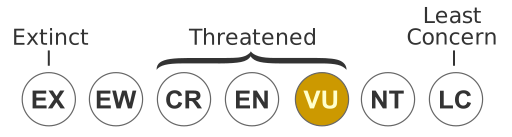
This fish is thought to hold good potential as an aquarium fish, but currently has a restricted distribution[9] and has been included in IUCN Red List as vulnerable.[1] Mining operations, tourism activities, organic wastes and sewage are reported as major threats to this species.[9]
References[edit | edit source]
- ↑ 1.0 1.1 1.2 Dahanukar, N. (2015). "Pethia setnai". IUCN Red List of Threatened Species. 2015 e.T172411A70413385. doi:10.2305/IUCN.UK.2015-1.RLTS.T172411A70413385.en. Retrieved 20 July 2025.
- ↑ 2.0 2.1 "Pethia setnai – Narayan Barb (Puntius setnai, Puntius narayani) – Seriously Fish". Retrieved 25 August 2021.
- ↑ Katwate, U.; M.S. Paingankar; S. Jadhav; N. Dahanukar (2013). "Phylogenetic position and osteology of Pethia setnai (Chhapgar & Sane, 1992), an endemic barb (Teleostei: Cyprinidae) of the Western Ghats, India, with notes on its distribution and threats". Journal of Threatened Taxa. 5 (17): 5214–5227. doi:10.11609/JoTT.o3857.5214-27.
- ↑ Template:FishBase
- ↑ "INSA :: Deceased Fellow Detail". insaindia.res.in. Retrieved 10 February 2022.
- ↑ Christopher Scharpf & Kenneth J. Lazara, eds. (15 March 2025). "Family CYPRINIDAE: Subfamily SMILIOGASTRINAE Bleeker 1863 (Small Barbs)". The ETYFish Project Fish Name Etymology Database. Christopher Scharpf and Kenneth J. Lazara. Retrieved 20 July 2025.
- ↑ "Department of Fisheries Government of Maharashtra, India". fisheries.maharashtra.gov.in. Retrieved 10 February 2022.
- ↑ Chhapgar, B.F.; S.R. Sane (1992). "A new fish of the genus Puntius Hamilton (Ostariophysi: Cyprinidae) from Goa". Journal of the Bombay Natural History Society. 89: 357–359.
- ↑ 9.0 9.1 "Pethia setnai missed state fish tag, but draws curiosity". The Times of India. TNN. 4 January 2016. Retrieved 25 August 2021.