

WikiDwarfBOT (talk | contribs) m →External links: Replace {{Source}} tag |
m adjusted page per sources and improved wording |
||
| Line 1: | Line 1: | ||
{{Short description| | {{Short description|Type of wedge tool}} | ||
{{About|the cutting tool||Axe (disambiguation)}} | {{About|the cutting tool||Axe (disambiguation)|and|Axed (disambiguation)|and|Axes (disambiguation)}} | ||
{{Redirect|Ax||AX (disambiguation){{!}}AX}} | {{Redirect|Ax||AX (disambiguation){{!}}AX}} | ||
{{more footnotes|date=July 2016}} | {{more footnotes needed|date=July 2016}} | ||
{{Use dmy dates|date= | {{Use dmy dates|date=February 2023}} | ||
{{Use British English|date= | {{Use British English|date=August 2016}} | ||
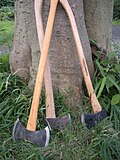
[[File:Felling axe.jpg|thumb|Double- and single-bit felling axes | [[File:Felling axe.jpg|thumb|Double- and single-bit felling axes[[File:An axe labelled-2edit.svg|thumb|upright|A diagram showing the main points on an axe]]]] | ||
[[File: | An '''axe''' ({{IPAc-en|æ|k|s}}; sometimes spelled '''ax''' in [[American English]]; [[American and British English spelling differences#Miscellaneous spelling differences|see spelling differences]]) is an implement that has been used for thousands of years to shape, split, and cut wood, to harvest timber, and as a weapon. The axe has many forms and specialised uses but generally consists of a head with a sharpened blade (also called a "bit") attached to a handle (also called "haft" or "helve"). | ||
Before the modern axe, the [[Stone Age|stone-age]] [[hand axe]] without a handle was used from 1.5 million years [[Before Present|BP]]. Hafted axes (those with a handle) date from at least 46,000 years BP by Northern Indigenous Australians. The earliest examples of handled axes have heads of stone with some form of wooden handle attached ([[hafting|hafted]]) in a method to suit the available materials and use. Axes made of [[copper]], [[bronze]], [[iron]] and [[steel]] appeared as these technologies developed. | |||
The axe is an example of a [[simple machine]], as it is a type of [[Wedge (mechanical device)|wedge]], or dual [[inclined plane]]. This reduces the effort needed by the wood chopper. It cuts and splits the wood into two parts by the pressure concentration at the blade and then the movement of the head in behind the initial cut. The handle of the axe also acts as a [[Lever#Third-class levers|lever]] allowing the user to increase the force at the cutting edge. Generally, the blades of 'cutting axes', which are used for [[felling]], [[limbing]], and [[Log bucking|bucking]], have a shallow (acute) wedge angle, whereas 'splitting axes' have a deeper (more obtuse) angle. Most axes are double bevelled (i.e. symmetrical about the axis of the blade), but some specialist [[broadaxe]]s have a single bevel blade. | |||
Most modern axes have steel heads and wooden handles, although plastic or [[fibreglass]] handles are also common. Modern axes are specialised by use, size and form. Hafted axes with short handles designed for use with one hand are often called "hand axes", but the term "hand axe" can also refer to an axe without a handle. [[Hatchet]]s tend to be short-, small-hafted axes often with a hammer on the back side (the poll, or butt). Relatively easy to make and use, the axe has frequently been used in combat, and is one of humanity's oldest weapons. Axes are also linchpins to the competitive sport of [[Woodchopping|wood-chopping]]. | |||
Most modern axes have steel heads and wooden handles | |||
==History== | ==History== | ||
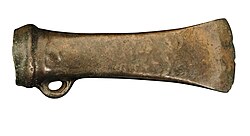
[[File:Kokerbijl van het Plainseautype in brons, 925 tot 800 VC, vindplaats- Maaseik, Heppeneert, Wayerveld, collectie Gallo-Romeins Museum Tongeren, He 1.jpg|thumb|Bronze socketed axe from the Heppeneert hoard (Belgium), about 800 BCE, collection of the [[King Baudouin Foundation]], [[Gallo-Roman Museum, Tongeren|Gallo-Roman Museum (Tongeren)]]]] | [[File:Kokerbijl van het Plainseautype in brons, 925 tot 800 VC, vindplaats- Maaseik, Heppeneert, Wayerveld, collectie Gallo-Romeins Museum Tongeren, He 1.jpg|thumb|Bronze socketed axe from the Heppeneert hoard (Belgium), about 800 BCE, collection of the [[King Baudouin Foundation]], [[Gallo-Roman Museum, Tongeren|Gallo-Roman Museum (Tongeren)]]]] | ||
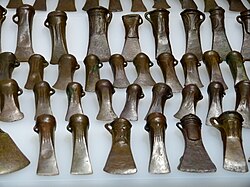
[[File:Brescia Monte pietà romani1 by Stefano Bolognini.JPG|thumb|upright|Roman | [[File:ALB - Hortfund Groß Gaglow.jpg|thumb|A collection of [[bronze]] socketed axe blades from the [[Bronze Age]] found in Germany. This was the prime tool of the period, and also seems to have been used as a store of value.]] | ||
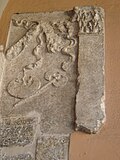
[[File:Brescia Monte pietà romani1 by Stefano Bolognini.JPG|thumb|upright|Roman axes in an ancient Roman relief in [[Brescia]], [[Italy]]]] | |||
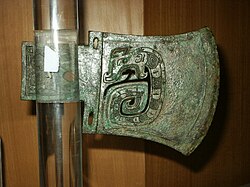
[[File:Shang Bronze Yue 2.jpg|thumb|[[Shang dynasty]] axe]] | [[File:Shang Bronze Yue 2.jpg|thumb|[[Shang dynasty]] axe]] | ||
[[Hand axe]]s, of [[Rock (geology)|stone]], and used without handles (hafts) were the first axes. They had [[Knapping|knapped]] (chipped) cutting edges of [[Flint axe|flint]] or other stone. Early examples of hand axes date back to 1.6 mya in the later Oldowan,<ref>Leakey, M. D. 1972. ''Olduvai Gorge''. Vol 3. Cambridge: Cambridge University Press.</ref> in Southern Ethiopia around 1.4 mya,<ref>{{cite journal|pmid=1465142|year=1992|author1=Asfaw, B.|author2=Beyene, Y.|author3=Suwa, G.|author4=Walter, R. C.|author5=White, T. D.|author6=Woldegabriel, G.|author7=Yemane, T.|title=The earliest Acheulean from Konso-Gardula|volume=360|issue=6406|pages=732–5|doi=10.1038/360732a0|journal=[[Nature (journal)|Nature]]|bibcode=1992Natur.360..732A|s2cid=4341455}}</ref> and in 1.2 mya deposits in [[Olduvai Gorge]].<ref name="FoleyLewin2003">{{cite book|author1=Foley, Robert Andrew|author2=Lewin, Roger|title=Principles of Human Evolution|year=2003|publisher=Wiley|isbn=978-0-632-04704-8}}</ref> Stone axes made with ''[[Grind|ground]]'' cutting edges were first developed sometime in the late [[Pleistocene]] in [[Indigenous Australians|Australia]], where grind-edge axe fragments from sites in [[Arnhem Land]] date back at least 44,000 years;<ref>{{cite journal | last1 = Hiscock | first1 = P. | last2 = O'Connor | first2 = S. | last3 = Balme | first3 = J. | last4 = Maloney | first4 = T. | year = 2016 | title = World's earliest ground-edge axe production coincides with human colonisation of Australia | journal = Australian Archaeology | volume = 82 | issue = 1 | pages = 2–11 | doi=10.1080/03122417.2016.1164379 | s2cid = 147777782 }}</ref><ref>{{cite journal | last1 = Geneste | first1 = J.-M. | last2 = David | first2 = B. | last3 = Plisson | first3 = H. | last4 = Clarkson | first4 = C. | last5 = Delannoy | first5 = J.-J. | last6 = Petchey | first6 = F. | last7 = Whear | first7 = R. | year = 2010 | title = Earliest evidence for ground-edge axes: 35,400 ± 410 cal BP from Jawoyn Country, Arnhem Land | journal = Australian Archaeology | volume = 71 | issue = 1 | pages = 66–69 | doi=10.1080/03122417.2010.11689385 | hdl = 10289/5067 | s2cid = 134077798 | hdl-access = free }}</ref> grind-edge axes were later | [[Hand axe]]s, of [[Rock (geology)|stone]], and used without handles (hafts) were the first axes. They had [[Knapping|knapped]] (chipped) cutting edges of [[Flint axe|flint]] or other stone. Early examples of hand axes date back to 1.6 mya in the later Oldowan,<ref>Leakey, M. D. 1972. ''Olduvai Gorge''. Vol 3. Cambridge: Cambridge University Press.</ref> in Southern [[Ethiopia]] around 1.4 mya,<ref>{{cite journal|pmid=1465142|year=1992|author1=Asfaw, B.|author2=Beyene, Y.|author3=Suwa, G.|author4=Walter, R. C.|author5=White, T. D.|author6=Woldegabriel, G.|author7=Yemane, T.|title=The earliest Acheulean from Konso-Gardula|volume=360|issue=6406|pages=732–5|doi=10.1038/360732a0|journal=[[Nature (journal)|Nature]]|bibcode=1992Natur.360..732A|s2cid=4341455}}</ref> and in 1.2 mya deposits in [[Olduvai Gorge]].<ref name="FoleyLewin2003">{{cite book|author1=Foley, Robert Andrew|author2=Lewin, Roger|title=Principles of Human Evolution|year=2003|publisher=Wiley|isbn=978-0-632-04704-8}}</ref> Stone axes made with ''[[Grind|ground]]'' cutting edges were first developed sometime in the late [[Pleistocene]] in [[Indigenous Australians|Australia]], where grind-edge axe fragments from sites in [[Arnhem Land]] date back at least 44,000 years;<ref>{{cite journal| last1 = Hiscock | first1 = P. | last2 = O'Connor | first2 = S. | last3 = Balme | first3 = J. | last4 = Maloney | first4 = T. | year = 2016 | title = World's earliest ground-edge axe production coincides with human colonisation of Australia | journal = Australian Archaeology | volume = 82 | issue = 1 | pages = 2–11 | doi=10.1080/03122417.2016.1164379 | s2cid = 147777782 | doi-access = | hdl = 10072/407100 | hdl-access = free }}</ref><ref>{{cite journal | last1 = Geneste | first1 = J.-M. | last2 = David | first2 = B. | last3 = Plisson | first3 = H. | last4 = Clarkson | first4 = C. | last5 = Delannoy | first5 = J.-J. | last6 = Petchey | first6 = F. | last7 = Whear | first7 = R. | year = 2010 | title = Earliest evidence for ground-edge axes: 35,400 ± 410 cal BP from Jawoyn Country, Arnhem Land | journal = Australian Archaeology | volume = 71 | issue = 1 | pages = 66–69 | doi=10.1080/03122417.2010.11689385 | hdl = 10289/5067 | s2cid = 134077798 | hdl-access = free }}</ref> grind-edge axes were later present in [[Japan]] some time around 38,000 BP, and are known from several [[Upper Palaeolithic]] sites on the islands of [[Honshu]] and [[Kyushu]].<ref>{{cite journal | last1 = Takashi | first1 = T. | year = 2012 | title = MIS3 edge-ground axes and the arrival of the first Homo sapiens in the Japanese archipelago | journal = Quaternary International | volume = 248 | pages = 70–78 | doi=10.1016/j.quaint.2011.01.030 | bibcode = 2012QuInt.248...70T }}</ref> | ||
Hafted axes are first known from the [[Mesolithic]] period ({{Circa|6000 BC}}). Few wooden hafts have been found from this period, but it seems that the axe was normally hafted by [[Wedge|wedging]]. [[Birch-tar]] and [[Rawhide (material)|rawhide]] [[Lashing (ropework)|lashings]] were used to fix the blade.{{CN|date=October 2024}} | |||
Hafted axes are first known from the [[Mesolithic]] period ( | |||
The distribution of stone axes is an important indication of prehistoric [[trade]].<ref>{{cite | The distribution of stone axes is an important indication of prehistoric [[trade]].<ref>{{cite web |last1=Micu |first1=Alexandru |title=Around 4,500 years ago, Vietnamese stone-age traders traveled hundreds of kilometers to sell their wares |url=https://www.zmescience.com/science/vitenam-trade-stone-ancient/ |website=zmescience.com |date=21 August 2017 |access-date=23 October 2020 |archive-date=26 October 2020 |archive-url=https://web.archive.org/web/20201026210014/https://www.zmescience.com/science/vitenam-trade-stone-ancient/ |url-status=live }}</ref> Thin sectioning is used to determine the [[Provenance (geology)|provenance]] of the stone blades. In [[Europe]], [[Neolithic]] "axe factories", where thousands of ground stone axes were roughed out, are known from many places, such as:{{CN|date=October 2024}} | ||
* [[Langdale axe industry|Great Langdale]], England ([[tuff]]) | * [[Langdale axe industry|Great Langdale]], England ([[tuff]]) | ||
| Line 35: | Line 31: | ||
* [[Aosta Valley]], Italy ([[omphacite]]). | * [[Aosta Valley]], Italy ([[omphacite]]). | ||
Stone axes are still produced and in use today in parts of [[Papua (province)|Papua]], [[Indonesia]]. The [[Mount Hagen]] area of [[Papua New Guinea]] was an important production centre. | Stone axes are still produced and in use today in parts of [[Papua (province)|Papua]], [[Indonesia]]. The [[Mount Hagen]] area of [[Papua New Guinea]] was an important production centre.{{CN|date=October 2024}} | ||
From the late [[Neolithic]]/[[Chalcolithic]] onwards, axes were made of [[copper]] or copper mixed with [[arsenic]]. These axes were flat and hafted much like their stone predecessors. Axes continued to be made in this manner with the introduction of [[Bronze]] [[metallurgy]]. Eventually the hafting method changed and the flat axe developed into the "flanged axe", then [[palstave]]s, and later winged and socketed axes | From the late [[Neolithic]]/[[Chalcolithic]] onwards, axes were made of [[copper]] or copper mixed with [[arsenic]]. These axes were flat and hafted much like their stone predecessors. Axes continued to be made in this manner with the introduction of [[Bronze]] [[metallurgy]]. Eventually the hafting method changed and the flat axe developed into the "flanged axe", then [[palstave]]s, and later winged and socketed axes.{{CN|date=October 2024}} | ||
{{multiple image |align=center | {{multiple image |align=center | ||
|image1=Franks HouseDSCF7155.jpg|caption1=Hand axes from Swanscombe at the [[British Museum]] that belongs to [[Swanscombe Heritage Park|Swanscombe Man]] who lived 200,000–300,000 years ago |width1=280 | |image1=Franks HouseDSCF7155.jpg|caption1=Hand axes from Swanscombe at the [[British Museum]] that belongs to [[Swanscombe Heritage Park|Swanscombe Man]] who lived 200,000–300,000 years ago |width1=280 | ||
|image2=CMOC Treasures of Ancient China exhibit - bronze battle axe.jpg|caption2=A bronze axe from the Chinese [[Shang | |image2=CMOC Treasures of Ancient China exhibit - bronze battle axe.jpg|caption2=A bronze axe from the Chinese [[Shang dynasty]], 12th to 11th centuries BC | ||
|image3=Zhejiang Provincial Museum 38.jpg|caption3=Various [[Warring States period]] axes | |||
}}{{Clear}} | }}{{Clear}} | ||
==Symbolism, ritual, and folklore== | ==Symbolism, ritual, and folklore== | ||
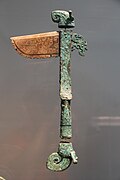
[[File:13th Cent. BC Unique Shang Hafted Axe with Jade (Nephrite) Blade.jpg|thumb|Jade axe, [[Shang dynasty]]]] | |||
{{Hiero|Axe|<hiero>T7</hiero>|align=left|era=egypt}}{{Hiero|Axe alternative|<hiero>T7A</hiero>|align left|era=egypt}} | {{Hiero|1=Axe|2=<hiero>T7</hiero>|align=left|era=egypt}}{{Hiero|1=Axe alternative|2=<hiero>T7A</hiero>|align=left|era=egypt}} | ||
At least since the late [[Neolithic]], elaborate axes (battle-axes, T-axes, etc.) had a [[Religion|religious]] significance and probably indicated the exalted [[Social status|status]] of their owner. Certain types almost never show traces of [[wear]]; deposits of unshafted axe blades from the middle Neolithic (such as at the [[Somerset Levels]] in Britain) may have been gifts to the [[deity|deities]]. | At least since the late [[Neolithic]], elaborate axes (battle-axes, T-axes, etc.) had a [[Religion|religious]] significance and probably indicated the exalted [[Social status|status]] of their owner. Certain types almost never show traces of [[wear]]; deposits of unshafted axe blades from the middle Neolithic (such as at the [[Somerset Levels]] in Britain) may have been gifts to the [[deity|deities]].<ref>{{Cite book |title=Interpreting the axe trade: production and exchange in Neolithic Britain |date=1993 |publisher=Cambridge University Press |isbn=978-0-521-43446-1 |editor-last=Bradley |editor-first=Richard |edition=1. publ |series=New studies in archaeology |location=Cambridge [England] New York |editor-last2=Edmonds |editor-first2=Mark R.}}</ref><ref>{{Cite book |last=Bradley |first=Richard |title=A geography of offerings: deposits of valuables in the landscapes of ancient Europe |date=2017 |publisher=Oxbow Books |isbn=978-1-78570-477-2 |series=Oxbow insights in archaeology |location=Oxford}}</ref> | ||
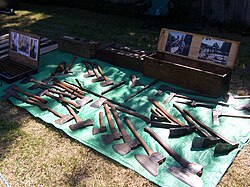
In [[Minoan civilization|Minoan]] [[Crete]], the double axe ([[labrys]]) had a special significance, used by priestesses in religious ceremonies | [[File:Old axes.jpg|thumb|A collection of old Australian cutting tools including [[broad axe]]s, broad hatchets, mortising axes, carpenter's axes, and felling axes. Also five [[adze]]s, a corner chisel, two [[froe]]s, and a [[twybil]].]]In [[Minoan civilization|Minoan]] [[Crete]], the double axe ([[labrys]]) had a special significance, used by priestesses in religious ceremonies.{{CN|date=October 2024}} | ||
In 1998 a labrys, complete with an elaborately embellished haft, was found at Cham-Eslen, [[Canton of Zug]], [[Switzerland]]. The haft was 120 | In 1998, a labrys, complete with an elaborately embellished haft, was found at Cham-Eslen, [[Canton of Zug]], [[Switzerland]]. The haft was {{convert|120|cm|abbr=on}} long and wrapped in ornamented [[Birch bark|birch-bark]]. The axe blade is {{convert|17.4|cm|abbr=on}} long and made of [[antigorite]], mined in the [[Gotthard Pass|Gotthard]]-area. The haft goes through a biconical drilled hole and is fastened by wedges of antler and by birch-tar. It belongs to the early [[Cortaillod culture]].{{CN|date=October 2024}} | ||
The [[coat of arms of Norway]] features a lion rampant carrying an axe which represents King [[Olaf II of Norway]], who was honoured as the [[Rex Perpetuus Norvegiae|Eternal King of Norway]].{{CN|date=October 2024}} | |||
[[ | [[File:Coat of arms of Tórshavn.svg|thumb|left|upright=0.5|Axe pictured in the coat of arms of [[Tórshavn]]]] | ||
[[File:Kalvola.vaakuna.svg|thumb|left|upright=0.5|Two axes pictured in the former coat of arms of [[Kalvola]]]] | |||
In [[folklore]], stone axes were sometimes believed to be [[thunderbolt]]s and were used to guard buildings against [[lightning]], as it was believed ([[Rumor|mythically]]) that lightning never struck the same place twice. This has caused some skewing of axe distributions.{{CN|date=October 2024}} | |||
[[ | [[Steel]] axes were important in [[superstition]] as well. A [[Axe throwing|thrown]] axe could keep off a [[hail]]storm, sometimes an axe was placed in the [[crops]], with the cutting edge to the skies to protect the harvest against bad [[weather]]. An upright axe buried under the [[sill plate|sill]] of a house would keep off [[Witchcraft|witches]], while an axe under the [[bed]] would assure [[male]] [[offspring]].{{CN|date=October 2024}} | ||
[[Basque people|Basques]], [[Australia]]ns and [[New Zealanders]]<ref>{{cite journal |last1=Arnold |first1=Naomi |url=https://www.nzgeo.com/stories/block-busters/ |title=Geography: Block busters |website=nzgeo.com |access-date=23 October 2020 |archive-date=6 November 2020 |archive-url=https://web.archive.org/web/20201106141238/https://www.nzgeo.com/stories/block-busters/ |url-status=live }}</ref> have developed variants of rural sports that perpetuate the traditions of [[Woodchopping|log cutting]] with axe. The Basque variants, [[Wood splitting|splitting]] horizontally or vertically disposed logs, are generically called ''[[aizkolaritza]]'' (from ''aizkora'': axe).<ref>{{cite web |url=http://www.axemanscomplex.com.au/history.html |title=History of the Australian Axeman's Hall of Fame & Timberworks | Latrobe | Tasmania | Australia |publisher=Axemanscomplex.com.au |access-date=2020-02-20 |url-status=dead |archive-url=https://web.archive.org/web/20120426045230/http://www.axemanscomplex.com.au/history.html |archive-date=2012-04-26 }}</ref> | |||
In [[Yoruba religion|Yorùbá mythology]], the oshe (double-headed axe) symbolises [[Shango]], [[Orisha]] (god) of thunder and lightning. It is said to represent swift and balanced justice. Shango altars often contain a carved figure of a woman holding a gift to the god with a double-bladed axe sticking up from her head.{{CN|date=October 2024}} | |||
{{ | |||
The [[Hurrian]] and [[Hittites|Hittite]] weather god [[Teshub]] is depicted on a bas-relief at [[Ivriz]] wielding a thunderbolt and an axe.{{CN|date=October 2024}} | |||
{{ | |||
The axe | The [[Arkalochori Axe]] is a bronze, Minoan, axe from the second millennium BC thought to be used for religious purposes. Inscriptions on this axe have been compared with other ancient writing systems.{{CN|date=October 2024}} | ||
In [[Order of Mark Master Masons|Mark Masonry]], the axe is a symbol of punishment meant to remind Mark Master Masons to be truthful and avoid deceit.<ref>{{Cite web |title=Mark Master Mason Degree |url=https://www.freemasons-freemasonry.com/mark_master_lecture.html |access-date=2026-01-02 |website=www.freemasons-freemasonry.com}}</ref> | |||
{{Clear}} | |||
{{ | |||
==Types | ==Types== | ||
===Axes designed to cut or shape wood=== | ===Axes designed to cut or shape wood=== | ||
| Line 87: | Line 75: | ||
[[File:Carpenter's axe.jpg|thumb|upright|A Swedish carpenter's axe]] | [[File:Carpenter's axe.jpg|thumb|upright|A Swedish carpenter's axe]] | ||
* | * [[Broadaxe]]: Used with the grain of the wood in precision splitting or "[[hewing]]" (i.e. the squaring-off of round timbers usually for use in construction). Broad axe bits are most commonly [[chisel]]-shaped (i.e. one flat and one beveled edge) facilitating more controlled work as the flat cheek passes along the squared timber. | ||
* [[Adze]]: A variation featuring a head perpendicular to that of an axe. Rather than splitting wood side-by-side, it is used to [[Rip cut|rip]] a level surface into a horizontal piece of wood. It can also be used as a [[pickaxe]] for breaking up rocks and [[clay]]. | |||
* [[Hatchet]]: A small, light axe designed for use in one hand specifically while [[camping]] or [[travel]]ling. | |||
* | * [[Carpenter's axe]]: A small axe, usually slightly larger than a hatchet, used in traditional [[Woodworking|woodwork]], [[Woodworking joints|joinery]] and [[Log building|log-building]]. It has a pronounced beard and finger notch to allow a "choked" grip for precise control. The poll is designed for use as a hammer. | ||
* | * [[Hand axe]]: A small axe used for intermediate chopping, similar to hatchets. | ||
* | * [[Mortise and tenon|Mortising]] axe: Used for creating mortises, a process which begins by [[drilling]] two holes at the ends of the intended mortise. Then the wood between the holes is removed with the mortising axe. Some forms of the tool have one blade, which may be pushed, swung or struck with a [[mallet]]. Others, such as twybil, bisaigüe and piochon have two, one of which is used for separating the fibres, and the other for levering out the waste.<ref>Johan David. [http://www.mot.be/w/1/index.php/Reading/NotesSurTroisOutilsAnciensDuCharpentier "Notes sur trois outils anciens du charpentier : le bondax, la bisaiguë, le piochon"] {{webarchive|url=https://web.archive.org/web/20111028220318/http://www.mot.be/w/1/index.php/Reading/NotesSurTroisOutilsAnciensDuCharpentier |date=28 October 2011 }}, ''Revue des archéologues et historiens d'art de Louvain 10''. 1977.</ref> | ||
* | |||
* | |||
===Axes as weapons=== | ===Axes as weapons=== | ||
[[ | * [[Battle axe]]: In its most common form, an arm-length weapon borne in one or both hands. Compared to a sword swing, it delivers more cleaving power against a smaller target area, making it more effective against armour, due to concentrating more of its weight in the axehead.<ref><nowiki>{{</nowiki>'''cite thesis''' |last1=Cahill |first1=Christopher | last2=Jung |first2=Bryan | last3=Kamat |first3=Omesh |last4=Schuler first4=Miles |date=March 2015 |title=EVOLUTION OF MATERIALS IN ARMS AND ARMORS: MEDIEVAL ERA BATTLE AXE |url=https://digitalcommons.wpi.edu/iqp-all/1532<nowiki> |work= |degree=Bachelor of Science |location= |publisher=Worcester Polytechnic Institute |url-status=live |access-date=4 November 2025}}</nowiki></ref>{{original research inline|date=August 2016}} | ||
[[ | * [[Dagger-axe]] (Ji or Ge): A variant of Chinese [[polearm]]-like weapon with a divided two-part head, composed of the usual straight blade and a [[scythe]]-like blade. The straight blade is used to stab or feint, then the foe's body or head may be cut by pulling the scythe-like horizontal blade backwards. Ge has the horizontal blade but sometimes does not have the straight spear. | ||
* [[Dane axe]]: a long-handled weapon with a large flat blade, often attributed to the [[Norsemen]]. | |||
* | * [[Halberd]]: a spear-like weapon with a hooked poll, effective against mounted [[cavalry]]. | ||
* | * [[Head axe]]: a type of thin-bladed axe with a distinctive shape specialized for [[headhunting]] from the [[Cordilleran peoples]] of the Philippines. | ||
* [[Hurlbat]]: An entirely metal throwing axe sharpened on every auxiliary end to a point or blade, practically guaranteeing some form of damage against its target. | |||
* [[Ono (weapon)|Ono]]: a [[Japanese people|Japanese]] weapon wielded by ''[[sōhei]]'' [[warrior monk]]s. | |||
* | * [[Panabas]]: A chopping bladed tool or weapon from the Philippines often described as a cross between a sword and a battle axe. | ||
* | * [[Parashu]]: The '''parashu''' ({{langx|sa|paraṣu}}) is an Indian battle-axe. It is generally wielded with two hands but could also be used with only one. It is depicted as the primary weapon of [[Parashurama]], the 6th Avatar of Lord [[Vishnu]] in [[Hinduism]]. | ||
* [[Poleaxe]]: designed to defeat [[plate armour]]. Its axe (or hammer) head is much narrower than other axes, which accounts for its penetrating power. | |||
* | * [[Sagaris]]: An ancient weapon used by [[Scythians]]. | ||
* | * [[Shepherd's axe]]: used by shepherds in the [[Carpathian Mountains]], it could double as a walking stick. | ||
* | * [[Throwing axe]]: A weapon that was thrown and designed to strike with a similar splitting action as its handheld counterparts. These are often small in profile and usable with one hand. | ||
* | * [[Tomahawk]]: used almost exclusively by Native Americans, its blade was originally crafted of stone. Along with the familiar war version, which could be fashioned as a throwing weapon, the pipe tomahawk was a ceremonial and diplomatic tool. | ||
* | * [[Battle axe#China|Yue]]: A Chinese weapon with very large axe blade, also served as [[ceremonial weapon]]. | ||
* | |||
* | ===Axes as tools=== <!-- [[Fire axe]] redirects here --> | ||
[[File:Jack of Clubs Throwing Axe.jpg|thumb|upright|A sport throwing axe embedded into a wood target.]] | |||
* [[Ice axe]] or '''climbing axe''': A number of different styles of ice axes are designed for [[ice climbing]] and enlarging steps used by climbers. | |||
* [[Mattock]]: A dual-purpose axe, combining an adze and axe blade, or sometimes a pick and adze blade. | |||
* [[Pickaxe]]: An axe with a large pointed end, rather than a flat blade. Sometimes exists as a double-bladed tool with a pick on one side and an axe or adze head on the other. Often used to break up hard material. | |||
* [[Pulaski (tool)|Pulaski]]: An axe with a [[mattock]] blade built into the rear of the main axe blade, used for digging ('grubbing out') through and around roots as well as chopping. | |||
* [[Splitting maul]]: A splitting implement that has evolved from the simple "wedge" design to more complex designs. | |||
===Axes | ===Axes for sport=== | ||
< | * [[Throwing axe]]: A tool that was thrown and designed to strike wooden targets and stay embedded in the target to score points in sport throwing competitions such as those hosted by the [[World Axe Throwing League]].<ref>Geno Perez [https://spectrumnews1.com/wi/milwaukee/news/2025/04/03/axe-knife-throwing-championships "Hundreds travel to compete in the World Axe & Knife Throwing Championships in Appleton"]</ref> These can range from axes that are small in profile and usable with one hand, or longer axes thrown with two hands. | ||
* [[Racing axe]]: A tool designed for competitive wood chopping sports such as the [[Stihl Timbersports Series]].<ref>engineeredforaxemen.com.au [https://engineeredforaxemen.com.au/ "The Basics of Racing Axes"] </ref>{{unreliable source|date=October 2025}} | |||
</ | |||
==Hammer axe== | ==Hammer axe== | ||
| Line 137: | Line 117: | ||
==See also== | ==See also== | ||
* [[Axe murder]] | * [[Axe murder]] | ||
* [[Cleaving axe]] | * [[Cleaving axe]] | ||
* [[Corded Ware culture]] | * [[Corded Ware culture]] | ||
* [[Fasces]] | * [[Fasces]] | ||
* [[Kaiser blade]] | * [[Kaiser blade]] | ||
* [[Nzappa zap]] | * [[Nzappa zap]] | ||
* [[Sagaris]] | * [[Sagaris]] | ||
'''Related forestry terms''' | |||
* [[Felling]] | * [[Felling]] | ||
* [[Hewing]] | * [[Hewing]] | ||
* [[Limbing]] | * [[Limbing]] | ||
* [[Pruning]] | * [[Pruning]] | ||
* [[Splitting maul]] | * [[Splitting maul]] | ||
| Line 163: | Line 136: | ||
==Further reading== | ==Further reading== | ||
'''Neolithic axes''' | |||
* W. | * Borkowski, W. (1995). ''Krzemionki mining complex''. Warsaw. | ||
* P. | * Bradley, R.; Edmonds, M. (1993). ''Interpreting the axe trade: production and exchange in Neolithic Britain''. | ||
* Pétrequin, P. (1995). ''La hache de pierre: carrières vosgiennes et échanges de lames polies pendant le néolithique (5400 – 2100 av. J.-C.)''. (''exposition musées d'Auxerre Musée d'Art et d'Histoire''). Paris: Ed. Errance {{in lang|fr}}. | |||
* P. Pétrequin | * Pétrequin P.; Pétrequin, A.M. (1993). ''Écologie d'un outil: la hache de pierre en [[Irian Jaya]] (Indonésie)''. Paris: CNRS Éditions, Mongr. du Centre Rech. Arch. 12 {{in lang|fr}}. | ||
'''Medieval axes''' | |||
* Schulze, André (editor) (2007). ''Mittelalterliche Kampfesweisen. Band 2: Kriegshammer, Schild und Kolben''. Mainz am Rhein: Zabern. {{ISBN|3-8053-3736-1}} {{in lang|de}}. | |||
'''Modern axes''' | |||
* | * Kauffman, Henry J. (1994). ''American Axes: A Survey of their Development and their Makers''. Elverson, Pennsylvania: Olde Springfield Shoppe. 152 pp. {{ISBN|188329412-6}}. | ||
* {{cite book |last1=Klenman |first1=Allan |last2=McPhail |first2=Larry |title=Axe Makers of North America: A Collection of Axe History & Manufacturers |date=2006 |publisher=Print & Copy Factory LLC |location=Bellingham, Washington |isbn=0-9690755-4-5}} 160 pp. | |||
* McLeod, Brett (2020). ''American Axe: The Tool That Shaped A Continent''. North Adams, Massachusetts: Storey Publishing. 192 pp. {{ISBN|978-1-63586-139-6}}. | |||
* Reissinger, Gottfried (1959). ''Die Konstruktionsgrundlagen der Axt''. Hamburg: Parey. {{ISBN|978-3490211163}} {{in lang|de}}. | |||
'''Superstition''' | |||
* H. Bächtold-Stäubli, Handwörterbuch des deutschen Aberglaubens | * H. Bächtold-Stäubli, H. (1987). ''Handwörterbuch des deutschen Aberglaubens''. Berlin: De Gruyter {{in lang|de}}. | ||
==External links== | ==External links== | ||
{{Wikiquote}} | {{Wikiquote}} | ||
{{wiktionary}} | {{wiktionary}} | ||
| Line 182: | Line 160: | ||
{{Commons category|Axes}} | {{Commons category|Axes}} | ||
* Section about types of axes is originally based on a [[Quicksilver Wiki]] article at {{URL|1=http://www.metaweb.com/wiki/wiki.phtml?title=A_Glossary_of_Terms_For_Traditional_Timber_Framing_(Timberbee)|2=the timber framing glossary}} under the terms of the [[GNU Free Documentation License]]. | * Section about types of axes is originally based on a [[Quicksilver Wiki]] article at {{URL|1=http://www.metaweb.com/wiki/wiki.phtml?title=A_Glossary_of_Terms_For_Traditional_Timber_Framing_(Timberbee)|2=the timber framing glossary}} under the terms of the [[GNU Free Documentation License]]. | ||
{{Navboxes | |||
|title = Articles related to the axe | |||
|list = | |||
{{Cutting and abrasive tools}} | {{Cutting and abrasive tools}} | ||
{{Forestry tools}} | {{Forestry tools}} | ||
| Line 194: | Line 169: | ||
{{Woodworking}} | {{Woodworking}} | ||
{{Prehistoric technology}} | {{Prehistoric technology}} | ||
}} | |||
{{Authority control}} | {{Authority control}} | ||
| Line 200: | Line 175: | ||
[[Category:Timber preparation]] | [[Category:Timber preparation]] | ||
[[Category:Forestry tools]] | [[Category:Forestry tools]] | ||
[[Category:Axes | [[Category:Logging]] | ||
[[Category:Axes]] | |||
[[Category:Gardening tools]] | [[Category:Gardening tools]] | ||
[[Category:Camping equipment]] | [[Category:Camping equipment]] | ||
Latest revision as of 02:32, 18 March 2026
 | This article includes a list of general references, but it remains largely unverified because it lacks sufficient corresponding inline citations. (July 2016) |


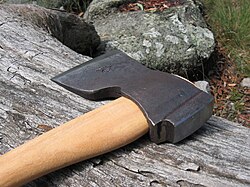
An axe (/æks/; sometimes spelled ax in American English; see spelling differences) is an implement that has been used for thousands of years to shape, split, and cut wood, to harvest timber, and as a weapon. The axe has many forms and specialised uses but generally consists of a head with a sharpened blade (also called a "bit") attached to a handle (also called "haft" or "helve").
Before the modern axe, the stone-age hand axe without a handle was used from 1.5 million years BP. Hafted axes (those with a handle) date from at least 46,000 years BP by Northern Indigenous Australians. The earliest examples of handled axes have heads of stone with some form of wooden handle attached (hafted) in a method to suit the available materials and use. Axes made of copper, bronze, iron and steel appeared as these technologies developed.
The axe is an example of a simple machine, as it is a type of wedge, or dual inclined plane. This reduces the effort needed by the wood chopper. It cuts and splits the wood into two parts by the pressure concentration at the blade and then the movement of the head in behind the initial cut. The handle of the axe also acts as a lever allowing the user to increase the force at the cutting edge. Generally, the blades of 'cutting axes', which are used for felling, limbing, and bucking, have a shallow (acute) wedge angle, whereas 'splitting axes' have a deeper (more obtuse) angle. Most axes are double bevelled (i.e. symmetrical about the axis of the blade), but some specialist broadaxes have a single bevel blade.
Most modern axes have steel heads and wooden handles, although plastic or fibreglass handles are also common. Modern axes are specialised by use, size and form. Hafted axes with short handles designed for use with one hand are often called "hand axes", but the term "hand axe" can also refer to an axe without a handle. Hatchets tend to be short-, small-hafted axes often with a hammer on the back side (the poll, or butt). Relatively easy to make and use, the axe has frequently been used in combat, and is one of humanity's oldest weapons. Axes are also linchpins to the competitive sport of wood-chopping.
History[edit | edit source]


Hand axes, of stone, and used without handles (hafts) were the first axes. They had knapped (chipped) cutting edges of flint or other stone. Early examples of hand axes date back to 1.6 mya in the later Oldowan,[1] in Southern Ethiopia around 1.4 mya,[2] and in 1.2 mya deposits in Olduvai Gorge.[3] Stone axes made with ground cutting edges were first developed sometime in the late Pleistocene in Australia, where grind-edge axe fragments from sites in Arnhem Land date back at least 44,000 years;[4][5] grind-edge axes were later present in Japan some time around 38,000 BP, and are known from several Upper Palaeolithic sites on the islands of Honshu and Kyushu.[6] Hafted axes are first known from the Mesolithic period (c. 6000 BC). Few wooden hafts have been found from this period, but it seems that the axe was normally hafted by wedging. Birch-tar and rawhide lashings were used to fix the blade.[citation needed]
The distribution of stone axes is an important indication of prehistoric trade.[7] Thin sectioning is used to determine the provenance of the stone blades. In Europe, Neolithic "axe factories", where thousands of ground stone axes were roughed out, are known from many places, such as:[citation needed]
- Great Langdale, England (tuff)
- Rathlin Island, Ireland (porcellanite)
- Krzemionki, Poland (flint)
- Neolithic flint mines of Spiennes, Belgium (flint)
- Plancher-les-Mines, France (pelite)
- Aosta Valley, Italy (omphacite).
Stone axes are still produced and in use today in parts of Papua, Indonesia. The Mount Hagen area of Papua New Guinea was an important production centre.[citation needed]
From the late Neolithic/Chalcolithic onwards, axes were made of copper or copper mixed with arsenic. These axes were flat and hafted much like their stone predecessors. Axes continued to be made in this manner with the introduction of Bronze metallurgy. Eventually the hafting method changed and the flat axe developed into the "flanged axe", then palstaves, and later winged and socketed axes.[citation needed]


Symbolism, ritual, and folklore[edit | edit source]
_Blade.jpg)
| <hiero>T7</hiero> |
| Axe in hieroglyphs |
|---|
| <hiero>T7A</hiero> |
| Axe alternative in hieroglyphs |
|---|
At least since the late Neolithic, elaborate axes (battle-axes, T-axes, etc.) had a religious significance and probably indicated the exalted status of their owner. Certain types almost never show traces of wear; deposits of unshafted axe blades from the middle Neolithic (such as at the Somerset Levels in Britain) may have been gifts to the deities.[8][9]

In Minoan Crete, the double axe (labrys) had a special significance, used by priestesses in religious ceremonies.[citation needed]
In 1998, a labrys, complete with an elaborately embellished haft, was found at Cham-Eslen, Canton of Zug, Switzerland. The haft was 120 cm (47 in) long and wrapped in ornamented birch-bark. The axe blade is 17.4 cm (6.9 in) long and made of antigorite, mined in the Gotthard-area. The haft goes through a biconical drilled hole and is fastened by wedges of antler and by birch-tar. It belongs to the early Cortaillod culture.[citation needed]
The coat of arms of Norway features a lion rampant carrying an axe which represents King Olaf II of Norway, who was honoured as the Eternal King of Norway.[citation needed]


In folklore, stone axes were sometimes believed to be thunderbolts and were used to guard buildings against lightning, as it was believed (mythically) that lightning never struck the same place twice. This has caused some skewing of axe distributions.[citation needed]
Steel axes were important in superstition as well. A thrown axe could keep off a hailstorm, sometimes an axe was placed in the crops, with the cutting edge to the skies to protect the harvest against bad weather. An upright axe buried under the sill of a house would keep off witches, while an axe under the bed would assure male offspring.[citation needed]
Basques, Australians and New Zealanders[10] have developed variants of rural sports that perpetuate the traditions of log cutting with axe. The Basque variants, splitting horizontally or vertically disposed logs, are generically called aizkolaritza (from aizkora: axe).[11]
In Yorùbá mythology, the oshe (double-headed axe) symbolises Shango, Orisha (god) of thunder and lightning. It is said to represent swift and balanced justice. Shango altars often contain a carved figure of a woman holding a gift to the god with a double-bladed axe sticking up from her head.[citation needed]
The Hurrian and Hittite weather god Teshub is depicted on a bas-relief at Ivriz wielding a thunderbolt and an axe.[citation needed]
The Arkalochori Axe is a bronze, Minoan, axe from the second millennium BC thought to be used for religious purposes. Inscriptions on this axe have been compared with other ancient writing systems.[citation needed]
In Mark Masonry, the axe is a symbol of punishment meant to remind Mark Master Masons to be truthful and avoid deceit.[12]
Types[edit | edit source]
Axes designed to cut or shape wood[edit | edit source]


- Broadaxe: Used with the grain of the wood in precision splitting or "hewing" (i.e. the squaring-off of round timbers usually for use in construction). Broad axe bits are most commonly chisel-shaped (i.e. one flat and one beveled edge) facilitating more controlled work as the flat cheek passes along the squared timber.
- Adze: A variation featuring a head perpendicular to that of an axe. Rather than splitting wood side-by-side, it is used to rip a level surface into a horizontal piece of wood. It can also be used as a pickaxe for breaking up rocks and clay.
- Hatchet: A small, light axe designed for use in one hand specifically while camping or travelling.
- Carpenter's axe: A small axe, usually slightly larger than a hatchet, used in traditional woodwork, joinery and log-building. It has a pronounced beard and finger notch to allow a "choked" grip for precise control. The poll is designed for use as a hammer.
- Hand axe: A small axe used for intermediate chopping, similar to hatchets.
- Mortising axe: Used for creating mortises, a process which begins by drilling two holes at the ends of the intended mortise. Then the wood between the holes is removed with the mortising axe. Some forms of the tool have one blade, which may be pushed, swung or struck with a mallet. Others, such as twybil, bisaigüe and piochon have two, one of which is used for separating the fibres, and the other for levering out the waste.[13]
Axes as weapons[edit | edit source]
- Battle axe: In its most common form, an arm-length weapon borne in one or both hands. Compared to a sword swing, it delivers more cleaving power against a smaller target area, making it more effective against armour, due to concentrating more of its weight in the axehead.[14][original research?]
- Dagger-axe (Ji or Ge): A variant of Chinese polearm-like weapon with a divided two-part head, composed of the usual straight blade and a scythe-like blade. The straight blade is used to stab or feint, then the foe's body or head may be cut by pulling the scythe-like horizontal blade backwards. Ge has the horizontal blade but sometimes does not have the straight spear.
- Dane axe: a long-handled weapon with a large flat blade, often attributed to the Norsemen.
- Halberd: a spear-like weapon with a hooked poll, effective against mounted cavalry.
- Head axe: a type of thin-bladed axe with a distinctive shape specialized for headhunting from the Cordilleran peoples of the Philippines.
- Hurlbat: An entirely metal throwing axe sharpened on every auxiliary end to a point or blade, practically guaranteeing some form of damage against its target.
- Ono: a Japanese weapon wielded by sōhei warrior monks.
- Panabas: A chopping bladed tool or weapon from the Philippines often described as a cross between a sword and a battle axe.
- Parashu: The parashu (Sanskrit: paraṣu) is an Indian battle-axe. It is generally wielded with two hands but could also be used with only one. It is depicted as the primary weapon of Parashurama, the 6th Avatar of Lord Vishnu in Hinduism.
- Poleaxe: designed to defeat plate armour. Its axe (or hammer) head is much narrower than other axes, which accounts for its penetrating power.
- Sagaris: An ancient weapon used by Scythians.
- Shepherd's axe: used by shepherds in the Carpathian Mountains, it could double as a walking stick.
- Throwing axe: A weapon that was thrown and designed to strike with a similar splitting action as its handheld counterparts. These are often small in profile and usable with one hand.
- Tomahawk: used almost exclusively by Native Americans, its blade was originally crafted of stone. Along with the familiar war version, which could be fashioned as a throwing weapon, the pipe tomahawk was a ceremonial and diplomatic tool.
- Yue: A Chinese weapon with very large axe blade, also served as ceremonial weapon.
Axes as tools[edit | edit source]

- Ice axe or climbing axe: A number of different styles of ice axes are designed for ice climbing and enlarging steps used by climbers.
- Mattock: A dual-purpose axe, combining an adze and axe blade, or sometimes a pick and adze blade.
- Pickaxe: An axe with a large pointed end, rather than a flat blade. Sometimes exists as a double-bladed tool with a pick on one side and an axe or adze head on the other. Often used to break up hard material.
- Pulaski: An axe with a mattock blade built into the rear of the main axe blade, used for digging ('grubbing out') through and around roots as well as chopping.
- Splitting maul: A splitting implement that has evolved from the simple "wedge" design to more complex designs.
Axes for sport[edit | edit source]
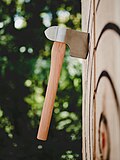
- Throwing axe: A tool that was thrown and designed to strike wooden targets and stay embedded in the target to score points in sport throwing competitions such as those hosted by the World Axe Throwing League.[15] These can range from axes that are small in profile and usable with one hand, or longer axes thrown with two hands.
- Racing axe: A tool designed for competitive wood chopping sports such as the Stihl Timbersports Series.[16][unreliable source?]
Hammer axe[edit | edit source]
Hammer axes (or axe-hammers) typically feature an extended poll, opposite the blade, shaped and sometimes hardened for use as a hammer. The name axe-hammer is often applied to a characteristic shape of perforated stone axe used in the Neolithic and Bronze Ages. Iron axe-hammers are found in Roman military contexts, e.g. Cramond, Edinburgh, and South Shields, Tyne and Wear.[citation needed]
See also[edit | edit source]
Related forestry terms
References[edit | edit source]
- ↑ Leakey, M. D. 1972. Olduvai Gorge. Vol 3. Cambridge: Cambridge University Press.
- ↑ Asfaw, B.; Beyene, Y.; Suwa, G.; Walter, R. C.; White, T. D.; Woldegabriel, G.; Yemane, T. (1992). "The earliest Acheulean from Konso-Gardula". Nature. 360 (6406): 732–5. Bibcode:1992Natur.360..732A. doi:10.1038/360732a0. PMID 1465142. S2CID 4341455.
- ↑ Foley, Robert Andrew; Lewin, Roger (2003). Principles of Human Evolution. Wiley. ISBN 978-0-632-04704-8.
- ↑ Hiscock, P.; O'Connor, S.; Balme, J.; Maloney, T. (2016). "World's earliest ground-edge axe production coincides with human colonisation of Australia". Australian Archaeology. 82 (1): 2–11. doi:10.1080/03122417.2016.1164379. hdl:10072/407100. S2CID 147777782.
- ↑ Geneste, J.-M.; David, B.; Plisson, H.; Clarkson, C.; Delannoy, J.-J.; Petchey, F.; Whear, R. (2010). "Earliest evidence for ground-edge axes: 35,400 ± 410 cal BP from Jawoyn Country, Arnhem Land". Australian Archaeology. 71 (1): 66–69. doi:10.1080/03122417.2010.11689385. hdl:10289/5067. S2CID 134077798.
- ↑ Takashi, T. (2012). "MIS3 edge-ground axes and the arrival of the first Homo sapiens in the Japanese archipelago". Quaternary International. 248: 70–78. Bibcode:2012QuInt.248...70T. doi:10.1016/j.quaint.2011.01.030.
- ↑ Micu, Alexandru (21 August 2017). "Around 4,500 years ago, Vietnamese stone-age traders traveled hundreds of kilometers to sell their wares". zmescience.com. Archived from the original on 26 October 2020. Retrieved 23 October 2020.
- ↑ Bradley, Richard; Edmonds, Mark R., eds. (1993). Interpreting the axe trade: production and exchange in Neolithic Britain. New studies in archaeology (1. publ ed.). Cambridge [England] New York: Cambridge University Press. ISBN 978-0-521-43446-1.
- ↑ Bradley, Richard (2017). A geography of offerings: deposits of valuables in the landscapes of ancient Europe. Oxbow insights in archaeology. Oxford: Oxbow Books. ISBN 978-1-78570-477-2.
- ↑ Arnold, Naomi. "Geography: Block busters". nzgeo.com. Archived from the original on 6 November 2020. Retrieved 23 October 2020.
- ↑ "History of the Australian Axeman's Hall of Fame & Timberworks | Latrobe | Tasmania | Australia". Axemanscomplex.com.au. Archived from the original on 26 April 2012. Retrieved 20 February 2020.
- ↑ "Mark Master Mason Degree". www.freemasons-freemasonry.com. Retrieved 2 January 2026.
- ↑ Johan David. "Notes sur trois outils anciens du charpentier : le bondax, la bisaiguë, le piochon" Archived 28 October 2011 at the Wayback Machine, Revue des archéologues et historiens d'art de Louvain 10. 1977.
- ↑ {{cite thesis |last1=Cahill |first1=Christopher | last2=Jung |first2=Bryan | last3=Kamat |first3=Omesh |last4=Schuler first4=Miles |date=March 2015 |title=EVOLUTION OF MATERIALS IN ARMS AND ARMORS: MEDIEVAL ERA BATTLE AXE |url=https://digitalcommons.wpi.edu/iqp-all/1532 |work= |degree=Bachelor of Science |location= |publisher=Worcester Polytechnic Institute |url-status=live |access-date=4 November 2025}}
- ↑ Geno Perez "Hundreds travel to compete in the World Axe & Knife Throwing Championships in Appleton"
- ↑ engineeredforaxemen.com.au "The Basics of Racing Axes"
Further reading[edit | edit source]
Neolithic axes
- Borkowski, W. (1995). Krzemionki mining complex. Warsaw.
- Bradley, R.; Edmonds, M. (1993). Interpreting the axe trade: production and exchange in Neolithic Britain.
- Pétrequin, P. (1995). La hache de pierre: carrières vosgiennes et échanges de lames polies pendant le néolithique (5400 – 2100 av. J.-C.). (exposition musées d'Auxerre Musée d'Art et d'Histoire). Paris: Ed. Errance (in French).
- Pétrequin P.; Pétrequin, A.M. (1993). Écologie d'un outil: la hache de pierre en Irian Jaya (Indonésie). Paris: CNRS Éditions, Mongr. du Centre Rech. Arch. 12 (in French).
Medieval axes
- Schulze, André (editor) (2007). Mittelalterliche Kampfesweisen. Band 2: Kriegshammer, Schild und Kolben. Mainz am Rhein: Zabern. ISBN 3-8053-3736-1 (in German).
Modern axes
- Kauffman, Henry J. (1994). American Axes: A Survey of their Development and their Makers. Elverson, Pennsylvania: Olde Springfield Shoppe. 152 pp. ISBN 188329412-6.
- Klenman, Allan; McPhail, Larry (2006). Axe Makers of North America: A Collection of Axe History & Manufacturers. Bellingham, Washington: Print & Copy Factory LLC. ISBN 0-9690755-4-5. 160 pp.
- McLeod, Brett (2020). American Axe: The Tool That Shaped A Continent. North Adams, Massachusetts: Storey Publishing. 192 pp. ISBN 978-1-63586-139-6.
- Reissinger, Gottfried (1959). Die Konstruktionsgrundlagen der Axt. Hamburg: Parey. ISBN 978-3490211163 (in German).
Superstition
- H. Bächtold-Stäubli, H. (1987). Handwörterbuch des deutschen Aberglaubens. Berlin: De Gruyter (in German).
External links[edit | edit source]
- Section about types of axes is originally based on a Quicksilver Wiki article at the timber framing glossary under the terms of the GNU Free Documentation License.


